




Abstract
Parental involvement is a valuable contribution to early adolescent behavior, particularly in educational contexts. This study analyzes the role of father’s socioeconomic status (SES) and perceived involvement (PI) when understanding school performance (SP) of adolescents, considering that involvement could be expressed as home-based and school-based. In a cross-sectional design, a sample from Colombia (South America) composed of 419 fathers (mean age = 42.2 years; SD = 7.37) and their adolescents (mean age = 12.63 years; SD = 0.86) completed self-administered questionnaires to measure SES, PI, and SP, and structural equation modeling was used to evaluate relations. Results indicate that the contribution of fathers to adolescent SP implies PI, considering that the direct effect of SES on SP is significant but small in comparison to the mediated path through PI. This article addresses the relevance of father’s contribution through involvement to understand the SP of adolescents, suggesting issues for studying the role of fathers in the adolescent’s outcomes.
Parents contribute to the results obtained by their children. One way to understand the contributions of parents is based on the theory of social capital, which states that parents receive the benefits and advantages related to their social context and transmit them to their children (Pleck, 2007). In this regard, socioeconomic status (SES) of parents is a construct defined as a multidimensional index of social capital (Gottfried et al., 2002), and it is commonly measured considering aspects such as parental education, income (Hoffman, 2002), and housing conditions (Leventhal & Brooks-Gun, 2002).
In general, parental SES has been related to the outcomes of children, such as educational (Bradley & Corwyn, 2002; Fryer, 2017), where parental education could influence children’s outcomes in the academic domain (Dubow et al., 2009), as well as income and housing conditions (Erola et al., 2016). Nevertheless, low values of the direct relation between parental SES and adolescent outcomes are usual (Letourneau et al., 2013). Taking this into consideration, it is possible that the parental influence may be related to other resources, so that contributions that affect children’s development could include not only the intellectual, financial, and environmental aspects but also the specific behavioral repertoire of parents (Lerner, 2002). In other words, education, income, and housing conditions of the parents could manifest a relation with the academic performance of the children, but parenting mediation improves that association (Davis-Kean, 2005).
According to this, parental involvement has proven to be a powerful predictor of school performance (SP) levels of children (Duan et al., 2018). Despite the variety in definitions, in general, parental involvement implies at least situations of direct interaction, parental availability, or responsiveness to children’s needs (Phares & Rojas, 2018), and it is widely recognized that involvement is a parenting practice that contributes to the educational performance of children even in adolescence (Wilder, 2014). According to previous studies, the relation between the SES of the parents and their involvement is not clear, since participation may vary independently of the parental status (Ibrahim & Al-Matalka, 2014); however, parents with a better SES could participate in the academic life of their children in positive ways, since they better understand the school context, taking into account their experience (Vellymalay, 2012).
Parental involvement could be expressed as home-based or school-based (Seginer, 2006), referring the first to parental efforts to be part of educational life of children in the home (e.g., communicate with their children), and the second is referred to the activities carried out by parents in the educational context (e.g., attend to meetings with teachers). Considering a developmental perspective, it has been suggested that parental home-based involvement could be more important to understand educational outcomes when children reach adolescence (Morales-Castillo & Aguirre-Dávila, 2018).
Furthermore, although the importance of the SES and cultural capital of the family has been previously indicated (Parcel et al., 2010) with a special analysis of maternal resources (Harding et al., 2015), the understanding of the father’s contribution remains incomplete (Yárnoz, 2006). Thus, the relationship between parental variables and the academic performance of adolescent children reveals aspects to be explored when studying the participation of the father in family dynamics and its consequences for adolescents. In this regard, father’s involvement effects are considered positive (Jeynes, 2015), and it could manifest possible differences in contrast to mother’s involvement (Kim & Hill, 2015). Concerning this, fathers tend to be less involved in the school activities of their adolescents in contrast to mothers (Kim, 2018), but this does not necessarily mean that fathers are excluded from the educational life of their children (Krampe, 2009).
For adolescents, the influence of described variables can be important to explain their SP, an issue of concern among professionals and parents. Educational life of adolescents is defined by achieving in academic activities and adjustment to social expectations of the school context (Shim & Finch, 2014), and adolescence is a period of life marked by a sharp decline in academic subjects (Dotterer et al., 2009), where the parental involvement could be relevant as they are perceived (Rodríguez et al., 2017).
Usually, the involvement of parents is analyzed from a general approach, avoiding to deepen in quality variations in the case of fathers, which constitutes a knowledge gap in this field. Moreover, although the relations between fathers and adolescents in communities such as Latin have been examined (Cabrera & Bradley, 2012), Latino families living in their countries of origin are an insufficiently explored population in relation to the role of the father and their correlates. In this context, it is important to analyze the parenting factor and its contributions to adolescent performance and, more specifically, to understand the particular configuration of father’s attributes that explain Latino adolescent outcomes, which leads to the question: What is the relationship between father SES, perceived involvement (PI), and SP of adolescents?
As Figure 1 represents, among hypotheses, it is expected that father’s SES and perceived father involvement predict SP, and it is also considered that father’s SES will affect the PI.

Path modeling of hypothesized relations among variables.
Method
Participants
Data for this study were part of a larger study about parenting and adolescent behavior in Colombia, South America, where 419 fathers and their adolescents completed self-administered questionnaires in a cross-sectional design. Fathers had a mean age of 42.2 years (SD = 7.37), with 32.5% of the fathers who did not finish their school studies, 35.3% who finished their school studies and did not continue studying, 23.7% who went to a university and 8.5% with postgraduate studies. Fathers’ income ranged from less than US$249.99 to more than US$3,999.40, with a special concentration (51.8%) between US$249.99 and US$749.86 range. Adolescents had a mean age of 12.63 years (SD = 0.867), including males (49.3%) and females, from public (59.9%) and private schools. In addition, 93,18% of fathers were married at the time of this study.
Measures
Sociodemographic status
Fathers completed a survey about their personal characteristics. Education was codified, from No education with one-point code to Doctoral education with ten-point code; levels of education coded were taken from the categorization of the National Ministry of Education in Colombia, including elementary school (partially or fully completed), secondary school (partially or fully completed), undergraduate (brief or long programs), and graduate studies (short courses, Master, Doctorate).
Father’s income was codified, taking the following monthly income ranges presented to the respondents: (a) Less than US$249.99; (b) between US$249.99 and US$749.86; (c) between US$749.87 and US$1,249.89; (d) between US$1,249.90 and US$1,999.82; (e) between US$1,999.83 and US$3,999.40; and (f) more than US$3,999.40.
Housing conditions were measured using data reported by fathers about their socioeconomic stratification, a classification of the residential conditions in a municipality or city, which is established according to the regulations and guidelines of local authorities (Congreso de la República, 1994). In the proceeding, the households are classified according to physical conditions of the house and the neighborhood where it is placed, assigning one of the following levels: Low-low, low, medium-low, medium, medium-high, and high (DANE, 2019). For the present study, every level was coded as a number, from 1 to 6, where high levels of housing were represented by the highest values.
Perceived involvement
To measure the PI, a questionnaire was constructed, considering previous meta-analysis (Jeynes, 2015; Wilder, 2014), where adolescents were asked How much your dad does these things?, followed by sentences that described fathers’ actions, to evaluate perceived fathers’ involvement in a four- point Likert scale, from Never, almost never to Always, almost always. The items were classified in one of the following scales: Home-based involvement, and school-based involvement.
Home-based involvement was measured with six items: Be aware that you do homework, “Supervise that you do well the school work, Ask about things that happen at school, Give you advice so that you can do well in school, Encourage you when you have difficulties in school, and Help you take school situations calmly (Cronbach’s alpha = 0.874). School-based involvement was measured with four items: Attend meetings with teachers, Go to school to receive report cards, Participate in parent assemblies, and Apply to Parent School Council (Cronbach’s alpha = 0.760). Items from both scales were randomly mixed in the final instrument, and high values represented high PI in every scale.
Confirmatory Factor Analysis (CFA) was developed to test the validity of fathers’ PI construct and scales, obtaining acceptable fit indexes that suggest adequacy (Arbuckle, 2017): CMIN/DF = 3.037; CFI = 0.958; TLI = 0.944; NFI = 0.939; and RMSEA = 0.070.
School performance
Schools provided grades for subjects of language, mathematics, natural science, and social science, which were averaged to calculate academic achievement. Taking into account that the schools in Colombia use different scales to evaluate the subjects, the grades received were standardized using a simple rule of three to make them all equivalent. High values mean better academic achievement.
Similarly, adolescents completed 30 items of the schooling scale from the Multifactorial Self-Reported Test of Child Adjustment (Test Autoevaluativo Multifactorial de Adaptación Infantil – TAMAI) (Hernández, 2015) to evaluate their school adjustment, a well-recognized test in Latin America to measure adolescent adaptation. Items like Bothers me a lot to study or In classroom I spend a lot of time distracted were assessed with Yes or No, where one-point code corresponded to maladjustment answers and two-point code corresponded to adjustment answers (Cronbach’s alpha = 0.87). High values represented high school adjustment.
Procedure
Ethical considerations, including local guidelines for research with human participants (Congreso de la República, 2006), and related international recommendations (American Psychological Association, 2010) were taken into account, including the completion of informed consent, and anonymous use of collected data. All procedures were reported and approved in by the evaluation and supervision committee of the research group.
A letter of invitation was sent to 166 schools from 11 municipalities distributed around Bogotá, the capital of Colombia, in a metropolitan area termed Sabana Centro Province, where principals and teachers from 30 schools agreed to participate in the research. For this study, the seventh- and the eighth-grade groups were selected. At the beginning of the second semester on the school calendar, the research assistants with the support of the teachers instructed the adolescents to give their fathers a letter of presentation of the study, an informed consent form, and the sociodemographic survey. The letter informed about the objectives of the study, the guarantee of reserve in the handling of information, and the importance of completing the forms honestly.
The adolescents’ teachers collected consents and surveys completed by fathers and helped to verify that the signatures and personal data matched the real ones. During normal school hours, research assistants, with the support of teachers, gave the PI and school adjustment questionnaires to authorized adolescents to fill them. Students who did not receive parental authorization completed alternative academic activities.
419 paired cases (father-adolescent) were completed, whose surveys and questionnaires were digitized in the research group. The schools shared the academic scores of the participating adolescents at the end of the final academic period. Schools received an inform with the summary of results.
Data Analysis
Data cleaning and preliminary analysis were carried out with SPSS v.25 (IBM, 2017a) and path modeling with Amos v.25 (IBM, 2017b). Descriptive data and correlations were obtained, and the structural equations model was achieved using maximum likelihood estimation. The fit of path modeling was evaluated searching small values for normed chi-square (CMIN/DF) below 0.3, Comparative Fit Index (CFI), Tucker–Lewis Index (TLI), and Normed Fit Index (NFI) values greater than 0.90, Root Mean Square Error of Approximation (RMSEA) and Standardized Root Mean Residual (SRMR) below 0.08, and small values for Akaike Information Criterion (AIC) (Arbuckle, 2017; Hooper et al., 2008).
The squared distance of Mahalanobis was used to handle outliers, excluding the five cases significantly farthest away from the centroid, considering a probability of 0.001 (Tabachnick & Fidell, 2019). Multivariate kurtosis of −0.429 with a critical value less than 1.96 (c.r. = −0.392) ensured multivariate normality (Sharma, 1996).
Results
As summarized in Table 1, in terms of correlations, fathers’ SES measures were adequately related. Thus, education was significantly related to income (r = 0.615; p < 0.01) and to house conditions (r = 0.441; p < 0.01), and income was related to house conditions (r = 0.551; p < 0.01). Both measures of PI (home-based and school-based) were significantly associated (r = 0.455; p < 0.01). The same occurred for the two measures of adolescent SP (r = 0.420; p < 0.01). All significant correlations were positive.
Correlations and Descriptive Data of the Variables.
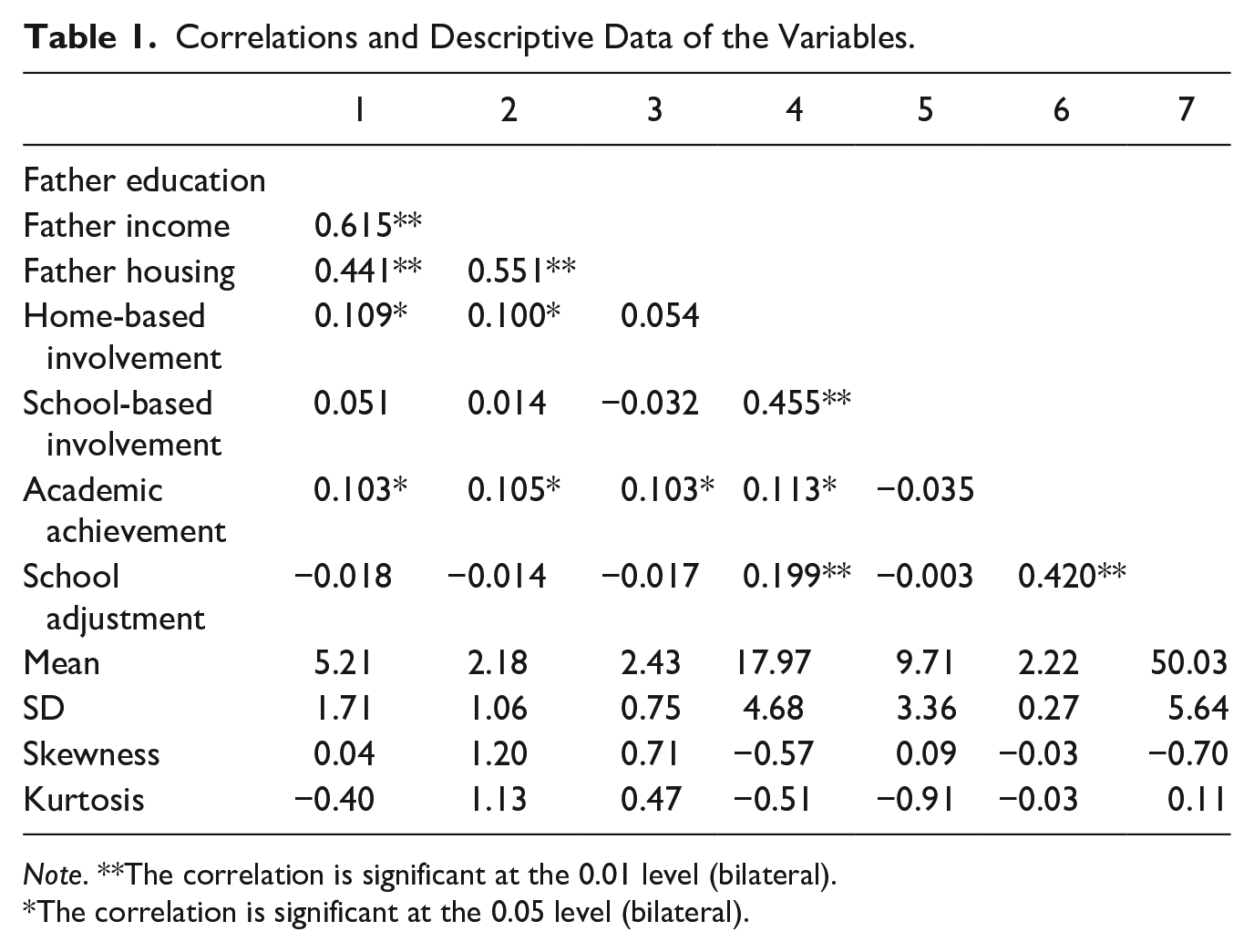
Note. **The correlation is significant at the 0.01 level (bilateral).
The correlation is significant at the 0.05 level (bilateral).
Hypothesized relations were tested in accordance with path modeling presented in Figure 2, where adequate fit indexes were obtained: CMIN/df = 2.653; CFI = 0.955; TLI = 0.937; NFI = 0.930; RMSEA = 0.063; SRMR = 0.063,
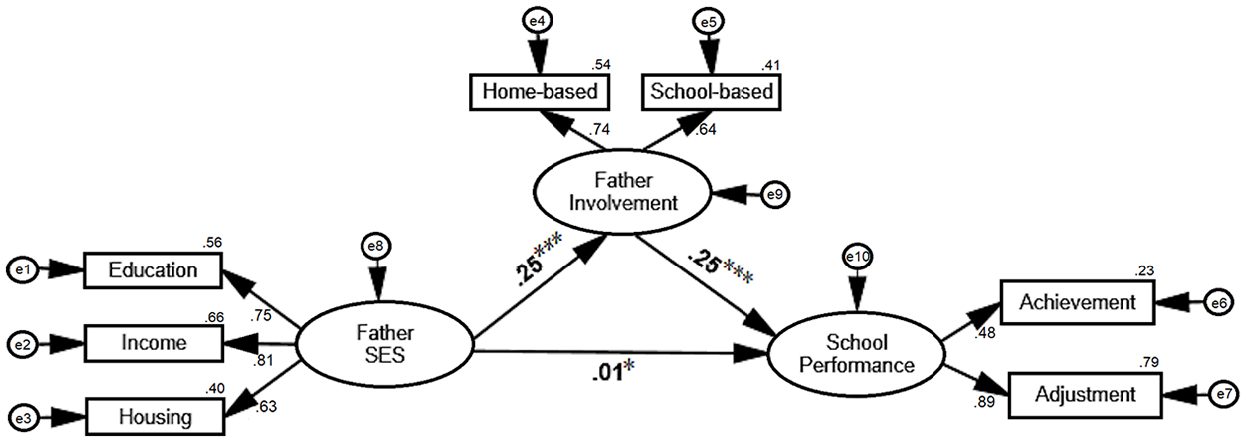
Path modeling of relations among variables, with ***p < 0.001 and *p < 0.05.
Figure 2 presented standardized estimates of the model, where fathers’ SES had a very small and significant direct relation with SP of adolescents (β = 0.01; p = 0.029). In the model, PI of fathers was related to SP (β = 0.25; p < 0.001). Fathers’ SES had a significant effect on PI of father (β = 0.25; p < 0.001), and considering that the direct relation of SES with SP was low, but the inclusion of PI contributed to the effect, there are reasons to state that the influence of the father’s SES on SP is mediated by the PI.
In SES latent variable, father income had the greatest load (λ =0.81, p < 0.001), followed by education (λ = 0.75, p < 0.001) and housing (λ = 0.63, p < 0.001). In PI, home-based PI had a greater load (λ = 0.74, p < 0.001) than school-based PI (λ = 0.64; p = 0.016). Furthermore, the school adjustment (λ = 0.89, p < 0.001) stood out over the academic achievement (λ = 0.48; p = 0.029) in its load.
Discussion
According to findings, father SES, PI, and SP of adolescents are related, where fathers’ SES and PI predict SP, and fathers’ SES affects the PI. In SES, fathers’ income and education stand out in their contribution to the latent variable, while, in PI, home-based involvement is highlighted in comparison to school-based involvement. Both school adjustment and academic achievement seize the influence of fathers’ contributions in a model where they are embraced as dimensions of SP.
In the sample studied, the worth of the contribution of the fathers’ SES to the academic performance of the adolescents depends on the PI. Fathers are important to adolescents in many ways, which include the real attributes of parents as well as the perceptions that children have of them (Krampe, 2009). Thus, the significant relation of the fathers’ SES with the father’ PI, and its effect on adolescent SP, supports a comprehensive model of fathers’ influence in a multidimensional approach, where the contributions of fathers include several concomitant effects (Pleck, 2007). Reported findings in this study posed that fathers’ SES has a weak and direct relation with the SP of adolescents, and the relation between SES and SP is better explained by the mediation of the PI.
Measures of SES tend to be correlated personal variables (De Gregorio & Lee, 2002), and the effects of SES variables may be overlapped (Erola et al., 2016). Thus, beyond a simple analysis of direct effects in a linear relation, the present study assumes a complex approach that entails the simultaneous contribution of the variables included in the SES. In this context, the SES of fathers was related to the academic performance of their adolescents, as previous studies have suggested (Fryer, 2017), which has been evidenced especially in terms of the income and educational levels. Considering the correlation between fathers’ income and education, and their loads in the final model, it is possible that both contribute to academic performance, offering resources as materials to learn and knowledge to guide their actions. While the fathers’ income guarantees access to material and social resources (Bradley & Corwyn, 2002), the education of fathers provides a set of abilities to connect with the school life of adolescents (Vellymalay, 2012), providing expert guidelines in a known domain and sharing on a common subject. Also, the overlapping effects of income and education or fathers tend to last as children grow older (Erola et al., 2016), which highlights their importance. In any case, both the income and the education of the fathers seem more important than the housing conditions.
Despite what has been described, according to the results of the present study, the relationship between the SES of fathers and the academic performance of adolescents is less than the relationship between PI and performance. Fathering and mothering have been proposed as equivalent categories (Fagan et al., 2014), but this position involves the risk of underestimating the challenges that men face in order to participate positively in the parenting process of their adolescents (Yárnoz, 2006), which makes relevant the correlates of fathering (Milkie & Denny, 2014). In this sense, there are indicators to consider that fathers’ SES affects adolescent performance, but that effect implies the mediation of PI, which emphasizes the importance of fathers’ resources as their skills to understand their role in the parenting process (Pleck, 2012). Furthermore, if the father’s involvement acts as a mediator of the SES, there are indicators that parents transmit their social conditions through the quality of their relationship with their adolescents, which makes the involvement of fathers a transmission belt (Schönpflug & Bilz, 2008).
Findings of this study registered that the value of father’s involvement seems to be especially striking to adolescents in terms of home-based involvement. Previous studies had found that home-based involvement could not be related with SP when children are in primary school (Tárraga et al., 2018), but the presented findings suggest that early adolescents could be benefited from expressions of involving such as communicating, monitoring, and support. Despite the significant correlation between adolescent perception of home-based and school-based involvement of fathers, home-based behaviors presented a greater contribution to the PI, so that this expression of involvement could be more important for adolescents (Morales-Castillo &Aguirre-Dávila, 2018). Considering that adolescents reach a milestone when performing in social contexts without the presence of parents (Zimmer-Gembeck et al., 2011), it could be understandable that fathers’ involvement results less intrusive in the home than the school. In addition, parents communicating with their adolescents at home can be productive (Trung & Ducreux, 2013), rather than participating in school activities. Moreover, if fathers tend to participate less than mothers in their children’s school activities (Kim, 2018), fathers’ relevance in home-based involvement appears as an opportunity.
Latino fathers are specially described as uninvolved or less implied in children’s lives (Cabrera & Bradley, 2012), but this could be an issue of conceptualization (Krampe, 2009) or a changing situation (Milkie & Denny, 2014). Thus, fathers’ contribution to Latino adolescent development could differ from mothers’ contribution, but, at the same time, it is relevant to consider a cultural evolution of the role played by fathers in family dynamics.
In general, fathers’ involvement could be considered beneficial to adolescent development (Jeynes, 2015), but more specifically, according to this study, the effect of the studied parental variables has been significant on the two adolescent variables considered, with a marked influence on the adjustment, which denotes importance when thinking about the correlation between school adjustment and academic achievement. If adolescence is a period marked by the decline in academic achievement (Dotterer et al., 2009), and the decay in adjustment (McGill et al., 2012), a focus on parents and their relations with adolescents is critical.
Adolescence is a period of specific and simultaneous changes (Forbes & Dahl, 2010), where several challenges in social performance are raised (Olivier et al., 2018), but the relation with fathers could act as a buffer structure to manage school’s demands. In terms of this work, fathers’ SES could contribute to the quality of relations at home perceived for early adolescents in a Latino sample, which affect academic achievement and school adjustment simultaneously.
As regards limitations, the characteristics of the sample, like the size and origin, must be attended in order to be cautious in generalizations. Similarly, a cross-sectional design to explore the behavior of the variables in other samples and in longitudinal approaches is needed to confirm reported findings. Also, the adolescent perception of parental involvement could be related to real involvement, but the same cannot be considered, which could be deepened in future studies.
Among recommendations, parental behaviors and adolescent outcomes are related to other variables as beliefs of parents and children (Morales-Castillo, 2019), taking into account the inclusion of constructs as self-efficacy (Albanese et al., 2018), which could reveal implications to understand expressions as parental involvement (Trahan, 2018) and adolescent performance in ethnic contexts (Shumow & Lomax, 2002). Future studies could also consider differences in fathers’ involvement according to their age and cohabiting status (Jones & Mosher, 2013).
In the practical implications of this work, it is possible to propose that the institutional support for the construction of the role of the father could be oriented toward a formative offer that allows fathers to recognize their capacities to influence their children and grow along with them in academic terms. Thus, considering the relationship mediated between SES and fathers’ involvement, the contribution of fathers’ status may be improved when expressed in association with involvement, which may be relevant in developing strategies for parent training focusing on the acquisition of capacities in fathers (Morales-Castillo et al., 2019), contemplating the distinctiveness of the father’s role in the parenting process.
Similarly, the influence of parental education has lasting effects that have been longitudinally established (Dubow et al., 2009), which could be important to explore from the perspective of social and political agenda in the contribution of fathers to the adolescent outcomes. In this regard, it is important to recognize that the efforts of fathers at home can be highly valuable, despite the possible difficulties to participate in school-based activities, which can provide clues to understanding the school–family relationship when working with adolescents.
Footnotes
Declaration of Conflicting Interests
The author declared no potential conflicts of interest with respect to the research, authorship, and/or publication of this article.
Funding
The author disclosed receipt of the following financial support for the research, authorship, and/or publication of this article: Acknowledgments to the Fundación CeiBA for its financial support.
