



Abstract
Low fertility willingness has become a major practical reality in China. From the perspective of family gender equality, this paper analyzes the impact of division of housework on women’s fertility willingness by using the data of China Family Panel Studies (CFPS). The results of propensity score matching method and instrumental variable method show that husbands’ participation in housework can effectively improve wives’ fertility willingness. Mechanism analysis shows that husbands’ active participation in housework can effectively reduce wives’ work–family conflict, increase wives’ satisfaction with husbands’ housework contribution, and help improve wives’ happiness and fertility willingness. Further discussion on whether families have had children or not shows that women who have had children are more sensitive to their husbands’ participation in housework. This study provides empirical evidence for the applicability of family gender equality theory in China and the factors affecting women’s fertility willingness.
Introduction
According to the seventh national census, China’s total fertility rate is 1.3 in 2020, which is significantly lower than the replacement level. According to international experience, once the total fertility rate falls below 1.5, it is likely to fall into the “low fertility trap.” At the end of 2021, China’s population increased by 480,000 compared to the previous year, with a natural growth rate of only 0.34‰, and the population is likely to reach its peak in 2022. 1 Obviously, the main population conflict has changed from total pressure to structural challenges. 2 Low fertility willingness is a major reality for China, which is also a problem faced by many Asian countries.
China began implementing the universal two-child policy in early 2016, but the effect on improving the low fertility rate was limited and far lower than expected. Since the implementation of the universal two-child policy, the birth rate and the number of new people added at the end of the year increased only in 2016, and then they declined year by year. The support for mothers’ parenting from national policies and labor market is very limited, and China’s fertility willingness may continue to decrease in the future. In order to improve the demographic structure and implement the proactive national strategy in response to population aging, Chinese government decided to implement the three-child policy. The introduction of the three-child policy means that population policy has a weaker restrictive effect on fertility behavior, and the role of couples of childbearing ages in their own fertility willingness is more decisive.
Since fertility policy adjustments have not led to signs of fertility rebound, it is necessary to examine the underlying mechanisms that influence female fertility motivation at the micro-level. Low fertility has become a global phenomenon, and gender equality within and outside the household has been shown to be one of the most important factors in exploring the transition from high to low fertility (McDonald, 2000; Yang, 2017). The division of housework is an important manifestation of the status of gender equality within the household (Hu & Mu, 2021), and in the past 30 years, although the participation rate of male housework has increased, women are still the main undertakers, and their housework hours far exceed those of men.
Up to now, there is little literature on the relationship between division of housework and women’s fertility willingness in East Asian cultural circles. This paper uses the data of China Family Panel Studies (CFPS) to further examine the relationship between division of housework and fertility willingness from the micro-level, and to test whether the relevant Western theories are applicable to the East Asian cultural circle represented by China, which is very important and necessary.
The degree of women’s all-round development is an important indicator of the progress of social civilization. Since the 1960s, the participation rate of women in global social affairs has been increasing, and the trend of equal division of housework has emerged in some Western countries (Carlson et al., 2016). According to the estimates of the World Labor Organization, the labor force participation rate of Chinese women exceeded 63% in 2016, which is the highest in the world. There has been an overall upward trend in Chinese men’s sharing of housework over the past 30 years, which is largely attributed to the improvement in individual education level and changes in the socio-cultural environment. However, the division of housework remains distinctly traditionalist in character, with rapidly increasing female access to education and employment, slow changes in gender equality within the household (Anderson & Kohler, 2015), and the increase of female labor force participation rates has not reduced their household burden (Goldscheider, Bernhardt, & Lappegård, 2015; Mills, Mencarini, Tanturri, & Begall, 2008), which Hochschild and Machung (1989) called “stagnant revolution.”
According to the theory of family economics, the increase in the return of specialized human capital creates a division of labor between married men and women (Becker, 1985). Men and women specialize in paid work or housework to maximize utility (Becker, 1991), individuals with educational advantages have comparative advantages in the labor market, and paid work is the most important for most men (Arrighi & Maume, 2000). According to the economic exchange theory, the spouse with higher income has higher bargaining power in the negotiation of division of housework (Brines, 1994), which is further verified by Greenstein (2000). Therefore, there is a significant negative correlation between income level and housework participation. However, there is no consistent conclusion whether women’s housework time is greatly affected by absolute income or relative income (Baxter & Hewitt, 2012; Gupta, 2006).
In recent years, China’s aging process has obviously accelerated, and the fertility rate has continued to decline, which will hinder the pace of economic and social development. Fertility willingness is one of the predictors of the future fertility level, which has important policy significance. Fertility level is closely related to fertility willingness. A large number of studies have focused on the influencing factors of the division of housework, but little is known about how the division of housework affects the outcome variables at the family level (Cooke, 2004). Although the improvement of education level and employment participation rate have provided new opportunities for women to realize their self-worth, it has also led to the increasing work–family conflict. If these new opportunities are not supported by their families after they become mothers, many women will reduce the number of children they might otherwise have (McDonald, 2013). The pressure on families caused by women’s entry into the labor market can be reduced by men’s participation in family affairs (Goldscheider et al., 2015). When work–family conflict is reduced, high employment can coexist with high fertility, and this transformation depends on both policies and the adjustment of internal relations of families (Brewster & Rindfuss, 2000). The actual situation in European countries shows that family-friendly public policies alone cannot help women balance family and work, and it is necessary to effectively change the division of roles between men and women in the family.
Studies have shown that husbands’ share of housework increases when their gender perceptions are more equal (Presser, 1994). However, the existing studies have not reached a consistent conclusion about the impact of gender equality on fertility. Evidence from Sweden suggests that men with gender equality are more likely to be “finally childless,” that is, they still have no children at the end of their reproductive period. The impact of family division of labor on fertility depends on the satisfaction of husband and wife with this division of labor (Riederer, Buber-Ennser, & Brzozowska, 2019), and wives’ marital satisfaction tends to rise when men do more housework (Amato, Johnson, Booth, & Rogers, 2003). Unequal division of housework is very likely to damage the quality of marriage and the physical and mental health of family members, and reduce the birth probability of the first and second children (Dommermuth, Hohmann-Marriott, & Lappegård, 2017). The persistence of the traditional gender division of labor mode of “men are breadwinners and women are homemakers” has inhibited women’s fertility (Ji & Zheng, 2018). Therefore, unless gender equality within the family is further improved, the fertility rate will continue to decrease (McDonald, 2000). For the second child, the greater the relative contribution of men to housework, the greater the possibility of having a second child (Cooke, 2004). Increasing fathers’ care for children can reduce the physical damage and psychological pressure caused by having a second child on women (Brodmann, Esping-Andersen, & Guell, 2007). The microeconomic theory emphasizes the opportunity cost brought by women’s “promotion” to the transformation of mother’s role (Becker, 1991). Although the higher the education level, the higher the income of women, thus increasing the opportunity cost of “motherhood,” the higher the economic income, the more economic strength to outsource housework (Mills et al., 2008; Gupta, 2006). Yang (2017) earlier studied the relationship between division of housework and fertility willingness in China by using the data of China Health and Nutrition Survey from 1993 to 2011, but found no significant relationship between them.
In summary, the existing studies have paid little attention to the relationship between division of housework and fertility willingness in East Asian cultural circles. This paper uses the data of CFPS in 2014 and 2018 to study the impact of division of housework on women’s fertility willingness. The main marginal contributions are as follows: (1) The data used in this paper can minimize the interference of family planning policy on fertility willingness. On December 28, 2013, the selective two-child policy was officially implemented. Most of the samples surveyed by CFPS2014 were in 2014, and 4.25% of the samples were surveyed in 2015. When CFPS2018 conducted the survey, the universal two-child policy had been implemented for 2 years. The micro-survey data used in existing studies are outdated, and the respondents may not report their true thoughts since the survey was conducted during the implementation of the family planning policy (Yang, 2017). (2) This paper uses instrumental variable method to correct the possible endogenous problems and analyzes the mechanism of the impact of division of housework on women’s fertility willingness, which can not only supplement the existing literature on fertility willingness but also provide a new research perspective. Under the background of fewer children and aging, the research in this paper has important practical significance.
Method
Data
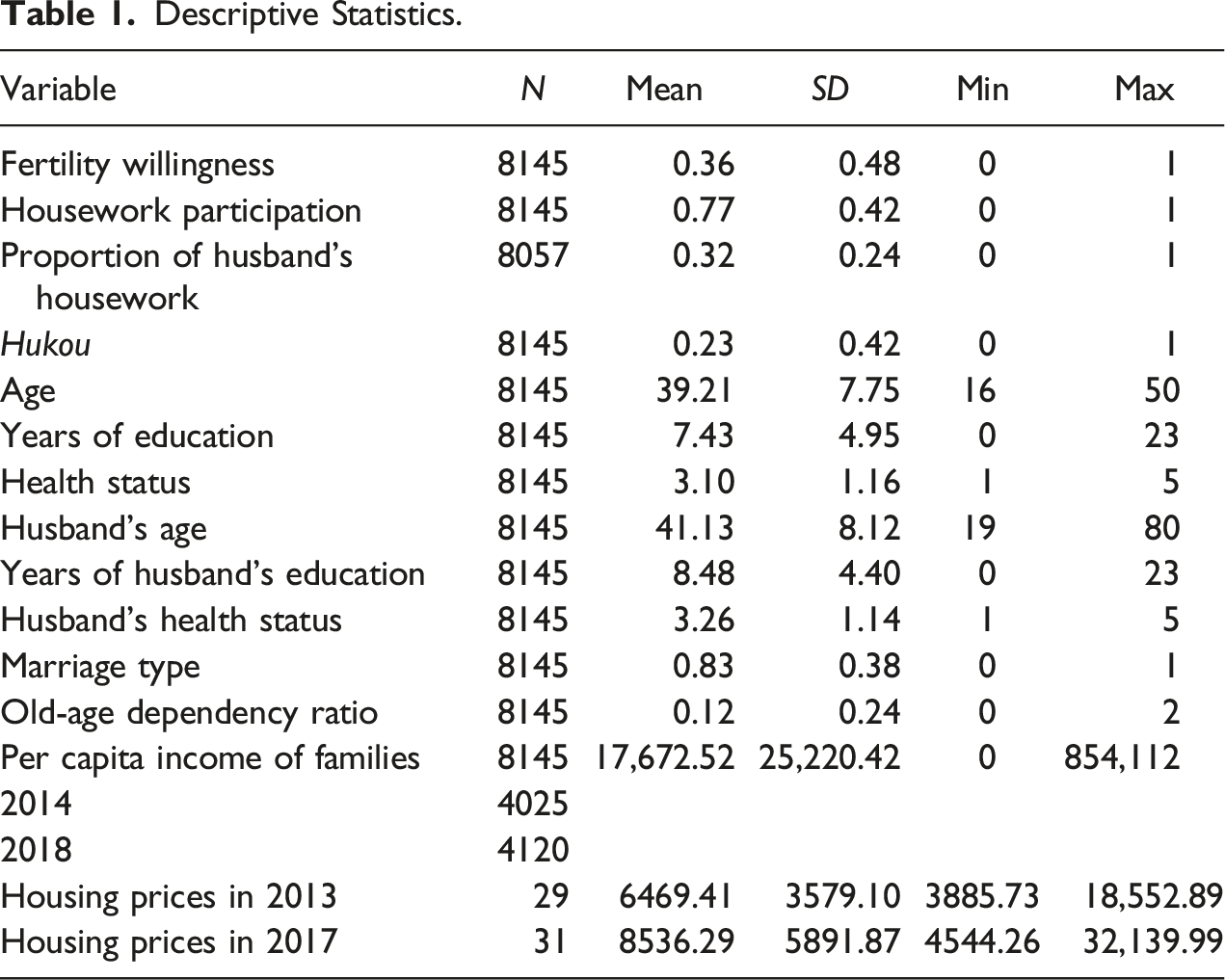
The data used in this paper come from the China Family Panel Studies conducted by the Institute of Social Science Survey of Peking University. The CFPS baseline survey began in 2010 and was followed up in 2012, 2014, 2016, 2018, and 2020. So far, the latest complete data released by CFPS is 2018. Based on the research needs of this paper, the questionnaire needs to include both personal housework participation and fertility willingness. Because CFPS2010 and CFPS2016 did not ask about fertility willingness, and CFPS2012 lacked data on personal housework participation, this paper finally uses CFPS2014 and CFPS2018 for analysis. 3 The samples of CFPS have good national representativeness. CFPS2014 covers 29 provinces, and CFPS2018 covers 31 provinces. In addition, CFPS is the only large-scale micro-database in China that contains information on personal housework participation and fertility willingness besides the data of China Health and Nutrition Survey. Compared with the data of China Health and Nutrition Survey, CFPS survey is later, which can reduce the interference of family planning policy on fertility willingness.
Since the labor force participation rate of Chinese women is the highest in the world, this paper mainly focuses on the working women. When cleaning the data, the samples of women who are unemployed and quit the labor market were removed. People who are older than 50 years generally rarely have actual fertility behavior, and this paper further eliminates the women samples older than 50 years. After deleting the unmarried samples, the samples with missing key variables such as fertility willingness, housework time, hukou, and years of education are eliminated. Finally, CFPS2014 and CFPS2018 are combined to obtain 8145 samples.
Variables
Fertility Willingness
CFPS asked the individual’s “expected/ideal number of children” and calculated the number of existing children in the family according to the questionnaire and data of CFPS. If the “expected number of children” reported by the individual is greater than the number of existing children in the family, it is regarded as having fertility willingness and is assigned a value of 1.
Division of Housework
The most appropriate measure of division of housework has always been a controversial topic. Referring to the existing studies, we adopt two methods to measure the division of housework. One is whether the husband participates in housework, and the other is the proportion of the husband’s housework time to the sum of husband and wife. CFPS not only asked family members about the time spent on housework every day, but it also distinguished working days from rest days and asked them separately. Since the time spent on housework reported by family members has missing values, for the samples with missing values, we assign 5/7 working days and 2/7 rest days, respectively, and add them up to get the time spent on housework every day. Furthermore, if the husband’s housework time is greater than 0, it is to participate in housework and assign a value of 1. If the husband’s housework time is equal to 0, he is not involved in housework, and the value is 0. The proportion of husband’s housework time to the sum of husband and wife is calculated by using the housework time reported by husband and wife.
Control Variables
In order to minimize the omitted variable bias, we add control variables including personal characteristics of the couples, family characteristics, and macro characteristics: (1) Hukou: non-agricultural hukou is assigned a value of 1 and agricultural hukou is assigned a value of 0. (2) Couples’ age. (3) Years of education of the couples. According to the education level reported by family members, the corresponding years of education are determined, from low to high: 0 years (illiterate/semi-illiterate), 6 years (primary school), 9 years (junior high school), 12 years (high school/vocational secondary school/technical school/vocational high school), 15 years (junior college), 16 years (undergraduate), 19 years (master’s degree), and 23 years (doctor’s degree). (4) Couples’ health status. Assign 1–5 from unhealthy to very healthy separately. (5) Marriage type. If the husband is younger than the wife, the value is 0, otherwise the value is 1. (6) Old-age dependency ratio. The old-age dependency ratio is calculated according to the number of people aged 65 and above and the number of people aged 15 and above and under 65. (7) Per capita income of families. According to the annual income of the family and the total number of families, the per capita income of the family is calculated, and the logarithmic form is used in the regression. (8) Housing prices. Continuously rising housing prices undoubtedly increase the cost of fertility. Because of the inability to obtain the information of the city where the individual is located, this paper uses the sales of commercial housing in each province divided by the sales area of commercial housing in China Real Estate Statistical Yearbook to get the housing prices of the corresponding provinces. In the regressions, housing price data for one lagged period, that is, 2013 and 2017, are used and logged. In addition, considering the differences across provinces, we add provincial dummy variables in regression analysis.
Descriptive Statistics.
Model
It is necessary to consider the influence of individual, spouse, family characteristics, and macro factors when we estimate the effect of housework division on women’s fertility willingness. Therefore, this paper constructs the following econometric model:
Results
Baseline Regression
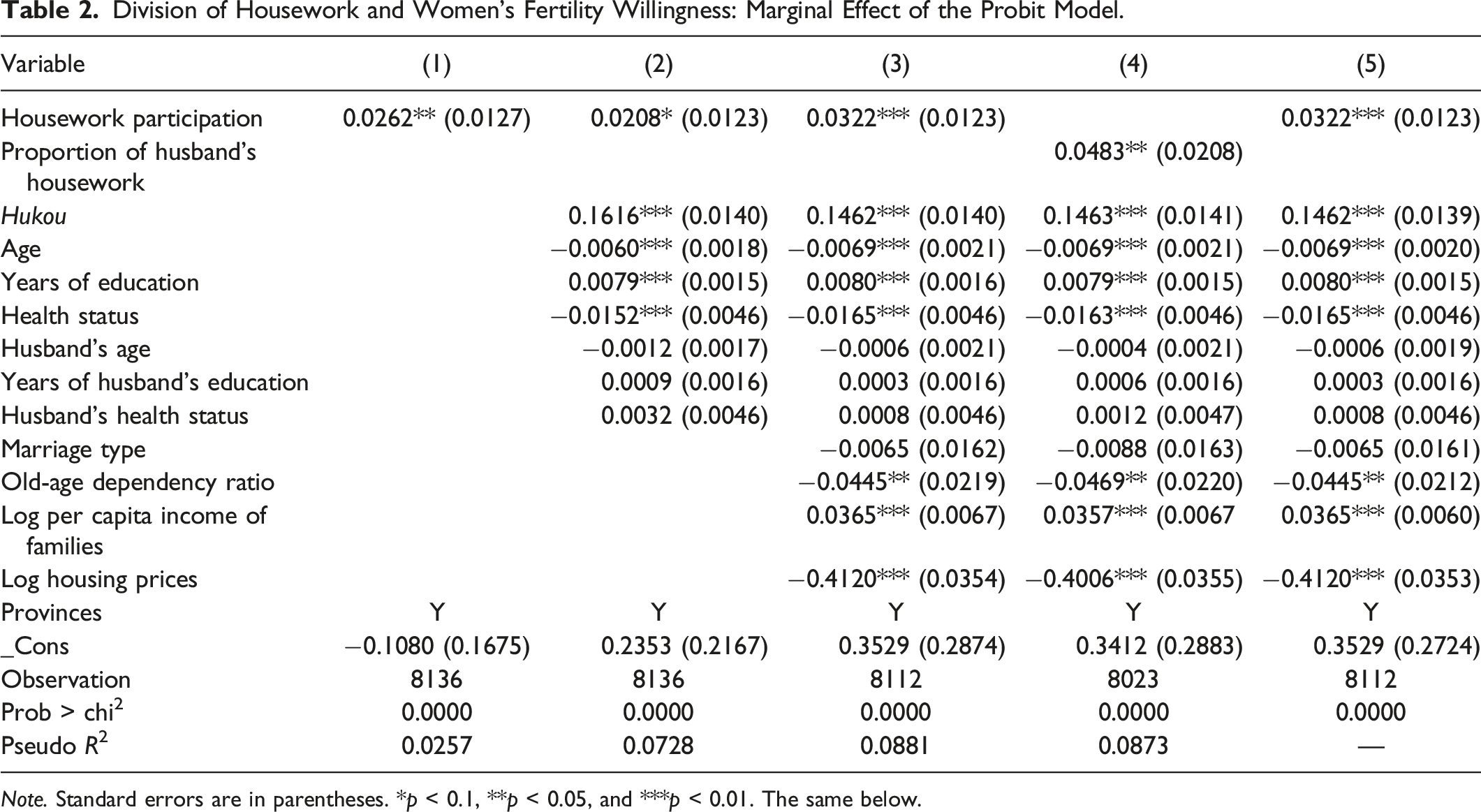
Division of Housework and Women’s Fertility Willingness: Marginal Effect of the Probit Model.
Note. Standard errors are in parentheses. *p < 0.1, **p < 0.05, and ***p < 0.01. The same below.
Column (1) adds only independent variable, column (2) adds personal characteristics of the couples, and column (3) further controls family characteristics and macro factors. The results of column (1) show that husband’s participation in housework can effectively improve wife’s fertility willingness, and after adding the couples’ personal characteristics, family characteristics, and macro factors, the coefficient of housework participation is still positive and significant. Column (3) shows that compared with agricultural hukou, women in non-agricultural hukou have higher fertility willingness. The intuition behind this is that hukou is linked to personal income and other benefits, and these factors just have an important impact on fertility willingness. For a long time, the formulation and implementation of China’s population management policy are based on the hukou system. The hukou system is not only a population registration system but also plays a supporting role with a series of other systems. A large number of studies show that there is a significant hukou discrimination between rural labor force and urban local labor force in China (Wu, Yao, & Zhang, 2015; Sun, 2017). Women with non-agricultural hukou can get higher income and better welfare, so they are more willing to have children. Age has a significant negative impact on fertility willingness. With the increase of age, fertility risk increases relatively, so fertility willingness will decrease. Years of education have a positive impact on fertility willingness. The increase of years of education has a positive impact on the improvement of income level, which can provide better material security for women’s fertility. In column (3), we can also see that the per capita income of families has a significant positive impact on women’s fertility willingness.
The coefficient of health status is significantly negative at the level of 1%, which means that women with better health status have lower fertility willingness. The possible reason is that women with better health status are more likely to pursue their own careers, while women in poorer health are more dependent on their children, so they will have higher fertility willingness. Column (3) shows that the husband’s personal characteristics and the marriage type do not have a significant impact on the wife’s fertility willingness. The old-age dependency ratio has a significant negative impact on women’s fertility willingness, and the reason is that young and middle-aged people are often faced with the pressure of supporting the elderly. The higher the dependency ratio of the elderly, the greater the pressure on the family to support the elderly, and the greater the cost of giving birth and raising babies. When faced with the greater pressure of supporting the elderly, they may have a sense of caring for one thing and losing the other, so their fertility willingness will be affected. Consistent with expectations, housing prices have a negative effect on women’s fertility willingness. In recent years, residents’ burden of buying houses continues to increase with the rapid rise of housing prices, and the cost of fertility continues to increase, which obviously inhibits women’s fertility willingness.
Robustness Test
The model is re-estimated by replacing the independent variable with the proportion of husband’s housework time to the sum of husband and wife. The results of column (4) in Table 2 show that after replacing the independent variable, the division of housework still has a significant positive impact on women’s fertility willingness, and women’s fertility willingness can be improved significantly if their husbands can participate in more housework. Compared with column (3), the direction and significance of the control variables in column (4) have not changed, so they will not be repeated here. In addition, drawing on Roodman (2011), the CMP model is used to re-estimate the marginal effect value of husband’s housework participation. The results are shown in column (5) in Table 2. It is clear that the conclusion is consistent with the baseline regression, thus verifying the robustness of the baseline regression conclusion.
Results of Propensity Score Matching.

Note. Bootstrap standard errors obtained by self-sampling 500 times are in square brackets.
Parallel Hypothesis Test.

Note. Matching variables are selected by step-by-step probit method.
Endogenous Problem
In order to avoid omitted variable bias, this paper controls the factors affecting women’s fertility willingness as much as possible in the baseline regression. As mentioned in the previous section, there is a large controversy in existing studies on the measurement of division of housework. Although this paper has corrected the sample self-selection bias, this paper tries to select appropriate instrumental variable to solve the endogenous problem caused by possible measurement error. Based on the analysis and the availability of data, the husband’s working hours are selected as the instrumental variable of division of housework. Firstly, there is a certain degree of substitution relationship between husband’s working hours and housework participation time. If the working hours are too long, it will obviously affect the time of housework participation; thus, the correlation hypothesis is satisfied. Secondly, the husband’s working hours are mainly affected by factors such as the nature of the work unit, the nature of occupation, and the environment of the work unit. With the progress of society, women have the main decision-making power on fertility willingness, while husband’s working hours have no absolute influence on husband’s income and other characteristics. Therefore, husband’s working hours will not directly affect women’s fertility willingness and can satisfy exclusive constraint.
Regression Results of Instrumental Variable.

Mechanism Analysis
The abovementioned analysis shows that husband’s participation in housework can effectively improve wives’ fertility willingness. Theoretical analysis shows that for working women, if they are faced with high work–family conflict, it is difficult to balance employment and family, which will lead to “you can’t have it both ways.” If the husband can help his wife to undertake some housework, he can reduce the wife’s work–family conflict, thus effectively improving the wife’s fertility willingness. Modern women may be dissatisfied with their husband’s contribution to housework because of his insufficient participation in housework, which leads to a decline in marital satisfaction, while personal subjective well-being has a significant impact on fertility willingness. The CFPS questionnaire asked individuals about their satisfaction with their spouse’s contribution to housework, and we test this mechanism by using the ordered probit model.
Results of Mechanism Test.

Further Discussion
Effect of Division on Fertility Willingness of Different Families.

Conclusion and Discussion
Gender equality within the family has always attracted much attention. A large number of studies in Western countries have shown that husbands’ participation in housework can effectively improve fertility willingness. China has a unique social and cultural background. In fact, little is known about China’s experience due to the lack of micro-survey data containing information on the division of housework and fertility willingness (especially after policy change). Yang (2017) first studied the relationship between the division of housework and the willingness to have a second child in China. Because the data used were investigated during the implementation of the family planning policy, no significant causal relationship was found between the division of housework and the willingness to have a second child.
The population issue is “the top priority of the country.” Low fertility willingness has become a major practical reality in China. Many changes in China’s fertility policy in the past decade show the fact that the influence of population policy on fertility behavior has declined, and fertility supply is no longer the key constraint factor affecting fertility willingness. Previous studies have generally paid attention to the inhibitory effect of fertility cost on fertility willingness. From the perspective of family gender equality, this paper uses data of CFPS2014 and CFPS2018 to examine the impact of division of housework on women’s fertility willingness. The results show that for working women, there is a significant positive impact on fertility willingness whether the husband participates in housework or the proportion of the husband’s housework time to the sum of husband and wife. This positive influence still exists after solving the problems of sample self-selection bias and endogeneity. The mechanism analysis shows that husbands’ participation in housework can improve wives’ satisfaction with husbands’ contribution to housework, which can help to improve wives’ happiness and then improve fertility willingness, and husbands’ active participation in housework can also effectively reduce wives’ work–family conflict. Further discussion on whether families have had children shows that women who have had children are more sensitive to their husbands’ participation in housework. This paper provides the latest evidence for the applicability of family gender equality theory in China and the factors affecting women’s fertility willingness.
Fertility willingness is the premise of fertility behavior. The joint support of the state and family is very important in converting fertility willingness into fertility behavior and thus maintaining sustainable fertility rate. China has the highest female labor force participation in the world and faces a great work–family conflict. More specific policies need to be formulated and implemented to be able to secure women’s employment, especially to create favorable conditions for women’s career development after childbirth. Housing prices have significant inhibitory effect on women’s fertility willingness in this paper. With the huge costs of childbirth, parenting and education, and with housing prices continuing to rise, the act of purchasing houses is likely to empty a family’s entire savings (or even two). Chinese traditional culture emphasizes living and working in peace and contentment, but how can people “work in contentment” when they have not yet “lived in peace”? The general understanding of the society is that high housing prices have severely squeezed out the expenditure for fertility, and how to return housing to the standard of “living” has become the key to improve the fertility willingness of childbearing age groups in the whole society.
Women are the pioneers of human civilization, the drivers of social progress, and an important force in national construction. To ensure that people of childbearing age “want to have children” and “dare to have children,” it is necessary not only to effectively reduce the cost of childbirth, parenting, and education but also to promote the construction of a fertility-friendly society. From within the family, men need to take on more family roles, actively participate in housework, and husband and wife share the responsibilities of child care and education, which not only improve women’s fertility willingness but also help to build a harmonious family in the new era, which is one of the important insights of this study.
Footnotes
Acknowledgment
The authors would like to thank the Institute of Social Science Survey of Peking University.
Declaration of Conflicting Interests
The author(s) declared no potential conflicts of interest with respect to the research, authorship, and/or publication of this article.
Funding
The author(s) received no financial support for the research, authorship, and/or publication of this article.
