




Abstract
Intimate partner violence is a major impediment to gender equality in developing countries like Pakistan, which requires thorough analysis to ascertain the extent of prevalent violence and identify its underlying causes. Consequently, this study aims to empirically examine the factors associated with women’s attitudes toward violence in Sindh province (the second largest by population, income, and employment in Pakistan) using Sindh Multiple Indicators Cluster Survey data. The province presents an ideal candidate for studying intimate partner violence as it is quite uneven in terms of development. Our results reveal a high prevalence of intimate partner violence, with 55% of married women providing an affirmative answer to any one scenario of wife beating in the Sindh province. Multivariate regression analyses results of our study found that higher education, access to media, and the wealth status of both partners are protective factors against attitudinal acceptance of violence.
Keywords
Introduction
Women’s subordination using means of violence by intimate partners is one of the prevalent barriers to gender equality (Uthman et al., 2009), which not only affects women and child health but also adversely affects household socio-economic conditions (WHO, 2013). Although laws exist that forbid violence against women, cultural and societal norms as well as gender divisions perpetrate such acts of violence (Uthman et al., 2009). Women’s attitudes toward intimate partner violence (IPV) are one such manifestation (Flood & Pease, 2009; Guoping et al., 2010; Khawaja et al., 2008; McKinney et al., 2009; Tran et al., 2016). Furthermore, justification of partner violence on women’s part explains patriarchal social norms and their willingness to accept that a man has a right to control women’s behavior by violent means (Nasrullah et al., 2017). Thus, a sense of worth and women’s autonomy are directly related to IPV in a society where women are deprived of their basic social, political, and economic rights (Gurmu & Endale, 2017). Women’s attitudes toward IPV are determined by their own subjugation to violence, their family structure, and the household members around them. Social norms and perceptions of gender roles in violent households are significantly associated with violence perpetration and its frequency (Flood & Pease, 2009).
Beliefs about gender division of labor and other societal roles are important factors affecting attitudes toward accepting/rejecting IPV (UN Women, 2015). About 30% of women face either physical or sexual violence committed by their intimate partner (married or cohabitating) (WHO, 2013). Furthermore, attitudes about IPV against women are multifaceted and determined by various socio-economic, political, religious, and demographic factors (Tran et al., 2016). Male dominance, widely present in low- and middle-income countries, supports the viewpoint that male members of the household are responsible for women’s behavior, and thus men must control and discipline their female partners for disobedience (Glick et al., 2002).
South Asian countries like Bangladesh, India, and Pakistan are examples of such male domination and female subjugation in social, political, and economic affairs, and therefore, there is a significant prevalence and increasing acceptance of this hideous behavior (Dalal et al., 2012; Tayyab et al., 2017). Violence against women in Pakistan is a widespread phenomenon and can be partially explained due to unique socio-economic, political, and historical forces interacting in a complex web of anachronistic cultural practices, uneasy political truces, and active intra-household familial conflicts, further exacerbated by low female literacy rates (male: 70 vs. female: 48; total: 58% in the year 2016). Hence, not surprisingly, Pakistan ranks 143 out of 144 countries in the global gender gap report (Schwab et al., 2017). Regardless of location, violence against women is one of the prominent contemporary challenges faced by Pakistan, even in urban areas.
Sindh is the second-largest province of Pakistan. It is quite uneven in terms of development; comprising very few developed urban centers like Karachi and Hyderabad and mostly underdeveloped small cities and rural areas. Education levels and women’s empowerment statistics in this region are not impressive. More than half (52.3%) of women aged 15–24 are illiterate, and 31.2% of women aged 20–49 get married before 18 years of age (MICS Sindh). The female unemployment rate is also around 14% (Pakistan Economic Survey, 2021–22). It is important to study how perceptions of IPV unfold in the second-largest province of Pakistan, both in terms of population and economic activity.
Theory and Evidence
Perceptions and beliefs about gender equality have been reported by several studies to have a significant impact on attitudes, especially toward gender-based violence (Trinh et al., 2016). Although, in developing countries, the IPV is believed to be a private matter; nevertheless, it gives an indication of the larger community’s attitude (Yoshioka et al., 2001). Therefore, the research literature commonly follows the established theoretical arguments of Patriarchal terrorism theory (Johnson, 1995; Johnson & Ferraro, 2000). The central argument of the theory is that the role of women in relation to men in a society can carry out IPV (Bueno & Henderson, 2017Caridad Bueno & Henderson, 2017). Patriarchy is believed to make women more likely to be responsible for their acts in the household and in the community relative to men. Thus, this male dominance in a society and/or culture allows partner violence toward women (Wencheko & Tadesse, 2020). Furthermore, a woman’s conduct activates partner violence as well (Murshid & Critelli, 2020). In an empirical study from Uganda, in a sample of 5109 women, it was found that women are more likely to justify IPV, and a younger woman is significantly more likely to justify violence (Koenig et al., 2003). In another study from Zimbabwe, it was found that not only the younger age of a woman but also her rural residence status, lower income, unemployment, and less than secondary education are significantly associated with the justification of the IPV (Hindin, 2003). Furthermore, women’s access to information is also significantly associated with their reduced chances of accepting violence (Ghuman et al., 2006). Empirical studies from Pakistan also show that due to the patriarchal nature of society and gender disparity, lack of access to economic, political, and social opportunities and education, along with other socio-demographic and environmental factors, results in wife beating (Haider, 2013).
Nevertheless, studies from low- and middle-income countries remain focused on empirically examining the prevalence and predictors of IPV against women (Ali et al., 2015; Peterman et al., 2017; Trinh et al., 2016; Waltermaurer et al., 2013), and relatively scant literature is focused on the underlying attitudes toward IPV against women (Hindin, 2003; Rani et al., 2004). Men who lack knowledge and information and women who lack autonomy and control over resources (income) were more likely to justify wife beating (Tayyab et al., 2017). In their meta-analyses of IPV in Pakistan, Ali et al. (2015) found that the common reasons for verbal IPV are the income and poverty situations of the household, infertility, son preference, and beating of children by the husband. Among the less common reasons for verbal IPV are the wife refusing sex with the husband, arguments with in-laws, especially with the mother-in-law and husband, not understanding the household chores along with the inability to perform them properly, and going out without the husband’s permission.
Given this backdrop, the present study sets out to empirically examine the socio-economic, demographic, ethnic, and spatial factors associated with the justification of wife beating by currently married women of age 15–49 years. This study is an attempt to fill the gap in research related to the justification of wife beating in a Pakistani context based on a provincially (sub-national) representative sample of women with various socio-economic and ethnic backgrounds from the province of Sindh, the second-largest province of Pakistan both in terms of population and economic activity. The economic diversity observed in this province is quite uneven. It includes a few developed cities, including Karachi, the most populated city and major economic hub of Pakistan. On the other hand, the rural areas and other small cities are undeveloped and primitive. Sindh is also the first province to approve the women’s protection bill in 2013. Thus, this study serves as a baseline study immediately after the passing of the “Violence Against Women Act 2013.” Moreover, this study analyzes the behavioral responses of married women toward IPV by using alternative definitions of IPV. Firstly, a composite index of IPV is used, which states whether a woman agrees to any type of IPV. Additionally, women’s responses toward all seven dimensions of IPV (available in MICS) have been incorporated separately: whether a woman feels IPV is justified in the case of going out without husband’s permission, neglecting children, arguing with husband, refusing sex with husband, burning food, not performing household chores, and using a mobile phone, Facebook, Twitter, TV, the Internet, or any other entertainment channel.
Methods
Study Design
This study uses data from the Sindh Multiple Indicator Cluster Survey (MICS-2014), conducted in February–August 2014 by the Sindh Bureau of Statistics (SBS) in collaboration with the Pakistan Council of Research in Water Resources (PCRWR), Global Alliance for Improved Nutrition (GAIN), with technical and financial support from the United Nations International Children’s Emergency Fund (UNICEF). The univderse of this survey consists of the household-based population in all urban and rural areas of Sindh as defined by the Housing Census 2011.
The Pakistan Bureau of Statistics (PBS) developed and updated its own sampling frame for all urban areas of the country in 2013. Each city/town has been divided into many small, compact areas called Enumeration Blocks (EBs). Each EB consists of an average of 200 to 250 households with well-defined boundaries recorded in the prescribed forms and maps thereof with physical features. Each EB in the self-representative cities (SRCs), namely, Karachi, Sukkur, and Hyderabad, has also been classified into low-, middle-, and high-income groups. The Rural Area Frame consists of a list of blocks; a block may be a whole village or part of a village. The Rural Area Frame has also been updated during the Housing Census 2011. Each Primary Sampling Unit (PSU) in both Urban and Rural areas has well-defined geographic boundaries described on a specified form along with maps. A two-stage stratified systematic sampling approach has been used for the selection of the survey sample. Urban and rural clusters have been selected in each district using the probability proportional to size (PPS) method, and then 20 households have been randomly selected within each of those clusters. The EBs in urban areas and villages (or parts of villages) in rural areas, have been taken as the PSUs, and the selected households are referred to as Secondary Sampling Units (SSUs). Seven clusters in Karachi could not be accessed due to a lack of law and order, poor geographical access, and political disputes. In two clusters (each in Dadu and Tando Muhammad Khan districts), data collection could not take place due to seasonal migration and internal conflict. About 17,014 households were successfully interviewed (a response rate of 94.4%). In the interviewed households, 29,898 women (age 15–49) were identified. Of these, 26,647 were successfully interviewed, yielding a response rate of 89.1% within the interviewed households (for details about the data, see Sindh Bureau of Statistics and UNICEF 2015).
Variables
Dependent Variables
Women of all ages (15–49 years) were asked questions related to the IPV, and their responses were recorded in binary (yes/no) form. In this analysis, we restricted our sample to currently married women. The question asked was: Sometimes a husband is annoyed/angered by the things that his wife does. In your opinion, is a husband justified in hitting or beating his wife in the following situations: if she goes out without telling her husband, neglects children, argues with husband, refuses to have sex with husband, burns food, does not perform household chores, uses a mobile phone, Facebook, Twitter, TV, the Internet, or any other entertainment channel?
Furthermore, in this study, two different specifications of our dependent variable are used. The first affirmative responses of currently married women are combined into one index and coded as yes if the woman has said yes (Yes = 1) to any one of the seven scenarios, and if she strictly said no to all seven scenarios, it is coded as no (No = 0). Furthermore, this study analyzed each of the seven scenarios separately by developing a binary outcome variable where if a woman favors wife beating by intimate partner, it is coded as one and zero otherwise.
Independent Variables
This study analyzed the socio-demographic, regional, ethnicity, access to media, and possession of agriculture land as independent variable.
Age of women, her age at time of first marriage, women’s education, education of her husband, and wealth quintile are used as socio-demographic variables. Studies indicate that the age of a woman significantly affects her behavior toward partner violence. Younger brides have higher odds of facing physical and emotional violence (Hayes & Protas, 2022). Women married at younger ages are highly likely to drop out of school; lower education coupled with low employment opportunities tends to decrease their bargaining positions in marital roles (UNICEF, 2011; Bhandari, 2019). Education of a woman reduces her risk of accepting IPV; knowledge and awareness programs at school reduce her attitude as well as her use or acceptance of domestic violence in her later life (Weitzman, 2018). Similarly, education of the husband reduces his odds of indulging in wife beating (Luke et al., 2007). The collective resources owned by a couple also affect the level of financial stress and, consequently, the attitude and perpetuation of IPV in the household (Fox et al., 2002).
The age of women is a categorical variable and is categorized into seven categories: 15–19, 20–24, 25–29, 30-34, 35–39, 40–44, and 45–49 years. Age at first marriage is categorized into four categories: women who got married at the age of 14 or less (early child marriage), women who got married at the age of less than 18 years (child marriage), 18–25, and 26–49. Women and their husbands’ education is categorized into six categories, including none or pre-primary (less than one year of schooling), primary (1–5 years of complete schooling within the category), middle (1–3 years of complete schooling within the category), secondary (1–2 years of complete schooling within the category), and higher secondary (1–7 years of complete schooling within the category). The wealth quintile is divided into five categories: poorest, poor, middle, rich, and richest.
Regional variables
Include the region of residence, that is, rural or urban, and the administrative division of residence. Studies indicate that the area of residence is related to the attitude toward IPV and its experience. Women residing in rural areas are more likely to face IPV compared to their urban counterparts (Shah et al., 2013). The prevalence of traditional gender norms as well as weak enforcement of laws in remote areas can be among its potential reasons (Ellsberg et al., 2008; Nabaggala et al., 2021). Cultural norms, beliefs, and practices of various communities affect their attitudes toward IPV (Laisser et al., 2011; Sears, 2021). Media exposure can play a significant role in shaping attitudes toward IPV. A study in India discovered that women who watched TV and listened to the radio were less likely to experience domestic violence, and that exposure to both forms of media has the same impact on decreasing the acceptability of domestic violence as three additional years of education. (Bhushan & Singh, 2014).
The language of the household head is taken as a proxy for ethnicity, assuming that intra-caste marriages in Sindh are very low. Ethnicity includes Urdu, Sindhi, Pashto, Balochi, Punjabi, Saraiki, and other language-speaking families. Access to media includes reading newspapers, listening to radio, and watching TV, and is coded as 0 if respondents have no access to any of the sources of media and 1 if respondents have access to either occasionally, once a week, or daily to any of the media sources. Administrative divisions include Larkana, Sukkur, Mirpur Khas, Hyderabad, and Karachi. Also, this study includes a binary variable for agricultural land possession, coded as yes = 1 and no = 0.
Statistical Analysis
For statistical analyses purpose, this study used bivariate analyses and multivariate logistic regression analysis. Bivariate analysis is employed to examine the association between women’s attitude toward IPV and independent variables. The bivariate analysis used the chi-square statistical method with corresponding P-value (p < .01).
Because our dependent variable is dichotomous in nature, multivariate logistic regression is employed for the analysis. This analysis is used to empirically examine the association of women’s attitudes toward IPV with a number of demographic, social, economic, and regional risk factors. This study has empirically estimated eight models for a comprehensive analysis. Model 1 analyzed the responses of all women who said at least yes to any of the seven scenarios and is hence labeled the “all scenario model.” Models 2–8 estimated multivariate logistic regressions for each scenario where women said either yes (= 1) or no (= 0). The results of all these models are presented as odds ratio (OR) with their confidence intervals (95% CIs) and the corresponding P-values.
Results
Out of a total of 17,679 currently married women, 9307 (54.5% weighted) showed their acceptance of wife beating by husband in any form. The median age of currently married women in the sample is 31 years, and the median age at marriage is 18 years. Furthermore, the acceptance of wife beating by husband in the given seven hypothetical scenarios (see Figure 1), that is, whether wife beating is justified by husband if; she goes out without telling her husband (39.4%), neglects the children (40.1%), argues with husband (40.8%), refuses sex with husband (38.1%), burns the food (31.8%), does not perform household chores (37.6%), and uses mobile phone, social media, and entertainment channels (31.6%). Acceptance attitude of intimate partner violence of currently married women (15–49 years) toward wife beating in Sindh, Pakistan.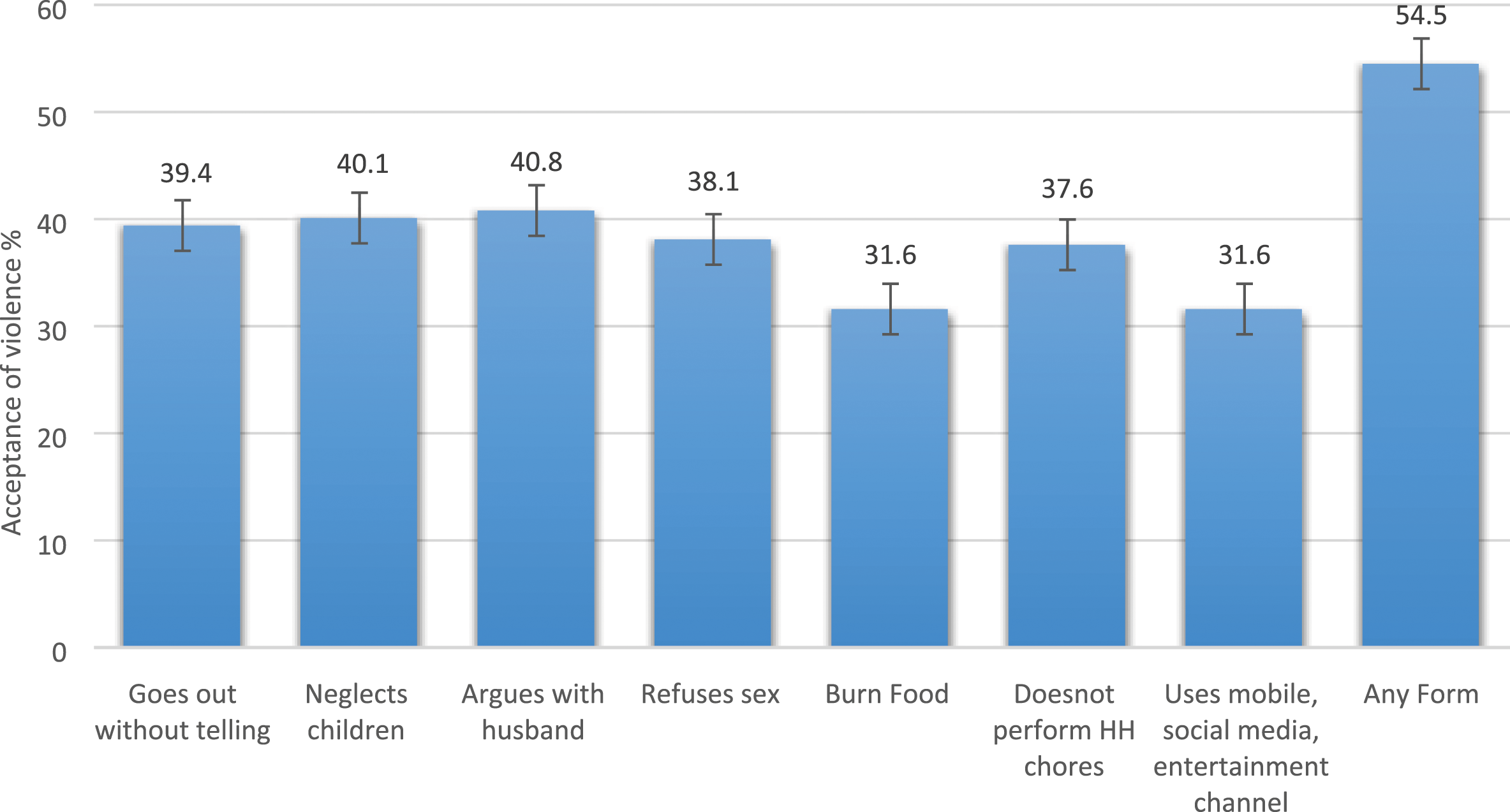
Descriptive Statistics and Association of Socio-demographic Characters With Attitude Toward Wife Beating.
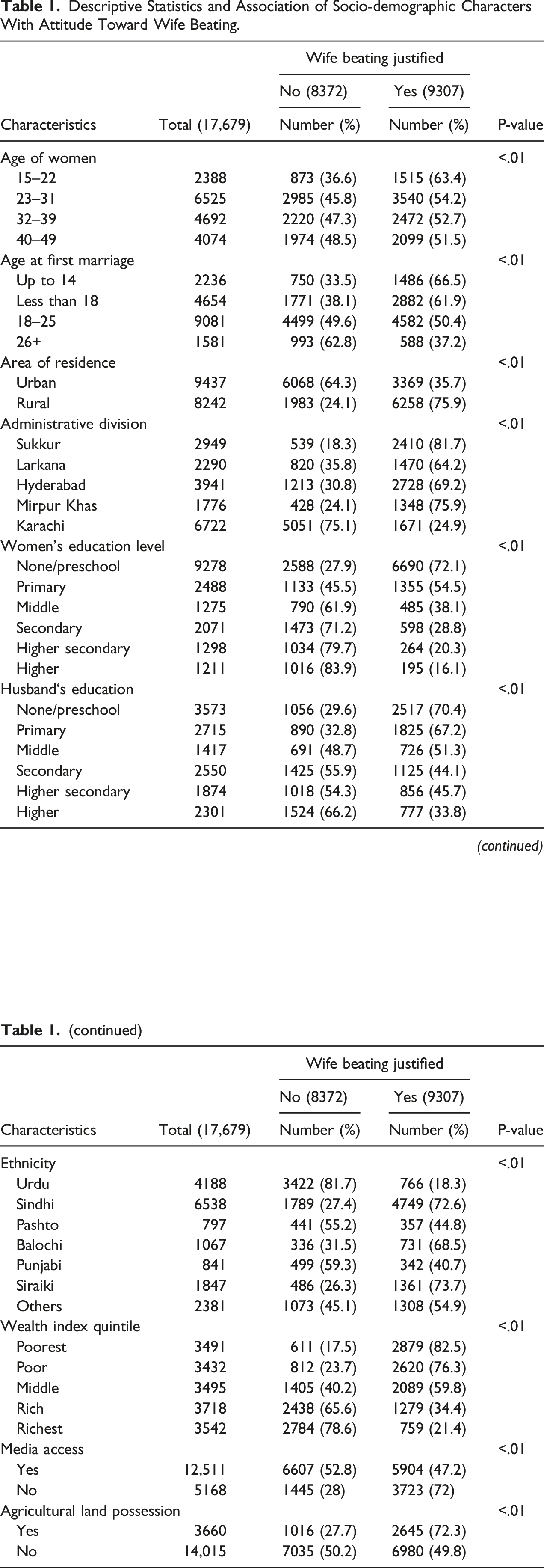
About a little above a third (35.7%) of currently married women living in urban areas have acceptance for wife beating, whereas three-fourths (75.9%) of rural women have an acceptance attitude toward wife beating. Karachi, being the most urbanized metropolitan city, has one-fourth (24.9%) of women accepting wife beating, whereas Sukkur has the highest acceptance of wife beating (about 82%), followed by Mirpur Khas (about 75.9%), Hyderabad (69%), and Larkana (64%). The acceptance of wife beating in predominantly urban Hyderabad is surprisingly high, as Hyderabad is the second-most populous city in the province of Sindh. Education of women is another important factor for women’s (not) justification of wife beating by their husbands, as about 72% of women who are not educated (with less than a year at school) accept wife beating, whereas about 16% accept wife beating in the higher education category. Similarly, a woman whose husband is less educated or illiterate has a higher level of acceptance of wife beating (70%) relative to those with highly educated husbands (about 34%). Three major ethnic groups in Sindh province are identified as Urdu-, Sindhi-, and Siraiki-speaking families. Of them, Urdu-speaking females, who predominantly live in urban Sindh, especially in Karachi, Hyderabad, and Mirpur Khas, have an acceptance level of about 18%. Sindhi women, on the other hand, have very high levels of acceptance for wife beating (at about 73%), being closer to Siraiki women (at about 74%). This behavior is not a surprise since people of these two ethnicities primarily live in the rural Sindh. Economic status is another important determinant of women’s attitudes toward wife beating. For example, about 83% of the poorest and a fifth (21%) of women in the richest quintile accept wife beating (See Table 1). Surprisingly, possession of agricultural land is significantly associated with the attitude toward wife beating, that is, 72% of women versus about 50% of women with no possession of agricultural land support wife beating. Almost every second, women having access to any kind of media (TV/radio/newspaper) are in support of wife beating (Table 1).
Adjusted Odds Ratio for Individual Attitude for Wife Beating and Combined.

The age of women is a risk factor for certain scenarios but for others, it is not statistically significant. Women aged 23–31 years are significantly less likely to accept wife beating for all cases, respectively (OR = .86, CI = .75–.98; OR = .86, CI = .75–.99; OR = .81, CI = .71–.93; OR = .81, CI = .70–.93) compared to women aged 15–22 years. Any other age category of women is not significant in the rest of the four estimated models. Furthermore, there is a significant odd of women aged 40–49 years, accepting wife beating in case the wife refuses sex with her husband (OR = 1.25, CI = 1.08–1.25). Women’s age at marriage is an important factor associated with the attitude toward wife beating in Sindh, Pakistan. There is significantly lower acceptance of wife beating when the woman’s age at marriage is higher, if she goes out without telling her husband (OR = .82, CI = .67–1.00), neglects children (OR = .76, CI = .62–.92), argues with husband (OR = .72, CI = .60–.88), and uses mobile/phones/social media (OR = .68, CI = .55–.83). Besides, for a woman married at less than 18 years of age (child marriage) and between 18 and 25 years, her odds of accepting wife beating in case of burning food is higher (OR = 1.16, CI = 1.02–1.33 and OR = 1.13, CI = 1.00–1.28). Administrative divisions are highly significant factor of acceptance of wife beating in all the models estimated. For example, compared to Sukkur reference category, Karachi and Larkana have the lowest odds (OR = .19, CI = .16–.23; OR = .30, CI = .26–.35) of accepting wife beating by intimate partner while Mirpur Khas (OR = .58, CI = .48–.70) and Hyderabad (OR = .51, CI = .45–.59) have the highest. The most surprising result is that Hyderabad, a predominantly urban center of Sindh province and most populous after Karachi, has higher odds than Larkana, which is a less developed and relatively rural area of the province. Women’s education is a significant predictor of attitude toward wife beating. Odds of justifying attitude toward wife beating decreases with the increase in education level of women compared to the reference category of no education. The odds of accepting wife beating by women with primary level of education is less compared to reference category of no education in our first model (OR = .81, CI = .70–.95). The odds of primary education of women are in the range of (OR = .82, CI = .72–.92) in model 2 and (OR = .91, CI = .81–1.03) for model 8. A woman with higher compared to no education is significantly less likely to accept wife beating if she goes out without telling her husband (OR = .26, CI = .19–.36), and burns food (OR = .31, CI = .21–.45). Likewise, husband’s education predominantly remains insignificant in the estimated models. Only secondary and higher education show significant but lower odds (OR = .80, CI = .67–.95; OR = .79, CI = .64–.79) of justifying attitude toward wife beating compared to reference category of no education in model 1.
Among women from poor, medium, rich, and richest wealth quintiles, the odds of highly favoring attitude toward wife beating are lower (OR = .68, CI = .59–.80; OR = .57, CI = .48–.69; OR = .45, CI = .35–.58; OR = .33, CI = .24–.43) than the reference category of poorest wealth quintile, respectively. Ethnicity of the household is another important factor that determines women’s attitude toward wife beating. Compared to reference category of Urdu speaking, Sindhi speaking have 2.4 times higher odds of accepting attitude toward wife beating and this result is significant in all the estimated models and the odds ratio ranges from (OR = 2.23, CI = 1.89–2.63) in the category of arguing with husband to almost (OR = 3.06, CI = 2.55–3.67) in the category of refusing sex with husband.
Access to media is significant only in two of the models estimated. Those women who have access to media are less likely to accept the attitude toward wife beating, when she burns the food (OR = .89, CI = .81–.99) and when she uses mobile/phone/social media/entertainment channel (OR = .76, CI = .69–.84) compared to the reference category of having no access to any kind of media. In four of the eight models estimated, land possession is a significant predictor of attitude toward wife beating and the odds are not much different from that of the reference category of not possessing the land. Land possession is a risk factor for women accepting wife beating by intimate partner if they refuse sex (OR = 1.12, CI = 1.01–1.24), burn food (OR = 1.15, CI = 1.04–1.28), do not perform household chores (OR = 1.20, CI = 1.08–1.33), and use mobile, phone, and social media (OR = 1.15, CI = 1.04–1.28). Region of residence, surprisingly, is not a significant predictor of attitude toward acceptance of wife beating in any of the models estimated.
Discussion
This empirical study analyzed that administrative divisions (regions of dwelling), a proxy for differences in socio-cultural setting, women’s level of education, wealth status, ethnicity, and women’s age at marriage can explain attitudes toward wife beating in Sindh, Pakistan.
The younger age of a woman is associated with acceptance of wife beating, which is in line with the existing literature (Hindin, 2003; Rani et al., 2004) but in contrast with others (Khawaja et al., 2008; Sayem et al., 2012). Older women receive more respect compared to younger women and are less likely to be beaten (Ali & Gavino, 2008). This is because Sindh is a very traditional, feudal, and patriarchal society and thus provides very few opportunities for women, especially those of younger age. It also points toward the intergenerational transmission as well as the high level of acceptance of traditional societal gender norms that provide a dominating role to men over women. This is a serious case of concern for policymakers and implementing agencies at the provincial as well as federal level in Pakistan. Similarly, if a woman marries early, she is more likely to accept the violent attitude of her intimate partner (Hayes & Protas, 2022; Nasrullah et al., 2017). It is because women are considered a social liability in Pakistan, and parents tend to marry them off at young ages to fulfill their social and religious responsibilities (Ali & Gavino, 2008). Due to some cultural practices like Addo-Baddo (marriage in exchange within tribes) and Vani/Swara (girls are given in marriage to resolve disputes among tribes and families), women are forced into early marriages. This is very prevalent in the province of Sindh (Shah & Cheema, 2017), besides the revision of marriage age under the “Sindh Child Marriage Restraint Act 2013,” according to which marriage of a child (boy/girl) below the age of 18 years is punishable. Girls raised in families with inequitable gender norms and a lack of attention and respect for females can have adverse effects on these women’s attitudes and acceptance of violence by their husbands (Santhya et al., 2010).
Region of residence (Administrative Divisions) is an important predictor of women’s acceptance of wife beating by the intimate partners. Karachi and Larkana divisions have the lowest odds of justifying wife beating compared to Sukkur division. Karachi is among the lowest of all five divisions of Sindh province. An interesting result is that the Hyderabad and Mirpur Khas divisions, which are more urbanized compared to the Larkana division, have the highest odds of accepting wife beating among divisions. This agrees with the study by Madhani et al. (2017) and points toward development disparities across various divisions as well as within administrative divisions. Also, this result asks for an in-depth analysis of gender inequality among various divisions of Sindh province, especially in the more urbanized division of Hyderabad. Hyderabad has a population of about 1.73 million, and according to the latest census 2017 results, it stands as the eighth largest urban city in Pakistan. Furthermore, according to a report by SPDC (2016), Hyderabad falls in the low range of the Human Development Index (.51 Hyderabad vs. .55 Sukkur) as well as having high levels of urban poverty (42%) compared to Sukkur (48%).
Women’s education is a significant predictor of not justifying wife beating, thus pointing toward the fact that better educated women are more resistant to wife beating. This argument is in line with Ebrahim & Atteraya (2018) and Joshi & Childress (2017). Furthermore, education seems an important tool to enhance women’s status in patriarchal societies like Pakistan as well as to end violence against women (Madhani et al., 2017). Nevertheless, the effect of girls’ education depends on whether the education is adaptive or transformative (Rani et al., 2004). Furthermore, highly educated husbands are not in favor of wife beating, thereby indicating that putting emphasis on male education at higher levels should be a priority.
Ethnicity is an important indicator for the justification of wife beating in Sindh. Compared to the Urdu-speaking, reference category, Sindhi women are more than twice in favor of wife beating. This is an interesting outcome of this analysis, and it is the first time that ethnicity and its association with attitudes toward intimate partner violence are examined in the case of Pakistan. Sindhi women have historically remained less educated compared to women from other provinces of the country. Also, the feudalistic structure of Sindhi society, concentrated developments with a few pockets of prosperity, and lower women labor force participation are among the reasons for wife beating justification. The poorest people in the province are more likely to justify wife beating, and this is consistent with previous studies (Ebrahim & Atteraya, 2018; Hayes & Boyd, 2017; Marshall & Furr, 2010). Surprisingly, the variable of region of residence (urban being the reference category) remains insignificant, contrary to other studies (Tayyab et al., 2017; Wencheko & Tadesse, 2020). Access to media is another important factor associated with the justification of intimate partner violence in Sindh, Pakistan, mainly in two categories of attitude toward wife beating; one if she burns food, and second if she uses a mobile/phone/social media/entertainment channel. For the rest of the categories and for the full model, it remains insignificant. This result is in line with studies from Bangladesh (Sayem et al., 2012), Pakistan (Tayyab et al., 2017), and Zambia (Lawoko, 2006). Exposure to electronic media has been reported to decrease the acceptability of violence in rural India as well, especially when the electronic media is used as a platform for information sharing and awareness campaigns (Bhushan & Singh, 2014; Jensen & Oster, 2009). Studies from Pakistan like Rabbani et al. (2008) confirm that women with resources are less likely to accept the IPV, whereas those like Tayyab et al. (2017) postulate that women who do not own land resources have a less supportive attitude toward intimate partners. Several studies report no statistical association between asset ownership and the acceptability of IPV (Panda & Agarwal, 2005). Whereas in our study, an interesting finding is the significant but non-differential impact of land possession versus no land possession on attitudes toward justifying wife beating.
Conclusion
The analysis confirms that women with a low level of education, living in certain administrative divisions of the province, belonging to a poor segment of society, and lacking access to media are more in favor of justifying wife beating.
Thus, women’s attitudes toward accepting violence should be given provincial as well as national priority to achieve gender equality and good health and wellbeing for women in accordance with the key Global Sustainable Development Goals (SDGs). Furthermore, prevention messages may need to be specifically tailored for different groups so that every woman who is justifying IPV should be protected against it. Potential public health programs could include structural and gender-based interventions. In this way, one can argue that focusing on the coverage and disseminating messages against IPV benefits the public and aids in changing men’s (especially husbands) attitudes toward IPV. The schooling system in Pakistan is not proliferating the information necessary to educate adolescent girls and boys about gender equity and tolerance.
There are three higher education institutes and two medical colleges in Pakistan that cater only to girls; therefore, it is necessary for these women’s universities and colleges to train women not to accept IPV by knowledge dissemination through seminar and circles. In recent times, the media has gotten active on gender-based issues; still, the media needs support from civil society and community organizations to help reduce acceptance of violence against women, especially in the deprived and remote areas of the Sindh province.
Limitations of the study include the following: this is cross-sectional data; hence, causality cannot be inferred. The MICS data is representative of provinces but not necessarily at the national level in Pakistan. Thus, results can be generalizable at the provincial level, but caution is needed when they are linked to the national level. Nevertheless, this study provides a decent insight into the prevalence and factors associated with the justification of wife beating in the second-largest province of Pakistan. Future research can combine MICS data for all provinces of Pakistan to get a national-level insight and compare the attitudes of women toward IPV across provinces. Repeating the same analysis for men would give a deeper insight into household beliefs and practices regarding wife beating.
Footnotes
Declaration of Conflicting Interests
The author(s) declared no potential conflicts of interest with respect to the research, authorship, and/or publication of this article.
Funding
The author(s) received no financial support for the research, authorship, and/or publication of this article.
