




Abstract
Social movement organizations have played an important role in athlete activism. Countless athlete activists have all benefited from having organizations supporting their social justice efforts. One such organization, Athlete Ally, partners with today’s athletes to create an inclusive athletic environment. Due to their relationship, both Athlete Ally and the athletes provide each other with resources to enact change through sport. The purpose of the following study was to examine the resources exchanged between the two entities through resource mobilization theory using qualitative interviews. Resources are divided into five categories: moral, cultural, social-organizational, human, and material. Results revealed moral, social-organizational, and material resources are shared between the two entities but not human and cultural resources. Practical and theoretical implications are expanded upon in the article.
Athlete Ally is a sport social movement organization (SMO) operating in the greater lesbian, gay, bisexual, transgender, and queer (LGBTQ) movement. A SMO is defined as a “complex, or formal, organization, which identifies its goals with the preferences of a social movement or a countermovement and attempts to implement those goals” (McCarthy & Zald, 1977, p. 1218). Given the persuasiveness of LGBTQ marginalization in sport (Dennison & Kitchen, 2015; Krane & Barger, 2006; Sartore & Cunningham, 2009), the organization utilizes athletes and the athletic environment to end “the rampant homophobia and transphobia in sport and to activate the athletic community to exercise their leadership to champion LGBTQ equality” (Athlete Ally, n.d.-a, para. 1). To accomplish this goal, the organization regularly partners with athlete activists. These “Athlete Ambassadors,” as the organization calls them, are current and retired professional, Olympic, and Paralympic athletes from countries all around the world and include names such as Kenneth Faried of the NBA, Sue Bird of the WNBA, and Mollie Lensig of Major League Quidditch. Athlete Ally currently has a relationship with over 150 Athlete Ambassadors. Per Athlete Ally’s website, the organization supports the athletes by organizing the Athlete Ambassadors to speak out against potential anti-LGBTQ legislation and policies. In return, the athletes work with the organization to sign open letters, make public statements, post on social media, and speak at events.
The goal of this study was to further examine the resources exchanged between Athlete Ally and its Athlete Ambassadors. Examining resources in a social change setting is best viewed through the lens of Resource Mobilization Theory (RMT). RMT, a subtheory of Social Movement Theory, focuses on the organizational unit of a social movement (Buechler, 1993). Specifically, the RMT approach provides a lens for investigating what resources SMOs utilize to further its organizational goals, the attributes of those resources, and how organizations acquire those resources (Edwards & McCarthy, 2004). Prior research has illuminated ways in which SMOs and activists can support one another to accomplish mutual goals (see Cress & Snow, 1996; Wilson et al., 2015). By providing resources to athletes, Athlete Ally can support its Athlete Ambassadors and shield them from potential negative verbal and financial consequences experienced by athlete activists (Agyemang et al., 2010; Frederick et al., 2017, 2018; Kaufman, 2008; Sanderson et al., 2016; Schmidt et al., 2018). In addition, the athlete activists provide the organization resources to progress the social movement (Wilson et al., 2015; Yan et al., 2018).
With the growing prominence of athlete activism in today’s landscape (see Smith & Tryce, 2019), SMOs can occupy an important source of support for these athletes against negative ramifications. In addition to Athlete Ally, other sport-specific SMOs, such as The Women’s Sport Foundation and the Players Coalition, partner with athletes to advance social justice causes. Yet, the underlying dynamics between these SMOs and their associated athlete activists is not well understood. Few studies have examined resources between an entity and an athlete activist, but they limited their scope to event-specific activism (Wilson et al., 2015) or an informal SMO via social media (Yan et al., 2018). The current study hoped to start understanding the dynamics between formal SMOs and athlete activists to serve those standing up against injustices. Although it is important to note that each athlete and organization differs, the focus of this study was on the broader organization–athlete relationship and not the intersectionality of individual athletes and their interactions with the organization. In addition, the study aims to answer the calls from Davis-Delano and Crosset (2008) to investigate sport for social change through the study of sport-related social movements. Specifically, the current study aims to illuminate how Athlete Ambassadors and Athlete Ally support one another through resources. Examining an existing SMO, like Athlete Ally, can begin to clarify how SMOs can support their athlete activists and vice versa. Thus, the purpose of this study was to investigate how a SMO, Athlete Ally, exchanged resources with its athlete partners to create a more inclusive athletic environment for athletes and fans through the lens of RMT.
Literature Review
SMOs, Celebrities, and Athlete Activists
As mentioned, SMOs are groups of individuals banded together to pursue or resist social change (Edwards & McCarthy, 2004). Although SMOs started off as ad hoc committees in the 1950s to 1970s in United States, they are more likely to have a hierarchical organizational structure and be professionally organized with professional cadres (paid decision-makers within the SMOs), staff, and external constituents in today’s landscape (Caniglia & Carmin, 2005). SMOs are an important area of study as they serve as the central point for social movements and are created to be the basis for the mobilization of a social movement. The organizations aim to define public problems, propose solutions, mobilize voters, demand action for elected officials, communicate information about government action, and attempt to make legislative action happen (Burstein & Linton, 2002). SMOs accomplish these goals by defining organizational goals, managing and coordinating contributions, collecting resources, selecting, training, and replacing members, and introducing participants to its services (Scott, 1981). For activists, SMOs are also vital as they act as an important point of continuity for identity and collective action (della Porta & Diani, 2006). This collective identity is important, specifically in the LGBTQ movement as it creates internal cohesion, which can increase mobilization for SMOs (Armstrong, 2002; Olutokunbo et al., 2015).
Resources, which will be discussed later in this review of literature, are crucial components for SMOs to survive (Burstein & Linton, 2002; Disney & Gelb, 2000; McCarthy & Zald, 1977). Recently, research notes that nearly 50% of a SMOs policy impact, recognition, and awareness are explained by the resources the SMO acquires and utilizes (Saville, 2015). Indeed, even the tactics a SMO utilizes can be impacted by the amount of resources the SMO mobilizes (Buechler, 1993; Wang & Piazza, 2016; Wang & Soule, 2012). Resources can be created in four ways: self-production, bestowal of resources by one entity (patronage), aggregation, and through reciprocal relationships (co-optation; Edwards & Kane, 2014). The current study aimed to specifically examine the co-optation between the SMO and their athlete activists, as research has started to identify the importance of celebrates and athlete activists for SMO operations (see Brockington, 2014; Kogen, 2015; Pilny, Yannick, & Riles, 2014; Wilson et al., 2015; Yan et al., 2018).
The strength of celebrity activists and advocates for SMOs lies in their ability to publicize field trips; design products to sell in support of charitable organizations; facilitate access to people with social, political, and economic power; promote general awareness; campaign, fundraise, and reward existing supporters, and communicate with proficiently with the public (Brockington, 2014; Kogen, 2015). Moreover, celebrities garner media attention which creates more attention for the SMO and brings legitimacy to the SMO. The legitimacy is bestowed upon the SMO as it has been viewed as validated, its organization’s goals have received discourse, and acts as an opportunity to recruit activists who were unaware of the SMO (Pilny et al., 2014). The celebrity endorsement also benefits the celebrity activist as it gives the celebrity activist a broader platform from which to advocate (Thrall et al., 2008). It is important that the celebrity is authentic in their activism. Authentic and genuine celebrity activist provides credibility to the celebrity and SMO (Ellcessor, 2016; Huliaras & Tzifakis, 2012). This holds true for organizations, as there is a growing concern over the authenticity of commercially driven social justice initiatives (i.e., Nike’s N7 initiative; Hayhurst & Szto, 2016).
Athletes being viewed as celebrity activists is not a foreign concept to sport and social change research (Cunningham et al., 2019; Darnell, 2012; Wilson et al., 2015). Cunningham et al. (2019) posited that the celebrity status may lead athletes to engage in social just efforts. Athletes can best serve SMOs and social movements in two ways: raising awareness and practically/programmatically serving programs in a broader sense (Darnell, 2012). This is shown in Wilson et al. (2015) study, which noted similar resources athletes provided a social movement event utilizing sport for social change in war-torn Kenya. The athletes were able to provide various resources including money and access to political elites through their social network. Social networks play an important role in furthering a social movement’s membership and help to achieve organizational goals. Individuals are more likely to engage in (Louis et al., 2016) and remain committed to the social change efforts (McPherson et al., 1992) if they are recruited through their social network. This is noted in Lee and Cunningham’s (2019) study as athletic activists were drawn into social justice advocacy work through their social network of teammates. The resource athletes can provide SMOs attempting to use sport for social change are plentiful, but warrant further in-depth examination.
How can SMOs best serve the athlete activists that they have a formal or informal relationship? It has been recently noted that athlete activists often receive criticism for their activism (see Smith & Tryce, 2019). One potential reason for this phenomenon is the belief that athletes should “be restrained to their sporting roles only and eschew any broader social and political remit” (Darnell, 2012, p. 1). If they were to engage in activism, the athletes subject themselves to negative ramifications like verbal backlash from fans, coaches, and teammates (Frederick et al., 2017, 2018; Sanderson et al., 2016), loss of respect (Smith & Tryce, 2019), and potentially the loss of future financial income (Agyemang et al., 2010; Schmidt et al., 2018). In this instance, a SMO could be utilized to shield the athletes from any negative ramifications of their activism. In an example of how SMOs could accomplish this, Wilson et al. (2015) noted how Kenyan runners were able to peacefully and safely train for their races utilizing the peaceful event.
However, not all athlete activism is negatively received by the masses. Research has supported the notion that an athlete engaging in potentially controversial forms of activism does not result in negative consumer perceptions (Cunningham & Regan, 2012). An example of this is LeBron James, who made activism part of his brand and was celebrated by society for being an athlete activist (Coombs & Cassilo, 2017). In this instance, when the activism is well-received, SMOs can provide means to make athlete more effective at their activism. This was evident in Yan et al.’s (2018) study, as the Black Lives Matter movement helped elevate and organize a movement started by 20 Missouri football players’ Twitter accounts. Whether it is positive reactions to activism or negative reactions, SMOs could serve as a role to support their athlete activists through various resources. RMT provides a sufficient lens to examine those resources.
RMT
RMT focuses on how social entrepreneurs (like athletes or activists) can access and utilize resources to find, lead, and coordinate action through SMOs (Edwards & Kane, 2014; Edwards & McCarthy, 2004; McCarthy & Zald, 1977). Although the resource mobilization approach has been a popular tactic for studying social movements, researchers have noted the frustration of discussing resources without the proper conceptualization of SMO resources (Cress & Snow, 1996). Although RMT initially focused on money, people, and organizations until the 1990s (Edwards & Kane, 2014), the theory has evolved to well beyond those three resource types. Edwards and McCarthy (2004) ultimately identified five resources available to SMOs as (a) moral, (b) cultural, (c) social-organizational, (d) human, and (e) material.
Moral resources include legitimacy and support from external organizations (Cress & Snow, 1996), with legitimacy receiving the most attention (Edwards & McCarthy, 2004). The key notion is that an outside entity can give and retract legitimacy to a SMO, causing an image transfer or shift for the SMO. Just as an external organization or individual can give an organization legitimacy through verbal or tangible support, the external organization or individual can also take it away. Within a sport context, Yan et al. (2018) noted how University of Missouri athletes provided legitimacy to the #ConcernedStudent1950 movement and were able to mobilize national groups like Young Black Twitter. It appeared that the University of Missouri athletes were able to provide the #ConcernedStudent1950 movement legitimacy and credibility to mobilize other informal and formal organizations for the movement.
Cultural resources are the conceptual tools and specialized knowledge that a SMO uses to achieve its goal (Edwards & McCarthy, 2004). For instance, a cultural resource could be the knowledge of enacting a protest event or the knowledge of contacting the media. Included in this resource are the organizational templates and strategic repertoires needed to progress a SMO toward its goals. These cultural products serve to recruit and socialize new constituents and maintain a SMO’s readiness and capacity for collective action (Edwards & McCarthy, 2004). Carty (2002) noted how SMOs provided cultural resources for its nonathlete activists in an internet-based movement against Nike’s worker conditions. Anti-Nike SMOs provided virtual training sessions for large protests, online handbooks, campaign starter kits, petitions, strategies, advice on planning rallies and demonstrations at sports events, to name a few examples. The SMO possessed this specialized knowledge of how to enact change and provided this knowledge to activists. Similar handbooks or starter kits could be provided to athletes for recruitment or socialization purposes.
Social-organizational resources are utilized to further one organization’s goals through other organizations, social networks, and infrastructures (Edwards & McCarthy, 2004). For example, the post office is a social-organizational resource utilized by SMOs to deliver marketing materials or recruit volunteers. In addition, access to one’s social network via church or an athletic team are social-organizational resources as well as they help to spread the message of the organization and potentially recruit constituents. Antunovic and Hardin (2012) investigated posts on the Women Talk Sports blog network. The blog allowed users to talk about their fandom of sport, social issues within sport, and hegemonic masculinity. By advocating for women’s sport, the users were able to promote the feminist movement. Although the knowledge of operating the Women Talk Sports blog and the knowledge that can arise from that channel are cultural resources, the platform of the blog is a social-organizational resource. The Women Talk Sports blog network provided an area to discuss fandom and concerns with women’s sport, helping provide forward momentum for the women’s sport movement.
Human resources are comprised of the labor, experience, skills, and expertise individuals bring to organizations. There are two parts to this resource. First, being the physical bodies associated with the movement. Wilson et al. (2015) investigated how athletes were able to provide human resources for the Kenyan event Run-For-Peace. The event utilized famous Olympic Kenyan runners to promote African peace and end civil war in Kenya. The runners, due to their celebrity status, were able to recruit volunteers to help the event. In addition, this resource can also examine the experience and skills to an individual. Not to be confused with cultural resources, human experiences and skills are inherent to the individual (Edwards & McCarthy, 2004). Another resource the Kenyan runners provided to the organization was their own stories. The athletes articulated their own experiences trying to train for the upcoming Olympics in a war-torn Kenya, an experience that was nontransferable to the nonelite runners. The ability of the athlete to provide the organization with human resources to use sport for social change is evident through multiple channels.
Finally, material resources are the money and tangible materials SMOs utilize (Edwards & McCarthy, 2004). These resources can include the signs, tables, buildings, or money an organization uses. One of the strengths of having material resources is their ability to serve as a point of collective identity for activists and organizations (Dorf & Tarrow, 2014). Material resources help mobilize activists around that identity (Caniglia & Carmin, 2005; Olutokunbo et al., 2015). In addition to volunteer recruitment and event promotion, the Kenyan runners also were able to provide sponsorships and money to the Run-for-Peace event (Wilson et al., 2015). Money is extremely valuable as it is a liquid resource and can easily be converted into other material resources like signs and clothing (Edwards & McCarthy, 2004).
As mentioned before, the dynamics between how athlete activists and formal sport-specific SMOs is not well understood. Literature discussing resources provided by athlete activists and social justice events or informal organization counterparts does exist (Wilson et al., 2015; Yan et al., 2018). Research has yet to examine how a formalized SMO can benefit athlete activists with resources and vice-versa. With the plethora of evidence suggestion there are negative consequences for athletes engaging in social justice (i.e., Kaufman, 2008), understanding how formal or informal organizations can support athlete activists is important. As such, the following research question guided the study:
Method
A qualitative case study methodology was utilized to satisfy the purpose of the current study. Case studies allow investigators to understand real-life events and complex social phenomena (Yin, 2009). Athlete Ally is a contemporary SMO in the sport setting that utilizes athletes as prominent organizational spokespeople. The complexity of understanding how Athlete Ally operates through the lens of RMT deserves an in-depth examination. Furthermore, case studies are often used in social movement studies. Snow and Trom (2002) state, Since most studies of social movements derive their data from research on a particular movement or a stretch in time in a movement’s career, one could conclude that the case study method and the study of social movements are almost one and the same. (p. 146)
Case Description
Athlete Ally is a pro-LGBTQ, 501c-3 nonprofit organization that provides public awareness campaigns, pro-ally programming, and other tools to foster inclusive sport environments (Athlete Ally, n.d.-a). At the time of the study, the governing structure of Athlete Ally consisted of a 20-member board of directors, four directors and two coordinators, and 22 advisory board members. Despite the large number of board members, Athlete Ally only employed five full-time staff. The employees work with and offer support to athletes, sport organizations, and government actors on a personal level to bring about social change. In addition to employees and the advisory board, Athlete Ally has formal partnerships with professional, Olympic, and collegiate athletes, called Athlete Ambassadors (professional and Olympic) and campus ambassadors (college). Athlete Ally had a relationship with over 150 Athlete Ambassadors at the time of the study. Athlete Ambassadors help promote the mission of Athlete Ally to peers in their sport and their fan bases (Athlete Ally, n.d.-b). Campus ambassadors are primarily athletes who represent, recruit, and mobilize resources for Athlete Ally.
Data Collection
The current study relied primarily on interviews for data collection. Interviews are one of the most common methods of data collection in social movement research (della Porta, 2014) and case study research (Yin, 2009) because interviews focus specifically on the case study topic and provide causal inferences (Yin, 2009). The researchers employed a semi-structured interview method. Semi-structured interviews are well-suited for case studies as the ability to ask follow-up questions after the initial protocol questions is important. Follow-up questions allow the researchers to probe for more information and encourage the participants to define the world from their own perspectives, not solely from the perspective of the researchers (Hancock & Algozzine, 2006). The primary research conducted all of the interviews. The researchers relied on della Porta’s (2014) advice as to what to ask and whom to interview for social movement studies. First, the researchers listed relevant themes toward which to orient the conversation (e.g., resources given from Athlete Ally to an Athlete Ambassador). Second, the researchers turned those relevant themes into questions (e.g., What resources does Athlete Ally provide to its Athlete Ambassadors?). Finally, the researchers improved the phrasing of the questions for the participant’s benefit. For example, each participant was asked: “What tangible (e.g., physical and touchable) resources do Athlete Ambassadors provide Athlete Ally?” “What intangible (e.g., nonphysical) resources do Athlete Ambassadors provide Athlete Ally?” “What tangible (e.g., physical and touchable) resources does Athlete Ally provide their Athlete Ambassadors?” “What intangible (e.g., nonphysical) resources does Athlete Ally provide their Athlete Ambassadors?”
Per the semistructured interview format, additional questions were asked. The researchers used everyday language, avoided double negatives, avoided asking two questions at one time, and prepared for any potentially sensitive or difficult questions (della Porta, 2014). Interviews were conducted from December 2017 until January 2019 and until saturation of knowledge was achieved (Creswell, 2013; della Porta, 2014; Marshall & Rossman, 2011; Yin, 2009). The interviews lasted between 30 and 75 min. Interviews were recorded using an audio-recorder and transcribed verbatim.
In addition to interview data, other sources of data were acquired from Athlete Ally. Documents, such as emails sent to the public who signed up for alerts were obtained, as were social media tweets by the organization and athletes, an educational tool kit for holding a fundraiser, an educational tool kit for starting a college chapter, a report between founder Hudson Taylor and the National Collegiate Athletic Association (NCAA), and a financial statement from 2015 were collected and reviewed by the researchers. The data were either found on the organization’s website, social media pages, or attained via email directly from Athlete Ally. The aforementioned data sources were used in combination with the interviews to establish trustworthiness.
Data Analysis
Yin (2009) acknowledged that the least developed, but most important, step in a case study is the analytical strategy utilized by researchers. A preferred strategy, and one employed for the current study, relied on theoretical propositions to shape the data collection and, by extension, the relevant analytical strategy. Data were coded deductively and inductively using constant comparative analysis to generate common patterns (Crabtree & Miller, 1992; Miles & Humberman, 1994). Deductive coding stems from themes found in the literature pertaining to RMT, specifically resource acquisition and allocation. Using this method allowed the researchers to use a strong theoretical lens to provide context for the data. Inductive coding allowed additional themes and patterns to emerge. Through the analysis, however, the data yielded no additional themes beyond those already identified in the literature.
As suggested by Creswell (2013), data were first gathered and organized in transcriptions on a single, password-protected computer. All obtained documents were stored on the computer, as well. Second, data were read multiple times and notes were taken using NVIVO, a qualitative software analysis. Finally, memoing provided the researchers with more intimate knowledge of the data. While reading the transcripts, the researchers simultaneously described, classified, and interpreted the data. The research team all examined the codes, from both the transcripts and documents, to ensure there was an agreement. If there was any disagreement, discussions ensued until the codes and themes were agreed upon by all coders.
Trustworthiness
The research team established trustworthiness and rigor in several ways. First, the researchers utilized prolonged engagement and member checking to ensure accuracy of the results. The researchers spent multiple months interacting with the organization before and after the study to gain an understanding of the culture. Although most communication was via email with all members of the organization, occasionally, phone conversations ensued outside of the interviews. Member checking, which Guba and Lincoln (1989) argued is the most crucial technique for establishing credibility, was also used. Member checking is the use of participants’ views to review the findings, themes, and accuracy of the account (Creswell, 2013). The researcher sent each completed transcript to the participant for review of the meaning of their words via email. The participants confirmed that their words and the meaning behind their responses were accurate. Finally, the researchers utilized thick description to ensure further trustworthiness (Guba & Lincoln, 1989). The researchers provided numerous quotes and supplemental documents for the reader to gain an understanding of the thick description of the data.
Findings
Participant Demographics
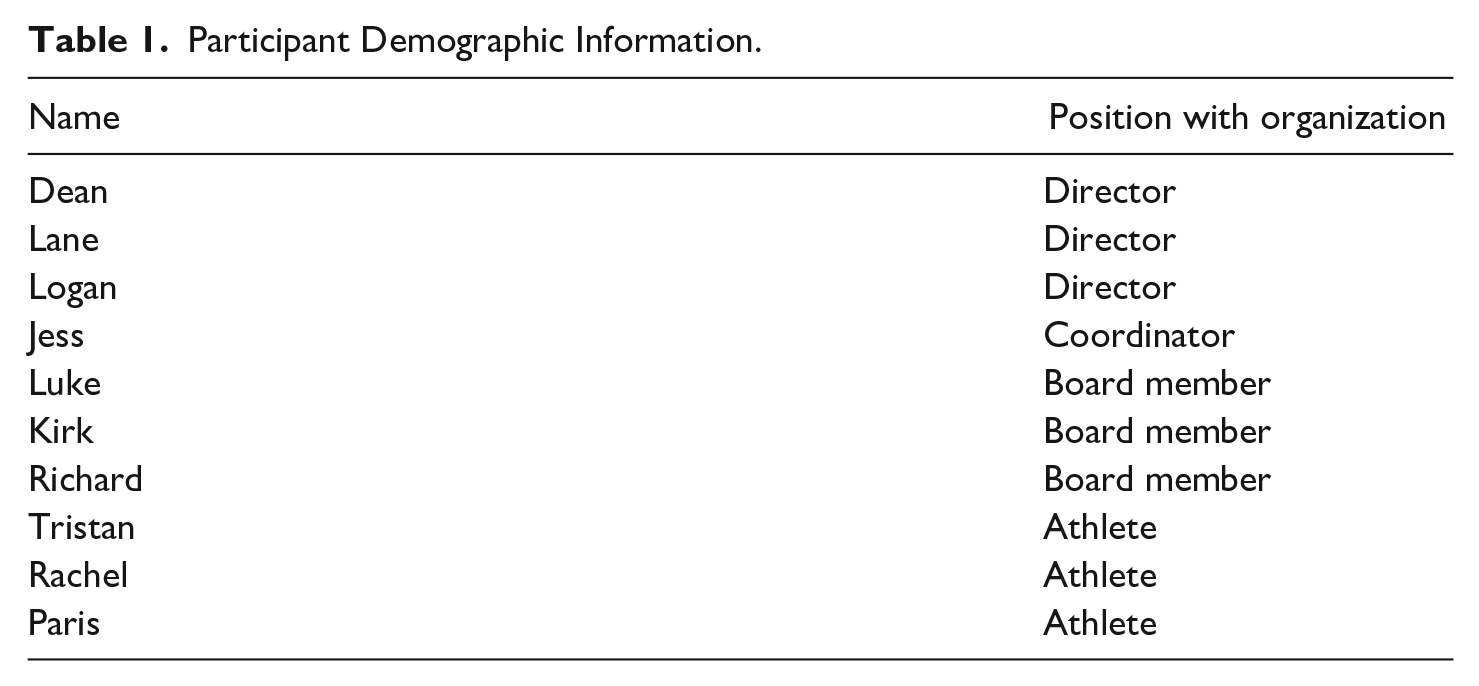
A total of 10 participants agreed to take part in the study. To protect participants’ identities, pseudonyms were assigned or provided by the participant. Demographic data were collected, but with a small organization, any demographic information given would reveal the identity of the individual. Participants within the organization represented a wide range of positions and roles, some entrenched with day-to-day operations of the organization (directors and coordinator, henceforth employee), while others establish the strategic plan, fundraise, and hire for the organization (henceforth board member). Athletes were recruited for the study. A total of three athletes, two from individual sports and one from a team sport participated in the study (henceforth athlete). Table 1 includes the participant positions and pseudonyms.
Participant Demographic Information.
RQ1: What resources are exchanged between Athlete Ally and its Athlete Ambassadors?
As previously discussed, Edwards and McCarthy (2004) identified five resources—moral, cultural, social-organizational, human, and material—that SMOs need to support activism and advocacy efforts. The following section outlines the resources that Athlete Ally provides its Athlete Ambassadors. Table 2 presents a list of resources Athlete Ally provides its Athlete Ambassadors. Conversely, Table 3 presents a list of resources the Athlete Ambassadors provide Athlete Ally.
Summary of Resources Athlete Ally Provides Athlete Ambassadors.

LGBTQ: lesbian, gay, bisexual, transgender, and queer.
Summary of Resources Athlete Ambassadors Provide Athlete Ally.

Moral resources
Moral resources include intangible, external resources like legitimacy, support, and celebrity (Edwards & McCarthy, 2004). Participants frequently noted that Athlete Ally consistently provided its athlete constituents with a plethora of moral resources, including credibility and legitimacy and a community of individuals who support athlete activism. When speaking on his own personal LGBTQ advocacy work via a social media campaign, Tristan (athlete) stated, “Having Athlete Ally’s name definitely helped and in that social campaign I ran, it was huge. So, again, I think that it just legitimizes the things that I try to do.” Tristan mentioned the powerful brand of Athlete Ally, specifically within the LGBTQ and sport realm, that provided him with a boost of credibility and legitimacy in his advocacy work. Jess (employee) noted how this credibility and legitimacy can be parlayed into further recruitment of activists: I often speak to a lot of athletes who are queer, who are on college campuses, who are like, ‘I kind of do this work in some capacities, but I’m alone in it and now that I have this organization’s name, and this organization’s support, I can get other people to join me in this work under the umbrella of a club.’ So, I think that credibility and that name is really helpful . . .
Jess (employee), in talking to athletes, noted that the work of the activism was a little easier with the organization supporting the athlete. Using the brand, image, philosophy, and shared values of Athlete Ally, according to Luke (board member), the athlete can more successfully engage in LGBTQ activism and/or mobilize other allies.
Athlete Ally’s support in the form of a community of athlete activists is another moral resource that Athlete Ally provides its athletes. Lane (employee) illustrated this point: I think the other piece that we offer is this sense of community in terms of being a part of a larger social justice movement for human rights of LGBTQ athletes just being in the social justice space and have it be both expected, we like to say, and accepted, because as you know, athlete activism is on the rise, but as is criticism of athlete activism, especially in this country.
As noted, the community is an important resource. Just as important, is the last phrase about how activism is on the rise, but so are the critics of athlete activism. As Luke (board member) said, More often than not, owners of sports professional franchises really don’t want their athletes being political. You know, they don’t like athlete activism, they want them to keep their heads down, play the sport, win the games, make money for them, and be quiet.
Lane and Luke offer confirm that certain actors do not want athletes engaging in activism. However, Athlete Ally provides its athletes with a space to openly engage in activism with a decreased fear of retaliation.
Shifting focus to what Athlete Ambassadors provide Athlete Ally for moral resources, the athletes also provide Athlete Ally with credibility and legitimacy through their numbers and celebrity. As Dean (employee) stated, “Well, you know, I think their name and likeness for us to be able to say we have 150 professional athletes, that lends a little credibility to the organization.” Dean and other participants believe the large number of athletes that are Athlete Ambassadors lends credibility and legitimacy to Athlete Ally. Lane (employee) added, “They also raise the visibility of our organization, so the more Athlete Ambassadors we have on board, the bigger the names are, the more people get to know our work in that way.” Lane also brought up way the athletes lend credibility and legitimacy other than just the number of athletes: celebrity status.
Celebrity and star power advocacy are crucial for mobilizing activists for SMOs. Logan (employee) provided an actual example of an athlete benefiting the organization through their star power, “Some of them [athletes] will show up at events, so for us that’s a big, big thing. If you can get Jason Collins to attend a party, people are more likely to go.” Jason Collins was the first out active gay player in any of the four major North American sports. As Logan stated, having Jason Collins attend an event (i.e., Pride Night) provides more legitimacy for the event and draws more of the public to the event. Through that attention and legitimacy, high-profile celebrity athletes can then lead activism efforts like mobilizing resources and influencing political entities. But even nonhigh-profile celebrity athletes provide great value. Paris (athlete) agreed with this notion, “I do think we [Athlete Ambassadors] provide some sort of notoriety. . . I guess we normalize this conversation and perpetuate that ‘acceptance is the way to go’ when it comes to LGBTQ issues.” Paris noted the strength of the Athlete Ambassador within and outside their sport through their ability to normalize the conversation about LGBTQ acceptance and encourage future activism.
Cultural resources
Cultural resources are conceptual tools and specialized knowledge that have not become widely known. For example, in the case of Athlete Ally, examples include hosting a panel of athletes to speak about LGBTQ inclusivity and collaborating with a professional sport organization to organize a Pride Night. Participants noted that Athlete Ally has positioned itself to be an actor that works to influence sport and provide more mechanisms for LGBTQ inclusiveness as the organization conducts research and engages with sport governing bodies. Thus, the organization is committed to the specialized knowledge of knowing how to operate in a social movement, particularly a social movement within sport. The cultural resources identified in this study come in different forms: tangible documents describing anti-LGBTQ or pro-LGBTQ policies and best practices for engaging with political and athletic actors, collaborations on opinion editorials and social media posts, and finally intangible resources like counseling and trainings.
Additional data sources provided by Athlete Ally, including tangible documents and tool kits describing policies or practices, were examples of cultural resources Athlete Ally provided its athletes. As Jess (employee) mentioned, “So, if there’s a policy that is coming out, we’ll provide them with a one sheeter of what’s going on and what they can do.” The one-page summary documents are intended to provide specialized knowledge that athlete constituents need to know about a certain policy or bill. In a similar vein, Athlete Ally also provides its athletes with in-depth educational tool kits. For example, the researchers were given access to an Athlete Ally Campus Resource Guide, a tool kit designed to help college athletes start an Athlete Ally Campus chapter (Athlete Ally, 2017). The tool-kit was broken into multiple parts: about Athlete Ally, recent campaign victories like launching the Athletic Equality Index, steps to starting a chapter, suggested on-campus initiatives and events, talking points for the college ambassador, and frequently asked questions (Athlete Ally, 2017). This data source points to the tangible knowledge that Athlete Ally provides its athletes to help them be more effective in their activism.
The goals of the tool kits and one-page policy summaries are to provide athletes with education and awareness. As Kirk (board member) mentioned, “I think we can provide people [athletes] with education, awareness. There are plenty of allies all over the country that just don’t know that there’s a world out here. So, I think awareness is a big part of it.” By providing the athletes with specialized knowledge, the organization can build awareness about combating anti-LGBTQ policies, supporting pro-LGBTQ polices, and practices to help assist the organization complete its mission in a quick and efficient manner. Tristan (athlete) mentioned these training resources in his interview: And then they literally provide me with training resources. So, I have been heavily involved with both the governing bodies of [Tristan’s sport] in this country, with getting their coaches trained properly on sensitivity issues and they have physical resources that they provided you with that I provided with the leagues.
Tristan is able to receive the training resources and turn around to the governing bodies for the entire sport Tristan competes in and train all coaches on being more inclusive. The specialized knowledge come from Athlete Ally and is given to the athlete to further their activism.
Second, the organization collaborates with athletes on making public statements. As both Dean (employee) and Logan (employee) mentioned, Athlete Ally provides sample social media tweets or content (e.g., logos) for the athletes if they want to send out a message. For instance, in March 2018, NBA player Reggie Bullock announced his partnership with Athlete Ally as he became an Athlete Ambassador. The tweet from Bullock’s personal account had a similar structure and appearance to other tweets from Athlete Ally’s account (see Figure 1). The two tweets having similar logos, fonts, and design indicated that Athlete Ally helped the athlete design a tweet to send out announcing his newly formed relationship with Athlete Ally. One can assume that Athlete Ally provided the logos, fonts, and helped craft the message for Bullock so he could send the tweet from his personal Twitter account.
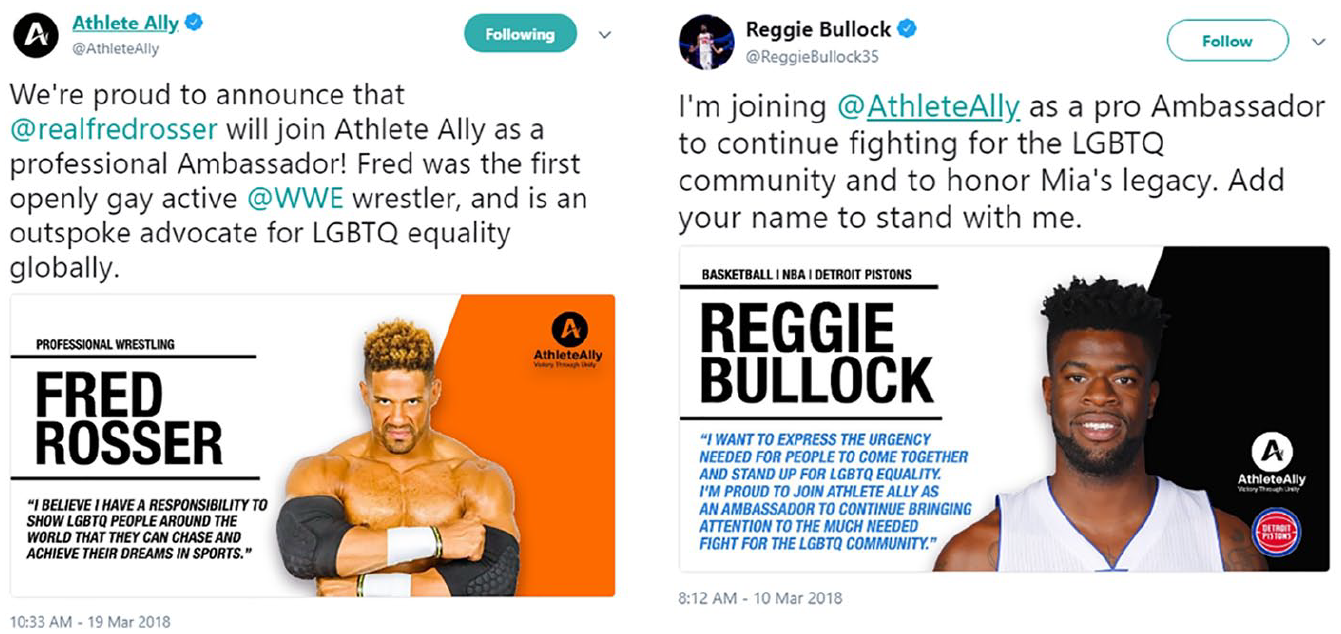
A comparison of tweets from an Athlete Ambassador’s account and Athlete Ally’s account.
The organization wants to create a uniform look and terminology while also allowing athletes to use their own story. The organization carries the specialized knowledge of creating uniform media posts, while the athletes can provide the words and the story. Beyond social media, Athlete Ally also helps with public statements by the athletes. Rachel (athlete) noted, When I wrote my essay, the story that I wrote initially, they were really awesome and they were just like “we want you to tell your story and we do not want to put any restrictions on it.” So, I wrote it out and sent it to them and we workshopped it a little bit so it was more concise and more direct.
Participants frequently noted that the organization wanted the athletes to construct the story, not Athlete Ally. Athlete Ally still is available to assist in the message being sent out, but athletes and employees noted that the core message must come from the athlete.
Finally, the last major cultural resource the organization provides its athletes is availability for questions and counseling, in other words, general support. With the prevalence of homophobia towards athletes and coaches who identify as LGBTQ within sport, the organization has sought to maintain support through an emotional means. By being available for the athletes, the organization can support athletes as they recognize their orientation, share their gender identity, and/or sexual identity. Tristan (athlete) takes comfort in this noting he receives benefits from Athlete Ally on “ . . . an emotional level. I love being part of a team. If there is ever a circumstance that comes up that I need extra support, I do not think you can put a return on that.” Tristan clearly cannot put a value on the emotional support Athlete Ally can provide. Jess (employee) noted that Athlete Ally is always available to answer questions for the athletes and written documents prove this fact.
On the flip side, participants did not note any cultural resources Athlete Ambassadors provided Athlete Ally. The athletes noted their primarily responsibility resided in building awareness for the movement and SMO. Their expertise is not in the coordination of action and organization of constituents, like a SMO. Therefore, it is not surprising that athletes do not provide Athlete Ally with cultural resources.
Social-organizational resources
Social-organizational resources are networks and infrastructures SMOs use to accomplish organizational goals. For example, social-organizational resources may include social networks (access to people) and other protagonist organizations. One of the most frequently mentioned intentional social-organizational resource Athlete Ally provides its athletes was a strong social network. Because Athlete Ally partners with so many athletes and other pro-LGBTQ sport entities, the organization can provide access to a vast array of connections and access to other athletes as the SMO serves as the basis for mobilization for a social movement. Jess (employee) noted, when speaking about Athlete Ally Campus Chapters in similar geographical areas, “They’re like, ‘can you put me in contact with this chapter, because I really like what they’re doing.’ So, in that way, it’s all about connections . . .” This seems to indicate that Athlete Ally is also connecting athletes to help them learn from one another about best practices. Being the centerpiece, Athlete Ally can easily provide direct contact with different athletes or teams to share strategies, information, or collaborate and create a strong system for the opposition of anti-LGBTQ policy. Logan (employee) illuminated about the ability of Athlete Ally’s network reach: So, I think it increases dialogue, and it’s also cross-sport, so it’s not just . . . You’re in your silo, and you’re just a soccer player, or were a soccer player. It’s more like bridging the gap with different sports so that there’s a bit more of a conversation going on. And even men and women, because I think there’s even that sort of division that happens.
Logan (employee) mentioned how Athlete Ally can reach out to other athletes across sports and genders. Athlete Ally has the chance to break down both of these gender and sport barriers through its network.
In addition to networks, Athlete Ally also provides its athletes with a platform. Athlete Ally is a platform for athletes to use and connect to other activists and protagonists. An examination of Athlete Ally’s social media accounts shows how large of a reach an athlete can have utilizing Athlete Ally’s platform. An athlete can share a story or make a statement through Athlete Ally’s Twitter (23.1K followers at time of study) or Facebook (15.1K likes at time of study) and access a platform to reach thousands of individuals with their story or activism. Richard (board member) summarized the importance of Athlete Ally as a platform: So, there’s that opportunity, especially for more prominent athletes at the collegiate, or at the professional level, and coaches who want to be a part of it. I mean, there’s a ton of athlete activism going on right now, whether it’s about racial equality, guns, LGBT equality, and we sort of provide that opportunity for athletes to use their voice. Because, they’re heroed in our society and they have huge fan bases, and huge social media followings, and we give them the tools and opportunities to do that, as well.
Richard noted the power of athletes by making the statement that athletes are “heroed in our society.” As noted before, the pull from extremely visible celebrities like Billie Jean King or Jason Collins is important, but athletes with lesser star power still feel their impact being made. As Paris (athlete) admitted that she did not have a large star power, she still noted her platform that she would otherwise not have obtained had she not partnered with Athlete Ally: I think they provide a platform to tell my story. I think that is mutually beneficial as well. But again, this opportunity to travel and speak to college students. That was something athletic activism/athlete activism, that I did not really get when I was in school.
Paris was still given this platform that she could use for activism to travel and speak to others and firmly believed that the platform she was given helped her grow as an activist. Rachel (athlete) furthered this notion, “So, Athlete Ally providing more of a platform for me to do that [LGBTQ activism] is definitely the biggest intangible asset they have provided me.”
Athlete ambassadors also provide the organization with social-organizational resources. The athletes also lend a network to other athletes, connections to state based and local groups, and generally open doors to other potential protagonists or antagonists to Athlete Ally. Logan (employee) described it by saying: They also help make introductions and relationships. Sort of like a spider web. That way we get to another athlete is often through another athlete. Or even just teams and leagues. So, someone will say, “Oh, you should be talking to the head of Major League Soccer. I can get you that meeting.”
The opportunity to expand a SMO’s network through constituents is invaluable. If an athlete participates in a team-focused sport (or even individual sports), Athlete Ally can recruit other members of that team to be Athlete Ambassadors.
The network, however, is not simply limited to athletes. Athletes, per Lane (employee), provide Athlete Ally access to people and spaces, and that kind of access we might not have. Connecting with high level athletes or their agents, open doors for us to either access the other athletes, access to other people interested in the organization . . .
If it was not for the athletes providing this network with other high-level athletes, agents, or other protagonists/antagonists, Athlete Ally may not be able to gain access to those spaces. For example, there was anti-LGBT legislation in Indiana when Republican Mike Pence was governor. Richard (board member) noted the importance of a former athlete being able to access a space previously inaccessible. Richard stated, We [Athlete Ally] brokered a meeting between Greg Louganis, who’s on our advisory board, and Vice President Pence, which hasn’t been often told. We got Lambda Legal lawyers in to meet with the Governor. And they had refused to meet with Lambda but, it turns out that the Governor was a big fan of Greg. Because Greg . . . I guess the diving program is based in Indiana? Or perhaps it’s some relationship to the diving program and he took the meeting with Louganis. And Louganis was able to bring in Lambda [Legal] and, my understanding is that, they either changed or he did not sign the law.
Greg Louganis gave Athlete Ally an incredible opportunity as the organization utilized his access to help defeat the anti-LGBTQ legislation. This example once again shows the strength of celebrity and athlete activists: the ability to connect and reach spaces a SMO cannot on its own. In addition, the network of athletes can provide opportunities for further activism within a sport for which Athlete Ally may not be familiar. Rachel (athlete) stated that she could help build a presence for Athlete Ally within her sport, a sport that Athlete Ally was not previously present. Rachel was then able to “Create an ‘Avengers’ type league of athletes within Athlete Ally to help form game plans on how to do inclusivity in the world of [Rachel’s sport].” Rachel, just as Greg Louganis did outside of the world of sport, was able to bring Athlete Ally into another sport realm and start to build those relationships and activism efforts.
Human resources
Human resources are mainly the labor needed to advance movement goals, but can also include an individual’s experience, skills, and leadership. For example, if an Athlete Ambassador wanted to hold a rally or a march but needed physical bodies to mobilize, Athlete Ally could reach out to volunteers or followers to attend the rally. There was no mention from Athlete Ally employees, board members, and Athlete Ambassadors however, that this practice ever occurred. The athletes are not the ones holding events and organizing activism efforts—the organization holds that responsibility. In addition, Athlete Ally is a small organization. According to Athlete Ally’s financial reports, only five full-time employees and board members who average two hours of work for the organization per week. This should indicate that supplying human resources is not a realistic role for the organization. Instead, the organization specializes in providing moral, cultural, social-organizational, and material resources for its Athlete Ambassadors.
Conversely, the athlete constituents provide a myriad of human resources, most notably their lived experiences and other activists (i.e., supporters of the athlete). For Logan (employee), athletes provide the organization with a “variety of voices” and a “patchwork or quilt of experiences” that aids the organization. Their lived stories represent human resources because they are not specialized knowledge, but rather are lived experiences inherent to the constituents. For an example, Dean (employee) talked about Greg Louganis being adopted. Louganis’ story can be used by Athlete Ally to help bring the issue into a real-life setting, particularly involving concerns over LGBTQ anti-adoption legislation. Using an athlete’s story is a common practice for Athlete Ally. Jess (employee) described how the stories are used through different channels: They [college chapters] provide us with a lot of stories, which we use in a lot of different ways. We use it on our communication front and even in the development front, when we ask donors for funds, or “this is the kind of work we’re doing, and these are the people it impacts in these stories of our college chapters.”
In addition, emails sent from the organization to those that signed up for the newsletter from Athlete Ally highlighted individual athletes’ stories. Their stories dove into their journey of being a LGBTQ athlete, their experience as a trans athlete, or an ally to a LGBTQ individual. Each story was unique to the athlete and their experience. One such story that was sent via email on Athlete Ally’s webpage was created by Rachel (athlete). The email contained information about Rachel’s background, their coming out story, why Rachel was involved with Athlete Ally, and her advocacy plans moving forward. Rachel was able to provide that unique experience and share her story on behalf of Athlete Ally and utilize that story to help Athlete Ally recruit members or continue their activism.
Stories are not the only human resource athletes provide Athlete Ally. The athletes, through their platform, can help provide “traffic” like human signatures or visits to the organization’s website. For example, Dean (employee) stated, So, it’s good to have their name and affiliation, they send a lot of traffic our way in terms of promoting our pledge. So, we’ll be getting . . . like they’ll encourage their followers oftentimes and sustain a substantial following to sign the Athlete Ally pledge.
Paris (athlete) reiterates this idea as she noted her reach through her coaching. She stated, “For me, personally, as much as I can, in my own avenues and arenas, I am also a coach, so it is important to have these conversations [about LGBTQ equality] with my athletes as well.” Paris can engage with those athletes or nonathletes she comes into contact to discuss how they could potential further the mission of Athlete Ally through LGBTQ equality. Athlete Ally can then use those human resources mobilized by the athlete activists to volunteer for marches and events or sign pledges and other forms of activism.
Material resources
Material resources are arguably the easiest resources to identify. They include tangible items like signs, money, equipment, and posters. Participants did note that the material resources provided to athletes were minimal. Almost every member mentioned stickers, t-shirts, graphics, and other “SWAG” as material resources provided to the athletes. These resources provide the athletes with awareness opportunities for the cause and Athlete Ally. Athlete Ally used merchandise to assist with the Principle 6 campaign. The Principle 6 campaign was started by Athlete Ally and All Out (a social media LGBTQ advocacy organization) in response to Russia’s anti-LGBTQ laws prior to the 2014 Sochi Winter Olympic Games. The organization had merchandise and apparel, some of which given to the athletes, for sale with a “6” logo. The level of awareness raised from the campaign helped society open their eyes to the issue, as Richard (board member) noted, We were able to get P6 into the conversation, not only having celebrities and athletes wearing P6 gear and posting about it, but literally, when Bob Costas opened the Olympics, as he always did until this year. With his opening narrative, he talked about be the movement and the anti-LGBT laws . . . And there were a number of athletes who wore P6 stuff at, potentially great, personal peril because you don’t know what’s going to go on in Russia.
The use of celebrities and providing them with visible unifying material goods helped Athlete Ally raise awareness for the Principle 6 campaign and bring issues into the societal conversation. What started off as a beanie, helped partly inspire journalists and media members to discuss the anti-LGBTQ Russian legislation. Athlete Ally gained a tremendous boost in traffic when a prominent athlete and/or protagonist wears or displays its material goods and brings awareness to the organization and its campaigns.
On the other side, material resources from the Athlete Ambassadors to Athlete Ally came in two forms: fund-raising opportunities and direct funds. In a simple example, participants noted merchandise, like a signed soccer ball from Athlete Ambassador Megan Rapinoe, was a resource that Athlete Ally was able to use for fundraising efforts. Another popular “package” provided to Athlete Ally by athletes are sport opportunities. For instance, Logan (employee) noted, “[we] auction off some cool packages, ‘Getting to work out with Jason Collins,’ and some unique sport stuff.” These opportunities are then translated into funds for the organization. In addition, the athletes will direct provide funds to Athlete Ally. Both Paris (athlete) and Tristan (athlete) have donated to Athlete Ally in the past as Athlete Ambassadors. Tristan (athlete) specifically noted, I fundraise once or twice a year through different things. I have done apparel sells. Right after the [2016 presidential] election everyone was super motivated. I put together a “Stronger together” t-shirt and all the proceeds went to Athlete Ally. This year, I ran a marathon and during my training for that marathon, I did a GoFundMe that was just a fundraiser and all that money went to Athlete Ally.
These direct funds also go straight to Athlete Ally to be utilized for their operations. Whether it is a fund-raising opportunity or direct funds, money is a material resource that Athlete Ambassadors provide Athlete Ally.
Discussion
This study was the first to examine the relationship between a sport SMO and athlete activist from both perspectives. Although past studies (Wilson et al., 2015; Yan et al., 2018) have examined resources from the athletes to an event or an informal organization, this study differs in that it examined the organizational resources provided to the athlete activists and vice-versa. In doing so, it is clear from the results that Athlete Ally and their Athlete Ambassadors have a mutually beneficial relationship. Without the Athlete Ambassadors, Athlete Ally could struggle to be taken seriously in the athletic realm. Without the organization, the athletes could be fractured and unable to achieve tangible progress within the movement. For a summary of the resources exchanged between Athlete Ally and their athlete constituents, see Figure 2.
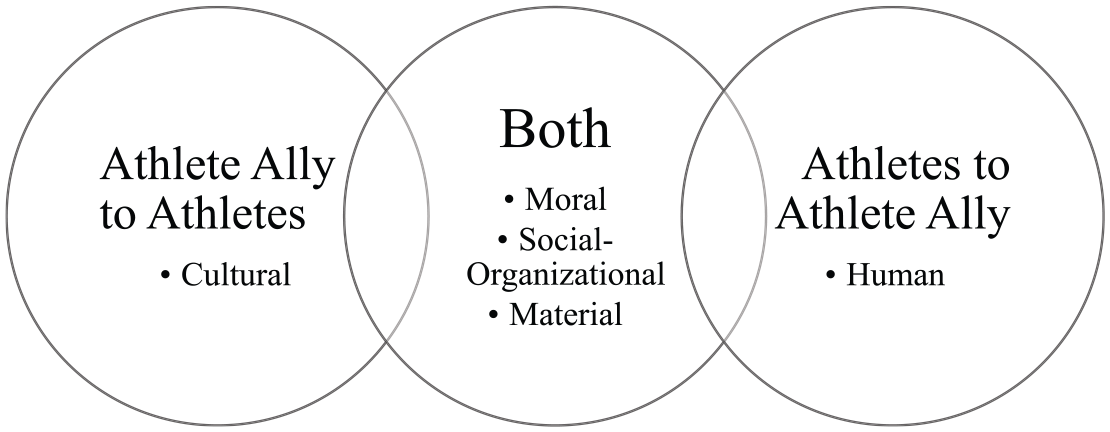
Comprehensive overview of resources exchanged between Athlete Ally and its athlete constituents.
Resources Athlete Ally Provides Athlete Ambassadors
Athlete Ally provides a wide variety of resources for its athletes ranging from intangible to tangible. First and foremost, Athlete Ally serves as the central point for mobilization of LGBTQ issues (Caniglia & Carmin, 2005). The athletes and employees all noted that athletes were given credibility by being associated with Athlete Ally. The organization’s name and support for the cause and, therefore the athlete, acts as an important point of continuity for identity and collective action for its constituents (della Porta & Diani, 2006). As noted by the athlete participants, Athlete Ambassadors are naturally leant credibility and legitimacy by being associated with the Athlete Ally identity. One athlete participant noted how he was given automatic legitimacy in his LGBTQ advocacy simply because he was associated with Athlete Ally. Athlete Ally’s credibility and legitimacy was a strong resource for athletes as it gave them confidence and encouragement to continue their own activism and recruit further activists. This finding is important as it speaks to the value that the SMO can provide the athletes to engage in activism. With that added credibility and legitimacy, the athletes were able to engage in more activism or social justice which can benefit the SMO as well.
Athlete Ally can also provide a safe space for their athletes to engage in activism. As noted by an employee, athlete activism is accepted and expected by Athlete Ally. Athlete Ally creates a safe space that can help shield athletes from harsh criticisms of being an athlete activist. For example, while an athlete is subject to verbal abuse for engaging in activism (Frederick et al., 2017, 2018; Sanderson et al., 2016), the organization, and its members, can reinforce the idea that activism is accepted and provide emotional support, as one athlete participant noted. Athlete Ally, and other sport specific SMOs, can step into the role of being a safe space for their athlete activists. Although the mission of ending trans and homophobia in sport is certainly the goal, it should not be overlooked the importance of a space area for constituents who wish to engage in activism or increase their engagement in activism.
Another crucial resource Athlete Ally provides its Athlete Ambassadors is coordinated activism via the specialized knowledge (e.g., tool kits, one-page summary sheets; Carty, 2002; della Porta & Diani, 2006; McCarthy & Zald, 1977; Scott, 1981). Professional, Olympic, and Paralympic athletes have to navigate rigorous training and playing schedules in their daily lives to achieve their athletic goals. As such, having expert knowledge on language for a speech, fundraising through other athletes, or knowledge on a specific policy may not be possible. Instead, the responsibility of having that cultural knowledge should fall on the SMO (Caniglia & Carmin, 2005). Athlete Ally is able to do this by coordinating social media posts or emails with important information proved to be beneficial to the athletes. They were able to understand important bills or legislation and act if desired. Thus, it falls upon the SMO to provide that specialized knowledge swiftly, so athletes can be used as prominent speakers and communicators with the public (Brockington, 2014; Wilson et al., 2015).
One of Athlete Ally’s other main contributing resources is its vast social network. The organization having a large social network is beneficial for multiple reasons: the retention of activists, the longevity of the SMO, and the ability to engage in more activism (Thrall et al., 2008). Athlete Ally’s large network is also beneficial as it allows athlete activists to have a greater platform. An overwhelming finding was that the platform Athlete Ally provided the athletes was invaluable. Not only were the athletes able to meet other athletes and mentors through Athlete Ally, but they were able to spread their message to an even greater number of individuals. To further this point, when asked how the athletes became involved with the organization, most athletes said through a friend or mentor who was with Athlete Ally. This reinforces the notion that social networks are vital for recruiting activists (Lee & Cunningham, 2019; Louis et al., 2016; McPherson et al., 1992) through their social network. It should be noted that Athlete Ally has, over eight years, built a social network to include over 150 athletes and thousands of followers on social media. Their social network is large and does grant athletes a large platform for which to engage in activism, furthering their mission.
Next, Athlete Ally generates awareness through SWAG and t-shirts to create a collective identity of athlete activists (Dorf & Tarrow, 2014). As mentioned, SMOs serve as the point of continuity for identity and collective action for its activists (della Porta & Diani, 2006). This point of identity is extremely important for Athlete Ally as creating a common identity in the LGBTQ movement creates internal cohesion, which increases mobilization (Armstrong, 2002). By creating logos and distributing material resources with that logo, the collective identity can become easily identified. Athletes, who can be positively viewed as leaders in society (Cunningham et al., 2019; Wilson et al., 2015), can be encouraged to wear the merchandise to benefit this organization.
Athlete Ally does have areas of improvement in terms of the resources it could provide its athletes. The data indicated that the organization does not provide notable human resources toward its athlete activists. Athlete Ally does not have the number of employees to effectively distribute human resources, as only five full-time employees were on the staff at the time of the study. Human resources are important for the survival of the SMO (Disney & Gelb, 2000; McCarthy & Zald, 1977; Saville, 2015). Athlete Ally could look to mobilize social media followers and activists to support their athletes. This strategy was not noted by either the athletes nor the organizational members. Athlete Ally has thousands of followers on social media, but there was a lack of obvious mobilizing of those followers. Athlete Ally has been able to overcome this deficiency of having human resources by leaning on their Athlete Ambassadors to provide this resource from their social network and platform.
Resources Athlete Ambassadors Provide Athlete Ally
Using their elevated status, or celebrity (Cunningham et al., 2019; Darnell, 2012; Wilson et al., 2015), athlete activists can provide the organization with credibility and legitimacy. Prior research has indicated that celebrity attention on the SMO creates media attention which provides discourse around the organization’s goal, and attracts third party actors to the SMO (Pilny et al., 2014). Thus, the celebrity endorsements are a crucial component for the success of Athlete Ally. The participants specifically noted both the quantity and star power of the athletes that leant them credibility and legitimacy. In addition, there is evidence to suggest that star power may not be all that be completely necessary as athletes are “heroed,” as one participant noted, in our society for being athletes. Regardless of the quantity or star power of the athlete, just being associated with an athlete who is committed to a social issue can help elevate the stature and media attention for the sport SMO (Thrall et al., 2008; Wilson et al., 2015).
Athletes also provide Athlete Ally with access to a broad social network of other athletes. This is a benefit for Athlete Ally as it allows for more athletes and constituents to be recruited for activist work. Just as the organization provided the athletes with a social network and therefore a greater platform, the same can be said about athletes providing the organization with their social network (Brockington, 2014; Wilson et al., 2015). The Athlete Ambassadors were shown to open new avenues for movement progress that were previously inaccessible for Athlete Ally. In the case of Greg Louganis and Rachel, the athletes helped Athlete Ally successfully reach previously unattainable actors and spaces. Whether those unattainable actors and spaces are in or outside of sport matters little. Both Louganis and Rachel provided an effective avenue into a sport that Athlete Ally was not previously well established. Due to Rachel’s connection, Athlete Ally can now continue to achieve organizational goals in a new sport while continuing to grow their own social network.
Another important resource athlete activists provide Athlete Ally was their personal stories and experiences. Almost every participant, both employees and athletes, noted how the athletes’ stories were a vital resource for the organization. Jess (employee) noted how the stories were used as a communication front and a fund-raising opportunity. From the communications stand point, the professional athletes’ story is meant to grab the reader who is sifting through their email or social media page. As the studies from Agyemang et al. (2010) and Kaufman and Wolff (2010), the personal studies from athlete activists are extremely important as they lead to their direct source for wanting to engage in activism. These personal stories help to sell the authenticity (Ellcessor, 2016; Huliaras & Tzifakis, 2012) for their activism and should be utilized by the SMO for communications and fund-raising opportunities. This is particularly true as athlete activists often times have their intentions questioned and efforts dismissed by the public (Frederick et al., 2018).
Athletes also provide resources for the sole reason of fundraising. Athletes merchandise or fundraising campaigns routinely provided materials to be turned into monetary resources. Although some athletes did provide direct funds to Athlete Ally, they made it clear their donations were not substantial. The athletes did use their platform to provide opportunities to raise funds through fundraisers or selling apparel. One athlete, who was training for a marathon, used the opportunity to raise funds for Athlete Ally. This was not a requirement, nor did Athlete Ally ask for Tristan to put on this fundraiser, but he did it to help the organization because he has such a strong connection to Athlete Ally. Outside of direct or indirect donation of funds, athletes can provide signed merchandise or personal experiences (e.g., work out with Jason Collins) as an opportunity to raise funds. Due to the importance of monetary resources for a SMO (Cress & Snow, 1996) understanding all potential revenue streams is important for organizations like Athlete Ally.
The one resource that missing is cultural resources, but that is not surprising. As mentioned, the athletes’ strength does not lie in coordinating action or being a basis for mobilization. As mentioned before, those roles are filled, and should be filled, by the SMO. Thus, it is important that the SMO has leaders and workers that are knowledgeable in being part of a social movement or running a SMO (McCarthy & Zald, 1977). However, no mention was brought up to the fact of helping develop those cultural resources within athletes. Although professional and international athletes may not have the chance to learn and develop these cultural resources, retired athletes could. Perhaps Athlete Ally could start a program or begin to educate athletes on cultural resources to help further develop the athletes’ activism. The role that the Athlete Ambassadors played in supporting Athlete Ally through the resources they provided the organization cannot be understated. Although their social network and ability to raise funds has been noted before (Darnell, 2012; Wilson et al., 2015; Yan et al., 2018), the findings from this study reveal that athletes can lend their credibility, legitimacy, and personal stories and experiences to the SMO to help the organization achieve its mission.
Implications, Limitations, and Future Research
Practically speaking, this study begins to illuminate how SMOs and athlete activists can support each other through various resources. Credibility and legitimacy are vastly important resources for both entities. Just as Athlete Ally provided credibility and legitimacy to their athlete activists, the athlete activists did the same to Athlete Ally. As Athlete Ally members noted, the number of athletes acting as ambassadors was a huge factor in driving credibility and legitimacy. An organization that has hundreds of international, professional, and collegiate athletes supporting its mission provides clout. Just as the organization can provide legitimacy to athletes by boasting the quantity of followers. Athletes and organizations alike can understand that mutually beneficial relationship that comes from forming a relationship between the two entities. This can be accomplished through the use of each entity’s social network. In addition, future SMOs should understand their role of developing and facilitating activism strategies and information, so that athletes can utilize their platform to engage with the activism. By providing specialized knowledge like tool kits or tangible resources like merchandise, the athletes can utilize their celebrity to generate awareness and spurn change for the organization. It falls on athlete activists to learn and utilize that message to continue their activism. This, once again, helps both parties utilize their strength to further their activism. Overall, this study showed that SMOs and athlete activists can utilize each other to help one another be more effective in their activism.
Theoretically speaking, this study contributed to past literature as it placed sport in the focus of Social Movement Theory and RMT. Curiously, Davis-Delano and Crosset (2008) noted that few resources they studied (i.e., Composition of the social movement, leadership of the social movement, and tactics and ideology employed by the social movement and/or countermovement) affected the outcomes of sport-related social movements, while others (e.g., money, labor/time, knowledge/skills) did not. Based on participant interviews, both Athlete Ally and Athlete Ambassadors felt such resources like legitimacy, credibility, and their social networks were vital to their success. Thus, the resources noted may seem to have more impact on sport-related social movements than previously thought. In addition, as one participant noted, athletes are “heroed” in this society, regardless of their star power. Although Social Movement Theory literature supports the notion that star power is important to nonathlete celebrities (Thrall et al., 2008), does star power matter less with athletes engaging in social justice due to their status of being athletes?
Like every study, this study is not without limitations. One specific limitation for this study is the lack of intersectional analysis. In investigating the organization Athlete Ally and the athletes themselves, examining the identities of the participants was not a focal point of this study. As noted by LGBT advocate in the sport setting, Dr. Pat Griffin, homophobia in sport has impacted men, women, and transgendered individuals differently (Sartore-Baldwin, 2012). Indeed, identities such as race, class, ability, sport, and others were not examined and could have an impact on the study. Focusing on the individual identities of the participants was not the focal point of the study. Instead, general roles that the SMO and athlete activists play in providing resources was the goal. One delimitation of the current case is the boundary of the case to one case, instead of multiple cases. The specific use of Athlete Ally narrows the transferability of the results to sport SMOs in the United States. Another delimitation of the study was the interviews of individuals who worked for or with Athlete Ally. Other constituents, like organization followers or bystanders, were not interviewed for the current study.
This study responded to the call from Davis-Delano and Crosset (2008) who encouraged social movement research in sport to “serve social movements that they value by doing research that may help the activists to understand how their movements succeed and fail” (p. 131). Future studies should do the same. To assist in the investigation of researching sport for social change through social movements, RMT, and by extension, Social Movement Theory, should be further studied. The current study identified resources within Edwards and McCarthy’s (2004) typology of resources. Future studies should attempt to go beyond the five categories of resources in studying sport and social movements due to the uniqueness of sport and paucity of research. In addition, examining the intersectionality of the athletes and their activism is important. Few studies have started to take up this task (Lee & Cunningham, 2019). The athletes (and organizational members) interviewed in this study came from all walks of life and had their own stories. Those stories, as well as how they interact with SMOs is vital for examination. Another line of research could happen through utilizing the other subtheories of Social Movement Theory as theoretical guides in studying social movements within sport. Davis-Delano and Crosset (2008), in their systematic review of the explanatory power of social movement theories, identified RMT, Political Process Theory, and Cultural Theories/Frame Analysis as relevant subtheories in sport social movements. Although RMT has been expanded upon in this study, political process theory and cultural theories/frame analysis are also viable frameworks. Each of the three theories can be sufficiently used to examine other organizations that utilize sport for social change such as the Women’s Sports Foundation, Athletes for Hope, National College Players Association, Advocates for Injured Athletes, LGBT SportsSafe, Pro Athletes Outreach, the Player’s Coalition, Athletes for Animals, and other sport-specific SMOs.
Footnotes
Declaration of Conflicting Interests
The author(s) declared no potential conflicts of interest with respect to the research, authorship, and/or publication of this article.
Funding
The author(s) disclosed receipt of the following financial support for the research and/or authorship of this article: This article was particially supported by the 2017 North American Society for Sport Management Doctoral Research Grant.
