



Abstract
The purpose of this study was to determine whether secondary choral directors employed at international schools implemented a multicultural education in their programs. Participants (N = 126) were secondary choral directors working at international schools in 59 different countries. A researcher-designed questionnaire was used to collect information on director backgrounds, opinions, methods, and experiences relating to multicultural music in international school secondary choral programs. Results showed that 62% of directors who teach in international schools reported current use of multicultural teaching practices. Most choral directors who implemented multicultural teaching practices were confident in teaching music from many cultures, considered their students’ backgrounds when selecting repertoire and included nonwestern music selections in their concerts. The resources and repertoire that directors used for multicultural music lessons were numerous and varied. Additionally, 88% of directors noted that working at an international school had positively influenced their multicultural teaching practices.
In secondary choral programs today, students can benefit from experiencing and learning about diverse world musics and traditions. Choral directors’ rationales for teaching multicultural music may vary. Some music teachers may choose to use multicultural music in the classroom in order to encourage awareness beyond western music traditions or to discourage singers from developing ethnocentric or elitist views in music and culture (Abril, 2006b; Anderson & Campbell, 1989; Bradley, 2008; Rose, 1995). Multicultural music can be defined as music that is of a culture other than one’s own, often outside western classical and mainstream traditions. Schippers (2010) describes such musics as “music of the other” or “a music that sounds different, is presented differently and comes across differently” (p. 18). As societies become more international and people of diverse backgrounds become increasingly interconnected, many educators now believe that students need to be prepared for a future that exists beyond the scope of their own hometown or nation (Hayden & Thomspon, 1995; Malik, 2009). In the past 50 years, a variety of reports have examined the importance and benefits of implementing multicultural ideas in schools and in fostering global knowledge and attitudes (Abril, 2006a; Hayden & Thompson, 1995; Spano, 2002).
Many international school educators believe in the importance of creating an environment that cultivates open-mindedness and global awareness (Duckworth, Levy, & Levy, 2005; Grant, Kuhns & Pickert, 1995; Hayden, Rancic & Thomspon, 2000; Hayden & Thompson, 1998). While not all international school employees value or promote cultural understanding, and many different kinds of international schools exist, some research suggests that a variety of these institutions have noteworthy multicultural programs in place (Cain, 2010; Fretheim, 2007; Fulton, 2001; Hayden & Thompson, 1995; Jackson, 2005).
Research on international schools began in the mid-1960s, but studies on the history of these schools and their various curricular programs are limited (Dolby & Rahman, 2008; Spano, 2002). Some writings have sought to provide a definition of international schools (Hayden & Thompson, 1995). For example, Gellar (1981) broadly defined an international school as one that provides an education to students of many nations and cultures and adjusts its curriculum to meet the differing goals of such students. International School Services (2010) has described international schools as private, non-profit, company, or proprietary private schools. These overseas programs most often serve multinational and international business families, members of the diplomatic community, and host-country nationals. The schools’ size, origin of staff, and composition of the student body can range greatly. With English as the primary language of instruction, the schools often offer internationally recognized credentials and generally base curriculum on American or British models.
Research has given insight into international school educators’ perspectives, opinions, and teaching practices. Some studies on international school teachers have identified similar perspectives on what it means to be international (Duckworth et al., 2005; Grant et al., 1995; Hayden et al., 2000; Hayden & Thompson, 1998; Tucker & Gail, 2007). Important themes that have emerged include: tolerance of other cultures, seeking to understand and view concepts from diverse perspectives, a spirit of international pluralism, and an interest in learning about and understanding other cultures. Tucker and Gail (2007) compared the educational views of western teachers and Thai parents at the International School of Bangkok: though it was found that parent and teacher opinions varied, international school teachers believed that education should serve many purposes beyond attaining subject knowledge alone and that students should be encouraged to become independent learners.
While the staff at international schools may agree on diverse and multicultural teaching concepts, such concepts may or may not be initiated and implemented. For example, Grant et al. (1995) noted that while certain elements of an international education were considered important, these elements were not implemented to the desired level at some institutions. Hayden et al. (2000) identified factors necessary to “be international” but did not determine whether international teachers possessed such traits.
Studies on teachers at international schools have also had conflicting results. While Duckworth et al. (2005) found that future international school teachers in George Mason University’s FAST TRAIN program were internationally minded, responses to Fretheim’s (2007) questionnaire, completed by in-service teachers at the American International School of Johannesburg, suggest that teachers were not internationally minded. Because these studies focused on two notably different populations, and used two different questionnaires, research of a similar nature covering a larger sample of international schools and teachers could provide more generalizable findings.
Few studies exist on the music programs in international schools (Cain, 2010; Fulton, 2001; Spano, 2002). Spano (2002) studied the status of music programs in international schools using a researcher-developed survey with quantitative and qualitative measures. That study is unique in that it covered a sample of international school music programs around the world. The returned surveys (N = 51, resulting in a 28% response rate) revealed that 92% of the schools had music programs in place and 71% of the schools offered choral music instruction. While some attention in this study was given to music curriculums and teacher opinions, information on specific methods and attitudes in relation to multicultural education was not reported.
In a qualitative study by Fulton (2001), a comparison of the multicultural practices and resources used by international school general music teachers was limited to China, Thailand, and Outer Mongolia. Through observations and interviews, Fulton found that only one out of the three observed international school music teachers implemented multicultural elements in the classroom. Cain’s qualitative study (2010) focused on the international school elementary music teachers in Singapore (N = 10) and revealed many positive findings concerning multicultural awareness and teaching practices. Results indicated that cultural diversity was an important feature for all of the educators, and that the diverse nature of the institutions and value of such diversity influenced the teachers to value similar practices. While both of these studies focus on international school music teachers and multicultural teaching practices, they are notably different concerning sample size and data collection. Fulton’s study (2001) suggested that multicultural music practices were not sufficient in all three observed international schools, whereas Cain’s (2010) research found that all surveyed international school teachers were culturally aware and actively working to implement sound multicultural programs. Findings are conflicting and it is not clear what kind of multicultural teaching practices, if any, international school music teachers are using today.
The research on multicultural music teaching practices has helped to describe certain programs and, in some cases, suggest the particular methods that may be useful or successful for teachers. Multicultural music education can be defined as an education in which students experience the diverse music of the world in order to achieve both musical and cultural understanding (Abril, 2006a; Kelly & Van Weelden, 2004). Multicultural music teaching practices consist of any method that supports a multicultural music education.
The teaching of multicultural music has been increasingly acknowledged and promoted since the 1950s (Anderson & Campbell, 1989; Campbell, 2004; Mark, 2000; McCarthy, 1997; Reimer, 2002; Schippers, 2010); however, multicultural choral music has not often been addressed. Bradley (2008) conducted a unique study on the Mississauga Festival Youth Choir and its members’ multicultural experiences. This research illustrated the importance of discussions on cultural context for improving understanding and musical meaning for students. Studies by Abril (2006a) and Shehan (1985), focusing on general elementary music, have also suggested that students need to learn about musical context and culture in order to develop understanding and a positive relationship with a foreign music style. Additionally, many music educators agree that multicultural music deserves a place in the classroom along with the traditional literature (Cain, 2010; Legette, 2003); however, little is known about the extent to which multicultural repertoire and practices are being used in schools.
Though studies have been conducted on the topics of international school programs and multicultural music education methods, there exists almost no research that combines the two; that is, international school music programs and the inclusion of multicultural practices. Particularly, there is no known research focusing on such methods in secondary choral programs. Therefore, a study was needed that focused on choral directors’ multicultural teaching practices, attitudes and experiences in international schools. One could not be certain that a multicultural education was of importance for these teachers; however, if multicultural and international methods and standards were in place, it was important to find out the ways in which they were being implemented.
Purpose of the study
The purpose of this study was to determine whether secondary choral directors employed at international schools implemented a multicultural education in their programs; and, if so, what methods and resources these directors used to achieve musical and cultural objectives. An additional purpose of this study was to examine the experiences of international school secondary choral directors and to inquire whether or not there are challenges and benefits to teaching multicultural music in the international school environment. The study addressed the following questions:
Are multicultural music education practices used by choral directors at international schools?
For those directors who do use multicultural practices, what specific practices and methods are used to implement a multicultural choral program? (e.g., Are such methods a reflection of the school-wide curriculum? What resources do the teachers use to create lessons and units? How do they select their repertoire? How do directors stay informed about the current state of multicultural music and international education?)
What challenges have these directors faced in implementing a multicultural program in the international school setting? On the other hand, what benefits have they experienced by working in the international school setting?
Methodology
Participants
The secondary choral directors in the pilot (N = 21) and main study (N = 126) were drawn from the schools listed in the 2010–11 International School Services (ISS) Directory of International Schools (Rick, 2010). There was no existing database that indicated how many schools in the ISS handbook had employed secondary choral directors and thus no list of choral director contact information. I obtained director emails in March and April of 2011 by contacting school personnel listed in the ISS handbook and school websites through personalized email messages, as well as Skype phone calls if there were no responses to the first two emails. In the pilot study, the ISS handbook was used to select international school choral directors from countries beginning with letters A and B as well as selected national school teachers working in the USA. I found that none of the sampled international schools that employed fewer than 25 teachers had secondary choral directors on staff; therefore, I decided that small schools with fewer than 25 teachers would be excluded from the main study. In the main study, the population was sampled from the international schools listed in the ISS handbook that employed 25 or more full time teachers and that were from countries beginning with letters C–Z (N = 409).
Of the 318 schools (78%) that responded to inquiries, 188 (59%) schools reported the employment of one or more secondary choral directors and 130 (41%) schools replied that there were no existing secondary choral directors on staff. Three of the schools employed secondary choral teachers who did not speak English and thus these individuals were not able to complete the questionnaire. Due to the scope of this study, which was developed with the intention of reaching teachers in approximately 100 countries, and the knowledge that the language of instruction in most international schools is English, the consideration for offering the questionnaire in different languages was not considered. Including some schools that had more than one choral director employed (n = 11), the sample for the main study consisted of 199 international school choral directors. A total of 136 directors completed the questionnaire; however, questionnaires completed by three individuals who did not meet the population criteria and seven other incomplete surveys were not included. This resulted in a final sample of 126 choral directors, for a moderately strong usable response rate of 63%.
Measure
This study was conducted with a mixed methods approach using quantitative and qualitative data. Since no known studies of a similar nature existed, a preliminary researcher-designed questionnaire, consisting of three sections and a total of 35 open- and closed-type items, was pilot-tested. The survey themes and questions were partially adapted from a variety of studies and sources (Abril, 2006a, 2006b; Anderson & Campbell, 1989; Cain, 2010; Campbell, 2004; Goetze, 2000; Legette, 2003; Schippers, 2010; Spano, 2002) and came to fruition through conversation and discussion at Indiana University, USA. Part A of the questionnaire was used to identify background information on teachers and information about the schools at which they were employed. Part B specifically addressed choral director opinions in relation to multicultural music methods as well as whether or not they currently implemented such methods in their classrooms. All participants taking the questionnaire answered Parts A and B, and only those who answered “yes” to the statement “I currently use multicultural teaching practices in my choral rehearsals” continued on to answer Part C. Part C addressed teaching approaches, choral program elements, and resources used. The final two open-ended questions allowed participants to express views on their personal experiences in the international school setting.
Two expert judges attested to the content validity of the measure before the pilot study was conducted. Internal consistency reliability of the pilot questionnaire was tested using the Kuder-Richardson technique and found to be acceptable (α = .77). Mostly unchanged from the pilot survey, the main questionnaire (α = .79) consisted of three sections and a total of 36 open- and closed-type items.
Procedure
Surveymonkey.com was used to distribute both the pilot and main study questionnaires after contact information was obtained. Choral directors were emailed initial invitations to participate and three reminder emails were also sent over the course of the following three weeks to those who did not respond. I completed quantitative analysis with IBM SPSS 18 software and surveymonkey.com and interpreted the final open-ended qualitative questions with emergent category coding.
Results
Demographics
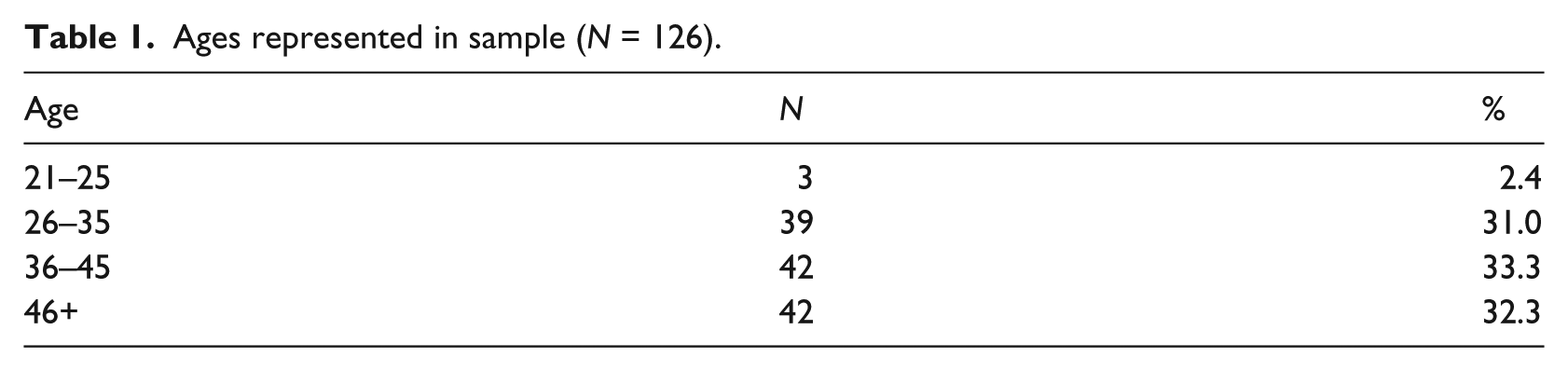
Participants exhibited diversity across a number of categories, although they were largely homogeneous in citizenship. In total, teachers were citizens of 21 different countries; however, the vast majority reported western nationality, with 62% reporting American citizenship (n = 74 plus 4 participants with dual citizenship), 14% reporting British Citizenship (n = 16 + 2), 5% reporting Australian citizenship (n = 5 + 1), and 5% reporting Canadian citizenship (n = 5 + 1). It was found that women represented 64% of the population (n = 82) and men represented 36% (n = 46). Subjects also represented a wide range of age groups (see Table 1); however, only a few reported being 25 years old or younger. A total of 70 teachers (56%) held master’s degrees, with 53 teachers (42%) holding bachelor’s degrees and only 2 participants holding doctoral degrees.
Ages represented in sample (N = 126).
Teachers were employed in 59 different countries, representing six continents, with Switzerland (n = 9), China (n = 6), Germany (n = 6), and Japan (n = 6) being most frequently identified. The majority of directors (n = 89) reported teaching music full time in international schools for 10 years or fewer (71%) and 79% of the population (n = 98) reported experience teaching music in non-international schools as well.
An overwhelming majority of participants (n = 105) taught subjects besides secondary choir during the school day. Six significant subject-types emerged: (a) secondary general music, (b) elementary general or choral music, (c) band, (d) orchestra, (e) drama, and (f) the International Baccalaureate (IB) or IB Middle Years Program (MYP) music. Most often, teachers (n = 50) noted music appreciation and general music-type classes as other subjects taught, not including IB courses; and a number of others (n = 43) taught band and/or orchestra in addition to chorus. IB MYP and diploma music, a specialized global music course and curriculum for students age 11–19, was taught by 26 teachers (International Baccalaureate Organization, 2010).
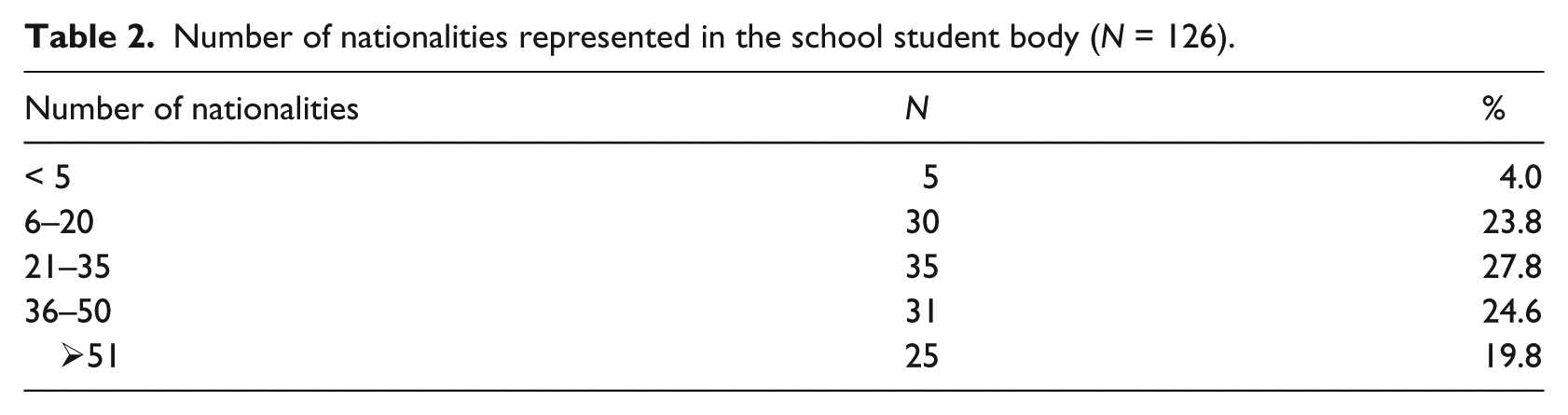
International schools can vary greatly in size, student population, and mission, among other things. Participants worked in schools representing a wide range of student nationalities (see Table 2). Also, roughly half of these schools (n = 59) had a dominant nationality in the student body (more than 50%) and the other half did not (n = 67). Schools that had one dominant student nationality were most likely institutions with a large western population or a large host-country national population. An example of a large western population would be an American International school in Tokyo, Japan that enrolls over 50% American students, where as an example of a large national population would be a Thailand International School in Bangkok that enrolls over 50% Thai students who speak or are learning to speak English. While the questionnaire did not investigate whether teacher nationalities related to those of their students, the range of student nationalities reported suggest that many students in these international schools were of a different nationality than their choral teachers.
Number of nationalities represented in the school student body (N = 126).
A great majority of participants (n = 105) reported working at a school with an established curriculum, mission statement, or set of core values that was multicultural in nature. Only 9% (n = 11) were uncertain and 8% (n = 10) stated that their school did not have a multicultural curriculum, mission statement, or core values.
Multicultural teaching practices and attitudes
For the Likert-scale portion of Part B (1 = Strongly Disagree; 5 = Strongly Agree), participants responded to five opinion statements concerning multicultural music education (see Table 3). Beliefs were convergent, with over 87% of participants agreeing that it was important for students to receive a multicultural education in music (M = 4.25, SD = 0.86), that choral students need to learn choral music from non-western traditions (M = 4.31, SD = 0.80), and that when choral students learn to perform diverse musics, they need to learn about the culture and context in which it came from (M = 4.29, SD = 0.88). Additionally, over 75% of the population agreed that they were confident in their abilities to teach multicultural music (M = 3.81, SD = 0.96), and would like to know more about multicultural teaching methods in choral music (M = 4.10, SD = 0.98). Most importantly, 62% of directors reported current use of multicultural teaching practices in choral rehearsals (n = 78), with 38% (n = 48) reporting that they did not.
Multicultural music education opinions.
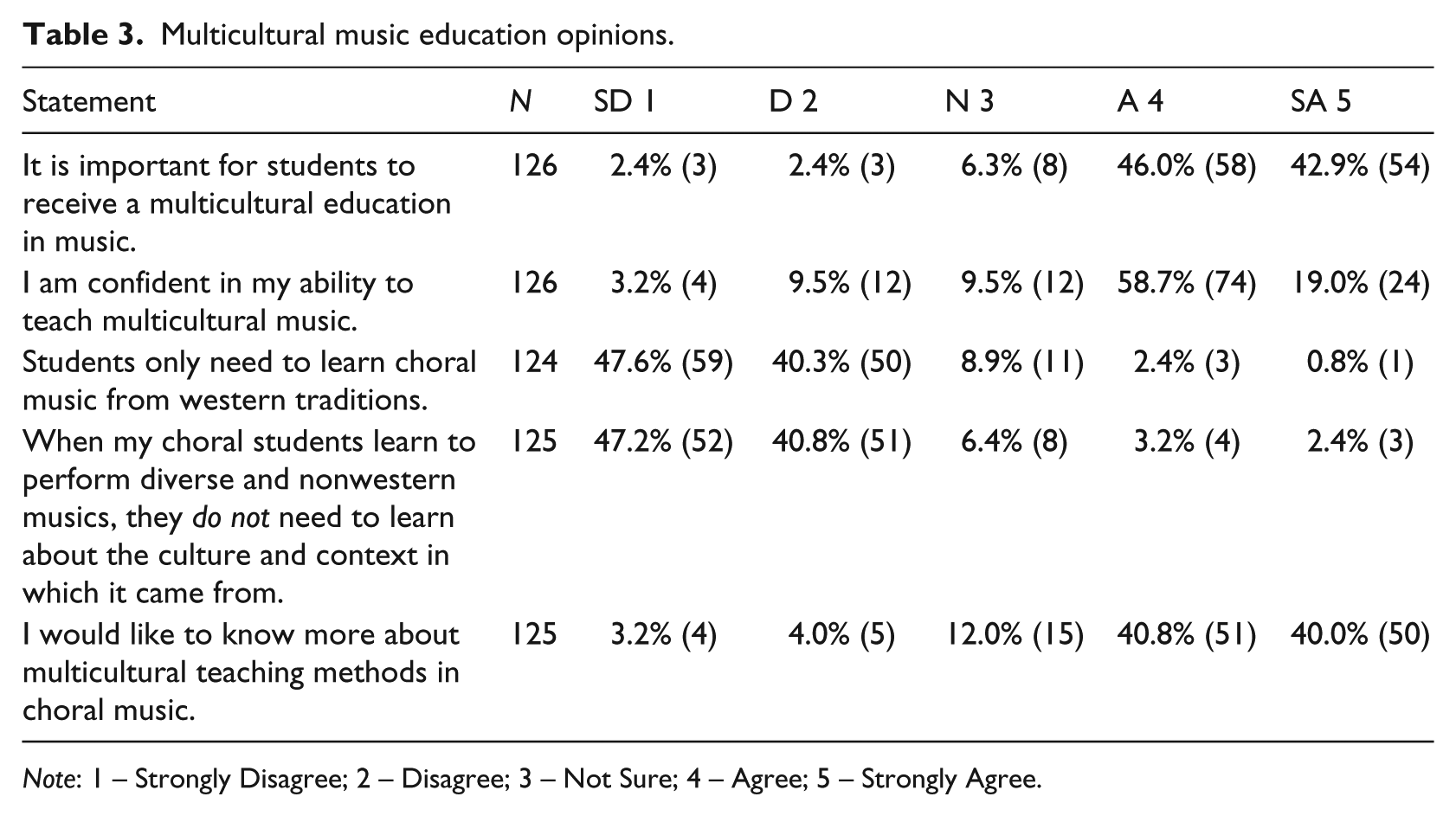
Note: 1 – Strongly Disagree; 2 – Disagree; 3 – Not Sure; 4 – Agree; 5 – Strongly Agree.
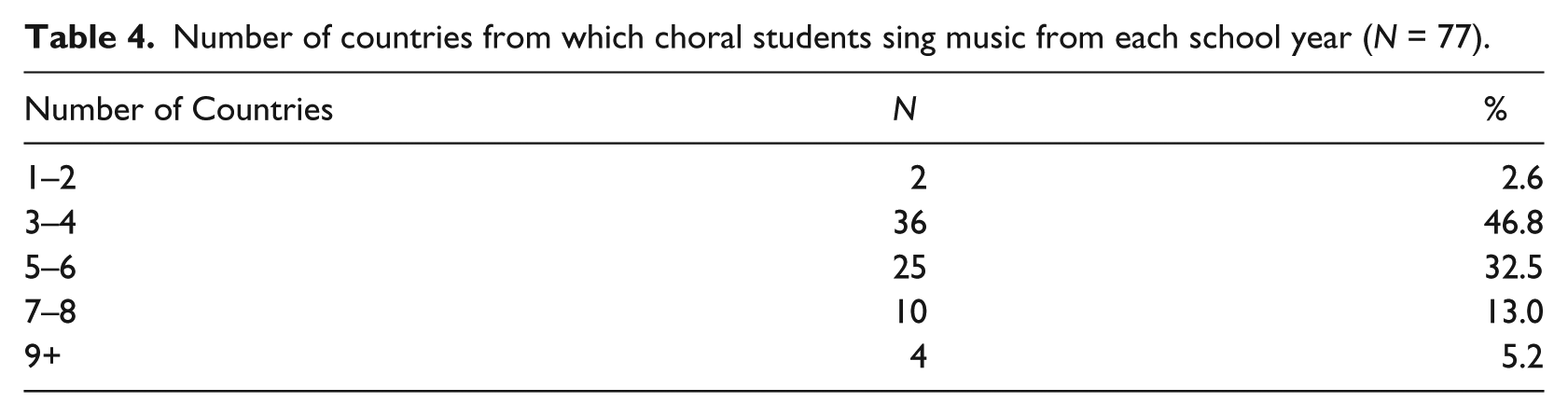
The final section of the survey, Part C, was completed by the participants who reported current use of multicultural teaching practices (n = 77). More than 65% of the directors (n = 51) reported using multicultural music methods for over 6 years, with almost 40% (n = 30) noting more than 10 years. A total of 79% of choral directors (n = 61) taught students music from three to six different countries in one school year (see Table 4) and 71% of participants (n = 55) reported taking one or more of their choirs to an out-of-school workshop, competition or similar choral event in the previous two years.
Number of countries from which choral students sing music from each school year (N = 77).
Participants responded to statements about teaching multicultural music on a Likert-type opinion scale (1 = Never; 5 = Always). Overall there was a wide range of variance in answers, but some majorities were apparent (see Table 5). Most notable is the finding that over 70% of directors who used multicultural practices reported always or often being confident in teaching music from many different cultures (M = 3.81, SD = 0.86) and more than 80% of participants reported that their multicultural methods were always or often compatible with the school curriculum, mission statement and core values (M = 4.17, SD =1.03). Only 47% of participants felt that their methods were always or often inspired by school values (M = 3.45, SD = 1.10). Additionally, a total of 65% of directors used nonwestern music in choral concerts always or often (M = 3.70, SD = 1.09) and more than 70% of directors revealed that they always or often considered students’ backgrounds when selecting multicultural choral repertoire (M = 3.83, SD = 0.97). Concerning the use of culture-bearers, over 40% reported rarely or never communicating with such individuals (M = 2.81, SD = 1.14) and over 55% of directors reported rarely or never having culture-bearers attend rehearsals to assist with multicultural lessons (M = 2.44, SD = 1.09).
Multicultural music teaching opinions and experiences (N = 76–77).

Note: 1 = Never, 2 = Rarely, 3 = Sometimes, 4 = Often, 5 = Always.
The directors who reported the use of multicultural practices in choral rehearsals listed a great variety of teaching resources. Through the process of emergent category coding, it was found that directors prepared for multicultural choral lessons with the aid of seven different kinds of resources: (a) methodology/pedagogy sources, (b) people, (c) professional development/experiences, (d) music scores and catalogues, (e) music news and information sources, (f) visual/audio recordings, and (g) web search engines. Over 80% of directors (n = 64) reported the use of YouTube.com, but no other specific resources were commonly reported. A total of 50 specific resources were listed over all. Performing Ethnomusicology (Solis, 2004), World Sound Matters (Stock, 1996), Teaching Music Globally (Campbell, 2004), Rough Guide to World Music (Broughton, Ellingham & Lusk, 2006), Nat Geo Music (www.worldmusic.nationalgeographic.com) and Smithsonian Folkways (www.folkways.si.edu) were some of the notable resources that directors listed. In a similar question that asked directors how they stayed informed about multicultural music and international education, it was found that directors stayed informed in the following ways: (a) listening to music, (b) attending events and traveling, (c) searching the internet, (d) reading journals, (e) communicating with colleagues and culture-bearers, and (f) searching choral repertoire catalogs.
Choral directors found nonwestern repertoire in a variety of places. Although published multicultural choral arrangements were most commonly reported (n = 71), such repertoire was not the only resource teachers used. More than half (n = 42) reported using unpublished choral arrangements from festivals, conferences and workshops and 60% (n = 46) identified published or unpublished songs and folksongs from music books or the internet. An impressive 48% (n = 37) stated use of their own personal arrangements and compositions and 47% (n = 36) found music with the help of culture-bearers from the local and international community.
Multicultural teaching experiences
At the end of the questionnaire, participants had the option to complete two open-ended questions concerning the challenges and benefits of teaching multicultural choral music in the international setting. Only 56% of directors (n = 43) reported that they had faced challenges in teaching multicultural choral music in the international school setting; however, 88% of teachers (n = 67) stated that working at an international school had developed or positively influenced their multicultural teaching practices. With regard to the challenges faced in implementing a multicultural program in the international school setting, six main categories emerged: (a) problems finding resources/music, (b) difficulty in preparing music, (c) student issues, (d) lack of support, (e) the teaching of sacred music, and (f) limited opportunities. Finding multicultural resources and music (n = 23) as well as preparing to teach the music (n = 18) were the two most often reported themes that provided challenges for teachers. Participants commented on the difficulty of finding authentic and high-quality arrangements in addition to music that was suitable for certain ability levels. Many directors also voiced concerns with language and pronunciation and noted the difficulty of interpreting the style of multicultural musics.
With regard to the benefits of working in the international school setting, six main themes emerged: (a) student attitudes and assistance, (b) career turning points, (c) positive changes in teaching, (d) culture-bearers, (e) the discovery of new music and methods, and (f) the environment. A large number of directors (n = 28) noted the benefit of working with international students. Not only was it explained that students were open to learning music of other cultures, but many described the great contributions of students in sharing and teaching music of their own cultures. Many directors (n = 24) also reported turning points in their careers; points where they developed new insights, interests, or awareness. For example, some particularly noted an increased interest in learning about multicultural music or music of the country in which they lived. The development of cultural sensitivity and awareness of multiple musical perspectives was also reported.
Overall, many directors who used multicultural teaching practices in choral rehearsals listed multiple positive benefits to teaching in the international school environment. One positive finding is that of the 44 teachers who reported challenges, 42 participants also reported different benefits to teaching in this setting. It can be suggested that while working in various international school environments may provide a variety of challenges, it is extremely likely that many benefits will also be present.
Discussion
This study supports previous research findings that educators in international schools believe multicultural and global ideas should be fostered in the classroom (Duckworth et al., 2005). It also reinforces the finding that most educators working at international schools want to learn more about teaching in a multicultural environment (Deveney, 2007). Important to note is the common finding that though the majority of international school teachers may believe that a multicultural education is important for students, individuals may not include or be satisfied with the implementation of such a program (Grant et al., 1995; Hayden et al., 2000).
This study also supports past research on international school music teachers. It can be surmised that while many international school music teachers use multicultural practices, many others do not. Based on this research and past studies (Cain, 2010; Fulton, 2001), it is likely that more than half of general and choral music teachers at international schools use multicultural methods. Also, similar to findings in recent research on Singapore international school music teachers (Cain, 2010), this study shows that choral directors commonly use a variety of resources to prepare for lessons, such as the internet, professional development experiences, and looking to colleagues, parents or native musicians for support.
Implications
The results of this study suggest several practical implications for international school choral directors and non-international school choral directors. To begin, international school choral directors who currently teach multicultural music in rehearsals should take advantage of colleagues and members of the community as culture bearers. Authors and professors such as Mary Goetze and Patricia Shehan Campbell have promoted the importance of working with culture-bearers when teaching world musics.
Nearly 90% of the international school choral directors in this study (n =112), 100% of the Singapore international school music teachers (n =10) in recent research by Cain (2010), and 99% of American music teachers (n = 394) in a past study by Legette (2003) have expressed the belief that music of other cultures should be used in the classroom, but not all teachers have implemented programs with multicultural elements. Teaching music beyond one’s own expertise can be a challenge and many teachers may have no training or experience in teaching diverse musics. In spite of this, if teachers believe that it is important for students to experience multicultural music in school, they must choose to stay informed and to educate themselves. As reported in this study, attending live concerts and listening to recorded music on websites such as YouTube may prove useful for providing models. Additionally, pursuing professional development opportunities or traveling to foreign countries may broaden knowledge of nonwestern music traditions. Searching the internet on websites such as Smithsonian Folkways or Nat Geo Music for information may also be helpful ways to become informed about specific cultural practices.
Becoming an international school choral director is an outstanding possibility for national music teachers to consider, and especially for those individuals who have a desire to travel and learn about other cultures and world musics. Teachers who are interested in developing a multicultural component in their choral programs may benefit from pursuing a career in an international environment. That said, not all international schools employ choral directors and thus position openings are limited.
Many recommendations can be made for future research. For example, in a future study of this kind, one might use a six-point Likert scale in opinion statements to avoid the “not sure” option. Also, more in-depth qualitative studies are needed. While open-ended questions and emergent category coding provided personal insights and implications in this study, the use of interviews would have given even richer information. Additionally, some choral directors were particularly insightful and experienced, and believed strongly in the importance of a multicultural education in choir. A series of case studies that focus on strong multicultural programs in the choral setting would allow educators to more closely view the intricacies of a well-developed program.
While this study has identified several methods and resources that international school teachers are using in their choral programs, it is not known how successful these programs are or what effects they have on student achievement, performance, and attitude. Future research could include the feedback of students, parents, and administrators regarding these aspects. A future questionnaire may also be offered in more than one language in order to reach non-English speakers who may provide further findings concerning multicultural teaching practices and resources. Experimental studies that compare different methods in international school secondary choral programs would be of interest. It would also be useful to focus on the specifically choral multicultural music resources, as most of the sources listed by teachers in this study were not specific to the choral setting. An in-depth content analysis of educational books, journals and websites would be helpful for choral teachers who want to know what resources are most effective.
Footnotes
Funding
This research received no specific grant from any funding agency in the public, commercial, or not-for-profit sectors.