



Abstract
Multicultural curricula that explore African musics often focus on the commonalities among its musical traditions. Exploring the diversity of individual African musical traditions provides a pathway to the multiplicity of sounds, cultures, beliefs, and uses inherent within African and all multicultural musics. Deeper insights into the diversity of African musics are explored through the rich tapestry of South African musics. South African Xhosa and Zulu traditions are discussed and explored using three rhythm lesson plans that include songs, techniques, and movements adaptable for any grade level and ideal for teachers who wish to expand their idea of diverse African musics. A culturally-expanded curriculum, that includes the diversity of sounds within various cultures, provides opportunities for students to experience some of the rich variety inherent in African musics.
Exposing students to the sights and sounds of African musics is an invaluable addition to any multicultural music curriculum. However, many lesson plans, books, and articles about African musics often focus purely on the commonalities among musical traditions, dismissing the variety of unique musical and cultural qualities offered by each country on the African continent. Although discussing the commonalities within African musics is important, focusing on the variety of African musics from specific regions or ethnic groups provides unique opportunities to incorporate one of the key ingredients of multicultural music education, that of cultural diversity. Elliott (1990) interprets Pratte’s definition of multicultural as a social ideal for “different groups of people to enrich all while respecting and preserving the integrity of each” (p. 151). Although there are many commonalities within African musics, there are overwhelming differences within them as well. Providing an authentic multicultural African music experience for students of any age requires an awareness of the depth of diversity within African musical heritages and practices.
After Asia, Africa is the largest continent in the world. It consists of 61 countries and territories that include various islands off its coastlines (Rust & Campbell, 2010, p. 27). The African continent is rich in cultural diversity and each country equally as rich in its musical traditions. Many of the countries or regions have their own languages, dialects, government, and/or monarchy, and most are rich in minerals, animal life, or vegetation. For this reason, Germany, Britain, France, Portugal, Italy, Spain, and Belgium all scrambled for a piece of the continent to colonize in the early 1800s. With so much diversity, how does one begin to plan a curriculum that includes African musics? The author suggests the following guide when preparing to explore African musics:
Focus on one country, region, or ethnic group at a time.
Follow an integrated curriculum of music, dance, art, storytelling, and crafts to best serve the authentic representation of the country, region, or ethnic group selected.
Highlight the commonalities within many African musical practices, but do not neglect the diversity of specific African musical traditions. Commonalities among many African musics include the use of polyrhythms, call-and-response techniques, improvisation, offbeat phrasing of melodies, the purposive unity of movement with song, and the use of instruments such as rattles, shakers, and drums of various sizes. Most African musics are transmitted orally from generation to generation and highlight community music-making and storytelling in their performance. These musics are performed predominantly outdoors and represent specific customs, traditions, and beliefs. Comparing songs, instruments, and traditions in regions within East Africa, West Africa, Central Africa, or Subsaharan Africa can provide a clear perspective of the musical diversity within African musics.
An example of a country that exemplifies the abounding diversity of African musical traditions is South Africa.
Diversity within South African Musics
Situated at the southern tip of Africa and known as the “Rainbow Nation” for its diversity, South Africa has 11 official languages and is one of the most economically developed countries on the continent. Two prominent cultures include Xhosa (pronounced “Kosa,” with a vocal click in the front) and Zulu (pronounced “Zooloo”). The greatest population of Xhosa-speaking people can be found in the eastern province of South Africa, home to the country’s first democratically-elected president, Nelson Mandela.
The Xhosa language makes use of 15 vocal clicks from various positions within the mouth. In the 1960s, Miriam Makeba recorded and performed the “The Click Song” that introduced Xhosa clicks to the world musical stage (Willoughby, 2007, p. 173). Known as “Mama Africa” to most South Africans, Miriam was exiled from South Africa after her 1963 address to the United Nations exposing the discrimination of black South Africans. She returned to her native homeland in 1990 and passed away in 2008.
“The Click Song” represents the vibrant and pulsating rhythms of Xhosa music. It can be used as an engaging and authentic lesson with students (Grades 5–7), introducing the unique and unusual sounds of various Xhosa clicks. “The Click Song” is a traditional Xhosa wedding song. The song begins with a brief explanation of its origin by Miriam herself. The 1979 Dutch recording of Miriam’s performance can be viewed on Youtube and provides a humerous reflection on Xhosa clicks. Miriam Makeba’s “The Click Song” from her album Pata Pata (Masuba, 1967) is available on iTunes.
The listening map in Figure 1 can be used by students as a guide to “The Click Song”. The circles on the page represent the steady beat. Students can stomp their feet to the steady beat while they perform the hand claps notated on the listening map. After a few hearings, students will be able to perform the syncopated rhythm represented by the djembe drum image on the listening map. Using the listening map as a guide, students will also be able to discuss small changes to each repetition of the melody, such as the use of clapping, humming, and the sound of “hiya” in the music.

“The Click Song.”
The following lesson plan (see Figure 2) introduces three of the most prominent vocal click techniques from commonly used words in the Xhosa language. As much African music relies heavily on rhythm, more so than melody or harmony (Willoughby, 2007, p. 170), the objective of the lesson is the exploration of rhythm through the use of traditional Xhosa clicks. Allow students to experience the vocal technique of clicking by exploring the sounds they heard in “The Click Song”. Demonstrate the three prominent clicks in the Xhosa dialect from Figure 2 and use them to create rhythmic ostinato. An author-created sample of the click sounds used in this lesson plan can be found online at http://snd.sc/UN9fnE.
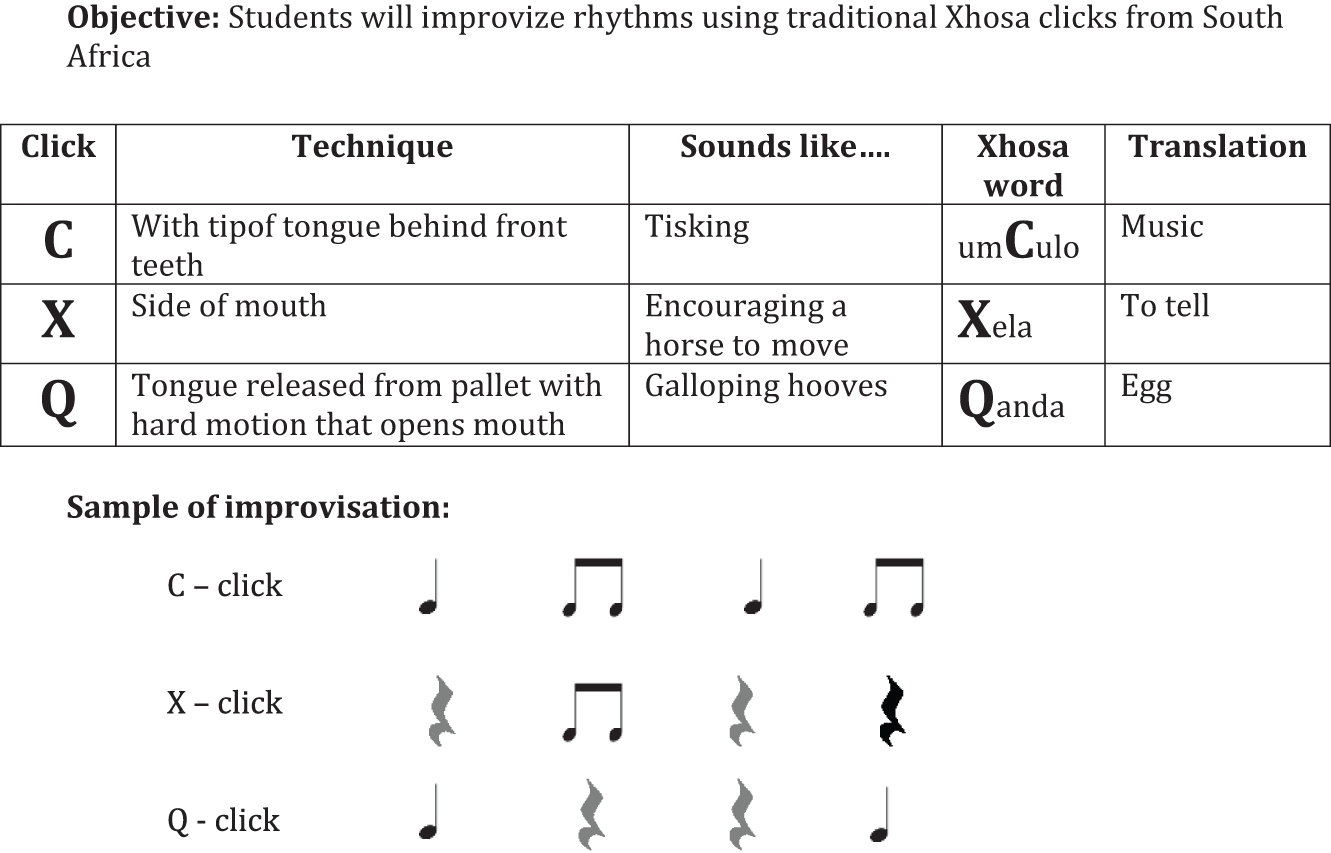
Xhosa vocal clicks.
Xhosa clicks can be used to explore other components of South African musics, including offbeat rhythms, polyrhythms, and a variety of African instrumental sounds. The creative teacher can also use homemade or commonly found instruments that closely resemble African instrumental timbres such as the alto or bass xylophone to mimic the warm African marimba sound. Homemade unpitched percussion can be used to imitate the sound of rattles and shakers by filling containers with natural ingredients such as grains, seeds, or rocks.
The diversity of South African musics is represented by a variety of musical practices, songs, languages, and historical significance. An example is the sounds of Zulu music that resonate from the stories of the great warrior, King Shaka Zulu. Zulu music is accompanied by strong percussive body movements and images of skillful Impi warriors with cowhide shields and assegai (long-throwing spear). Today, many Zulu songs have been adapted for recreational use in South Africa by all South Africans and have been transcribed for choirs around the world. Call-and-response melodies like “Shosholoza” ring from the bleachers of many sports events throughout the country, and traditional songs like “Singabahambayo” and “Siyahamba” are included in the repertoire lists of international choirs. The popular traditional Zulu war cry ‘Izika Zumba’ (Figure 3) is often sung by children on the playground and used as a teaching tool in the classroom. Each of the two verses of “Izika Zumba” is sung in a different language, Zulu and English. The contrast provides an ideal platform for highlighting AB (binary) form.
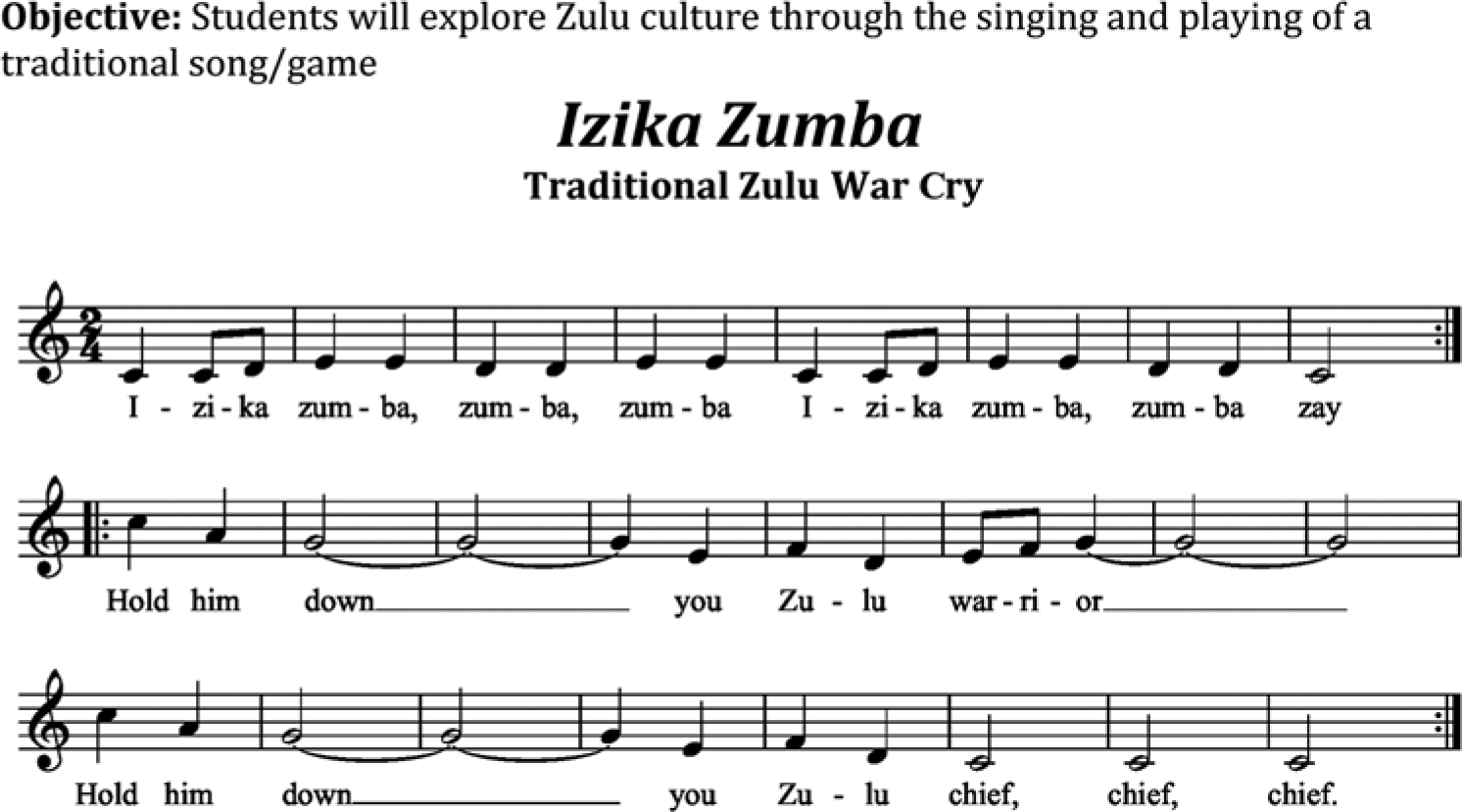
“Izika Zumba.”
Begin the lesson by singing the song to a steady drumbeat, pronouncing the words as written. Promote active listening by asking questions: Is the song in English? How do you know? What words can you pronounce? In a drum circle, have students imitate the teacher in song and drumming. Allow students time to explore their own steady beat to accompany the song by demonstrating various techniques, and including striking the drum on the rim, in the middle, with the fist, and with an open hand.
Introduce students to animals commonly found in South Africa by playing the author-adapted game, The “Lion and Impala.” Impala is the Zulu name for an African antelope, also known as a gazelle. Seated in a circle, each with a hand drum, students sing the Zulu song “Izika Zumba” while the steady beat is passed around the drum circle. Each student can change the tempo of the song by anticipating or delaying his or her turn to play the beat. The “lion” (volunteer student) must move around the outside of the drum circle, listening carefully to the beat. When the song ends, the “lion” will land on an “impala” (student seated in the circle). Roles are reversed, and the lion trades places with the hunted impala. The impala now becomes the new hunting lion, and the game continues.
An adventurous alternate activity to clicking or drumming that further explores the diversity of South African musics is gumboot dancing. Used by South African migrant workers in the gold mines and railways of the central and northern provinces, gumboot dancing is a percussive form of movement that relies on the sounds of the rhythms produced by gumboots when struck by the hand or stomped on the ground. Gumboots are rain boots traditionally worn to keep worker’s feet dry in the gold mines of Johannesburg, also known as Egoli, “The city of gold.” Under the oppression of apartheid, black rural miners worked under harsh conditions deep in the dark, wet mines. Talking was forbidden, and so miners created a system of communication that included the slapping and stomping of their boots. With its origins dating back to the1880s, gumboot dancing has evolved to become a popular art form that includes traditional songs performed using call-and-response techniques. Today, this athletic stomp routine uses hand slapping on both the inside and outside of the ankle as well as kicks in front and behind the body and is most often found at tourist hot spots around the country. The South African National Digital Repository provides an audio and video sample of gumboot dancing on their website (http://ndr.org.za/cultures/stories/47). Gumboot dancing is not traditionally notated, but movements have been documented and are often included in music classrooms in South Africa (Evans, 2010). The following lesson is an introduction to exploring a basic gumboot pattern that includes a simple hand slap on the inside of the bootleg (Figure 4).
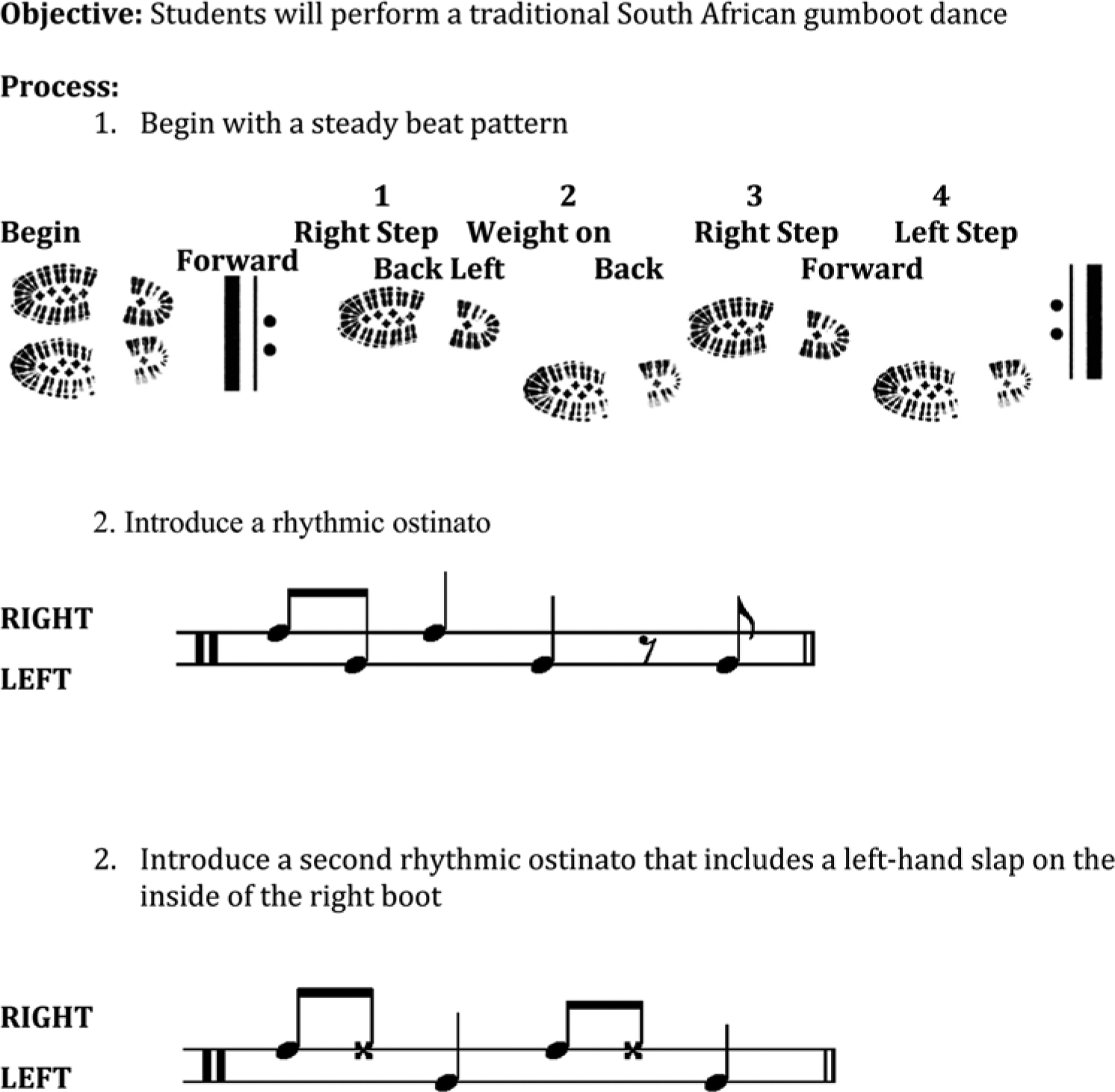
Gumboot dance.
The teacher assumes the role of the “leader.” Begin with a basic steady beat pattern. Once students are comfortable with the movement of the pattern, introduce ostinato patterns that include a variety of movements, including hand slaps on the ankle of the boot. Present the movements in canon, that is, students complete their pattern before imitating the next pattern.
The inherent nature of South African music naturally complements teaching approaches commonly used by American teachers like Orff Schulwerk, Kodály, or Dalcroze Eurythmics. The Orff Schulwerk process, that includes imitation, exploration, improvisation, and composition (Frazee, 1987, p. 26) is an ideal approach for teaching diverse African musics. Author Komla Amoaku (African Songs and Rhythms for Children, 1971) makes a close comparison between African musical traditions and the Orff Schulwerk with regards to speech, rhythm, movement, tuned percussion, and the process of imparting musical knowledge (Amoaku, 1982, p. 118). Campbell and Scott-Kassner (2010, p. 379) highlight the easy transfer of Kodály and Dalcroze teaching techniques to the teaching of African music, especially with the use of rhythm syllables and movement as an aid in learning various African songs and dances. Kiel, Tormod, and Anundsen (2006) also present a simple sequential process for teaching Swahili music that can be used for all African music lessons through imitation, call-and-response, and improvisation. By drawing on pedagogical approaches commonly used in general music, exploration into the diversity of African musics does not have to be a daunting task.
Conclusion
South Africa offers a rich variety of sounds and traditions that provide an ideal platform for a culturally-expanded curriculum focusing on the diversities within African musical traditions. Exploring a variety of South African musics with the intent of gaining deeper understanding of the diversity of African musics further serves to support one of the objectives of multicultural music education and provides opportunities for authentic African musical experiences in the classroom.
There are many resources for teachers who want to include South African music in their classrooms. The author suggests listening to the sounds of LadySmith Black Mambazo available on iTunes or the Soweto Gospel Choir found online at http://www.sowetogospelchoir.com/. The Global Voices Interactive DVD series (Goetze & Fern, 2006) includes an authentic guide to teaching various South African Zulu and Sotho songs and their accompanying movements, history, and traditions. And the Putamayo series, African Playground (2003), African Dreamland (2008), and South Africa (2010) provide music from specific areas across and within Africa and South Africa.
Footnotes
Declaration of Conflicting Interests
The author(s) declared no potential conflicts of interest with respect to the research, authorship, and/or publication of this article.
Funding
The author(s) received no financial support for the research, authorship, and/or publication of this article.