




Abstract
This paper assesses the prevalence of substance use in Spanish music students as a strategy for coping with Musical Performance Anxiety (MPA). We also assess the relation between substance use and thoughts of abandoning one’s musical career in connection with the degree of self-reported MPA. We carried out this survey on a sample of 463 students studying different music specialties and enrolled in five superior music academies in Spain (mean age: 22.71 years). Among other questionnaires, all participants completed the Spanish version of the Kenny Music Performance Anxiety Inventory and responded to a series of additional questions associated with MPA, substance use and thoughts of abandoning their musical career. Of those surveyed 33.9% indicated that at one point or another they had used substances in order to cope with MPA, and 19.0% had considered abandoning their musical studies. Those students who indicated that they had used substances to cope with MPA tended to have had more frequent thoughts of abandoning their musical career and suffered from a higher level of MPA than those who did not. A high percentage of music students who are attempting to cope with MPA also tend to adopt poorly adaptive strategies. These, in turn, lead to even greater levels of anxiety.
Keywords
Introduction
Music Performance Anxiety (MPA) is a subtype of social anxiety. It has been defined as the experience of persistent and distressing apprehension related to performing in front of an audience. In this sense, MPA is associated with anxiety suffered before, during and after musical performance, either as a soloist or as a member of a group, regardless of the type of musical instrument (Barbar, Crippa, & Osorio, 2014a; Brodsky, 1996; Gerling & Dos Santos, 2015; Papageorgi, Hallam, & Welch, 2007; Ryan & Andrews, 2009). As in other anxiety disorders, it manifests itself at a cognitive, motor and physiological level (Herrera, Jorge & Lorenzo, 2015); the repercussions on the physiological level are particularly significant, since they can directly affect the quality of a musical interpretation (Guven, 2015; Studer, Danusera, Hildebrandt, Arial, & Gomez, 2011). These components are not highly connected with one another in musicians who display low levels of performance anxiety, but they are highly interrelated in other cases. However, it seems that the cognitive component – particularly regarding one’s evaluation by others, negative self-statements about oneself and one’s performance, as well as the possibility of making mistakes – has a direct influence on anxiety (Herrera et al., 2015; Kobori, Yoshie, Kazutoshi, & Ohtsuki, 2011; Patston & Osborne, 2016).
Several studies (Barbar, Crippa, & Osorio, 2014b; Ryan & Andrews, 2009) have demonstrated that MPA occurs widely among professional musicians (soloists or orchestra members, stemming from a wide variety of cultural contexts). Apart from certain individual traits that could partially account for the emergence of MPA (Barlow, 2000; Orejudo, Zarza, Casanova, & Rodríguez, 2017; Zarza, Orejudo, Casanova, & Mazas, 2016), further factors such as job pressure associated with the need of maintaining one’s professional status and prestige, worries about job security, and the desire to meet the highest professional expectations are all likewise associated with MPA.
Furthermore, other studies (Fehm & Schmidt, 2006; Ryan, 2004) have shown that MPA occurs in music students of widely varying levels – not only in those who are about to embark on a professional career, but even in children at beginner levels. Thus, ‘stage fright’ constitutes one of the greatest problems that musicians face as part of their daily routine throughout their lives. It can ruin promising careers and job openings, and can constitute a true health risk for this group of professionals (Studer, Gomez, Hildebrandt, Arial, & Danusera, 2011). In Spain, few studies have been carried out on the incidence of this type of phenomenon. However, those few that exist – and which have featured conservatory students as subjects – ascertain the marked presence of MPA among future music professionals (Herrera et al., 2015). In his book on the most severe repercussions of this phenomenon, Guillermo Dalía (2004) estimates that up to 20% of all music students abandon their professional career due to MPA.
As pointed out by Patston (2014), MPA has not yet been the object of frequent or exhaustive study. Neither have potential coping strategies been studied adequately – although they probably count among the variables that can partially explain the persistence of MPA. Indeed, the fact that musicians use substances such as alcohol or beta blockers to cope with MPA is a relatively well-documented phenomenon (Ackermann, Kenny, O’Brien, & Driscoll, 2014; Dobson, 2011; Fishbein, Middlestadt, Ottati, Straus, & Ellis, 1988). At earlier educational levels, Fehm & Schmidt (2006) ascertained that performance anxiety is already a problem for the majority of younger music students who have not yet embarked on university-level music academy studies. However, these adolescents do not frequently resort to unfavourable coping strategies such as alcohol; instead, tobacco use is estimated at around 20%. Other coping strategies adopted by young students are: repeatedly practising the most difficult passages, cultivating positive thoughts, eating chocolate, or praying. At higher levels of music education, coping strategies do not differ significantly: university-level music students mention practising the most difficult passages, cultivating positive thoughts, trying to talk with someone, trying to relax, praying, but also resorting to substances – even though the majority of participants reject their use (Zakaria, Musib, & Shariff, 2013).
The connections between music and drug consumption are numerous. They can thus be analysed from different viewpoints: 1) the type of music and its content, 2) the audience that attends concerts, and 3) the performing artists themselves. Several research papers have observed a habitual presence of the topic of drugs in song lyrics, particularly in modern popular music; this tendency is more marked at certain points in time. Song lyrics can feature a series of allusions to drugs associated with sexual activity, mood management, and celebrating or partying (Hall, West, & Neeley, 2013). Regarding music audiences, research has tended to associate a certain nighttime leisure lifestyle (bars and discotheques) with youth consumption of different substances (Van Havere et al., 2012). From the angle of research that centres on the performing artists, substance use has been associated with different motivations: drugs are used recreationally as a means to stimulate creativity, or are simply linked with the general lifestyle of the music profession (Miller & Quigley, 2012). Certain prevalent myths associate several kinds of drugs with an increase in creativity, a belief which has nevertheless not been confirmed (Holm-Hadulla & Bertolino, 2014). The musician’s professional lifestyle is also of key importance in this field. It is not infrequent that musicians resort to different substances in order to manage the typical stressors with which they are confronted in their professional or relational environment. Those stressors are present either because the musician needs to launch and maintain a successful career, or needs to remain professionally competitive despite new demands and the gradual diminution of his/her physical capacities (Breitenfeld et al., 2008). Such a description, however, does not apply uniformly to all music genres: each one features its own behavioural patterns (Miller & Quigley, 2012), and the tendency toward drug consumption also varies from one historical period to another.
This study attempts to further investigate an aspect of the relation between music and drugs which has been less studied, particularly in Spain: the use of different substances as a means of confronting a specific type of anxiety, stage fright or MPA. Researchers who follow the self-medication hypothesis have observed significant relations between the consumption of different substances and anxiety (Becoña & Miguez, 2004); however, none of those studies provides concrete data regarding a specific type of anxiety such as MPA. In this paper we assess the relation between MPA and corresponding coping strategies that consist in resorting to substances. We attempt to identify which substances tend to be used in Spain, a country for which no study of this sort has been previously undertaken. We also assess the joint occurrence of MPA in advanced music students with thoughts of abandoning their studies and, therefore, their career. As a frame of reference we adopt the theory of anxiety propounded by Barlow (2000), its adaptation to the area of music by Kenny, Davis and Oates (2004) and to the specific context of Spain by Zarza et al. (2016). This theory proposes that individual differences related to MPA reflect three types of vulnerability: one is biological, the second one is personal and linked to early experiences of lack of control that result in a personal profile of helplessness: those two interact with the third type of vulnerability, that is, specific contextual factors, and such interaction can predict the emergence of concrete problems associated with anxiety. In order to predict the appearance of a specific anxiety problem, it would be necessary for the three vulnerabilities to be present: the first two indicate the personal predisposition to experience anxiety (Barlow, 2000), whereas specific psychological vulnerability would determine the concrete type of problem the individual would subsequently develop. Biological vulnerability refers to personality traits such as neuroticism, negative affect or behavioral inhibition (Barlow, 2000; Orejudo et al., 2017). Psychological vulnerability is determined by experiences of perceived situational uncontrollability in the first years of life, giving rise to a belief system in which negative thoughts and an overall impression of uncontrollability prevail.
More concretely, the questions we wish to address in this paper are the following: how frequently do conservatory students use substances to mitigate MPA, and what percentage of them have considered abandoning their studies? How do students displaying such behaviour differ from one another in their personal profile and in relation with their reported performance anxiety based on Barlow’s model? Can mediations between personality traits, anxiety and these coping strategies be observed?
Method
Participants
Our sample consisted of 463 participants studying towards an advanced music degree in five different music academies: conservatorios superiores, which, in Spain, are the equivalent of a university music department. In terms of gender, 256 participants (53.3%) were male and 221 (46.0%) were female. The mean age was 22.64 years (SD = 4.77) ranging from the age of 16 to 51. Instrumental families (types of instrument) included in this sample were: woodwinds (130), brass (71), bowed strings (140), keyboard (69), plucked strings (31), percussion (13) and voice (19); four orchestral conducting students also took part in the survey, and three participants did not indicate which type of instrument they played.
Materials
In this study we gathered the following variables.
Personal variables
Age, gender, year of study and type of instrument.
Stage anxiety (MPA)
Evaluated using the Spanish adaptation (Zarza et al., 2016) of the Kenny Music Performance Anxiety Inventory (K-MPAI) (Kenny et al., 2004) survey tool. It consists in 24 items scored on a seven-point Likert scale and grouped into three factors: 1) cognitions: worries that are connected specifically with musical performance (11 items, α = 0.870); 2) general psychological vulnerability or helplessness (10 items, α = 0.786); and 3) contextual vulnerability associated with relations and interactions experienced early in life (three items, α = 0.632).
Mode of coping with MPA
At the end of the K-MPAI, we also asked participants if on any occasion they had used some type of substance to deal with MPA (yes = 1, no = 0), and if so, to indicate what type of substance they had consumed (). We also asked whether for that reason they had ever considered abandoning their musical career. Responses to both questions were subsequently categorized according to content.
Procedure
Our research team contacted all university-level music academies (conservatorios superiores) in Spain. Five of them responded affirmatively; we thereupon explained our objective to the administrative departments and proposed our data gathering procedure. In each case we set a date upon which a member of our study team would visit the institution and hand out the questionnaire to all students present on the premises who were willing to take part in the survey. All subjects were explicitly informed that anonymity and voluntary participation were guaranteed.
Statistical method
The data we analysed in this study included the students’ reported frequency of substance use to mitigate MPA and the presence or absence of thoughts of abandonment. In order to relate these behaviours with Barlow’s anxiety theory, we conducted an initial analysis of variance (ANOVA) on the resulting data, thereby creating groups in function of substance use and the presence or absence of thoughts of abandonment: the dependent variables were the students’ K-MPAI scores in thoughts about stage fright and helplessness. Finally, by applying a model of structural equations, we tested the hypothesis of mediation of personality traits (exogenous variables), thoughts about stage fright (endogenous and exogenous variables) and the two coping strategies (endogenous variables). In the first case we worked with the SPSS v.22 program; in the second case, we used AMOS 17.0 (Arbuckle, 2008) with the procedure of Path Analysis, being the variables included in the model the observed variables previously analysed. According to Mulaik (2009, p. 257), structural equation models such as this allow testing hypotheses about linear relationships between variables with mediation relations. The model is shown in the Results section. For the estimation of parameters the maximum likelihood method has been used and in order to compare the adequacy of the data to the model, the chi-square test of fit (χ2), the comparative fit index (CFI) and root mean squared error of approximation (RMSEA) have been calculated (Mulaik, 2009).
Results
A total of 157 students enrolled in studies for a university-level music degree (33.9%) indicate to have consumed some type of substance in order to cope with MPA; 66.1% affirmed never to have done so. A slight correlation between substance use and gender can be noted (χ2 = 5.40; p = 0.020; ϕ = 0.108), with a greater frequency of substance use among females (39.4%) than among males (29.1%). No significant differences depending on age, year of study or type of instrument were noted (p >0.05 in all cases).
In terms of type of substance, on the one hand we note that 12.5% of students took pharmaceutical substances, mostly beta blockers (11.9%, 55 students) and in some cases benzodiazepines (0.6%, three participants). On the other hand, 7.6% indicate that they resorted to herbal treatments (35 students); additionally, apart from all the preceding cases, a further 6.3% (29 students) indicate that they combined pharmaceutical substances (benzodiazepines or beta blockers) with herbal treatments: thus, a total of 19.8% have used pharmaceutical substances. Finally, 1.7% (eight students) indicate that they mainly consumed alcoholic beverages of various types and degrees; one student indicated amphetamines. We found no significant correlation between gender, year of study, type of instrument and type of substance used (p >0.05).
Regarding contemplation of abandoning musical studies due to MPA, 15.1% admit to have considered abandoning, and the percentage rises to 19% of the total if we take into account only those students who actually answered the question (20% left it unanswered). We also observe a significant correlation between gender and thoughts of abandonment (χ2 = 7.672; p = 0.004; ϕ = −0. 148). Thus, among those who responded to the question whether they had considered abandoning studies, 25.0% of females but only 13.6% of males responded affirmatively. No significant differences appear in connection with age, year of study or type of instrument (p >0.05 in all cases).
A significant correlation can be observed between substance use and thoughts of abandoning studies (χ2 = 24.233; p = 0.000; ϕ = −0.257). Of those who resorted to substances in order to alleviate MPA 32.8% have considered abandoning their musical career, but only 11.8% of those who did not use substances have done so. This connection can be observed in both males and females (p <0.05), but no significant correlation appears between considerations of abandonment and type of substance used (χ2 = 5.095; p = 0.165).
Crossing the variables, we find that 57.6% of subjects did not ingest substances, nor did they consider abandonment; 11.4% took substances to mitigate MPA and likewise considered abandoning; 23.4% took substances and did not consider abandoning, and 7.6% considered abandoning but did not resort to substances.
Regarding differences in self-reported anxiety levels, Table 1 displays the significant differences observed in the various groups of students under consideration. We see that those subjects who consumed substances in order to deal with MPA and those who entertained thoughts of abandonment displayed a greater level of negative cognitions associated with performance, as could be logically expected. They also display a more pronounced helplessness profile.
Mean comparisons among groups of participants.

K-MPAI: Kenny Music Performance Anxiety Inventory.
Regarding the use of a determined type of substance, the ANOVA analysis reveals certain differences among groups in terms of their specific cognitions (F3,126 = 5.541; p = 0.001; η2 = 0.117). The group with the highest score consists of subjects who resort to pharmaceutical products, followed by those who combine the latter with herbal treatments and, finally, those who consume alcoholic beverages. The sole person who admitted to having used amphetamines is also the subject with the highest anxiety score (Figure 1). No significant differences appear in connection with the helplessness profile (general psychological vulnerability delivers the following statistic: F3,126 = 1.454, p = 0.230).
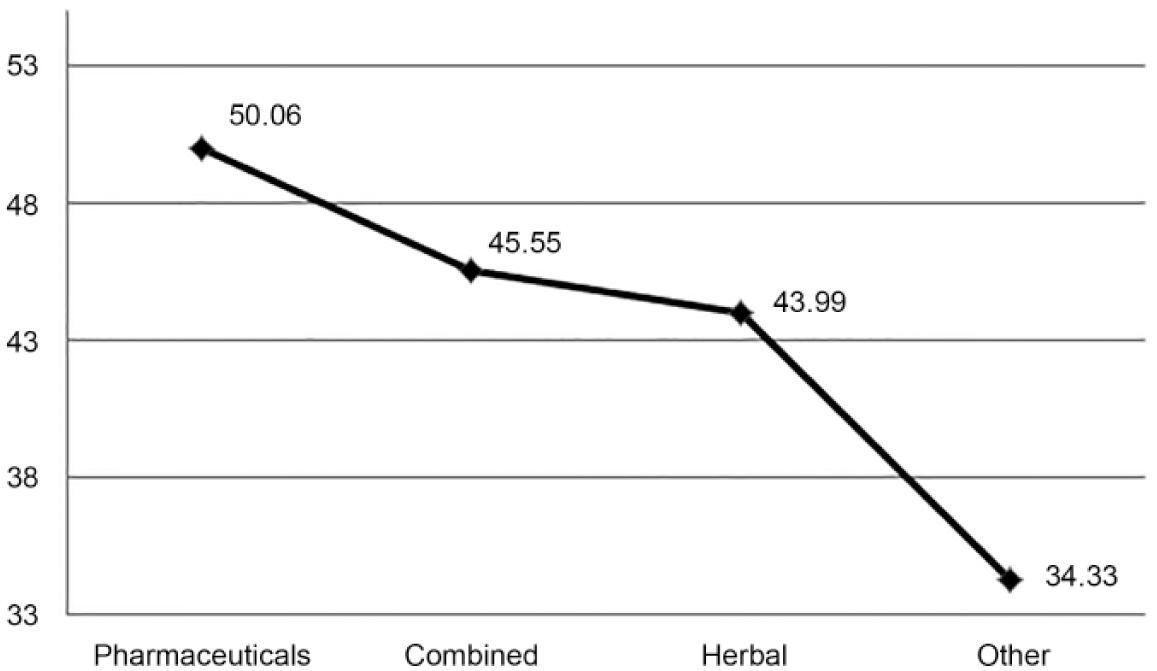
Level of Musical Performance Anxiety related to the substance consumed.
As to possible differences associated with the factor of early relations and contexts, no significant differences were found between the group of subjects who had ingested substances to alleviate MPA and those who had not (F = 0.010; p = 0.922; η2 = 0.000), nor between those who considered career abandonment and those who did not (F = 1.232; p = 0.268).
The combination of both variables results in the same tendency, yet with significant differences in the cognition factors of MPA and helplessness: the effect is greater in the first case (η2 = 0.315) than in the second (η2 = 0.141). Comparison among groups reveals a linear relation: the extreme representing greatest difficulty is located at the point where thoughts of abandonment are combined with substance use, followed by the group that considered abandonment, followed by the group that solely consumed substances and, finally, by the group that presented neither of those two characteristics (Table 1).
The linear relation between variables and mediational analysis was confirmed by the SEM model. It showed that MPA is indeed significantly related to helplessness, and the latter is associated, in turn, with contextual factors. Furthermore, MPA is a predictor of substance consumption as well as of thoughts of abandonment. This model’s result (Figure 2) displays good fit (χ2 = 4.816; g.l. = 6; p = 0.568; CFI = 1.000; RMSEA = 0.000). MPA appears as a predictor of thoughts of abandonment (β = 0.494) and of substance use (β = 0.383). The two paths – substance use and thoughts of abandonment – are not sufficiently closely related to display a cause-and-effect relation: the path that connects them is not statistically significant (β = 0.098, p = 0.094). Thus this model accounts for 14.6% of variance in substance use and 24.4% of thoughts of abandonment. Apart from the importance of MPA in itself, we also found a significant indirect effect on these behaviours via their mediation by MPA, with a degree of mediation of 0.239 on substance use and of 0.295 on thoughts of abandonment.
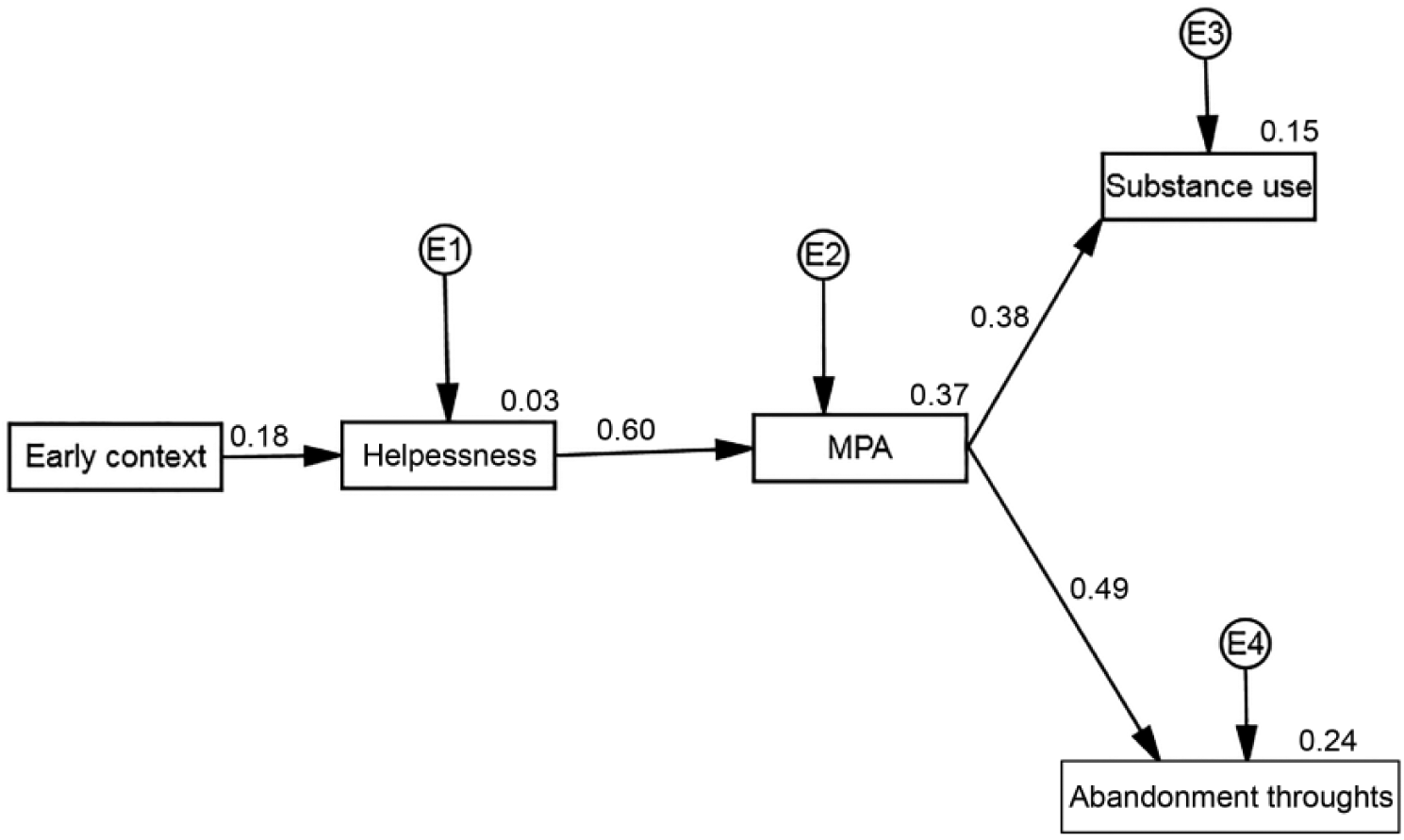
Path from Musical Performance Anxiety (MPA) to substance abuse and thoughts of abandonment.
Discussion and conclusion
MPA clearly constitutes a risk factor for the career and mental health not only of those already working in the music profession, but of students who are preparing to enter it as well. Among university-level Spanish music students we have found a relatively high prevalence of substance use to alleviate MPA (33.9%), as well as thoughts of abandoning their musical career (19.0%). Classified into types of substances, the most frequent ones are legal substances (beta blockers as well as herbal treatments), with a low occurrence of alcohol or illegal drugs. This study cannot be easily compared with others in the literature due to differences in methodology, population groups and chosen points in time. One factor to help explain the variety of MPA-coping strategies could be the fact that different substances tend to be viewed as having different kinds of social ‘status’. Such positive or negative status certainly has an influence on the reputation sought after by music professionals, and on the manner in which the public at large views their profession (Dobson, 2011).
We thus ascertain that music students resort frequently to pharmaceutical or herbal products in order to alleviate MPA. Regarding pharmaceutical substances, Fishbein et al. (1988) found in their study of orchestra members that there was a high prevalence of sporadic beta blocker consumption to cope with MPA (30% of subjects aged 35 or less; 70% of all such cases did not have a prescription). On the other hand, Steptoe (2001) has found in musicians that 12% resort to pharmaceutical products prior to an important performance situation. In a recent study on a sample of Australian orchestra professionals, Ackermann et al. (2014) found that up to 31% of the participants indicate that they have resorted to beta blockers to cope with MPA. In a sample of music students, Studer, Gomez, et al. (2011) have found that up to 9.7% use pharmaceutical products on a regular basis to control anxiety. Our own data gathered among Spanish music students cannot be compared across the board with these studies of professional musicians – due, in part, to diverging cultural contexts and different points in time.
This study nevertheless provides a relevant result which upholds opinions previously voiced by other authors: they recommend the sporadic use of such pharmaceutical products, but only for a time, until the musician manages to develop more appropriate strategies to control performance anxiety (Allen, 2013; Dooley, 2015). Indeed, although the literature on the use of such substances to alleviate MPA confirms their efficacy (Gates et al., 1983; James & Savage, 1984; Neftel et al., 1982) – and that is likewise the perception of the users themselves (Fishbein et al., 1988) – it seems that such effects are merely short-term. Thus, in our case, those students most prone to anxiety were also those who used substances and who, furthermore, had entertained thoughts of abandonment. In other words, they were those who possessed the least amount of adequate resources to truly deal with MPA. According to the anxiety theory of Barlow (2000), they would be marked by a helplessness profile. In this sense, our study has provided new evidence on this theory in which, so far, the role of personality characteristics as predictors of anxiety cognitions (Orejudo et al., 2017) is now expanding into anxiety coping behaviours, such as thoughts of abandonment and substance use. These evidences, moreover, were based on a model of probabilistic causal relations (Mulaik, 2009) in which the personality characteristics have a very important weight on the cognitions of anxiety and these, in turn, have a high predictive value on the thoughts of abandonment (β= 0.494) and on substance use (β= 0.383). The same risk-prone profile, connected with personal traits, has been confirmed in other investigations with professional musicians as subjects, such as the research conducted by Miller & Quigley (2012), who associated tobacco and alcohol consumption with sensation-seeking.
Another personal factor appears in a study that associates a different factor with substance use: namely, gender. Few studies have investigated the gender variable more closely in this context. The study most similar to ours – since it is based on a sample of music students – is Studer, Danusera, et al. (2011), but it does not differentiate results according to gender. However, the study by Fishbein et al. (1988) on a sample of music professionals also found greater levels of substance use among females – beta blockers in particular, since 24% of women who were interviewed had a regular beta blocker prescription, in contrast with only 10% of the males. One possible explanation for that greater frequency of substance use among women could be associated with the higher MPA scores they report in certain studies (Biasutti & Concina, 2014; Kenny, Driscoll & Ackermann, 2014; Zarza et al., 2016). It is also possible that these differences are related to other, previous characteristics associated with anxiety, and which can be distributed differently among men from among women, such as avoidance strategies (Barbar et al., 2014b), social support (Biasutti & Concina, 2014) or fear of negative evaluation (Kenny et al., 2014; Studer, Gomez, et al., 2011). Patston and Osborne (2016) are of the opinion that significant differences between males and females can be observed all through the many years of musical training. Such hypotheses, notwithstanding, do not allow us to discard other factors that can differentially affect women – for instance, in certain groups, expectations concerning their professional role are heightened, as can occur in opera singers (Kenny et al., 2004).
Perhaps, as Kenny, Fortune, and Ackermann (2013) have pointed out, an analysis of several MPA subtypes could help us identify different anxiety patterns in individuals and adjust treatment accordingly. At any rate, it is important to mention the research conducted by James, Pearson, Griffith, Newbury, and Taylor (1978), who have shown that oxprenolol, one of the most widely used beta blockers, indeed reduces musicians’ anxiety prior to performance – however, in subsequent performances, its effect is notably diminished. Along the same lines, Dooley (2015) has pointed out that beta blockers can be used as an adequate rapid alternative to immediately combat purely physiological symptoms, but they do not provide a long-term solution to psychological or behavioural difficulties. Furthermore, research on subjects who are accustomed to high doses of alcohol (regardless of gender) shows that their performance level is indeed affected by such doses; furthermore, such acquired behaviour hampers their ability to cope with anxiety, as shown by Vinader-Caerols, Monleón, and Parra (2015).
The literature dealing with herbal and ‘natural’ products is scant. Studer, Gomez, et al. (2011) found that 27.7% of their subjects occasionally resort to such substances, to which they attribute a certain degree of efficacy. Our data indicate a less prevalent use, and students who resorted to them were not those who reported the greatest degrees of anxiety compared with others. As long as we lack further data concerning the prescription of such substances, we cannot know whether subjects with the greatest anxiety tend to resort to other techniques, or whether herbal products’ reduced efficacy simply leaves the problem unsolved.
Alcohol consumption does not appear to be one of the most frequent methods used by students to deal with MPA: this finding agrees with previous studies carried out in similar populations (Fehm & Schmidt, 2006; Studer, Gomez, et al., 2011; Wesner, Noyes, & Davis, 1990). It seems as if the alcohol problem – which is highly prevalent among professional musicians – is more associated in the case of the latter with social and relational issues than specifically with MPA-confronting strategies (Kenny et al., 2014). It is not associated with all types or age groups of musicians in equal measure, either (Ackermann et al., 2014). In this sense, alcohol consumption as a means of reducing stress could be associated, rather, with post-performance habits and behaviour, particularly among professional musicians – habits which students such as those who participated in our study may not yet have adopted.
Regarding thoughts of abandonment, we know that in Spain 28.8% of students abandon university-level music studies in the course of their first year. Obviously, the transition from music school (conservatorio profesional) to university level (conservatorio superior) can constitute a stress factor in itself. And it also appears that MPA could be one of the stressors responsible for such abandonment. In younger population samples, Fehm and Schmidt (2006) have found that MPA is indeed associated with diminished hopes of pursuing studies on a future academic level.
The relationship between withdrawal thoughts and substance use has also been examined. The data support that an association but not a causal relationship between them can be established. Therefore, the most plausible hypothesis is that students who experience higher levels of anxiety resort more to substances and have more thoughts of career abandonment. In the scientific literature it is difficult to find studies based on the determinants of the abandonment of musical education, and those that are are usually made with younger student populations who have started their musical training without a professional orientation. However, some of the reasons analysed in these age groups could be applicable, specifically the one related to the perception of competence, which would be seriously threatened by the presence of scenic anxiety, as is established by the theory of self-efficacy (Bandura, 1997) and studies in musical contexts (Wehr-Flowers, 2006). Thus, Lowe (2010) finds that young people who abandon music education perceive less musical competence and more negative expectations about performances. The hypothesis of the competence also exposes it (Hartley & Porter, 2009) when relating the age of beginning the musical formation with the abandonment.
Further study should be devoted to practices and methods in the classroom, laying particular emphasis on elements that foment musicians’ individual psychological resources to help them adequately face performance situations – an area not yet satisfactorily covered in the current conservatory curriculum (Dobson, 2011). Such elements could be: speaking frequently in front of an audience about the works one is about to perform; improved and increased preparation for public performance; finally, the increased use of interesting techniques such as improvisation (Allen, 2013; Kim, 2005; Moore, Burland, & Davidson, 2003). Likewise, a greater amount of support on the part of professors, family members and peers could play a valuable role in helping students cope with MPA (Biasutti & Concina, 2014; Lehmann & Kristensen, 2014; Moore et al., 2003).
We conclude by pointing out our study’s limitations. This research was carried out as a cross-section assessment of substance use and considerations of abandonment, based on data gathered at a certain point in time only. We lack data about the subjects’ previous history – that is, about the onset of such phenomena, and about their frequency – thereby limiting the possibility of assessing these dimensions. Another limitation arises from the fact that these data were gathered via self-reported information provided by participants. This can affect the data’s trustworthiness: substance use is linked with a certain negative or positive degree of social desirability or prestige, and such factors can affect an individual’s reputation, particularly in the case of substance use while preparing for a musical performance (Dobson, 2011).
