



Abstract
Music Performance Anxiety (MPA) is one of the major emotional problems affecting music professionals and music students; it can only be addressed on a professional basis if a more profound knowledge of determining factors is acquired. This study examines one of these factors, scarcely investigated until now: the age at which an individual began music training. The relation of age of onset with MPA is examined here in two separate samples of music students/pupils in Spain: one of 437 advanced music students (mean age = 22.64 years) and another one consisting of 209 pupils enrolled in music schools (mean age = 12.09 years). The first sample was tested with the Spanish version of the Kenny Music Performance Anxiety Index (KMPAI), and the second sample was tested with the Performance Anxiety Questionnaire (PAQ) elaborated by Cox and Kenardy (1993). These two independent samples, tested with different evaluation tools, yield results that indicate a significant relation between the age of musical training onset and the individual’s currently perceived level of MPA. Those students/pupils who started at the age of 7 or younger report lower levels of MPA. The article concludes with a discussion of these results’ potential implications on a theoretical and practical level.
Keywords
Music Performance Anxiety (MPA) is a phenomenon that can affect musicians’ playing skills to the point of threatening their professional careers (Yoshie, Kudo, Murakoshi, & Ohtsuki, 2009). Salmon has defined MPA as “the experience of persisting, distressful apprehension about and/or actual impairment of performance skills in a public context, to a degree unwarranted given the individual’s musical aptitude, training and level of preparation” (1990, p. 3). Papageorgi, Creech, and Welch (2011) have pointed out that MPA is one of the psychological variables that most affect the quality of musical performances in front of an audience; it can eventually lead to a series of cognitive, physiological, and motor difficulties (Studer, Danusera, Hildebrandt, Arial, & Gomez, 2011; Wilson, 2002). In musicians with low MPA levels, these symptoms are not highly interrelated; however, they interact intensely with one another in the most severe cases (Kenny, Davis, & Oates, 2004). Other factors can also have a direct influence on the emergence and persistence of MPA: cognitive components associated with peer group acceptance, combined with an individual’s own negative language and associated thoughts concerning his/her performance, previous mistakes, and his/her self-image (Kobori, Yoshie, Kazutoshi, & Ohtsuki, 2011).
MPA affects musicians on all continents (Yoshie et al., 2009). According to Dalia Cirujeda (2004), 20% of advanced music conservatory students eventually abandon their studies due to problems with MPA (Dalia Cirujeda, 2004), and 40%–60% of those who go on studying note that their musical performances deteriorate in quality due to MPA (Kaspersen & Götestam, 2002; Marchant-Haycox & Wilson, 1992). After graduation, MPA will continue to be a part of their professional lives (Fishbein, Middlestadt, Ottati, Straus, & Ellis, 1988; Van Kemenade, Van Son, & Van Heesch, 1995). Other studies have highlighted the importance of this problem in musician subgroups: classical, popular, and jazz (Kenny et al., 2004; Papageorgi et al., 2011; Ryan & Andrews, 2009). It seems to affect women more than men (Iusca & Dafinoiu, 2012; Thomas & Nettelbeck, 2014; Vaag, Bjørngaard, & Bjerkeset, 2016).
From a theoretical perspective, Barlow’s Triple Vulnerability Model (Barlow, 2000) explains the probable origins of anxiety and the reasons for its persistence throughout different stages of a person’s life. This model has proven to be one of the most consistent and reliable integrative theories of its kind, supported by a large corpus of empirical investigations carried out by Kenny (2009a, 2009b), Kenny et al. (2004), Papageorgi et al. (2011), Orejudo, Zarza, Casanova, Rodríguez, and Mazas (2016), Zarza, Casanova, and Orejudo (2016a, 2016b) and Zarza, Orejudo, Casanova, and Mazas (2016), among others. Barlow’s model postulates the presence of three risk factors for anxiety to develop: a generalized (heritable) biological vulnerability, a generalized psychological vulnerability (based on early experiences) and a specific psychological vulnerability. The first and second factors provoke a general sense of helplessness, which becomes a general risk factor, creating the necessary conditions for anxiety disorders and depression (Barlow, 2000). The third refers to specific contextual factors triggered by anxiety cues, especially in the case of phobias: it is associated with experiences in concrete situations (Osborne & Kenny, 2008). Specific psychological vulnerability is therefore a product of a person’s entire conditioning and experience.
So far, research has focused more on personal traits than on contextual conditions that could have an effect on specific psychological vulnerability. Thus, among specific factors, most studies have only singled out the type of instrument or ensemble, along with rehearsal and performance conditions (Cox & Kenardy, 1993; Kaspersen & Götestam, 2002; Kenny et al., 2004; Papageorgi, Hallam, & Welch, 2007).
In this study, we will be focusing our attention on one factor mostly ignored by research until now: the age of musical training onset and its relation with MPA. One should point out that the age of onset in musical training tends to vary widely. Although most children start to learn an instrument before the age of 12, there is great variety: almost 50% of children have started their training before the age of 7 (Nagel, 1993). Thus, it would be advisable to study the influence of age of onset on MPA in adulthood, as well as on the characteristics of MPA in childhood and adolescence.
A series of articles by Ryan (1998, 2004, 2005) have replicated the original study carried out by Simon and Martens (1979), which showed that music students experienced anxiety regarding public performance in a manner similar to the anxiety experienced by a sportsman or sportswoman before a match. It has been shown that performance anxiety is present very early in children, even at the age of 3 years (Boucher & Ryan, 2011). They experience MPA quite similarly to the way adults suffer from it prior to a performance – in terms of anticipatory anxiety, sensitivity to context, and regarding how difficult the music is (LeBlanc, Jin, Obert, & Siivola, 1997). Furthermore, Chan (2011) found that the youngest members of an orchestra in Hong Kong, 174 musicians aged 7 to 18, reported anxiety levels that even altered the quality of their performance in a highly stressful examination situation. On the other hand, although certain qualitative differences between adults and adolescents have been noted, no significant MPA differences are observable between boys and girls up to the pre-teen years, and a pronounced habituation effect sets in when two performances occur within short succession (Boucher & Ryan, 2011; Ryan, 2005).
None of the studies hitherto conducted has analyzed the relation between the age of musical training onset and subsequent manifestations of MPA in individuals. Boucher and Ryan (2011) are the only ones to have remarked that children with prior musical experience are less prone to MPA. Apart from that finding, the most relevant relation hitherto proposed between the age of onset and musical achievement is that the acquisition of certain technically demanding skills requires early initiation to music (Lehmann & Kristensen, 2014). In two independent studies, Bailey and Penhune (2010, 2012) compared musicians who started early (before the age of 7) with others who started playing music later on, and found that the two groups achieved significantly different skill levels in nonverbal tasks such as visual-motor and auditory motor synchronization. Improved short-term memory skills would also explain the higher performance levels achieved by those who started early, even taking other variables into account such as the number of years taking lessons, the number of musical practice years and total hours of practice. These authors hypothesize that there is a critical period in life for developing such skills. For their part, Moore, Burland, and Davidson (2003) note that a small group of successful music students had generally begun training earlier than those who dropped out; however, they had also had a close relationship with their professors in the first years, enjoyed significant family support and were encouraged to practice, and had offered public performances at a very early age. That study, however, did not analyze MPA as a variable. Thus, the current study’s objective is to analyze the relation between the age of musical training onset and MPA, while taking other possible variables into account that may contribute to this relationship, such as years of musical practice, age, sex or type of musical instrument. For that purpose, we selected a sample of music students enrolled in two different types of institutions. On the one hand, we gathered data from advanced university-level music academies (conservatorios superiores) in which students tend to enroll when they are 18 or older, with the purpose of attaining the highest degree of skill. On the other hand, we also gathered data from music schools (conservatorios profesionales) in which grade-school and secondary-level students enroll, either for recreational purposes or with hopes of going on to study for a professional career. Apart from the above-mentioned theoretical implications, the age of onset in musical training has practical implications, since the educational system in Spain regulates at which age children can enter music schools. As a hypothesis, we expected to find differences in MPA levels between participants depending on their age of onset, both in groups of younger pupils (attending music schools) and among older students (enrolled in advanced music academies). Since the number of practice years can also have an influence on such differences, we took that variable into account as well, despite the fact that previous studies had shown only slight differences between years of practice and level of MPA (Sadler & Miller, 2010). Although the number of years of musical practice has a significant bearing on a person’s degree of musical competence (Sloboda, Davidson, Howe, & Moore, 1996), it does not predict success any better than, say, the amount of public performance experience at a very young age (Moore et al., 2003).
Regarding the type of instrument, further studies have also revealed differences in personality traits or other psychopathological indicators, such as sleep problems (Buttsworth & Smith, 1995; Vaag, Bjørngaard, et al., 2016; Vaag, Saksvik-Lehouillier, Bjørngaard, & Bjerkeset, 2016).
Method
Participants
As indicated above, we worked with two separate samples. Sample I was composed of 437 students studying for an academic music degree; 54.2% of them were male and 45.8% female. Aspiring to become professional musicians and music teachers, they were enrolled in six advanced music academies (conservatorios superiores) in Spain. The sample mean age was 22.64 years (SD = 4.73), ranging between ages 16 and 51. The males in the sample were slightly older than the females, and with a wider age spread: males = 23.33 (5.15), females = 21.83 (4.02); Brown-Forsythe: F(1, 430.60) = 11.458, p = .001, η2 = 0.025. Their specialties, including their instrument of specialty, are listed in Table 1.
Sample description.
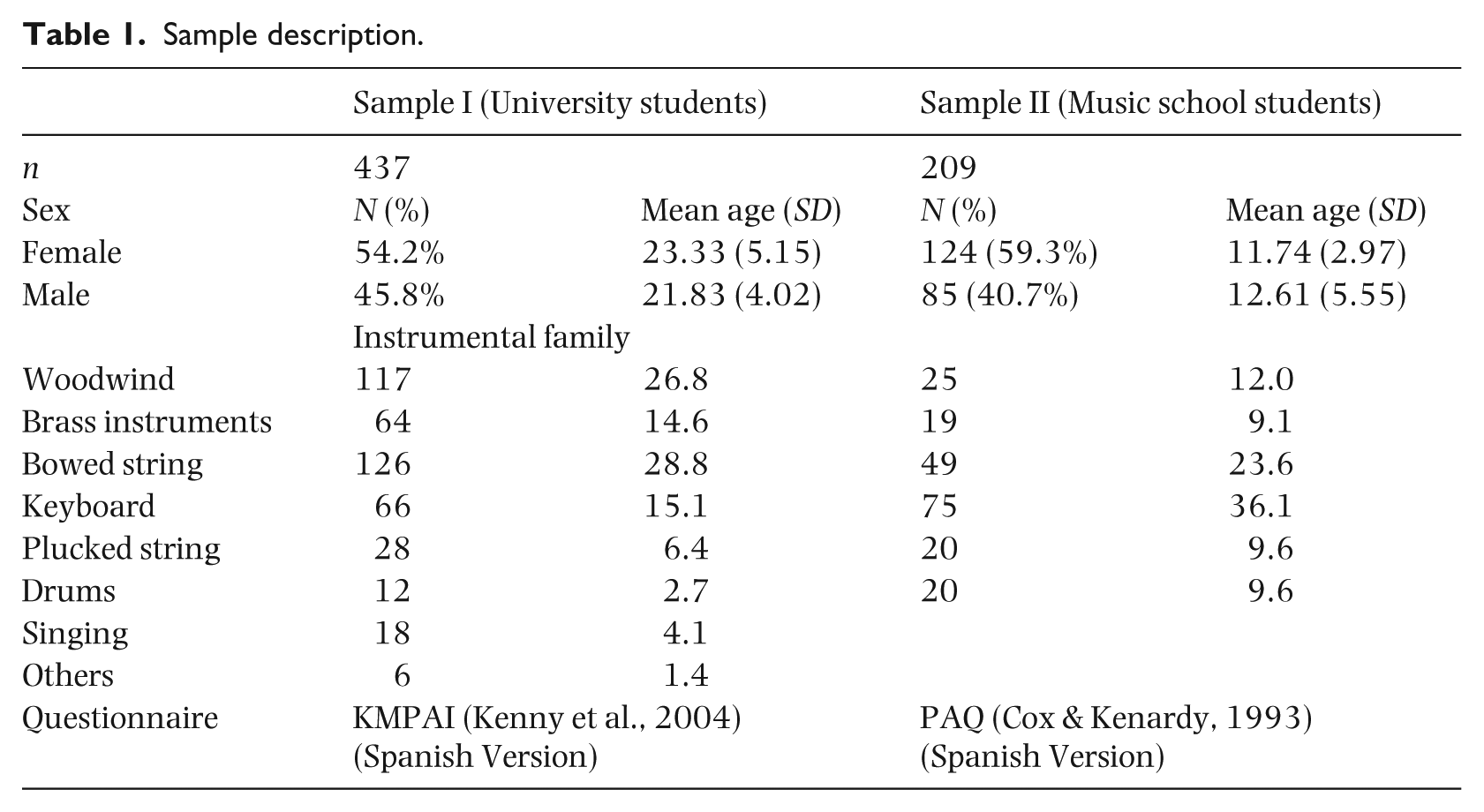
Sample II comprised a total of 209 music school pupils, of which 40.7% were male and 59.3% were female. Their ages ranged from 8 to 46 years, but 92.3% of them were aged 15 or younger. The mean age was 12.09 years (SD = 4.22). In this case, although males were slightly older, the age difference between males and females was not statistically significant (Table 1, Brown-Forsythe: F(1, 117.12) = 1.743, p = .189, η2 = 0.010); here the age spread among males was likewise wider than among females (Levene’s F(1, 207) = 4.387, p = .037). All these students were enrolled in the music school of Zaragoza, Spain (Conservatorio Elemental de Música de Zaragoza). The instrumental families occurring in the sample are described in Table 1.
Variables and tools
Music Performance Anxiety
In order to evaluate the participants’ degree of music performance anxiety (MPA), each of the two samples was tested with a different tool. For the advanced music academy sample, we applied the Spanish adaptation by Zarza, Orejudo, et al. (2016) of the Kenny Music Performance Anxiety Inventory (KMPAI), which features 26 items on a 7-point Likert scale (Kenny et al., 2004) and in which higher scores on KMPAI correspond to higher levels of MPA. The KMPAI tool groups the aspects related with vulnerability according to Barlow (2000) into three general factors reflecting experiences within a family context (3 items; Cronbach α = 0.56; e.g. “Excessive worrying is characteristic of my family”), a general vulnerability (10 items; Cronbach α = 0.78; e.g. “Sometimes I feel anxious for no reason”), and a specific factor related to musical performance cognition (11 items; Cronbach α = 0.86; e.g. “Prior to or during a performance I have feelings akin to panic”).
To test the sample of younger music school pupils, we applied the Spanish adaptation (Dalia Cirujeda, 2004) of the Performance Anxiety Questionnaire elaborated by Cox and Kenardy (1993), a 20-item tool that evaluates cognitive and physiological symptoms (Fehm & Schmidt, 2006) related to MPA on a 5-point Likert scale, along three different levels of performance conditions: study, practice or rehearsal either alone or in a group; performance as a member of a group, and concert performance as a soloist in which the higher scores the higher level of MPA. The Cox and Kenardy Performance Anxiety Questionnaire is generally considered more appropriate for younger-aged samples than KMPAI. Although participants are normally tested in all three areas (practice/rehearsal, group performance, solo performance), in this case we only tested the pupils in this sample on two conditions: group and solo performance, and we also eliminated two further ones (item number 5 “I feel nervous” and item number 19 “I need to urinate more often”) that were detrimental to internal consistency. We thereby differentiated a cognitive factor (10 items, α = 0.81 in group performance and α = 0.86 in solo performance; e.g. “I worry about my performance”) and a physiological factor (8 items, α = 0.77 group and α = 0.80 solo; e.g. “I feel tense in my stomach”). The four different conditions under consideration display significant intercorrelations of between 0.425 and 0.712.
In order to gather sociodemographic variables related with musical training and experience, we asked participants to indicate their age, gender, age of onset (musical training) and years of musical experience, along with the type of instrument they were learning.
Procedure
Both samples were collected within a formal music teaching context. The first sample was gathered according to availability, in terms of which institutions of higher learning were willing to participate, and also in terms of which students were willing to fill out the questionnaires. To that purpose, we contacted the directors of all 23 Spanish university-level music academies (conservatorios superiores), requesting collaboration in this study. Once affirmative answers arrived from six institutions, we agreed with them on dates and times for a member of our research team to carry out the survey on their respective premises. Pen-and-pencil questionnaires were administered to students; we emphasized that their participation was voluntary and that their responses would be kept anonymous.
The second survey was to be administered to minors; therefore, we first sent a letter to their parents, explaining the study’s main goals and asking if they objected to their child’s participation. Those children whose parents had stated they did not want their offspring to participate were not handed questionnaires in the classrooms. We also selected the music school in terms of its availability; the Conservatorio Elemental de Música de Zaragoza is the only state-sponsored music school of its kind located in the same town as our own institution. In terms of the responses we gathered, those students who indicated they had no experience in group performance because they played a solo instrument did not fill in the corresponding portion, and vice-versa for group-oriented instruments which do not tend to be played alone.
Results
Age of onset and years of practice
Among the university-level students (Table 2), the mean age at which they began playing an instrument was 8.80 years old (SD = 3.07), the minimum age of onset was 2 and the maximum 25. Broken down according to gender, both men and women differ in the mean and standard deviation, Brown-Forsythe: F(1, 433.79) = 7.241, p = .007, η2 = 0.017, with men starting later and more heterogeneously (Table 2).
Students age of onset distribution. Samples I and II.
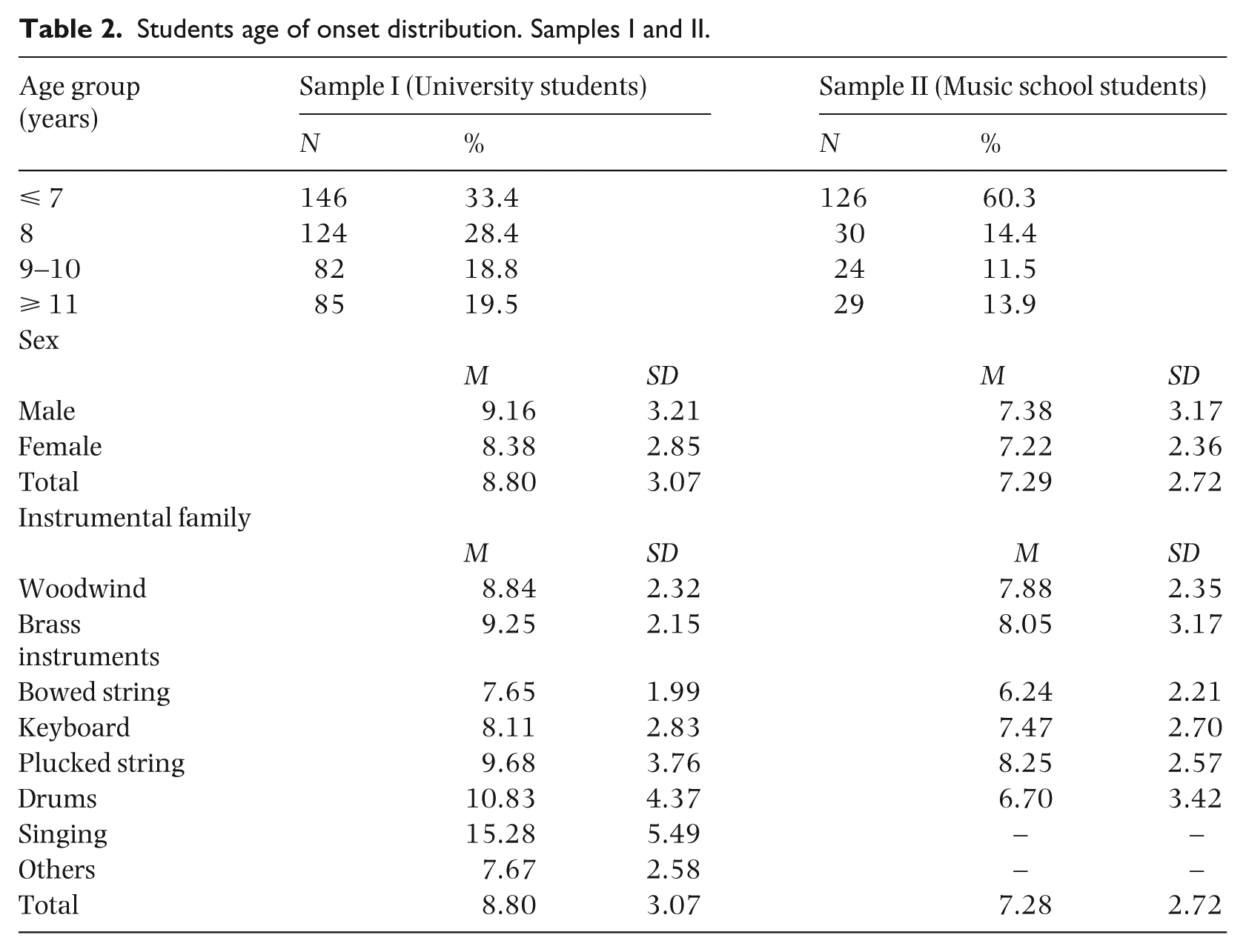
Broken down into age blocks to test the association between those and sex, χ2(3) = 10.821, p = .013, φ = 0.157, a lower percentage of females had started at age 11 or thereafter (68.2% of boys, 31.8% of girls), whereas girls were more frequent in the age group where musical practice onset was at age 7 or under (46% of boys 53.4% of girls).
With respect to the number of years of music practice, the university-level students had spent a mean total of 13.86 years (SD = 4.09) learning music, and here there were no significant differences between males and females: males = 14.16 (4.34), females = 13.50 (3.74); Brown-Forsythe: F(1, 432.77) = 2.914, p = .089; once more, however, the group of boys was more heterogeneous in this aspect.
In the second sample, the mean age of onset was 7.29 years (SD = 2.72), with significant differences neither between the sexes, nor between averages, Brown-Forsythe: F(1, 145.70) = 0.161, p = .689, although variance was greater in the group of boys, Levene’s F(1, 207) = 10.667, p = .001, nor between age blocks, χ2(3) = 5.464, p = .141.
In accordance with their lower age, this group had been learning music for a mean of 4.80 years (SD = 3.87), with a slight difference in favor of the boys, males = 5.22(4.88), females = 4.51(2.98), a difference which nevertheless was not statistically significant, Brown-Forsythe: F(1, 126.93) = 1.418, p = .236.
A relationship between age of onset and type of instrument was found, F(7, 409) = 20.889, p < .001, η2p = 0.254. Pairwise comparisons (Scheffé) showed three different homogeneous sub-groups. The first one was composed of singing students. They began studying music later due to the physiological requirements of their specialty: this was the group with the latest age of onset. Another subgroup included two groups of younger instrumentalists (bowed strings and the category of “other instruments”) and all other groups except voice students. Finally, the third group included students whose age of onset was intermediate, therefore not belonging to the singing group, to bowed strings or to “other instruments.” The results of each group are shown in Table 2.
Music performance anxiety (MPA)
University-level music students
In the age groups corresponding to musical practice onset (Table 3), the one-way ANOVA showed significant mean differences in the specific cognitions of MPA, F(3, 433) = 6.071, p < .001, η2 = 0.04. This result remained significant after a MANCOVA control of age and years of study was applied, F(3, 425) = 9.066, p < .001, η2 = 0.060. Related to gender, both a main effect, F(1, 425) = 24.672, p < .001, η2 = 0.055, and an interaction with the age of onset, F(3, 425) = 6.887, p < .001, η2 = 0.046, were found. However, no gender interaction with age was found, F(1, 428) = 3.014, p = .083, η2 = 0.007, or years of study, F(1, 428) = 1.242, p = .266, η2 = 0.003. By gender, the females scored higher on the specific factors of anxiety and helplessness (Table 3), but according to the interaction found, this trend did not occur in the group of participants who started at the age of 11 (males = 40.81, SD = 12.89; females = 36.54, SD = 10.52).
KMPAI factor differences associated with gender and age of onset in musical studies.
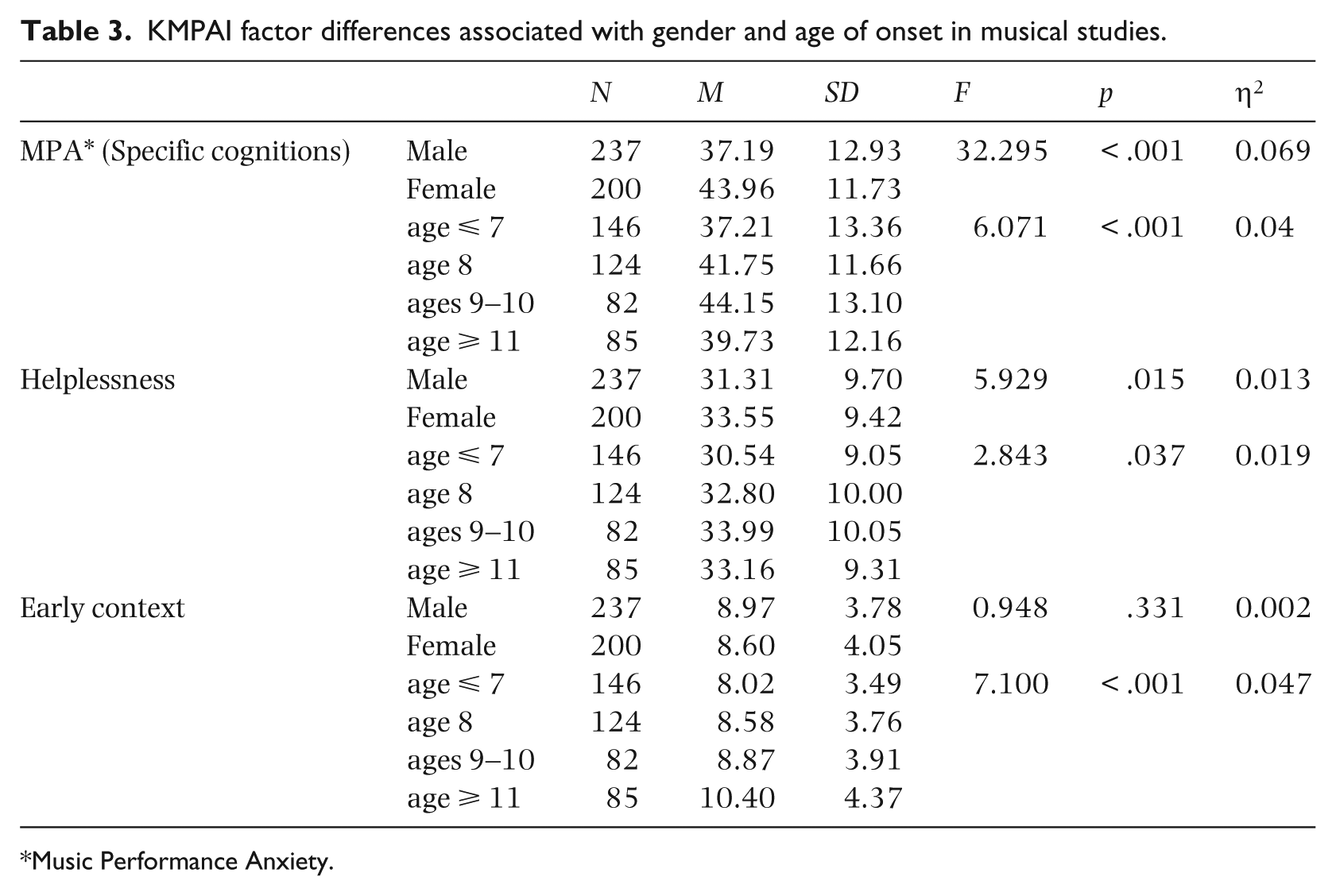
Music Performance Anxiety.
Post-hoc tests revealed that two groups stand out with a higher mean score (onset at ages 9 or 10) and a lower mean score (onset at age 7 or earlier). The other age groups are neither differentiated among themselves, nor with relation to the two aforementioned groups with more extreme scores.
With regard to the helplessness factor, a one-way ANOVA by gender revealed slight differences in favor of females (Table 1), whereas analysis according to age onset groups once more revealed significant differences, F(3, 433) = 2.843, p = .037, η2 = 0.019. The same above-mentioned MANCOVA control revealed no relation with the participant’s current age, F(1, 428) = 0.111, p = .74, nor with the number of years of study, F(1, 428) = 0.061, p = .806, however, just as mentioned above in the ANOVA result, a relation with gender was indeed observed, F(1, 428) = 7.889, p = .005, η2 = 0.018. In this case, the post-hoc tests revealed that the significant differences (p = .046) which can be observed only differentiate the group of students who started learning an instrument at age 7 or earlier from the group of students who started between ages 9 and 10.
With relation to early family context, Table 3 shows that there were no significant differences for gender, but they did exist among the four groups divided into age of musical practice onset, F(3, 433) = 7.1, p < .001, η2 = 0.047. In this case, post-hoc comparisons suggested that the group of those who started playing music at age 11 or older was significantly different from the other groups, which did not differ among one another (Table 3). However, this result did not remain significant after the MANCOVA analysis, F(3, 428) = 0.687, p = 0.56. None of the co-variates attained statistical significance: age, F(1, 428) = 2.176, p = .141, gender, F(1, 428) = 0.014, p = .906, years of study, F(1, 428) = 0.241, p = 0.624.
To control the possible effect of type of instrument (typically soloist/typically orchestral), we carried out multiple regression in blocks (step-wise method). The variables we included, and the results, are compiled in Table 4. Block 2 included all instruments as dummy variables. As can be seen, the variables that were entered into the regression equation are those already mentioned in the ANOVA, without considering any variable relative to instruments.
MPA regression analysis (Sample I and Sample II).
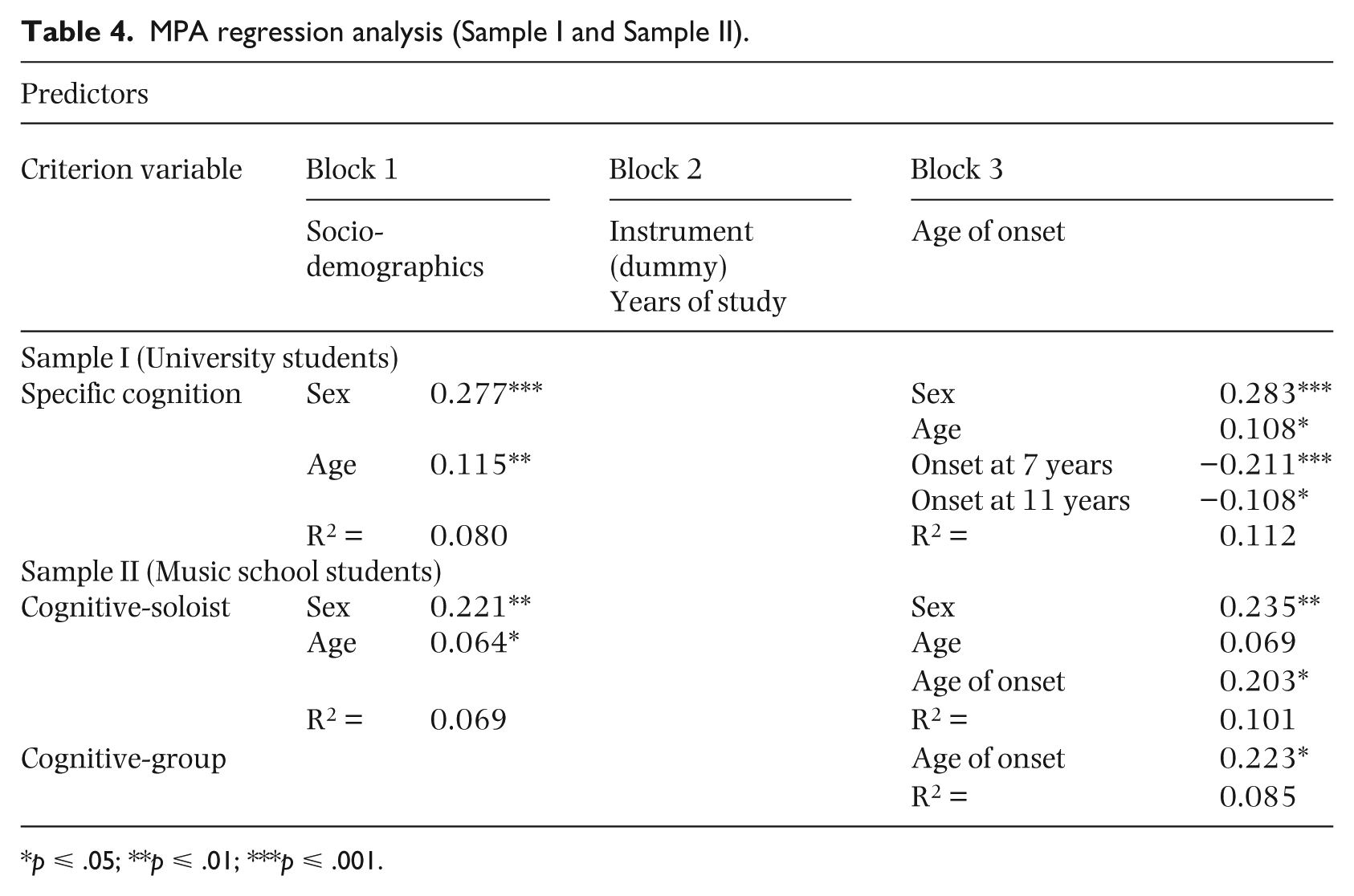
p ⩽ .05; **p ⩽ .01; ***p ⩽ .001.
Music school pupils
In this case, no significant differences were notable between mean results by gender in any factor within group performance conditions (Table 5). In solo performance conditions, however, differences were observed by gender, both in the cognitive factor, F(1, 207) = 7.866, p = .006, η2 = 0.037, and in the physiological factor, F(1, 207) = 7.841, p = .006, η2 = 0.036. In both cases, females obtained higher scores.
PAQ factor differences associated with gender and age of onset in musical studies (Sample II “Music school students”).
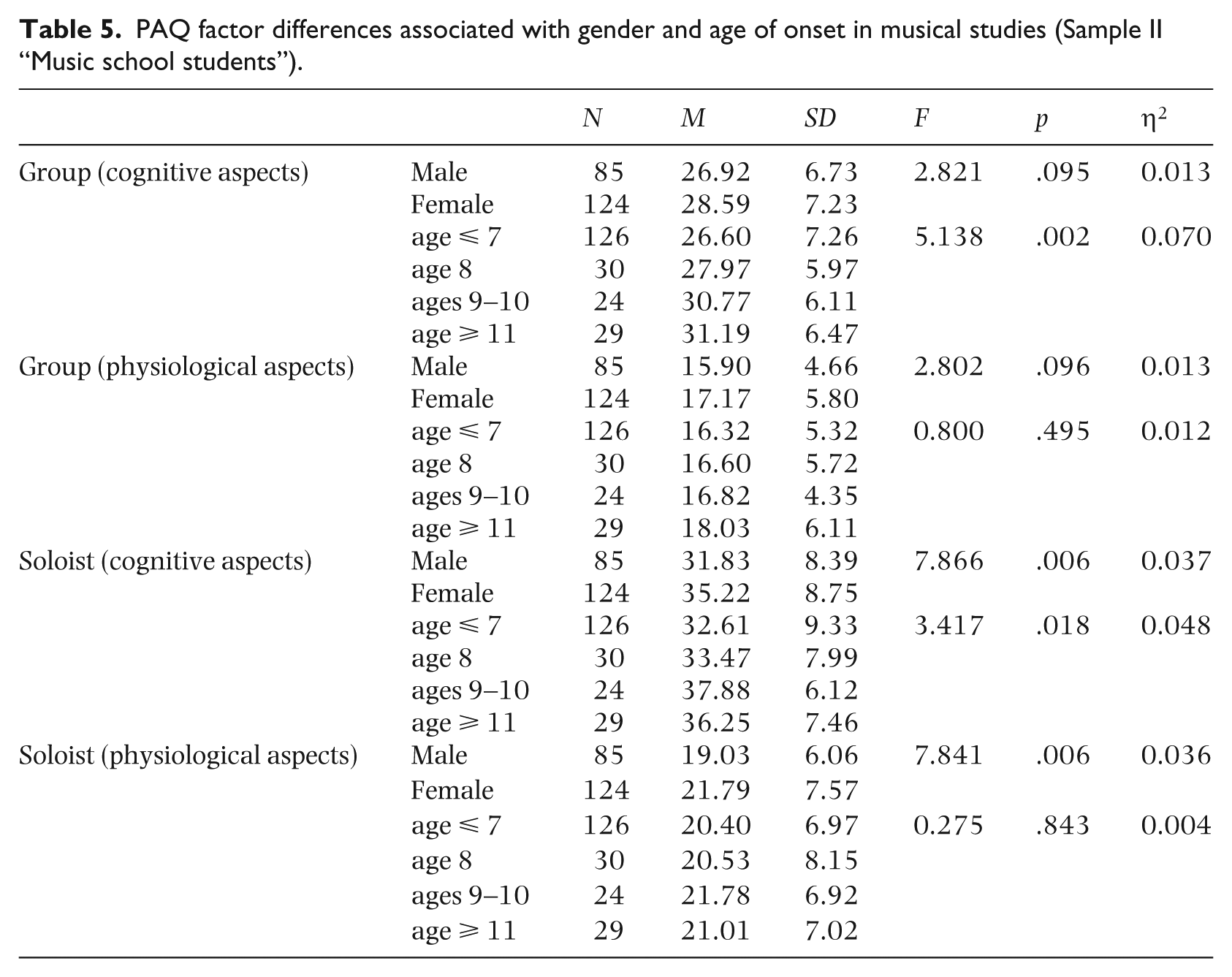
On the other hand, an ANOVA on the age onset factor revealed no differences in function of that variable, in either physiological anxiety in group rehearsal/performance, F(3, 205) = 0.8, p = .495, or in solo performance, F(3, 205) = 0.275, p = .843. In the cognitive factor, however, we did find significant differences in both cases: group rehearsal/performance, F(3, 205) = 5.138, p = .002, η2 = 0.070, and solo performance, F(3, 205) = 3.417, p = .018, η2 = 0.048. Just as in the previous case, MANCOVA control analysis showed that the results persist in the cognitive factor, both in group performance, F(3, 132) = 4.559, p = .005, η2 = 0.094, and in solo performance, F(3, 132) = 3.748, p = .013, η2 = 0.078. But here the physiological factor was not significant in either the group situation, F(3, 132) = 1.998, p = .117, or in solo performance, F(3, 132 ) = 2.002, p = .117. With respect to the covariates, current age was not significant in any of these cases, whereas the above-mentioned gender and years of study effects persisted and were relevant in both the cognitive-group factor, F(1, 132) = 3.932, p = .049, η2 = 0.029, and the physiological-soloist factor, F(1, 132) = 4.591, p = .034, η2 = 0.034.
With respect to differences among different groups (Table 5), post-hoc tests indicated that the differences in mean scores in cognition as a member of a group emerged between those who started learning music at age 7 at the latest, those who started between 9 and 10 (p = .041) and between the young age of onset and those who started at age 11 or older (p = .008). In solo performance conditions, we found significant differences only emerging between those participants who began at age 7 or earlier and those who started between ages 9 and 10 (p = .038).
As in the case of the sample I, in order to control the effect of the instrument factor, we conducted a regression analysis on the performance anxiety variables (Table 5). Again, no variables related to the instrument were considered in the regression equations.
Conclusions and discussion
In this study, we have attempted to analyze the relation between age of onset and MPA, one of the afflictions most frequently suffered by students and professionals in the musical field. Most studies had hitherto focused on personality traits; however, theoretical models (Barlow, 2000; Kenny, 2009a, 2009b) had postulated the importance of contextual factors associated with life experiences. Thus, we confirm the notion that the age when pupils start learning to play music leads to significantly different levels of MPA later on. These results have been confirmed in two very different groups of students: older ones, studying at university level in conservatories and music academies to become professional musicians, therefore subjected to frequent stressors and a great amount of pressure to attain a high level of mastery, and a group of younger pupils in a music school with a population that includes participants who desire to become music professionals, mixed with others who wish to remain amateurs. Moreover, these results are independent of the number of years a student/pupil has been practicing an instrument or following music training or instrument played.
To summarize, these results suggest that musicians who start learning their instrument at the age of 7 or younger experience a lower level of anxiety than those who only started at ages 9 or 10. As to those who indicate having started at 8, music school pupils feature a profile similar to those who started earlier, but this finding is not replicated in the sample of older (university-level) participants. Finally, in the older sample, the group of those who started at age 11 or later show a profile similar to those who started at 7 or earlier, only now there are no significant differences between boys and girls. The theoretical implications of these findings are probably divergent for each case.
The children and adolescents in the younger sample are confronting the experience of performing in public at a time in their lives when the processing of performance-related information tends to change qualitatively with age. As Colonnesi, Engelhard, and Bögels (2010) have proposed, children can feel embarrassment at those ages, but the mechanisms with which they grasp their own reactions and those of others tend to differ according to age. They grow in complexity from the age of 8 onwards. That very age is generally associated with a series of mechanisms that help one learn to value one’s own mental representation of oneself in relation with an audience – either by adopting behavior that does not correspond with the established social norm or, on the other hand, behavioral tendencies that seek recognition on the part of others in a public situation (Banerjee, Bennett, & Luke, 2010; Naito & Seki, 2009). Something similar is suggested by Modigliani and Blumenfeld (1979), who propose that children at the age of 8 differentiate “primitive” embarrassment from mature embarrassment. The latter emotion displays a greater level of cognitive complexity since it stems from evaluating the discrepancy between one’s own self-image and the image one projects to an audience. Along the same lines, Bennett (1989) has ascertained that, thanks to that greater acquired cognitive ability, children from the age of 8 onwards can feel anxiety in front of an audience, even if its members are not particularly critical. Those different ways of confronting public situations at different ages, along with the fact that children in those ages already experience anxiety (Boucher & Ryan, 2011), can entail that a child younger than 8 who is about to confront an audience is thereby actually somewhat “vaccinated” against the stress often associated with such experiences. In later ages, conversely, the situation of having to perform can have an entirely different effect: anxiety, in fact, can continually reinforce itself in a vicious circle if such situations tend to occur on a regular basis (Colonnesi et al., 2010). Along those lines, Moore, Burland, and Davidson (2003), analyzed music students’ success profiles. They found that those who pursued their musical training and had access to advanced conservatory had tended to perform a greater number of public recitals at early age than those who were not able to continue music training or abandoned it. This even applied when there was no difference in terms of ages of onset.
Such situations could be affected, however, by reactions in the children’s environment, particularly on the part of their family and closest peers. Thus, family context and the support provided by close mentors can play a crucial role, not only in helping these children develop specific self-regulation skills, but also in identifying areas of interest that can be reinforced (Lehmann & Kristensen, 2014). One should point out that support on the part of adults is particularly relevant in activities requiring a great degree of specifically focused self-control, and thus requiring an early age of onset. Nevertheless, the role played by adults can also become a risk factor when their preparation as role models, teachers and mentors does not take children’s specific needs into account.
Another additional element could confirm the contextual effect on MPA: varying reactions on the part of professors, and the individual’s environment in those ages. Bastian (1989) found that the type of reaction on the part of adults present in the environment of younger children is warmer and more centered on them and their needs than at later ages. Apart from the different ways professors can treat children, one should also consider the different degrees of sensibility that youngsters in those ages display when reacting in public performances to feedback coming both from adults and from their peers (Mizokawa, 2015). This leads authors such as Lehmann and Kristensen (2014) to recommend that professors who introduce children to music should undergo thorough specialized training.
A further hypothesis could help explain our results. The notion of critical periods in life for the acquisition of skills such as music could corroborate the notion that those who initiate their training the earliest tend to attain greater mastery: this would lead the frequency of public performances to increase, thereby exposing them early on to audiences, and providing them with a greater sense of self-efficacy (Sichivitsa, 2007). Additionally, if this occurs in a family and/or social context of people highly interested in music, with parents that encourage the child’s spontaneous participation in musical activities while planning more numerous and better-quality activities, it can have a bearing on the age of onset, and we would thus be dealing with a combination of elements that would reinforce a child’s musical skill in a positive feedback loop (Moore et al., 2003). We should point out that the sense of mastering a specific skill acts as a protector against anxiety: in fact, if the skill is mastered at a high level, such anxiety can even turn into a positively favorable activator that encourages good performance (McCormick & McPherson, 2003; McPherson & McCormick, 2006; Ritchie & Williamon, 2011).
Another group of students present a series of traits that are significantly differentiated from the other groups, depending on age of onset: those who started playing an instrument at age 11 or older, and are currently studying at a university-level conservatory. There is probably a different explanation for this result, namely, those who suffer the most from MPA tend to have already abandoned musical studies altogether by that time. Fehm and Schmidt (2006) found that pupils at the pre-academic music school level who did not wish to continue their training tended to display higher levels of MPA than those who were still considering a musical career. In our study, the fact that differences related to age of onset can only be found in the university-level student sample, with no significant difference between boys and girls, would tend to corroborate that hypothesis.
We acknowledge some limitations of this study. Firstly, our results were gathered from the participants’ self-assessment: thus, the variables they indicated, such as age of onset of musical practice, could suffer from bias, and even more so since we are dealing with conditions and activities that have their origins in childhood. Secondly, the possibility of comparing the two sample groups is limited by the fact that different instruments were used to gather data from one sample and the other. Thirdly, a final limitation comes from the fact of having asked the participants when they started playing a musical instrument, although we actually presuppose, in theory, that those practices are associated with public appearances, i.e., situations in which a series of diverse processes of conditioning and sensitization to varying audience reactions can take place. In the future, this aspect will need to be addressed with greater care, despite the eventual danger of memory bias. At the same time, it would be advisable to study further chronological aspects of musical practice and formation: other studies have shown, for instance, that the number of previous years of practice is not the only predictor of success; another predictor is the manner in which practice and training are distributed along a chronological timeline (Biasutti & Concina, 2014; Moore et al., 2003).
Footnotes
Funding
The authors disclosed receipt of the following financial support for the research, authorship, and/or publication of this article: Programa Operativo FEDER Aragón 2014-2020 “Construyendo Europa desde Aragón.”