




Abstract
The purpose of this ethnographic case study was to explore the musical ability beliefs and musical self-concepts among eight fourth-grade students whose music teacher believed in universal human musicality—the idea that all human beings have the potential to be musical and can become competent music makers. Data collection lasted 12 weeks and included twice-weekly observations of the students’ music class, numerous one-on-one interviews, and student journal entries. Findings included three themes: (a) conflicting beliefs about the root of musical ability (effort/practice or innate talent), (b) the fluidity and malleability of students’ musical self-concepts, and (c) a perception that musicmaking in the real world is only for performers. Implications include the need for music educators to actively confront the “talent myth” with their students, to be aware of the potential effects of overt comparison and judgment on students’ musical self-concepts, and to provide a learning environment in which mistakes are embraced and music-making is seen as possible and valuable for all.
Students’ beliefs about abilities—including their own—have long been considered an important topic related to academic motivation, and numerous theories of motivation incorporate some aspect of ability beliefs and/or self-perceptions (Austin et al., 2006). Academic self-concept (one’s general perceptions of ability in a domain) and self-efficacy (one’s perceptions of ability for a specific task) are both “potential mediator[s] of academic motivation and performance” (Bong & Skaalvik, 2003, p. 27). Specifically in the field of music education, existing research indicates that students’ musical ability beliefs and self-concepts are positively correlated with their interest and/or participation in music (Austin & Vispoel, 2000; Demorest et al., 2017; Wigfield et al., 1997). Unfortunately, children’s musical self-concepts tend to become more negative with age (McPherson & O’Neill, 2010; Shouldice, 2014; Simpkins et al., 2010; Wigfield et al., 1997).
One specific belief that may affect musical self-concept is that of musical ability as a “natural talent” or “gift” (Howe et al., 1998). A participant in a study by Abril (2007) described this belief, saying, “the ability to make music is something that comes to you when you are really young . . . you just have it or you don’t” (p. 8). This conception of innate and selective musical talent—present at birth among some but not others—is prevalent among the general population in many Western cultures and tends to strengthen with age (Abril, 2007; Hallam & Prince, 2003; Randles, 2011; Ruddock & Leong, 2005; Shouldice, 2014; Wayman, 2004).
Like the general population, many music teachers believe musical ability requires innate talent and attribute a student’s musical success or failure to the presence or absence of talent (Biasutti, 2010; Elmgren, 2019; Jaap & Patrick, 2015; Shouldice, 2009). For example, one music teacher in a previous study (Shouldice, 2009) expressed the belief that “some people can’t be . . . ‘a musician’ because they might not have that talent” (p. 133), while another stated, “To be truly musical I think is a gift” (p. 148). Teacher beliefs—including beliefs about students’ abilities to learn—have been an important focus of study in the field of education due to their inevitable impact on teachers’ actions in the classroom and the learning experiences of their students (Fives & Buehl, 2012; Raths, 2001; Thompson, 2007; Vartuli, 2005). This is particularly true during the early school years, which “are an important formative period when children’s beliefs about their intellectual abilities are based on academic expectations and ability evaluations conveyed by their teachers” (Vartuli, 2005, p. 77). Thus, teachers who believe in innate, selective musical talent likely convey this belief to students through their words and actions in the classroom.
Belief in innate, selective musical talent can have profound negative effects on a person’s musical self-concept, particularly for those who feel they are not talented (Abril, 2007; Elmgren, 2019; Ruddock, 2012; Ruddock & Leong, 2005; Whidden, 2010). Judgments from teachers and/or family members can be powerful influences on one’s musical self-concept, and participants in numerous studies have recalled experiences in which a music teacher communicated to them that they were not musical (Abril, 2007; Elmgren, 2019; Ruddock, 2012; Ruddock & Leong, 2005; Swain & Bodkin-Allen, 2014; Welch, 2005; Whidden, 2010). Sometimes these judgments were expressed explicitly, such as a music teacher calling a student tone-deaf or asking them not to sing, but just as often judgments were implicit, such as a music teacher not choosing a student for singing opportunities or denying them entry into an ensemble. Whether the judgment was implicit or explicit, the end result was the same: those persons’ musical self-concepts were destroyed, and they chose to cease music-making for the rest of their lives.
While the conception of musical ability as an innate and selective talent is common among many Western cultures, ethnomusicologists have studied numerous cultures in which this idea does not exist (Blacking, 1971; Koops, 2010; Mapana, 2011; Russell, 1997; Turino, 1989). Instead, there is a belief in what I will refer to as universal human musicality: all human beings are considered to be musical and capable of becoming competent music makers. For example, while studying the Venda people of South Africa, Blacking (1971) found that virtually all of them were musically competent, noting their belief “that every Venda is capable of musical performance, unless he is totally deaf” (p. 25). More recently, Koops (2010) discovered a similar finding among the “Baatikunda” (pseudonym) community in The Gambia, specifically that there was an “expectation [for all] to be musical” (p. 29). While individuals in cultures with a belief in universal human musicality acknowledge that a few may show superior ability, they do not believe that any lack the capacity to become competent musical participants and virtually all do.
Given the contrast between the negative effects of innate talent beliefs in many Western cultures and the positive effects of universal human musicality in other cultures, I wondered how the belief in universal human musicality might manifest in a teacher’s classroom. To explore this, I previously conducted an ethnographic case study (Shouldice, 2019) of Ms. Ridge (pseudonym), one elementary music teacher in the Midwestern United States who believes in universal human musicality, in order to investigate the ways in which this belief related to her actions in the classroom and interactions with students. In this prior study, I discovered that Ms. Ridge’s belief in universal human musicality connected to her emphasis on the importance of practice and effort, normalization of the varying speeds at which students learn, establishment of a safe and supportive learning environment, communication of a persistent belief that each student can and will succeed, and a goal of helping students “feel like musicians” so they would be empowered and motivated to make music.
Although Ms. Ridge stressed the importance of helping students develop positive musical self-concepts, it is not clear the extent to which this was actually achieved since I did not examine students’ experiences or beliefs in that study (Shouldice, 2019). If previous research suggests the belief in innate talent can be damaging to students’ musical self-concepts, might a teacher’s belief in universal human musicality transfer to her students and result in more positive ability self-perceptions? Therefore, the purpose of the current study was to explore the musical ability beliefs and self-concepts among eight of Ms. Ridge’s fourth-grade students. Specific guiding questions included the following:
What is the nature of these students’ beliefs about musical ability?
What is the nature of these students’ musical self-concepts?
What relationships exist between students’ musical ability beliefs, musical self-concepts, and/or their experiences both inside and outside of school music class?
Theoretical framework
In this study, I draw on the construct of self-concept as “a person’s perception of himself” (Shavelson et al., 1976, p. 411). As described by Shavelson et al. and emphasized by Bong and Skaalvik (2003), self-concept is multifaceted rather than a single, global entity, giving rise to “a conceptualization of self-concept as situation-specific” (Shavelson et al., 1976, p. 412). Thus, academic self-concept is one aspect, which can be further “divided into subject-matter areas” (p. 412) in relation to various school subjects. Therefore, in the current study, I examined musical self-concept as each student’s “perception of [them]self” in relation to the subject area of music.
Method
To examine the students’ beliefs regarding musical ability and the ways in which beliefs related to experiences, I implemented an ethnographic case study design (Creswell & Guetterman, 2019). The participants were fourth-grade students at a suburban elementary school in the Midwestern United States. Because this study built on my earlier investigation of Ms. Ridge’s beliefs and teaching practice, I purposefully sampled seven of her students from one fourth-grade class to participate, the majority of whom I had met when they were in second grade during the previous study (Shouldice, 2019). Using maximum variation sampling (Patton, 2015), I chose these students after several initial observations, as well as an initial interview with Ms. Ridge, to include variety in terms of participants’ sex, apparent musical skill level, observable engagement in class, and previous amount of time at the school. Near the end of the data collection period, I added one interview with an eighth participant (Gavin) 1 after it became clear from the other students’ comments that he was perceived to be the musically strongest in the class. I also attempted to include the student perceived to be the musically weakest in the class, but his parents did not give consent for him to participate.
I collected data using ethnographic techniques over a period of 12 weeks, during which I conducted two half-day visits to the school each week. Each visit included an observation of the students’ 30-min music class with Ms. Ridge, which I documented through fieldnotes, analytical memos, and video footage. I also individually interviewed two students during each visit, for a total of five interviews with each original participant and one with the eighth. Each semi-structured interview lasted approximately 25–30 min and covered a variety of topics, including experiences in music class, musical experiences outside of school, beliefs about musical ability, and self-perceptions of their own musical abilities. I also incorporated several questionnaire tools from previous studies to elicit further conversation, asking students questions about their responses as they marked them. In addition, I asked each student to keep a “music journal” consisting of a small binder of paper in which they were invited to write or draw anything related to music. At the end of each interview, I gave the students a page with a specific prompt to complete and bring back, which we would discuss in the next interview. (Interview protocols, questionnaires, and journal prompts are available as online supplemental material.) Finally, I conducted two 25-min interviews with Ms. Ridge at the beginning and mid-point of data collection to discuss her perceptions of the students’ abilities and self-concepts.
Data analysis occurred during and after the data collection period. I first coded each data source using open coding. In addition to coding textual data (e.g., interview transcripts, student journal text, fieldnotes), I coded visual images (i.e., student journal drawings) using HyperResearch software. After finishing data collection, I read through all data sources multiple times and edited my codes, creating new codes or subcodes to reduce bulk and combining codes to reduce redundancy. I then grouped codes that seemed to be related using axial coding. During both open and axial coding, I wrote analytical memos “to document and reflect on: [my] coding process and code choices; how the process of inquiry [was] taking shape; and the emergent patterns, categories and subcategories, themes, and concepts in [my] data” (Saldaña, 2016, p. 44). From the groupings constructed during axial coding, I identified main categories that served as emergent themes.
Trustworthiness was established in several ways. First, I participated in prolonged engagement in the field. Second, trustworthiness was enhanced through the collection of multiple sources of data. This allowed for data triangulation, showing that findings are “supported by more than a single source of evidence” (Yin, 2009, p. 116). Finally, a colleague with experience in qualitative research in music education provided peer review of codes and emergent themes.
Findings
Three main themes emerged regarding the participants’ musical ability beliefs and self-concepts: (a) conflicting beliefs about the root of musical ability, (b) fluidity and malleability of students’ musical self-concepts, and (c) a perception that music-making in the real world is only for performers.
Conflicting beliefs about the root of musical ability
All of the participants expressed the belief that anyone can be good at music with effort and practice, and they applied this belief to their own experiences. For example, Jayla explained a person would not do well at music if “they didn’t really work as hard as other people did,” and Eli reflected, “I was the only person who tested and didn’t get my belt, 2 but I think it’s because I didn’t practice.” Often the students’ attributions of musical ability to practice and effort seemed directly connected to their experiences with Ms. Ridge. In my observations I noted many examples of Ms. Ridge conveying this belief to the students, such as her explanation that, with practice, they would “get there” (i.e., experience success). For example, when the class struggled at playing a song on their recorders, Ms. Ridge said, “Today it wasn’t 100%, but we’ll get there!” Ms. Ridge also emphasized that tasks were easier for those who practice, such as when she commented to the class, “The people who said it was easy were the same people who practiced it at home!” At times the students even echoed some of Ms. Ridge’s words, as when Darion mentioned in an interview, “She says keep trying and you’ll get there.”
Despite the fact that all of the participants believed musical ability comes from effort, four of the original seven at some point expressed the belief or at least pondered the possibility that musical ability is innate for some people. For example, Peyton referred to, “people who are born being good at music,” and Kayley explained, “I think I just have a gift for playing piano.” Similarly, Darion shared, “[My mom’s] a good singer so I might be one. It might be in my blood.” Thus, a tension seemed to exist between the belief in musical ability as the result effort/practice and a belief in ability as an innate talent.
Allen was the most obvious example of this tension. In our first interview, Allen stated that anyone can be good at music if they “train really hard.” In our second interview, it seemed that Allen was beginning to question this belief: They just might not be good at it naturally or you might not put time into it . . . Some people, it’s hard for them to do it, and it just comes hard . . . It just comes naturally to some people.
This tension was again expressed in our third interview, when Allen reflected that ability comes from hard work and dedication. I guess that’s how talent comes or maybe you’re just naturally good at it . . . Some people can just do it well in the beginning . . . see someone doing it and then just do it.
This tension suggests that the attribution of musical ability to innate talent might take time to develop and may be shaped by students’ observations of how quickly or easily they acquire musical skills.
Fluidity and malleability of students’ musical self-concepts
While each student expressed both positive and negative ability self-perceptions to varying degrees, most notable was the fluidity and malleability of their musical self-concepts. Their musical self-perceptions tended to be unstable and fluctuated frequently throughout the 12-week period. For some, self-perceptions varied from day to day or even moment to moment, such as when Allen told me in an interview, “I think I can play ‘Hot Cross Buns’” but then a moment later said “I can’t do it . . . because I can’t really play that well.” For Minako, the change in her musical self-concept was more gradual but also more drastic. At the beginning of the school year, Minako expressed confidence in playing recorder, as she had previously learned to play in Japanese school. However, by mid-November, Minako believed she was not talented at music because other students had surpassed her in belts. In addition to being fluid, students’ musical self-concepts seemed to be malleable and easily influenced by a variety of factors, the most salient of which were comparison, judgment from others, and the experience of struggling.
Comparison
As examples from the previous paragraph illustrate, one of the most powerful influences shaping students’ musical self-concepts was the gauging of their own ability through comparison with others. The perception that they were better than others had a positive effect on their musical self-concept, such as when Gavin stated he was one of the best musicians in his class because he was the first one to be awarded the most advanced recorder belt. The perception that they were as good as others—or almost as good—often had a positive effect as well. Kayley told me she knew she was “pretty good” at recorder because “[Gavin’s] pretty good, and I think I’m one [belt behind] him,” and Eli felt he was good at recorder because he was “gaining belts at the regular normal speed.” In contrast, feeling less skilled than others had a negative effect on students’ musical self-concepts. Earlier in the fall, Eli was crestfallen when explaining, “I was the only person who tested and didn’t get my [white] belt,” and later in the fall Allen told me he was not very good at music because he was “sort of behind compared to other people.” Although both Allen and Minako cited Gavin’s advanced accomplishments when expressing their own poor musical self-concepts, even Gavin was not immune to the negative effects of making comparisons. In my one interview with Gavin, he shared, “Sometimes I get really mad at myself [when I play the wrong note], and I just want to hide in the corner because people see me as a person to look up [to].” Despite Ms. Ridge’s attempts to normalize ability differences, as described in my previous study (Shouldice, 2019), the students still tended to gauge their musical ability by comparing themselves to others.
Judgment from others
Another influence on students’ musical self-concepts was judgment from others. All of the students seemed susceptible to others’ judgments of their musical abilities—whether they were actually expressed or simply imagined. A number of students recalled positive feedback from others (e.g., teachers, peers, family members), which positively influenced their musical self-concepts. Some instances of positive feedback occurred in music class, such as Darion recalling an instance in which classmates applauded his eventual success after he initially struggled to play a song, which made him feel “like a superstar.” In contrast, both the lack of positive feedback and the presence of negative feedback tended to lead to a more negative self-concept. Peyton, who took private violin lessons, recalled an instance in which he “felt a little worthless” because he had played a wrong note “quite a few times,” causing the teacher to look up and throw her hands in the air. For other students, the mere fear of negative judgments from others seemed to have a negative effect on self-concept, as when Darion commented he was afraid to sing alone in front of others because “if I sung the wrong part . . . [They would think] I was a bad singer.” Whether positive or negative, the students seemed to use others’ judgments as a way of gauging their own abilities. How they believed others saw them influenced how they saw themselves.
Experience of struggling
Another factor that appeared to affect students’ musical self-concepts was the experience of struggling, particularly the outcome. When students struggled with a musical task that ultimately ended in frustration, their musical self-concepts seemed to suffer, especially if others witnessed the struggle. Ms. Ridge gave students the option of performing in class to earn their recorder belts, and after Eli tried but did not receive his white belt, he shared with me, “I felt like a dope . . . Everybody starts staring at you and then you feel like, ‘oh my god, I’m a failure.’” In contrast, when a student struggled with a musical task but ultimately experienced success, their musical self-concept seemed to be enhanced. After initially failing but then succeeding in earning his white belt, Eli drew an image of himself in his journal, his recorder held high above his head in celebration, about which he told me, “I felt like ‘Boom’ . . . I felt great, like ‘oh man I’m so proud!’”
Beliefs/effort/outcome cycle
The outcome of struggling with a task seemed to influence the students’ musical self-concepts, which in turn appeared to affect effort in musical tasks, in a cyclical manner. Putting forth effort at a challenging task that ended in success prompted feelings of capability and a positive self-concept, which in turn led to more effort—thus increasing the likelihood of future success. Conversely, putting forth effort at a challenging task that ended in failure led to feelings of incapability and a more negative self-concept, which tended to diminish effort—thus decreasing the likelihood of future success. Ms. Ridge seemed to be aware of this cycle, as evidenced when discussing Allen: He probably could do really well, but because he thinks he won’t be able to, he doesn’t even want to try. . .. So then it’s like this cycle because he’s not interested so he doesn’t try and then he’s not interested in it because he can’t do it.
To combat this, Ms. Ridge said, “I watch to make sure he’s ready [before starting to play] so he can be successful from the beginning.” Ms. Ridge also seemed to be sensitive to effects of self/other comparisons on students’ self-concepts and tried to combat this through providing reassurance: If he feels like he’s not the only one who is struggling, then he feels better about it, too. Like [telling him] “Even I struggled at the beginning,” things like that. And when he hears that and if he believes it, then he’s more willing to try and put the effort in.
Incorporating comparison and judgment from others into this cycle results in the model shown in Figure 1. Comments from a number of the students suggested they were aware of this cycle. Jayla reflected that, in order for a person to improve at music, “It would take them lots of practice . . . effort . . . believing in their selves.” Gavin said that a person might do well at music if “[they have] been noticed as a good singer slash player and stuff. Another reason is probably maybe from experience . . . Like doing it before and they feel like they can do it again.” However, if a person does not do well at music, Gavin believed it is likely because “they feel like they’ve done something wrong and they think that they can never do it.”
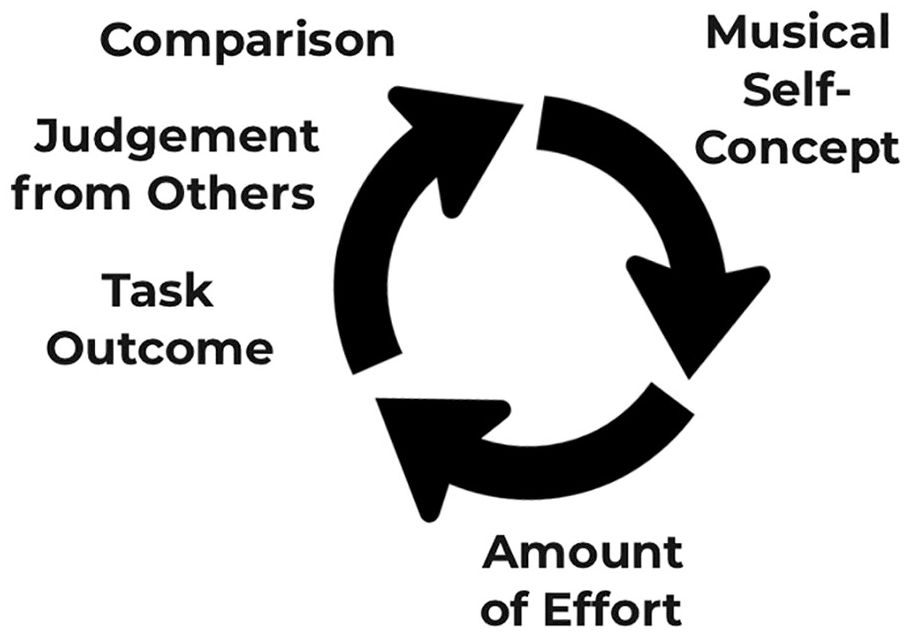
Beliefs/effort/outcome cycle.
Perception of music-making as performing
All of these students were reasonably competent at music. Each could sing in tune to some degree and play at least a few songs on recorder. Sadly, however, they did not all feel they were good at music, which seemed to be due to the level of skill and mastery they perceived was expected and required for musical participation. Despite Ms. Ridge’s attempts to normalize mistakes and her practice of awarding recorder belts even if students had not played the song perfectly, the students perceived mistakes as bad and seemed to hold an expectation that music should be perfect. According to several students’ definitions, a person who is good at music “[tries] to perfect it” (Allen), “wouldn’t miss any notes” (Darion), and “[wouldn’t] get a squeak on the recorder” (Eli). Many students gauged their own musical abilities in terms of whether they were perfect or made mistakes, like Jayla describing herself as “just OK at music” because “sometimes I make mistakes, and sometimes I don’t.” Similarly, despite Ms. Ridge’s efforts to establish a safe and supportive classroom environment where students’ musical potential could be nurtured without fear of mistakes or judgment, most of them still expressed a fear of mistakes or being judged by others as “bad,” like Peyton saying, “I’m scared that I may mess up . . . It gets me all nervous and jiggly.”
This fear of mistakes and desire for perfection seemed to be rooted in an assumption that, in order to make music, a person must be recognized as one of “the best.” Underlying many of the students’ perceptions was the idea that the goal of musical participation is to reach a superior level of skill. According to Minako and Kayley respectively, musicians play “hard” music and play “better” than other people. It could be that these students, despite having reasonable musical competence, did not feel like good musicians because the standard they were visualizing was that of a performer/professional musician.
For many of the students, it seemed that becoming a performer was the only reason to continue participating in music. Although all of them expressed interest in participating in school music classes beyond elementary school, most of them stated that they would stop making music when they finished high school—if not sooner—and would only listen to music after that. Eli even thought it ridiculous that an adult who was not a professional musician would sing in their daily life, as evidenced by this exchange:
Can you see yourself singing at home for fun sometimes [in the future]?
If I’m thirty or forty, no; if I’m a high schooler, yes . . . If I was thirty or forty years old and I started singing, I’d probably replace the cat lady . . . as the craziest person on the block! . . . I just can’t really imagine a 30- or 40-year-old because when I think of 30- or 40-year-olds, I think of my dad. [laughs]
He doesn’t sing ever?
No.
No? Do you know any grownups around that age that sing, that you ever hear?
[pauses] Not other than the people who do the Thoroughgood Players [a community theater group].
Other than that, Eli did not regularly observe any adults making music unless they were professionals. The implication for Eli and many of the other students seemed to be that, since the perceived standard is so high, music-making is all-or-nothing. The apparent belief is that, unless you are good enough to be a performer, the only option for musical participation in daily life is as a listener.
Discussion
The purpose of this study was to explore musical ability beliefs and self-concepts among eight American fourth grade students whose music teacher believes in universal human musicality. In my previous research (Shouldice, 2019), I found that this belief manifested in Ms. Ridge’s emphasis on the importance of practice and effort, attempts to normalize the varying speeds at which students learn, creating a safe and supportive learning environment, communicating a persistent belief that each student can and will succeed, and a goal of helping students “feel like musicians.” While all of her students who participated in the current study expressed a similar belief that anyone can be good at music with effort and practice, many also expressed a conflicting belief that musical ability is innate. In terms of Bronfenbrenner’s (1977) ecological systems theory of child development, Ms. Ridge’s classroom is only one part of the microsystem within which the students exist, while messages of musical ability as innate and selective are conveyed by many other influences within the students’ microsystems—including family, peers, or private teachers—as well as the macrosystem of culture in the United States. Although Ms. Ridge frequently communicated to her students the importance of effort and practice and the belief that they all can experience success, I have never observed her directly confronting the idea of innate talent with her students. It seems that, unless the teacher explicitly talks with students about the idea of innate talent as a myth, they will be left to assume a belief in that myth, which permeates the mainstream culture.
This attribution tension and the fluidity/malleability of the students’ musical self-concepts suggest that ability beliefs and self-perceptions may be particularly sensitive and amenable to influence during this time in children’s lives. Causal attributions have been identified as a key antecedent to self-concept, specifically that “self-concept and attributions are related in a reciprocal manner such that the types of causal attributions made for previous successes and failures influence subsequent self-concept and the self-concept thus formed affects later attributions” (Bong & Skaalvik, 2003, p. 3). The participants’ musical self-concepts seemed to fluctuate throughout the 12-week period in relation to comparing themselves with others, perceived judgments of their abilities from others, and the experience and outcome of struggling with a musical task. These factors parallel three other key antecedents to self-concept: (a) frames of reference/social comparison, (b) reflected appraisals from significant others, and (c) mastery experiences (Bong & Skaalvik, 2003). In the current study, these factors seemed to interact with musical self-concept and effort in a cyclical manner, as shown in Figure 1.
Teachers should be aware of the influence of these factors on students’ developing musical self-concepts. The effects of comparison was a notable discovery of Stipek and Daniels (1988), who “found that in schools in which evaluation [was] based on normative criteria and [was] frequent and public, kindergarteners perceived their competence to be lower than did kindergarteners in schools in which such evaluation [was] deemphasized” (p. 355). The Recorder Karate program used in Ms. Ridge’s classroom served as a constantly visible measure of students’ abilities in comparison with one another, which seemed to be detrimental to some students’ musical self-concepts. While many music educators in the United States use this program as a means of motivating students, teachers also should be aware of the possible negative effects of such a program on some students’ musical self-concepts and seriously weigh these drawbacks when considering whether to use it in their classrooms.
The students’ descriptions of their own abilities were often related to the presence/absence of mistakes and a goal of perfection. This, coupled with the fact that most of them planned to stop making music after finishing their schooling, suggests that they see music-making in the real world as something done only by professional musicians. This coincides with Siebenaler’s (2008) finding that American children’s are less likely to believe “everyone should sing, not just singers on radio, TV, and records” as they get older (p. 52) and some American adolescents’ implied belief that “the average person listens to music but doesn’t perform it” (Wayman, 2004, p. 33). The participants in the current study seemed to acknowledge only the presentational mode of music-making (Turino, 2008), in which there is a clear divide between music makers and listeners/consumers, and seemed completely oblivious to the idea of a participatory mode of music-making, in which everyone can play a part and amateurs can make a meaningful contribution.
The participants’ perception of an extremely high level of skill and mastery necessary in order to call oneself “a musician” is similar to a finding in Whidden’s (2010) study of adults who self-identified as “non-singers.” Though all of her participants could indeed match pitch and execute rhythm, they conceptualized a singer as “one who can sing adequately enough to perform in a solo capacity in front of an audience” (p. 95). One reflected, If I say I’m a singer, everyone expects Celine Dion. If we could say, yes I’m a singer but I am a singer that sings to her baby at night . . . But if I say I’m a singer, it is expected that I can get up on stage and sing. Maybe if there were different levels allowed, then people would dabble. (Whidden, 2010, p. 96)
Rather than perpetuating the idea that only those who perform for an audience are worthy of making music, we might propagate the concept of what Blacking (1971) referred to as “average musical ability”: If average linguistic ability is taken to refer to the fact that almost every member of every known human society is able to communicate with [others] in at least one language, average musical ability should refer to a similarly universal ability to communicate in music. (p. 22)
In this conception of musical ability, one is not expected to reach the skill level of a professional performer to be considered musically competent and worthy of making music in daily life. In both my current and previous (2019) studies, I found that Ms. Ridge does help students develop a level of “average musical ability”; by the time they reached the end of elementary school, virtually all of them could use their singing voices and sing in tune. The problem seems to be that they do not realize this “average musical ability” is worthwhile in its own right—that you do not have to be a highly skilled performer to engage in making music as a valuable and meaningful part of your daily life.
Conclusion
Unless the music teacher explicitly confronts the myth of innate musical talent with students, they will be left to assume and perpetuate a belief in that myth. This, along with other factors, can have detrimental effects on students’ musical self-concepts, which music teachers should actively work to prevent if they wish for students to have positive musical futures. Instead of leaving students to assume that music-making in the real world is only for professionals, music educators can encourage and communicate the value of everyday, participatory music-making. Musical potential does indeed lie in every human being, but to realize it, we must foster an appreciation for the musicality of which everyone is capable and a belief that this “everyday musicality” is worthwhile.
Supplemental Material
Online_Supplemental_Material – Supplemental material for An investigation of musical ability beliefs and self-concept among fourth-grade students in the United States
Supplemental material, Online_Supplemental_Material for An investigation of musical ability beliefs and self-concept among fourth-grade students in the United States by Heather Nelson Shouldice in International Journal of Music Education
Footnotes
Declaration of conflicting interests
The author(s) declared no potential conflicts of interest with respect to the research, authorship, and/or publication of this article.
Funding
The author(s) disclosed receipt of the following financial support for the research, authorship, and/or publication of this article: This work was supported by the Provost’s New Faculty Award at Eastern Michigan University.

Supplemental material
Supplemental material for this article is available online.
Notes
References
Supplementary Material
Please find the following supplemental material available below.
For Open Access articles published under a Creative Commons License, all supplemental material carries the same license as the article it is associated with.
For non-Open Access articles published, all supplemental material carries a non-exclusive license, and permission requests for re-use of supplemental material or any part of supplemental material shall be sent directly to the copyright owner as specified in the copyright notice associated with the article.
