



Abstract
This study examined demographic information for current music education faculty (N = 136), the factors that seem to influence music education faculty members’ levels of job satisfaction and primary stressors, also by institution type. Simultaneous multiple regression revealed that academic autonomy, collegial support, sleep, parental responsibilities, and certainties of the tenure process affect music education faculty members’ reported levels of job satisfaction and stress. Mean job satisfaction and stress scores for each group by Carnegie institution types were compared using a one-way ANOVA. Significant differences in stress scores between groups suggested that the larger institution group (R1) did not report feeling more stressed about professional responsibilities than the smaller institution group (M1). Analyses of open-ended questions also reinforced the notion that the COVID-19 pandemic increased flexibilities in work and parental responsibilities leading to lower stress levels.
Keywords
Introduction
Music education faculty (MEF) in the United States (US) perform various tasks according to the types of higher education institutions in which they teach (Pellegrino et al., 2018). MEF’s work-related responsibilities can be highly satisfying. Inversely, the same professional responsibilities can be perceived as overwhelming, and subsequently lead to high levels of stress. Job satisfaction or stress levels may differ especially as MEF attempt to balance their personal lives and professional responsibilities (i.e. research, teaching, and service) amid the years during which MEF pursue tenure and promotion (Pellegrino et al., 2018).
However, over the past 20 years, few researchers have conducted studies examining the demographics of US MEF, and indicators of satisfaction and stress related to professional responsibilities, professional interests, and personal priorities (Brewer & Rickels, 2012; Hewitt & Thompson, 2006; Pellegrino et al., 2018; Sims et al., 2010). Therefore, it is both timely and necessary to examine MEF’s demographic information and potential determinants of their job satisfaction and stress, beyond the current and limited literature.
Literature review
Demographics
A limited number of researchers have examined MEF demographics. Hewitt and Thompson (2006) constructed a MEF demographic profile evidencing that MEF identified more often as male (56.1%), married (78.0%), White (94.0%), with doctorate degrees (71.1%), with an average age of 51.65 and average yearly salary of $53,092. MEF reported spending more time teaching than conducting research. Brewer and Rickels (2012) demonstrated that MEF have different workloads depending on the types of institutions in which they teach. Brewer and Rickels also yielded similar demographic profiles where more MEF were male (55.1%) and the largest portion of MEF time was allocated to teaching (65.0%), adding MEF had an average of 12.25 years of K-12 teaching experience.
Even though such few researchers have examined MEFs’ demographic backgrounds, such information suggests that these faculty members are mostly men, White, and married. Additionally, MEF spend more time teaching, primarily undergraduates, than conducting research. Such demographic information can be important to also understanding job satisfaction and stressors among MEF.
Job satisfaction
Over the past decades, a considerable amount of literature on job satisfaction of general university faculty has emerged. Overall, job satisfaction indicators seem to be associated with work environmental factors and faculty members’ personal lives. These determinants include academic autonomy (Daly & Dee, 2006; Lee & McNaughtan, 2017; Shin & Jung, 2014), support from colleagues and supervisors (Mudrak et al., 2018; Pellegrino et al., 2018), and faculty members’ marital status (Leung et al., 2000; Mamiseishvili & Rosser, 2011; Sabharwal & Corley, 2009). Research on job satisfaction has its roots in autonomy, defined as ‘the freedom of faculty members to research, publish, and teach without restraints imposed by university administrations’ (Eisenberg, 1988, p.1433). Indeed, researchers of several studies have documented that autonomy positively impacts job satisfaction (Daly & Dee, 2006; Lee & McNaughtan, 2017; Shin & Jung, 2014). For example, Daly and Dee (2006) uncovered that high levels of autonomy had a positive and indirect influence on job satisfaction, which facilitated faculty retention. These findings matched those of Shin and Jung (2014) who demonstrated that academic autonomy is a fundamental component linked to job satisfaction. More specifically, Lee and McNaughtan (2017) found that job crafting, defined as autonomy in conducting research and levels of flexibility in music faculty members’ teaching and service, also enhances job satisfaction and vitality, which also affects job satisfaction. They ultimately found that freedom to conduct one’s research is the most critical factor MEF use to gauge their autonomy.
Researchers have also found links between job satisfaction and the support faculty receive from colleagues and supervisors. Mudrak et al. (2018) found that faculty (55.7%) valued support provided by colleagues ‘all the time’ or ‘often’ (p. 336), as well as the job resources provided. Similarly, Pellegrino et al. (2018) reported that MEF regarded mentoring interactions with senior faculty as invaluable, also as positively associated with job satisfaction.
Researchers have also addressed the marital status of faculty members alongside job satisfaction (Daly & Dee, 2006; Leung et al., 2000; Sabharwal & Corley, 2009). Leung et al. (2000) found that married professors reported greater levels of job satisfaction, and single professors demonstrated higher psychological stress (see also Sabharwal & Corley, 2009). However, it remains unclear as to whether marital status affects job satisfaction among MEF. That marriage was defined in traditional terms in these studies might also be modernized to include non-traditional partnerships (e.g. same-gender relationships).
Stressors
Job-related stress is also an important issue, especially since stress can trigger psychological and physical illnesses (Haseeb & Sattar, 2018) and can be related to job turnover (Hamann & Sherbon, 1988). Scholars have examined job-related stress concerning faculty salary (Hamann & Sherbon, 1988; Sabharwal & Corley, 2009), hours of class preparation and sleep (Bernhard, 2007), parental responsibilities (Carr, 1998; Misra et al., 2012; Pellegrino et al., 2018), and uncertainties surrounding tenure (Bradley et al., 2017; Pellegrino et al., 2018). Researchers have also commonly reported that salary plays a significant role in faculty stress levels (Hamann & Sherbon, 1988; Sabharwal & Corley, 2009). Hamann and Sherbon (1988) found that as much as faculty regarded their salaries as insufficient, this resulted in higher levels of stress among men versus women faculty. Sabharwal and Corley (2009) corroborated this finding that the average annual salary of men faculty was higher than women faculty, suggesting that gender inequities in salary in fact matter.
Fewer researchers have focused on links between hours spent on class preparation and stress. Bernhard (2007) found that stress is associated with ‘emotional exhaustion, depersonalization, and low personal accomplishment’ (p. 118), adding that there exists a strong, positive relationship between depersonalization, emotional exhaustion, and the average hours of class preparation per week. Regarding relationships between sleep and stress, Bernhard (2007) demonstrated that stress (i.e. emotional exhaustion and depersonalization) and sleep are negatively correlated. Put differently, as hours of sleep decrease, emotional exhaustion, and depersonalization increase. Given that the often-recommended hours of sleep per day for adults is 7-to-9 hr (Hirshkowitz et al., 2015), the average daily hours of sleep reported (6.78) may exacerbate stress.
Researchers have also explored parental responsibilities of faculty members. Hamann and Sherbon (1988) found that female faculty with children had fewer peer-reviewed publications. Misra et al. (2012) found that women spent more time caring for their children regardless of academic rank. Pellegrino et al. (2018) added that female MEF with children experienced more challenges in balancing their professional lives. It appears, then, that parental responsibilities are related to stress, also by gender.
Finally, Misra et al. (2012) suggested that job demands are different across faculty, underscoring that the uncertainties involved with tenure-track requirements punctuate anxiety and stress. Bradley et al. (2017) found that tenure-track MEF felt unsure if their scholarly outputs were sufficient, complaining about a lack of clarity in tenure requirements. Pellegrino et al. (2018) also found that most MEF respondents (70.0%) felt very stressed during their tenure processes, and this was especially true for MEF in larger institutions.
Summary and purpose statement
In sum, the literature indicates that autonomy, collegial support, marital status, and tenure status contribute to job satisfaction, while salary, hours of class preparation, hours of sleep, parental responsibilities, and uncertainties surrounding the tenure process contribute to stress. These findings suggest that, as within other academic disciplines and areas, both the current status of academic appointments and types of institutions influence MEF’s job satisfaction and stress.
This current study is important, especially to undergraduate, graduate, and doctoral students entering MEF roles, as making such updated information more accessible and transparent should help give those interested in pursuing academic positions in music education more opportunities to investigate their future professional and professional lives, especially as related to their future job-related factors. Therefore, it is both timely and necessary to examine potential determinants of MEF’s job satisfaction and stress, beyond the current and still quite limited literature. Therefore, the purpose of this study was to construct an updated profile of current MEF throughout the US, their demographics, job satisfaction, and stress levels. We examined five research questions, accordingly:
What are the demographic characteristics of current MEF?
What factors influence MEF’s self-reported levels of job satisfaction?
Are there differences in reported levels of job satisfaction among MEF by institution types?
What factors influence MEF’s self-reported levels of job-related stress?
Are there differences in reported levels of stress among MEF by institution type?
Methods
Participants
We employed multiple sampling methods to survey our study participants (Nardi, 2018). More specifically, after obtaining university Institutional Review Board (IRB) approval in November 2020, the National Association for Music Education (NAfME) distributed our survey instrument via Google Forms on behalf of us as researchers. The NAfME invited 820 members whose membership profile indicated that they taught at the university level. However, due to a small number of responses (n = 37), we employed a purposeful sampling technique (Nardi, 2018) adding MEF who worked at the 100 US colleges and universities to our sample (Universities.com, n.d.). We obtained an additional list of 279 MEF and contacted them via an email invitation containing a link to the survey. Our sampling framework yielded 1,099 potential respondents and an overall response rate of 12.4% (N = 136). We informed participants of the aims and ethical implications of the study before they volunteered to participate.
Survey instrument
We collected data via an online survey instrument as per best survey research practices (Edmondson et al., 2012). More expressly, we developed a 67-item instrument that corresponded to constructs and concepts derived via researchers’ previous studies and findings (Bernhard, 2007; Bradley et al., 2017; Carr, 1998; Daly & Dee, 2006; Hamann & Sherbon, 1988; Lee & McNaughtan, 2017; Leung et al., 2000; Mamiseishvili & Rosser, 2011; Mudrak et al., 2018; Pellegrino et al., 2018). We framed the 67-item instrument around our three primary sections of interest: (a) demographics, (b) indicators of job satisfaction, and (c) indicators of stress.
The first section included 12 demographic items (e.g. gender and age). We collected institution types in which participants taught following the Carnegie Classifications of Institutions of Higher Education (Center for Postsecondary Research, 2020), or whether participants taught in the following institutions: (a) Research 1 (R1) universities with very high research activity, (b) Research 2 (R2) universities with high research activity, (c) Doctoral/Professional Universities (D/PU) with less than $5 million in research expenditures, (d) Master’s 1 (M1), (e) Master’s 2 (M2), (f) Master’s 3 (M3), and (g) Baccalaureate Colleges (BC). All M1 through M3 grant master’s degrees but vary in terms of the number of degrees offered (i.e. large, medium, and small). BCs confer baccalaureate or higher degrees which represent at least 50% of all degrees, and fewer than 50 master’s degrees or 20 doctoral degrees are awarded each year.
The second and third survey instrument sections included items using 5-point Likert-type scales ranging from 5 (strongly agree) to 1 (strongly disagree) and open-ended questions to solicit richer information (Miller, n.d.). Likert-type scale item responses were aggregated, and composite scores were calculated based on average scores ranging from 5 to 1 for all the subconstructs under the second and third sections.
The second section included one dependent variable—job satisfaction—and three independent variables—autonomy, collegial support, and marital status. Job satisfaction levels were assessed using items 26 to 28. Higher scores denoted greater job satisfaction. Autonomy, collegial support, and marital status were measured with items 29 to 40. Higher scores were positively associated with each independent variable.
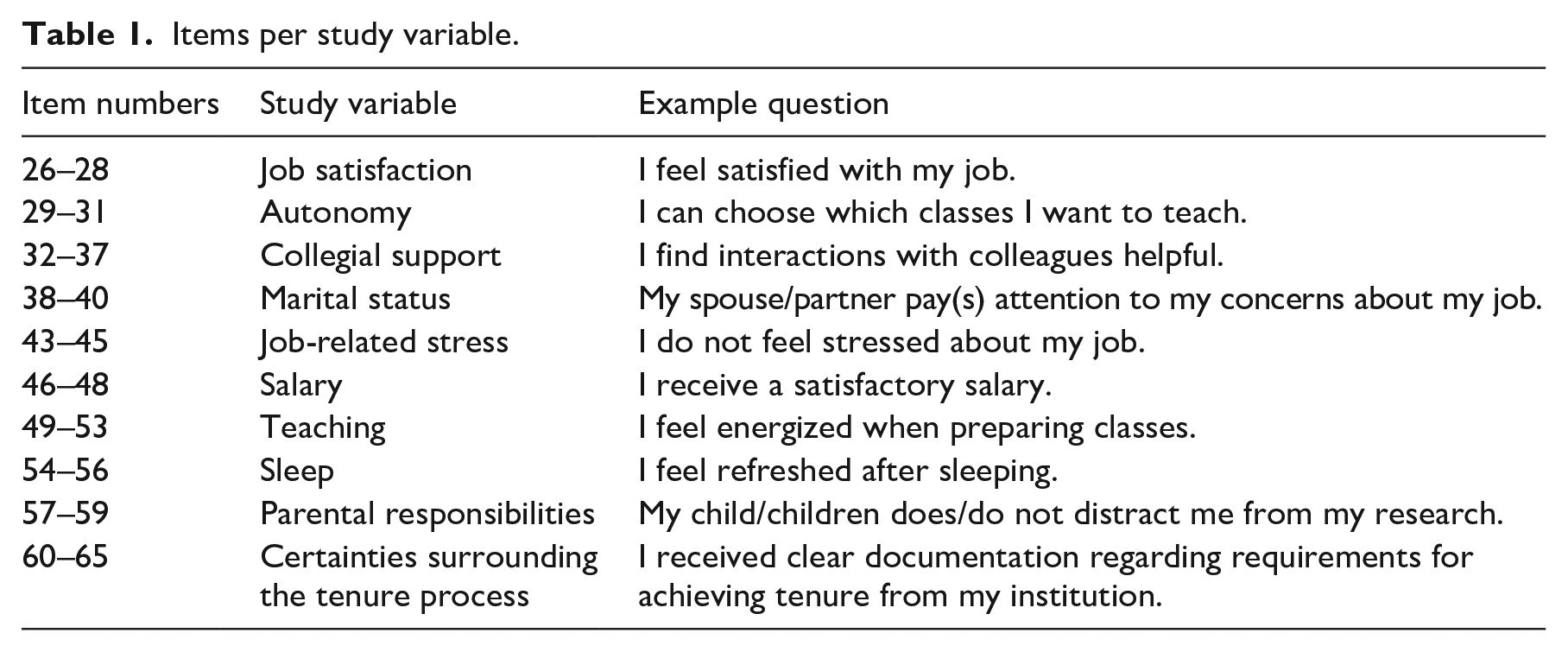
The third section included one dependent variable—stress—and five independent variables—salary, teaching, sleep, parental responsibilities, and certainties surrounding the tenure process. Job-related stress levels were assessed with items 43 to 45. Higher scores indicated lower job-related stress levels. Each stressor was measured with items 46 to 59, with higher scores positively associated with each stressor. See the full survey instrument in the supplemental material. See also Table 1 that illustrates item numbers and one example question per construct.
Items per study variable.
Instrument reliability
Cronbach’s alpha analyses confirmed the satisfactory reliability of our survey instrument. Overall alpha estimates on both our job satisfaction and stress constructs were acceptable (α = .82 and α = .73; Vaske et al., 2017). We also piloted this instrument and had three MEF who were not participants in this study review and critique the content of this instrument before distributing to respondents. We did all of this to determine whether this survey instrument measured the concepts that we developed it to measure (Edmondson et al., 2012). After the pilot, we officially collected data in January of 2021.
Data analyses
To answer research question one, we used frequency distributions for all nominal data (Thompson, 2009). For our continuous data, we calculated means and standard deviations (SDs). We explored central measures of tendency for each Likert-scale item, including mean responses and SDs. We also combined item responses per construct to generate composite scores.
To answer research questions two and four, we conducted simultaneous multiple regression analyses. We confirmed the assumptions of linearity, normality, and homoscedasticity, and each variance inflation factor (VIF) score was well below 10, indicating that multicollinearity assumptions were also met. We used the first regression model to determine if autonomy, collegial support, and marital status significantly predicted job satisfaction. We used the second model to test if salary, teaching, sleep, parental responsibilities, and (un)certainties surrounding the tenure process significantly predicted stress levels. To offer a measure of practical significance concerning the magnitude of the effect (Field, 2018), we calculated Cohen’s (1988) f 2 as an index of effect size, also categorizing effects as small (f2 = .02), medium (f2 = .15), and large (f2 = .35).
To answer research questions 3 and f5, we conducted two sets of one-way ANOVA analyses on participants’ levels of job satisfaction and stress to determine if scores varied by institution type. We based interpretations on statistical significance at or below p = .05. We confirmed assumptions of independence, linearity, normality, homoscedasticity, and noncollinearity (Field, 2018), after which we calculated Eta-square (η2) as an index of effect size to examine the proportion of variation in the dependent variable accounted for by groups as the independent variable, also categorizing effects as per Cohen’s (1988) η2 categories of small (η2 = .01), medium (η2 = .06), and large (η2 = .14).
Finally, for our qualitative analyses, we employed NVivo (QSR International Pty Ltd, 2020) to yield comprehensive pictures of participants’ perceptions and thoughts (Wong, 2008). We performed a word frequency analysis on the comments to use the output for uncovering recurring themes. Such auto-coding examinations are less susceptible to research bias, which enabled us to identify the main themes and indicator words as codes (Fielding et al., 2013). As such, we also coded and sorted a set of categories to extract main ideas by quantitatively presenting open-ended questions as follows: ‘X% of responses mentioned concepts Y’ (Fielding et al., 2013, p. 3266).
Findings
Participant demographics
Gender, marital status, ethnicity
The proportion of male participants (50.7%) was slightly higher than female participants (44.9%). Most participants were White (88.2%) and married (66.9%) (see Table S1 for details in the Supplemental Material).
Age, parental responsibilities, hours of sleep
Participants’ mean age was 49 (SD = 10.56) and their mean number of children was 1.08 (SD = 0.96). The mean hours spent with respondents’ children per week was 3.26 (SD = 2.15), and their mean hours spent sleeping per day was 6.84 (SD = 1.07).
Education and employment
A doctorate degree was predominantly participants’ highest degree earned (99.3%). A strong majority (89%) of participants had a main curricular area focus on music education. Of all respondents, tenured MEF (55.1%) had slightly higher degrees than tenure-track MEF (44.9%). For participants’ faculty position, 39.7% were assistant professors, followed by associate professors (31.6%) and professors (28.7%). Most participants worked at public universities (72.1%) and R1 institutions (53.7%). More than half (61%) of participants reported that their institutions conferred doctoral degrees as the highest degree (see Table S2 for details in the Supplemental Material).
PreK-12 Teaching experience
Prior to their current positions, participants’ preK-12 teaching experience varied ranging from 0 to 30 years (M = 8.44, SD = 5.44).
Professional responsibilities
By Carnegie classification, we aggregated participants’ reported mean teaching, research, and service hours per week. The BC group reported the highest mean of teaching hours (M = 28.00). The R1 group spent more time on research (M = 10.63). The M1 group reported the highest mean of service hours (M = 14.90), and overall, participants spent more time on teaching (M = 22.83) than on service (M = 12.35) and research (M = 8.57) per week (see Table S3 for details in the Supplemental Material).
Scholarly activities
Scholarly activities were reported within the last 3 years. Participants published an average of 0.45 books (SD = 1.06), 1 book chapter (SD = 1.6), and 3.45 journal articles (SD = 2.99). At international and national conferences, the mean number of scholarly papers that participants presented was 8.45 (SD = 8.89).
Courses taught
A total of 99.26% (n = 135) of participants reported teaching undergraduate courses at their current institutions. The undergraduate course that the majority of MEF reported having taught was supervising student teachers (74.6%). Conversely, 86.76% (n = 118) reported teaching graduate courses at their institution. The graduate courses most often taught at participants’ institutions were in music education foundations (40.2%) (see Table S4 for details in the Supplemental Material).
Salary
Respondents’ reported annual incomes varied. Salary data indicated that the highest reported annual income was $70,001 to 80,000 (23.5%) (see Table S5 for details in the Supplemental Material).
Factors Affecting Job Satisfaction
Simultaneous multiple regression results revealed that the overall model significantly predicted job satisfaction, F(3, 106) = 10.353, p < .001, adjusted R2 = .205, Cohen’s f2 effect size estimate of 0.258. Predictor variables—autonomy, collegial support, and marital status— explained 20.5% of the total variance in job satisfaction. Overall, two predictors—autonomy (β = .257, p = .005) and collegial support (β = .290, p = .002)—were significant predictors of participants’ reported levels of job satisfaction with a medium effect size (Cohen, 1988). Marital status did not significantly predict job satisfaction levels. Overall, both autonomy and collegial support contributed the greatest to the regression model, but collegial support predicted more of the variance than autonomy (see Table S6 in the Supplemental Material).
Comparisons of Job Satisfaction by Institution Types
ANOVA results indicated that there was no significant and a small effect of institution type on mean job satisfaction, F(6,129) = 0.908, p = .492, η2 = .041. The mean score of M3 group (M = 4.07) was slightly higher than those of other groups, but no significant differences revealed that all seven groups were essentially equal in job satisfaction levels. Accordingly, no post hoc pairwise comparisons with a Bonferroni correction were conducted (see Table S7 in the Supplemental Material).
Factors affecting job-related stress
The regression model was statistically significant (F[5, 56] = 5.790, p < .001, adjusted R2 = .282, Cohen’s f2 effect size estimate of .393). Stressors—salary, teaching, sleep, parental responsibilities, and certainties surrounding the tenure process—explained 28.2% of the variance in job-related stress with high effect sizes observed (Cohen, 1988).
More specifically, results indicated that of the five variables entered as predictors, three variables—sleep, parental responsibilities, and certainties surrounding the tenure process—were significant predictors of participants’ reported levels of job satisfaction, with standardized coefficient β = .281, p = .024, standardized coefficient β = −.245, p = .046, and standardized coefficient β = .320, p = .015, respectively. This suggests that greater levels of sleep, parental responsibilities, and certainty surrounding the tenure process resulted in lowering job-related stress level. In addition, standardized beta coefficients further identified certainties surrounding the tenure process to be the most influential predictor (see Table S8 in the Supplemental Material).
Comparisons of Stressors by Institution Types
ANOVA results indicated that institution types had a statistically significant difference in terms of the mean stress score with a medium effect size observed, F(6,129) = 2.356, p = .034, η2 = .099. This suggests that at least one of the group means was statistically significant from the other group means. The effect size was medium, suggesting that the magnitude of difference between group means was medium (Cohen, 1988).
The post hoc tests of pairwise comparisons using Bonferroni correction revealed that the mean score of R1 group was statistically higher than that of M1 group (R1 = 3.82, M1 = 3.42; p = .010) (see Table S9 for details in the Supplemental Material). Given that the only statistically significant different result for mean stress arose between R1 and M1 institutions, this would suggest that R1 faculty were more likely to report low levels of stress than M1 faculty.
Open-ended questions
Factors contributing to job satisfaction
Responses (64.12%; n = 94) centered on two primary factors most often influencing participating MEFs’ levels of job satisfaction: (a) autonomy (39.36%; n = 37) and (b) supportive environments (37.24%; n = 35). Autonomy was mainly associated with participating MEFs deciding what and how to structure classes regarding curriculum. Participants identified the most important features related to autonomy to be ‘The opportunity to have the autonomy to make choices in curriculum and materials’ and ‘Autonomy in what I teach (both courses and content within the courses)’. Supportive environments were also related to atmospheres where respondents’ colleagues were willing to lend a hand if and as needed. In relation to this, one participant reported, ‘I have a lot of support from colleagues and administration to do the work I need to do’. The remaining responses also included factors related to the types and quality of students who respondents taught and mentored (10.64%; n = 10), students’ satisfaction levels with classes (7.45%; n = 7), job security with no threat to MEFs’ employment (3.19%; n = 3), and additional opportunities to earn more salary with summer pay (1.06%; n = 1).
Factors contributing to job-related stress
Responses (72.79%; n = 99) related to factors contributing to job-related stressors mostly fell into two categories: excessive workload (56.57%; n = 56) and remote teaching (28.28%; n = 28). Similar to the data presented about job satisfaction, there was evidence that excessive professional responsibilities contributed to participating MEFs’ workload-related stressors, also given time pressures and competing priorities such as teaching courses, conducting research, and responding to emails. One participant wrote about this issue, noting there was ‘SO much email, teaching an overload every semester, [and] no time for research’. Remote teaching was also identified as a factor related to time demands regarding synchronous instructional methods for remote teaching during the COVID-19 pandemic, for example, while ‘[d]ealing with technology and re-inventing how to teach music remotely during a pandemic’.
Other categories that the respondents discussed as stressors were as follows: uncooperative colleagues who have little concern for the feelings of respondents (10.10%; n = 10) and anxiety that was associated with both the tenure and promotion process, combined with annual evaluations (4%; n = 4), and a general lack of sleep (1.01%; n = 1).
Discussion and implications
This study provides an important profile of current MEF across the US, including participants’ demographics and indicators of levels of job satisfaction and stress. Demographic data revealed that the proportion of male participants was slightly higher at 50.7% than female, and those participants were predominantly White (88.2%). These findings are similar to those from previous studies on MEF’s demographic trends across the US (Brewer & Rickels, 2012; Hewitt & Thompson, 2006), advocating the need for increased gender, but even more so racial and cultural diversity across faculties. Given that faculty women of color disproportionately confront marginalization, prejudice, and challenges with students who do not anticipate being taught by women of color (Misra et al., 2021; Turner et al., 2011), such a lack of diversity in ethnicity also supports the notion that faculty women of color may feel more relatively isolated in their institutions.
The finding that the academic autonomy felt by participating MEFs can be an influential predictor of job satisfaction also represents a challenging issue in academia. This study, especially as compared to previous studies (Daly & Dee, 2006; Lee & McNaughtan, 2017; Shin & Jung, 2014) in which autonomy was broadly defined, solely focused on the teaching-related aspects of autonomy. The comments provided by the participants revealed that MEF’s job satisfaction depends on the autonomy-supportive contexts of teaching. Specifically, our analyses of open-ended questions supported that responding MEF were satisfied especially when they had the authority to determine the content of the curricula they taught. Given that university administrations may have a greater influence over MEF’s freedom to determine the content of teaching or development of new courses, academic autonomy in teaching was reported as one of the most significant indicators of job satisfaction.
Study findings also showed that collegial support was a strong predictor of participating MEFs’ job satisfaction levels. Aligned with previous studies (Mudrak et al., 2018; Pellegrino et al., 2018), these findings underscore the notion that collegial support, that comes in a variety of forms via teaching, research, and emotional support, appear to have a positive impact on MEFs’ levels of job satisfaction. Our analyses of open-ended questions further revealed that the most important factor as related to contributing to participants’ job satisfaction and job-related stressors was supportive colleagues who were willing to help if and as needed.
It is also important to underscore that the perspectives of our participants in this study were influenced by the COVID-19 pandemic; this was certainly a reality in higher education, as well as a reality that influenced work-family conditions in this study. Related, participants reported desires to return to face-to-face learning modes to lower their job-related stress levels. This finding reinforces similar findings by Dunn et al. (2022) and Vaziri et al. (2020), supporting the notion that as the boundaries between work and home life became more blurred and amorphous, extended lockdowns, for example, likely exacerbated work–family conflicts among higher education faculty.
On the other hand, findings demonstrated that parental responsibilities were an influential predictor when lowering stress levels. This finding, however, contradicts the results of previous studies (Carr, 1998; Misra et al., 2012; Pellegrino et al., 2018). One possible explanation for this finding might be that the COVID-19 pandemic possibly made MEFs’ work and home life more well-balanced, whereby respondents may have realized more flexibility when spending more time caring for their children at home, again, as compared to pre-COVID 19 realities and situations. Nevertheless, it is surprising that parents reported spending an average of only 3.26 hr per week engaging in activities with their children, which raises the need for further exploration. It is possible that the survey question may have been interpreted by some participants as referring only to structured, planned activities with their children, rather than including unstructured time spent together, such as chatting or doing chores together. However, since little is known about the effects of the various lockdown-induced changes on balancing job-related responsibilities with family responsibilities, the findings of this study contribute to the existing knowledge base. Further investigation is needed to determine whether the changes in balancing job-related and family responsibilities continue to persist or revert to pre-pandemic levels, particularly as the transition back to a pre-pandemic way of life progresses.
Results also revealed that sleep was an influential predictor in lowering stress levels, which confirms previous research among MEF (Bernhard, 2007). This suggests that enough sleep contributes to lowering stress levels. Furthermore, demographic information suggested that the average daily sleep time (6.84 hr) can cause stress since adults are typically recommended 7 to 9 hr of sleep each day (Hirshkowitz et al., 2015). MEF may need slightly more sleep time to prevent such stress when working in higher education and, perhaps, elsewhere.
Finally, results showed that MEF participants’ certainties surrounding tenure were found to be a strong predictor in lowering stress levels. Consistent with previous studies (Bradley et al., 2017; Misra et al., 2012; Pellegrino et al., 2018), this finding reinforces the notion that MEF respondents did not report being relatively more stressed when they were aware of and clear on the processes and requirements regarding receiving tenure at their institutions. However, this finding varied by institution type, illuminating that MEF participants in larger institutions (R1) did not report feeling more stressed about such tenure processes than those in smaller institutions (M1). This also suggests that R1 faculty members may be more likely to be more relatively aware of clear expectations about the tenure process from their institutions than those at M1 institutions.
Conclusions
This study elucidated the distinctive features of the working conditions of MEF in the contemporary US. Results highlight that academic autonomy and collegial support are significant predictors of job satisfaction, while sleep, parental responsibilities, and certainties surrounding the tenure process are significant predictors of job-related stress. Furthermore, the findings of this study suggest that faculty at larger institutions tend to experience lower stress levels regarding the tenure processes than those in smaller institutions. Future research investigating tenure-track faculty experiences by institution type also likely holds important implications for addressing faculty’s academic life issues in music education.
This study further provides evidence that the COVID-19 pandemic clearly blurred the lines between work and home life, allowing for greater flexibility in work and parenting duties. More research on MEF’s perceptions on gender equality issues surrounding parental responsibilities is needed. The empirical findings of this study might also suggest that higher education administrators consider providing MEF with practical coping strategies on stress tolerance or resilience training workshops, or facilitate peer-mentoring programs beyond this pandemic. Such findings also contribute to strengthening the current body of research by providing further insight into the perceived experience of MEF stress in higher education contexts in general.
There were also some study limitations that are important to note. First, and as just noted, we conducted this study at the beginning of the COVID-19 pandemic, making the survey research approach that we used even more appropriate, but also likely yielding an even more limited response rate (12.4%). Our response rate might or, rather, should be considered low (Nulty, 2008), considering that 39.6% mean response rates are now common across survey research studies (Fulton, 2018). Likewise, given that high response rates lead to higher degrees of inferential validity (Cornesse & Bosnjak, 2018), our responses may not offer generalizable inferences, especially given self-selection biases are likely. However, as per Stake and Trumbull (1982), study findings might still allow readers to make naturalistic generalizations within certain contexts.
Ultimately, though, this study presents valuable information on the effects of the diverse variables on MEF’s job-related satisfaction and stress. When designing a pleasant working environment for MEF, accordingly, university administrators might consider the results of this study. Future research on mediating or moderating variables is still needed to address a more comprehensive understanding of the critical predictors of job satisfaction and stress confronting MEF in their professional careers, however.
Supplemental Material
sj-docx-1-ijm-10.1177_02557614231164652 – Supplemental material for A survey research study of music education Faculty: Demographics as related to indicators of job satisfaction and stress
Supplemental material, sj-docx-1-ijm-10.1177_02557614231164652 for A survey research study of music education Faculty: Demographics as related to indicators of job satisfaction and stress by Dong-Ju Cha and Audrey Amrein-Beardsley in International Journal of Music Education
Footnotes

References
Supplementary Material
Please find the following supplemental material available below.
For Open Access articles published under a Creative Commons License, all supplemental material carries the same license as the article it is associated with.
For non-Open Access articles published, all supplemental material carries a non-exclusive license, and permission requests for re-use of supplemental material or any part of supplemental material shall be sent directly to the copyright owner as specified in the copyright notice associated with the article.
