



Abstract
This article examines the role of various economic, socio-psychological and sociological factors that influence a salesperson’s intention to share knowledge with other salespersons. The research framework is based on the original theory of reasoned action developed by Fishbein and Ajzen in 1975. Data were gathered through questionnaires involving 164 respondents across sectors. Measure validation and model testing were conducted using Partial Least Square (PLS) Graph Version 3.0. Results indicate that subjective norm (SN) followed by attitude towards knowledge sharing (KS) has the strongest influence on intention of salespeople to share knowledge. Among factors that affect attitude towards KS, perceived reputation enhancement has the strongest impact followed by other salient variables, such as perceived loss of knowledge power, organizational commitment and anticipated reciprocal benefits. This testifies that before engaging in KS, employees carefully weigh in the benefits and costs involved in the process. Negative and insignificant relationship is found between perceived organizational incentives and attitude towards KS. SN in context of KS is strongly influenced by factors, such as sense of self-worth followed by organizational climate.
Introduction
Knowledge has been multifariously defined, such as justified true belief (Nonaka, 1994), stock of expertise (Starbuck, 1992) and information in action (Elliott & O’Dell, 1999). In this study, knowledge is understood as information processed by individuals including ideas, facts, expertise and judgments relevant for individual, team and organizational performance (Wang & Noe, 2010). There is a growing discernment that KS is critical to knowledge creation, organizational learning and performance achievement (Bartol & Srivastava, 2002). Knowledge tends to grow rather than being consumed as it is shared with others (Styhre, 2002).
KS can be defined as individuals sharing organizationally pertinent information, ideas, suggestions and expertise with one another. It is critical in enabling an organization to serve its customers more efficiently and effectively, thus gain a competitive advantage (Merlo, Bell, Menguc, & Whitwell, 2006). Several researchers (Connolly & Thorn, 1990; Wasko & Faraj, 2000) consider organizational knowledge as a public good. A public good is a shared resource from which every member in a community can benefit and whose availability does not diminish with use (Olson, 1965). To promote knowledge management in organizations, it is crucial that employees are convinced to regale knowledge as a public good rather than a private good, thus invigorating them to share it with other employees.
The foremost condition for KS is patronizing interaction and communication among employees. Success of KS largely depends on the amount and quality of interaction that takes place among employees, and the willingness and ability of employees to use knowledge (Lagerstrom & Andersson, 2003). KS is a voluntary behaviour (Davenport & Prusak, 1998; Dixon, 2002) and it is up to the employees to identify the unique, valuable knowledge they possess and share it with others. There have been studies (Ramaswami, Srini, & Stephen, 1997; Ruggles, 1998) which show that it is a real challenge to find ways to motivate employees to share knowledge and insights with their peers.
Research indicates that there are four ways to assess the value of KS in an organization (Brown, Dennis, Burley, & Priscilla, 2013): increase in efficiency of individual workers as well as the organization as a whole (Hansen, Nohria, & Tierney, 1999; Zander & Kogut, 1995), improvement in work quality, learning and understanding (Argote, McEvily, & Reagans, 2003; Ko, Kirsch, & King, 2005). KS plays an important role in assisting the organization in achieving its best practices, and in minimizing both the learning curve and the effort invested on the part of employees to master new fields of expertise (Hansen, 2002; McDermott & O’Dell, 2001). It enhances decision-making and facilitates development of new knowledge (Cohen & Levinthal, 1990; Jennex, 2005; Roberts, Galluch, Dinger, & Grover, 2012).
Salespersons are very important resources for an organization and the overall investment in the sales force in the large firms can be the order of billions of dollars (Zoltners, Sinha, & Zoltners, 2001). They are a potentially valuable source of market information for organizations (Evans & Schlacter, 1985). As boundary spanners, they have wide access to various sources of knowledge, ranging from customers and competitors to suppliers (Alavi & Leidner, 2001). Because of their direct interface with customers, salespeople are in a position to twig the pulse of the market. As suggested by Verbeke, Dietz and Verwaal (2011), salespeople should take on the role of knowledge brokers because salespeople are in a unique position to accumulate and transfer knowledge with important stakeholders. They are well positioned to communicate strategic information generated at the point of customer contact to key managers within the company (Flaherty & Pappas, 2009). Yet, they are often been underutilized as information carrier by organizations (Liu & Comer, 2007). One of the possible reasons could be that most of their knowledge about customers is tacit, it is personal and anecdotal (Bennett & Gabriel, 1999). Tacit knowledge is difficult to be embodied, but it is even more difficult to create.
Many salespeople oftentimes do not understand the value of the information they possess (Klompmaker, 1980). Many may be ready to share general information, rules and procedures with co-workers without any hesitation, but they are reluctant to share any tricks of the trade or influential knowledge that could affect his importance within the organization (Lin, 2007a). It has been seen that hoarding of knowledge does exist when there are personal gains and losses (Hayes & Geoff, 2000; Yang, 2008). In addition to the commissions they receive for their performance, in many companies sales force are offered individual incentives, such as rewards (sales executive of the month) or team based awards. Though unpremeditated, such practices can induce competition. Thus, for an expert salesperson, cost of sharing expertise in a competitive environment outweighs the benefit of sharing (Hinds & Pfeffer, 2003). This may impede their motivation and intention to share knowledge with others.
Despite existing research on salespeople as agents for knowledge accumulation (Liu & Comer, 2007), little empirical work has been conducted that examines salespeople as knowledge sharers specifically in the Indian context. The purpose of the present research is to address this gap. It aims at examining various potential factors that motivate salespeople’s KS intention considering the economic, social psychological and sociological perspectives. A research model is devised tailing Bock, Zmud, Kim and Lee (2005)’s framework of behavioural intention formation in KS. Some additional measures are added into the model based on the available literature and it is tested.
Theoretical Underpinning
KS is differentiated into two processes (Van den Hooff & Van Weenen, 2004), namely, knowledge donating (communicating to other’s personal expertise) and knowledge collecting (consulting co-workers to seek knowledge). The motivations behind both these processes could be different. Hence, we have restricted the study to factors influencing the motivation to donate knowledge.
Wang and Noe (2010) conducted a narrative review of existing literature on KS across disciplines. They found that the theory of reasoned action (TRA) (Bock et al., 2005; Hsu & Lin, 2008), theory of planned behaviour (TPB) (Chennamaneni, Teng, & Raja, 2012; Jeon, Kim, & Koh, 2011), social exchange theory (Kankanhalli, Tan, & Wei, 2005; Watson & Hewett, 2006) and social capital theories (Chiu, Hsu, & Wang, 2006; Kankanhalli et al., 2005; Wasko & Faraj, 2005) were the most frequently used theoretical frameworks to study KS.
In this research, the TRA (Fishbein & Ajzen, 1975), one of the best established theories to predict behavioural intentions, is used as the theoretical framework. TRA suggests that a person’s behaviour is determined by his/her intention to perform the behaviour and that this intention is, in turn, a function of his/her attitude towards the behaviour and the SN. Attitude towards behaviour refers to the degree to which an individual has a favourable or unfavourable evaluation of the behaviour in question. It is a combination of one’s beliefs regarding the outcomes arising from behaviour and an evaluation of the desirability of those outcomes (Ajzen, 1991). SN is defined as the individual perception of the social pressures to engage (or not to engage) in a particular behaviour (Ajzen, 1991). SN is both explicit and implicit rules of a group that identify the range of acceptable behaviours (Thibault & Kelley, 1952).
Research Model and Hypotheses
The proposed research model delineated in Figure 1 is built largely on the work of Bock et al. (2005), who employed as theoretical framework the TRA, and augmented it with extrinsic motivators, socio-psychological forces and organizational climate factors that are believed to influence individuals’ KS intentions (INT). It should be mentioned here that the proposed model is hived off in two major ways from the prescribed TRA formulation: the SN of an individual is positioned to directly and indirectly (through attitude) influence intention to share knowledge, and organizational climate is positioned to directly and indirectly (through SN) influence intention to share knowledge.

INT in this study refers the degree to which one believes that one will be engaged in explicit and implicit KS act (Bock et al., 2005). Literature suggests that behavioural intention is the most influential predictor of behaviour; after all, a person does what he/she intends to do (Pavlou & Fygenson, 2006). Bock et al. (2005) categorizes factors that influence employees’ attitude and SN towards KS under three streams: economic, socio-psychological and sociological. In this study, economic factors include perceived organizational incentives by employees. This contains extrinsic rewards, such as better chances for promotion, salary increase, etc. Socio-psychological factors include perceived reputation enhancement, sense of self-worth, perceived loss of knowledge power, organizational commitment and perceived reciprocal benefits. Sociological factors include organizational climate factors, such as affiliation (climate with pro-social norms) and psychological safety (climate tolerant of mistakes). Factors Affecting Attitude towards Knowledge Sharing
Perceived Organizational Incentives (POI)
POI is defined as the degree to which one believes that one will receive incentives for one’s KS (Bock et al., 2005). Rewards and incentives are required to show employees the importance of KS activities (Van der Spek & Kingma, 2000). Hall (2001) states the examples of explicit/hard rewards for social exchange in knowledge markets. This includes financial incentives, such as bonuses and stock options (Beer & Nohria, 2000). For Toyota component suppliers, the reward for KS is the expectation of future work from Toyota (Dyer & Nobeoka, 2000). It was found that organizational rewards (such as better work assignment, promotion incentive, salary incentive, bonus incentive or job security) were a significant motivator for employees to contribute to electronic knowledge repositories (Kankanhalli et al., 2005). Employees who perceive a higher level of incentives to share and use knowledge are more likely to report that the content of KMS (Knowledge management system) is useful (Cabrera, Collins, & Salgado, 2006; Kulkarni, Ravindran, & Freeze, 2006). Thus, it is hypothesized that:
Hypothesis 1(a): The perceived organizational incentives will positively impact the attitude of salespersons towards KS.
Perceived Reciprocal Benefits (PRB)
PRB is defined as the degree to which one believes that one can improve mutual relationships with others through one’s knowledge (Bock et al., 2005). Social exchange is characterized by the unspecified obligations carried by it and trust which is both a pre-requisite and an outcome of such an exchange. The concept of reciprocity in exchange implies the existence of balancing forces that tries to move towards equilibrium. Bock et al. (2005)’s study among managers in Korean organizations found that anticipated reciprocal relationships significantly affected their attitudes towards KS. Wasko and Faraj (2000) examined three Usenet newsgroups and asked participants to provide reasons as to why they participate and help others. Content analysis of the comments received from participants showed that giving back to community in return for help was the most cited reason for contributing knowledge. 14.6 per cent of comments mentioned reciprocity as the reason for making contributions. However, people did not expect to receive help in future from the same individual. So, reciprocity in this context reflects generalized reciprocity. This is in line with other findings where generalized reciprocity was found to be one of the significant predictors of knowledge contribution in open source communities like Wikipedia (Kuznetsov, 2006). Thus, it is hypothesized that:
Hypothesis 1(b): The perceived anticipated reciprocal benefits will positively impact attitude of salespersons towards KS.
Perceived Reputation Enhancement (PRE)
PRE can be defined as the degree to which one believes that one can earn recognition and respect from peers and boss by sharing expertise with others. Past research has found that building reputation is a strong motivation for people to participate in electronic networks of practice and share personal knowledge (Donath, 1999). Constant, Kiesler and Sproull (1994) examined the practice of distant employees exchanging technical advice through computer network and found that contributor’s motivation for personal benefits, that is, earning respect could predict the usefulness of the contributions made. Similarly, Wasko and Faraj (2005)’s longitudinal study on factors influencing knowledge contribution in an electronic network of practice which belonged to the national legal association in US found that the perception of enhancing one’s professional reputation significantly influences an employee’s decision to contribute knowledge. However, Kankanhalli et al. (2005) in their study of factors affecting employees’ contribution to electronic knowledge repositories found that image (reputation enhancement) did not significantly affect the employees’ contribution to the electronic repositories. It is suggested that the need for recognition is one of the reasons why employees often share their best practices (O’Dell & Grayson, 1998). Thus, it is hypothesized that:
Hypothesis (c): The perceived reputation enhancement will positively impact the attitude of salespersons towards KS.
Perceived Loss of Knowledge Power (PLK)
PLK can be defined as the degree to which one fears the loss of superiority and knowledge ownership after sharing personal knowledge. ‘If knowledge is power, then the owners of knowledge have power that may dissipate if other people come to know what they know’ (Davenport & Prusak, 1998). Loss of knowledge power is considered to be a factor that discourages people from sharing their expertise (Chennamaneni et al., 2012). This leads to the hypothesis that:
Hypothesis 1(d): The perceived loss of knowledge power will negatively impact the attitude of salespersons towards KS.
Organizational Commitment (OC)
OC can be defined as the degree to which one identifies and involved in one’s organization. Mowday, Porter and Steers (1979) define organizational commitment as the relative strength of an individual’s identification with and involvement in a particular organization. They further noted that those who are committed to the organization ‘are willing to give something of themselves in order to contribute to the organization’s wellbeing’. MacKenzie, Podsakoff and Ahearne (1998) studied factors affecting extra-role behaviours among salespeople. Extra-role behaviours of salespeople consisted of various dimensions, such as helping behaviour which included sharing of sales strategies with others at work. A positive relationship was found between organizational commitment and such extra-role behaviours performed by the salesperson voluntarily. Greater commitment may produce beliefs that the organization has rights to the knowledge one has created or acquired (Jarvenpaa & Staples, 2001). Van den Hooff and Van Weenen’s (2004) case studies found that affective commitment is an important determinant of KS, specifically of knowledge donating. In a study involving IT professionals in Taiwan, it was found that organizational commitment had a positive effect on knowledge-sharing intention (Tsai & Cheng, 2012). Another study done among employees in Taiwan found the lack of organizational commitment as one of the reasons for low levels of tacit KS (Lin, 2007b). Based on these findings, it is hypothesized that:
Hypothesis 1(e): The greater the organizational commitment is, the more favourable will be the attitude of salespersons towards knowledge sharing.
Factors Affecting Subjective Norms towards Knowledge Sharing
Sense of Self-worth (SSN)
Bock et al. (2005) defines sense of self-worth as the degree of one’s positive cognition based on one’s feeling of personal contribution to the organization (through one’s knowledge behaviour). In their study, they found that sense of self-worth through KS behaviour was positively related to SN to share knowledge. For an employee to develop a sense of self-worth, it is important that they possess knowledge self-efficacy. Knowledge self-efficacy is defined as the confidence in one’s ability to provide knowledge that is valuable to the organization (Kankanhalli et al., 2005). Thus, when employees share their knowledge with co-workers, they attain confidence that their knowledge can help to solve job-related problems (Constant, Sproull, & Kiesler, 1996). As suggested by Huber (2001), sense of self-worth directs an individual’s behaviour as per the organizational norms. Individuals characterized by the high sense of self-worth through their KS are more likely to be both aware of the expectations of significant others regarding knowledge sharing behaviours (KSB) and comply with these expectations (Bock et al., 2005). This reasoning leads to the second hypothesis.
Hypothesis 2: The higher the sense of self-worth of salespersons is, the greater will be their SN to share knowledge.
Organizational Climate (OC)
OC consists of both objective organizational conditions and the employees perceptions of those conditions (Guion, 1973). OC is considered to have a strong influence on employee motivation (Brown & Leigh, 1996), and it plays a significant role in employees’ KSB (Constant et al., 1996; Lee & Sulaiman, 2002; Orlikowski, 1993). Bock et al. (2005) in their research found that organizational climate (which was operationalized as fairness, innovativeness and affiliation) exerts a strong influence on the formation of SNs regarding knowledge sharing. This finding was validated by Chennamaneni et al. (2012).
Affiliation (AFN)
AFN is defined as the perception of a sense of togetherness among an organization’s members, which consists of caring and pro-social behaviour that inspires the organization’s members to help each another. It indicates a friendly feeling, to be receptive to ideas, taking efforts to resolve differences, cooperate and maintain harmony (Murray, 1938). Lack of AFN among team members could inhibit KS among them due to lack of trust. Affiliation and group cohesiveness influences extra-role performance, such as helping behaviours among employees (Podsakoff, Scott & William, 1996). Szulanski (1996) studied 122 best-practice transfers in eight companies and found an arduous (i.e., laborious and distant) relationship as a major barrier towards the transfer of knowledge within a firm.
Psychological Safety (PS)
PS relates to an employee’s sense of being able to show and employ one’s self without the fear of negative consequences to self-image, status or career (Kahn, 1990). Siemsen, Roth, Balasubramanian & Anand (2009) defined psychological safety as an employee belief that a dyadic relationship is safe for interpersonal risk taking including actions, such as admitting mistakes to a co-worker or sharing potentially inaccurate knowledge with him. It deals with whether the knowledge provider believes that the recipient of the knowledge will give him/her the benefit of the doubt. Thus, psychological safety is conceptualized not just as a motivator, but more as a factor that reduces the employee’s reluctance to share knowledge.
Ajzen and Fishbein (1980) states that external factors like organizational climate affects the normative beliefs held by employees, such that they try to exhibit behaviours which are expected out of them. Creating an organizational climate which employees consider psychologically safe to share knowledge is very important for fostering KS as it encourages employees to share their knowledge without fear of unwelcome reception or reprimanding whenever they are not completely confident about the knowledge they want to share. This leads to the third hypothesis.
Hypothesis 3: The greater the extent to which organizational climate is perceived to be characterized by psychological safety and affiliation, the greater will be the SN to share knowledge.
Antecedents of Intention to Share Knowledge
KS intention refers to the degree to which one believes that one will be engaged in explicit and implicit KS act (Bock et al., 2005). According to TRA, intention is collectively determined by the employee attitude and SNs towards KS.
Attitude towards Knowledge Sharing
Bock et al. (2005) described attitude towards KS as the degree of one’s positive feelings about sharing one’s knowledge. Attitude towards KS has been found to have the strongest influence on KS intentions among employees (Chennamaneni et al., 2012; Jeon et al., 2011). Yang (2008) conducted a study on individual attitudes towards learning and sharing and KS among employees. This was done among 499 respondents working in international tourist hotels in Taiwan. It was found that a positive attitude to sharing and learning was associated with KS, but the extent of this relationship was found to be moderate. This results in our fourth hypothesis.
Hypothesis 4: The more favourable the attitude towards knowledge sharing is, the greater will be the intention to share knowledge.
Subjective Norms toward Knowledge Sharing (SNK)
SNs refer to the perceived social pressure to perform or not to perform a behaviour in question (Ajzen, 1991). It suggests that behaviour is instigated by one’s desire to act as important referent others act or think one should act (Pavlou & Fygenson, 2006). SN has been shown to be an important determinant of intention to share knowledge in various studies (Bock et al., 2005; Cabrera et al., 2006; Chennamaneni et al., 2012; Lin & Lee, 2004; Ryu, Ho, & Han, 2003; Tohidinia & Mosakhani, 2010). One’s social environment is a valuable source of information to reduce uncertainty and determine whether behaviours are within rules and are acceptable. Therefore, SN may, through informational and normative influences, reduce uncertainty with respect to whether the use of a system is appropriate (Evaristo & Karahanna, 1998; Srite & Karahanna, 2006). A positive and strong relationship between SN and intentions to share knowledge among salespeople is thus expected.
Hypothesis 5: The stronger the subjective norm to share knowledge is, the greater will be the intention to share knowledge.
There has been empirical evidence that attitude and SN are correlated. Ryan (1978) questioned the independence of normative beliefs and beliefs affecting attitude. According to Lewis, Agarwal and Sambamurthy (2003), SNs lead to internalization, where the individual incorporates the opinion of a significant other as part of her own belief structure and also through identification where the individual tries to act in a manner similar to those possessing referent powers. Several studies (Shepherd & O’Keefe, 1984; Shimp & Kavas, 1984; Vallerand, Deshaies, Cuerrier, Pelletier, & Mongeau, 1992; Venkatesh & Davis, 2000) have found that there is a significant causal path from SNs to attitude. Oliver and Bearden’s (1985) study of new product trial behaviour found that the normative structure–attitude path was robust under all data subsets. Chang (1998) also found that the path from SNs to attitudes was significant. He suggested that the link could be explained as the impact of social influence on an individual attitude formation. Bock et al. (2005) in their study found that as the SNs towards KS became higher, the attitude towards KS became more favourable. Thus, it is hypothesized that:
Hypothesis 6: The stronger the SN to share knowledge is, the more favourable will be the attitude towards KS.
Organizational Climate and INT
Bock et al. (2005) in their study described Korean culture as being highly collectivistic where business culture is characterized by a concern for group harmony, company loyalty and paternalistic leadership. Hence, in this context, organizational climate can directly affect employees’ intention to share knowledge. Evidence was given based on past research where cultural factors were found to directly affect intention to perform a behaviour (Bang, Ellinger, Hadimarcou, & Traichal, 2000). In line with this argument, Bock et al. (2005) empirically found that organizational climate directly affects (although less strongly) individuals intentions to engage in KSB. This shows that organizational climate has a direct influence on employees’ intention to engage in KS. Thus, it is hypothesized that
Hypothesis 7: The greater the extent to which the organizational climate is perceived to be characterized by psychological safety and affiliation, the higher is the intention to share knowledge.
Research Methodology
This study was designed to assay the predictive power of the proposed research model. The unit of analysis was the salesperson engaged in direct sales. A questionnaire-based survey method (cross-sectional) was used to gather data from the respondents.
Sampling
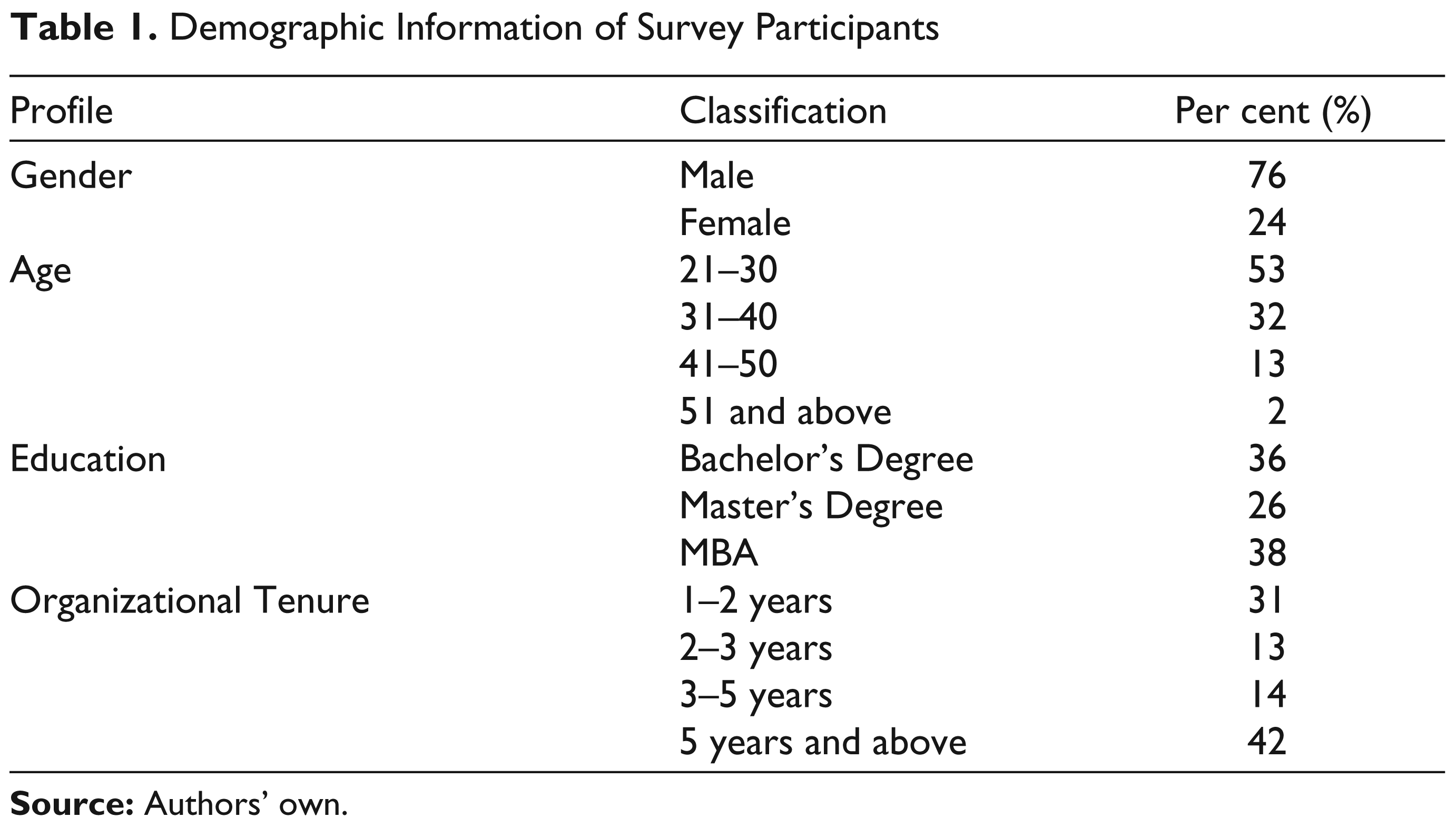
The survey was administered to salespeople across sectors, such as Insurance, Pharmaceuticals, Banking, Engineering and Manufacturing. Individuals with a minimum of one year of experience in direct sales were considered eligible for the study. A total of 197 individuals participated in the survey. Of these, 33 responses had to be removed on account of various reasons. 77 per cent of the respondents were male and 23 per cent were female sales employees. Majority of the respondents (45 per cent) belonged to sales function of insurance companies followed by Banking and Non-banking Financial Companies (10.4 per cent) and Manufacturing/Engineering and Automobile companies (10.4 per cent). The demographic profile of survey participants is presented in Table 1.
Measures
A comprehensive questionnaire comprising 48 items was used to measure the constructs. Most of the scales were drawn from pre-validated measures in KM literature. Table 2 depicts scales used in the study, and reliabilities of the scales as reported by the respective researchers. As can be seen from the internal consistency reliability analysis through Cronbach’s alpha, the values exceed the recommended value of 0.70, providing support for the validity of the measures used in the research. Items for the constructs were based on a 7 point scale with anchors ranging from 1 (strongly disagree) to 7 (strongly agree).
Demographic Information of Survey Participants
Survey Instruments

Data Analysis
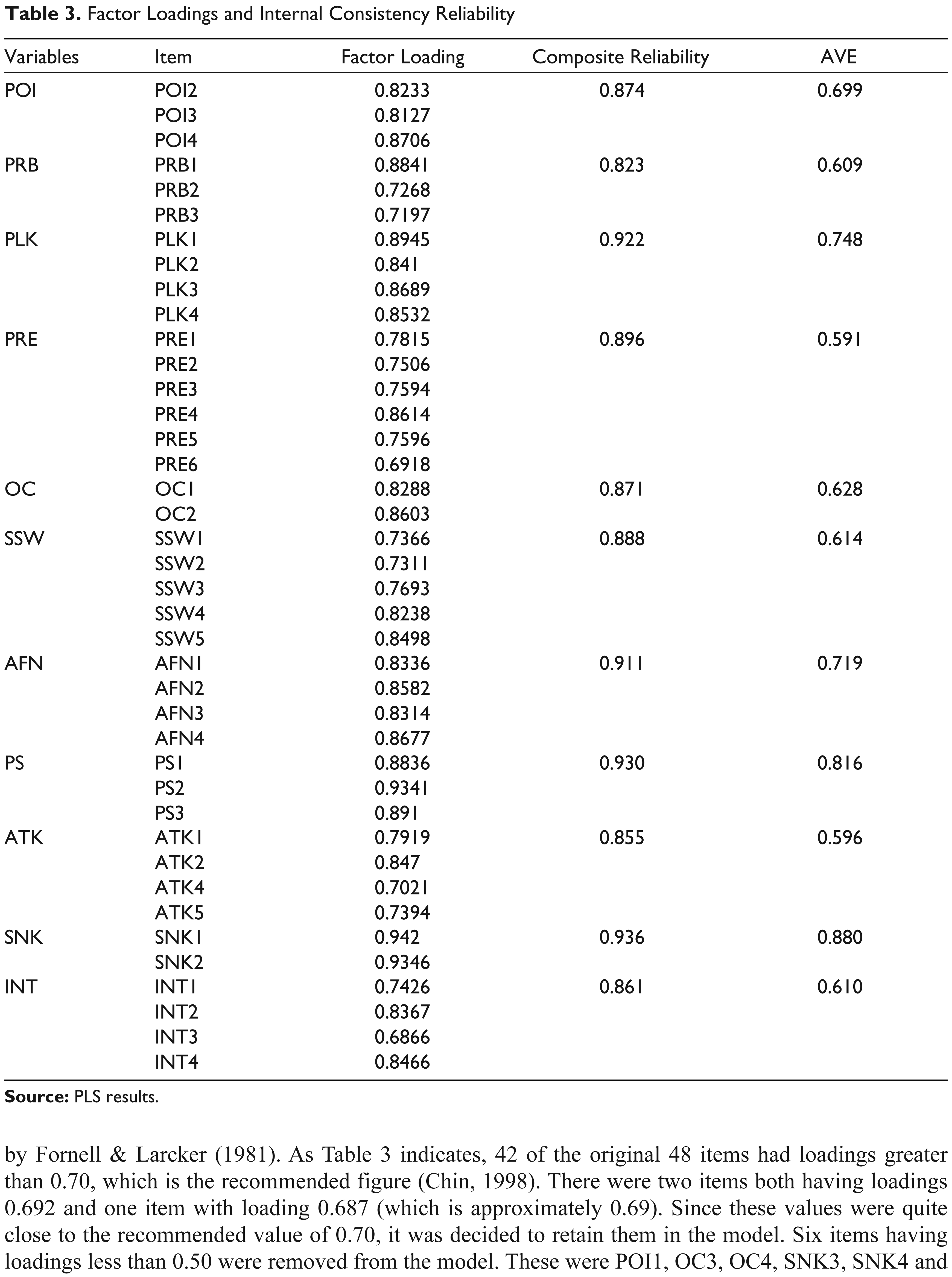
Measure validation and model testing were conducted using PLS Graph Version 3.0 as it allows latent constructs to be modelled either as formative or reflective indicators as was the case with our data. Before testing the hypothesized structural model, we first evaluated the psychometric properties of the study variables through confirmatory factor analysis (CFA) using a measurement model in which the first-order latent variables were specified as correlated variables with no causal paths. To test the measurement model, two methods were used: convergent validity and discriminant validity. The convergent validity was assessed by examining the composite reliability and average variance extracted (AVE) from the measures. Convergent validity is demonstrated when item loading exceeds the acceptable value of 0.5 recommended by Hair, Black, Babin, Anderson and Tatham (2006) on their corresponding constructs, and AVE of the construct is larger than 0.5, exceeding the threshold value suggested by Fornell & Larcker (1981). As Table 3 indicates, 42 of the original 48 items had loadings greater than 0.70, which is the recommended figure (Chin, 1998). There were two items both having loadings 0.692 and one item with loading 0.687 (which is approximately 0.69). Since these values were quite close to the recommended value of 0.70, it was decided to retain them in the model. Six items having loadings less than 0.50 were removed from the model. These were POI1, OC3, OC4, SNK3, SNK4 and ATK3. The clipped model was then re-evaluated for further analysis. The composite reliabilities ranged from 0.823 to 0.936 and the AVE values from 0.591 to 0.880 that are more than the acceptability values.
Factor Loadings and Internal Consistency Reliability
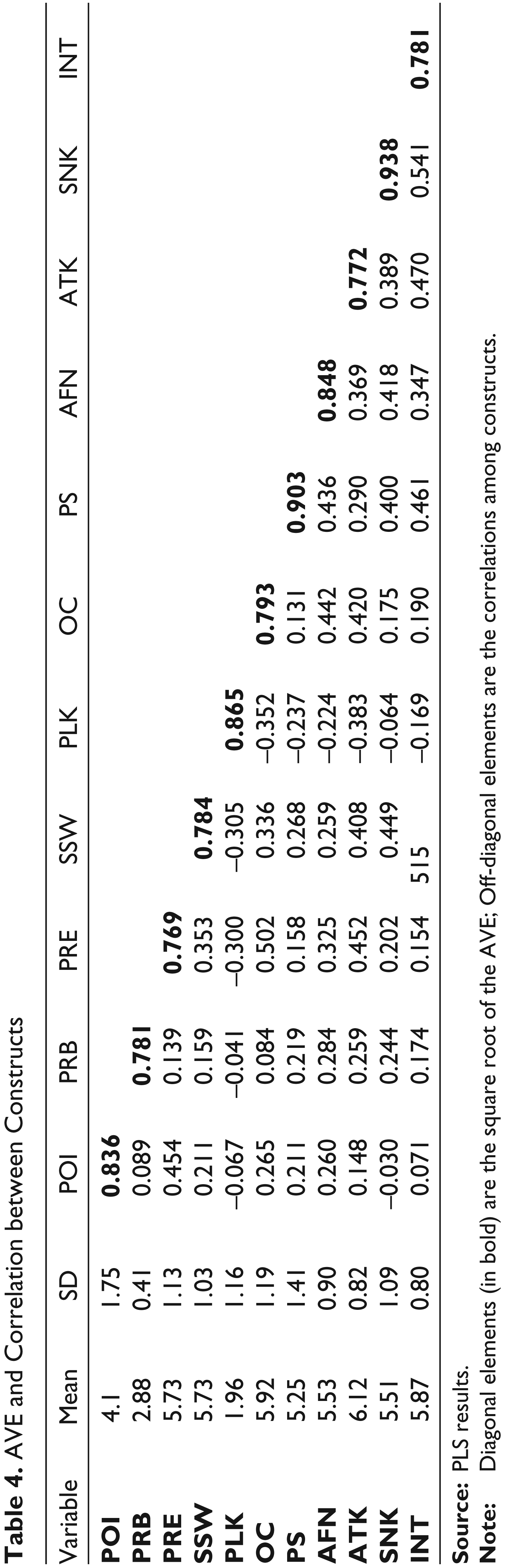
Discriminant validity was used to find out the extent to which one construct is different from all the other constructs present in the model. Discriminant validity is demonstrated when the square root of the AVE from the construct is greater than the inter-construct correlations, as suggested by Fornell & Larcker (1981). As it is observed from Table 4 concerning the inter-construct correlations, each construct shares larger variance with its own measures than with other measures. The boldfaced diagonal elements in the Table represent the square root of the AVE scores. The off-diagonal elements are the correlations between constructs. For each variable, the square root of the AVE value was larger than the correlation coefficient values with any other variable.
Test of Model and Hypotheses
The structural paths between the variables were estimated by the PLS procedure. PLS is similar to regression, but simultaneously models the structural paths (i.e., theoretical relationships among latent variables) and measurement paths (i.e., relationships between a latent variable and its indicators). It also makes minimal demands in terms of sample size to validate a model compared to alternative structural equation modelling techniques. The R-square value of the dependent variable indicates the predictive power of the model and the path coefficient shows the strength of the hypothesized relationships.
Following Chin (1998), bootstrapping was performed on the model to obtain estimates of standard errors for testing the statistical significance of path coefficients using a t-test. If the size of the empirical t-value is above 1.96, we can assume that the path coefficient is significant at a significance level of 5 per cent. The critical t-values for significance levels of 1 per cent are 2.57. Results of the PLS analysis is shown in Figure 2. The model was able to explain 40.2 per cent of the variance in the behavioural intention to share knowledge among salespeople.
Results and Discussion
Factors Affecting Attitude towards Knowledge Sharing
The model explains 40 per cent variance in the attitude towards KS. This is similar to previous studies of Bock et al. (2005), Chennamaneni et al. (2012) and Jeon et al. (2011) which were able to explain 57 per cent, 41 per cent and 34 per cent variance in the attitude towards KS respectively. Individual attitude is a good predictor for behaviour (Davis, 1989; Fishbein & Ajzen, 1975). Attitude plays a significant role in influencing INT. Many empirical studies also supported this viewpoint (Bock & Kim, 2002; Hsu & Lin, 2008; Lin, 2006). Hislop’s (2003) study revealed that the most important factor in KS is the question of employees’ attitudes, not the motivation that leads employees to share.
In this study, among various factors influencing attitude towards KS, perceived reputation enhancement had the strongest influence (0.237). Previous studies also suggest that individuals participate in KM (Knowledge management) practices to improve or establish a reputation (Constant et al., 1996; Davenport & Prusak, 1998; Donath, 1999; Taylor & Murthy, 2009; Wasko & Faraj, 2005) or to earn peer recognition (Carrillo, Robinson, Al-Ghassani, & Anumba, 2004). This finding is also consistent with past researches done on KS in online voluntary communities and electronic repositories (Kankanhalli et al., 2005; Wasko & Faraj, 2000).
AVE and Correlation between Constructs
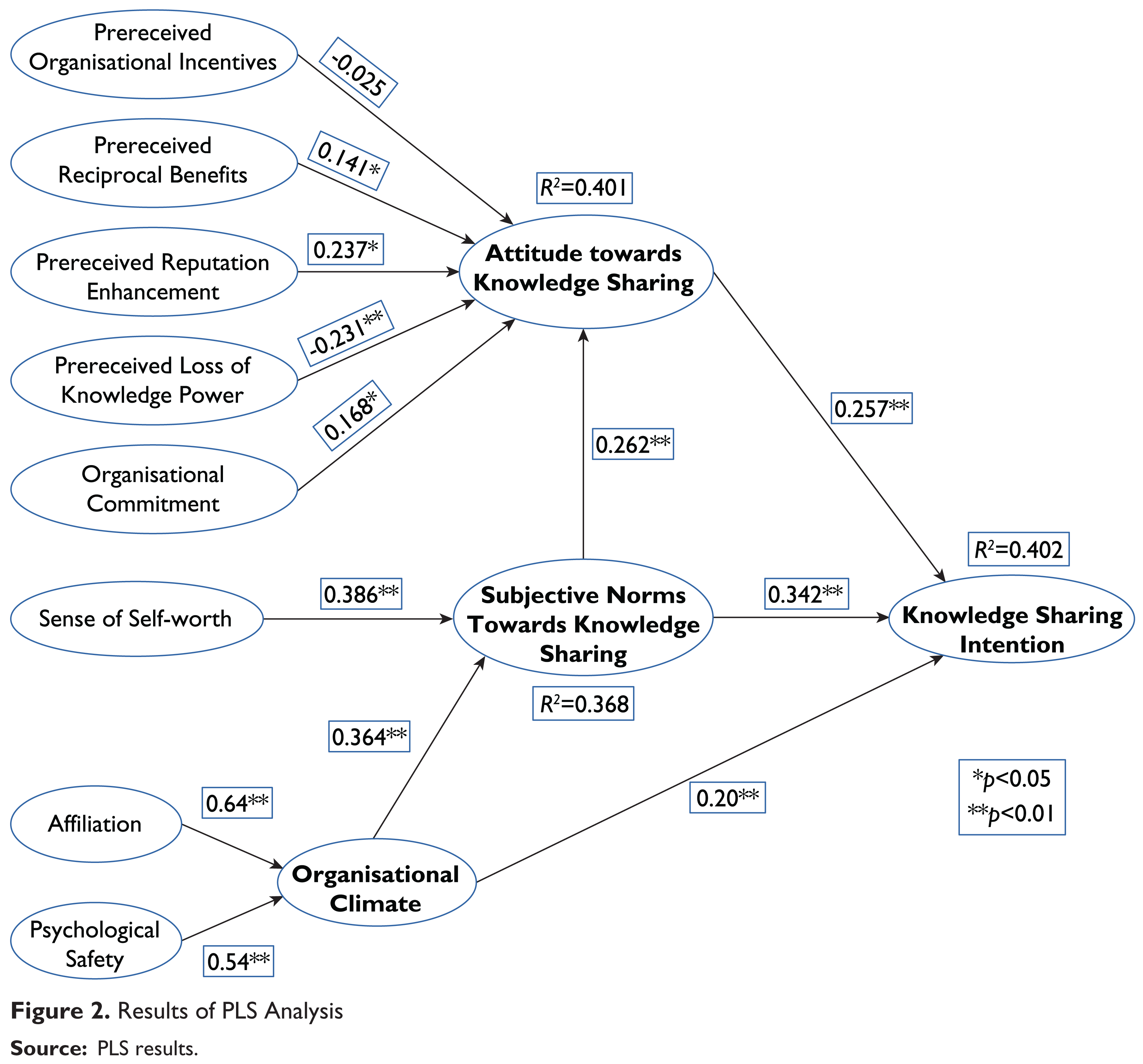
Several studies have shown how knowledge is considered as a source of power (Dunford, 2000; Grandori & Kogut, 2002; Gupta & Govindarajan, 2000; Hendriks, 1999; Szulanski, 1996). Employees may fear loss of superiority and knowledge ownership after sharing their own personal knowledge (Bartol & Srivastava, 2002; Szulanski, 1996). It is assumed that if the expertise or tricks of the trade known to a salesperson provides personal gains for him such as commissions and promotions, it will act as a hindrance preventing him from sharing this valuable knowledge. Similarly, the salespeople have imposed on them the needs to meet quotas, and everyone competes with each other for the sake of their personal productivity to meet required targets, so they are less likely to share their knowledge. Consistent with this belief, perceived loss of knowledge power in this study was found to have the second strongest influence (–0.231) on employees attitude towards KS. This contradicts the findings of Kankanhalli et al. (2005) that loss of knowledge power is not a major concern of employees while contributing to the repositories.
No significant relationship was found between perceived organizational incentives and attitude towards KS. The nature of relationship was also found to be negative. This is consistent with the studies by Seba, Rowley and Lambert (2012) and Bock et al. (2005) which established that anticipated extrinsic rewards (operationalized as monetary rewards and chances of promotion) had a negative influence on attitudes towards KS. Lin (2007b) in an empirical study conducted among Taiwanese employees also found no significant relationship between organizational rewards and employees’ willingness to donate or seek knowledge. This clearly shows that organizational rewards can only secure temporary compliance and not change employees’ attitudes.
Thus, this study contravenes findings of a few previous studies which suggest that lack of incentives is a major barrier to KS across cultures (Yao, Kam, & Chan, 2007). Incentives including recognition and rewards should be introduced as interventions to facilitate KS (e.g., Hansen et al., 1999; Liebowitz, 2003; Nelson, Sabatier, & Nelson, 2006). There are firms such as Ernst & Young and Xerox that use individual rewards contingent on the extent of knowledge that employees contribute to knowledge repositories (Hansen et al., 1999; Huber, 2001).
It is important to note that the internal validity of the research on the incentives–KS relationship may be apocryphal, because in these studies all measured variables were collected on the same survey making it impossible to preclude alternative causal directions for the observed significant relationships or the results attributable to common method variance. The inconsistent findings also suggest the possibility of moderators, such as personality, organization based self-esteem or contextual conditions.
A moderate positive relationship (0.168) was found between organizational commitment and attitude towards KS. This finding seems to be consistent with some of the previous studies (Lin, 2007a). However, studies such as Cabrera et al. (2006) found that organizational commitment did not have a significant relationship. Further study can be undertaken to confirm this finding.
A moderate positive relationship (0.141) was found between perceived reciprocal benefits and attitude towards KS. This is founded on the social exchange theory (SET). According to SET, individuals regulate their interactions with other individuals based on a self-interested analysis of costs and benefits. These benefits need not be tangible as individuals may engage in an interaction under the expectation of reciprocity in the future (Gouldner, 1960), an expectation regulated by trust (Davenport & Prusak, 1998). A social exchange deals with intangible social costs and benefits (e.g., love, respect and knowledge) and it does not pledge that there will be a reciprocal outcome because there are no rules or agreements that conduct the interaction (Chadwick-Jones, 1976; Gefen & Ridings, 2002). Thus, SET emphasizes that people share their knowledge by weighing the potential benefits and risks of social relationships. However, studies have also established that expectation of reciprocity increases individuals’ quantity of KS but not knowledge quality (Chiu et al., 2006).
Factors Affecting Subjective Norm to Knowledge Sharing
Sense of self-worth along with organizational climate (consisting of affiliation and psychological safety) was able to explain 37 per cent variance in the SN towards KS. Sense of self-worth was found to have the strongest influence (0.386) on SN to share knowledge. Employees with a strong sense of knowledge self-efficacy, who seem to value their knowledge contribution to the organization, are more likely to engage in KS. Knowledge self-efficacy can be manifested in the form of people believing that their knowledge can help to solve job-related problems, improve work efficiency or make a difference to their organization (Kankanhalli et al., 2005).
Organizational climate also had a strong influence (0.364) on SN. An environment of affiliation among team members (0.64) and psychological safety (0.54) has a significant positive impact on organizational climate which in turn affects the SN towards KS.
Relationship between Subjective Norm and Attitude towards Knowledge Sharing
Among determinants linked to KS intention, SN was found to be positively related to attitude towards KS (0.262). This finding is consistent with that of Ryu et al. (2003). It also validated the finding of Bock et al. (2005) that in an organizational setting, the opinions of important referent groups (norms) regarding any behaviour influences the attitudes of the employees towards the particular behaviour.
Factors Affecting Intention to Share Knowledge
Among determinants linked to KS intention, SN had the strongest influence (0.342). This finding is consistent with that of Lee, Kim, & Kim (2006) and Cabrera et al. (2006) who found that among various organizational variables, normative pressures (perceptions of support from colleagues and supervisors towards KS) had a strongest influence on employees’ motivation to share knowledge.
Cultural values and practices of a country have been found to moderate relationships between the TRA constructs. One of the main dimensions on which cultures vary is individualism and collectivism (e.g., Hofstede, 2001; Oyserman & Lee, 2008; Triandis, 1995). People from the more individualistic countries of Western Europe consider themselves as autonomous, more differentiated from others and independent from social groups, compared with people in more collectivist countries. Collectivist stands for a society where qualities, such as interdependence, loyalty and solidarity and where identification with the in-group is strongly emphasized (Hofstede, 2001). In collectivist cultures, people tend to perceive themselves using a socio-centric perspective which is socially sensitive, more interdependent and less differentiated, that is, pursuing group rather than personal goals (Markus & Kitayama, 2003; Oyserman & Lee, 2008). They feel a moral obligation towards their in-group and knowledge is expected to be shared within the in-group in exchange for loyalty and protection (Littrell, 2002). People in such cultures are also found to be open and willing to share their knowledge with members of their ingroup (Chow, Deng, & Ho, 2000). India’s culture is highly collectivist and this could be the reason why SN was found to have the strongest influence on salesperson’s intention to share knowledge.
Attitude has a positive and significant relationship with intention to KS(0.257). This relationship has received substantial empirical support (Agarwal & Prasad, 1999; Ajzen & Fishbein, 1980; Bhattacherjee & Premkumar, 2004; Brown & Venkatesh, 2005; Galletta, Henry, McCoy, & Polak, 2006; Kolekofski & Heminger, 2003; Pavlou & Fygenson, 2006; Wixom & Todd, 2005).
Bock et al. (2005) from their study found that institutional factors such as organizational climate affect behavioural intention directly as well as indirectly through SN. This was validated by the results of this study, which showed that organizational climate had a significant relationship (0.36) with SN towards KS and a moderate direct relationship (0.20) with intention to share knowledge.
Implications for Practice
Based on the TRA, this research aimed to examine KS intention and its predictors. The analysis of research results showed the overall consistency of findings with the research model and also the previous studies. It shows how different socio-psychological factors, such as social image (reputation enhancement), anticipated reciprocal benefits (social exchange in terms of norms of reciprocity), cognition of sense of self-worth (self-efficacy), organizational commitment and sociological factors, such as organizational climate (characterized by affiliation and psychological safety) that are theorized to influence KS behaviours, also proved empirically significant.
Though much of the classical and neo-tradition including utilitarian classical presumes economics, self-rational and interested behaviour in explaining actions (Granovetter, 1985), economic factors such as anticipated organizational incentives is found to have insignificant and negative relationship with attitude towards KS. This key fnding suggests that as an alternative to introducing variety of incentive systems deep-laid for salespeople, organizations should gestate recognition programmes for knowledge sharers ranging from public acknowledgement to extolment in the company newsletter to extra vacation time with families.
As Saleh and Wang (1993) propose, the role of management in developing a desirable climate is irrefutable. However, management can’t just force or mandate KS. Managers desiring to institutionalize knowledge sharing behaviours must foster a work context that encourages amorphous and intuitive sharing of knowledge. Management often considers water cooler conversations by employees a waste of time (Davenport & Prusak, 1998). These are oftentimes used for transferring knowledge. While discussing problems at work, employees may exchange each other’s ideas and discuss ways to resolve them.
Managers should also encourage KS through informal networks such as self-generated communities of practice to encourage sharing and transferring of knowledge throughout the organization. It is also important for organizations to communicate the success stories that have egressed from KS.
Sense of self-worth of an employee has a strong influence on intentions to share knowledge indirectly through SN. It is therefore important for employees to develop knowledge self-efficacy in order to feel motivated to share their personal knowledge. Efficacy of the contributions can be increased by providing feedback to employees every time others successfully use their contributions. Training programmes are also useful to make employees aware of what kind of knowledge will be facilitative, if shared with others.
The study shows how national culture dimensions such as collectivism and strong in-group orientations in a country like India affect employee behaviours. Consistent with this, SN was found to have the strongest influence on intention to share knowledge. This finding provides useful insights into how organizations should invigorate employees’ concerted behaviours or activities, so as to create a favourable organizational climate that will in turn enhance attitude and intention to engage in KS leading to benefits for the organization as a whole.
Limitations and Recommendations for Future Research
Our study is not without limitations; however, these limitations provide directions for future research as well.
Participants in the study were salespeople drawn from different sectors. There is a possibility that various cultural and contextual differences among sectors have influenced salespersons’ perceptions regarding knowledge sharing which is not captured in the present study. A substantial percentage of the participants (around 45 per cent) were salespeople belonging to the insurance sector. A more uniform sample where salespeople belonging to various sectors are more or less equally covered could have made the results more generalizable.
The study measured only willingness (or intention) to share knowledge among participants and not their actual KSB. Thus, our results should be interpreted keeping with this in mind.
The problem of response distortions and social desirability response bias are likely to have implications for the self-report of KSB among salespeople.
Future researchers should replicate and extend our model to the sales team context by paying specific attention to other influential salient (and moderate) variables, such as individual characteristics, role of trust, team-level norms, organization based self-esteem, organizational identification and the quality of relationships between sales team members which are not considered in this study. The moderating role of gender and field-level experience can also be explored.
Last but not the least, the study is based on the original TRA. However, heretofore several modifications to the original TRA is found in recent research. For instance, Ajzen (1988) added the variable, perceived behavioural control, to create the TPB. Similarly, Gorsuch and Ortberg (1983) and Randall and Gibson (1991) included a measure of moral obligation and confirmed findings that moral obligation directly predicted intent. Along similar lines, Boyd and Wandersman (1991) found that the additional variable of personal normative beliefs significantly contributed to predicting behavioural intentions. Thus, in future, researchers can consider one of these to predict KSB of salespeople.