




Abstract
Information technology-business process management (IT-BPM) sector of India employs 3.7 million people including 1.25 million female employees. The flip side of this high absorption rate is an equally fast attrition of employees and more so in females. This alarming number makes it imperative to study the antecedents of high organizational commitment as a consequence of which voluntary turnover diminishes. This research article aims at identifying variables impacting the organizational commitment of female employees. Leader-member exchange (LMX), work-life balance and gender bias have been studied for effect on organizational commitment in IT-BPM sector. Data were collected from female employees of BPM sector through questionnaire survey, and stepwise regression was applied to test the hypotheses. This article gives insight into the management of IT-BPM sector helping them enhance the organizational commitment of its female employees. This research is first of its kind conducted on the female employees of IT-BPM sector of India giving insights on leader-manager exchange, work-life balance and gender bias and its role in improving their organizational commitment.
Introduction
Information technology-business process management (IT-BPM), popularly known as business process outsourcing (BPO), marching ahead like a raging bull, has become the largest private sector in India. As per the NASSCOM (2016) report, it generated revenue of USD 143 billion for the Indian market, contributing 9.5 per cent of India’s GDP, a very high contribution from a single industry. Acting as a scaffold to the economy, it employs 3.7 million people and being an ardent promoter of gender diversity is employing 1.2 million females amounting to 34 per cent of the total workforce in BPOs.
But the flip side of high employment in IT-BPM sector is soaked with organizational challenges, the most dishevelling being the ever-growing employee attrition rate (Budhwar et al., 2006). Attrition is not just an employee’s loss; rather it triggers a ‘cycle of failure’ for the organization (Bleuel, 2006). This ‘cycle of failure’ starts with falling competitive advantage, inferior service productivity, loss of customers and ultimately reduced profitability. The incidences of voluntary turnover are frequent because of weaker bonds of employee and their non-alignment with the goals of the organization, making it easier for them to sever these ties. This indicates the absence of any affective commitment of employees towards the organization making the departure easy. Employees with lower organizational commitment (hereafter OC) have been found to succumb to instances such as better opportunity with a higher pay, monotony of work, low work satisfaction and erratic work pattern, easily triggering the high attrition rate.
Although antecedent and consequences of high attrition rate of employees in the Indian BPM sector have been an area of considerable research, feeble research is done on its female employees. Female employees, owing to the vulnerabilities and insecurities subjected on them by the society, are more susceptible to higher voluntary turnover. Maintaining a balance between family life and work life, maternity breaks, extended hours and night shifts, increasing incidences of harassment, lower career growth prospects and many other reasons push the female employees out of the workforce. The impending threat on the stability of economy due to high voluntary turnover of female employees has become an area of grave concern requiring feasible and sustainable solution.
Rekha and Kamalanabhan (2013) in their study on BPO employees in Chennai, India found that organizational commitment played a mediating role in reducing employee turnover. Meyer and Allen (1991) have explained organizational commitment as ‘a psychological state that characterizes the employee’s relationship with the organization and has implications for the decision to continue membership in the organization’. Organizational commitment plays the role of handcuffs resisting the employee departure from the organization (Siders et al., 2001). An employee having higher organizational commitment not just tries to prolong its association but also proves to be an asset for the organization by contributing towards higher productivity with a renewed vigour and enhanced efficiency (Wan, 2012).
One of the major setbacks for a female employee is her comparatively higher responsibility towards her family and any failure in fulfilling these leads to a feeling of guilt and incompetence triggering her voluntary turnover. Such issues of dichotomy in female employees’ lives could be counterbalanced by organizational policies assisting them in regaining work-life balance and making them more attached and committed to the organization. Similarly, supervisors who treat their female employees as valued employees in the organization allowing autonomy foster a sense of well-being in them escalating their OC. Another aspect downgrading the OC of female employees is the gender discrimination faced by them in the organization. The second-grade citizen treatment given to female employees by the organization weakens their trusts making their attachment with the organization frail.
The constructs considered in the study have been previously identified in relation to OC. The contribution of the study is to investigate the variables impacting OC of female employees. The article is organized with an introduction followed by a literature review on the three variables. This is followed by an explanation of methodology adopted and tools use and then results. The article concludes with a discussion and implication.
Literature Review
Organizational Commitment and Leader-Member Exchange
Leader-Member exchange (hereafter LMX) derives its theoretical underpinning from the social exchange theory and is defined by Liden et al. (1997) as the nature of exchange relationship between supervisor and employee that maintains the relationship equilibrium. This dyadic relationship between supervisor and employee is an important construct of organizational studies because of its instrumental effect on the member’s behaviour (Tyler & Blader, 2003). Varied exchanges taking place between the employee-supervisor dyad during execution of work acts an antecedent to the follower’s attitude and organizational behaviour (Dulebohn et al., 2012). A high LMX also impacts the justice expectations of employees in a positive way such that they presume leaders as institutions of fairness and as a corollary build an expectation of justice and equitable treatment from the organization and its representatives (Tyler, 1999). An image of ethical and unprejudiced supervisor incubates a sense of pride and contentment in the employees pulling them closer to organization’s philosophies and making them work diligently towards the organizational goals.
An important doctrine of the LMX is the dependence of employee’s work-related behaviour on the leader’s interpersonal approach (Rockstuhl et al., 2012). When the superior treats the employee with respect and bestows favourable treatment, the employee feels indebted towards the supervisor and repays through hard work (Graen & Uhl-Bien, 1995). The presence of LMX strengthens the bond of an employee not just with the supervisor but with the organization as well, making them intrinsically work harder towards the organizational goals which renders a feeling of accomplishment to the employee (Dulebohn et al., 2012). The strengthened tie with the organization also enhances their organizational citizenship behaviours making them a competitive advantage of the firm (Ilies et al., 2007). Carson and Carson (2002) in their concluded that employees inculcating a high LMX and experiencing respect, mutual obligation, trust, barrier free communication, etc., give extra effort and often go beyond their call of duties for the benefit of their organization.
The bond so established between the supervisor and employee enlarges the threshold to step out of the organization. Leaving the organization becomes a psychological loss for the employees, too heavy to recuperate (Mossholder et al., 2005). Butler and Cantrell (1984) in their study found that support received by employees is reciprocated to the supervisor and organization. An employee receiving unflinching support from her supervisors, not just in the execution of responsibilities but also having as a custodian in situations of organizational milieu develops a sense of security. The steadfast support from supervisors renews their determination making them unyielding in their contribution and innovative in approach. The exchange of benefits, tangible as well as intangible and the introduction of support in the dyadic relationship make them appreciative of their supervisors and obliged towards the organization (Gouldner, 1960). The high LMX at stake, there is anecdotal evidence of employees forgoing lucrative offer (Logan, 1984) to prolong their association with their organization (Cunha, 2002). Keeping the existing theories and research in consideration, LMX is perceived to have a significant impact on employee’s organizational commitment.
H1: LMX significantly affects the organizational commitment of female employees of the IT-BPM sector in India.
Organizational Commitment and Work-Life Balance
Female employees in the BPM sector have a comparatively higher imbalance between their work and personal life owing to the erratic and strenuous work hours (Chawla & Sondhi, 2011) along with predominant night shifts in their job description. Work life and personal life are the two major domains of an individual’s existence requiring a sound balance as well as a coordination between the two such that a fluctuation in one could be accommodated by the other, seamlessly (Sturges & Guest, 2004). Although work culture and job description of ITeS-based jobs allow increased work-life balance (Ahuja & Thatcher, 2005), it is the female employees in this sector facing challenges in their work-life balance (WLB) which further has a debilitating impact on their OC (Chawla & Sondhi, 2011).
Work-life balance has been defined as the ability of an individual to do justice to various roles during different stages of her life (Marks & MacDermid, 1996). Any disruption in the WLB causes a spillover effect on the employee’s efficiency as a human resource leading to higher attrition rate and having its ultimate effect on employee’s commitment to the organization (Chawla & Sondhi, 2011). Many researchers have studied the detrimental effect of low work-life balance in causing burn-out and stress (Moore, 2000), thus triggering their intention to quit (Anderson et al., 2002).
Organization’s support and supervisor’s empathy play a vital role in regaining balance between the work front and personal life of an individual (Voydanoff, 2002). A survey conducted by Mercer-NASSCOM (2008), published a report on gender inclusivity in the IT-BPM sector in India revealed the moderating effect of provisions like flexible work timing, considerate leave policies, women’s recreational activities, protection against harassment, etc. on increasing the female employee’s OCs.
Organizations have been offering support to their female employees through facilities like telecommuting with clients, flexi-timing, paid maternity leave period along with the assurance of job security, secured working conditions, child care facilities, job-sharing and part-time working options (Rajadhyaksha & Smita, 2004). Thus, if an organization, by restructuring its policies, makes the work environment conducive enough to accommodate both the personal and work life of the employee, it would lead to an elevated sense of dedication and commitment (Rothbard et al., 2001).
Various research, theories and anecdotes of social exchange between the organization and female employees have found to improve their WLB. Having a balanced work-life due to various intervention techniques of organization, female employees develop a deeper attachment and feel indebted towards their organization which inhibits their intention to quit. Considering these theoretical underpinning, we frame a hypothesis.
H2: Work-life balance of female employees has a significant relationship with their organizational commitment.
Organizational Commitment and Gender Bias
Gender bias or gender discrimination is defined as a universally present vice impacting every facet of existence including workplaces and organizations. Women are discriminated owing to their gender and are treated as second-order citizens. Discrimination inflicted upon women further reduces their chance to participate in the workforce making it tremendously difficult for them to have a foothold in the fiercely competitive market (Pang & Huang, 2010). Lost opportunities and depleted chances of monetary returns further slowdown their economic abilities. Perceived gender bias (PGB) has been found to play a pernicious role reducing a female employee’s job satisfaction, job involvement, organizational commitment and much more (Sattar & Nawaz, 2011).

Biases and discrimination are inflicted upon female employees from various directions. Co-workers, supervisors, organization, organizational policies, etc., contribute to this discrimination which dilutes their levels of commitment towards organizations (Ensher et al., 2001). This discrimination creates an economic waste due to underutilization of female skills lowering economic efficiency of the organization (Tianhu & Huang, 2010).
Gender biases and discrimination within the boundaries of the organization, its antecedents and consequences have been an area of continuing research. But the unique occupational conditions of IT-BPM female employees and its ever-increasing challenges have not been the context of a study for researchers. This study attempts to identify the impact of perception of gender bias and commitment levels of female employees of the IT-BPM sector.
The conceptual framework of this research is presented in Figure 1.
H3: PGB has a significant impact on the OC of female employees of the IT-BPM sector.
Research Methodology
Research Design
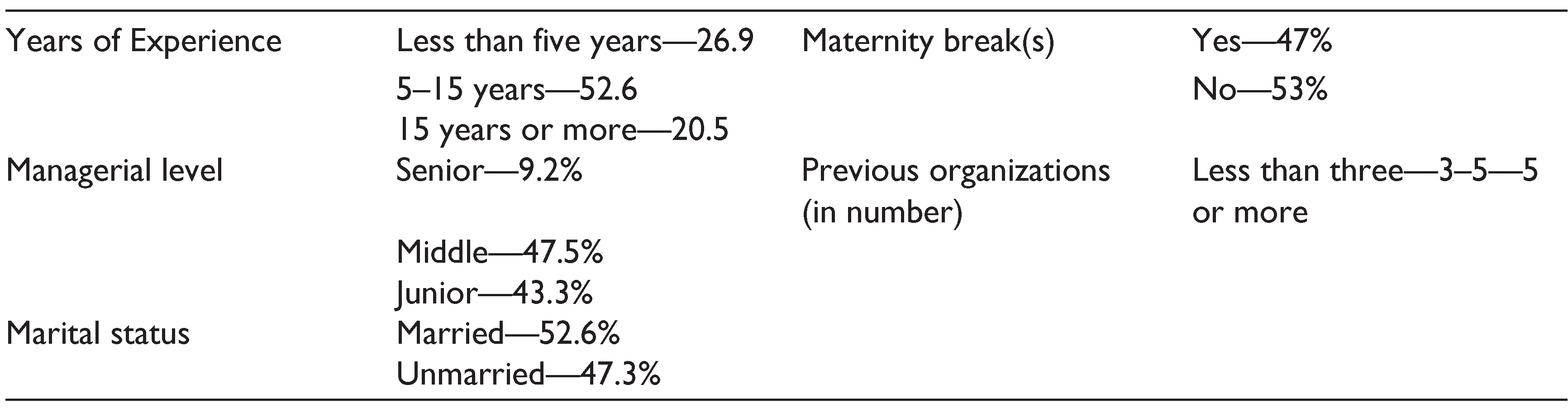
The female employees working at six different BPMs in India were the respondents of the study, and the opinions of these respondents were collected through convenience sampling due to limited reach and paucity of time. Out of the 250 questionnaires distributed 186 were received and 176 were usable having a response rate of 70.5 per cent. These responses were used for statistical analysis and hypothesis testing. The demographic profile is in Table 1.
Demographic Characteristics of Sample
Measures
Organizational commitment was measured using Allen and Meyer’s (1990) scale validated for Indian service sector by Kaur and Sharma (2015). The scale comprises 18 items and three subscales, namely affective, normative and continuance commitment. To measure LMX, Graen and Uhl-Bien’s (1995) seven-item scale was adopted. A 37-item scale developed by Chawla and Sondhi (2011) to measure WLB of BPM employees was adopted. A five-item scale developed by Foley et al. (2015) was used to measure PGB of female employees in their organizations.
Various statistical analyses adopted were descriptive statistics, correlation analysis and stepwise regression. The predestined hypotheses were tested using backward entry stepwise regression. OC was considered as the dependent variable and LMX, WLB and PGB were the independent variables.
Reliability and Validity Analysis
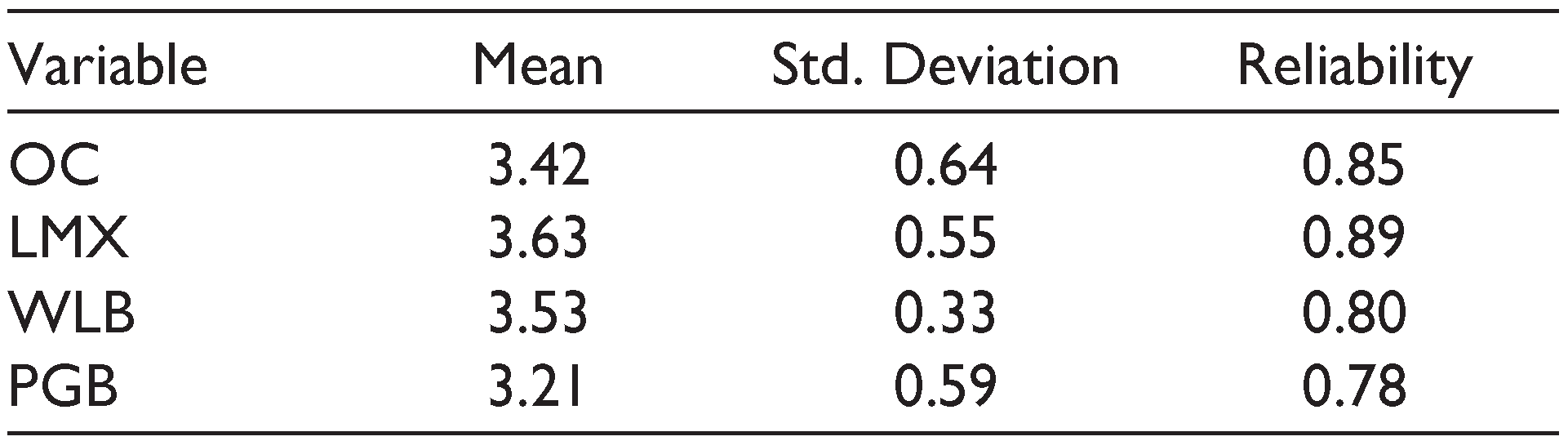
The preliminary steps included conducting an exploratory factor analysis of the four scales to confirm its applicability to Indian IT-BPM context as a single questionnaire. All 67 items on the four subscales together were retained since the factor loading were above the acceptable threshold. Cronbach’s alpha for individual as well as the overall scale was calculated and found to be reliable since the values were above 0.7 (Nunnally, 1978). The results are in Table 2.
Descriptive Statistics and Reliability Coefficients
Empirical Results
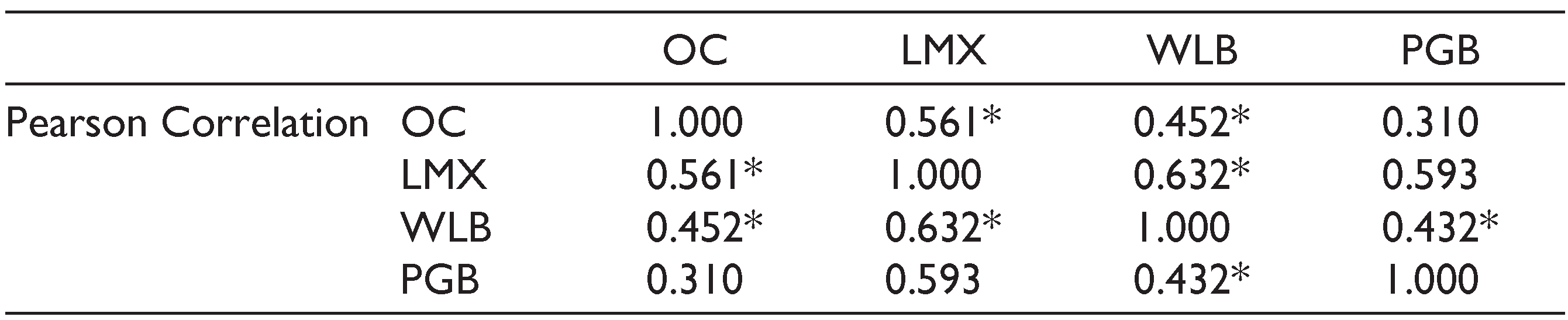
Correlation analysis was conducted on all the variables and the results showed a significant relationship of OC with all three constructs. The strongest relationship was between OC and LMX (r = 0.56, p < 0.001). The correlation between OC and WLB was found to be r = 0.45, p < 0.001 and the correlation between OC and PGB was not found to be significant. The results are present in Table 3.
Correlations Matrix (N = 176)
Stepwise regression was used to develop a parsimonious model of factors affecting OC of female employees in the Indian IT-BPM sector. The independent factors to be tested for significant impact were LMX, WLB and PGB. Backwards elimination method in stepwise regression was adopted on account of a limited number of predictors. The result shows that 37.6 of the variance in OC of female employees in BPM sector are explained by the model containing LMX and WLB at 0.001 level of significance. PGB did not significantly increase the prediction of OC and was removed from the model. The summary of stepwise regression is in Table 4.
Model Summary of Stepwise Regression Model

bPredictors: (Constant), LMX, WLB.
Standardized beta coefficients indicated relative impact of LMX and WLB on OC. LMX was found to have a stronger influence (B = 0.36, t = 1.72, p < 0.001) on OC of female employees of BPM sector than WLB (B = 0.24, t = 1.7, p < 0.001). PGB was excluded to achieve parsimony in the model. The beta values are in Table 5.
Model Coefficientsa

Discussions
The primary aim of the study was to test the conceptual framework of the study and identify variables having a significant impact on the OC of female employees of BPM sector in India. A close correlation was found between OC and the three variables indicating the presence of positive relationship. The results of the study confirmed a significant impact of LMX on OC supporting the first hypothesis. A healthy dyadic relation between the supervisor and female employees, in which their presence is acknowledged and contribution appreciated, shoots up their commitment towards the organization. This result aligns with the findings of Masterson et al. (2000) and Ansari et al. (2001).
WLB was found to have a significant and direct relationship with the OC of female employees supporting the second hypothesis. When organization assist female employees in balancing their personal and work life, it wins the loyalties of that employee making her more committed and attached to the organization. This attachment and commitment dull various distractions, such as job-hopping for better pay, opting out of the workforce due to difficulty in managing personal and professional lives, and the likes. Conducive work environment with changes, such as lesser hierarchy, organizational policies accommodating the needs of female employees and autonomy granted to them, enhances their commitment towards the organization. The results of this study converged with the findings of Alvesson (2000).
However, despite presence of a positive correlation between PGB and OC, no significant impact of PCB was found on OCB refuting the third hypothesis. Female employees agreed with three out of the five items of Foley’s scale of PGB confirming a gender bias. Although no discrimination was found in the hiring process and promotion opportunities, female employees felt discriminated in obtaining training and development opportunities and during performance appraisal. This indicates the perfunctory nature of organization’s initiatives in improving status of women. While organizations did not differentiate between genders while hiring, lukewarm efforts were put forth in providing them equal training and development opportunities casting its shadow on their performance appraisals. Respondent’s results indicated an unbiased promotion practice but organizations seldom put in efforts to foster competence in female employees in all respect at par with male counterparts.
Managerial Implications and Conclusion
Results of this study are pertinent to female employee of IT-BPM sector of India. High levels of commitment towards organizations are an opportunity gain since they nullify the potential economic loss incurred on the organization due to voluntary turnover. High levels of OC in female employees bind them to the organization giving them a sense of belongingness and a feeling of oneness, developing strong ties with an organization which could tolerate emotional fluctuations caused by any changes in internal as well external environment. This study shows a significant relationship of LMX (supervisor’s role), and WLB (organizational policies) with the OC of a female employee of BPMs. This result adds to the pool of knowledge about variables playing an instrumental role in retaining the female employees in BPMs in India by strengthening their organizational commitments. Organizations should be gender sensitized in their conduct to make it more accommodating to women employees and their personal challenges. Lower OC and its consequences are not limited to the female employees; rather it has a spill effect on the organization’s overall performance due to deteriorated employee efficiency and high turnover rate. Genpact 1 —a leading name in India BPM sector—has tightened its belt to take up the cause of women inclusivity. It has floated many women mentoring and leadership generating programmes. Many women’s friendly policies, such as flexi-options, security measures and stork parking, have been adopted as regular practice.
The findings of a study would be insightful for management to identify the importance of a culture of inclusivity and women development generating a feeling of gratefulness and attachment towards the organization leading to increased commitment towards commitment. However, the moderating effect of job satisfaction, marriage and psychological support form family has not been taken into consideration which could be taken up by future researchers. A qualitative approach to this study to uncover some latent variables of OC and in a different time frame could also be taken up by future researchers.