



Abstract
I explain how the concept of profit maximization and its link with elasticity can be done without recourse to calculus for the benefit of students with non-mathematical backgrounds. In the time of the ongoing pandemic, I tried teaching methods that bring the advantages of off-line teaching to online mode, namely extensive use of blackboard, the use of WhatsApp for receiving solutions of students in class, and the use of an extra monitor for students to view, not only the instructor but also the person asking questions or simply putting a view.
Introduction
During admission of students into a business school, there is always an attempt for inclusion of diversity, be it with regard to gender or across disciplines. It is an established fact that Indian business schools have a low percentage of women as students and that most of the students selected/admitted are from an engineering background, with poor representation of Liberal Arts or Humanities. Islam and Manaloor (2012) bring forward the problem that many students taking introductory Economics courses take it since it is a compulsory part of their curriculum, and therefore may not be sufficiently motivated for the course. More so teaching Economics to Business Major students should be different than the way it is taught to an Engineering major student. Admission tests for MBA programs require Mathematics of the level of standard ten. Once admitted, many courses require knowledge of a higher level of Mathematics. However, the effort required to equip/familiarize the disadvantaged students with the extra knowledge is usually inadequate.
My teaching innovation this year is one wherein a concept is taught using simple mathematical tools the students are familiar with, rather than the use of higher-level Mathematics. The challenge, as rightly put by Mardanov and Khasanova (2014), is to persuade learners especially those in Economics for the need of Mathematics for further understanding of Economics concepts. The course I teach is introductory Microeconomics to first year students. This course requires a lot of board-work and diagrams, all of which are difficult to show online. Last year, due to the restrictions imposed by the pandemic, the alternatives were detailed PowerPoint presentations (ppts) and sophisticated iPad where the written work done during the class can be transferred once the session is over. None can really be a substitute for the real offline board work experience. During my online sessions, I tried to replicate the off- line experience by instituting a wide-angle camera that captured my writing boards. In order to facilitate live class interaction, I decided to do away with ppts.
This article is organized as follows: The second section presents how innovations are introduced in teaching the concept of elasticity in managerial economics. The third section explains changes made to my office set up to facilitate a better learning experience as close as possible to off-line teaching. The fourth section provides the concluding remarks.
Innovations Introduced in Teaching a Concept
In Economics, profit is an important variable for entrepreneurs, and maximization of profit is a key technique that has to be taught. Although profit maximization can be easily visualized by a layman not exposed to economics, the concept of elasticity is usually not known. Starting with the objective of profit maximization, I introduce the concept of elasticity and explain its relevance in profit maximization. For a monopolist or single seller who knows the market demand, the problem is to set a price that maximizes profit. The optimal price setting is related to the elasticity of demand which may be defined as the proportionate change in quantity due to a proportionate change in price. For a person familiar with calculus, the elasticity is calculated as
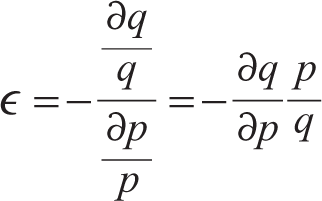
where p is the price and q is the quantity demanded.
High school textbooks usually explain this concept with the help of a linear inverse demand curve, p p = a – bq, as shown in Figure 1. Starting from any point, P0, when the demand is Q0, it its explained that if a monopolist increases the price by a very small amount ∆P, the quantity demanded reduces by ∆Q. Total revenues will increase, with a price increase if:

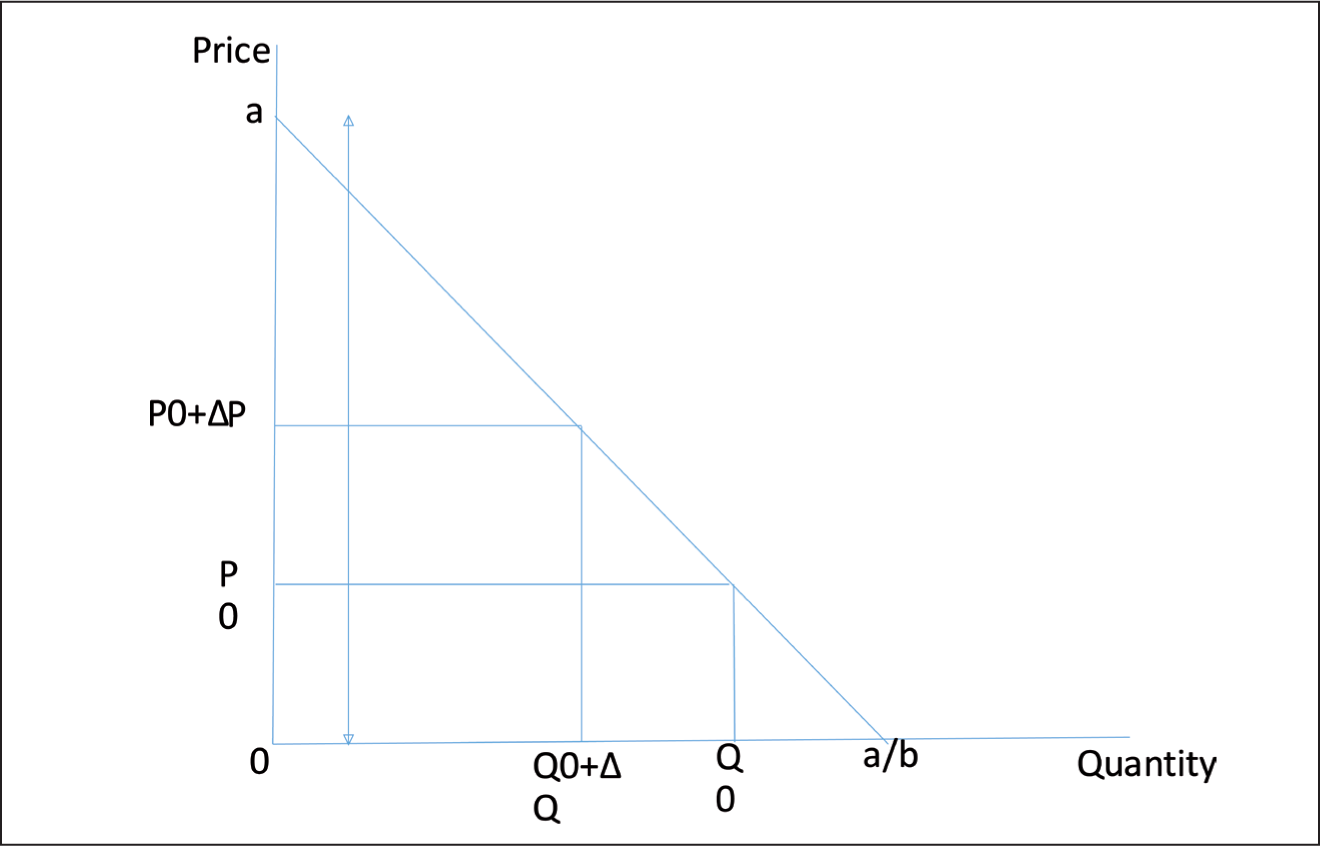
If ∆P and ∆Q are very small, ∆P ∆Q is even smaller and can be ignored. High school textbooks explain that the revenues increase if the elasticity of demand ϵ is less than one.
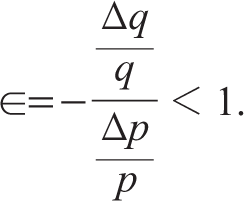
The textbooks, using an inverse linear demand function, p = a – bQ, go on to explain that
As managers, we need to take the discussion to a slightly higher level. We start with the discussion of price setting by a monopolist whose aim is to maximize profits, with fixed costs only. In such a situation, the maximization of profit is synonymous with the maximization of revenue. Students are asked to think of examples of businesses with fixed costs, such as a movie hall or a no-frills airline. In a class of students familiar with calculus, the discussion proceeds in this way. Consider a demand function q = q(p), where q is the quantity demand and p is the price, and given q(p) < 0. The Revenue function, R will be given by R = p.q(p). Maximizing this function with respect to p, will imply
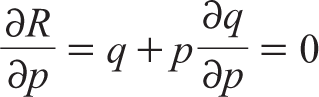
Which implies that
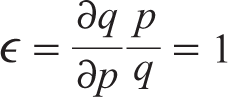
It is said that when only fixed costs are present, the monopolist sets the price such that the elasticity of demand is equal to one. The discussion then carries on to the case when variable costs are also present, that is the cost structure to produce a given quantity q, is given by C(q) = F + c.q, where F is the constant average cost per unit. In this case, the profit equation is given by

Partially differentiating the above equation with respect to p and setting it equal to zero, we get
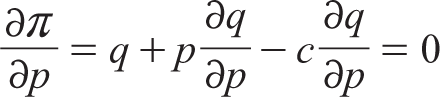
Rearranging the terms, we get,
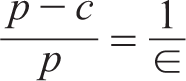
The above index is called the Lerner’s index of monopoly. The lower the elasticity of demand, the larger is the markup of the price set by the monopolist over and above the average cost of production. When this proof was done in class last year, a student mentioned that she had a Political Science background and had no background in calculus. Remedial sessions at the beginning of the course were also not conducted as it was the pandemic year. For her sake, and for the sake of other similarly disadvantaged students, the same results were presented in a different fashion the next day.
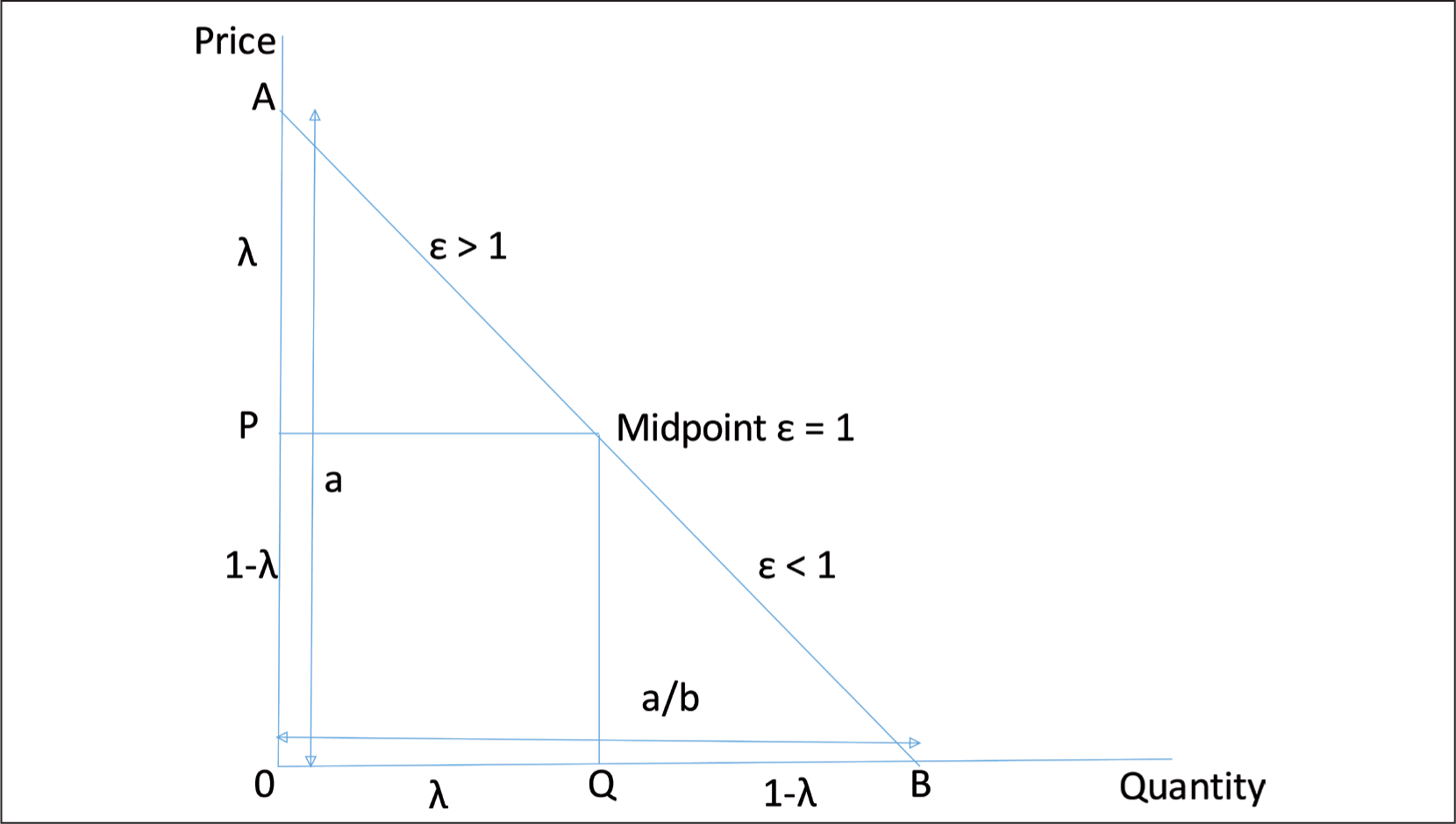
Let us consider an inverse linear market demand function of the form p = a – bq. If a monopolist with only fixed costs is trying to maximize profits, it is equivalent to maximizing revenues. In the figure above, (please refer to Figure 2), we see that, for this inverse demand function, for the revenue to be maximized, the area OP. OQ.
1
needs to be maximized. Let P and Q cut the lines in the ratio
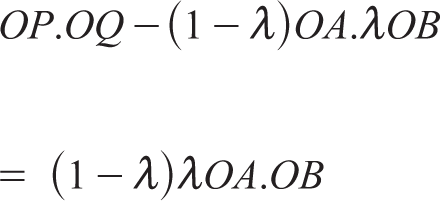
Since OA and OB are constants, the expression,
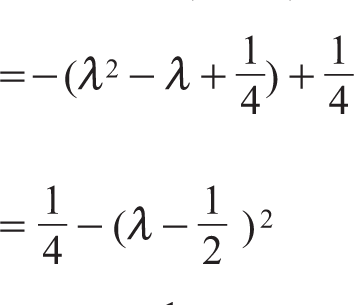
It is apparent that k is maximum when
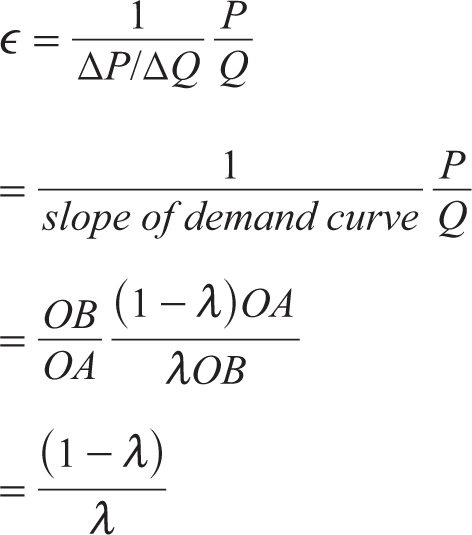
Given the formula for elasticity for a linear demand curve, it is apparent that at the midpoint, with λ = 0.5, elasticity is one. On the top half the linear demand curve, elasticity is greater than one and it is less than one in the lower half.
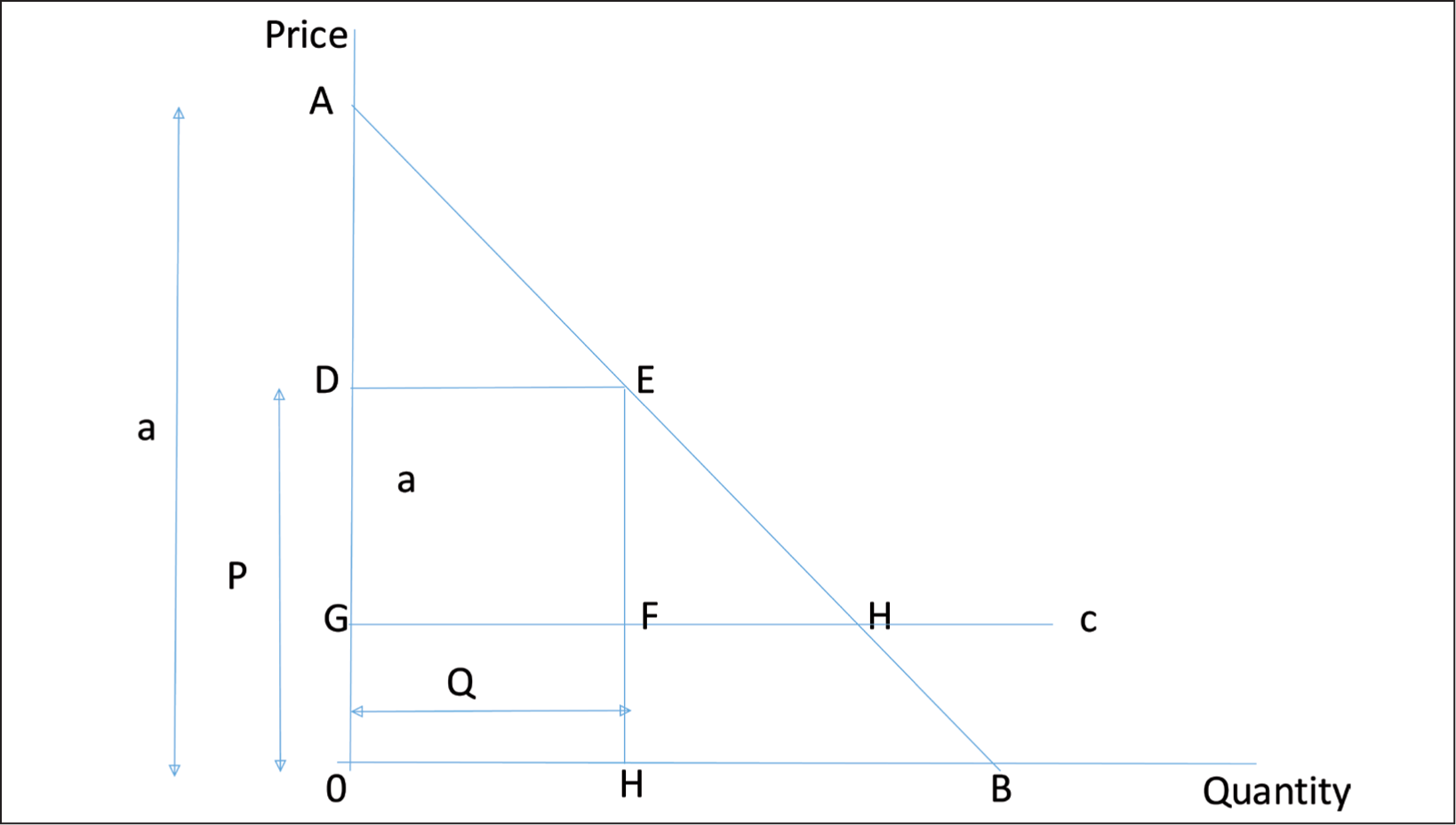
Now, one has to derive the case of both, fixed and variable costs present, and let c be the cost per unit of production. In this case again, taking an inverse linear demand curve p = a – bQ, for any quantity chosen, the profit will be the rectangle DEFG less the fixed costs (please refer to Figure 3). So, once again the challenge is to maximize the area of this rectangle. This can be done if the price chosen at point D is the midpoint of AG. The elasticity of demand at point D will be . In terms of the variables of the inverse demand function, the same can be written as
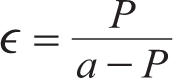
Since
Changes to my Office
My real experience with online teaching started in August last year as our students were not available on campus for offline lessons due to the pandemic. Although the school offers a range of online courses through the satellite mode, I stayed away from these throughout the 13 years of my association with this school for the simple reason that I did not find this method of teaching engaging. This is a widely accepted view, and Dhawan (2020) states that apart from audio and video issues with online classes, students find it boring and unengaging. I was initially overwhelmed by the idea of taking online classes.
In a book written before the pandemic Darby and Lang (2019), titled Small Teaching Online, address issues to be addressed in online teaching, namely—(a) Designing for learning; (b) Teaching humans; and (c) Motivating online students and instructors. I kept these in mind while changing the pedagogy.
In the month of July 2020, our school invested huge funds in making studios with smartboards so that online classes could be held with elan. Unfortunately, one of the professors using these studios, along with a huge number of IT staff, got infected with COVID. These studios were sealed, and faculty members were advised to take classes from their homes or offices, using a laptop or desktop. In short, smartboards were no longer available to the faculty for use. Instead, what was provided was a digital writing pad which I personally found uncomfortable to use.
Managerial Economics, an introductory Microeconomics course is the course I teach to a class of over 180 students. In a normal year of offline teaching, the class is divided into three sections of 60 students. Each section attends 20 sessions of one and a half hours. This adds up to total of a 30-hour session with me. I make it a point to know each student by name and taking regular attendance helps memorize and link a name to a face. Each lecture I give is repeated thrice, once to each section. There are two sessions every week, making it a 10-week course. In a course, we need to assign a minimum of three evaluation components. Keeping this in mind, I usually have a mid-term, an end term and a two-page essay on any topic to be submitted at the end of the term. Apart from that, Economics requires a great deal of mathematical exercises which I give to my students to solve in class. In a normal year, I check the understanding of the students as I move around the classroom, personally helping them with their work.
What I would like to lay emphasis on is that there is a lot of board work involved in teaching. It should be an intensive and passionate process whereby students are expected to comprehend and copy what is written on the board. It is my firm belief that writing, along with comprehension, is necessary as what the mind forgets, the hand remembers. This is true especially for mathematical computations. Digital boards used for online teaching are no doubt effective as whatever is handwritten in class is available to the students but, as aptly put by a student, while there is transfer of content, there is little transfer of emotion.
When classes were about to begin, we were asked to conduct a mock trial in which I found myself at a complete loss as to how to handle the digital writing board. If one writes something on it, the written work appears at a different place on the screen. I thought it would be next to impossible to draw diagrams on these digital boards.
What I already had was a 5 × 4 feet whiteboard which I got replaced by a green board of the same size. The purpose was to be able to write with chalk rather than markers. Now the problem I encountered was that the camera of the PC being fixed due to power connections at one end could barely capture the green board. This problem was only partially sorted out by using an extension cord because the camera could still not cover the entire board.
Once the online classes started, I realized that there were other problems with this primitive setup. Apart from the board not being completely visible, there was a lot of sound disturbance. To minimize disturbance, one had to keep the fan switched off even during the uncomfortable hot Indian summers. I had to make major changes soon. In the third week of teaching, the school changed the platform from Disperz to Zoom. It was a welcome change, the major advantage being that one could view the students. I purchased a wide-angle camera with a Jabra mike and speakers, and with that, the green board became perfectly visible. All this came at a considerable cost of over $1,000. Once the classes shifted to zoom, I could familiarize myself with the students while taking attendance and when students asked questions, I could see them. It was more like a normal class interaction.
The camera sorted out problems to a considerable extent, but issues of light and sound prevailed. In lighting, for example, certain parts of the board shone too bright which I could not figure out when writing but my students would request me not to write in that portion. I did not document the initial days but later, for another course, when the whiteboards were purchased, I marked with magnets, those places where the light fell. I made sure to avoid this space while writing on the board. The electrician had to be called many a time to fix the lighting problem on the board. Please refer to Figure 4 and Figure 5 to see how the lighting problem was resolved.
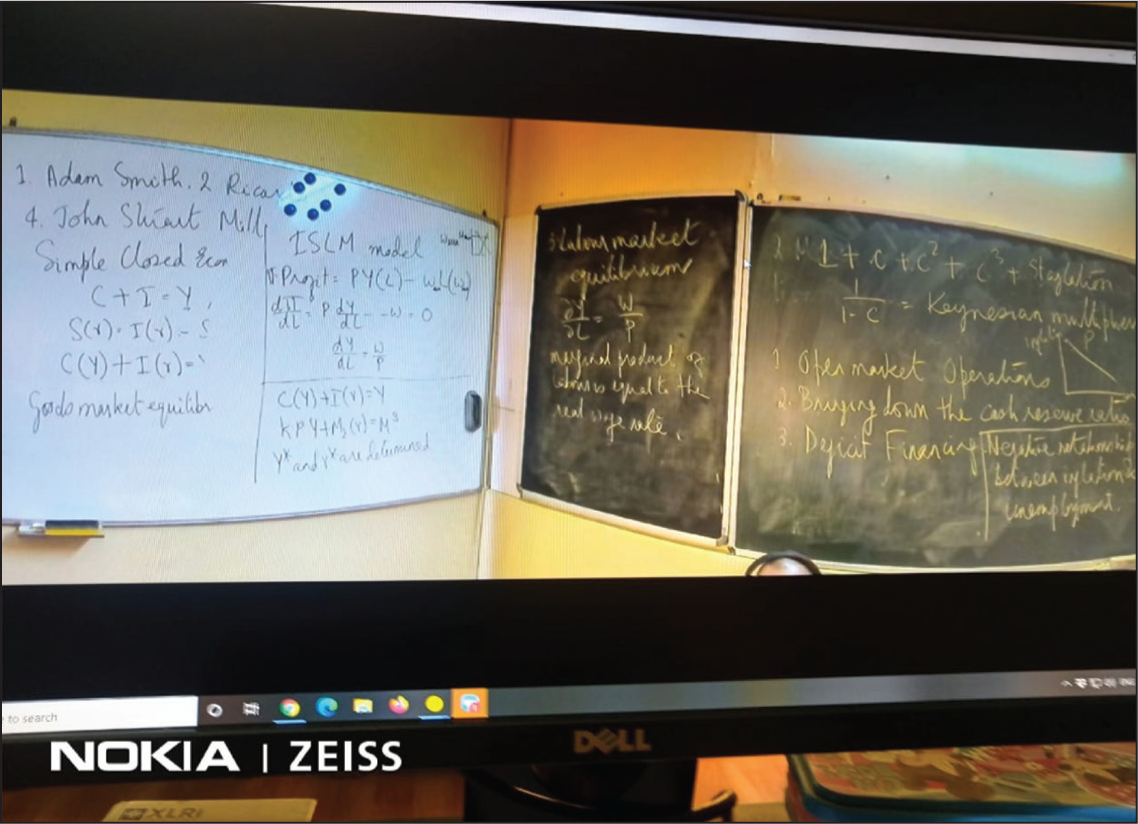
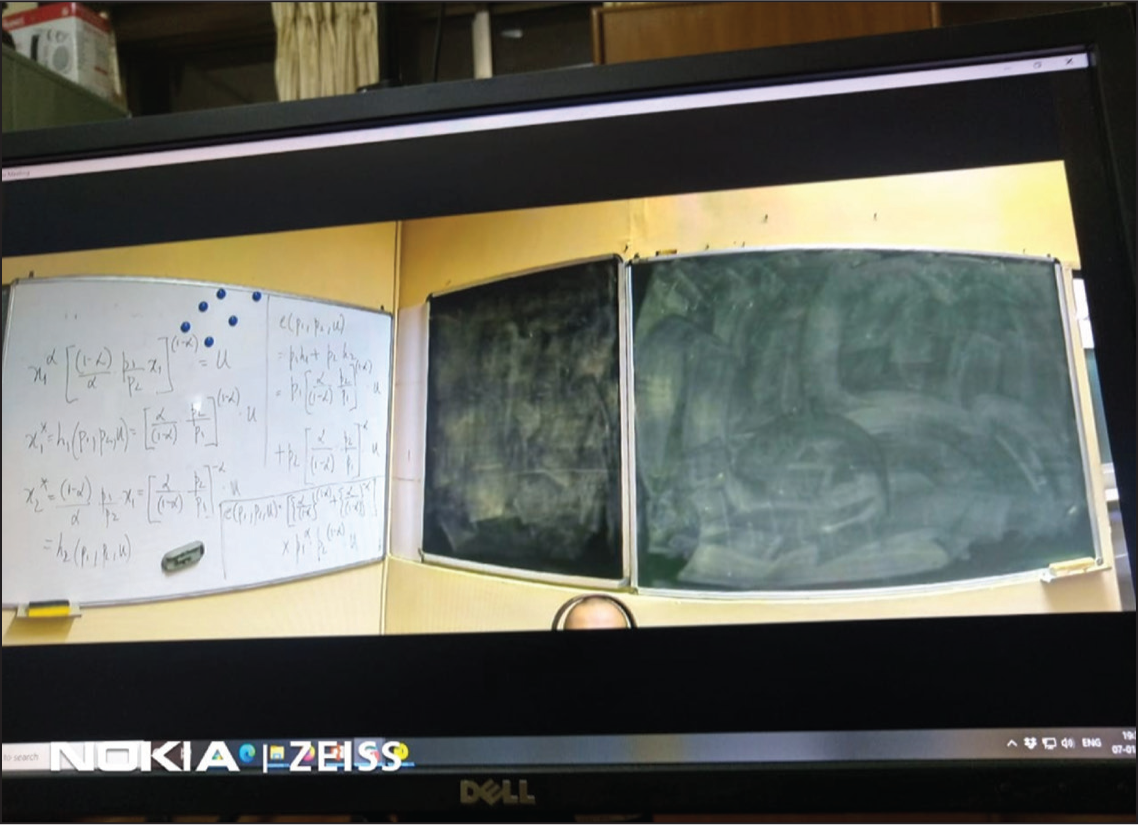
Initially, I was given a Jabra speaker cum mike along with the camera. In terms of sound quality, this was definitely better than the previous arrangement, but problems persisted, especially when I would turn towards the board. There prevailed an interruption in sound. To counter this problem, I was advised to go in for a Jabra headset cum mike for an additional $200. It perfected the sound quality.
The next challenge was how to monitor the large class size of 60 and provide my inputs when an exercise was given. I stored the mobile numbers with names and roll numbers of each of my students and whenever they finished the exercise, which could be as quick as 5 to 10 minutes, they were to click a snapshot of their work and send it to me by WhatsApp. While the session was on, I would start receiving WhatsApp messages. I would comment on their answers and after a few students had been addressed, I would give the correct answer. Nurdianti (2020) has outlined the advantages and weaknesses of WhatsApp communication in Economics learning. Although I can now give real-time feedback to students as quickly as in an offline session, I miss out on the non-verbal and body language cues that I can pick up in a normal offline class and immediately address the students who are not with me. This is something that is most difficult to monitor in an online class. Even if students keep their videos on, it is impossible to keep a tab on each student while the session is on.
The first course with more than 180 students ended in October 2020. By the end of the course, I figured that given the power of the camera and the space in the room, an additional small white board could be fixed, but when it was actually mounted on the wall, the students found it impossible to read as the camera captured it at a peculiar angle. The board had to be taken off the wall and placed on a stand. Please refer to Figure 6 to check out the look at the end of the first course.
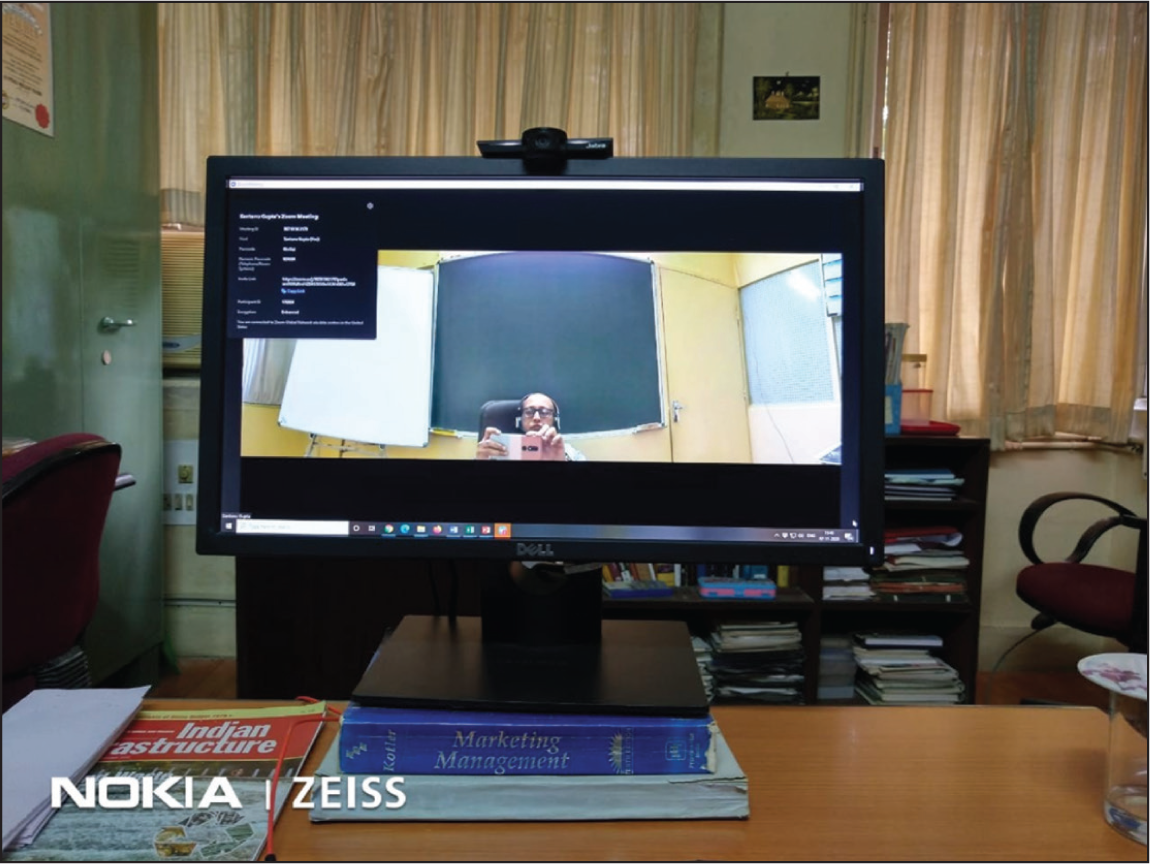
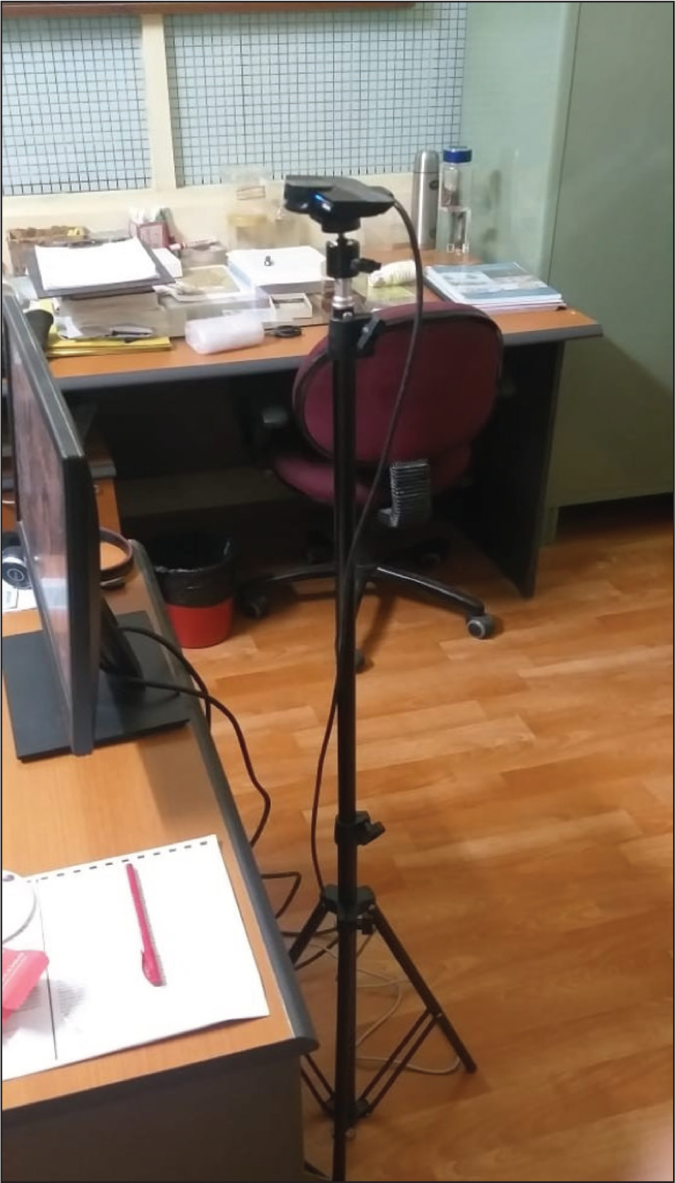
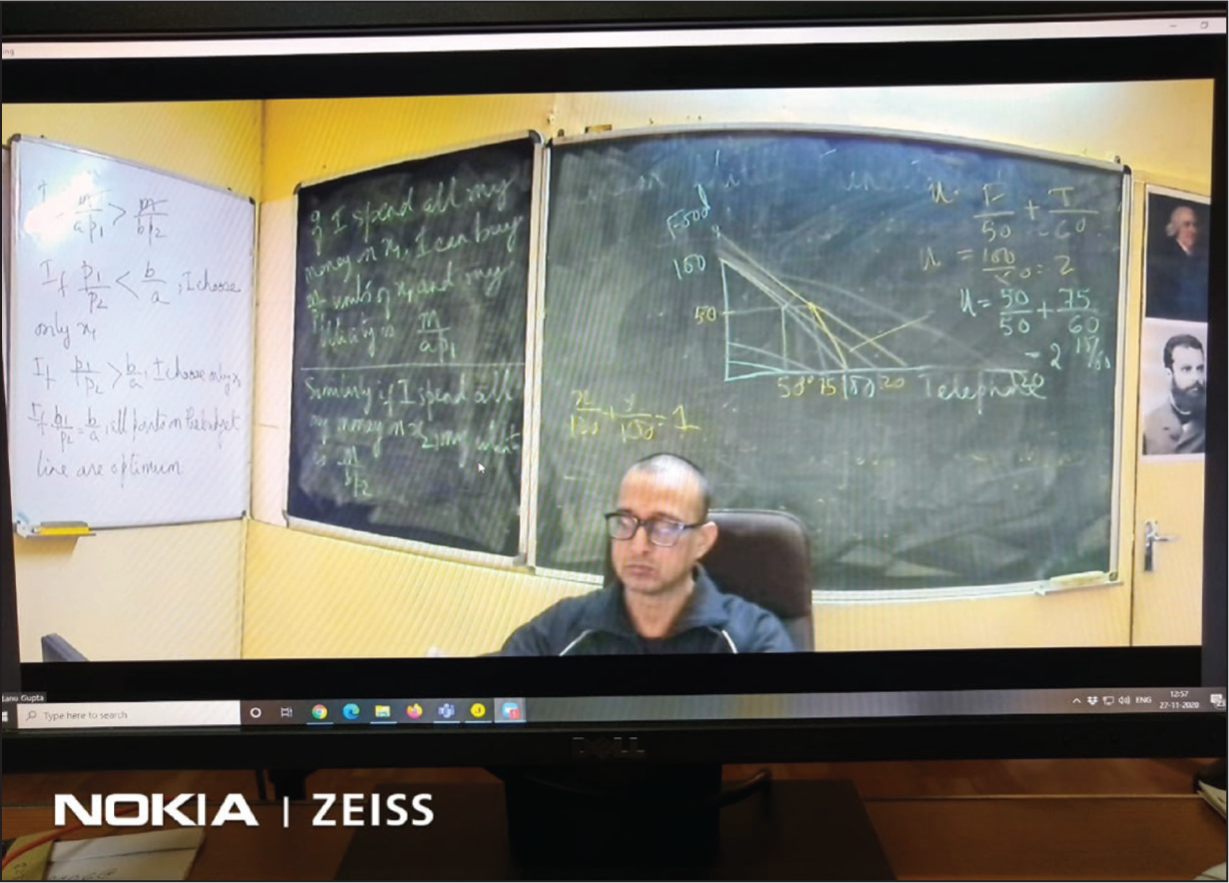
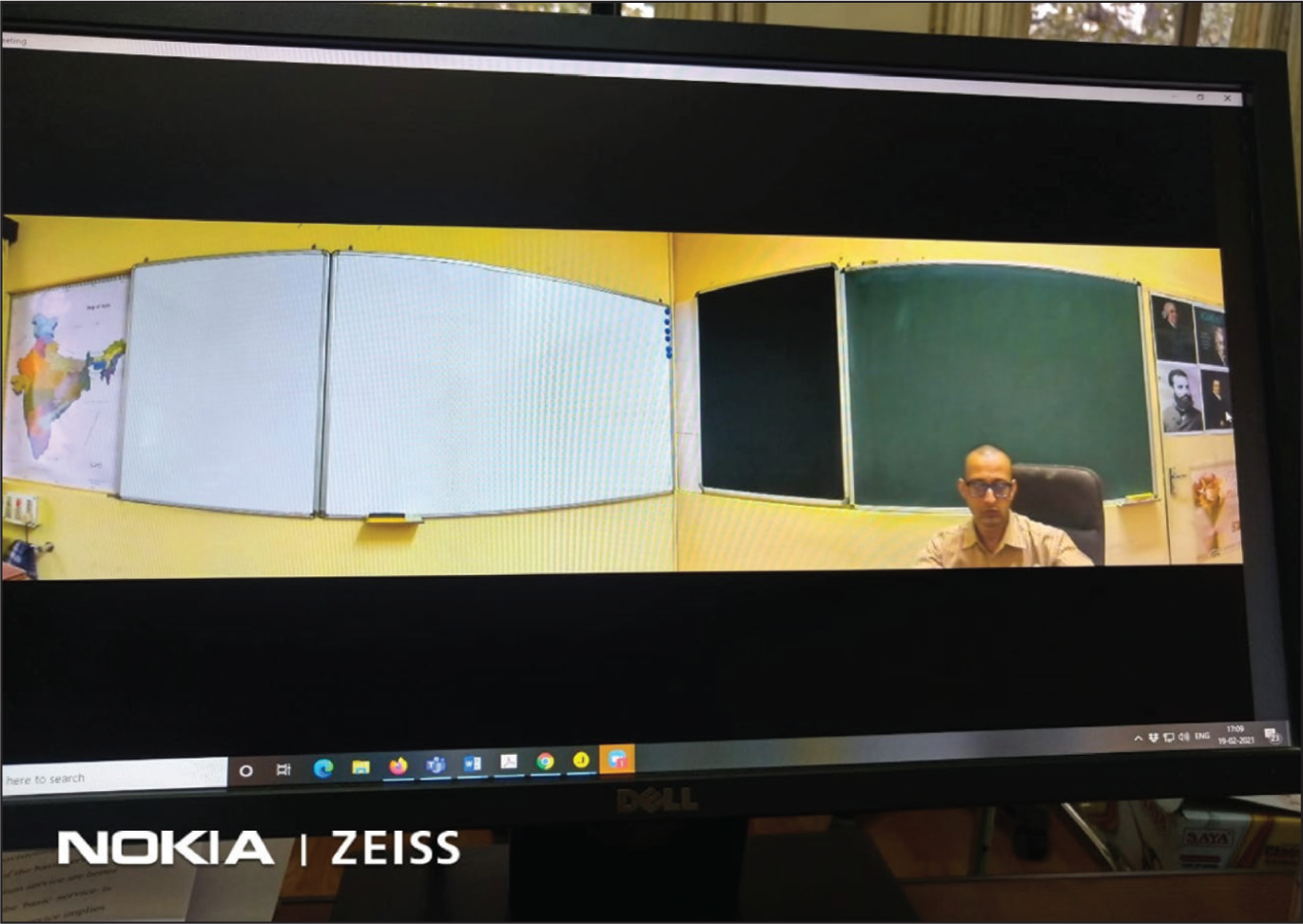
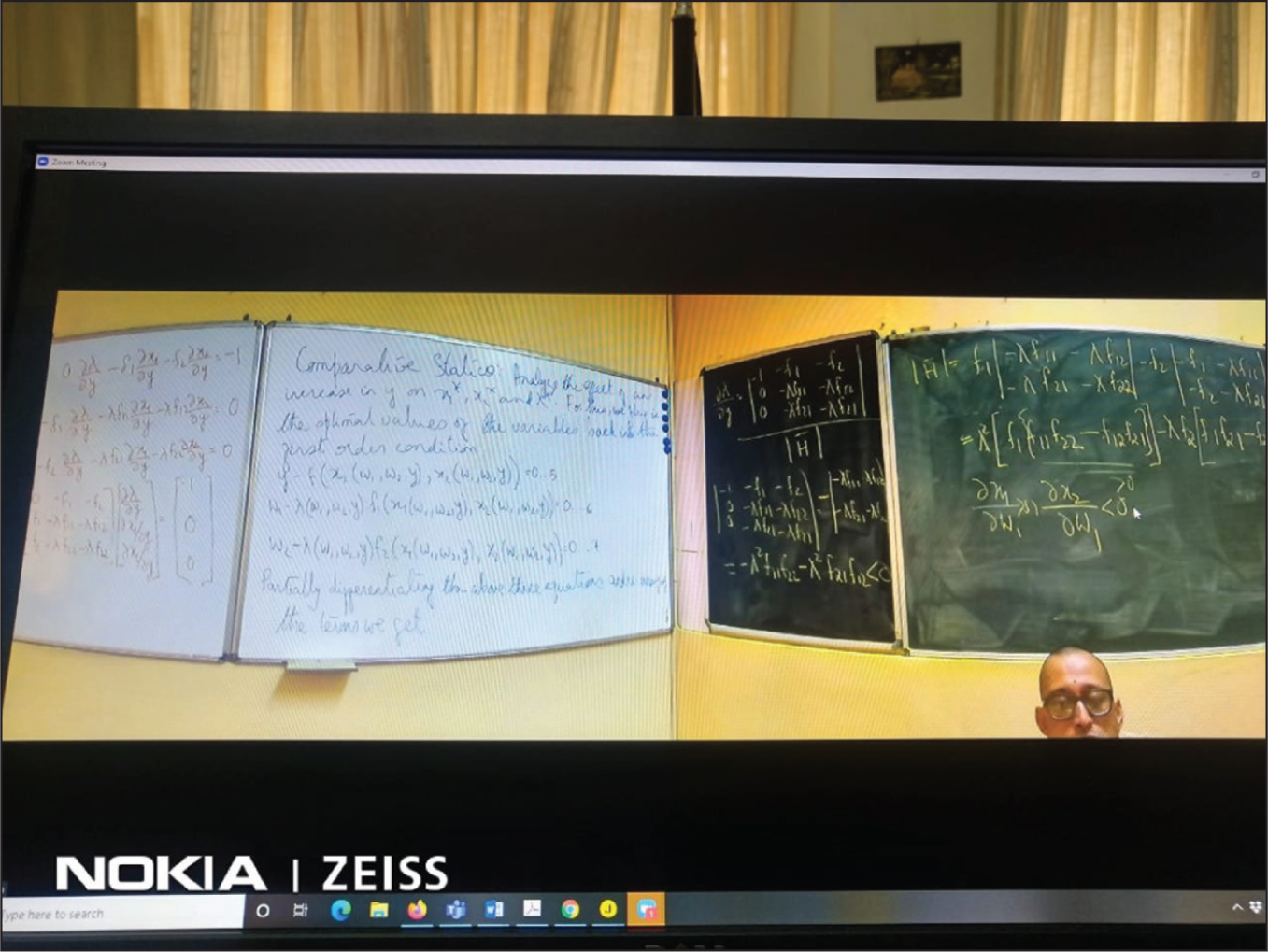
Right after the first course got over in October 2020, a PhD course in Microeconomics started in November itself, comprising only one student. The short span of time in between the two courses gave me the scope to make some changes. The office was packed with furniture and board stands with hardly any place to move. I was informed that the angularity problem when boards are mounted can be resolved by placing the webcam on a stand (please refer to Figure 7) rather than on the top of the monitor. When implemented, this gave me the flexibility to introduce more boards (please refer to Figure 8 & 9). Since the PhD course was derivation heavy, a typical lecture would look as shown in Figure 10.
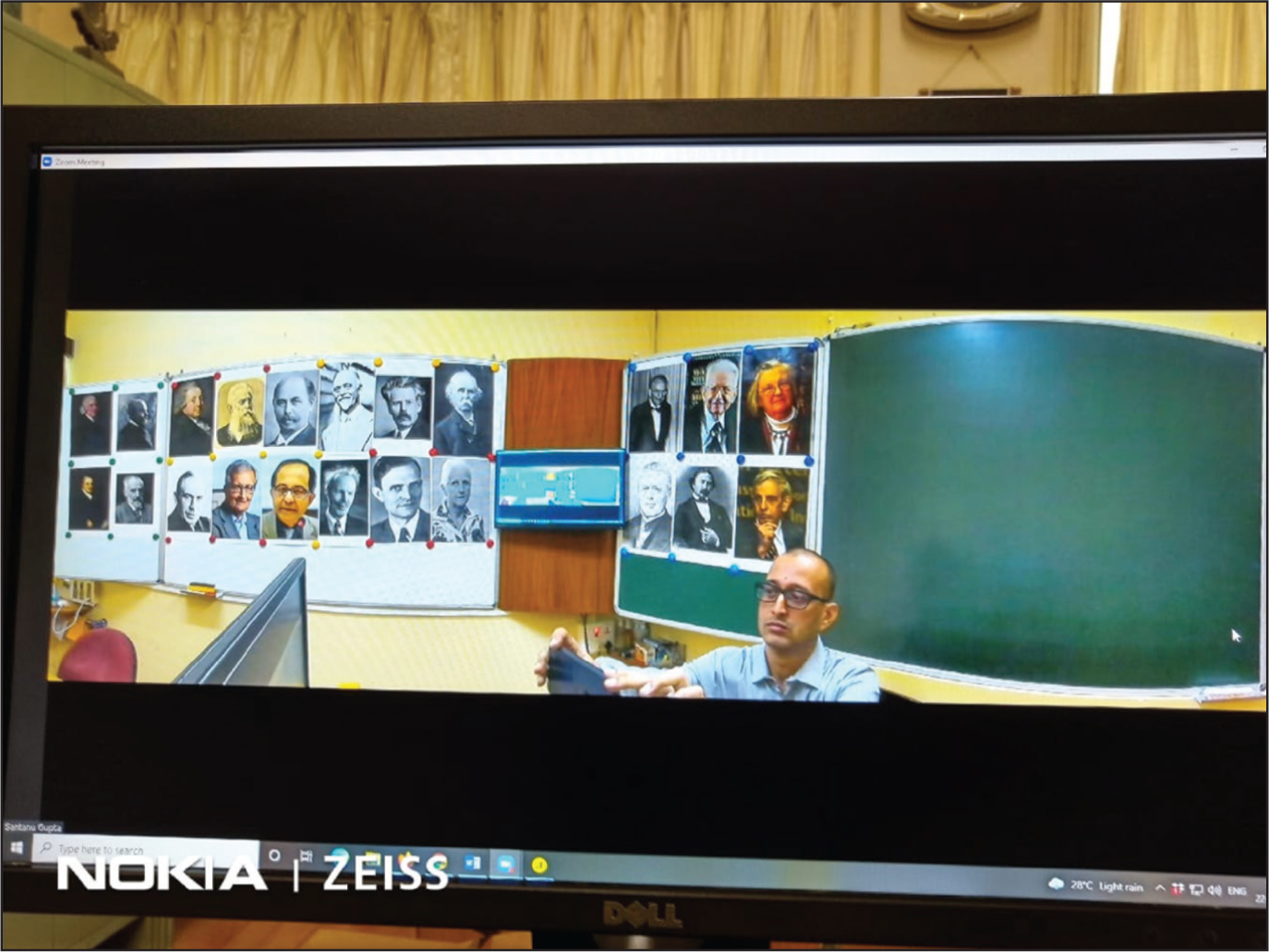
In May 2021, I started a new course with 120 students. This was again an introductory Microeconomics course for experienced professionals. I was keen to provide an actual classroom experience. In an offline classroom at XLRI, the ppt on the screen is in the middle, with green boards on both sides to write. I was hoping that my students could capture both, the writing on the green board as well as the ppt, to replicate the offline experience. That was a failure from my first course experience. I hired a 32-inch television for a day to depict my monitor view of the ppt. As it was impossible to read, I gave it up. Over time I realized, an offline class is superior to an online one since the students can see other students and also the person asking a question. This is not the case in zoom, especially if a ppt. is on and the students have pinned it on the instructor’s screen. To enable other students to see and hear the student, while the class is on, I have now installed a duplicate 27-inch monitor on my wall, and my screen is always in speaker mode. This definitely enhances the online class experience as the students get to see other students asking a clarification. But we have to adhere to the requirement of no sharing of ppts.
There is no doubt that ppts have an edge over other methods of teaching. They make the session visually appealing and tables to be discussed are already integrated and do not need to be made while the session is on. Markus (2020) on a YouTube discussion on change in pedagogy with the pandemic mentions explicitly that use of a ppt worsens class interaction, and he experimented with using ECAMM live, as an alternative to ppts. However, ECAMM live is suitable only when keywords are used, and not full sentences and derivations as happens in a standard Economics lecture, for which there is no substitute to the blackboard. Figure 11 gives an overview of how I prepare my class. I give the ppt in advance. If there are pictures to be displayed, I print them and stick them on my magnetic boards, and if there are tables to be discussed, I write them on the board before the session begins for easy reference during the session. Only the green board is kept blank to be used to write during the session.
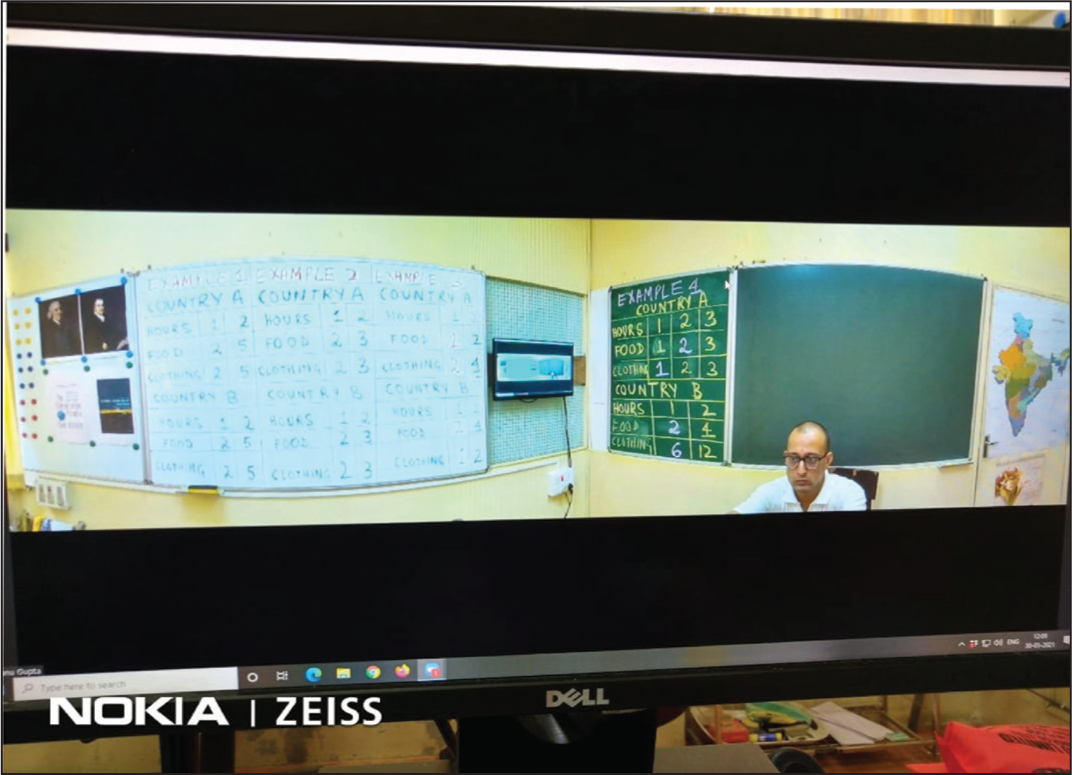
Initially, the contents of the monitor in Figure 11 were not clearly visible given the angle problem. To resolve that, the monitor was placed on a rotating stand. This definitely improved the visibility of the monitor though the angle problem of the small white board and the small green board remained. Please refer to Figure 12 for an understanding of the problem. To solve this problem, I got a carpenter to have the two small boards project slightly out of the wall for better visibility. Figure 13 shows the correction of the angularity problem of the small boards.
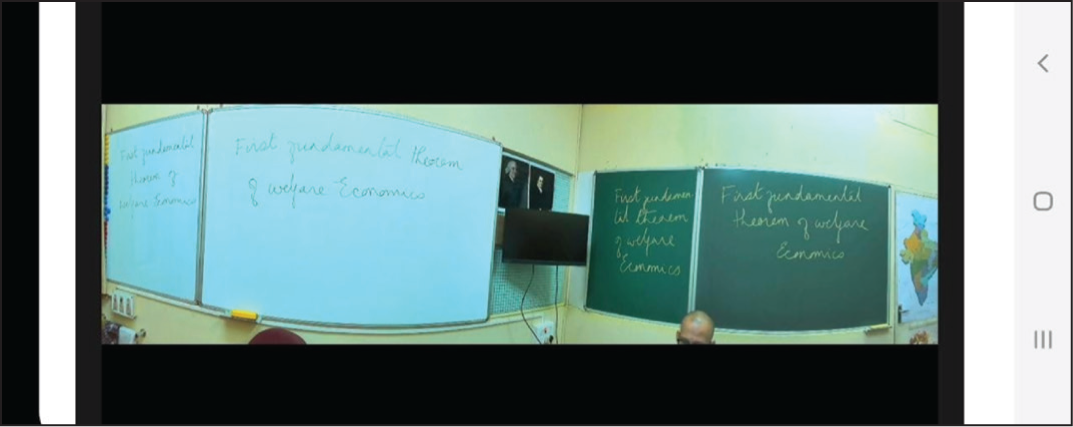
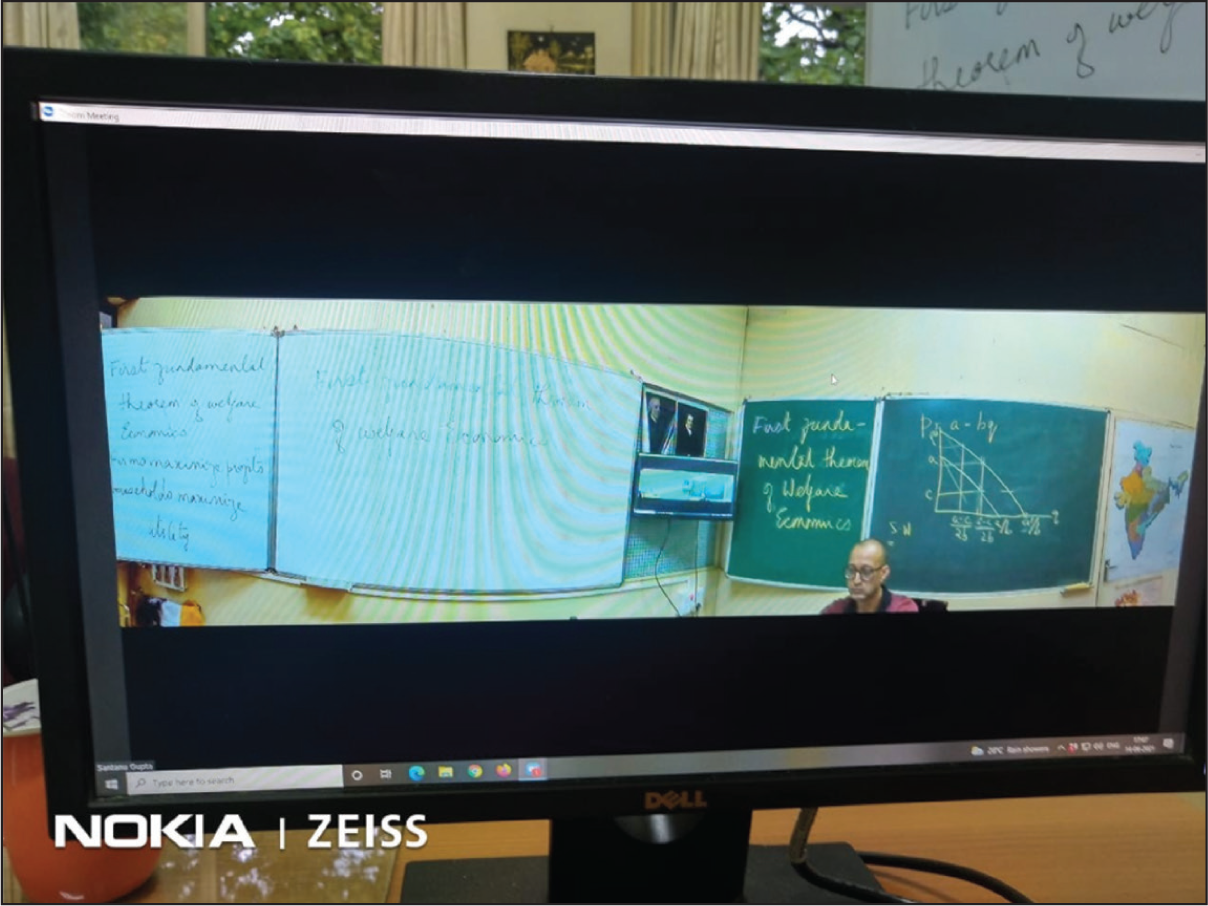
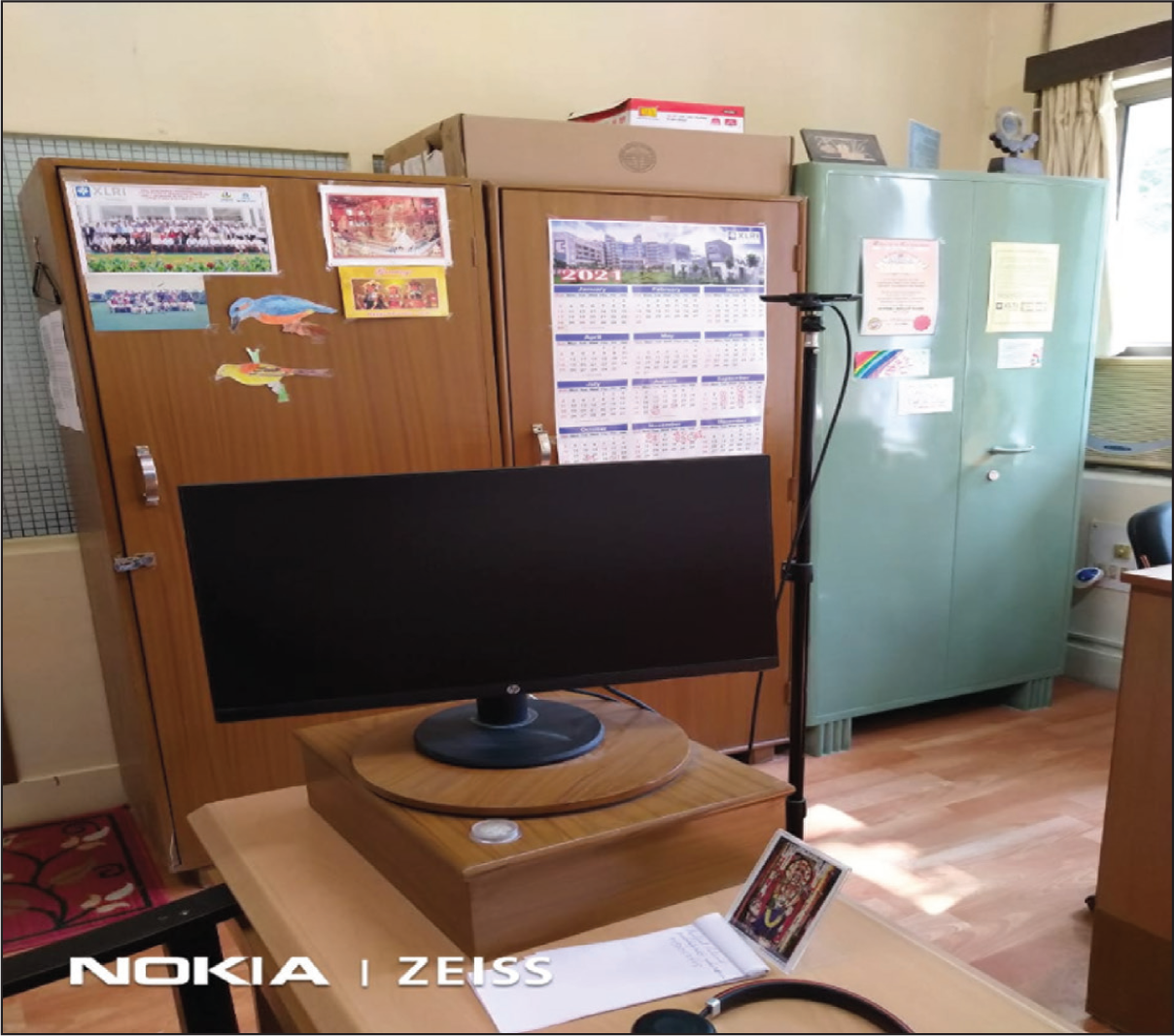
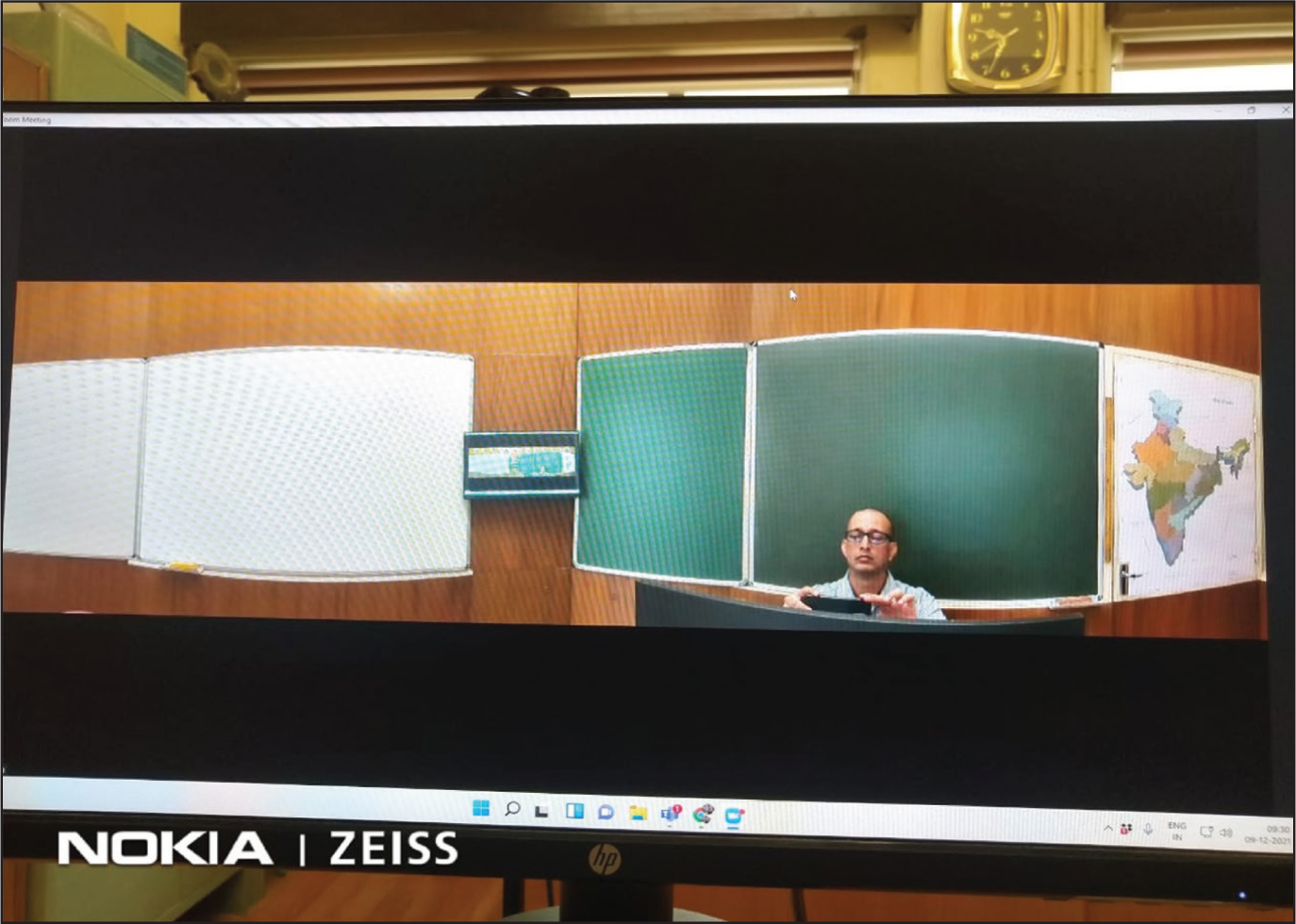
Given that the whiteboard and the green boards are at right angles to one another, it is impossible to view the monitor, when one moves to the other side. For that reason it was necessary to mount the monitor kept in front of the board on a swivel. This helps to ensure that one is not speaking to the wall, if one moves to the other side. Figure 14 illustrates the front monitor being kept on a swivel. Without a swivel, students would view a side view of the instructor rather than the front view, if the instructor were looking at the monitor on the wall rather than the monitor in the front. Finally, to improve the ambiance of the room, I had the walls panelled. Figure 15 and Figure 16, show the view of the room with partial and full panelling.
Conclusion
For most instructors, blackboard teaching comes naturally, and I am sure the students miss this style of teaching as much as we do. However, never one to miss out on a challenge, we teachers have come up with innovative methods that we have implemented to make online teaching as engaging as offline teaching. I have tried to list out the teaching innovations I have introduced in my office which is a small room of 11.5 × 11.5 feet. If the transition from offline to online could effectively happen in this small room, it can be replicated anywhere. I am yet to get the formal feedback for the courses but personal feedback from my PhD student has been very encouraging. In fact, it is he who suggested that the big whiteboard be moved to the centre for better visibility. I am indebted to all my students and well-wishers who have helped me through this journey.
Footnotes
Acknowledgements
I thank my student Kalyan Krishna Manasai Metta for suggesting the shorter proof, Gautam Sardana and Sachin Jabra for all the help in procuring the material for online teaching. I thank Vikram Kapoor for giving detailed feedback on the first version of this paper and for citing and suggesting appropriate references. I also thank Sonia Raisurana for excellent editorial assistance and Bincymol Vinod for help in transition of the document from pdf to word. I thank Sadique Akhtar for the selection of appropriate photographs to document the changes made in the office.
Declaration of Conflicting Interests
The author declared no potential conflicts of interest with respect to the research, authorship and/or publication of this article.
Funding
The author disclosed receipt of the following financial support for the research, authorship, and/or publication of this article: The author thanks XLRI for the computer grant given which was used to buy the Jabra camera, which was used extensively for online teaching.