



Abstract
Although the term has roots in the training and development literature, blended learning has only recently begun to be studied in management education. This article examines the literatures of blended and fully online management education to determine whether there are factors that may influence instructional effectiveness that are unique to blended learning. The review provides tentative support for the premise that opportunities for enhanced learner control of the learning process and group cohesiveness and collaboration may be distinguishing advantages of blended learning in management education. The article concludes by discussing pressing research issues, including discovering optimal blends, differentiating from or integrating blending with the concept of “flipped classrooms,” distinguishing the effects of blending from other potential confounds, determining the effects of subject matter and program level, and seeking increased thought leadership on blended perspectives from classroom-based management education scholars.
The last decade has seen a boom in the study and application of online delivery in management education (Allen & Seaman, 2011; Arbaugh & Hwang, 2013; Sitzmann, Kraiger, Stewart, & Wisher, 2006), with increasing interest in course offerings that blend online and classroom-based delivery approaches in higher education (Allen, Seaman, & Garrett, 2007; Bonk & Graham, 2006; Garrison & Kanuka, 2004; Halverson, Graham, Spring, & Drysdale, 2012). About half of the 4-year institutions in the United States reported offering blended courses by 2007, including 64% of those schools with 10,000 or more students (Parsad, Lewis, & Tice, 2008), and momentum for this approach to delivery of education appears to be accelerating all over the world (Drysdale, Graham, Spring, & Halverson, 2013). In fact, some forecasts predict that the number of U.S. students taking traditional classroom-based courses could decline from 14.1 million in 2010 to 4.1 million by 2015 (Moskal, Dziuban, & Hartman, 2013). Although defining what exactly constitutes a blended learning environment has been a challenge (Oliver & Trigwell, 2005), consensus is emerging that a blended course combines online learning with traditional face-to-face class activities in an intentional, pedagogically valuable manner where between 20% and 79% of course content and activities are delivered online (Allen et al., 2007; Garrison & Kanuka, 2004; Graham, 2006).
Although influence of this interest has been seen in research on online delivery in management education (Arbaugh et al., 2009; Daspit & D’Souza, 2012; Hwang & Francesco, 2010), blended approaches have received considerably less attention in the management education literature (Arbaugh, Desai, Rau, & Sridhar, 2010). Considering that the term may have roots in the organizational training and development literature (Oliver & Trigwell, 2005; Reay, 2001), the comparative lack of attention given to it by management education scholars is somewhat ironic. However, as online delivery moves increasingly into undergraduate business education settings (Grandzol & Grandzol, 2010; Hansen, 2008; Ivancevich, Gilbert, & Konopaske, 2009; Proserpio & Gioia, 2007), considerations of appropriate blends take on increasing importance for at least three reasons (Chou & Chou, 2011; Ross & Rosenbloom, 2011; Wilson, 2011). First, online delivery may be more amenable to graduate education because these learners generally have greater practice in self-regulation and in acquiring learning strategies, and therefore can adjust to online environments relatively quickly (Akyol & Garrison, 2011; Arbaugh, 2004, 2014; Comer & Lenaghan, 2013; Shea & Bidjerano, 2010, 2012). With such prior experience, graduate-level learners can recognize approaches to teaching presence through virtual environments more readily than can relatively novice learners (Arbaugh & Hwang, 2006; Rienties, Giesbers, Tempelaar, & Lygo-Baker, 2013). Without the cues provided through the relatively rich media of face-to-face contact, online activities in the hands of novice learners can descend into self-directed malaise (Daymont & Blau, 2011; Kirschner, Sweller, & Clark, 2006). Second, blends could be used to help undergraduate students assimilate more quickly to online environments. Some comparative studies of online and classroom undergraduate business settings have found that although perceived ambiguity is higher and grades are lower in online courses than in classroom-based settings early in the course, these differences no longer existed by the end of the course (Kock, Verville, & Garza, 2007). This progression suggests that blends provide the possibility for accelerating the process by which novice learners become more comfortable with learning online. Third, changes in the nature of work suggest that undergraduate students become more accustomed to working virtually (Daspit & D’Souza, 2012; Dineen, 2005; McDonald, 2011). The rise of virtual workplaces and teams suggests that for professional development reasons, some course activities that historically have been conducted face to face should be conducted online.
Although publications devoted to the phenomenon suggest that research in blended learning is a relatively new topic (Halverson et al., 2012; Osguthorpe & Graham, 2003), closer examination of the management education literature suggests that studies of blended learning actually have been taking place for some time. Initial research suggested that introducing online elements or exercises into classroom-based courses was positively associated with course outcomes in studies of management education (Balotsky & Christensen, 2004; Clouse & Evans, 2003; Hwang & Arbaugh, 2006, 2009; Webb, Gill, & Poe, 2005), and blended courses have fared well in studies comparing them with both purely classroom and purely online courses (Klein, Noe, & Wang, 2006; Terry, 2007; Webb et al., 2005). Other benefits of blending in management education include increased confidence in working in virtual project teams (Bull Schaefer & Erskine, 2012; Clark & Gibb, 2006; Dineen, 2005), increased learner control of the educational experience (Bull Schaefer & Erskine, 2012; Klein et al., 2006), and enhanced dialogue skill development (Eveleth & Baker-Eveleth, 2003).
In spite of this increased research attention, many questions about blended learning in management education continue to persist (Arbaugh et al., 2010). Management education research generally has failed to be explicit regarding whether a course is purely online or blended until very recently (Hwang & Arbaugh, 2009; Hwang & Francesco, 2010; Klein et al., 2006). This lack of specificity in denoting the degree of blending within courses has limited the management education literature’s ability to determine the conditions under which online or blended learning is most appropriate (Kellogg & Smith, 2009). This inability to provide guidance to educators and administrators leaves those practitioners in the position of having to make decisions based on factors such as personal preference, institutional convenience, administrative edict, and access, rather than necessarily what is best for the learners.
Therefore, in this article, we compare the literatures on online and blended learning in management education to identify areas of similarity and difference in design and delivery of these learning modes. By identifying these differences, we seek to help create an initial research framework unique to blended learning in management education. From this framework, we then identify this domain’s most pressing topics so that researchers with potential interests in blended management education know where to target their efforts to accelerate the development of future studies with hopes that educators can implement appropriate blends more quickly rather than having to appropriate them through extended periods of trial and error.
The remainder of the article proceeds as follows. We open our discussion by providing an overview of the more prominent pieces on blended learning in higher education to provide context for considering specific applications to management education. Next, after describing our review protocol, we briefly review the results of comparative studies between online and blended courses. We then compare findings from these literatures regarding course designs, student characteristics, and students’ attitudes toward and usage of the delivery mediums. We conclude the article with our recommendations regarding the most pressing areas for future research, specifically the need to identify optimal blends, either differentiating from or integrating with the concept of “flipped classrooms,” and further consideration of contextual factors such as subject matter and degree program level. We hope that the ideas presented in the article will be helpful, both for scholars seeking how to best contribute to the literature of online and blended management education and for instructors contemplating how to best blend their own courses.
Blended Learning in Higher Education
To frame future directions for the study of blended approaches in management education, it is helpful first to provide the broader context of research on blended learning. Although the elements necessary for blending approaches to educational delivery have existed for some time (Garrison & Kanuka, 2004; Garrison & Vaughn, 2008; Moskal et al., 2013; Osguthorpe & Graham, 2003), serious consideration of what course activities should be blended and how to do so have emerged only in the last decade. Initial conversations of blends considered not only delivery mediums, but also types of learning, content, pedagogy, and participants (Osguthorpe & Graham, 2003; Singh, 2003). However, for operational purposes, blended learning has come to be defined as educational experiences delivered through the thoughtful combination of face-to-face and online activities (Drysdale et al., 2013; Garrison & Kanuka, 2004; Graham, 2006; Ocak, 2011; Rovai & Jordan, 2004). Although some early authors have criticized this definition for focusing more on instruction than on learning (Oliver & Trigwell, 2005), others have noted that the approach allows instructors to change how class time is used to better tailor opportunities for student learning and provide learners with increased control over their learning experience by allowing them to decide what material they will study and how they will study it (Osguthorpe & Graham, 2003). Specifically, blended approaches have been sought to allow the advantages of thoughtful and objective consideration of complex topics and questionable ideas associated with online teaching and learning with the spontaneity and greater media richness of face-to-face settings (Garrison & Kanuka, 2004; Osguthorpe & Graham, 2003; Rovai & Jordan, 2004).
Although much has been made of the potential of blended learning to provide the “best of both worlds” of educational delivery, and early comparative studies suggested positive course outcomes relative to both purely classroom-based and purely online courses (Hartman, Dziuban, & Moskal, 2000; Rovai & Jordan, 2004), subsequent meta-analytic work on studies of blended learning that employed experimental and quasi-experimental designs suggests that the jury still may be out on the comparative effectiveness of blended approaches. An initial meta-analytic study of blended and purely online training or education found that blended learning yielded 13% greater effectiveness for conveying declarative knowledge and 20% greater effectiveness for procedural knowledge over purely online training, but learner satisfaction was 6% higher for online training than for blended offerings (Sitzmann et al., 2006). In an examination of studies that employed student, instructor, and/or content interaction interventions, Bernard et al. (2009) found no differences between blended, online, and classroom-based courses regarding the effectiveness of those interventions, and also suggested that this finding may be due to the small number of studies (7) in their analysis that examined blended courses. Means, Toyama, Murphy, Bakia, and Jones (2010) had a larger number of blended studies in their meta-analysis, and found that blended courses demonstrated stronger learning outcomes than face-to-face courses. However, they also found that outcomes for blended offerings and purely online courses tended to be comparable. They also noted that the positive effects associated with blended learning may not be attributable to the medium because of features such as additional learning time provided and other instructional elements added in these settings that were not associated with the control conditions. Therefore, the advantages of blended learning environments may reflect differences in content, pedagogy, or learning time rather than the delivery medium.
Because educational research in the business disciplines tends first to draw from work in its respective disciplinary area and then to broaden its perspective to draw from educational research in other settings (Arbaugh et al., 2009), management education researchers interested in blended learning are only beginning to draw from these foundational works for framing their studies. Also, because pure experimental designs often are not feasible in management education settings, these works tend to not be included in those recent meta-analytic studies (Arbaugh, Hwang, & Leisen Pollack, 2011). That said, our review of blended learning in management education will show that scholars have been drawing from the educational research of their own disciplines and building on conclusions from research in online environments to construct their own distinctive body of knowledge.
Literature Review Protocol
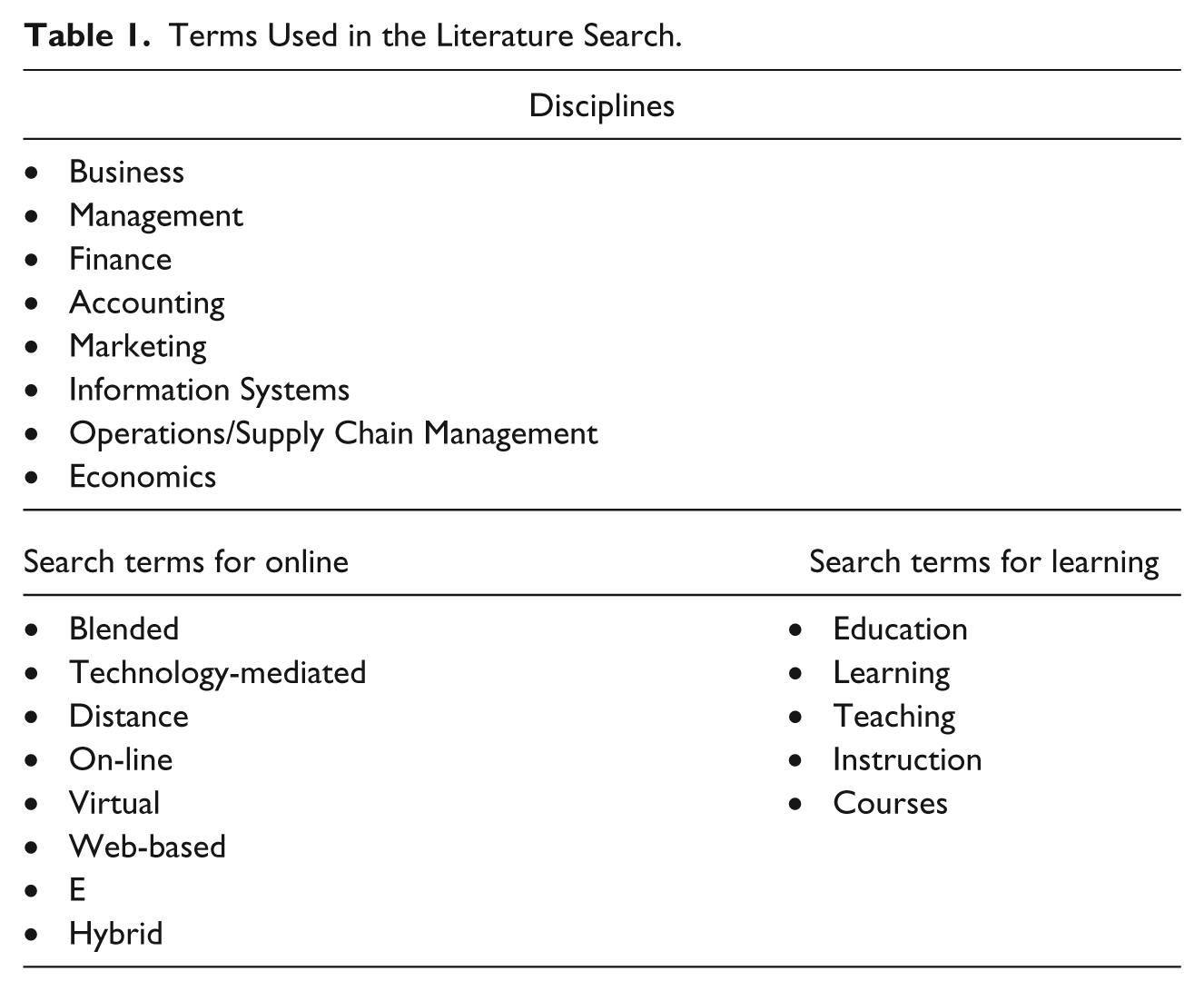
Having provided the broader context of blended learning research and how the work in the area from management education fits into it (or perhaps more accurately, develops independently and assimilates over time), we now discuss the development of parameters for our literature review. This article is developed from an ongoing systematic review of articles in business education that have examined virtual learning environments, including both fully online and blended teaching and learning settings. This comprehensive search for peer-reviewed articles published after January 1, 2000, began in September 2006, and to date has identified articles published through December 2013. The databases examined in the review include ABI/Inform, EBSCO Business Full Text, EBSCO Business Source Premier, and Science Direct. Terminology used in the search is provided in Table 1. To supplement this review, the primary educational research journals for each business discipline dating back to 2000 as identified in the journals database published in Academy of Management Learning and Education were included in the review (Whetten, 2008). Using this approach, to date we have identified at least 338 peer-reviewed articles that examined online and/or blended learning in business and management education. Regarding empirical studies of blended learning, we found 44 studies that focused on undergraduate students, 12 that focused on MBA students, 2 that examined both, 1 that did not designate student program level, and 1 that focused on instructors.
Terms Used in the Literature Search.
When comparing this data set to criteria for levels of evidence for systematic reviews in management developed by Reay, Berta, and Kohn (2009), most of the articles in our review constitute either Level 3 (multi-course and/or large sample studies) or Level 4 (small-sample, single-site studies), with limited numbers of articles constituting Level 1 (meta-analysis), Level 2 (systematic and/or comprehensive and replicable literature reviews), and Level 5 (descriptive and/or self-report studies). We provide these levels of evidence and example articles in Table 2.
Levels of Evidence Identified in the Literature Search.

Source. Adapted from Reay, Berta, and Kohn (2009).
Results of the Literature Review
On completing the review of these studies of blended management education, several general observations emerge. First, although blended formats tend to be viewed favorably relative to online offerings, researchers tend to present blended designs descriptively rather than as theoretically derived and tested. Second, learner attitudes toward delivery technology may be more subject to peer influence in blended environments than in purely online settings. Third, although the technological characteristics of the delivery formats may be similar, the element of learner control of the learning environment appears to be more salient in blended settings, perhaps because of the opportunities provided to influence peer opinion offered by face-to-face meetings. We probe these observations further in the following section.
Comparisons of Blended With Classroom and Online Management Education
Although educational technologists have engaged in considerable debate for at least two decades over whether a delivery medium influences learning and whether educational delivery mediums even should be examined comparatively (Bernard et al., 2004, 2009; Clark, 1994; Kozma, 1994), there are numerous comparative studies of business and management education in online, blended, and classroom-based formats. One possible explanation for this may be that unlike educational technologists, business school faculty members generally spend their doctoral training and early careers immersed in the literatures of their respective disciplines rather than in the area of instructional technology. As these scholars become interested in studying technology-mediated learning, comparing these alternative mediums to what they have known in their teaching may seem reasonable to them, to other business education research authors, and to much of the editorial functions of the learning and education journals in the business disciplines (Rynes & Brown, 2011; Sullivan, Baruch, & Schepmyer, 2010). Therefore, from the perspective of management education research practice, reviewing comparative studies is a reasonable first step for our review. Nevertheless, as we will see later in the article, this comparative orientation can generate attractive opportunities for future research.
To date, the few studies that have compared blended with online delivery in management education generally have shown favorable results for the blended format. Although initial studies indicated some less favorable results or no significant differences for blended offerings (Benbunan-Fich & Hiltz, 2003; Bryant, Campbell, & Kerr, 2003; Haytko, 2001; Sauers & Walker, 2004), as learners and instructors have become more experienced with the technological aspects of the delivery format, blended courses have been shown to yield stronger learning motivation (Klein et al., 2006), higher skill development (Chen & Jones, 2007; Kovach, Miley, & Ramos, 2012; Priluck, 2004), and higher course performance (Clouse & Evans, 2003; Gratton-Lavoie & Stanley, 2009; Hamilton & Te, 2010; Keith & Simmers, 2013) relative to purely online and purely classroom-based offerings, even when examining more than one type of blend (Webb et al., 2005). However, more recent studies suggest no difference in learning outcomes, particularly when controlling for issues such as selection bias (Olitsky & Cosgrove, in press; Wiechowski & Washburn, 2014).
In contrast, purely online courses in management education generally have shown either no significant difference in learning outcomes or a migration toward equivalent outcomes (Arbaugh, 2000; Borthick & Jones, 2000; Friday, Friday-Stroud, Green, & Hill, 2006; Grandzol, 2004; Kock et al., 2007), with some less favorable outcome comparisons in quantitatively oriented courses (Anstine & Skidmore, 2005; Brown & Liedholm, 2002; Coates, Humphreys, Kane, & Vachris, 2004). Although comparison studies have shown online environments to yield more positive group cohesion and collaboration (Hansen, 2008; Heckman & Annabi, 2005), they also have shown lower learner satisfaction with the delivery medium (Piccoli, Ahmad, & Ives, 2001; Weber & Lennon, 2007).
Although most of these studies did not compare blended and online courses concurrently, and therefore do not allow us to make definitive conclusions, the collective findings from these studies suggest that there is at least the potential for blended courses to provide the touted “best of both worlds” in management education. Students do not appear to be as distraught with the technological characteristics of blended courses because, in part, they have the option of seeking answers to questions in person with either fellow learners or the instructor (Eveleth & Baker-Eveleth, 2003; Hwang & Arbaugh, 2009). As will be shown later in this article, opportunities for sustained collaborative cohesion, along with increased control over their individual learning, also may yield both more positive attitudes toward the format and higher learning outcomes.
Course Designs
To date, several conceptualizations and descriptive accounts of blended course design have been developed for management education. Originally derived for developing graduate-level courses in managerial accounting, Zabriskie and McNabb’s (2007) model for blended learning was first to determine the needs of all stakeholders (students, employers, instructors, university) and then to consider available technologies for providing the course. Only then were instructors to begin developing the course and determining which content would be delivered online and which would be addressed in the classroom. Sautter (2007) provided some guidelines for determining whether particular course activities should be conducted in a classroom or online. She contended that activities that required team cohesion or learner control should be conducted online, whereas activities that require skills in active listening, oral communication, and/or extemporaneous thinking were better served by a classroom setting. This approach to activity design was reflected in Ross and Rosenbloom’s (2011) recent narrative of redesigning a classroom undergraduate strategy course for blended delivery. Their approach advocates first having a clear understanding of why a move to a blended course is necessary, determining the essential course content and desired learning outcomes. After that, determining activities for the blend and creating new activities for the blend could be considered (they incorporated self-created student video presentations and moved to mini-case classroom discussions). Finally, they considered what needed to be done to ensure that the activities in one modality enhanced the effectiveness of the other, and discovered that creating a sense of social presence early in the course was particularly important for holding the two learning environments together. In online learning environments, social presence has come to be defined as the extent to which participants are socially and emotionally connected to each other (Gunawardena & Zittle, 1997; Richardson & Swan, 2003). This emphasis on connection suggests that activities not directly related to course content are important at the beginning of blended courses. The importance of social presence early in the course also is consistent with emerging research regarding online course effectiveness in management education (Arbaugh, 2013; Ke, 2010; Shea et al., 2010).
Unfortunately, such conceptualizations of process generally have not resulted in increases in the empirical study of blends. Our review yielded only one study that tested varieties of blends (Webb et al., 2005). With few exceptions (i.e., Chou & Chou, 2011; Drennan, Kennedy, & Pisarski, 2005), course blends are treated descriptively, with limited discussion of theoretical support or rationale for them beyond starting the course in a classroom setting, in part because that is the setting with which learners are most familiar (Chen & Jones, 2007; Colucci & Koppel, 2010; Vamosi, Pierce, & Slotkin, 2004). Such was the case whether the course had front-loaded classroom activities at its beginning, mixed online and classroom activities throughout the course (Bryant et al., 2003; Gratton-Lavoie & Stanley, 2009; Haytko, 2001; Hwang & Arbaugh, 2006; Klein et al., 2006; Stubbs, Martin, & Endlar, 2006), or neglected to mention the nature of the blend entirely (Benbunan-Fich & Hiltz, 2003; Grzeda & Miller, 2009). However, the general lack of theoretical grounding of approaches to blended learning appears to apply to all disciplines and levels of education, not just college- and university-level business and management education research (Drysdale et al., 2013). These findings, or rather, the absence of their consideration, suggest that blend variety should be a primary conceptual and empirical consideration for future research in blended management education.
In contrast, although conceptual prescriptions for course design issues in fully online management education have received limited attention, design issues have received comparatively extensive empirical study. Research to date suggests that a primary design factor for effective graduate courses is that a course be designed to encourage participant interaction, particularly because course design appears to interact with instructor facilitation styles and group dynamics (Arbaugh, 2005; Cox, Carr, & Hall, 2004; Ivancevich et al., 2009; Millson & Wilemon, 2008). Rungtusanatham, Ellram, Siferd, and Salik (2004) conceptualized that higher-order thinking and double-loop learning would be focused primarily in graduate-level online courses; therefore, these courses should be designed to enhance both content knowledge and decision-making skills, and include high interaction and interaction timing flexibility, with faculty controlling the pace of learning. This conceptualization of delivery of online graduate management education has received empirical support from studies such as Arbaugh and Benbunan-Fich’s (2006), which found that online MBA courses designed on instructor-based content dissemination and group-based learning activities were most strongly associated with learning outcomes and satisfaction with online courses. The importance of group-based interaction at the graduate level suggests several design features: the use of student groups that have continuity (Erez et al., 2013; Hodgson & Reynolds, 2005; Williams, Duray, & Reddy, 2006), an established body of knowledge from which to structure group activities (Benbunan-Fich & Arbaugh, 2006), and a variety of types of assignments (Arbaugh & Rau, 2007).
The results of recent studies, however, have begun to suggest that there may be other modes of interaction than peer-based that may influence online learning outcomes, and that instructors will have to be increasingly vigilant to manage their online class settings to keep learners from becoming overwhelmed with the volume of discussion postings (Ke, 2010; Kellogg & Smith, 2009; Rollag, 2010). Another course design approach that may address these trends, which are supported by at least preliminary evidence, is to begin with relatively simple activities to create rapport and mastery of the learning environment, and then move on to progressively more complex and difficult topics and activities (Allan & Lawless, 2003; Erez et al., 2013; Mariola & Manley, 2002).
Participant Attitudes and Usage of the Technology
Influences on Learner Attitudes Toward the Technology Platform
One noteworthy difference between the online and blended literatures is the attention and influence that fellow course participants have in shaping learner attitudes toward the technology in blended environments. The Technology Acceptance Model (TAM) has been the dominant theoretical lens through which attitudes toward technology have been examined in studies of both online and blended environments in management education (Arbaugh et al., 2009; Padilla-Melendez, del Aguila Obra, & Garrido-Moreno, 2013). Most of the studies that have examined TAM in either environment have found perceived usefulness of the technology to be a stronger direct predictor of attitudes toward the technology or of actual usage (Arbaugh, 2005; Drennan et al., 2005; Landry, Griffeth, & Hartman, 2006; Padilla-Melendez, Garrido-Moreno, & del Aguila Obra, 2008; Padilla-Melendez et al., 2013), and that TAM predicts learner satisfaction with the delivery medium (Arbaugh, 2004, 2005; Landry et al., 2006; Stoel & Lee, 2003). However, peer encouragement (Martins & Kellermanns, 2004) and positive instructor attitudes toward the technology (Martins & Kellermanns, 2004; Selim Ahmed, 2010) have been found to be important factors associated with learner attitude and usage of learning management systems in blended environments. Although fellow participants may at least indirectly influence learner attitudes toward the learning environment (as will be discussed in the upcoming section on participant interaction), studies to date in purely online settings suggest that the characteristics of the system are the primary influences on learner attitudes toward the technology (Davis & Wong, 2007; Saade, 2007; Saade & Bahli, 2005).
Learning Management System (LMS) Usage Behavior
The literature also suggests differences in the role usage behavior plays in online and blended environments. Although there is evidence that consistency rather than intensity of system usage may better predict learning outcomes in both settings (Arbaugh, 2005, 2010b; Asarta & Schmidt, 2013; Baugher, Varanelli, & Weisbord, 2003; Hwang & Arbaugh, 2006), time on task and learner control of the pace of learning afforded by the placement of materials in the LMS have received greater emphasis in studies of blended learning and have been found both to be attractive features of these courses and to influence learning motivation and outcomes. Several studies of blended learning environments in management education settings have found that increased time on task was associated with higher learning outcomes (Chou & Chou, 2011; Van der Merwe, 2011; Wilson, 2003); however, recent studies suggest that the consistency and timing of accessing online materials may be more significant predictors of learning outcomes than is the amount of time spent accessing them (Asarta & Schmidt, 2013). The opportunity to create simulated features of work environments also has allowed instructors to introduce realistic work-related features into blended courses, particularly at the undergraduate level (Ford, Kent, & Devoto, 2007; Garvey & Buckley, 2010; Hu, 2009; Wagner & Ip, 2009). Although these studies did not consider whether such features also could be introduced into fully online courses, the initial learning curves students had to navigate using these suggested that adding the complexity of online communication may have been overwhelming for them. Blended environments also have been associated with increased student self-monitoring and feedback seeking, which in turn increases opportunities for self-directed learning (Chou & Chou, 2011; De Lange, Suwardy, & Mavondo, 2003; Geddes, 2009; Klein et al., 2006).
Participant Interaction in Online and Blended Courses
Most research on online management education has found interaction between learners, fellow learners, and the instructor to be a prominent predictor of course outcomes, particularly at the graduate level (Arbaugh, 2002, 2005; Arbaugh & Rau, 2007; Benbunan-Fich & Arbaugh, 2006; Brower, 2003; Peltier, Drago, & Schibrowsky, 2003; Rollag, 2010). However, overparticipation in asynchronous class discussions is beginning to be a cause for concern at the graduate level (Ke, 2010; Rollag, 2010), quantitatively oriented courses may be more content-driven than peer interaction-driven (Kellogg & Smith, 2009), and more individualistic students may not view the courses as favorably (Hornik & Tupchiy, 2006). Positive student–student interaction experiences, particularly in the context of smaller student groups as subsets of the entire class, have been shown to help to create cohesiveness and trust among group members (Liu, Magjuka, Bonk, & Lee, 2007; Liu, Magjuka, & Lee, 2008; Williams et al., 2006).
Research on online management educators to date has focused on instructors’ prior experience and behaviors. Experienced online instructors explain more variance in graduate student learning than does course content (Arbaugh, 2005; Arbaugh & Rau, 2007; Drago, Peltier, & Sorensen, 2002). Even after controlling for course design effects, instructors still have significant influence on the extent to which graduate students are satisfied with the internet as an educational delivery medium (Arbaugh & Benbunan-Fich, 2006). However, these experience effects generally appear to be less important than behavioral effects in predicting course outcomes (Arbaugh, 2005; Arbaugh & Rau, 2007). Although the importance of the instructor feedback role has long been considered critical for success in online courses (Arbaugh, 2001; Eom, Wen, & Ashill, 2006; Peltier, Schibrowsky, & Drago, 2007; Simon, Haghirian, & Schlegelmilch, 2003), recent research in online management education supports the importance of the additional roles of interaction, facilitator, and participant. These roles appear to be particularly important at the graduate level (Arbaugh, 2010a; Arbaugh & Hwang, 2006; Kellogg & Smith, 2009; Millson & Wilemon, 2008). In a sample of 50 online MBA courses, Marks, Sibley, and Arbaugh (2005) found that although student–student interaction significantly predicted learning outcomes, the effect of size of student–instructor interaction was twice as large. Recent research also indicates that the formal instructional behaviors of content presenter and discussion facilitator influence not only perceptions of student learning, but also their involvement in the course as informal social participants (Arbaugh, 2010b; Liu et al., 2007; May & Short, 2003). The role of thought and interaction provocateur was proposed early on by Brower (2003) and has been supported by research finding that the amount of time the instructor was logged into a course site was negatively associated with course outcomes (Arbaugh, 2010b). These findings suggest that creating efficiencies through course design and organization prior to the beginning of the course and cultivating learner self-directedness may allow instructors to use their online time with a course more strategically by engaging in content-related discussions rather than initiating class discussions and addressing administrative queries (Garrison, Anderson, & Archer, 2000; Shea & Bidjerano, 2010).
These findings are not inconsistent with results of studies for blended courses, but the classroom element does appear to make the relationship of participant interaction to course outcomes more nuanced. Although some studies suggest that individualistically oriented or relatively competitive students may be less likely to engage fellow learners in blended environments regardless of medium and more likely to seek feedback directly from the instructor (Hwang & Arbaugh, 2009; Hwang & Francesco, 2010), there are numerous studies supporting the importance of learner–learner interaction in blended settings. Collaborative approaches have been associated with more numerous and more positive feedback-seeking behaviors among students in both online and classroom activity (Hwang & Arbaugh, 2006, 2009; Hwang & Francesco, 2010). Other studies have suggested that online group activities may cultivate characteristics such as learner social development, collaboration, and cohesiveness (Alrushiedat & Olfman, 2013; Baker-Eveleth, Eveleth, & Sarker, 2005; Dineen, 2005; Eveleth & Baker-Eveleth, 2003; Olson-Buchanan, Rechner, Sanchez, & Schmidtke, 2007; Proserpio & Gioia, 2007). At the graduate level, these characteristics have been found to lead to significantly greater integrative complexity of group discussions and the ability to implement rigorous collaborative course examinations (Wu, Bieber, & Hiltz, 2008; Yoo, Kanawattanachai, & Citurs, 2002). A possible explanation for these findings may be that attempts to make the environments mutually supporting, as called for by Ross and Rosenbloom (2011), may be particularly beneficial in cultivating learner collaboration. Therefore, this course structural aspect of managing the relationship between the mediums further supports the importance of instructors in blended settings and indicates that this may be a more complex role than merely managing classroom and online settings separately. Although learner–learner interaction may be enhanced by blended environments, recent research suggests that the facilitative and content leadership roles of the instructor that historically have been associated with positive fully online course experiences also may be important in blended settings (Daspit & D’Souza, 2012).
Unanswered Questions and Future Directions
Based on our comparative review of the literatures on online and blended management education, one could say that blended environments may yield more positive outcomes, in part due to both the opportunity for and the requirement of increased learner control over the learning process and interaction and collaboration with fellow learners. This combination of self-directed and group-directed activity is enhanced by intentional and thoughtful instructor consideration of the types of activities that are positioned in either aspect of the blend (Drennan et al., 2005; Ross & Rosenbaun, 2011; Sautter, 2007). However, because we have so few studies that examine both settings simultaneously, it also is possible that we may be seeing in this review the result of several potential confounds, such as differing pedagogies or learning time allocations (Means et al., 2010). These confounds create prime opportunities for future research that will advance not only business and management education, but also the entire field of blended learning research. Because we are interested in helping management education researchers take a leadership role in advancing this field, we note some of these opportunities in the following paragraphs.
The New Comparison Study: Identifying Optimal Blends
Perhaps the most pressing issue regarding blended management education that emerges from this review is the need for further work in determining optimal blends. By “optimal blend,” we mean the combination of classroom-based and online activities that best promotes student learning (Osguthorpe & Graham, 2003). As noted earlier, comparative studies of blends are very limited (Webb et al., 2005), even beyond the context of management education (Hartman et al., 2000; Rovai & Jordan, 2004). Initial thoughts regarding blending online and classroom delivery were that no two blends were to be the same (Osguthorpe & Graham, 2003; Singh, 2003). However, this approach has left instructors with not much beyond trial and error for considering how they might thoughtfully integrate their courses. Considering that one of the early pushes for blending was the opportunity for increased cost effectiveness (Osguthorpe & Graham, 2003; Graham, 2006), it is somewhat surprising that we do not have more theoretically grounded and empirically driven guidelines around which instructors can focus their attention more efficiently for thoughtfully blending their offerings. The resulting lack of guidance that has emerged from this “laissez-faire” approach to developing and disseminating the results of blends may be one of the reasons that many instructors sense a lack of support when trying to teach in blended formats (Ocak, 2011). Considering that current studies of student delivery mode preference suggest that graduate business students have some comparable priorities for their preferences regarding online versus regular face to face delivery (instructor contact, educational benefits), but significantly different priorities compared with intensive face-to-face delivery modes (flexibility and travel), the question of an optimal blend also appears to have practical relevance for students (Ladyshewsky & Taplin, 2013).
Another factor in the lack of comparative studies of blends could be from an unintended consequence of calls to end comparative studies of online and classroom-based settings (Arbaugh et al., 2009; Bernard et al. 2009). This conclusion would be unfortunate, especially because Bernard et al. (2009) also argued that comparative studies within respective delivery media were, in fact, necessary for research going forward, and Arbaugh et al. (2009) specifically called for more research into blends that are most beneficial by discipline and topic area. Unfortunately, these more specific calls have yet to be heeded by management education researchers, or, for that matter, educational researchers in other disciplines (L. R. Halverson, personal communication, January 18-27, 2013). Therefore, rather than being late to the party, management educators that experiment with varying degrees of blends and report on the results of those blends would be providing a great service not only to both management educators and management education researchers, but also to the broader community of scholars and educators interested in approaches to blended learning.
Although the lack of research on comparative blends may be the biggest gap in the literature on blended management education, it also is the one where advances based on previous work in online settings could come most quickly. Conceptual and methodological perspectives on this research stream could be pursued as a logical extension of the substantial literature that compares online and classroom-based course offerings in business education (Arbaugh et al., 2009; Hansen, 2008; Kock et al., 2007). Such an approach also may have a broader benefit of helping to address general concerns regarding the lack of theoretical grounds for developing blends (Drysdale et al., 2013). Another benefit of considering the broader literature on blended learning would be the ability to provide conceptually justifiable and aesthetic rationale for using the term blended rather than hybrid. Definitionally, blended focuses on developing well-balanced combinations, and hybrid focuses on piecing together diverse and incongruous elements (Osguthorpe & Graham, 2003). Given these definitional differences, seeking optimal combinations appears to be a question that flows naturally from blended environments, but that may not be the case when examining hybrid ones.
Although we can address theoretical and methodological issues, at least initially, through borrowing from prior studies of online management education and other disciplines, investigating optimal blends for management education will require dedicated work to develop and conduct multisection studies. Such studies could be designed to examine content selection for blends, content sequencing, and/or structuring of student activities. Those scholars willing and able to create such studies would provide a beneficial service to management educators. In addition to helping reduce student and educator frustration by helping to identify poor or less than optimal blends, such studies could be extended to address each of the areas for future research previously mentioned. Needless to say, such pioneering research also could be professionally beneficial for those who pursue it.
Can We Have More Contributions From or Linkages to Classroom-Based Researchers?
Another pressing challenge of the broader stream of research in blended learning is that, to date, thought leadership regarding the phenomenon is somewhat one-directional. The leading scholars in this area tend to come from backgrounds in educational technology, distance education, and/or online teaching and learning, such as Randy Garrison, Charles Graham, Curtis Bonk, and Charles Dziuban (Halverson et al., 2012). This intellectual weighting toward the virtual side of the blend suggests that classroom-based activities are receiving less attention in blending prescriptions than perhaps is warranted. In practice, this unevenness of attention is demonstrated by lack of description of the nature of blends, and those studies that do provide descriptions tend to discuss only the online components of the course.
However, classroom-based researchers actually may be studying this phenomenon but using different terminology to describe it. Emerging definitions of “flipped classrooms” indicate that activities such as practice exercises, group-based problem solving, and Q&A sessions occur during classroom-based meetings, and video lectures and individual quizzes and practice exercises take place outside of class, usually accessed via some type of online platform (Bishop & Verleger, 2013; Bruff, Fisher, McEwen, & Smith, 2013). Could it be that the term flipped classroom becomes classroom instruction researcher-speak for blended learning? We are beginning to see work in business education research that incorporates these terms (Asarta & Schmidt, 2013; Brink, 2013). Integrating these streams would bring benefits to both. In addition to the substantial intellectual heft that online delivery scholars bring to blended learning, categorization approaches of classroom and online activities applied to early reviews of flipped classroom research could help provide stronger framing for optimal blends (Bishop & Verleger, 2013).
In addition to the chance for integrating two emerging literature streams, this also presents an opportunity for management education scholars to contribute to this literature from their streams of expertise (Arbaugh, DeArmond, & Rau, 2013). Communities of established scholars in areas such as experiential learning (Kayes, 2002; Kenworthy & Fornaciari, 2010), critical management education (Cunliffe, 2004; Reynolds, 1998), and student team management (Andre, 2011; Bacon, Stewart, & Silver, 1999; Leigh, Beatty, & Szwed, 2008) give management educators opportunities to draw from these literature bases to help ensure that the discipline’s sizeable knowledge base on online teaching and learning (Arbaugh et al., 2010) is not the only literature considered when developing prescriptions for blending coverage of management-related topics. Initial work on blends in management education research has focused on embedding virtual activities into classroom-based courses (Bull Schaefer & Erskine, 2012; Clark & Gibb, 2006; Daspit & D’Souza, 2012). Could the next step in this progression be incorporating classroom-based management education research into experimenting with elements of online courses to determine whether they may be better conducted in face-to-face settings?
How Do Instructor Roles Differ in Blended Settings?
Although research about instructors in management education generally has lagged relative to research on issues of content, technique, or students (Rubin & Dierdorff, 2013; Rynes & Brown, 2011), studies of online environments have benefitted from greater focus on instructors. Emerging research provides support for the idea that online management educators have roles as social actors, discussion facilitators, and content experts (Arbaugh, 2010b, 2013; Brower, 2003; Comer & Lenaghan, 2013; Liu et al., 2007; Rollag, 2010; Yoo et al., 2002). Although such roles also exist in classroom settings, we know little about the extent to which the expression of these roles differs from online or classroom environments in blended settings. The importance of peer support on attitudes toward delivery technology and the association of learner–learner interaction with positive course outcomes in blended environments suggests that there may be a different effect from the blended environment than there would be from either learning environment conducted separately, which suggests that instructors may have to manage these courses differently than they do for classroom-based or purely online courses (Dineen, 2005; Martins & Kellermanns, 2004; Ross & Rosenbloom, 2011; Wu et al., 2008). This consideration of the nature of instructor roles in blended environments raises several potential questions. Does the emphasis on these behaviors in the respective mediums change as blend composition changes? Are some of these roles more important than others, depending on the delivery medium? What strategies can instructors employ to ensure that blended courses are conducted in a way that does not result in having to teach the equivalent of two class sections for a single course (Ocak, 2011)? What instructor characteristics, if any, influence the composition of optimal blends (Osguthorpe & Graham, 2003)? Ross and Rosenbloom’s (2011) study provides initial insights into such questions from a design perspective, and we encourage other scholars to build on their work.
Does Subject Matter Impact Blend Effectiveness?
Along with the potential for instructor effects, it is possible that the findings regarding group cohesiveness and performance in blended environments may be moderated by academic discipline. For example, there is some evidence that students in quantitatively oriented courses may be using the learning environment primarily to engage content rather than each other (Brink, 2013; De Lange et al., 2003; Wells, De Lange, & Fieger, 2008). This may explain, in part, why realistic simulation tools have been received so favorably in such settings (Garvey & Buckley, 2010; Ford et al., 2007). Although these findings are consistent with research on the importance of learner control in blended settings, they also suggest at least the possibility that the importance of peer-based learning may not be consistent across the entire business school. In fact, many of the studies finding support for the influence of peers in blended environments have examined courses from the management discipline. Fortunately, future researchers interested in this issue will have an emerging literature on subject matter effects in management education (Arbaugh, 2013; Burke & Moore, 2003; Gaver & Berge, 2010; Kellogg & Smith, 2009), which they could use to help frame their studies.
Do Undergraduates and MBA Students Perform and Benefit Differently in Blended Settings?
Another potential implication of the lack of studies that examine both learning environments is a bifurcation of results by degree program level. As noted earlier in the review, to date, research on blended management education is decidedly weighted toward undergraduate settings. Conversely, for purely online environments, the volume of empirical studies is decidedly weighted toward MBA settings (Arbaugh, 2010a). Therefore, the review’s findings regarding the importance of learner control and group cohesion and collaboration may be a general function of effective undergraduate settings (Alshare, Freeze, Lane, & Wen, 2011; Arbaugh, 2010a), and MBAs may prefer blends to purely classroom settings due to their relative time and location convenience (Arbaugh & Duray, 2002; Jones & Chen, 2008; Wilson, 2011). Therefore, this research stream would benefit greatly from studies that examined blends in both undergraduate- and graduate-level management education settings to help determine whether and how the nature of blends should vary for these environments.
Do Individual Characteristics Matter in Blended Environments?
One of the challenges of studying blended learning is determining the extent to which the findings are the result of the blend versus other factors (Oliver & Trigwell, 2005). For example, some scholars have raised the possibility that the finding supporting comparatively positive learning outcomes for blended learners actually may be indicating learner characteristics such as self-efficacy, motivation, or cognitive absorption, which may have led them to be stronger learners regardless of the course format (Alshare et al., 2011; Johnson, Hornik, & Salas, 2008; Johnson, Top, & Yukselturk, 2011; Saade, 2007; Simmering, Posey, & Piccoli, 2009; Van der Merwe, 2011). Granted, studies such as Klein et al.’s (2006) that consider the interaction of learner characteristics and the delivery format help to diminish such concerns, but this issue underscores the importance of recent calls for further consideration of moderating effects in studies of online and blended management education (Arbaugh & Hwang, 2013). Studies that consider these individual effects would be useful for helping business schools determine whether they should encourage or discourage students from taking blended offerings, as opposed to purely classroom-based or online environments.
Conclusion
Although technology-mediated management education has received substantial research attention over the last 15 years, our understanding of effectively blending classroom and online activities is only beginning to take shape. Opportunities to enhance learner control and group collaboration through blended environments have the potential to substantially enhance instructional approaches and student learning in management education. By using our extensive research knowledge of both online and classroom-based instruction, management educators have the opportunity to provide a balanced approach to blended environments, from which both students and educators will benefit.
Footnotes
Declaration of Conflicting Interests
The author(s) declared no potential conflicts of interest with respect to the research, authorship, and/or publication of this article.
Funding
The author(s) received no financial support for the research, authorship, and/or publication of this article.