




Abstract
This article intends to revisit the optimistic and pessimistic views on offshoring and investigate their contemporary relevance in the context of Indian information technology (IT) workers. Drawing from ethnographic fieldwork and in-depth interviews with 51 IT workers, this study argues that the nature and content of work are less relevant than circumstances, situational conflicts and social interactions in constituting work and its experiences. Thus, the study suggests that relocation of business activities or its expansion does not render work as utopian or precarious only by itself; it is also co-constructed as such by the offshore players.
Introduction
International sourcing is an increasingly diverse phenomenon as a wide range of activities—from the system and process-oriented tasks and services to high value, knowledge-intensive functions—are now being distributed across the globe (Bandyopadhyay et al., 2020; Schmeisser, 2013; Strasser & Westner, 2015). Rapid changes in technology (Bottini et al., 2007), shortage of local talent in developed countries (Howcroft & Richardson, 2012) and intense competition for new markets/resources (Arora et al., 2021) are the new imperatives that compel organizations to relocate hitherto internally performed core functions, abroad. Moreover, pandemic conditions and the subsequent extension of remote work have increased the demand for specific information technology (IT) roles, such as full-stack developers, data analysts and cloud specialists (Tejaswi, 2021).
The expanding offshoring operations and continued reliance on IT solutions across businesses provide many opportunities to developing countries with a proven capability in offshore service delivery. The resulting gains, whether economic or strategic, can be amplified if contested issues concerning the ‘quality of offshore employment’ (Flecker & Meil, 2010; Upadhya, 2016), working conditions (Frade & Darmon, 2005) and long-term implications (Bottini et al., 2007) on workers, are addressed. However, divergent views on offshoring and a lack of understanding of employee responses to precarious working conditions make it difficult for policymakers and offshoring firms to produce appropriate solutions to engage employees meaningfully.
Standard models on offshoring point to the fragmentation of the tasks being outsourced, the commodification of labor and power inequalities between the client and provider firms as the main reasons behind the perils of offshore workers (Howcroft & Richardson, 2012). But macro-level political economy models that attribute development of low-wage destinations only to the abstract forces of globalization are erroneous as ‘local modalities of capital accumulation and social configurations also inflect its trajectory’ (Upadhya, 2016, p. 6; Thompson, 2003). On the contrary, anthropological and labor process studies suggest that institutional structures, forms of organizing and the experience of workers are intimately tied to actions and discursive practices as well as the social order that shapes and is created by work (Barley et al., 2017; Beerepoot & Hendriks, 2013). These accounts, however, either tend to evade real structures and operations of power (Thompson, 2003) or over-generalize the offshoring phenomenon 1 (Liesch et al., 2012; Manning, 2013; Nadeem, 2009a). Rising wages and shifting career preferences at offshore locations juxtaposed against a sharp increase in labor turnover (Demirbag et al., 2012), frequent layoffs and growing disillusionment (Upadhya & Vasavi, 2008; Upadhya, 2016) also suggest that recipient countries/firms/workers may not be willing to risk economic gains by changing the status quo. While the impact of offshoring has been explored, with no consensus as to the actual recipients of the offshore work (Bottini et al., 2007; Pisani & Ricart, 2016), few attempts have been made to understand the role and relevance offshore workers may have in constituting the conditions of employment and thereby impacting its outcome.
Drawing from ethnographic fieldwork and in-depth interviews with a cross section of 51 misplaced IT professionals,
2
this article attempts to contribute to our understanding of how the recipient firms and their workers in India mold the conditions of their employment and hence the experience of the IT labor process. As an exemplar of progression in offshoring operations,
3
the Indian IT industry is a relevant site for this study. To this end and acknowledging that even within the IT employment, there can be considerable heterogeneity and domain specificity, this article seeks to answer the following research questions:
What does paid employment mean for a typical Indian IT worker? How do employees make sense of their work and seek purpose and direction in their lives? What mechanisms do they validate themselves with on an immediate and long-term basis? What are the implications for the organization and the employees?
Proceeding from the assumption that structures do not do anything by themselves, and that power relations are unstable, dynamic and contested, this study positions itself within the critical management studies 4 (CMS) oeuvre. Acknowledging the dynamic nature of organizational realities (Hultin & Introna, 2018), it is argued that the reorganization of value chains (Flecker & Meil, 2010) or the actions of the powerful who dictate the terms and conditions of employment from a distance are ancillary to the experience of work in the Indian context. Instead, precarious subject positions and conditions of their enactments are mostly, a recursive construction of local agents. We contribute to the emerging trend of the literature that questions the assumptions of similarity and consistency in employee responses by documenting the disparate experiences of the workers and rare instances of deviations from the hegemonic discourses. We also demonstrate the inter-linkages between better income in some jobs and greater pressure on an employee to perform, as an inherent paradox of IT employment in India, reconciliation of which requires serious reflection, policy intervention and responsible action from the firms as well as the employees. Empirical evidence to this effect and contemplation on possible solutions are presented. To begin with, a critical exploration of the offshoring literature and rationale for the qualitative methods deployed in this study have been discussed. The findings from the field and their interpretations have been presented in the next section. The concluding section summarizes relevant findings, highlights the implications and limitations of the study and suggests potential areas for future research.
Review of Literature
Outsourcing and offshoring often portrayed as ways through which organizations relieve themselves of less skilled work and get it done at a far lower cost (Barley et al., 2017) is one of the most visible and fast expanding modern management practices (Beerepoot & Hendriks, 2013). As the distribution of tasks, functions and identities across the globe impacts the nature of work, ‘it raises several issues regarding welfare gains or losses in developed and developing countries alike’ (Bottini et al., 2007, p.15).
Offshoring has been presented by researchers either as a utopian dream and a global panacea for mass deprivation and poverty of third world economies (Friedman, 2005) or as a dystopian nightmare through which labor exploitation associated with western capitalism is exported to the underdeveloped world at the cost of displacing labor in the west (Mirchandani, 2004; Nadeem, 2009b; Taylor & Bain, 2005). A review of the literature also shows that researchers have often taken extreme and contradictory positions on the issue of offshoring. On the one hand, optimistic versions hail offshoring for higher salaries and better employment opportunities. On the other hand, critiques describe fragmentation and redistribution of tasks as risk and flexibility transfer chains that spread precarious employment (Frade & Darmon, 2005), new forms of risks (Upadhya, 2016) and power inequalities (Flecker & Meil, 2010) across geographies. Empirical evidence is equally perplexing; a sharp increase in labor turnover does not corroborate with a rising preference for offshore-based employment in vendor locations (Arulmani & Nag-Arulmani, 2006; Sinha & Kanungo, 1997).
Optimistic arguments appear weak on account of failure to locate offshoring firms and their workers within a wider political economy, a criticism which is consistent with Thompson’s (2003) observation that most significant drivers of organizational change cannot be revealed by focusing on the workplace alone. But, more notably, critiques of offshoring and deeper sociological explorations also attribute external restructuring and homogenization of the workforce for the precarious working conditions, job insecurity and a high rate of labor attrition at offshoring locations. For instance, bringing Sennett (2006) in discussion, and pointing to the process of individualization in Indian IT firms, Upadhya argues that ‘under the regime of flexible accumulation, workers are made to take ownership of their careers and build their own security by changing jobs frequently’ (Upadhya, 2016, p. 113). While such assertions appear to be plausible, can it be assumed that monetary considerations always take precedence over job stability and quality of employment for offshore workers, regardless of the individual differences, varying life experiences and continuously evolving social and work context?
Another case in point that has attracted widespread criticism is the presumption that offshoring often results in developing countries taking away jobs from developed countries (Rosa & Ribeiro, 2019). In contrast, the majority of offshoring is between industrialized economies, and outsourcing low value, labor intensive functions to a third party also creates new job opportunities in the developed countries (Bottini et al., 2007, p. 17; Nolan, 2004). As a matter of fact, foreign subsidiaries of multinationals export their goods and services to emerging markets as ‘global production systems help large organizations expand markets, improve efficiency and leverage the skills available in a different country’ (Oshri et al., 2011, p. 15). Economists suggest that ‘corresponding fragmentation of service processes entail need for supervision and coordination eventually increasing the competitiveness of the host firm with a positive impact on employment generation’ (Egger & Egger, 2005, p. 351; Solow, 1956).
Despite overwhelming counter evidence, it is considered a priori that offshore-based employment and corresponding higher incomes would essentially be attractive and beneficial to the recipient countries and their workers. However, offshoring has often led to rising skill-premium and growing wage differentials in the developing countries. Additionally, it has adversely affected other sectors as highly qualified people in these countries prefer offshore employment because of the better wages (Contractor et al., 2010). Interestingly, outsourcing of manufacturing functions to low-cost countries did not appeal to the researchers and policymakers as much as the trans-national relocation of IT and informational technology enabled Services (ITeS). As most of the service jobs relocated to countries like India and the Philippines are better paying white-collar jobs, offshoring of services has instigated widespread public outrage in the first world countries. Such exaggerated fears of job loss and unemployment in the IT-ITeS sector has adversely affected enrollments in science, technology, engineering, and mathematics (STEM) courses leading to a shortage of local talent in these countries. Nonetheless, while employment losses in developed countries have become a matter of contest and political debate, it is ironical that the actual recipients of offshore work have remained largely invisible. Given the fact that the organizations headquartered in the Western countries are often the initiators of offshoring operations, such bias is predictable. This study intends to fill this gap and bring to the fore, the perils and paradoxes of offshoring by challenging the dominant discourses that serve to suppress people on the periphery of the global software value chain.
Methodology
This article draws data from ethnographic fieldwork conducted in Delhi—National Capital Region (NCR), Bangalore and Hyderabad—involving in-depth informal interviews with 51 respondents over 4 years, from August 2017 to July 2021. India, with a 55% market share of the US$ 200–250 billion global sourcing business in 2019–2020 (Indian Brand Equity Foundation [IBEF], 2021), is a leading sourcing destination across the world. While Bangalore accounts for 38% of the total IT exports (Johnson, 2022), Hyderabad, Chennai, Pune and Delhi-NCR are other prominent Indian cities with significant IT footprints.
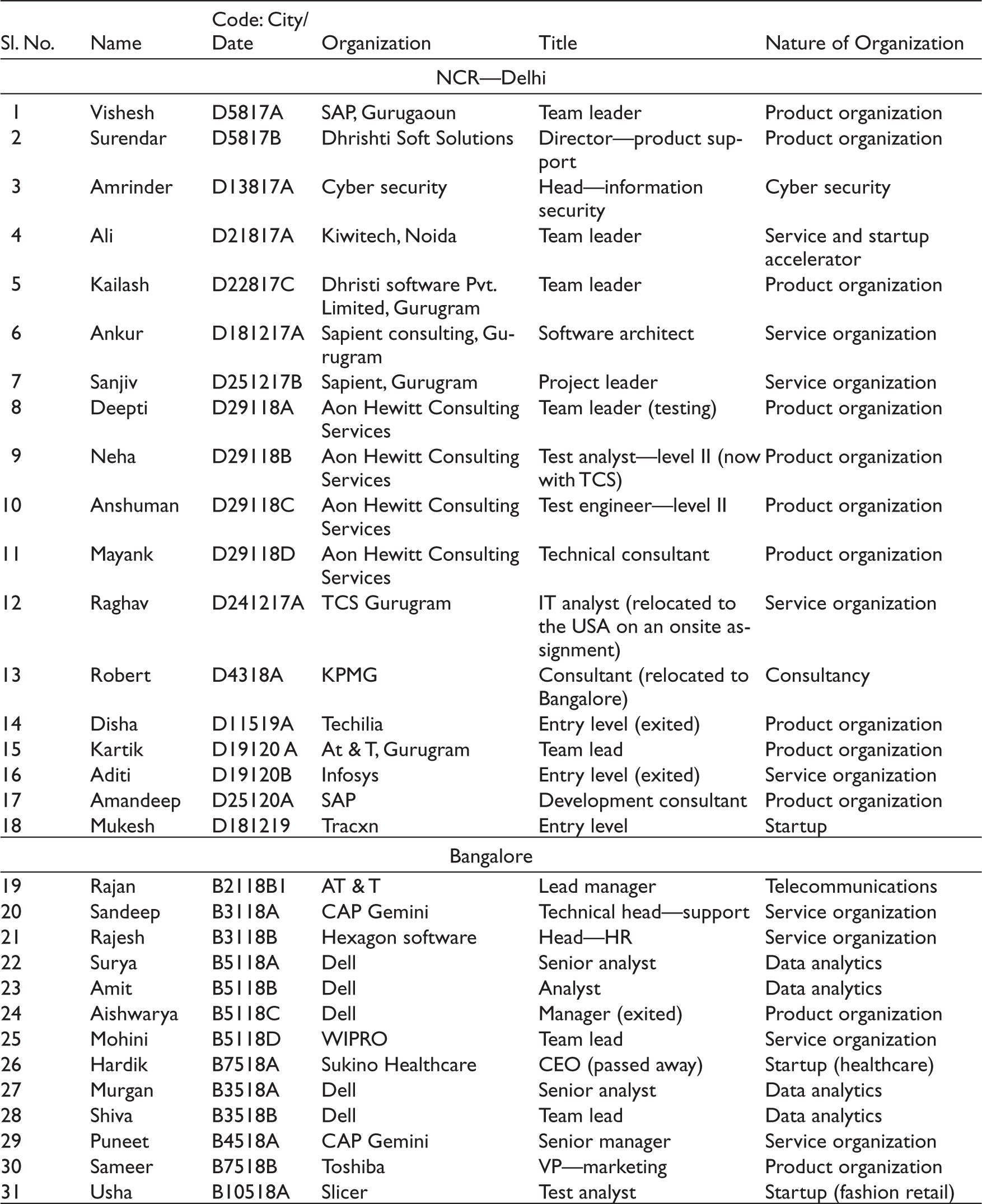
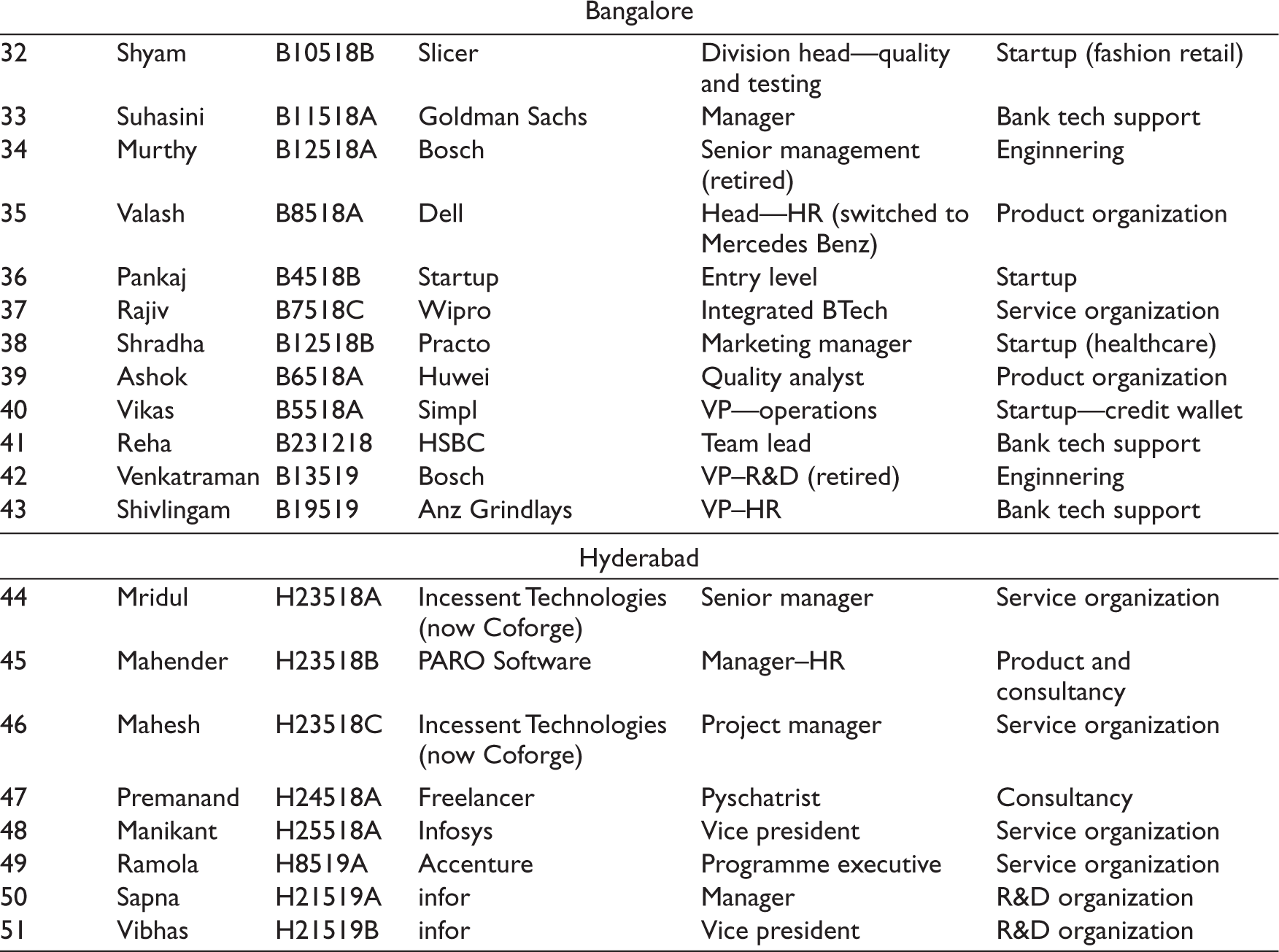
Multiple and episodic interviews were conducted with thirteen women and thirty-eight men at various stages of their careers and life. Accessibility to the field and personal network of researchers should be considered in selecting the participants’ locations. This explains for the exclusion of Pune and Chennai from our data set. In terms of the official classification of various IT domains (Indian Brand Equity Foundation [IBEF], 2019), the participants were employed in ‘Engineering, Research & Development (ER & D)’, ‘software products’ and ‘IT services’. Notable exclusions were ‘hardware’ and ‘Business Process Management (BPM)’. At the time of the interviews, seven (7) participants were working in technology-based startups, 38 in middle and large organizations, two had retired from senior positions and four had exited the IT sector (see Appendix 1 for participants’ profile).
The interviews lasted between 30 min and two hours and were recorded and transcribed verbatim. In cases where the recording was not possible either because of the respondent’s hesitation or the possibility of contamination of data, the interviews were transcribed manually, immediately after the interview. Each interview started with an informal discussion on the life history, current job profile and career goals of the respondent. Depending on the flow of discussion, the interviewees were further asked to elaborate on their expectations, aspirations, fears and experiences within and beyond their employment (see Appendix 2 for interview schedule). In line with the ethical guidelines for social science research, consent was taken from each of the respondents, and the details were anonymized.
Constructivist Grounded Theory (CGT) (Charmaz, 2006) was used to analyze the transcribed data and field notes. CGT was chosen for data analysis as it has the potential to elicit information of interest to social actors (Cullen & Brennan, 2021; Pettigrew, 2000), and it is highly compatible with the ethnographic approach (Glaser & Strauss, 1967). The initial analysis was done manually, using a line-by-line coding to grasp the data fully and to generate the first cycle of initial codes. The text was read and re-read to get a gist of each transcript, and possible codes emerging from the data were contemplated. Analytical memos and code sheets were concurrently prepared to revisit the data in subsequent stages and maintain the audit trail of the analytic process that enhances the credibility of the research. Memo writing, an informal form of taking notes, is an important process in CGT research (Birks & Mills, 2011). It allows the researcher to reflect upon and engage in critical thinking, all the while remaining connected to the participants’ stories, in a manner elicited by the participants themselves (Glaser & Holton, 2004). Respondent memos are written immediately after the interviews, and the analytical memos help researchers minimize bias (Charmaz, 2006). Both these processes require researchers to reflect on the data iteratively and thus help in developing objectivity in their analytical process (Evans & Liverpool, 2013).
The second stage of coding in CGT is building focused codes. This is achieved by clubbing the initial codes in a manner that the resulting focused codes contain the properties of all the initial codes they represent. In doing so, we identified the codes with (a) most common occurrences and deviations, (b) codes of higher analytical value and (c) codes which were closely related to the research questions posed (Charmaz, 2014). The purpose here was to have some conceptual clarity by synthesizing and analyzing large chunks of data as this would aid the development of theoretical categories later. Diagrams, visuals and mind maps are powerful analytical tools that help the researcher to ‘map the relative power, scope, and direction of the categories and to explore the connections among them’ (Charmaz, 2014, p. 218). Initial codes were accordingly merged and condensed into more refined diagrams which represented categories, their properties, directions and movements (see Figure 1).
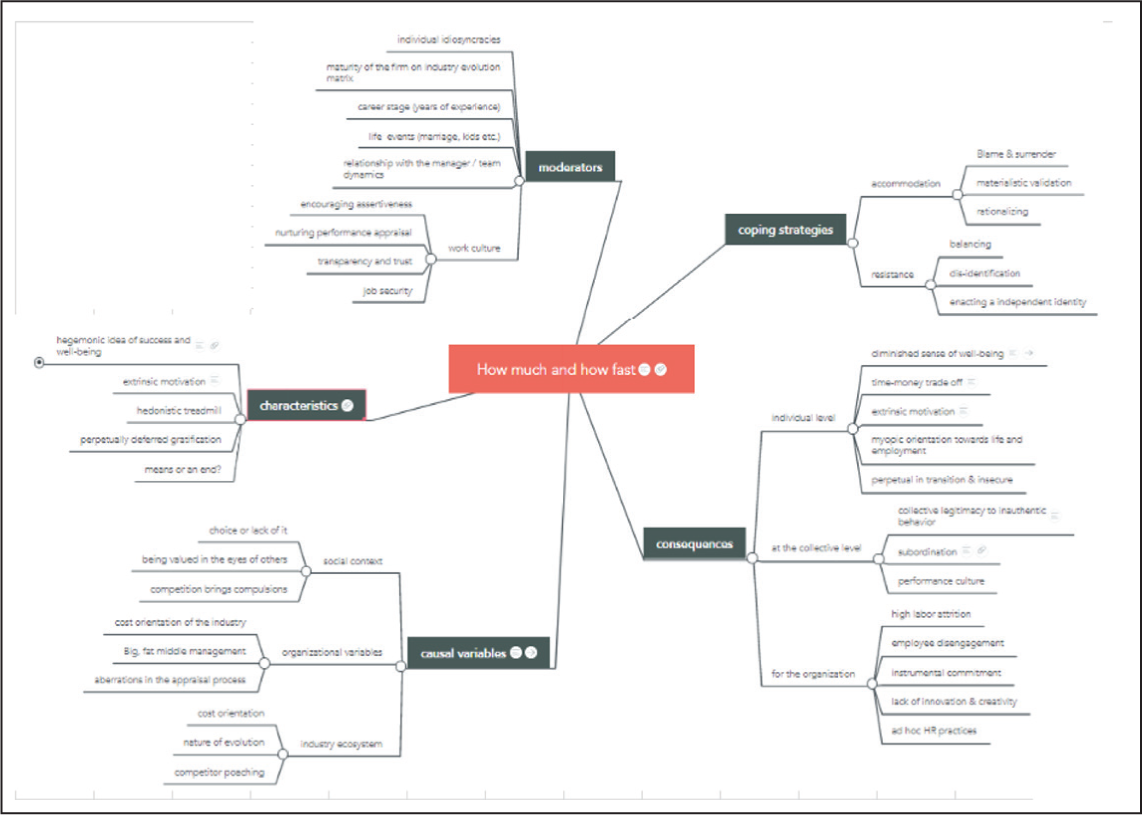
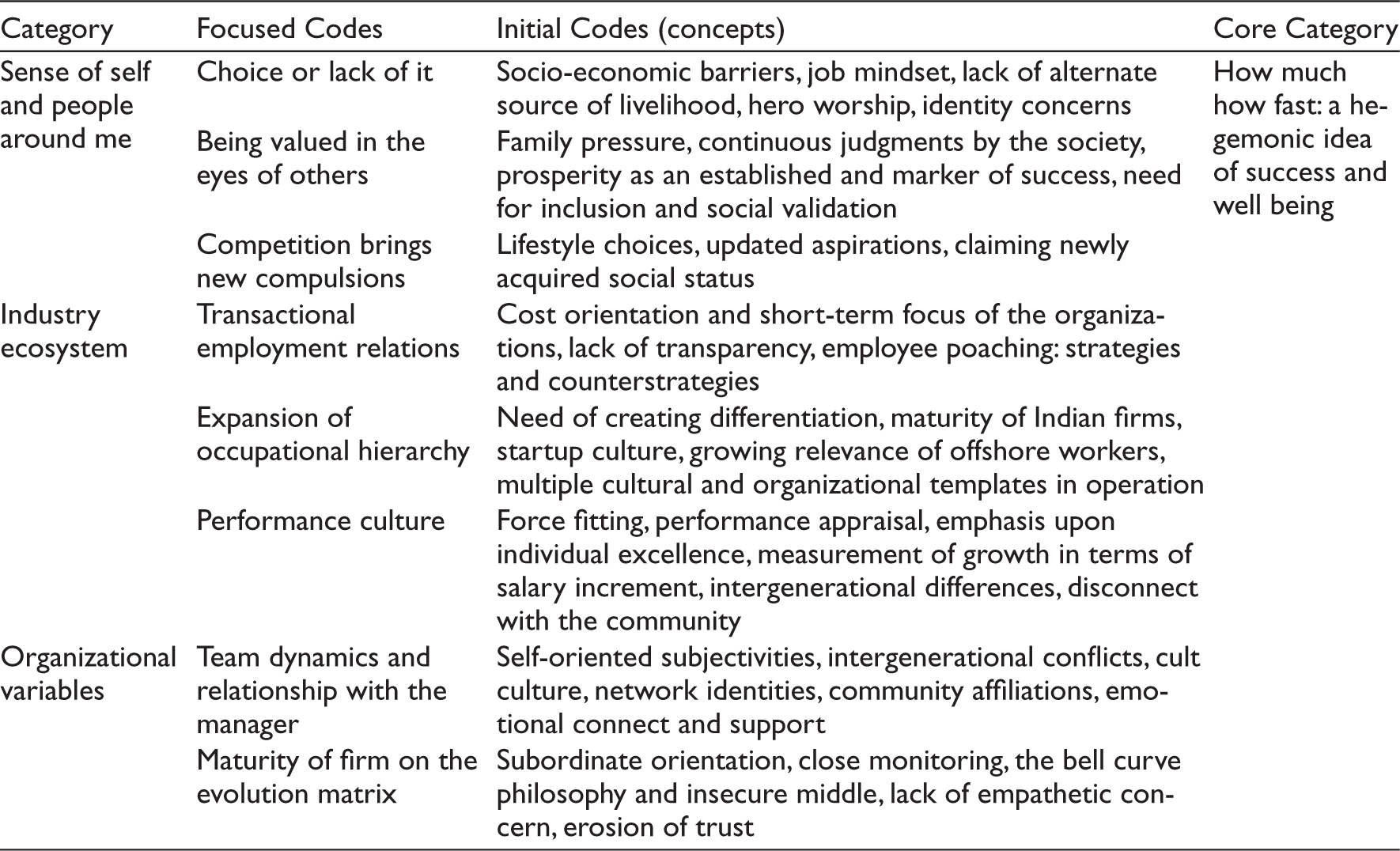
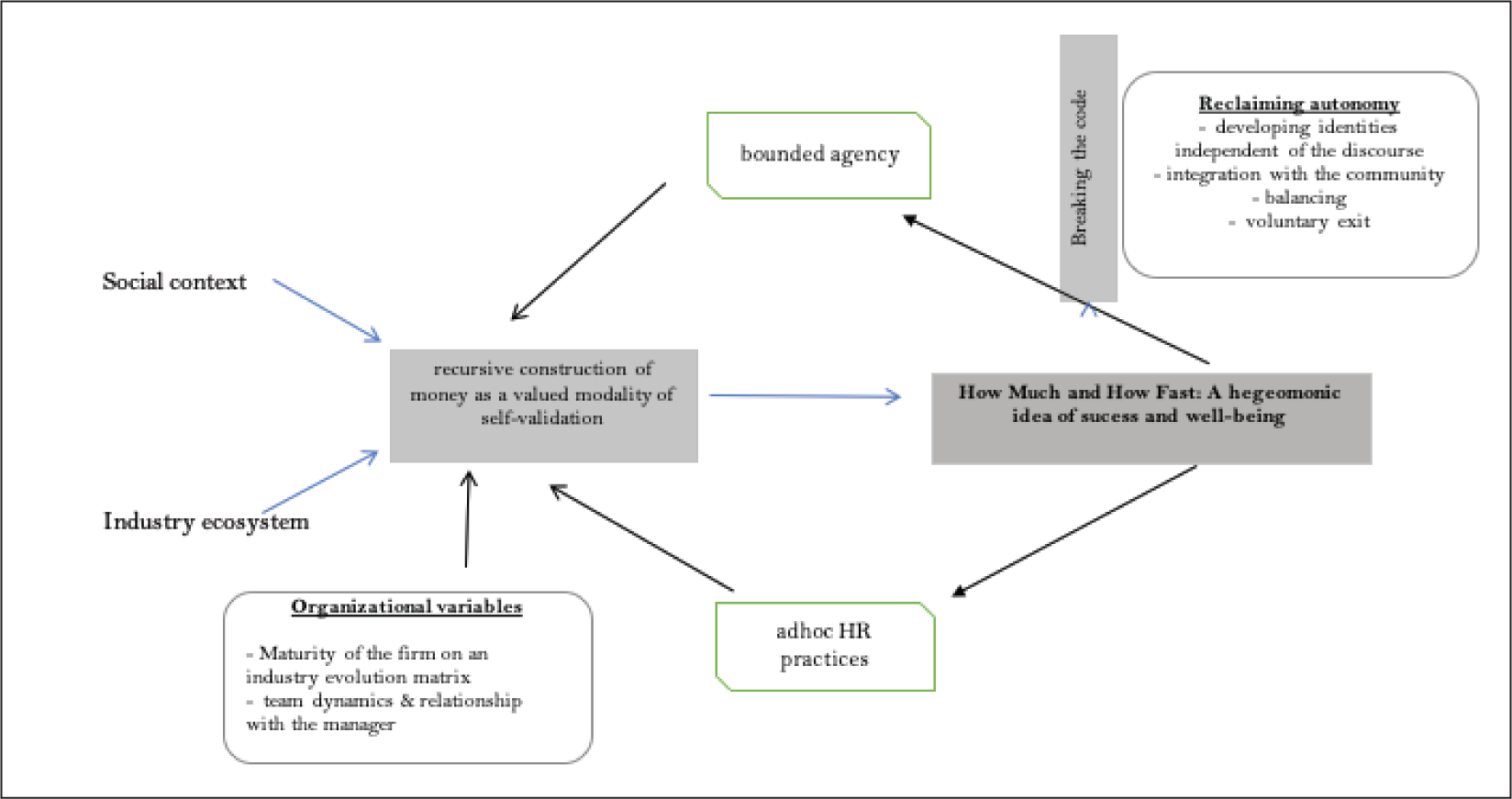
After constantly comparing the initial codes with each other and with the focused codes, we could establish relationships within them and assemble these codes into themes, according to the taxonomy given above (Table 1). Finally, at this stage ‘How Much How Fast’—both as salient materialistic aspiration as well as overbearing constraint—was introduced into the analysis as a unifying metaphor to capture the perils and paradoxes of offshore-based IT employment (Figure 2).
Perils and Paradoxes of Offshoring: Core Concepts and Categories (identified from initial codes and focused codes)
Findings and Discussion on Field Narratives
‘It’s raining perks for IT workers—from luxury bikes to gadgets to pay hike’—read a recent article in one of the most well-known newspapers in India (Ghosh, 2021). Such a portrayal of IT jobs in India, particularly after the post-pandemic surge in demand for IT services, reflect quixotic employee aspirations, as well as attrition woes of Indian IT firms. Young and ambitious career professionals are believed to enter consultancies and professional services for career prospects, self-fulfillment and prestige, and intense competition for high caliber talent have placed experience at the heart of contemporary people management practices. But, in the context of the Indian IT industry, and ironically so, ‘financial incentives have become the biggest inducements for people to evaluate job offers, and HR practices satiating the materialistic aspirations of the employees’, a common strategy of the IT firms to attract and retain talent.
As a popular discourse or an introjected aspiration—this collective internalization of financially contingent orders of self-worth referred as ‘How Much How fast’ in this study—is however not a simple phenomenon. This is also driven by the demographics of the place, the opportunities available, the social conditioning and the socio-economic background of the individuals as well as society. Drawing from the empirical data, we present a processual model on the basis of which ‘How Much How Fast’ is iteratively construed and established as a ‘hegemonic idea of success and well-being’ among the Indian IT workers (see Figure 2). The theme, ‘recursive construction of money as a valued modality of self-validation’, refers to the interactions of social, contextual, and organizational variables, through which compensation gets established as a privileged and contested commodity. The focused codes, ‘bounded rationality’ and ‘ad-hoc HR practices’, can be seen as both, antecedents and outcomes of the way the IT industry is evolving in India. As resistance and as a coping strategy, the theme, ‘breaking the code’, affirms the hegemony of the core phenomenon and captures the emancipatory struggles of the Indian IT employees.
How Much How Fast: A Hegemonic Idea of Success and Well-being
The core category, ‘How Much How Fast’, understood in terms of monetary equivalence of the job, represents the major action or phenomenon that influences the ways by which Indian IT employees were seen to organize their work and social lives. For instance, ‘becoming a lead manager in just 8 years when others reach this position in 12 years’ is the biggest accomplishment that Reha is proud of (Participant [P] 41, 23 December 2018). On the contrary, ‘transcending the charm of monetary success and getting out of the rat race’, as Mohini calls it, is how she found her fulfillment (P25, 5 January 2018). Whether a valued modality of self-validation or a perpetual struggle to counter it, ‘money and speed at which it is accumulated’ was found to be a powerful discourse, which informs as well as limits the ‘being and becoming’ 5 of an IT employee.
Why It Is a Unique Feature of the Indian IT Labor Process?
Discussions with IT employees and HR managers reveal that, with multiple job offers in hand, the capability of employees to negotiate has increased tremendously and organizations are compelled to offer ‘obnoxious pay hikes’. Despite this scenario, the drop-out ratio, understood in terms of ‘candidates rejecting an offer from the company and taking another’, has become alarmingly high. Vibhas, Vice President—HR of a research firm that builds cloud-based ERP software products, explains:
You see the mindset. ‘I have procured a job for myself which gives me a 30% hike on my current salary. I am serving my notice period so let me explore and take some more chances’. It sets a chain reaction; ‘I have two offers; one gives me a 30% hike while the other gives me 50%’. Peer influences and assessing well-being in relation to what others are getting makes them want to explore more options in the notice period and eventually, they end up having multiple offers, possibly with a 100% hike. (P51, 5 July 2021)
Moreover, given the emphasis on labor mobility, which both, the client and the provider firms need to leverage to keep the offshoring operations profitable, ‘compensation patterns remain highly unstructured’, asserts Sameer, currently the Vice President in the semiconductor division of a Japanese conglomerate:
Compensation is based on the extent of relevant experience, I require. Is his competence level excellent, average or below average? What is his current level of compensation? If I pay him lower than what he is getting, he will never join. Sometimes we adjust the salaries based on our need. If I need an engineer urgently, I will pay him an extra 5 lakhs. There are rules but they can be broken. (P30, 7 May 2018)
Regardless of the sporadic growth conditions caused by the prevailing sense of urgency among businesses to upgrade their infrastructure and move to a digital platform, monetary considerations are posited as the most important criteria to ‘choose the employer’, and ‘an anticipated pay hike’ seems to be the salient determinant of job satisfaction. Puneet, a lead manager with a French multinational in Bangalore was satisfied with his present job until he received a job offer from the competitor firm with ‘a higher designation and 50% hike on his existing salary’ (P29, 4 May 2018). Likewise, Murgan moved to a fast-paced ‘marketing service company’ as working in the same domain could hurt his growth prospects and also because he had applied for ‘a house loan’ (P27, 3 May 2018). While triggers such as a sense of security and validation which come from ‘buying a house in a city like Bangalore’ or ‘living an aspirational lifestyle which others envy’ may induce people to sacrifice what they value most, such as living near their loved ones or pursuing alternate life projects closer to their heart, ‘earning enough to be able to exit the employment’, is, ironically, what Puneet and Murgan, both aspire for.
Why It Is Hegemonic and How are the Firms/Employees Impacted?
Workers may be seen as the prime beneficiaries of this kind of employment but ‘obnoxious pay hikes beyond caliber’ (P51, 5 July 2021) are neither reasonable nor viable for the organizations in the long run. Organizations need to bill their resources to the clients and higher salaries increase the cost of operations, making offshoring operations unviable. Organizations also need to recover the additional spend incurred on higher salaries which puts tremendous pressure on the employees to deliver. Either because of the risk of the business moving to more competitive firms/different geography or the inability of the firms to get a desirable return on investment, market correction becomes an ultimate eventuality. Moreover, ‘as one keeps getting hikes that are not matching the value being added’ and ‘there is no equivalence in the market’ (P33, 11 May 2018), ‘there exists a perpetual fear of becoming redundant’ (P32, 11 May 2018). Manikant, who worked on a Government project in Baroda and is now in the senior management of a leading Indian services firm, asserts:
Somebody who is earning ten lakhs suddenly gets an incremental increase of thirty lakhs sets up his lifestyle in accordance to the increase, rents out a flat of fifty thousand, increases his expenses—but tomorrow if there is a market correction, would he be able to continue this lavish lifestyle? It will lead to frustration and maybe push them into depression. The more the money they are getting, the more vulnerable they are becoming about any change in the status quo. (P48, 22 July 2021)
Money is an important commodity in contemporary society and ‘a higher pay within the IT employment can lead to more freedom and greater well-being’, provided an individual is able to define her needs and priorities. But ‘when employees start looking around and see that their peers have received a 150% pay hike’, this sets up a vicious chain; success is measured in relative terms and ‘the ceiling remains unknown’ (P51, 5 July 2021). While maximizing available opportunities is a normal human tendency, the growing market creates a sense of false opportunity. ‘If employees are not able to normalize their thinking and expectations and there is a market correction, they are bound to be affected adversely’.
Recursive Construction of Money as a Valued Modality of Self-validation
Sense of Self and People Around Me
‘I was in a horrible situation’ (P22, 5 January 2018) says Surya, whose father could barely earn a living tilling his half acre of farmland. Good education in an English medium private school was a distant dream then. Grit and perseverance to do something worthwhile for himself and his family impelled Surya to enter the highly remunerative and prospective IT sector. The constrained autonomy of the workers may be a typical theme of classical labor studies alluding to workers of the industrial organizations. But, for the educated, reflexive and highly employable Indian IT workers like Surya, who happen to be the subjects of this article, the realities governing their choices appear to have remained the same even in the new economy.
Respondent accounts demonstrate that the ‘empowered autonomous agents’ of the Indian IT workplaces remain bounded by ‘socio-economic factors’, ‘contextual sensitivity’, ‘considerations of the family’ and the ‘fatalistic orientation’ of the Indian society. For instance, economic hardships limit one’s access to vital resources such as education which, operating as a barrier, forecloses limitless possibilities one could aspire for. But, challenging circumstances and deprived experiences of the past also shape one’s aspirations, molding an individual’s expectations from the self and his employment. Surya, now a senior analyst with a well-known multinational firm, aspires to live a ‘better lifestyle’. However, his idea of a good life—a widescreen television, a car and a bigger apartment (P22, 5 January 2018)—is both, relative and self-limiting.
One side of compensation is about continuity of life, and the other is that it empowers you with an identity. India has a huge population, and a large cohort of the IT workforce comes from provincial towns and rural areas. While also the ‘Indian IT dream’ has certainly trickled down to the masses, IT firms, especially those in the service sector, have become more accessible to the less demanding and low-cost talent pool, with lesser leverage in terms of experience and exposure to move across organizations. In the absence of the established social markers of merit and excellence—outstanding academic performances, affiliations to prestigious institutes and a good command over the English language—many of these aspirants see the identity of an ‘IT corporate professional, both, achievable as well as desirable’ (P46, 23 May 2018).
Identity, understood here in terms of how individuals articulate themselves in their internal dialogues and social interactions, is however a work in progress. The struggle to sustain and forge a self-identity is also shaped by multiple images and ways of being (Alvesson & Willmott, 2002). One may be a hero expected to take his family out of poverty, a valued member of the community, an obedient son, (P19, 2 January 2018) a responsible head of the family, a star performer, a reliable team member, an empathetic colleague (P28, 3 May 2018) and so on. Navigating between multiple roles and multiple identities can be seamless when individual aspirations and embedded organizational values resonate with that of society. However, in the cases described here, the traditional pull from one’s family and community and often new ways of sociality and subjectivity borrowed from the organizations are often contradictory. One such manifestation of the tightrope walk between the traditional stereotypes and autonomy, understood in terms of the material aspects of IT employment, can be seen from conflicting socially mandated aspirations of female IT employees to concurrently match her mother as a homemaker and an individualist corporate professional construction of her male counterparts.
One person is trying to be two. See I am a working woman, and I clearly knew how the working mother can climb the corporate ladder. But I have colleagues, who see their mothers as role model and aspire to become like them. They also want to grow professionally. They are trying to be both. This is where all the confusion is. They find it difficult to choose when they should be at home and when they should be putting the same kind of effort men do… I am also equal, so I should sit because he is sitting there. (P33, 11 May 2018)
Respondent’s accounts demonstrate that Indian IT employees aspire to have a semblance of autonomy and often act as western, atomized, individualistic selves. But, they also iteratively play up to Indian normative values. They lack decisiveness and emphasize more on enacting socially desired identities. For instance, crossing a one-million mark is often the first milestone new entrants aspire to achieve. Then, they want to go for international assignments, have their necessities covered and save for future contingencies. ‘It is only after they have checked all the boxes that they would start thinking about what they actually want to do in life’, says Hardik, a marketing consultant and serial entrepreneur in the tech domain (P26, 7 May 2018). Multiple and competing priorities lead to emotional ambivalence and a sense of rootlessness in terms of what ought to be valued in life and at work. As an escape from the resulting ambivalence and to seek inclusion in society, most of the employees find fulfillment in pursuing and achieving socially worthy goals and follow the direction where ‘the wind is blowing’ (P46, 23 May 2018).
Industry Ecosystem
As the low value and peripheral tasks used to be, and, to a large extent, still are the mainstay of IT business in India, ‘cost saving strategies’ (P32, 11 May 2018) gained prominence in shaping the culture of the industry. ‘Focus on research was never a priority in the Indian business culture and IT firms are no exception’, says Hardik:
Across the world, the best innovation happens when five great engineers of equal capability build something. In India, we have one great engineer, 20 half decent engineers, and 80 pathetic engineers trying to build a product. (P26, 7 May 2018)
Most of the IT work undertaken in India consists of activities such as ‘support’, ‘maintenance’, ‘windows update’ and the development of low-cost software projects. As leveraging on a ‘cost arbitrage’ is the main trigger for outsourcing, vendor firms need to devise new ways to remain cost competitive. While system and process-oriented activities do not require any intellectual input from the worker and thus are amenable to be undertaken by low-cost labor with basic skills, cost advantage in software projects is achieved by hiring a fewer number of engineers than the actual requirement of the project (P33, 11 May 2018). Even though multinational firms are increasingly relocating their high-value functions to India because of a lower cost of technical skills and availability of ‘intelligent’ resources, highly technical projects are mostly performed through captive arrangements’ (P29, 8 December 2020).
To meet project deadlines with fewer number of people then actually required, working for longer hours becomes inevitable. Due to the potential threat of a lay off or with an eye on the next big pay hike, Indian IT are impelled to comply. The time also gets extended infinitely, more so in support jobs, where the issues faced by the client have to be solved in real-time. ‘As it is next to impossible to predetermine all the issues that can crop up, the workers in these jobs are required to be available round the clock’, says Surendar, director of a mid-sized product company (P2, 5 August 2017). Likewise, Sandeep, who oversees the support function of a services firm in Bangalore, claims:
My work starts at 3 p.m. I have to be in front of the system; I am able to get hardly 5-6 hours of sleep. If a call comes, you have to take it. I can’t tell you how stressing it is. (P20, 3 January 2018)
Another challenge emerging from the mistakes of the past concerns the ‘big, fat middle management’ across organizations. Recent news headlines suggest that despite sustained growth, IT companies in India are laying off their middle and top-level employees in huge numbers. But, forced attrition of experienced workforce at such massive scale is neither warranted nor an outcome of market changes alone. Appeasement policy of the organizations to keep the numbers intact and mindless implementation of the bell curve philosophy to assess and reward employees have created a large pool of middle managers, who draw hefty salaries but are able to contribute little to the organizations.
‘People who started IT growth in India were given stocks by the Indian IT companies as part of the compensation plan, so they continued to work in the same firm for a long period’, explains Venkatraman (P42, 13 May 2019), a veteran in the Indian IT industry. When these companies grew, the fortune of the employees grew, too. The people of that generation made a lot of money and started investing elsewhere. They were the people who had vast experience in terms of technical skills and people management. When they quit their jobs, their companies lost out on experience; so, they started promoting newcomers.
The mindless retention strategy of IT firms, which aligned perfectly with its exponential growth in the last two decades, has started to backfire. Even though Indian companies are expanding, the pie is not expanding (P42, 13 May 2019). Intergenerational differences and varying individual priorities at different stages of life make it even more difficult for the already insecure managers to match the skills of the digital natives, so says Hardik, an ex-consultant of a global management and strategy firm.
The generation who were working from 1998 – 2007 is different from the current workforce, who have started their careers from 2012 onwards: Golden oldies, Gen X, Gen Y and now, the millennials, are invariably working on the same skill level and at the same project. (P26, 7 May 2018)
IT organizations have thus become a hub of power struggles as a result of varying aspirations and idiosyncratic ideas of growth of different generations. Contradictions between the espoused managerial ethos and their implementation on the ground provide opportunities to the managers to wield their power and secure their interest. For instance, ‘originally designed to appear transparent and unequivocal, performance assessment is mostly skewed, obscure and contaminated with one’s class and community linkages’ (P1, 5 August 2017). To make matter worse, the goals are ‘very fancy-sounding which do not even translate into everyday work’ (P29, 4 May 2018) and are deliberately kept open, reveals Puneet. As the assessment is critical to lay a claim on organizational rewards and achieving performance targets may not necessarily translate into a favourable appraisal, working extra hours to keep the manager happy has become an internalized work value. Growth within the organization, measured in terms of meeting the Key Performance Indicators (KPI), also distort the worker’s idea of success and well-being’ (P26, 7 May 2018). Hardik, a veteran from the industry and also a serial entrepreneur, explains:
Who says he won’t grow… again you are making a mistake… Growth within the organization is not linked to growth of the individual in the mental and moral capacity. There exists a system and process-oriented grid. There are ten matrices through which you track performance; they are called KRA’s … as long as I hit my KRA… I am guaranteed a minimum of 8 to 15% hike depending upon where I fall at the Bell curve… I do that for 5 years, I will have growth.
Situational conflicts such as the mass exodus of experienced people and systemic issues like the manipulation of the performance appraisal process have adversely impacted local business practices as well as employee orientation towards oneself, and others. ‘One way to reduce ambiguity is to change jobs frequently; at least the initial six months are challenging’, says Reha, a team lead working in the bank support function of a leading British multinational bank in Bangalore (P41, 23 December 2018). When the capability of the employees to move across organizations is reduced because of family responsibilities and aging parents, ‘chasing growth in a visible and tangible format, seems to be a much cogent pathway’, reflects Manikant (P48, 22 July 2021).
Organizational Variables
Making a generalized statement that all IT companies in India are cost-oriented, cultivate subordination and legitimize inauthentic behavior would perhaps be incorrect. The leadership, maturity of the firm on the evolution matrix, performance appraisal system, and most importantly, the middle managers, enable or constrain employee autonomy and hence impact their work experiences in contrasting ways. Product companies and large multinational firms are considered to be more humane and empathetic than service firms. Americans or European leaders are often seen as enablers. On the contrary, Indian managers are preoccupied with ‘micromanaging their employees’, says Mohini:
It is definitely easier to work with an American team rather than Indian managers because the latter are not enablers … they act more like a Shepherd controlling his herd. (P25, 5 January 2018)
Mature organizations look at performance appraisal from the perspective of helping people understand what their goals are, how they expect to fulfill them and how the performance ought to be assessed. To reduce ambiguity in assessment, the whole plan must be provided upfront, given to people in a way they understand, and with an inbuilt mechanism that provides an opportunity to the workers to come back and clarify. However, time is always precious; and most managers choose not to invest it in something which eventually has to be force-fitted, one way or another.
Nonetheless, quantification of the human effort is neither viable nor warranted; as there will always be a possibility of error and manipulation, and managers can wield their power over subordinates, by exploiting the gaps. Given the alienation and trust issues which purely quantitative appraisal can cause, some organizations are moving away from the bell curve kind of philosophy and including a subjective component into the appraisal process, which can potentially provide more freedom to the employee, explains Valash (P35, 8 May 2018), an ex-president (HR) of a globally renowned multinational IT firm. Delinking rewards from the appraisal process is another strategy which has been effective in reducing the potential dissonances such arbitrary reward distribution can instigate. In such a scenario, employees feel empowered and work on their improvement plans without fearing financial consequences and coercion, claims Rajan, a lead manager with one such organization:
The reason employees hate their manager the most is because … my manager rated me 2 … in India everyone makes comparisons on the basis of financial numbers … and when I don’t get a hike because I was rated 2, it is natural that I will feel dejected. Instead, if you give suggestions on how to improve and it is not related to an appraisal or a hike, the employees feel empowered and take the feedback positively. (P18, 19 January 2020)
Some organizations indeed espouse and promote values of open culture, but managers adopt their own strategies to feel secure and eliminate any possibility of escalation. As the task or an assignment is distributed across teams, which often work in silos, the manager holds the authority and the responsibility for escalations as well as accomplishments of their teams. Most organizations use rating scales on a half yearly or annual basis to evaluate their employees. Before the commencement of the assessment period, an employee is given a performance plan which may or may not have been prepared in consultation with them. Interestingly, the projections may not have any relevance for the employee in the long run but because the organization requires specific capabilities and the manager thinks so, the employee is required to work on her/his self-improvement (P29, 8 December 2020).
However, most of the respondents of this study claimed that it is their relationship with the immediate senior that makes them like or dislike their jobs. Neha, a test analyst with an American human capital and management consultancy firm, claims that she is working at her present organization only because of the team leader:
Your life in the organization depends completely on the team leader. If he is not good to you, even good relations with other seniors would not be of much help. (P9, 11 February 2018)
Some organizations have the capacity and capability to experiment and move beyond the philosophy of the bell curve for evaluating performance of their employees and rewarding them proportionately. Workers respond favorably because they see sustained growth and security in these organizations. In contrast, most of the other IT organizations believe that workers chase ‘pay bands’ and organizational loyalty is a passé (P30, 7 May 2018). Regardless of the type of assessment, performance appraisal and reward distribution process in Indian IT firms remains discriminatory, where power is exercised to favor a few and oppress the majority.
Breaking the Code
Offshoring employment, and in particular IT jobs in India, offers a good income and facilities for the employees. However, people management practices, expansive benefits to the workers and ‘year on year financial increments’ align the employees towards a particular socio-cultural consciousness. An American working from home would be bothered only about the output. But for an Indian employee, going to a five-star hotel for a dinner matters more than the output itself (P38, 12 May 2018). All these things are quite big and overwhelming. Managers thus target things that may make employees happy for the moment; but in the larger context of their well-being, there are no synergistic interventions that try to give them space, coherence, nurture their careers or allow their personal space to grow, morally and intellectually.
Chasing salaries and moving across organizations is thus not an outcome of the insatiate greed of the globally exposed cosmopolitan identities, as often claimed. These tendencies have been co-produced and distributed because of compulsions of retaining a business, keeping it attractive and simultaneously creating insecurity. HR strategies are well-intended but there is always a mismatch and inconsistencies in delivery. Middle managers who rise from below may be technically sound but lack specific skills required to manage people. They are prejudiced by their view of the world and their biases. Sporadic moments of happiness are thus created, and employees also feel privileged and empowered. But in a larger context, they remain devoid of validating self-definitions or coherent life script. The acquisition of money and the parallel process of freedom and constraint thus become important modalities to motivate employees and also keep them in a state of fear. For instance, employed in the IT sector for 15 years, and now a director with a midsized Indian IT firm, job still remains an existential necessity for Surender:
In today’s world, money is everything. I have an EMI to pay, and education is very expensive in Gurgaon… You need a minimum amount to maintain your lifestyle. My greatest fear is that if an unfortunate thing happens to me, like an accident or something, how would I manage? This thought persists and keeps me going. (P2, interview 1, 5 August 2017)
Likewise, Reha does not want to become the next Einstein in the IT industry. She just wants a good, comfortable lifestyle which she is scared of losing (P41, 23 December 2018). She cannot even imagine working in a small company with less visibility for fear of what others would think or what her Instagram image would look like. Murgan, a senior analyst in a well-known data analytics firm in Bangalore, echoes similar sentiments and helplessness:
I don’t want this life. My dream was different but somehow, I have to do this job because it makes my education worth the while… I feel more comfortable in Vizag and I want go back … but my friends question me about what I would accomplish going back. We have come to do this job so we will do that. (P27, 3 May 2018)
Likewise, IT companies in India operate in their own way and have grown in a system which grants them a lot of freedom. But they also operate within several constraints and these constraints are self-governing and self-regulating. Given this framework of bounded rationality governing IT firms and their employees, individuals are compelled to navigate their identities within a pre-set of variables, where they can be sure of the outcome.
However, employees as whole individuals are also capable of discerning what is good for them. They are constantly evaluating the different aspects of work and life, identifying with some and rejecting the others. Even if workers choose not to display resistance explicitly, they may be engaged incrementally in developing alternate identities, as seen at the field locations. When Suhasini refers to IT employees as ‘sheep’, and IT firms as ‘floor grinding mills’, she attempts to break the hegemony of the powerful discourses that are constraining her autonomy (P33, 11 May 2018). Similarly, when Puneet turns down an offer with a 50% hike because he wants to live with his family and be closer to the community (P29, 8 December 2020), he is consciously making an agential choice.
It however appears that the quest for peace and a sense of integrated wholeness that Indian IT workers feel can be possible with financial independence are actually and ironically, elusive. We came across rare instances when employees were able to break free from the vicious cycle they call entrapment—finding passion beyond employment (P36, 4 May 2018), exhibiting unique identities independent of the organization (P43, 19 May 2019), compartmentalizing between home and work (P33, 11 May 2018) and even exiting the employment altogether (P49, 8 May 2019)—by reflecting, critically thinking and questioning established norms, seductions and identity projects which may otherwise be considered natural. Most others get their motivation by either developing a myopic and short-term orientation towards work and life or by following significant others by iteratively tying themselves to some of the competing and often contradictory discourses within and beyond the employment. Breaking the code entails critical reflection and serious action. Nonetheless, reflection is a privilege which we sometimes are born with and sometimes need to earn, says Amandeep (P17, 25 December 2020), encapsulating the perils and paradoxes of the Indian IT industry.
Conclusion
This article seeks to explore the perils and paradoxes of offshoring through the examination of work experiences and meaning-making repertoires of the Indian IT employees. Building upon existing research which challenges the idea that ‘globalist projects and dreams remake the world just as they want’ (Tsing, 2000, p. 330), this research points to the heterogeneous experiences of work and supports Butler’s ‘material-discursive approach’ (Butler, 1995, p. 134), whereby material conditions are mediated by the context, and continuously reenacted by the subjects. Institutionalization of materialistic values and excessive work regimes, both as a recursive construction of the offshore players and as a phenomenon shaped by contextual influences, is demonstrated.
While there is space for agency, with employees having the capacity to reflect and enact identities beyond the available subject positions, it remains limited because of the multiple, and often contradictory realities Indian IT workers are embedded within. Chasing pay hikes, unrelenting learning, navigating career options to optimize subjectively defined ideas of growth, sustaining a lifestyle befitting the demeanor of a knowledge worker, as seen through the eyes of significant others, are merely some of the workers’ responses to the resulting indeterminacy and ambivalence. But privileged or subordinated subject positions are not the outcome of the demographics of the place or social conditioning of the employee alone. The Indian IT industry has evolved from a call center labor process, and Indian managers are oriented to leverage a particular employee output in an efficient and time-bound manner. Moreover, globally best work practices and HR interventions intended to empower and engage employees get distorted during their implementation in the local context. Whether under the system surveillance or panoptical gaze of the managers and trying to reconcile meaning within multiple yet often contradictory priorities, Indian IT employees tend to cope by contesting compensation as a relatively controllable and easily accessible object of value.
This research is empirically novel because it explores the perils and paradoxes of offshore workers through their own experiences, surfacing power relations to draw upon the wider tradition of ethnographic research. Its theoretical novelty is in positing offshoring and its consequences, not as a reality pervading the actors, but as an ongoing flow of material-discursive practices. Extant discourses on offshoring often link individualization of employment relations with job insecurity and attribute it to a higher labor attrition at offshoring locations (Howcroft & Richardson, 2012; Taylor & Bain, 2003; Upadhya, 2016). But our analysis demonstrates that insecure disposition, frequently changing jobs, and chasing financial incentives are a recursive construction, and privileged subject positions, institutionalized by the IT firms and voluntarily internalized by the Indian IT workers. Nonetheless, higher pay also means greater dependency on the job, increased leverage in the hands of the organization, and hence more pressure on the employees to deliver.
From a critical perspective, one may argue that knowledge organizations tend to exploit the hopes and fears of the employees to insidiously seduce and pressurize them to put in more efforts and longer working hours (Alvesson & Spicer, 2012; Alvesson & Willmott, 2002; Karreman & Alvesson, 2004). However, cultivating subordination, force fitting the employees on a bell curve, promising impossible deadlines to clients, allocating bare minimum resources to projects and hiding critical information—common strategies of IT firms in India to attain growth can no way be said to be covert and insidious. What is more problematic is that people in these organizations co-opt in legitimizing discrimination, inauthentic behavior, and subordination; values they describe as most alienating. Besides, the institutionalization of long working hours as a proxy to performance leaves little scope for employees to reflect, spend time with the family, integrate with society, or engage in more meaningful pursuits beyond the job. Moreover, we maintain that employment should ideally enhance the well-being and free choice of the employees instead of clouding their judgment through coercion and seduction.
Our work has its set of limitations. First, ideally, we could have spent more time with the participants in office settings to understand how power/knowledge distinctly impacts and is negotiated between people from different generations, gender and hierarchical positions. We could not do so because of the limited access provided by the organizations, and the skeptical gaze of co-workers which often made our respondents uncomfortable. Second, interactions with the client firms, policymakers and family members of the respondents could have provided us a wider perspective of why specific ways of being, experiences, and goals become desirable, and whether respondent narratives resonate with the people around them. Third, despite the best intentions, we could not fully capture the work dynamics and workers’ experiences in organizations with a visible social impact. Our analysis reveals that lack of purpose and understanding in terms of the outcome of the task being performed is one of the main reasons for people getting frustrated and looking for a job change. Future studies can investigate whether complex, and creative work content or prosocial work outcomes have any bearing on workers’ experiences and their intentions to remain with the organization. With continuous progression in offshoring operations, it would be interesting to see how the dynamics of offshoring change when complex and highly valued functions such as research and development hopefully dominate the Indian IT landscape.
Footnotes
Declaration of Conflicting Interests
The authors declared no potential conflicts of interest with respect to the research, authorship and/or publication of this article.
Funding
The authors received no financial support for the research, authorship and/or publication of this article.
Appendix 1. Participant’s Profile
| Sl. No. | Name | Code: City/Date | Organization | Title | Nature of Organization |
| NCR—Delhi | |||||
| 1 | Vishesh | D5817A | SAP, Gurugaoun | Team leader | Product organization |
| 2 | Surendar | D5817B | Dhrishti Soft Solutions | Director—product support | Product organization |
| 3 | Amrinder | D13817A | Cyber security | Head—information security | Cyber security |
| 4 | Ali | D21817A | Kiwitech, Noida | Team leader | Service and startup accelerator |
| 5 | Kailash | D22817C | Dhristi software Pvt. Limited, Gurugram | Team leader | Product organization |
| 6 | Ankur | D181217A | Sapient consulting, Gurugram | Software architect | Service organization |
| 7 | Sanjiv | D251217B | Sapient, Gurugram | Project leader | Service organization |
| 8 | Deepti | D29118A | Aon Hewitt Consulting Services | Team leader (testing) | Product organization |
| 9 | Neha | D29118B | Aon Hewitt Consulting Services | Test analyst—level II (now with TCS) | Product organization |
| 10 | Anshuman | D29118C | Aon Hewitt Consulting Services | Test engineer—level II | Product organization |
| 11 | Mayank | D29118D | Aon Hewitt Consulting Services | Technical consultant | Product organization |
| 12 | Raghav | D241217A | TCS Gurugram | IT analyst (relocated to the USA on an onsite assignment) | Service organization |
| 13 | Robert | D4318A | KPMG | Consultant (relocated to Bangalore) | Consultancy |
| 14 | Disha | D11519A | Techilia | Entry level (exited) | Product organization |
| 15 | Kartik | D19120 A | At & T, Gurugram | Team lead | Product organization |
| 16 | Aditi | D19120B | Infosys | Entry level (exited) | Service organization |
| 17 | Amandeep | D25120A | SAP | Development consultant | Product organization |
| 18 | Mukesh | D181219 | Tracxn | Entry level | Startup |
| Bangalore | |||||
| 19 | Rajan | B2118B1 | AT & T | Lead manager | Telecommunications |
| 20 | Sandeep | B3118A | CAP Gemini | Technical head—support | Service organization |
| 21 | Rajesh | B3118B | Hexagon software | Head—HR | Service organization |
| 22 | Surya | B5118A | Dell | Senior analyst | Data analytics |
| 23 | Amit | B5118B | Dell | Analyst | Data analytics |
| 24 | Aishwarya | B5118C | Dell | Manager (exited) | Product organization |
| 25 | Mohini | B5118D | WIPRO | Team lead | Service organization |
| 26 | Hardik | B7518A | Sukino Healthcare | CEO (passed away) | Startup (healthcare) |
| 27 | Murgan | B3518A | Dell | Senior analyst | Data analytics |
| 28 | Shiva | B3518B | Dell | Team lead | Data analytics |
| 29 | Puneet | B4518A | CAP Gemini | Senior manager | Service organization |
| 30 | Sameer | B7518B | Toshiba | VP—marketing | Product organization |
| 31 | Usha | B10518A | Slicer | Test analyst | Startup (fashion retail) |
| Bangalore | |||||
| 32 | Shyam | B10518B | Slicer | Division head—quality and testing | Startup (fashion retail) |
| 33 | Suhasini | B11518A | Goldman Sachs | Manager | Bank tech support |
| 34 | Murthy | B12518A | Bosch | Senior management (retired) | Enginnering |
| 35 | Valash | B8518A | Dell | Head—HR (switched to Mercedes Benz) | Product organization |
| 36 | Pankaj | B4518B | Startup | Entry level | Startup |
| 37 | Rajiv | B7518C | Wipro | Integrated BTech | Service organization |
| 38 | Shradha | B12518B | Practo | Marketing manager | Startup (healthcare) |
| 39 | Ashok | B6518A | Huwei | Quality analyst | Product organization |
| 40 | Vikas | B5518A | Simpl | VP—operations | Startup—credit wallet |
| 41 | Reha | B231218 | HSBC | Team lead | Bank tech support |
| 42 | Venkatraman | B13519 | Bosch | VP–R&D (retired) | Enginnering |
| 43 | Shivlingam | B19519 | Anz Grindlays | VP–HR | Bank tech support |
| Hyderabad | |||||
| 44 | Mridul | H23518A | Incessent Technologies (now Coforge) | Senior manager | Service organization |
| 45 | Mahender | H23518B | PARO Software | Manager–HR | Product and consultancy |
| 46 | Mahesh | H23518C | Incessent Technologies (now Coforge) | Project manager | Service organization |
| 47 | Premanand | H24518A | Freelancer | Pyschatrist | Consultancy |
| 48 | Manikant | H25518A | Infosys | Vice president | Service organization |
| 49 | Ramola | H8519A | Accenture | Programme executive | Service organization |
| 50 | Sapna | H21519A | infor | Manager | R&D organization |
| 51 | Vibhas | H21519B | infor | Vice president | R&D organization |