



Abstract
This study examines the mediating role of employee engagement on the relationship among job involvement and job satisfaction as independent variables and organizational commitment as the dependent variable in private life insurance companies in Coimbatore, Tamil Nadu, India. Primarily, employee engagement plays a vital role in organizational performance. Therefore, this study was conducted to demonstrate how employee engagement mediates the relationship among job involvement and job satisfaction as independent variables and organizational commitment as the dependent variable. For this study, data was collected through a structured questionnaire, and 225 samples were taken. A simple random sampling method was used to collect the data, and the partial least square (PLS) method was used to analyze the data. In the study, job involvement and job satisfaction were considered to be antecedents, employee engagement was considered a mediating variable and organizational commitment was considered an outcome. It is suggested that job involvement and job satisfaction are significantly related to employee engagement. The study also revealed that job involvement and job satisfaction positively influence organizational commitment. Employee engagement was found to partially mediate the relationship between job involvement and organizational commitment, while it did not mediate the relationship between job satisfaction and organizational commitment. Hence, this study proves that employee engagement plays a significant role in the organization. Therefore, organizations should concentrate on employee engagement strategies on the basis of which employees’ job involvement, job satisfaction and organizational commitment will increase.
Keywords
Introduction
Employee engagement is a positive psychological condition that supports individuals focusing on their careers (Kahn, 1990).1 It enhances employee performance and job satisfaction, and leads the organization to achieve its goals (Ibrahim & Al Falasi, 2014). It supports work-life balance, high performance, teamwork and leadership (Iddagoda & Opatha, 2020). It increases the employees’ morale, commitment and motivation toward the organization (Chanana, 2021). Based on the study, it is found that there is a significant relationship between employee engagement and job performance (Ismail et al., 2019). Employee engagement has been getting significant importance over the last 10 years at the workplace. Companies are exercising the concept of employee engagement as a strategic tool because it supports the employees as well as the organization (Bedarkar & Pandita, 2014). According to the Gallup research, only 13% of employees are engaged by their organization. At the workplace, employee engagement is closely related to job attitude. Job attitude consists of three important variables: job satisfaction, organizational commitment and job involvement (Newman & Harrison, 2008). Employee engagement supports all age groups in the workplace and also increases the mutual understanding between employees and employers (Motyka, 2018).
A study found that there is a good relationship between employee engagement and job satisfaction (Extremera et al., 2018). Employee engagement supports job satisfaction, job involvement and organizational commitment (Christian et al., 2011). Previous studies found that there is a good relationship between employee engagement and job attitudes at the individual level as well as the organizational level (Alarcon et al., 2010). Based on the study, it is found that there is a significant relationship between employee engagement and job performance (Bulińska-Stangrecka & Iddagoda, 2020). The productivity and efficiency of the organization increase when employees experience job satisfaction on account of their involvement in their job (Nwibere, 2014). Employees who have high job involvement and self confidence have a high job satisfaction at the workplace (Chen & Chiu, 2009). Job satisfaction increases productivity, quality, responsiveness and recognition. Based on the study, it is found that job satisfaction influences organizational commitment and organizational citizenship behaviour (OCB) (Purwanto et al., 2021).
Nowadays, organizational commitment of employees has taken centre stage in the business environment. Organizational commitment gives a lot of benefits to employees as well as the organization. The benefits include increased OCB, less absenteeism, extra efforts and performance, and reduced turnover (Chen et al., 2012). According to the study, in today’s business environment, job involvement and organizational commitment are considered important factors. Besides, many studies opine that job satisfaction influences organizational commitment (Bahjat Abdallah et al., 2017). Based on the study, it is identified that organizational commitment has a positive and significant effect on an employee’s performance (Ridwan et al., 2020). Another study has also identified that transformational leadership has a positive impact on organizational commitment and job satisfaction (Eliyana & Ma’arif, 2019). A study has also recommended that the banking and insurance sectors need to find out their employee’s job involvement, job satisfaction and organizational commitment to succeed in the business environment. At the workplace, ff the aforementioned variables are not focused on, it leads to absenteeism, poor work effort, lower organizational loyalty and higher employee turnover. Based on the study, it is found that employee engagement is the right construct to measure job involvement, job satisfaction and organizational commitment (Newman & Harrison, 2008). Another study found that there is a strong relationship between employee engagement and job attitudes (Newman et al., 2010).
Although, it has been two decades since the concept of employee engagement emerged, the consensus and research on it are not up to the mark (Shuck & Wollard, 2010). Therefore, the present study focuses on the relationship between job satisfaction, job involvement and organizational commitment with the support of employee engagement. Many studies have indicated that employee engagement leads to discretionary behaviour. However, a few studies had earlier linked employee engagement with organizational outcomes (Koonmee et al., 2010). Therefore, this study focuses on how employee engagement plays the mediating role of discretionary behaviours of individual employees and the expected outcome of the organization. Eventually, this research addresses the effect of job involvement and job satisfaction on organizational commitment with the help of employee engagement in private life insurance companies. Besides, the mediating effect of employee engagement on the relationship between job involvement, job satisfaction and organizational commitment is also examined.
Industry Background
The life insurance industry plays a vital role in any country’s economy. Life insurance meets the needs of the people and is also important for the country’s economic growth. This industry attracts long-term funds from customers. The same are then invested in the development of the country. Therefore, the life insurance industry plays a significant role nowadays (Kumar & Priyan, 2012). Prior to 1999, the Life Insurance Corporation of India (LIC) dominated the Indian market. Beginning in the year 2000, after the IRDA Act in 2009, several private players entered the Indian market. In India, out of a total of 57 insurance companies, 24 are in the business of life insurance. In the life insurance sector, LIC is the sole public sector company, while the remaining are private players. The life insurance and the non-life insurance industry contributed a total premium of 74.96% and 25.06% respectively in India in 2019–2020. The Indian life insurance industry received a total premium of ₹5.73 trillion (US$81.3 billion), of which the contribution of private players’ was 33.7% in 2020. Life insurance companies issued 2.8846 billion individual policies. LIC contributed 75.9% and the remaining 24.1% was contributed by private players.
The life insurance penetration in India stands at 3.2% and the insurance density is at US$78 in the financial year 2021. The market share of life insurance grew to 49.31% in the financial year 2021. Six private life insurance companies increased their premium to 66.6% at 14.0664 billion in the first half of 2021. In the first half of the financial year 2022, the growth of the industry was 5.8%. The premium of the life insurance industry is expected to reach ₹24 trillion by the financial year 2031. When private players entered the Indian market, growth for the public sector company was sluggish. Moreover, private players slowly captured the market share and started performing well (Ansari & Fola, 2014). The private sector companies in the life insurance sector have grown from 47.97% to 48.03% in 2020. Based on the S&P global market intelligence data, in Asia-Pacific, India was the second-largest insurance technology market. Within the next three to five years, the Indian life insurance industry is expected to grow by 14%–15%. Based on the previous reviews, only a limited number of empirical studies covered life insurance companies. Most of the studies focused on financial performance, measuring efficiency and productivity and the structure of the insurance industry. No study focused on the employees’ side, which plays a predominant role in the insurance industry (Parida et al., 2017).
Insurance is a highly personalized product (Pareek et al., 2022). Moreover, buying insurance is an emotional decision. Hence, customers prefer to buy insurance from trusted companies whose employees play a vital role in selling the insurance to customers. They must be satisfied and engaged in the workplace. In the insurance sector, there are problems related to the working environment, motivation, participative decision-making, and rewards and recognition of employees. Most employees are not satisfied and are not fully engaged (Rupavathi, 2020). The Three ‘I’ frameworks ‘Inform, Involve and Invigorate’ support the employee engagement architecture. Apart from that, organizations are conducting employee surveys and giving on-time feedback through which employees are engaged at the workplace. When compared to other industries, work-life balance was a major issue in the life insurance industry. 63% of the people said work-life balance was the biggest employee engagement issue. The study revealed that 54% of the employees leave the industry for a better work life balance, even though they consider a career in the life insurance industry to be a better option.
Employee Engagement
Employee engagement is a combination of the ‘cognitive, emotional and behavioural’ aspects of an individual employee that influences the employee to connect to the job (Saks, 2006). Based on the study, it is found that employee engagement supports the well-being and organizational commitment of employees (Rasool et al., 2021). Employee engagement contributes towards increasing profit, improving productivity and performance, customer satisfaction and curbing the intention to quit (Rich et al., 2010). Employee engagement improves employees’ communication at the workplace and reduces employee turnover (Kang & Sung, 2017). Based on the Social Exchange Theory, employees who receive more support from the organization tend to reciprocate the same. Engaged employees create their resources and deliver great performance at the workplace (Bakker et al., 2011). Employee engagement has significantly improved the performance of the organization. It has a positive impact on individual and organizational performance (Sun & Bunchapattanasakda, 2019). It motivates employees to perceive the organization in a positive manner (Cook, 2012). It improves job satisfaction and employee performance by which organizational goals can be accomplished (Ibrahim & Al Falasi, 2014). It is a vital factor for an organization’s success. Moreover, through employee engagement, employees can comprehend the objective and nature of the work (Ugwu et al., 2014). Many studies recommend that employee engagement positively influences employee performance in an organization (Kim et al., 2013). The study found that employee engagement predicts organizational commitment, organizational citizenship behaviour and job satisfaction (Saks, 2019).
Job Involvement, Job Satisfaction and Organizational Commitment
Job Involvement
Job involvement leads to greater job satisfaction and higher productivity at the workplace. (Varshney, 2020). The Classic Motivation Theory is a supportive theory of job involvement. The theory suggests that when employees are involved in the job, they put in more effort and can work more efficiently. In addition to that, they become productive and are ready to receive feedback from others (Cotton, 1993). Job involvement plays an imperative role in building a supportive work environment, which ultimately leads to the organization’s success. Apart from that, it integrates the goals of an individual and those of the organization (Mgedezi et al., 2014). There is a strong relationship between job involvement and organizational commitment (Ćulibrk et al., 2018a). Job involvement leads to job satisfaction on the basis of which productivity and efficiency of the organization can be increased (Nwibere, 2014). Job involvement supports employees and employers in terms of organizational loyalty and job performance. It reduces absenteeism and turnover. It is positively correlated with organizational commitment and job satisfaction (Bahjat Abdallah et al., 2017). This study revealed that there was a positive relationship between job involvement, job satisfaction and organizational commitment. Based on the study, it is found that job involvement directly supports organizational performance (Sriviboon & Jermsittiparsert, 2019).
Job Satisfaction
Job satisfaction attributes employees as loyal champions, ambassadors and advocates of their organization, and it also reduces attrition rates. When employees are satisfied at the workplace, their productivity increases, which in turn leads to the organization’s enhanced performance (Suliman & Al Kathairi, 2012). This article revealed that there is a positive and significant relationship between job satisfaction and employee engagement, which means that when employees are satisfied with the job, they became highly engaged (Biswas & Bhatnagar, 2013). Based on research, there is a positive relationship between spirituality and job satisfaction (van der Walt & de Klerk, 2014). From the organization’s perspective, job satisfaction results in better performance of the employees (Smith et al., 2023). The study revealed that external factors of job satisfaction influence job satisfaction, people development and working environment (Coughlan et al., 2014). Organizations realized that the best employees are engaged employees who display loyalty and productivity, and those who are aligned with the objectives of the organization. Moreover, engaged employees are intellectually and emotionally connected to the organization (Kapoor & Meachem, 2012). Work engagement is influenced by job satisfaction factors such as ‘nature of the job, superiors’ recognition of one’s work, team spirit, cooperation among departments, comparative benefits and good administration policies’ (Abraham, 2012). The study found that job satisfaction supports employees in terms of decision-making, autonomy, team cohesion and social support, and it also reduces job stress (Penconek et al., 2021).
Organizational Commitment
Organizational commitment includes the organization’s values and beliefs that improve employees’ skills, knowledge and work conditions (Suharto & Hendri, 2019). Organizational commitment connects an individual to the organization for attaining the individual’s as well as the organization’s objectives (Enache et al., 2013). When an employee is committed to the organization, the organization receives substantial benefits (Furtmueller et al., 2011). At the workplace, employees can enhance organizational commitment by increasing trust and participation (Dahmardeh & Nastiezaie, 2019). Organizational commitment provides benefits such as reducing turnover, and increasing job effort and organizational citizenship behaviour (Chen et al., 2012). When employees are engaged at their workplace, their organizational commitment increases and employee turnover decreases. Organizational commitment supports employees in achieving their goals as well as improving their performance (Mehta & Mehta, 2013). Based on the study, it is found that there is a significant relationship between organizational commitment and leadership. When the leadership of the organization is good, the commitment level of the employees is also good (Eliyana & Ma’arif, 2019).
Hypotheses
Job Involvement and Employee Engagement
The study found that there is a significant relationship between job involvement and employee engagement (Rich et al., 2010). Based on the study, it is found that job involvement and employee engagement are significantly related (Arifin et al., 2019). This implies that engaged employees have high job involvement (Newman et al., 2010). The employees’ job involvement in terms of initiatives towards the betterment of the company and open communication is considered an important tool for engaging employees at the workplace. Based on the study, job involvement influences employee potential as well as employee engagement for organizational success (Gupta & Sharma, 2016). The study has identified that job involvement influences the employee engagement (Ababneh et al., 2019). There is a significant relationship between job involvement and engagement (Dalal et al., 2012). Conversely, employees with a low level of job involvement are less creative and their interests are not aligned with the objective of the organization (Hogan et al., 2013). It is observed that job involvement can predict components of work engagement with the help of organizational commitment. Recent studies have revealed that individual personal resources like ‘self-efficacy, self-esteem, and job involvement are related to work engagement’ (Scrima et al., 2014). The study found that an increase in job involvement at the workplace increases the chances of employees being engaged, which in turn enhances the performance of the organization (Riyanto et al., 2021).
Based on the reviews, the following hypothesis is formed for this study.
H1: Job involvement has a significant relationship with employee engagement.
Job Satisfaction and Employee Engagement
Based on the Social Exchange Theory, employees who receive a socio-emotional reward from their organization are satisfied with the job and dedicate themselves to the organization (Bellani et al., 2017). Based on the study, it is found that there is a positive relationship between job satisfaction and employee engagement, which means that satisfied employees are highly engaged employees at the workplace (Arifin et al., 2019). The study recommended that intrinsic and extrinsic factors of job satisfaction must be focused on to improve the job satisfaction level, on the basis of which employee engagement can be increased (Tepayakul & Rinthaisong, 2018). Another study has also revealed that employee engagement and job satisfaction are significantly related (Kim-Soon & Manikayasagam, 2015). The study identified job satisfaction and employee engagement as positively correlated (Ababneh et al., 2019). Employees are satisfied in their workplace when the job is interesting, motivating and challenging, and this eventually leads to employee engagement (Biswas & Bhatnagar, 2013) Job satisfaction plays the role of an antecedent in employee engagement (Garg & Kumar, 2012). Another study also established that there is a positive association between job satisfaction and employee engagement, which can lead to good employee performance (Pongton & Suntrayuth, 2019). When employees are satisfied in the organization, their engagement level increases. Therefore, job satisfaction is an antecedent of employee engagement (Rayton & Yalabik, 2014).
Based on the reviews, the following hypothesis is formed for this study.
H2: Job satisfaction has a significant relationship with employee engagement.
Job Involvement and Organization Commitment
There is a significant relationship between job involvement and organizational commitment, the components of which are affective and normative organizational commitment and team commitment (Singh & Gupta, 2015). The study revealed that there is a significant relationship between job involvement and organizational commitment as well as job satisfaction (Zopiatis et al., 2014). Based on the study, it is found that there is significant relationship between job involvement and organizational commitment (Ćulibrk et al., 2018). When employees are highly involved in their jobs, they are more committed and put in more effort to attain organizational objectives (Ineson et al., 2013). Job involvement significantly influences job satisfaction and organizational commitment (Bahjat Abdallah et al., 2017). In today’s environment, organizational commitment and job involvement are considered to be vital factors for organizational success (Al-Ma’ani, 2013). The result of the study revealed that job involvement influences organizational commitment (Lambert et al., 2018). Job involvement significantly influences organizational commitment and organizational citizenship behaviour (Umiriyana et al., 2020). The study revealed that job involvement has a strong positive relationship with organizational commitment which means that employees who are involved in the job, display high levels of commitment at the workplace (Nwibere, 2014).
Based on the earlier review of literature, the following hypothesis is formed.
H3: Job involvement has a significant relationship with organizational commitment.
Job Satisfaction and Organizational Commitment
The study found a significant relationship between job satisfaction and organizational commitment. This relationship is also seen to reduce employee turnover intention (Ekhsan, 2019). The study indicated that job satisfaction is significantly related to organizational commitment (Abdallah et al., 2016). As per the study, it is found that there is a significant relationship between job satisfaction and organizational commitment, which means that employees who are satisfied with their jobs have high commitment levels towards the organization (Purwanto et al., 2021). The study revealed that job satisfaction and organizational commitment are significantly correlated (Ineson et al., 2013). Another study also identified that job satisfaction and organizational commitment are positively correlated (Tarigan & Ariani, 2015). When employees are satisfied, they become engaged at the workplace. In fact, it helps employees to perform better and be committed to their job as well as the organization (Deepa et al., 2014). Similarly, another study identified that there was a significant relationship between job satisfaction and organizational commitment (Nwibere, 2014). Employees who have an internal locus of control are satisfied with their jobs. As a result, they are highly committed to the organization (Srivastava, 2013). Another study observed a significant relationship between job satisfaction and organizational commitment (Pratama et al., 2022).
Based on the earlier review of literature, the following hypothesis is formed.
H4: Job satisfaction has a significant relationship with organizational commitment.
Employee Engagement and Organizational Commitment
Employee engagement influences organizational commitment, which means that when employees are engaged, their commitment to the organization would be high (Shoko & Zinyemba, 2014). The study found that there is a significant relationship between employee engagement and organizational commitment (Sahni, 2019). The study revealed that employee engagement has a positive and significant relationship with organizational commitment. Besides, the work environment also has a significant influence on organizational commitment (Hanaysha, 2016). Employee engagement influences the trust and loyalty of employees, which is directly connected to organizational commitment (Biswas & Bhatnagar, 2013). The study revealed that there is a positive relationship between employee engagement and employee commitment as well as organizational commitment. When compared to public organizations, employees in private organizations have higher levels of commitment (Agyemang & Ofei, 2013). Another study suggested that employee engagement is significantly associated with affective and normative commitment but not associated with continuance commitment (Rameshkumar, 2020). Various studies have discussed the positive relationship between organizational commitment and employee engagement, the outcome of which is organizational commitment (Hansen et al., 2014). The study proved that there is a positive relationship between employee engagement and organizational commitment. The study indicated that when employees are highly committed at the workplace, their engagement level is certainly higher (Albdour & Altarawneh, 2014). Based on the study, it is found that employee engagement has a positive relationship with individual performance such as organizational commitment and positive behaviour (Sun & Bunchapattanasakda, 2019).
Based on the earlier review of the literature, the following hypothesis is formed.
H5: Employee engagement has a significant relationship with organizational commitment.
Mediating Role of Employee Engagement
The more the employee engagement at the workplace, the higher their organizational commitment. Moreover, in this study, employee engagement plays a mediation role for organizational commitment (Anindita & Seda, 2018). Based on the Social Exchange Theory, some studies suggest that employee engagement is an antecedent of organizational commitment. The study recommended that employee engagement is the mediator between antecedents and consequences (Biswas & Bhatnagar, 2013). Based on the study, it is identified that employee engagement plays a mediating role between job satisfaction and employee performance (Riyanto et al., 2021). Work engagement plays a mediating role in job involvement and organizational commitment (Scrima et al., 2014). Many studies recommended that there is a significant relationship between employee engagement and organizational commitment (Hansen et al., 2014). Based on the previous literature, job satisfaction is an antecedent of employee engagement. Hence, it is understood that employee engagement plays a vital mediating role (Rayton & Yalabik, 2014). Another study identified that employee engagement plays a mediating role between psychological well-being and job performance (Çankır & Şahin, 2018). When employees are engaged, they will exhibit more positive commitment. Therefore, engagement is the mediator variable for organizational commitment (Geldenhuys et al., 2014). Some studies recommended that employee engagement is the predictor variable of organizational commitment.
Based on the earlier review of the literature, the following hypotheses are formed:
H6: Employee engagement mediates the relationship between job involvement and organizational commitment. H7: Employee engagement mediates the relationship between job satisfaction and organizational commitment.
Methodology
The research methodology is a comprehensive plan that outlines how the research is executed. It is a ‘blueprint’ for research aimed at answering research questions. Moreover, it helps guide the research in a structured way. In this study, the research methodology focuses on the research design, questionnaire design and data collection process, descriptive statistics, variables, measures and framework of the analysis. Every part has been explained in detail for a clear understanding of the study.
Research Design
The research design of the study is descriptive and explanatory. Generally, a descriptive research design is appropriate to describe a population or phenomenon, and the explanatory part is appropriate for how or why a particular phenomenon is occurring. The study adopted a quantitative research approach to examine the mediating role of employee engagement on the relationship among job involvement and job satisfaction as independent variables and organizational commitment as the dependent variable. The study was undertaken in private life insurance companies in Coimbatore, Tamil Nadu, India. Coimbatore is known as the Manchester of South India. The city is well known for businesses like textile, engineering, small- and medium-scale enterprises, and the IT industry. It is the second-largest city in Tamil Nadu in terms of contributing to the GDP. It has secured the 14th position for being the most competitive city for the criterion of business environment in India. For this study, a sample size of 225 was determined based on the G Power analysis. A simple random sampling technique was adopted. The Partial Least Square–Structural Equation Modelling (PLS-SEM) was used to analyze the data. PLS is a variance-based technique and it supports reflective and formative indicators. Moreover, it is more flexible and robust in sample size requirements and it is a widely accepted method in social science research. This method has been adopted in many studies (Chin et al., 2022).
Questionnaire Design and Collection of Data
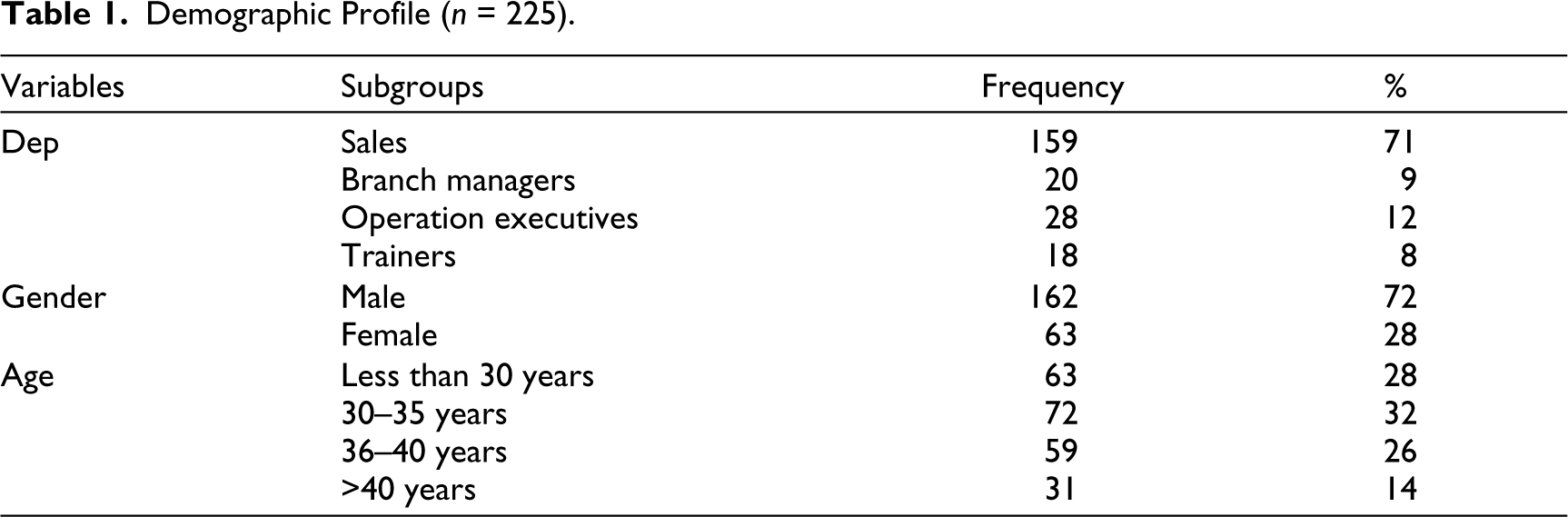
A structured questionnaire was prepared and given to the respondents to collect the data. The data was collected in 20 branches across Coimbatore through an interview schedule. Based on the data collection, the descriptive statistics were calculated and presented in Table 1.
Demographic Profile (n = 225).
Variables of the Study
In the study, job involvement and job satisfaction were considered as antecedents, employee engagement was considered as the mediating variable and organizational commitment as an outcome.
Measures
The study included four constructs: job involvement, job satisfaction, employee engagement and organizational commitment. Based on the existing literature, measurement scales were taken for this study. The participants were asked to fill their responses on a five-point Likert scale with the anchors of (1) strongly disagree to (5) strongly agree. To measure job involvement (Kanungo, 1982), a scale consisting of six items was used. A sample item is ‘Most of my personal life goals are job oriented’. To measure job satisfaction (Cammann et al., 1979), a scale that included three items was used. A sample item is ‘All in all, I am satisfied with my job’. To measure employee engagement (Saks, 2006), a scale that consisted of two scales such as ‘job engagement and organization engagement’ containing six items each was used. A sample item of job engagement is ‘Sometimes I am so into my job that I lose track of time’ and for organizational engagement is ‘One of the most exciting things for me is getting involved with things happening in this organization’. To measure organizational commitment (Rhoades et al., 2001), an affective commitment scale that included six items was used. A sample item is, ‘I feel personally attached to my work organization’.
Framework of Analysis
The PLS-SEM was used to analyze the data. PLS is a variance-based technique that supports reflective and formative indicators. PLS-SEM is an appropriate tool for exploratory research (Chin, 2000). PLS-SEM has a two-step process. Step one examines the reliability and validity of the constructs and step two proposes a model that is assessed to support the hypotheses. This study was conducted to identify the interconnection between employee engagement and organizational commitment. Moreover, this study has a small sample size of 225, which is also one of the reasons for PLS being used. Generally, PLS handles a small set of data sizes (Bari et al., 2016). Generally, when the objective of the research is theory development and prediction, the recommended method is PLS-SEM. When the objective of the research is theory-testing and conformation, the appropriate method is Covariance Based-Structural Equation Modeling (CB-SEM). As this study aimed at theory development and prediction, the PLS-SEM was used. Moreover, the objective of the PLS–SEM is to explain variance in the dependent variables as well as to measure the data quality on measurement models (Hair et al., 2017).
Analysis and Results
Measurement Model
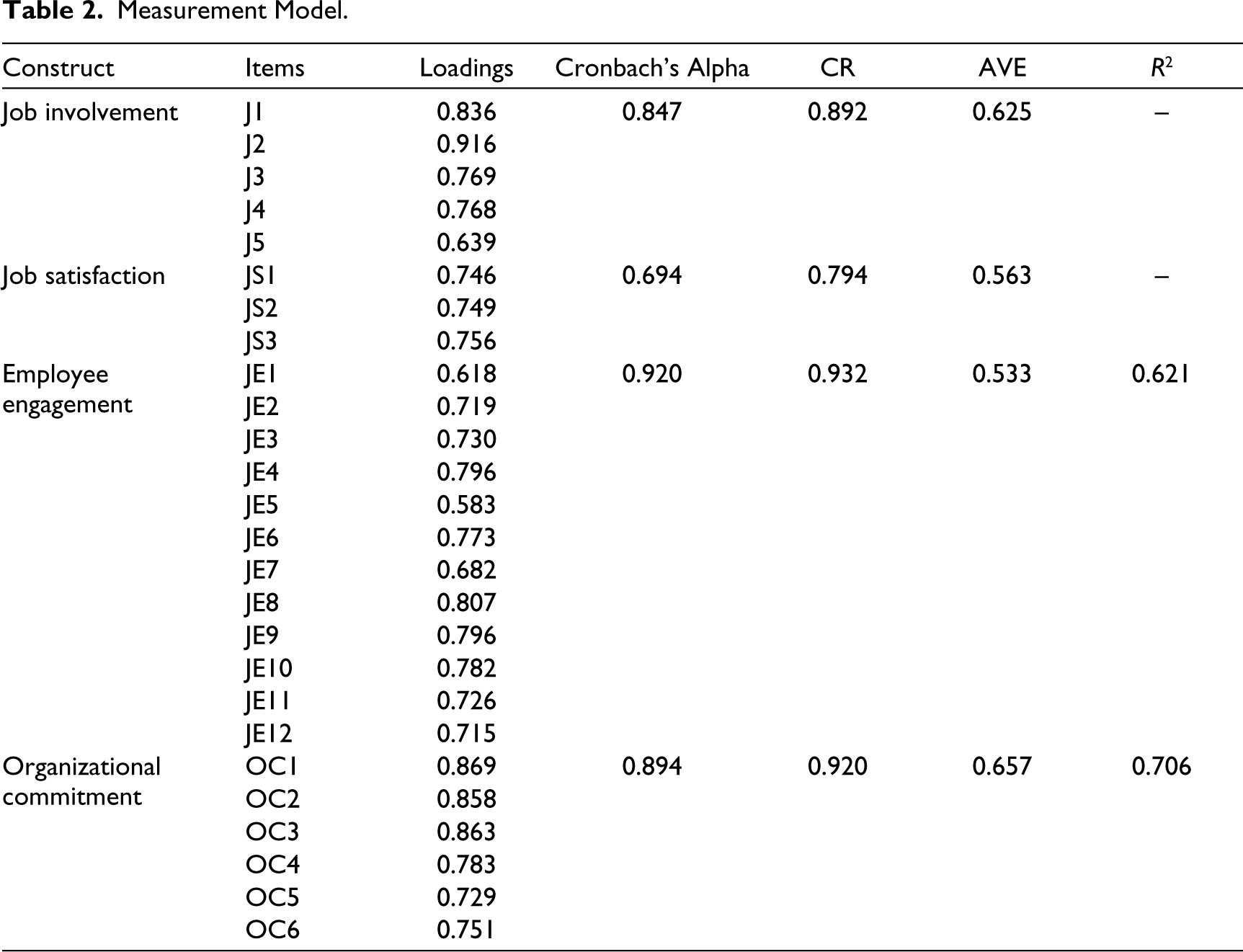
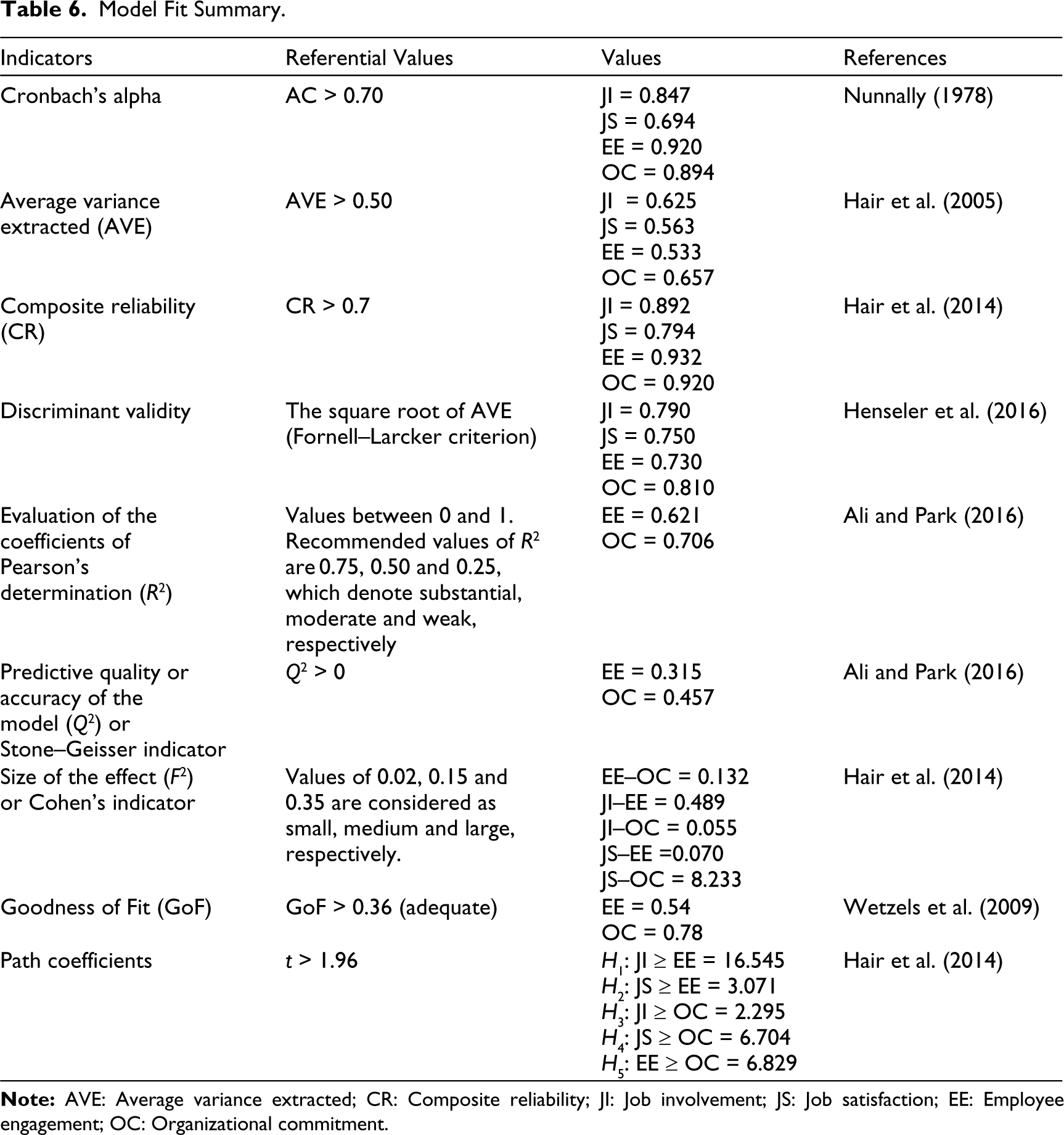
This study used a reliability test (Cronbach’s alpha) to measure the internal consistency among the variables measured. If Cronbach’s alpha score is higher than 0.7, it is considered acceptable for a good construct (Nunnally, 1975). The factor loadings are calculated to measure the convergent validity, composite reliability (CR) and average variance extracted (AVE) (Hair et al., 2010; Table 6). Factor loadings support the impact of each item and its respective construct (Table 6). A higher level of factor outer loading recommends a higher level of indicator reliability. When the factor loading is >0.70, the item must be retained (Hair et al., 2010). Factor loadings between >0.40 and <0.70 can also be retained, provided they do not have any effect on AVE and CR (Hair et al., 2014).
The AVE is the level of variance identified by a construct. The recommended AVE value must ideally be greater than 0.5 (Hair et al., 2006). In this study, for all the constructs, the AVE value is higher than 0.5, which means that it supports the construct measures in terms of construct validity. CR supports the construct indicators that contribute to the latent variable. The suggested value must be greater than 0.7 (Hair et al., 2014). Table 2 shows the recommended values of AVE, factor loadings, CR and Cronbach’s alpha. Based on these, the convergent validity is established.
Measurement Model.
Discriminant Validity
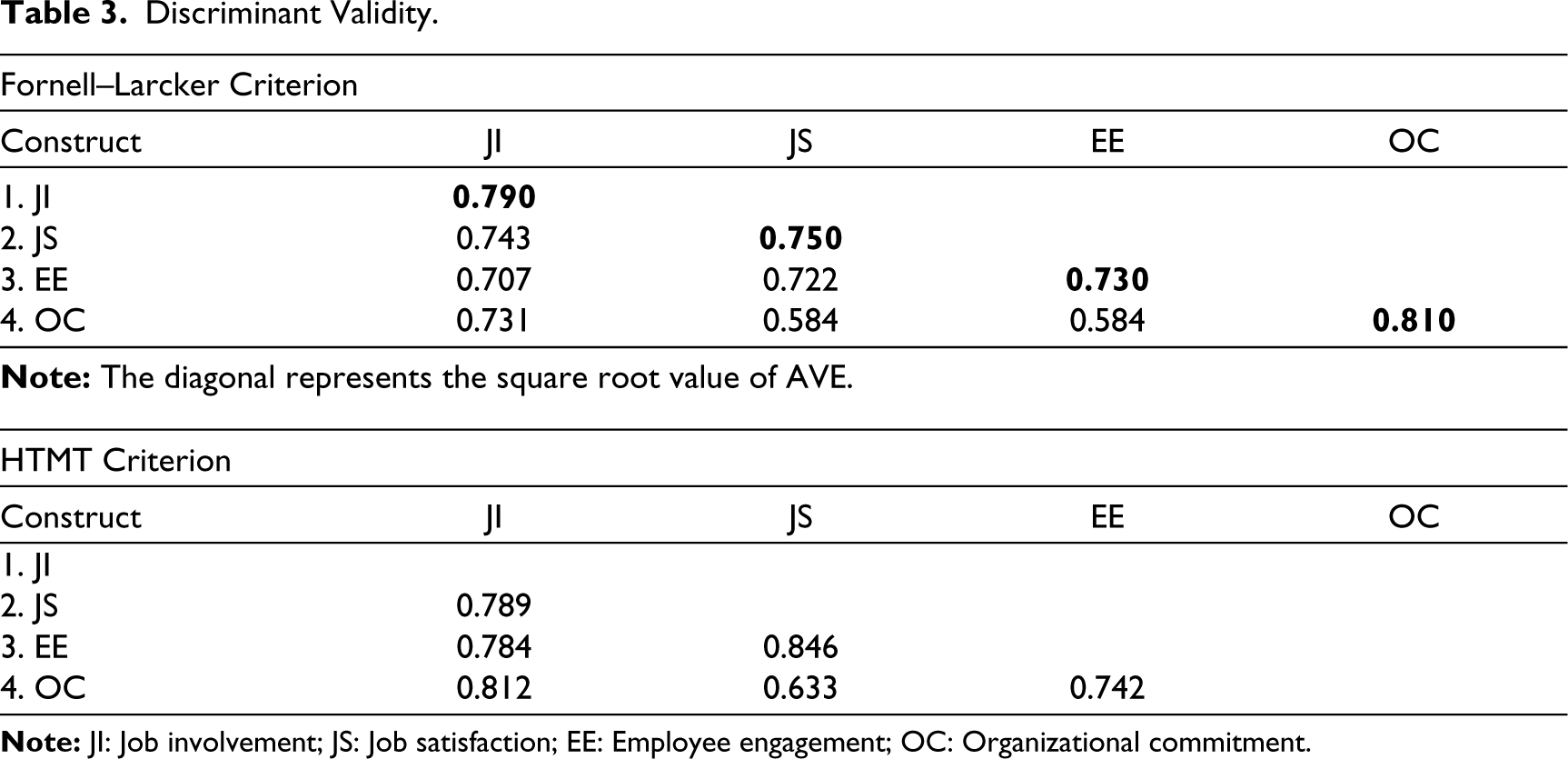
For this study, the discriminant validity was tested by two methods. The first method was the Fornell–Larcker method, recommended by Hair et al. (2013), and the second one was the Heterotrait–Monotrait (HTMT) test developed by Henseler et al. (2016). The discriminant validity was measured based on the Fornell–Larcker method (Table 6). The square root of AVE is significantly higher than the correlations between the constructs with items (Henseler et al., 2016). The HTMT method was used as a strong criterion to measure the discriminant validity in a way other than the traditional approach (Fornell–Larcker method). In the HTMT method, the measured value is less than 0.85 as per the recommendations by Hair et al. (2017). The results are shown in Table 3.
Discriminant Validity.
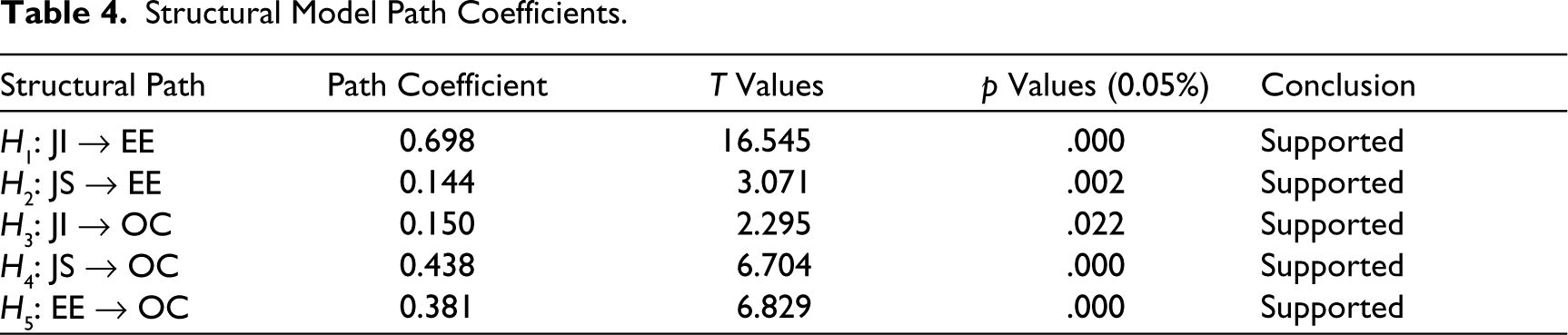
Structural Model Path Coefficients.
Structural Model and Model Fit
This study used a five-step approach to measure the structural model. The first step is to measure the coefficient of determination (R2 value); the second step is to check the structural model path coefficients; the third step is to measure whether the model has the predictive relevance Q2 or not; the fourth step is to predict model accuracy by using Cohen’s Indicator (F2), and the last step is to measure the model quality fit using the Goodness of Fit (GoF) criterion.
R Square
The R2 statistical measure is useful to check how the data has fitted on the regression line. In other terms, R2 is the square of the correlations between the actual response values and the predicted response values. Generally, the R2 value is between 0 and 1. If the measured value is high (closer to 1) it indicates that the predictive accuracy level is also high. The recommended values of R2 are 0.75, 0.50 and 0.25 (Hair et al., 2013) where they denote substantial, moderate and weak levels, respectively (Table 6). In this study, it is determined that the R2 value of employee engagement and organizational commitment are 0.621 and 0.706, respectively. Therefore, the model has good strength (Kumar & Punitha, 2022).
Q Square
The Stone–Geisser indicator (Q2) method was used in this study. It measures the prediction quality or accuracy of the model. The Q2 outcome is stable when the value is higher than zero (Hair et al., 2014). The values of Q2 of employee engagement and organizational commitment are 0.315 and 0.457, respectively (Table 6). These values denote that the model has predictive relevance. As R2 and Q2 results are positive, the structural model is strong and of good quality (Kumar & Punitha, 2022).
F Square
Cohen’s Indicator, F2 is another indicator to predict model accuracy. It is obtained by adding and deleting model constructs one by one. The recommended values are 0.02, 0.15 and 0.35, which denote small, medium and large, respectively (Hair et al., 2014; Table 6). Also, the F2 is evaluated by the ratio between the part explained and the part not explained (F2 = R2/(1 – R2)). The result can be obtained by reading the commonalities through blindfolding. Based on the blindfolding result, the accuracy level of the model is fit as shown in Table 5.
Structural Model Accuracy Level.

Goodness of Fit
The general adjustment indicator of the model should be evaluated, for which the GoF needs to be measured. The recommended value of 0.36 is adequate for the areas of the social and behavioural sciences (Wetzels et al., 2009). Based on the calculation, the result is 0.54 (EE) and 0.78 (OC), which means that the model is fit (Table 6).
Model Fit Summary.
Testing of the Hypotheses
Based on the hypothesis (H1), job involvement significantly supports employee engagement with the value of β = 0.698, t value = 16.545 and p value = .000. As the p value is less than .05 (Table 4), the hypothesis is accepted. Based on the hypothesis (H2), job satisfaction significantly supports employee engagement with the value of β =0.144, t value = 3.071 and p value = .002. As the p value is less than .05 (Table 4), the hypothesis is accepted. Based on the hypothesis (H3), job involvement significantly supports organizational commitment with a value of β = 0.150, t value = 2.295 and p value = .022). As the p value is less than 0.05 (Table 4), the hypothesis is accepted. According to the hypothesis (H4), job satisfaction significantly supports organizational commitment with a value of β = 0.438, t value = 6.704 and p value = .000. As the p value is less than .05 (Table 4), the hypothesis is accepted. Based on the hypothesis (H5), employee engagement significantly supports organizational commitment with a value of β = 0.381, t value = 6.829 and p value = 0.000. When the p value is less than .05 (Table 4), the hypothesis is accepted.
Tests for Mediation
The mediating effect of employee engagement in the relationship between job involvement, job satisfaction and organizational commitment is analyzed by the bootstrapping technique recommended by Preacher and Hayes (2008). The indirect effect of JI on OC is significant (IE = 0.265 and t value = 5.842) at p < .05 (Table 4). Also, the interval confidence was different from zero (0.175, 0.357). Similarly, the indirect effect of JS on OC is significant (IE = 0.054 and t value = 3.076) at p < .05. The interval confidence was different from zero (0.021, –0.091) (Table 7). Based on the readings of Nitzl and Hirsch (2016), Variance Accounted For (VAF) is used to calculate the ratio of the indirect-to-total effect. Based on the recommendation, if the VAF value is <20%, it denotes zero mediation, >20% and <80% denote partial mediation, and >80% denotes full mediation. In this study, the VAF value of job Involvement and employee engagement is 0.41, which means 41%. Therefore, employee engagement is the partial mediator between job involvement and organizational commitment. The VAF value of job satisfaction and employee engagement is 0.12, which means 12%. Hence, employee engagement does not play a mediating role between job satisfaction and organizational commitment.
Test of Mediation by the Bootstrapping Approach.

VAF: Variance accounted for; P.M: Partial mediation; N.M: No mediation; JI: Job involvement; JS: Job satisfaction; EE: Employee engagement; OC: Organizational commitment.
Discussion
The outcome of the study is associated with the Social Exchange Theory. Eventually, the study proves that employee engagement does play a mediation role between independent and dependent variables. Certainly, it improves organizational outcomes with the help of antecedents like job involvement and job satisfaction.
Conclusion
The study examined the job involvement, job satisfaction and organizational commitment of the employees by testing the mediating role of employee engagement among employees in the private life insurance companies in Coimbatore, Tamil Nadu, India.
It is proved that employee engagement plays a vital role at the workplace and it helps employees improve their job involvement, job satisfaction and commitment.
In this study, job involvement and job satisfaction are identified as being significantly related to employee engagement. Job involvement and job satisfaction are significantly related to organizational commitment. Employee engagement and organizational commitment are significantly related to each other.
With respect to mediation analysis, employee engagement partially mediates job involvement and organizational commitment. However, it does not play any role between job satisfaction and organizational commitment.
Hence, the study concluded that employee engagement drives employee job involvement, job satisfaction and organizational commitment at the workplace.
Managerial Implications
This study has recommended that employee engagement plays a mediating role for independent and dependent variables of this study.
Based on H1, job involvement is the personal resource and antecedent for employee engagement. According to the study, job involvement and employee engagement are significantly related to one another. This means that when employees have a high level of job involvement, their engagement level is high. Hence, the organization must focus on the employees’ job involvement activities on the basis of which the engagement level of the employees can also be increased.
H2 indicates that there is a positive and significant relationship between job satisfaction and employee engagement. Therefore, when employees have a high level of job satisfaction, their engagement level is also high. Generally, job satisfaction is considered a personal resource. Hence, organizations must satisfy their employees, through which engagement levels can be increased.
According to H3, job involvement and organizational commitment are significantly related to each other. This means that the higher the job involvement, the better will be their commitment to the organization. So organizations must take initiatives regarding job involvement to increase the commitment level of the employees.
H4 suggests that job satisfaction and organizational commitment are positively and significantly related. This indicates that satisfied employees in the organization show a high level of commitment towards the organization. Hence, organizations must concentrate on satisfying employees in the working environment, through which employees’ commitment levels can be increased.
H5, there is a positive and significant association between employee engagement and organizational commitment, which implies that employee engagement plays a vital role in organizational commitment. So organizations must improve the engagement level of employees in the working environment by which employees’ commitment levels can be increased.
H6, employee engagement is partially mediating job involvement and organizational commitment, which means that job involvement plays an antecedent role in employee engagement through which the goals of the organization can be achieved. Therefore, organizations must focus on job involvement activities, and their support can be enhanced by employee engagement to increase the commitment level of employees.
Through H7, our findings suggest that employee engagement does not play any mediating role between job satisfaction and organizational commitment, which implies that organizations must concentrate on employees’ satisfaction and engagement activities so that organizational commitment can be increased. Finally, this study recommends that HR managers in the organization should focus on employees’ job involvement, job satisfaction and engagement activities. Certainly, these variables support employees’ commitment and loyalty to the organization.
Limitations and Future Research
There are some limitations in this study that may be addressed in future research. First, the study focused only on one demographical area and not the entire state or country. Therefore, a future researcher can extend the scope of work to a wider demography. Second, the study focused only on private life insurance companies. The results identified in this study may or may not apply to other industries. Hence, future studies can focus on other sectors. Third, the results have been established in the Indian context and can therefore not be generalized. Future researchers may base their study on a global perspective.
Footnotes
Declaration of Conflicting Interests
The authors declared no potential conflicts of interest with respect to the research, authorship and/or publication of this article.
Funding
The authors received no financial support for the research, authorship and/or publication of this article.