



Abstract
While research is emerging around the employee engagement construct, evolution is in early stages of development. Presently, some questions remain about how employee engagement differs from other well-researched and documented constructs such as job satisfaction, job involvement, and job commitment. Although such inquiry is seemingly academic in nature, the use of engagement in practice is gaining momentum, and debate remains healthy as to the utility and statistical validity of the engagement construct. To respond, developing clear lines of interpretation and coordination across varied disciplines seems prudent, but an essential first step is a context-specific, conceptual exploration of the construct of employee engagement in relation to other well-researched job attitude and organizational constructs in the literature. This article explores literature on employee engagement, job satisfaction, commitment, and involvement. Implications for organizational learning and workplace performance are examined in a human resource development (HRD) specific context.
Keywords
Recent research has called into question the utility of the emerging motivational construct employee engagement (Newman, Joseph, Sparkman, & Carpenter, 2011). Newman et al. (2011) proposed that what is commonly known in the scholarly literature as employee engagement actually commits the jangle fallacy, in which apparently similar constructs measuring like nomological networks are labeled unique from one another (Kelly, 1927). The jangle fallacy is a common issue in construct validation work particularly as a new construct emerges in research. Newman et al. suggested that engagement, examined under its current operationalization (Macey & Schneider, 2008; Schaufeli & Bakker, 2003), is no different from overall job-related attitudes defined in earlier research as the “A-Factor” (Harrison, Newman, & Roth, 2006). Newman et al. (2011) went on to propose questions regarding whether or not measures of engagement actually provided utility beyond existing measures of validated, well-researched constructs currently in use (i.e., job satisfaction, job involvement, and organizational commitment).
Furthermore, in reaction to recent models of employee engagement, several authors (e.g., Griffin, Parker, & Neal, 2008; Hirschfeld & Thomas, 2008; Newman & Harrison, 2008; Saks, 2008) have provided commentary dialogue regarding the contemporary conceptualization of engagement. Some of these scholars have suggested that engagement provides little utility above what is already known about performance. For example, Saks (2008) commented that engagement has become an umbrella term encompassing a myriad of operational definitions, measures, and research conglomerates and thus remains difficult to link with specific performance outcomes. Others have suggested that engagement is not a distinct construct, and several doubt that engagement can be individually assessed at any level (Pugh, Dietz, Brief, & Wiley, 2008). Meyer and Gagne (2008) further proposed that engagement lacks the necessary comprehensive framework for serious research. It seems that Newman et al. (2011) are not alone in their concerns.
Notwithstanding, and on the other hand, recent research has provided some empirical evidence of the employee engagement constructs distinction and empirical merit (Christian, Garza, & Slaughter, 2011; Rich, LePine, & Crawford, 2010; Shuck, Reio, & Rocco, 2011). For example, work by Christian et al. (2011) found that engagement “exhibited discriminate validity from, and criterion related validity over, job attitudes” (p. 89); this evidence seems to be in contrast to research by Harrison et al. (2006), the foundational framework on which Newman et al. (2011) built their perspective. Moreover, other scholars such as Rich et al. (2010) provided empirical evidence that job involvement, job satisfaction, and intrinsic motivation failed to exceed engagement in predicting performance-related outcomes. The Rich et al. (2010) study proposed a new framework for engagement connected to, yet distinct from, traditional measures of performance in the workplace (as measured by a three-factor engagement model). Other research specifically grounded in the context of HRD highlighted the predictive utility of employee engagement (see, for example Shuck, Reio, et al., 2011) above and beyond other traditionally linked antecedents (i.e., job fit, psychological climate). As is often the case with emerging research, two divergent perspectives have developed.
Understandably, the debate on employee engagement continues and, is healthy for a new construct evolving in the scholarly literature. In many ways, it is expected; however, in light of the current discussion around engagement, there remains widespread confusion as to what engagement is conceptually and statistically how it differs from widely used performance tools and expected outcomes. Several existing frameworks for understanding employee engagement have been proposed (Shuck, 2011), and while definitions remain as varied as individual perspectives on the topic, some agreement on the conceptualization of engagement is taking shape (see, for example, Christian et al., 2011; Kahn, 2010; Macey & Schneider, 2008; Rich et al., 2010; and Shuck, 2011), but clearly the concept is still advancing. Meanwhile, as the engagement evolution continues, the use of employee engagement in human resource practice goes on (Shuck, 2011). Evidence of this growth can be operationalized in the growing body of research on engagement as well as the numerous practitioner-based commentaries touting unique engagement interventions aimed at increasing organizational performance. Recent research by Schaufeli and Bakker (2010) suggested that between the terms employee engagement and work engagement, some 639,000 entries can be found on the Internet alone. While debate continues on what engagement actually is, its use as a tool remains active. This scholar-practitioner gap presents a unique challenge to the HRD community.
Problem Statement
Employee engagement is a well-known construct to scholars and practitioners alike (Christian et al., 2011). Although research is emerging, evolution of the construct is in its early stages of development, and little agreement exists, statistically speaking, about how engagement differs from other well-researched and documented constructs such as job satisfaction, job involvement, and organizational commitment. While this question seems purely academic in nature, the use of engagement in practice touts the ability of the construct to influence organizational learning and workplace performance, two constructs that represent the bedrock of HRD (Swanson & Holton, 2009). While its use in practice gains momentum, little is known about how, or even if, employee engagement adds uniqueness of any kind to the utility of HRD practice. Certainly, questions have been raised. As suggested earlier, some scholars have provided evidence that suggests differentiation (see, for example, Christian et al., 2011, and Rich et al., 2010) while others continue to ask questions that push the boundaries of known research (see, for example, Newman et al., 2011 and Nimon, Zigarmi, Houson, Witt, & Diehl, 2011). While debate remains healthy, exploration remains one promising way to investigate recurring questions.
As suggested by Shuck (2011), the next steps for employee engagement should focus toward differentiating the construct from “other well-researched job attitude and organizational constructs such as job satisfaction, organizational commitment, job involvement, and job affect, as well as uncovering statistical evidence regarding the concept’s demonstrated usability and validity” (p. 317). To respond to questions related to both scholarly inquiry and reported relations to both organizational learning and workplace performance, Macey and Schneider (2008) suggested developing clear lines of interpretation and coordination across varied disciplines. To begin work, a deep, thorough understanding of the literature is required; conceptual integration is necessary. To better understand implications for both organizational learning and workplace performance, a context-specific, conceptual exploration of the employee engagement construct in relation to other well-researched job attitude and organizational constructs is long overdue and an essential first step.
The purpose of this article is to explore conceptually, through known research, the utility of employee engagement within an HRD specific context. Specifically, because of its importance to organizational learning and workplace performance, we aimed to examine one of the research questions posed for further exploration and refinement by Newman et al. (2011). That is, according to the literature, “Is employee engagement different from an overall job attitude?” (p. 38). In this article, because rigorous research must first be developed on solid theory, our goal was to explore and illuminate existing literature on employee engagement, job satisfaction, organizational commitment, and job involvement and to examine conceptual relations, both commonality and uniqueness, as they relate to the original research question of Newman et al. Loosely following Torraco (2005), because the nomological network of employee engagement had been scantily explored in the HRD literature as a specific focus, a holistic review of existing frameworks from disparate streams of literature and research was a logical first step. The remainder of this article unfolds as follows: (a) review of constructs, (b) implications for research and practice, and (c) recommendations for future research.
Review of Constructs
The following sections review and integrate literature on each of the constructs described previously to generate relevant propositions that guide attempts to answer the research question posed.
Employee Engagement
There are many frameworks from which to view the employee engagement construct (Shuck, 2011). While many available frameworks offer unique perspectives that differ in range and application, research by Rich et al. (2010) offers a multidimensional framework reflecting underlying conditions of an employee’s experience of work, an important yet often overlooked dimension of the evolving employee engagement construct. Quite often, engagement, as a psychological state and an observable behavior, is measured simultaneously (both the state of and resulting behavior to). Rich et al. (2010), however, suggested alternatively that researchers should focus on dimensions of motivational energy affected by latent conditions within an employee’s environment that result in observable behavior rather than focusing on the behavior alone.
According to Rich et al. (2010) the simultaneous investment of cognitive, affective, and physical energies into performance-related outcomes represents something distinct and fundamental, differentiating engagement from other potentially related variables (i.e., job satisfaction and commitment; Newman et al., 2011). Moreover, the intensity at which these motivational energies are applied in concomitant fashion gives context to individuals’ level of full engagement in their work as well as highlight the personal choice they make to invest such energies in their work performance. Engagement in this context is much more than what we see employees do; it is rather how employees experience and interpret the context around them, and then, accordingly behave. As such, employee engagement is operationalized as a motivational-state variable representing the manifestation of individual evaluations (cognitive and affective) regarding personal resource allocation toward work-related tasks (Christian et al., 2011; Rich et al., 2010). Exploring further, two main characteristics of engagement should be considered when distinguishing the concept in operationalization: (a) intensity of focus on the task and (b) the decision to invest personal resources toward the tasks (Christian et al., 2011).
One of the fundamental characteristics of employee engagement is the focus toward work, or more specifically, tasks related to the immediate work of the employee. As several researchers have pointed out (Maslach, Schaufeli, & Leiter, 2001; Rich et al., 2010; Shuck, Reio, et al., 2011; Shuck, Rocco, & Albornoz, 2011), although levels of engagement can be affected by a variety of organizational antecedents (i.e., job fit and psychological climate), employee engagement involves performance on immediate, work-related tasks, not attitudinal functions about or perceptions of the work environment; it can be assumed, however, that attitudes and perceptions about the work environment can and do affect levels of employee engagement in an intimate fashion. This does not downplay the utility of understanding antecedents to engagement although the two perspectives should be distinguished in research. The experience and interpretation of work during the ephemeral moment that work is underway is the focal point of employee engagement. Measures that explore dimensions of tangible and intangible elements of the environment (see, for example, Shuck, Rocco, et al., 2011) rather than state-of-the moment experiences serve a different purpose from understanding the utility of engagement; rather, these kinds of studies provide context about the moment of employee engagement and what its antecedents and leverage points might be; however, these kinds of studies are often confused with having a utilitarian purpose above and beyond their exploratory focus. Research around the nomological fringes of engagement can be useful for understanding antecedents and outcomes; however, this is different research and must be distinguished.
Work around behavioral intentions in an HRD context (see Zigarmi & Nimon, 2011) developed from cognitive and emotional interpretation has significant merit when we consider engagement as a behavioral outcome. This line of research has received little attention in HRD as it pertains to performance, partially around the employee engagement variable.
The second, and perhaps most fragile dimension of engagement, concerns the decision an employee makes to invest personal resources toward work. Grounded in Kahn’s (1990) understanding of engagement, this decision is interpreted through a lens that considers comparative and contextually sensitive levels of meaningfulness and safety (physically, emotionally, and psychologically) as well as the adequacy and availability of resources toward a given work task (Kahn, 1990; Rich et al., 2010). When employees interpret their work as meaningful and safe and perceive that they have the adequate resources to complete their work, they are more likely to be engaged (Shuck, Reio, et al., 2011). A cognitive appraisal (Shuck & Rocco, 2011; Zigarmi, Nimon, Houson, Witt, & Diehl, 2011) places a value on a given situation grounded in the unique interpretations of that time and place. Thus engagement is dynamic and in a state of fluidity with each new appraisal, not static or monotonous. Kahn suggested that this decision could be understood operationally as the interpretation of the simple question, “Does it matter?” (Kahn, 2010). In further writings, Kahn (2010) proposed that employees chose to invest when they felt they could “make a difference, change minds and directions, add value” or join with something larger than themselves (pp. 22-23). In other words, employees engage when they feel as if their engagement matters. More specifically, it is believed that the giving of resources can involve tangible and intangible items such as time, care, mental abilities, extra work, pride, ownership, belief, staying later, speaking up, and other overt manifestations of personal investment. This list is inclusive, but not exhaustive. As such, employees who choose to engage, cognitively, emotionally and behaviorally, have “a sense of belonging and identification” that connects them to their work on a personal level (Rhoades, Eisenberger, & Armeli, 2001, p. 825).
Job Attitude Variables
Of great interest to researchers is whether engagement is simply a repackaging of similar constructs suggested by researchers or something distinct and new awaiting examination. Much discussion has ensued regarding the repackaging, from metaphors about old wine in new bottles (Macey & Schneider, 2008), an emperor in his new clothes (Newman, Joseph, & Hulin, 2010), or an old lady in a new dress (Schohat & Vigoda-Gadot, 2010). Regardless of semantic metaphor, there seems to be some confusion about how, if at all, engagement is distinct from similar attitudinal-type constructs, such as job satisfaction, organizational commitment, and/or job involvement. This central question is a good one.
In the forefront of this debate are questions about employee engagement and overlap with traditional measures of attitudinal factors. For example, some have asked, “What utility does employee engagement have beyond measuring what we already know about work attitude variables?” Others wonder, “What does engagement add to the conversation about improving work performance above and beyond traditionally measured job attitudes such as satisfaction?” These questions seem prudent; both practical and scientific issues guide inquiry into this nomological space. Additionally, we believe that HRD has a serious stake in the answer to such questions, particularly as organizations continue to turn their attention to the development of increased engagement levels across multiple industries, in multiple countries, and at multiple organizational levels.
The following sections present a review of literature that conceptually examines the question posed by Newman et al. (2011): Is employee engagement different from an overall job attitude? Our attempt is to identify and bring forth literature that has the potential to inform and guide. First, job satisfaction is explored, followed by job involvement, and finally, organizational commitment.
Job satisfaction
Job satisfaction has been defined as a favorable evaluation of one’s work role (Smith Kendall, & Hulin, 1969). Several researchers and authors explicitly define employee engagement as a satisfaction-related concept (Fleming & Asplund, 2007; Harter, Schmidt, & Keyes, 2003; Wagner & Harter, 2006). For example, Harter, Schmidt, and Hayes (2002), authors of a well-cited study on employee engagement, defined engagement as “satisfaction-engagement,” suggesting that engagement and satisfaction with one’s work occupy the same conceptual and empirical space. Here, engagement is operationalized as a satisfaction-like state. Furthermore, practitioner-based models (Towers Perrin, 2003, 2007) conceptualized engagement as having satisfaction-like rational and cognitive elements, suggesting that, at least conceptually, engagement and satisfaction shared similar nomological linkages. Also, Macey and Schneider (2008) pointed out that “many traditional measures of satisfaction … seemingly tap facets that fit [the] conceptual space for engagement” (p. 7). And still, Brayfield and Rothe’s (1951) seminal measure of job satisfaction provided parallels to several statements that, at least on the surface, seem to be intertwined with the nomological network of the engagement concept. An example of one such statement is “Most days I feel enthusiastic about my work” (Brayfield & Rothe, 1951, p. 311), which directly parallels measures on the Utrecht Work Engagement Scale (UWES; Schaufeli & Bakker, 2003).
Many measures of employee engagement appear similar to those used for measuring satisfaction, and it is thus tempting to label engagement as a repackaging of job satisfaction or as a construct that adds little value to understanding organizational performance. On the other hand, as Erickson (2005) pointed out, engagement is a progressively forward moving state in which satisfaction is stationary and is understood as fulfillment. Satisfaction in this context conveys contentment and the fulfillment of human needs through organizational means (Macey, Schneider, Barbera, & Young, 2009). This suggests that engagement as a behavioral output ultimately has movement forward whereas satisfaction, in its final measurable state, does not; rather, satisfaction is an inactive or unmoving state of fulfillment. At the time of this article, no study on satisfaction could be located that suggested otherwise (i.e., satisfaction as anything other than the measurable state of satiation). Despite conceptual linkages between satisfaction and engagement, definitional and operational aspects of the two constructs seem to differ. While satisfaction connotes fulfillment, engagement connotes “urgency, focus, and intensity” (Macey et al., 2009, p. 40).
Moreover, early empirical work on this issue by Schaufeli, Bakker, and Salanova (2006) distinguished satisfaction and engagement (as measured by the UWES). Specifically, Schaufeli et al. provided evidence that, although they shared a relation, engagement and satisfaction were two distinct constructs; statistically each was distinguishable from the other. Supporting commentary from Heger (2007) suggested that measuring satisfaction provided a barometer about an employee’s general perception but did not capture expression in day-to-day interactions. In this context, satisfaction could be operationalized as more trait-like, whereas engagement could be operationalized as more state-like. Intuitively, it is understandable to expect satisfied employees to excel in performance or be less likely to quit their jobs as opposed to dissatisfied employees, and thus, engagement to share performance and turnover as outcomes with job satisfaction (Judge, Thoresen, Bono, & Patton, 2001; Wollard & Shuck, 2011); this seems understandable and somewhat justifiable.
However, using theory as a guide, we suggest that the fundamental drive of a satisfied employee is to maintain a certain level of status quo (i.e., I like the way things are, don’t change them, I am satisfied). This however is very different from current viewpoints of engagement (Christian et al., 2011; Cole Walter, Bedeian, & O’Boyle, 2012; Shuck, 2011). Furthermore, the view of satisfaction as an end state, rather than a dynamic psychological state implies different cognitive, emotional, and behavioral outcomes from that of engagement (Macey et al., 2009). Through this lens—engagement vis a vis satisfaction—evidence seems to suggest that there is the possibility of uncovering statistical, and more importantly, practical uniqueness between the two constructs. To advance theory, research, and practice in HRD, we propose the following:
Proposition 1a: Employee engagement and satisfaction are similar in that they both measure a like dimension of a work-related attitude.
Proposition 1b: Employee engagement is unique in that it measures in-the-moment expressions of cognitive, emotional, and behavioral energies directed toward organization outcomes (dynamic expressions of task focused energies) in which satisfaction measures general, global, and static expressions of an overall work-related attitude (see Figure 1).
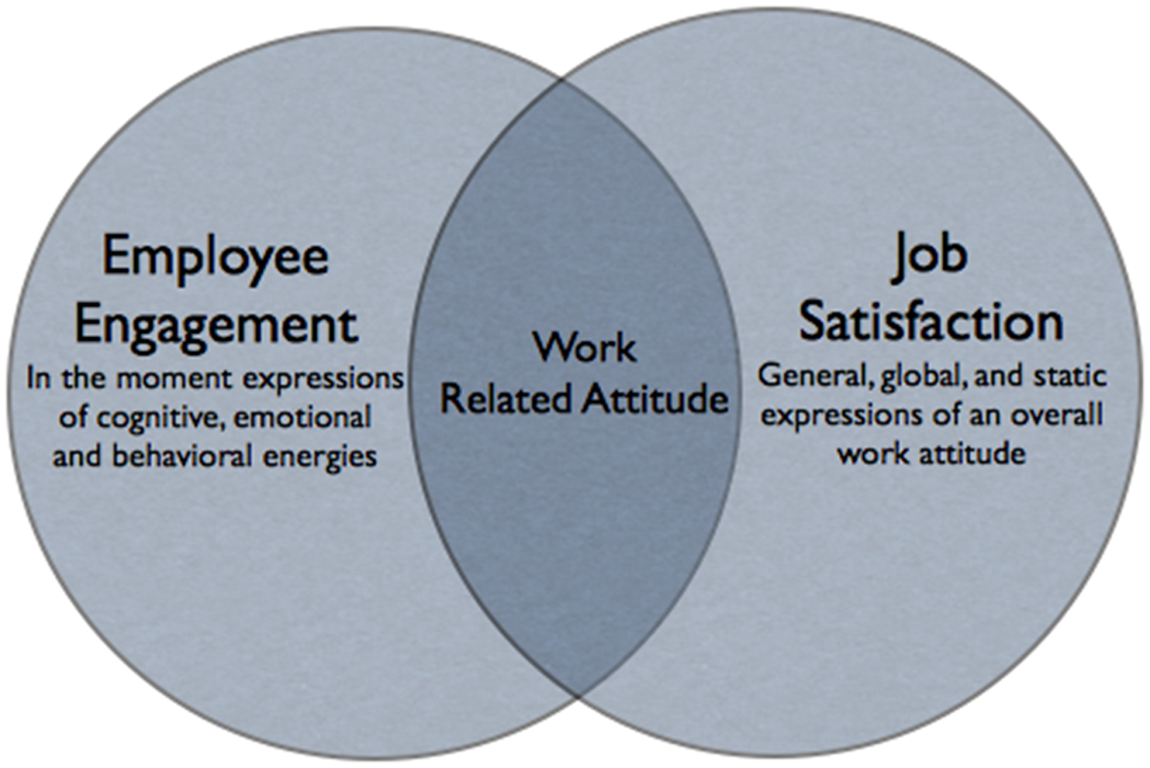
Proposed nomological overlap of employee engagement and job satisfaction.
Job involvement
Using a meta-analytic approach to examine the construct of job involvement, Brown (1996) suggested, “[Job] involvement implies a positive and relatively complete state of engagement [regarding the] core aspects of the job itself” (S. Brown, p. 235). According to Macey and Schneider (2008), job involvement occupies the same conceptual space of engagement and, in support of their argument, they cited the Harter et al. (2002) definition of engagement that encompasses both a state of satisfaction and involvement. Cooper-Hakim and Viswesvaran (2005) further suggested that job involvement is the degree to which a person psychologically relates to his or job, which in some operationalizations is a component of the engagement construct.
While seemingly clear parallels can be made between the two constructs, other scholars suggest that employee engagement and job involvement are separate, yet potentially related (S. Brown, 1996; Harter et al., 2002; Jeung, 2011; Mathieu & Zajac, 1990; Salanova, Aguit, & Peioro; 2005). For example, May, Gibson, and Harter (2004) suggested, “Engagement may be thought of as an antecedent to job involvement in that individuals who experience deep engagement in their roles should come to identify with their jobs” (p. 12). While they may share conceptual space, scholars agree (S. Brown, 1996; Harter et al., 2002; Macey & Schneider, 2008; May et al., 2004; Saks, 2006; Salanova et al., 2005) that engagement and job involvement seem distinct and often measure unique aspects of employees’ interpretations of their work. Job involvement is understood as a facet of engagement; however, it is not seen as equal to engagement (S. Brown, 1996; Jeung, 2011; Macey & Schneider, 2008). Empirically and practically, each construct maintains unique conceptual identity.
In support of differentiation, citing work from May et al. (2004), Saks (2006) suggested that job involvement is a cognitive judgment about the job itself, which is tied to self-image, whereas employee engagement is a broader, more inclusive construct consisting of energy and enthusiasm toward the job (Christian et al., 2011; Kahn, 1990; Rich et al., 2010;). Conceptually, job involvement is a judgment; engagement is a psychological state (Saks, 2006). However, they have the propensity to share antecedents such as self-esteem and supervisory support and feedback and to be related to common organizational outcome variables such as performance and employee turnover (S. Brown, 1996; Wollard & Shuck, 2011), which perhaps is the impetus for the confusing state of affairs. A comparison of the definitions of the two constructs helps make clear that the focus of job involvement is on cognition (e.g., Lawler & Hall, 1970; Lodahl & Kejner, 1965; Kanungo, 1982; Paullay, Alliger, & Stone-Romero, 1994), whereas, engagement, according to most definitions (e.g., Baumruk 2004; Frank, Finnegan, & Taylor, 2004; Kahn, 1990; Richman, 2006; Shaw, 2005; Shuck & Wollard, 2010), encompasses cognition, emotion, and behavior. Moreover, as aptly put by Christian et al. (2011), engagement refers to a psychological connection with the performance of work tasks instead of an attitude toward the situations or conditions of the job (Maslach et al., 2001); job involvement is understood as the degree to which a job situation is central to an individual’s identity (Kanungo, 1982).
Lastly, another important distinction between the two constructs is their association with role perceptions and related physical or mental health outcomes. For instance, research suggests that employee engagement represents a psychological health concept (Hallberg & Schaufeli, 2006) that negatively correlates with health ailments (e.g., burnout symptoms such as sleep disturbances, depression, etc.) and role perceptions (e.g., workload, role conflict). Job involvement, on the other hand, appears to be unaffected by role perceptions and shows no association with any mental or physical health outcomes (S. Brown, 1996; Hallberg & Schaufeli, 2006). This remains an important distinction as research begins to focus on understanding relations between well-being and work and individual levels of health and welfare.
Similar to the job satisfaction literature, the research is divided, and no definitive empirical model exists. Thus, no clear, easy answer is available for which to ground the conversation regarding utility. However, hints of both overlap and distinction are resounding although disparate across disciplines. To synthesize and advance theory, research, and practice in HRD, we propose the following:
Proposition 2a: Employee engagement and job involvement are similar in that they both measure cognitive dimensions of work-related thought processes.
Proposition 2b: Employee engagement provides uniqueness in that it measures psychological states of energy directed towards a task, or specific work role, while job involvement measures a cognitive judgment about the work or the job itself and has no known behavioral implication; rather, job involvement manifests a personality implication connected to identity development of the self (i.e., I identify with my job or work; I am a researcher or OD consult; I am a teacher).
Proposition 2c: While job involvement is operationalized as a cognitive dimension of appraisal or judgment, employee engagement is thought to be made up of three distinct dimensions (a) cognitive, (b) emotive, and (c) behavioral, each facet each suggesting behavioral implication (see Figure 2).
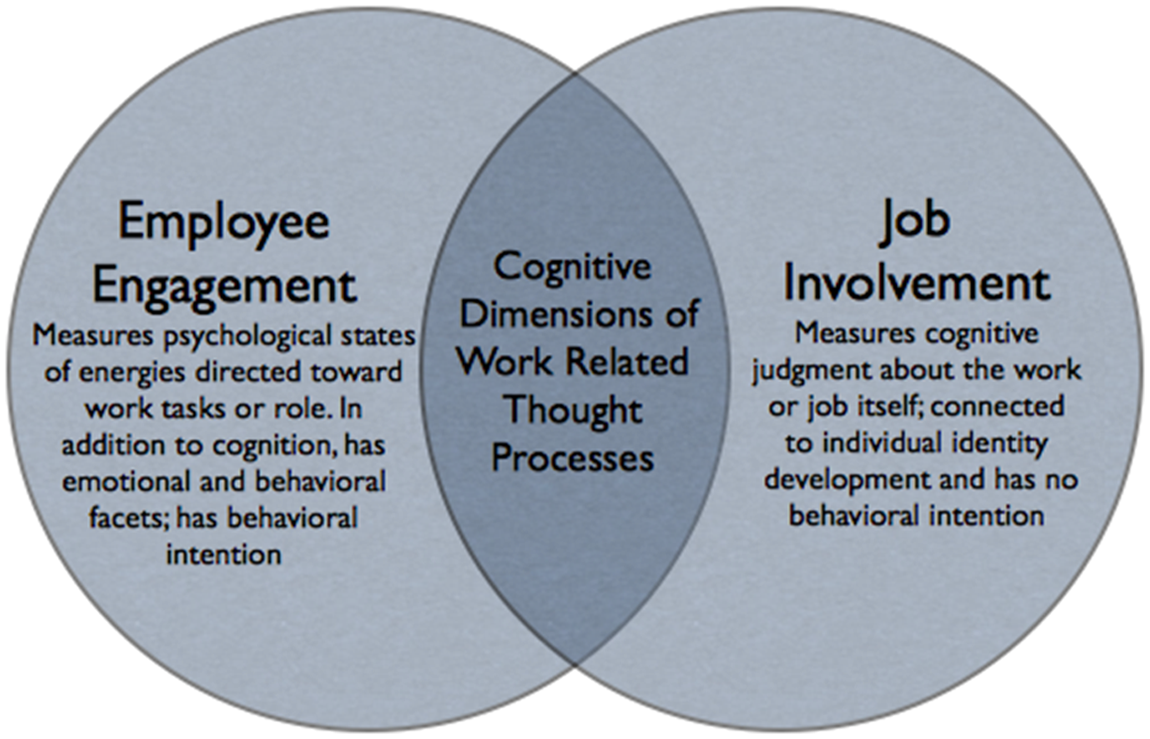
Proposed nomological overlap of employee engagement and job involvement.
Organizational commitment
Similar to job satisfaction, several practitioners define employee engagement explicitly as commitment (Corporate Leadership Council, 2004; Wellins & Concelman, 2005) or as a component of the commitment concept (Towers Perrin, 2003, 2007). Commitment from this perspective is understood as a person’s attachment or attitude towards an organization (Saks, 2006). As an attitude, it is inferred that engagement is an outlook or dedicated stance toward work or the workplace. While this subtle relation between commitment and employee engagement may seem intuitive, Saks (2006) suggested that engagement is not an attitude but rather a state and operationally speaking, the degree to which persons are attentive and absorbed in their work (Saks, 2006). Kahn (1990) commented on the fluctuating nature of the state of engagement, explaining that unlike organizational commitment, which is comparatively stable over time, organizational members might not maintain average levels of engagement over time. As such, it is believed that engagement as a psychological state is subject to ebbs and flows as employees interpret and interact with a myriad of environmental stimuli in the workplace. Commitment, conceptually and often empirically, remains a relatively stable construct.
Most importantly in this discussion, the foci of attachment and attentiveness should be considered while evaluating potential nomological overlaps in the constructs of organizational commitment and employee engagement. As noted by Christian et al. (2011), organizational commitment refers to an employee’s attachment to the organization as a whole, whereas employee engagement represents employees’ perceptions that are based on the job they are asked to do as well as the organization that is asking them to do it (Zigarmi, Nimon, Houson, Witt, & Diehl, 2009). Moreover, employee engagement is considered to be a multidimensional construct that focuses on the self’s investment of cognitive, emotional, and physical energies (Rich et al., 2010; Shuck & Reio, 2011; Shuck & Rocco, 2011) on behalf of both job and organizational outcomes. Organizational commitment, especially affective commitment, with which engagement is often compared (Meyer & Allen, 1997; Newman et al, 2011), represents the emotional state of attachment to the organization (Christian et al., 2011). Consequently, Macey and Schneider (2008) rightly suggested that organizational commitment might be a facet of engagement but may not embody the entirety of the engagement concept. From this context, engagement seems bigger. Following this logic, scholars have even considered commitment to be the prior reason for the state of engagement (Robinson, Perryman, & Hayday, 2004; Rothbard, 2001). Engagement might begin with the decision to commit or have a component of commitment embedded within the construct.
Many authors (e.g., Cooper-Hakim & Viswesaran, 2005; Harrison et al., 2006; James & James, 1989; Newman & Harrison, 2008) have advocated a myriad of commitment forms predictive of employee work behavior, rather than a single, specific, narrow form such as job or organizational commitment. Building on the ideas of R. Brown (1996), it could be reasoned that the concept of commitment is not exclusive to either an organizational context or a job context. Brown stated that the word commitment “refers to a pledge or promise of some sort …and refers to the condition of someone who is made a firm commitment to another party connected with some future event” (R. Brown, 1996, p. 233). Moreover, Brown stated, "It is virtually impossible to describe commitment in terms other than one’s inclination or intention to act in a particular way" (R. Brown, 1996, p. 234).
While distinguished conceptually in the literature, employee engagement and organizational commitment share commonly specified antecedents and consequences. Examples of common antecedents include perceived organizational support, supportive organizational culture, and leadership (Lok & Crawford, 1999; Rhoades et al., 2001; Saks, 2006; Wollard & Shuck, 2011). Consequences include but are not limited to organizational citizenship behavior, turnover intent, and performance (S. Brown, 1996; Meyer & Allen, 1997; Meyer, Stanley, Herscovitch, & Topolnytsky, 2002; Riketta & Landerer, 2002). Thus it is not surprising that only a few authors have suggested that organizational commitment is related to, but could also be distinct from, engagement as an antecedent variable (Macey & Schneider, 2008; Saks, 2006; Shuck, Reio, et al., 2011). However, the incremental variance predicted in performance variables by employee engagement over and beyond organizational commitment is supported in recent organizationally focused research (Christian et al., 2011). Clearly, in the debate regarding overlap or utility, scholars have focused on one side or the other. In a challenge to moving the concept forward, scholars seems to be at an impasse. However, using theory and known research as a guide in the advancement of theory, research, and practice in HRD, we propose the following:
Proposition 3a: Employee engagement and job commitment are similar in that they both measure an attachment-like state directed toward work dimensions (organizational commitment is directed to the organization for which the work is being completed, and employee engagement is directed to the job or the task [emotional engagement]).
Proposition 3b: Employee engagement provides uniqueness in that it measures an individual’s investment of cognitive, emotional, and physical energies directed toward organizational outcomes and understood to be a psychological state with implied directionality (positive, to the organization). Commitment is understood as a pledge or attachment to the organization as an entity and is not focused on the specific job, task, or role (see Figure 3).
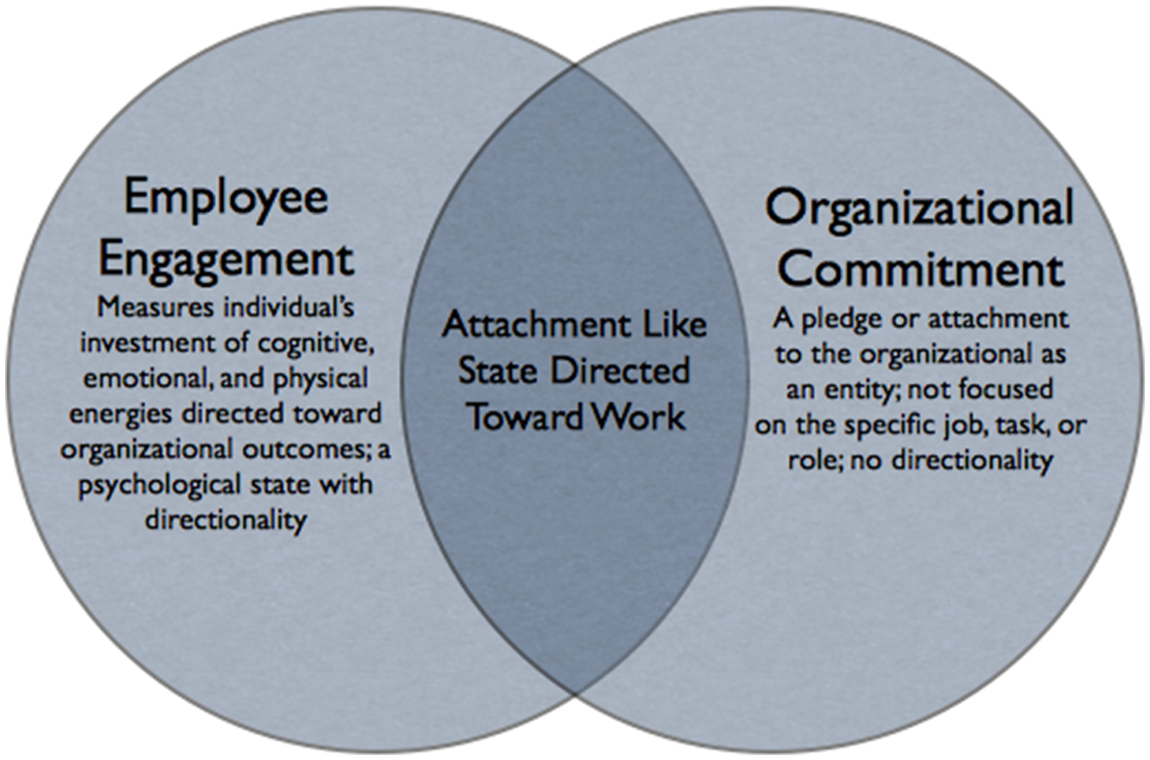
Proposed nomological overlap of employee engagement and organizational commitment.
Summary
In summary, we have proposed that employee engagement, job satisfaction, job involvement, and organizational commitment may share similar conceptual space in like nomological networks. We have further proposed that the variables of interest in this conceptual research (i.e., employee engagement, job satisfaction, job involvement, and organizational commitment) could also share some overlap and be statistically linked in addition to being conceptually linked. However, grounded in known research, we proposed that at structural, fundamental levels, the constructs could also be empirically separable and discriminate from one another. See Figure 4 for graphic depiction of full propositional model.
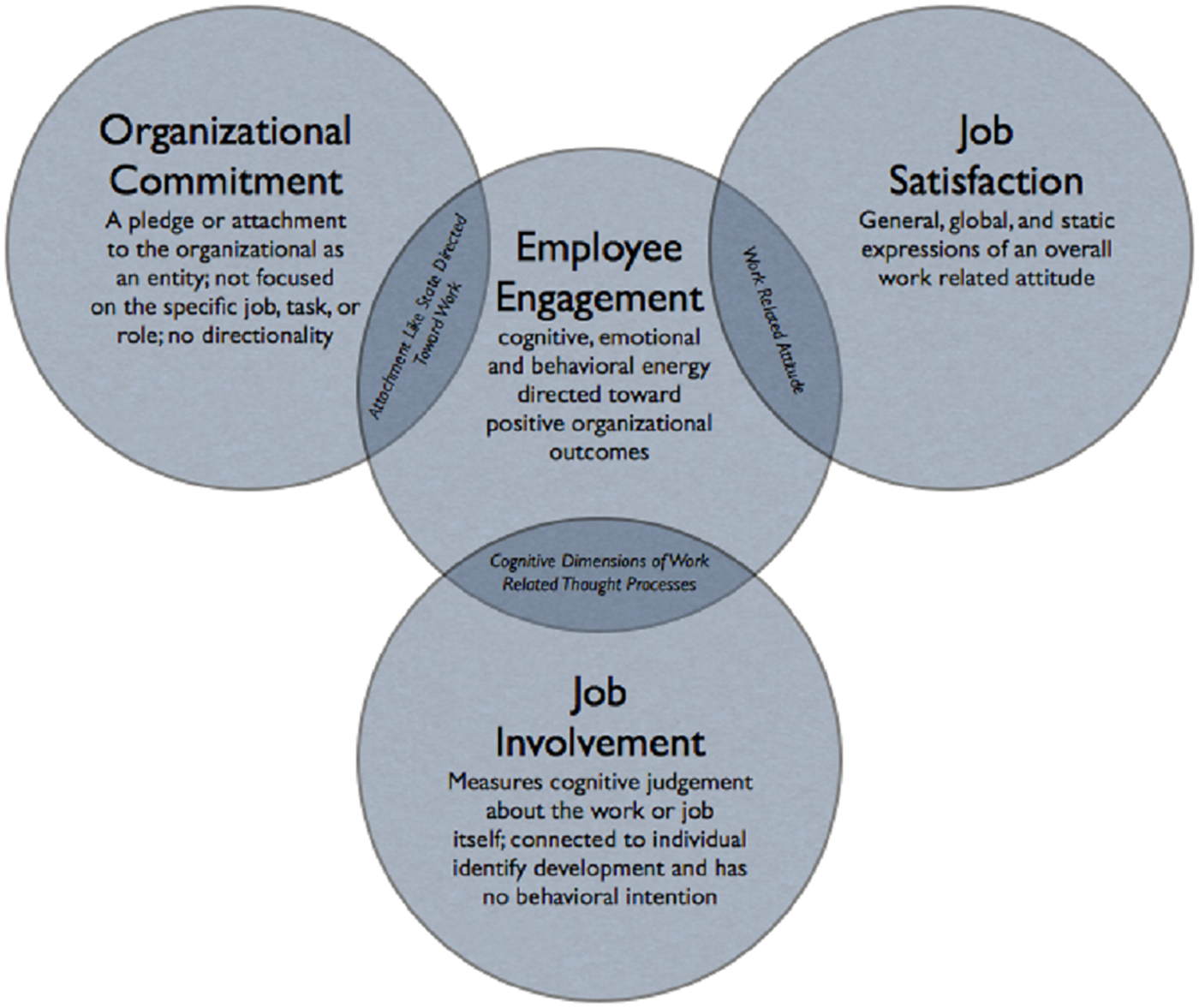
Proposed nomological overlap model of employee engagement, job satisfaction, job involvement, and organizational commitment.
In support of our proposition and before discussing implications and recommendations for research, it should be noted that there are several possible reasons for the existing confusion that scholars and practitioners experience with the above-mentioned constructs. We suggest that there are at least three contributing reasons for the confusing and seemingly overlapping use of various constructs.
First, the epistemological and theoretical foundations under which these various concepts were developed bring with them various perspectives, all of which are important and worth honoring, yet different and telling. For example, the concept of engagement as originated from the academic burnout literature (e.g. Maslach et al., 2001; Bakker, Emmerik, & Euwema, 2006), is quite different from other explanations and emergent definitions (cognitive, emotional, behavioral; see, for example, Rich et al., 2010; Shuck, Reio, et al., 2011; Shuck & Wollard, 2010). This could be because of the emphasis placed on mental and physical health as a lower order facet of the engagement construct (i.e., vigor, dedication, and absorption). In contrast, various definitions of employee engagement provided by several professional consulting firms have emphasized an employee’s involvement and satisfaction with work as well as enthusiasm for that work (see, for example, Harter et al., 2002). Still further, other firms have defined engagement as a positive attitude held by employees toward the organization and its values. Thus, it is not difficult to see why there could be overlapping confusion and conceptual nomological chaos (see Christian et al., 2011, Shuck, 2011, Shuck & Wollard, 2010, and Zigarmi et al., 2009, for more comprehensive summaries of this definitional debate).
In many ways, it is not the definitions (although differing definitions do present serious problems for research); rather, it is the assumptions about these definitions that are critical to advancing research in HRD. As both scholars and practitioners begin to explore the utility of the employee engagement construct, inquiries should be made as to how the term engagement fits within the operational definition and framework that explains how employee engagement is cultivated or formed. As such, users are urged to consider the “fundamental scaffolding” or philosophy, terms, assumptions, and principles inherent in the schools of thought from which the term employee engagement or work engagement is derived when researching or applying the term in practice.
Second, most approaches to the concept of employee engagement fail to offer an operational definition but rather use derivatives-based terms to define their concepts (this is also true for organizational commitment and job involvement although discussions regarding this are beyond the scope of this paper; for more information, see Brown, R., 1996). For example, if the term engagement is explained by using words such as involvement or phrasing such as satisfaction and enthusiasm for work, this only provides other words or synonyms without any explanation of the latent psychological steps or phases someone might experience in the process of becoming engaged. These words do little to help scholars or practitioners understand how engagement develops or is formed, although they provide a familiar, often-comfortable conversational edict. This, of course, makes it difficult for HRD practitioners to “move the needle” on any measure of engagement. Currently, many definitions and measures of engagement suggest an “arrival-like” state; still further, there is currently no agreed-on operational definition or contextually sensitive approach to which scholars or practitioners can refer.
We might offer that employee engagement is formed within a context—a work context of daily experiences within an organization in which the employee is responsible for performing a specified role and interacting with a specified set of individuals. However, current derivative definitions of the construct suggest a flat, unidimensional approach. Some of these definitions suggest that once employees develop high levels of engagement, we can proudly and enthusiastically proclaim, “they have arrived—they are engaged, and our work here is done!” This seems naive at best.
Engagement, or any psychological, emotional, or behavioral state of being human, should not focus on an arrival, but rather on the appraisal process an individual goes through. In the case of employee engagement, these appraisals occur as an employee is performing a specified role towards various work outcomes. Here the inherent challenge is the intentional use of language when discussing constructs and the use of language as a tool for guiding and forming theory, research, and informed practice. For example, scholars and practitioners might consider using an appraisal approach to describing and understanding employee engagement similar to that used for the emerging construct of employee work passion (Zigarmi et al., 2009, 2011). Work passion has been defined as “an individual’s persistent, emotionally positive, meaning-based sense of well-being stemming from frequent appraisals of various job and organizational experiences which results in constructive work intentions and behaviors” (Zigarmi et al., 2009). This definition involves an appraisal (or ongoing appraisals) that includes the measurement and constant calibration of emotions, the measurement and constant calibration of job perceptions and organizational experiences, and the measurement and constant calibration of work intentions. Work passion, as a higher order construct to engagement, is a dynamic variable. The same holds true for employee engagement which is a dynamic variable and should be interpreted as a process, not a final state of being.
Third, if an appraisal approach is taken, the measurement of such appraisals may require different measurement techniques. Until now, most measurement attempts have been completed with general cognition items that can blur various components inherent in the concept being measured, specifically descriptive cognitions and emotional inferences. The measurement of affect or emotion could require the use of a semantic differential technique that is powerful enough to separate emotion from cognition while simultaneously reducing common method bias. Further, as a specific recommendation, when measuring commitment, researchers should construct clear intention items instead of general cognition statements that may blur various specific aspects of the latent process (Zigarmi & Nimon, 2011). The design and measurement of overlapping constructs must take into consideration not only the similarity of constructs but also the discriminate qualities of concepts.
Implications and Recommendations for Extending Research and Informing Practice
First, as an extension of research, substantial literature supports the testing of the three propositions outlined in this conceptual review. The Christian et al. (2011) framework can be used as a starting point for discussion and model building, yet careful extension of the model through rigorous research is warranted. First, it would be interesting to examine how employee engagement, job satisfaction, organizational commitment, and job involvement are related and, if evidence suggests a relationship, at what level or levels do the relationships exist. Understanding the potentially overlapping nomological web between the constructs could provide fruitful insight into better understanding issues of discriminate validity, as well as uncovering potentially limiting factors for each construct. For example, engagement as a state-like variable could have significant limitations in application, and thus, usability within an HRD context (i.e., increasing levels of workplace learning and performance); however, we contend that this is a potential outcome for each variable examined in this manuscript, although we suspect that more insights could emerge around the variable of employee engagement because it stands to gain the most as an emerging construct.
Understanding the relationships between the constructs could begin with simple research questions around correlational analysis and understanding baseline descriptive statistics. In full disclosure, we suspect that each of the constructs would have a relationship, potentially a strong one, but are unsure at what level this might occur; the question remains novel indeed. While opinions on how strongly the constructs would need to be correlated to generate suspicion vary from methodologist to methodologist, Newman et al. (2011) provide a litmus test for exploration. They suggested that correlations exceeding .70 could call the theoretical utility of the engagement construct into question. We partially agree and believe this litmus test should be applied constructively and within an innovative, context-sensitive approach; nevertheless, in an abundance of caution to the researcher and to the field of HRD, we contend that should relationships reach the .70 level, we not thrown the baby out with the bathwater, but rather look further and deeper at what the data are suggesting. There is a story here, and we should read it.
Moreover, understanding the relationships between the constructs examined in this manuscript provides theoretical leverage points for developing objective and context specific interventions. For example, understanding how employee engagement, job satisfaction, organizational commitment, and job involvement are related could provide new theoretical evidence toward developing human resource and organizational development interventions around workplace learning and performance. Carefully constructed and integrated interventions focusing clearly on incorporating current management practices, organizational structure, job-design, and culture building (Joo, 2010) could be outcomes. Specifically, we suspect that insight around the relationships of engagement, job satisfaction, organizational commitment, and job involvement could provide useful evidence about why certain organizationally focused interventions are successful in one place yet fail in another. It seems unreasonable to expect specific, reliable outcomes when the constructs upon which an intervention is based seem tenuous and tortuous at best. Distinction must be an outcome of future research, and currently each construct of interest in this paper seems intertwined and confusing. Lines of variance should be explored more fully.
Second, discriminate validity metrics of each of the propositions in this manuscript should be examined in an HRD-specific context. Christian et al. (2011) examined the role of individual performance and engagement, providing initial evidence that engagement may be different from job satisfaction, organizational commitment, and job involvement. The findings are monumental for the field of engagement theory and particularly interesting in light of work from Newman et al. (2011); however, for the field of HRD, the implications for research from the Christian et al. model remain incomplete. More evidence about how the engagement construct adds utility to interventions around workplace learning and performance should be explicit for use in practice. This adds utility to the construct and situates the usefulness and value of engagement for practitioners within the HRD context (e.g., organizational learning and workplace performance). Furthermore, in conducting such analyses, it is important to note that there are many measures of employee engagement including, but not limited to the Utrect Work Engagement scales (UWES-17: Schaeufeli, Salanova, Gonzalez-Romá, and Bakker, 2002; Scaufeli, Bakker, and Salnova, 2006: UWES-9:), the Maslach-Burnout Inventory General Survey (MBI-GS: Schaufeli, Leiter, Maslach, & Jackson, 1996), and The Passion Scale (Vallerand et al., 2003). Although a review of these scales and others (e.g., May et al.’s (2004) measure of psychological engagement and Rich et al.’s (2010) measure of job engagement), is outside the scope of this paper, future research that considers the propositions set forth in this article may need to either take a multivariate approach to operationalizing employee engagement or consider the measure of employee engagement that is best suited to the underlying theoretical framework to be examined.
Initially, understanding the unique variance explained by engagement in relation to outcome variables could be interesting and enlightening. As a next step, understanding the relationships and explained variance of the combination of variables (i.e., employee engagement, job satisfaction, job involvement, and organizational commitment) could provide particular insight into leverage points for future research. Still further, path and structural equation modeling, as well as other emerging multilevel modeling procedures (i.e., fancy pants analyses [FPA]; Adelson & Owen, 2012) could be useful procedures to investigate. This research sophistication level could be incredibly powerful and potentially reopen lines of organizational effectiveness research, many of which had their case files closed years ago. This not only extends the Christian et al. (2011) model, but it also grounds the utility of engagement within a specific context; consequently, engagement becomes usable to HRD. This could also provide a known-framework within which to interpret the practical utility and statistical uniqueness of engagement and HRD. Finally, great potential exists for uncovering new insight about the role of job satisfaction, commitment, and job involvement in relation to organizational learning and workplace performance and the individual and/or organizational level each represents.
Additionally, as an explicit extension of the Christian et al. (2011) and Newman et al. (2011) models, no research has examined the utility of the three-facet model proposed by Shuck and Wollard (2010) as well as others (see Rich et al., 2010) in relation to the overarching job-attitudes model (Newman et al., 2011). As suggested by Newman et al., other domains of engagement could be explored in relation to potential performance variables (i.e., organizational learning and workplace performance); these domains of engagement have been defined for HRD and could continue to be fruitful grounds for exploration. As a further suggestion, looking at performance across multiple levels (i.e., individual performance, group performance, and organizational performance) could shed new insight on how the varying facets of the engagement state (e.g., cognitive, emotional, and behavioral; Shuck & Wollard, 2010) influence workplace performance and hence, guide HRD practitioners. We also recommend the examination of emerging and conceptually innovative constructs such as the work passion model (Nimon et al., 2011; Zigarmi et al., 2009, 2011) with the three-facet employee engagement model (Shuck & Reio, 2011; Shuck & Wollard, 2010) in the context of the A-factor and workplace performance outcomes (i.e., workplace learning and performance, intentions). As a parallel extension to HRD, the application of engagement to factors outside of work that could influence the study, perception, or experience of work (including the variables of play, relationships, leisure, community, family, and spirituality) could be fruitful. For example, scholars or scholar-practitioners might ask “Is there is a cost to engagement, and if so, what is it and where is it likely to emerge?” “How does engagement influence relationships inside and outside of work, and what leverage points can be gleaned?” “How does engagement affect the employee at basic levels?” As work boundaries continue to expand and become increasingly blurred, findings from this kind of research and design have serious implications for practical utility and extensions of known theory and research. The utility of engagement and the practice of HRD might not be limited to organizational systems.
Last, at the macro-level, understanding the nomological network of engagement and job attitude variables could help identify meaningful relational qualities among engagement, job satisfaction, organizational commitment, and job involvement; thus, this line of research which builds from seminal work by Christian et al. (2011) has the potential to extend and draw connections to conceptual models which served as theoretical underpinnings to attitudinal and workplace climate frameworks such as social identity (Ashforth & Mael, 1989), job stress (Thoits, 1991), job design (Hackman & Oldham, 1980), and emotion in the workplace (Hochschild. 1979). Increased understanding of the importance or nonsignificance of the engagement construct and what relationships it shares with satisfaction, organizational commitment, and job involvement could help HRD professionals refine interventions around engagement theory as well as inform the larger HRD and organizational behavior literature base. Still further, it is interesting to consider the role of employee engagement and job attitudinal variables in relation to positive psychology, emerging health and wellness research, and the experience and interpretation of work from the employee perspective. Thus, researchers have much to explore for many years to come. We look forward to it.
Footnotes
Authors’ Note
This article is the author’s original work, has not been published elsewhere, and is not under consideration for publication elsewhere at the time. A previous version of this article was included in 2012 Proceedings of the Academy of Human Resource Development presented in Denver, Colorado.
Declaration of Conflicting Interests
The author(s) declared no potential conflicts of interest with respect to the research, authorship, and/or publication of this article.
Funding
The author(s) received no financial support for the research, authorship, and/or publication of this article.