



Abstract
There is significant research evidence which demonstrates that LGBTQI+ young people experience higher rates of homelessness than their straight and cis peers. However, estimates of the scale of their over representation in homelessness vary significantly. This partially reflects difficulties in identifying and researching LGBTQI+ homeless youth due to their invisibility within homeless services. Drawing on in-depth interviews with homeless LGBTQI+ youth in Dublin and other Irish cities and with policy makers, homeless service providers and advocacy group representatives, this article reflects on the causes and implications of this invisibility. As its title suggests, the article identifies four interrelated causes of the invisibility – the unreal, unsheltered, unseen and unrecorded nature of LGBTQI+ youth homelessness. The article examines how these factors individually and collectively perpetuate the invisibility of LGBTQI+ homeless youth, impede their access to services for homeless people and reduce the likelihood that homeless services will be tailored to meet their needs and enable them to successfully exit homelessness.
Introduction
There is a strong consensus in the international research that LGBTQI+ youth face significant risks of homelessness (Curry et al., 2017; Rosario et al., 2012) and are overrepresented in the population of homeless young people (Lolai 2015; Cochran et al., 2002). Ecker’s (2016) comprehensive review of this research reveals that estimates of the size of this cohort vary from between 8% and 37% of total youth homeless population. Research on the triggers of youth homelessness also supports this consensus. It suggests that LGBTQI+ youth are at greater risk of homelessness because they are affected both by the factors which precipitate homelessness among the young population-at-large and by additional challenges related to their sexuality and/or gender identity which can directly or indirectly result in homelessness (Abramovich, 2012, 2017).
Existing research identifies several common proximate pathways into youth homelessness. These are: histories of being in care, household disruption and family instability, family conflict and/or violence and problem behaviour and neighbourhood stressors (Mayock et al., 2014). These individual pathways can be difficult to disaggregate because they intersect with one another and also with wider structural factors which are fundamental drivers of youth homelessness including: poverty, unaffordable housing, discrimination and inequality (Fraser et al., 2019; Mayock et al., 2014; Mayock and Corr, 2013). For LGBTQI+ young people these homelessness risk factors may be amplified by parental or caregiver rejection of their sexual orientation and/or gender identity and associated familial conflict. This has been consistently identified as a key trigger of LGBTQI+ young people’s departure from home and thereby of their homelessness (e.g. Castellanos, 2016; Durso and Gates, 2012; Lolai, 2015; Robinson, 2018).
However, the wide range of LGBTQI+ youth homelessness identified by Ecker (2016) points to significant challenges in accurately measuring this population. Only a few studies have attempted to do so robustly and, like all efforts to quantify homelessness, measuring LGBTQI+ homelessness is challenging and there are several reasons why the findings of even state-of-the-art research might be unreliable. This research often draws on surveys of homeless service providers’ own estimates based on client records and/or on staff or volunteer’s observations and response rates to these surveys can be low. For instance, using this methodology, a 2015 study of LGBTQI+ youth homelessness in Britain found that 24% of young homeless people identified as LGBTQI+ (Albert Kennedy Trust, 2015). It was distributed to 473 homeless service providers across 30 cities but achieved a low response rate of 16%. The 2014 LGBTQ Homeless Youth Provider Survey used the same methodology to survey 138 youth homelessness service providers in the USA and realised a very high 91% response rate. These data indicate that 20% of service users identified as gay or lesbian, 7% identified as bisexual, 2% identified as questioning their sexuality. In terms of gender identity, 2% identified as transgender female, 1% identified as transgender male, and 1% identified as gender queer (Choi et al., 2015). The 2015 Canadian National Youth Homelessness Survey used a different methodology -a self-administered questionnaire given directly to homeless youth living in 57 homeless youth services countrywide which were selected using purposive (i.e. non-random) sampling. It was completed by 1,103 homeless youths of which 29.5% self-identified as LGBTQI+, while 6% self-identified as transgender, Two-Spirit and non-binary (Gaetz et al., 2016).
Choi et al. (2015) and other researchers discuss the challenges associated with measuring the scale of LGBTQI+ youth homelessness. A key theme which cuts across these analyses is the role which the invisibility of this vulnerable group plays in heightening these challenges. For instance, LGBTQI+ homeless youth who don’t use mainstream homeless services inevitably remain unrecorded in homeless statistics (Curry et al., 2017). Research with four government funded homeless services in the USA found that the sensitivity and accuracy of arrangements for recording service users’ LGBTQI+ identities varied significantly both between and within organisations (Burwick et al., 2014). Data may also be skewed by the way that gender identity and sexuality are recognised and defined (Durso and Gates, 2012). Furthermore, even when asked directly about their gender identify and/or sexuality, young people may understandably choose to withhold this personal information because of their own ambivalence about these identities or because they fear that they will face discrimination if they do self-identify as LGBTQI+ (Burwick et al., 2014). Durso and Gates (2012) argue convincingly that this reluctance to ‘come out’ to homeless providers suggests that official figures underestimate the size of the homeless LGBTQI+ youth population.
Drawing on in-depth interviews with homeless LGBTQI+ youth in Dublin and other cities and towns in Ireland along with policy makers, homeless service providers and advocacy group representatives, this article explores the extent, causes and implications of the invisibility of this section of the homeless population. Just as LGBTQI+ youth homelessness is often triggered by transphobia and homophobia the analysis presented here argues that their homelessness is rendered invisible by this discrimination and by LGBTQI+ young people’s efforts to deal with it (Ahmad and Bhugra, 2010; Bochenek and Brown, 2001). As is flagged in the title, a four-dimensional conceptualisation of this invisibility is proposed here. This reflects the fact that LGBTQI+ youth homelessness is commonly:
Unreal: because of a reluctance among LGBTQI+ youth to see themselves as being in ‘real’ homelessness.
Unsheltered: because LGBTQI+ homeless youth are often unwilling to use accommodation services for homeless people due to concerns that they will be subject to homophobic and/or transphobic bullying by other service users and about the gender binary, sex segregated and congregated organisation of most homeless accommodation in Ireland.
Unseen: due to these same concerns about the risk of homophobic and/or transphobic bullying, when LGBTQI+ youth do use homeless services they are often unwilling to reveal their sexuality and/or gender identity.
Unrecorded: homeless service staff are reluctant to record clients’ sexuality or gender identity because of concerns about ethics, privacy, and data protection or because they question the necessity for doing so.
The analysis of these issues presented here is organised as follows. The next two sections clarify the analytic context by reviewing relevant Irish research and policies and the methodology used to generate the primary research on which this analysis is based. Four further sections draw on this primary research and the findings of the extensive international literature on LGBTQI+ youth homelessness to examine the four-dimensional conceptualisation of the invisibility of LGBTQI+ youth homelessness. On the basis of this analysis, the conclusions identify the distinctive features of LGBTQI+ youth homeless which reinforce the invisibility of this group and the implications of this invisibility for the pathways through homelessness followed by these young people and for youth homeless policy and services.
Policy and research on youth homelessness in the Republic of Ireland
Since the decriminalisation of homosexuality in 1993 and enactment of equality legislation in 1998, Irish governments have progressed steadily towards providing greater equality for LGBTQI+ people. In 2015, Ireland was the first state in the world to legalise same sex marriage following a popular vote/referendum and legislation enacted the same year enabled transgender people to achieve full legal recognition of their preferred gender. In 2018, the Irish government was the first in the world to publish a dedicated LGBTI+ National Youth Strategy (Department of Children and Youth Affairs, 2018).
However, the extensive policy action in relation to other aspects of the lives of LGBTQI+ people has not been reflected in youth homeless policy. Whilst the late 1990s saw increased government action to address youth homelessness, which culminated in the publication of the first Youth Homeless Strategy 2001, LGBTQI+ youth are not mentioned in this strategy (Department of Health and Children, 2001). It does set out plans for providing support for families, schools, and communities to prevent youth homelessness, aftercare services for young people leaving care and emergency accommodation for homeless children. A 2013 review of the implementation of this strategy acknowledged that: LGBT youth, who appear to be overrepresented in the population of homeless young people in international studies, were not often identified as a group with particular needs by service providers consulted in this review, which may reflect a lack of understanding of the issues for this group. (Department of Children and Youth Affairs, 2013: 24)
The review proffered a positive assessment of the Youth Homeless Strategy’s achievements – due to falling youth homelessness since its publication and the expansion of services for homeless youth and in-inter-agency cooperation to prevent youth homelessness. However, the review also identified a need for service improvements including better supports for young adults, particularly those leaving foster or residential care. This reflects the very strong focus of legislative and policy action on addressing child homelessness (children are defined in Irish law as those aged 18 or under) as part of efforts to comply with the Irish government’s legal child welfare protection responsibilities (O’Sullivan, 2020). Whereas, with the exception of new supports for care leavers, very few additional measures have been put in place to address homelessness among young people aged over 18 years (Mayock and Corr, 2013).
Notably, since this review was published in 2013, the decline in youth homelessness which it highlighted has reversed sharply. In November 2019, 882 people aged 18–24 were ‘officially’ homeless (i.e. included by the housing ministry’s count of homeless people) in Ireland, compared to 642 people only three years earlier (see Figure 1). This development reflects an unprecedented rise of 200% in the overall rates of homelessness between the end of 2015 and 2019 (Department of Housing, Planning and Local Government, various years). Notably, these official data only include homeless people living in short term, government funded, emergency accommodation and exclude categories of people who would be considered homeless elsewhere in Western Europe (e.g. people in transitionary homeless accommodation or in insecure or overcrowded housing) and fall within the widely accepted definition of homelessness proposed by FEANTSA, (n.d.) (the European federation of organisations working with the homeless) (Allen et al., 2020). Therefore, these official data probably significantly underestimate the true level of homelessness in Ireland, including the level of youth homelessness (O’Sullivan, 2020).
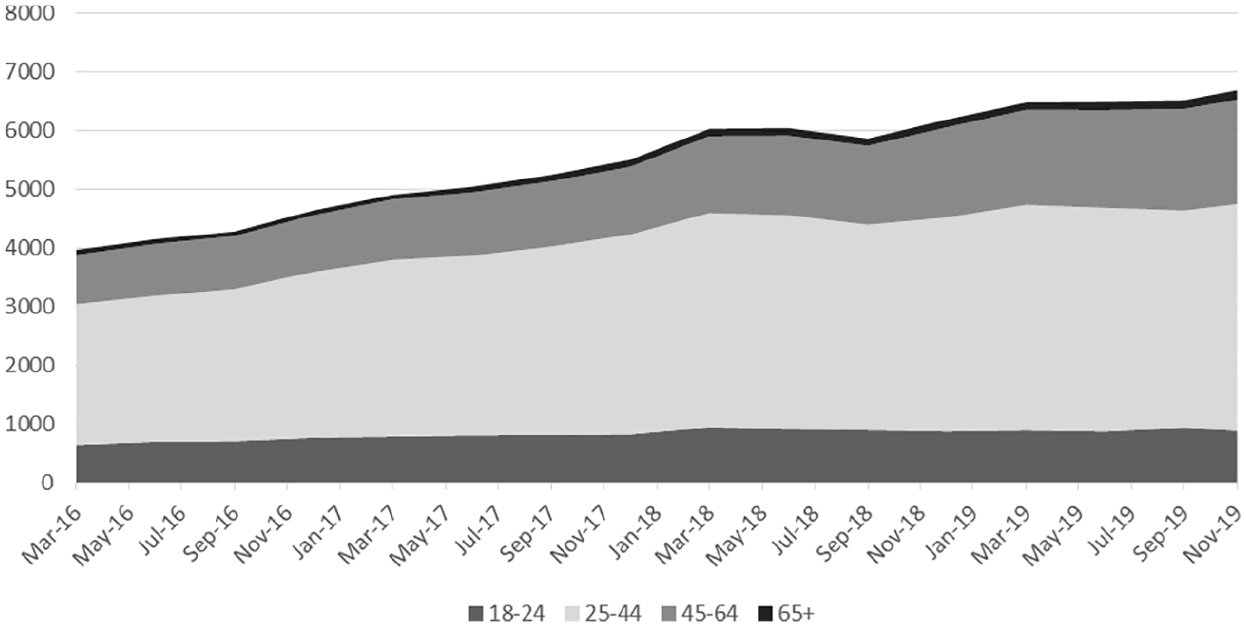
Number of Homeless Adults by Age Group in the Republic of Ireland, March 2016–November 2019.
The research evidence links rising homelessness to the particularly severe economic, fiscal and housing market crisis Ireland experienced in tandem with the 2007 Global Financial Crisis. Private house building and funding for social house building collapsed in the years which followed and recovered much more slowly than the economy and population growth (Byrne and Norris, 2018). This has created a housing affordability and accessibility crisis which is particularly acute for low-income households and is the primary driver of rising homelessness. This is evidenced by the concentration of homelessness in cities where the housing affordability crisis is most acute (O’Sullivan, 2016). Despite this, radical increases in spending on emergency accommodation for homeless people, rather than on social housing provision, has been the primary government response to rising homelessness. Total public spending on homeless services increased from €76.6 million to €191 million between 2008 and 2018. Approximately half of homeless accommodation expenditure is devoted to private hotel and bed and breakfast rooms mainly for families with children, the rest funds institutional accommodation known as ‘hostels’ (equivalent to shelters in North America) mainly for single people. The latter is provided entirely by non-profit organizations and local government does not directly provide accommodation for homeless people in Ireland (Allen et al., 2020).
Rising youth homelessness has inspired increased research on this issue but heretofore LGBTQI+ homeless youth have either not been identified in the research (e.g. Mayock and Corr, 2013) or, when there are, the intersection between their sexuality and homelessness has not been explored (e.g. Mayock et al., 2008). Among the research on youth homeless in Ireland, Mayock and colleagues’ longitudinal, panel studies which followed two groups of homeless youth over six years provides a particularly rich picture of their experiences. This research indicates that most homeless young people share intersecting disadvantages such as poverty, housing instability, parental substance use and domestic violence. However, in terms of the proximate triggers of homelessness, four dominant pathways were evident among the research participants: histories of being in care, household disruption and family instability, family conflict and family violence and problem behaviour, such as substance misuse and negative peer associations (Mayock et al., 2014). Further analysis of the trajectories which research participants followed through homelessness suggests that more linear (and less chaotic) trajectories which are more likely to culminate in exit from homelessness are associated with higher levels of engagement with services and strong relationships with service professionals and family members and lower levels of substance misuse and mental health needs. Conversely, difficulties in accessing affordable housing, perceived lack of support and ‘service fatigue’ inhibited young people’s exit from homelessness (Mayock and Parker, 2017, 2019). Importantly, the research data presented here reflects the complex reality that while young LGBTQI+ people face the same homelessness risks as all young people their situation is aggravated by an additional set of risks associated specifically with their sexuality and/or gender identity (Fraser et al., 2019).
Research methodology
The research examined here was conducted as part of the first national qualitative study of LGBTQI+ youth homelessness in Ireland (2018–2020), a stand-alone study commissioned by Focus Ireland, one of Ireland’s largest non-profit sector homeless services providers.
To avoid excluding any sections of the LGBTQI+ homeless youth population, the focus of the primary research examined here was deliberately broad. This is exemplified by use of the expansive abbreviation LGBTQI+- an abbreviation for Lesbian, Gay, Bisexual, Transgender, Queer and Intersex. The + denotes other sexual orientation and gender categories not accurately described by these terms and captures the continuous expansion of understandings of gender identities and sexualities (Savin-Williams, 2005). As outlined in Table 1, the homeless young people interviewed for this research identified across all points on the LGBTQI+ spectrum.
Characteristics and Anonymised Names of the Homeless, LGTBQI+ Young People Interviewed.
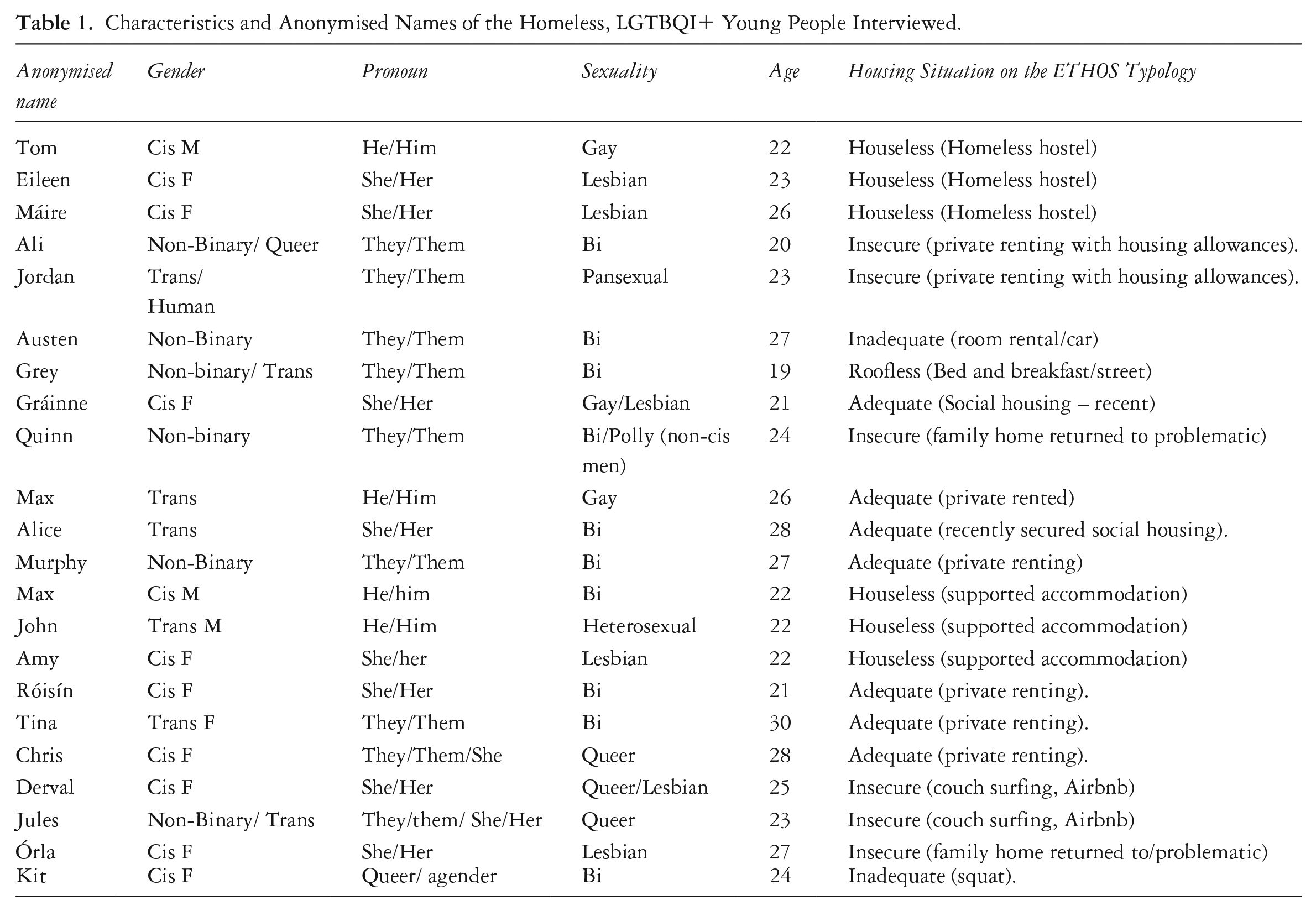
Homelessness was also broadly defined for the purposes of this research with reference to the aforementioned FEANTSA (undated) ‘ETHOS’ typology. It identifies four types of homelessness: rooflessness (without any shelter, sleeping rough); houselessness (with a temporary place to sleep, in institutions or shelters); living in insecure housing (due to insecure tenancies, eviction, domestic violence) and living in inadequate housing (in caravans on illegal campsites, unfit housing, extreme overcrowding). LGBTQI+ youth in all these situations, or who had recently been these situations (and are now adequately housed) were interviewed for the research (see Table 1).
Recent Irish research and policy statements on homelessness have defined young adults as aged between 18 and 23 years (e.g. Department of Children and Youth Affairs, 2013; Mayock et al., 2014). However, sexual and gender identity is a fluid and complex developmental process which varies between individuals and young people may come out and/or transition at different ages and life stages (Robertson, 2018). To capture all these experiences, young people aged between 18 and 30 were interviewed for this study.
The research was informed by grounded theory (Charmaz, 2014) which involves the construction of new theories through methodical gathering and analysis and reanalysis of data. Grounded theory is particularly appropriate for examining under-researched and sensitive topics and has been employed in several studies of LGTBQI+ youth homelessness (e.g. Alessi et al., 2017). It also encourages openness to new ideas and therefore facilitates deeper understanding of the myriad of individual, structural and service issues which influence homelessness (Corbin and Strauss, 2008).
The research commenced with a review of the Irish research and policy on youth homelessness. As the grounded theory approach requires this was intended to clarify the research purpose and concepts, rather than to guide the rest of the data collection (Corbin, and Strauss, 2008). In total, 22 one-to-one interviews with homeless, LGTBQI+ young people aged between 18 and 30 were conducted between December 2018 and August 2019. As these young people interviewed were identified as a vulnerable and potential high-risk research category, a best practice-informed plan to address the ethical challenges arising was formulated and approved by the relevant university research ethics committee (Liamputtong, 2007).
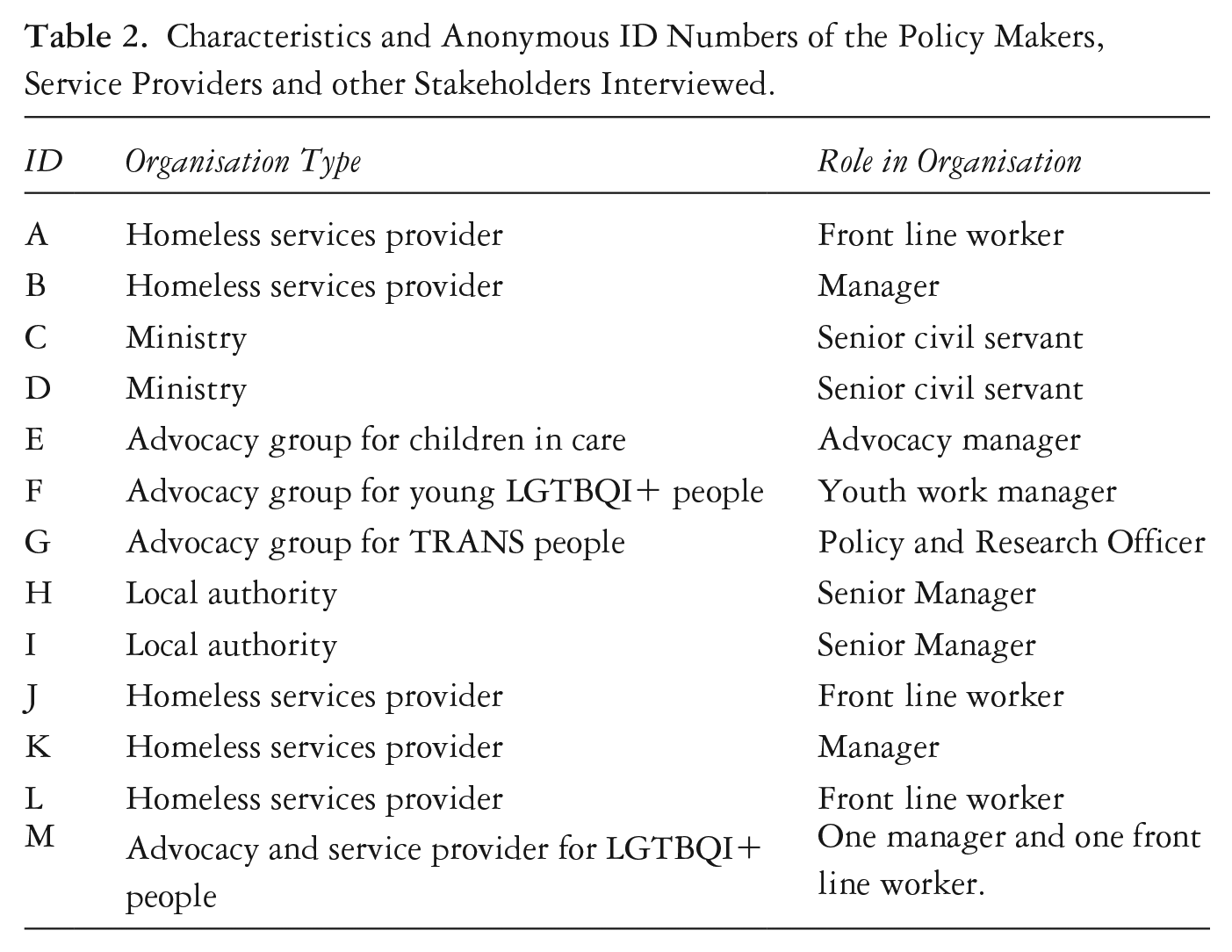
Interviewee’ characteristics and anonymised pseudonyms, with which they are referred to in this article, are detailed in Table 1. The interviews were loosely structured around interviewees’ personal biographies and particularly their experience of becoming homeless, being homeless and (if relevant) leaving homelessness. In addition, thirteen interviews with fourteen policy makers and representatives of homeless service providers and support and advocacy groups for LGBTQI+ youth and careleavers were conducted between May 2018 and June 2019 (see Table 2). These stakeholder interviewees are identified in this article as Interviewees A to M. These interviews were also semi-structured around three themes: the extent, measurement, and triggers of LGBTQI+ youth homelessness, the key challenges facing this group, and the effectiveness of policy and service responses.
Characteristics and Anonymous ID Numbers of the Policy Makers, Service Providers and other Stakeholders Interviewed.
The interviews with LGBTQI+ youth and the other stakeholders were recorded, transcribed verbatim and then analysed separately using qualitative data analysis software (specifically: MAXQDA). Reflecting the grounded theory approach three rounds of analysis of these two datasets were then conducted sequentially as follows: first, the data were examined to identify the arguments, concepts and experiences raised most commonly and differences and similarities between different interviewees’ views; second, the stage one results were re-examined to identify tentative relationships between interviewees’ views and relevant contextual issues; third, the Irish literature review was extended to include the international research on LGBTQI+ youth homelessness. This informed the re-analysis of the stage-two results to identify relationships between these findings and the literature (Corbin and Strauss, 2008).
The multiple invisibilities of LGBTQI+ homeless youth
Unreal LGBTQI+ youth homeless
The interviews with the LGBTQI+ young people conducted for this research revealed that they had highly subjective perceptions of ‘homelessness’ which they defined across a spectrum or hierarchy of legitimacy or ‘realness’. They also tended to minimise the seriousness of their experiences (even if the facts suggested otherwise) and to suggest this was not ‘real’ homelessness. For instance, recounting their experiences after being ‘kicked out of home’, Quinn mentioned: ‘I stayed one night in a squat, I stayed in guesthouse one night with a friend, and then I stayed in two different friends’ houses over the course of about two weeks. . . . Does that count as being homeless, as well?’ Similarly, Róisín reflected that during the time she spent living in bed and breakfasts and couch surfing: ‘I never thought about it as homelessness until I was kind of reading about this research, because I didn’t feel like I was homeless. I had a roof over my head, do you know?’
These interpretations reflected a widespread perception among the young interviewees that homelessness equates with being ‘on the street’. In this vein Tom reported that: ‘Even before I got homeless, I thought the same. Sleeping bags, most on drugs or whatever. It’s so different’. Órla spoke of how she hadn’t equated her own housing access problems with being homelessness: I was just telling them [friend] a story about something and then they’re like, 'So you were homeless?' And I was like, 'No,' because it was. . . temporary, and you know what I mean?. . . It’s not like living on the street.
Significantly in view of the aforementioned research evidence which links successful exit from homelessness with stronger engagement with homeless services and professionals (Mayock and Parker, 2017, 2019), Austen reflected that their unwillingness to acknowledge the reality of their homelessness impeded them from accessing services: I guess that’s kind of how I never saw myself as homeless. . . Yeah, up until I was living in a van and I found some old link to a music video that featured someone that was living in a van and they put a content warning for homelessness. And then I was like oh, this person sees that as homelessness. And that made me realise that I was homeless which was helpful because it allowed me to start accessing services.
Other research on homelessness indicates that these responses are not unusual because homeless people often try to cope with extreme stress by ‘psychologically distancing’ themselves from it and cope with stigmatised low position in the social hierarchy by denying it (O’Carroll and Wainwright, 2019; Farrington and Robinson, 1999). Indeed the 2015 Canadian Youth Homeless Survey reveals no correlation between LGBTQI+ identities and denial of homeless status (O’Grady et al., 2020). However, several of those interviewed for this project argued that the ‘unreality’ of LGBTQI+ youth homeless is enabled by the particularly strong informal support network which exists within this community. For instance, a LGBTQI+ advocacy group representative reflected that: And it’s something we have been trying to name for a very long time, working with LGBT young people to understand that that’s homeless, because when they see homeless, they think of somebody on the street. And I suppose for me just something beautiful about the LGBT community that I haven’t seen in other communities around in understanding that they can become homeless because of coming out or being outed and the community sort of provides a buffer for safe places to stay (Interviewee F).
Although she acknowledged the benefits of these supports, she also mentioned ‘I suppose for me the negative side of that is them then not coming up in the homeless stats’.
Unsheltered LGBTQI+ youth homelessness
The research by Curry et al. (2017) on youth homelessness in the United States found that LGBTQI+ youth were over-represented in homeless services and less likely to survive by couch surfing. However, the research conducted for this article suggests that this isn’t the case in Ireland. Even when the young LGBTQI+ interviewees did accept the reality of their homelessness, many reported that didn’t use homeless accommodation services and remained in hidden homelessness – primarily by relying on couch surfing but also by what Mayock and Parker (2019) term ‘living off-grid’ in cars and vans . The homelessness service providers interviewed agreed that these experiences were widespread.
Rather than external, practical barriers to accessing homeless accommodation such as lack of places, the interviews with LGBTQI+ homeless youth indicate that their unwillingness to use services was the primary barrier. For instance, Ali suggested: ‘I’m just really happy that I’m not in hostels and stuff. . . because I know a lot of people in there, and it’s not good’. O’Carroll and Wainwright’s (2019) ethnographic on entrenched homeless people’s health service usage in Dublin identified similar barriers which they term ‘conversations of exclusion’ - meaning that homeless people effectively talked themselves out of using these services. Many of the themes they identify in the general homeless population’s conversations of exclusion, such as fear, embarrassment and presumption of poor services, were echoed in the interviews with the LGBTQI+ youth and homeless service providers conducted for this study. For instance, a homeless service manager, argued that fear of ‘the risks that are involved in going into generic hostels’ was a significant barrier to their use by LGBTQI+ youth because the accommodation they provide is predominately in dormitories and shared rooms ‘. . . where. . . you could be sharing with someone who’s an active IV drug-user or an alcoholic’ (Interviewee K). A policy maker suggested echoed the view that ‘People don’t avoid homeless hostels just because of their orientation’. In his opinion ‘They avoid them because you’re under scrutiny of an agency. Everything you do is documented. You’re in an environment with you don’t know who. You’ve no choice directly who you’re surrounded with…. You’ve no control over your life, in essence’ (Interviewee C).
However, other interviewees identified additional barriers to using homeless accommodation which impact particularly on LGBTQI+ youth. Among these the fear of homophobic and/or transphobic bullying by other service users was mentioned most often (research by Abramovich (2017) on Toronto flags the same issue). For instance, a LGBTQI+ service representative reported: ‘I would know people that they would be afraid to go to hostels because they identify as LGBTI, because of bullying and maybe possibly worse’ (Interviewee M). A colleague from a different homeless service, saw transphobia and homophobia as part of a wider ‘hierarchy of exclusion’ (an idea echoed in several ethnographies of marginalised communities, for example. Tyler, 1995; Bourgois, 1995). In his opinion: So, if you’re socially excluded and you find someone who has another difference, you’ll have greater hierarchy of exclusion… . The drug users have categories of addicts and how they refer to them… So, people will create natural hierarchies to make themselves feel better about their shit… . so, if a group of homeless lads are around and discover that someone is gay, they will be further down the food chain. So, we’ll abuse them to make ourselves feel better (Interviewee A).
Interviewees also highlighted the barriers to access which the heteronormative and cis-normative organisation of most homeless accommodation in Ireland create for trans and gender diverse people in particular (see Begun and Kattari, 2016; Maccio and Ferguson, 2016). In relation to the latter, a homeless service provider pointed out that: Like the biggest example would be… the Central Placement Service [the database used place homeless people in emergency accommodation]. They register people according to gender. What happens if a young trans man or trans woman presents to a service and they’re still classed as a man or they’re still classed as their gender recorded at birth rather than their new gender? (Interviewee K).
A local government interviewee reported that they plan to change this system by allowing clients to register as male, female, or other (Interviewee H). However, an LGBTQI+ advocacy group representative pointed out that it is not just arrangements for allocating accommodation to homeless people which causes challenges, but the fact that many homeless accommodation services cater for the gender nature of them [homeless services] often leads people to self-exclude on the basis that they assume that they will not be able to access them. So, for example, a young trans woman assuming that she may not be perceived as female and therefore not be allowed into a women’s homelessness service, or vice versa (Interviewee G).
Several of the queer, trans and non-binary young people interviewed also raised privacy concerns related to their sexuality and gender identity which prevented them from using homeless hostels in Ireland. For instance, Kit said that they would not consider using homeless hostels because: ‘I would never have my own room. That’s really, really taxing on my mental health, to be sharing a room with so many other people’. Murphy described being in a constant state of exhaustion due to the need to be ‘hyper vigilant’ and ‘hyper-situationally aware’ about negative responses to their sexuality and gender identity and how private space provides a respite from this which is vital for their mental health. On this basis they reported: ‘I have an awful lot of anxiety around, and I think possibly a lot of queer people have anxiety about someone coming into their bedroom’.
Unseen LGBTQI+ homeless
While the unreality and unsheltered nature of LGBTQI+ youth homelessness has been rarely researched, there is extensive international research on this group’s experience of using homeless services. This highlights widespread unsatisfactory and sometimes traumatic experiences, ranging from: sense of discomfort when using hostels to extremes of physical violence by fellow residents (Hunter, 2008); denigrating treatment by and in the presence of homeless hostel staff (Cray et al., 2013) and homophobia and transphobia (Lolai, 2015).
Many of the young people interviewed who did use homeless accommodation reported that fear or experiences of trauma and discrimination discouraged them from being open about their sexuality and/or gender identity and service providers agreed that this practice is widespread. For instance, Interviewee F (from a LGBTQI+ advocacy group) who reported that her young clients ‘… would say to us ‘I can’t be out in the service’. And then we would have staff in the homeless services saying it’s not safe for them to be out’. Tom described the psychological strain which maintaining multiple invisibilities while using homeless services triggered for him. He reported that: ‘You start to hate yourself because of the situation you’re in. And hiding that you’re gay, hiding that you’re homeless. It’s difficult’. Begun and Kattari’s (2016) research on homeless trans people describes how they mitigate the risk of experiencing transphobia in homeless service by ‘conforming for survival’ i.e. changing their appearance to confirm with cis norms. This strategy was employed by a non-binary young interviewee called Austen who reported: So, like in the situation of the homeless shelter when I’m going to access services it’s safer not to be out, because then I can use the female showers. That’s a privilege that I could have, that trans women might not have, that I can pass as a cis woman and use those bathrooms. And that means I am less likely to be attacked.
All of the homeless service providers interviewed have policies to combat homophobia and transphobia in their services but there were mixed views about their effectiveness. This reflected variable practices in this regard and awareness among staff, together with the practical difficulties of combatting this type of behaviour among clients (see Abramovich, 2017; Hunter, 2008). For instance, a youth homeless service manager reported that in his service homophobic and transphobic bullying is simply not tolerated ‘in any way, shape or form’ (Interviewee A). However, he acknowledged that these behaviours are still there ‘under the surface, and they’re explicitly, from the moment they [LGBTQI+ youth] walk outside services’. Furthermore, if LGBTQI+ youth leave one of the handful of specialist youth homeless services provided in Ireland and ‘end up in the mainstream [i.e. adult] homeless services . . . that’s a different kettle of fish. They are very exposed’. Another homeless service professional didn’t agree that homophobia and transphobia was always taken seriously in homeless services. He argued that: ‘The way homophobia is treated in hostels is that, oh, just shake hands and move on. But if you compare that to racist incidents in hostels, it’s an immediate exclusion from services’ (Interviewee K).
As mentioned above, the research evidence links successful exit from youth homelessness to higher levels of engagement with services and strong links with service professionals (Mayock and Parker, 2017, 2019). Although the research on which this article draws isn’t longitudinal and only a few of homeless LGBTQI+ youth interviewed engaged with homeless services, it does provide some tentative support for this thesis. The LGBTQI+ homeless youth who had strong relationships with the key worker assigned to provide them with one-to-one support during their time in homeless services reported benefits. At the most basic level Tom reported that being able to confide in their keyworker, a trusted person about their sexuality ‘. . . made it so much easier’. John and Máire described how their key workers provided vital practical supports: If you have drugs or alcohol problems, they’ll support you with that. They will actually bring you to your meetings. . . . Or counselling. . . They’re very good that way. . .especially for the people that might not have a lot of family, or don’t get on with their family. I was on the streets for maybe six or seven months. Some woman came out to me. . . She goes, ‘I’m here to help you. . . I’m from [named organisation] and I’m going to be your key worker’. So, she got me off the streets and into a hostel and then from there I moved onto different places.
In terms of the factors which facilitated good relationships with homeless service staff, the importance of trust, respect for confidentiality and understanding and acceptance of their sex/gender identification and nomenclature (often described as’ getting it’) was repeatedly emphasised by the young interviewees. For young people encountering staff who did not ‘get it’ was a significant cause of distress. Perhaps for this reason, Interviewee H (a local government official) reported: ‘What we have found is where people do come out as gay or trans in services, they want to raise this, there is kind of a network of gay people working in [homeless] services around the city [they approach]’. The importance of educating homeless service staff regarding LGBTQI+ issues was raised by many of the young research participants because some reported that even, in supportive environments, they sometimes experienced ignorance particularly in relation to transgender issues (Maccio and Ferguson (2016) concur). In this vein John reported: ‘Straight away [after entering a youth homeless service], they changed my name to [chosen name]. They put me down as a boy in the house, and any time new young people come in, they’ll always introduce me as [chosen name] and ‘he’’. However, he also mentioned ‘. . . there would have been a lot of ignorance. As in, the staff would have not been informed about anything about transgender people. . . . I actually had to teach them a lot’.
Unrecorded LGBTQI+ youth homelessness
None of the policy makers, service providers or advocates interviewed had any robust data on the scale of LGBTQI+ youth homelessness. Most (but not all) agreed that homelessness is higher among this population, but their estimates of its scale varied dramatically and were based entirely on anecdotal evidence. They varied from 7–10% of homeless people (Interviewee F, from an LGBTQI+ service and advocacy organisation), one third of clients (interview G, from a transgender support organisation) and half of young clients (Interviewee A, a front-line homeless service professional). However, a policy maker reported: ‘In all our discussions [with homeless service providers] it hasn’t arisen as an issue. . . I’m not saying it’s not an issue, but it wasn’t raised’ (Interviewee C).
The lack of data on LGBTQI+ youth homelessness in Ireland reflects the absence of arrangements for recording this population by government and service providers which in turn reflects the challenges of doing so. Many homeless service providers supported plans to include a third gender option in the database for allocating places in homeless services, but they raised ethical, practical and legal concerns about collecting more detailed data on all LGBTQI+ identities from homeless service clients. For instance, a homeless accommodation service manager reported that when new clients present ‘we don’t ask the question, but there’s a reluctance to answer questions that we ask. . . because at that point in time if they’ve nowhere to stay, they’re in an unsafe environment’ (Interviewee K). Interviewee M (from a LGBTQI+ advocacy organisation) highlighted the practical challenges for recording data created by the fact ‘that there’s a whole vocabulary that maybe we’re not all aware of these days. So, I might ask someone are they gay. That’s not really relevant anymore to everyone because there’s a spectrum of how people identify’. In her view the ‘tick boxes’ often used when recording information don’t work ‘for someone who doesn’t identify as one of the tick boxes’ (Burwick et al., (2014) raise these issues too).
Conclusions
There is convincing research evidence that LGBTQI+ young people experience higher rates of homelessness than their straight counterparts (Choi et al., 2015; Gaetz et al., 2016). However, there are also radically varying estimates of the scale of LGBTQI+ homelessness in this literature and among Irish policy makers, homeless service providers and advocacy group representatives interviewed for this research (Ecker, 2016). The argument offered in this article is that these variations are shaped by LGBTQI+ homeless young people’s multiple invisibilities – due to the unreal, unsheltered, unseen and unrecorded nature of their homelessness – which are in turn driven by homophobia, transphobia and LGBTQI+ young people’s efforts to deal with this discrimination (Ahmad and Bhugra, 2010; Bochenek and Brown, 2001).
Denial of the reality of their homelessness, coupled with concerns about the lack of privacy in the congregated hostels which dominate homeless accommodation provision in Ireland and risks of experiencing homophobia and transphobia from other service users, discourages LGBTQI+ homeless youth from these services and therefore renders their homelessness invisible. When they do use homeless services, these same concerns can also precipitate continued invisibility by discouraging them from being open about their sexuality and gender identity to homeless service staff and keyworkers. Furthermore, LGBTQI+ youth homelessness remains unrecorded in official data or research on homelessness in Ireland because of policy makers’ and service providers’ concerns about the ethics and privacy implications of collecting data on homeless people’s gender identity and sexuality, together with the sheer complexity of this task.
The analysis presented here suggests that invisibility of LGBTQI+ homeless youth has several important negative implications for these young people. The same factors which perpetuate this invisibility discourage these young people from entering homeless services and from building strong relationships with homeless service staff if they do avail of these services. This is a problem because the longitudinal research on the pathways which young people follow through homelessness links successful exit from homelessness to higher levels of engagement with services and strong links with service professionals (Mayock and Parker, 2017, 2019). The invisibility of LGBTQI+ homeless youth also reduces the impetus for policy makers and service providers to reform homeless services to better meet their needs.
In terms of policy and service responses to the multiple invisibilities of LGBTQI+ homeless youth in Ireland, the analysis presented here suggests that action to address the unsheltered and unseen nature of this group is a probably a necessary precursor to achieving recording and would also help improve their chances of exiting homelessness. A key step in this process is training homeless service staff in anti-homophobic and anti-transphobic practice, particularly the key workers who provide one-to-one support to homeless youth, because the evidence presented in this article indicates that the equality policies introduced by most homeless service providers are not sufficient on their own to combat transphobia and homophobia which perpetuate the unseen and unsheltered nature of LGBTQI+ youth homelessness. Although space constraints meant that it wasn’t possible to examine intersectional aspects of LGBTQI+ youth homeless in this article, for some of the young people interviewed, such as Irish Travellers for instance, the intersection of their ethnic and LGBTQI+ identify amplified their invisibility by increasing their reluctance to use homeless services and to come out when they did use services. Therefore, intersectional issues should be addressed in staff training. Transphobic and homophobic bullying between clients in homeless accommodation was also identified as a key driver of the invisibility of LGBTQI+ homeless youth. In view of the difficulty in eliminating this behaviour in the congregated hostel accommodation which are the main source of accommodation for homeless youth in Ireland, and the limited privacy this accommodation provides young LGBTQI+ clients, replacing hostels with private, single units of accommodation would reap significant benefits for this group. The Irish government’s ‘housing first’ programme (which aims to provide permanent, single social housing units for homeless people, rather than hostels) has the potential to contribute to achieving this objective. However, the primary target group for housing first in Ireland – which is rough sleepers and long-term users of emergency homeless accommodation with high and complex mental health and addiction needs- excludes most young people (Allen et al., 2020). This article demonstrates that there is a strong argument for rethinking this prioritisation strategy and extending eligibility for housing first to other groups of homeless people whose needs are not met by homeless services as currently organised in Ireland. This includes young LGBTQI+ homeless people and other homeless members of minority groups who face particularly strong barriers to accessing homeless services and making effective use of the supports provided by homeless service key workers when they do.
Footnotes
Funding
The author(s) disclosed receipt of the following financial support for the research, authorship, and/or publication of this article: This research was funded by Focus Ireland, an Irish non-governmental homeless service provider. The authors are grateful for the support and advice they received from Focus Ireland’s research department particularly from Mike Allen, Sarah Sheridan and Daniel Hoey and also from Moninne Griffith of BeLongG To.
Author biographies
Her recent publications have appeared in Housing Studies and Environment and Planning A.