



Abstract
This study reports a cognitive-response-based analysis of advice planning. Through an examination of full-time employees’ thought generation pattern when they plan to offer suggestions to their supervisor (Study I), this study identifies five distinct types of thoughts involved in advice planning and provides evidence of the association between thoughts (e.g., assessment, goal-oriented, and caution) and message qualities. These results are replicated in Study II when the same data collection procedure is used to examine advice planning in a friendship context. While advice message qualities are determined to a certain extent by advice givers’ thought content, results from Studies I and II also suggest that such a process is further moderated by people’s cognitive elaboration. That is, heightened degree of effortful thinking in deciding how to give advice, as compared with low effortful thinking, results in a greater number of caution thoughts and advice messages that contain a larger number and more diverse set of reasons.
Advice, which can be defined as messages that make recommendation about what to do, think, or feel in response to a problematic situation (MacGeorge, Feng, & Thompson, 2008), is a form of supportive communication. Besides signaling care and concern, one important property of such communication is that it involves persuasion, motivating the advisee to consider and perhaps adopt the proposed idea (Goldsmith, 2004). So far, researchers have explored why doing so is inherently face-threatening (Goldsmith & MacGeorge, 2000), how different sequential moves affect perceived face threat (Goldsmith, 2000) or effectiveness of advice (Feng, 2009); what advice message features are rated as useful and helpful (Feng & Burleson, 2008; MacGeorge, Feng, Butler, & Budarz, 2004); as well as the barriers to adopting advice (Grasso, Cawey, & Jones, 2000; McLaughlin, Cody, Dickson, & Manusov, 1992). Much less attention, however, is given to the examination of how people plan to give advice. For instance, how do people plan what to say, anticipate resistance and skepticism from an advisee, and deliberate on what is the best way to deliver a message?
To understand the strategic thinking process that guides message generation (Berger, 1997; Greene, 1997), this study proposes to examine advice-givers’ cognitive responses as a way of tapping their message planning process. By definition, cognitive responses are “the thoughts generated in response to the communication and are the end result of information processing activity” (Petty & Cacioppo, 1986, p. 225). Such self-generated thoughts reflect people’s interpretation of situational cues and mental deliberations on how to react (Brock 1967; Greenwald, 1968). Because of this, an analysis of advice-givers’ cognitive responses may help clarify whether certain types of thoughts facilitate or debilitate effective advice message generation.
Furthermore, the present study seeks to examine advice-givers’ planning process under high versus low effortful thinking modes. Researchers have long observed that people use both systematic and automatic thinking modes to deal with communicative activities (Burgoon, Berger, & Waldron, 2000; Gigerenzer, 2000; Klaczynski, 2001). As Miller (1990) has observed, many times people do not have sufficient time or energy to think a great deal before they speak. To provide a more complete description of how advice-givers engage in planning, the present study seeks to address the following research question: “Will more or less effortful thinking about how to give advice make a difference in advice message quality?”
This article contains two major sections. The first section provides a literature review to lay out a foundation for a cognitive-response-based analysis of advice planning. Next, research questions and hypotheses are proposed, and results from an empirical study using subordinate–supervisor advice giving data are reported (Study I). The second section reports a replication study examining advice planning in a friendship context (Study II). Finally, a discussion of the major findings from these two studies is presented.
Giving Good Advice Is Cognitively Demanding
Although advice-giving is a common communication task (Wilson, Aleman, & Leatham, 1998) and is frequently used in supportive interactions (MacGeorge et al., 2008), doing it well is not easy. Extant research indicates that effective advice needs to simultaneously address multiple issues, including (a) justifying why the proposed action is desirable, relevant, and feasible; (b) mitigating the face threats implied in such an act (e.g., avoid appearing as if “I know better than you”); and (c) managing the obstacles that arise during the course of influence, such as a resistance from the advisee (Goldsmith & MacGeorge, 2000; Koestner et al., 1999; MacGeorge et al., 2004). Advice researchers found that one way to address these issues is through the use of appropriate reasoning (Feng & Burleson, 2008). That is, effective advice givers explicitly explain why an advised action is good (effectiveness), why an advised action is doable (feasibility), and/or why taking the advised action will not cause other problems (lack of limitations).
The positive association between diverse reasoning and advice effectiveness has been documented by both large-scale survey data (e.g., Feng & Burleson, 2008) as well as field observational data. For example, based on conversational analysis, Waring (2007) noted the graduate tutors frequently use accounts to encourage their students to follow their advice on how to improve writing. Waring explained that the use of accounts serves to justify the validity of the advice, manage resistance and face concerns, and promote teaching agenda.
Giving advice with well-elaborated reasons demands cognitive effort (Berger, 1997; Waldron & Applegate, 1994). Cognitive effort refers to the “amount of cognitive capacity expended on a task” (Petty & Cacioppo, 1986, p. 14). Greene and Lindsey’s (1989) research indicated that an increased cognitive burden is associated with the production of multiple-goal messages. For example, they observed that people with multiple goals showed longer speech-onset latency than those who pursued a single goal. Along this line of reasoning, it seems that advice message qualities may, to a certain extent, relate to how much effort people spend in message planning.
The Role of Thoughts in Advice Planning
To the author’s knowledge, advice planning is not yet systematically studied in the advice literature. As an initial investigation, this study draws on contemporary message production research to derive its analytical framework. Plans are cognitive representations of action sequences intended to help achieve goals (Berger, 1997; Dillard, 2004). For example, a goal of persuading someone to quit smoking may include several plans, “To explain why,” “To use examples,” and “To check the target’s reactions.” Planning is a multistaged process, involving situation assessment, selecting goals, as well as anticipating contingencies and adversity in the course of action (Berger, 1997). In his theory of strategic communication, Berger (1997) suggested that a good planner needs to balance two meta-goals: efficiency and appropriateness. Although people with an efficiency goal want to form plans with the least waste of time or effort, they are restrained by an appropriateness goal, for example, “not being too intrusive.” As such, planning is a cognitive elaboration process where people consider certain ways to talk and forego others.
Greene (1997) explained the dynamics in planning from an action assembly perspective. According to his action assembly theory II (AAT II), a relevant set of procedural records (thought units) are activated when people encounter a communication situation. Once activated, these thought units need to find ways to integrate with each other in order to form a meaningful utterance. This process is called coalition formation or assembly. According to him, such a process can be chaotic, dynamic, or quite automatic depending on the complexity of a communication task.
To analyze planning, two methods have been used by prior researchers: participants’ self-report and cued recall. For example, in Berger and diBattista’s (1992) study on how people plan for a date request and new roommate interaction, they collected data by directly asking participants to write down their plans. Plan units were then coded into two categories: Conceptual Action Unit (e.g., “Introduce myself”) and Contingency Unit (e.g., anticipating obstacles that interfere with a smooth plan completion, “if . . . then”).
In Waldron and colleagues’ study on how people seek sensitive information from another party, they asked participants to recall their thoughts when talking with the target by watching their videotaped conversation (Cegala & Waldron, 1992; Waldron, Cegala, Sharkey, & Teboul, 1990). Thought units were coded into three categories: (a) assessment thoughts, (b) goal-relevant thoughts (“I did action X to attain goal Y”), and (c) topic-oriented thoughts.
Past research has shown that goal-relevant thoughts have a positive impact on message qualities (Cegala & Waldron, 1992), and the degree of perceived face threat in a communication task may influence how many contingency plans people generate (Berger, 1997; Berger & diBattista, 1992). Building on this line of research, the present study uses a thought-listing method to analyze people’s advice planning. There are two reasons why such an approach can further extend planning literature in an advice-giving context.
First, because thoughts are the end product of mental processing, people are aware of them. In a cognitive response or “thought listing” procedure (e.g., Brock 1967; Cacioppo & Petty, 1981; Greenwald, 1968), participants are given 2 to 3 minutes to list anything that was going on in their mind while they were reading a message, such as thoughts, feelings, or ideas. The obtained cognitive-response units are later coded into analytical categories to identify patterns. This study proposes that data collected from such a procedure can provide more detectable evidence of how planning unfolds overtime (e.g., initial vs. final response).
Second, by collecting data from two different advice-giving contexts, this research seeks to capture some common patterns regarding the relationship between thought content and message construction. In particular, this study examines how employees give advice to a work supervisor (Study I) and how people make suggestions to a good friend (Study II). Due to power distance, offering advice to one’s supervisor is potentially more complicated than giving advice in a close relationship. The degree to which it is difficult depends on multiple factors, such as supervisor–subordinate relationship and organizational norms about whether input from all employees is actively sought (Fairhurst, 2001; Waldron, 1999). By juxtaposing a difficult advice-giving situation with a situation where advice can be given in a relatively care free manner (e.g., between close friends), the present study tries to detect some common themes as well as situationally unique factors involved in message planning.
In both contexts (Studies I and II), participants are instructed to read a scenario where they imagine that they would offer advice to either a work supervisor or a friend. Then they are asked to list their thoughts and feelings while reading the scenario in the order of initial, middle, and final thinking stages. By examining thought content and the order in which they are generated across time stages, this study seeks to address the following two questions:
Research Question 1: What types of thoughts occur in people’s mind when they consider offering advice to another person?
Research Question 2: What is the sequential pattern in the generation of thoughts in people’s mind when they consider giving advice to another person?
More or Less Thoughtfulness in Advice Planning
Prior research has documented that there are noticeable differences in behavior when people engage in high versus low effortful thinking. For example, by manipulating people’s motivational level, hence increasing or decreasing their cognitive effort, Waldron (1990) found that effortful thinking tends to be associated with more instrumental thoughts. Jordan and Roloff (1997) also noted that cognitive effort leads to a greater consistency between internal thinking and overt negotiation performance. Through a gamma spectrum comparison analysis, Beaty and Heisel (2007) observed more cortical activities in people’s brain in novel situations (more cognitive effort is required) than in routine situations.
As Research Questions 1 and 2 examine the types of thoughts and their generation pattern in planning, the next logical question is whether increased cognitive effort leads people’s thought pattern to change in particular ways. Therefore, the following research question was posed:
Research Question 3: How will people’s cognitive responses vary in content and quantity when they engage in a more or less effortful thinking about how to give advice?
To test the association between thoughts and advice message qualities, this research examines advice message along two dimensions: reasoning quantity and diversity. These two dimensions are derived from past research on advice effectiveness (Feng & Burleson, 2008; MacGeorge et al., 2008). Although reasoning quantity refers to whether an advice giver can provide sufficient amount of relevant reasons to justify an advised action, reasoning diversity indicates whether a person can address a diverse range of issue-relevant concerns related to a proposed action (e.g., effectiveness, feasibility, lack of limitation). This study speculates that higher levels of cognitive effort should result in an increased level of plan elaboration. Subsequently, advice messages’ overall quality should improve as a result of such an effortful planning. To test this speculation, the following hypothesis was proposed:
Hypothesis 1: Advice messages generated under a relatively high effortful thinking mode will contain more reasons and more diverse perspective of reasoning than messages generated under a relatively low effortful thinking mode.
Furthermore, this research proposes that the level of cognitive effort (low vs. high) may moderate the association between thoughts and advice message features. When people think in a less elaborate manner, they may activate fewer relevant thoughts or may spend less cognitive energy to implement their plans in overt messages, thus showing a weaker association between thoughts and message features. In contrast, the association between thoughts and message features may appear stronger when advice givers exert more mental effort in planning and implementing their thoughts in message construction. Due to the complexity of multiple thoughts and their associations with message features, instead of making specific prediction, a research question was proposed:
Research Question 4: How will thoughts predict and explain advice message features differentially depending on a high versus low thoughtful processing?
Study I: Advice Planning in Workplace
Method
Participants
Study I was an anonymous survey. Participants were recruited through an online Research Participation System managed by the researcher’s department. This system allows college students to participate in research or help recruit qualified participants in exchange for extra course credit. On this study’s website, it states that, if a student wants to participate in this research, he or she needs to meet three inclusion criteria: (a) having at least 1 year work experience at a full-time paid job position, (b) using English as one’s primary working language, and (c) having a supervisor to whom one directly reports. If a student does not meet these criteria, he or she can recruit another qualified individual to participate and still receive the same amount of extra credit.
A total of 212 participants completed the survey. Based on the geographical locations that participants reported about their most recent job, 75% of them are employees working in Indiana whereas 25% are employees working in organizations in Seattle and California (N = 212; 116 men, 96 women). The majority of participants were between 20 and 30 years old (81%, Mage = 25.5). Most participants were Euro Americans (73%).
Procedure
Once participants logged onto the survey website, they were reminded of the voluntary nature of their participation and the purpose of the study, which is stated as follows: “This questionnaire asks you to imagine what you would say or do in a situation in which you were trying to influence your supervisor at work.” Next, participants read a scenario. In this survey, there were eight versions of the scenario, crossing cognitive effort manipulation (low vs. high), supervisor sex (female vs. male), and advice content (old testing method vs. total quality management training). Each participant read only one version that was randomly assigned by the system. After reading the scenario, all participants were asked to complete a thought-listing task first and then write their actual messages. Such a procedure is used to ensure that planning-related thoughts are collected before actual message construction. Following this, participants completed measures of perceived realism, cognitive effort, and a demographic questionnaire.
Manipulations
Cognitive elaboration
To induce relatively high versus low levels of effortful thinking, this study incorporated three manipulation techniques to vary people’s cognitive elaboration states. They are task importance (Petty, Harkins, & Williams, 1980; Petty, Wells, & Brock, 1976), personal relevance (Johnson & Eagly, 1989), and a reminder of careful thinking (Chaiken, 1980). For example, in the high cognitive elaboration condition, the instructions containing task importance stated:
As a pilot study, we are only surveying 25 people for each version of the questionnaire. So your opinions will weigh heavily in the final research design.
In contrast, the instruction in the low elaboration condition stated,
As a pilot study, we are surveying a large number of people with work experience as a means of identifying patterns in how people give advice at work.
Furthermore, participants in the high elaboration condition received information that “Your company has an incentive policy for contributing good suggestions,” and a reminder: “Please think carefully about what to say,” whereas participants in the low-elaboration condition did not receive such information.
Boss sex
Boss’ sex was varied, with four conditions stating that their supervisor is “Bob” and another four conditions their supervisor is “Barb.”
Advice content
Advice content was also varied by having half of the participants read a scenario on updating a company’s testing method, and the other half read a scenario on proposing an alternative plan for a company’s total quality management training program.
Questionnaire Measures
Cognitive effort
The self-reported cognitive effort measure was adapted from Dillard, Segrin, and Harden’s (1989) study. The two items were the following: “While responding to this survey, I put a lot of thought into figuring out what is the best way to persuade Barb” and “While responding to this survey, I put a great deal of effort into persuading Barb” (1 = strongly disagree, 7 = strongly agree). Cronbach’s alpha was .84. The two items were averaged to create an index of cognitive effort (M = 5.02, SD = 1.23).
Thought listing
The thought listing instruction (Cacioppo & Petty, 1981) read,
In this section, we are now interested in everything that went through your mind during the last few minutes when you were reading the scenario. They can be ideas, feelings, or questions. Please list them, whether they were about yourself, the situation, and/or others; whether they were positive, neutral, and/or negative.
Under the headlines of “Initially I was thinking,” “In the middle I was thinking,” and “In the end I was thinking,” there are multiple lines serving as open space for participants to record their thoughts. They were instructed to write down the first thought in the first line, the second thought in the second line, and so on, and put only one idea or thought in each line. As such their report in each line is considered as one unit of thought.
Message construction
The instruction for participants to write down their advice read,
In this section, we are interested in knowing how you would personally deal with such an advice-giving situation. Now please think of the situation that you just read again and write down exactly what you would say to Bob below. It might help if you imagine speaking to Bob right now in his office.
Realism check
To assess participants’ perceptions of realism, two items were used, “The scenario is believable” and “The scenario is realistic” (1 = strongly disagree, 7 = strongly agree). Cronbach’s alpha was .89. The two items were averaged to create an index of realism assessment (M = 5.51, SD = 1.21). A t test comparing realism scores for the two scenarios revealed no significant difference (M = 5.47 vs. 5.54), t(210) = −.453, p = .65.
Thought Coding
The creation of a coding manual was informed by prior research and further developed based on a close examination of the data. First, four types of thoughts were categorized: (a) scenario-based assessment thoughts (Waldron, 1990), which are direct quotes or paraphrases of the scenario information (e.g., “Barb is my boss.”); (b) advice-goal-related thoughts (Waldron et al., 1990), which are ideas about how to give advice in terms of addressing task, relationship, or identity-related goals (“I would be straightforward,” “I don’t want to offend Bob,” “I need to emphasize . . .”); (c) alternative action thoughts (Heckhausen & Gollwitzer, 1985), which indicate not to give advice but do something else (e.g., “Don’t try and be a hero”); and (d) task-irrelevant thoughts (Cacioppo & Petty, 1981; e.g., “I’m hungry”).
Further examination of thought data revealed that there is an additional group of thoughts, which do not fit into the four identified thought categories. Rather than focusing on advice message itself, this type of thoughts anticipates how people would perceive the advice, including reactions of the supervisor (e.g., “Will Bob side with the majority . . .”) and coworkers (e.g., “Co-workers might be mad at me since I’m new . . .”). This type of thoughts also elaborates on how an advice-giving action will affect oneself (e.g., “I might get into trouble if . . .”).
This new type of thought differentiates from the goal-relevant thought category because it is explicitly concerned with an advice message’s social impact rather than its actual content. Although such thoughts also consider future adversities or contingencies (Berger, 1997; “I doubt if he . . .”), they seem to involve ideas beyond that scope by weighing the overall benefits and costs of an advice giving behavior. Based on this observation, this new type of thought is labeled as caution thoughts. As a result, the final coding manual consists of five thought categories.
Two graduate students were recruited and trained to code thoughts based on this coding manual. Training ended when both the author and the coders agreed on the procedure and criteria for coding thoughts specified by the coding manual. Following this, Coder 1 coded 100 participants’ thought units and Coder 2 coded the remaining 112 participants’ thought units, whereas the author coded all the thought units.
To check intercoder reliability, an overall Kappa across the five thought categories was calculated by using the formula: (Po − Pc)/(1 − Pc). In particular, a 5 × 5 contingency table crossing five thought categories was set up. Po (observed percentage agreement between coders) and Pc (proportion of agreement by chance) were calculated. Results revealed a Kappa of .93 between Coder 1 and the author and .94 between Coder 2 and the author. Next, Kappa was calculated category by category. Kappas exceeded .86 between Coder 1 and the author for all five categories. Kappas exceeded .93 between Coder 2 and the author. The final data were based on the coding results after disagreements were discussed and resolved.
Message Coding
The author and one graduate student of communication coded message reasoning. The coder was instructed to identify the point at which a participant started to explain why the current situation is somewhat problematic (need for action), then count each additional phrase that justifies one’s suggestion. Unitizing index, Guetzkow’s U, was .03 between the coder and the author, which indicated a good agreement. All the reason units were summed to create a reasoning quantity score.
Reasoning diversity measures whether an advice giver can reason from diverse aspects, including (A) a need for action, (B) the desirability, (C) the feasibility, (D) a lack of limitations associated with the proposed action. These dimensions are selected based on MacGeorge et al.’s (2004) study on advice message effectiveness. The coder was instructed to classify reasons into one of the four categories and then count how many reasoning categories that each individual message has. Pearson’s r was .98 over 212 messages between the coder and the author, indicating a high agreement. 1 The final data are based on the consensus reached by the coder and the author through discussion.
Results
Manipulation Check
Descriptive data are shown in Table 1. Except for “Alternative-action thoughts” and “Irrelevant thoughts,” 2 all other variables are within or close to the −1 to +1 range in skewness and kurtosis, which indicated that the data were close to normal distributions.
Means (SD) and Correlations Between Thoughts and Message Reasoning of Studies I and II.
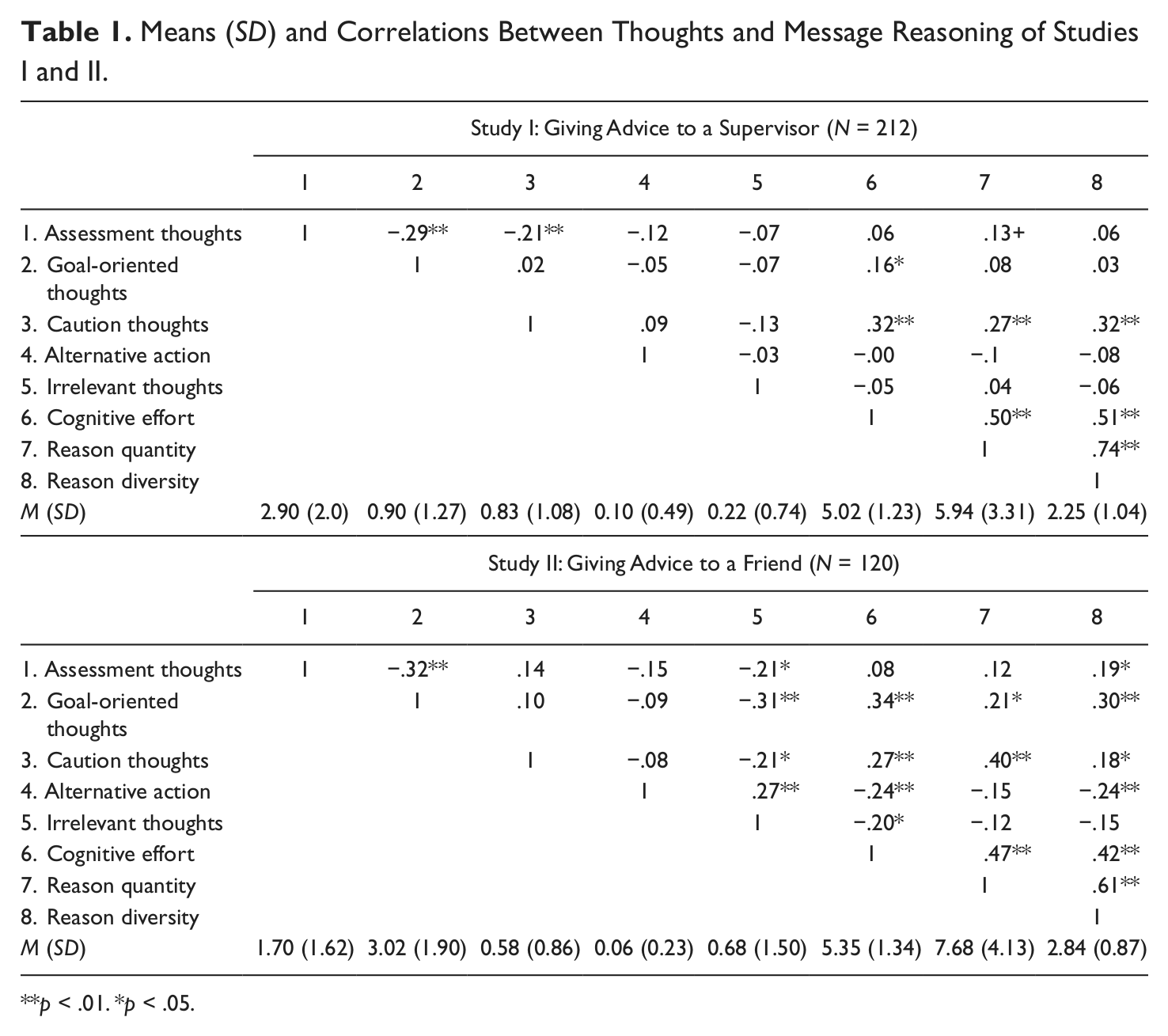
p < .01. *p < .05.
Participants in the high cognitive elaboration condition reported a significantly higher degree of cognitive effort than those in the low elaboration condition (M = 5.47 vs. 4.62), F(1, 204) = 28.15, η p 2 = .12, d = .73, but it did not interact with boss sex or advice content on cognitive effort or other dependent variables. These results suggest that the manipulation of high versus low effortful thinking was effective.
The manipulation of supervisor sex yielded a main effect on cognitive effort, with participants who imagined talking to a male boss reporting greater cognitive effort than those who imagined talking to a female boss, M = 5.20 versus 4.85, F(1, 204) = 4.12, p =.05, η p 2 = .02, d = .30, but it did not interact with cognitive elaboration. Subsequent analysis revealed that supervisor sex did not significantly affect thought generation or message reasoning. Because of this, male and female boss conditions were collapsed in subsequent analysis. Advice content did not yield any main or interaction effects on cognitive effort or other dependent variables. As such, the two advice contents were also collapsed in subsequent analyses.
Thought Content and Its Sequential Patterns
Research Question 1 asked what types of thoughts occurred in people’s mind when considering give advice. Content analysis of thoughts data revealed five distinct types of thoughts were identified (see thought coding). They are assessment thoughts (59%), caution thoughts (18%), goal-oriented thoughts (17%), alternative action thoughts (2%), and irrelevant thoughts (4%).
Research Question 2 investigated the thought generation pattern when people plan to give advice. Because participants were instructed to list their responses in a sequential order on labeled lines provided by the researcher (e.g., initially I was thinking; in middle I was thinking, and finally I was thinking), their thoughts were categorized into three stages. A 5 × 3 repeated-measures ANOVA was conducted, crossing thought types (5) and repeated measures of time stage (3). Both the thought type, F(4, 2,532) = 219.31, η p 2 = .26, and time stage, F(2, 633) = 233.40, η p 2 = .42, ps = .000, main effects were significant. There was also an interaction between thought type and time stage, indicating that how thoughts are generated across time stages depends on the type of thought, F(8, 2,532) = 96.07, p = .000, η p 2 = .23.
Follow-up pairwise comparison analyses showed that participants in Study I reported a greater number of thoughts in Stage 1 than they did in Stage 2 or 3 (M = 0.54 vs. 0.31 vs. 0.12, ps = .000). Participants on average generated significantly more assessment thoughts than goal-oriented thoughts or caution thoughts (M = 0.95 vs. 0.31 vs. 0.27, ps = .000). Alternative action thoughts and irrelevant thoughts (M = 0.03, 0.06) were among the least frequently reported thoughts.
To decompose the interaction effect between thought type and time stage, five one-way repeated ANOVA was conducted. Results revealed two trends (see Figure 1). First, caution thoughts generation differed from other types of thoughts. Although assessment and goal-oriented thoughts were salient in Stage 1, they decreased gradually in Stages 2 and 3. In contrast, caution thoughts started with a small quantity, but it increased significantly in Stage 2 then dropped in Stage 3, M = 0.16 versus 0.42, versus 0.22; F(2, 422) = 9.56; ps =.000, or an introverted “U” shape. Second, alternative action thought as well as irrelevant thought were generated across all stages in a similar quantity, F(2, 422) = .43, p =.65; F(2, 422) = .02, p = .98, respectively.
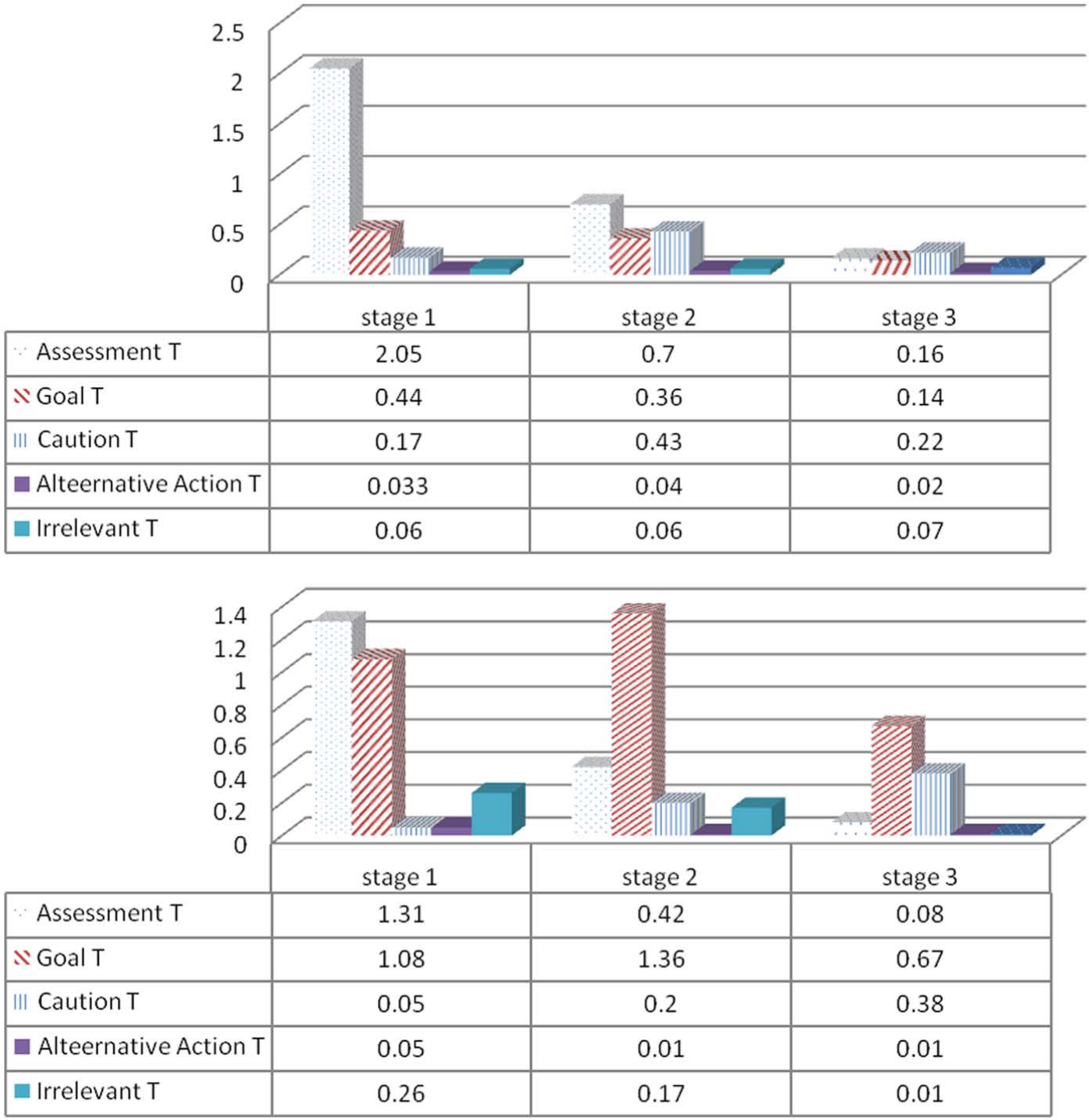
Thought generation pattern in Study I and Study II.
Further analysis of thought generation dynamics within each time stage revealed a clearer pattern. Assessment thoughts occurred most frequently in Stage 1, followed by goal-oriented thoughts and caution thoughts (M = 2.5 vs. 0.44 vs. 0.17, ps < .05). Because caution thoughts increased considerably in Stage 2, by the time of Stage 3, there was no significant difference between three types of thoughts, M = 0.16 versus 0.14 versus 0.22, ps > .10. See Figure 1.
High and Low Effortful Processing: A Comparison
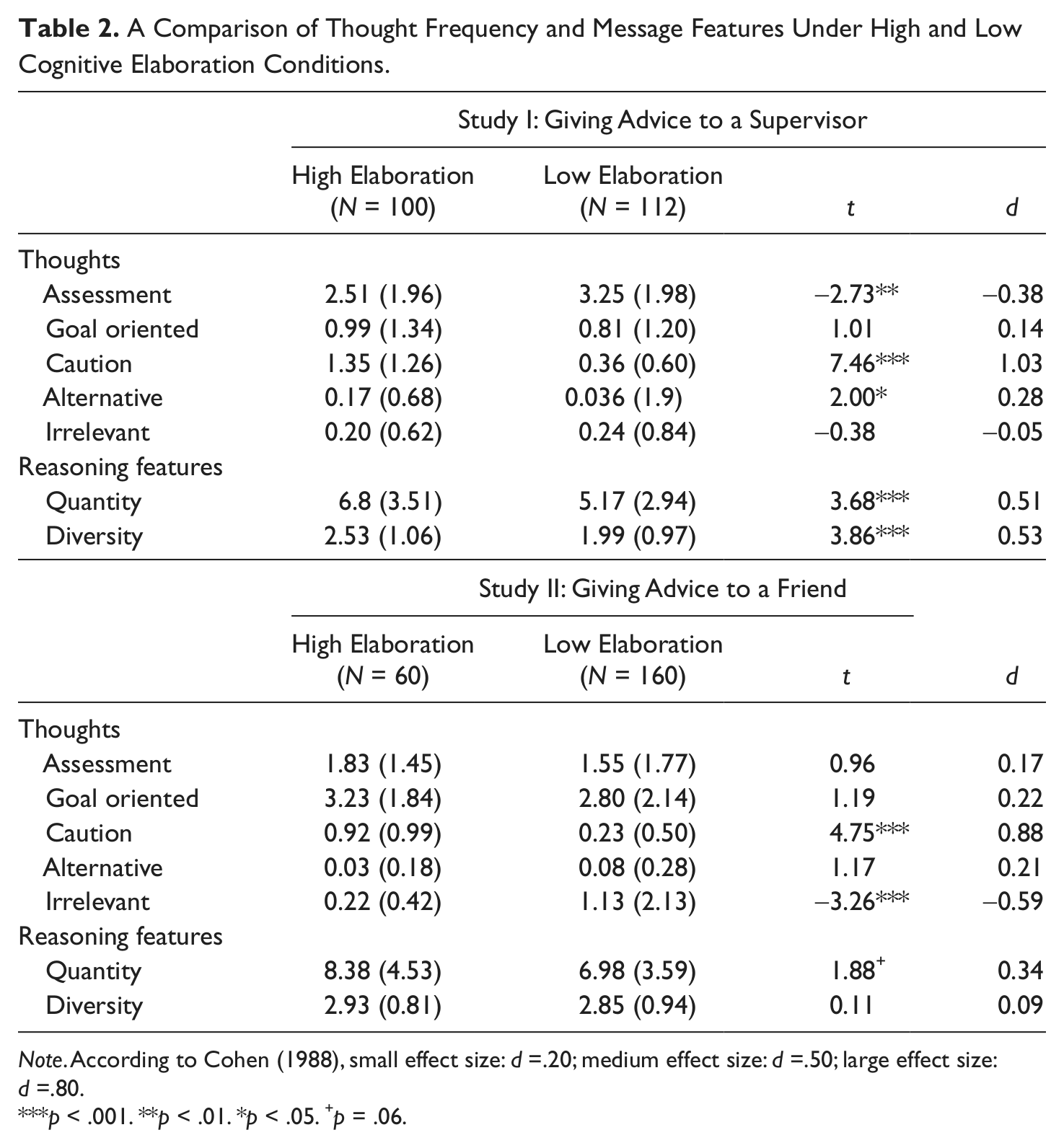
Research Question 3 investigated thought variations under high and low elaboration conditions. T test indicated that participants reported significantly more caution thoughts (M = 0.36 vs. 1.35, d = 1.03) and alternative action thoughts (M = 0.04 vs. 0.17, d = .28), but fewer assessment thoughts (M = 3.25 vs. 2.51, d = −.38) in the high cognitive effort condition than they did in the low effort condition.
Hypothesis 1 examined message variations under the two conditions. Consistent with the prediction of Hypothesis 1, participants in the high cognitive effort condition generated more reasons (M = 6.80 vs. 5.17, d = .51) and attempted to advise from more diverse aspects (M = 2.53 vs. 1.99, d = .53) than those in the low cognitive elaboration condition (see Table 2).
A Comparison of Thought Frequency and Message Features Under High and Low Cognitive Elaboration Conditions.
Note. According to Cohen (1988), small effect size: d =.20; medium effect size: d =.50; large effect size: d =.80.
p < .001. **p < .01. *p < .05. +p = .06.
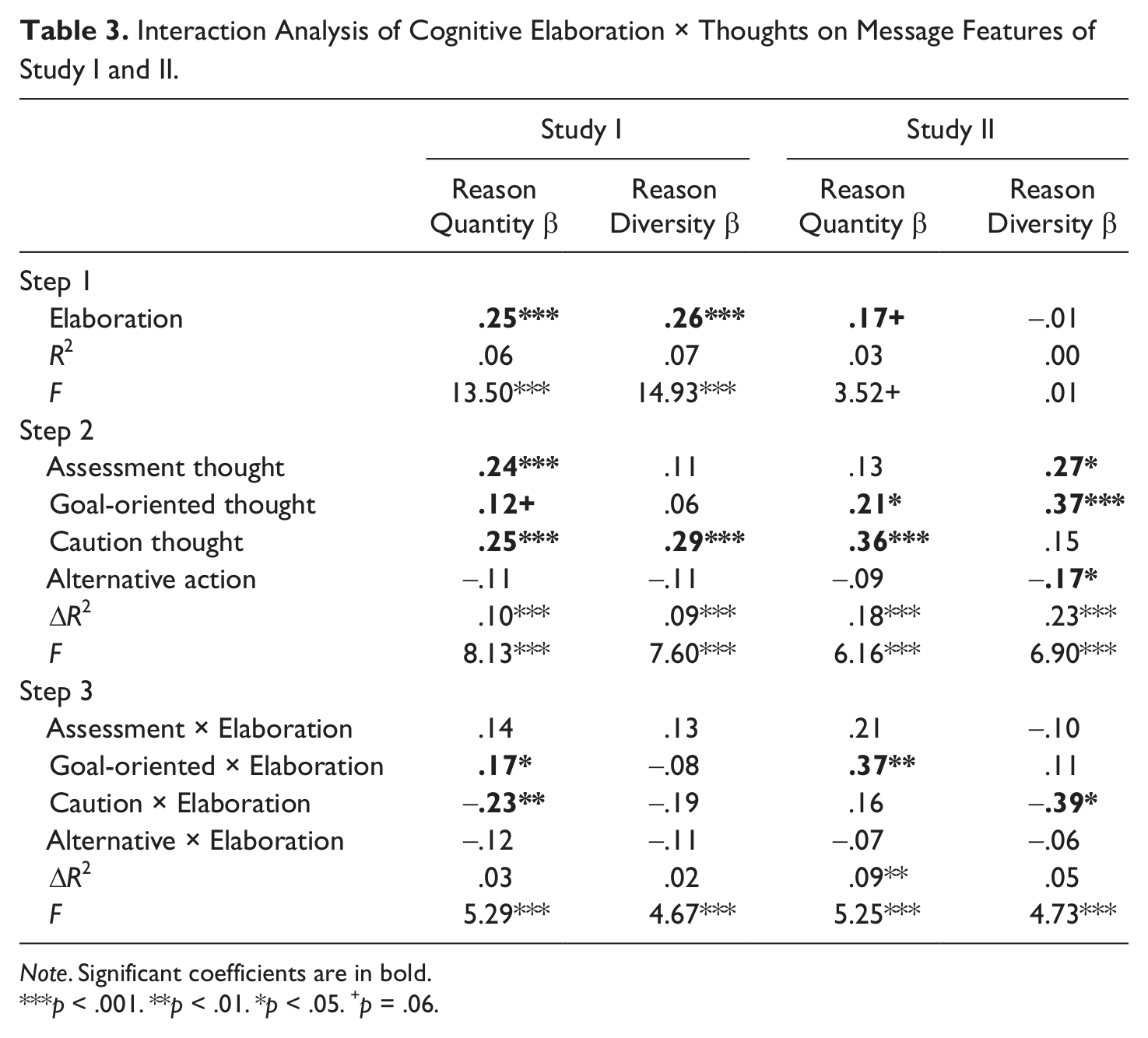
To examine how thought type affects advice giving under a high versus low effort condition (Research Question 4), a hierarchical multiple regression analysis was conducted (low = 0, high = 1). All dependent variables were standardized. Data showed that except for alternative action thoughts, all other types of thoughts could significantly predict at least one reasoning dimension, ranging from βs =.12 to .29, ps < .001. Two significant interaction effects were detected. First, caution thoughts interacted with cognitive elaboration, β = −.23, p = .01, so as goal-oriented thoughts, β = .17, p = .05 (see Table 3).
Interaction Analysis of Cognitive Elaboration × Thoughts on Message Features of Study I and II.
Note. Significant coefficients are in bold.
p < .001. **p < .01. *p < .05. +p = .06.
Follow-up comparisons of regression coefficients revealed that caution thoughts influenced reasoning quantity more in the low than the high elaboration condition, but it did not approach statistical significance, β = .34, t(208) = −1.96, p = .08. Goal-oriented thoughts had a greater impact in the high than the low elaboration condition, but it did not reach statistical significance either, β = .09, t(208) = .63, p = .50.
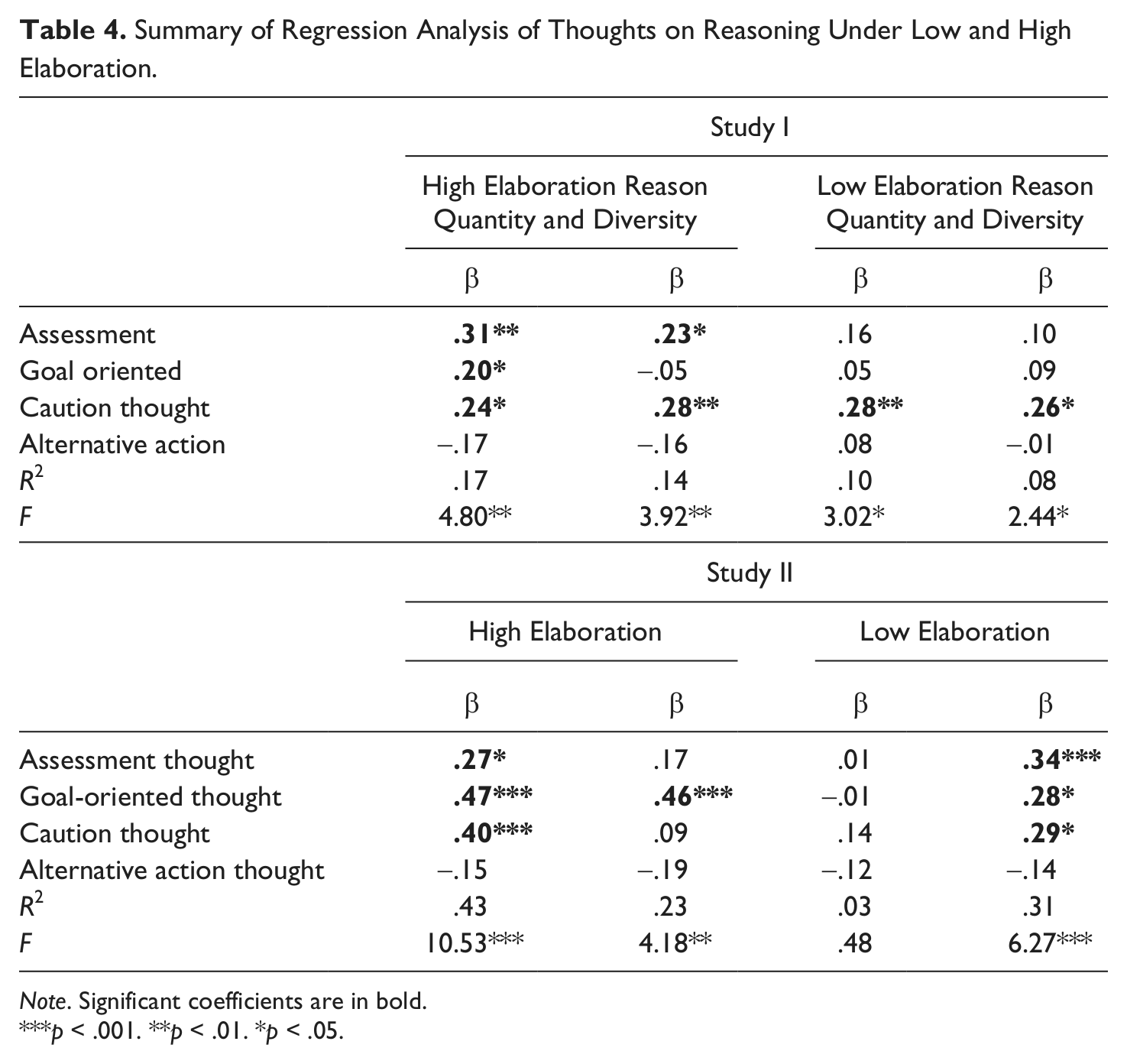
To gain a clearer understanding of these observed interactions, separate regression analyses under high and low effortful processing were conducted (see Table 4). When people were in high effortful processing, data revealed that multiples thoughts were able to exert influence on message reasoning, including assessment (βs = .31, .23), goal-oriented (βs = .20, .05), and caution thoughts (βs = .24, .28). In contrast, when people did not think in an effortful way, the associations between most types of thought and message features became weak and nonsignificant (βs = .05-.16). In contrast, this pattern was reversed for caution thought. Caution thoughts was the only type of thought that could continue to predict message reasoning in the low elaboration condition (βs = .28, 26).
Summary of Regression Analysis of Thoughts on Reasoning Under Low and High Elaboration.
Note. Significant coefficients are in bold.
p < .001. **p < .01. *p < .05.
Study II: Advice Planning in Friendship—A Replication
Method
Participants
The purpose of Study II was to replicate Study I to determine whether a similar thought generation pattern in advice planning can be observed in a different sample. A total of 120 undergraduate students from three universities in the United States participated in an online survey (77 women, 43 men, Mage = 23.5, age range = 19-30, 69% Caucasian).
Procedure
All participants read a scenario about “Mark” being upset with his parents’ disapproval on choosing creative writing as his major. To vary people’s cognitive effort, in addition to the task importance manipulation, participants in the high elaboration condition were told that “Mark is a very close friend. You’ve known each other for over 10 years.” In contrast, participants in the low elaboration condition were told that “Mark is your friend. You’ve known each other for about a month.” Except for a change in advice-giving context, all other parts of the questionnaire, including the methodology to gather thoughts and messages were the same as Study I.
Manipulation Check
Participants reported a significantly higher degree of cognitive effort in the high cognitive elaboration condition than they did in the low elaboration condition (M = 5.62 vs. 5.08), F(1, 118) = 4.94, d = .41. This result suggests the manipulation was effective in inducing high versus low effortful processing conditions.
Coding Reliability
Two coders (one holds a PhD degree and one holds MA degree in communication) were recruited. After a 2-hour training session, one coder coded thoughts data and another coder coded message data while the author coded both sets of the data. Kappas exceeded .90 for thought categorization between Coder 1 and the author. Guetzkow’s U of unitizing reasons was .02 between Coder 2 and the author. Pearson’s r was .92 on reasoning diversity. The final data were based on consensus after disagreement was resolved through discussion.
Results
Thought Content and Its Sequential Patterns
Regarding Research Question 1, consistent with Study I (84%), Study II found that about 88% of people’s thoughts focused on situation assessment (28%), communication goals (50%), or caution (10%).
In terms of thought generation pattern (Research Question 2) across time stages, Study II replicated two findings that were observed in Study I and also revealed one different result. As Figure 1 shows (Study II section), consistent with Study I, participants reported a greater number of thoughts in Stage 1 than they did in Stage 2 or 3 (M = 2.75 vs. 2.15 vs. 1.13, ps = .000). Mixed-model ANOVA crossing thought type (5) and time stage (3) also yielded a significant interaction effect, F(8, 1,428) = 25.60, p = .001, η p 2 = .13. Similar to Study I, data from Study II also indicated that caution thought has an unique generation pattern cross time stages. Whereas other four types of thoughts went down by Time 3, the number of caution thoughts went up from Time 1 to Time 3, M = 0.05 versus 0.20 versus 0.38. ps = .05.
In terms of divergence, Study II found that participants in a friendship context tend to generate significantly more goal-oriented thoughts than assessment thought or caution thoughts (M = 1.04 vs. 0.60, 0.21). Note that participants in Study I generated more assessment thoughts than other thought types in a workplace context.
High and Low Effortful Processing: A Comparison
By comparing thought content and message qualities under high versus low cognitive effort condition, Study II found that participants generated significantly more caution thoughts (M = 0.92 vs. 0.23, d = .88) and used more reasons (M = 8.38 vs. 6.98, d = .34) in their advice message in the high-elaboration condition than they did in the low-elaboration condition. These two findings successfully replicated what were found in Study I.
With regard to the relationship between thoughts and advice messages, results of Study I and II shared two common features. As Table 3 shows, consistent with Study I, regression analyses in Study II indicated that a variety of thoughts can influence advice message features (β = .21-.37, p < .05). Second, in terms of interaction effects, Study II successfully replicated two interaction effects observed in Study I. That is, both caution thoughts and goal-oriented thoughts interacted with cognitive elaboration on message reasoning. Similar to Study I, a follow-up comparison of regression coefficients indicated that caution thoughts influenced reasoning quantity significantly more in the low than the high elaboration condition, β = −.48, t(116) = −2.36, p = .02. Goal-oriented thoughts, despite a significant interaction effect, did not show a considerable difference when regression coefficients under high versus low conditions were compared, β = .15, t(116) = .85, p = .40.
Finally, separate regression analyses in Study II also revealed a similar pattern of message construction as observed in Study I. As shown in Table 4, when people gave advice under a high effortful processing, multiple thoughts seem to exert influence on their message construction in terms of reasoning diversity and quantity, ranging from β = .09 to . 46. In contrast, when advice givers did not think in an elaborate way, they appear to touch on issues in a great variety (reasoning diversity: β = .29-.34) but not in a substantial manner (reasoning quantity: β =.01-.14).
Discussion
The purpose of this research was to investigate how different types of cognitive responses (thoughts) affect people’s advice-giving behavior. Results from both Studies I and II revealed that advice message qualities, such as reasoning quantity and diversity (also called “argument explicitness”; see Feng & Burleson, 2008), are determined to a certain extent by advice givers’ thought content. Furthermore, cognitive effort tends to moderate the process of how thoughts affect advice message production. The following sections summarize its major findings and discuss their implications in terms of how they may advance our knowledge of advice giving.
Advice Giving Involves Multiple Thoughts
This study extends advice literature by identifying five distinct types of thoughts that may occur in mind when people are about to give advice: (a) assessment thoughts, (b) goal-oriented thoughts, (c) caution thoughts, (d) alternative action thoughts, and (e) irrelevant thoughts. Collectively, thoughts on situation assessment, communication goals, caution, and alternative action account for one fifth of the variance observed in advice message reasoning (Study I, 16%; Study II, 22%).
Regarding thought structure involved in planning, results from Studies I and II are consistent with Waldron et al.’s (1990) study using a cued-recall method. They found that 89.6% of people’s thoughts are either on assessment or future plans. Similar to their findings, the present research using a thought listing technique found that about 84% to 88% of people’s cognitive responses focused on assessment, goals, and caution. This result suggests that there is rather stable proportion of cognitive resources that are engaged when people plan a message.
Although there are a number of thoughts relevant for advice planning, the present research provides evidence that the relative proportion of each type of thought is context specific. In a work place context (Study I), people reported significantly more assessment thoughts than other types of thoughts when imagining talking to a work supervisor. In a friendship context (Study II), people reported a greater proportion of goal-oriented thoughts when imagining talking to a friend. This line of evidence seems to suggest that salient situational factors give rise to what people think and say (Berger, 1997). As discussed previously, it is more face threatening to give advice to a supervisor than a friend. As a result, participants in Study I paid more attention to situation assessment (e.g., who, what, how) in preparation for subsequent message design. Comparatively, participants seem to have less hesitancy in providing advice to a friend. Their goal-oriented thoughts were most prevalent in such a context.
There is also a possibility that the difference in proportion of particular kinds of thoughts is a function of task familiarity. As compared with giving advice to friends, many participants might not have the experience of giving the kind of advice to a work supervisor, thus they had to spend more mental effort assessing/understanding the situation. In other words, familiarity with the task or situation can be a potential moderator that can be empirically assessed in future research.
This research also advances prior research by discovering a new type of thoughts that appears to be crucial for advice planning—caution thoughts. Such thoughts have an anticipatory focus on advice receiver’s reactions, communication obstacles, and message’s social effects on the self and other. They exist in a relatively small proportion (10% to 18%) and are activated later in people’s thinking stream in both Studies I and II. But when participants are in an effortful thinking mode, they tend to generate a greater number of such thoughts than other types of thoughts. Moreover, caution thoughts are found to predict advice message reasoning in both high and low elaboration conditions. Such a unique role of caution thought was observed in Study I and was replicated in Study II. This result seems to suggest that caution thoughts may serve, to a certain extent, as an indicator of elaborative thinking in message planning.
Furthermore, the present research is the first empirical investigation conducted to describe how diverse advice-related thoughts interact with each other in the message planning stage. Based on the analysis of participants’ thought listing data in three intervals—initial, middle, and final stages—both Studies I and II found that although assessment thoughts are prevalent in early stages, caution thoughts begin to increase considerably in Stage 2. Goal-oriented thoughts tend to remain in a moderate amount across planning stages. In the final stage, different types of thoughts eventually strike a balance. Throughout this process, alternative action and irrelevant thoughts are active but in a very small amount.
Such thought generation dynamics correspond well with AAT II’s conceptual analysis of the relay and coalition features in message production (Greene, 1997). During initial planning, assessment thoughts provide raw situational information. As people continue to think, goal-oriented and caution thoughts start to accumulate, which indicates a tendency toward more complex planning regarding advice message content and effects. Such a “building” process of different kinds of thoughts connecting with each other seems to resonate well with AAT II’s proposition regarding message planning. According to Greene (1997), during a message construction process, multiple active thoughts work on or against each other. They demand a communicator to find ways to address them in an overt message. Although this study did not fully capture this dynamic integration process, the relatively equal amount of different kinds of thought observed in later advice planning stage seems to provide preliminary evidence of such a tendency. As message production theorists advocate, an effective communicator knows how to integrate multiple (sometimes conflicting) goals and plans in a coherent manner (Greene, 2006; Wilson, 1990, 2002).
Moreover, this research provides important evidence regarding the positive association between certain types of thoughts (e.g., assessment, goal oriented, and caution) and advice message qualities. Data from Studies I and II consistently indicated that thoughts on assessment, communication goals, and caution can predict message reasoning in terms of quantity and diversity. One practical implication for advice giving is that advice givers should be aware that the number and the type of thoughts they have in mind may directly affect what they say when giving advice. For example, although many thoughts might come into mind, those individuals who are able to move beyond assessment thought and start to elaborate on how to integrate multiple thoughts (e.g., goal-oriented and caution thoughts) are more likely to produce effective advice messages, as compared with those who do not seriously consider these aspects.
The Significance of Cognitive Effort
The present research highlights the importance of cognitive effort in advice planning. Both Studies I and II showed that higher level cognitive effort was related to a greater number of goal-oriented thoughts and caution thoughts (rs = .16-.34). Consistent with prior research (Jordan & Roloff, 1997; Waldron, 1990) on the role of effort, results from Studies I and II also suggest that heightened degree of effortful thinking in deciding how to give advice, as compared to low effortful thinking, results in a greater number of caution thoughts and advice messages that contain a larger number and more diverse set of reasons. As a whole, this finding is consistent with the proposition that, when everything else is being equal, cognitive effort can enhance message qualities.
Moreover, this study provides first evidence that the level of cognitive effort (low vs. high) moderates how thoughts affect message construction. A common theme that emerged from Studies I and II is that there is an array of thoughts actively exerting influence on message construction when people are in a high effortful thinking mode. Apparently some plans are in conflict with others (e.g., “I need to present reasons in order to be effective.” “But if I give too many reasons, I might appear too aggressive or pushy”). Thus, consistent with Berger’s (1997) strategic planning proposition, a careful advice giver not only considers multiple relevant thoughts but also balances several potentially conflicting demands when planning on how to say.
In contrast, people may want to follow a rather simplified model to construct a message. This research provides some initial evidence that when people are in a relatively less effortful thinking mode, they may either excessively rely on one type of thoughts in planning (Study I) or give advice in a superficial manner without sufficient reasoning (Study II). This part of the findings extends our understanding by providing a more complete account for message construction processes under high versus low effortful processing (Miller, 1990). In particular, it clarifies that, although a comprehensive thinking mode is cognitively taxing, it results in significantly different message qualities.
On the other hand, however, it should be noted that the observed positive relationship between cognitive effort in message planning and message quality is based on the assumption that individuals have the necessary levels of knowledge and skill for increased cognitive effort to enhance their performance. In this research, full-time employees and college students were asked to give advice on issues that they are familiar with. Plus they read a detailed description of the problem, to which they are to advice on solutions. As such, they largely possess the basic knowledge and skills to offer advice. Under such a condition, this study clarifies that whether or not exerting effort to think before talking will make a difference in message qualities. With this said, it seems that the present findings can be applied well to those moderately complex situations in everyday communication (O’Keefe & McCornack, 1987). However, they may not be applicable to those situations when a communication task requires special knowledge and training (e.g., counseling), when an automatic behavior with minimum effort is more desirable (e.g., smile and say “Hi”), or when an expert can give effective advice without effortful thinking.
Limitations and Future Research Direction
Using a thought listing method, this study collected people’s cognitive responses at one time frame right before message construction. Such a design does not fully reflect the whole planning process. Planning occurs throughout the message construction process, such as initial reaction, word choice, and online editing. Some planning process even operates below the level of conscious awareness (Greene, 1997). To gain a fuller view of advice message planning, a more comprehensive method is called for to examine the multiprocess nature of planning (e.g., initial planning, premessage planning, and online planning).
Second, by using individual participants as the analysis unit, this research did not fully capture the dynamic process in advice giving situations. Past research suggests that reasoning quantity and diversity can be used to evaluate advice effectiveness. They are true in most cases, but “more” is not always “better.” Sometimes one piece of right-on-target suggestion may be seen as more effective than advice with five nonessential reasons. As Sanders and Fitch (2001) suggested, in actual compliance seeking dialogues, message sources and targets negotiate how much reasoning is needed to justify advice on a turn-by-turn basis. Although artificial in some respects, future studies might ask participants to role-play advice-giving interactions, document their thoughts during the conversation, and ask how they evaluate the effectiveness of the advice received. If some of the findings from the present study are replicated, we might be more confident about the current knowledge regarding how thoughts in planning are associated with advice message effects.
Footnotes
Acknowledgements
The research reported in this article is part of the author’s doctoral dissertation, which was directed by Dr. Steve R. Wilson from Purdue University. The author wants to express her sincere gratitude to Drs. Steve R. Wilson and Bo Feng for their generous support for this research. She also wants to thank two anonymous reviewers for their insightful comments on an earlier draft of this article.
Declaration of Conflicting Interests
The author declared no potential conflicts of interest with respect to the research, authorship, and/or publication of this article.
Funding
The author received no financial support for the research, authorship, and/or publication of this article.