




Abstract
The consequences of marginalized ethnic group emancipation for historically privileged groups are rarely examined, despite assertions that the disruption of traditional power balances leads to backlash. This article addresses identity change in a ‘most probable case’ of intergroup threat, examining reactions to indigenous empowerment in Bolivia. After translating theory on identity change into testable implications, it explores meso-level rhetoric of the Santa Cruz Autonomy movement through diverse sources and micro-level identification through time-series survey data. It finds evidence for the constructionist power of discourse: its ability to create societal consensus on collective identity in a relatively short time span.
Introduction
Collective identities are constructed and hence, in theory, also amenable to re-construction. Yet how, and how quickly, identities change remains up for debate (Hale, 2004). While this question has received some attention recently (e.g. Chandra, 2012; Wimmer, 2008a), much work on identity politics is still based on differing assumptions as to the speed of identity change. On the one hand are studies in nationalism and related topics that hold that collective identity change is a long-term process, unfurling only over many generations. On the other hand are studies, particularly on ethnic conflict, that assume that political entrepreneurs are able to manipulate collective identities for personal gain (see Weber et al., 2016).
In the latter works, collective identity change occurs relatively quickly: political elites alter the conception of the collective identity in public discourse, which is increasingly accepted by rank-and-file citizens and invested with meaning. Political elites are hence able to create consensus on a new collective identity and in doing so create the identity itself. However, empirical research on the links between political rhetoric and citizen conceptions of collective identity is very young and so far remains inconclusive. Some studies suggest that political rhetoric indeed has a deteriorating effect on ethnic relations, and not only when the rhetoric is negative (Sprague-Jones, 2011): the mere mention of ethnic diversity suffices as it increases the salience of differences in society (Helbling et al., 2013). Other studies do not find evidence for any link between rhetoric and attitudes and suggest not to overestimate the ‘constructionist power’ of political rhetoric (Boonen and Hooghe, 2014: 56; see also Hjerm and Schnabel, 2010). Yet the majority of studies do not directly examine collective identity conceptions, either at the elite or individual level, nor are their cross-sectional designs able to examine dynamic processes such as identity change.
This article fills this gap. It examines processes of identity contestation and consensus at both the elite and individual levels over time and in a context of rapid socio-political transformation: the department of Santa Cruz in Bolivia. The steady rise of the indigenous–peasant-based political left in the 2000s, culminating in the election of Bolivia’s first indigenous president and the announcement of sweeping political and economic reforms, appeared to threaten the privileged position of (mainly white and mestizo, that is, mixed) landholders in the resource-rich department of Santa Cruz. In reaction to the threat, the elite mobilized for regional autonomy and supported their demands with a discourse on a regional cruceño identity. Such shocks to a society’s power relations are said to provide fertile ground for identity change: members of the historically privileged group may assert their identity in reaction to perceived challenges to their hegemonic status (e.g. Horowitz, 1985; Wimmer, 2008b). But while such instances, for example, through supremacist or anti-immigrant movements, have been documented (Doane, 1997), less is known about whether they do indeed affect consensus on identity change in the population at large. In the United States, the forerunner in much of the political sociology and psychology of ethnic relations, research on white identity has only just begun (e.g. Jardina, 2014; Schildkraut, 2015). As a most likely case for identity change, the Bolivian context provides a useful probability probe of hypotheses about the link between elite and societal conceptions of identity.
Following an introduction to the Bolivian context, the article outlines a conceptual framework for the analysis of identity change at both elite and mass levels, translating the sociological theoretical literature on identity boundaries into testable implications. In particular, I propose to examine an identity’s boundary location, its salience and its permeability in order to obtain measures of societal consensus or contestation on collective identities. The following sections take a first step in applying the operationalization to the Santa Cruceño context. Given the intersubjectivity of identity and identity change, the empirical examination is necessarily a medley of methods. For the elite level, I draw on historical and anthropological accounts as well as local expert interviews and newspaper analysis to map out how the Santa Cruz elite (claimed to) perceive a threat to cruceños, and how they reacted to that: first with an emphasis on a regionally circumscribed rather than an ethnic boundary, and then with a renewed ethnicization of this regional boundary and an increased focus on the negative out-group. I then go on to examine whether this elite conception of the group boundary is reflected in the wider population through the use of representative time-series survey data. I show that consensus indeed developed: identification first increased and spread to all social spheres and, from around 2008 onwards with the switch of the discourse towards the focus of the negative out-group, also had an exclusionary effect on those with weaker historic ties to the department, namely, highland indigenous immigrants. While consensus seems to somewhat lessen again from 2010 onwards, the article hence lends support to the ‘constructionist power’ of political discourse to affect identity change, and to do so in a relatively short time span.
On Bolivia
Bolivia is one of the most unequal countries in Latin America, and socio-economic situation and ethnic background usually coincide. Long-term structural and direct discrimination long marginalized the country’s indigenous population, such that indigenous Bolivians fare consistently and considerably worse in developmental indicators such as poverty, malnutrition, infant mortality, literacy rates and land ownership (Committee on the Elimination of Racial Discrimination (CERD), 2006; Economic Commission for Latin America and the Caribbean (ECLAC), 2006; United Nations Development Programme, 2011; see also Gisselquist, 2013). Indigenous Bolivians mobilized against this marginalization from the 1970s, but only began to see some success in the 1990s, when changes in the political structure opened up spaces for indigenous movements and parties (Van Cott, 2005). In December 2005, the continued mobilization culminated in the election of Evo Morales as the country’s first indigenous president and the subsequent initiation of constitutional reform, which was to lead to the pronouncement of the Plurinational State of Bolivia and the recognition of its indigenous population as an integral part of it.
It was widely perceived that Bolivia’s indigenous movement had succeeded in elevating the indigenous category to be equal in both power and status with that of the non-indigenous – white or mestizo – population. Some among the non-indigenous population, however, perceived this process not as equalizing power relations but as inversing the status quo, fearing that the indigenous movement’s advance would now curtail their own interests. This reaction was particularly pronounced in Santa Cruz, a relatively wealthy department in the south-east of the country.
While Bolivia is rich in natural resources, these resources are unevenly distributed: most are found in the eastern lowlands of the Amazon and little in the western highlands of the Andes. Of Bolivia’s nine departments, the south-eastern lowland departments of Tarija and Santa Cruz together produce 82.3% of the country’s gas output and 41% of its gross domestic product (GDP). With 28.2%, Santa Cruz is the single largest contributor to Bolivia’s GDP (Weisbrot and Sandoval, 2008). Santa Cruz’ situation as Bolivia’s economic powerhouse has bestowed upon the department a steady stream of immigrants. According to the 2001 census, about 25% of the department’s population were born elsewhere in Bolivia, and some rural areas of the department, as well as the periphery of the capital Santa Cruz de la Sierra, are mainly inhabited by immigrants from the Andean highlands (Instituto Nacional de Estadística (INE), 2001; Kirshner, 2010).
However, the majority of these internal immigrants, as well as the mainly indigenous population in the department’s rural areas, are excluded from Santa Cruz’ wealth, living in precarious circumstances (Kirshner, 2010; Weisbrot and Sandoval, 2008). The profits of the agricultural industry are produced by only a few large landholdings, and those generated in the hydrocarbon industries concentrated in the urban middle and upper classes of the capital. This ensures that the economic elites are at the same time the political elites. Organized in the Committee for Santa Cruz (Comité Pro Santa Cruz, CSC), they have long been an influential force in the defence of the department’s interests. It was principally from this organization that the demand for greater autonomy from the centralized state originated.
The Committee was first founded by local landholders in the 1950s to defend the, until then long-ignored, region and its political and economic interests against increasing intervention from the central state. Part of its strategy was the creation of a distinct regional identity: it recuperated the previously pejorative term ‘camba’ to denote the descendants of the white cruceños and the lowland indigenous population. In so doing, the Committee created its own regional form of mestizaje (mixture), which had previously served as a nation-building device in much of Latin America (e.g. Loveman, 2014). The newly coined camba were contrasted to the ‘colla’ in the Bolivian highlands, descendants from Incas, who then and now, it was argued, controlled the central state and intruded into regional affairs (Peña Hasbún et al., 2011; Pruden, 2003). The campaign was successful and following the 1950s, the camba–colla distinction was always evoked when the Committee was unable to attain local interests directly through alliances with the national political elite (Peña Claros and Boschetti, 2008; Sivak, 2007) – such as in the 2000s, as addressed in the remainder of the article.
Examining changing consensus on collective identities
Examining identity change requires detailing which elements change and who or what impels these changes. Here, identity refers to a collective feeling of belonging to a bounded group, or what Brubaker and Cooper (2000) call groupness. Identity, or groupness, thus consists of two elements: the definition of a bounded group on the basis of certain attributes as well as a sense of belonging among the members of this bounded group (see also Flesken, 2014).
Political elites are said to affect both group boundaries and feeling of belonging to the group by shaping public discourse (Wimmer, 2008a; Weber et al., 2016). However, for such changes to hold, the group’s rank-and-file members must accept them, turning merely symbolic boundaries into social boundaries with consequences for social interactions (Lamont and Molnar, 2002). A focus on group boundaries is particularly useful for the study of identity in a situation of rapid socio-political transformation. It allows for examination of what is essentially a relational and intersubjective process involving multiple actors in the definition and legitimation of identities (e.g. Barth, 1969; Lamont and Molnar, 2002; Wimmer, 2008a). Thus, identity change refers both to consensus about changes in the group boundaries at the collective-intersubjective level and to the acceptance of these changes at the individual level.
The article focuses on three interrelated properties of identity boundaries: their location, salience, and permeability. The location of a boundary defines its scope of inclusion or exclusion, the in-group and the out-group, determining the composition of people and attributes of the identity at each side of the boundary. A change in boundary location may occur either through a recombination of attributes that constitute group membership rules or a change in the attributes themselves (Wimmer, 2008a; Chandra, 2012). A second essential property is boundary salience within the population. Boundaries can become more or less salient; they can be blurred or brightened (Alba, 2005; Zolberg and Long, 1999) and deactivated or activated (Tilly, 2004). Location and salience determine a boundary’s third property: its permeability or closure. Permeability denotes the ease with which individuals can cross boundaries and be accepted by others as fellow members (Lamont and Molnar, 2002; Wimmer, 2008b). A more prominent, widely agreed upon boundary makes unconscious shifts in identity less likely and makes conscious, active crossings more difficult.
I examine changes in boundary location, salience, and permeability at both the intersubjective and the individual level. The first level refers to the dominant discourse, shaped by the political elites. I investigate it by asking three questions: who is included or excluded from the cruceño? Is the distinction made out to be absolute or would individuals be able to cross the boundary and become cruceño? How salient is this distinction? I map the dynamics of the discourse on the basis of anthropological and historical accounts of the Santa Cruz autonomy movement and its major driver, the CSC. I complement these accounts with interviews among local experts in late 2011 and a content analysis of Bolivian newspaper articles between 2005 and 2010 (Centro de Documentación e Información Bolivia, 2012). To select the articles for analysis, I searched all archived newspaper articles for the occurrence of boundary-related words and then chose up to four articles per month, amounting to 220 articles, for closer examination. 1
The article also discusses changes in the degree of consensus among Santa Cruz residents, using the AmericasBarometer survey data gathered by the Latin American Public Opinion Project (LAPOP) every 2 years since 2004. 2 To capture the salience of the cruceño label, I examine the degree to which Santa Cruz inhabitants claim attachment to the bounded group: the higher the attachment, the more prominent the boundary (see ‘Introduction’, this volume). Since aggregate measures may be driven by extreme values among certain groups of society, I disaggregate attachment by socio-demographic groupings: if the boundary is widely accepted in society, there should be no differences between age, gender, income, or education categories. Finally, I study the perceived permeability of the boundary by accounting for respondents’ non-regional, ethnic background: does the regionally bounded group appeal only to white and mestizo inhabitants, or also to the department’s indigenous population? All three lenses provide us with evidence on consensus about identity change.
Changes in elite discourse: The Santa Cruz autonomy movement
In Bolivia, the early 2000s were marked by a series of large-scale, anti-neoliberal protests. In October 2003, their focus turned to the government’s natural resource policy, causing concern in resource-rich Santa Cruz: the political and economic elites feared the forced eviction of a major international investor and the loss of revenues from gas exports (Eaton, 2007; see also Assies, 2006). These events led the CSC, which had mainly operated in the background before, to now take on an explicit role as opposition to ever more likely changes to the government’s natural resource policy. 3 At a public rally in June 2004, the Committee’s president directly attacked the protesters’ agenda as one of violence and repression, and instead proclaimed an alternative agenda centred on regional autonomy which, he argued, would bring prosperity to all Bolivians (Assies, 2006). By January 2005, the rhetoric had sharpened and a distinctive boundary was drawn between the department and what was seen as the ‘radically distinct vision that dominates the western part of the country’. Some politicians even expressed separatist considerations should natural resources be nationalized and property rights and investments threatened (Webber, 2010: 59–60; see also Assies, 2006; Eaton, 2007). In support and legitimation of its political course – which could have been easily interpreted as a strategic step to defend elite economic interests – the Committee and other organizations availed themselves of a regional identity discourse that had served previous generations well. The following years saw a growing emphasis on the regional cruceño identity, which was increasingly ethnicized, before violent consequences put a stop to the discourse.
The autonomist elite first reached out to the wider population by emphasizing the cruceño regional identity and unity as well as its distinction to the western, highland population of Bolivia. 4 The official discourse focused on the territory and ideology shared by the inhabitants of Santa Cruz, with repeated references to the department’s positive attributes, particularly its productivity and prosperity (Peña Claros and Jordán Bazán, 2006). The narrative also discursively united its population by emphasizing that statements are made in the name of all – rather than just white or mestizo – Santa Cruz inhabitants. The latter were now defined as everyone living, not only being born, in Santa Cruz, including the department’s immigrant population (Eaton, 2007). In this way, the autonomy movement changed the definition of the cruceño from one of territorial, or even biological roots, to one of choice and thus de-ethnicized the category, broadening the boundary and making it more permeable. At the same time, this collective identity was strategically politicized in the discursive sphere, with the cruceño increasingly connected to demands for more political rights: of all examined newspaper articles, the share of those linking the two issues rose from 7.1% in 2005, to 15.2% in 2006 and to 28.6% in 2007.
The movement’s discourse and behaviour led to an increasingly clear definition of the ‘other’ to Santa Cruz. While Peña Claros and Jordán Bazán (2006: 83) argue that in October 2003, the other to Santa Cruz was not yet clearly articulated, this changed by the end of 2005, when both discourse and action emphasized two out-groups in particular. The first out-group was the ‘unruly’ lowland indigenous people. Although the lowland indigenous population was discursively included in, for example, speeches and public festivities, the represented versions of the Guaraní and Guarayo peoples – taken to stand for the entire lowland indigenous population – remained stylized and folkloristic (Gustafson, 2006; Lowrey, 2006). Diversion from this stylized version was not accepted: Gustafson (2006) describes how the movement’s shock troops were sent to break up a Guaraní blockade in the department’s poorer, southern periphery, which had been set up in demands of higher shares of gas royalties. Thus, while the autonomy movement’s discourse broadened the boundary, its actions suggested the appropriate content of this boundary.
The second out-group was highland immigrants, the so-called colla. This discourse in particular radicalized following the December 2005 national elections, which turned Bolivia’s political sphere upside down. With Morales’ Movimiento al Socialismo (Movement towards Socialism, MAS), an indigenous–peasant-based social movement was now in government and the traditional national political parties were severely weakened. The previous power parity was broken, and the polarization instead continued within congress, and in particular in the constitutional assembly convoked by the new government (see also Yaffar de la Fuente, 2011), as well as in the streets (for a chronology of events, see Centellas, 2016; Chávez Casazola, 2009; Sivak, 2007). The colla, according to newspaper representations, threatened the department’s prosperity. Santa Cruz and its political agenda were repeatedly presented as a role model for the whole of Bolivia, superior to the model presented by the primitive, indigenous Bolivia (see also International Crisis Group, 2004; Schilling-Vacaflor, 2009). Being cruceño was based on the antagonism between a failed and chaotic Bolivia, represented by the west, and a successful Bolivia represented by Santa Cruz. The autonomy movement’s political agenda was seen as a chance to ‘easternize the Westerners’. 5
While the discourse emphasized the cultural content of the cruceño further, with attention being paid to the use of local dialect in advertising or the permanent hoisting of the departmental flag, it now focused more on the out-group and became increasingly hostile (Peña Claros, 2010). Before the elections to the constitutional assembly in July 2006, 34.1% of all examined newspaper articles made a direct reference to collas or the West, but by the end of 2008, this share rose to 53.9%. The movement’s repertoire of performative politics became ever more violent, including the burning of effigies and armed assaults (Gustafson, 2008; Howard, 2010). Carnival celebrations portrayed the colla – and especially Morales as stereotypical representative of the colla – as the enemy by joking about or conducting mock lynchings of Morales (Fabricant, 2009). Following the conduct of a self-proclaimed and illegal autonomy referendum in September 2008, several buildings were occupied and robbed, with the declared goal to bring state institutions under departmental control. The offices of indigenous organizations as well as those of several non-governmental organizations were attacked and destroyed, and in the poorer, mostly migrant quarters of the capital Santa Cruz de la Sierra, numerous people were victims of violence. In the aftermath, the attacks were justified as having been ‘provoked by the government’ (Schilling-Vacaflor, 2009: 291). 6
The political polarization led to further clashes in the streets. In September 2006, the autonomy movement organized a general strike in support of its political demands. However, not everyone in Santa Cruz was supportive: especially in suburbs and towns mainly inhabited by highland immigrants, people resisted the strike and clashed with movement shock troops trying to enforce it. Violence also spread to anti-government protests outside of Santa Cruz. In January 2007, clashes between government-supporters and government-opponents in the city of Cochabamba left two dead and dozens severely injured (International Crisis Group, 2004, 2007a; Prado Salmón, 2009) in an attempt to ‘free the city’ from indigenous and rural pro-government protesters (Schilling-Vacaflor, 2009: 295; see also International Crisis Group, 2007b). Protests around the constitutional assembly in the city of Sucre in summer 2007 and in 2008 quickly became overtly racist when delegates of the governing party MAS and party supporters, as well as by-standing Bolivians in traditional dress, were insulted and attacked (Calla and Muruchi, 2008; Nuñez Reguerin, 2008). The most violent days, however, happened in the department of Pando when at least 18 unarmed pro-government protesters were killed in a departmental-government incensed act of violence against ‘shitty’ colla (Gustafson, 2009: 3; see also Prado Salmón, 2009).
While many of these more radical events were likely orchestrated by elite organizations, the autonomy discourse had received increasing support among ordinary inhabitants, too. Figure 1 shows how the number of protest events in support of autonomy increased in frequency from 2004 but particularly from 2006 onwards. From then on, both the political discourse as well as civic relations became ever more polarized. The discourses and especially the violent clashes all may be interpreted varyingly as based on regional, class, or ideological divides, but racist components cannot be dismissed. Victims of violence were overwhelmingly of different skin colour or dress, which shows that the camba–colla distinction was again ethnicized or racialized – there were no victims among white or mestizo collas.

Pro-autonomy protests in Santa Cruz, 2000–2010.
However, the so-called ‘Massacre of Pando’ acted as a wake-up call, as it shocked the country and led many to reject the confrontational discourse of the autonomy movement. The government declared a state of emergency in the department, and oppositional department and autonomy movement leaders accepted Morales’ invitation for a dialogue for peace, suspending all protest measures. This, too, is reflected in Figure 1, where there are no more autonomy protests after October 2008. The constitutional draft was renegotiated and, although more than 100 articles were changed, approved in both congress and national referendum (CSC, 2009).
The decline of the regional opposition went hand in hand with a change in the identity discourse on the cruceño. While many in the autonomy movement today maintain their version of both self and other (including the colla state) – the constitution is argued to be discriminatory, the now official indigenous Wiphala flag is not raised and the so-called Massacre of Terebinto against cruceños in the 1950s repeatedly recalled (CSC, 2009) – the debate is now more open. 7 Illustrative here is not only the hosting of an essay competition titled ‘Unravelling the Cruceño Identity’ but also that one of the winning essays asked whether there is one cruceño identity to begin with? 8
In summary, in support of regional autonomy demands, the Committee’s discourse had first shifted the boundary of the cruceño from one based on ethnic to one based on regional attributes, seeking to expand it to all ‘productive’ and ‘hard-working’ inhabitants of Santa Cruz. With increased salience, however, the distinction between the in-group and the out-group both within the department and in the rest of the country was increasingly drawn along ethnic lines, with highland indigenous Bolivians in particular depicted as the adversary. The following section examines to what extent this elite discourse was paralleled by changes to rank-and-file inhabitants’ acceptance of the regional identity.
Popular consensus of identity
The analysis of changes in the boundary properties at the individual level is based on survey data biennially collected in the AmericasBarometer. The main survey question of interest here – the degree of feeling cruceño or camba – was only included from 2004, which in itself signals the increasing salience of this identity category in Bolivia. 9 While this does not allow us to compare identification before and after the start of the autonomy initiative, it still can provide us with some indication on identity change during the different stages of the initiative.
Looking at aggregate feeling of belonging to the departmental community in Santa Cruz over time, we can see that it increased (Figure 2). While it was already relatively high in 2004, with a mean of 5.63 on a 7-point scale, the value increased to 5.95 in 2006 and further to 6.19 in 2008, paralleling the political identity discourse of the departmental elite. 10 That is, a higher share of respondents now rate their feeling of belonging at the maximum value. Overall, this translates to an eight percentage point increase in a feeling of belonging; not a small order for an attitude generally considered to be relatively stable. Following the political loss of the autonomy movement, the average feeling as cruceño similarly decreased to 5.95 in 2010, although it is still significantly higher than at the start. That is, while general identification seems to have been hampered by the increasing radicalization and subsequent end of the identity discourse, salience of the identity remains high.
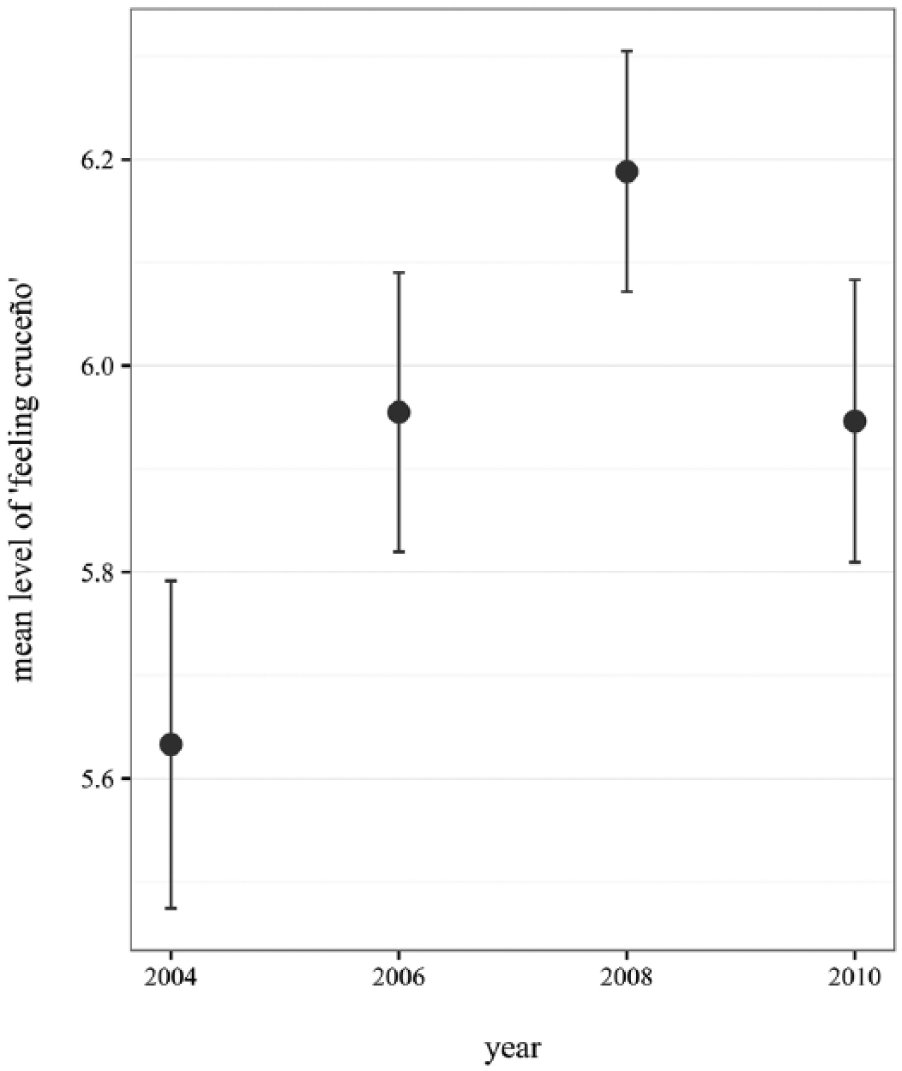
Feeling cruceño among all Santa Cruceños, 2004–2010.
But was the identity discourse evenly accepted among all Santa Cruz inhabitants? If so, we should not be able to see differences in identification between different demographic and socio-economic groups. Figure 3 shows the results of a series of binary regression analyses for above-average levels of feeling cruceño for gender, income, political ideology (left–right), education and age. The plotted dots mark the coefficients values and the lines the confidence intervals for each factor; where the lines do not cross the dotted line at 0, the factor has a significant effect on the likelihood of high levels of feeling cruceño.
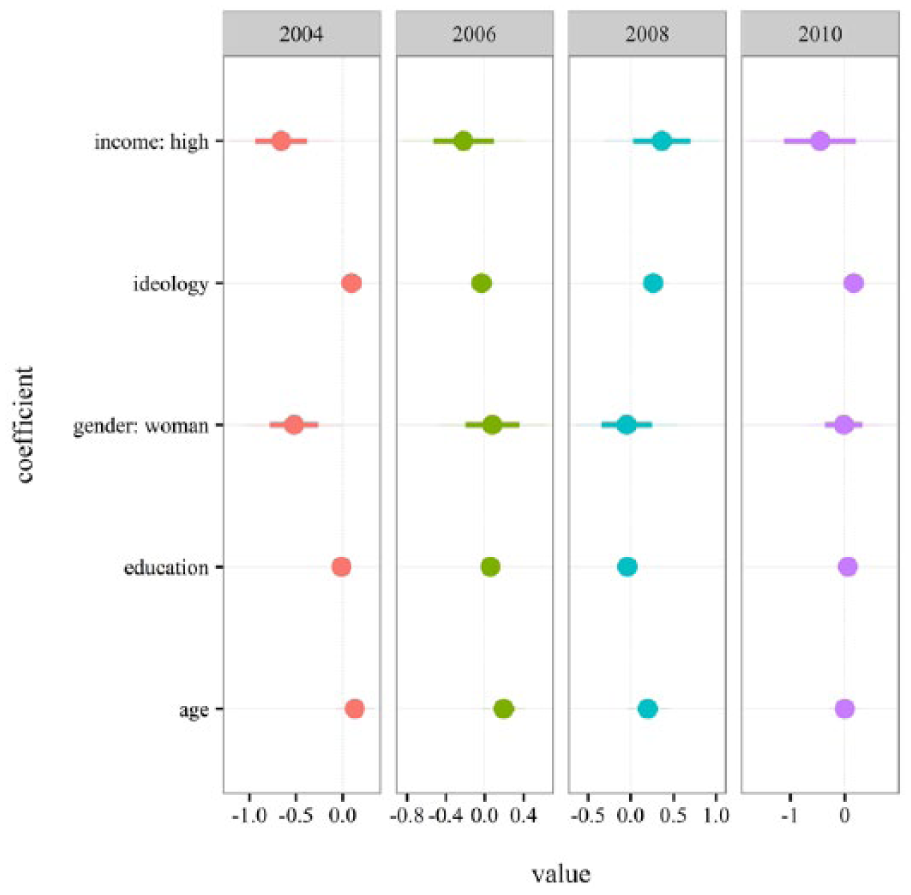
Results of logistic regression analyses for above-average levels of feeling cruceño, 2004–2010.
Of all factors, only gender and income had a significant, if uneven, effect. Male and poorer inhabitants were more likely than female and richer inhabitants to report high levels of feeling as cruceño in 2004. The fact that both ceased to be a significant factor from 2006 suggests that identification was indeed more evenly spread within the population. The regressions also show that political ideology becomes an important factor in 2008, with more conservative inhabitants more likely to report high levels of identification than left-wing inhabitants. This suggests that, at least in the year of the most pronounced polarization between the national government and the regional opposition, regional identification became politicized.
Finally, we need to examine the relationship of the cruceño to the indigenous. The narrative presented above implies that the cruceño and camba categories were not as inclusive as first proclaimed. In particular, three different categories remained visible: inhabitants of white or mestizo, of lowland indigenous, and of highland indigenous descent. The LAPOP survey allows distinguishing between Bolivians identifying themselves in these terms, and to compare feeling as cruceño or camba for these groups. 11
Figure 4 demonstrates that highland indigenous people indeed show a significantly lower level of belonging than others in the department. In contrast, there are no significant differences between lowland indigenous and non-indigenous inhabitants; and if anything, lowland indigenous showed a stronger, rather than weaker, identification. Neither form of regional identification thus seems to have differed between the indigenous and non-indigenous populations per se but according to geographic origin; regional identification cross-cuts indigenous identification. The boundary between native lowlanders, no matter their ethnic identification, and others is corroborated in separate regional surveys from 2001, 2009 and 2011 with regard to cruceñoness. Among native-born inhabitants, the vast majority felt cruceño, whereas residents born elsewhere were less likely to do so (Table 1).
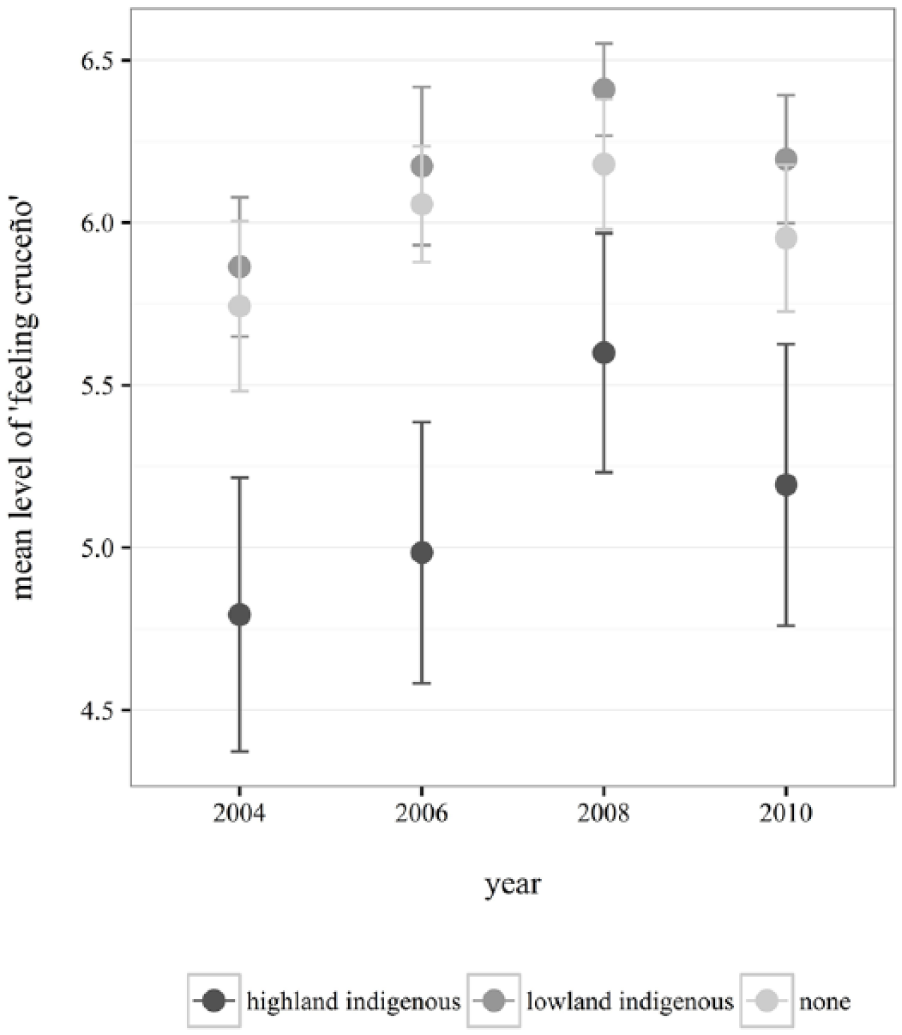
Feeling cruceño according to indigenous background, 2004–2010.
Feeling Cruceño in 2001, 2009 and 2011.
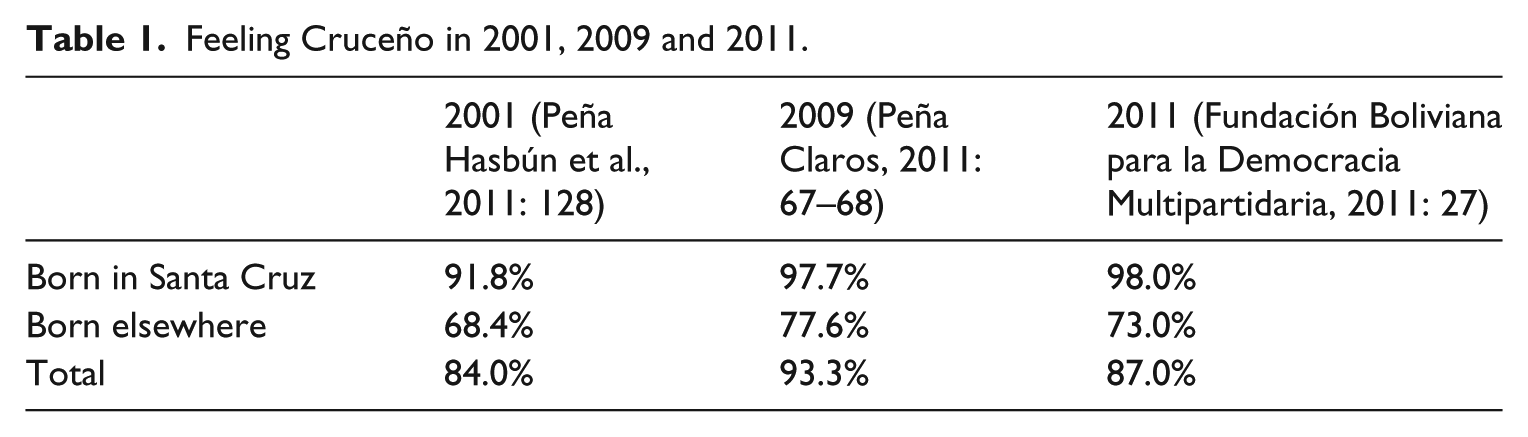
However, in both the graph and the table, highland indigenous still show a relatively high level of feeling cruceño as well as an increase over time. This reflects an inclusive effect and the power of the positive regional identity which promised success and welfare to those adhering to it (see also Peña Claros, 2011). After 2008, however, this effect declined: among highland indigenous, regional identification decreased noticeably, in tandem with the ever more radical, out-group emphasizing discourse of the department’s elite and the subsequent racial violence. This shows again that, contrary to Barth (1969), not only the boundary but also the content enclosed by the boundary is important.
In summary, there is some evidence of a discursive effect on identification: first, identification has more evenly spread throughout all demographic and socio-economic spheres, even to those reporting belonging to highland indigenous peoples. Second, among the latter, the feeling of belonging to the cruceño decreased again once the discourse slid from a focus on the positive in-group to one on the negative out-group. And third, at the same time, identification has become somewhat politicized. With regard to identification, then, the findings lend support to the literature on the effects of political discourses on the (political) salience within society.
Discussion and conclusion
The December 2005 elections had turned Bolivia’s political sphere upside down. An indigenous–peasant-based social movement was now in government and the traditional national political parties were severely weakened. In response to both developments, an oppositional regional power bloc began to consolidate, particularly in the department of Santa Cruz, which drew on historical notions of regional difference from the rest of the country. Its identity discourse first established a non-ethnic, regional conception of the in-group, a discourse which enabled the elites to evade explicitly racist, anti-indigenous rhetoric and which allowed for an expansion of the boundary to include, in theory, the whole of Bolivia (see also Eaton, 2007; Lowrey, 2006). Among inhabitants of Santa Cruz, this localism was paralleled with an increase in identification with the department and spread to all social spheres, including the highland indigenous immigrant population which has historically been the predominant out-group to the regional identity: the boundary was perceived to be more permeable than before. But when the elite discourse continued to construct the out-group in ethnic terms by emphasizing the biological and cultural attributes of the boundary, this had again an exclusionary effect on highland indigenous inhabitants.
The Santa Cruceño context hence suggests that developments at the macro- and meso-level do indeed have an effect on micro-level identity definitions, lending support to the ‘constructionist power’ of political rhetoric. But it also suggests that this constructionist power is constrained and does not necessarily result, as often feared, in a spiral of worsening ethnic relations. Although the exclusivist discourse was accompanied by violent conflict, the violence did not lead to a spiralling out of control but instead stopped the conflict, and the discourse, in its tracks; the distinction between the cruceño as better and the other as worse was not anchored strongly enough in society. The elite-level backlash against indigenous emancipation did not achieve sufficient consensus among citizens. It is important to stress, however, that the evidence presented here for rhetoric’s constructionist power is limited to identity salience and does not extend to its content per se. The content of the identity may be – likely is – differently understood among the inhabitants of Santa Cruz. Lowland indigenous inhabitants’ feeling of belonging, for example, may be based on their ancestry and white inhabitants’ feeling of belonging on their pride in the department’s prosperity. But whatever the identity content, the rhetoric seems to have struck a chord among all, increasing the feeling of belonging to their individually defined identity content.
It is also important to stress that, while this article and prior theory suggest a causal link between rhetoric and attitudes, the data presented here cannot definitely establish such a link. Indeed, the nature of both rhetoric and attitudes largely impede the establishment of treatment effects outside of randomized controlled experiments in psychology laboratories. However, I argue that the suggested causal link is more plausible than the alternative assertion that attitudes changed rhetoric. The attitudinal change would have had to be noticed by elites for them to adjust their rhetoric. Systematic data on identity attitudes in Santa Cruz before 2004 are not available – and had it been, elites likely would have referred to such data in their public speeches to bolster the legitimacy of their claims. Neither did large-scale events occur before 2004 that would have had signalling power on issues surrounding regional identity or autonomy, as seen in Figure 1: the two events in 2001 and 2002 were organized by the CSC itself.
Moreover, this would leave open the question why attitudes changed in the first place. Again, the cause likely would have been picked up in the rhetoric to increase its appeal. The rhetoric’s focus in the early stages was the department’s productivity and prosperity; increased prosperity may have, for example, induced greater pride in belonging to the department. However, when comparing GDP per capita over time, it actually decreased between 2000 and 2004, and subsequent increases were at lower rates than for Bolivia as a whole (INE, 2016). Another cause for changes in both rhetoric and attitudes may have been the new focus on the indigenous ancestry of Bolivia (Flesken, 2014). However, this should have increased feelings of belonging to the department either among indigenous (reflecting empowerment) or non-indigenous (reflecting a backlash) inhabitants, not among both. The in-depth qualitative analysis does not suggest an alternative, department-wide reason for changing attitudes.
This article was conceived as a first step in a wider research effort to examine the relationship between political rhetoric and identity change, and is hence limited in scope. While the ‘most probable case’ of identity change serves as illustration of the relationship, and of the utility of different methods in examining it, findings may not be generalizable more widely. Moreover, the article does not speak to the question whether resulting identity changes are superficial or more fundamental, as doing so would require longer term data on identity change at both the elite and the individual level – in Bolivia, the question on regional identification is no longer being asked. Future research may hence probe the relationship in other contexts and with additional data; data from panel studies would be particularly promising. This article provided a first step in conceptualizing and operationalizing identity change at both elite and individual levels through the lens of consensus and contestation of collective boundaries.
Footnotes
Acknowledgements
I thank the project team of ‘A dangerous liaison? Ethnicity, natural resources and civil conflict onset’ at the German Institute of Global and Area Studies, Hamburg, for making their protest event data available; and the Latin American Public Opinion Project and its major supporters (the United States Agency for International Development, the United Nations Development Programme, the Inter-American Development Bank and Vanderbilt University) for access to the AmericasBarometer survey data. I further thank Cecilia Peñaranda del Carpio for excellent research assistance, Andrew Zammit-Mangion for help with the text-mining algorithm to generate data for the content analysis, and participants of the European Consortium for Political Research (ECPR) Joint Session Workshop on in Warsaw, April 2015, as well as the anonymous referees for their helpful comments.
Funding
The author(s) disclosed receipt of the following financial support for the research, authorship, and/or publication of this article: Initial fieldwork in 2011 was supported by a travel grant from the Society of Latin American Studies. Further data collection and writing up were supported by a postdoctoral scholarship provided by the Fritz Thyssen Foundation (Az. 40.14.0.006).