




Abstract
This article brings together two cases to contribute to the growing body of literature rethinking the study of international relations (IR) and the Global South: The Libyan Arab al-Jamāhīrīyah and the Bolivarian Republic of Venezuela. Drawing on media representations and secondary literature from IR and international political economy (IPE), it critically examines three main conceptual theses (authoritarian, rentier, and rogue) used to describe the historical socio-political formations of these states up to this date. Mixing oil abundance with authoritarian revolutionary fervour and foreign policy adventurism, Libya and Venezuela have been progressively reduced to the figure of one man, while presenting their current crises as localized processes delinked from the imperialist inter-state system. The article argues that these analyses, if left unquestioned, perpetuate a US-led imperial ordering of the world, while foreclosing and discrediting alternatives to capitalist development emerging from and grounded in a Global South context. In doing so, the article contributes to the growing and controversial debate on the meanings and needs for decolonizing the study of IR.
In 2019, an opinion piece appeared in the English version of the Spanish newspaper, El Paìs, posing an interesting question (Naím, 2019). It asked whether Venezuela was turning into the Libya of the Caribbean. The article, in other words, discussed the possibility we might see the emergence of violence and political chaos in Venezuela because of a crisis that had emerged since 2013, after the death of Hugo Chávez. Thus, is the crisis in Venezuela unfolding in a manner similar to what had happened in Libya in the aftermath of the events of 2011? The author identified numerous similarities. For instance, both countries have two separate centres of power, each supported by armed groups that seek to control the oil industry. This, in turn, has transformed Libya and Venezuela into failed states whose governments are unable to perform basic governing functions or to control the entire national territory. Moreover, the void ‘has been filled by a plethora of bad actors (ELN, FARC, ISIS, etc.) [. . .] Regional strong men, militias, and criminal gangs’ (Naím, 2019). Finally, both crises have very few prospects for a simple political or diplomatic solution since the international community is already overwhelmed by other conflicts and humanitarian emergencies. It is worthwhile noting that, in 2011, a few weeks after the start of popular protests in Libya, the US journal Foreign Policy published a column, titled ‘Harvard for Tyrants’ (Farah, 2011). The piece pinpointed the unique role of the Libyan leader, Mu’ammar Qaddafi, in nurturing and supporting a generation of bad guys, meaning: authoritarian – if not, dictatorial – rulers around the South of the world. The catchy column drew a comparison between the American university and a school of political thought in Benghazi, the ‘World Revolutionary Center’, which numerous political leaders had visited since the 1980s. This school – like Harvard – had functioned as an excellent educational programme for the spread of terrorist actions and ideas worldwide, including the political formation of the Venezuelan leader, Hugo Chávez.
These two opinion pieces are symptomatic of a broader problematic that also affects academic knowledge production within the discipline of international relations (IR) on the socio-political formation of the Bolivarian Republic of Venezuela and the Great Socialist People’s Libyan Arab al-Jamāhīrīyah (Republic of the Masses). 1 In other words, these opinion pieces reveal a conceptual sub-text that uncritically adopts the use of regime-type categories – that is, authoritarian, rentier, and rogue – to frame the nature of the current crises. Mixing oil abundance with authoritarian revolutionary fervour and foreign policy adventurism, Libya and Venezuela have been progressively reduced to the bizarre ideas and figure of one man – Mu’ammar Qaddafi or Hugo Chávez, while simultaneously being presented as concrete threats to the US-led world order.
It is the aim of this piece to take stock of these works and examine the main conceptual assumptions upon which their analyses draw; to contribute to the field of IR of the Global South, and particularly to the growing body of literature discussing the need to assess critically the Eurocentric and imperial genealogies of IR knowledge production. From a Gramscian perspective, it is through political and ideological hegemony that economic control is established (Gramsci et al., 2005) or, as Althusser (2014) argued, ideology has a material existence that sustains the reproduction of the dominant mode of economic production: capitalism. In a similar fashion, I argue that the use of these imperial genealogies to describe the political history of these social formations consolidates the political and economic interests of the United States, trivializing those attempts to establish alternatives to capitalist development, as emerging from and grounded in a Global South context. In doing so, the article draws inspiration from those analytical works that have focussed on the role that imperial genealogies of race (Anievas et al., 2014) and gender/sex (Weber, 2016) play in framing social formations of the Global South, particularly those daring to challenge the global dominance of the West. It is my argument that these imperial genealogies function as historically specific ideologies that imbricate and perpetuate the actual workings of imperialism as a process of capital accumulation, thus going far beyond the question of discursive production.
The article structures this argument in three main sections. The first part takes stock of three main conceptual theses – authoritarianism/populism, rentier state theory (RST) and rogue/aggressive state – used to characterize these socio-political formations. Against this backdrop, the second part unpacks the problematic assumptions contained in these dominant framings, unveiling their racialized, gendered, and class nature. Ultimately, it shows how these conceptual theses, if left unquestioned, reproduce a US-led imperial ordering of the world. The article concludes by reflecting on how these notions have not only contributed to the making of the US-led imperialism, but the latter has also shaped the study of IR and the Global South. Hence, it calls for the necessity to set out a research agenda whose knowledge production questions, rather than reproduces, the centrality of the US-led imperialism.
Authoritarian, rentier, and rogue: A recipe for state failure
When examining the political development of the Bolivarian Republic and the Libyan Arab al-Jamāhīrīyah, the most recurrent idea conveyed draws on the concept of authoritarianism. This concept is used to indicate the presence of a repressive government that, while silencing the opposition, concentrates political power in the hands of one man. In particular, the concepts of authoritarianism and populism, and their variations, are relentlessly used to explain this dominant feature.
The Bolivarian Revolution is strictly associated with the idea of Chavismo, a political ideology reduced to the figure of one man, Hugo Chávez, and traced in relation to the long tradition of caudillos (Zanatta, 2006) in Latin America. Presented as a populist movement (Arenas, 2018; Stavrakakis et al., 2016), Chavismo took hold of Venezuelan politics at the end of a decade that had seen a catastrophic deterioration of living standards. Most scholars argue that Chávez and his supporters transformed the country into ‘a polarized party system with two camps that saw each other as enemies in a cosmic struggle’ (Hawkins, 2010: 4), thus undoing the largely peaceful system of electoral competition that made the country a democracy, the pact of Punto Fijo of 1958 (Corrales, 2012). The main feature of Chavismo translates into a capacity to use democratic ideas to question democratic practices, thus with a ‘natural tendency to turn into something totalitarian’ (Corrales and Penfold-Becerra, 2011: 13). We are told that, while the military plays a prominent role in political and societal affairs, the ideology of this authoritarian regime is based on a Manichean vision of the world, which translates into an active attempt by the regime to undermine the autonomy of civil society and not to negotiate with opposition forces. In authoritarian Venezuela, as Corrales and Penfold-Becerra (2011: 1) sums up, ‘freedom exists and the opposition is allowed to compete in elections, but the system of checks and balances becomes inoperative’. The idea of competitive authoritarianism is used to describe Venezuela as a state where electoral practices continued to take place after the rise of the Bolivarian Revolution, yet the playing field is skewed in favour of incumbents, thus competition is real but unfair (Mainwaring, 2012). Hijacking democracy, these analyses emphasize how the revolution got rid of checks and balances to bring a form of what they call ‘participatory democracy’, but ended up building an illiberal revolutionary coalition.
The lack of functioning institutions and the focus on the rule (and role) of one man are also the preponderant elements stressed in academic analyses, when discussing the case of the Libyan Arab al-Jamāhīrīyah. Libya is associated with the authoritarian, quixotic, idiosyncratic, or bizarre (Parteger, 2012; Vandewalle, 2006) ideas of Qaddafi. The discourse on the absence of state institutions (not enough state) in Libya comes hand in hand with a focus on the bizarre and authoritarian theoretical experimentations of Qaddafi (too much Qaddafi) (Capasso and Cherstich, 2014). Those claims resonate with Western media pundits’ descriptions, cultural representations, and political statements commenting on the mad and evil personality of Qaddafi. Already in the 1980s, the President of the United States of America, Ronald Reagan, described Qaddafi as an irrational leader and the ‘mad dog of the Middle East’. Other former US presidents often spoke of him ‘in terms that implied their support for his downfall and death’. There is a long list of terms that have been used to characterize and stigmatize Qaddafi, which range from ‘subhuman’, through ‘cancer’, to ‘egomaniac who would trigger World War III to make headlines’, and many more (Wright, 1981: 16). Media pundits often preferred catchier, yet more absurd, labels, such as a ‘tent-loving dictator who travels with camel and virgin guards’ (Roper, 2009) or a complete power-hungry, narcissistic, and psychopathic tyrant (Fallon, 2011). If one wants to have a proper taste of how Western cultural representations depicted Qaddafi, it is worth watching the Hollywood movie The Dictator, whose main character – represented as a childish, tyrannical, sexist, anti-western, and anti-Semitic despot who surrounds himself with female bodyguards – was based, as the same director admitted, on Qaddafi (Eden, 2011).
At the same time, authoritarianism in Libya is not entirely explained as a diversion from a democratic past, like the radical turn of Chavismo against puntofijismo. Rather, the capacity of Qaddafi to turn Libya into a political and economic laboratory ties with the established idea of statelessness. Going back to Ottoman times and up until the present day, Libyans are described as rejecting the structures of the so-called ‘modern’ state (Pack, 2014), moving from a conglomerate of tribes and authoritarian rulers and, more recently, rag-tag rebels and militias. The term ‘statelessness’ or ‘stateless society’ derives from the anthropological work of John Davis, who adopted this concept to describe Libya on the basis of two main factors: first, the historical incapacity of the colonial authorities to establish hegemonic institutions in the eyes of the colonized population; and second, the presence of a tribal structure in Libyan society that allowed Qaddafi to reject conventional notions of the state (Davis, 1987). In such a scenario, where statelessness represented both an historical anomaly and the continuity of Libya’s rulers who were unwilling to establish a modern state, the Libyan Arab al-Jamāhīrīyah only re-affirmed this understanding of the country’s history, adding another piece to the mosaic of statelessness. Undoubtedly, this difference across the two cases stems from their diverse historical trajectory vis-à-vis their colonial domination, also due to their geographical location and spheres of influence, as discussed later.
Moreover, to strengthen further the authoritarian argument, it is important to introduce and reflect on the second main thesis associated with these two social formations, which is the concept of rentier state. That is, conventional academic analyses argue that oil revenues acted as lubricants to the incremental erosion of democracy and the pursuit of authoritarian-illiberal projects in these two social formations. The abundant oil revenues helped Qaddafi and Chávez to maintain power and build a patronage network around them, since it liberated their governments from the need to tax its citizens. Al-Jamāhīrīyah avoided the modern development of a state, refusing the complexities of the modern age and maintaining instead ‘a sentimental longing for a mythical golden age when life was simpler’ due to the presence of oil revenues (Anderson, 1987). Similarly, the radical politics pursued by the Bolivarian Republic were proportionally related to the oil revenues (Corrales and Penfold-Becerra, 2011; Rosales and Sánchez, 2020; Weyland, 2009). The state’s dependence on oil rent created social dynamics of dependence that, in turn, fuelled corruption, authoritarianism, and nepotism (Bahar, 2019; Martinez, 2012; Maya, 2018).
As some scholars argue (Albertus et al., 2018), this system of coercive distribution paves the way for the construction of authoritarian regimes. It is argued that Libya and Venezuela are the perfect examples of rentier states, having an economy predominantly reliant on external rent that can sustain itself without a strong productive domestic sector. The political implication of such an arrangement, according to the proponents of this theory, is that it allows the government to maintain its legitimacy without any accountability from social forces, thus no democratic values. Rentier structures are sustained through alliances with traditional networks of tribes, families, gangs as the most effective levers for the distribution of oil revenues. Yet, they require the creation of strong security apparatuses used to suppress and silence the population, while rewarding loyalty. Therefore, the presence and discovery of oil signal not only the further entrenchment of the process of authoritarianism in Libyan and Venezuelan political history, but also – most importantly – shows how it allowed the rise of authoritarian rulers and rent-seeking elites.
Finally, the discussion around the constitutive role of oil permits us to understand the last predominant thesis used to characterize the foreign policy of these two states. An increasing number of studies have linked the abundance of oil revenues to the refusal of these states to cooperate with established international norms, thus explaining how oil fuels their supposedly anti-liberal, anti-democratic, and terrorist foreign policy. Being governed by strong men ready to squander oil revenues for their personal political gain, Libya and Venezuela were, and still are, described as a menace to the stability of the US-led international order. While scholars rely on several concepts to describe this unique characteristic, they ultimately all express the same meaning, that is, the animosity of these states towards the United States and its world order. Since the case of al-Jamāhīrīyah developed during the Cold War, the concepts included capturing its aggressive behaviour range from rogue state or its variations of outlaw state, pariah state (Martinez, 2007; Oakes, 2011), irrational state (Mandel, 1987), quasi-state (Jackson, 1990), or terrorist state (Lake, 1994). Qaddafi’s Libya was considered a state nurturing and supporting international terrorism, relentlessly pursuing the creation of Weapons of Mass Destruction and, thus ultimately, threatening the world’s peace and stability. As Anthony Lake (1994: 94–95) puts it, Libya was one of those regimes ‘on the wrong side of history’, together with Cuba, North Korea, Iran, and Iraq. It is nonetheless important to stress that, in the aftermath of the US invasion of Iraq in 2003, Libya was removed from the list of states sponsoring terrorism.
Since the Bolivarian Revolution came about 30 years later, if compared to Libya, the conceptual vocabulary diverges and Venezuela is mostly described as a confrontational, antagonistic, and closely allied to illiberal states, including Russia, Iran, and China. In relation to Libya, the difference is perfectly captured in an International Institute for Strategic Studies (2005: 2) publication that reflected on how ‘Washington is likely to apprehend Chávez not as a Gaddafi-style rogue in America’s backyard – and a potential strategic problem – but rather as an acute annoyance’. More interestingly, the US ambassador to the UN has coined a new term to describe the criminal behaviour of the Bolivarian Republic, referring to it as a ‘narco-state’ that threatens the region, the hemisphere, and the world (Fox News, 2017). Despite the lack of evidence, the latter term is supposed to refer to the reliance of the Venezuelan government on the trafficking of narcotics in cementing its authoritarian rule at home, thus justifying the moral need for the United States to intervene.
Overall, the importance of this last thesis lies in how the pariah status of oil reflects the rogue international status of the Libyan and Venezuela social formations, since it provided the material grounds for pursuing aggressive, confrontational, and irrational behaviour, domestically and beyond. In a book titled Petro-aggression: When Oil causes War, Jeff Colgan (2013) sets the analytical endeavour to study the causal mechanisms between petro-states, conflicts and aggressive foreign policies, which leads him to conclude precisely what I have described so far. In the case of Libya, oil powerfully shaped Libya’s domestic politics by creating a clientelistic political culture whereby the leader of the state was able to offer economic benefits in exchange for political quiescence. This political culture reduced Qaddafi’s risk of domestic punishment for foreign policy adventurism [. . .] Consequently, the modern history of Libya offers considerable support to the argument that revolutionary governments that arise in petrostates constitute a special threat to international peace. (Colgan, 2013: 151)
In the case of Venezuela, ‘oil income enabled Chávez to centralize political power in his hands and radicalize the domestic political discourse. Finally, oil income played an essential part in Venezuela’s foreign policy in aggressive and provocative ways’ (Colgan, 2013: 223).
If one accepts uncritically these three main hypotheses, the socio-political crises in Venezuela and Libya appear to be of a fundamentally internal nature, as the natural ingredients for a recipe leading to state failure. The legacy of authoritarianism, the oil curse rooted in geographical, if not historical and tribal, divisions, have brought these countries to their current destruction. These narratives stress the existence of a so-called path dependence (Buxton, 2020) that hinders the possibilities of building a prosperous and democratic future. Whereas Libya has descended into a civil war with the looming possibility of a new authoritarian ruler coming to power, the Bolivarian Revolution has slid into an ever-increasing authoritarian present under the presidency of Nicolas Maduro (Corrales, 2020). Consequently, while these current crises are presented as the result of localized and self-inflicted historical causes, they are delinked from the inter-state imperialist system. When discussed, the international dimension is presented as one among several elements that have contributed to this historical outcome, rather than being articulated in an organic and dialectical manner. Against this backdrop, the next section moves to reflect critically on the imperial genealogies of the conceptual framings presented so far, arguing for the necessity to develop a Global South grounded knowledge approach that recentres the question of imperialism in IR.
Bringing imperialism back in
The ruling ideas are nothing more than the ideal expression of the dominant material relationships, the dominant material relationships grasped as ideas; hence of the relationships which make the one class the ruling one, therefore, the ideas of its dominance. (Marx and Engels, 1970: 64)
The first problematic assumption lies in the Eurocentric position that the notion of authoritarianism exude. The persistence of authoritarianism, in fact, is premised on the absence of modern, liberal, and democratic institutions. In other words, it opposes the natural, linear, and idealized model of European state formation, revealing the lacking impurity of those ‘Other’ (meaning: non-European) political orders in the rest of the world (Malito, 2019). At the discursive level, the presence of an unstable and less decipherable ‘periphery constitutes the symbolic Other against which a stable European Self can be posited’ (Manchanda, 2020, 102). Reminiscent of Orientalist writings, the concentration of power in one man signals the lack of a normal, democratic, and functioning political order that inevitably leads up to the emergence of deviant forms of authority. Interestingly, this argument builds on the use of two self-reinforcing notions that come to occupy the empty space coinciding with the absence of liberal-democratic state structures.
On one side, it is possible to find the figure of one man, the authoritarian ruler who uses the population to realize his own whims and experiment with bizarre ideas, Qaddafi or Chávez. On the other side of the spectrum, the category of tribes and barrios routinely re-emerges to describe the social configuration of the country. These notions do not work in contradictory ways; rather, they are part of the same unit of analysis that re-enforces the unruly and undemocratic character of these states. Historically, for instance, the notion of stateless Libya emerges from the tribal character of the country, in its unruly and un-modern organization of life that has constantly rejected the modern state. In this regard, the figure of the authoritarian ruler appears as somewhat required because it shows a capacity to manipulate and rein in tribes, while governing without any accountability towards them. Following this logic, both the tribal configuration of society and its authoritarian ruling confirm the inherent difficulties that Libya possesses to embrace modernity and imitate the construction of a functioning model of statehood and sovereignty. In the case of Venezuela, this type of relationship is also present, yet unfolding in relation to other unruly societal elements. There is a constant association of the charismatic and missionary role of Chávez vis-à-vis the masses and, particularly, the barrios, the shanty towns and slums of Venezuela, as well as with indigenous communities (The Economist, 2014). Proposing what experts call a moralizing discourse that opposed the political establishment vis-à-vis el pueblo, Chávez relied on the support of the poor to craft his populist vision for Venezuela.
Overall, what these studies propose is the construction of a patron–client relationship between these communities and the Venezuelan and Libyan governments, rather than being based on a politically conscious and engaged population. Other scholars (Azzellini, 2021; Capasso, 2020) have, however, challenged this argument and shown the need to take seriously into consideration the unique ways in which these revolutionary formations aimed to remake the state–society relationship, while considering their obstacles and limitations. Azzellini (2021), for instance, traces revolutionary Bolivarianism to a genuinely Venezuelan revolutionary project that started to take shape in the guerrilla movements of the 1960s, which then became hegemonic for the radical transformation of society in Venezuela during the presidency of Hugo Chávez. The socialist project of revolutionary Bolivarianism under Chávez is grounded in the construction of councilist structures of self-government and control of production, built to overcome the bourgeois state and gradually replace it with a communal state (Azzellini, 2018). The launch of the project of direct democracy in Libya also entailed the renunciation of any form of representation or delegation of the people’s authority, jointly with the imperative for permanent, popular self-organizing at every level of society (Capasso, 2020). Most importantly, both revolutionary formations pursued projects of political, economic, and monetary integration at the regional level, believing in the necessity to overcome unequal integration in the world market, and the international hierarchy that facilitated the domination of the Global South by the US-led imperialism (Campbell, 2013; Ellner, 2002; Muhr, 2012; Yaffe, 2011). Strategies of regional integration did not derive from the rejection of nationalism; rather, they were conceived of as integral to the securing of national independence.
Furthermore, the basic proposition of these conceptualizations, which entail the complete disarticulation of the relationship between state and society, also leads to the representation of these social formations as mainly patriarchal and male dominated. In other words, the patron-client relationship solidifies into the constitution of a machista vision of the state, where caudillos, strongmen and – more widely – authoritarian leaders exercise their control over society whose acquiescence is bought through the redistribution of oil revenues. While these revolutionary formations certainly exhibited a predominant configuration of society that privileged the authority of men, the obsession with strong and machomen – on an analytical level – had two important consequences. First, it triggers the complete disappearance of women, their active political participation, and the progressive improvement of their living conditions, from the socio-historical formation of these revolutions (Fernandes, 2010; Graeff-Wassink, 1993; Marquina and Gilbert, 2020; Motta, 2013). More importantly, the hypermasculine characterization of these countries reveals less about them, and more about the US foreign policy anxiety to project a straight, masculine hegemonic identity, and phallic power at the global level (Weber, 2016).
Despite those commonalities, there are also important differences across these two cases. The question of sexuality does not emerge in the ways in which Venezuela is represented, but it is a recurring element associated with the authoritarian rule of Qaddafi. An interesting depiction is offered by the Swiss Center for Women for a campaign raising awareness of domestic violence against women (see Figure 1; Publicis Communications Schweiz, 2016). The poster, showing a woman standing behind a seated Qaddafi who holds a book in his right hand – most likely the Qur’an, conveys the main message of the advertisement via the sentence: ‘If your partner turns out to be a tyrant’. After the brutal killing of Qaddafi in 2011, French journalist Annick Cojean published a book, Gaddafi’s Harem: The Story of A Young Woman and the Abuses of Power in Libya, in which she recounts the infinite sexual appetite and hidden evil deeds of the Libyan leader as related by a Libyan teenager who claimed to have been one of several young women kept as sex slaves for Qaddafi. Despite his seemingly progressive ideas towards the role of women in society that had characterized the early years of the revolution, such as allowing them to join the army, Cojean (2013) describes Qaddafi as someone who enjoyed the darkest carnal pleasures, including systematically raping men, women, and children as part of his (alleged) quest for absolute power.
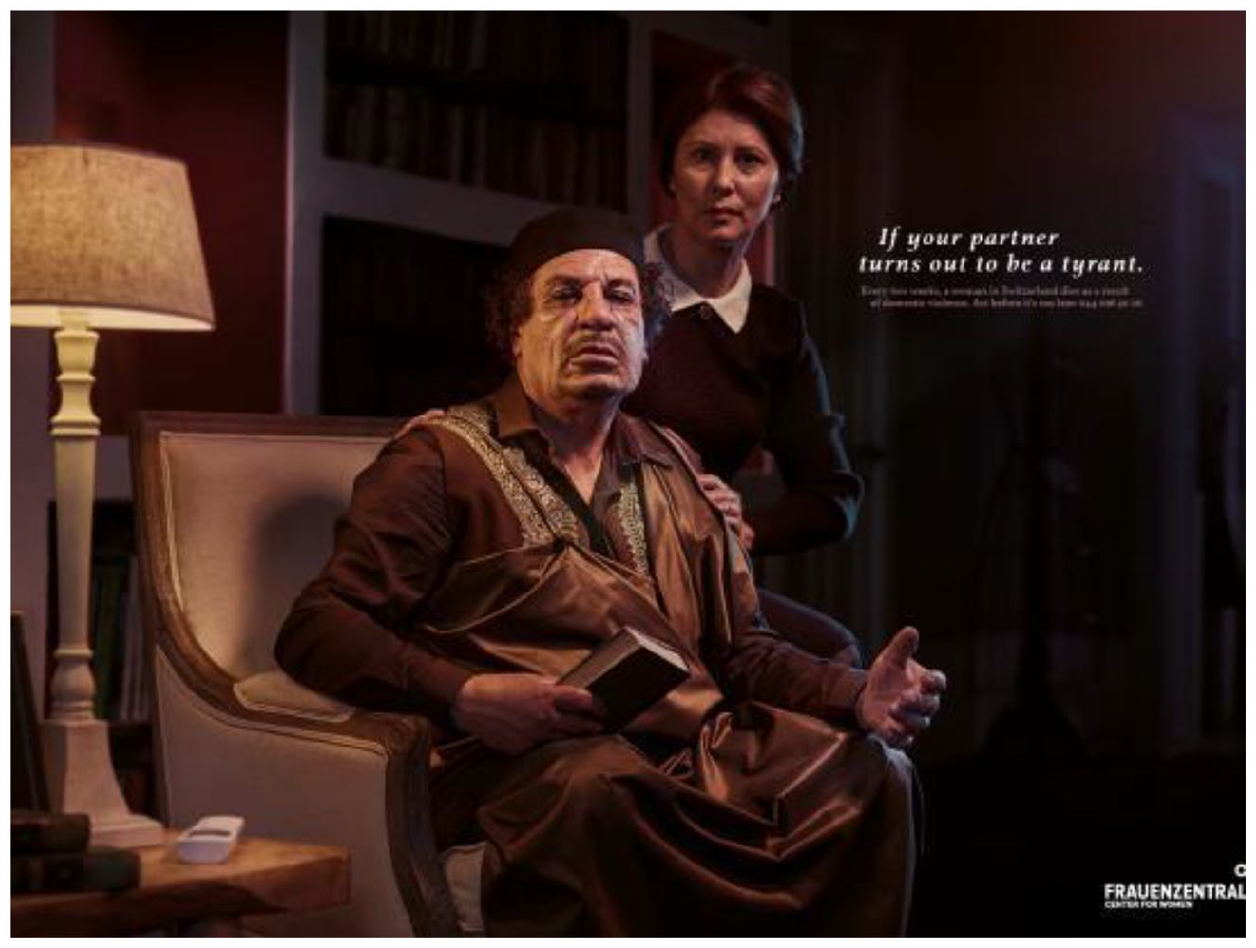
If your partner turns out to be a tyrant.
Investigating how gender and sexuality are central to the war on terror, Jasbir Puar and Amit Rai (2002) describe how the notion of monstrosity is used as a regulatory construct of modernity that imbricates not only sexuality, but also questions of culture and race. They argue that Western cultural and political narratives tend to dwell on the sexual desires of their ‘terrorist enemies’ to reduce complex power struggles, exclude questions of political economy and – most importantly – attempt to master forms of political dissent by resorting to a banal and often dichotomous scheme of classification. The absence of these sexualized representations in relation to the Bolivarian Republic of Venezuela appears to be linked to the religious colonization of Latin America, when compared to the historical colonial legacy of the Middle East and North Africa, which did not translate into a full adoption of Christianity throughout the region. As Joseph Massad (2016) points out, Islam occupies a very constitutive role in the formation of the set of ideas supporting Western liberal modernity, which remains Orientalist at its premise. Thus, Western anxieties over Muslim sexual desires also translate at the geopolitical level.
Overall, these racialized, gendered, and sexualized assumptions premise the existence of a core difference from the ways in which the state–society relationship unfolds in the modern and democratic West, vis-à-vis countries of the Global South. The issue at stake here is not to acknowledge Libya or Venezuela as different vis-à-vis a self-proclaimed universal notion of statehood uncritically adopted to study what lies outside Europe, but, rather, to show the constitutive role of racial tropes in the production of imperial knowledge in IR, and how they are used to render these countries legible. Manchanda (2020) emphasizes the importance of showing how the act of representing (the Other) is inherently one of conferring difference and creating distance. In its attempt to either capture or re-create reality, representation reifies its object, gives shape to it, and also sets it apart, both temporally and spatially from the speaking subject. Yet is this purely a question of representation and framing?
I argue that these racialized, gendered, and sexualized constructs are historically specific ideologies that emerged, took shape, and have evolved as constitutive elements within a definite set of social relations anchored to a particular system of production: capitalism. In his Prison Notebooks, Antonio Gramsci already warned us not to reduce politics and history to a grotesque fight between ‘irrational’ individuals and ‘dangerous’ ideologies, thus turning history into a treatise on teratology (Gramsci et al., 2005: 449). In biology, teratology refers to the study of congenital abnormalities and abnormal formations in plants and animals. Gramsci used this word to refer to the methodological anti-historicism adopted to judge – rather than study – the communist past as irrational and monstrous. At the methodological and conceptual level, this entails that, while the actions of individuals and their ideologies are important details that help to explain the course of history, they are not its over-determining elements. Individuals and ideologies are representatives of class interests that have become subordinated or resistant to the interests of the capitalist world system, thus inherently linked to the material reality that sustains their power. Thus, I argue that such racialized and sexualized constructions, if left unquestioned, perpetuate the international division of labour and the unequal exchange (Kadri, 2015; Lauesen, 2018) at the core of the US-led imperialism.
These connections appear in a very distinctive manner when interrogating the notion of rentier state. First, RST abstracts the social formation of these states from the inter-state imperialist system, thus from the dynamics of the world market, which are instead treated as secondary or marginal. As mentioned above, RST depicts oil-abundant states as having an economy predominantly reliant on external rent that sustains itself by fostering corruption and patronage, buying off legitimacy from the local population and undertaking an adventurous foreign policy (Beblawi and Luciani, 1987; Coronil, 1997; Villa, 2012). What these analyses leave out is the parasitic, usury-based, and rentier nature of imperialism (Lenin, 1916), and the constitutive role of oil as a commodity (Di Muzio, 2015; Kadri, 2016). More recently, as Ellner (2020) pointed out, the concept of extractivism has emerged to describe these countries in Latin America that rely heavily on the extraction of natural resources, thus causing environmental damage and impinging negatively on the lives of indigenous communities. By omitting how these revolutionary formations reclaimed their sovereignty over natural resources for the pursuit of alternatives to capitalist development, both theories do not differentiate the progressive politics of these social formations from more conservative states (i.e. the Gulf monarchies or Brazil under Bolsonaro), whose role in the maintenance of the US imperialism is functional and reactionary. This emerges more bluntly by looking at how these two revolutionary formations stood against any normalization of the Zionist occupation of Palestine, often providing military and diplomatic support. Venezuela, for instance, was the first Latin American state to recognize an independent State of Palestine with Jerusalem as its capital in 2009 (Silverburg and Cuéllar, 2016).
Similarly, when governmental redistributive programmes are presented as a coercive measure, characterized as malicious and evil plans that aimed to impact the lives of billions, while paving the way for some of the of the longest-lived authoritarian regimes of the 20th and the 21st centuries (Albertus et al., 2018: 5), the risk is to reach the level of theoretical fabrication. Such theories, in fact, are developed to explain the coercive aspect of distribution as ‘a form of forceful compulsion in which a more powerful party credibly threatens severe sanctions against a weaker one should the latter fail to comply with terms imposed by the former’ (Albertus et al., 2018: 8). In other words, this definition could apply to explain the functioning of a repressive government; yet it also could be used to comprehend the political nature of the measures taken by the United States and the international community towards Libya and Venezuela throughout several stages of history via the use of military coups, bombings, and international sanctions (Capasso, 2020; Gill, 2020; Schincariol, 2020; Tricontinental Institute, 2019).
This knowledge production can be collectively seen as an attempt to reinterpret the past as a failure to embrace liberal and economic reforms. Not surprisingly, the nationalization of the oil sector in Venezuela under the Bolivarian Revolution is often portrayed as a problematic break with internationalizing policies of oil opening (apertura petrolera) undertaken by previous governments. Conventional literature argues that, while the latter aimed to reduce state dependence on oil, the former only increased it (Bull and Rosales, 2020). Therefore, the economic difficulties of Venezuela now, and Libya in the past, are always attributed to the nationalization of mineral resources, to state intervention in the economy, to the anti-capitalist stances, invoking concepts like corruption and incompetence. However, what is not discussed – instead it is trivialized – is how oil became under the Bolivarian Republic or al-Jamāhīrīyah a tool to achieve social and regional development (Capasso, 2020; Marquina and Gilbert, 2020). By reintroducing the concept of class and imperialism, these policies no longer appear as forms of crass populism or authoritarianism (Ellner, 2019), but they appear as a form of postcolonial resistance and reveal the serious efforts undertaken by these social formations to overcome underdevelopment through socialization of production (Petras and Veltmeyer, 2016), despite their numerous limitations (Marquina and Gilbert, 2020; Strønen, 2020).
Liberal and institutionalist theory presents capitalist modernization as a global phenomenon, one that spread in time and space differently, advancing in the colonized world at a later stage (see Figure 2). 2 Therefore, when political and social actors in the periphery of the world do not exhibit forms of social consciousness and political organization that conform to modern expectations, then the cure lies in allowing capitalism to incorporate these countries within its world system. These ideas, however, confirm how the rules of membership are set in the international world order, and determine the fate of those who neglect or defy them. These designations, such as rogue, pariah, or illiberal, can thus imply eligibility for punishment or re-colonization. The prevailing assumption lies in measuring these states’ failure and success, thus gauging their degree and participation in liberal globalization and/or international terrorism. Bilgin and Morton (2004: 172) have aptly traced, for instance, how the notion of rogue states can be viewed as an attempt on the part of the US policymakers and their allies to replace the threat of communist expansionism with another ‘one size fits all’ nemesis.

Hugo Chávez and Margaret Thatcher in the Economist.
These notions are the result of aligning academic scholarships with the hegemonic pretentions of the United States and its imperial ordering of the world, dis-acknowledging not only the progressive and egalitarian impact of socialist measures for the population, but also the possibilities that alternatives to capitalist development could emerge from the Global South. The projects of Arab-African (CENSAD, African Union) or Latin American (ALBA, PetroCaribe) solidarity that these two revolutionary formations championed politically had the potential to create and stimulate the pursuit of alternative world orders. The most important limitations of these analyses, therefore, lie in how they elide the role of imperialist domination, the ways in which it locks countries of the Global South in a condition of unequal exchange or punishes them if they dare challenge the imperial world-ordering. By way of structuring the world in material and discursive ways that conceal the unequal development and imperial violence used to destabilize political orders in the Global South, these notions end up – willingly or not – serving the diktat of the US imperialism. Why have the Bolivarian Republic and the Libyan Arab al-Jamāhīrīyah been considered more rogue and authoritarian than the Western-led group of countries aiming to destabilize them by any means necessary? For these reasons, I argue that it is important to read these three main theses as a continuum because their intimate intermingling reveals how this production of knowledge is connected to current imperial and colonial exigencies.
Towards international-ist relations
The idea that the government was supposed to serve the wishes of the people, then, was as alien to the twentieth-century Third World as it had been to eighteenth-century Europe under the reign of kings. But the situation in Western Europe and America eventually produced democracy while the political attitudes and experiences of the Third World were conducive to the appeal of modern dictatorship. (Rubin, 1987: 27)
At the height of the US-led imperialism, in 1987, US-Israeli academic, Barry Rubin, published a book titled Modern Dictators: Third World Coup Makers, Strongmen and Populist Tyrants; its aim was to unpack why the Third World appeared dominated by political formations of totalitarian and authoritarian nature. Bringing together figures as diverse as Gamal Abdel Nasser, Thomas Sankara, Mu’ammar Qaddafi, Manuel Noriega, and many others, the book aimed to provide the reader with an analytical explanation on how these dictators came to power and controlled their population. In doing so, he also stressed how ‘much of the Western left and some liberals have become apologists of modern dictators, accepting their claims and statistics at face value, something they would never do with their own governments’ (Rubin, 1987: 352). These ‘deeply emotional’ analyses, Rubin (1987: 353) continues, that yearn for romanticism and utopianism are the intellectual equivalent of pornography.
Thirty years later, Paul Hollander’s From Benito Mussolini to Hugo Chávez: Intellectuals and a Century of Political Hero Worship lays out a very similar argument. Grouping another batch of very diverse political figures and histories under the umbrella of ‘dictators’, ranging from Mussolini and Hitler to Stalin and Castro, he proposes a set of individual reasons to explain why intellectuals appreciated their ideas and cult of personality, including ignorance, idealism, and some other shared personal traits. Even more recently, in 2019, an edited volume Ideological Storms: Intellectuals, Dictators, and the Totalitarian Temptation collected diverse contributions on the relationship between intellectuals and dictators in former and contemporary communist, third worldlist and fascist countries, including a chapter on the inherent anti-Semitic character of the German Democratic Republic’s participation in the Soviet Union’s ‘hostile campaign’ towards the state of Israel. The concluding chapter comments how politically innocent intellectuals have been useful idiots to all the tyrants of the 20th century. It is important to pause and reflect on these works because their claim to scientific objectivity and neutrality takes place by revealing how scholars and intellectuals either praised the ideological, barbaric, and extreme positions of dictators, or they unwillingly became ‘useful idiots’.
Long before these works had been published, Arthur K. Davis (1957) wrote a paper criticizing what he called ‘the canon of orthodoxy’ in the social sciences, which consisted of – he argued – two main elements: the ethic of neutrality and the ethic of nonideological science. While the former claims that scientists should not take stands on controversial aspects of society, the latter labels as ideological those who do so. In other words, the canon of orthodoxy expects a separation from science and ideology because science can only describe ‘empirical’ facts, whereas ideology advocates for a significant change in the basic social structure. Hence, the canon of orthodoxy functions to support the dominant political structure, precluding science from becoming a tool of criticism or liberation. This article reiterates and aims to contribute to a long tradition of scholarship that vindicates the political nature of science. It does so by examining critically the impact of the effect of Euro-American imperialism on the understanding of IR and history, focussing on two revolutionary social formations of the Global South. While it aligns with the recent call to decolonize knowledge production in the field of IR (Barkawi, 2016; Jones, 2006), it also identifies the need for an international-ist relations. In other words, it aims to recover the autonomy of judgement and framing towards socio-political formations that aimed to build, despite their numerous limitations, alternatives to capitalist-led development. Consequently, I have stressed how academic concepts (authoritarian, rentier, and rogue) matter because they can function as historically specific ideologies that imbricate and perpetuate an imperial world order. It goes without saying that my argument should not be understood as an attack on the discipline (whose tools are what allow me to write this article), but an attempt to discuss critically (1) how it participates in the making of our world and of the Global South and (2) to defend its relevance to advancing new knowledge in the present. These notions explored above have not only contributed in the making of the US-led imperialism, but the latter has also shaped the discipline of IR. The ways in which we remember, analyse, and understand these social formations matters because it shapes how we assess the failures of Global South countries to move on and challenge their (neo)colonial past and present. At this critical historical juncture, where these concepts explored above have remerged in framing the socio-political formation of the People’s Republic of China, it is crucial to ponder on their political uses, yet this would require another article.
Footnotes
Acknowledgements
The author wants to thank all those whose intellectual support was crucial in writing this article, including Walaa Alqaisiya, Lucas Koerner, Eric Hooglund, Matteo Legrenzi, Nivi Manchanda, and all his colleagues of the ‘Envisioning the Global South(s)’ Workshop Programme at the EUI. He also extends his thanks to Alyson Price for editing this piece, and to the editorial board of Politics and its two anonymous peer-reviewers for their very constructive engagement.
Funding
The author(s) received no financial support for the research, authorship, and/or publication of this article.
