




Abstract
The voting patterns of immigrants in Western European countries have for decades tilted towards centre-left parties – a phenomenon referred to as an ‘iron rule’. Evidence from recent elections is suggestive of a breakup of this pattern. Are migrant voters shifting towards parties on the right, and if so, why? We study this question using quality panel survey data from the Norwegian local elections of 2019 and 2023 with uniquely large samples of immigrants, second-generation Norwegians, as well as natives. The 2023 election was a big win for the right. We test whether shifting voter allegiances of voters with immigrant or second-generation backgrounds can be explained by social conservatism and religiosity. Results indicate that social conservatism among religiously active voters is not the main cause of this shift. Rather, pocketbook issues such as taxes are the main driver. The voting patterns of migrants seem to be aligning more with those of native voters, compared to what we have seen in previous studies.
Introduction
In recent elections, we have witnessed a change in non-Western immigrants’ party preferences in Norway. Historically, non-Western immigrants have predominantly supported the Labour Party (Bergh and Bjørklund, 2011). More broadly, the voting patterns of immigrants across Western Europe have tended to favour centre-left parties – a phenomenon referred to as an ‘iron rule’ (Bergh and Bjørklund, 2011; Saggar, 2000). However, recent electoral developments suggest that this rule is eroding. Support for centre-left parties has declined, while parties on the right have gained ground.
Electoral gains for populist right-wing and conservative parties have been fuelled by support from both natives and people with a migration background (see, for example, Bartosch, 2025; Jakobson, 2025; van Oosten, 2025). This shift has been visible in exit polls from the US presidential election (Carson et al., 2025), the European parliament elections in 2024, and the Norwegian local elections of 2023 (Corneliussen, 2024). This new phenomenon is not yet fully understood, but it is evident that the long-standing loyalty of migrant voters to centre-left parties is weakening (see, for example, Kleven et al., 2022; Lubbers et al., 2024).
A plausible explanation for this shift is the social and ideological conservatism of voters with immigrant backgrounds. Scholars have long noted the puzzle of why non-Western immigrant voters support left-wing parties despite, on average, holding relatively conservative social attitudes. Left-wing parties are often associated with support for LGBT rights, gender equality, and reproductive rights, while right-wing parties traditionally hold more restrictive positions. The recent movement of immigrant voters towards right-wing parties may suggest a resolution to this apparent paradox.
Socially conservative attitudes have long been part of Western European politics. The religious–secular cleavage in Lipset and Rokkan’s (1967) framework explains the formation of religious (Christian) parties in some countries and may help explain why people vote for either religious or secular political parties. Although European societies have moved in a secular direction in recent decades, there is still an element of religious voting in many countries, even the most secular ones. Native populations have, on average, moved away from organised religion. Immigrants bring with them a greater variety of religious beliefs and are more religiously active than native populations (Kaufmann, 2007). Furthermore, immigrants – especially Muslims – hold, on average, more conservative positions on social issues than native populations (Bergh and Kleven, 2018; Dancygier, 2018; Kleven, 2019).
Based on this, we ask, what drives the shift in the voting patterns of immigrants and their descendants from a left-wing preference to more conservative parties? Specifically, we focus on the role that social conservatism and religiosity play in explaining electoral volatility among immigrants. 1 This study adds to the existing academic literature in two ways. First, while left-wing voting among immigrant populations in European democracies has been a central research theme, we explore how and why this pattern is changing. Second, studies on electoral volatility among immigrants are rare. Existing research is largely limited to Canada, the United Kingdom, and Australia (Anderson and Stephenson, 2011; Heath et al., 2013; Martin and Sobolewska, 2023; Pietsch, 2016). A study of electoral volatility among immigrants in a European multi-party system is therefore timely.
We approach our analysis mainly by using survey data from the Norwegian local elections of 2019 and 2023, which include uniquely large samples of immigrants, second-generation Norwegians, and natives. Norway is an interesting case because it is one of the countries where the ‘iron rule’ of left-wing voting among immigrants has been well documented (see, for example, Bergh and Bjørklund, 2011). The choice of these two elections for study is based on data quality and the fact that we are able to document a shift in the voting preferences of immigrants between the two elections. If there is a trend towards more conservative voting in this group of voters, then vote switching between these two Norwegian elections is a good opportunity and a good case for studying that phenomenon.
In the 2019 election, support for Labour declined substantially, concurrently with a rise in votes for other centre-left parties and the anti-toll-road party, FNB (Folkeaksjonen Nei til mer Bompenger). 2 This movement away from the Labour Party suggested the potential for a realignment among voters with migrant backgrounds. In anticipation of a potential change of that nature, we included some attitudinal questions in the local election survey for 2023. Our aim was to uncover the ideological reasons for party switches or a potential realignment. We also split the sample and included a panel component linking respondents to the 2019 survey. Examining this change in the context of a local election is appropriate, as previous research shows that many voters use local elections to express support or dissatisfaction with the governing parties at the national level (Saglie et al., 2021).
Our findings indicate that the long-standing loyalty of voters with immigrant backgrounds to centre-left parties is indeed weakening, thereby opening opportunities for conservative – and even populist right-wing – parties traditionally avoided by immigrant voters. However, this shift appears to be driven more by economic concerns than by social conservatism.
Immigration, social conservatism, and religious voting
There is a long tradition of electoral research examining the impact of both religion and immigration on the voting behaviour of European electorates. Some form of religious–political conflict exists in most European countries, which has shaped their party systems and continues to influence voting behaviour today (Knutsen, 2004; Lipset and Rokkan, 1967; Montero et al., 2023; van der Brug et al., 2009). Furthermore, a substantial body of literature investigates how immigration and related issues contribute to the rise of populist right parties and the decline of some established parties in Europe (see, for example, Betz, 1994; Ivarsflaten, 2008; Kitschelt, 1994; Mudde, 2007).
Some scholars have also argued that immigration to Europe could transform the relationship between religion and voting (Kaufmann, 2007; van der Brug et al., 2009). Their argument is that, while native European populations are becoming increasingly secular, the immigrant population remains quite religiously active. Immigrants are, on average, more religious than natives, and their religiosity does not seem to decline with time; on the contrary, it is passed on to the next generation (De Graaf and Jansen, 2023; Kaufmann, 2007). As immigrants and their descendants form a growing demographic – due to continued migration and higher fertility levels – a rising share of the population may view religious beliefs as central to their lives. This could potentially reverse long-standing secularisation trends in Europe (Kaufmann, 2007). So far, there is limited evidence that such a reversal is occurring (Biolcati and Vezzoni, 2023). However, most evidence stems from surveys, which may not fully capture minority migrant populations. It remains, nevertheless, a reasonable hypothesis that as today’s immigrants become tomorrow’s voters, religious voting could strengthen in Europe. What remains unclear is the character of that religious vote (for a discussion, see Segatti et al., 2023).
Religious voting in Europe has traditionally been associated with two types of cleavages. The first concerns religious denomination; in some countries, Protestants and Catholics exhibit distinct voting patterns (Knutsen, 2004). The second is the religious–secular cleavage, pitting religious parties and their voters against more secular parties (van der Brug et al., 2009). A key aspect of this political cleavage is a conflict over religious and social issues, such as abortion, gender equality, LGBT rights, and the role of religion in society. Some immigrant groups, especially Muslims, tend to hold relatively conservative positions on such issues (Dancygier, 2018). Norris and Inglehart (2019) argue that the rise of right-wing populism in many countries can be explained as a response to progressive, liberal politics. They describe a ‘cultural backlash’ in which some voters mobilise around socially conservative views in opposition to strengthening progressive norms. These views are prevalent among some voters with immigrant backgrounds. It is conceivable that this cultural backlash contributes to a break with centre-left parties. The question then becomes what the alternatives to a centre-left vote might be. For instance, in the Netherlands, we have seen the rise of an ethnic minority conservative party (Lubbers et al., 2024). Evidence from Norway suggests some degree of demobilisation among migrant voters (Kleven et al., 2022). Another possibility is a movement towards parties on the right, as evidenced in some recent elections.
Existing studies examining the relationship between religion and voting among voters with migrant backgrounds in Europe are, to our knowledge, limited to descriptive statistics (see, for example, Kleven, 2019). van der Brug et al. (2009) argue that immigration will alter the landscape of religious voting in Europe – partly due to increased religious fractionalisation – but do not test this empirically.
Kaufmann (2007) predicts that the long-term effect of rising religiosity in Europe, resulting from immigration, will benefit religious and right-wing parties. He does not provide any evidence for this; it is more of an expectation for future voting behaviour. However, evidence from the United States provides some support for that hypothesis. Studies of Latin American voters in the United States indicate that religiosity is associated with Republican voting, with Protestant evangelicals of Latin American origin particularly likely to support the Republican Party (Lee and Pachon, 2007). Based on this small but suggestive body of work, increased religiosity in European societies could be expected to benefit right-wing and religious parties.
On the other hand, there is now a substantial set of studies examining the voting behaviour of immigrants in Europe (Azabar et al., 2025; Dancygier, 2018; Spierings and Jacobs, 2025). The general finding is that immigrants, especially those born outside Europe, tend to vote for centre-left parties. This pattern has been referred to as an ‘iron law’ and has been confirmed in several countries (see, for example, Bergh and Bjørklund, 2011; Marcos-Marne, 2017; Saggar, 2000; Sanders et al., 2014). Is there now a movement away from this pattern, especially among religiously conservative immigrant voters? The answer remains unclear, and addressing it is the central aim of this article. Previous studies show that parties on the right are increasingly attempting to appeal to minority voters (Jakobson, 2025). In addition, van Oosten (2025) demonstrates that even far-right parties enjoy some level of support among voters with immigrant backgrounds.
Our approach to studying the appeal of right-wing parties among the immigrant-origin population in Norway is to study vote switching (electoral volatility) within this group. Only a few previous studies have examined vote switching among immigrants. The scarcity of such studies is largely due to the lack of high-quality data on the voting behaviour of minorities. Studies of electoral volatility require large samples and preferably panel data. Such data has been available to researchers in Canada (Anderson and Stephenson, 2011), the United Kingdom (Heath et al., 2013; Martin and Sobolewska, 2023), and Australia (Pietsch, 2016), but, to our knowledge, not in European multi-party systems such as Norway.
Trends in party choice among non-Western immigrants in Norway
In this article, we focus on immigrants (both first and second generation) from Asia, Africa, Latin America, and Eastern Europe outside the European Union (EU). We compare them to the native population in Norway. We do not analyse Western immigrants for two reasons. First, immigrants from the Nordic and Western European countries are quite like the native population in terms of party choice and attitudes (see, for example, Kleven, 2019; Kleven and Bergseteren, 2024; Kleven et al., 2022). Second, citizens from EU countries are a part of the common labour market and can work and live in Norway without restrictions. Immigrants from Eastern European countries like Poland and Lithuania are a large immigrant group in Norway. But they vote to a very little extent in elections, and thus have little impact on the election result (see, for example, Kleven and Bergseteren, 2024; Kleven and Corneliussen, 2024). Their reasons for coming to Norway are quite different from refugees from African, Asian, and some Latin American countries who often have fled from authoritarian regimes and civil war.
In 1983, all foreign nationals who had been legal residents in Norway for the 3 years preceding local elections were granted the right to vote. Since then, there has been a steady increase in the number of persons with an immigrant background who are entitled to vote. In the 2023 local elections, 4.3 million individuals were eligible to vote, of whom 433,000 had a non-Western immigrant background, mainly from Asian and African countries such as Pakistan, Somalia, Iraq, Syria, Eritrea, Iran, Vietnam, Sri Lanka, and the Philippines.
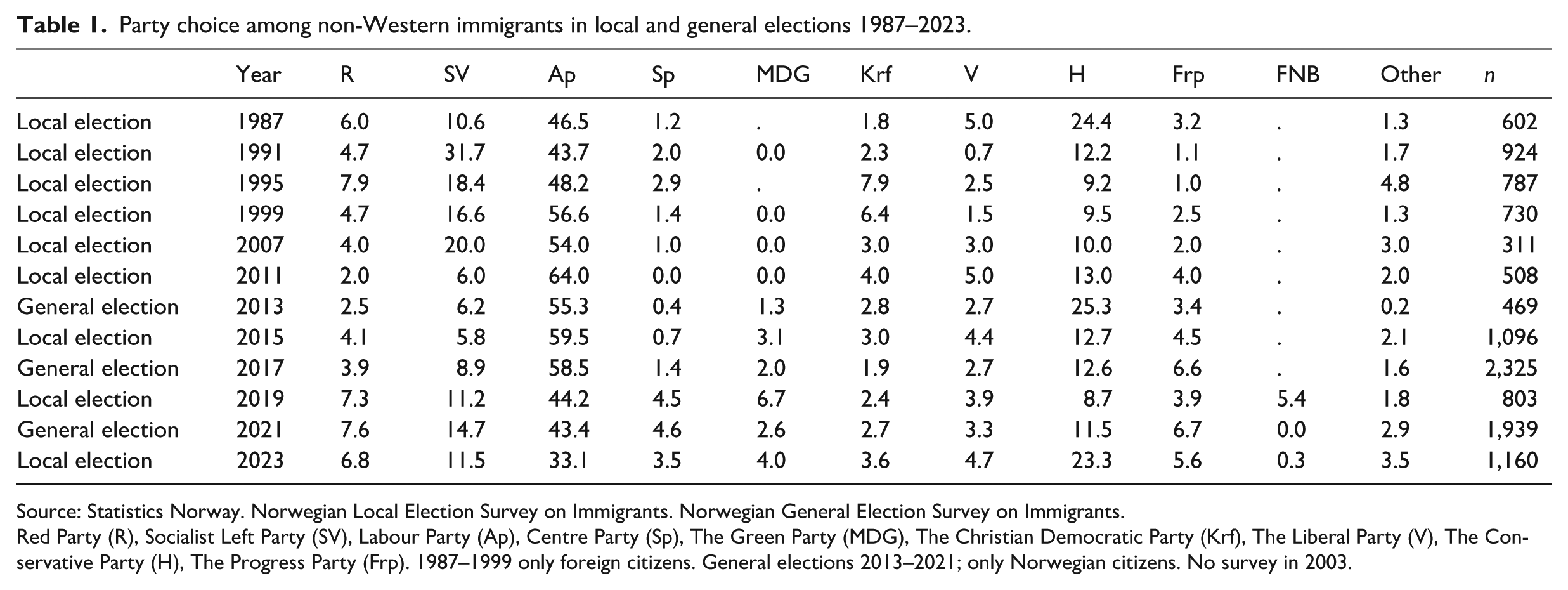
Table 1 displays the results from immigrant election surveys in Norway. The first survey was conducted in 1987. Until 2007, only foreign citizens were surveyed; at that time, most immigrants were foreign citizens and were only allowed to vote in local elections. No survey was conducted in 2003. From 2007 onwards, naturalised and second-generation immigrants were also included. As the number of voters with immigrant backgrounds increased over time, from 2013, the survey was also extended to include voters with immigrant backgrounds in the national parliamentary election. Although the surveyed population changes between 1987 and 2023, Table 1 offers a unique timeline of party preferences among non-Western immigrants in Norway. In the early years, the surveys show strong support for left-wing parties such as the Socialist Left Party and the Red Alliance, to a greater extent among non-Western immigrants than among the rest of the electorate. From 1999 until 2017, most non-immigrant voters preferred the Labour Party. Support for the left-wing parties Red (Red Alliance), the Socialist Left Party, and the Labour Party has been consistently higher among non-Western immigrants than among the rest of the electorate across all survey years, in both local and general elections. However, in the 2019 election, support for the left-wing parties began to decline among non-Western immigrants. From 2019 onwards, this decline continued, regardless of trends in the electorate overall, but the decrease is far more prominent among immigrants (Table 5, Appendix).
Party choice among non-Western immigrants in local and general elections 1987–2023.
Source: Statistics Norway. Norwegian Local Election Survey on Immigrants. Norwegian General Election Survey on Immigrants.
Red Party (R), Socialist Left Party (SV), Labour Party (Ap), Centre Party (Sp), The Green Party (MDG), The Christian Democratic Party (Krf), The Liberal Party (V), The Conservative Party (H), The Progress Party (Frp). 1987–1999 only foreign citizens. General elections 2013–2021; only Norwegian citizens. No survey in 2003.
There has been a striking change in support for the Norwegian Labour Party among non-Western immigrants over time. From 1999 until 2019, support for the Labour Party in this voter group was extraordinarily high (Bergh and Bjørklund, 2011), comparable to the voting patterns of working-class voters in the 1950s and 1960s. Support for Labour declined substantially in the 2019 election, concurrently with a rise in votes for other centre-left parties as well as the ‘other’ category. The latter includes the anti-toll-road party FNB – a single-issue party protesting against the fees that drivers have to pay when driving into big cities and on other toll roads. The FNB was successful in appealing to voters with immigrant backgrounds in 2019 (see Table 1). In the local elections of 2023, the FNB had practically fallen apart due to internal strife, but apparently, voters with immigrant backgrounds did not return to the Labour Party. In fact, many did not turn out to vote in the national election in 2021 (Kleven et al., 2022). Support for Labour continued to decline, falling to almost half of its 2015 level.
Norway has a multi-party system with five parties on the centre left and four on the centre right. Those nine parties tend to run for office at both the national and local level, but in local elections, there are also a variety of smaller parties that do not run for national office. For the purposes of this article, the most relevant political parties are (1) the Labour Party, which has been the main governing party in Norway since World War II; (2) the Conservative Party, the other major governing party in Norway and a moderate conservative party comparable to similar parties elsewhere in Europe; and (3) the Progress Party, Norway’s right-wing populist party. Although the Progress Party participated in a governing coalition from 2013 to 2018 and is generally considered less extreme than comparable parties in other countries (see, for example, Mudde, 2007), it is the most distinctly anti-immigrant party among the major parties in Norway. 3
Although there are some local lists and parties that run for office in local elections in Norway, the national parties are by far the most important in local elections (as well as in national elections). The outcomes of local elections in Norway tend to be influenced by both national-level trends and local issues and trends (Saglie et al., 2021). In this article, we use data from local elections to study trends in the voting patterns of voters with immigrant backgrounds. While these could be influenced by local issues, it is clear from Table 1 that at least the trend of declining support for the Labour Party is evident both in national and local elections.
Data and methods
In Statistics Norway’s electoral statistical system, there are several surveys of the electorate. In this article, we use data mainly from three samples/strata from the Norwegian Local Election Survey (Appendix Table 6; NO-LES 2023; Kleven and Bergseteren, 2024). 4 The survey combines data from administrative data provided by Statistics Norway and self-reported data from the surveyed populations. The samples are drawn directly from the electoral register and are merged with the register of phone numbers and e-mail lists provided by the tax authorities. From Statistics Norway’s registers on population, the immigrant background is merged. Therefore, the survey does not suffer from possible coverage errors, which often occur due to sampling strategies by name-recognition or area-based sampling to select immigrant samples. The sample is drawn using an EPSEM (equal probability sample) design across three samples/strata: (1) a cross-sectional sample of all voters, (2) non-Western immigrants, and (3) descendants of non-Western immigrants (Norwegian citizens with two immigrant parents). The 2023 survey also includes a rotating panel, with about half of the gross sample having participated in a similar survey in 2019 and a new sample drawn to join the panel in 2027. In the net sample, we have a total of 1160 voters with a non-Western immigrant background, which we compare with 3410 responses from native voters. 5
In most surveys of voter behaviour, the share who claimed to have voted is higher than the actual rate of turnout (Jackman and Spahn, 2019; Kleven, 2022). In this analysis, we check and control the self-reported response by the administrative records from the local election committee, thus eliminating over-reporting of voting. 6 However, we still have an over-representation of people who voted because they tend to be more willing to respond to surveys.
Religious attachments are an important independent variable of interest and are often used in studies of voter behaviour. Religious voting was a key concept in Lipset and Rokkan’s (1967) seminal work, and it remains relevant today (Montero et al., 2023). The NO-LES 2023 includes measures of both religious denomination and religiosity. Respondents were asked: ‘Which denomination or faith community do you belong to?’ 7 We merged the responses into four categories: Christian, Muslim, other religion, and no religion. Attendance at religious services and meetings is typically used as a measure of religiosity. For this purpose, we used the following survey question: ‘Excluding special occasions such as weddings and funerals, how often do you attend religious meetings such as a church service, Mass, Friday prayers, or similar?’ 8 We coded attendance into a dummy variable in which high attendance (= 1) was defined as ‘at least once a month’.
The NO-LES 2023 also includes a series of questions about attitudes towards political issues, covering both economic policy and ‘social’ issues. These questions can be seen as indicators of voters’ ideological placement. In the analysis, the questions are coded into binary variables based on respondents’ self-placement on agree–disagree scales (see Appendix for question wording): (1) The process of creating gender equality should continue further, (2) pro self-determined abortion, (3) queer people should have the freedom to live as they want, (4) we should be willing to accept bigger differences in wage levels, (5) it is more important to develop public services than to reduce taxation, (6) want a society with more international orientation, (7) minorities should conform to Norwegian customs and traditions, and (8) we should make it easier for immigrants to come to Norway.
Results
We start this section by studying the individual-level volatility of voters with immigrant backgrounds between 2019 and 2023, using panel data. While we know that there was an aggregate shift towards the right, the individual-level data allow us to observe more precisely how voters moved between parties (and abstention). To explain these changes, we first analyse the relationship between religiosity and voting, followed by an examination of the attitudes of voters with immigrant backgrounds compared with native voters. Finally, using regression analysis, we investigate whether religion and these political attitudes can account for the party switches from 2019 to 2021.
Electoral volatility
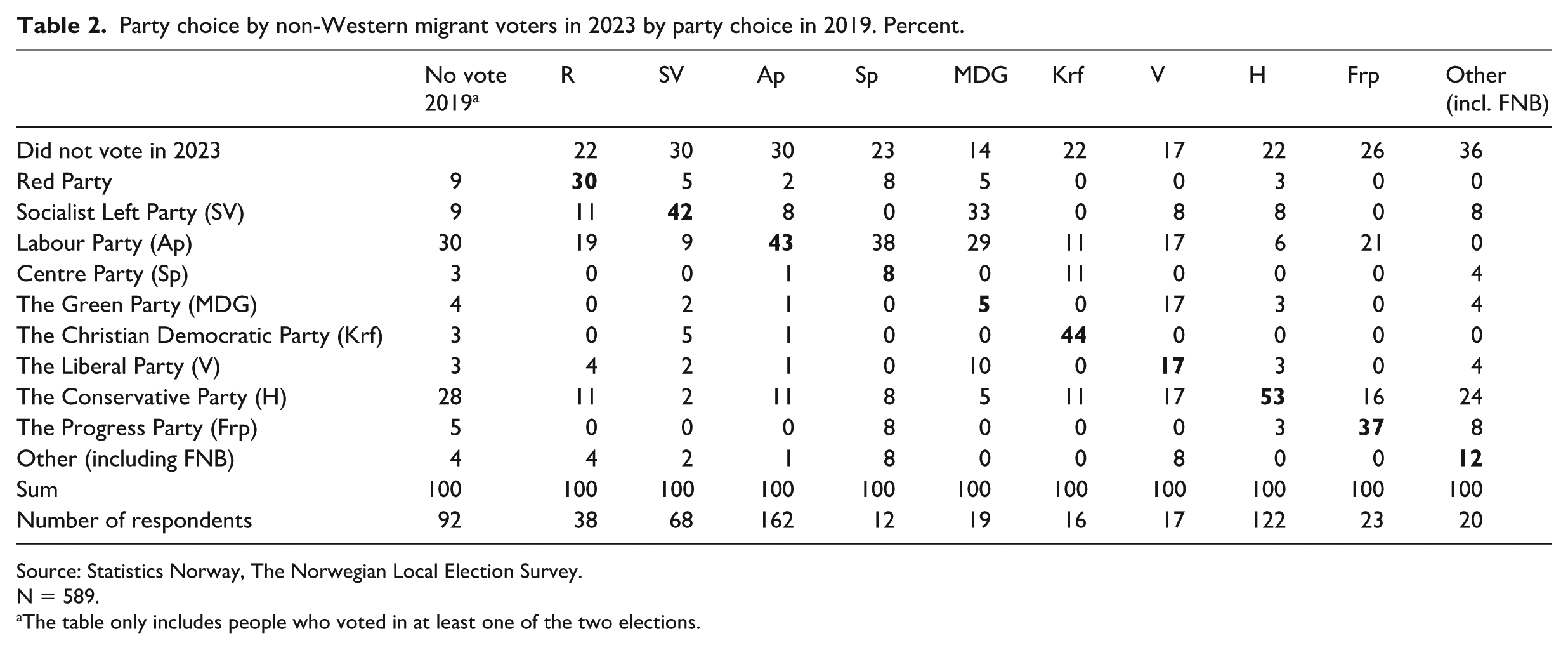
We use panel data to examine voters’ changing party preferences between the 2019 and 2023 local elections. The movement towards centre-right parties in 2023 among voters with non-Western immigrant backgrounds indicates that some voters changed their party preferences. However, newly eligible voters or individuals who abstained in the previous election could also account for part of the centre-right vote. Table 2 presents party preferences in both elections among people who were eligible to vote in 2019 and 2023, and who voted in at least one of these elections. Electoral volatility is displayed as the party choices in 2023 for each party’s voters in 2019 (including non-voters). Table 2 excludes voters who were not entitled to vote in the 2019 election (i.e. first-time voters in 2023). Table 7 in the Appendix reports the party choices of these first-time voters. Among them, support for the Conservative Party is slightly lower than among voters who were eligible to vote in both 2019 and 2023. Support for the left-wing parties is also a bit lower, whereas the shares for the Liberal Party and the Progress Party are slightly higher. However, none of these differences are statistically significant; therefore, it is unlikely that the decrease in support for left-wing parties is driven by first-time voters.
Party choice by non-Western migrant voters in 2023 by party choice in 2019. Percent.
Source: Statistics Norway, The Norwegian Local Election Survey.
N = 589.
The table only includes people who voted in at least one of the two elections.
There are substantial changes in party preferences between the two elections. Most parties retain less than half of their voters from the previous election, as shown by the bold numbers along the diagonal. Overall, 80% of these voters either switched parties or moved between voting and non-voting from 2019 to 2023. The Conservative Party (H) is the most successful in retaining its 2019 voters in 2023. There are also notable shifts towards centre-right parties, including movements from the Labour Party to the Conservative Party. People who did not vote in 2019 support the Conservative Party at a high rate in 2023. The same pattern is observed among voters in the ‘other’ category, the majority of whom voted for the Conservative or Progress Parties in 2023. Table 2 does, in other words, indicate that these voters were on the move between 2019 and 2023. Although Voters move in many different directions, the aggregate effect of these movements benefited parties on the right. The key question then is how to explain these party switches. In the regression analysis below, we examine the extent to which these movements can be accounted for by religion and political conservatism. Before doing so, we take a closer look at the relationship between religion and voting.
The religious vote
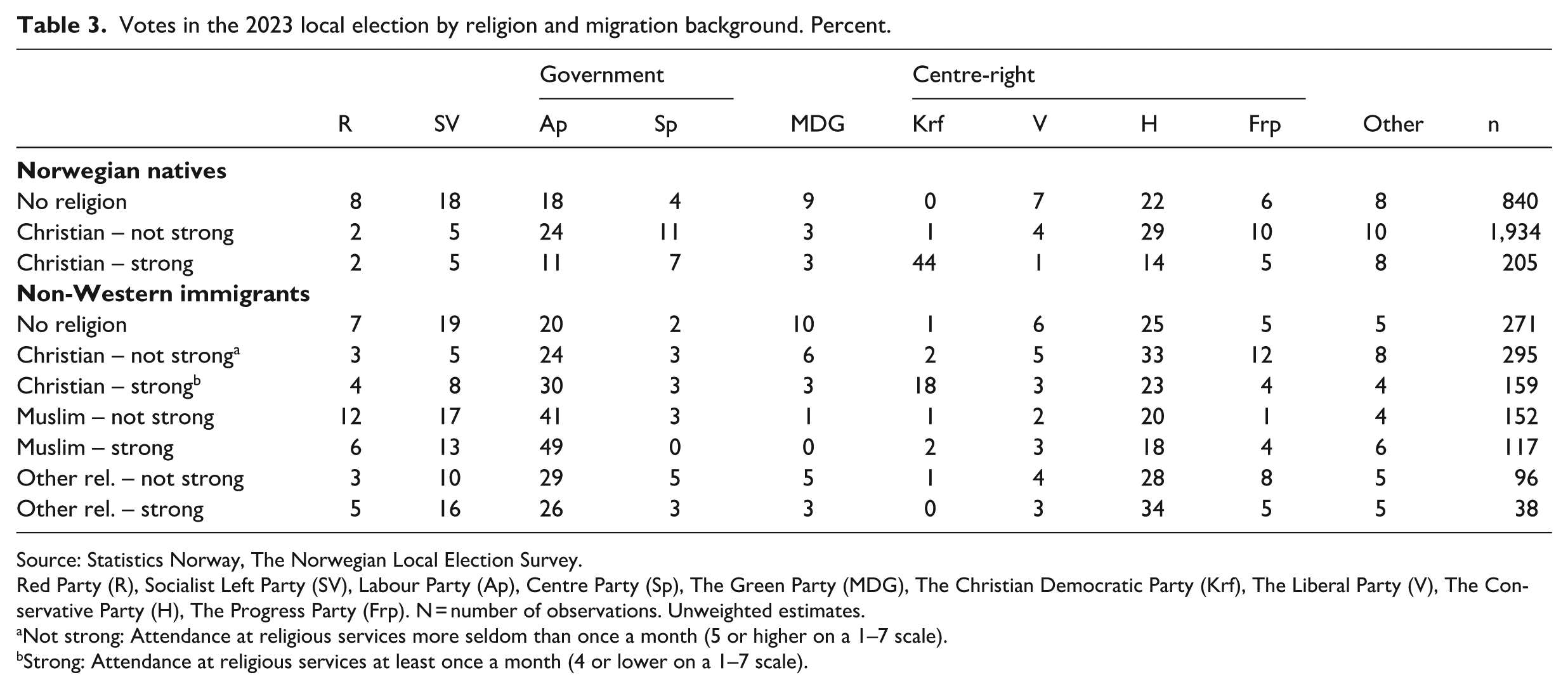
The 2023 Election Study reveals stark differences in the voting patterns of Muslim, Christian, and secular voters with immigrant backgrounds. Muslim voters tend to vote for parties on the centre-left, especially the Norwegian Labour Party. Christians are more likely to vote for centre-right parties, similar to religiously active native voters. Secular voters with immigrant backgrounds are over-represented among voters for the outer-left (the Red Party and the Socialist Left Party).
In Table 3, we include a measure of ‘strength of religion’. This is based on religious attendance (‘How often do you attend church services or other religious meetings?’). Not strong refers to attending religious services less often than once a month, while Strong refers to attending at least once a month. Among Norwegians without an immigrant background, ‘strong Christians’ express much lower support for left-wing parties compared to Christians who seldom attend religious services. Support for the Christian Democratic Party is much higher among ‘Strong Christian’ Norwegians. Among voters with immigrant backgrounds, support for left-wing parties is higher across all religious congregations compared with voters without immigrant backgrounds. However, it is especially high among Muslim voters, particularly among ‘strong Muslims’. In this latter group, 77% voted for left-wing parties. This aligns with previous research, including Dancygier’s (2018) study of Muslims in European politics and the findings reported by Galle et al. (2020). It should also be noted that there are no explicitly Muslim political parties in Norway.
Votes in the 2023 local election by religion and migration background. Percent.
Source: Statistics Norway, The Norwegian Local Election Survey.
Red Party (R), Socialist Left Party (SV), Labour Party (Ap), Centre Party (Sp), The Green Party (MDG), The Christian Democratic Party (Krf), The Liberal Party (V), The Conservative Party (H), The Progress Party (Frp). N = number of observations. Unweighted estimates.
Not strong: Attendance at religious services more seldom than once a month (5 or higher on a 1–7 scale).
Strong: Attendance at religious services at least once a month (4 or lower on a 1–7 scale).
We must bear in mind that the estimates presented here are based on relatively small samples with potentially non-sampling errors. Standard errors accounting for sampling variance can be computed, but it is hard to account for non-sampling errors. We must not put too much emphasis on small differences in the estimated values of the subgroups, but try to see the bigger picture: Muslims strongly favour centre-left parties, and the main evidence for a religiously conservative or right-wing vote is to be found among Christian voters, either native or with a migrant background.
Political attitudes in the immigrant population
The Norwegian party system is multidimensional, with parties covering different cleavages. Voters choose parties for a variety of reasons. Non-Western immigrant voters have traditionally favoured parties on the left, perhaps because these parties have been perceived as the ‘defenders of immigrants’ against the populist right. At the same time, many non-Western immigrants hold traditional, socially conservative opinions. We also observe large differences between native left-wing voters and non-Western immigrant left-wing voters. Non-Western immigrant left-wing voters tend to be more socially conservative, especially on LGBT rights and abortion, than their native counterparts. Moreover, on economic issues, non-Western immigrant left-wing voters tend to agree more with the conservative (right-wing) voters. Earlier research has captured this pattern with the phrase: ‘vote left but are not left-wing’. However, on issues related to immigration, such as integration and whether it should be easier for immigrants to come to Norway, native left-wing voters are more aligned with non-Western immigrants. On several attitudinal dimensions, non-Western immigrants resemble native voters of the Christian Democratic Party (Krf), which is not a right-wing (or populist) party but is generally viewed as part of the left-right centre. Its focus on conservative social issues has not attracted many voters, as the party has remained small in recent Norwegian elections. Norris and Inglehart (2019: 235) classify the Progress Party (Frp) as an authoritarian-populist party. However, the Progress Party is traditionally an anti-tax populist party, and its voters are not specifically socially conservative in regard to gender equality, LGBTQ rights, and pro-abortion. The Progress Party is known for its restrictive positions on immigration, which makes it unlikely to mobilise socially conservative non-Western immigrants.
The 2023 survey includes a series of questions about political attitudes that enable us to compare voters with non-Western immigrant backgrounds to native Norwegian voters (Kleven and Bergseteren, 2024). In the Appendix, we display the position of voters of centre-left and centre-right by religion on these attitude questions. Non-voters are also displayed (Tables 8 to 10, Appendix).
The first three issues (the process of creating gender equality should continue further, pro self-determined abortion, and queer people should have the freedom to live as they want) concern social issues and thus measure social conservatism. Among centre-left voters (Appendix Table 8), we find clear evidence of the ‘paradox’ in which immigrant voters, particularly Muslim voters, hold more conservative positions while voting for ‘progressive’ parties. On all three items, immigrant voters, especially Muslims, are more socially conservative than native Norwegian voters. Among centre-right voters, the figures are somewhat more aligned with these social issues. Views of gender equality, for instance, do not differ much between native and immigrant voters (irrespective of religion). On the other two items (abortion and LGBT rights), however, there is a pattern in which native Norwegian voters of centre-right parties are more liberal than immigrant voters, especially Muslims.
It should be emphasised that the majority of both immigrants and natives support LGBT rights, abortion rights, and gender equality. Nonetheless, substantial minorities of immigrants hold traditionally conservative views. It is worth remembering, however, that we are comparing immigrants from around the world to a native population in a country known for its liberal and progressive views.
The next two issues are about the traditional difference between left and right in economic policy (we should be willing to accept bigger differences in wage levels, and it is more important to develop public services than to reduce taxation). The first question (accepting wage differences) reveals substantial differences between natives and immigrants who vote for centre-left parties (Table 4), with the latter group being ideologically further to the right (accepting of wage differences to encourage individual effort). These differences are not as great with respect to the second question, but again, immigrants are further to the right; they are less likely to support public services over lower taxes. The corresponding questions in Appendix Table 9 (centre-right voters) are ideologically to the right, and on the question about wage differences, maybe even more so than native voters.
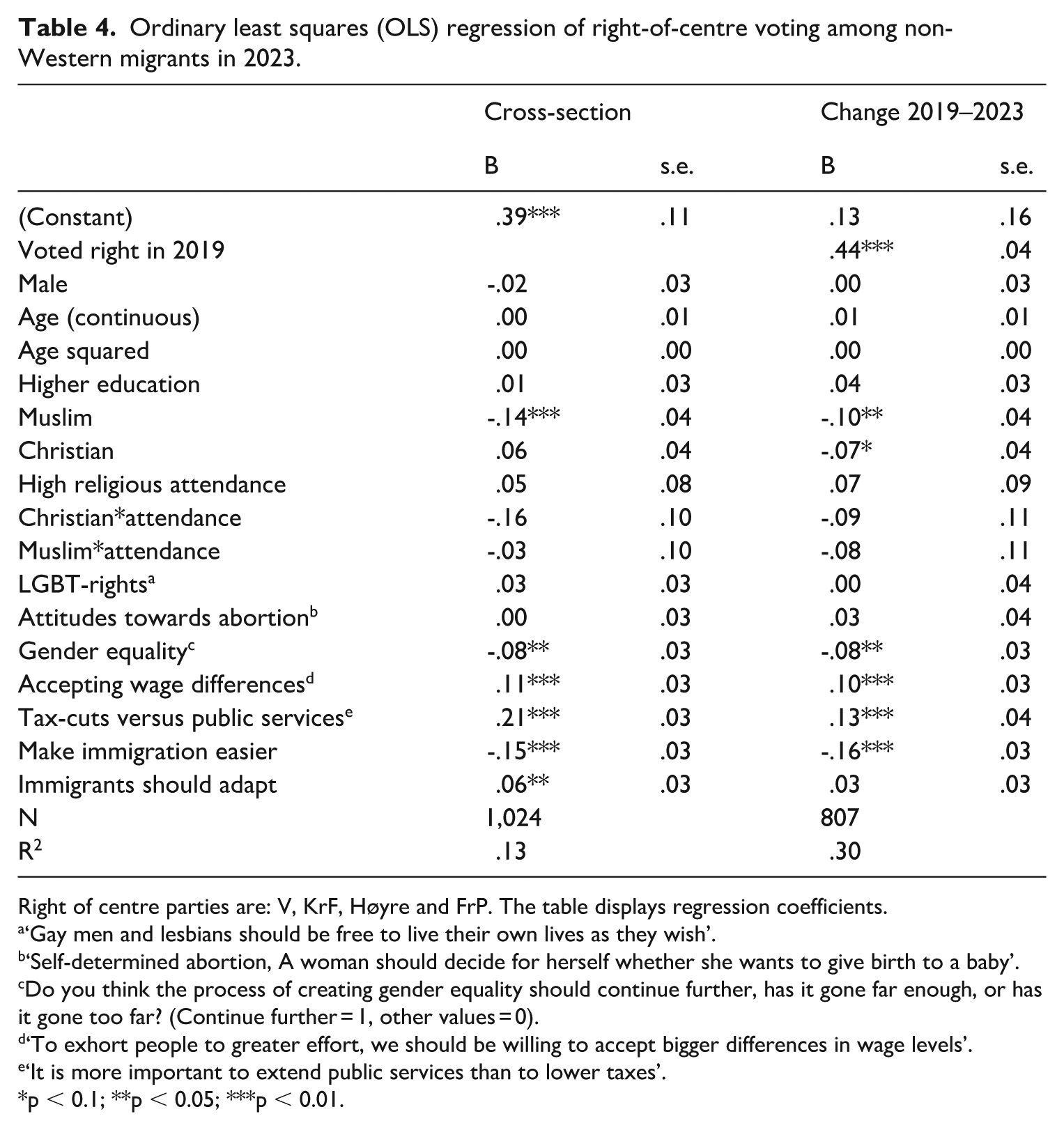
Ordinary least squares (OLS) regression of right-of-centre voting among non-Western migrants in 2023.
Right of centre parties are: V, KrF, Høyre and FrP. The table displays regression coefficients.
‘Gay men and lesbians should be free to live their own lives as they wish’.
‘Self-determined abortion, A woman should decide for herself whether she wants to give birth to a baby’.
Do you think the process of creating gender equality should continue further, has it gone far enough, or has it gone too far? (Continue further = 1, other values = 0).
‘To exhort people to greater effort, we should be willing to accept bigger differences in wage levels’.
‘It is more important to extend public services than to lower taxes’.
p < 0.1; **p < 0.05; ***p < 0.01.
On immigration policy (want a society with more international orientation, minorities should conform to Norwegian customs and traditions, and we should make it easier for immigrants to come to Norway), similarities between immigrants and natives are striking. Immigrants support a slightly more liberal immigration policy than natives and are about as likely as natives to agree that immigrants should conform to Norwegian customs and traditions. This pattern is evident among both centre-left and centre-right voters. Just and Anderson (2015) documented a similar pattern among naturalised immigrants in their study of 18 Western European democracies.
Finally, many non-Western immigrants who previously voted for the Labour Party have become non-partisan and do not participate in recent elections. If we look at the non-voters as a group, we see that the immigrant non-voters hold more socially conservative values compared to those who voted, regardless of whether they voted left or right (see Table 10 in the Appendix). In that sense, conservative parties may have an opportunity to win votes if they manage to mobilise this group.
In sum, although we should not exaggerate the differences in policy views between natives and immigrants in Norway, there is a pattern in which immigrants hold more conservative positions both on economic policy and on social issues. This is true among centre-left voters and less so among centre-right voters. These patterns indicate that a number of voters with immigrant backgrounds currently supporting the centre-left are ideologically closer to centre-right parties. These are indications that centre-right parties have the potential to mobilise more immigrant-background voters. The question in the next section is whether voter switches can be explained by these types of ideological differences.
Multivariate analyses
The descriptive analyses indicate, first, that there are substantial changes in party preferences towards the right among immigrant voters. Second, there is limited evidence that religiosity can explain this trend. Religiously active Muslims, for example, have a clear preference for centre-left parties. Third, the ideological positions of voters with immigrant backgrounds could be described as right-leaning, even among voters of centre-left parties. This presents a potential opportunity for centre-right parties.
A potential problem with the descriptive results is that the variables are related, creating the possibility of confounding effects. We therefore conducted multivariate analyses of party change. We chose to use a simple ordinary least squares (OLS) regression because the effects are easy to interpret and communicate. We also performed a logistic regression model; the model did not alter the results. The dependent variable in the OLS regression models is a dichotomous variable (0/1), where 1 indicates that the respondent voted for a right-wing or centre party in the 2023 election. Respondents coded as 1 are those who voted for one of the following parties: the Christian Democratic Party (Krf), the Liberal Party (V), the Conservative Party (H), or the Progress Party (Frp).
The independent variables in the models are the attitudinal variables previously described. Gender, age, education, and religion are included as control variables. These variables often influence the dependent variable. Including them controls for their effects, allowing us to isolate the impact of our primary independent variables. We also included a variable measuring religious attendance, as well as interactions between religious denomination and attendance. This allows us to examine whether the most religiously active within each denomination differ from others.
Table 4 presents two regression models: one based on the cross-sectional 2023 election dataset and the other based on the 2019 through 2023 panel dataset.
The difference between the first and the second models is that the panel model controls for vote choice in the previous (2019) election. Unfortunately, the panel is relatively small for this voter group. 9 We use the vote-choice question from the 2019 survey wherever possible. For respondents not included in the 2019 survey, we use the recall question about voting in 2019. 10 In a separate analysis, not shown here, we included a dummy variable indicating whether the 2019 vote information came from the panel or from the recall question. The effect of this variable is not statistically significant, nor does its inclusion meaningfully affect the size or significance of other coefficients.
Since we use OLS regression, the coefficients can be interpreted as the change in support for centre-left parties associated with a shift from 0 to 1 (or from low to high) on the independent or control variables. The ‘usual social background control variables’ (gender, age, education) do not affect support for parties on the right. However, Muslims are less likely than others to vote for centre-right parties, in line with what we have seen in previous elections. In the first, cross-sectional model, none of the other variables related to religion have statistically significant effects on right-wing voting. There is thus little support for the idea that conservative religiosity contributes to support for the centre right among voters with immigrant backgrounds.
Next, looking at the ideological or attitudinal variables, attitudes towards economic policy (both indicators) have a stronger effect on support for centre-right parties compared to the attitudes measuring social conservatism. Clearly, our measures of social conservatism have weaker effects. It looks as if support for centre-right parties among immigrants is fuelled by traditional economic conservatism, rather than social conservatism. This is also an area in which the attitudes of voters with immigrant backgrounds appear to have changed in recent years, potentially explaining a shift towards parties on the right in this group. Attitudes towards immigration are predictably related to right-wing voting. People who favour stricter immigration policies and believe that immigrants should adapt to Norwegian customs and traditions tend to vote for the centre-right.
We take this a step further in the second panel model. By controlling for vote in the 2019 election, we are in effect measuring the effects of the independent variables (ideological or attitudinal variables) on party switches (across the left-right divide) between 2019 and 2023. What drives these changes?
In this analysis, both measures of religious adherence have a negative effect on party switches towards parties on the centre-right. In other words, religion or religiosity cannot explain party switches towards the right. Quite the contrary, secular voters are more likely to change their vote towards parties on the right.
The one social issue that has an effect on party switches is attitudes towards gender equality, but the effect is not very large. LGBT rights and attitudes towards abortion, issues on which immigrants tend to hold conservative attitudes, do not have any effect on party switches. In other words, neither religiosity nor socially conservative attitudes are significant drivers of the shift towards the right.
Rather, economic policy issues explain the changes observed between 2019 and 2023. Both economic policy indicators show significant effects. Immigrants have become more economically conservative, and this is now reflected in their voting patterns. Since some voters who typically support centre-left parties also hold right-leaning economic attitudes, there is potential for centre-right parties to attract more voters with immigrant backgrounds.
Conclusion
Immigration is transforming the religious and ideological landscapes of Europe. Not only is immigration policy one of the most bitterly divisive policy issues on the continent, but immigrants themselves are also increasingly important political actors. Studies of the voting patterns of voters with migrant backgrounds in Europe now cover several decades, and they have become more relevant as immigration populations have grown. Although immigrant populations are heterogeneous, ideologically and otherwise, many previous studies have documented a left-wing voting pattern in these groups (see, for example, Bergh and Bjørklund, 2011). This pattern appears to be breaking in some counties, and in some cases, there is movement towards parties on the right. The purpose of this study was to explain this pattern using high-quality migrant election data from Norway.
Scholars have long noted the paradox that socially conservative voters with immigrant backgrounds disproportionately vote for socially liberal parties on the left (Bergh and Kleven, 2018; Dancygier, 2018; Kleven, 2019). Evidence from the 2023 Norwegian Local Elections Study indicates that this pattern may be changing. Similar developments may be occurring in other countries (see, for example, Spies et al., 2022; van Oosten, 2025).
A reasonable explanation for this development is that the social conservatism of voters with immigrant backgrounds is finally leading them to shift political allegiance. However, our analysis does not support the idea that social conservatism explains this shift. Rather, a gradual ideological move to the right on economic policy appears to be a more important factor. Voters with migrant backgrounds appear to be driven by ideological and issue-based voting that is similar to that of native voters. The break with the distinctly left-wing voting pattern of voters with migrant backgrounds may signal a normalisation of this voter group and a greater sense of political integration into the host country. There are, we believe, several lessons to be drawn from this, which may also guide future research.
First, while religious voting has been an important component of European politics for as long as democratic politics have existed, this may not be the ideal frame of reference to study migrant voters. Migrants tend to be more religiously active than native voters. They also tend to hold socially conservative positions on issues such as abortion and LGBT rights. Nevertheless, these characteristics seem to have less of an impact on the voting patterns of migrants than they do among natives. While there is an argument to be made that immigrants will transform the nature of religious voting in Europe, our study indicates that conservative religion does not translate into a conservative vote in the way that one may expect.
Second, economic issues seem to hold more sway than social ones. The increase in the centre-right vote among immigrants in Norway is strongly driven by views on economic policy. Perhaps we are overemphasising the role of ‘identity politics’ when it comes to voters with immigrant backgrounds. The most important political distinction between left and right is, in fact, over economic policies such as taxation. Most countries in Europe, including Norway, have experienced a rise in the cost of living for most people. Inflation can be especially challenging for people with low or medium incomes, with an immigrant background or not. The parties on the right have made taxation one of their core issues, making the case that conservative policies will enable people to keep more of the money they earn. These types of arguments have a broad appeal, probably also among voters with immigrant backgrounds.
Third, this is an early study of a recent trend among voters with immigrant backgrounds in Norway. We do not yet know whether this trend will persist. Comparative research across several countries would be especially valuable (see van Oosten, 2025). It remains unclear whether our findings are generalisable beyond Norway. What is clear, however, is that voters with immigrant backgrounds constitute a growing share of European electorates at a time when their voting patterns are changing. Continued research on the dynamic voting behaviour of these voters is essential for understanding not only migrant voters themselves but European politics more broadly.
Footnotes
Appendix
Attitudes towards political issues among non-voters, Norwegian natives and non-Western immigrants by religious denomination. 2023 election. Percentages.
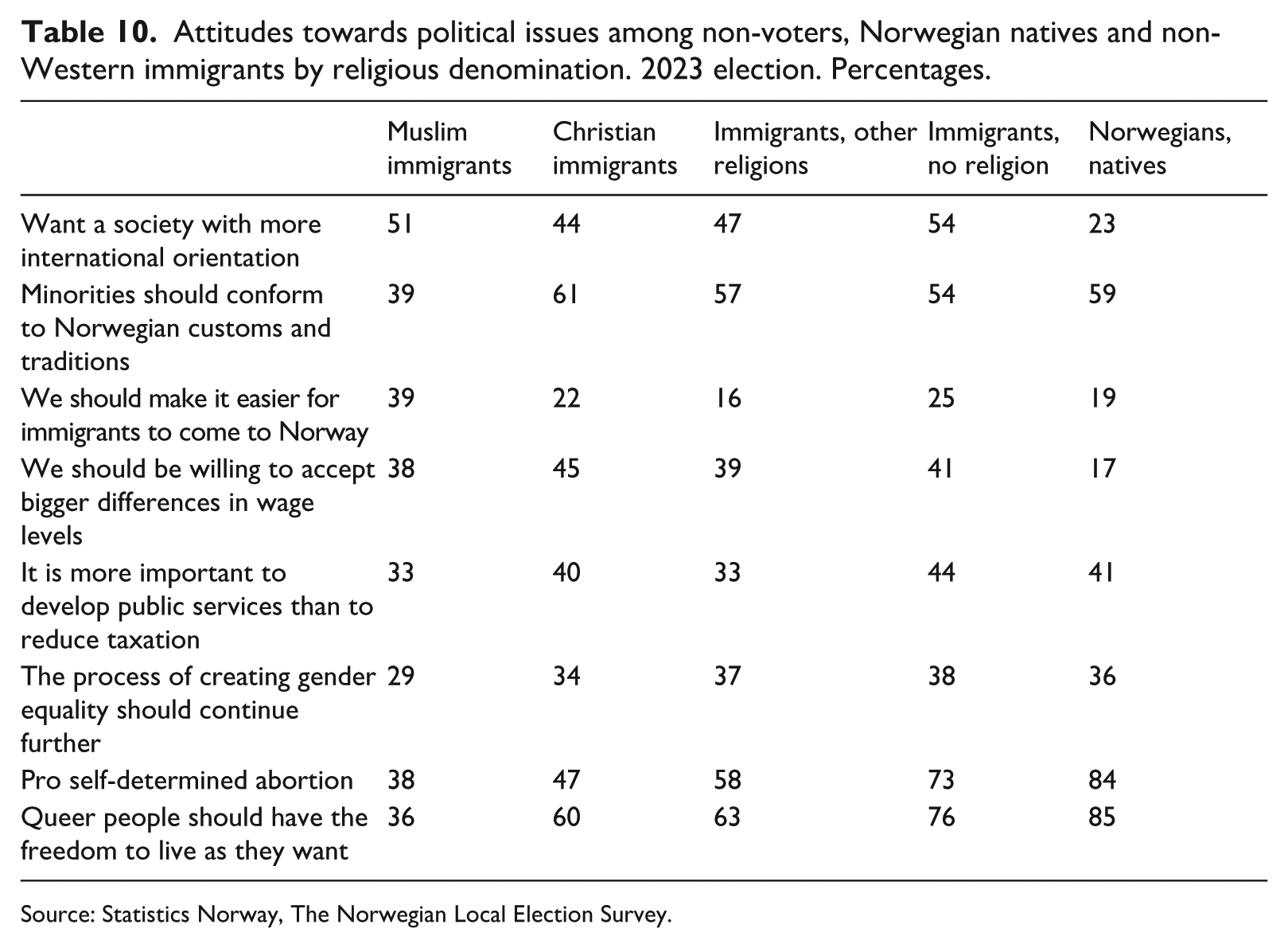
| Muslim immigrants | Christian immigrants | Immigrants, other religions | Immigrants, no religion | Norwegians, natives | |
|---|---|---|---|---|---|
| Want a society with more international orientation | 51 | 44 | 47 | 54 | 23 |
| Minorities should conform to Norwegian customs and traditions | 39 | 61 | 57 | 54 | 59 |
| We should make it easier for immigrants to come to Norway | 39 | 22 | 16 | 25 | 19 |
| We should be willing to accept bigger differences in wage levels | 38 | 45 | 39 | 41 | 17 |
| It is more important to develop public services than to reduce taxation | 33 | 40 | 33 | 44 | 41 |
| The process of creating gender equality should continue further | 29 | 34 | 37 | 38 | 36 |
| Pro self-determined abortion | 38 | 47 | 58 | 73 | 84 |
| Queer people should have the freedom to live as they want | 36 | 60 | 63 | 76 | 85 |
Source: Statistics Norway, The Norwegian Local Election Survey.
Acknowledgements
We would like to thank Mari-Liis Jakobson, Niels Spierings, the anonymous referees as well as the editor of Politics for their constructive comments to previous versions of this article.
Funding
Funding comes from the Research Council of Norway, project number 352455; and from NordForsk, project number 196398.
