



Abstract
The fragmentation and complexity of governance are well recognized among scholars and policy makers. The debate on fragmentation has itself, however, also remained rather fragmented. This has inhibited the drawing of common lessons among the different communities, and has delayed the development of more concerted efforts to enhance synergies and address trade-offs between different societal goals. In order to move forward, this theme issue shows that the various disconnected debates are in essence trying to do the same thing—contribute to the discussion on the relationships between governance instruments. In order to do so, it is based on and advances the notion of Integrative Governance, defined as the theories and practices that focus on the relationships between governance instruments and/or governance systems. The theme issue serves the debate in two ways: (1) it contributes to the “defragmentation” of the debate by bringing together the different concepts and approaches used to study Integrative Governance and (2) it furthers the debate by addressing the main gaps in the Integrative Governance literature. Each article contributes to both aims of the theme issue by making conceptual links between the different approaches, and by addressing multiple gaps in the literature. As such, the theme issue as a whole contributes to a better understanding of the relationships between governance instruments, with a view to enhance these relationships and governance performance.
Keywords
Introducing the theme issue
The fragmentation and complexity of governance has been widely recognized in scholarly and practitioner debates, and a rich literature has emerged on the issue (see e.g., Abbott and Snidal, 2010; Alter and Meunier, 2009; Biermann, 2014; Bogdanor, 2005; Rayner et al., 2010; Tamanaha, 2008; Young, 1996). Both scholars and policy makers realize that, given the continuous development of policies and rules at different levels of governance (from the global to the local) to address different societal problems, these rules influence one another. This influence can take place among instruments addressing the same issue, or among those addressing different societal challenges.
However, as I have suggested earlier (Visseren-Hamakers, 2015), “the debate on fragmentation has itself been rather fragmented,” with authors from different disciplines contributing to the debate over time, using different terminologies, focusing on different levels of governance, and studying relationships between various units of analysis. Used concepts include interorganizational relations (see e.g., Schmidt and Kochan, 1977), legal pluralism (Griffiths, 1986; Merry, 1988), polycentric governance (Ostrom, 2010), regime complexity and fragmentation (Alter and Meunier, 2009; Biermann et al., 2009; Fischer-Lescano and Teubner, 2003), integrated management (Born and Sonzogni, 1995; Hughes and Pincetl, 2014), landscape governance and approaches (Buizer et al., 2015; Görg, 2007; Sayer et al., 2013), (environmental) policy integration (EPI) (Jordan and Lenschow, 2010; Persson et al., 2018; Weber and Driessen, 2010; Winkel and Sotirov, 2015), coordination (Geddes and Jordan, 2012; Peters, 1998), mainstreaming (Brouwer et al., 2013; Karlsson-Vinkhuyzen et al., 2017; Kok and de Coninck, 2007), coherence (Jones, 2002), smart regulation and policy mixes (Gunningham and Grabosky, 1998), multilevel governance (Hooghe and Marks, 2003; Marks et al., 1996; Rambonilaza et al., 2015), governance architectures and systems (Biermann et al., 2009; Visseren-Hamakers, 2009), regime complexes (Abbott, 2012; Raustiala and Victor, 2004), institutional interaction and interaction management (Oberthür, 2016; Oberthür and Gehring, 2006), metagovernance and orchestration (Abbott Kenneth and Bernstein, 2015; Abbott and Snidal, 2010; Kooiman and Jentoft, 2009), telecoupling (Liu et al., 2013), the governance of complex systems (Young, 2017), and the nexus approach (Benson et al., 2015; Rasul and Sharma, 2016). 1
Similar debates take place among policy makers. Examples include the Convention on Biological Diversity (CBD), which promotes the mainstreaming of biodiversity concerns especially in the forest, fisheries, aquaculture, and agricultural sectors (CBD, 2016), and the Global Environment Fund (GEF) that is applying integrated approaches (GEF, 2014). Policy coherence is also explicitly mentioned as part of the Post-2015 Development Agenda and the Sustainable Development Goals (SDGs) by recognizing the integrated and indivisible nature of the goals (UN, 2015).
The fragmentation of the debate—both among academics and between academia and policy makers—has had implications both for its theoretical and conceptual evolution and for the development of policy solutions. It has delayed the development of more concerted efforts to enhance synergies and address trade-offs between different societal goals, and has stood in the way of the drawing of common lessons among the various communities. In order to highlight that the disconnected debates are in essence trying to do the same thing—contribute to the discussion on the relationships between governance instruments—this theme issue is based on and advances the notion of Integrative Governance (IG). IG can be defined as the theories and practices that focus on the relationships between governance instruments and/or governance systems. Governance instruments include public, private, and hybrid (public–private) policies and rules, and a governance system is defined as the total of instruments on a certain issue at a specific level of governance (see also Visseren-Hamakers, 2015).
A significant part of the IG debates among scholars and policy makers, including the articles in this theme issue, has focused on environmental and sustainability issues. To reflect this emphasis in the literature, I previously applied the concept of Integrative Environmental Governance (Visseren-Hamakers, 2015). This theme issue, however, uses the more generic term IG to acknowledge IG perspectives are relevant more broadly, also beyond environmental and sustainability issues.
An IG perspective thus promotes a mode of governance in which not a single governance instrument is the point of departure, but the relationships between governance instruments take center stage. Scholars, policy makers, and other stakeholders need further insights into the potential explanations for, implications of, and adequate response strategies to the fragmentation of governance. This is what an integrative approach can deliver.
Different disciplines have contributed to the IG debate, and an IG perspective is relevant for and contributes to current (inter-) disciplinary debates, including in organization studies, international relations, public administration, law, sociology, geography, environmental studies and science, development studies, and innovation studies. Moreover, it can contribute to some of the most pressing policy questions of our time, including on trade-offs and synergies between environment and development. An IG perspective can especially support efforts to conceptualize links between the spatial and political, including through work on integrated management and landscape governance—for relationships between governance instruments or systems in a specific location; sustainable urban and regional planning—for governing the relationships between cities and their surrounding rural areas; and telecoupled governance systems—for relationships between governance systems over large distances. It is in the governing of such complex relationships where an IG perspective is most needed.
Contributions of the theme issue
This theme issue has two main aims. First, it aims to contribute to the “defragmentation” of the IG debate by bringing together key concepts and approaches used to study the relationships between governance instruments or systems, and clarify the conceptual differences between the various approaches (see also Table 1). This enables the drawing of collective lessons learned and developing common insights, thereby furthering the debate theoretically, conceptually and empirically.
Overview of the theme issue on Integrative Governance (IG).
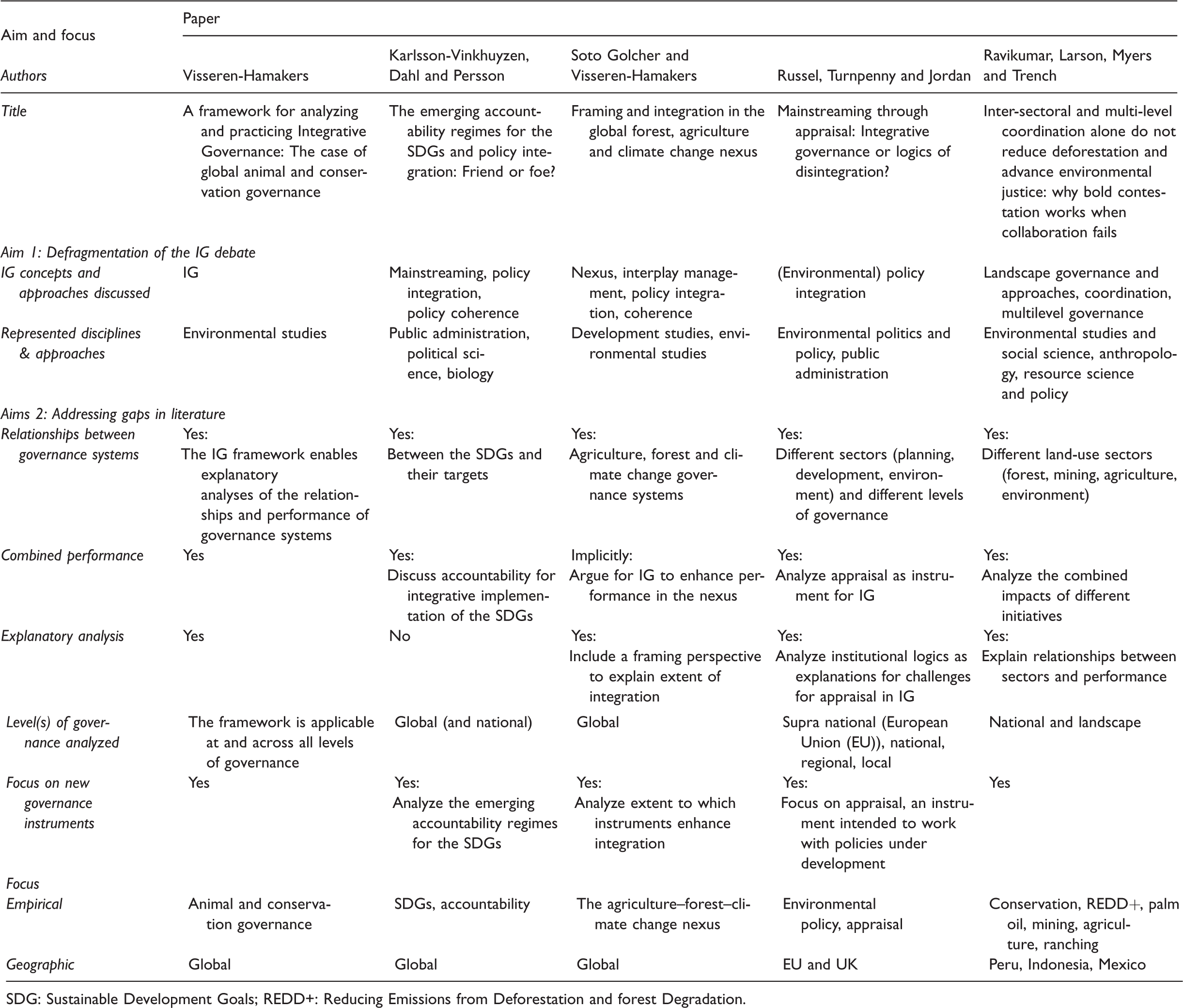
SDG: Sustainable Development Goals; REDD+: Reducing Emissions from Deforestation and forest Degradation.
The theme issue as a whole contributes to this first aim by bringing together scholars representing the various approaches and concepts, including EPI (Jordan and Lenschow, 2010; Persson and Runhaar, 2018), mainstreaming (Karlsson-Vinkhuyzen et al., 2017), multilevel governance (Ravikumar et al., 2015), polycentric governance (Jordan et al., 2015), policy mixes (Persson, 2006), integrated management (Dahl, 1993), institutional interaction (Somorin et al., 2016), and interaction management (Visseren-Hamakers and Verkooijen, 2013).
The theme issue also brings together contributions from different (inter-) disciplinary perspectives, thereby again contributing to the further defragmentation of the debate. Represented fields include anthropology, biology, development studies, environmental policy, studies and social science, human geography, political science, public administration, public policy, and resource science and policy. Because some authors are policy practitioners and/or actively involved both in academia and policy processes, the theme issue also contributes to bridging the gap between the academic and practitioner debates. The theme issue also includes authors representing different theoretical perspectives in the IG debate, with some promoting the enhancement of synergies, others studying the relationships between governance instruments from an analytical perspective, and a third group critically reflecting on the coherency debate.
The second aim of the theme issue is to take a next step in the debate by addressing the gaps in the IG literature (for further detail, see Visseren-Hamakers, 2015), with each paper addressing at least one of the following gaps (see also Table 1).
Relatively few studies analyze the relationships between governance systems. While several contributions to the IG literature discuss relationships between (instruments from) different governance systems (e.g., mainstreaming, EPI, landscape governance and the nexus approach), little work has been done to systematically analyze the relationships between governance systems. Most studies to date analyze relationships between instruments (or organizations) within one governance system (see e.g., Abbott, 2012), and if the analysis includes multiple governance systems, it is usually focused on the relationships between two specific instruments, each from a different governance system (see e.g., Gehring and Oberthür, 2009). Therefore, more work is needed in analyzing the relationships between governance systems.
Very little work has been done to analyze the relationships in and the combined performance of groups of instruments. Even though different IG literatures focus on groups of instruments (including the literature on governance architectures and systems, regime complexes, landscape governance, policy mixes, and metagovernance), very few of these contributions develop frameworks or methods to systematically study the relationships in or the combined performance at this level of abstraction. Most of the more conceptual and analytical work so far has studied the relationships between pairs of instruments (Oberthür and Gehring, 2006) and the performance of single instruments instead (Underdal, 2002).
Very few studies develop explanatory analyses of the relationships between instruments or systems. Most studies to date have focused on placing the issue of regime complexity on the agenda (Alter and Meunier, 2009), or developing frameworks to analyze IG (Avant, 2013; Biermann et al., 2009; Gunningham and Grabosky, 1998; Morin and Orsini, 2013; Nilsson and Persson, 2003). Even though several authors highlight the need for explanatory analyses (Keohane and Victor, 2011; Zelli et al., 2013), very few studies have focused on explaining why the relationships between governance instruments or systems are the way they are, or develop frameworks to do so (Visseren-Hamakers, 2018).
There is a lack of understanding on how IG works at different levels of governance. Since most studies focus on a specific level of governance, and these different literatures have developed in relative isolation from each other, the debate on how IG works at—and across—different governance levels, has only started fairly recently (Nilsson et al., 2009; van Oosten et al., 2018; Zelli and van Asselt, 2013).
IG analyses are mostly applied to existing instruments, less so for developing new ones. While some authors do highlight that new instruments are not developed on a “clean slate,” but in a context of existing ones (Raustiala and Victor, 2004), most analyses are applied to existing instruments. Little is known about how new governance instruments are—or could be—developed in a “crowded” governance system, with many instruments already in place.
The contributions of the articles
Each paper in the theme issue contributes to both aims, namely the defragmentation of, and addressing the gaps in, the IG debate. Each article discusses the conceptual links between the main concept(s) used in the article and related terminologies (see Table 1). In this manner, the theme issue as a whole contributes to developing an overview of a significant part of the IG literature, with each article contributing to strengthening the conceptual relationships between the various contributions to the IG literature.
The geographical and empirical focus of the various articles has been kept relatively diverse in order to enable the drawing of general lessons on IG on multiple issues, from different parts of the world, and for various levels of governance. The geographical focus of the different papers is comprehensive, with several continents and all levels of governance represented. Two papers apply a multilevel governance approach, one of which zooms in on landscapes, a level of governance that is recently receiving increased attention in debates on integrative approaches.
All papers focus on timely issues related to environment and sustainable development. Issues studied by the various papers include agriculture, animal governance, conservation, environmental policy, climate change mitigation, including Reducing Emissions from Deforestation and forest Degradation (REDD+), climate change adaptation, forest governance, and the SDGs.
Visseren-Hamakers (2018) presents a framework to analyze and practice IG. In order to address the above gaps in the literature, the framework focuses on explanatory analyses of the relationships and performance of governance instruments and/or systems. It includes three steps of analysis, with the first focused on the governance instruments and the relationships between them, the second on the combined performance of governance systems, and the third on explanations for the relationships and performance. Especially for the third step, insights from different theoretical perspectives are used, incorporating insights from rational choice theory, institutionalism, constructivism, and critical theory, thereby creating four clusters of explanatory factors. The application of the framework is illustrated by the example of the global animal and conservation governance systems. The paper shows that applying the IG framework enables an enhanced understanding of the multiple and intertwined explanations of the relationships and performance of governance systems, allowing academics and policy makers to develop more realistic, durable solutions both in the shorter and longer term.
Karlsson-Vinkhuyzen et al. (2018) discuss IG through an accountability lens. They examine the IG concepts of mainstreaming, EPI, and coherence. Mainstreaming “involves taking a specific objective of one issue domain and declaring that this objective should be integrated into other issue domains” (Karlsson-Vinkhuyzen et al., 2018). With this, it is a normative concept, arguing to prioritize certain issues, for example the environment, biodiversity, gender, climate change, or human rights. The concept of integration can be used as a synonym for mainstreaming (as in EPI), or can refer to two-way integration. Coherence refers to synergies between different policy domains. So policy integration or mainstreaming can be seen as aiming for policy coherence.
The authors analyze the relationship between integration and accountability conceptually and focus on the question whether a high degree of policy integration is compatible with accountability, since on the one hand, integration implies diffusion of responsibilities—and thereby accountability—across actors and sectors. Moreover, integration (or more broadly IG) often works through networks or other collaborative arrangements, thereby further blurring accountability relationships. On the other hand, strong accountability regimes could inhibit integration efforts, since they assume clear roles of different actors.
In order to analyze the synergies and trade-offs between integration and accountability, the authors analyze the emerging accountability regimes of the United Nations 2030 Agenda for Sustainable Development and its SDGs. These are meant to be integrative and indivisible—the SDGs should be implemented together in order to contribute to the transformation necessary to achieve sustainable development. The paper concludes that accountability regimes will only support the integrative character of the SDGs if accountholders have clear understanding of the interlinkages, trade-offs, and synergies. I suggest here that applying the IG framework (Visseren-Hamakers, 2018) could support such enhanced understanding among different actors.
Soto Gólcher and Visseren-Hamakers (2018) analyze the extent of integration in the global forest–agriculture–climate change nexus. They show that efforts to enhance integration include soft law, programs, and specific integrative approaches, such as the landscape approach, climate smart agriculture, and agroforestry.
They discuss the concepts of nexuses, integration, and interplay management. Contrary to mainstreaming and some approaches to policy integration, the nexus approach gives equal importance to different sectors or governance systems, and is meant as an avenue to balance conflicting sectoral objectives and promote policy coherence (Soto Gólcher and Visseren-Hamakers, 2018). Policy integration is understood as “the inclusion of sector-specific objectives, considerations or concerns into other policy domains,” with interplay management defined as “conscious efforts by any relevant actor or group of actors, in whatever form or forum, to address and improve institutional interaction and its effects” (Strokke and Oberthür, 2011: 6). Thereby, integration can be achieved through interplay management efforts.
The authors combine the degree of legalization (defined as density and types of norms and rules) in the different governance systems and the concept of framing (“the process by which issues, decisions or events acquire different meanings from different perspectives” (Dewulf, 2013)) as potential explanations for the extent of integration. With this, the analysis focuses on steps (1) Analyzing the interactions between governance instruments and (3) Explaining the relationships and performance of a governance system of the IG framework, with special attention for interplay management efforts (step 1d in the IG framework: Mapping governance instruments aimed at managing the relationships), and the institutional and discursive clusters of explanatory factors. The results show that integration is facilitated by compatibility of dominant frames in different governance system and a low degree of legalization.
Russel et al. (2018) analyze the relationship between policy integration and appraisal, defined as “a family of ex ante techniques and procedures … that seek to inform decision makers by predicting and evaluating the consequences of various activities…” (Owens et al., 2004), including, among others, Environmental Impact Assessment (EIA) and Strategic Environmental Assessment (SEA). Appraisal could advance IG since it provides decision makers with the necessary knowledge on impacts of plans early in decision-making processes. The paper studies the challenges faced by appraisal as a tool for IG in a multi-level decision-making context.
Geographically, the paper focuses on the European Union (EU) and the UK, contexts with ample experience with both appraisal and EPI. The paper discusses institutional logics, or “logics of disintegration,” that can explain integration problems when using appraisal. These mostly include differing logics across levels of governance, sectors, policy processes, and professions. With this, the paper mainly focuses on the institutional cluster of explanatory factors of the IG framework.
Ravikumar et al. (2018) examine the degree to which coordination across multiple sectors and levels determines land-use change outcomes. They take a critical look at the conventional wisdom in the IG literature (including the literature on multi-sector coordination, multilevel governance, and landscape approaches) that coordination will enhance governance performance, arguing that the literature does not adequately explain the reasons behind coordination failures. They use the political ecology literature to discuss the political nature of land use and the different interests of different actors and their coalitions.
The paper analyzes land-use initiatives across landscapes in Indonesia, Peru and Mexico to conclude that coordination between different governance systems does not necessarily yield better environmental or social outcomes. The impacts are influenced by who is coordinating with whom and for what purpose. Coordination among actors proposing development is often instrumental in bringing about deforestation. In other cases, initiatives enabling conservation and social justice have indeed included coordination of efforts, but the success is often built on political actions over longer periods of time, not only on coordination. With this, the paper mainly focuses on the actors and structure clusters of explanatory factors in the IG framework in aiming to explain both the relationships and performance of governance systems.
Conclusions, discussion, and ways forward
This theme issue aims to contribute to the defragmentation of the IG debate by bringing together different approaches, and to furthering the IG debate by addressing the main gaps in the literature. With these aims, the authors contributing to the theme issue strive to advance the IG debate theoretically, conceptually, and empirically.
For the first aim, the papers together discuss a large number of IG concepts, including mainstreaming, EPI, coherence, nexuses, interplay management, governance systems, coordination, multilevel governance, and landscape governance and approaches. The papers show that many IG approaches, including integration, mainstreaming, interplay management, landscape approaches, and the nexus approach, aim to enhance policy coherence. Together, the papers show that the IG literature is actually quite homogeneous, despite the proliferation of different concepts. Most of the contributions to the IG debate view incoherence as problematic, while recognizing the politics often underlying the incoherence, and aim to help resolve the incoherence both through analyses and suggesting ways forward.
The main conceptual differences between the different contributions to the IG literature are found in the study object, with some focusing on relationships between actors (e.g., organizations), and others on those between rules or policies. In order to differentiate between these different approaches, IG is defined as those theories and practices focused on the relationships between governance instruments and/or systems, in other words, on relationships between rules and policies. Actors are included in the IG framework (see Visseren-Hamakers, 2018) as a potential explanation for the relationships between governance instruments.
Also, together, the papers cover the entire IG framework (as presented by Visseren-Hamakers, 2018), thereby highlighting the contributions of the different theoretical perspectives to the IG literature, including rational choice theory, institutionalism, constructivism, and critical theory. As argued by Visseren-Hamakers (2018), all of these theoretical perspectives are needed to fully understand why the relationships and performance of governance systems are the way they are. While the majority of the IG debate to date has been based on rational choice and institutional approaches, the debate needs to become more inclusive of constructivist and critical perspectives, and more “integrative” approaches that combine different theoretical perspectives.
For the second aim, the theme issue addresses each of the gaps in the literature discussed above. All of the papers contribute to addressing multiple gaps. By including analyses on relationships between different governance systems, the papers show how political IG can be. While all papers discuss the combined performance of multiple governance instruments, more research is needed to more explicitly analyze and explain the performance of governance systems. The IG framework could be used in such analyses. The papers explain the relationships between governance instruments in different ways, including e.g. framing and institutional logics as potential explanations. Especially the papers including multilevel analyses show how difficult IG can be across multiple levels of governance, highlighting the need for explicitly including such multilevel perspectives in future research. All of the papers focus on new or emerging governance instruments. Thereby, they provide an important lesson learned for the “defragmentation” between practitioner and academic debates: focusing on emerging governance instruments makes the papers highly relevant for policy makers.
The theme issue papers also position and contextualize IG in relation to several main debates in the literature and policy practice, including framing and power, and some papers discuss the relationship between IG and specific instruments, including accountability regimes and appraisal instruments. This represents a highly relevant and important avenue for further research. Where IG has often been studied as a topic in itself, these papers show that important insights can be found in better contextualizing IG in broader academic and policy debates.
As noted in the above, the theme issue empirically stays close to the origin of most IG debates, and focuses on environmental and sustainability issues, with most of the papers discussing the relationships between environmental governance systems and others, including animal welfare, agriculture and mining. In order to better understand how IG works on different issues, future IG research could focus also on non-environmental issues. The papers do show that IG is difficult around the world, whether at the global level, in Peruvian, Indonesian and Mexican landscapes, or in the EU and UK. This underlines once again that an IG perspective—in which not an individual instrument but the relationships between governance instruments take center stage—is urgently needed.
Footnotes
Declaration of conflicting interests
The author(s) declared no potential conflicts of interest with respect to the research, authorship, and/or publication of this article.
Funding
The author(s) received no financial support for the research, authorship, and/or publication of this article.