



Abstract
This article presents a framework to analyze and practice Integrative Governance, defined as the theories and practices that focus on the relationships between governance instruments and/or systems. The need to pay explicit attention to such relationships is increasingly recognized, especially in achieving the transformative change needed for sustainable development. The Integrative Governance framework focuses on explanatory analyses of the relationships and performance of governance instruments and/or systems, and is inspired by a pragmatic theoretical perspective. It includes three steps of analysis, with the first focused on the governance instruments and the relationships between them, the second on the combined performance of governance systems, and the third on explanations for the relationships and performance. Especially for this third step, insights from different theoretical perspectives are used, incorporating insights from rational choice theory, institutionalism, constructivism and critical theory. The application of the framework is illustrated by the example of the global animal and conservation governance systems. The preliminary analysis shows that the global conservation governance system is relatively more developed than the global animal governance system. The latter is mainly focused on animal health, with fewer instruments on welfare, and none on animal rights. The former includes more governance instruments and has some systems in place for monitoring implementation. The performance of both systems however remains limited, and there are few interactions between the systems. Main explanations include the interests of countries involved in the governance systems, the dominant anthropocentric discourses, and the current mostly animal-unfriendly and unsustainable political economy. Applying the Integrative Governance framework enables an enhanced understanding of the multiple and intertwined explanations of the relationships and performance of governance systems, allowing academics and practitioners to develop more realistic, durable solutions both in the shorter and longer term.
Introduction
This article presents a framework to analyze and practice Integrative Governance (IG), defined as the theories and practices that focus on the relationships between governance instruments and/or governance systems (Visseren-Hamakers, 2015, 2018). Governance instruments include public, private and hybrid (public–private) policies and rules, and a governance system can be defined as the total of instruments on a certain issue at a specific level of governance.
Such a framework is urgently needed, given the tremendous number of governance instruments developed on specific issues at the international, national and local levels, which are not only influencing each other, but are also being influenced by those from other governance systems.
The need to pay explicit attention to the relationships among governance instruments or systems is increasingly recognized by both researchers and policy practitioners. Perhaps the clearest example of this recognition is the United Nations (UN) 2030 Agenda for Sustainable Development, in which the international community explicitly acknowledges that “the interlinkages and integrated nature of the Sustainable Development Goals (SDGs) are of crucial importance”, and that their indivisible nature is key to the transformation needed to achieve the goals (UN, 2015). Integrative Governance thus can be seen as a prerequisite for and an integral part of the transformative change needed for sustainable development.
The framework can be used by both researchers and policy practitioners to study relationships within one or among governance systems, and can be applied at, and across, all levels of governance, from the global to the local. The framework is meant to contribute to a better understanding of the relationships between governance instruments or systems, which provides a solid foundation for efforts to enhance governance performance. The insights generated by analyses applying the framework can be used to enhance coordination among various efforts, or – in cases where the relationships between instruments are more contentious – inform negotiations for better managing trade-offs between various societal goals. The framework can be used for analyzing existing and developing new instruments: it can inform the development of new instruments by analyzing the existing governance systems that the new instrument will become part of.
The notion of IG has been introduced as an umbrella concept in order to show that the diverse contributions of many authors and practitioners discussing similar issues are actually very much connected, and part of one, overarching debate on the relationships between governance instruments (Visseren-Hamakers, 2015). The IG literature thus incorporates past and ongoing academic and practitioner debates on, among others, regime complexity and fragmentation, interorganizational relations, polycentric governance, integrated management, landscape governance, legal pluralism, (environmental) policy integration, coordination, policy coherence, mainstreaming, smart regulation and policy mixes, governance architectures and systems, regime complexes, institutional interaction and interaction management, metagovernance, multilevel governance, the governance of complex systems, and the nexus approach (see Visseren-Hamakers, 2018).
Many scholars have discussed and studied IG, with several highlighting the importance of the issue. Young (1996: 1), for example, acknowledges “the importance of thinking systematically about issue linkages”, and Alter and Meunier (2009: 21) argue for studying “interactive relationships” and analyzing “how the whole shapes the pieces”. Several authors highlight the need for explanatory approaches in studying IG (Keohane and Victor, 2011; Zelli et al., 2013), and some have developed frameworks for analysis (see e.g. Avant, 2013; Biermann et al., 2009b; Gunningham and Grabosky, 1998; Morin and Orsini, 2013; Nilsson and Persson, 2003). None of these frameworks, however, enable explanatory analyses of the relationships and performance of governance systems, which is what the IG framework presented here sets out to do.
In an earlier literature review, Visseren-Hamakers (2015) discovered the following main gaps in the IG literature: very little work has been done to analyze the relationships between and performance of governance systems; very few studies develop explanatory analyses of the relationships between governance instruments and/or systems; there is a lack of understanding on how IG works at different levels of governance; and IG analyses are mostly applied to existing instruments, less so for developing new ones. In order to address these gaps, the IG framework focuses on explanatory analyses of both: (1) the relationships between, and (2) the performance of governance instruments and/or systems.
The IG framework especially aims to further current disciplinary and interdisciplinary debates on (new) governance (see e.g. Cashore et al., 2007; Kjær, 2004; Lobel, 2012; Van Kersbergen and Van Waarden, 2004). Given its focus on governance instruments and systems, the framework is focused on rules and policies of and beyond the state, arguing that since the “shift from government to governance” (Rosenau and Czempiel, 1992) that has been ongoing more or less since the 1990s, a focus on governmental law only would not capture all relevant rules and policies (Abbott and Snidal, 2010). With this, the framework adopts a broad interpretation of law, also including hybrid and private rules and policies, often made through collaborations or partnerships among multiple kinds of societal actors, including governmental, market and civil society representatives (Arts, 2006; Visseren-Hamakers, 2013), in line with “thick” approaches in institutionalism, focused on rules in use and including informal rules, instead of rules on paper (as discussed below).
The framework was developed through a literature review. Starting point for the design of the framework was the ambition to address the main gaps in the IG literature, as discussed above, and to include a broad range of explanatory factors, incorporating insights from various social scientific theories. This latter ambition brought me to embrace a pragmatist perspective. The literature review applied a snowball method, starting with the global environmental governance literature known to the author to find related and relevant publications. I here use the more generic concept of IG, contrary to an earlier publication (Visseren-Hamakers, 2015), in which the term Integrative Environmental Governance was used. Where the previous publication was focused specifically on environmental governance, the current framework has been designed to be relevant for IG more generally, also beyond the environmental realm.
The application of the framework is illustrated by the example of the global animal and conservation governance systems. This case study was chosen because very little work has been done to date to study the relationships between these governance systems. At first glance, the relationship between the issues of animal welfare and conservation might seem synergistic, but when taking a second look this relationship is much more complex. The two issues influence each other in significant ways, sometimes positively and in other cases negatively, and are both influenced by different economic sectors. Examples include protected areas that support biodiversity conservation and often the health and welfare of wild animals; animal agriculture negatively impacting both animal welfare and conservation; and the use of animal testing in conservation research. Despite these intricate relationships, the academic debates on, and governance of these two issues have developed in a rather separate manner, and the relationships between them are not well understood.
The article is organized as follows. Before the framework is presented, I first introduce the pragmatist perspective underlying its design. The case study then illustrates the application of the framework, and finally, the discussion and conclusions reflect on the added value and use of the framework.
Pragmatism as theoretical perspective
While much of the existing IG literature is anchored in institutionalist perspectives, authors applying constructivist perspectives are increasingly contributing to the IG debate. Here, I purposefully develop a framework incorporating contributions from different theoretical perspectives in order to contribute to a more thorough understanding of IG, inspired by pragmatism, including critical, environmental and animal pragmatist approaches and the application of pragmatism in socio-legal theory (Dewey, 1927; Forester, 2013; James, 1909; Light and Katz, 1996; McKenna and Light, 2004; Maris and Béchet, 2010; Maxcy, 2003; Peirce, 1932; Tamanaha, 1997; Ulrich, 2007).
In a pragmatic theoretical perspective, not the various philosophical positions drive the research design, but trying to understand a specific problem with the potential for practical outcomes is the main driver (Rorty, 1982; Tashakkori and Teddlie, 1998). While there are many contributions to and interpretations of pragmatism, one of its core characteristics is indeed this focus on making a difference or the use value of an analysis (Light and Katz, 1996; Rorty, 1982; Tashakkori and Teddlie, 1998). As Isacoff (2015: 27) puts it: “theories should be no more, and no less, scientific or ‘rigorous’ than is necessary to achieve the particular task at hand”. The pragmatic perspective is especially relevant here, since the framework is not only meant for analyzing, but also practicing IG, and can be used by practitioners to reflect on IG practices and improve governance performance.
While I don’t want to underestimate the importance of theorizing and fundamental research, the article is inspired by pragmatism, since especially in the policy sciences, the disconnect between academics and the policy processes themselves is relatively large. So specifically in the policy-related social sciences, a pragmatic approach can contribute to closing this gap, and make the social sciences more relevant for policy practitioners.
Also, a pragmatic theoretical approach enables me to approach the different theoretical perspectives as complementary, instead of contradicting each other. Although a pragmatic theoretical perspective embraces a realist ontology, its epistemology goes beyond objectivism, accepting (inter-)subjectivist points of view, and taking an “anti-essentialist” position (Tashakkori and Teddlie, 1998). According to this view, scientific knowledge is per definition biased, incomplete and dynamic, and its credibility – either of objectivist or (inter)subjectivist nature – can therefore only be deduced from its practicality and workability. With this theoretical position, pragmatism is well equipped to inspire an overarching approach such as IG, and enables contributions to the debate from all philosophical perspectives, theories and methodologies.
Thus, instead of positioning the various theoretical perspectives as mutually exclusive or competing explanations for social order, in the IG framework I approach them as complementary potential explanations that – together – will provide a more thorough and encompassing understanding of IG. This “integrative” approach towards the different theoretical perspectives builds on earlier efforts, such as approaches in environmental sociology that embrace realism while recognizing the importance of the insights generated by constructivist approaches (Dunlap, 2010), “conventional” constructivism in International Relations (Hopf, 1998), the Policy Arrangement Approach (Arts et al., 2006; Dang et al., 2015), the four pathways of influence (Bernstein and Cashore, 2012), theoretically broad interpretations of the concept of power (Barnett and Duvall, 2005), discursive institutionalism (Schmidt, 2008), the theory of structuration (Giddens, 1984), and work on socio-ecological systems (Ostrom, 2009). The framework thus incorporates insights from objectivist and subjectivist epistemologies, and from rational choice theory, institutionalism, constructivism, and critical theory.
The IG framework
The framework (Figure 1) includes three steps of analysis, with the first focused on the governance instruments and the relationships between them, the second on the performance of governance systems, and the third on explanations for the relationships and performance. The main thrust of the analysis takes place in step 3, with steps 1 and 2 providing the basis for the explanatory analysis.

The Integrative Governance (IG) framework.
Step 1: Analyzing the interactions between governance instruments
This first step is focused on the governance instruments to be included in the analysis and the relationships between them, and is mainly inspired by institutional and regime literature (see for a detailed discussion of this literature step 3 below). Goal of this first step is to understand the main characteristics of the relationships between governance instruments and/or systems over time.
As briefly introduced above, governance instruments include public, private and hybrid policies and rules, with policies defined as “a course of action or a plan” or a “rationale, a manifestation of considered judgment”, thus aiming to direct behavior (Parsons, 1995: 14). This relatively small unit of analysis of individual rules and policies is necessary in order to capture the relationships between all instruments. The framework allows analyses also at a higher level of abstraction by clustering governance instruments into governance systems. It is expected that most analyses will actually be done at such a higher level of abstraction. A governance system can be defined as the total of instruments on a certain issue at a specific level of governance, allowing analyses of relationships among governance systems at different levels. Governance systems at different levels of governance can be studied together if necessary or appropriate. The analysis is done through the following process.
a. Mapping the governance instruments to be included in the analysis. Here, the governance instruments to be included in the analysis are analyzed. The decision on what instruments to include should be seen as an ongoing process throughout the first step of analysis, since the research of the relationships between instruments (under b–d.) will also inform the decision on which instruments to include in the definition of a governance system. b. Analyzing the relationships in pairs of instruments. This step applies the framework developed by Oberthür and Gehring (2006) to study institutional interaction between two instruments, and will be used as a basis to enable conclusions on the relationships in and between governance systems. The relationship between two governance instruments can be made up of several individual instances of interaction (Oberthür and Gehring, 2006). The analysis should focus on the most prominent interactions, aiming to distil the main characteristics of the relationship in the pair of instruments over time. The following aspects of an interaction between the instruments are considered.
Type of interaction ○ Cognitive (learning – the flow of information or knowledge) ○ Commitment (rules and norms – the commitments made under one instrument can influence another) ○ Behavioral (behavioral change induced by one instrument affects another) ○ Impact (when the aims of instruments are interdependent, the aims of one instrument are directly influenced by the other instrument) Main direction of interaction (target and source instrument for each interaction) Effect of interaction (trade-offs, synergies or neutral) Evolution of interactions (historical overview in chronological order) c. Analyzing the relationships in and among governance systems. Here, the instruments are clustered into governance systems. The following main characterizations of the relationships in and among the governance systems can be summarized, using the underlying analysis on the relationships between pairs of instruments under b.
Dominant type of interaction (cognitive, commitment, behavioral, impact) Main direction of the interaction (target and source governance system) Dominant effect of the interaction (trade-offs, synergies or neutral) Evolution of main interactions over time. d. Mapping governance instruments aimed at managing the relationships. This step analyzes initiatives or governance instruments that aim to improve the relationships in or between governance systems.
Step 2: Analyzing the performance of governance systems
Step 2 analyzes the combined performance of a governance system, and is done for each governance system as established in step 1. The operationalization of the concept of performance is mainly inspired by the literature on institutions, regimes and policy evaluation. While institutions and regimes only represent certain kinds of governance instruments, the frameworks to study their performance can also be applied to other governance instruments (see e.g. Visseren-Hamakers, 2013). I here further expand the application to governance systems, instead of the usual evaluation focused on the performance of a single instrument.
The operationalization of performance distinguishes direct and indirect performance. Both are operationalized using more objectivist and subjectivist epistemologies, combining both the evaluation by the researcher him/herself, and the perceptions of policy stakeholders on the performance. This latter aspect of evaluating performance is inspired by constructivist evaluation (Crabbé and Leroy, 2008; Guba and Lincoln, 1994), which argues for the recognition of diverse values in policy evaluation. While the framework does not go as far as constructivist approaches that claim that there are no absolute answers to policy evaluation, since some effects can easily be determined (e.g. the number of protected areas worldwide), it does acknowledge that stakeholders have different priorities and opinions on the performance, which can inform the evaluation and recommendations for improvements.
a. Direct performance. Here, the framework follows the differentiation between effectiveness or performance in terms of output (the established rules and policies), outcome (changes in behavior) and impact (effect on the ground) in order to establish the extent to which the governance system has achieved what it intended to accomplish (Crabbé and Leroy, 2008; Underdal, 2002). The impact analysis may need input from natural scientists, or secondary sources can be used to establish the effects on the ground. b. Indirect performance. Indirect performance includes both intended and unintended indirect consequences, and is evaluated in terms of the following aspects. The influence could be positive or negative.
Knowledge development Changed views among actors Changed relationships among actors Side-effects (e.g. influences on other issues).
Step 3: Explaining the relationships and the performance of a governance system
Here, insights from different theoretical perspectives are used to explain the relationships and performance of governance systems, incorporating insights from rational choice theory, institutionalism, constructivism and critical theory. While the four clusters of explanatory factors presented here represent different bodies of literature, authors from different theoretical perspectives have contributed to each of these literatures. The clusters are thus related and overlap (for example, norms are discussed both in the literatures on institutions and discourse). Application of the framework should recognize these linkages, instead of treating the clusters separately. Therefore, the four clusters are discussed together at the end of this section. Also, the explanatory factors should not be analyzed in a static manner, but the historical context and development of these factors should be taken into account, with the aim that the analysis results in an understanding of the main factors that together explain the relationships and performance of governance systems. For each cluster of explanatory factors, guiding questions are presented to facilitate the analysis.
a. Actors. The actor cluster reflects (neo)realist and constructivist perspectives in IR and critical pragmatism (Forester, 2013; Hopf, 1998; Morgenthau, 1973; Waltz, 1979). (Neo)realist perspectives, in which nation states are seen as autonomous, rational actors aiming to defend their national interests in an anarchic international system, are anchored in rational choice theory (Simon, 1959), which sees actors as rational, aiming to maximize their “utility”, or benefits, acting according to a “logic of consequence” (March and Olsen, 1989).
I borrow from (neo)realism and critical pragmatism their focus on actors’ power and interests. These issues are very relevant for IG, since relationships between governance instruments are often highly political in nature, especially among governance systems that have different goals (e.g. trade and environment) (Biermann et al., 2009a). Following Barnett and Duvall (2005), the framework complements the (neo)realist focus on material power with those of other theoretical perspectives, namely institutional, discursive and structural power (see also Kuindersma et al., 2012). Here, in the cluster focused on actors, I only include material power, or tangible resources (e.g. money, land, facilities, machinery, natural resources), with some elements of discursive power, or intangible resources (e.g. trust, knowledge, capabilities, and skills) (see also Austin and Seitanidi, 2012). The other perspectives on power will be addressed as part of the relevant cluster. For interests, both (neo)realist approaches to interests, and perceived, constructed interests are included (Hopf, 1998).
Guiding questions for analyzing actors include:
Which are the main actors (organizations and their specific representatives involved in the governance systems)? What are different actors’ tangible and intangible resources, and to what extent and how have these influenced the relationships and performance of the governance systems? What are the actors’ main interests, and their perceptions of their interests, and to what extent and how have these influenced the relationships and performance of the governance systems?
b. Institutions. This cluster is derived from institutionalism (see e.g. Keohane, 2005), focused on the role of rules and norms. Institutions can be defined as “sets of rules, decision-making procedures and programs that define social practices, assign roles to the participants in these practices, and guide interactions among the occupants of individual roles” (Young, 2002: 5). Related is the concept of regimes, which refers to “principles, norms, rules and decision-making procedures around which actor expectations converge in a given issue-area” (Krasner, 1982: 185). The IG framework uses a “thick” interpretation of institutions in which rules in use are the focus, instead of rules on paper, and in which informal rules and social norms are also included (Keohane, 1988; March and Olsen, 1989; Young, 2002). Norms are discussed in more detail in section c. below.
Analyzing institutions as a cluster of explanatory factors in IG allows us to understand how relationships between governance systems are shaped by rules and norms in their context, and is thereby related to the concept of institutional power (Barnett and Duvall, 2005). It is important to realize that actors in the past have shaped current rules, linking this cluster of explanatory factors to the previous one (Koremenos et al., 2001; Raustiala, 2005). The analysis here should include the instruments aimed at improving the relationships in or between governance systems (see step 1d).
Guiding questions for analyzing institutions include:
To what extent and how have the relationships and performance of governance systems been influenced by institutions in their context?
c. Discourses, norms, and practices. This cluster is inspired by constructivism, and the literatures on discourses, norms, and practices. There are different theoretical approaches to discourse analysis, including “thin” and “thick” approaches, with thick approaches considering all reality socially constructed, and thin approaches differentiating between the discursive and non-discursive (Arts et al., 2010: 59). I here, obviously, adopt a thin approach to discourse theory, since the framework views discourses as one of several factors – instead of the one and only – in understanding the relationships and performance of governance systems.
Following Hajer and Versteeg (2005: 175), a discourse is defined as “an ensemble of ideas, concepts and categories through which meaning is given to social and physical phenomena, and which is produced and reproduced through an identifiable set of practices”. According to Hajer, discourse coalitions, defined as “a group of actors that, in a particular set of practices, shares the usage of a particular set of storylines over a particular period of time”, struggle for discursive hegemony in politics (Hajer in Takahashi and Meisner, 2012: 348). With this, discourse analysis enables the unveiling of the underlying meanings driving IG.
Social norms can be defined in different ways. Hechter and Opp (2001a) differentiate two types of definitions, with the first interpreting social norms as a moral imperative, a “sense of oughtness” (Hechter and Opp, 2001a: xiii), or the “logic of appropriateness” (March and Olsen, 1989). The second interpretation is broader, interpreting social norms as “behavioral regularities that generate social expectations” (Hechter and Opp, 2001a: xiii). Both interpretations include some kind of punishment or reward for (in-) appropriate behavior (Hechter and Opp, 2001b).
Practices “are the result of inarticulate know-how that makes what is to be done self-evident or commonsensical” (Pouliot, 2008: 257). Practices are able to “reproduce actors through identity, but also reproduce an intersubjective social structure….” (Hopf, 1998: 178).
The above shows that the concepts of discourses, norms and practices are highly related. Discourses are produced and re-produced through practices, and norms, in the broad interpretation of behavioral regularities, also include elements of practices. All three have the power to “produce predictability” (Hopf, 1998: 178), influence behavior and decisions of actors involved in IG, and thus are related to the concept of “productive power” (Barnett and Duvall, 2005). When analyzing these explanatory factors, it is important to differentiate between discourses, practices and norms among actors involved in the governance systems, and those beyond the systems (although these can of course overlap).
Guiding questions for analyzing discourses, norms and practices include:
To what extent and how have (hegemonic) discourses, norms, and practices influenced the relationships and performance of governance systems?
d. Structures. This cluster is mainly derived from contributions to (environmental) sociology, geography, critical theory and more specifically political economy and (critical) political ecology, which study the influence of basic and structural social, institutional, political, economic and technological forces on social order, and the relationship between these forces and the environment (Bryant, 1998; Foster et al., 2010; Gould et al., 2008; Gupta, 2012; Schnaiberg, 1980). Critical theory thus looks at how these structures influence power relations among actors, and thereby explain behavior (White et al., 2016), and is related to the concept of structural power (Barnett and Duvall, 2005).
While this cluster of explanatory factors clearly overlaps with the others, it is important to include structures as a separate potential explanation, because of its focus on systemic characteristics. So while structures can include discourses, power relations among actors, and institutions, here, the focus is on how these factors together influence the relationships and performance of governance systems. Moreover, the focus here is on societal structures, while the other factors can also be applied at a more “micro” level, for example looking at the resources of the actors involved in the analyzed governance instruments, the institutions directly related to the analyzed governance instruments, or dominant discourses among the actors involved in the instruments.
Guiding questions to analyze structures include:
To what extent and how can societal structures explain the relationships and performance of governance systems?
Bringing the explanatory factors together
As explained above, the clusters of explanatory factors should be considered together, in recognition of the overlap and relationships between the different factors. The following hypotheses integrate insights from the four clusters.
The performance of a governance system is supported if:
The main interests of the main actors are in line with addressing the issue that the system governs, and the actors perceive their interests as such Main actors (or discourse coalitions) promoting ambitious rules and policies have the needed resources, and those opposing ambitious rules and policies have few resources Institutions in the context of the governance system are supportive of ambitious rules and policies The governance system is synergistic with hegemonic discourses, dominant norms and common practices The governance system is supported by societal structures
The relationships between governance systems are more positive if:
The main interests of the main actors are in line with addressing all issues governed by the different governance systems, and the actors perceive their interests as such Main actors (or discourse coalitions) promoting enhanced relationships have the needed resources, and those opposing enhanced relationships have few resources There is trust between the main actors in the different governance systems Institutions in the context of the governance systems are supportive of all governance systems All governance systems are synergistic with hegemonic discourses, dominant norms and common practices All governance systems are supported by societal structures
Crucial questions emerge from combining the insights from the different theoretical perspectives, which should be considered when applying the IG framework, including the following:
To what extent can governance systems that are not in line with dominant societal structures, discourses, norms or practices be successful? To what extent and how do the different clusters of explanatory factors reinforce or contradict one another, thereby influencing the performance and relationships of governance systems? Are some clusters of explanatory factors more dominant than others? How do the clusters of explanatory factors influence the performance and relationships of governance systems over time?
Global animal and conservation governance
The example of the global animal and conservation governance systems is used to show how the framework can be applied, and the types of insights such an analysis delivers. This case study represents a preliminary analysis of the relationships and performance of the global animal and conservation governance systems – further research is needed for a more detailed analysis. The global conservation governance (GCG) system can be regarded as part of the larger environmental governance system (including other issues such as climate change and pollution). Because of the sheer size of the global environmental governance system, the focus here is on global governance instruments addressing conservation. For both of the analyzed systems, only intergovernmental processes are included in this preliminary analysis. The case study is based on literature review, document analysis, four phone interviews with representatives of the secretariats of the Convention on Biological Diversity (CBD), Convention on Migratory Species (CMS), the animal welfare non-governmental organization (NGO) World Animal Protection, and the animal rights NGO People for the Ethical Treatment of Animals (PETA), and an email exchange with the World Organization for Animal Health (OIE). The research was done June–December 2017.
As briefly discussed in the introduction, the global animal and conservation governance systems, and the academic debates on both issues, have developed in a rather separate manner. Exception is the environmental ethics literature, which also includes contributions to the animal ethics debate (Palmer et al., 2014). Below, I first briefly review both literatures before delving into the case study analysis.
Ethical reflection on the relationship between humans on the one hand and non-human animals or the environment on the other can be traced back to antiquity (Cochrane, 2010; Palmer et al., 2014). Global animal governance (GAG) has been mainly studied from philosophical and legal perspectives (Beauchamp and Frey, 2011; Bowman, 1988; Gibson, 2011; Harrop, 2011; Kalof, 2017; McKenna and Light, 2004; Wagman and Liebman, 2011; White, 2013). One of the core debates in the literature has been how and the extent to which animals should be considered in human practices, with main approaches including animal welfare, rights and liberation. While animal welfare advocates aim to improve the welfare of animals without necessarily questioning the legitimacy of treating animals instrumentally for human uses, animal rights advocates aim to end animal exploitation, commodification, and the legal status of animals as property of people (Regan, 1983, 2003; Sunstein and Nussbaum, 2004). Singer’s (1975) animal liberation theory can be positioned in between these two approaches, arguing that every sentient being should be considered equally (Francione, 1995). Only a few authors have recently started studying animal politics and policy empirically (Garner, 1998; Heerwagen et al., 2015; Otter et al., 2012; Vogeler, 2017; Wissenberg and Schlosberg, 2014).
The global environmental governance literature can be characterized as more empirical than the animal governance literature. The main philosophical debates include the ones on the intrinsic value and rights of nature (Blackstone, 1974; Palmer et al., 2014; Stone, 1972). A vast empirical literature has studied the development and consequences of global environmental governance (see e.g. Biermann et al., 2012; Miles et al., 2002; Young, 2002), with GCG remaining relatively under-studied (Jóhannsdóttir et al., 2010; Stokke and Oberthür, 2011; Visseren-Hamakers, 2009).
Very few authors have studied the relationships between global animal and conservation governance. Most of the contributions are rather philosophical and legal in character (Hargrove, 1992; Wissenberg and Schlosberg, 2014), including discussions on the similarities and differences between animal rights or liberation on the one hand, and rights of nature on the other (Hargrove, 1992; Sagoff, 1984), and a longstanding debate between environmental and animal ethicists on the priorities in conservation, the individual animal or species (see for an overview Keulartz, 2015). Different authors make the case for more attention to animal welfare in conservation (Paquet and Darimont, 2010), with Bekoff (2013) promoting “compassionate conservation”. Others study the relationship between animal and conservation governance on specific issues, including meat production and consumption (Vinnari and Tapio, 2012), the role of zoos in conservation (Keulartz, 2015), Invasive Alien Species (IAS) (Keulartz, 2015) or climate change (Harrop, 2011; Thomas et al., 2004). However, a generic debate about – and thorough empirical analysis of – the synergies and trade-offs between animal and conservation (or environmental) governance is lacking. This preliminary analysis aims to start filling this gap.
Step 1: Interactions between global animal and conservation governance instruments
While the academic debate on animals mainly focuses on animal welfare and rights, the majority of GAG instruments are focused on animal health. I therefore define the GAG system as the total of global governance instruments on animal health, welfare and rights. Since there is no global agreement or treaty specifically aimed at protecting the welfare or rights of animals (Gibson, 2011), one could argue that in this sense it’s a “nonregime” (Dimitrov et al., 2007). Most animal welfare laws have been developed at the regional (e.g. European Union), national and sub-national level, with some countries having relatively strong legislation and others completely lacking such standards (Bowman, 1988; Otter et al., 2012; White, 2013).
Most interviewees agree that the standards of the World Organization for Animal Health (Office International des Epizooties – OIE) are currently positioned at the center of the GAG system. Most of its rules are focused on animal health, with recently an increasing number of rules on animal welfare, but none on animal rights. Most of the work of the OIE is focused on animal health in the food industry, and research and education. The OIE has agreements with several other organizations, including the United Nations Food and Agriculture Organization (FAO), World Health Organization (WHO), World Trade Organization (WTO), and Convention on International Trade in Endangered Species of Wild Fauna and Flora (CITES). The OIE, FAO and WHO collaborate on health issues through a tripartite agreement. The agreement embraces the concept of “one health” (Murtaugh et al., 2017), which approaches the human–animal–environment interface from an integrative perspective (FAO-OIE-WHO, 2017). The WTO Agreement on the Application of Sanitary and Phytosanitary Measures recognizes the OIE standards on animal health (WTO, 1995). Interviewees and authors consider CITES to be part of both the global animal and conservation governance systems (Otter et al., 2012; Wagman and Liebman, 2011). CITES includes provisions for animal welfare during international transport of live animals (Favre, 2011). The OIE and CITES have signed an agreement to collaborate on wildlife health and welfare (CITES-OIE, 2015).
Over the last century, several attempts have been made to develop global animal welfare or rights treaties (Bowman, 1988; Favre, 2011). World Animal Protection is currently leading the campaign for a Universal Declaration on Animal Welfare (UDAW), which has been ongoing since 2000, and hosts the secretariat for the Steering Committee (WAP, undated a; White, 2013). The idea is for the UDAW to gain official status within the UN and eventually convert the declaration into a convention. The UDAW has been endorsed at several high level forums, and 46 countries and ministries from an additional 17 countries have indicated their support (Gibson, 2011; WAP, undated b). Although the OIE and UDAW can be seen as representing two competing models for a future global animal protection regime (Otter et al., 2012), they have expressed support for one another (WAP, 2014).
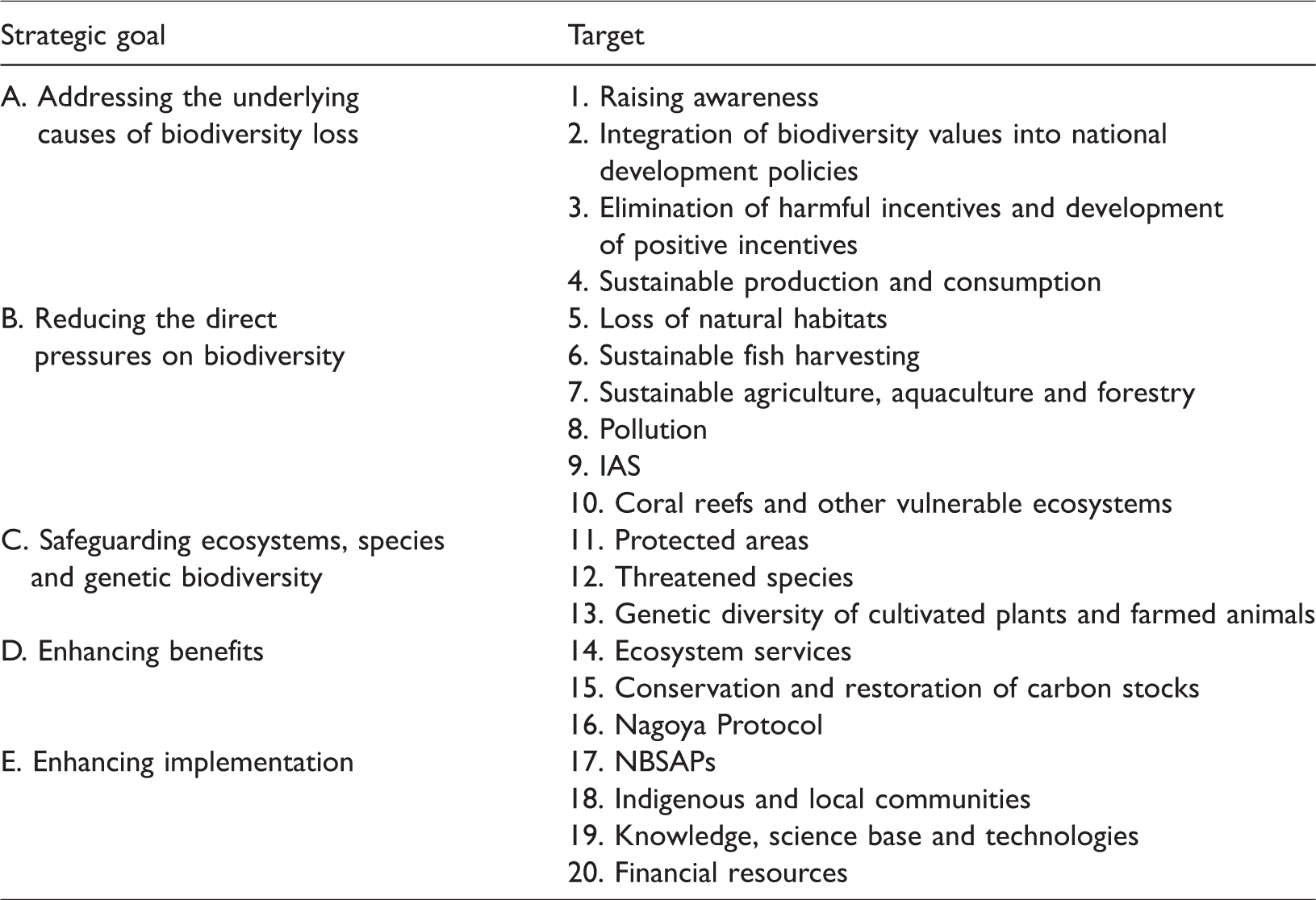
For the GCG system, this preliminary analysis focuses on the main rules, namely the CBD Aichi Biodiversity Targets for 2020 (Table 1), which are meant as overarching targets for the entire global community working on biodiversity-related issues. All members of the Biodiversity Liaison Group (BLG), through which eight biodiversity-related conventions collaborate (including the CBD, CMS, and CITES), have accepted the Aichi targets. While it goes beyond the analysis in this article, it is important to acknowledge the intricate relationship between the Aichi targets and the SDGs. The SDGs can thus be regarded as part of the GCG system, especially the goals on the conservation and sustainable use of oceans and terrestrial ecosystems (CBD, undated).
Overview of Aichi biodiversity targets (adapted from CBD, 2010).
Because the GAG system is mainly focused on kept animals, and the GCG system on endangered wild animals and rarely includes animal welfare provisions (Harrop, 2011; White, 2013), there are few relationships between the systems (Table 2).
Interactions between the global animal and conservation governance systems.
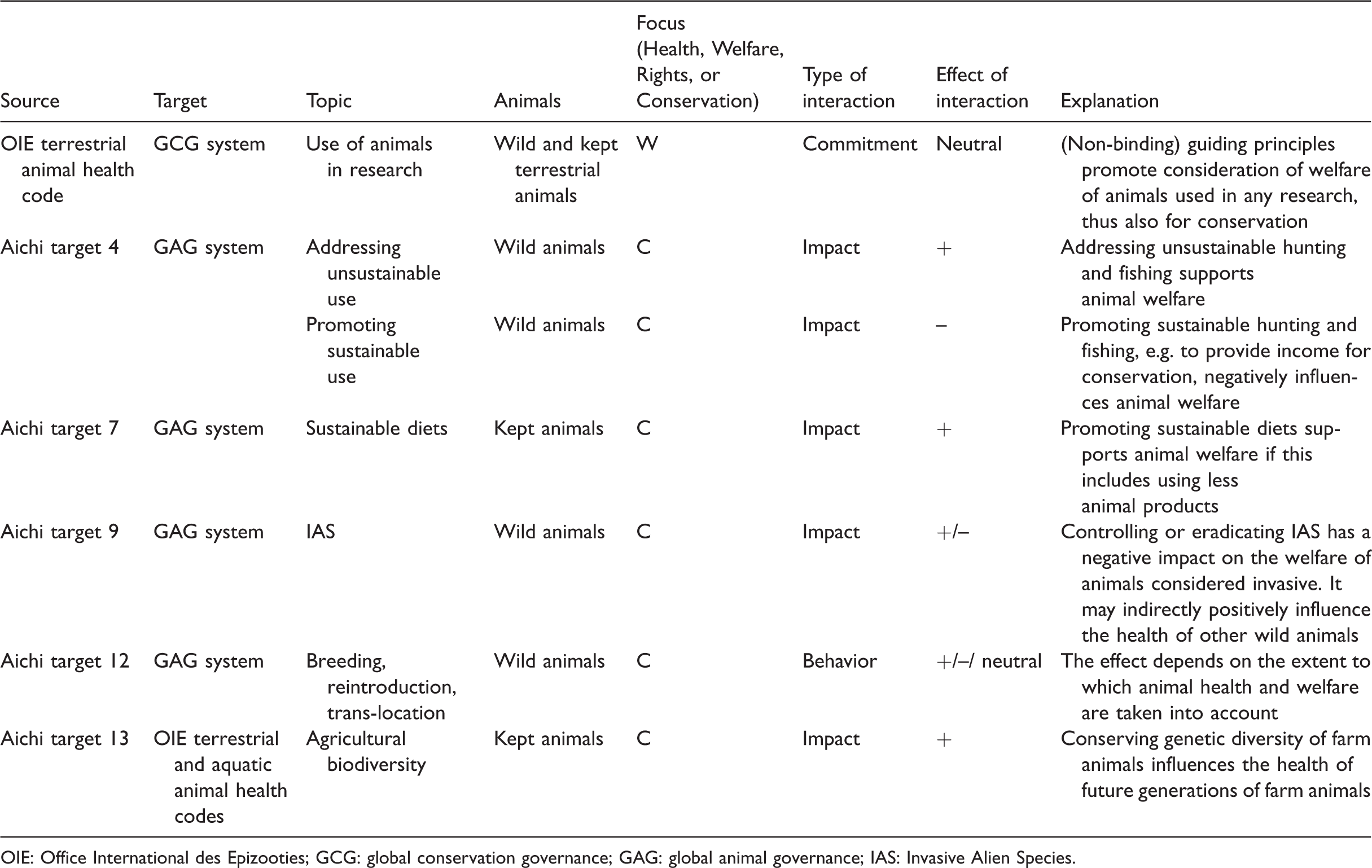
OIE: Office International des Epizooties; GCG: global conservation governance; GAG: global animal governance; IAS: Invasive Alien Species.
There are a few initiatives that aim to enhance the relationships between the governance systems, for example, platforms through which actors of the two governance systems collaborate (among others the OIE and the secretariats of biodiversity-related conventions), e.g. the Inter-Agency Liaison Group on IAS, the Inter-Agency Liaison Group on Health and Biodiversity, and the Collaborative Partnership on Sustainable Wildlife Management.
Step 2: The performance of global animal and conservation governance
The performance of both governance systems has been limited. Many rules have been developed, but implementation and monitoring have been lacking.
As introduced above, the majority of the GAG system is focused on animal health, with recently an increasing number of rules on animal welfare, but none on animal rights. While most of the work of the OIE is focused on the health of kept animals, it also has a working group on wildlife, mainly focused on monitoring wildlife disease. The OIE has convened four global conferences on animal welfare, and its World Assembly of 181 member countries has adopted 14 animal welfare standards, covering: transport of animals by land, sea, and air; slaughter of animals; killing of animals for disease control; use of animals in research and education; welfare in beef and dairy cattle and broiler chicken production systems; stray dog population control; welfare of working equids; welfare of farmed fish during transport; and killing of farmed fish for human consumption and disease control purposes (OIE, 2017a, 2017b; Otter et al., 2012). In 2017, the OIE adopted a global animal welfare strategy, which sees the common uses of animals as legitimate but also recognizes animals as sentient beings. The strategy includes the development of standards, capacity building, communication, and implementation of standards and policies, and promotes the development of regional animal welfare strategies (RAWS). The OIE encourages the development of national animal welfare focal points (OIE, 2017c).
In terms of animal welfare, the OIE recognizes the so-called “five freedoms” (freedom from hunger, thirst and malnutrition; freedom from fear and distress; freedom from discomfort and exposure; freedom from pain, injury and disease; and freedom to express normal behavior) (McCulloch, 2013; Mellor, 2016), and the “three Rs” for animals in experiments (reduction in numbers of animals; refinement of experimental methods; and replacement of animals with non-animal techniques).
According to critics (in the literature and interviewees), the longstanding focus of the OIE has been prevention and control of animal diseases, thereby facilitating animal production and trade in animals, with its work on animal welfare dating back only to the turn of the century. Also, its language on animal welfare has been critiqued as aspirational, limited in scope, nonbinding, and lacking meaningful content or enforcement mechanisms (Favre, 2011; Otter et al., 2012; White, 2013). The UDAW also recognizes animals as sentient beings (McCulloch, 2013; WAP, 2014), but this text has also been criticized as being too vague and not legally binding (Favre, 2011; Gibson, 2011).
Little is known on the implementation and impacts of the GAG system. Although the OIE currently does not have a system in place to monitor national implementation, information on animal health and the Performance of Veterinary Services is gathered through its World Animal Health Information System (WAHIS) and PVS evaluations. Despite the increasing number of GAG instruments, production of animal products worldwide continues to grow (FAO, 2009), with an estimated 1.43 billion cattle, 1.87 billion sheep and goats, 0.98 billion pigs, and 19.60 billion chickens used in 2014 (Robinson et al., 2014), and an estimated 115.3 million animals were used in research worldwide in 2005 (Taylor et al., 2008).
The GCG system includes meaningful rules for conservation. However, the Aichi targets and SDGs are not legally binding, and there are no enforcement mechanisms, although there are systems in place for national reporting. Of the 196 countries that are Party to the CBD, 138 have submitted a National Biodiversity Strategy and Action Plan (NBSAP) that takes the Aichi targets into account, and 189 submitted the latest national report (NR5) (CBD, 2017).
However, several evaluations show that these commitments and efforts will need to be significantly scaled up if the Aichi Targets are to be met by 2020 (CBD, 2014, 2016). As one interviewee put it, there has been limited progress towards the Aichi targets, and the performance of the GCG system is mixed. On relatively “simple” issues, on which conservation actors are not depending on other sectors, e.g. creating protected areas or targeted species conservation, the performance is relatively high. Some progress is also being made on issues that are a bit more complex, e.g. avoiding IAS introductions or regulating trade in endangered species. However, conservation efforts trying to address the structural, underlying causes for environmental problems, e.g. demographic changes, or unsustainable economic development and behavior, have been less successful.
Step 3: Explaining the performance and relationships
According to some interviewees, one of the main explanations for the limited performance of both governance systems is that countries are defending their interests: their economies in general, and their natural resource and animal products industries more specifically. Most countries do not see conservation or animal governance as their prime interest. In order to enhance the performance of both governance systems, countries would “have to stop doing certain things”, as one interviewee put it. Several interviewees name the power of the animal products and extractive industries as explanation, and one interviewee highlights the systemic aspects of factory farming. Current economic structures are ex- or implicitly named by all interviewees. Since the majority of the global economy is not (yet) sustainable or animal-friendly, both governance systems would have to challenge the current political economy in order to enhance their performance. The global trade rules of the WTO are also named; these are seen as limiting the possibility of countries to address the import of animal- or conservation-unfriendly products.
One interviewee pointed out that the limited performance of the GAG system can be explained by the fact that (kept) animals are legally seen as private property – many states thus don’t see animal welfare as a governmental responsibility. Interestingly, the lack of progress in conservation is explained by the fact that natural resources are often “commons” (Hardin, 1968) – no one’s property. Both legal statuses are thus used as explanations. Also, the vast majority of global animal and conservation rules are not legally binding, and there are few enforcement measures available.
The anthropocentric perspective underlying both governance systems can also explain their limited performance. Animal health is mainly being addressed to prevent disease among humans and ensure food security. The anthropogenic perspective can also explain why the GAG system is mainly based on an animal health (and to a much lesser extent, welfare) perspective. The aim of preventing animal exploitation and suffering, as promoted by an animal rights perspective, is not represented in the system, since there are no common global norms on animals – the position of animals if very different across societies around the world. As one interviewee put it, seeing animals as individuals is still in its infancy. The widely recognized concept of ecosystem services in the GCG system also represents an anthropocentric perspective, although the intrinsic value of nature and biodiversity is widely recognized in the governance system (Díaz et al., 2015).
The limited performance of both systems can also be explained by practices involving the use of animals. The consumption of animal products (meat, dairy, eggs, fish), for example, is continuing to increase, with tremendous impacts on both animal welfare and conservation (CBD, 2014).
As stated above, the low number of relationships between the two governance systems can simply be explained because the GAG system is mainly focused on kept animals, and the GCG system mainly on wild animals. Also, different actors are involved in the different systems, and these networks overlap very little. Ministries of environment and conservation NGOs are mainly involved in the GCG system; veterinary representatives and animal welfare organizations participate in the GAG system.
The limited relationship between the two governance systems can also be explained by the fact that individual animals are not the focus in the GCG system, where animals are approached as “biodiversity”, “species”, and “natural resources”. In the Aichi targets and SDGs the word “animal” is barely mentioned. So while the SDGs are integrative for environmental, social and economic issues, animal welfare or rights are not included.
Discussion and conclusions
This paper has introduced a framework to analyze and practice IG. The framework addresses the main gaps in the IG literature by facilitating explanatory analyses of relationships and performance of governance instruments and/or governance systems. Academics and policy practitioners can use the framework to analyze and practice IG. The framework promotes an IG perspective, in which not individual governance instruments, but the relationships between instruments take center stage (see also Visseren-Hamakers, 2018). The need of such a perspective is widely recognized, both among academics and practitioners. The framework can be used to study the relationships and performance of governance systems on all issues, including environment, trade, development, health or education.
I realize that the framework incorporates a wealth of theories, and that especially the explanatory part of the analysis could easily become unwieldy. The framework should however be applied with a focus not to be exhaustive, but to distil the main relationships between governance instruments and systems, and the major explanations for the relationships and performance of the governance systems. This will allow for the analysis to remain manageable, and become most relevant for efforts to enhance the relationships and performance of governance instruments and/or systems.
The application of the IG framework to the case of global animal and conservation governance has shown that this is possible. Even a preliminary analysis such as the one presented here provides a thorough overview of the main governance instruments in the systems, and the most relevant relationships between the systems. It also distills the major explanations for their performance and relationships. Animal and conservation issues are often not considered a priority, and this is reflected in current institutions, discourses, norms and practices, and the political economy. Thus, the clusters of explanatory factors together explain the limited performance and relationships of the governance systems, although additional research is needed to more thoroughly discuss the interlinkages between the clusters of explanatory factors, and their effects over time. Decision makers and stakeholders can use these insights to develop strategies to further enhance the governance systems. More efforts are especially needed to address the more structural explanations for the limited performance of global animal and conservation governance. One recommendation flowing from the analysis above is for the relatively further developed GCG system, and especially the Aichi targets and the SDGs, to more explicitly incorporate animal welfare issues and rights perspectives.
I also acknowledge that some of the literatures underlying the IG framework, and especially some clusters of explanatory factors, have been criticized for their lack of practical ways forward (see e.g. White et al., 2016). For example, knowing that the limited performance of global animal and conservation governance can be explained by a combination of (among others) dominant anthropocentric discourses and the mostly animal-unfriendly and unsustainable political economy does not necessarily lead to practical short-term solutions. Especially given the fact that the framework is inspired by pragmatism, this could be considered problematic. However, I am convinced that an enhanced understanding of the multiple and intertwined explanations of the relationships and performance of governance systems will allow academics and practitioners to develop more realistic, durable solutions both for the shorter and longer term. It will also enable an understanding that some solutions may indeed need a long-term perspective, in which solutions and ways forward are “nurtured” over time (Cashore et al., 2016; Humphreys et al., 2017), since some of the explanations, including discourses, practices and structures, are in most cases not changed overnight. Thus, by unraveling and unveiling the complex system of explanations for the relationships and performance of governance systems, the IG framework enables a more thorough understanding of the different explanations, allowing actors to develop more realistic strategies to enhance the relationships and performance of governance systems, and thereby, enable the transformative change needed for sustainable development.
Footnotes
Acknowledgements
The author would like to sincerely thank the interviewees for the informative conversations, and Professors Bas Arts and Sebastian Oberthür and two anonymous reviewers for their comments, input and feedback on earlier drafts of this paper.
Declaration of conflicting interests
The author(s) declared no potential conflicts of interest with respect to the research, authorship, and/or publication of this article.
Funding
The author(s) received no financial support for the research, authorship, and/or publication of this article.