



Abstract
This article examines the effects of Morocco’s new, “humane” migration policy that claimed to center human rights and integration over securitized border enforcement. Drawing on ethnographic research, this paper demonstrates how the new migration policy expanded rather than dismantled the border regime, respatializing it from the edges of Moroccan territory into cities in the interior. Border respatialization was accomplished through abandonment, theorized not as an absence of government but a technique of governance that targets the racialized poor. Focusing on the experiences of migrants living in two urban spaces—an informal migrant settlement and a working-class neighborhood—this paper illustrates how abandonment limits black migrants’ ability to move and transgress the border, and how these effects have site-specific, as well as racial and gendered dimensions. This analysis underscores how humanitarian migration policy may have changed the modality of border violence, but not its substance.
Introduction
In the summer of 2013, weeks after signing the latest in a series of agreements to aid European border enforcement in the Mediterranean Sea and within its own territory, Morocco was shocked by a wave of anti-black attacks against West and Central Africans. Alain Toussaint, a legal resident of Morocco originally from the Democratic Republic of Congo, was swept up during a police raid on migrants in a Tangier neighborhood. He and 700 other “blacks” (noirs) were rounded up and put on buses toward Oujda, near the Algerian border. On the way, Toussaint was thrown from the bus and fell into a coma; he died of his injuries on 5 August 2013. Days later Ismaila Faye, a Senegalese citizen, was stabbed to death by a Moroccan man after Faye refused to give up his seat on a Rabat bus (Schmid, 2016). In the following weeks, hundreds of migrants and activists demonstrated against these racist attacks, which, according to one refugee organization, were just two of the dozens that had taken place during the same period (Schmid, 2016).
Incidents of violence against sub-Saharan migrants have come to characterize Morocco’s role in the European Union’s (EU) “externalized” border program, a program that recruits buffer states along Europe’s edges to stop migrants before they reach their destination (Piños, 2009). As a primary gateway to Europe for illegalized African migrants, Morocco has leveraged its proximity to Europe across the Straits of Gibraltar and its contiguity to Melilla and Ceuta, Spain’s two enclaves on the African continent, to position itself as an essential partner in the EU’s externalized border, earning the country dubious recognition as “Europe’s policeman” (Belguendouz, 2003). In exchange, both Spain and the EU have invested heavily in Morocco’s border infrastructure and offered financial incentives in the form of aid, special trade status, cash payments, and remittance facilitation for its expatriate population in Europe (Den Hertog, 2016; Gammeltoft-Hansen, 2006). In December 2018, the European Commission announced that the EU had invested one billion euros in Morocco since 2014, much of which was channeled to migration-related domains (European Commission, 2018).
Until recently, the majority of border crossers intercepted between Morocco and Europe were North Africans. Nonetheless, disproportionate attention has been paid to West and Central African migrants passing through Morocco to reach Europe. As Moroccan scholar Mehdi Lahlou points out, this is curious given that “if Morocco appears to be Africa’s gateway to Europe, it is a gateway that until today has been used primarily for Moroccans” (2015: 4). In both European and Moroccan discourse, the specter of “African” migration is represented as a crisis and figured in the body of the sub-Saharan migrant (Lahlou, 2015). While this article is concerned with the Moroccan context, other North African states with significant out-migration of citizens have likewise recast unauthorized migration as a “black” phenomenon (Hagan, 2017; Hamood, 2008; Natter, 2014).
Even before the events of the summer of 2013, public awareness about the racial violence of border enforcement in Morocco had become widespread. In March, Doctors Without Borders (Medecins sans Frontières (MSF)) released a report entitled Violence, Vulnerability and Migration: Trapped at the Gates of Europe (2013). The report detailed the violence West and Central African migrants endured en route and in attempts to cross the border fences between Morocco and Spanish Melilla and Ceuta. MSF documented how, while traveling along dangerous routes toward Morocco, many women were compelled to take a “husband” for protection who then asserted sexual rights over her, while men were often beaten and extorted for money as they encountered new groups of smugglers at different stages of travel. Once in Morocco, more than half of MSF respondents had been forcibly expelled to the Algerian desert in sweeps like the one in which Toussaint lost his life. These desert expulsions often resulted in migrants’ being apprehended and subjected to physical assault at the hands of Algerian security forces (MSF, 2013). The report detailed other encounters with the violence of the border regime: at Melilla and Ceuta’s fences migrant men routinely sustained injuries from razor wire or from falls while scaling the six-meter high barriers. Many were beaten by baton-wielding Moroccan border personnel (often after being handed over to them by Spanish Guardia Civil), and some were wounded by rubber bullets fired by both Spanish and Moroccan security forces as they tried to launch boats into the Mediterranean Sea.
Prompted by humanitarian pressure at home and in Europe, in September 2013 Moroccan King Mohammed VI issued a public statement declaring a new, comprehensive policy that would prioritize human rights and integration in migration management and border enforcement (MCMREAM, 2014). A central component of this new approach was the declaration of a period of “exceptional regularization” providing a one-time legal pathway for illegalized migrants to obtain residency permits (Alioua et al., 2017). Morocco also ceased expulsions to the desert, instead pushing migrants back from the northern border zones to urban centers in the interior. The policy sought a more humane and sustainable approach to immigration control that minimized violence and offered pathways to integration. The announcement was greeted in the international community with great enthusiasm, and Morocco has been held up as exemplary for its humanitarian migration policy (El Masaiti, 2017).
This article examines Morocco’s new migration policy in the first five years after its implementation to consider claims that it represents a shift from a security-oriented approach to one centered on human rights. There are two questions that guide this analysis: First, how did the new policy approach change the nature of border enforcement in Morocco? And second, what effects did these changes have on West and Central African migrants’ daily lives, the spaces they inhabited, and their ability to move? To answer these questions, I draw on data from interviews and fieldnotes collected between 2017 and 2018 among migrants living in four major cities in the interior (Rabat, Casablanca, Fes, and Meknes), and among migrants in the securitized “frontier zone” along the Mediterranean coast (Figure 1). For narrative clarity, I focus on communities in an informal migrant camp in Casablanca and a migrant community in a working-class neighborhood in Fes as representative of migrant experiences in urban spaces throughout the country. These data are supplemented by media reports and published interviews with migrants and other actors within the “border regime.” By border regime (or for brevity, “the border”), I refer to an ensemble of discourses, rules, practices, and material configurations that enroll a variety of institutions and actors to regulate the mobility of groups of people (Paasi, 2009; Parker and Vaughn-Williams, 2016). This heterogeneity enables the EU border to travel outside of its territory to confront migrants along transit routes, effectively “stretching the border” long distances (Casas-Cortés et al., 2012).
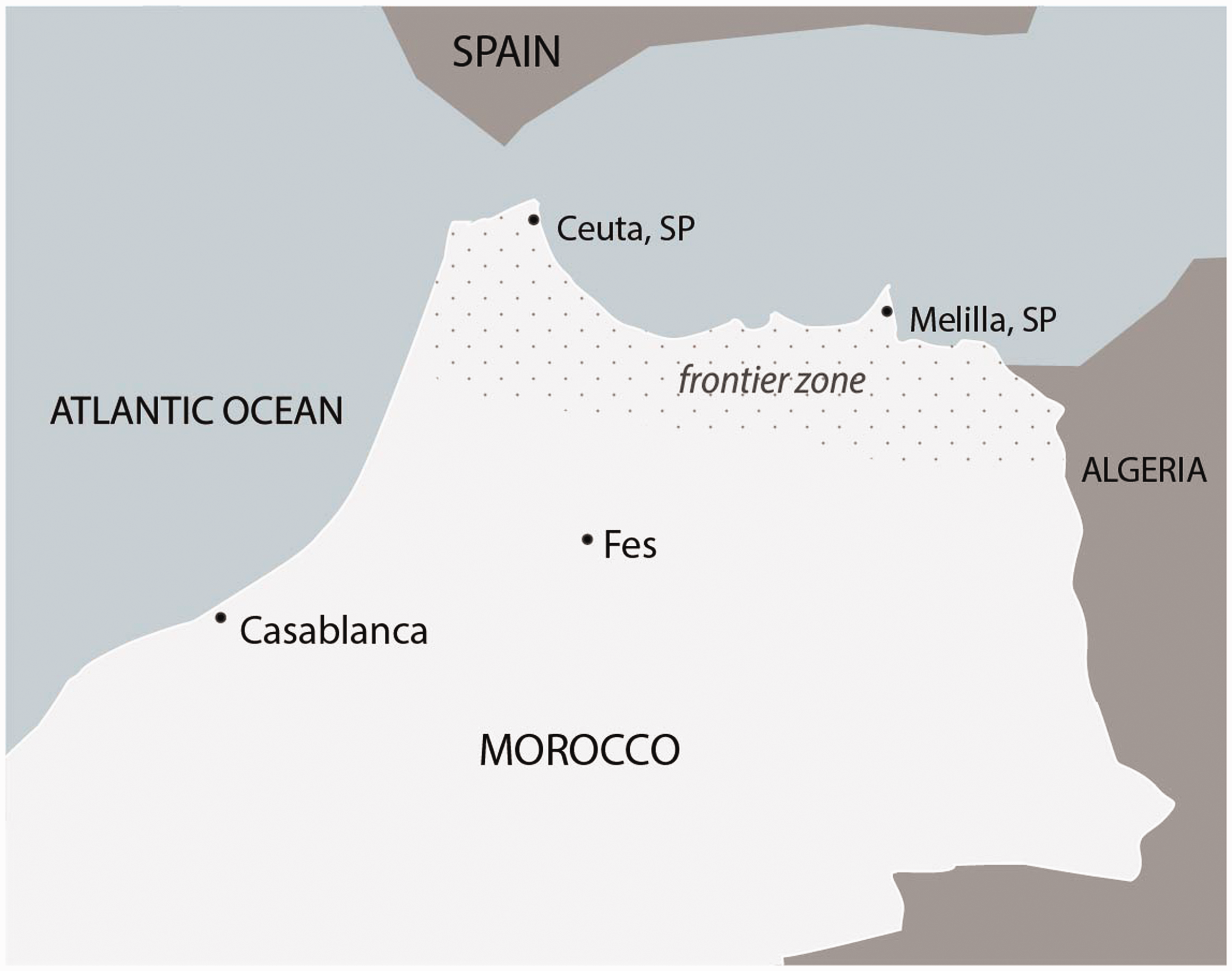
Map of research cities and northern frontier zone.
The data from this study reveal that the new migration policy did not dismantle the externalized border but expanded it into the Moroccan interior. Further, as the border expanded, so too did the array of actors implicated in migrants’ care and control. I argue that migrant encounters with the border in Moroccan urban space are best understood as abandonment, a mode of governance that draws on racial logics to mark migrants as out-of-place, legitimizing their ongoing containment and exposure to violence. The article proceeds in three parts. The first section describes how changes to Morocco’s border policy respatialized the border to the city, making “black” migrants more legible to the state even as the state was less accountable for their care. Far from the “fast” violence of the fences at Melilla and Ceuta, border encounters in the cities were characterized by the “slow” violence of inaction, neglect, or exclusion from the body of the nation (Nixon, 2011). The second section develops the concept of abandonment to explain how migration governance works in the respatialized border. Abandonment derives from critiques of neoliberal forms of governance that target marginalized spaces and populations for violence and dispossession. In the border regime, abandonment is a mode of “containment beyond detention” (Tazzioli and Garelli, 2018), enlisting non-state actors in management of racialized migrants’ lives and mobilities. Because abandonment looks like the absence of the state, the violence of this form of state power is obscured (Biehl, 2005; Davies and Polese, 2015). The third section depicts life in two “zones of abandonment” (Biehl, 2005) that migrants inhabit in Morocco, an informal migrant camp and a working-class neighborhood in an industrial quarter. Abandoned in the city, visible as outsiders, and struggling for daily subsistence, West and Central African migrants’ ability to continue across borders is limited even far from physical barriers or militarized border policing. Furthermore, stories of daily life in place illustrate how abandonment’s effects have site-specific, as well as racial and gendered dimensions.
Finally, this article asks what it mean that reforms to border policy reinforced rather than diminished the racialization, exploitation, and exposure to violence that West and Central Africans experience in Morocco. As a technique of governance in the border’s repertoire, abandonment offers the EU and the Moroccan state a mode of migration management that is at least partially concealed beneath discourses of integration and humanitarianism, facilitating the growth of the border regime and enlisting formerly antagonistic actors such as human rights organizations and migrants themselves in the project of racialized containment. This analysis has stakes for other third countries in the EU’s externalized border under pressure to respect migrants’ human rights without compromising on their (contractual) obligations to repel them from the edges of European territory.
Respatializing the border: From edges to interior
King Mohammed VI’s September 2013 declaration that Morocco would embark upon a “new approach” to migration management sought to balance Morocco’s commitments to Europe with its desire for political influence within Africa (Aït Ben Lmadani et al., 2016). Morocco would continue to enforce Europe’s external borders, but rather than expelling West and Central African migrants, they would be contained throughout Moroccan territory and offered pathways to integration. To support Morocco’s “integration” efforts, the EU designated an additional 72 million euros between 2015 and 2018 (Statewatch, 2019). The centerpiece of this new policy was the declaration of a period of “exceptional regularization” which would provide a one-time legal pathway for illegalized migrants to obtain residency permits. While Migrant Affairs would coordinate the campaign, the Ministry of Interior (the state security arm) would vet each applicant, and NGOs and other members of “civil society” would aid its implementation. Regularization and pushbacks represented both a spatial enlargement of the Morocco–EU border and an expansion of the actors implicated in the surveillance and control of black migrants’ mobilities. Border violence continued as well: while “fast” violence persisted in the northern securitized frontier, in the city migrants were subjected to the “slow” violence of abandonment, a violence that, according to Rob Nixon, “occurs gradually and out of sight … that is dispersed across time and space” (2011: 2).
Regularization
Regularization offered real potential for improving illegalized migrants’ daily lives while stuck in Morocco. The campaign began on 2 January 2014 and ended on 31 December of the same year. Criteria favored migrants who had entered the country legally and were more likely to have an entry date stamp, lease, or proof of income. Despite the obstacles, more than 27,000 applications were received, and about 23,000 applications were approved (Benjelloun, 2017). Around 55% were from sub-Saharan Africa, with the majority of that group (about a quarter) from Senegal. Also included in the exceptional regularization were Syrian applicants who obtained 19% of the total permits issued (Aït Ben Lmadani et al., 2016). The permits were good for one year and could be renewed based on a clean police record, a legal address, and evidence of income-generating activity.
A second period of regularization coincided with Morocco’s re-entry to the African Union in 2017 and granted permits to another 14,000 people including automatic acceptance for minors and women with children (Kuperblum, 2018). At one of the regularization processing centers, researcher Sara Benjelloun observed that officials turned a “blind eye” to suspect documents, accepting applications as long as they were complete and met one of the required criteria. When asked about this, officials explained that papers made people legible to the state: “a documented person is a known person” (2017: 61). Thus, while public discourse around regularization focused on integration and humanitarian ethics, Benjelloun’s informants within the Ministry of Interior emphasized a security imperative for having migrants counted and identified.
The two regularization campaigns would not have been possible without the involvement of NGOs and other non-state actors. Compiling dossiers, tracking down documents, transporting and escorting people to the office to submit applications required an army of NGO workers, advocates from churches and human rights organizations, sub-Saharan students with legal residence, and migrant middlemen familiar with navigating the system and able to speak French. Benjelloun observed that, upon entering the processing office, an applicant was greeted by a “sub-Saharan member of civil society” who would go over their application and verify they had all the correct documents (2017: 56). In one instance, the sub-Saharan volunteer suspected an applicant had submitted a falsified residency document and alerted the manager who called the local branch of Migration Affairs. It just so happened that members of the NGO supposedly issuing the document were at the local Migrant Affairs office submitting a list of names of people for whom they had provided documents and verified that they never issued one to the applicant (Benjelloun, 2017: 56–57). The new migration policy changed the geometry of migrant-state-civil society relations so that humanitarian actors, rather than acting as advocates for migrants against the Moroccan state’s border enforcement and migration management practices, became partners with the state in everyday work of surveilling and managing migrants within the border regime (Andersson, 2014; Pallister-Wilkins, 2018). This is characteristic of neoliberal forms of governance that, under the cover of rights provision, expand securitization across a range of actors in the private sector, interpellating even the very populations most vulnerable to enhanced security (Clarno, 2017; Melamed and Reddy, 2019; Wacquant, 2009). 1
Pushbacks to the city
The new migration policy not only changed the legal landscape of migration management but shifted the border from the frontier to the city. Practices of rounding up migrants apprehended in the frontier and expelling them to the desert border with Algeria slowed. Instead, migrants caught at sea or on border fences were bused to Moroccan cities in the country’s interior where they were summarily dropped off, sometimes with significant injuries from barbed wire, falls off the fences, or beatings (GADEM, 2018). Once in the cities, migrants were left to fend for themselves with patchwork assistance from overtaxed NGOs and benevolent residents while at the same time trying to scrape together the resources to make another journey back to the northern frontier. They erected camps in empty lots often adjacent to the bus stations where they were dropped off, building shelters out of found materials and donated plastic sheeting. Others, mainly migrants who had been in the country longer or women with children, were able to “hustle” enough money to rent rooms in working-class neighborhoods, paying their way through begging, informal day labor, engaging in sex work, or entrepreneurial activities like hair braiding and selling prepared food.
This policy of pushback effectively created a cordon sanitaire across the entire northern and northeastern frontier, reproducing on a national scale the EU’s region-wide strategy of pushing migrants into third countries like Morocco, Libya, or Turkey (Bialasiewicz, 2012; Ferrer-Gallardo and van Houtum, 2014; Topak, 2014). To accomplish this, Moroccan border police sought to clear the region of people they often referred to as “blacks” (noirs) or “Africans”—ignoring their own African identity and the phenotypical diversity of the Moroccan population. After a brutal summer of crackdowns on migrants in the frontier region in 2018, the Anti-Racist Group for the Accompaniment and Defense of Foreigners and Migrants (GADEM) published a report documenting human rights abuses in the course of these pushbacks. “The goal of these operations,” the report states, “is clear: push black non-citizens as far as possible from the border zones” (GADEM, 2018: 4). I also heard reports of this nature. While visiting a migrant advocacy association in July 2018, I chatted with Justine, a Senegalese leader of a migrant women’s NGO. She told me how she and a delegation from several African states had just returned from the north where they had been stopped by police about 30 kilometers southwest of the border city of Oujda and forced to turn around and drive the five hours back to Rabat. The police told her they weren’t allowing any “Africans” into the city of nearly half a million people, despite the fact that all the passengers in the car were either legal residents or holders of valid passports and visas. 2 These experiences suggest that while the switch from expulsions in the desert to pushbacks to the city altered the direction and modality of border violence, the racialized logics identifying phenotypically “black” people as objects of border enforcement remained unchanged.
The change from expulsions to pushbacks expanded border enforcement and migration management in Morocco from fences, the sea, or remote desert landscapes to the heart of Moroccan public space—the city. Morocco has been hailed for a progressive approach to border enforcement that de-centers detention or deportation, but more “humane” practices of delivering migrants to the city and providing some with temporary papers deploys an ethical discourse of humanitarianism and integration that conceals the violence of ongoing border projects to control migrants’ mobilities (Little and Vaughan-Williams, 2017). The 2013 new migration policy did not replace the former sites, practices, institutions, and discourses that constituted the Morocco–EU border, but expanded these to more effectively contain migrants outside of European territory by enlarging the border zone, enlisting civil society in border projects, and making migrants more legible to the security apparatus. Examination of the new migration policy as it actually exists reveals that the border regime in Morocco is a site of spectacular violence and a site of migrant abandonment. Clashes at the border fence and dramatic rescues at sea have a less visible other, the slow violence of long months and years on the street, scraping by while nursing dreams of a better future in Europe. As Kate Coddington (2019) points out, though academic and popular attention is drawn to the spectacle of fences and walls, today’s border governmentality disciplines migrants on a quotidian basis through entwined logics of care and control that enable them to survive but not thrive, to be present but not belong (see also Coddington et al., 2018; İşleyen, 2019).
Abandonment as racialized governance
The concept of abandonment is a useful way to capture the border’s operations to contain migrants in Moroccan urban space. Genealogically entwined with both Foucauldian accounts of power and theorizations of race and space, abandonment provides an analytical frame that links calculations of risk and value in governance to structures of violence and dispossession of racialized populations (Andrijasevic and Walters, 2010; Petitjean and Gilmore, 2018). Building on these literatures, abandonment offers insights into how the “humane” border diffuses across social space, how it articulates with market logics, and how it mobilizes the racialized visibility of its targets even as the border itself recedes from view.
Historically, abandonment characterized the lives of marginal populations in “shatter zones” beyond the state’s reach (Scott, 2009); under capitalism, however, abandonment is recast as a strategic exercise of power. David Harvey (2001) described how the state “organized abandonment” of the built environment as a fix for stalled capital accumulation. Dispossessing people of land, livelihood, and rights (such as the right to move across borders) is characteristic of global capitalism and disproportionately targets minorities or people living on/in the “periphery” (Harvey, 2005). Ruth Wilson Gilmore (2007) showed how manufactured social crises enabled the state to resolve actual economic and political crises through mass incarceration of poor, racialized populations whose criminalization and incarceration, rather than their labor, provided new opportunities for wealth generation. For Gilmore, the state’s abandonment of its role as welfare provider, its abandonment of poor black men to the prison industrial complex, and the abandonment by capital of vast swaths of space and populations come down to calculations of whose lives and spaces are valuable, and in what form (Petitjean and Gilmore, 2018).
Abandonment, then, is not the retreat of the state, but a reorganization of governance to “extract value from the lives of marginalized people who are deemed unworthy of the socio-economic security and political equality that are conducive to human flourishing” (Bhandar, 2018: n.p.). This is characteristic of policies like austerity and privatization that endanger human life not as a side effect of the pursuit of profit but as a means for maximizing wealth (Bhandar, 2018; Wismayer, 2017). In order for this to occur, market rationalities constitute people, land, and the relations of social life [as] translatable into value form, making incommensurate histories, experiences, and forms of social being commensurate by reducing them to their meaning and value within the ‘capital relation,’ placing them within an ontology of dis/possession. (Byrd et al., 2018: 7)
Abandonment manifests materially in both bodies and space. As racialized, gendered people are “routinely separated from their normal political status,” they are also spatially separated from market-able citizens who conduct their conduct according to neoliberal scripts (Biehl, 2005: 38). Prisons, deindustrialized cities, refugee camps, and asylums are spaces that demarcate the line between the valuable and the disposable. There is an iterative relationship between bodies and space that is structured by racializing logics and operates through the visual field: places become “no-man’s land” because their inhabitants are marked as disposable by virtue of their skin color, gendered appearance, clothing, dirtiness, or other visible feature (Butler, 1993; Delaney, 2002). At the same time, people confined to these zones are naturalized as extensions or manifestations of them: those who have been incarcerated in prisons become “prisoners,” those denied access to affordable, legal housing become “squatters,” and those abandoned by family and the state to die in the street become “the abandoned.” Once, when I was visiting a friend in a migrant encampment, an older Moroccan man peddling knock-off watches followed me around shouting, “What do you want with these azziin? 3 Don’t you know they are savages?” 4 In Morocco, skin and site, Blackness and bidonvilles mark the material boundaries of mattering. West and Central African migrants are confined to impoverished and segregated spaces in the city where they become, in Moroccan Arabic, “poor things” (mesaakin).
If the spaces of abandonment are read as “lands of no-one” (McKittrick, 2013), this does not occur by chance. Writing about los abandonados in Brazil, João Biehl argues that if families are the ones who deposit the sick, addicted, and disabled in informal asylums, it is nonetheless the government that “direct[s] the unwanted to these zones, with no human rights and no one accountable for their condition” (2005: 4). The state organizes abandonment so that it occurs in spaces that are remote, hidden, in “no-go zones” or occupying the unreal spaces of the “informal” where the state is presumed absent (Bhandar, 2018; Gilmore, 2007; Gordon, 2008; Harvey, 2005; Wacquant, 2009). The deregulation of social housing in London, privatization of public utilities in Detroit, and the informal status of the refugee camp in Calais foreclose any demands for redress—who to complain to? What rules have been violated? (Bhandar, 2018; Davies and Isakjee, 2015). This contradicts the thesis that modern state governance solidifies control by making subjects and spaces legible and by forcing their participation in formal political and economic spheres (i.e. serving in the military, paying taxes) (Scott, 1998). Instead, legiblity/illegiblity and formality/informality are techniques of statecraft organizing populations as subjects of protection or objects of violence (Roy, 2005). In other words, there are things the state does not want to be seen seeing because subjects legible to the authority of the state should also be eligible as claimants to the state (Campbell, 2017).
Illegibility and informality function as a sort of one-way mirror whereby the state (in this case as agent for the border regime) can maintain tight control over a group while appearing to have no direct contact with them at all. There is an economic rationality as well. Writing about the United States, Jill Williams and Vanessa Massaro (2017) analyze Immigration and Customs Enforcement (ICE) practices of dumping migrant families pending trial at city bus stations in southern Arizona. They argue that, faced with stricter regulations for housing migrant families with minors, the burden of care was pushed onto local NGOs, activists, and relatives, effectively outsourcing the reproductive costs of migrant detention to civil society. The “hotspot” approach along Europe’s southern borders effectively accomplishes the same result: Polly Pallister-Wilkins (2018) observes that the spatial dispersion of border controls in Greece necessitates a “disaggregated network” of humanitarian agencies to manage migrants’ daily lives and (im)mobilities. In Italy, once migrants are fingerprinted and registered, they are channeled to spaces throughout the country where they must provide for themselves while awaiting an asylum decision and are held responsible for their own deportation following an expulsion order (Tazzioli, 2017). Contrary to the argument that this form of spatial governance does not constitute abandonment because migrants have “never been taken into account or protected” in the first place (Tazzioli, 2017: 2773), I contend that the very organization of migrant governance so that the state cannot be held responsible or called to account is what defines it as abandonment. On both sides of the Mediterranean, the formal spaces of the refugee camp are giving way to informal tent cities and ghettos administered by a bricolage of local NGOs, international organizations, and migrants themselves (Darling, 2017; Sanyal, 2017). This is illustrative of border governmentality at work—we all participate in containing migrants in what Stephen Dillon (2018) calls “the neoliberal carceral.”
Zones of abandonment in Casablanca and Fes
In Morocco, abandonment reshuffles border geographies and the actors and operations of power within the border regime. At the border fences or in the Mediterranean Sea, migrants encounter the border through formal agents of the state exerting sovereign power to drive them back; in the city, migrants’ movements are limited in less obvious ways. Left to fend for themselves and marked as racialized outsiders, migrants move through the city as bordered subjects, pushed to the margins of urban life even as they occupy spaces in the heart of the city. In Casablanca, Rabat, Marrakech, Agadir, Meknes and Fes, black migrants are visibly excluded through the spaces they occupy—street corners where they beg, empty lots in which they camp, informal rentals where they survive through a mixture of licit and illicit economic activity. This section offers stories of life in two such spaces—an encampment in Casablanca and a working class (chaabi) neighborhood in Fes—to illustrate how abandonment in the city contains West and Central African migrants away from Europe through the slow violence of destitution and racial segregation. Furthermore, migrants’ experiences in these spaces reveal the variability of migrants’ immobility depending on the particular places migrants occupy, on their gender, and on their relational and economic obligations.
In the ghetto: (The) killing time
In Casablanca, migrants apprehended in the north are dropped off near a bus station in the Ouled Ziane neighborhood. From there, many join the informal settlement or camp (called a “ghetto” by migrants) situated in a parking lot in front of the taxi stand. At the time of fieldwork (2017–2018), the area housed a changing roster of several hundred West and Central African migrants, all men, mostly from Guinea and Mali. Within the Ouled Ziane ghetto, buildings are made of plastic sheeting, railroad ties, old cinderblocks, and metal from oil drums pounded flat. It is shielded from view by a high fence with boards and plastic affixed to it, though it is clearly visible to taxi drivers, passengers, and passersby. There is no running water or bathrooms in the ghetto, and people use a pedestrian bridge spanning the highway for the latter purpose. The dwellings are roughly grouped by nationality, presided over by “chairmen” (migrant leaders), and arranged around a common area that serves as the soccer pitch. This setup resembles ghettos I visited in other cities around the country (down to the requisite soccer pitch). There are several tent-restaurants serving simple meals of rice, beans in spicy sauce, fried sardines, or hardboiled eggs on plastic plates hastily dipped in a bucket of water before reusing for the next customer.
Because of the rough conditions and poor sanitation, scabies is common and residents lacked regular access to bathing and laundry facilities to get rid of them. The public bath (hammam) costs about two dollars, and even when they could afford it people told me they did not always feel welcome there. When it rains, water runs into the tents, muddying the dirt floors and soiling bedding, clothes, and other possessions. The inability to stay clean reinforces ghetto residents’ segregation from the rest of the city. As one person told me, if you want to move through the city without being harassed, you have to be able to dress “like a student,” referring to sub-Saharan university students on state-sponsored bursaries.
5
If your clothes are dirty, you cannot get a taxi; if you take the bus, people cover their noses with their hands.
6
“Dirtiness” reinforces perceptions that migrants pose a threat to the well-being of the social body. This discourse was central to the framing of a conflict between migrants and locals in November 2017. Local youth attacked the camp following a rumor that a migrant was harassing a Moroccan woman passing by. The clashes that followed between the youth and migrants lasted several days and resulted in the ghetto being demolished by fire and dozens of migrants arrested, deported, or pushed into more remote southern cities.
7
One Moroccan man told a reporter, We are not against them, but nobody wants a dirty home. His Majesty wouldn’t want his home to be soiled. Yes, they are welcome, but they messed up the place, you can see for yourself, for God’s sake. Does this look like a bus station entrance?
8
In her study on the material evidence of migrant crossings at the Mexico–U.S. border, Juanita Sundberg (2008) has argued that migrants’ bodies and “bodily comportment” is a field upon which social and geopolitical exclusions are staked. Migrants who leave possessions, body effluvia, and other material remnants of their passage are polluters, people who leave things “where they don’t belong” because they themselves are out of place (Sundberg, 2008: 887). Sara Ahmed (2000) has pointed out that such discourses are “sticky”; both their meaning and affective qualities circulate and attach to bodies so that, for example, the abhorrence one feels for dirt transposes itself to bodies discursively associated with it. For migrants abandoned to city streets, the inability to keep clean becomes evidence of their unwillingness to integrate (“they messed up the place”), of their perceived difference (migrants as dirt), and ultimately, justification for violence against them.
In the ghetto, time moves slowly. Residents in Ouled Ziane spend the day “hustling” for money—begging in a round-robin system at street corners, looking for day labor, fetching water from a public fountain several blocks away, or just sitting around. Neighboring shop owners will sometimes let ghetto residents charge their mobile phones, or migrants will spend a few dirhams at a nearby cybercafe where they might post pictures of themselves on Facebook posing by nice cars or wearing knock-off Gucci hats or belts. The inaction and stress of living outside takes its toll on migrants’ mental and physical health: A Cameroonian doctor who frequently volunteers in another ghetto told me that many people suffer from hypertension and other problems related to the physical and mental stress of living outside or as a result of the trauma of the journey and the violence of the fence (see also MSF, 2013). Amadou, a Guinean resident of the camp, told me that many people “became crazy” living in such conditions, while “others became ill because there was no moral support.” 9 These conditions can be life-threatening, especially when compounded with racism: in the span of one month, two people I knew died after being refused admittance to the public (free) hospital. 10
Beyond the stress of subsistence and life in rough conditions, the experience of “stuckness” takes its toll (Cresswell, 2012). Writing about protracted refugee situations, Jennifer Hyndman and Wenona Giles (2011) argue that decades in formal and informal refugee camps is a political tactic to contain and control migrant bodies-in-motion. Living in the camp is to experience liminality in location and legal status: camps are often separated from the city by fences and guards, and refugees will wait years or decades for their applications to be processed in order to receive papers to work, move, get an education, and integrate into society. In Morocco, bodies on the move and at border crossings are constructed as a threat to the state; migrants stuck “in-between,” dependent on humanitarian welfare or having to survive on their own, are “feminized” as unable to move or act (Collyer, 2007; Hyndman and Giles, 2011). Immobilized and depoliticized, they are consigned to the slow violence of abandonment even as the Moroccan state garners accolades for its humanitarianism.
In spite of all of the hardships, many migrant men, having arrived from the militarized violence of the northern frontier, refer to their time in the interior as a period of “repose.” Near the border fences of Melilla and Ceuta, migrants live in a constant state of terror at the possibility of a night-time military raid or of being swept up on the street for begging, leading to deportation or pushback even further from the northern border. In the clandestine camps in the northern frontier, food is scarce and weather conditions in the mountains are harsh. Migrant leaders enforce strict discipline to prevent catching the attention of patrolling border police. Everyone planning to attack (frappe) the fences at Melilla and Ceuta or cross the Mediterranean Sea by Zodiac knows that injury (from barbed wire, beatings, or boat capsizing) is imminent. In the city, the militarized aspect of border enforcement and migrants’ own social organization is relaxed. As long as they don’t “make trouble,” people are generally left to get on with the exhausting business of daily subsistence under the watchful eye of local residents, street surveillance cameras, and weekly visits from Ministry of Interior agents. Far from the northern frontier, containment is a way of life: keeping a low profile, hustling enough money to feed oneself, pay off debts, or save to get back to the northern frontier means months or even years before another try. In this way, abandonment in the city succeeds as a means of immobilizing racialized migrants without significant investment or visible action by the Moroccan state.
In the neighborhood: Gendering containment
People less sanguine about success in reaching Europe often move from the ghetto to more permanent housing. Denied access to middle- and upper-class neighborhoods through lack of funds, papers, or because of anti-black/anti-“African” bias, they concentrate in working-class neighborhoods such as the one in the industrial quarter of Fes. This neighborhood consists of densely compacted two- and three-story buildings divided into apartments. These flats are rented informally or through migrants or students who have papers. Women with children, old-timers who have found ways to hustle, or newcomers who have not yet tapped dry their relatives back home make up most of the migrant resident population here. By day, it is a pleasant neighborhood, with narrow strips of flowers and olive trees planted along the walls of some of the buildings, interspersed with small stores and sandwich shops, and anchored by a large mosque with fruit stands arranged in from of it. At night, the streets are more dangerous, and several times during my fieldwork an acquaintance was mugged by a group of young Moroccan men. Muggings are common to Moroccan big cities, but migrants make easy targets because they are far less likely to appeal to the police, even when they know who the assailant is. 11 Migrants and advocates who have been in the country a long time tell me that these crimes intensify during the holy month of Ramadan when everyone is scrambling for extra money to celebrate the daily breakfast feast. Nearly everyone I met (men and women) had been held up at knifepoint or had their phone swiped by someone on a passing motorbike. In at least two instances, this happened in full view of a police officer. For women, walking in the neighborhood has an added risk: black migrant women are widely assumed to be sex workers, and women are routinely followed and propositioned by Moroccan men. 12
Much of my fieldwork in Fes was spent in the neighborhood in a spacious apartment that doubled as an underground bar. With the help of a migrant leader, I offered English classes twice a week to a group of Cameroonian and Nigerian migrants out of that apartment. The head of the household, Lawrence, graciously allowed me to use the smaller of the two living spaces for my class, while the other functioned as a restaurant, bar, and hang-out for men passing the time. During the day, there were usually only a few people around smoking and watching Nollywood movies on the flat-screen TV, while Lawrence’s “wife,” Grace, and their toddler, Lina, moved in and out of the main bedroom and migrant sex workers lounged in the smaller bedroom watching videos on their phones. Lina, the toddler, often joined the class of adult men, being passed from lap to lap as they worked. Grace also joined the class when she was not busy preparing food, washing clothing by hand, or resting from the long hours of work at night when the bar opens up and the apartment fills with Nigerians, Cameroonians, Ivorians, and other West and Central Africans from the neighborhood. While the men in my class had been educated at least until middle school (and two had studied in university), Grace struggled to read in English. She was very ambitious and asked me to assign her more homework than the others, which she always had completed when I arrived for the next session.
Like many of the migrant women I met in Morocco, Grace was reserved around me for many months. But as I got to know her better, we talked about parenting, having a partner, life in Morocco, and the kinds of futures we both wanted for our children. I learned more about her story—how, unlike most West and Central African women who indenture themselves to sex traffickers to pay for the journey, Grace’s father paid the smuggler outright for her passage to Morocco. After several months “hiding from police” in Tangier, she eventually found her way to Casablanca where she worked first on a farm, and then as a maid for a European woman. Those were happy days for her because, for the first time in her life, she lived on her own and made her own money. “If you had seen me on the street, you would not know me. I was like a European lady,” she said, gesturing to her hair and clothes. 13 She met Lawrence at a baby naming party a few months before she decided to try her luck getting to Europe via Libya. Once in Libya, she was kidnapped along with the other migrants she traveled with, and held hostage while they extorted families back home for more money. It was there in Libya that she discovered she was pregnant. Lina was born shortly after she made it back to Morocco and she and Lawrence moved in together. Now any money she made she handed over to Lawrence, and she worked in the house like the maid she had been before, but without pay.
One day in class, we read an article about the negative effects of stress. That stirred something in Grace, and later she pulled me aside to talk more about it. She told me how stressful life was now, especially because of Lina. She did not want to stay in Morocco, but she could not leave either. To go to Europe with Lina meant taking an inflatable boat across the Mediterranean Sea; she was terrified that they would drown. She could not return to Nigeria because Lina did not have a birth certificate and therefore could not get a laissez-passer document 14 to travel. Grace’s world had contracted to the apartment and the neighborhood, cleaning what was effectively a bar and raising a child in a place that, in her eyes, offered no chance of a better future. When I offered to investigate what it would take to get Lina into a public preschool, she said she would never let her child learn Arabic because in Libya “they say ‘Allahu Akbar’ before they kill you.” 15 Both she and Lawrence have repeatedly asked me to adopt Lina and take her with me to the U.S.; for them, this is the only solution that would liberate all of them—Lina would get an education and a “better life”; Grace would be free to leave Lawrence to return home or try her luck on the Zodiac; and Lawrence would be free from the feeling that he was failing both Grace and Lina as a provider and father. Despite my frequent protests that this would be nearly impossible given the complicated legal situation, our relationship has become strained. Grace argues that, as a white woman, I could bribe someone to make it happen if I wished. Lawrence feels that our friendship obliges me to do this thing. We are at an impasse, and while I continue to move in and out of the country, they remain in the neighborhood in Fes.
For women like Grace, abandonment in the city is an effective strategy for preventing unauthorized migration to Europe. The vast majority of West and Central African migrant women in Morocco have children, and many are indebted to smugglers or in patronage relationships with other migrants (MSF, 2013). The need to pay off debt, provide for daily needs, and ensure the safety and well-being of children limit women’s daily choices and their ability to plan for the future. Trauma endured on the journey and racial and sexual harassment that characterize their movements through the city shrink migrant women’s world to a few blocks in the neighborhood. Although several male interlocutors have reached Europe since I began research in 2017, none of the women have done so.
Conclusion
In contrast to the fast violence of the border fences, migrants experience the border in the city through the slow violence of abandonment. Abandonment in the city is perhaps preferable to long-term incarceration or widespread deportation, but it also functions to immobilize migrants and contain them outside of their destination. Abandonment is a useful strategy because it enables states like Morocco to capitalize on opportunities associated with monitoring and containing migrants on behalf of a destination country (or destination region) while having to devote few resources toward their actual incarceration. Abandonment effectively limits migrants’ movements as they struggle day-to-day and devote any surplus resources to debt and future expenses associated with crossing an ever-expanding, ever-hardening border. Abandonment is especially effective at containing women. Saddled with both debt and children, migrant women in the city are the least able to move toward Europe, change their living situation within Morocco, or even return home. For men, their outsider status, made visible as blackness, further limits their movements back to the frontier and also through spaces within the city. Getting a taxi, a handout at the stoplight, or finding work depends on the largesse of the taxi driver, the passerby, or the local boss who has his pick of available Moroccan laborers.
Containment and integration operate across different registers of legibility and illegibility and formality and informality to expose West and Central African migrants to quotidian suffering and to garner accolades (and investment) for Morocco. Abandoned in the city, migrants’ containment is illegible. From a distance, it looks a lot like freedom: left alone, migrants are supposed to become functioning (non)members of Moroccan society. The state formally promotes integration while informally leaving civil society and migrants themselves to make it happen individual by individual. For both men and women, the precarity engendered by immobility and the poverty of abandonment is life-threatening, though attention to the dangers of the border is usually focused on the sea or the fence. International watchdogs try to keep a count of people who perish crossing the Mediterranean Sea, but the deaths of migrants in the city—from AIDS, tuberculosis, malnutrition, criminal violence, exposure, untreated injuries—are invisible.
Furthermore, if racism is “state-sanctioned or extra-legal production and exploitation of group-differentiated vulnerability to premature death” as Ruth Wilson Gilmore (2002: 261) has suggested, then migrant suffering while contained and abandoned in the city is not accidental but the sine qua non of the border regime. Migrants identified as “black” or “African” are selected for pushback to Moroccan cities where they occupy spaces at once in the heart of and distinct from Moroccan social space. While the Moroccan state and the EU continue to frame border projects as necessary to prevent and rescue people (especially women and children) from human trafficking, destitution and immobility in the city create the conditions whereby such situations are necessary. Discourses of integration conceal how migrants continually experience large and small exclusions—from being denied avenues for legal immigration to Europe to being shut out on a more quotidian basis that makes survival a constant struggle.
Finally, abandonment not only exposes the failure of the “humanitarian border” (Walters, 2010), but links it to other forms of governance that devalue certain people’s lives to generate value for others. Borders are but one way of inscribing inclusions and exclusions to maintain a racial hierarchy of power and regulate the flow of capital from those lower on the rung to those higher up. Abandonment puts struggles against the violence intrinsic to border projects in relation to other movements against racial violence and dispossession in multiple domains, seeding solidarity across local, national, and global space.
Footnotes
Acknowledgements
I thank the three anonymous reviewers for their thoughtful comments and suggestions. Special thanks to Doris Gray at the Hilary Rodham Clinton Women’s Empowerment Center at Al Akhawayn University in Morocco for giving me an early platform for this project; to Deirdre Conlon and Kate Coddington for allowing me to participate in the 2018 AAG paper session “Destitution economies: Mapping relationships of enforced precarity and control”; and to Solange Munoz and the organizers of the 2018 Race, Ethnicity and Place Conference for providing funding and a platform to workshop these ideas. Deb Martin, Jody Emel, and Clark University’s HENS writing group offered insightful feedback at every stage.
Declaration of conflicting interests
The author(s) declared no potential conflicts of interest with respect to the research, authorship, and/or publication of this article.
Funding
The author(s) disclosed receipt of the following financial support for the research, authorship, and/or publication of this article: This research received support from the National Science Foundation’s Graduate Research Fellowship Program, the Fulbright-Hays Doctoral Dissertation Research Abroad fellowship, and a Faculty Fellowship from Yale University’s Center for Race, Indigeneity, and Transnational Migration.
