




Abstract
There has been limited research published investigating the experiences of the children with a visual impairment in physical activity and sports. The aim of the study was to explore the experiences of children with a visual impairment on their physical self-concept (PSC). A hermeneutic phenomenological approach was employed to investigate the experiences of children with a visual impairment. Qualitative interviews were conducted with six children between 10 and 12 years, followed by a thematic content analysis. Within the framework of the PSC, four themes emerged: (1) adaptations, (2) friends, (3) bullying, and (4) eyes and glasses. Findings suggest that children with a visual impairment despite the occurrence of bullying or lack of adaptations in sports of physical activity are satisfied with their physical self and global self-esteem.
Keywords
Introduction
Physical inactivity is a global public health problem. Worldwide there are more than a billion people with a disability (WHO, 2014) of whom many face barriers to physical activity. Physical inactivity in individuals with a disability is associated with even much greater health risk and in order to be physical active individuals have to overcome many barriers (Rimmer & Marques, 2012). Longmuir and Bar-Or (2000) found that children with a visual impairment are among the least active disability group. A literature review on the physical activity levels in school-age individuals with a visual impairment by Haegele and Porretta (2015) found that children with a visual impairment were significantly less physically active than their sighted peers (Ayvazoglu, Oh, & Kozub, 2006; Grønmo & Augestad, 2000; Kozub & Oh, 2004). Besides lower levels of physical activity, a delay of motor skills has been reported (Houwen, Visscher, Lemmink, & Hartman, 2008, 2009; Wagner, Haibach, & Lieberman, 2013). Compared to their sighted peers, children with a visual impairment perform poorer gross motor skills. Running, leaping, catching, and kicking are thereby the most affected skills (Haibach, Wagner, & Lieberman, 2014). Moreover, findings of Datta and Talukdar (2016) show lower scores on the physical self-concept (PSC), global summary of all the perceptions in the physical domain, by students with a visual impairment compared to their sighted peers. Limited research has been published on the experiences of children with a visual impairment in sports and physical activity. Experiences of the parents have been explored (Ayvazoglu et al., 2006; Perkins, Columna, Lieberman, & Bailey, 2013; Stuart, Lieberman, & Hand, 2006) as well as the experiences of teachers (Conroy, 2012). Few articles explore the experiences of children (Goodwin, Lieberman, Johnston, & Leo, 2011; Lieberman, Robinson, & Rollheiser, 2007; Lieberman, Stuart, & Hand, 2006; Ward, Farnsworth, Babkes-Stellino, & Perrett, 2011).
The existing literature shows the needs of children with a visual impairment in the context of physical activity. Furthermore, a lack of description of experiences was reported. Most studies are on children rather than with children as participants. In order to develop strategies to promote physical activity among children with a visual impairment, it is important to get a greater understanding of their needs. Therefore, this study was designed to explore the meaning of the PSC on six children with a visual impairment which will lead to a greater understanding of the children’s world perspective of their lived experiences (Kortesluoma, Hentien, & Nikkonen, 2003).
Conceptual framework
The framework adopted in this research to study the experiences of the six children in sports and physical activity is the PSC. A great number of studies have been conducted on the self (e.g. self-esteem) seen as a rather unidimensional concept that reflects a general view of the self. Shavelson, Hubner, and Stanton (1976) proposed a model (Figure 1) that studies the self as a multi-faceted, hierarchical, and dynamic construct. The advantage of such a multidimensional model is that it enables the examination of the separate domains.

The self-concept model of Shavelson et al., (1976).
The self-concept model of Shavelson, Hubner, and Stanton (1976) is a hierarchical model with global self-concept at the top of the model. The academic self-concept, social self-concept, emotional self-concept, and the PSC are considered second-order factors. Each factor is further divided into subdomains (e.g. academic self-concept is subdivided into English, history, math, and science). The facets of the self-concept higher in the model are considered to be more stable than the facets found in the lower levels. Moreover, the model acknowledges that people don’t feel equally competent in different areas (Marsh, Papaioannou, & Theodorakis, 2006).
In the area of sports and exercise psychology, Shavelson’s multidimensional self-concept model has been incorporated into the PSC model proposed by Fox and Corbin (1989). The model (Figure 2) acknowledges that people have various PSCs across different domains (i.e. endurance, skill). The PSC (or physical self-esteem, definition used by Fox and Corbin), the global summary of all the perceptions in the physical domain, works as a mediator between the general self-concept and the physical self-perceptions (i.e. strength, condition, body attractiveness, and sports competence). Within the PSC, individuals recognize that they have different capabilities across the different domains (strength, etc.). The PSC is considered a significant mediating variable facilitating in physical education (PE) and exercise setting for the attainment of desired outcomes, including exercise behavior, adherence, or health-related physical fitness (Marsh et al., 2006).
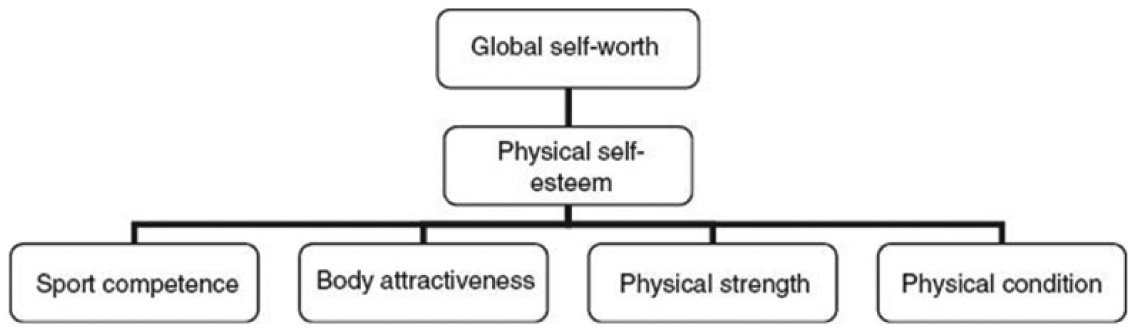
The physical self-concept (Fox & Corbin, 1989).
A few studies on the PSC have been conducted in the area of Adapted Physical Activity (Ferreira & Fox, 2008; Martin & Whalen, 2012; Shapiro & Martin, 2010). Specifically, no studies have been conducted on children with a visual impairment and PSC.
Rather than using the PSC as a model to predict physical activity behavior, this research seeks to get a greater understanding of the experiences of children with a visual impairment on their self-concept in physical activity and sports. The multidimensional construct of the PSC enables the researchers to gather experiences in a broader range on the different subdomains in contrast to a unidimensional construct as self-esteem. The use of the PSC is guided by a social constructivism paradigm which acknowledges that subjective meanings are formed through interactions with others and historical and social norms in the lives of individuals. The research will rely as much as possible on the participant’s view of the situation (Creswell, 2013).
Methods
The purpose of the study was to explore the experiences of children with a visual impairment on the physical self. To study the experiences of others manifested in the social constructivism paradigm, a hermeneutic phenomenology research approach was adopted. Many styles of phenomenology and different interests exist among phenomenologists, but they all have some commonalities (Dowling, 2007). They all tend to share the interest about what the experience of being human is like. This understanding comes from asking how the person’s world is lived and experienced (Finlay, 2011; Smith, Flowers, & Larkin, 2009). Hermeneutics is the theory of interpretation, how one interprets the “texts” of life (Van Manen, 1990). Consequently, hermeneutic phenomenology is the study of experience together with its meaning (Hendriksson & Friesen, 2012).
This approach enables the researchers to examine the PSC experiences in children with a visual impairment. Furthermore, it facilitates a connection between hermeneutic phenomenology and pedagogy. The phenomenological pedagogy is developed and described by Van Manen (1990):
Pedagogy [the activity of teaching, parenting, educating, or in generally living with children] requires a phenomenological sensitivity to the lived experience (children’s realities and lived worlds). Pedagogy requires a hermeneutic ability to make interpretative sense of the phenomena of the lifeworld in order the see the pedagogic significance of situations and relations of living with children. (p. 2)
In other words, a gap between research and practice is being bridged by recognizing the resemblances in pedagogy and phenomenology. This study aims to be a meaningful contribution to serve the practical aims for people involved in the field of pedagogy.
Participants
In selecting the participants for the study, a purposeful sampling strategy was used (Creswell, 2013). Participants were selected on specific criteria:
Visual impairment or blindness;
Age (at least six of the same age group 10–12 or 13–15 or 16–18 years);
Sex (at least three of each sex).
The participants were recruited from 1-day sports day for children with a visual impairment and a 3-day winter sports camp for children with a visual impairment in the northeast of the United States. Letters of invitations were sent to the potential participants. From the pool of participants, the age group 10–12 years gave the greatest number of potential participants. Six participants were selected based on the described specific criteria. Parents signed informed consent forms.
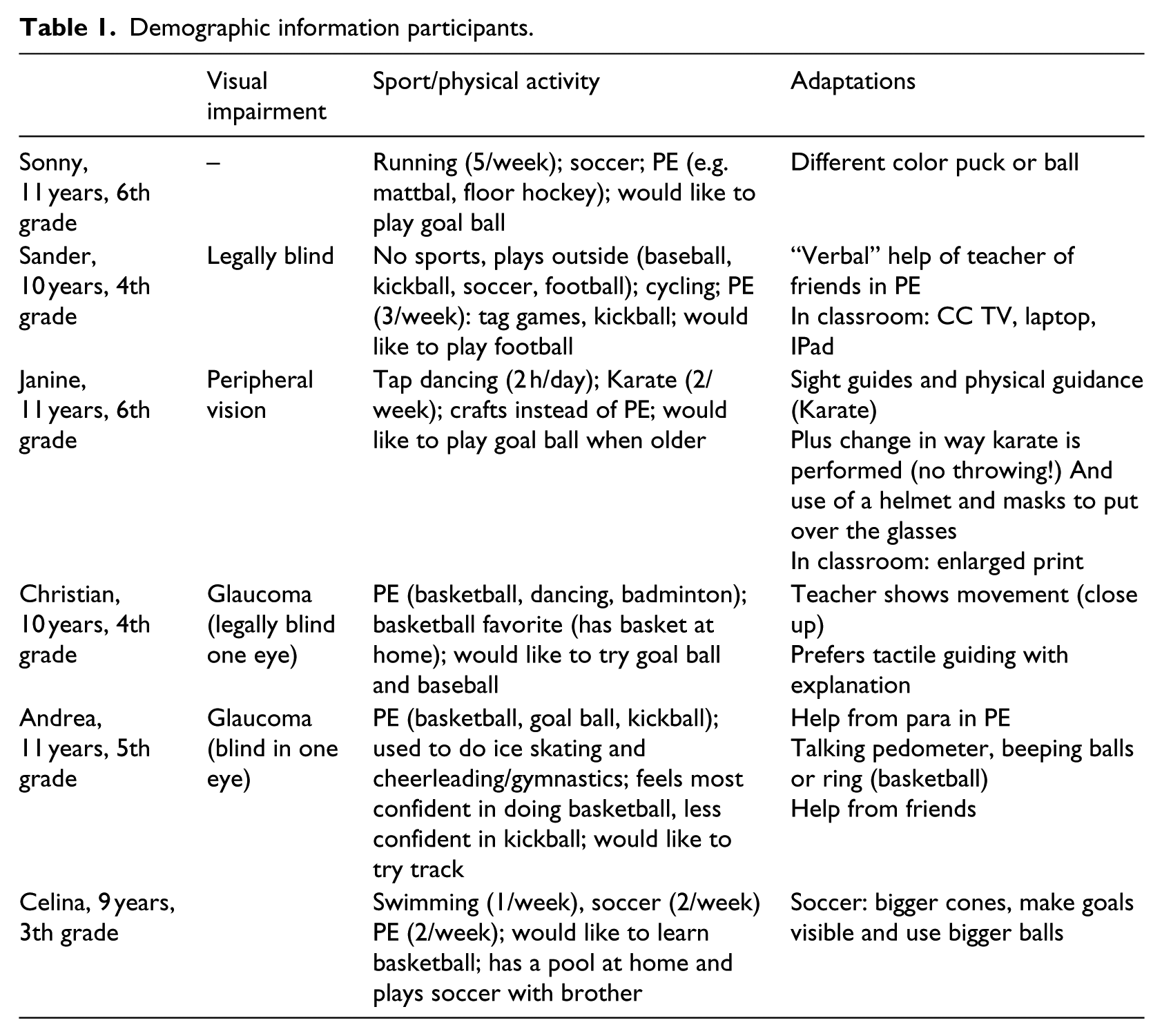
The participants were involved in physical activity on various levels and in a range of activities. Experiences were gained in different settings: physical education, sports clubs, sports camps (for children with visual impairments), and after school sports. All the six participants were attending an inclusive school. Of those, five participants were included in PE, and one participant reported to be excluded from PE (Table 1 for demographical information).
Demographic information participants.
Procedure
To explore the experiences of the six participants, a hermeneutic phenomenological research design was employed. A bottom-up approach was used to examine how the phenomenon appears (Smith et al., 2009). In-depth interviewing was selected as a method of data collection (Creswell, 2013; Van Manen, 1990). Interview notes and reflective notes were kept by the research members to reflect on motives, personal history, and the adults’ perspective of the world (Punch, 2002b; Zitomer & Goodwin, 2014). Pseudonyms were used for each child in the study. A semi-structured interview guide was based on the PSC as theoretical framework. It focused on experiences in the sports competence, body attractiveness, physical strength, physical condition, global physical self, and global self-esteem (Fox & Corbin, 1989). The language of the questions was consciously formulated since children may have limited vocabulary and use different language (Punch, 2002b). Open-ended and experiential questions were carefully formulated, such as: “Can you tell me how confident you feel in doing sports or physical activity?”; “Which activities make you feel more confident?”; “Which activities do make you feel less confident?” Quotes about each subdomain were added as a stimulus to talk and followed up by open questions. For example: “I have good sport skills,” “What number would you give it between 0 (lowest) and 10 (highest)”; “Can you tell me why?” The interview guide was reviewed by six experts in the field of Adapted Physical Education. Three pilot interviews were conducted to refine and finalize the interview guide (Creswell, 2013). The issue of building rapport (Kirk, 2007; Punch, 2002b) is addressed by showing warmth and interest and asking easy warm-up questions (e.g. about hobbies). During the interview, the interviewer emphasized toward the participants that there is “no wrong or right” and that they can take a break or withdraw at any moment (Punch, 2002b).
After each interview, reflective notes were taken by the interviewer to add to the data. As emphasized in Punch (2002b), reflexivity should be a central part of the research process with children to critically reflect on the interviewer’s role and assumptions, as well as the research method. Furthermore, reflectivity is reported by Zitomer and Goodwin (2014) as a distinct feature of qualitative research.
One interview was conducted with each of the six participants between 20 and 35 min in length and audio taped. The interviews took place in two different settings, a 1-day sports event for children with a visual impairment and a weekend sports camp for children with a visual impairment in northeast of the United States. In both situations, interviews did take place during leisure time between the sports activities.
Analysis
As Van Manen (1990) describes,
when we analyze a phenomenon, we are trying to determine what the themes are, the experiential structures that make up the experience. (p. 79)
Therefore, transcriptions of the semi-structured interviews were completed verbatim. Both researchers immersed themselves in the transcripts to become completely familiar with it and make sense of the data as a whole. The experiences were studied within the framework of the PSC; therefore, an inductive analysis was employed within each subdomain (Figure 2) (Braun & Clarke, 2006; Elo & Kyngäs, 2008). Within each subdomain, significant statements were extracted and meaning was carefully formulated by the research members. The aim was to stay as close to the experiences of the children without adding the researcher’s interpretations (Miller, 2003). Through interpretation, themes emerged and each theme was named using a content characteristic word (Elo & Kyngäs, 2008). Research members met to discuss and review the themes that emerged. Not every subdomain did reveal themes but general tendencies were found and reported.
Reliability
Conducting qualitative research with children brings methodological and ethical issues with it that need to be considered (Kirk, 2007). But as Punch (2002b) discusses, we should rather see research with children on a continuum depending on the individual child, the research context, and the research questions rather than seeing it the same or different from adult research. Often similarities have been overlooked and the differences overstated (Kirk, 2007). Issues regarding an unequal power relationship between researcher and participant are addressed by carefully considering methodological and ethical issues (Punch, 2002a). A reflective log was kept by the interviewer to be aware of her experiences, assumptions, and reactions throughout the research process (Zitomer & Goodwin, 2014). As well as, being aware of not imposing the researcher’s owns perception of childhood in the research (Punch, 2002b).
Pilot interviews were conducted to fine-tune the interview guide. Furthermore, the pilot interviews were used to help the interviewer become more experienced in the types of questions to ask in order to gather the most relevant narratives and stories (Kortesluoma et al., 2003).
Findings
The main purpose of this study was to explore the experiences of the physical self in children with a visual impairment. Six participants were interviewed, and they were prompted to describe what and how they experienced different topics. The subdomains sports competence and body attractiveness were the most reported on. Within the domain sports competence the following themes emerged: adaptations, friends, and bullying. Body attractiveness revealed the theme eyes and glasses. The findings will be described from the top to bottom of the PSC model (Figure 2).
General self-concept
The general self-concept is considered to be the summary evaluation of the different domains. All the children reported to be very positive in how they experience life and the opportunities they have. Despite their positive evaluation, the feeling of being excluded was reported in four of the six children outside the sports and physical activity (PA) context. Two children shared their feelings in the classroom and how their position of their desk makes them feel excluded. One girl shares how during recess she is excluded from the participation of games by her sighted peers. Notwithstanding, the children with a visual impairment do not seem to identify themselves with other children with a disability in their environment. Three participants clearly stated their position toward other children with other disabilities:
I’m kind of the only one in my class, but there’s like other impairments because they have special classes for those people, you know what I’m talking about? Like those people, I don’t want to hurt anybody, but those people they have special classes for I used to do ice skating, but I didn’t really want to do it anymore because it’s for kids with disabilities, and being blind isn’t really a disability.
PSC
The physical self-concept is the global summary of all the perceptions in the physical domain. The participants were rather positive about what they can do in sports and physical activity. All the participants reported on the importance of being active. Several reasons were given for example: cardiovascular benefits, losing weight, and feeling healthy. At least three participants shared how they would like to be involved in goal ball or beep-baseball but that they do not have the opportunity (e.g. not offered in area).
Sport competence
Sport competence can be described as the perception of owns sporting ability. Exploring the domain of sports competence gave a lot of input and appeared to be an important topic for the participants. Three subthemes emerged, whereas (the lack of) adaptations and (the lack of) friends either enhance or decrease their feeling of competence. Bullying was the third emerging theme and played an important role in decreasing their feeling of competence.
Adaptations
All the participants shared the common experience of the importance of the right adaptations in activities, equipment, and instructions for them. Since all the participants had different types of visual impairment, different adaptations were made to fit sports and physical activity to their needs (Table 1). All the participants do attend an inclusive school setting and five of the six participants are included in general physical education with their sighted peers. Sander reported on how changing the color of the puck in floor hockey influenced his feeling of competence:
It made me feel good because it made me know that I was included.
Another example is from Carla. She loved to play soccer and to be integrated on her soccer team they use bigger cones; they make sure she could see the goal and they use bigger balls. But sometimes in PE there wasn’t adequate equipment to make adaptations and she would feel more insecure:
Like football, they’re asking me to catch this tiny football, and they don’t have any bigger ones, so it’s really hard to do that when we do a different gym [. . . ] Well I’m happy it’s over, and I want to practice again so I can get better.
Other adaptations made in equipment mentioned by the participants were equipment with sounds (e.g. beeping balls), talking pedometers, and the use of different colors. The adaptations in instructions were as well reported as being important for the feeling of competence. One participant describes how his teacher helps him by explaining the activity carefully and letting him come closer to see how the movement was executed. Other strategies reported by the participants are tactile modeling, physical guidance, and the use of sighted guides.
Friends
Friends, (PE)-teachers, para-educators, and family were frequently mentioned in the narratives. They appear to play an important role for the children in the support they provided and their feeling of competence. All the participants reported to have had at least one sighted friend that did help him or her in sports, for example, by telling them where to go or what to do. Not only do friends function as help or support but they also appeared to be a reference to which the participants compared their skills. Being better than their sighted peers and friends seems to boost their feeling of competence:
It shows me that even though you are visually impaired, you can still do things better than people with regular eyesight. I am a lot faster than them, and stronger. I am more in shape. It makes me kind of feel that I am better than some people at sports, even though I’m visually impaired. When me and my friend are racing I feel really confident because most of the time I beat him. When someone says, “you can’t play tennis” [ping-pong] Because you can’t see the ball. But I actually beat them at it. And sometimes people say “Yeah, you can do it, just believe in yourself.”
Not only are friends a comparison, they are also the ones that knew them. Four participants distinguished on the questions “how good do other people think you are in sports?” on how friends perceived them and how other people perceived them. They reported how others might have thought they are not good in sports because of their visual impairment except their friends because they knew what they could do.
Bullying
Four out of the six participants report about their experiences with bullying. Two girls share their experiences with being bullied in sports. Anna had to stop doing cheerleading and gymnastics because other kids were picking on her:
Like “you can’t see” and stuff like that. And they said my eyes were creepy, and I was young, so I still was. When kids do that to me today, now I’m older, I don’t really take it that seriously, but when I was younger I did.
Despite Anna’s positive attitude toward sports and her confidence in sports she was familiar with, Anna describes how kids sometimes picked on her:
Sometimes I fail and sometimes I try to not do stuff. Sometimes, like maybe baseball, like sometimes I really don’t want to hit the ball or catch because I fail and like I told you earlier, kids pick on me [. . . ] And sometimes, yeah, that’s kind of all I can think of.
Other participants describe experiences of bullying and exclusion during lunch break (recess) and being picked on because of their looks (stomach or eyes).
Body attractiveness
Body attractiveness can be described as perceived attractiveness of figure or physique, ability to maintain an attractive body, and confidence in appearance. Participants were prompted to talk about how “good-looking” they felt, what they liked the most about their looks and what others might think about them. The three boys reported to be less influenced by what others were thinking about how they looked. Two of three boys pointed out they do not really care about what others might think about their looks. The girls were more sensitive toward the opinion of others and describe how they are influenced by what others were saying to them or about them.
Eyes and glasses
Four out of the six participants were using glasses. During the conversation about how good-looking they experienced themselves, the look of the eyes and the use of glasses were a common theme. Most of the participants were rather negative about their glasses and eyes. They described how they did not like the look of the glasses or how their eyes looked. But one participant reports on how he likes his glasses the most about his looks and how this makes him look smarter.
Physical strength
Physical strength can be described as the perceived strength, muscle development, and confidence in situations regarding strength. Participants were rather positive about their strength and mostly related their strength with the activities they are involved in. For example, Sander describes how he felt strong in his legs because he played soccer but felt weaker in his arms. Other participants shared similar experiences.
Physical condition
Physical condition can be described as the perceptions of the physical condition, stamina, and fitness. Although all the participants were positive about their condition and their fitness (or health), it appeared to be difficult to describe how they felt toward their endurance. Most participants compared their abilities with their peers or friends in their environment.
Discussion
This study explored the experiences of the different domains of the PSC of children with a visual impairment. The aim was to get a greater understanding of their experiences in physical activity and sports guided by the framework of the PSC. Moreover, this study intended to make a meaningful contribution to serve the practical needs for people involved in pedagogy and sports.
Global self-concept and PSC
All the participants reported to be physically active in a variety of activities and sports. Different sport contexts were mentioned: sports clubs, after school sports, PE, and leisure time. In general, the participants perceived doing sports and being active important as found in Stuart et al. (2006) and Ward et al. (2011). Although some of the participants spoke about being bullied, exclusion, and other negative experiences they appeared to be very satisfied with what they could do in their lives and gave high grades to their global self-concept and PSC. In spite of the small sample and the sports-related research context, these findings are similar to the findings of Bowen (2010) who found that on a sample of 60 students 70% reported “normal” to “high” levels of self-esteem. Shapiro, Moffett, Lieberman, and Dummer (2005, 2008) found that children with a visual impairment have a rather high global self-worth but discount the importance of their physical appearance, physical competence, and social acceptance. This tendency was not found in this research. A difference in gender has not been found in this study, according to the findings of Datta, Halder, and Talukdar (2012) and Halder and Datta (2012).
Sports competence
The subdomain, sports competence, revealed the following main themes: adaptations, friends, and bullying. The themes can be shared under the umbrella of barriers and facilitators which either enhance or decrease their perceived feeling of competence. Shields, Synnot, and Barr (2012) identified the barriers and facilitators to physical activity in children with a disability. They did distinguished personal, social, environmental, and policy-program barriers. Children with a visual impairment have the same potential to develop the same level of motor skills as their sighted peers but without consistent opportunities or goals they may not attain the appropriate skills to participate with their peers (Lieberman et al., 2007). Therefore, identifying the barriers and facilitators can help to increase the opportunities to be successfully physically active.
Adaptations can either be a barrier or a facilitator. Correct adaptations can enhance the feeling of competence, whereas a lack of adaptations (e.g. lack of adaptive equipment or a lack of trained staff) is likely to decrease the feeling of competence (Shields et al., 2012). Findings showed that a decrease in sports competence was related to the lack of adaptive equipment and/or the lack of adaptations in instructions of the professionals. Barriers to the inclusion of students with a visual impairment in general PE were identified by Lieberman, Houston-Wilson, and Kozub (2002): as professional preparation, equipment, programming, and time. This research shows that at the present time those barriers are still an issue and haven’t been addressed adequately which is of a great concern.
Bullying is reported to be a barrier to participate in sports and physical activity (Shields et al., 2012). Several participants talked about their experience with being bullied, being picked on, and how this led to withdraw of their participation in sports and physical activity. Persons with observable disabilities have been shown to be bully-victims more often (Swearer, Wang, Maag, Siebecker, & Frerichs, 2012). Very few studies report bullying and teasing of children with a visual impairment in sports and physical education (Danes-Staples et al., 2013; Lieberman et al., 2007; Stuart et al., 2006) while it appears to be an actual and important issue.
On the other hand, friendship and positive support can be perceived as a facilitator and play a vital role in coping with bullying. A study by Bourke and Burgman (2010) about the experiences of bullying in children with disabilities points out the important role of friends in helping them, showing respect toward their impairment and managing the bullying. A study on friendship between children with and without a disability of Seymour, Reid, and Bloom (2009) sheds light on friendships in inclusive education settings. Friendship between children with and without a disability is often proposed as a desirable outcome of inclusion. The experiences shared in this research do show that friendship does occur in inclusive settings.
Body attractiveness
Within the literature, body attractiveness and similar related topics as body image and body awareness have been explored very little in children and adults with a visual impairment. The assumption is that physical appearance is negatively affected in children and adults with a visual impairment because of the cosmetic flaws (e.g. damaged eye), no visual input for comparison with peers, and a greater dependence on the social evaluations. Studies comparing body image, the subjective perception or belief about appearance, of children with a visual impairment with their sighted peers shows a variety of outcomes and are considered to be inconclusive (Pinquart & Pfeiffer, 2012). Although within this study body attractiveness emerged as an important theme, further research is recommended to explore this topic more in depth.
Physical condition and physical strength
In the literature, there has been research on physical activity levels and physical fitness (including strength) in children with a visual impairment. For example, children with a visual impairment have lower PA levels compared to their sighted peers (Haegele & Porretta, 2015). Children in this study perceived themselves as active and strong, also in comparison with their sighted peers. A comparison with their actual levels of physical activity or physical fitness cannot be made. A further investigation in the existence of a gap between perceived and actual physical activity or fitness levels might be of interest.
Limitations
The study was limited by a generally small sample as findings are not transferable to all children with a visual impairment. The research context was set up around sports camps/days in which it is very likely to attract participants that have affinity with sports and physical activity. This may give a different meaning to their experiences.
No member checks were done after the interviews because of privacy issues. It was not feasible (time and distance) to pay all the participants a visit to do a follow-up interview or a one-on-one review of the interview. Member checking by email remained a delicate issue since the participants shared their experience in confidence and sensitive topics were discussed. Therefore, it was decided not to do member checks although this might affect the reliability of the study.
Conclusion
The aim of the study was to explore the physical self in children with a visual impairment. This aim was met by the analysis of the in-depth interviews with six children with a visual impairment. The study found that children with a visual impairment are satisfied and happy with their physical self despite the occurrence of bullying and lack of adaptations in sports in physical activity. Nevertheless, several important issues were mentioned in this study: barriers as inadequate training and lack of adaptive equipment, the effect of the friendship theme, the issue of bullying, and lack of research on body awareness/body image.
Recommendations to improve the area of physical activity for children with visual impairments are to teach advocacy to the children with visual impairments. This way they can find their voice when they feel excluded, marginalized, demeaned, or bullied. They can ask for the modifications and teaching approaches that they need for each unit. In addition, providing trainings for their physical education teachers and coaches to help them with modifications and adaptive equipment may help to minimize exclusion and bullying. Finally, support for parents will help with opportunities, with increasing understanding, and with the parents’ recommendations for modifications to existing programs.
Footnotes
Declaration of Conflicting Interests
The author(s) declared no potential conflicts of interest with respect to the research, authorship, and/or publication of this article.
Funding
The author(s) received no financial support for the research, authorship, and/or publication of this article.