




Abstract
This investigation was aimed at validating the feelings of patients with thyroid-associated orbitopathy (TAO), who commonly report psychosocial impairments due to the cosmetic disfigurement caused by the disease. In all, 50 adults, equally divided between two experimental conditions, participated. Adults’ visual behavior was recorded with a corneal reflection eye-tracking system as they viewed side-by-side photograph pairings of affected and non-affected individuals’ upper facial region. Adults in Experiment 1 viewed photographs of patients before corrective surgery and those in Experiment 2 viewed photographs of patients after corrective surgery. Visual behavior measures of interest included the number of stares and cumulative time spent staring. Adults appear to differentially attend to patients with TAO, staring more often and longer at these individuals, regardless of surgical correction. TAO patients’ feeling of self-consciousness and being more concerned about their appearance may be due to differential persistence of fixations (i.e. staring) from their peers.
Introduction
Thyroid-associated orbitopathy (TAO) presents with a constellation of periorbital changes such as periocular swelling, chemosis, conjunctival congestion, proptosis, restrictive strabismus, and optic neuropathy (Bartley & Gorman, 1995; Ben Simon et al., 2006; McKeag et al., 2007). Beyond vision-specific physical consequences, patients with TAO commonly report psychosocial consequences, such as feelings of being “stared at” and/or eye contact avoidance from interlocutors, due to the cosmetic disfigurement caused by the disease. When asked about their quality of life, almost two-thirds of patients with TAO felt their clinical severity had interfered with psychosocial functioning (Park, Sullivan, Mortimer, Wagenaar, & Perry-Keene, 2004). Regarding individual differences and personality disorders, patients with TAO are observed to have a poorer self-image (Yeatts, 2005) and higher levels of anxiety and depression (Estcourt, Quinn, & Vaidya, 2011). Moreover, disease activity or severity does not appear to differentially affect the reduced quality of life experienced by patients with TAO (Terwee et al., 1999, 2001; Yeatts, 2005).
Periorbital changes may attract others’ attention to the upper facial region of patients with TAO. However, the feelings that these patients report are comparable to Elkind’s (1967) characterization of imaginary audience, which describes a preoccupation with one’s own appearance and belief that others are critically attending, even if they are not. To validate the feelings of patients with TAO empirically, we measured 50 non-affected adults’ visual behavior as they viewed side-by-side photograph pairings of TAO affected and non-affected individuals’ upper facial region. We performed two arms of the study evaluating the response of non-affected individuals to TAO affected before corrective surgery (Experiment 1) and non-affected to TAO affected after corrective surgery (Experiment 2).
Experiment 1
To validate the feelings of patients with TAO, we measured adults’ visual behavior as they viewed side-by-side photograph pairings of affected and non-affected individuals’ upper facial region (i.e. mid-forehead to mid-nose). If periorbital changes attract others’ attention to the upper facial region of patients with TAO, then non-affected individuals should stare more often and longer at those who are affected. Equally distributed glances and stares would suggest that periorbital changes are not differential features and patients’ feelings of being stared at may best be ascribed to a heightened self-consciousness.
Method
Participants
A total of 25 University of California, Los Angeles (UCLA) undergraduates (20 females, 5 males; M age = 22 years, 4.3 months) were observed, recruited from a pool of participants managed by the Department of Psychology; they received course credit or modest payment for participation. All participants had a complete, acceptable calibration and visual behavior data yield of 80% or greater (i.e. data were obtained for more than 80% of the time that the stimuli were presented).
Apparatus and stimuli
A corneal reflection eye-tracking system (Tobii model T60XL) was used to record participants’ visual behavior at 60 Hz. Tracking and viewing were binocular. The spatial resolution of the eye tracker was approximately 0.5–1.5 degrees of visual angle. Tobii Studio, the system’s proprietary software, was used to design and implement the experimental protocol.
Photographs of 36 affected individuals, who had not been treated surgically, were matched with photographs of 36 non-affected individuals, which were taken from the NimStim stimulus set (see Tottenham et al., 2009). Patient photo selection was determined by the availability of (1) both pre- and post-operation photographs and (2) at least one photograph that captured both eyes and auxiliary features of the patient’s face (e.g. eyebrows, part of the forehead and nose). 1 Pairs were matched based on both eye and skin color. The position of the photographs was randomized so that the same type of individual did not always appear on the same side of the monitor. One of the side-by-side photograph pairings can be seen in Figure 1.
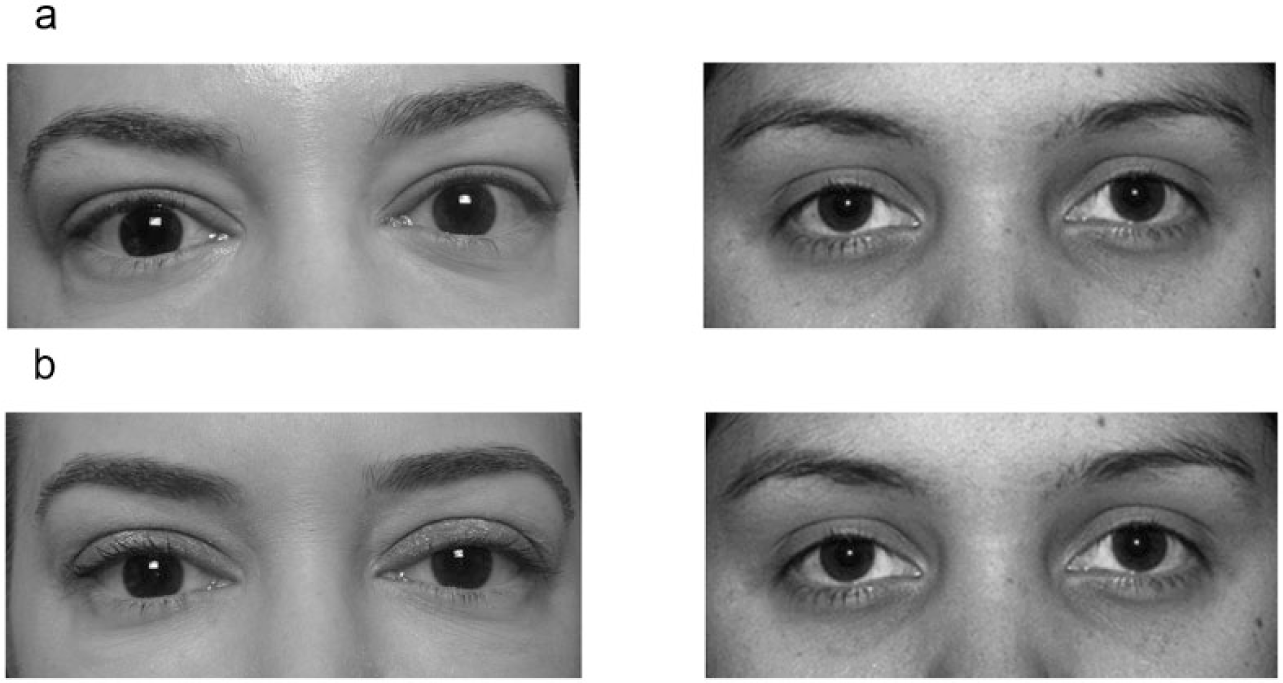
Side-by-side photograph pairings from (a) Experiment 1 and (b) Experiment 2: untreated affected individual (top left), non-affected individual (top right), affected individual after treatment (bottom left), and non-affected individual (bottom right).
Procedure
Each participant’s point of gaze was calibrated at the start of the session using a 5-point calibration routine. Point of gaze was calibrated by comparing it to known coordinates on the screen as the participant viewed a target-patterned “attention-getter,” looming/contracting in synchrony with a rhythmic sound. The attention-getter was presented at five locations on the monitor, and the participant looked at each in turn. Calibration was regularly completed in less than a minute. Following calibration, the thirty-six 5-s photograph pairings were presented, with a temporal gap of 1 s between them. The total presentation duration was about 3½ min. The protocol was approved by the UCLA Institutional Review Board.
Results
Paired-sample t-tests were used to analyze adults’ overall viewing behavior. The number of fixations (i.e. number of “stares”) and total fixation duration (i.e. cumulative time spent “staring”) for each group (patients with TAO vs non-affected adults) was compared across adults. The results of these analyses seem to confirm patients’ feelings as adults were found to stare more often (patients: M = 285.68 fixations, standard deviation (SD) = 57.81; non-affected M = 218.64 fixations, SD = 54.83; t (24) = 3.32, p = .003) and longer (patients: M = 91.34 s fixation duration, SD = 19.23 s; non-affected M = 66.56 s fixation duration, SD = 15.69 s; t (24) = 3.60, p = .001) at the patients with TAO.
Experiment 2
Results from Experiment 1 suggest that non-affected adults pay greater attention to affected, untreated individuals. To determine the effect of corrective surgery on reducing stares from non-affected individuals, in Experiment 2 we measured adults’ visual behavior as they viewed photographs of affected individuals after treatment, presented alongside the same non-affected individuals.
Method
Participants
A total of 25 UCLA undergraduates (18 females, 7 males; M age = 21 years, 1.7 months) were observed, recruited from the same participant pool previously described. All participants had a complete, acceptable calibration and visual behavior data yield of 80% or greater. Data from four additional adults were excluded, two adults could not be reliably calibrated, one adult had a visual behavior data yield below 80% and one adult had both an acceptable calibration and data yield, but she rarely attended to the presented images.
Apparatus and stimuli
The corneal reflection eye-tracking system used for Experiment 1 was also used for Experiment 2. Regarding patient photographs, although the 36 affected individuals were the same, the selected photograph now captured their upper facial regions after surgery. Matched pairs remained the same (see Figure 1).
Procedure
The calibration routine and photograph presentation followed the same procedure described in Experiment 1.
Results
Paired-sample t-tests were used to analyze adults’ overall viewing behavior. The number of fixations and total fixation duration for each group was compared across adults. Corrective surgery does not appear to significantly reduce stares from non-affected individuals as the results of these analyses still confirm patients’ feelings. Adults were again found to stare more often (patients: M = 265.44 fixations, SD = 53.40; non-affected M = 224.60 fixations, SD = 46.70; t (24) = 3.17, p = .004) and longer (patients: M = 88.40 s fixation duration, SD = 16.14 s; non-affected M = 72.29 s fixation duration, SD = 14.57 s; t (24) = 2.72, p = .012) at the patients with TAO.
Independent-sample t-tests were used to compare adults’ staring behaviors, toward patients with TAO, before and after corrective surgery. The number of fixations and fixation duration for each group, patients with TAO versus non-affected adults, was analyzed, comparing the visual behavior data of non-affected adult participants in Experiment 1 and Experiment 2. These analyses did not reveal any statistically significant differences in adults’ staring behavior (all p’s > .188). Together, the results from Experiment 1 and Experiment 2 suggest that adults differentially attend to the upper facial region of patients with TAO, staring more often and longer at these individuals, regardless of surgical correction.
Discussion
TAO results in both physical and psychosocial consequences. Even after surgical rehabilitation, patients with TAO may continue to experience psychosocial consequences because periorbital changes appear to continue to attract others’ attention to the upper facial region. Patients’ feelings of self-consciousness and being more concerned about their appearance may be due to differential persistence of fixations (i.e. staring) from their peers. Given the significance of facial features and specifically eyes in conversational exchanges and social interactions (Langton, Watt, & Bruce, 2000), periorbital changes associated with thyroid dysfunction can be debilitating since the physical consequences are viewable to others and affect patients’ perception of themselves.
When working with patients with TAO, clinicians tend to focus on the physical consequences, such as periocular swelling, erythema, and proptosis, and neglect to account for psychosocial consequences. Surgical rehabilitation is typically performed after the disease has stabilized, which may require 18–24 months (Bothun, Scheurer, Harrison, & Lee, 2009). Rehabilitation commonly follows a three-stage approach: (1) decompression surgery, to reduce the bulging; (2) strabismus surgery, for eyelid misalignment; and (3) retraction surgery, for eyelid malposition. These stages may last 6–9 months, which further prolongs the course of the disease and psychological impact. Although surgical rehabilitation may improve some of the clinical severity, the physical consequences may continue to affect the feelings of self and other in patients with TAO.
Clinicians can neither predict nor prevent the consequences of TAO for patients that may require surgical rehabilitation. Notwithstanding the best surgical rehabilitation, patients are unable to return to their pre-disease appearance and may continue to be affected by the psychosocial consequences of the disease. Through pre- and post-surgical photographs that captured both eyes and auxiliary features of the face, we sought to begin to understand and define patients’ feelings of differential perception because of the periorbital changes of TAO and effect of surgical rehabilitation. Our results validate the feelings of patients with TAO and suggest a need for increased clinical attention to the psychological well-being of patients, from the onset of the disease through post-surgical rehabilitation. Providing long-term counseling and education on the psychosocial impact of the clinical manifestations associated with TAO may positively contribute to patients’ perceptions of themselves, interactions with others, and their overall quality of life.
Footnotes
Acknowledgements
The authors would like to thank HoJin Kim for his help in analyzing the data.
Declaration of conflicting interests
The author(s) declared no potential conflicts of interest with respect to the research, authorship, and/or publication of this article.
Funding
The research was supported by NIH grants R01-HD40432 and R01-HD73535.