




Abstract
Inclusion is a subjective experience related to sense of belonging and acceptance. In this way, the specific nature of a disability can have particular implications on the obstacles one experiences in physical education. Thus, the main objective of this study was to investigate the experiences of students with visual impairments in physical education classes in Brazil from an individual and subjective perspective. Eight students with visual impairments (five female students and three male students) between 13 and 18 years participated in the study. Interviews, which utilized a semi-structured interview guide, were used to obtain important information from the students. Interview transcripts were analyzed by the content analysis technique. Results revealed two main themes: (1) participation and (2) social interaction. Exclusion from physical education activities was omnipresent among the experiences of students with visual impairments. Physical education teachers did not recognize physical education classes as a place for student with visual impairments.
Introduction
Proper inclusion is associated with a sense of belonging, acceptance, and value in the group (Stainback & Stainback, 1996). Thus, the process of inclusion is understood in recent studies as a subjective experience associated with individual interpretations, feelings, beliefs, and perceptions (Blinde & MCCallister, 1998; Goodwin & Watkinson, 2000; Spencer-Cavaliere & Watkinson, 2010). Understanding inclusion in physical education (PE) classes as a subjective experience requires investigations through the perceptions of students with disabilities (Spencer-Cavaliere & Watkinson, 2010). However, these experiences and feelings about inclusion change individually according to the specific nature of disability, requiring studies to explore experiences in PE from the perspectives of individuals with different types of disabilities (Haegele & Sutherland, 2015).
In recent years, two reviews of literature sought to summarize this line of inquiry. Coates and Vickerman (2008) found few studies to examine the perspectives of youth with disabilities toward PE, which were carried out mainly with students with physical disabilities. When reviewing the literature in this area of inquiry, the authors found that students with disabilities tended to report experiencing numerous obstacles for their inclusion in PE classes. Although they expressed wanting to participate in PE classes, students with disabilities had reduced participation, with discrimination from peers and a lack of preparation of the teacher to meet the student’s needs as primarily barriers to inclusion.
More recently, Haegele and Sutherland (2015) confirmed many of the results found by Coates and Vickerman (2008). Despite the research base broadening to include students with various additional disabilities (e.g. autism, congenital heart problems), results continued to show that students with disabilities were still experiencing situations of exclusion in PE classes, as well as discrimination by peers and negligence by teachers. However, the authors also highlighted the presence of positive inclusion experiences, primarily related to the establishment of positive social relationships with peers and the PE teacher’s attitude. Importantly, the role of the PE teacher was considered essential, as was the teachers’ ability to adapt activities and modify content for students with disabilities to feel included in classes (Haegele & Sutherland, 2015).
In recent years, research in this area of inquiry focusing on the perspectives of individuals with visual impairments has grown (DeSchipper, Lieberman, & Moody, 2016; Haegele, Sato, Zhu, & Avery, 2017; Haegele & Zhu, 2017; Haegele, Zhu, & Davis, 2017; Lieberman, Stuart, Hand, & Robinson, 2006). These studies have demonstrated that, like others with disability, the experiences of individuals with visual impairments in PE are typified by negative social interactions, such as bullying (Haegele, Sato, et al., 2017). In these instances, social dynamics and interactions tend to be influenced by perceptions of ability and disability among youth with visual impairments and their peers (Haegele, Sato, et al., 2017; Haegele, Zhu, & Davis, 2017). Liken to research focusing on individuals with other disabilities, studies in this area also point toward the importance of the role of the PE teacher in shaping participants’ experiences, where positive experiences are available when PE teachers are willing to modify and adapt activities (Lieberman et al., 2006).
Inclusion in Brazil from the perspectives of children with disability
In Brazil, specific laws, such as the Brazilian Law on the Inclusion of Persons with Disabilities (Statute of the Person with Disabilities – Law 13.146/15), mandate the inclusion for all children with disabilities in the general education system, including the availability high-quality education and resources for learning. These laws specify that resources, such as special education teachers and adapted materials, are made available to enhance learning for students with disabilities. This includes in PE classes, where students with disabilities have the right to learn and participate with peers (Alves & Duarte, 2011).
Unfortunately, however, there are major barriers in the Brazilian general education system to including children with disabilities. Many times, mandated resources described in educational laws are limited or absent. In this context, it can be said that Brazilian laws are only succeeding to guarantee children with disabilities access to the general educational system (Ferreira, 2006), without accommodations or modifications needed for a successful educational experience.
Liken to research in other contexts, studies focusing on inclusion in PE in Brazil tend to demonstrate instances of low social interaction and participation of students with disabilities (Alves & Duarte, 2013, 2014; Nacif et al., 2016). For example, in a study examining inclusion from the perspectives of students with physical disabilities or visual impairments, Alves and Duarte (2014) described feelings of inclusion being associated with participation in activities, group interactions, and perceptions of feeling capable to perform during activities. However, students with disabilities reported reduced participation in classes due to the lack of adequate and adapted material and access to the practice location. These aspects were highlighted by students with disabilities as relating not only to the lack of professional preparation of the PE teacher but also of the school as a whole.
In another study (Alves & Duarte, 2013), students with physical disabilities or visual impairments reported perceptions of exclusion in PE classes associated with social isolation, neglect in their educational needs and feelings of inferiority. In this study, participants reported a lack of material adaptation, activity, and teaching strategies by the teacher. These students also described difficulties accessing the class location, damaging their autonomy and independence. At this point, the lack of adaptations for students with visual impairments to participate in team sports activities was considered a major obstacle to inclusion, since it represented a large part of the content currently developed in classes. Interestingly, conflicting results were found in a study by Nacif et al. (2016), who examined inclusive PE from the perspectives of 20 students with physical, visual, intellectual, or hearing impairments. In this study, students with disabilities reported actively engaging in PE classes, with positive social interaction with their peer group. These students further expressed a desire to continue to participate in classes and enjoyed the health benefits resulting from the practice of physical activity.
Studies focusing on the perspectives of youth with disabilities based on the Brazilian educational reality are scarce (Alves & Duarte, 2013, 2014; Nacif et al., 2016), which demands further investigation in the area. Furthermore, Brazilian studies focusing only on students with visual impairments have not been conducted yet. The PE experiences for student with visual impairments should be understood as different from students with other disabilities. It is important that these studies build a deep understanding of the obstacles and experiences of inclusion from the perspective of students with visual impairments. Knowledge of their needs and perspectives allows the structuring of specific paths toward a sense of belonging and inclusion in PE classes. Thus, the main objective of our study was to investigate the experiences of students with visual impairments in PE classes from an individual and subjective perspective.
Methods
Participants
The study included the participation of eight students, five girls and three boys, with visual impairments between ages 13 and 18 years (15.3 ± 1.9). Table 1 provides more detailed information about each participant. Participants were selected through the Associação Brasileira de Assistência a Pessoa com Deficiência Visual – Laramara located in São Paulo, Brazil. This institution develops activities to attend to the specialized education of children, adolescents, and adults with visual impairments focusing on employability, culture, and leisure. Hence, the presence of children and adolescents with visual impairments at the institution allowed the analysis of different experiences in PE classes.
Description of the study participants.

F: female; M: male; MS: middle school; HS: high school.
Inclusion criteria included participants with visual impairments who (1) were enrolled in a school in the regular education system between the 5th grade of middle school and 3rd year of high school, (2) were present in at least 75% of their enrolled PE classes, and (3) did not have a medical waiver for participation in PE classes. Students were excluded from this study if they had other associated disabilities that prevented them from being able to effectively communicate their experiences and feelings during interviews. Informed consent was obtained from parents/guardians of all students, allowing the research team to engage the participants in the interview protocol. This study was approved by the Ethics Committee at the institutional affiliation of the first author. The identity (i.e. given and family names) of the participants was removed from the presentation of the results of the study to ensure anonymity.
Data collection
The main source of data for this study were one-to-one semi-structured interviews. In order to create a friendly atmosphere between the participant and researcher, each interview started with a brief conversation about the interests and activities of the participant. The interview followed an interview guide with open-ended questions to pursue the study’s proposed objectives. This type of structure allowed the researcher to explore the concepts of interest to the study, as well as to have flexibility to deepen the answers given by the participants (Patton, 2002).
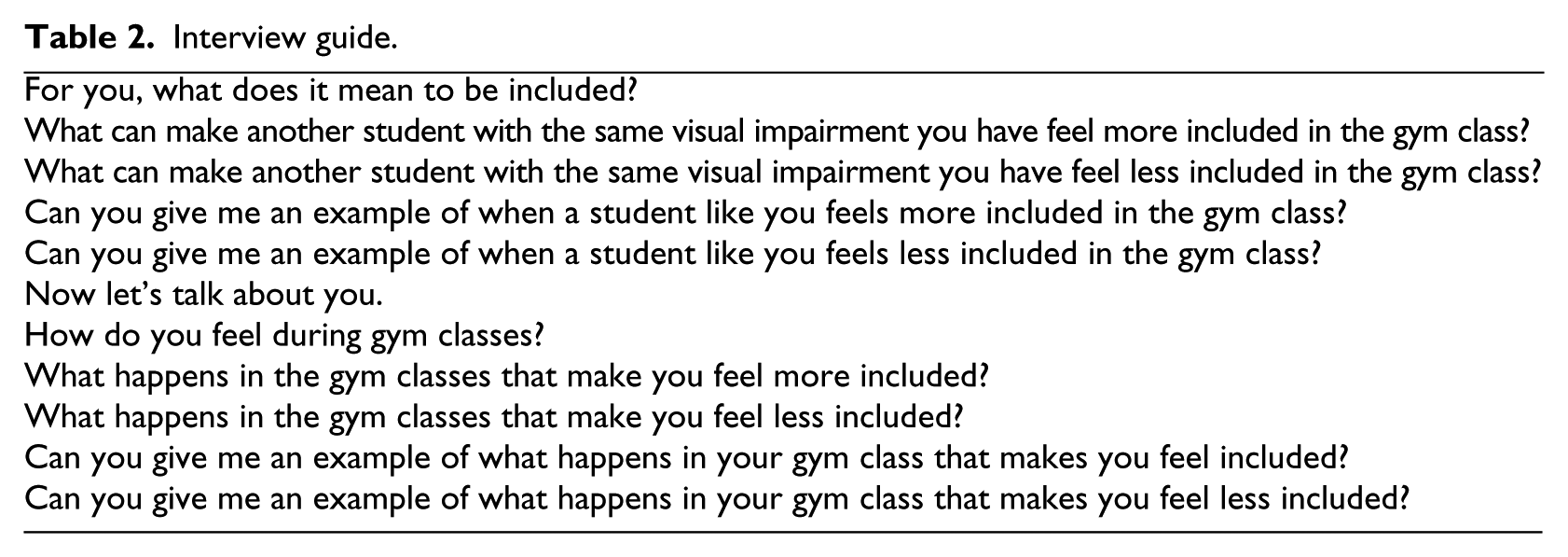
The interview guide (Table 2) used the same technique described by Watkinson, Dwyer, and Nielsen (2005). In this technique, the participants were asked about the perspectives of another person in the same conditions, to subsequently answer questions about their own perspectives. This technique was used because when initially responding about a fictional person under the same conditions, the participants did not have to expose feelings and sensations at the very beginning of the interview. Participants were later encouraged to elaborate on how they believed they would feel under similar circumstances. Interviews were carried out by the first author and, with agreement from the participants, were audio-recorded in MP3 format using voice recorder model Panasonic RR-US511. Subsequently, all interviews were transcribed verbatim, respecting the linguistic features and particularities of each participant. After transcription, interviews were translated from Portuguese to English by a translation professional in Brazil. The translated materials were then reviewed by the first author (who is bilingual in English and Portuguese) and other members of the authorship team.
Interview guide.
Data analysis
The interviews were analyzed using Bardin’s (2010) content analysis method, where meaning and central consistencies were identified from the qualitative data (Patton, 2002). More specifically, the interviews were individually coded into units of meaning. After that, these units of meanings were classified and grouped into emerging themes. These emerging themes reflected the core group ideas of meaning units. Processes of inference and interpretation were performed within the context of each interview, seeking to analyze and understand the individuals’ meanings inside each theme. Subsequently, the emerging themes of each interview were categorized into larger thematic groups. This step included developing cross-sectional themes, that is, themes that permeated across all participants’ interviews. After this categorization, there was a process of inference and interpretation of the themes present in the set of interviews, allowing the analysis and understanding of the latent meanings according to the study objectives. Thus, the interviews were analyzed and interpreted within their uniqueness, as well as in their collectivity, to expose the lived experiences of the participants (Bardin, 2010).
Trustworthiness
Specific procedures were applied before and during data collection, as well as during analysis, to enhance the data trustworthiness (Zitomer & Goodwin, 2014). Prior to data collection, a pilot study was conducted to adapt the interview script to the particularities of participants. The script was prepared by three researchers with extensive experience in the area of adapted PE and in teaching of children with disabilities in school contexts. During the pilot, the script was utilized with three students with visual impairments in the same age group and school period of the study participants. This preliminary study enabled the adaptation of the questions elaborated in the interview script, as well as the preparation of the interviewer, to more clearly pursue the study purpose.
For data collection, selected students were studying in different schools, which allowed recognition of different education realities. At this point, the script with open-ended questions allowed a deepening in the topics raised or in unclear points of the conversation. Before the interview began, the interviewer explained to students her background as a teacher and researcher in order to expose researcher positionality. One’s positionality is understood as the relationship between the researcher and the group being studied (Haegele, Sato, et al., 2017). In this study, the researcher described herself to the participants as general PE teacher, with previous experience teaching students with and without disabilities.
During the interview process, field notes were taken and identified personal values and judgments that could interfere in the process of data collection and analysis. Field notes were considered in the researchers’ reflections on the data and their meaning and also on possible emerging themes. In qualitative research, reflexivity refers to researcher’s awareness of their experiences and theoretical influences on the study design, development, and conclusions (Zitomer & Goodwin, 2014). In the data analysis phase, the complete interview transcriptions were analyzed by two responsible independent researchers. Points of disagreement were discussed until reaching a consensus between them.
Results
For students with visual impairments, participation in activities during PE classes and social interactions with their peers were central to feeling included. Students with visual impairments still have difficulties being included in PE classes, with issues related to participation in specific activities and to be accepted by peers. Results were grouped according to these two themes: (1) participation and (2) social interaction.
Participation
Students with visual impairments described their PE class participation in four distinct experiences in the PE classes: (1) exclusion, (2) integration, (3) segregation, and (4) limited participation.
In exclusion, the participants reported attending the school environment, but had no participation in the activities. According to Beatriz, the PE teacher “just says ‘sit down and stay there because you can’t do PE’. We can’t do anything.” Laura reported feeling isolated and ignored during PE classes because “sometimes I don’t play and it bothers me a little because while others are out having fun.” The students’ words demonstrate feelings associated with instances of exclusion, as well as the impact of their teacher’s attitude toward people with disabilities. In these classes, students claimed to remain seated throughout the duration of their class, simply waiting for its end.
Instances of integration were typified by students with visual impairments being invited by their teacher to participate in activities, but without any kind of preparation or adaptation for their participation. In these cases, the participants reported experiencing feelings of exclusion from activities, still, because they were unable to participate due to a lack of adaptations and modifications needed to successfully participate. For example, Júlia reported that [. . .] I felt left out when he wanted to insert me in the activities, in the games and such, but I had to do everything like the others did. I would supposedly have to see to be able to do it. [. . .] I can do what they do, but it has to be by other ways. [. . .] For you to be included, certain adaptations have to be made and without these adaptations I would feel excluded.
In this situation, Júlia described that she started to perform the proposed activities, but left the playing area moments later for fear of getting hurt. Again, these instances display a non-recognition by the PE teacher of the participants’ needs for participating in the activities. The same kind of situation was described by Pedro during a typical Brazilian kids game: There’s a game I do not like. I do not know how to play and whenever I go in this game, someone has to reach out to get me by myself. I do not know how to play this game and then I’m running after the crazy person. And then a person has to help me, to get me to play the game because I do not know how to play this game.
When asked what the teacher did during these instances, Pedro continued that He tells the student to reach out and get me. Then, as I do not know how to play, then I’m running after the person. Then I run, run, run. The teacher sends the student to help me, to get the student. This bothers me a lot.
A third situation, segregation, was typified by the participants’ performing fundamentally different activities from their classmates. According to the participants, their teacher provided separate activities for the participants to perform in isolation from the group. In this context, some PE teachers proposed playing board games, such as chess or cards. Thus, the activities proposed were very distinct from content developed in PE classes, considering that the rest of the class was involved with content related to team sports. These instances were common among participants, for example Camila stated that “they do something else, they play ball and other things that the teacher invents to be able to move [. . .]. I usually play checkers, dominos, and these things.” Similarly, Maria reported that “the teacher last year always asked me to do gymnastics at least [. . .].” In this case, the mentioned gymnastics refers to stretching exercises while the group of students was playing sports. Involvement with differentiated activities revealed itself as a form of distraction for the student during allotted PE time, without consideration of curriculum goals.
During the last commonly reported situation, limited participation, the participants described engaging in activities at specific and predetermined times during sports games and activities. However, they were still not full participants in all activities. As an example, Pedro described a scenario where he was positioned in front of a beam during a soccer game, and was responsible for performing a kick to the goal when the ball approached. Under these conditions, the participant had only this specific function in the activity, not participating in the actual game dynamics. Interestingly, this strategy de-characterized the game, since it was interrupted when the ball approaches the student with a visual impairment. Camila described that “In basketball I think I’m more included because I play the ball like this (gesture) . . . but we do not play basketball like this . . .” The student was not involved with the activity and its dynamics as a whole, but just played with a ball near a basket. However, despite not participating in the dynamics of the game, the participants reported feeling included during instances like this. This perception was associated with feeling like part of a team in pursuit of a common goal (e.g. winning the match).
Social interaction
Positive social interactions
Despite non-participation in typical PE activities, the participants reported that they still felt included in their classes when they engaged in positive social interactions with classmates, without prejudiced attitudes or behaviors. While not mutually exclusive, the participations described social interactions with peers separately from participation in activities. For example, Júlia described that she felt included by the . . . fact of their company. Even in the class, the company, I don’t know . . . being together, when they tell me something that happens in the game. I end up getting in the group.
In this instance, Júlia described that although she may not be actively engaged in activities, the feeling of inclusiveness was brought to her by conversations with her peers about the activities they were engaging in. In the same way, Maria reported that Because they [friends] are always keeping company. For example, they don’t like when I’m in the classroom when I want to do some other lesson and not get on the court there. In the sense, even when I’m not doing the same thing, they, for example, stay with me so I will not be alone. In that sense, this way, I feel very included in the general.
Negative social interactions
Conversely, participants reported experiences of social interactions with classmates marked by perceived non-acceptance of those experiencing disability. They perceived these negative interactions to be rooted in prejudice and aggressive attitudes, which caused the perception of exclusion in the context of PE classes. The participants felt ridiculed in instances like this, and that their limitations and disabilities were highlighted. Beatriz reported that she felt excluded because “[. . .] the friends don’t respect me either. Because they keep calling names, mocking.” This participant described the occurrence of this kind of situation with a peer with a visual impairment, when Sometimes he was going to play soccer with the boys and the boys said to him “Oh, no! You can’t see . . . you can’t I don’t know what . . . ” It was . . . kinda. And everyone at the classroom called him blind, blind boy.
In this way, the participants experienced instances of non-acceptance of disability in PE classes, leading to feelings of exclusion and rejection by the group. For example, Laura described feelings of prejudice when colleagues did not allow her participation during class activities: My own classmates also in PE classes. Not all the activities I had to attend, I did not attend because of prejudice sometimes. [. . .] in PE class, if there’s any game or some activity that I cannot play well, they think you’re going to mess up the group.
Discussion
Despite inclusion (both social and educational) being a right for individuals with disabilities guaranteed by the Brazilian educational legislation (Alves & Duarte, 2011), this may not yet be a reality achieved in contexts of PE classes. The results described here demonstrate that students with visual impairments are not yet successfully included in PE classes in Brazil. Instead, for the most part PE classes in Brazil can be described as integrated. In contexts described as integrated, the participation of students with disability is possible for those who can answer demands of typical activity and curriculum (Grenier, 2007).
The report of the participants’ experiences demonstrates that, currently, total exclusion and isolation experiences are still present in schools, where the right to learning and participation in regular education are denied. According to the participants, their teachers emphasized the participants’ perceived disability as a hindering factor that influenced any practice or involvement in PE classes. At this point, the concept of inclusion was unclear for the PE teachers and unrealized for the participants. Attitudes of PE teachers and students without disabilities revealed that students with visual impairments are not yet accepted in these classes. PE is not yet recognized as a place for every student, with disabilities or not. PE classes seem to be a place where only students who can respond to the sports skills and abilities requested by teachers.
The participation of students with visual impairments in group activities with the rest of the class still proves to be a major obstacle for PE teachers who are unaware of strategies to adapt games to allow the involvement of all students. Thus, it is clear that the initial and continuous training of PE teachers needs to focus on successful adaptation and modification skills to include students with visual impairments in traditional activities (Conroy, 2012). Because students with visual impairments tend to find difficulty being involved in team sports with their peers, they are denied opportunities to learn important parts of the curricular content. In this way, it is important to change Brazilian PE teachers’ training courses to address the issues still present to make a class inclusive. It is important to provide pre-service and in-service teachers with practical knowledge that emphasizes the participation of children with visual impairments (Conroy, 2012). Teachers’ training courses could propose active learning experiences for PE teachers using different adaptations at the environment, material, and teaching strategies (Block, 2007; Hodge, Lieberman, & Murata, 2012; Sherril, 2004).
The use of separate activities for students with disabilities is another point that deserves attention. The proposed activities, mostly stretching exercises or board games, are not within the curricular plan, that is, activities without pedagogical purpose or with concrete learning outcomes. In this way, the PE classes did not represent a curriculum component for students with disabilities, with real goals of meaningful learning. Far from the goals of inclusion, distinct practices without pedagogical value in PE classes tend to exacerbate the differences among students, making them feel different from the group. Studies in the area show that students with disabilities feel excluded when they perform differentiated activities in all classes or when they have their disabilities exacerbated by the teacher (Alves & Duarte, 2013; Blinde & MCCallister, 1998; Goodwin & Watkinson, 2000).
Fitzgerald (2005) demonstrated that PE class activities have different values and dictate status in the group, influencing the social position of its participants, where team games and sports are the most valued activities by teachers and students. However, research suggests that team games and sports are the least practiced by students with disabilities, including those with visual impairments (Alves & Duarte, 2013; Blinde & MCCallister, 1998; Goodwin & Watkinson, 2000; Schedlin, Lieberman, Houston-Wilson, & Cruz, 2012). The practice of encouraging students with disabilities to participate in segregated activities prevents them from being recognized as members of the group, which impacts their social value. Thus, it is necessary to reflect on values and content developed in PE classes.
Our results also point out the importance of social interaction in the group as a critical factor for the perception of inclusion. Fitzgerald (2005) draws attention to the role of students without disabilities in inclusion, given that disability acceptance legitimizes the participation of students with disabilities. As mentioned, PE classes are still structured and understood through the paradigm of normalcy, according to which those who do not fit into the standard of performance expected for the group have their right to participate questioned. Thus, students without disabilities influence the practice and involvement of students with disabilities in PE classes.
Acceptance of disabilities, and consequently, of the diversity among people is an important cultural aspect with historical roots. Acceptance of disabilities composes the framework of values and ideas to which the children are subjected during their development in the family and society (Suomi, Collier, & Brown, 2003). In response to this question, adapted PE scholars (Block & Obrusnikova, 2007; Hodge et al., 2012; Sherril, 2004) indicate that it is up to the teacher to prepare the class to receive and interact with students with disabilities in PE classes. However, the teacher’s attitude toward disability and difference among students is also shown as a factor that influences the acceptance of disability by the class (Fitzgerald, 2005; Qi & Ha, 2012). Teachers who ignore or exclude students with disabilities can reproduce the same type of attitude in students without disabilities (Qi & Ha, 2012). Moving forward, it is essential to identify strategies to enhance teacher attitudes, which can similarly influence the rest of the individuals in the PE classes to gain more positive perspectives toward disability.
These aspects require a change in both the teacher’s pedagogical practices and beliefs related to disability. Inclusion of sports adapted to the school curriculum may be a logical beginning to a solution. Acceptance of disability requires deeper considerations in search of a change in the culture of the school community and in the performance standards in PE classes (Fitzgerald, 2005). The paths for these changes are not yet clear, but they require efforts to be elucidated.
Footnotes
Acknowledgements
We thank Laramara – Brazilian Association of Assistance to the Visually Impaired and National Council for Scientific and Technological Development –CNPq for the research support.
Funding
The author(s) received no financial support for the research, authorship, and/or publication of this article.
