



Abstract
Currently, there still exist barriers that prevent a satisfactory connection between music education and the visually impaired population. This is due to the teachers’ lack of preparation and their general ignorance of the functioning of the Braille music system, the materials, specialist support, and other tools needed for the inclusion of this type of students in the classroom. In order to familiarize the educational community with the resources and specialist support involved in inclusive music teaching, we conducted and analysed semi-structured interviews with the following persons: (1) the music specialists at the Organización Nacional de Ciegos Españoles Resource Centre (Spanish National Organization of the Blind); (2) a music teacher who had two visually impaired students in her classes; and (3) a blind student who studied music and had specialized in piano performance. The contributions made by this article consist of the categorization of the different teaching–learning resources involved in inclusion, information on how specialist support can be provided to facilitate these resources, and the relationships between resources and specialist support taking into account the point of view of teacher as the main figure responsible for inclusion in the music classroom.
Introduction
Music education for people with visual impairment currently finds itself at a critical point on the path towards the goal of becoming an inclusion-friendly environment. However, in most cases, teachers dealing with mainstream classes with both sighted and visually impaired students have no specific training and are often faced by a series of doubts and uncertainties, many of them related to access to didactic materials, possible teaching strategies, communication with the students, and different approaches for learning music notation, including Braille music. Ignorance of the available tools and the teachers’ lack of preparation when it comes to coping with the challenges of the music classroom are some of the main problems hindering successful inclusion of visually impaired students. For this reason, the educational community must be acquainted with the resources and specialist support aimed at inclusive music education.
By resources in music education, we mean any strategy, material, technique, or adaptation that facilitates teaching–learning processes. On the other hand, specialized support provides a complementary aid to teaching–learning resources, and according to York, Giangreco, Vandercook, and Macdonald (2001), their purpose is to ensure teachers feel supported in their efforts to promote student success. Those providing specialized support must possess special knowledge beyond the mere fact of ‘mastering a specific discipline, or of being physically present in class’ (p. 119).
Adopting the terminology used by Baker and Green (2017), we will refer to ‘visually impaired’ as an umbrella to include the two main terms ‘blind’ and ‘partially sighted’. Within the spectrum of needs generated by visual impairment, McLinden and Douglas (2016) speak of the barrier to information access and how information allows the development of students’ knowledge, perceptions, and abilities. Therefore, access to learning occurs when ‘the child is provided with access to appropriate information in order to learn about a particular curriculum area’ (McLinden & Douglas, 2016, p. 183). In the case of music education, it is not just a question of materials (e.g. Braille scores, talking scores, or large-print notation); the educator can also adapt activities and look for appropriate strategies to transmit the necessary information to the students. Thus, the set of these elements that make up teaching–learning resources in the classroom is what permits access to learning by visually impaired students.
The starting point from an inclusive perspective, in cases where the visually impaired student attends a general music education centre (e.g., ordinary schools, music schools, and conservatories) is the philosophy that all the students belong to the group. Therefore, adaptive teaching is fostered, with specialized support offered at the educational centre attended by the student (Stainback, Stainback, & Jackson, 2001). In these cases, although some specialized support is provided outside the classroom, the basic core of the integrated student’s schooling will continue to take place within the class group (Puigdellívol, 2009). This places the responsibility on the school staff and the teacher in charge, who must have effective teaching resources and ideas that provide guidelines on how to cope with visual impairment and involve all the students in the classroom (McDowell, 2010; Pearpoint & Marsha, 2001).
According to McDowell (2010), the teacher in charge of a mainstream music classroom should be able to adapt the curriculum, classroom activities, and materials and have a generic set of effective pedagogical strategies that while not definitive – which they should not be – provide guidelines that benefit all the students in the class. Meanwhile, Baker and Green (2016) state that to achieve effective music education, apart from resources and specialized support, the particular condition of each visually impaired student must be taken into account, the learning processes related to the score format in use, the technology available to the students, and its compatibility with music software. In addition, Chaves (2013) and Ockelford (2000) argue that it would be worth increasing the adaptation and preparation of music education materials intended for those working in this field in order to facilitate learning processes.
The way of appropriating musical language (or solfa) is a controversial issue that generates a lot of debate in our discipline. On the background, there is the idea of whether it is necessary or not to have a system of codes that represents language. We are on the side of authors such as Galera (2012), Jorquera (2002), and Leal (2006) considering that music notation, accompanied by activities that relate it to sound and the meaning of the notation itself, can promote music learning as a tool for organizing mental representations and symbolization. Moreover, as reported by Baker and Green (2016), there had tended to be an emphasis on notated ways of transmitting music, even though there has been interest in informal learning and ear-playing techniques. In general terms, all the students at a music school or conservatory who hope to become professionals must, without exception, master music notation. In this context, blind students are faced by the need to learn and use Braille music notation to meet the demands of making music both inside and outside school (Baker, 2014), especially in genres such as classical music. In contexts such as this one, the mastery of Braille notation is extremely important for music learning (Chaves, 2014) and together with the use of assistive devices and technologies, is the main source of student autonomy (Egea, 2008). It enables them to understand music theory, compose, learn repertoire (Baker, 2014), and feel and create their own music, instead of just imitating the sounds they hear (Park & Kim, 2014).
In the Spanish context, the educational system is guaranteed for everyone aged 6–16 years. As reported by Organización Nacional de Ciegos Españoles (ONCE; Spanish National Organization of the Blind), there are currently more than 99% of the visually impaired schoolchildren attending mainstream schools, following the regular curriculum and receiving specific attention according to their particular needs. In the case of blind children, Braille system plays a crucial mean for learning, including the musical education.
However, Braille music is not the only available way for learning music for a visually impaired person. According to Baker and Green (2017), partially sighted people with some functional vision can use modified stave notation, large-print formats, and magnification. Modified stave notation is a score format which modifies some of the elements of stave notation, changing the size, thickness, or colour to be more easily read by a partially sighted person. Large-print stave notation is an overall rescaled score enlarged by photocopying or by a computer screen or tablet using common or specialist magnification software. For the partially sighted and blind people who do not use any of these mentioned forms either because are unable or no longer able to read stave notation, another music-learning way are talking scores, which involve the translation of notated music into either a computer-generated rendition or a verbal description. Finally, for both sighted and blind people, it is commonly used ear playing for learning music, either for popular, folk music, jazz, and even for Western classical traditions. The most common ways for learning music by ear playing are copying notes from audio recordings (Cds, Mp3s), copying from Internet sources (e.g., YouTube), and copying from live musicians (Baker & Green, 2017).
All in all, given music teachers’ need for a greater knowledge of the factors that favour inclusion, this article seeks, specifically, to expand on the nature of the teaching–learning resources and specialized support needed to integrate visually impaired students in the mainstream classroom in the contexts of compulsory and non-compulsory music education.
Method
Design
This is a qualitative–interpretative study based on the ideas of Grounded Theory (Glaser & Strauss, 1967), which involves the construction of knowledge through inductive and emerging analytical processes. To meet the aforesaid objective, we considered it appropriate to collect information from different standpoints. Accordingly, the following three complementary sources were selected:
The Spanish National Organization of the Blind (Organización Nacional de Ciegos Españoles, ONCE), which provides guidelines on teaching strategies and methodologies, adapting materials, and curricular areas.
A teacher who had taught two blind students in her piano and music language classes.
A blind student who studied music and had specialized in classical piano performance and who had progressed through the different levels of music education (lower, intermediate, and advanced).
Semi-structured interviews were conducted with these three agents: the first with the two music specialists from the ONCE Barcelona Resource Centre at the same time; the second with the teacher; and the third with the blind student specialized in piano performance.
All interviews were saved as audio recordings and subsequently transcribed and analysed with the help of ATLAS.ti software (version 6.2). The first interview is longer, 1 and its design and analysis differ from the other two. In its formulation, different factors that involve the issue of inclusion of visually impaired students in music were addressed, which generated a dialogue that brought to light the points of view of the ONCE music specialists and some of their lines of action. A transcription was made of the entire interview, followed by a rigorous analysis, categorization, and interpretation of the information, which gave us this institution’s vision of what music education implies for visually impaired students.
After this analysis, the teacher and the student were interviewed to complement the existing information, with questions based on the categories resulting from the analysis of interview 1.
To sum up, the data obtained in the interviews was analysed and categorized and, once organized, it was described. This description then served to conceptualize the different teaching–learning resources and specialized support, as well as the relationships that exist in the subcategories.
Analysis of data and results
The analysis was divided into two stages: the first stage involved the analysis of the interview with the ONCE specialists, and the second stage, the analysis of the interviews with the teacher and the student.
Given the large amount of data collected in the interview with the ONCE specialists, we begin by grouping it into 10 initial themes. Using these themes, obtained by identifying the key words in the interview, the information was classified into categories (codes) and subcategories. To confirm that the interview data matched up with the chosen categories and subcategories, we reviewed the key terms: resources, tools, strategies, adaptations, materials, and specialized support. This information was contrasted with the accessibility categories figuring in the inclusive approach proposed by Sassaki (2005), which made the reorganization of the data possible (see Appendix 1 for the relationship between the key terms and the accessibility categories). The clarification of the aforesaid terms led to the organization of the information in four major themes (supercodes), 12 categories (codes), and 10 subcategories.
The second stage consisted of the analysis of the other two interviews (teacher and student). While listening to the recordings, these were transcribed, and the data relevant to each category were classified directly. Then, with the aid of the ATLAS.ti software, the information from each interview was reviewed in greater detail and redistributed in the existing categories. By the end of the second stage, four new subcategories had emerged. These were included in the initial proposal.
Having concluded the analysis and organization of the data obtained from the three interviews, it was observed that the system of categories resulting from the first stage had remained intact, while the two new points of view (teacher and visually impaired student) complemented the information contained in the four major themes: teaching–learning strategies, specialized support, teaching staff, and visually impaired student.
Results I: conceptualization of the categories
For reasons of space, in this article, we only discuss the categories related to teaching–learning strategies and specialized support. See Figure 1 for the list of categories and subcategories of these two major themes.
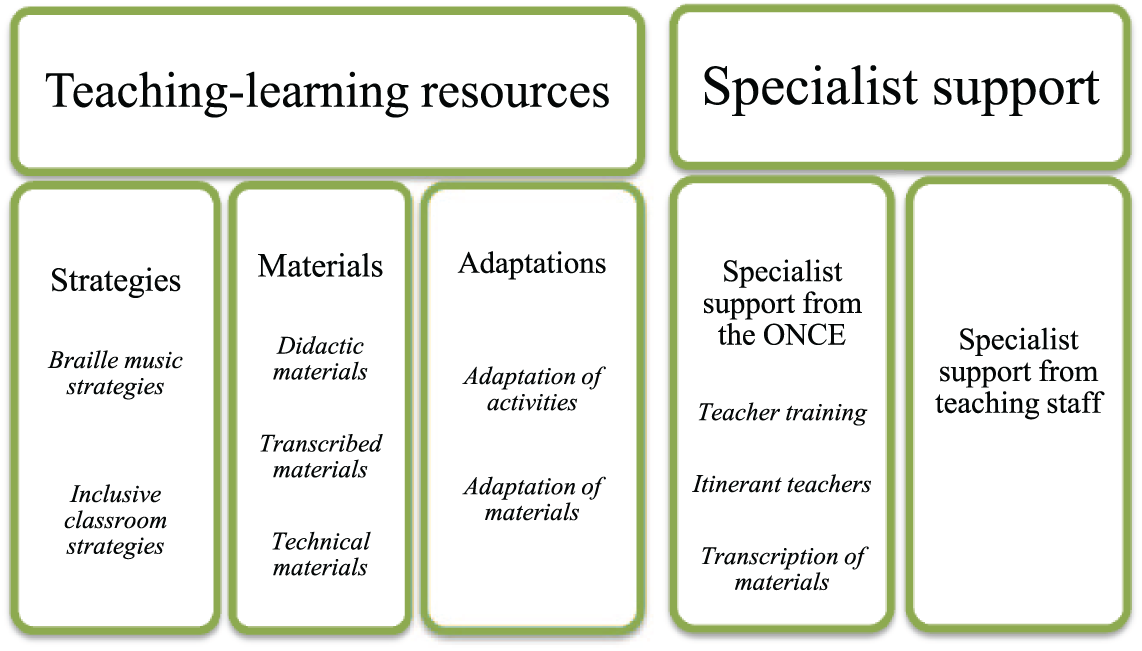
List of categories and subcategories of mayor themes: teaching–learning strategies and specialist support.
The two themes with their categories and respective subcategories, definition, and description are presented below.
Teaching-learning resources
According to the analysis of the interviews, the teaching–learning resources needed for the inclusive music education of visually impaired students consist of strategies, materials, and adaptations.
Strategies
Strategies are all those specific pedagogical actions taken in teaching–learning processes involving visually impaired students. They are based on the specific needs of visually impaired students in the music-learning environment. They are divided into Braille music teaching–learning strategies and inclusive classroom strategies.
In view of their specificity, students can use Braille music teaching–learning strategies outside the music classroom to incorporate music symbols into their learning process. According to the ONCE specialists, for the strategies to be effective, students must have a minimum knowledge and mastery of the Braille alphabet before beginning to learn Braille music. When teaching music symbols, it is advisable to work on the melodic and rhythmic aspects separately so that knowledge is built up gradually. The specialists also recommend learning the musical symbols in Braille directly, without relating them to the Braille alphabet (for example: Do = letter D, Re = letter E, etc.), in order to avoid mental rigidity and constant comparison with other symbols. At more advanced levels, given the complexity of the display of Braille notation, it is recommended that specific complementary signs such as legatos, dynamics, fingerings, and so on are presented progressively as the transcribed materials are introduced.
Inclusive classroom strategies refer to the guidelines that mainstream class teachers should take into account to facilitate the transmission of knowledge to visually impaired students. The main strategies are as follows: describe what is on the pentagram or on the board; use the audio-description; learn to use the language more specifically and precisely; replace gestural language with more explanatory language; and use the verbal information describing the movement. Furthermore, the teacher must explain things exactly as they are, use as many music resources as possible, and take into account the sequential analytical perception of blind people in order to present activities in a sequence accessible to everyone.
Materials
Materials are all the physical and technological tools used to support the teaching–learning process of visually impaired students in the music-learning environment. These materials vary and can be adapted to the student’s music level. They consist of didactic, transcribed, and technical materials.
Didactic materials are mainly used in general music classes as an adaptation of the content. They help students learn Braille music, whose acquisition can be divided into three different stages:
In the first stage, generally from 3–5 years old, the materials are usually manipulative and accompanied by movement; so in most cases, they turn out to be naturally inclusive and do not need any adaptation.
A second stage sees the use of tactile graphics representing the notes, the rhythms, the pentagram, and so on. The manipulation of these graphics is useful for understanding aspects concerned with the directionality of sound on the pentagram.
The third stage occurs when the student is considered ready. The transition is made from tactile graphics to Braille notation – from one type of tactile information to another – by presenting smaller and smaller graphics until achieving the intake of information through Braille notation. They are referred to as transcribed materials from this point on.
Transcribed materials are class materials transcribed to the Braille system. They are mostly scores in the case of music. Here, the ONCE plays an extremely important role, as it is responsible for transcribing all class materials and sheet music to Braille music. The interviewed student highlighted the importance of having a specialized organization such as the ONCE on hand for the transcription of all the written materials, notes, and scores, so that they are ready at the beginning of each course. Likewise, he highlighted the importance of the transcribed materials themselves because they promote autonomy and give the students an idea of what they have to do at any given moment without having to resort to outside help.
Technical materials consist of assistive technology used both in and outside the general music classroom. They contribute greatly to visually impaired students’ autonomy. In the case of the interviewees, the main assistive technology mentioned was the Perkins Brailler and computers running specialized Braille Music Editor 2 (BME) software. This application is usually used in conjunction with the Braille display and the JAWS screen reader.
Adaptations
Adaptations are all those actions that involve the preparation of materials, adaptation of methodologies, and adjustments to class activities. They are classified as adaptation of activities and adaptation of materials.
Any discussion of the adaptation of activities should make a distinction between activities that need adaptation and those that do not. According to the ONCE specialists:
The activities that do not need any adaptation are the more experiential, sensory ones, which usually involve singing and listening.
The activities that need adaptation are those that require a visual or written support, where a parallel mode of communication is essential to ensure the information reaches the student.
In some cases, as explained by the interviewed teacher, the adaptation of activities can be planned by getting other students to accompany the blind student, although she points out that it is important to make sure blind students do not become dependent on their classmates.
As regards the adaptation of materials, the materials needing adaptation are those that require special preparation and are used as visual support for information, as in the case of tactile graphics and the adaptation of transcribed materials (scores, class notes, textbooks, and so on). The use of tactile graphics is supervised by the specialized centre. The goal is to enable blind students to absorb information about the directionality of the sound by taking into account their tactile needs.
Transcribed materials include Braille music scores, class notes, textbooks, and other student materials. Transcribed materials are normally adapted by the ONCE, although the teacher in charge or the support teacher may also be involved in this task – as in the case of the interviewed teacher, who used BME software, Finale 3 and a Braille printer. In other cases, such as that of the interviewed student, the materials can be prepared by the students themselves with the help of someone who explains what information the materials contain.
According to the interviewed teacher and student, if enough time is available (approximately 3–4 months), the best option is to ask the support centre to adapt the transcribed materials. However, when materials have to be prepared on the fly (e.g., for band or choir studies), the interviewees indicated that they are obliged to transcribe the materials themselves.
Specialist support
According to the analysis of the interviews, the specialist support needed for the inclusive music education of visually impaired students is provided by the ONCE and the teaching staff.
Specialist support from the ONCE
This is all the support and help offered by this specialized organization for the purposes of music education, which includes teacher training and accompaniment, education and tracking of student needs, development of special class materials, supply of technical materials, and so on. In music education, the main support comes through teacher training, itinerant teachers, and the transcription of materials.
Primary school teacher training provided by the ONCE includes theoretical and experiential workshops to give teachers an idea of what to expect in the classroom. Training is usually imparted at the beginning of the school year and may be complemented by courses and pamphlets containing self-learning materials for teachers. There is also the possibility of contacting music specialists when the teachers need them. In this way, an attempt is made to guarantee that teachers have had adequate prior training when they are allocated blind students. In the case of the interviewed teacher, who worked at a music school, training was received during a couple of visits by the itinerant teacher and through self-learning pamphlets containing information on Braille notation.
Itinerant teachers are responsible for assisting blind students in school and making all the necessary adaptations. In the case of primary schools, each blind student is allocated a case teacher (or itinerant teacher) who visits the school once a week and sets the guidelines on how to work with the student. It is the itinerant teacher who decides when it is time to take the step from tactile graphics to Braille music. And when there is a specific demand, they act as a bridge between the music teachers and the ONCE specialists. Support may be given to the teacher alone, to the student alone, or to the teacher and the student together. All cases are coordinated with the respective itinerant teachers so that they know what the intervention by the specialists consists of and what is being planned. At music schools itinerant teachers provide a bridge when visually impaired students begin a course and serve as a reference for dealing with issues related specifically to contact with the students’ families.
The transcription of materials is the adaptation of materials to Braille music using specialized equipment and software. Transcription takes a considerable amount of time, so it should be requested some time in advance. According to the interviewed student, these materials comprise instrument scores, scores for being analysed theoretically, and music language textbooks.
Specialist support from teaching staff
This specialist support consists of all the help provided by music teachers in schools, music schools, conservatories, and private classes, usually available thanks to training by the ONCE.
If teachers are to play a supportive role, they should have training in Braille music, be in permanent contact with the specialized centre, transcribe and adapt materials for classes, and anticipate needs by requesting materials and resources in advance to plan the next step. The support teacher may or may not be part of a music education centre and should be seen as a figure playing a key role – although not as the sole person responsible for student inclusion.
Results II: relationships between categories
Having defined and conceptualized the categories and subcategories of the research on teaching–learning resources and specialist support, the relationships existing between them were studied. A conceptual map is presented below (Figure 2), which displays the direct and indirect connections between the categories. This map was drawn up to help understand the general context of what the inclusion of visually impaired students in the music classroom implies.
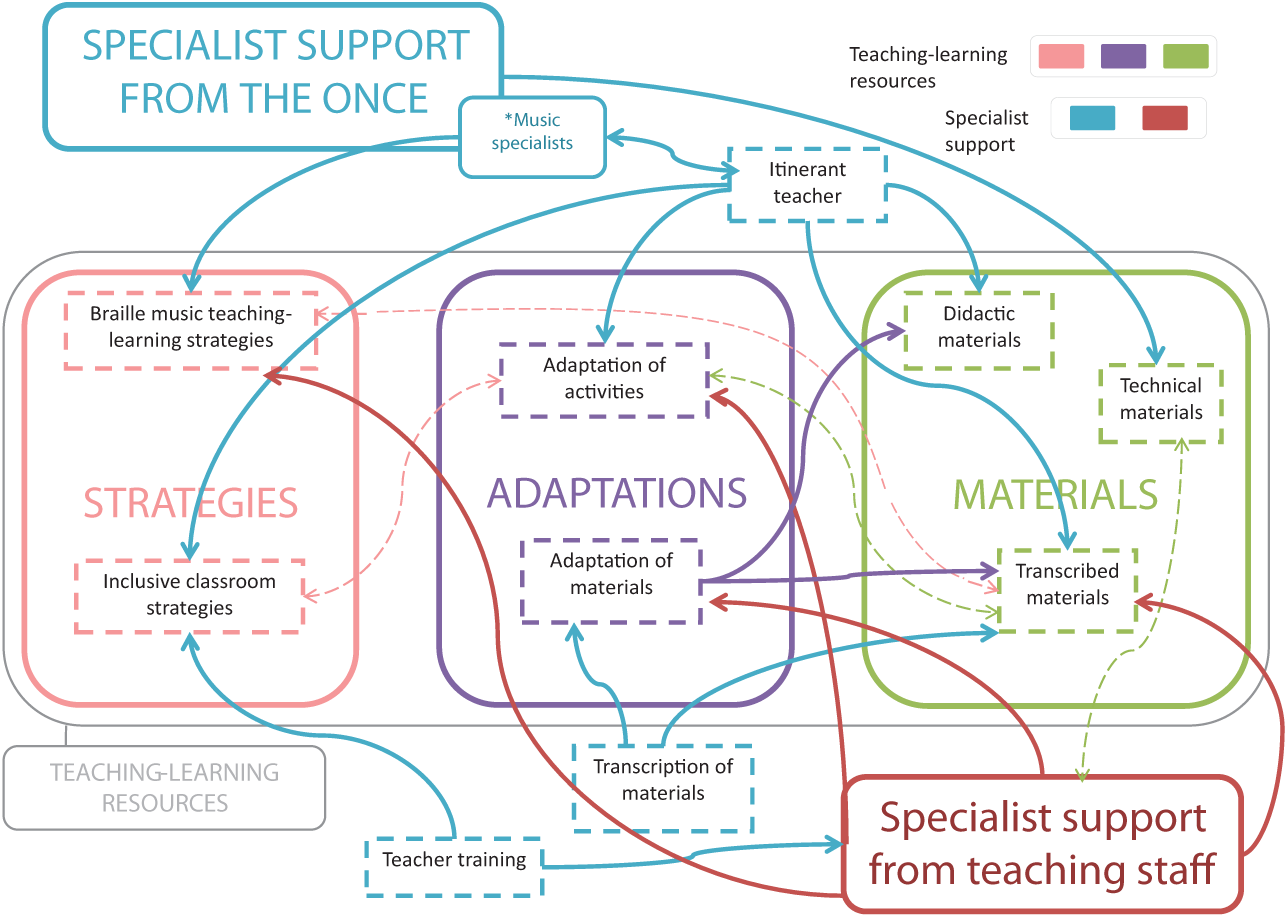
Relationships between the categories and subcategories of teaching-learning resources and specialist support.
Figure 2 shows how the three categories of teaching–learning resources (strategies, materials, and adaptations) are related jointly and directly with specialist support. In turn, the different kinds of specialist support are related to each other through the specialist support provided by the ONCE and the teachers. The unbroken lines indicate a direct relationship, that is, these are the cases where one category has a direct, unilateral influence over another. The broken lines indicate a complimentary or reciprocal relationship between categories.
The relationships between teaching–learning resources are mostly complementary or reciprocal, and they occur between Braille music teaching-learning strategies, transcribed materials, inclusive classroom strategies, and the adaptation of activities. This shows how the learning of Braille symbols is connected to the need for adaptation of the transcribed materials and the activities, in order to later accompany them with the appropriate strategies so that the information reaches the blind students. In this process, music teachers will have to clear up any doubts and order transcribed materials for the preparation of classes, which leads to a relationship with specialist support, provided either by a specialist centre or a support teacher.
There is also a direct relationship between the adaptation of materials, didactic materials, and transcribed materials, where two types of materials are an adaptation. The transcribed materials, that is, the Braille scores, the Braille class notes and the materials in text format (in Braille or in digital format) are an adaptation of the materials used in the classroom by visually impaired students. As regards, the didactic materials used by the teachers, the tactile graphics are also an adaptation of the materials. Itinerant teachers often act as mediators who ask the ONCE to adapt the didactic materials (tactile graphics) for use in the classroom, as part of the process of student accompaniment.
For the adaptation of activities and to collect information about inclusive classroom strategies, the support of itinerant teachers again proves useful, since through them, class teachers can communicate with the music specialists to clear up any doubts. Specialist support from teachers is also linked to the adaptation of activities and Braille music teaching–learning strategies, since as well as transcribing and adapting materials the support teacher’s duties include the adaptation of activities and teaching of Braille music to blind students. Braille music teaching–learning strategies are also linked to the specialist support provided by the ONCE because it is the music specialists who know best how to teach Braille music to visually impaired students.
As regards inclusive classroom strategies, the ONCE offers teacher training (especially at primary school level). This includes theoretical and experiential aspects that acquaint them with what to expect in the classroom. In the same way, the knowledge acquired through support teachers can be imparted in self-learning pamphlets prepared by the ONCE and containing technical information on Braille notation. Also, in cases where music teachers cannot be trained by the ONCE music specialists, information about general strategies to be applied in the classroom can also be provided by itinerant teachers.
Conclusion and discussion
This article is part of a larger body of research in which other important aspects of inclusion such as teacher training and student autonomy were explored from the standpoint of the general music classroom. Here, we have focussed on teaching–learning resources and specialist support in the field of music education, given the lack of scientific literature on the subject. Our findings are presented as themes, categories, and subcategories. These facilitate an understanding of the different elements involved and their relationships in favour of the inclusion in the classroom of visually impaired students.
Specifically, it may be affirmed that teaching–learning resources (strategies, adaptations, and materials) lie at the core of inclusive teaching in the music classroom in contexts where music notation is in use. The responsibility for inclusive music teaching lies with the teachers, as pointed out by Pearpoint and Marsha (2001), with the basic core of the student teaching–learning process developing in the general music classroom, regardless of the available support (in line with Puigdellívol, 2009). Likewise, teaching–learning resources are provided through the support coming from specialized centres and support teachers. They are offered to both teachers and visually impaired students. Support is always necessary, irrespective of the student’s degree of autonomy.
We have also seen how adaptations are essential to inclusive teaching because they are the resource that enables blind students to participate actively in the classroom (by adapting activities and/or materials). As described by Mata, Rodríguez, and Bolívar (2004), this research confirms that strategies used in combination with classroom activities and other teaching–learning resources promote the understanding of content and achieve the proposed goals. According to these authors, the adaptations are intended to specifically facilitate the learning process of students with special educational needs. For this reason, we agree with Onrubia (2009) in that adaptive teaching is the model that pays most attention to the goals of inclusive education because it ensures all students continue to learn together and share the same goals.
As regards to technical and transcribed materials, they also play a crucial role in inclusive music education, and it could be asserted that the autonomy of blind students is subject to the use of these materials. We can see that in some specific contexts such as classical music, the learning of Braille music is of vital importance for the students to fully understand musical theory and meet the demands required of musicians both inside and outside the classroom, as explained by Baker (2014). Observing the ONCE intervention, it can be said that it is thanks to the use of active technology and opportune access to scores and class materials that blind students can cope without having to resort to outside help. In this respect, we agree with Chaves (2013) and Park and Kim (2014) in that the mastery of Braille music is the starting point for the independence and autonomy of blind students, and with Egea (2008) in that autonomy is also possible thanks to the use of assistive technology. Ultimately, we agree with Baker and Green (2017) that quality music education would surely involve playing by ear as well as playing from a score, either if it is Braille music or any other adapted format.
In parallel, it is the responsibility of class group teachers to introduce the teaching–learning resources needed for the inclusion of blind students and they need a minimum of training to do so. As stated above, preparation of classes includes the planning of activities, strategies, and the provision of materials, adaptations, and supports needed to reach all the students in the class and make inclusion possible. In other words, teachers in charge of mainstream music classes must have a generic set of effective pedagogical strategies at their disposal and possess basic notions about how to cope with visual impairment (McDowell, 2010). This is particularly the case at music schools and conservatories, where it is necessary to prepare new music education materials and also didactic guides that orientate the teachers’ work in the classroom (Chaves, 2013; Ockelford, 2000).
On the same lines, we share York’s et al. (2001) ideas which affirm that the provision of support requires more than just a mastery of the discipline of music and that specialized knowledge is necessary. This research confirms the indispensable role played by specialized centres such as the ONCE, which provide support at various levels, from the adaptation of materials and strategies to teacher training, consultancy services, provision of technical materials, and student training.
Although we have paid special attention to Braille users (blind students) in the discussion of materials, given that the Braille system is ‘the most important factor distinguishing the musical education of a blind child from that one who can see’ (Ockelford, 1992, p. 7), the contributions made by this study are valid for the entire group of people with visual impairment.
Finally, it should be noted that this research aims to give added value to the study of inclusion from the perspective of what is needed in the music classroom. This approach paves the way for new lines of research that we think are essential for the proper inclusion of visually impaired students in the framework of music education and, ultimately, musical activity in general.
Footnotes
Appendix
Relationship between the key terms and the accessibility categories of the inclusive approach proposed by Sassaki (2005).
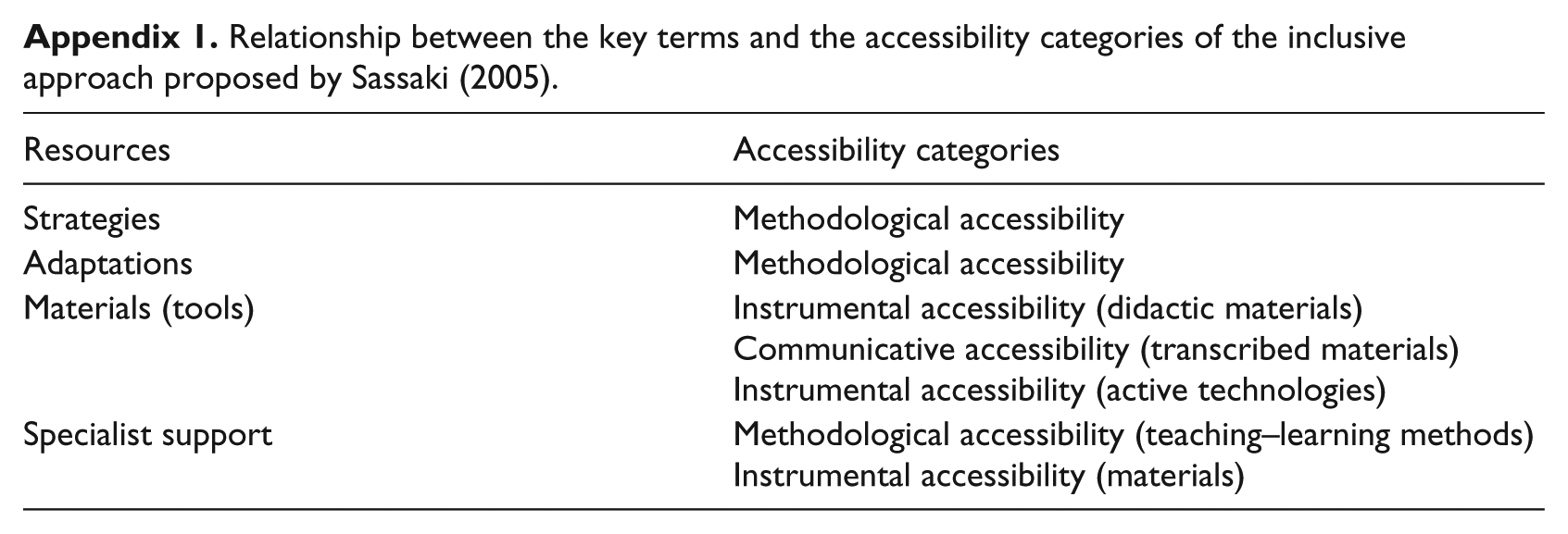
| Resources | Accessibility categories |
|---|---|
| Strategies | Methodological accessibility |
| Adaptations | Methodological accessibility |
| Materials (tools) | Instrumental accessibility (didactic materials) Communicative accessibility (transcribed materials) Instrumental accessibility (active technologies) |
| Specialist support | Methodological accessibility (teaching–learning methods) Instrumental accessibility (materials) |
Declaration of conflicting interests
The author(s) declared no potential conflicts of interest with respect to the research, authorship, and/or publication of this article.
Funding
The author(s) received no financial support for the research, authorship, and/or publication of this article.
