



Abstract
Braille reading is a very demanding active tactile process. Forefingers of both hands play a predominant role in braille reading, because the pulps are extremely sensitive in tactile exploration and recognition. The main objective of the present study was to investigate the potential effects of handedness on braille reading patterns during braille text reading. Thirty-two Greek students (from Grades 3 to 12) with visual impairments, who used systematically the braille code as a reading medium, participated in this study. Handedness was assessed through a modified version of the Edinburgh Handedness Inventory, while their reading level was estimated via a standardized test. In turn, participants read 18 texts, which were chosen randomly from their textbooks. Results indicated that handedness affected braille readers’ selected reading patterns during text reading. A variety of reading patterns were recorded and the selected data were correlated with tactile reading strategies in terms of dominant hands and fingers. It seems that readers who selected one-hand braille reading patterns performed significantly more errors with the index of their dominant hand, whereas those who chose to read with both hands faced more difficulties toward the effective collaboration of the indices of their hands. Finally, the findings of the present study are discussed in relation to educational practice, relevant theory, and subsequent research.
Introduction
Handedness in individuals with and without severe visual impairment or blindness
The study of handedness has been of interest for many years because it may be regarded as the most apparent reflection of lateralization of the central nervous system in humans (Guadalupe et al., 2014) as well as an alternative measure to define subtle cognitive and behavioral differences (Johnston et al., 2013). Hand preference and related cognitive functions are often considered to be derivatives rather than contributors to the hemispheric specialization (Michel et al., 2016). However, sensorimotor experiences can contribute to the functional organization of the brain (Casasanto, 2009). During the past years, most studies stressed mainly the importance of direction of handedness in sighted individuals (Niebauer et al., 2004). Nevertheless, Christman and Prichard (2016) proposed the shift of interest from left- versus right-handedness to consistent- versus inconsistent-handedness, to better comprehend the behavioral and physiological differences of humans. For example, inconsistent-handedness was associated with increased cognitive flexibility and openness to environmental feedback, while consistent-handedness was related to the increased stability of perceptions (Prichard et al., 2013). On the contrary, children with consistent early hand preferences by the end of year two are more likely to exhibit advanced cognitive development compared with children who indicate a hand preference later in life (Michel et al., 2016). Such contradictory findings and therefore contradictory positions regarding direction and degree of handedness in terms of cognitive variables (e.g., stability of perceptions, cognitive flexibility) indicate the necessity to conduct further research using a variety of protocols to grasp a better understanding of the behavioral and physiological differences of humans pertinent to handedness and its impact on cognition.
Research concerning the handedness in individuals with blindness is very limited. The direction of hand preference is initially evident by the age of three among sighted children (McManus et al., 1988), while there are no such indications among blind children (Ittyerah, 1993). The degree of handedness increases from 3 to 7 years and is stabilized by the age of eight for both sighted (McManus et al., 1988) and blind children (Ittyerah, 1993, 2000) A recent research study investigated the handedness of 82 participants who were totally blind and revealed the prevalence of moderate right-handedness and concluded that the degree of vision loss did not affect the choice of the preferred hand but the degree of handedness (Argyropoulos et al., 2014). Furthermore, two studies examined potential correlations between blindness (i.e., total loss of sight) and left-handedness with contradictory results. On one hand, Caliskan and Dane (2009) found that left-handedness was significantly more prevalent in blind compared with sighted children due to the hypothesis of neural network reorganization. According to this hypothesis, the brain may have the ability to reorganize or modify its networks after the onset of visual impairments (VI) because of a capacity known as “plasticity” (Voss, 2013). On the other hand, Ittyerah (2000) found that the degree and direction of handedness did not differ fundamentally in blind and sighted children, despite their differences in sensory experiences, which means that vision would not constitute a strong determinant of direction and degree of handedness. It seems that the variables degree and direction of handedness as well as degree of vision loss are influenced by a set of confounding factors − such as cultural factors − causing a spurious association, for this more research is needed into this direction (Pearl, 2009).
The Greek braille code
The braille code is a tactile system of raised dots that enables individuals with VI to access information through touch. Its fundamental element is the braille cell, which consists of six raised dots distributed into the scheme of two columns and three rows. Word reading in Greek language is mainly based on graphophonemic correspondence, although there are some inconsistencies (Vakali & Evans, 2007). In essence, Greek language is sufficiently transparent to allow complete sequential correspondences between graphemes and phonemes (Protopapas & Vlahou, 2009). As a result, Greek students implement the alphabetic reading strategy effectively at their first school years (Porpodas, 2002). Respectively, the Greek braille code is regarded uncontracted because it mainly depends on a one-to-one correspondence between print letter and braille character (Argyropoulos & Papadimitriou, 2015). In particular, the Greek braille code consists of 63 distinct dot patterns (i.e., alphabet letters, numeral and capital indicators, punctuation marks). Eight of those dot patterns are called diphthongs and combine two vowels in one. Accent is not used in the Greek braille system.
Braille reading
Braille reading is related to the sense of touch as well as to the somatosensory system of the brain including the thalamus, the primary, and the secondary somatosensory cortexes (Debowska et al., 2016), while it activates the occipital and basal temporal occipital brain areas with particular importance of the primary visual cortex (Beisteiner et al., 2015). In general, it has been reported that the same reading network which is active through vision is still recruited when reading through other senses (Sigalov et al., 2016). For instance, when it comes to verbal exercises, a brain area, called the visual word form area, seems to be activated in a similar way for sighted and congenitally blind braille readers (Cecchetti et al., 2016) as well as for sighted subjects during braille reading (Bola et al., 2016). The establishment and maintenance of such procedures evolves over time both in individuals with partial or total loss of sight (Millar, 1997; Sabbah et al., 2016).
Tactile reading is a complex activity which combines the activation and collaboration of both the right and left hemispheres of the brain. For example, the left side of the brain tends to influence significantly many aspects of language and logic, whereas the right side tends to handle spatial information and leads to the development of spatial skills (Gainotti, 2014). Braille readers decode each braille character individually using their fingertips with the assistance of specific neurons, such as the endings of the Merkel cells in the skin (Hughes, 2011). In turn, braille readers extract the meaning of the word and they ultimately link the hand movements with perceptual and linguistic processes of reading, to transform spatial into meaningful information (Wei et al., 2014). For example, a braille reader decodes dots 2 and 4 through their fingertip(s). With the assistance of the perceptual and linguistic process of reading, dots 2 and 4 are transformed to the meaningful braille character “i.” Nonetheless, the interaction between hand movements and perceptual and linguistic processes of reading is not yet fully understood (Hughes, 2011).
Braille reading accuracy
Braille reading accuracy relies mainly on systematic, active, exploratory movements rather than passive perception (Millar, 1997). It is highly related to phonological awareness (Gillon & Young, 2002), verbal working memory (Argyropoulos et al., 2017; Papastergiou & Pappas, 2019), as well as the correct identification of the relative spatial position of the braille dots (Dodd & Conn, 2000). Braille readers are usually error prone due to (a) the nature of the braille code which results in a high degree of similarity among the braille characters (Millar, 1997); (b) the inability of students to practice braille reading in their free time (Vakali & Evans, 2007); and (c) the lower resolution of tactile processing, which demands a conscious effort to maintain braille accuracy (Veispak et al., 2012).
Braille reading patterns
Reading patterns affect the rate and the amount of successive tactile input, which loads short-term memory (Millar, 1997). Four braille reading patterns seem to be apparent in the Greek braille code: (a) reading with the right hand solely (first pattern), (b) reading with the left hand only (second pattern), (c) reading with simultaneous usage of both hands, in which the left forefinger is flat, whereas the right forefinger precedes (third pattern), and (d) reading with both hands, when hands act independently (fourth pattern) (Papadimitriou & Argyropoulos, 2017; Papadopoulos, 2005). There is not enough evidence regarding the option of the best reading pattern because it depends heavily on the individual needs and preferences. However, several studies have deduced that the parallel reading (fourth model) is the most efficient, because one hand receives verbal information while the other one at the same time deals with spatial attributes (Davidson et al., 1992; Mousty & Bertelson, 1992; Wormsley, 1996; Wright et al., 2009). A very common reading procedure is the following: the left forefinger starts to read until it meets the right forefinger approximately at the middle of the braille line. At that point, both forefingers go along for a while. Then the right forefinger takes charge of decoding until the end of the line, while the left moves to find out the beginning of the next line (Lorimer, 2002). Nevertheless, two very recent studies indicated that the one-handed pattern may be equally or even more efficient than the parallel reading. More specifically, young Greek braille readers performed better with the left hand only (Papadimitriou & Argyropoulos, 2017). Similarly, Chinese braille readers performed better with one-handed patterns due to the prevalence of a teaching method which demands reading with one hand and writing with the other (Chen et al., 2019).
Only one study has investigated the effect of handedness on braille reading patterns (Wright, 2009). Wright recorded and studied braille reading patterns of 35 primary students and correlated them with handedness. In the end, she did not find any correlation between those two variables and deduced that braille readers are apt to adopt the braille reading pattern, which is best suited to them when reading. Nevertheless, the researcher pointed out that she did not assess students’ hand preference through a formal test nor did she control the selected passages with regard to the students’ reading levels.
Researchers of the present study examined the validity of the hypothesis that blind participants’ handedness does not affect the selected braille reading patterns during their reading. To ensure the validity of the outcomes, the researchers primarily (a) assessed handedness of the students with VI through a modified research tool and (b) estimated the students’ reading levels to choose appropriate texts (i.e., equivalent to their reading level).
Method
Participants
The present study was approved by the ethics committee of the Greek Ministry of Education and Religion Affairs and in turn the researchers granted approval by the participants’ parents. The vast majority of students with VI were enrolled in schools (special or integrated educational settings) which were located in Athens, Thessaloniki, and Crete. As a result, the researchers invited students from these educational settings to take part in the present study (convenience sampling) (Cohen et al., 2002). Thirty-two braille readers (18 females and 14 males) with blindness but no additional disabilities participated. The mean age was 14.2 years with a standard deviation of 3.3 years and the age range was from 8 to 21-year old. The participant who was 21-year old reported that he was a long time off school due to severe health problems. Eighteen (56.2%) attended secondary education, while the rest were enrolled in primary education. Twenty participants (62.5%) were congenitally blind (i.e., blindness was present from birth) and 12 (37.5%) were adventitiously blind (i.e., blindness was acquired later in life). The mean age of vision loss of the students who were adventitiously blind was 5.1-year old with a standard deviation of 2.8 years. Furthermore, 21 could not perceive at all visual stimuli (65.6%) and 11 had severe VI (34.4%). Finally, eight (25%) read solely with the right hand (first braille reading pattern), six (18.8%) with the left hand (second braille reading pattern), 10 (31.2%) preferred reading with simultaneous usage of both hands, in which the left index is flat whereas the right index precedes (third braille reading pattern), while eight (25%) selected reading with both hands, when hands act independently (fourth braille reading pattern). Participants were classified to the aforementioned subgroups according to their haptic reading activity and the adopted reading patterns. Namely, in case participants implemented one certain braille reading pattern for more than 90% of their haptic reading activity, then this specific pattern was considered to be the dominant reading pattern for them. Table 1 presents the distribution of participants based on gender, age, educational level, age of vision loss, level of vision loss (blindness or severe VI), and braille reading patterns.
Demographic characteristics of the participants (individuals − % distribution).
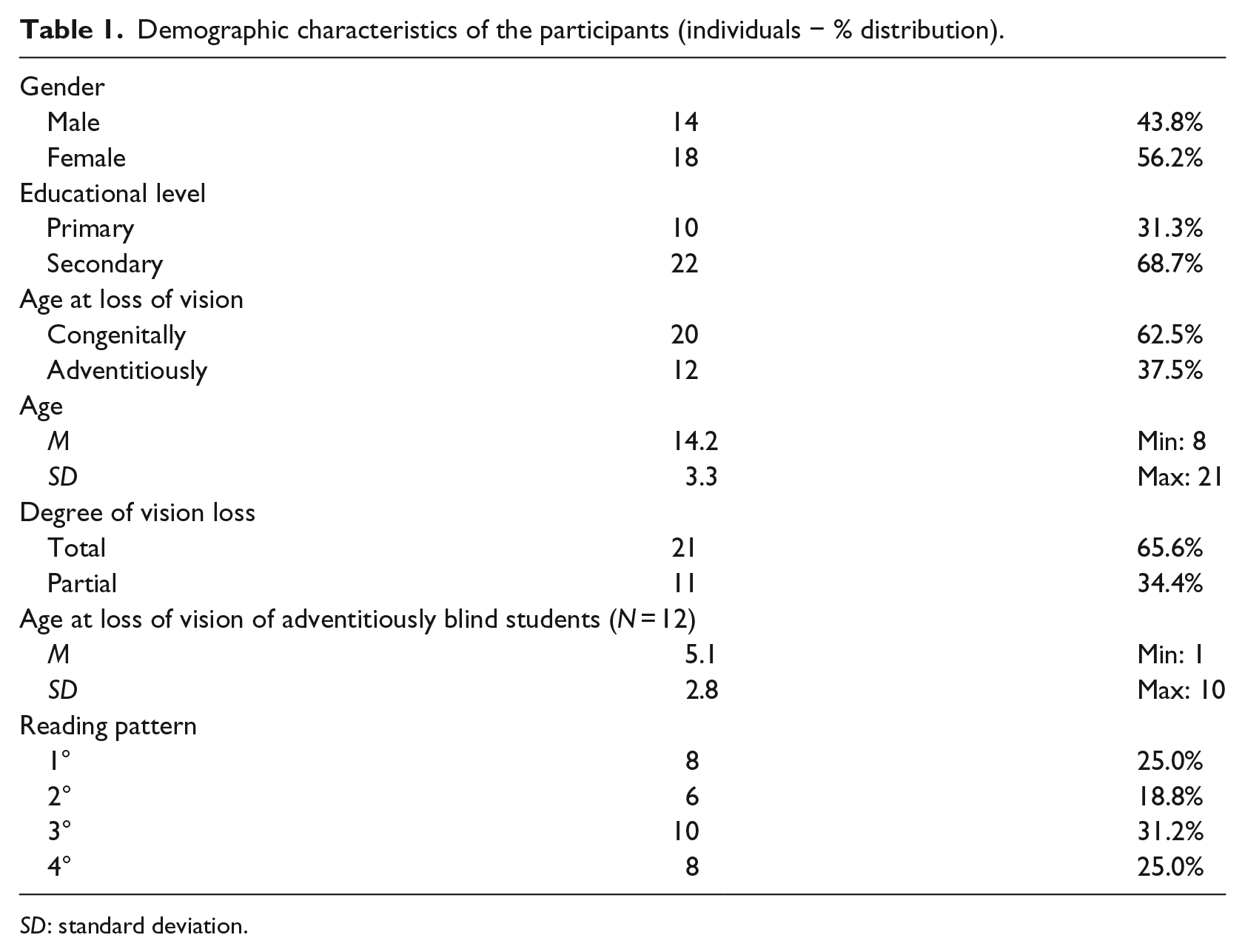
SD: standard deviation.
Research design and Instruments
The researchers first assessed participants’ handedness according to the 15 items of the modified Edinburgh Handedness Inventory (EHI; Argyropoulos et al., 2014), which focus on various unimanual tasks and assess the preference of a person’s right or left hand in everyday activities on a 5-point rating scale (–2 for always left to +2 for always right with the mid response [i.e., 0] indicating no preference). This instrument encompasses six unimanual tasks from the EHI (Oldfield, 1971; e.g., use knife), four from the Waterloo Handedness Questionnaire (Bryden, 1977; Bryden & Steenhuis, 1991; e.g., lift light objects), while the rest tasks were slightly modified to best conform to the everyday activities of the individuals with VI. For instance, tasks pertinent to writing with a pen or drawing which were incompatible for this population were substituted by very familiar activities such as “holding a cane.” The validity of the modified scale was tested through a series of confirmatory factor analysis coupled with the item response theory (i.e., Rasch model) and a simulation process run with 500 replications (i.e., Monte-Carlo simulation; Argyropoulos et al., 2014).
A laterality quotient (LQ) was calculated for each participant, adding the sum of “Left-Hand” (LH) responses (–2 and −1) and the sum (S) of “Right-Hand” (RH) responses (+2 and +1). This sum was divided by the total number (N) of the responses (R), and the result was multiplied by 100, according to the following formula

The LQ of each participant resulted in a score ranging from −100 to +100, where −100 indicated pure left-handedness and +100 indicated pure right-handedness.
In turn, the authors evaluated the reading accuracy level of the participants via the first three subscales of the standardized test-A (Instrument 2) which assesses the reading ability of students who are in the third grade up to the 12th grade (Padeliadu & Antoniou, 2008). The researchers transcribed the test-A into the uncontracted Greek braille code because the original form of the test was addressed to sighted students. The first subscale consists of 24 pseudowords (e.g., δαταβα). The second subscale estimates the ability to decode 53 meaningful words (e.g., ρύζι = rice; Padeliadu & Antoniou, 2008). In comparison with the ballistic saccadic movements activated during print reading (Marcet et al., 2016), when reading braille, the fingers move across the text from left to right, character by character, thus braille readers are likely to try harder to decode fluently compared with their sighted peers (Simòn & Huertas, 1998). In the third subscale, students were asked to discriminate 20 meaningful words in a set of a mixed up meaningful and non-meaningful words (36 in total). Researchers assessed not only the contribution of semantics to braille decoding, but also children’s reading strategies during decoding (Padeliadu & Antoniou, 2008; Vakali & Evans, 2007). The level of difficulty gradually increased in all three exercises.
The researchers wrote down the answers in an answer sheet. Correct answers were marked with 1, while wrong or no answers were marked with 0. Afterwards, the researchers calculated the sum of the student’s performance in the three subscales of decoding and found the “equivalent grade” from the “Equivalence Grade Table.” The “equivalent grade” depended on the decoding performance of the students by grade and gender compared with the general population (Padeliadu & Antoniou, 2008).
The following step was to create 18 texts according to the participants “equivalent grade” (Instrument 3). The Greek Institute of Educational Policy is in charge for the design of the curriculum and the production of the school textbooks according to some norms related to the skills which students are expected to acquire and develop during their growth. Consequently, the researchers selected extracts which were equivalent to their age according to the national curriculum. Texts were written in braille via a Perkins brailler upon plastic transparent sheets of A4 size. Transparent plastic was appropriate to videotape underneath participants’ fingers during braille reading, while it has been reported that plastic does not influence the slipping ability of the reading indices (Darden & Schwartz, 2015).
The researchers videotaped the procedure with the contribution of a special construction made of transparent and durable plexiglass, which was developed to make shootings underneath participants’ fingertips. Its dimensional size was 40 × 40 cm, 4 mm thick and it was placed on two parallel wooden slats 70 cm long. These slats were placed between the edges of a desk and were stable by the use of two metal holders. In turn, a black sheet was placed above this construction to help video recording by diminishing all light reflections. The black sheet did not affect the participants’ hand movements during the braille-reading task, because it rested on the top of the two holders. Afterwards, the transparent plastic sheets, which enclosed the embossed braille texts, were placed in order in the center of the plexiglass and remained stable using Scotch tape. Hence, participants performed braille reading undisturbed. This procedure as well as the following careful analyses of the video frames facilitated the resolution of the hand movements, which cannot be always analyzed with naked eye (Hughes, 2011), especially upon characters that were not decoded correctly.
The camera, which performed the shootings, was a Canon XA10 HD with a resolution of 1920 × 1080 pixels and it was placed at the bottom perpendicular to the plexiglass. A supplementary single luminaire of 150 W shed light on hands as well as on the embossed text, to better record which hand and finger performed the errors as well as which braille reading pattern was chosen during braille reading. Researchers also placed a microphone on the participants’ blouse to transcribe their reading at ease. Finally, the researchers connected the camera with a laptop screen to ensure that the image and sound were received properly (Figure 1).
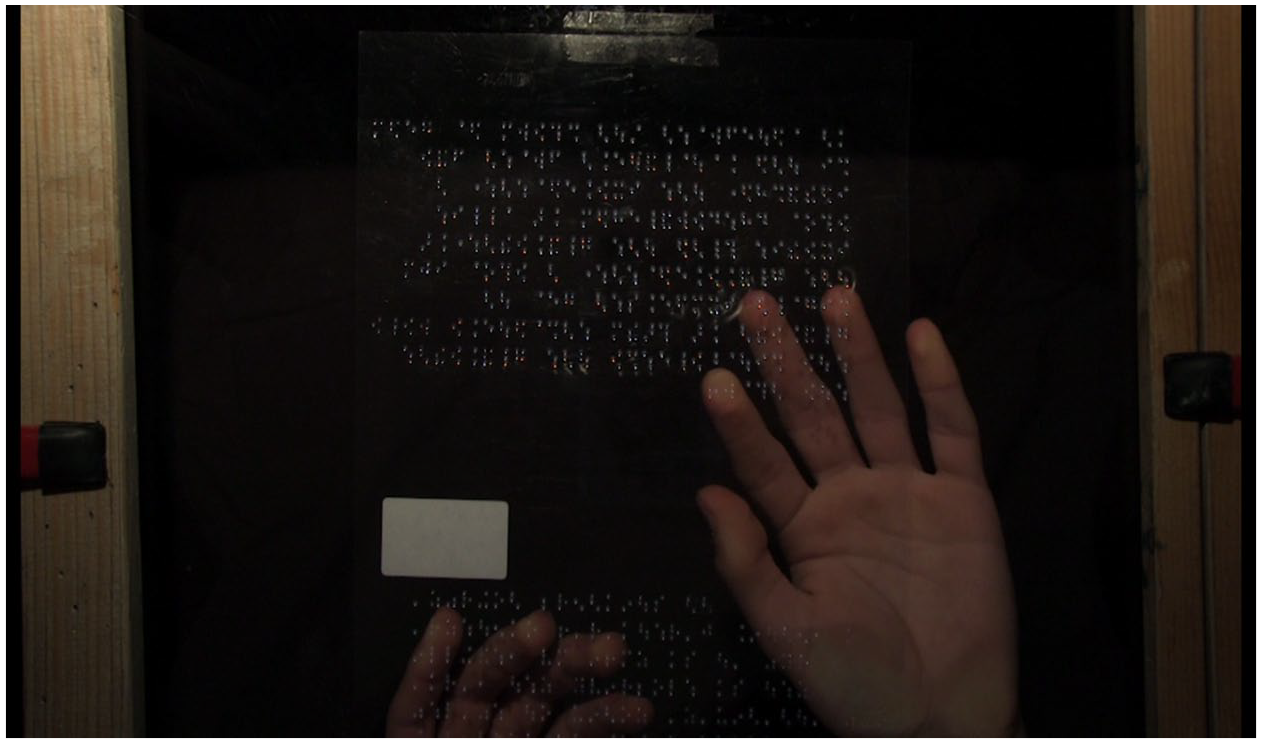
Recording underneath the hand movements of the participants.
Research procedure
After the assessment of handedness and the classification of the students according to their reading level, the participants were asked to complete the last task. First, they were invited to sit in a chair in front of the plexiglass construction. Then, they were informed for the research purpose and they were urged to ask questions regarding the research procedure of the text reading task. When there were no more questions, the experimental procedure began by reading a plastic embossed braille sheet containing the phrase: “I want you to read the following lines,” to ensure that there were no technical problems. Participants had 45 minutes at their disposal to read as many texts as possible. The texts were selected and administered to the students according to their equivalent grade, as mentioned above in the research design. For example, if the decoding score of a seventh-grade student corresponded to the level of a fifth-grade student, then the student began to read from the fifth-grade text onwards.
Once a student had finished reading a braille text, the researchers replaced the braille plastic transparent sheet with another one. Most of the participants completed the task in time. After collecting the audiovisual material, finger movements were analyzed through the Avid Media Composer editing program.
Results
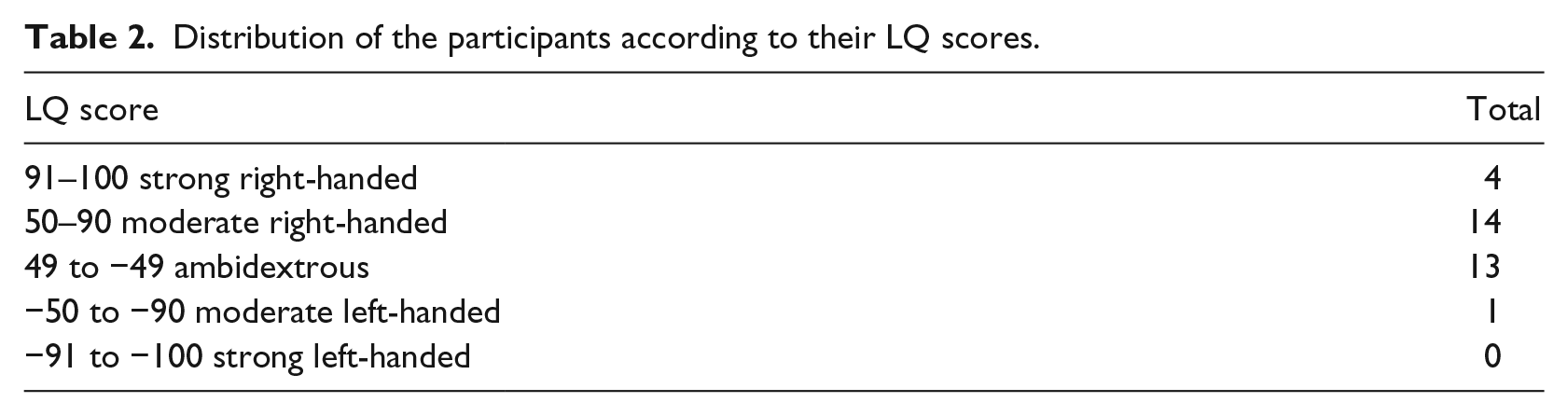
Researchers assessed the handedness performance of the 32 participants. The sample was initially divided into five groups: pure left-handed (NPLH = 0, −100 < LQ < –91), moderate left-handed (NMLH = 1, −90 < LQ < –50), ambidextrous (NA = 13, (–49 < LQ < 49), moderate right-handed (NMRH = 14, 50 < LQ < 90), and pure right-handed (NPRH = 4, 91 < LQ < 100). Table 2 and Figure 2 present the distribution of the handedness performance of the participants.
Distribution of the participants according to their LQ scores.
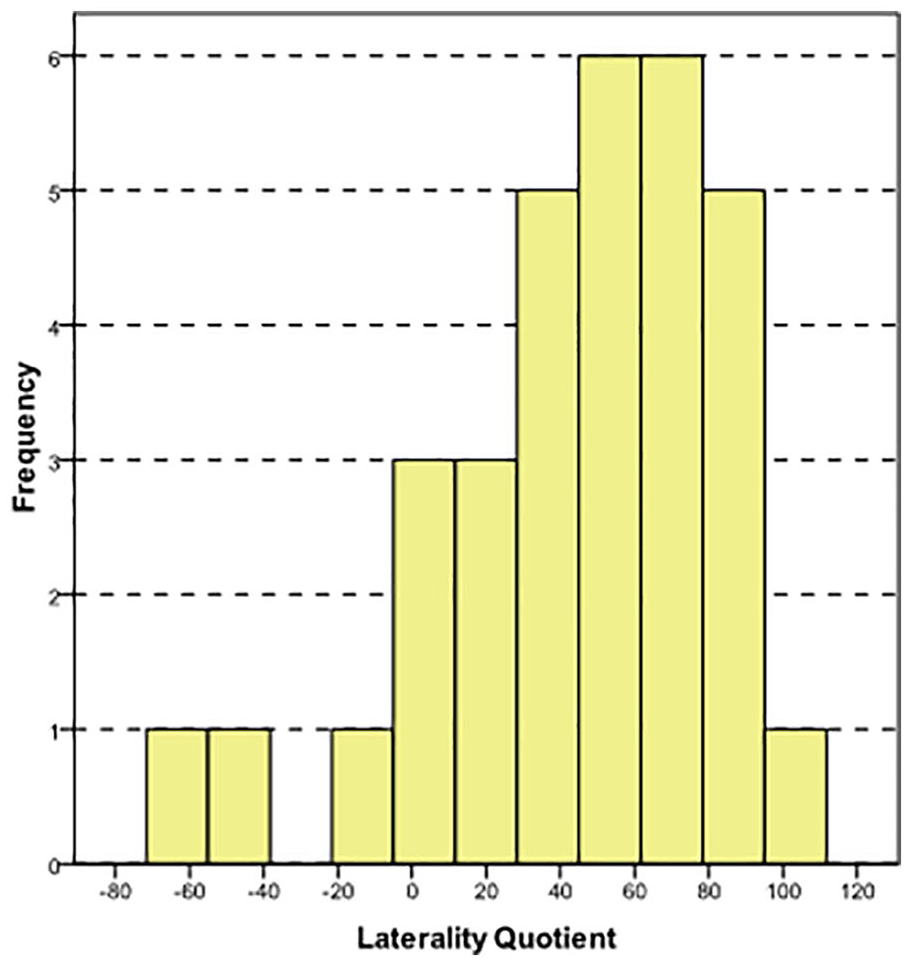
Distribution of the participants according to their LQ.
However, participants were finally classified in two groups as right-handed (+50 < LQ < +100) and non-right-handed (+49 < LQ < –100) because of the small sample. Consequently, 18 participants were regarded right-handed (56.2%) and 14 non-right-handed (43.2%). Of the 14 non-right-handed, one was estimated as moderate left-handed and the rest 13 mixed-handed.
Table 3 presents the distribution of the number of errors performed by the forefingers in correlation with handedness and braille reading patterns during braille reading.
Distribution of errors performed by the forefingers in correlation with handedness and braille reading patterns.
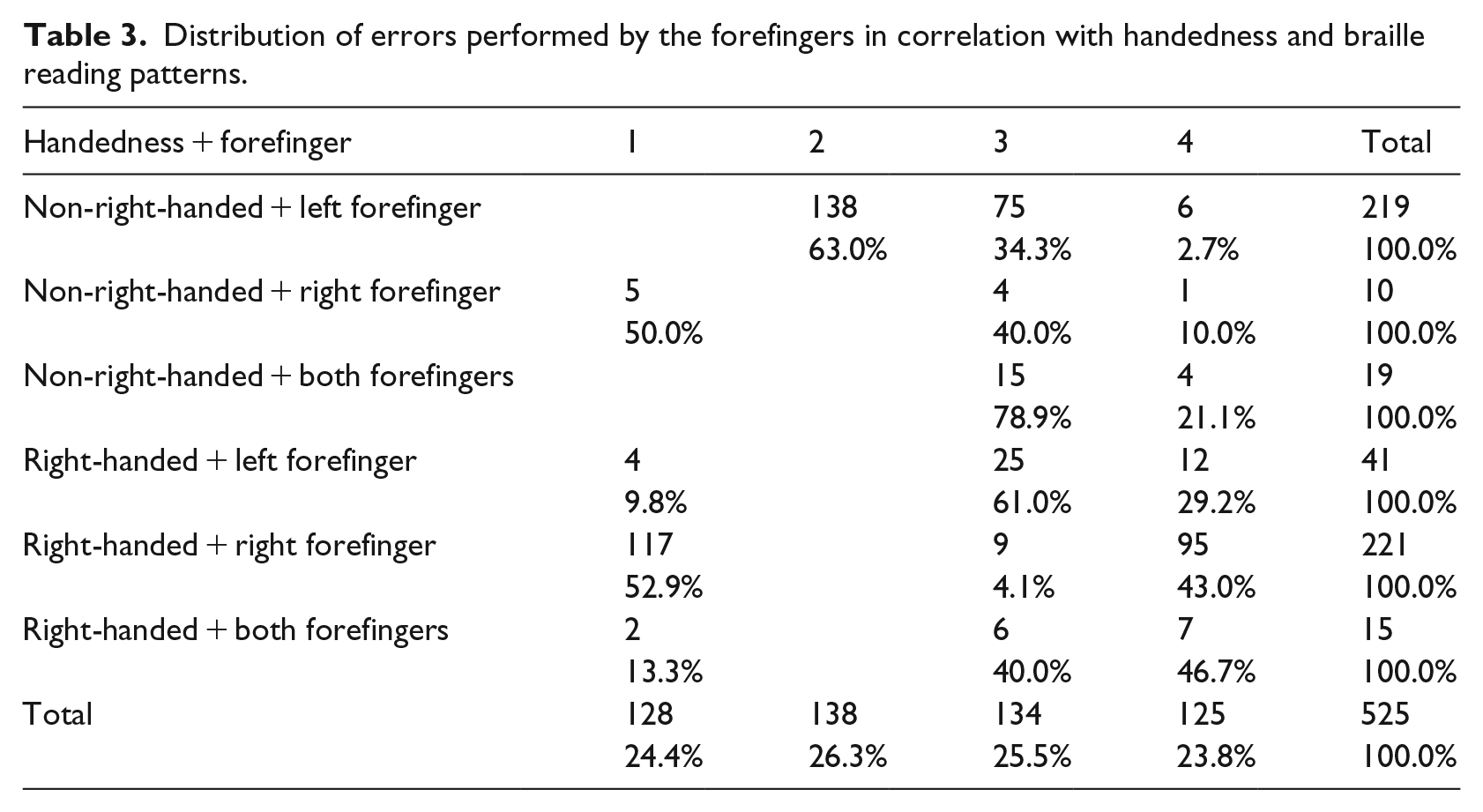
Chi-square criterion indicated statistically significant differences (χ2(15) = 501.3, p < .001), as shown in Table 3. The most intriguing differences referred to errors performed by (a) the right forefinger of the non-right-handed (50.0%) and the right-handed (52.9%) who preferred to use the first braille reading pattern (i.e., reading exclusively with the right hand), (b) the left forefinger of the non-right-handed (63.00%) who preferred to use the second braille reading pattern (i.e., reading exclusively with the left hand), and (c) the left forefinger of the right-handed (61.0%), the right forefinger of the non-right-handed (40.0%), as well as both forefingers of the right- (40%) and non-right-handed (78.9%) who adopted the third braille-reading pattern (i.e., reading with simultaneous usage of both hands in a collaborative scheme). Finally, right-handed participants who applied the fourth braille-reading pattern performed statistically significant number of errors with both forefingers (46.7%) as well as with the right forefinger (43.0%).
Discussion
The present study investigated the statement that handedness would not affect participants’ reading performance during braille text reading. Compared with a former similar study (Wright, 2009), this research is innovative because handedness of people with VI was assessed via a suitably modified research tool (Argyropoulos et al., 2014), while blind participants’ forefingers were video recorded underneath via a special construction, to draw valid inferences. Another novel element is that the researchers estimated the participants’ reading level via a standardized research tool (Padeliadu & Antoniou, 2008), to classify them to their equivalent grade before braille text reading.
Handedness and forefingers which were “responsible for errors” were correlated with braille reading patterns. Both right- and non-right-handed students who preferred the first reading pattern (i.e., reading with the right hand solely) performed a statistically significant number of errors with the right forefinger, as expected, which was attributed to the loss of the necessary tactile sensitivity of the overused right forefinger. Moreover, the non-right-handed who preferred the second reading pattern (i.e., reading with the left hand only) performed statistically significant number of errors with the left forefinger due to the gradual loss of the tactile sensitivity of the dominant forefinger. They also seemed not to benefit from the fact that brain perceives braille characters as spatial objects, which are analyzed by the right hemisphere that corresponds to the left hand (Choraghe & Pillai, 2015). This may be attributed to the fact that the non-right-handed group consisted of both ambidextrous and left-handed.
As for the third reading pattern (i.e., reading with simultaneous usage of both hands, in which the left forefinger is flat, whereas the right forefinger proceeds), most errors were performed by non-right-handed with both forefingers and right-handed with the left forefinger finger. Second, significant amount of errors were performed by the right-handed with both forefingers simultaneously and non-right-handed with the right forefinger. Right-handed and non-right-handed who preferred to use the third braille-reading pattern were expected to perform statistically significant number of errors with both forefingers, because forefingers read the text very close to each other. This may have resulted from the fact that fingers had not shared out distinct roles and functions, as Millar (1997) suggested. Consequently, regardless of handedness the attempt to decode a braille character with both forefingers simultaneously was unsuccessful, since the size of a braille cell is covered by one finger (Goldberg & Swan, 2011). Moreover, right-handed who preferred to use the third reading pattern performed more errors with the left forefinger, because the left forefinger seemed that had adopted the role to escort the leading right forefinger instead of confirming or checking effectively what it was just read by the preceding right forefinger (Lorimer, 2002). In contrast, non-right-handed made a significant number of errors with the leading right forefinger, which seemed unable to manage the increased workload regarding the decoding process (i.e., great number of braille characters).
The right-handed participants who elaborated the fourth braille-reading pattern (i.e., reading with both hands, when hands act independently) made more errors with the right forefinger and both forefingers as well. The previous finding which involved both forefingers indicated that it was difficult for the participants to keep them together till the end of the braille line. Usually, both forefingers were processing the text together on the same line until the middle of the braille line where the left forefinger started to process text on the line ahead, while the right forefinger was finishing the previous line. Since this reading pattern requires perfect collaboration and synchronization between the forefingers, it may be argued that the participants who had adopted this specific reading pattern had not reached that level of excellence and they were very often confused regarding the decoding process (Goldberg & Swan, 2011). Right-handed who selected the fourth reading pattern also performed a significant number of errors with the right forefinger, which indicated difficulties in decoding the second half of the text because the right forefinger was affected by the rotation/alternation of the forefingers in the middle of the line. An alternative explanation is that they had focused their attention on the smooth transition to the next line instead of decoding till the end of the line.
Conclusion
To sum up, it seems that certain subgroups across all reading patterns were affected by handedness, which means that handedness may not always be a negligible parameter during a text-reading task, as it has been supported before (Wright, 2009). At the same time, the present study pointed out that reading with both hands does not necessarily lead to an improved reading fluency or accuracy. Based on this outcome, it may be argued, that blind students who read and write through braille, may be encouraged to select those braille reading patterns which best suit their needs, to read as accurately as possible. Perhaps some interventions or recommendations may be appropriate during their reading process. For example, if the students choose one-handed reading patterns (i.e., reading solely with the right or the left index, respectively) and the reading hand is the preferred hand, then it would be reasonable to have short breaks during their text reading. In this way, the index of the dominant hand which constantly reads, will keep its tactile acuity in recognizing the braille characters.
In addition, those who selected the two-handed braille-reading patterns, especially the fourth reading pattern (i.e., independent use of both hands in braille reading), were found to read ineffectively regardless of the dominant hand. This result contradicted past research studies, which claimed that the fourth reading pattern is the most effective (Davidson et al., 1992; Millar, 1997; Wright et al., 2009). Perhaps in this case, braille readers who selected synergistic reading patterns need to practice more and equally both indices (i.e., of the dominant hand as well as of the non-dominant hand) through intensive instruction.
Limitations
The main limitation in this research was the small sample size, which prevented a clear association between handedness and braille reading. The initial intention of the researchers was to classify the participants into five handedness groups (pure left-handed, moderate left-handed, ambidextrous, moderate right-handed, and pure right-handed), but the limited sample unavoidably led us to the decision to classify the respondents in two wide groups as right-handed and non-right-handed. Therefore, there is need to conduct the same research study in larger samples to determine the generalizability of the findings for more specific handedness categories. Dividing samples because of the degree/strength of preference toward the variable “dominant hand” often has more predictive power than direction of handedness in many domains (Prichard et al., 2013). An alternative way of splitting the sample into subgroups, especially when the sample is small, may be ambidextrous versus left- and right-handed braille readers. In addition, it would be very interesting to compare the effects of handedness on both uncontracted and contracted (i.e., groups of letters may be combined into a single braille cell) braille. The investigation of this correlation in a large sample of braille readers is likely to give a more informative answer to the contradictory results that exist for the time being. Finally, future research could investigate the effect of handedness on other equally significant aspects of braille reading (i.e., fluency, comprehension).
