



Abstract
The present study aimed to investigate the extent to which audio description contributes to the visually impaired individuals’ comprehension of a film by examining the visually impaired and sighted participants’ comprehension of two versions of the same film, one with and the other without supplementary audio description. The results of the study showed that the visually impaired participants were able to comprehend and narrate the events to the same extent as the sighted participants did when the film was supplemented with audio description. The qualitative analysis validated this finding and demonstrated that the visually impaired participants were able to comprehend the film to a great extent with the assistance of audio description. These findings emphasized the role of audio description assistance and its effects as an important resource in converting visual information to vocal information, which greatly aids the visually impaired individuals’ film comprehension. Also, the use of “Causal Network Model” showed that understanding the plot better could enable the audio description creators to provide better assistance for the visually impaired if they applied this model.
Introduction
Visual impairment is a disability that constrains individuals with visually impairment ability in accessing the world in the way sighted individuals do. This means that visually impaired (VI) individuals do not have the advantages of visual input that enables easy access to not only linguistic but also nonlinguistic information. This nonlinguistic information provides additional information in the form of gestures, body movement, posture, eye contact, and such, therefore being unavailable to the VI as input.
Visual impairment has been widely studied in the field of physiology of the VI (Cattaneo & Vecchi, 2011; Roeser et al., 2000; Röder & Rösler, 2004). However, the development and use of language of VI individuals, as one of the essential impacts of visual impairment, has been a relatively less examined topic (Andersen et al., 1984, 1993). Overall, the available studies demonstrated that the language development of VI individuals differs from that of the sighted. To illustrate, Kayler (1983) compared the development and use of language of blind and sighted children relying on observational and naturalistic data. The overall results demonstrated that the VI can become as skilled communicators as the sighted after a certain age, with the help of additional input during the interaction. In another study, Andersen et al. (1984) examined the effect of blindness on language acquisition and argued that the language development of blind children deviates from the sighted children’s language development in that the blind children cannot acquire the semantic values of vocabulary items as fast as the sighted children do. The scholars suggested that the blind children have difficulties in areas of language acquisition where visual information can provide input about the world and be a stimulus for forming hypotheses about pertinent aspects of the linguistic system. In another study, Andersen et al. (1993) focused on the possible impact of input, linguistic and environmental, as a factor accounting for differences in language development between the blind and sighted individuals. For this purpose, the scholars examined the language use of VI children and reported that they, until the age of 5 years, adopt past tense markers for their daily language use instead of present continuous, although their sighted peers can use both past and present tense markers appropriately. These studies, in common, revealed that discursive cues that enable the conversion of visual information to verbal information enable the participants understand the context.
This study aims to contribute to the research focusing on language comprehension of the VI population by examining audio description (AD) (Snyder, 1987) as an important input provider that converts visual information into verbal information. Specifically, the study aims to examine (1) the level of comprehension of VI individuals after watching two different versions of a film, one with and one without supplementary AD, and (2) the extent that AD contributes to the VI individuals’ comprehension of a film’s plot, by adopting a case-study research approach and using the causal network model as a framework of narrative analysis. In this study, we use the term VI to refer to the participants with congenital visual impairment.
Audio description
AD, which is defined as “translating visual images into verbal descriptions” (Braun, 2008, p. 14), is an essential tool that allows VI to access the world. AD makes the visual images of theater, media, and visual art accessible for people who are blind or have low vision (Snyder, 2014). In the context of this study, AD refers to the spoken commentary that is added to film soundtracks to enable VI to follow scenes and actions on the screen to provide supplementation in the appropriate parts of the media such as soundtracks and after the necessary noise cues (Braun, 2008; Palmer & Salway, 2015). Using expressions that are succinct, vivid, and imaginative via the use of similes or comparisons, describers convey visual images that are either inaccessible or only partially accessible to VI.
There are four fundamental components of an AD development: observation, editing, language, and vocal skills (Snyder, 2008, 2014). The first component is observation, during which a sighted person tries to express the setting, characters, and their movements to assist visualization of these elements in the mind of the VI. For example, providing the setting as in place and time or characters for their clothing styles or visual features enables the hearer to create contextual mindsets for the following events in the plot. The components that concern this study most are editing and language since they provide insights into what AD consists of in linguistic terms. The editing component consists of providing directional information and “use of color” that will help the VI to “see” and organize the background. For example, leaves are almost always green in color but when they are described as yellow in a particular scene, the essential information that the season is autumn is understood inductively by VI. Language is another essential component of AD since the words that are chosen and said to have a tremendous impact on what message is delivered. Language elements enable the VI to create the background knowledge to understand the events, the direction of movements, and the positions of the characters, all of which contribute to the general comprehension of the film. The language component of AD is mostly determined by the choice of words describing the events. It answers questions such as “when,” referring to time, part of day, and the specific hour/minute; “where,” referring to the place of action, direction of movement, and the position of the characters; “who,” talking about the age, appearance, clothing, or the relationship of the character with the other elements and characters, and the characters themselves, along with their most significant physical features; and “what,” referring to the most important actions (Snyder, 2014). For instance, the original movie setting starts with the following depictions: Bozkırda buharlı lokomotifin çektiği vagonlar . . . Gündüz. Parlak bulutlu gökyüzünde “kelebeğin rüyası” yazdı. Tren içi. Görüntü vagon koridorundaki adama arkadan yaklaşıyor. (The wagons pulled by the locomotive in the middle of the terrains . . . Morning. In the image of the bright cloudy sky, it wrote “the butterfly’s dream” [name of the film]. In a wagon. The visuals move upon the man from his back.)
The last component consists of the use of vocal skills such as pronunciation patterns, enunciation, breath control, and volume. For example, if a stressful event is taking place, the describer rushes the speech or when the event is interrupted, the describer pauses for a moment.
Research on AD has mainly focused on preparation of AD such as the what, when and where and how of creating AD (Benecke, 2007; Braun, 2008; Gambier, 2006), the profile of AD audience (Packer & Kirchner, 1997), the benefits of AD (Lopez, 2010; Schmeidler & Kirchner, 2001), ways to improve AD (Bardini, 2020; Hyks, 2005; Romero-Fresco & Fryer, 2013), and how VI perceive AD styles (Fels et al., 2006; Walczak & Fryer, 2017). Research regarding the impact of AD on comprehension of VI has been relatively less. One of the studies concerning how VI perceive AD (Fernández et al., 2015) focused on whether the describer’s voice can enhance the reception of a film. The study examined the VI participants’ expectations of AD and their assessment of the describer’s vocal sonority and emotional load. The results revealed that the participants attributed a higher importance to the AD script than to the audio describer’s voice, the musical soundtrack, or the special sound effects.
In another study, Chmiel and Mazur (2012) analyzed the experiences of VI participants immediately after watching two audio described films. The study dealt with methodological issues of AD reception studies, highlighting the difficulties of data collection from VI. The scholars reported having adopted a case-study research approach for the VI’s preferences in AD products regarding the gender and voice of the describer, objectivity of AD, and their reflections about the usefulness of AD.
Another study that focused on the reception of AD by the VI was conducted by Cabeza-Cáceres (2013). The study examined whether speed, explicitation of information, and intonation of AD had an influence on the comprehension and enjoyment of the films watched. The study reported that while there was a negative correlation between the speed of AD and comprehension, the correlation between AD explicitation and comprehension was positive, and the intonation did not play a role in comprehension.
In Turkey, which is the context of this study, AD initially started as a project by a group of volunteers in 2006 and was later further developed by the establishment of the Audio Description Association (Sesli Betimleme Derneği). In the Turkish context, research on AD does not have a long history and is relatively scarce. One of the early studies was conducted by Tanış Polat (2013) which, following Benecke (2007), aimed to describe what, when, where, and how to prepare AD. In another study, Güven (2018) adapted a linguistic perspective to illustrate the difficulties arising from the particular structural properties of Turkish in linking referential elements with their antecedents in Turkish AD texts. The researcher reported co-referentiality as a difficulty and suggested linguistic solutions such as changing word order, proper use of sentence intonation, and repetition of antecedents to enhance the comprehension.
However, as, to our knowledge, there has been no study investigating the extent that AD contributes to the VI individuals’ comprehension of a film plot, we aim to fill this gap in the field.
Causal network model
The framework for the narrative analysis of this study, the causal network model (Trabasso & Sperry, 1985; Trabasso & van den Broek, 1985; van den Broek & Trabasso, 1986) is based on the analysis of causal and semantic structure of plots and aims to explain the organization of narrative texts. Plot is defined as “an abstract schema” of a story (Trabasso & Rodkin, 1994), where each action is goal-oriented and results in an outcome. The schema of the causal network model (Trabasso et al., 1989) consists of six elements, which are Setting, Initiating Event, Reaction, Goal, Attempt, and Outcome. The setting, which essentially describes the time and place of the plot, encapsulates the other elements and is present at least until the goal arrives. Next, an event, which is an internal reaction to the situation, happens and forces the character to set a goal. The goal, in return, is reached by planning attempt(s) which may succeed or fail. If an attempt is successful, the outcome happens, and the character moves on to other goals. If it fails, the attempt is renewed and reapplied. Examining narratives relying on this model enables researchers to investigate the extent of comprehension. For instance, Horiba (1993) examined the extent of comprehension of high and low coherent passages by intermediate L2 (second language), advanced L2, and native readers of Japanese. The participants were asked comprehension questions to identify their recall capacity and correctness of the information provided. The results showed significant differences between the proficiency levels of groups in relation to recall, meaning the higher their proficiency the better they performed on recalling causal units.
In another study, Gerrig et al. (2009) utilized the theoretical framework to investigate the cognitive state of making inferences. The researchers asked the participants to read two excerpts, one which included, and another which did not include some components of a story that were vital for readers to make inferences for full comprehension, and later asked them to answer comprehension questions. The study revealed that the participants were slower to respond to “unresolved” components, for which crucial information was missing and were quicker to respond to components that made logical sense within the narrative. The study showed that when the causal links among the elements of a story such as characters, settings, goals, actions, and outcomes were not comprehended, the recall of elements became slower.
Kalalı (2002) studied the Turkish narratives of preschool children within the same framework. The participants were asked to narrate a story right after reading it, and then for the second time 5 days later. The results showed that the elements that did not have a causal network in the story were narrated worse, whereas the ones with causal links between the goal and action were recalled and narrated better.
The study
Participants
The participants consisted of four congenitally VI participants (three females and one male) who were all university students aged between 19 and 24 years and four sighted university students in the same age range. The VI participants formed an experimental group, which was the main focus of the study. The sighted participants formed the control group. All the participants were from a middle socio-economic background.
Data collection tool
The film Kelebeğin Rüyası (The Butterfly’s Dream) directed by Erdoğan (2013) was utilized as the main data collection tool in this study. The film, set in 1941, is about the friendship of two young poets who suffer from tuberculosis in Zonguldak, a major mining city in the north of Turkey. Muzaffer and Rüştü are the two poets and main characters who are the students of Behçet Necatigil, a famous poet in Turkish literature. These men fall in love with the girl named Suzan and they compete with their poems for the sake of her love. But the film’s emphasis is actually the hardships of these gentlemen in those times due to poverty and lack of interest in literary arts. As the end of the movie states, the film is dedicated to the lost poets that have never seen sunshine (in terms of literary popularity.) The movie was chosen as a suitable tool for this study because it had an extensive amount of AD. The original film consists of 5399 words in the film script. The audio described movie consists of 9954 words, which means the AD adds 4555 words (nearly 45% of the entire verbal input) to the plot of the film. The film’s duration is 2 hr and 19 s and is a full feature film.
Data collection procedure
This study was conducted with the approval of the Ethical Committee of Middle East Technical University (2018-EGT-213) and informed consent was obtained from the participants. Two tasks were utilized to collect the data. In Task 1, VI participants watched the film without AD. In Task 2, VI watched the same film, this time assisted with AD. In this task, the sighted participants watched the film without AD, as the control group. There was a very short break or no break before switching to Task 2 for the VI.
The participants were informed that if they felt any discomfort while watching the film, they were free to quit the study. The participants were informed beforehand that after watching the film, they would be requested to narrate the events of the film in detail. The participants watched the film individually in the prepared silent environment with monitors and audio systems (speakers or headphones as the participants wished). The researchers were present while the participants were watching the film and took field notes to record the behavior and reactions of the VI participants. The movie was watched without any breaks when it started. After watching the film, the participants were asked to narrate it without any restrictions in format or time. All the narratives were recorded with the help of an audio-recording device.
Data analysis
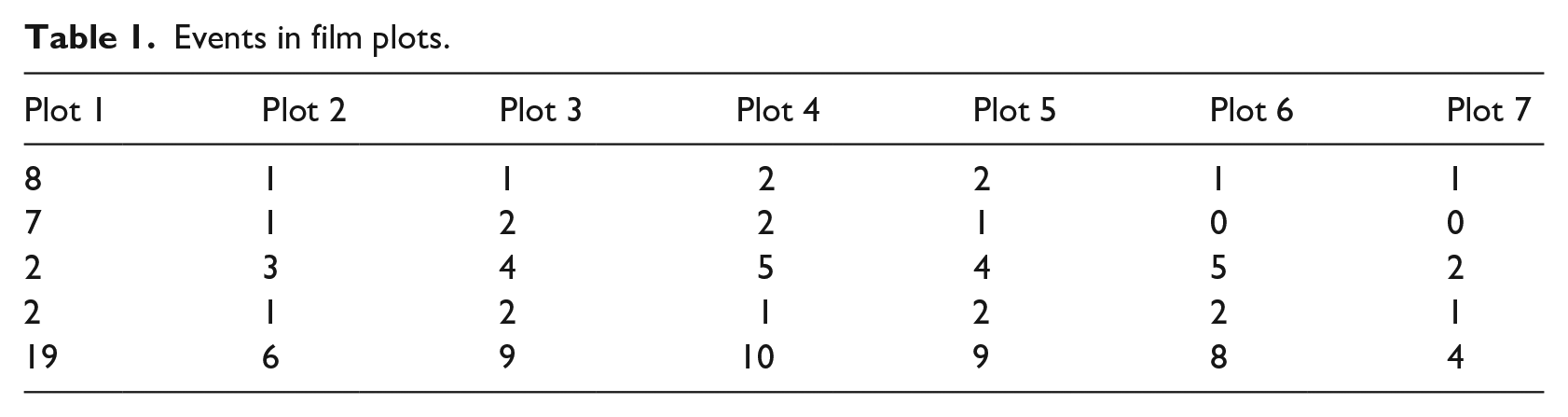
Before starting the quantitative and qualitative analysis of the participants’ narratives, the film was analyzed within the framework of the causal network model. The film was divided into seven subplots. Furthermore, the number of events in the settings (visuals and the narrators’ depictions of scenes and characters), initiating events (events that force characters to act, or make a move), attempts (the characters’ actions committed to change the initiating events), and outcomes (the events that happened as a result of characters’ actions) were identified in each of the seven subplots (see Table 1). After that, all the available ADs were identified for each of the events (see Table 2). The table provides information for each event category that is originally in the film and the same events that are provided by the AD.
Events in film plots.
Events of the original and audio described film.
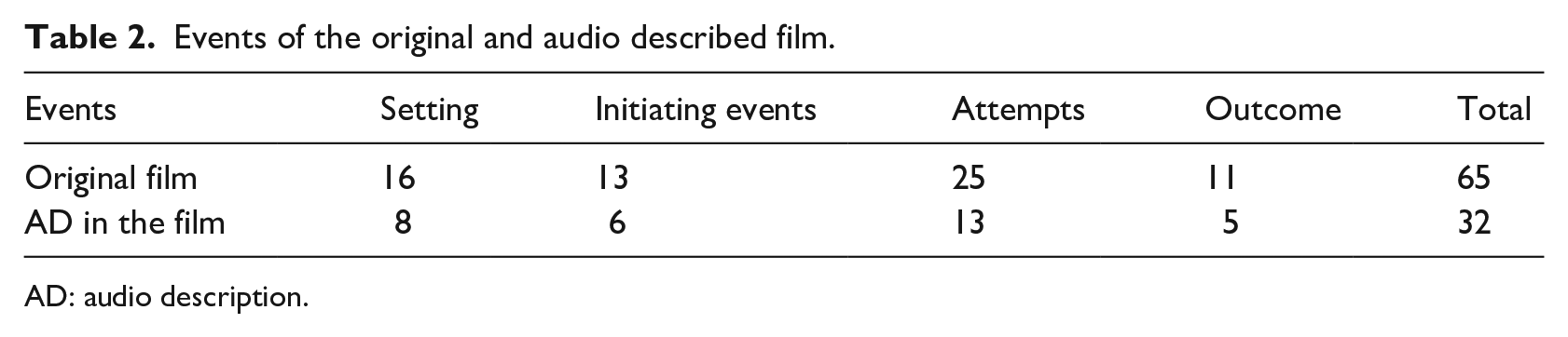
AD: audio description.
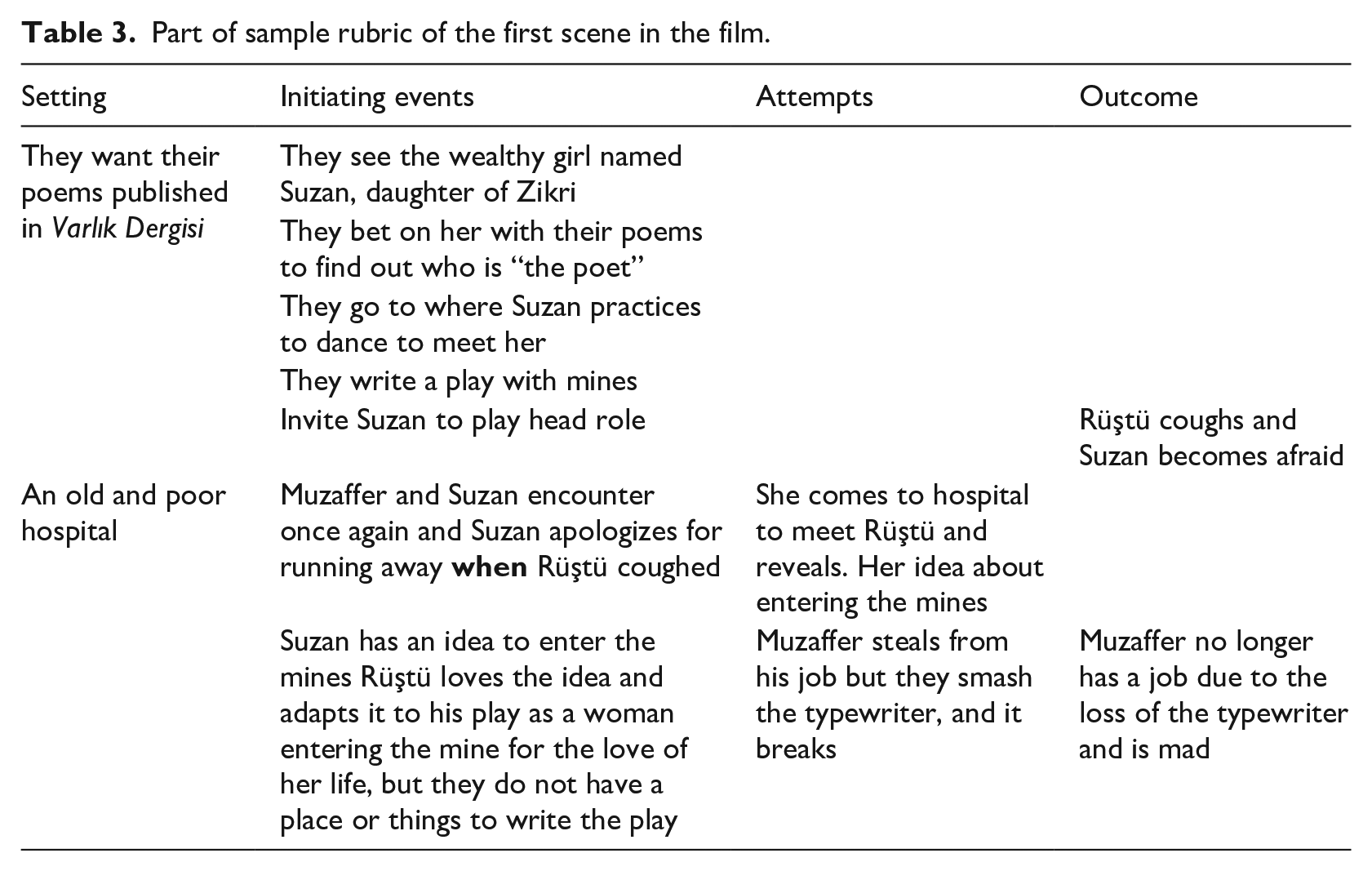
Relying on the analysis presented above, a rubric (Table 3) comprising all the events in each subplot was developed. One point was given for each event referred to in the narratives of the participants. The recorded narratives of the participants were transcribed by the researchers and the comprehension of the film was evaluated with the help of the rubric. The evaluation was done by two researchers separately and then the scores were compared and discussed until a mutual agreement was reached. The data were analyzed in the R programming language and environment.
Part of sample rubric of the first scene in the film.
The results
Task 1
Task 1 aimed to examine whether the VI participants would be able to comprehend the film without any AD and whether their comprehension would be at a level similar to that of the sighted participants. Thus, we asked the participants to watch the film without AD and to narrate it afterwards. However, the VI participants were not able to complete the task and toward the middle of the film they wanted to quit watching the film, stating that they were not able to follow the plot and understand what was going on. When they were asked by the researchers what they had been able to understand, their answers were limited to one or two sentences in total. One of the VI participants stated that the film was about a mine and there were sick kids. Two others said that the film was about friends. The last VI participant stated that she could not understand the events and where they were taking place, at all. The field notes revealed that the VI participants expressed their frustration, disappointment, and exhaustion when trying to follow the plot of the film, and finally expressed their unwillingness to continue. Task 1 showed that the VI participants had major difficulties in following the flow of the events since the events were extensively conveyed through visual input that the VI participants could not access. The participants did not even make it to the half of the film and stopped watching it to move on with the film with AD.
Task 2
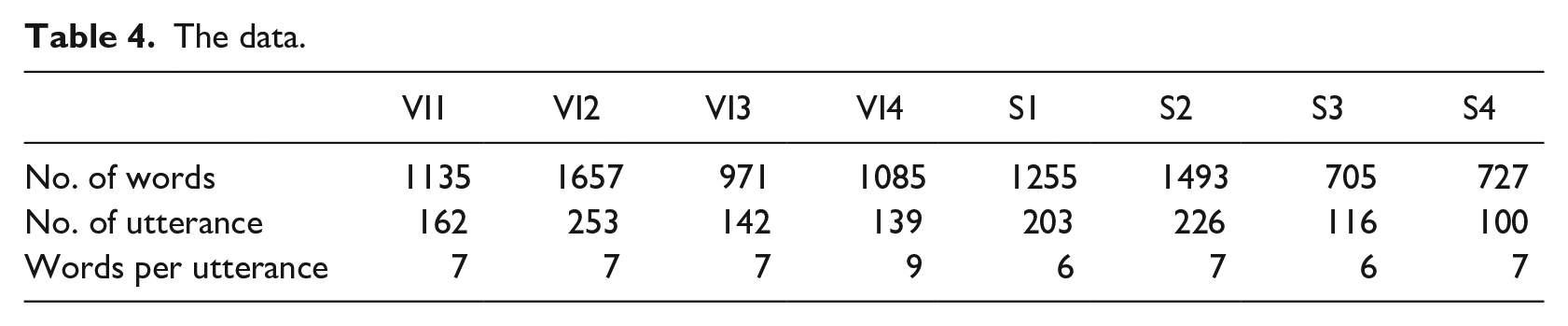
In Task 2, which was applied immediately or after a small break from Task 1, the VI participants were asked to watch the same film, this time assisted with AD. In addition, the sighted participants were asked to watch the original film. The data analysis conducted on the narratives of the VI and sighted participants revealed that all of them watched the film till the end and were able to narrate the plot correctly. Table 4 presents the data as total number of utterances and number of words per utterance produced by each participant.
The data.
Next, events in the participants’ narratives were examined and the analysis revealed that both the VI and sighted participants were able to comprehend and narrate most of the events in the film. Table 5 presents the descriptive statistics (M, SD and Median) for every event category for each participant that has been narrated correctly. Furthermore, to see whether the provided AD allowed the VI participants to comprehend the film as well as the sighted control group, a nonparametric Wilcoxon test was conducted with the help of R statistical package. The test revealed that there was no significant difference between the comprehension of the film by the VI and sighted participants at the .05 significance level (W = 130.5, p = .9394). These results showed that the AD enabled the VI participants to comprehend and narrate the film in a manner similar to the sighted participants.
Participants’ narratives of the events.
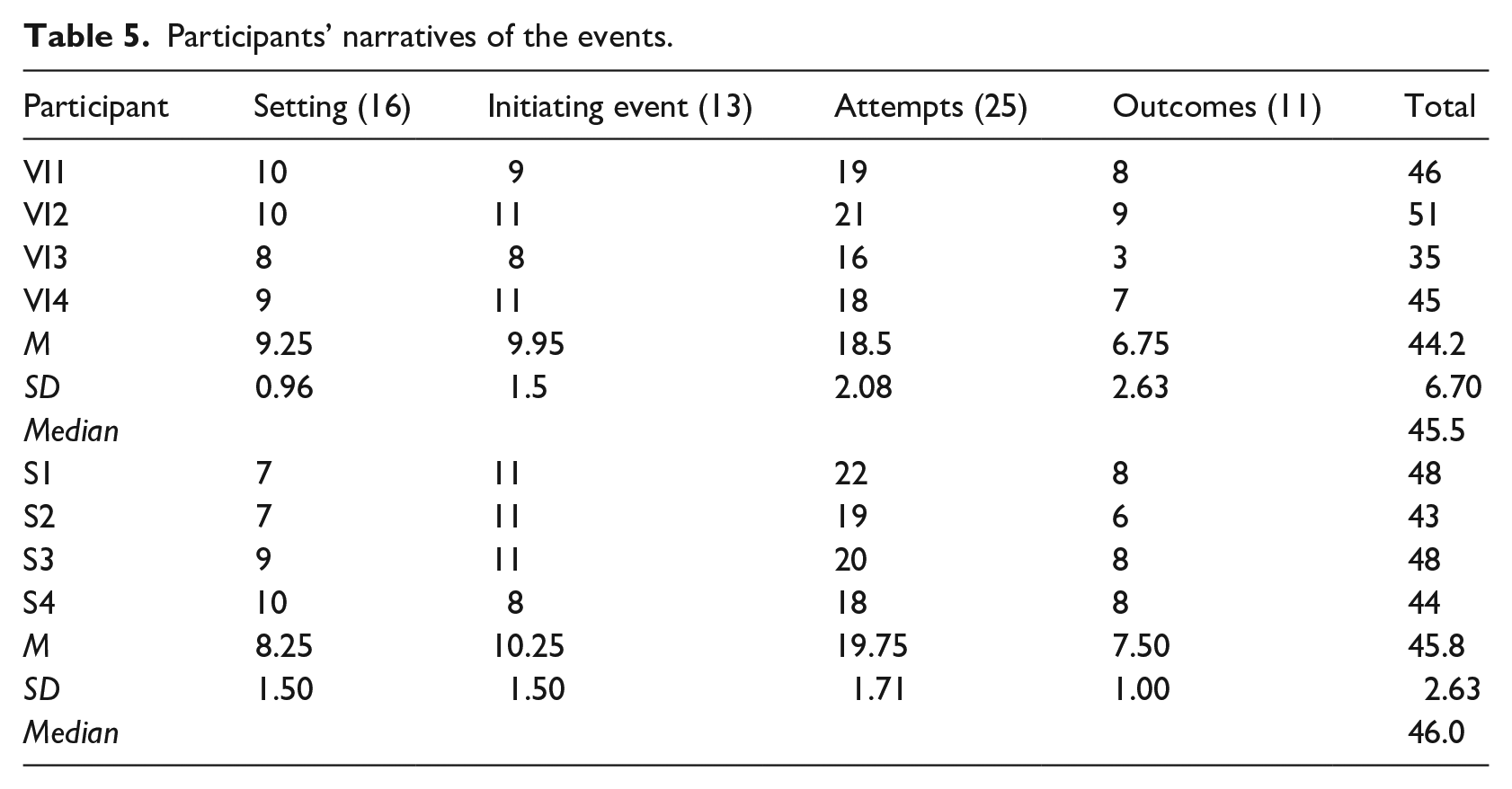
Furthermore, the data were qualitatively analyzed to examine the contribution of the AD to the comprehension of the VI participants. The qualitative analysis revealed that when the film script was presented in dialogues between the characters, it was sufficiently comprehensible, so the VI participants did not need the assistance of AD and were able to narrate the events as well as the sighted participants. However, while watching the scenes where only visual elements were utilized to depict the events, the assistance of AD became essential for the comprehension of the VI participants.
The data analysis showed that when the scenes that only utilized visual elements were supplemented with AD, the VI participants were able to narrate them. For instance, in Plot 3 after Suzan and Muzaffer secretly visited the mine (because women were not allowed to enter the mine), they were caught and Muzaffer was beaten by men hired by Suzan’s father and Suzan was slapped by her father. This event was the turning point of the film and therefore understanding the event was of crucial importance. Since the event was mostly visually depicted in the original film, the event was aided with a vivid AD as in (1): (1) Birileri Muzaffer’i vagonların geçtiği dehlize getirdiler. Birisi izlerken, iri yarı olan evire çevire dövmeye başladı. Muzaffer kendini savunamadan demirlere çarpıp yere devrildi. Yumruk yetmedi. Defalarca tekmelediler. Acımasızca yüzüne karnına vuruyorlar. Çamur içinde perişan acı içinde kıvranırken bırakıp gittiler. Muzaffer kalkmayı denedi mecalsiz acele yere yığıldı. (Some guys brought Muzaffer to the pits where mining wagons were passing by. While one of them was watching, the other one started to beat Muzaffer. Muzaffer could not defend himself and hit the iron fence and fell down. Just punching was not enough. They kicked him over and over. They beat him in the face and stomach. They left him suffering and in pain in the mud. Muzaffer tried to get up but failed instantly and fell down without any strength.)
The AD, rich in details, allowed the VI participants to comprehend the event and narrate it in detail. Example (2) taken from a VI participant’s narrative is illustrative: (2) Yakalanıyorlar. Ve maalesef ki bundan sonra çok kötü bir şekilde dövüyorlar Muzaffer’i. (VI4) (They are caught. And unfortunately, they beat Muzaffer very badly.)
The qualitative analysis also revealed that the AD not only enabled the VI participants to better understand the events, but also enabled them to narrate the events with detailed descriptions. For instance, in Plot 1 where the two young poets were introduced, their literature teacher Behçet Necatigil, a famous Turkish poet, was also introduced. While both the original film and the AD referred to Behçet Necatigil by his name, only the VI participants mentioned this in their narratives, as in (3): (3) Onların öğretmeni Behçet Necatigil de oradaydı (Their teacher, Behçet Necatigil, was also there).
However, none of the sighted participants mentioned the name of the teacher even though he was a famous Turkish poet. We assume that the sighted participants were not able to perceive this information presented in the dialogues and therefore did not include it in their narratives.
Another example of the detailed depictions provided by the VI participants thanks to the assistance of the AD was observed in Plot 2. The event described a dance party where Muzaffer tried to contact Suzan. Muzaffer was hidden behind a flag and whispered to Suzan to attract her attention and give their poems. The scene was mainly visually depicted and assisted with AD as in (4): (4) Masalardan birinde hoca Muzaffer’le oturuyordu. Aniden Muzaffer’in yokluğunu fark etti. Muzaffer kocaman Türk bayrağının ardına saklanmış. Pistten gelişini bekliyor. (Muzaffer was sitting with the teacher. All of sudden the teacher noticed that Muzaffer was not there. Muzaffer had hidden behind a big Turkish flag and was waiting for Suzan to come from the dancing hall.)
The narration of the event was described with almost no details by a sighted participant as in (5): (5) Bayram tarzı bir etkinlikte kız dans ediyor. Ondan sonra çıkışta yakalamaya çalışıyor kızı. (Suzan was dancing at an event. Muzaffer tried to catch her as she left.)
The same event was described by the VI participants in more detail. To illustrate, in (6) a VI participant provided information about where Muzaffer hid and his attempt to give Suzan the poems: (6) Akşamki baloda, parti gibi, balo gibi bir şeyde işte . . . bayrağın arkasında bir yere saklanmış Muzaffer. Oradan çıkıp şiiri veriyor. (In the evening, there was a ball, party like thing. Muzaffer hid behind the flag. He got out from behind the flag and gave the poems to her.)
The data analysis also revealed that there were events included in the narratives of the VI participants,’ but totally neglected and not included in the sighted participants’ narratives. For instance, in Plot 1, Muzaffer stole a typewriter from the company he worked for. However, while the two poets were tugging at the lamb, the typewriter fell down from the second floor and broke. This event was described by the AD as in (7): (7) Lambayı çekiştirirken daktilo ikinci kattan aşağı düşüverdi. İkisi de afallamış. Parçalanmış, demir yığınına baktılar. (While they were tugging at the lamb, the typewriter accidentally fell down from the second floor. Both looked down, stunned, at the broken lump of metal.)
The event was depicted and explicitly narrated by all the VI participants as illustrated in (8), while the sighted participants did not include the event in their narratives at all: (8) Bir gün Muzaffer çalıştığı yerden daktiloyu kapıp kaçıyor gizli, devletin malı. Yani onunla işte yazalım darken, daktiloyu düşürüp kırıyorlar bir kaza sonucu. (One day Muzaffer secretly takes the typewriter – which is government property – from his work. They try to write [the play] with that, but they accidentally drop and break it.)
In contrast, there were several scenes in the film where the AD was not provided, and these scenes were not comprehended by the VI participants. For example, in Plot 1 Suzan went to the hospital to see Rüştü and to talk about her wish to see the mines. This event was neither vocalized by any character in the film nor narrated in the AD. Although the event was an important attempt and was narrated by the sighted participants, none of the VI participants narrated it. Another instance where the VI participants failed to narrate an important event was the final scene of the film. The film ends with the funeral of the two poets. This scene was completely depicted via visual input and accompanied by a poem read by the teacher in reminiscence of the two poets’ death. The VI participants were not able to infer the information about the death of the poets relying only on the poem and they were not able to narrate the very important event of the film while all the sighted participants included the final event in their narratives. We assume that because the scene was already filled with the poem the teacher read aloud, it was not possible to add the AD.
Discussion and conclusion
The present study investigated the extent to which AD contributes to the VI participants’ comprehension of a film by examining the VI and sighted participants’ comprehension of two versions of the same film, one with and the other without supplementary AD. To this end, four VI and four sighted participants were asked to take part in two tasks. In Task 1, the participants were asked to watch the film without AD. In Task 2, the participants were asked to watch the same film assisted with AD and narrate it. Since the VI participants were not able to complete the task in Task 1 due to their frustration and lack of comprehension, only the narratives of the participants obtained from Task 2 were included in the analysis. The quantitative analysis of the narrated events revealed no significant difference regarding the extent of comprehension of the VI and sighted participants. This result showed that the VI participants were able to comprehend and narrate the events to the same extent as the sighted participants did when the film was supplemented with AD. The qualitative analysis validated this finding and demonstrated that the VI participants were able to comprehend the film to a great extent with the assistance of AD.
This study emphasized the role of AD assistance and its effects as an important resource in converting visual information to vocal information that greatly aids the VI individuals’ film comprehension. Films, as a form of visual art, by nature, rely on moving images that are accompanied by sound and therefore the comprehension of sighted individuals is taken for granted. As for the VI who need to perceive the plot, characters, setting as well as emotions, feelings, beauty, and so on, films without AD may not be comprehensible. Relying on the AD of the film, our VI participants were able to comprehend and narrate the events in vivid detail, and even included some details that were not mentioned by the sighted participants. This finding is consistent with Andersen et al. (1984), who reported that the VI learners gained more experience from an event when assistive language was provided.
The study also suggested that when an event is not assisted with AD, the VI individuals may not be able to reach the comprehension level of the sighted individuals; moreover, they may completely fail to comprehend the event. Yet, some of the events may be of crucial importance (e.g., a turning point or an important description of a character) and without their comprehension the whole film becomes meaningless for VI individuals. For example, the scene of the poets’ death was not understood and narrated by the VI because this scene could not be interfered with AD as it would overlap with the poem the teacher read. These findings are in line with the studies demonstrating the benefits of AD (López Vera, 2006; Schmeidler & Kirchner, 2001) and emphasize that AD does make a difference in the comprehension of VI individuals.
The application of the causal network model as the framework of analysis enabled us to not only divide the major plot into minor plots but also to create a rubric, which allowed us to scrutinize the participants’ comprehension of the film events. Utilizing a similar analysis of the plot might be also useful when preparing AD for films. Among all the events in the plot, settings and attempts were defined as the most important by Trabasso et al. (1984) and Palmer and Salway (2015), since the comprehension of setting and attempt events has a tremendous effect on the general comprehension of a story’s plot. Therefore, inclusion of AD for these two events is especially important. A proper AD for setting events enables VI individuals to gain information about the visual depictions of the atmosphere, characters, time, and place, which is essential for following the film plot. In our study, for example, AD contribution to the setting events became evident when one of the VI participants described the main characters as “sick kids” in Task 1 and after that was not able to continue the line of the plot. On the contrary, after watching the film with AD assistance, the same participant described the main characters correctly and with accompanying details such as “two poets suffering from tuberculosis,” which allowed him to further develop the line of the story. The attempts, that is, the events that describe the actions of the characters committed to pursue a certain goal, are commonly followed by the outcomes of the characters’ actions. So if an attempt is not understood, there is almost no possibility to comprehend the outcome, and therefore the VI individuals are unable to follow the plot. Attempts are usually described by the characters’ verbal and nonverbal actions. Thus, supplementary AD that describes nonverbal cues such as the gestures or actions of the characters becomes vital for the VI to correctly comprehend the events. All in all, the framework demonstrating the flow of the plot and the relationship between the subplots has a lot to offer while preparing AD. As the studies focusing on the preparation of AD (Benecke, 2007; Braun, 2008; Gambier, 2006; Snyder, 2014) revealed the importance of what and how to create AD, we believe that AD in films should be based on a narrative analysis evaluating the importance of plottal events and how much AD is necessary.
We also believe that this study may not only contribute to AD developers but also to those in the field of cinematography. To reach a wider audience including VI film viewers, filmmakers should be aware of how AD works and how it compensates for the visual depiction of the events.
Last but not least, it is necessary to point out an important limitation of this study. The sample size of this study was very limited because it is very difficult to reach VI participants and gain their trust. Furthermore, VI participants may have unique individual differences which complicate forming a homogeneous group. Nevertheless, to gain a deeper understanding of how AD contributes to VI individuals’ comprehension, further research is needed. Further research should include more and diverse VI participants to enrich our understanding of how AD should be used to supplement films.
Footnotes
Authors’ note
The data contained in this article were extracted from the MA Thesis by the author, Zeynep Zengin Temırbek uulu, for English Language Teaching Program at Middle East Technical University, Ankara, Turkey. The thesis was supervised by Çiğdem Sağın-Şimşek.
Funding
The author(s) received no financial support for the research, authorship, and/or publication of this article.
