



Abstract
Through the use of their developing vision, young children develop increasingly sophisticated ways of establishing control within different learning environments, thereby helping them to exert influence as active ‘agents’. Vision impairment can present significant barriers to a child developing personal agency through reducing access to visual information. In this article, we present the parameters of a conceptual framework to inform the design of intervention approaches that can help to reduce these barriers. We draw on a dual model of ‘access’, contextualised within a bioecological systems perspective, to examine how young children with vision impairment can establish increasing personal agency through intervention approaches that promote progressive independence access skills within an ‘ethos of empowerment’. In presenting new conceptual foundations for examining the development of personal agency in young children with vision impairment, the article has significance for research, policy, and practice in vision impairment education and offers a theoretical reference point for related areas of early childhood inclusive education.
Introduction
Through the use of their developing vision, young children evolve increasingly sophisticated ways of establishing control within different learning environments, thereby helping them to exert influence as an active ‘agent’ (Nolan et al., 2006). Vision impairment can present significant barriers to a child developing such agency through reducing ‘access’ to sensory information (Douglas et al., 2011; McLinden & Douglas, 2014), potentially resulting in the child becoming increasingly reliant on other individuals for support (Webster & Roe, 1998). Research highlights the importance of promoting distinctive independence access skills to maximise a child’s ability to develop as an ‘independent’ learner within a given educational context (e.g., Douglas et al., 2011; McLinden et al., 2017). Furthermore, recent work in this area highlights the significance of these independence access skills being suitably developed to enable successful transition from compulsory school education into independent adulthood (e.g., Hewett et al., 2017; Douglas et al., 2019).
A key challenge for educators, therefore, is how to ensure an early year’s curriculum is structured so as to support a young child’s emerging personal agency which can then be sustained throughout the child’s educational pathway. In this article, we outline the parameters of a conceptual framework that can be drawn upon as an educational response to this challenge to show how young children with vision impairment can establish increasing control of their lives within an environment that promotes an ‘ethos of empowerment’ (Sadan, 1997, p. 16). Our analysis is structured around a dual model of access for learners with vision impairment (‘access to learning’ and ‘learning to access’) and contextualised within a bioecological systems perspective of human development. We propose that this holistic framework offers a suitable vocabulary and developmental route map to examine the function, nature, and role of the distinctive early intervention strategies required to promote and sustain equitable curriculum access within a given educational pathway for young children with vision impairment in different educational contexts and settings.
For the purpose of this article, we define early intervention broadly as incorporating services and programmes that facilitate the development of young children (i.e., aged between the ages of 0–5) who have vision impairment, and who as a result, may be at risk of developmental delay given that they may not meet recognised developmental milestones (e.g., Dale et al., 2019; Dale & Sonksen, 2002; Sonksen & Dale, 2002; Tadic et al., 2009). We argue that to maximise the ability of these children to mature as increasingly independent and ‘active’ learners, an ‘ethos of empowerment’ should have a focus on the following:
Ensuring these young children have equitable and optimised access to an appropriate curriculum balance;
Structured opportunities within this balance to develop their personal agency as ‘active agents’ through emphasising distinctive and progressive independence access skills;
Sustaining the development of their personal agency through promoting ‘progressive’ and ‘mutual’ accommodation throughout a given educational pathway.
We start the article with an analysis of issues relating to early years curriculum ‘access’ for children with vision impairment. This is a deceptively complex term, and we draw on the terms ‘access to learning’ and ‘learning to access’ to emphasise the careful balance required in ensuring young children have fair and optimised access to an early years curriculum, complemented with structured opportunities to develop distinctive early independence access skills. We examine how a bioecological perspective has informed an examination of this balance with respect to curriculum access within school and higher education in different national contexts, but to date, with limited explicit consideration of early intervention settings. We review how the related concepts of ‘empowerment’ and ‘personal agency’ are described in the literature, drawing attention to the distinction between empowering ‘process’ and ‘outcome’, and illustrate how these terms can be usefully applied to areas of a specialist curriculum for learners with vision impairment. We then outline the parameters of a bioecological systems perspective within which to contextualise the dual-access model, and through this holistic framework explore the development of personal agency for young children with vision impairment. We provide insights into how such personal agency can be sustained within an ‘ethos of empowerment’ to optimise future success and propose indicators that can be drawn upon to evidence the extent to which such an ethos can guide early intervention with respect to the ecological systems surrounding the young child. We discuss three limitations of the analysis presented in the article and outline key implications for practice. We conclude the article by emphasising that promoting an ‘ethos of empowerment’ within a right-based early years education should seek to support a child’s progression through the development of longer-term independence outcomes, so as to ensure learners with vision impairments can be actively involved in shaping their own future.
Vision impairment education and curriculum access
As reported by Douglas et al. (2018), vision impairment education has traditionally focussed upon two broad areas of intervention and targeted educational outcomes as follows:
Ensuring children have fair and optimised access to the curriculum.
Ensuring children have opportunities to develop their independence and social inclusion.
The second area is partly linked to maximising children’s ability to develop as independent learners within education, but is also part of a broader agenda about empowering children for adult life, independent living, and employment through promoting personal agency (e.g., Douglas et al., 2018; Hewett et al., 2017, 2018; Opie, 2018). The philosophy underpinning this distinction is to some extent based on a ‘rights’ agenda which demands fair and equal access to education for all children, as well as a concern that an individual child should have structured opportunities to develop their independence to whatever extent is possible (Douglas et al., 2018). The distinction between the two broad areas has been articulated in a variety of ways, reflecting particular perspectives about the nature and role of intervention for children with vision impairment (e.g., desired educational outcomes, the conception of the curriculum, the provision of inclusive/specialist services, and the training of professionals), and has recently been examined through reference to the notion of ‘access to learning’ and ‘learning to access’ (e.g., Douglas et al., 2018; Hewett et al., 2017; McLinden et al., 2016):
Access to learning: inclusive practice and differentiation ensuring that the child’s environment is structured and modified to promote inclusion, learning, and access to the ‘core’ or national curriculum, the culture of the educational setting and broader social inclusion.
Learning to access: teaching provision which supports the child to learn independence skills and develop agency to afford more independent learning and social inclusion.
Although the distinction has been presented primarily with a particular focus on ‘school’ education, it also provides a suitable framework and vocabulary through which different programmes and targeted educational outcomes can be aligned within early intervention (e.g., McLinden et al., 2018). Thus, the early intervention approaches (and associated targeted educational outcomes) in relation to ‘access to learning’ can be closely aligned with what can be described as ‘inclusive’ practice and modifications for young children with vision impairments (i.e., adaptations made to the core curriculum to facilitate access) (Douglas et al., 2018). The particular early intervention programmes (and associated targeted educational outcomes) in relation to ‘learning to access’ would be more closely aligned to areas of the ‘distinctive’ or ‘additional’ needs (e.g., Mason & McCall, 1997; Sapp & Hatlen, 2010) and may not typically be taught in a context as part of a ‘core’ or national curriculum. These areas include, for example, the teaching of early compensatory skills that facilitate learning through touch, early mobility and independent living skills, the use of specialist equipment; social communication and early pragmatic language skills. In the United States, the curriculum areas that are considered to be distinctive to vision impairment education are described as forming part of an ‘expanded core curriculum’ (ECC) and refer to the knowledge, concepts, and skills typically learned incidentally by sighted students but which must be sequentially presented to the student who has vision impairment (e.g., Allman & Lewis, 2014; Sapp & Hatlen, 2010). A summary of the curriculum areas of the ECC is presented in Figure 1.
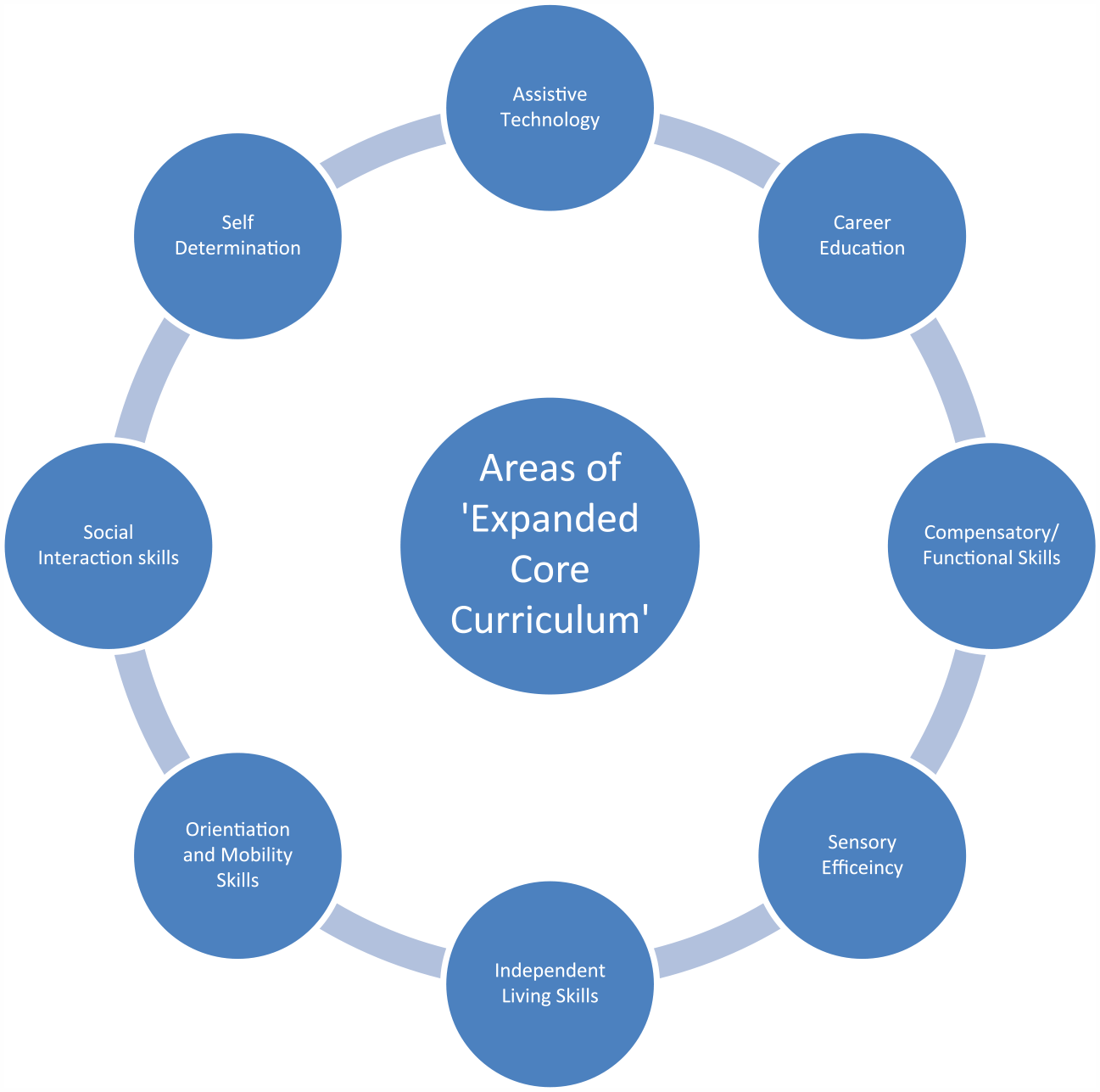
Areas of the expanded core curriculum (adapted from Sapp & Hatlen, 2010).
In emphasising the importance of an early focus on the ECC, Allman and Lewis (2014) report that this curriculum should begin at ages 0–3 through exposure to a wealth of experiences that ‘lay the groundwork for learning the multiple skills that students who are visually impaired will need to be ready for learning in school, and ultimately, to become successful and happy adults’ (n.p.). They argue that for this reason it is important for teachers of children with vision impairments and ‘early interventionists’ to work with the families of young children to provide and expand appropriate experiences and learning opportunities.
Similar frameworks to the ECC have been developed for use in other national contexts. A notable example, in the context of England is the ‘Learner Outcomes Framework’ (LOF) for children and young people with vision impairment which accounts for both short- to medium-term outcomes that are specific to the individual learner, as well as longer-term outcomes that aim to prepare the individual for independent adulthood (Keil, 2016). The LOF is organised around eight outcome categories, which map onto the ECC, covering skills that learners with vision impairment are considered to need to enable them to take part in lessons with increasing independence.
A bioecological perspective has been drawn upon to examine the proximal (i.e., close to the learner) and distal (i.e., at a distance from the learner) influences on promoting curriculum access within school and post education contexts (e.g., Douglas et al., 2018; Hewett et al., 2017; McLinden et al., 2016). This perspective makes reference to Bronfenbrenner’s bioecological systems theory (e.g., Bronfenbrenner, 2005) and is illustrated as a series of concentric circles situated around a developing individual with each circle referring to nested but separate ‘systems’ (micro-, meso-, exo-, and macro-) that reflect a complex and evolving ecology of human development (e.g., Shea & Bauer, 1994). The temporal dimension of development is represented by the chronosystem which was introduced by Bronfenbrenner to show the changing nature of the learner over time as well as the changes in the proximal learning environment and the distal influences. Through this framework, the nature of intervention has been highlighted as seeking to promote ‘progressive, mutual accommodation’ (Bronfenbrenner, 2005, p. 107) between the growing individual and the changing characteristics of the immediate settings in which the child with vision impairment develops (e.g., McLinden et al., 2016). As such, the framework offers scope to examine the complexity and multi-dimensional nature of influences on promoting particular areas of curriculum access and the distinctive nature of specialist input throughout an educational pathway (e.g., McLinden et al., 2018). To date, however, there has not been an analysis of how such a perspective can be applied to early intervention approaches for young children with vision impairment within an ‘ethos of empowerment’ that stems from a rights-based approach.
Early childhood rights, empowerment, and personal agency
Woodhead (2005) argues that ‘a right to development’ can be traced back to the Geneva Declaration of the Rights of the Child, adopted by The League of Nations in 1924 and which in turn eventually fed into the United Nations (UN) Declaration of the Rights of the Child (1959) and the UN Convention of the Rights of the Child (UN General Assembly, 1989). Article 6 in the convention directly states that ‘Parties shall ensure to the maximum extent possible the survival and development of the child’ (UN General Assembly, 1989, Article 6). There are a further series of articles within the UNCRC that relate holistically to development of the child (Article 2, 3, 5, 12, 18, 24, 28, 29, 32) and seek to ensure early childhood intervention strategies or approaches heed these rights. More recently, the sustainable development goals (SDGs) have offered a framework of 17 goals and 169 targets across social, economic, and environmental areas of sustainable development, which United Nations Member States have committed to making a reality. Of particular relevance to this review is SDG Target 4.2 which states that by 2030 countries should ‘ensure that all girls and boys have access to quality early childhood development, care and pre-primary education so that they are ready for primary education’ . . . and are ‘developmentally appropriate’ respecting children’s rights, needs, capacities, interests, and ways of learning at each stage of their early lives; recognising the interdependencies between nutrition, health, care, and education, from the ‘first 1000 days’ onwards (Young Lives Policy Brief, 2016).
Unlike the clear statements of rights found in the UNCRC and the SDGs, the concept of empowerment has had many definitions and transformations. For example, Ibrahim and Alkire (2007) suggest that the concept of empowerment ‘is related to terms such as agency, autonomy, self-direction, self-determination, liberation, participation, mobilisation and self-confidence’. Kellett (2010) notes that our knowledge around empowerment is consistently changing and that children have taught us that listening and participative processes should not only inform research, but significantly, enable them to change their lives: As we move into the second decade of the 21st century, it is apparent that children’s agency and voice are going to preoccupy children’s agendas in a way that listening and participating dominated the first decade . . . Establishing methods for hearing children’s research voices . . . providing powerful dissemination platforms are central tenets of this process. (Kellett, 2010, p. 217)
A particular challenge is that young children with disabilities may need more support from professionals than children without disabilities, and as Whitburn (2013) highlights, paraprofessionals who provide ‘heavy’ support can severely reduce the students’ agency no matter the ‘rights-based’ lens they are working from. Given the potential implications of vision impairment for the development of personal agency, it is crucial therefore for young children to have opportunities to make choices, have control over their environment to promote independence and avoid passivity.
With reference to the work of Rappaport (1984), Page and Czuba (1999) note that it is easy to define empowerment by its absence but difficult to define in action as it takes on different forms for different people and contexts. They argue therefore that a common understanding of empowerment is required to establish how it is acted out in practice and for evaluating programmes. At a basic level, the concept of empowerment can be described as being about ‘power’ relationships at different levels that enable individuals to assume control of their lives. This is captured succinctly by Page and Czuba (1999) in proposing that empowerment is a ‘multi-dimensional’ and ‘social process’ that helps people gain control over their own lives, arguing that at the core of the concept is the idea of ‘power’, and with the possibility of empowerment depending on two notions as follows:
That the power relationships can change – if power cannot change, then it is argued that empowerment is not possible, nor is empowerment conceivable in any meaningful way. Conversely, if power can change, then empowerment is possible.
That power can expand.
They argue therefore that three components are considered to be basic to any understanding of empowerment, namely, that it is ‘multi-dimensional’, ‘social’, and a ‘process’ as follows:
It is multi-dimensional in that it occurs within sociological, psychological, economic, and other dimensions. Empowerment also occurs at various levels, such as individual, group, and community.
Empowerment, by definition, is a social process, since it occurs in relationship to others.
Empowerment is a process that is similar to a path or journey, one that develops as we work through it.
While other aspects of empowerment may vary according to the specific context and people involved, Page and Czuba (1999) argue that these components remain constant. The notion of empowerment as an ongoing process is supported by Zimmerman (2000) who makes reference to the concept as a process in which ‘efforts to exert control are central’, and argues that ‘actions, activities, or structures may be empowering, and that the outcome of such processes result in a level of being empowered’ (p. 45). This line of argument is supported by Staples (1990) in noting that empowerment relates to both a ‘process’ and an ‘outcome’, namely, an attempt to obtain a degree of ability so as to influence the world. Zimmerman reports that such a process can be considered to be ‘empowering’ if it helps people develop skills so that they can become independent problem-solvers and decision makers. Furthermore, Zimmerman notes that empowerment outcomes refer to the operationalisation of empowerment so it is possible to study the effects of interventions that have been designed to empower participants.
Sadan (1997, p. 13) makes reference to this process as one of a transition ‘from a state of relatively powerlessness to a state of more control over one’s life, fate, and environment’, arguing that empowerment ‘expresses an ongoing social process, not a one-time occurrence’ (p. 15) and highlights the importance of creating ‘an ethos of empowerment’ (p. 16, italics added). The process of empowerment is considered by Sadan (1997) to be an active one with its particular form determined by ‘the circumstances and the events, but its essence is human activity in the direction of change from a passive state to an active one’ (p. 76). It is argued therefore that an empowering process brings about ‘an integration of self-acceptance and self-confidence, social and political understanding, and a personal ability to take a significant part in decision-making and in control over resources in the environment’ (p. 76).
The concept of ‘agency’ is commonly drawn upon to describe an individual’s perception that they have control over their life to influence events. As noted by Aubrey et al. (2006), the child can be considered as an agent of its own and the world’s construction, but whose agency develops in the context of an unchanging social and historical praxis, which includes the ‘constraints and potentialities of nature, and the action of other agents’ (pp. 202–203). In proposing a framework of outcomes for young people with an emphasis on empowering providers and commissioners to articulate and demonstrate impact in improving outcomes, McNeil et al. (2012) define agency succinctly as being ‘A feeling that you are actively in control of your life’ (p. 53). The notion of agency is also linked to the individual as an ‘agent’ who is able to influence his or her environment. This is captured by Sadan (1997) who notes that ‘To be an agent is to influence intentionally one’s functioning and life circumstances’. Citing the work of Giddens, 1984, Sadan (1997) examines agency in relation to what it is to be a human noting that: A human agency ceases to be such if it loses the ability to influence the world in some way . . . To be a human being in the full sense of the word, then, means to carry out intentional acts in order to achieve defined goals, that is to say, to influence the environment, to be able to bring about change. (p. 146)
This brief review of literature indicates that the concept of ‘empowerment’ is broad ranging but in essence can be viewed as being a process of transition from a state of being relatively powerless (in terms of influencing one environment) to a ‘a state of relative control over one’s life, destiny, and environment. This transition can manifest itself in an improvement in the perceived ability to control, as well as in an improvement in the actual ability to control’ (Sadan, 1997, p. 144). At its core is the notion of ‘power’ and ‘power relationships’ and crucially, the fact that power can both ‘change’ and ‘expand’ through an active process of transition that supports and promotes the development of personal agency. The review suggests, therefore, that in order for young children with vision impairment to become empowered (i.e., from relatively passive to relatively active), there needs to be built in to intervention approaches scope for expansion (i.e., the young children being able to draw on and express their ‘power’ in a wider range of contexts). The notion of empowerment, or of becoming empowered, therefore indicates a process of empowering that involves a complex interaction between the young child and their learning environments with appropriate opportunities afforded for the development and expansion of such agency within an ‘ethos of empowerment’ underpinned by the legislative acts of children’s rights. This suggests an important distinction therefore between the process of empowerment (empowering process) and the nature of the particular intervention procedures that are drawn upon as a child seeks to establish control of his or her learning environment (empowered outcomes) through the development and expansion of the child’s personal agency.
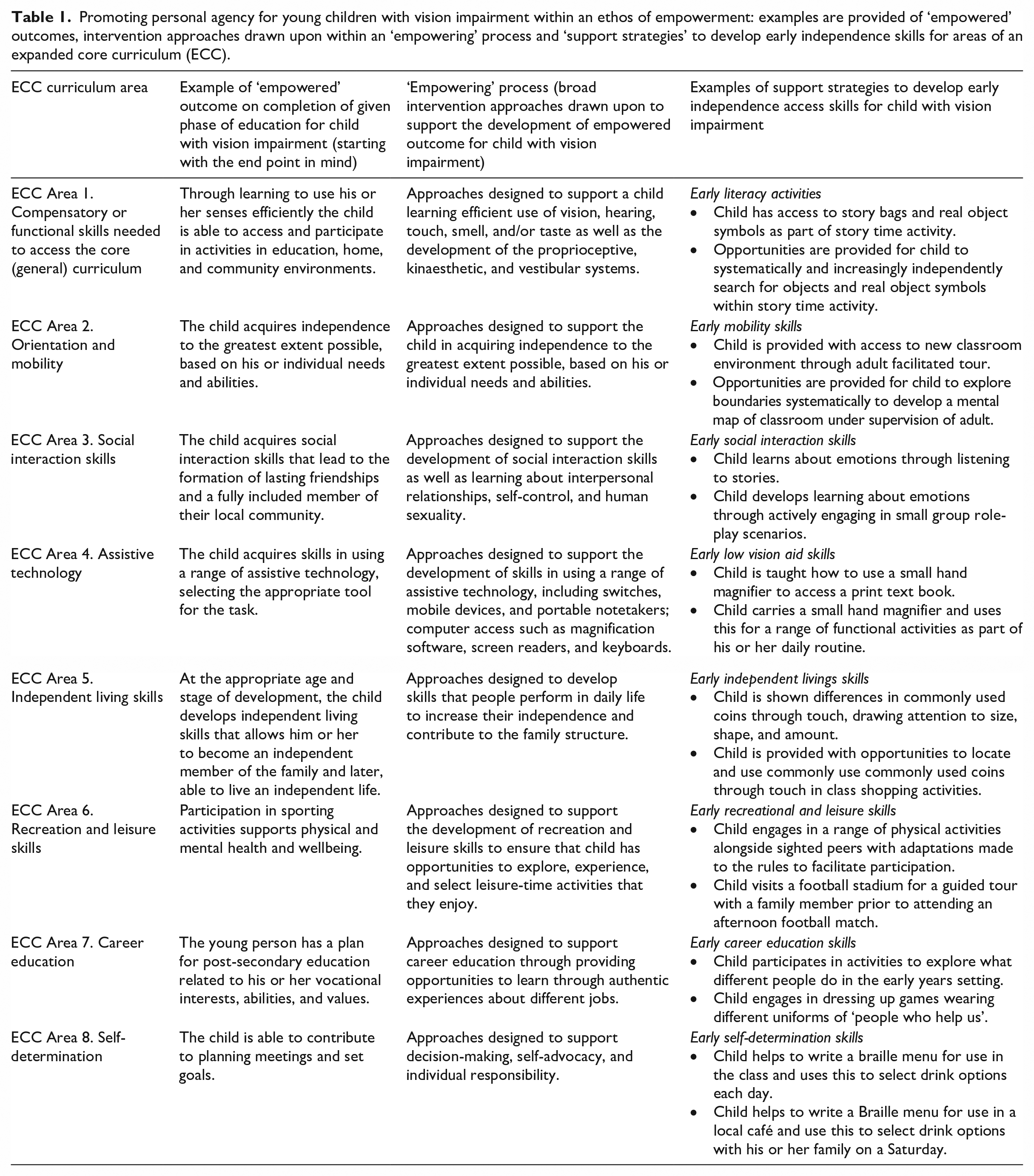
We illustrate this distinction through reference to areas of the ECC to show examples of ‘empowered’ outcomes (i.e., outcomes that the child might be expected to demonstrate on completion of a particular phase of education), the nature of an ‘empowering’ process (i.e., the intervention approaches drawn upon to support the development of empowered outcomes), and examples of the particular support strategies that can be drawn upon to promote curriculum access within each area of the ECC (see Table 1).
Promoting personal agency for young children with vision impairment within an ethos of empowerment: examples are provided of ‘empowered’ outcomes, intervention approaches drawn upon within an ‘empowering’ process and ‘support strategies’ to develop early independence skills for areas of an expanded core curriculum (ECC).
We examine next the parameters of a bioecological systems framework through which to contextualise the development of personal agency for young children with vision impairment. Through this holistic perspective, we illustrate how these learners can be suitably ‘empowered’ over a given timeframe and propose provisional indicators that can be drawn upon to evidence the extent to which an ‘empowering ethos’ can guide early intervention with respect to the various systems surrounding the young child.
Examining the development of personal agency through a bioecological perspective
Through a bioecological perspective, the young child with vision impairment is viewed as being a potentially active ‘agent’ at the centre of a multilayered and complex ecology. Given the limitations and implications arising from reduced access to visual information however, he or she will require appropriate opportunities within different environments to access the world through a curriculum balance that seeks to emphasise and sustain personal agency through promoting independence access skills. The microsystem surrounds the child and in the home environment, as noted by Shea and Bauer (1994), includes relationships between the parents and the child, the child and each sibling, and between other family members. Within an early childhood context, this system includes the relationships between the child and teacher as well as the child and his or her peers. Factors within this system that can influence the development of personal agency include the relationships with those involved in the child’s education – including peers, friends, practitioners, families, and other individuals. The quality of practitioner involvement can also influence personal agency in these environments, requiring adults to effectively interpret the young child’s attempts to exert control on his or her environment.
The mesosystem represents the interrelations among two or more settings (i.e., microsystems) in which the individual child actively functions (e.g., Bronfenbrenner, 2005; Shea & Bauer, 1994). Factors within this system that can influence the development of personal agency include the interrelations between home and school, home and the various agencies, home and the child’s immediate neighbourhood, and school and peer group (Shea & Bauer, 1994). It also includes parent–teacher collaboration and family–community service involvement as well as a ‘consideration of “transitions” or the movement of the learner with disabilities from one microsystem to another’ (Shea & Bauer, 1994, p. 11). Other factors within this system include the structures to support inclusive learning activities (e.g., coordination between different professionals, home-centre links, etc.) as well as the training of practitioners who support the child’s care and learning. As noted by Shea and Bauer (1994), the exosystem represents ‘those settings that do not involve the individual directly. However, events occurring within the exosystem affect, or are affected by, what happens in settings (microsystems) in which the individual functions’ (p. 11). Factors in the exosystem that can influence the development of personal agency include the early years curriculum structures, inclusive curriculum policies as well as funding allocation for inclusive policies.
The macrosystem includes the varying contexts in which early years provision exists including pre-school education systems and agendas. Factors within this system that can influence the development of personal agency include the key drivers for early child development and inclusive education at national and/or international levels, including the implementation of Article 24 of the UN Convention on the Rights of Persons with Disabilities (CRPD), United Nations International Children’s Emergency Fund (UNICEF) resources promoting more integrated early childhood development (e.g., WHO and UNICEF, 2012) as well as internationally agreed SDGs (United Nations, 2015). Finally, the timeline is illustrated through the chronosystem which equates with the different phases of education in the context of a given national context (e.g., early years, primary, secondary). Factors within this system that can influence the development of personal agency include the approaches taken to facilitate transition between different educational phases/settings of education, thereby resonating with Bronfenbrenner’s notion of ‘ecological transitions’ (Bronfenbrenner, 2005) as young children move from one educational setting to another (e.g., home to early years provision and then to primary school) throughout a given educational pathway.
Discussion
We have argued in this article that a dual model of access, contextualised within a bioecological perspective, offers a holistic unit of analysis through which to explore the development of personal agency for young children with vision impairment, and provides insights into how such agency can be sustained within ‘ethos of empowerment’ to optimise future success. The significance of focusing on promoting such an ethos throughout a learner’s educational pathway can be illustrated through research with older learners highlighting the potential barriers to development that can result from vision impairment. This work emphasises the importance of ensuring learners with vision impairments have opportunities to develop their independence access skills from an early age and throughout their educational pathway, to suitably prepare them for adulthood (e.g., Douglas et al., 2018; Hewett et al., 2017).
In support of recent theoretical work in this area, the analysis presented in this article highlights the significance of interactions between the developing learner with vision impairment and the changing educational ‘ecology’ in which such development occurs over a given timeframe (e.g., Douglas et al., 2018; Hewett et al., 2017; McLinden et al., 2017). As noted by McLinden et al. (2017), a central issue is that the nature and complexity of a child’s environments change with transitions across the different stages of development (e.g., infancy, early childhood, middle childhood, and adolescence). As such, the developmental timeframe is of particular significance as it allows practitioners to maintain a focus on current, as well as medium- and longer-term outcomes, and factor into the intervention key transition points within and between educational phases. The complex interactions between the individual and their changing learning environments over time is captured succinctly by Bandura (2006) in noting that ‘People do not operate as autonomous agents. Nor is their behaviour wholly determined by situational influences. Rather, human functioning is a product of a reciprocal interplay of intrapersonal, behavioural, and environmental determinants’ (p. 165).
We end the discussion by proposing provisional indicators of ‘possible exercises of agency’ (Ibrahim & Alkire, 2007) that can be drawn upon to examine an ‘ethos of empowerment’ through a bioecological perspective within early years contexts. These indicators focus on conceptualising such an ethos as the ‘expansion of agency’ (Ibrahim & Alkire, 2007), which is sustained through emphasising progressive independence access skills throughout a given education pathway. Through a bioecological perspective therefore, indicators of an ‘ethos of empowerment’ within early intervention contexts can be characterised as the following.
Individual child
An ‘active’ young child who is learning to use personal agency to influence a given learning environment to bring about desirable change.
Microsystem
‘Empowering learning environments’ that afford opportunities for the development and expansion of personal agency through a suitably ‘balanced curriculum’ that promotes progressive independence access skills.
‘Empowering people’ who understand the development implications of vision impairment and afford opportunities for the development and expansion of personal agency through a suitably ‘balanced curriculum’ that promotes progressive independence access skills.
‘Empowering intervention procedures’ that are designed to afford opportunities for the development of personal agency through a suitably ‘balanced curriculum’ that promotes progressive independence access skills.
Mesosystem
Relationships and structures that afford opportunities for the development and expansion of personal agency through supporting a suitably ‘balanced curriculum’ that promotes progressive independence access skills.
Exosystem
Educational systems and curriculum policies that afford opportunities for the development and expansion of personal agency through supporting a suitably ‘balanced curriculum’ that promotes progressive independence access skills.
Macrosystem
Early child development and inclusive education policies and structures at national and/or international levels that afford opportunities for the development and expansion of personal agency through supporting a suitably ‘balanced curriculum’ that promotes progressive independence access skills.
Chronosystem
Measurable levels of individual activity over time that indicate progress with respect to a child developing personal agency so as to be able to influence the environment to bring about desirable change (e.g., ‘empowered outcomes’).
We propose that these provisional indicators offer a basis for a holistic evaluation of early intervention for young children with vision impairment through providing a means of identifying evidence of the extent to which personal agency is being developed and promoted within an ‘ethos of empowerment’ (see Table 2).
Developing the personal agency of young children with vision impairment within an ethos of empowerment: provisional indicators of exercises of agency.

Limitations
This is the first analysis we have identified which examines the development of personal agency in young children with vision impairment through a systems-based perspective. We outline what we view as being three main limitations of the article. First, as a conceptual analysis it is limited given its wider application remains untested in authentic settings through reference to young children in different types of educational settings. This would provide the field with a valuable direction for future research, and further work is planned to develop this focus. Second, the article is currently illustrated through reference to only one commonly used curriculum model (i.e., ECC) and its application could therefore be examined in future work through drawing on curricula frameworks in other national settings and cultural contexts. Finally, and perhaps of greater interest in terms of a future research focus, are issues relating to limitations of the analysis with respect to the power dynamics assumed within the conceptual perspective presented in the article. While we as professionals engaged in education seek to acknowledge that we are working within a child-centred approach, in practice we may not actually be paying full attention to the ‘transformative’ impact of children and young people’s voices. It is possible therefore that we can become deceived in thinking that we have actually positioned children at the forefront of our work as a bioecological model suggests, and in practice we may not actually be doing so. Indeed, a recent movement that is gaining in impetus, known broadly as a ‘living right’ agenda (e.g., Hanson & Nieuwenhuys, 2013), suggests how we may be deceived in the sense that individualised approaches to childhood still involve children being judged against normative criteria, and deceived in the sense that working collaboratively within ecological frameworks may lull us into thinking we are actually listening to children and young people with vision impairment when we are not. This notion of focusing on a local level – living rights – challenges the idea that children are ‘granted’ agency because of universal international institutions. Living rights is therefore not only a theoretical concept, because it takes into account this power dynamic of a global perspective and a local concern of what children’s rights should be but also a methodological one, one that ensures the rights of children within different cultural and sociological concepts and spheres of influences, but also allows for the rights to be constantly changing, incomplete, and being reinvented. In other words, they should be ‘living’ (Hanson & Nieuwenhuys, 2013) by making the most of their daily living situation. Further work is planned to examine this complex area further.
Implications for practice
Children and young people with vision impairment constitute a heterogeneous group within which there is a wide spectrum of characteristics, abilities, and educational support needs. Vision impairment is associated with significant barriers to curriculum access that can result in developmental delay and increasing dependence on others. Distinctive input, in early childhood, is considered integral to ensuring there is equitable curriculum access throughout different educational phases. The conceptual and empirical evidence suggests that distinctive and effective educational input tends to be in two inter-related forms as follows:
inclusive practice and environmental adjustments (providing a child with access to learning);
teaching provision supporting the child to learn independence skills and develop agency to facilitate independent learning and social inclusion (e.g., promoting learning to access independence skills).
Clearly, this does not depend on one person or a key worker within the early years setting but to ensure a ‘balanced curriculum’ collaborative approaches between the professionals, children, and their families/carers are necessary throughout a given education pathway to ensure the young learner can develop the educational outcomes required to succeed within the early years setting and be suitably prepared for future phases of education. Such a balance acknowledges that while facilitating access to areas of a ‘core’ academic curriculum is important (access to learning), consideration also needs to be given to promoting areas of a ‘specialist’, or ‘expanded core curriculum’, from an early age (learning to access). The balance will be progressive and as such will develop and change throughout the time the learner is in education. In this article, we have outlined how such a balance can be promoted within the early phases of an educational pathway to ensure there is equitable curriculum access for the young learners with vision impairment that can then be sustained throughout the pathway.
Conclusion
Much of the literature to date on intervention in the early years of childhood for children with vision impairment has focused on early intervention strategies that are designed to develop the young child’s particular abilities, with limited work on the nature of the interaction between the developing young child, the changing environments in which such learning takes place and the longer-term outcomes of early intervention. A dual model of access highlights the need to ensure there is an emphasis on sustaining an appropriate curriculum balance throughout an educational pathway with an emphasis on learning to access skills. Contexualising this model within a bioecological systems perspective highlights the significance of acknowledging the child as an ‘active agent’ in development, the ‘interrelatedness’ between the active child and the learning environment and therefore the need for early intervention approaches to focus not just on the learner, the environment, or indeed each in isolation, but rather the changing relationships between these over a given period of time and across different settings within a given educational pathway (e.g., McLinden et al., 2018). This is captured succinctly by Bronfenbrenner (2005) in making reference to the notion of ‘progressive and mutual accommodation’ over a given timeframe.
As Sadan (1997) argues, the potential for empowerment, ‘like one’s very humanity, exists in everyone, and the ability to make a difference is a component of human existence. Systematic and permanent limitation of one’s ability to exert power is a negation of one’s very humanity’ (p. 146). Promoting an ‘ethos of empowerment’ should therefore ultimately support the development of longer-term independence outcomes to ensure children and young people with vision impairments can exert their ‘power’ through expressing personal agency in order to influence their environments and ultimately help to actively shape their own future.
Footnotes
Declaration of conflicting interests
The author(s) declared no potential conflicts of interest with respect to the research, authorship, and/or publication of this article.
Funding
The author(s) received no financial support for the research, authorship, and/or publication of this article.