



Abstract
Orientation and Mobility is a specialist field of knowledge, skills, and understandings specific to people with visual impairment. Blending traditional and developmental disability-specific eruditions, Orientation and Mobility focuses on the sensory, spatial, perceptual, and environmental concepts and skills for people with visual impairment. Linked to well-being, social participation, employment, and self-determination, Orientation and Mobility, therefore, is the cornerstone of equity and access for people with visual impairment. Despite this, there is little explicit discussion about the dominant discourses prevalent within the professional field of Orientation and Mobility. Drawing on theories of paradigms and grand narratives, a critical review of the dominant discourse on Orientation and Mobility learning and teaching was undertaken. The aim of this critical literature review was to identify ‘if and how’ the privileging of important intellectual traditions guides the professional field of Orientation and Mobility. Results confirmed that there is a consistent philosophical world view underlying much of the activity in Orientation and Mobility research. This paradigm of Orientation and Mobility professional attitudes, perspectives, and interests impedes a shared commitment to studying and improving the fundamentals of Orientation and Mobility learning and teaching. An important finding of this review was the effect that gaps in research and literature have on the future profession and perception of Orientation and Mobility. Alternative discourses to the traditional Orientation and Mobility learning and teaching are considered and discussed in terms of the longevity and growth of the Orientation and Mobility professional field.
Introduction
Orientation and Mobility (O&M) is a uniquely crafted pedagogical practice blending specific microteaching skills to enable people with visual impairment (VI) to achieve functional interpretation of extra-personal and peri-personal space. Linked to well-being, social participation, employment, and self-determination, O&M is a cornerstone of equity and access for people with VI. Despite this, there is little explicit discussion about the dominant discourses prevalent within the professional field of O&M.
O&M is traditionally understood as the learning and teaching of the technical long cane skills required for people with VI to move independently and safely through space (Cmar et al., 2015). O&M specialists implicitly consider O&M learning and teaching as encompassing a broad range of skills and concept development. However, long cane instruction continues to form the basis of contemporary formal O&M assessment, checklists, curricula, research, and training programmes (Wiener et al., 2010). The attainment of long cane skills persists as a major component of O&M practice and is a clear illustration of the almost exclusive focus on technical skills in O&M teaching. These particular forms of everyday O&M practice and activities, therefore, continue to sanction the dominant and perseverant way of thinking within the field of O&M. In other words, the exclusive focus on the instruction of technical long cane skills masks possible alternative O&M discourses and practices.
Every professional discipline lays claim to a range of research perspectives, schools of thought, assumptions, beliefs, and adherents (Chua, 1986). These knowledge beliefs – epistemologies – become indicators of research traditions, dictating appropriate research methods and the nature of valid evidence (Creswell, 2013). According to Chua (1986), these beliefs ‘delineate a way of seeing and researching the world’ and constitute the distinctive research perspectives or worldviews adopted by researchers and practitioners (p. 604). The result is value-based self-perpetuating paradigm choices and grand narratives (Clandinin & Connelly, 2000).
The introduction of the term ‘grand narrative’ by Lyotard (Sim, 1996) drew awareness to the underlying political, social, and economic narratives embedded in any professional knowledge claim. The knowledge claim – grand narrative – of the O&M profession was initially determined following the introduction of the long cane to adventitiously blinded soldiers post-World War II (Welsh & Hudson, 2011). Long cane instruction continued to frame the O&M paradigm thereafter. O&M long cane instruction became an ‘unquestioned way of looking at things’ – a discourse (Clandinin & Connelly, 2000, p. 22).
The term discourse refers to a way of behaving, interacting, valuing, thinking, believing, speaking, reading, and writing, which is an accepted example of a particular identity (Gee, 2012). According to Gee (2012), discourse is not just about doing and saying the ‘right’ thing but also incorporates the who and what of an activity (p. 46). More specifically, and in O&M terms, discourse is the canon – the master and hegemonic dialogue of the professional field and social context of O&M learning and teaching.
Bound by the overarching hegemonic discourse however, O&M specialists have too infrequently questioned, interrogated, or dwelt upon the dominant O&M canon. Transforming the O&M profession and O&M learning and teaching practices, however, requires exposing the dominant discourse. According to Creswell (2013), understanding dominant discourses involves critically analysing traditionally accepted systems, processes, and social contexts. In terms of O&M practices, this means exposing the links between O&M research, practice, and the subsequent accepted beliefs of the O&M profession.
Highlighting the interconnection between O&M discourse, paradigms, and O&M practices, Emerson and McCarthy (2014) completed an extensive literature review of contemporary O&M research. As a response to perceived changes in O&M services, and as part of a larger investigation into issues in the education of students with VI, their literature review – comprised of 181 articles from over 37 journals and 541 presentations – examined O&M topics published and presented from 2000 to 2014. The literature review revealed six ‘hot topic’ trends within the O&M profession (Emerson & McCarthy, 2014, p. 261). From this literature review, the authors drew attention to the paucity of research in early childhood and established that using and adapting technology was a dominant trend in O&M research. Suggesting the O&M profession needed to ‘advance’ and ‘strengthen’ its research and evidence base, Emerson and McCarthy (2014) called for a ‘sea-change’ to the modern O&M field (p. 274).
This article is a follow-up to, and small-scale replication of, Emerson and McCarthy’s (2014) literature review. As part of a larger body of qualitative research, the objective of this critical literature analysis was to identify ‘if and how’ the privileging of important intellectual traditions guides the O&M profession. Therefore, in an innovative attempt to understand, to question, and to interrogate the O&M paradigm, a critical quantitative literature review of the contemporary dominant discourse on O&M learning and teaching was completed. Simply put, the aim of this current critical literature analysis was to explore the existence of any potential ‘sea-change’ within the O&M field.
Method
An initial literature search was prepared using the terms ‘O&M’ combined with vision* and impair* or disab* or blind*. To specifically confine the results to the most recent journal articles, and to reduce any overlap from Emerson and McCarthy (2014), the date range was restricted from 2013 to January 2016. The databases included Web of Science, Google Scholar, and ERIC, as well as conference proceedings from the South Pacific Educators of the Vision Impaired (SPEVI) and the International O&M Conference 2016. The search included empirical research printed in English, peer-reviewed, and available with full text online. Duplicate articles from Emerson and McCarthy’s (2014) literature search were eliminated. Dissertations and doctoral thesis were not included in the initial literature search, which focused on journal articles, but were included in a second follow-up targeted search and literature review. Inadvertent exclusions may have occurred when locating current articles and conference proceedings.
Results
The initial peer-reviewed journal search generated 19 articles, comprised of 16 research articles and three conference presentations, retrieved from 10 journals and three conference proceedings (see Table 1). Non-vision-specific journals and conference proceedings represented 42% of the journal sources. The Journal of Visual Impairment & Blindness (JVIB) represented 36.8% of the retrieved articles. A surprising find was the under-representation of articles from alternative VI, O&M, disability, and education-specific journals and conferences, such as the Journal of South Pacific Educators for the Vision Impaired, International Journal of O&M and British Journal of Visual Impairment.
Initial Journal Search.

JVIB: Journal of Visual Impairment & Blindness.
Drawing on Emerson and McCarthy’s (2014) six hot topic-oriented research categories, a single primary or combined category of O&M research was allocated to each article (see Table 2). The six categories underpinning O&M research were ‘built environment’ (including complex traffic and residential travel), early childhood, multiple disabilities, teaching focus, using and adapting technology (e.g., electronic travel aids), and long cane use. An additional category of other was included to allow for the diversity of research articles. The categories of teaching focus and other included a range and combination of O&M and VI themes. The categorisation of the retrieved articles indicated that using and adapting technology continues to be a leading theoretical topic area in O&M research.
Research categories.
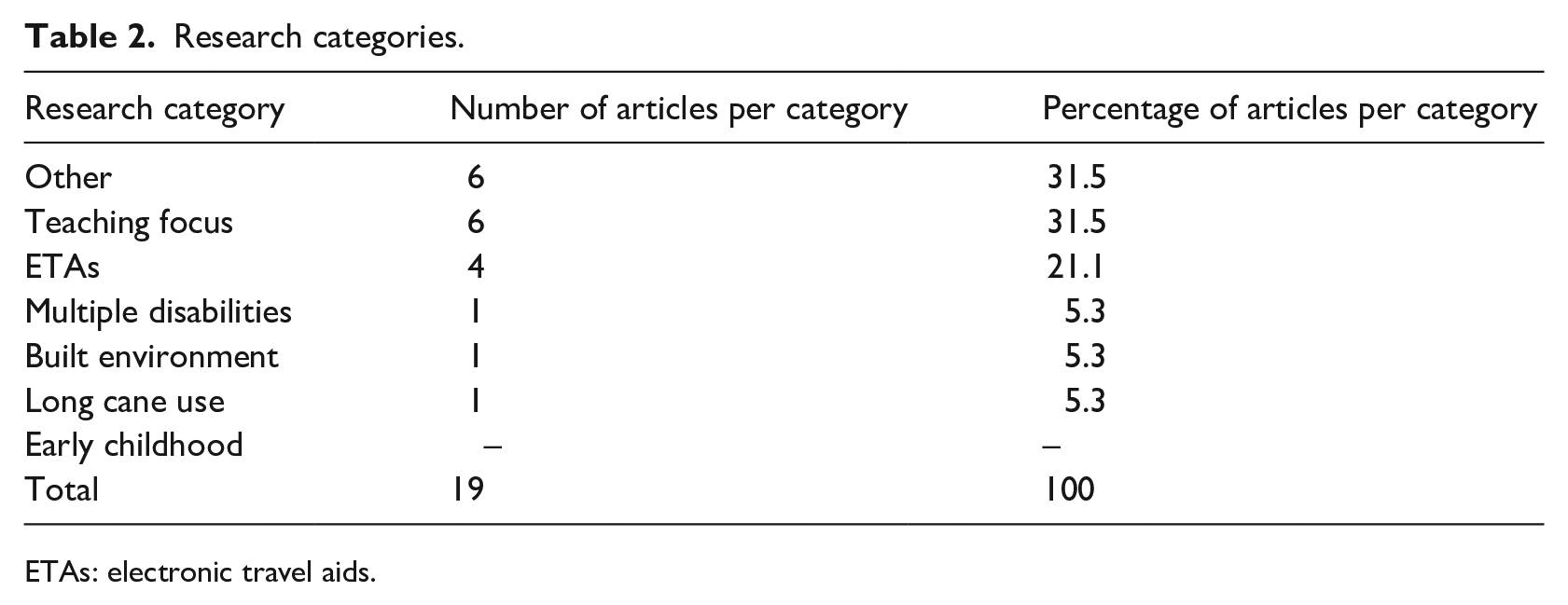
ETAs: electronic travel aids.
To explore the existing discourse and paradigm of O&M research and the ‘extent to which a dominant set of assumptions’ (Orlikowski & Baroudi, 2011, p. 4) informs O&M learning, teaching, research, and subsequently practice, a three-way literature analysis was completed. The three-way literature analysis of the 19 articles (see Tables 1 and 2) comprised classification and analysis of the articles by research design, then by the time frame of the study, and finally, by epistemology (Orlikowski & Baroudi, 2011).
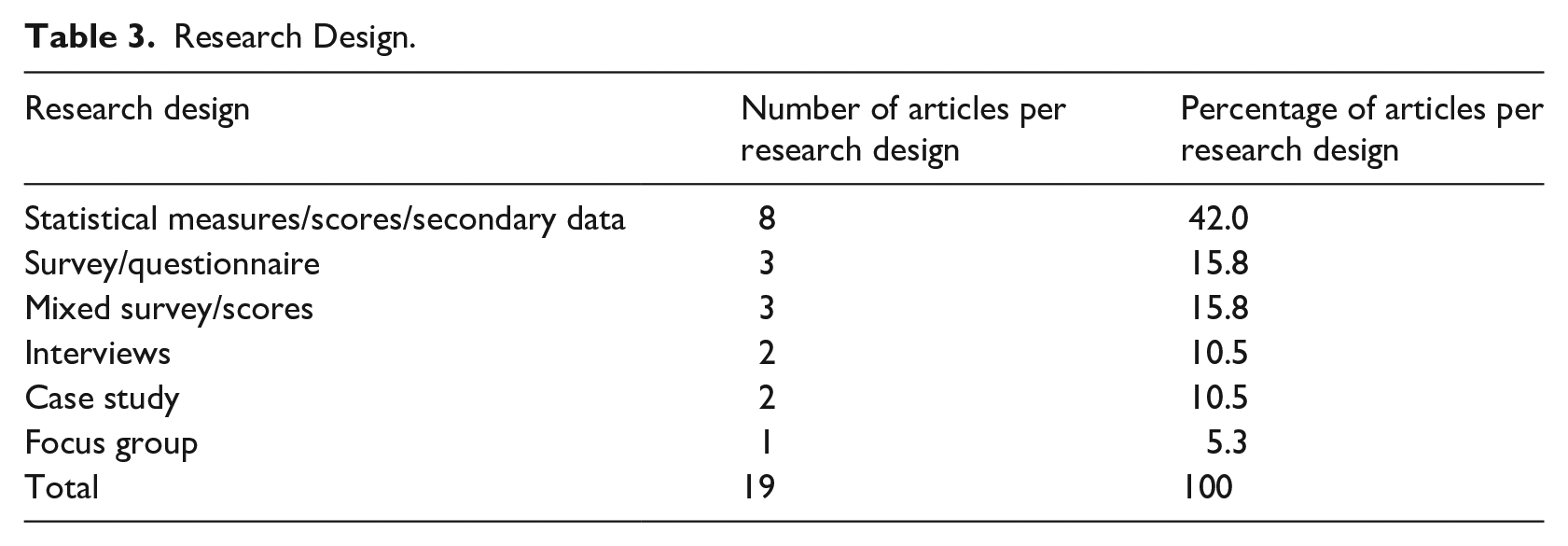
Table 3 displays the frequency of the various research designs in the 19 articles. Three primary research designs emerged: statistical measures (42%), surveys and questionnaires (15.8%), and research with a mix of both statistical measures and surveys (15.8%). These three designs accounted for almost 74% of the studies under review. Statistical measurements were clearly the dominant research method in this sample.
Research Design.
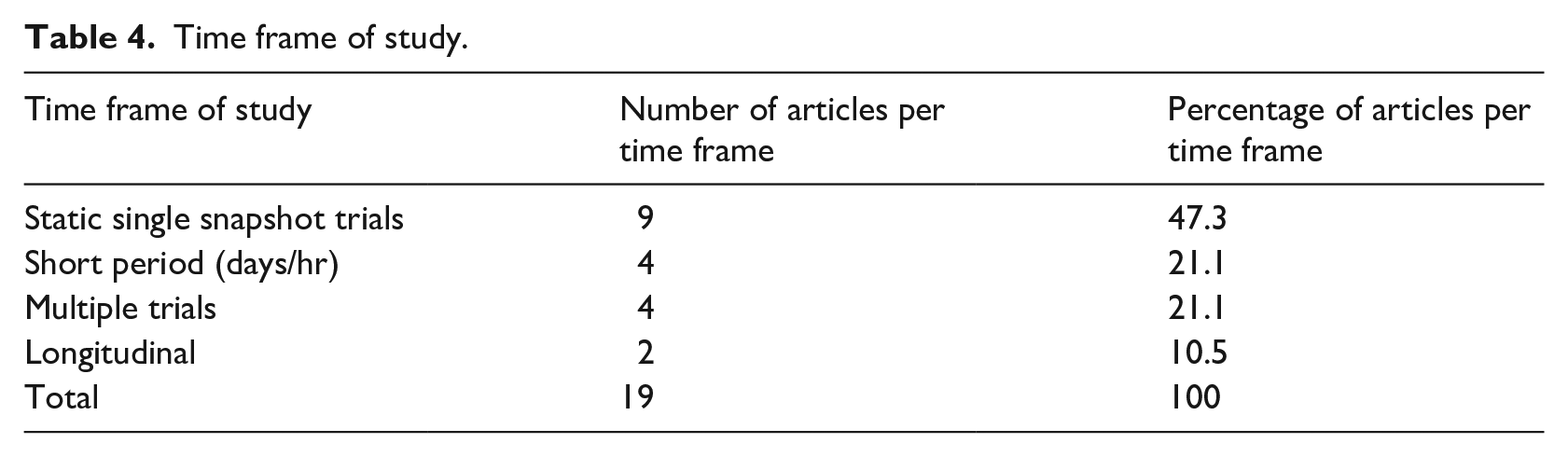
The 19 articles were then analysed based on the period of the study (see Table 4). The four period categories from Orlikowski and Baroudi (2011) were appropriated to the O&M professional research field. For example, the information-processing category ‘process traces’ used in Orlikowski and Baroudi’s (2011) literature investigation was replaced by ‘short period’ to more specifically reflect O&M field research. Static single snapshot studies were the predominant form of research in O&M for this given period. These studies accounted for nearly 50% of the articles in the sample, while longitudinal studies accounted for only 10.5% of the literature sample.
Time frame of study.
The final literature analysis involved investigating the underlying epistemology – knowledge beliefs – that guided the research (see Table 5). Similarly to Orlikowski and Baroudi (2011) and Chua (1986), the research epistemologies were classified into positivist, interpretive, and critical studies. The criteria adopted in classifying studies as positivist required evidence of the central tenets of positivism, such as ‘formal propositions, quantifiable measures of variables, (and) hypothesis testing’ (Orlikowski & Baroudi, 2011, p. 5). The studies deemed interpretive were identified based on Orlikowski and Baroudi (2011), where the ‘intent of the research was to increase understanding of the phenomena within cultural and contextual situations’ in ‘natural setting(s) and from the perspective of the participants’ (p. 6). The criteria adopted for classifying critical studies required evidence of a fundamental critical and political orientation with an emphasis on communicative action (Willmott, 2011).
Epistemology.

The epistemological article analysis revealed that positivist knowledge beliefs were most dominant, accounting for 63.2% of the studies. Interpretive studies represented less than half of the studies, and there was a paucity of critical studies in the O&M research field.
Discussion
The primary goal of this critical literature analysis was to examine the dominant research perspectives and worldviews present in the O&M research phenomena. In particular, the aim of this critical literature analysis was to consciously examine and question the underlying assumptions of the O&M research community and to elicit a transformation of thinking about O&M learning and teaching. To put it another way, this literature analysis was an attempt to search for the sea-change to the O&M profession as called for by O&M theorists Emerson and McCarthy.
The results from the three-way critical literature analysis collectively indicate that the two categories – using and adapting technology (e.g., electronic travel aids) and built environment (e.g., navigating complex traffic) – continue to be dominant practice and research in O&M. In addition, there was clearly a predominant set of assumptions about what constitutes acceptable O&M research and practice.
The O&M identity or more specifically, the accepted O&M way of thinking, acting, and believing appears to influence much of the published O&M research. This O&M paradigm includes investigations of phenomena from a primarily quantitative epistemology, mostly employing single snapshot and statistically measured data. In other words, the acceptable measures of O&M learning and teaching are a small set of visible formal, technical, and quantifiable O&M skills. Specifically, the technical knowledge and skills of long cane, technology, and efficient route travel frame the O&M learning and teaching discourse. More importantly, the accepted O&M learning and teaching identity is of the O&M practitioner who is well versed in the instruction of traffic navigation, residential travel, and electronic travel aids.
The results of this current literature analysis confirm conclusions by Emerson and McCarthy (2014) that ‘using and adapting technology is a dominant trend’ in O&M research and subsequently in practice (p. 273). The results also highlight the continued lack of research on O&M for people with VI and additional disabilities, O&M for people with cerebral visual impairment, O&M for students and children with VI, and more importantly, the O&M learning and teaching pedagogies. Finally, this current literature review provides evidence that the publicly accepted identity of the O&M profession – with the exception of the trend in technology – has remained unchanged since the profession’s inception nearly 80 years previously. The O&M profession is yet to experience a sea-change.
None the less, there appears to be implicit consensus among O&M specialists that O&M learning and teaching is an important disability-specific skill for people with VI. O&M learning and teaching is more than a set of formal technical skills, traffic navigation skills, or adaptive technology. According to LaGrow (1998), O&M is a ‘learned skill’ requiring selective attention to various sensory input, and the assigning of meaning to that input (p. 195). For Huebner and Wiener (2005), O&M is a ‘fundamental and enabling life skill’ (p. 579). While for Anthony et al. (2010), O&M awareness is ‘knowing oneself as a separate being, where one is in space, where one wants to move into space, and how to get to that place’ (p. 327). Although O&M specialists advocate that O&M learning and teaching encompasses a broad range of concepts and learning areas (Downey, 2017), this is not reflected in the research literature on O&M learning and teaching.
The lack of alternative accepted O&M discourses potentially limits the study and practice of the more diverse aspects of O&M learning and teaching. Consequently, this lack of diversity in the O&M professional discourse has far-reaching implications for the growth and development of the theory and practice of the O&M phenomena. It was for these reasons, therefore, that Emerson and McCarthy (2014) initially called for the sea-change to O&M research priorities.
Radical transformational change such as a sea-change, however, is more than continuous improvement or development (Duffy, 2009). Transformational change requires ‘true innovation’, and ‘reinvention rather than just replication’ of best practice (Duffy, 2009, p. 5). Profound paradigm shift requires clarity, communication, and commitment to transformation across three platforms (Duffy, 2009). Appropriated to the O&M context, these platforms of change are situated as change to: the core systemic overarching international body of O&M processes and practices; the internal social O&M infrastructure (e.g., O&M professionals and people with VI); and the external or larger O&M sociocultural systems (e.g., the general public).
Enacting a paradigm shift, therefore, is a multifaceted process (Astin, 1996; Astin & Astin, 2000). Hence, enacting an O&M paradigm sea-change urgently necessitates clarity and understanding of all aspects – ideas, values, and actions – of O&M learning and teaching.
Conclusion
This literature analysis focused on better understanding ‘if and how’ a sea-change has occurred in the discourse of the O&M profession, practices, and research. Results of the literature analysis revealed that the research paradigm and consequently identity of the O&M profession has not moved beyond the accepted formal long cane, residential, and traffic navigation skills. In fact – with the exception of adapting and using technology – very little has changed within the O&M phenomena. The old paradigm persists. This means that the vital sea-change called for by Emerson and McCarthy (2014) is yet to occur.
There is future need for greater evidence-based O&M processes and practices. The implicit O&M subculture requires further critical analysis. The public expectations and perceptions of O&M practices require additional clarity. Most importantly, the current identity of the O&M profession urgently requires reinvention.
