



Abstract
Mate choice is one of the biggest psychological, social, and emotional changes in the life of every human being. This issue is associated with challenges and problems for people especially blind and visual impairment (VI) people. Although marriage leads to many changes and transformations in the life of blind and VI people, it is essential for meeting psychological, social, emotional, and sexual needs. Accordingly, this study aimed to analyze the psychosocial experiences of VI girls about the ideal husband and marriage. This qualitative study was conducted with a descriptive phenomenological approach. The data were collected through targeted interviews with 20 single girls with VI who were members of the White Cane Society of Tehran in 2021. The collected data were analyzed using Colaizzi’s seven-step method. Four main themes were extracted from the participants’ experiences, including “experience of love and freedom,” “criteria for selecting an ideal spouse,” “fear and worry about the marriage,” and “stigma and strict public judgments.” Following the findings of the study, it can be argued that paying attention to the experience of girls with VI can shed light on their criteria for mate choice and marriage and clarify their needs and demands. This perspective helps mental health professionals and rehabilitation counseling experts to meet their needs through social welfare planning and family awareness programs.
Introduction
According to Lancet Global Health statistics, by 2020, 1 billion persons have moderate or severe distance vision impairment or blindness due to unaddressed refractive error (Bourne et al, 2021). According to statistics, by 2020, between 600,000 and 700,000 people in Iran have been identified with visual impairment (VI), and 115,000,000 of them were completely blind (Aghaee-Chaghooshi et al., 2021). Blind people, as sensory disabled people, face limitations in having an independent life, psychological and social problems, poor involvement in social activities, and even the problems of not adapting to the urban space and public transportation (Aslan et al., 2012). Blindness and VI are problems and challenges that make affected people face many psychological and social problems (Bhagchandani, 2014). Every society is formed based on diversity in language, gender, religion, age, and disability, and having a family and children is a human right for all people regardless of these diversities. Each society is founded on the family system (Satvat et al., 2019). Marriage can meet the need for love and affection. Marriage is a psychological and physical need for humans, and loving and being loved is a human need that can be satisfied with another person. There is a stereotype that people with disabilities are sexually disabled, unattractive, and lack sexual desire. In some cases, they are not considered a full woman or “fully human beings” (Goyal, 2017; MacInnes, 2011).
This common thinking does not exist only in ordinary people, but health professionals are also affected by these false beliefs about sexual ability and sexual functions in blind, and VI men and women. For example, Peta (2017) revealed that health and care providers refuse to advice on sexual health and contraceptive methods for women with disabilities, assuming that they are not involved in this relationship or do not need this information (Peta, 2017). In another study in Iran, the researchers analyzed the challenges of the marriage of physically disabled people and concluded that there is a strong social stigma about their marriage and even the public is not willing to accept their psychological, emotional, and sexual needs for marriage. There is a dominant assumption that why these people should get married when they cannot even take care of themselves. Other obstacles to the marriage of physical–motor disabled people in Iran were unemployment, dual attitudes and feelings toward marriage, and lack of government economic support (Satvat et al., 2019).
People with VI are directly and indirectly exposed to various discriminations in their daily lives. A major part of discrimination is rooted in social misconceptions, and even many people in various societies not only do not consider marriage to be a psychological and physical need for these people, but also consider it a kind of burden for society (Warner & Adams, 2016).
Bekoe (2018) examined the obstacles to the marriage of people with disabilities in Ghana and concluded that these obstacles are more severe when it comes to sensory disabled, that is, blind and VI people. The results showed that the major obstacles to the marriage of blind and VI people include: (1) severe public rejection, (2) interaction problems with family members and surrounding people, and (3) motor and physical problems, for example, in using public transportation system and even the ability to move independently without physical restrictions in cities or villages. The results also indicated these problems are worsening several times when a blind or VI person lives in developing and poor countries (Bekoe, 2018).
Although blind people face many challenges and obstacles in their daily life, finding a good partner and having a high-quality and satisfying married life solves many of their emotional and psychological problems (Schulz, 2008; Trelfa, 2004). In their meta-analysis study, Robles et al., (2014) concluded that the quality of life of a couple has a direct and significant relationship with the physical health of the couple. Couples who experience high marital quality in their relationships experience longer life spans and higher psychological health compared to unhappy couples (Robles et al., 2014).
Despite the prevenient public belief, a disabled person has the same mental and sexual needs as other non-disabled people and even sometimes they feel the need to love and to be loved more than non-disabled people (Satvat et al., 2019). Public beliefs governing societies and conventional policies in countries are one of the main obstacles to the marriage of disabled people (Li & Singleton, 2016).
In general, marriage and mate choice are of the basic social and psychological problems of girls with blindness and VI. Considering the special cultural sensitivities of the Iranian society toward the marriage of girls and the negative views about celibacy, marriage has become a challenge for this group of girls. Blind and VI people face major problems in getting married and forming a life, including unemployment, high cost of living, negative beliefs, or biased public views. Even health care experts have negative attitudes toward the marriage of these people (Peta, 2017). Accordingly, it is essential to explore mate choice problems and marriage issues among Iranian girls with blindness and VI. An important thing to note is the small number of qualitative studies in this field in Iran and other countries. Thus, this qualitative phenomenological study aims to provide an in-depth analysis of the psychosocial experiences of VI and blind girls about mate choice and marriage criteria.
Method
This qualitative study was conducted using a descriptive phenomenological research design. In this type of study, the researcher explores the lived experiences of people and seeks to discover the meaning of the phenomena from their point of view (Valle & King, 1978). People narrate their actions or experience and feelings to the researcher, and the researcher then interprets their statements. This research method can provide researchers with information about the participants’ experiences and views. Accordingly, this phenomenological study aimed to analyze the psychosocial experiences of blind and VI girls about the ideal husband and marriage. The research population included girls with blindness and VI who were members of the White Cane Society of Tehran in 2021. In phenomenological studies, sampling should continue until the data collected about the phenomenon in question are saturated, that is, when no significant information is obtained with further sampling (17). The participants in this study were selected through purposive sampling, and data collection continued until the data were saturated by interviewing 20 girls. To check the degree of blindness and VI, the International Classification of Diseases 11, Fricke et al. (2018) classifies vision impairment into two groups, distance and near presenting vision impairment.
Distance vision impairment - Mild visual acuity worse than 6.12–6.18 - Moderate visual acuity worse than 6.18–6.50 - Severe visual acuity worse than 6.60–3.60 - Blindness – visual acuity worse than 3.60
Near vision impairment - Near visual acuity worse than N6 or M.08 at 40 cm (Fricke et al., 2018).
The selection criteria for the participants in the study were: (1) having at least a high school diploma for the interview and the ability to understand the content of the interviews, (2) having disability records in the welfare department and being a member of the Tehran White Cane Society, (3) the girls who were planning to get married, and (4) the girls of marriageable age (20–35 years). The exclusion criteria were: (1) single participants who had married previously and (2) those who had other physical and mental disabilities in addition to visual disabilities.
To eliminate the researcher’s bias in her personal views and inference in detecting the saturation of the data, not only sampling continued until the data were saturated, but also the data collected from the participants were reviewed by three professors of mental rehabilitation, ophthalmology, and nursing and data collection continued until the adequacy of the data was confirmed by the three experts.
The data were collected through semi-structured interviews to explore the experiences of VI and blind girls and their views about marriage and mate choice criteria. Before conducting the interviews, it was ensured that the participants were involved and had experiences with the subject, and intended to get married. Examples of the questions asked in the interviews were: What experiences and views do you have about mate choice? What personal experiences do your family and people around you have about the criteria for choosing your future partner?
Before starting the interview, the researcher introduced herself and the research topic. Each interview lasted from 45 to 70 min, totaling 1240 min. The interviews were conducted from 10 April to 20 October 2021. The location of the interviews was the White Cane Society in Tehran. First, the participants’ demographic information, including age, education, employment, the field of study, parents’ kinship, type of disability, medical class, cause of disability, and place of residence were recorded. All interviews were conducted in person. Then, the participants responded to the main interview questions. At the end of each interview, the content of the interview was transcribed for subsequent coding and analysis.
The collected data were analyzed using Colaizzi’s seven-step method (Shosha, 2012). In the first step, at the end of each interview and taking field notes, the researcher listened to the participants’ recorded statements several times and transcribed their statements word by word on paper. Then, the transcripts were reviewed several times to understand the participants’ feelings and experiences. In the second step, the significant statements related to the phenomenon in question were identified and underlined. In the third step, the themes related to each statement that reflected the participants’ ideas and experiences were extracted and classified. The extracted themes were then compared with the corresponding statements to ensure their relevance. In the fourth step, the researcher carefully reviewed the themes and classified them into related categories based on their similarities. The related categories were merged into thematic clusters. In the fifth step, the emerged thematic clusters were merged into more general categories. In the sixth step, a thorough description of the phenomenon in question was provided. Finally, in the seventh step, the findings were reviewed and confirmed by asking the participants to express their opinions about the findings of the study.
To check the rigor of the study, the credibility and trustworthiness criteria proposed by Guba and Lincoln (1994) were used. This was done through long engagement with the research setting, triangulating the findings with the previous studies in the literature on obstacles to the marriage of people with sensory disabilities and the experiences of blind and VI girls, engaging the participants and returning to them frequently in interpreting the data and reviewing the findings (member checking), and describing the research procedures clearly to help readers understand the findings. The findings were also reviewed by the two professors (peer checking) in the qualitative research. To comply with the ethical principles for voluntary participation and withdrawal, conducting the interviews, and recording the participants’ voices, informed consent was obtained from them. The participants were also reassured of the confidentiality of their names, phone numbers, and addresses. After the interview, the recorded voices of the participants will be stored in a secure place for 5 years, after which they will be destroyed. The protocol for this study was confirmed by the Research Council of Khatam University.
Results
Table 1 shows the participants’ demographic characteristics.
The participants’ demographic data.
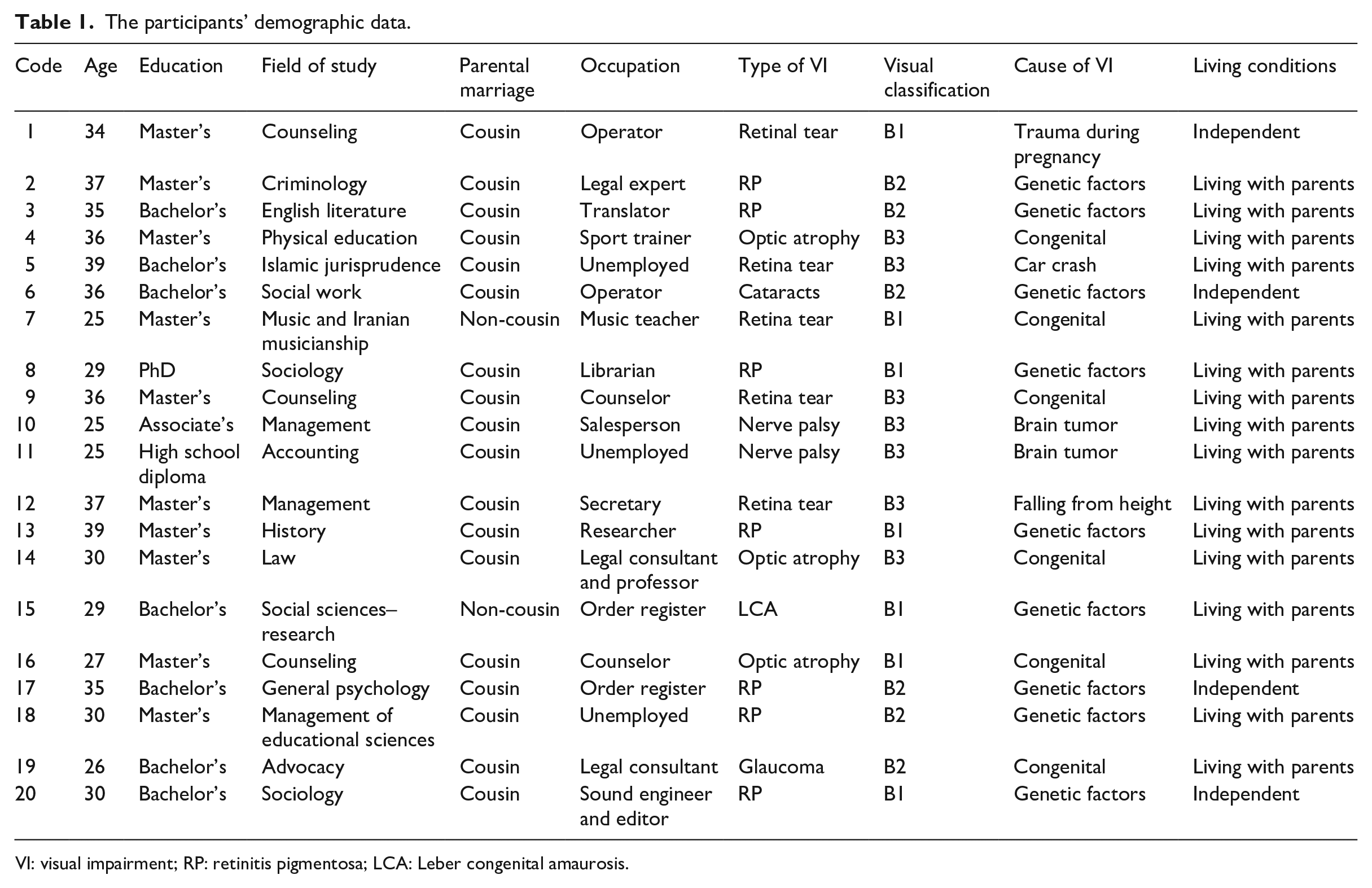
VI: visual impairment; RP: retinitis pigmentosa; LCA: Leber congenital amaurosis.
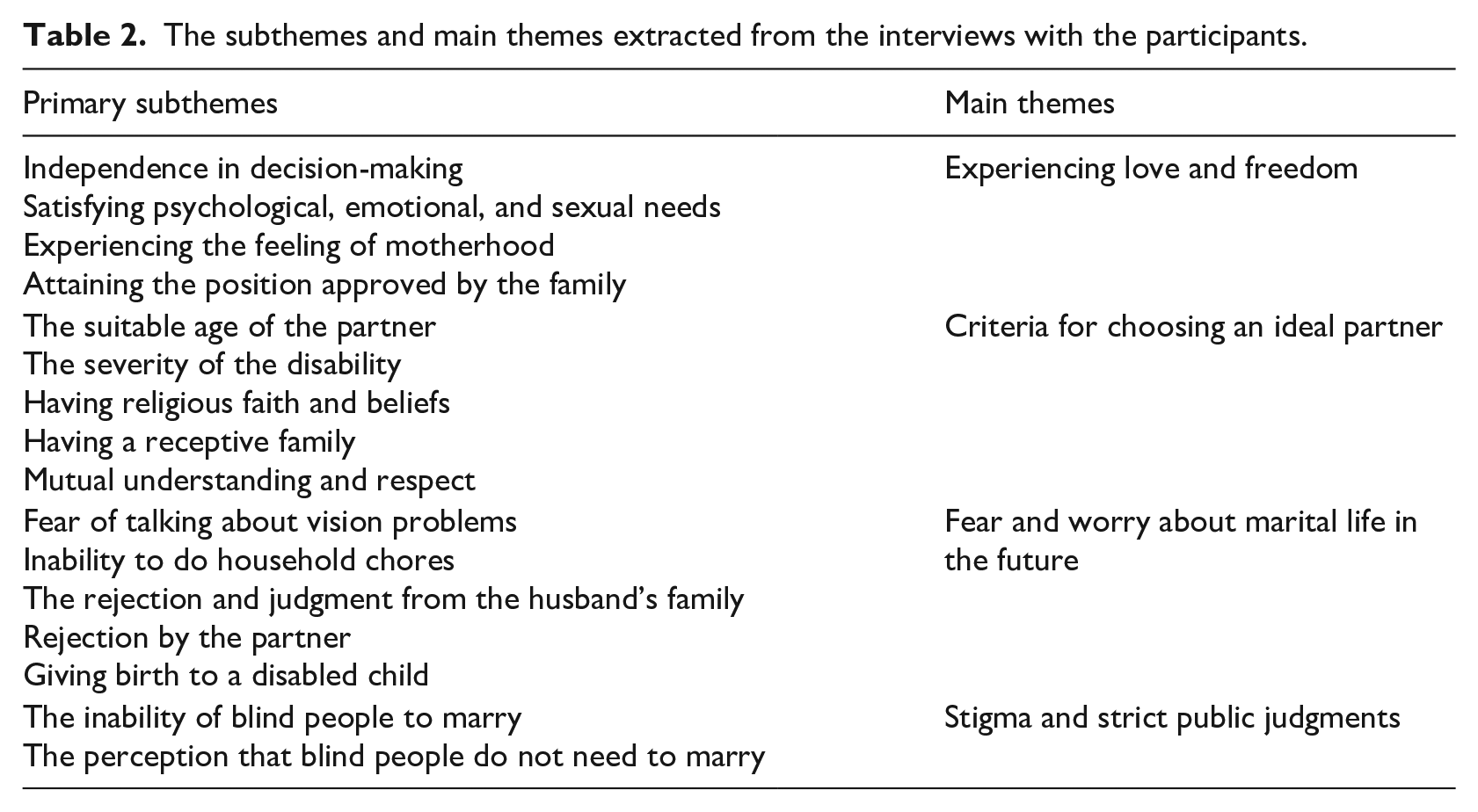
As can be seen in Table 1, 18 participants out of 20 participants, their parents had a consanguineous marriage. This marriage is encouraged for religious reasons in Iran and other Muslim countries in the Middle East. For this reason, most of the disabilities of people in Iran are also due to genetic reasons (Saadat et al., 2004; Table 2).
Theme 1: experiencing love and freedom
Independence in decision-making
Independence means the ability to think and act without relying on others. For example, a participant stated, I think by getting married, I will be able to become independent and make progress. I will also have a bit fewer limitation. For example, my parents constantly ask me where I am going, and what I am doing. I cannot take every course or I can’t hang out with anyone. When I get married, I will be relieved from my parents’ strict behavior and somehow, I will experience freedom and independence. (Participant 11)
The subthemes and main themes extracted from the interviews with the participants.
Meeting psychological, emotional, and sexual needs
People marry to survive their generation and meet their mental, emotional, and sexual needs. One of the participants pointed out, I want to marry to reach mental, spiritual, and psychological peace through love. I don’t think about anything else in marriage because, in my opinion, there is nothing more pleasant than that two people love each other so much that they enrich and free each other from everything in this world and they support each other and live peacefully together. In my opinion, marriage has no higher purpose than that two people support and rely on each other and bring peace to each other. The biggest goal in marital life is to achieve peace and of course, marriage is also an emotional and sexual need that must be satisfied. (Participant 2)
Experiencing the sense of motherhood
For many women, one of the most beautiful experiences in life is the feeling of motherhood, as was frequently highlighted by the participants. For example, a participant stated, When you are young and up to 25 years old, you have a lot of energy and you are busy with work, studies, etc. so that you don’t think about finding a good partner. I didn’t think about marriage then and I believed that I still had enough time. But not anymore. When you see that everyone is getting married, you will not be satisfied, no matter you have a good job and something is missing with you because everything must be done at its right time. You suddenly end up being alone and longing for having children but you have not married yet. I love children and want to have 5–6 children. Sometimes I think how hard it is to come into this world as a woman without experiencing the feeling of motherhood for a moment. It’s very sad. (Participant 4)
Attaining the position approved by the family
In some cases, people marry to gain approval from the family. For example, a participant said, Many times, marriage gives a person a sense of approval. When you see your brothers or sisters married and how much more respected by other family members or parents, you also want to get married as if to prove yourself that you can get married too. (Participant 13)
Theme 2: mate choice criteria
Suitable age of the partner
A reasonable age difference between the husband and wife in pre-marriage counseling is an essential requirement for marriage stability. One of the participants stated, At first, I thought it didn’t matter how old my would-be husband was, but recently it has become very important to me. Because one of my friends married an old man whose wife had died, and they had a lot of problems. It’s like they were from two different worlds and then they got separated. Unfortunately, since we’re blind or partially sighted, even family and friends think we should marry people who are very old or do not have a good appearance. Sometimes very old people with many physical problems seek to marry us and they may think we do not see their defects and problems. (Participant 19)
Severity of disability
Some blind or VI girls are encouraged to marry men with different disabilities. However, the severity of the future partner’s disability was one of the criteria for mate choice. For example, a participant said, I don’t like my partner to be half-sighted like me, and I would like him to be healthy at least. Unfortunately, many people think that we do not have the right to choose our partner because of our disability. I experienced this. They once introduced me to a boy who was even mentally retarded, i.e. borderline, and they insisted that I marry him. Now imagine that I had a bachelor’s degree myself. How can I communicate with these people? I don’t want to criticize anyone, but I mean the husband and wife must have the ability to talk and communicate with each other. (Participant 10)
Having a job and independent life
Responsibility means an internal commitment on the part of a person to carry out the activities assigned to him, especially the commitment on the part of the husband. Accordingly, a participant stated, In my opinion, a man should be responsible, and one way to be responsible is to have a job. How can he accept the responsibility of life when he doesn’t have a job? A girl needs support when she gets married, but unfortunately, the economic conditions in our community are so unfavorable that some healthy people cannot afford the costs of their families and they are looking for their wives to pay their living costs. (Participant 6)
Having faith and religious beliefs
Faith means believing in God and characteristics, such as honesty, good manners, trustworthiness, not being jealous, and humanity. These characteristics were of special importance for the participants in the study. For example, a participant said, First, my husband must be a believer and responsible man. He should have a belief in God and have faith. Prayer is an important criterion for me. His family should not doubt and be proud of the partner chosen by him. He should be honest and he should have an education at least equal to mine. He should have social manners to fit the dignity of my family. He should be independent and wise, and he should not have my disabilities. (Participant 9)
A receptive family
The acceptance of the future spouse by the family is very important in the stability of marital life. One of the participants stated, I believe that if a boy is good, his family is also good and he has been raised by good parents. If a boy is not the way I like, his family is also the same. You may know by a handful the whole sack. I like him to have a small family and I don’t know why. Maybe I feel that if my husband has a large family, they may interfere with our life. The reality is that if a person wants to get married, the family must accept their child’s spouse. Many marriages that were solemnized just with the consent of the families end up breaking after a few years at the instigation of the families. What about a marital life that has not been formed upon the two families’ consensus since the beginning? (Participant 3)
Mutual understanding and respect
One of the requirements for a good marriage is mutual understanding and respect between the husband and wife. One of the participants stated, I like my husband to understand me, to be a good listener, to have good communication skills, to have a beautiful and attractive voice, not to be selfish, to be a good friend and to be full of energy. Generally, we need to respect each other and he must be able to understand me. (Participant 20)
Theme 3: fear and worry about marital life in the future
Fear of talking about vision problems
Vision impairment means a person has any visual disorder that makes it difficult for them to have perfect visual functions. Accordingly, a participant stated, One of my fears with suitors who propose marriage to me is to talk about my vision problem. I already had a suitor and I told him on the phone that I have vision problems, he apologized and he did not call again. But what happens in the end? I have to talk about this problem with any person who wants to marry me, but I was always faced with the problem of when I should reveal this issue and how I should make it clear to him that I hate it if my husband wants to twist me for his favor of marrying me with my vision impairment. (Participant 14)
Inability to do household chores
One of the concerns of VI and blind girls is the problems they face when doing household chores and handling housekeeping affairs. For example, a participant stated, I always feel anxious when I think about doing things such as housework and taking care of the baby, especially in the first months of marital life. In general, doing housework is not an easy task, and anyway, this is part of a wife’s duties. (Participant 8)
The rejection and judgment from the husband’s family
Being judged in marital life, especially by the spouse’s family is one of the problems that may affect the stability of the marital life of a couple. Accordingly, a participant said, There is some difference between us and people without any vision problems, and my biggest fear is the husband’s family, not the husband himself. I don’t know how I can be confident not to show any weakness while I’m living with them and I don’t know why . . . ? I’m afraid of being judged and that’s all. (Participant 15)
Rejection by the partner
The feeling of abandonment and rejection by the husband is one of the concerns of blind and VI girls in their marital life. For example, one of the participants stated, Marriage and its responsibility make me feel the fear of loss, for example, losing the relationship I built, the fear of separation because I see married people have many problems; fear of not only divorce but also the distance between couples who get involved in daily life. I also ask why a healthy man stay with me as blind people should face many problems. Well, I’m worried that my husband will leave me after a while because he will get tired of taking care of me. (Participant 7)
Giving birth to a disabled child
The best outcome of every marriage is to have a child, and this child can be healthy or have a congenital disability or a disability that is developed after birth. Taking care of such a child is very difficult for non-disabled or healthy people and much more difficult for disabled people: One of my dreams is to have a child, but given my physical condition and of course, genetic issues, and my disability, I fear that if I give birth to a child with a disability, whether it is sensory, physical, or even mental, the care and concern of taking care of the child will become worse and thus having a child not only does not solve my problems but also will worsen them. (Participant 3)
Theme 4: social stigma
Inability of blind people to marry
In this study, opposition to the marriage of disabled people means some people in the community do not agree with the marriage of disabled people under any circumstances and they consider only healthy people to be entitled to this right. One of the participants stated, People treat individuals with disabilities in a dual way: either very good or very bad. Those who show good treatment are divided into several categories, but I think those who do not think positively about disabled people make up 50% of the community. These people believe that we should not get married because of our inability to do household chores, and they don’t even believe that we can prepare a simple meal, and this is very indecent in my opinion. (Participant 5)
The perception that blind people do not need to marry
Some people think that disabled people do not need to marry. For example, a participant stated, Many people just ask if blind people must get married. Many people say, and I have even heard them say that, well, this type of marriage is not right because the husband or wife has to take care of the disabled partner until the end of their life. They also resort to the visual ability to account for the feeling of love and sexual needs. They believe that when a person cannot see, then he/she does not have sexual feelings. Once someone asked me if I need to get married and my marriage only has a financial burden. I got very sad. I asked myself what was God’s purpose in bringing us to this world. (Participant 1)
Discussion
The findings of the present study showed that the marriage of blind girls is associated with fear and hope. This means that VI and blind girls face many challenges in Iranian society in terms of the criteria for selecting a partner and starting martial life. However, they want to marry to experience love and freedom. Some Iranian families are sensitive to girls’ freedoms, and sometimes girls have to marry just to gain freedom and get rid of the pressures and the strict family atmosphere. At the same time, these girls referred to the sense of motherhood and emotional needs as other factors in their desire to get married. Similarly, Shpigelman and Vorobioff (2021) showed that romantic relationships in adults with vision disorders lead to self-acceptance and psychological well-being. Although, individual, cultural, religious, and gender-related factors can be influential in the formation and continuation of a romantic relationship (Shpigelman & Vorobioff, 2021). The participants in the present study considered some criteria for marriage, including the suitable age of the partner, the severity of the disability, having religious faith and belief, a receptive family, and mutual understanding and respect. In line with these findings, Kapperman and Kelly (2019) examined the criteria for mate choice according to gender. They found that girls with vision problems choose their husbands based on higher education, social status, and financial resources. Higher body size and strength are also important (Kapperman & Kelly, 2019). The present study also showed that the spouse’s family and having a good family were also important criteria due to cultural differences. Moreover, blind and VI girls tend their husbands to be at a suitable age that is, not too old or too young. Some participants emphasized the beautiful and expressive voice of their ideal partner as one of their criteria for marriage. Accordingly, the researchers showed that auditory ability is an important mate selection criterion for both men and women with blindness disorders (Scheller et al., 2021; Sorokowska et al., 2018). Another study showed that emotional maturity is an important criterion for marriage for VI youth (Pinquart & Pfeiffer, 2012). Moreover, Fekler et al. showed that people with VI did not have much difference in ideal romantic partners with sighted people. However, VI was a problem in finding a mate and offered proposals (Fekler et al., 2020).
Although studies have provided some evidence for the ideal partner criteria for VI girls, the concerns and psychosocial problems experienced by these girls about having a marital life have been less addressed or not addressed at all. The participants in the present study stated that they had many fears about their marital life in the future. For instance, they feared that their vision or their disability worsens, they could perform housework and conjugal duties, and eventually, their husbands get tired of them and leave them.
The perception that people with VI do not need to marry and have sexual relations is one of the basic problems to address the importance of psychological and social needs of this group of people for marriage. Even there are some social and cultural obstacles to education on sexuality and sexual health. People with VI face many challenges to sexual health education like health issues, communication problems, and people’s acceptance of the inhibition of their sexuality (Jablan & Sjeničić, 2021).
The participants in this study stated having an emotional and sexual relationship is essential for the continuation of marital life. However, the importance of teaching sexual organ physiology, sexual health education, creating educational content and the necessity of people’s participation in sex education should be highlighted in rehabilitation and treatment programs (Aghaee-Chaghooshi et al., 2021; Kapperman & Kelly, 2013; Wild et al., 2014).
Previous studies have revealed that the marriage of disabled people is very different depending on the type of disability and even the gender of disabled people. For example, Bekoe (2018) examined the challenges of disabled people’s marriage and showed that blind and VI people are subject to more social judgment and rejection for marriage, and there are more problems faced by blind women. Furthermore, Anderson (2018) considers the role of social relationships and interactions to be very important for marriage in people with disabilities. The findings also indicated that disabled people generally experience higher social isolation, low self-esteem, and more depression than non-disabled people. Therefore, they have fewer social activities and less chance of getting married (Anderson, 2018). Likewise, other studies have shown that the level of life expectancy and hope for the future in blind girls are much lower than their sighted counterparts (Monah, 2018).
In addition to the physical and psychological challenges that VI and blind girls face on the path to choosing an ideal spouse and marriage, social rejection and the belief that blind and VI girls do not need to marry are other problems on their way to marriage. This problem is worsening in developing and poor countries. For example, Monah (2018) investigated the public opposition to the marriage of disabled people in Kenya and concluded that families, relatives, and even the public systematically do not accept the presence of people with visible disabilities in the community, and this opposition is more server for women and girls. Similarly, the studies conducted in Western countries do not consider cultural restrictions the only obstacles to the marriage of these people, but also the type of national and community policies, which reduce the chance of interaction and finding a partner for these people (Caputo & Simon, 2013).
Limitations
The present study was conducted with some limitations, including the difficulty of conducting interviews due to the participants’ physical conditions and restrictions in their transportation and movement. Moreover, the participants were selected only from blind and VI girls in the Tehran White Cane Society. These participants did not represent blind or VI girls ready for marriage in the cities and villages and illiterate or low-educated people in Iran.
Conclusion and implication
The findings of the present study highlighted two basic issues: The first issue was related to the perspective of VI and blind girls regarding their psychological and personal challenges and concerns about marriage and their marital life, which may be rooted in their low social activities and poor self-esteem and self-concept. The second challenge was the family and public rejection and the perception that blind and VI girls do not need to marry. However, the findings of this study highlighted that emotional, psychological, and sexual needs are not related to the appearance or the visual power of people. Besides, since marriage and mate choice are considered human needs in all cultures regardless of their differences, non-governmental organizations (NGOs) and organizations supporting the blind should provide an opportunity for these people to get acquainted with other people by holding various social events. Moreover, educating and raising the awareness of the public, mental health professionals, and health care workers about the psychological and sexual needs of blind and VI is essential. Future studies can also focus on the perceptions and beliefs of the families of girls with IV about marriage and address the role of gender differences in women’s and men’s experiences.
Footnotes
Acknowledgements
The authors would like to express their acknowledgment to the participants and officials at the White Cane Society, the Blind and Visual impairment Association of Tehran, and the Welfare Organization of Tehran Province for their sincere cooperation in conducting this research project.
Declaration of conflicting interests
The author(s) declared no potential conflicts of interest with respect to the research, authorship, and/or publication of this article.
Ethical considerations
This research project was approved under the code of ethics by the Khatam University in Iran.
Funding
The author(s) received no financial support for the research, authorship, and/or publication of this article.
