




Abstract
This study focuses on the lived experiences of students with blindness in learning and using Braille for academic purposes at Haramaya University, Ethiopia. A descriptive phenomenology design was employed, and eight students with blindness were purposefully selected to be the sample for this study. Data were collected using substantive interviews. A digital audio recorder was used to capture the voices of respondents. The data were translated into English using Google Docs and Google Translate (supported by VB audio virtual cable). Then, the data were coded, themed, and analyzed using QDA Miner Lite software. Thematic analysis was used to analyze collected data. There are three main themes and seven subthemes among students with blindness based on their actual experiences learning and using Braille for academic purposes. These are characteristics of blind students who have learned Braille and are using it for learning; contributing factors for knowing Braille and using it; benefits of using Braille; impacts of knowing but not using Braille for academic purposes; reasons for knowing but not using it for learning; factors influencing not learning using Braille; and characteristics of blind students who did not know Braille. The practical intersections of students with blindness knowledge of Braille and their use of it for academic purposes influence their lived experiences. The study encourages and advises administrators of academic programs, curriculum and software developers, and policymakers, including practitioners, to consider Braille interpretation service issues to increase participation and meet the needs of students with blindness during teaching–learning programs in the study area.
Introduction
Braille is vital and the only system through which children with the visually impaired can learn to read and write. Braille is a system to help blind children learn Braille with a sighted parent (Gadiraju, 2019). In developing countries, less than 3% of children with visual impairment are learning to read Braille in school (Seng Sai, 2019). People with blindness use the Braille system for reading and writing (Chitte et al., n.d.). The relevance of the study depends on the fact that sufficient methods and approaches related to teaching Braille literacy have not yet been thoroughly studied and developed. There are insufficient typo-technical and typographic techniques to help promote literacy through the Braille system (Davtyan & Avagyan, 2020).
Braille is a communication medium for students with blindness (Wanja et al., 2021). It is the method to obtain information and education for students with blindness (Kongkul & School, 2019). For people with blindness to become literate and educated, early Braille instruction is essential (Davtyan & Avagyan, 2020). In Article 24, the Convention on the Right of Persons with Disabilities (PWDs) (2006) stipulates that students with blindness shall be taught instructions by the Braille skills that are their most appropriate means of communication (Pimentel, 2020).
The document that is the file from the office of the Gender, Children, and Youth Directorate at Haramaya University, starting from 2011 to 2015 E.C., reveals that the number of students with blindness, respectively, is 89, 86, 37, 29, and 28. Currently, in this 2023 academic year, there are 26 students with blindness out of the total 28 students with vision impairments at Haramaya University.
Several studies were conducted concerning learners with vision impairment in the country in general, and particularly at Haramaya University (Chawaka, 2018; Dabi & Golga, 2022; Dea & Negassa, 2017; Kenea, 2019; Mitiku & Desta, 2020). These studies emphasized more on the challenges of students with vision impairments. However, to the researchers’ best knowledge, no study was conducted on the lived experiences of students with blindness in learning and using Braille at the University. This gap initiated the researchers to conduct this study so that the University may use it to recognize and give due attention to students with blindness in the teaching and learning process regarding inclusiveness in the study area. As a result, this study aims to explain the actual experiences of blind students studying their lessons using Braille and applying it for academic purposes in the study area.
Creswell discussed how a researcher can incorporate a conceptual framework throughout a research project, the purpose for doing so, and how this led to a resultant conceptual model. The conceptual framework was considered appropriate for this study (see Figure 1).
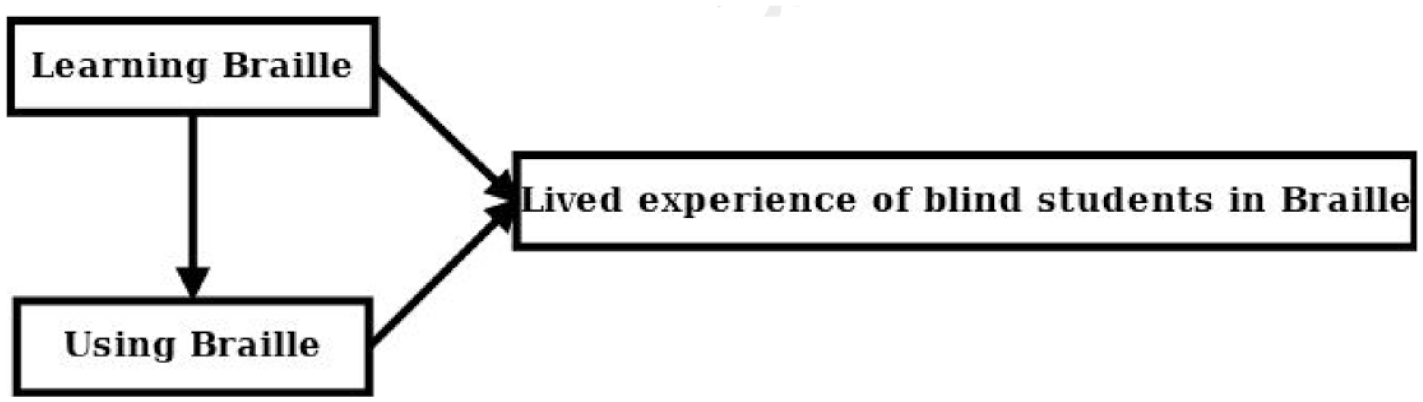
Conceptual frameworks for the lived experiences of students with blindness in Braille.
Braille learning precedes using Braille. Using this conceptual framework, examine the value of Braille to blind students who have learned it and are using it for academic purposes. Mean that learning Braille has little value for blind students unless they may be able to use it in the teaching and learning process. So, it makes sense that the conceptual framework was associated with the following new themes: Knowing Braille and Using It for Learning, Knowing Braille but Not Using It for Learning, and Students with Blindness Who Did Not Know Braille.
The constructivism paradigm is considered the most appropriate to conduct this study. Because it philosophizes that individuals seek an understanding of the world in which they live and work. The paradigm also focuses on the qualitative approach to study the complexity of views using the lived experience of the individuals or groups (Creswell & David Creswell, n.d.).
Creswell, in his book of 2014, suggests that the number of participants involved in a phenomenological study typically ranges from 3 to 10. Thus, the maximum sample size for this study was eight, using a non-probability sampling technique called purposive sampling based on information-rich study participants related to the phenomenon. In this 2023 academic year, the registration documents of the university revealed that out of the total number of 26 blind students, 19 were male and 7 were female. For this study, considering the gender distribution, five males and three females, a total of eight sample sizes were used until the point of saturation. Exclusion criteria were low vision (partial sight) and first-year students with blindness; inclusion criteria included blindness in terms of the degree of sight loss and the batch that belongs to the second year to the graduating class (see Table 1).
Demographic distributions of the participants.
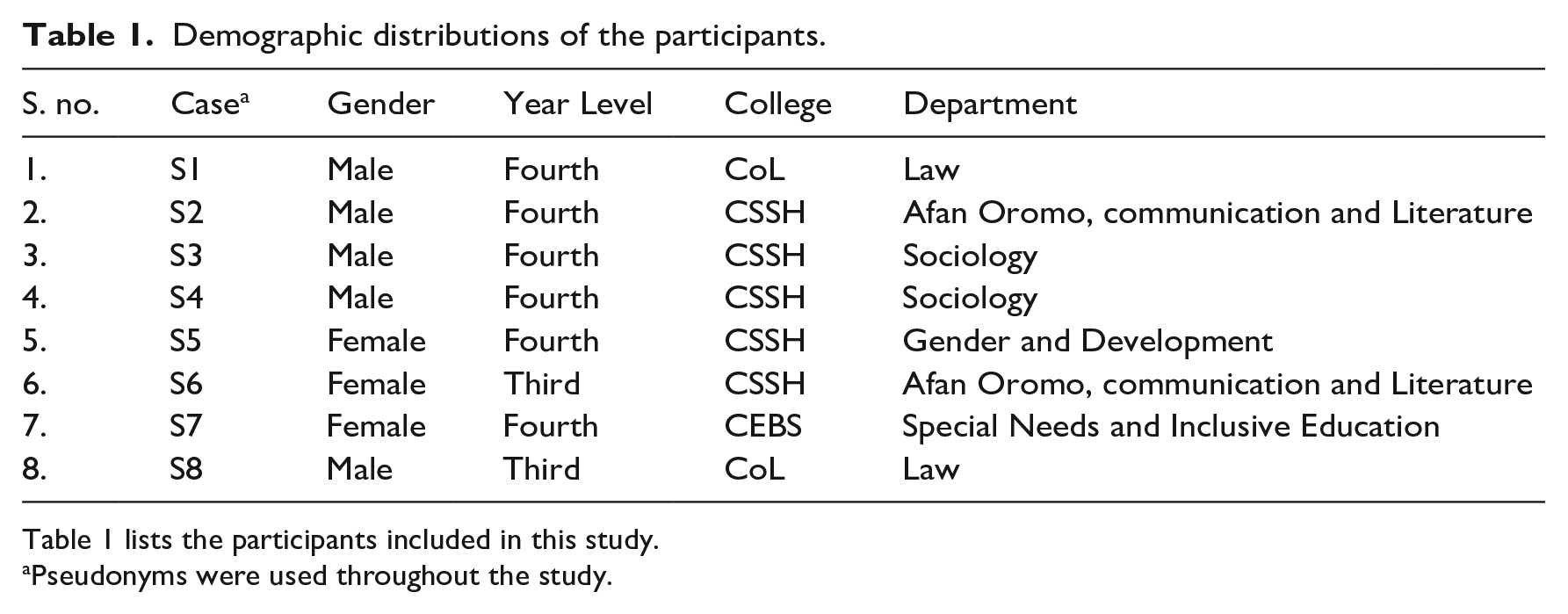
Table 1 lists the participants included in this study.
Pseudonyms were used throughout the study.
Creswell has suggested a script on how to write both a qualitative purpose statement and research questions. The research questions then narrow the purpose statement to specific questions which should be answered by collecting and analyzing data (Ojakaa et al., 2014). Considering these, this study aimed to report the actual experiences of blind students while studying their lessons using Braille for academic purposes.
Basic research questions
The research questions addressed in this study were as follows:
To what extent do students with blindness share their lived experiences of learning Braille at or before joining Haramaya University?
What are the lived experiences of students with blindness in using Braille for academic purposes?
The first question dealt with the experience of learning Braille before joining the university, uncontracted Braille, contracted Braille, and mathematics in Braille, including either devices or technologies for Braille. The second question concerned students’ lived experiences with using Braille for learning, such as taking notes, completing assignments, or taking exams, and the availability of text or audio to Braille conversion services, the types of technologies used, and the challenges of using Braille for academic purposes.
Methods
A transcendental (descriptive) phenomenology, a qualitative approach, was used to conduct this study. The reason is that it is more appropriate to study the complexity of views about the phenomenon rather than finding meaning to the phenomenon (Noon, 2018). Primary data sources used in this study were students with blindness attending their education from the second year to the graduating class of the undergraduate program at Haramaya University. Data were collected using in-depth interviews. According to the study by Wijekoon et al. (2023), an in-depth interview is the most appropriate means of data collection in the phenomenological study.
Ethical considerations
The study received official ethical approval from the Haramaya University Department of Special Needs and Inclusive Education. The permission form specifies that study participants’ participation is voluntary. Supplementary Appendix A explains the sentences allowing leave without penalty. Then, the researchers provided participants with descriptions of the nature and objectives of the study. Participants in the study were requested to sign up voluntarily and offered the chance to withdraw at any time. To ensure confidentiality and reliability, the researchers created pseudonyms for participants and used them throughout the study. Moreover, each participant was asked for and obtained permission for the interviews to be audiotaped or recorded based on their willingness.
Procedures of data collection
Before starting data collection, the researcher sent the topic and interview questions to the subject matter expert for editing and approval. Data collection then began after the expert gave the go-ahead and approval. We gathered this information for 16 days, from 13 January to 29 January 2023. Each participant in this study was typically only interviewed once, with an average interview lasting 23 min throughout the eight interview sessions. The data were gathered and taped using an IC recorder. To ensure validity and dependability, the information was transformed into text using Google Docs or Google Translate (as supported by VB audio virtual cable), and then grammar was checked online using Grammarly (see Figure 2).

Procedures of data collection.
The three languages that respondents could use to participate in the interviews were English, Afan Oromo, and Amharic. The interviewees’ sounds were captured or recorded using an IC recorder device during the interviews. In Amharic or Afan Oromo, audio files were transformed into text formats for Google Translate online English translation. On the laptop connected to the internet, using Google Docs and the VB virtual cable extension, the audio or voice recordings from the IC were then converted into text format in English.
The method of data analysis was thematic analysis. Phenomenological research uses the interpretation of significant statements, the generation of meaning units, and the development of what is called an essence description (Ishtiaq, 2019). Referring to this, the essences of the phenomenon under this study have been identified and presented thematically followed by detailed descriptions.
The authors deemed inappropriate words throughout the data analysis when we used Google Translate to transcribe the interviewee’s language, and we phoned the respected interviewee to ask about the word’s definition. Then, we substituted the most recent interpretation provided by the interviewee for the confused or obsolete words.
Procedures of data analysis
Qualitative research requires valid methods to analyze and organize data (Sundler et al., 2019). Data analysis uses several steps to identify significant statements, meanings, and structures (Wulandari et al., 2021). Taking into account this principle, in this study, following conversion and transcription, the data were then coded and thematized using the QDA Miner Lite application for analysis, as shown in Figure 3. QDA Miner Lite is the software for qualitative data analysis (Fina, 2020).
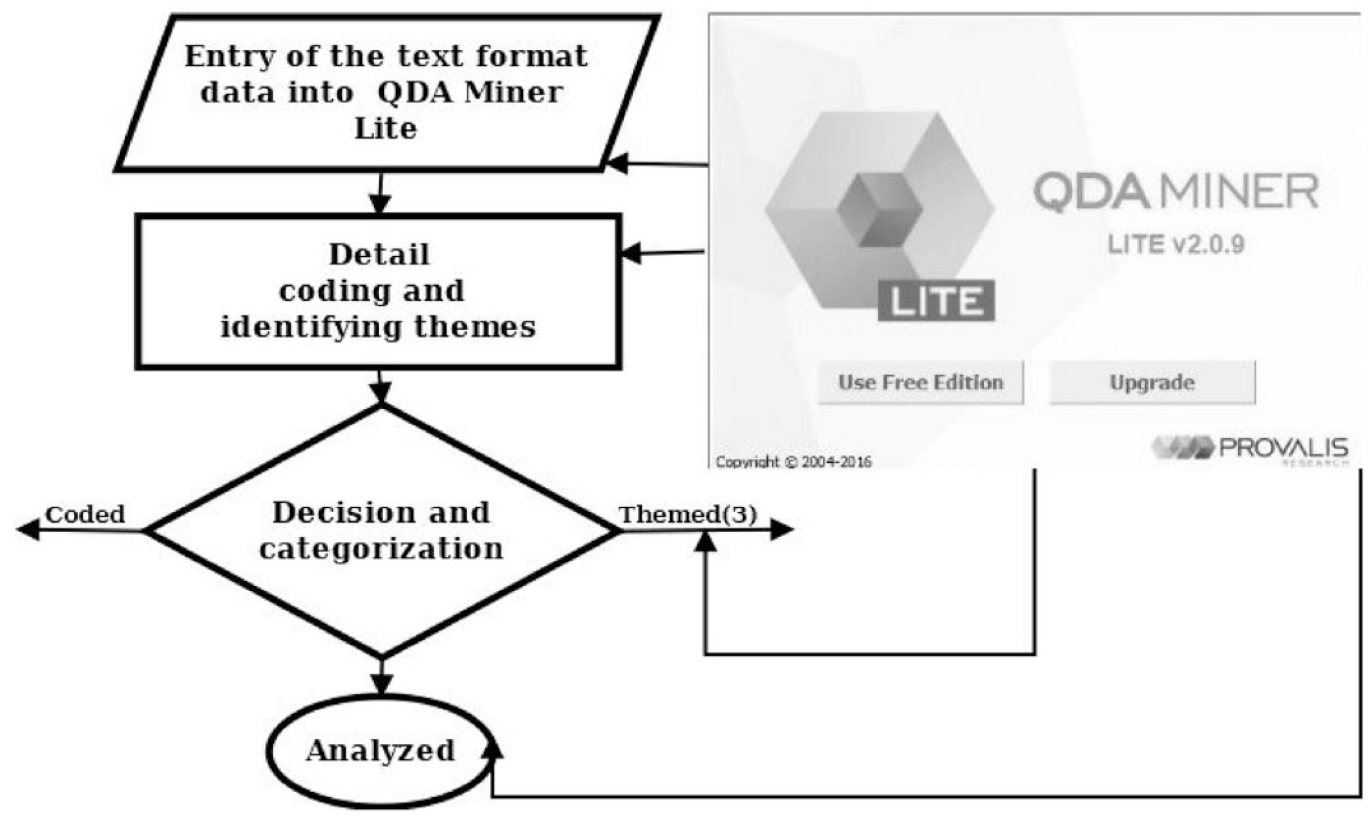
Data analysis procedures.
Results
The in-person interviews were analyzed, and three main themes emerged that best captured how students with blindness learn and use Braille for academic reasons. The theme is broken down into three main categories and seven subcategories to address the issues brought up by the study. The three major themes that emerged were learning Braille and using it for learning, learning Braille but not using it for learning, and not knowing Braille. Figure 4 depicts the primary and supplementary themes.

Major themes and subthemes.
Table 2 explains blind students who have learned Braille and use it for academic purposes. Due to their instruction in Braille from preschool through eighth grade, tutorials, and support from others, blind students are using it for academic purposes. Two of the most common benefits of knowing and using Braille for students who are blind are independent study and formal communication.
Students with blindness who know Braille and use it for learning.

Table 2 describes students with blindness (SWB) using Braille for academic purposes.
Table 3 illustrates that the students with blindness have knowledge of Braille skills but are not using them for academic purposes. Students with blindness who are not using Braille for academic purposes experience negative consequences, such as limiting their ability to learn through listening, forgetting Braille, finding it difficult to perform mathematics in Braille, and wishing to use other technologies instead of Braille.
Students with blindness who know Braille but do not use it for learning.
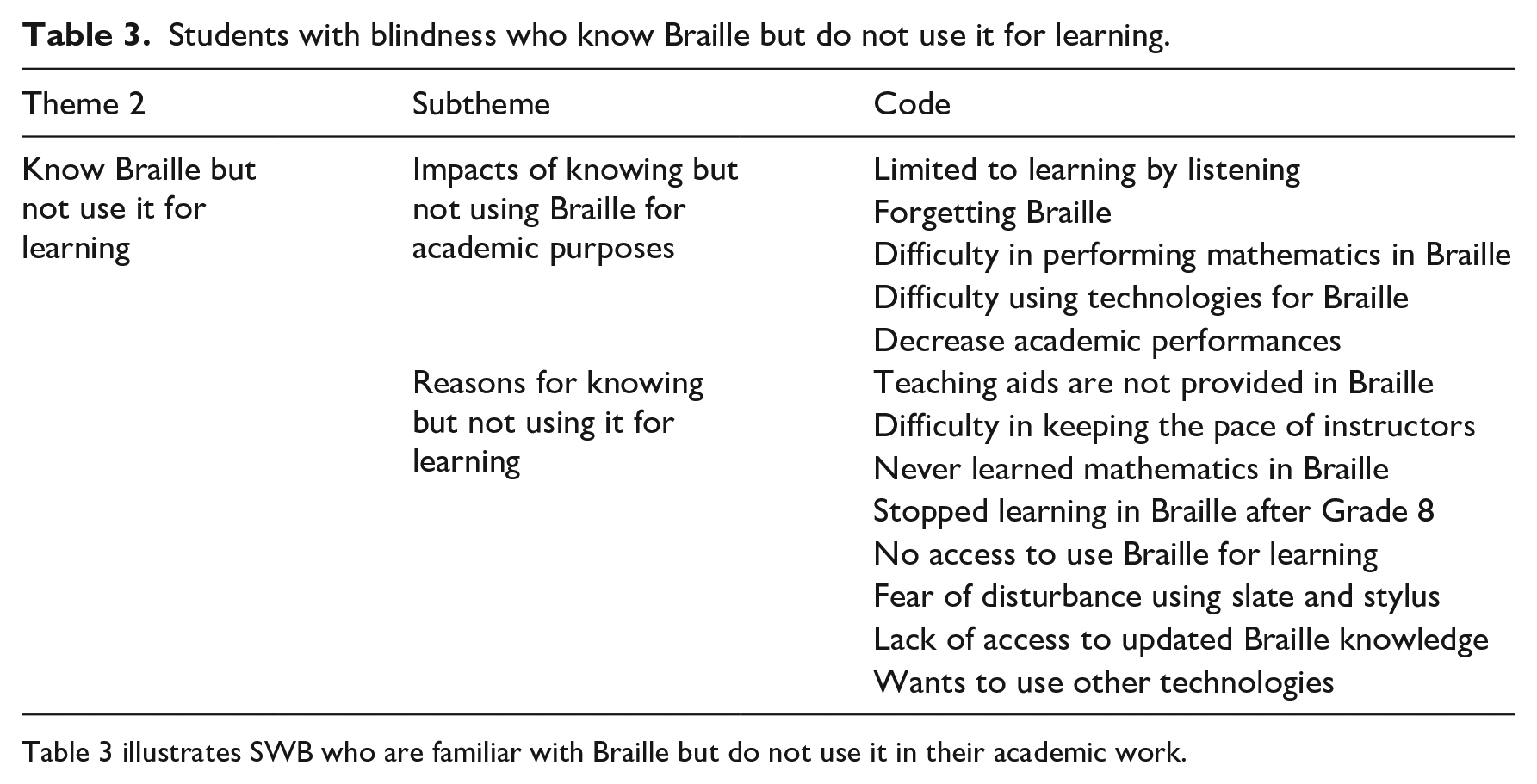
Table 3 illustrates SWB who are familiar with Braille but do not use it in their academic work.
Table 4 lists the reasons for not learning Braille and the characteristics of students with blindness who did not know Braille. The main challenges that students with blindness encounter when attempting to learn Braille are inaccessibility issues, wrong societal perceptions, reader dependence, giving up and feeling hopeless, the need to learn more about Braille, the inability to read or write, and the desire for other technologies.
Students with blindness who did not know or learn Braille.
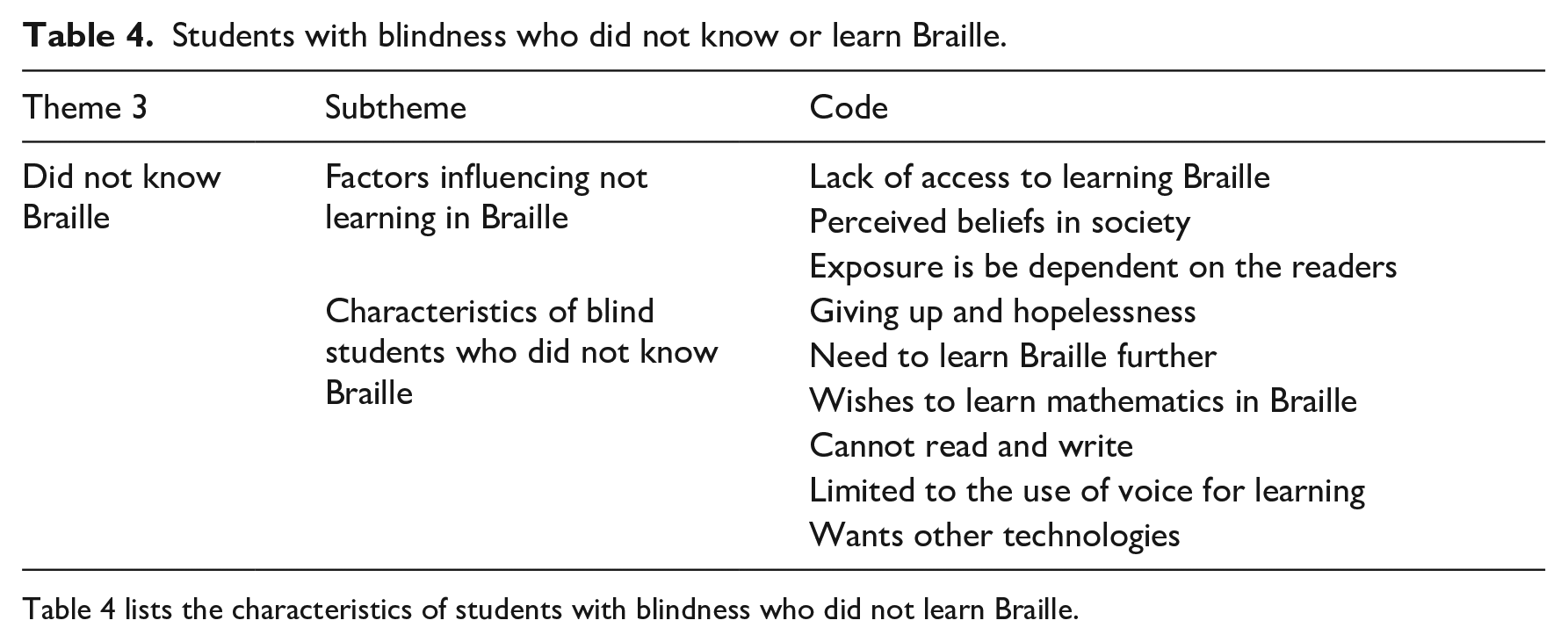
Table 4 lists the characteristics of students with blindness who did not learn Braille.
Discussion
Under this topic, all themes and subthemes were covered in more detail to address the research questions, using quotes from the interviewee and literature sources as necessary. The themes and supporting subthemes listed below provide evidence for this conclusion in response to the research questions:
(a) Know Braille and use it for learning;
(b) Know Braille but not use it for learning;
(c) Students with blindness who did not know Braille.
Theme 1: knowing Braille and using it for learning
Knowing Braille is acquired by learning it. Braille cannot be known and used for reading or writing, so learning it is necessary before using it for academic purposes. Various quotes from the interviewee were used to answer the first central research question as follows.
Subtheme 1: characteristics of students with blindness knowing Braille and using it for learning
In this study, common characteristics of students with blindness who knew and used Braille for learning include being able to read and write Braille contractions, reading and writing uncontracted Braille, having stopped learning Braille, taking notes in Braille, and wanting training to adapt to technology: I attended Braille and used it at Bako Special Boarding School from grades one to eight. From grade 1 to grade 6, I attended Braille using slate and stylus but used it for learning only until grade eight. I am using Braille to take notes, but not in the classroom. (S1)
Knowing Braille and using it for learning does not mean students with blindness are not facing trouble with Braille. Blind students who can read Braille still struggle with using technology in the classroom because the slate and stylus are uncomfortable for them to use. This finding agrees with the study by Sarah Mboshi (2018) on issues with the Perkins Brailler and all software and its accessories, for instance, brought on by a lack of training or even the absence of assistive technologies. Similar to this, students or interviewees S7 and S8 reflected on their ideas as quoted below: I did not use any software application or technology except a slate and stylus device to read and write in Braille. (S8) For now, there is only a slate and stylus device for blind students to use Braille at this university. That is what my friends and I are using right now. (S4)
Subtheme 2: contributing factors for students with blindness who know Braille and use it for learning
Students with blindness in residential schools attended a blind school from first through eighth grade to continue their Braille education. An additional study conducted by Kenea (2019) supported this conclusion. Students with blindness only learned Braille from preschool through sixth grade. Other common contributing factors included support and tutorials: I studied Braille as a subject in the boarding school, from grade one to six. Students with blindness only learned Braille from preschool through grade six. We learned Braille and heard voices from the teachers in the classroom, but we also learned from each other in the dormitory from the students who came before us. All visually impaired students learned Braille with a slate and a stylus, as did I. (S2)
Subtheme 3: advantages of knowing Braille and using it for learning
Braille provides advantages for students with blindness, such as being able to write and read in Braille, independently studying lessons, and using it as a formal means of communication: I used Braille for doing assignments and performing exams from grades one to eight. (S1) For me, Braille is a symbol to convey the message of our writing and to communicate with anyone. (S2) I think Braille is necessary for students with blindness. If students with blindness could use it, it would have saved us from begging someone to read to us. (S6) In my view, Braille is life for students with blindness. That is because it is impossible to read or write without Braille. For me, a student with blindness who attempts to learn without Braille is similar to an illiterate person. (S7)
Theme 2: knowing Braille but not using it for learning
This theme has two different subthemes.
Subtheme 4: impacts of knowing Braille but not using it for learning
Knowing Braille can lead to learning by listening, forgetting Braille, difficulty performing mathematics, and decreased academic performance: I can write and read in Braille, but some abbreviations and contractions in Braille are difficult for me. (S2)
Assigning such Braille transcriptions in regular schoolwork to a special educator or someone familiar with the Braille system is the standard solution to this problem for blind students (Dürre et al., 1987). As a result, this finding agrees with this investigation in such a way that it was so challenging to access Braille transcription that some students with blindness stopped using Braille for learning: The teacher cannot correct or understand the misreading and mistakes of readers for students with blindness, or deficiencies that are harming our academic performance and learning intensity. (S3)
Subtheme 5: reasons for knowing Braille but not using it for learning
Students with blindness struggle in school due to a lack of Braille teaching materials, inability to keep up with instructors, lack of access to Braille, concern about disruption, inability to update knowledge, and desire to use other technologies instead of Braille: Taking notes in Braille in the classroom is not conducive due to teachers’ hurry. (S1) No Braille-to-text, audio, or audio or text-to-Braille accessibility at this university. (S2)
Students with blindness choose not to use Braille for learning due to a lack of resources: I cannot take notes, take exams, or do assignments in Braille due to a lack of accessibility. (S3) Braille paper is not enough to take notes on all subjects, so blind students are given two rims per semester for a year. (S4)
Developing a curriculum for students with blindness is the responsibility of governments and civil society organizations. The author believes that students with blindness have the ability to develop, promote, and become more active in their communities if resources for improving their living, education, and health are available to them (Al-Jaleeli & Galimyanov, 2018). This report agrees with this study in such a way that because of lack of access and resources, almost all respondents stopped learning subjects in Braille in Grade 8: . . . but after eighth grade, there was no opportunity to study it. (S5)
Students with blindness want to adapt to other technologies due to the lack of a help or resource center: The most difficult challenge for students with blindness is the lack of adaptive instructional technologies adopted in the resource room for educational purposes, so the university should provide updated applications and technologies that are sophisticated and fast for blind students. Braille materials are expensive and difficult to use. For instance, taking notes using a slate and stylus can cause disturbances making the sound “kua,” “kua,” “kua,” etc. (S8)
Theme 3: students with blindness who did not know Braille
This theme has two subthemes.
Subtheme 6: causes of not learning Braille for students with blindness
Lack of access, negative societal perceptions, and exposure to readers caused students with blindness to not learn Braille. The belief that students with blindness cannot learn mathematics in Braille also isolates them from learning mathematics-related subjects in Braille: I learned mathematics in Braille from grades one to six at Bako Special Boarding School. However, I never had the opportunity to learn mathematical formulas and calculations in Braille after the sixth grade. The reason is that there was a belief that “ students with blindness cannot learn mathematics in Braille,” so there is no hope and no access to learning mathematics in depth in Braille. Even in this university, there are courses that students with blindness are supposed to drop and add other related courses when they come to study during the first year. For instance, those isolated from learning some subjects like “emerging technology,” “statistics,” etc. during the freshman program level are students with blindness. This belief, in turn, appears to be correct but has not been proven yet. (S1)
Subtheme 7: characteristics of students with blindness who did not know Braille
Students with blindness struggle to learn Braille due to giving up and hopelessness, wishing to learn mathematics in Braille, being unable to read or write, and wanting other technologies: I wish Braille training access for exam readers, teachers, and blind students at this university . . . (S3)
Blind students who never learned Braille were limited to learning by the voice of either teachers or readers for them. Similar studies, with agreeing results, had been conducted by Davtyan & Avagyan, (2020). Some interviewees, in this study, also reflected on their ideas as follows: I cannot use Braille, so limited to using the voice of teachers for learning. However, our college or university does not provide text-to-voice, voice-to-Braille, or voice-to-text translation services. However, I can convert softcopy handouts into audio with my efforts in the Blind Computer Lab, using JAWS software installed on desktops. (S5)
Before learning Braille, there are essential prerequisite skills that must be mustered (Pendidkan & Upsi, 2021). This study supports this finding by demonstrating that, despite Braille training being the method for acquiring required skills, it was inaccessible to students who were blind in the study area:
Interactive Braille keypads and educational websites improve Braille learning outcomes (Bintaleb & al Saaed, 2020). However, one of the respondents said: For now, there are only slate and stylus devices for students with blindness to use Braille at this university and an embosser machine was not functioning for us. (S4)
Implications for practitioners
For students with blindness, the ability to integrate Braille into their academic learning determined their success and achievements. Braille-translated educational materials should be used to help blind students learn and use Braille. Any creative person can modify slate and stylus to work with modern gadgets. For students with blindness, to use systems (such as desktop or web applications) as an alternative method for learning in educational settings, we also want to encourage the programmers of those systems to make them accessible either on a computer desktop or on the web. Curriculum developers and school administrators are also strongly recommended to teach Braille skills to students with blindness at the pre-primary and elementary school levels so that they will not suffer from learning later in their education.
Limitations of the study
This study has some restrictions. For instance, scarcity of relevant studies to the research. The findings of this study cannot be generalized to all students with blindness in higher education institutions in Ethiopia. The current study only looked at the lived experiences of students with blindness in one university excluding students with low vision. Thus, it is unclear whether students with partial sight or low vision in university had different lived experiences. Given these limitations, the researchers would like to suggest that further research into the actual experiences of students with blindness including those with partial sight or low vision, in all universities in Ethiopia, might be able to provide a thorough understanding of the dynamics of learning and using Braille for academic programs.
Conclusion
This study examines the experiences of students with blindness at Haramaya University in Ethiopia, focusing on their use of Braille for academic purposes. The study identifies three main types of students with blindness: those who knew Braille and used it, those who knew Braille but did not use it, and those who did not acquire Braille. Some students with blindness learned Braille only in elementary school but not at Haramaya University due to inaccessibility and other factors. Generally, the study explains the advantages, effects, and reasons behind using Braille for learning and teaching purposes.
Supplemental Material
sj-docx-1-jvi-10.1177_02646196231195699 – Supplemental material for Lived experiences of students with blindness learning and using Braille at Haramaya University in Ethiopia
Supplemental material, sj-docx-1-jvi-10.1177_02646196231195699 for Lived experiences of students with blindness learning and using Braille at Haramaya University in Ethiopia by Fituma Yadasa Kana and Dawit Negassa Golga in British Journal of Visual Impairment
Footnotes

References
Supplementary Material
Please find the following supplemental material available below.
For Open Access articles published under a Creative Commons License, all supplemental material carries the same license as the article it is associated with.
For non-Open Access articles published, all supplemental material carries a non-exclusive license, and permission requests for re-use of supplemental material or any part of supplemental material shall be sent directly to the copyright owner as specified in the copyright notice associated with the article.
