



Abstract
Killing in the name of God is complex and someone could arrive at the conclusion that God participates in their actions through a variety of channels. This article examines one common practice among many who believe their killing pleases or is willed by God—inhabiting biblical texts. Focusing on the Abrahamic and Mosaic narratives and on eschatology, I will explain part of the process whereby individuals and groups come to believe that they are participating in killing patterned on or prophesied in scripture. Finally, this article will suggest a scripture-based approach aimed at moving an individual or group away from the harmful habitation of sacred texts.
Keywords
Introduction
This article explores how inhabiting biblical texts can facilitate killing and suggests possible approaches that safeguard against harmful application. Christians, to varying degrees, inhabit the texts of the Bible. They locate their individual or collective narratives in the larger narrative of God’s redemptive work that began in Genesis and will find eschatological consummation. A working definition for inhabiting the Bible might be: The act of using a particular biblical narrative to (1) interpret reality (past, present or future), (2) inform decision-making and (3) retroactively describe events, actions and choices made. Keon-Sang An has recently used a similar phrase to describe the purpose of scriptural study: ‘Theological interpretation of the Bible means engaging and inhabiting the Bible, not just cognitively understanding the meaning of sacred texts’. 1 This is a normal practice and the majority of Christians use their Bible fairly responsibly.
Inhabiting the Bible can facilitate harmful beliefs and dangerous decision-making. Harmfully inhabiting the Bible could be taken in two ways. First, it could imply that one inflicts harm on another while using the Bible to justify or describe the act. Second, it could imply that the meaning of the Bible is stretched or inverted as one employs the text in a conflict situation. Both senses are used throughout and distinguished by context. In this article I focus on three biblical narratives that have been particularly problematic throughout church history: The sacrifice of Isaac, the exodus–conquest and eschatology. I will propose a slight alteration in how we view these texts. This rereading aims to be faithful to the original narrative, taking its claims more seriously, while providing safeguards against using these narratives to justify or describe killing. Finally, this article will close with suggestions for identifying when an individual or group might be inhabiting a biblical text in a way that could prove harmful.
Child Sacrifice, Conquest and Cosmic War
It is easy to see how a Christian could come to believe their personal situation corresponds with biblical narratives. Consider the life of Abraham. He yearned for a son, and, after he fathered Isaac, God asked that Abraham give him up. Many have experienced expectation, arrival, loss and recovery like Abraham. The exodus narrative is so moving, in part, because bondage, waiting and victory seem written into the fabric of the individual and collective struggle for freedom. The promised land so often seems slightly out of reach beyond the Jordan. Finally, when all is dark, especially in war, the apocalyptic literature of Daniel and John takes on new importance. Complex situations and emotions in the Bible map easily onto ordinary human experience—especially in conflict.
The particular text one chooses to inhabit is important. There are so many narratives in the Bible to choose from. One could inhabit a prophetic text that emphasised international reconciliation or one that emphasised the superiority of an elect group. These two habitats, if emphasised to the exclusion of the other, would likely lead to a very different approach to the ‘other’.
In this article I emphasise ‘inhabiting’ rather than ‘obeying’ a text. We are not, first and foremost, considering commands (e.g. love your neighbour), but narratives (e.g. we are like Israel). The particular biblical narrative one believes they are located in, in some way, influences the commands that must be obeyed. For example, if one is a new Israel fighting for Canaan, then the obligations of the conquest increase in importance. If one believes that they are in the age of Christ, then his commands concerning killing will have primacy. If one believes they crossed into the eschaton, they might also believe that ordinary Christian obligations no longer apply in this new time of cosmic importance.
As these three examples show, I am primarily concerned with how people come to inhabit biblical texts and frame their conflict through that text. How is it that Christians come to believe that they are living in something analogous to the killing of scripture and how do they come to frame their killing through that text? Is there a way to view these biblical texts that remains faithful to the narrative and resists the promotion of killing through that narrative? These are the two primary questions of this article. What follows is a partial picture of the relationship between religion, scripture and killing. 2 It is an examination of one facet of this phenomena—inhabiting scripture.
Inhabiting Abraham’s narrative
What unites the following narratives?
A random murder on the street.
3
The authoritarian leadership of Joseph Smith (founder of Mormonism).
4
A gruesome double murder in Utah.
5
An assault with a knife on a beloved daughter after a sermon.
6
A mother who killed her child in the microwave.
7
A California father who used a knife to kill his favourite daughter.
8
A Texas mother who offered her daughter to God by amputating her limbs while listening to hymns.
9
The unifying theme is this: Scholars claim that these acts were influenced by the sacrifice of Isaac in Genesis 22 or they claim that the act in some way imitates Abraham. I say that scholars ‘claim’ there is a link between the Bible and these acts because, in some cases, the connection is rather tenuous. Stories like this contribute to the popular notion that the Abrahamic narrative has been, and could again be, dangerous.
For the believer, Abraham’s obedience and Isaac’s submission can be puzzling and alarming; for the unbeliever it is revolting and viewed as dangerous. This is a perfect example of killing based on blind faith—or so the popular narrative goes. 10 The dangerous nature of Abraham’s narrative is considered common knowledge. For example, though President Obama showed respect for the text, he argued that public policy cannot be based on the Bible and he used Genesis 22 to make his point. Because Abraham’s relationship with God was not verifiable to outsiders (i.e. because Abraham offered no reasonable ‘proof’ that God spoke to him), we would all ‘call the police and expect the Department of Children and Family Services to take Isaac away from Abraham’. 11 The implication is that Abraham, though revered by many faiths, would be arrested today for his irrational and life-threatening behaviour.
Some might look at Abraham’s blind faith as a problem—yet one is likely to find his blind faith praised in sermons. A modern preacher might assert: (1) Abraham had blind faith; (2) Abraham was willing to kill based on blind faith; (3) blind faith is a good thing since it evidences great trust in God; and (4) Abraham’s blind faith is an example for the modern believer.
Constructing the Abrahamic habitat. How one perceives the original Abrahamic narrative influences the way that one can apply the text in the present. Inhabiting Abraham’s blind faith could be illustrated as follows:
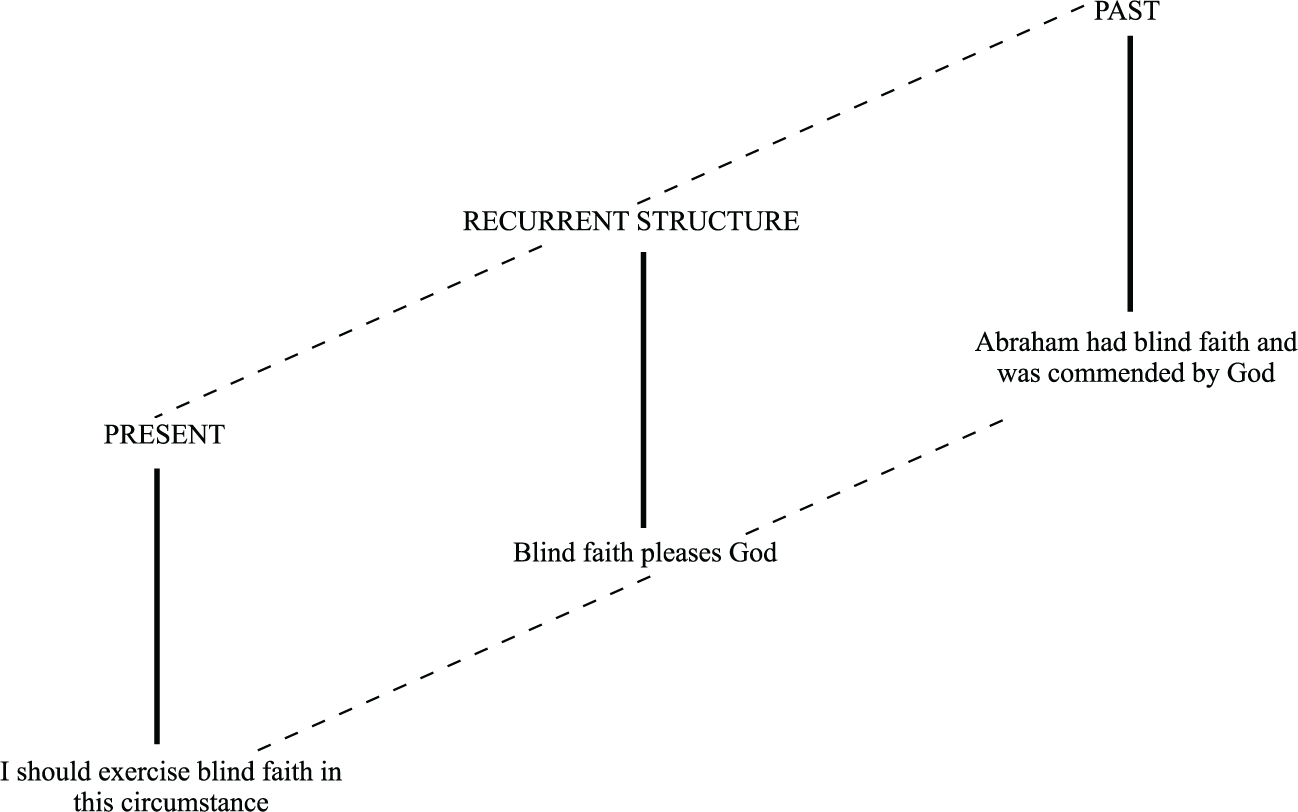
Inhabiting Abraham’s Blind Faith. 12
The hermeneutical judgement concerning Abraham’s blind faith influences modern applications. This reader may be prone to irrational, and sometimes dangerous, decisions because of what he or she interprets to be a biblical precedent. In what follows, I argue that Abraham did not possess blind or irrational faith—therefore urging a modern Christian to make risky decisions based on the precedent of Abrahamic blind faith stems from a misreading of the text.
Deconstructing the Abrahamic habitat. If someone believes that God could, or has, called them to kill like Abraham, is there anything that can be done to deconstruct this belief? Some might think we need to assert—loudly—that God would never command such an unethical thing—but this does not sit well with the details of Genesis 22. Surely Abraham already knew that killing a non-murdering human was unethical (Gen 9:6). Others might argue that the Christian should live in light of later scriptural commands—but what if God issued a new command that was specific to them and their child? 13 Does the original narrative support the belief that God commanded killing based on blind faith?
To answer this, we need to reexamine the entire Abrahamic narrative. The question is not ‘is it ethical?’ or ‘is it hermeneutically sound to imitate Abraham’s faith?’. Instead, we could also ask ‘is it humanly possible to imitate Abraham’s faith?’. This question opens up new vistas of inquiry into the Abrahamic narrative—namely an examination of the way in which miracle claims in the text function in the creation of Abraham’s beliefs.
In what follows I argue that commending an Abraham-like blind leap of faith is the result of a partial reading of the narrative. This is a summary of my conclusions and I have interacted at length with the biblical text and secondary sources relating to sacrifice of Isaac elsewhere. 14 Many, knowingly or unknowingly, follow the lead of influential scholars who for various reasons separated Genesis 22 from Genesis 12–21. 15 In Genesis 22, the narrative puts forward no public verification of Abraham’s unique relationship with God. Thus, Genesis 22 seems to show that Abraham was willing to kill based on blind faith. However, the evidence that he was a uniquely set apart prophet is in Genesis 12–21. The larger Abrahamic narrative (Genesis 12–22) describes decades of large-scale miracles associated with Abraham and these miraculous events are fundamental to the narrative being told. These miracles are described as being communal, multi-ethnic, widespread, multi-sensory, multi-event and prophesied in detail. Before the text describes the command to sacrifice Isaac in Genesis 22, it shows that Abraham was miraculously validated on a national and international scale as one who hears from God. The modern mother or father who believed God told them to kill has not been—and does not even claim to be—validated in the same way as Abraham in Genesis 12–21.
Since many modern interpreters (atheist or theist) separate Abraham’s supreme act of faith in Genesis 22 from the miraculously validated life of faith in Genesis 12–21, they have fundamentally misunderstood the narrative with the possible result that imitating Abraham’s faith might entail a willingness to kill one’s child. As I argued here this evidences a dangerous misunderstanding of the final form of the narrative. God never commanded that Abraham commit violence based on blind faith—therefore, the modern Christian should not think that the text puts this forward as a model for imitation.
The following illustration shows how application would be different if the interpreter noticed the miracles mentioned in the larger Abrahamic narrative. In contrast to the earlier paradigm, inhabiting Abraham’s rational faith could be illustrated as follows:

Inhabiting Abraham’s Rational Faith.
As this illustration shows, the person in the present will apply the Abrahamic narrative to different situations. They would recognise that there are major differences between Abraham and the modern believer—therefore they would also recognise that it is humanly impossible to claim the same sort of justifications as Abraham. They are more likely to use this narrative in accord with their strong reason—not in place of it. 16 Though Abraham might still be preached as an example of faith (Rom 4; Heb 11:17–19; Jas 2:20–21), he is an example of rational, and not irrational faith. Focusing on the entire Abrahamic narrative and highlighting the many differences between Abraham and the modern reader guards against harmfully inhabiting this narrative. Adjusting this minor belief about the nature of Abraham’s faith could have a significant effect on individual decision-making.
Inhabiting Israel’s Exodus
The historical impact of the Abrahamic narrative is dwarfed by that of the next major episode in redemptive history—the exodus from Egypt and the conquest of Canaan. Again, it is difficult to parse the relationship between the use of the exodus and conquest in conflict and the actual reasons why people are fighting. Nearly every portion of the exodus narrative has been used politically—to oppress or to resist oppression. 17 The conquest is one of the most frequently cited causes of violence. This story of liberation, wandering and possession of the land has, in the words of Michael Walzer, been found ‘almost everywhere’ in history. 18 The oppressed, once liberated, often become a new oppressor. Power and freedom present new temptations.
Recognising the power of the narrative, the iconoclastic political philosopher, Niccolò Machiavelli (1469–1527), ended The Prince with a call for a new Moses to recognise the exodus-like miracles and rise up: Look how Italy beseeches God to send someone to rescue it from the cruel and arrogant domination of the foreigners …. This is a very righteous cause …. [I]f only your family will imitate the methods of the men [in the Bible] I have proposed as exemplars. Moreover, very unusual events, which are signs from God, have recently been observed here: the sea has opened; a cloud has shown you the way; water has flowed from the rock; manna has rained down here. Everything points to your future greatness. But you must play your part, for God does not want to do everything.
19
This mosaic appeal at the end of an ethically-questionable treatise shows the ease with which one can appropriate the exodus narrative to further political ends.
Scholars claim this narrative influenced killing during the Maccabean revolts, 20 the Crusades, 21 the conquest of the Americas by the Spanish, 22 the ‘Wars of Religion’ in Europe 23 and the Boer Wars in South Africa. 24 The narrative was used by Eusebius to support Constantine, 25 Martin Luther against the Jews, 26 the Puritans in the English Civil War, 27 American colonists against the Native Americans, 28 Zionists since 1948 29 and liberation theologians. 30 These few examples show the pervasiveness of this narrative in conflict. How is it that people come to believe their conflict resembles that of the ancient Israelites?
Constructing the exodus habitat. Many have argued that, within scripture, there is a ‘new exodus’ theme. 31 As such, the exodus was paradigmatic. Numerous historical groups have claimed something akin to a post-scripture new ‘new exodus’. Christians have long held to some correspondence with Israel as a basic tenant of orthodoxy. This section focuses on when and how this belief can be used to facilitate killing. Below I discuss a few of the numerous, often intertwined, beliefs that could create or sustain the belief that a group is like the ancient Israelites.
First, Christians could believe that all the commands of the Pentateuch are still in force. There is still a promised land to be fought over and victory will only be achieved through the grace of God if the people remain faithful to their covenant obligations (e.g. Lev 26; Deut 28–29). Christians hold to varying levels of perceived continuity between the two covenants. In many cases, Hebrew Bible land or warfare promises are spiritualised. In historical documents, treatment of the rules of warfare in Deuteronomy 20 are often an insightful window into the perceived relationship between the Christian and the warfare commands of the Hebrew Bible. 32 Some might still use the language of canaan, israel and amalek—but these are, as it were, differentiated from Canaan, Israel and Amalek. 33 These Christians recognise that there are differences between their relationship with God and that of the ancient Israelites. 34
Second, the belief that a group is like Israel could be supported by a political and religious structure. A national or ethnic group could be equated with the people of God. As such, the body politic is viewed as largely co-extensive with the body of Christ. An attack on the one is, of necessity, an attack on the other. When threatened, they mutually come to the aid of the other. Civil authority, land, law and warfare are more explicitly treated in the Hebrew Bible and Christians frequently turn there for guidance in structuring society. Within societies possessing established churches, there are varying degrees of this belief—and some have differentiated more clearly between civil and ecclesiastical powers.
A third interrelated theme is covenant. The Hebrew Bible records many covenants between God and his chosen people. Viewing themselves as heirs to the blessings of God, a group of Christians might believe God entered into a unique covenant with them. 35 They promise to live in a certain manner and God promises to remain faithful to them. When they are obedient, the faithfulness of God is usually experienced as blessing. When they are disobedient, the faithfulness of God is usually experienced as loving punishment. Depending on the group, they may believe they are the only covenanted people or they may believe they are only one of many Christian groups in a covenant with God.
Fourth, some support the belief that they are like ancient Israel through the interpretation of providence—a concept often facilitated by a belief in a group covenant. Interpreting providence is a relatively normal, though variegated, Christian practice and some are more cautious concerning their ability to discern God’s will. Evidence for beliefs about God’s actions in temporal affairs can be found, among other places, in their feelings and circumstances (e.g. weather, plague, famine, coincidence, success, failure and victory or defeat in battle). Looking around for evidences, Christians try to discern God’s disposition and agency. In war, they often conclude that they are fighting against God’s enemies. Since God is providentially in control of the world, when victory is accomplished, some participants declare that it was God who crushed their enemies. 36 For example, an English victory over Native Americans was viewed as ‘divine slaughter by the hand of the English’. 37
Fifth, groups often come to identify with Israel’s exodus when they feel they are oppressed or violated. Though some might falsely assume the cloak of victim, frequently the experienced injustice is very real. Resistance is often viewed as a justified response to the actions of an aggressor. The aforementioned beliefs are then marshalled for use in defensive war.
Convictions concerning the righteousness of a cause are often inseparable from and intertwined with arguments for the justice of the cause. 38 Though many believed God was active on their side, they believed their war, and conduct in war, must be just in order to garner the approval and participation of God.
Biblical mandates, political and religious structures, group covenants, interpreting providence and a just cause are a few of the conceptual tools used to support the belief that one is like Israel in a struggle of biblical proportion. Typology often serves to delineate between those on the side of righteousness and those who fight against it. For example, in the 1630s in colonial New England, the Native Americans were often treated collectively—as all bad—or treated symbolically rather than as persons. 39 This occurred in Europe as well. Against the backdrop of the perceived atrocities done by Catholics during the Thirty Years War one prominent theologian in England, who remained within the just war tradition, said this of Catholics: ‘So long as there are Israelites in the world, there will be Amalakites.… Papists to Protestants are as Amalakites to Israelites’. 40 The following illustration shows the mental framework created when historical characters are branded as biblical types:
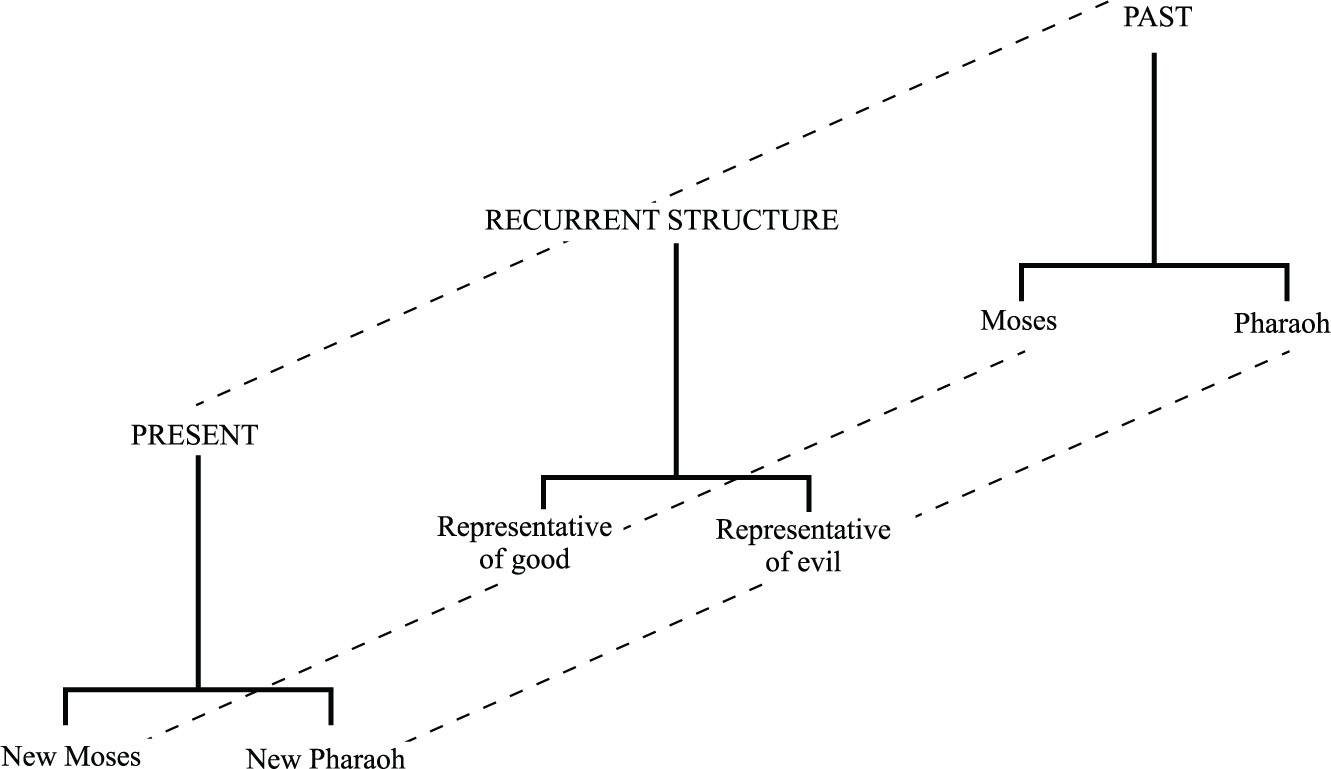
Inhabiting Israel’s Exodus.
In this paradigm there is a new Pharaoh (correlation) and sometimes a greater Pharaoh (escalation) who wars against the bride of Christ. The claim that someone was a new Pharaoh was not simply a logical claim, it was also highly emotive—framing a particular conflict in a larger and longer cosmic struggle.
During the English Civil Wars, many biblical narratives and theological categories were employed to justify or describe killing. Puritans—who preferred to be called ‘the godly’—tended to side with Parliament in their civil and ecclesiastical struggle against the perceived abused of Charles I and his advisors. One of the hallmarks of Puritanism was a collapsing of much of the space between biblical characters or events and contemporary ones. 41 Though they frequently appealed to the New Testament, in conflict the warfare of ancient Israel was foregrounded. The prominence of the exodus and conquest narrative will be illustrated with explanations of the battle of Naseby (14 June 1645)—a decisive battle of the war. 42 It was commonly believed that God was active on the battlefield. 43 Glory was often given entirely to God because he was the decisive causal agent and human weapons were unable to secure victory without him. 44 Language from Miriam and Moses’ songs about God’s miraculous deliverance frequently framed battle accounts during this time period. 45
Many believed Naseby, and other battles, corresponded with the exodus from Egypt. 46 One sermon closed with a call to ‘repent, and pray, and waite, and yee shall still see the salvation of God’. 47 This is either referring to Exodus 14:13 or 2 Chronicles 20:17. In both verses God promised victory would be divinely accomplished without human agency.
Exodus 14:13–14: And Moses saide unto the people, Feare ye not, stand still, and see the salvation of the Lord, which he will shew to you to day: for the Egyptians whom ye have seene to day, ye shall see them againe no more for ever. The Lord shall fight for you, and ye shall hold your peace.
In both of these accounts, the righteous were merely observers of the battle—they only partook passively. Such a victory of biblical proportion in the English Civil War could be seen as a hope for the future—something earnestly desired but not yet experienced by Parliament. However, a marginal note alerts the reader to the belief that, on the day of his sermon, God actually gave this sort of victory: ‘That very day salvation was seen wonderfully by Westchester’. 48 If the reference was to the battle of Rowton Heath, then human agency was clearly employed to secure victory. The preacher took a text that promised victory by divine agency alone and applied it to a situation where human agency was fundamental.
The application of divine warrior miracle narratives to human battles should be expected since The Souldiers Pocket Bible made the greatest Hebrew Bible victory—one that involved no human fighting—normative for the soldier. 49 Exodus 14:14 was then a promise from God to the combatant. 50 It is significant that, in the biblical text, trusting the promise involved not fighting, whereas, for the soldier, trusting involved fighting.
In a fast sermon, another preacher altered or internalised miracle accounts so that they could be applied to Naseby. 51 Large-scale, variegated, long-lasting, multi-sensory biblical miracles were relocated in the heart where the sense-experience was internal. An author claimed that, at Naseby and other battles, ‘the work is done, not by might or by power, but Gods way, by Gods spirit … like Jericho’s wase’. 52 Noting the miracles surrounding Moses and Joshua, another author claimed that the Parliamentarians had the same epistemic proof that their leaders were ordained by God. 53 Using language reminiscent of the miracles of the exodus and the divine warrior motif, John Owen framed multiple victories through the exodus lens. 54 John Coffey notes the importance of the mental world created by the biblical text: ‘In their minds, Puritan Parliamentarians were treading in the footsteps of the Hebrews, leaving Egyptian bondage behind, and marching to the promised land’. 55 As the conflict stretched on, control of the exodus narrative fragmented and it was eventually used against those who first framed their actions through that text. 56
In the Pequot War in colonial New England (1636–1638) the English used Amalek or the exodus and conquest narrative to justify or describe their war against Native Americans.
57
Though Roger Williams cautiously supported the war, he was critical of the excessive and indiscriminate use of force.
58
His words helpfully critique inhabiting Israel’s narrative: Many things have been spoken to prove the Lord’s perpetual war with Amalek extraordinary and mystical; but [2 Kings 14:5–6] is a bright light discovering the ordinary path wherein to walk and please him. If the Pequot were murderers … [they were] not comparable to those treacherous servants that slew … [the] King of Judah … yet the fathers only perish in their sin.
59
Williams claimed the English passed over a clear ‘ordinary’ command—do not kill the child for the crimes of the father—by inhabiting the ‘extraordinary and mystical’ Amalek narrative. In the words of Peter Hoffer, a conflict like the Pequot War became ‘an extension of the biblical story’. 60
Deconstructing the exodus habitat. The discussion above has used examples from the early modern period to illustrate the complex nature of inhabiting the exodus and conquest narrative. From Constantine to Joseph Kony, violence has been justified or described with the Mosaic narrative. 61 It is not identification, in some way, with Israel that is harmful. Christians have long held to some correspondence as a basic tenant of orthodoxy. The vast majority of them have not, and will not, use the exodus narrative to justify or describe killing. However, when conflict situations arise, often thrust on the Christian by an aggressor, the temptation to use typology in warfare will increase. Because the miraculous exodus, wilderness and conquest narrative is so compelling it is used in many conflicts. Because the miracles are so spectacular they are often altered or internalised when the narrative is applied to subsequent conflict.
How can one guard against closely identifying leaders with pharaoh or Moses? How can one resist the urge to claim that God fought against present day enemies in an exodus-like manner? How is it that one can deconstruct the claim to a divine mission or conquest like that described in the Pentateuch? By taking the text more seriously and emphasising differences between the text and modern situations.
Typology thrives on correspondence, but it is the differences that guard against harmful application—as I argued with the Abrahamic narrative. Though one could argue they overreacted to claims of close correspondence, well-known tolerationists like Roger Williams (1603–1683) and John Locke (1632–1704) recognised that one of the main supports for Christian killing was a close and direct identification with theopolitical Israel as described in the Torah. As a result they emphasise distinctions between the Old and New Testaments while highlighting differences between ancient Israel and the modern Christian. 62 In order to create a Christian theory of universal religious toleration, Roger Williams reevaluated the believer’s relationship with the ‘so much imitated, yet most unimitable State of Israel’. 63 In the seven volume Complete Writings of Roger Williams he stressed discontinuity on at least 150 pages. 64 He even went so far as to argue that Christians should take the biblical text more seriously by recognising that the astounding nature of the miracles resist a direct transfer from theopolitical Israel to any other nation. 65 Noting these subtle differences in the text is still important to modern peace studies.
In her excellent field-work with ex-LRA child-soldiers, Helen Nkabala, a contributor to this volume, has carefully noted the relationship between divine and human agency in the language of the Lord’s Resistance Army in Uganda. With reference to the Sodom and Gomorrah narrative, soldiers claimed God was active in the killing. 66 However, when they applied the narrative to their combat, they held two beliefs in tension: God did the fighting through an angel and today, like at Sodom, God calls someone to kill for him. She notes that ‘in relation to the text … the ex-LRA members seem to equate their role to that of the angels in the Sodom/Gomorrah narrative’. 67 However, the text describes God as acting without mediation. ‘This could imply that the ex-LRA members’ continuous claim that God uses someone to kill or to destroy others, like he sent the angels in Sodom and Gomorrah, finds no proper basis in the Sodom/Gomorrah narrative’. 68 Noting similarities and differences with reference to causality might be a helpful way to show the ex-soldier how a divine warfare text was altered to accommodate human violence. Kony’s authority was bolstered, in part, through this subtle linguistic shift from divine to human agency.
Like the Sodom/Gomorrah narrative, the exodus would be rendered nonsensical if the agency of God were removed. The text of Exodus–Joshua describes dozens of large-scale, communal, multi-ethnic, widespread, multi-sensory, multi-event and prophesied life-saving miracles. While this narrative has certainly been used to further killing, the actual precedent set by a face value reading of the final form of the text is this: killing and large-scale miracles go together. Elsewhere, I have argued for this from the biblical text at length. 69 Further, due to the inimitable miracles described in the text, it is actually humanly impossible to imitate the situation described therein. It would be equally impossible to imitate much of the violence of Harry Potter due to the magic that is essential to the narrative. If an individual or group believes they have been set apart like Israel, emphasising the grandeur of miracles described in the text might be a helpful way to deconstruct this volatile belief. 70
Inhabiting Eschatology
Having examined the harmful habitation of the Abrahamic and Mosaic narratives and having suggested using miracles in the text to deconstruct harmful beliefs, this article will now examine our last case study—eschatology. Most scripture points backward historically. It focuses on what happened, the interpretation of that event and the contemporary relevance for the believer. Eschatology primarily points forward. As such, it lends itself to being inhabited in a way that historical narratives do not. Instead of ‘our situation is like theirs in the past’, eschatology facilitates ‘those in the past spoke about our situation’. My concern here is not with generic eschatological inquiry. I am critiquing the (often harmful) practice of specifically identifying persons or events with their symbolic description in the Bible’s eschatological literature.
‘Eschatology can be dangerous stuff’, writes Lee Griffith. 71 Eschatology is also, to some degree, unavoidable—if one stops to think about it. One could likely argue that every major eschatological belief has been used to support killing at some point in history. 72 One subset of beliefs concerns the world’s end through an apocalyptic struggle. Cosmic war is closely related to apocalypticism and has been a very volatile idea. 73
Constructing violent eschatology. This section focuses primarily on the ‘eschatological explosion’ in early modern British history as Puritans (and other Protestants) developed their own unique beliefs about the apocalypse. 74 Puritans employed a wide range of biblical and non-biblical sources in forming their beliefs about the end times. 75 The bewildering swirl of ideas matched the tumultuous political and religious times. 76 Thus, it is important to note the strong relationship between external factors (e.g. persecution or war) and the development of particular eschatological beliefs. 77 The importance of God’s plan increased when this world seemed to be falling apart. Eschatological beliefs could be used to support retreat from or ambivalence towards this present world. 78 They could also foster a desire to conquer the world or force its end.
Millennialism was usually treated with antipathy since the time of Augustine. Early Reformation confessions reiterated this ‘hostility to millennial ideas’. 79 In 1524, Thomas Müntzer—preaching on Daniel 2 before high-ranking officials in Saxony—argued that the church recently entered into a time of cosmic importance. He encouraged receptivity to private revelation from God and called for a ‘new Daniel [who] must go forth, as Moses teaches … at the head of the troops’. Using 2 Peter 1:4 (Christians participate in the divine nature), he blurred divine and human agency, urged revenge for dishonouring God, and advocated killing ‘the godless [who] have no right to life except that which elect decide to grant them’. 80 A decade later, the town of Münster, an early Reformation millenarian community influenced by the Lutherans and Anabaptists, descended into chaos, legal polygamy and violence.
The ideas and conduct of ‘Radical Reformers’ further confirmed Luther, Zwingli, Calvin and others in their aversion to millennial ideas.
81
However, Luther left the door open for later Christians to identify, within current history, characters or events referred to in the Bible: By 1530 Martin Luther was convinced that the Papacy was the prophetic Antichrist, which subsequently framed the Protestant struggle against Roman Catholicism (both the Roman Catholic Church and Catholic nations) in the grandest apocalyptic terms. Ultimately Luther believed he was engaged in a cosmic war between God and the Devil. From 1530 on, nearly all Protestants, from John Calvin to Jonathan Edwards in eighteenth-century North America maintained this apocalyptic perspective.
82
Luther constructed a framework that centuries of Christians would come to inhabit. 83 Protestants also modified Augustine’s view of the millennium. The optimistic Puritans ‘interpreted the signs of the times and the unfulfilled prophecies of the Old and New Testaments (particularly Daniel and Revelation) within their own historical context. For them, scripture was referring to the times in which they lived’. 84
As with other biblical interpretations, no group had a monopoly on branding another as a typification of evil. Though typology aided in inhabiting a given biblical text, the habitat could be hijacked. The identification of the Antichrist kept expanding to include other Protestants. 85 Fragmentation has only increased in subsequent centuries. 86
For the Puritans, eschatology influenced behaviour as they sought to act according to the times. 87 The influential theologian, William Ames, argued that ‘in the Apocalipse are many Prophesies of Warres, which the Children of God should wage’. 88 Though he was not advocating a particular war against a particular enemy, and though he remains within the just war tradition, he was expecting human fighting in the eschaton. As some mapped eschatological details onto war, they believed they witnessed long-anticipated prophecy. 89
Apocalyptic thinking, of the theistic and atheistic (utopian or dystopian) variety, takes on many forms. Some thought they must hasten the end—not mainly through evangelism—but believing that they could force the end through killing. 90 With the latter, an individual, often perceiving themselves to be in a defensive struggle against an unjust aggressor, believes that their violence is contributing to the fulfilment of prophecy. The killing then becomes an integral part of realising the anticipated or feared telos of history.
In the present day, the identification of the Antichrist (or other apocalyptic events or persons) within history creates a world that the claimant and reader can inhabit—a world in which they can now identify other apocalyptic texts with new historical events or figures. Hans Kippenberg explains: The framing of … conflicts in a religious [specifically apocalyptic] language generates a corresponding way of acting, thereby creating a reality all of its own. The conflict offers the chance to prove one’s faith and unleashes energies born of the believers’ commitment …. [When a religious community is demonised or threatened] the hostile forces are promoted to eschatological agents of evil, apostates become the fifth column of Satan, and fighters for the faith become saints.
91
He then summarises how apocalyptic groups from various faith convictions inhabit their respective narratives: An Adventist faith community, besieged by the FBI, behaves as if it were living in the Last Days; in Iran and Lebanon, the battles of Karbalā (680 CE) are fought out afresh; Israel interprets … victory … as the beginning of the redemption of Israel and the world … American Evangelicals interpret Israel’s victory as its salvation-historical restoration, and hence as the arena of the upcoming struggle against the Antichrist; jihadists carry out an attack on the U.S. Centers of power, like the accounts carried out by Muhammad and his adherents … In all these cases, a situation of threat to the community is interpreted in salvation-historical conceptions, and people gain confidence from this interpretation.
92
An analysis of more eschatological beliefs is regrettably outside the scope of this article: e.g. viewing the actions by or against modern Israel (or other Middle East nations) through detailed eschatological paradigms; inhabiting eschatology through apocalyptic novels; or associating potential nuclear destruction with prophesied judgements. As this brief treatment has argued, Christian history is replete with those who have created an apocalyptic world—one that existed only in their heads. The failure of their expectations shows that their worldview was not veridical.
Deconstructing violent eschatology. When dealing with biblical narratives, be they Abrahamic, Mosaic or eschatological, my concern is not only with the interpretation of scripture—it is also with the regrettable wake of bloodshed. With reference to Abraham and the exodus–conquest I suggested that one might deconstruct harmful beliefs by emphasising the miracles in the text. The solution is more complex with militant eschatology. Any large-scale miracles in apocalyptic literature, of which there are many, are so laden with symbolic language that one could easily apply them to many situations.
Though deconstructing a militant, or potentially militant, eschatological habitat might be harder, I believe it would be helpful to promote epistemic humility. Apocalyptic thinking thrives on certainty. Stephen Stein observes common traits in American apocalypticism: Interpretations have ‘amazing plasticity … Confidence, urgency and hostility are three of the most striking aspects that characterise apocalyptic discourse, whether religious or secular … [and the adherents] have not been particularly self-reflexive or self-critical’.
93
In light of continual Christian error in apocalyptic identification and in light of the negative consequences that often follow false identifications, one could encourage caution in inhabiting apocalyptic literature. Further, the Bible itself cautions against specifically identifying future events (e.g. Matt 24:36; Mark 13:32; Acts 1:7). Below is a summary of what eschatological epistemic humility might look like: (1) The cryptic nature of apocalyptic literature + (2) biblical injunctions critiquing the attempt to figure out what was intentionally left cryptic + (3) the high possibility of error in identification + (4) the high possibility of contributing to harmful thoughts or actions should = (5) a cautious (and highly critical) attitude towards anyone making (or believing) precise identifications that link a cryptic scriptural apocalyptic event or person with a spatiotemporal event or person.
Though one might never be able to disprove an apocalyptic identification, one can urge epistemic humility in light of the above considerations. Also, as mentioned before, since there is a relationship between external circumstances (e.g. hostility) and eschatological innovation, one should also pay attention to and seek to prevent the circumstances under which generic eschatology morphs into militant eschatology.
When is a Biblical Text Being Harmfully Inhabited?
A simple answer to the above question is that a text is harmfully inhabited when it is used as grounds for unjust killing. This must be nuanced because there are likely dozens of other causal factors leading to killing. 94 Further, even if one disagrees with using typology to describe killing, many would argue that defensive killing is still justified in extreme circumstances (see the discussion on just war theory in the introductory essay). For example, one might type a rapist as an agent of the Satan and forcefully—maybe even lethally—resist him. The belief that the attacker was in league with Satan does not nullify the justice of resistance or turn resisting rape into ‘religious violence’. Similarly, one might question the Puritan use of the exodus narrative and still think they had good reasons to oppose the monarchy. Observers need to carefully consider both the justice of the actions and the interpretive frames used to describe the actions.
In what follows I provide possible steps toward identifying when a person or group might be inhabiting a text in a way that is more prone towards violence. Drawing on the examples given in this article, four things can be considered: biblical text, level of perceived continuity with the characters or events, blurring human and divine agency, and circumstances. These might help in understanding when a text is inhabited in a harmful way.
First, one should pay close attention to the biblical text. As illustrated in the introductory chapter to this volume, many texts—regardless of content—can be used to facilitate killing. For obvious reasons, martial texts would be more likely to foment killing. If one believes that they are living in a new conquest or in Daniel’s cosmic war, then killing could easily be justified or described with these narratives. One important question to ask is: ‘Why is this narrative being inhabited as opposed to another narrative that might promote love for an enemy?’
Second, the level of continuity a group perceives with biblical characters or events is important. Most who inhabit the exodus or apocalypse never martialize. In fact, as Martin Luther King Jr. illustrates, the exodus might be employed to further nonviolence. However, the more continuity one believes they have with killers in the Bible, the more likely it is that killing might be supported with this typology. Danger potentially increases as an individual or group goes deeper in inhabiting a martial text. Two important questions to ask are: ‘How is this narrative being used to justify controversial decision-making?’ and ‘What continuities and discontinuities exist between the biblical characters (or event) and this group (or circumstance)?’.
Third, one should watch for the blurring of human and divine agency. Giving credit or glory to God is part of generic Christian practice (e.g. Ps 115:1; Col 3:17). This can be problematic in conflict. If God is to be glorified in everything a Christian does, it does not follow that God should be glorified for everything a Christian does. Some things should not be done to the glory of God, as many proscriptions in the New Testament make clear. One should watch carefully when an individual or group conflates their controversial actions with God’s. This could be expressed by downplaying human action: ‘We did nothing’, or by emphasising divine activity: ‘This is the Lord’s doing’. When this happens in war, responsibility is deferred from humans. Since they believe God was involved in the killing, the conflict must have his approval. Three important questions to ask: What activity do they attribute to God? How do they claim to know specifics about God’s agency? Do they alter biblical texts where God alone fights so that they accommodate human fighting?
Fourth, circumstances are essential to understanding most conflict. Points 1, 2 and 3 are unlikely to support killing unless certain circumstances present themselves. 95 Though the Bible has been used as a cloak to conceal ulterior motives, it is often used by those who find themselves in an unwanted defensive war. Care must be given to all of the circumstances leading to confrontation. One important question to ask is this: ‘Why did this group turn violent when other groups with similar beliefs did not?’.
When an individual or group shows many of the signs above, there is a higher probability that a text is being inhabited in a harmful way. In dealing with personal, rational, passionate and volitional humans in unique historical circumstances there is no exact science that can predict when the Bible will be used to justify killing.
Conclusion
Christian history is replete with examples of people who have used the Bible to justify or describe their killing. It is also full of biblical scholars and lay interpreters who have inhabited the biblical text in ways that fostered culture, respected human dignity, furthered justice and promoted reconciliation. Modern scholars have provided valuable resources that help a reader engage responsibly with the whole of the Bible while paying careful attention to the rich development of redemptive history. This is evidenced by the New Dictionary of Biblical Theology, the vast Commentary on the New Testament Use of the Old Testament and the New Studies in Biblical Theology monograph series. 96 Other multidisciplinary scholars have thoughtfully engaged with the responsible political and social application of the Bible in our modern world. 97
This article has examined three biblical narratives that have been used to justify or describe killing. With reference to the Abrahamic and Mosaic narrative, I argued that emphasising the miracles in the text might prove useful in deconstructing harmful beliefs supported through those texts. With apocalyptic texts, I argued that one could promote epistemic humility. This would allow for beliefs about the eschaton, but not beliefs held with such certainty that one would use them to justify or describe killing. Finally, I closed by considering possible indicators that a biblical passage is being harmfully inhabited.
Footnotes
Acknowledgements
I would like to thank those who read versions of this manuscript and provided valuable feedback.
Funding
This research received no specific grant from any funding agency in the public, commercial, or not-for-profit sectors.