



Abstract
This study explored the role of faith-based organizations (FBOs) in addressing the scourge of cultism in Rivers State. Views were elicited from 16 informants from different parts of the state. Using a descriptive narrative approach, the study revealed that youth unwillingness to work and unemployment were ranked highest among the factors responsible for the menace of cultism in Rivers State. Prayers and occasional enlightenment are the major roles FBOs (e.g. congregations) have played in addressing the menace amidst setbacks such as complicity of politicians, lack of fund and lack of cooperation from parents and local chiefs in some communities in the state. The implications of the findings for FBOs, youths and family are discussed.
Introduction
Nigeria is bedevilled with a seemingly intractable challenge of insecurity. While herdsmen and Boko Haram attacks are currently ravaging the northern and some of the eastern parts of the country, the menaces of cultism, cult-related killings and kidnapping have been posing a strong security threat in the south-south region of the country (Nnodim and Ochogba, 2018). Although cultism, cult-related killings and kidnapping have widely been experienced in some other parts of the country, they seem to be more prevalent in the Niger Delta region, particularly in Rivers State (see Akasike, 2018; Eyo, 2015; Rilwan, 2018) where this study focused. In fact, the prevalence of these menaces in Rivers State has made the state to be declared as one of the most volatile areas in the country (Dikewoha, 2016).
Cultism refers to a ritual practice by a group of people whose membership, admission, policy and initiation formalities as well as their mode of operations are done in secret and kept secret, with their activities having negative effects on both members and non-members alike (Ajayi et al., 2010). It is an enclosed association devoted to the same course which often clashes with accepted norms and values of everyday life (Ogumbameru, 2004; Oyemwinmina and Aibieyi, 2015). Cult groups engage in nefarious activities such as extortion, armed robbery, maiming, rape, murder and use of drugs (Egbochuku, 2009; Muyiwa, 2004; Nnodim and Ochogba, 2018; Udoh and Ikezu, 2015). In the Niger Delta, especially in Rivers State, a very thin line seems to exist between militants and cultists. For instance, Ukiwo (2007) traced how different Ijaw youth cult groups gradually mobilized against the federal government in response to a perceived marginalization. Also, Amadi et al. (2016) argued that most of the militant leaders were initially cult leaders who rebranded and aligned their groups with seemingly pro-emancipation proclivities with militia groups. This, according to the authors, was because of the disappointment they received from political elites to whom they served as thugs during electioneering periods. This highlights the complexity of the security situation in the region, especially Rivers State (Nche et al., 2019).
Be that as it may, there are numerous incidences or cases of killings, kidnapping, armed robbery, etc. that are accredited to cult groups especially the Icelanders (also called Deywell) and the Greenlanders (also called Deygbam) who appear to be the most notorious of all the cult groups in Rivers State. Other groups include Red Squad, KKK, Mafia Lords, Germans, Vultures, etc. (Amadi et al., 2016; Osaghae et al., 2011). For instance, as a result of frequent attacks and reprisal attacks largely by the Icelanders and Greenlanders, uncountable lives have been reportedly lost in many communities especially in Ogba/Egbema/Ndoni, Emohua, Ahoada East and West, Ikwerre, Obio/Akpor local government areas (LGAs) of Rivers State (see Iheamnachor, 2016a; Iheamnachor and Oguji, 2016; Onoyume and Iheamnachor, 2016; Yafigborhi and Iheamnachor, 2018). These have led to situations in which people desert their communities for fear of being killed or kidnapped. Adeniyi et al. (2017) reported how some communities in Ogba/Egbema/Ndoni LGA such as Aga, Omoku, Okposi, Ukwunsi and other communities in Ahoada have been deserted. Iheamnachor (2016b) also reported how cult groups have taken over and are running the affairs of some communities in Ahoada East and West LGAs of Rivers State. Cultists, according to him, now assume the position of headship of communities in Omoku and determine who gets a job and whose business would operate in the area. Communities in these LGAs now contribute money on monthly basis for cult gangs in the area to allow them live in peace. Before a resident of the area would be allowed to hold any event, such as burial or wedding ceremonies, the organizers would first of all meet with the cult groups controlling the area and pay certain amount of money before such events would be allowed to hold. Iheamnachor also reported of how the boys call prominent indigenes on the phone, threatening them to pay ‘ransom’ or they would be kidnapped. People do not go to farm anymore because farmlands have become ‘no-go-areas as different gangs use them to hold kidnapped victims’ (Adeniyi et al., 2017). These and more have put the state in a situation of anarchy – a situation which has resulted in the occupation of almost the entire state by the Nigeria police and military forces (Ogbugo-Ololube, 2016). The negative impacts of these have indeed been enormous. These range from poor human and infrastructural development in the state to the loss of billions of naira in many communities (Ajayi et al., 2010).
This highlights the imperativeness of a long-lasting solution to the scourge of cultism in the state. Apart from the amnesty granted to the cultists by the Rivers government as well as the efforts of security operatives in the state, the role of faith-based organizations (FBOs) in addressing the menace of cultism in the state is worth attention. Generally, FBOs have been acknowledged or found to be efficient in healthcare delivery (Duff and Buckingham, 2015; Olivier et al. 2015; Summerskill and Horton, 2015); capable of influencing social relationships among youths and adolescents (Li et al., 2016); and active stakeholders in some other social and developmental issues in societies (Beaumont, 2008; Kaybryn and Nidadavolie, n.d.; Nwokoro, 2017; Vidal, 2001). FBOs have also been reported to be effective in the area of environmental governance and education for sustainability (Lyons et al., 2015; Pigem, 2007). However, little or nothing has been done on the roles of FBOs in addressing cultism.
It is in this light that this study explored the roles of FBOs in combating or addressing the scourge of cultism in Rivers State. FBO, in the context of this study, was broadly viewed as an organization with or without non-profit status, which provides social services and which is either religiously motivated or religiously affiliated. This may be a religious congregation (e.g. church); organizations or projects sponsored by congregations; incorporated non-profit organizations that are independent or affiliated with a congregation; and/or local and regional interfaith coalitions (Goldsmith et al., 2006). In this sense, churches such as Roman Catholic, Anglican and Pentecostal churches and an interdenominational body such as the Christian Association of Nigeria (CAN) fell within the focus of the study. This study is actually part of a larger study conducted within Rivers State on the menaces of militancy, cultism, kidnapping; the effectiveness of the Amnesty Programme; and the roles of FBOs in combating youth restiveness in the state. However, the current study only examined the causes or factors responsible for cultism, the actions taken by FBOs in combating the menace and the setbacks they are beset with in Rivers State.
Methods
The Study Area
Rivers State is one of the 36 states in Nigeria with Port Harcourt as its capital city. Due to the abundance of crude oil and gas resources in the area, the state is not only categorized under the Niger Delta states, but also one of the most economically viable states in Nigeria. Located in the southern part of Nigeria, the state has a total land mass of 11,077 km2. It is bounded on the south by the Atlantic Ocean, on the north by Imo, Abia and Anambra states, on the east by Delta states. Its topography ranges from flat plains, with a complex network of rivers, to tributaries (Rivers State Government, 2016).
Rivers State is a home to many indigenous ethnic groups such as Ekpeye, Ikwerre, Okrika, Eleme, Abua, Ibani, Opobo, Kalabari, Egbema, Ogoni, Etche, Ogba and Engenni. It is also home to many religions with Christianity as the dominant religion. Very few residents are Muslims (Ihejirika, 2009). Among the Christians, Roman Catholics are in the majority. However, there are other Christian denominations/churches such as Anglican, Methodist, Baptist, Presbyterian, Evangelical and Pentecostal churches that are spread across all the communities in the state.
Participant Recruitment
The study involved 16 persons who were at the leadership of different FBOs (i.e. congregations/churches). The choice of these leaders who are basically clergy men was informed not only by their influential positions in their respective organizations/congregations/churches, but also by the fact that they are better placed to know and narrate what their organizations have done in connection to cultism in Rivers State. A referral sampling technique was employed to enable the researcher locate informants who reside or operate in communities where the incidences of cultism are prevalent. The technique also helped the researcher in contacting persons who are very knowledgeable and actively involved in the roles or actions taken by their organizations with respect to cultism in the state.
The participants comprised of 13 males and 3 females. Their age ranged between 34 and 62 with a mean age of 48.9. See Table 1 for more socio-demographic information of participants.
The socio-demographic information of participants.
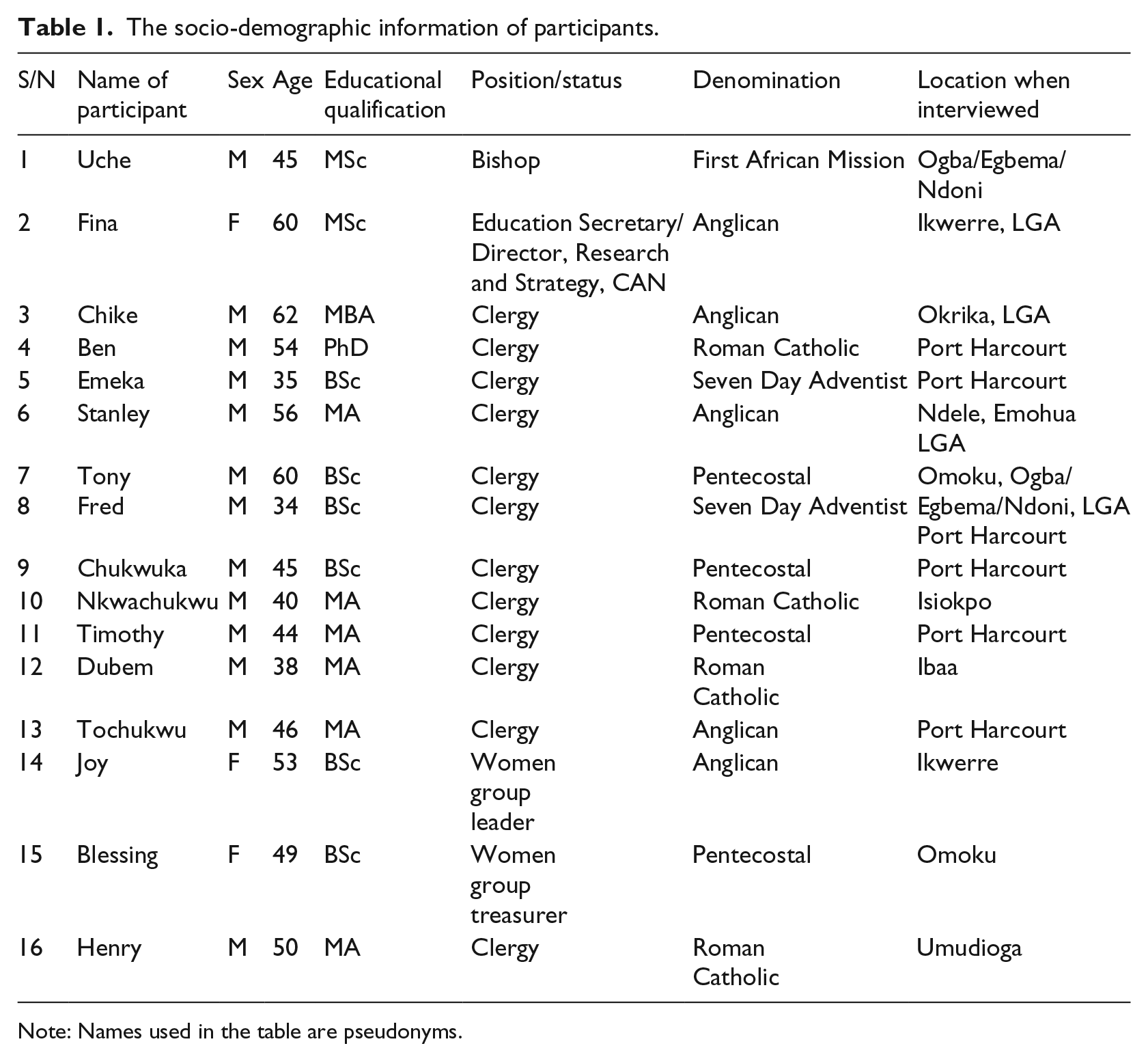
Note: Names used in the table are pseudonyms.
Data Collection
The primary technique for data collection was Key Informant Interview (KII). The KII was conducted over the phone with 16 participants and audio-recorded. The choice to conduct phone interviews was informed by the high rate of insecurity as well as the financial implications of conducting face-to-face interviews with participants in Rivers State. Hence, the researcher got specific names and phone numbers of informants from some residents of Rivers State. Among the 19 persons whose phone numbers were provided, only 16 were eventually interviewed. Among the other three persons, two were indisposed whereas one was uncomfortable and refused to grant interviews on the phone.
Before each interview, participants were informed of the nature of the study as well as why and how they were selected. They were encouraged to be as honest as possible in their responses. Although, some of them initially expressed suspicion, they became relaxed and responsive especially after they were assured of my commitment to handling their responses confidentially. All the interview questions were exhaustively addressed. In the course of interview, participants were made to express views on the causes or factors responsible for the high incidences of cultism in Rivers State and the roles they have played as leaders of FBOs (congregations) in addressing the menace. It was actually in the course of the discussions that the setbacks or challenges that beset them were identified. The interviews were conducted in English and lasted between 38 and 53 minutes.
Data Analysis
The data generated were organized thematically and analysed through descriptive narrative while following an adapted form of Colaizzi’s guide for data analysis (see Morrow et al., 2015; Shosha, 2010). The steps involved in the analysis are listed below:
Each interview audio recording was carefully transcribed by the researchers. Each of the transcripts was painstakingly verified afterwards by the researchers who listened to each interview audio recording to ensure accuracy.
Each transcript was read and reread in order to obtain a general sense about the whole content.
For each transcript, significant statements that pertain to the phenomenon under study were extracted. These statements were written on a separate sheet noting their page and line numbers.
Meanings were formulated from these significant statements in line with the major objectives of the study.
The formulated meanings were sorted into categories and clusters of sub-themes under the major objectives.
The findings of the study were then integrated into an exhaustive description of the phenomenon under study.
Findings
Causes of Cultism in Rivers State
The participants expressed their views on what they have observed to be the causes or factors responsible for the spate of cultism and other related crimes like killing, kidnapping and armed robbery in Rivers State. These factors are analysed below.
Youth Unemployment
Majority of the participants attributed the spate of cultism in Rivers State to youth unemployment. They decried the situation in which many of the young people graduate from the universities with various qualifications only to be faced with unavailability of job opportunities. This, for them, makes these young people remain idle and susceptible to crimes such as cultism, kidnapping and armed robbery in the state. For instance, Emeka notes that: I think the major cause of the cultism and kidnapping is unemployment. And when the youths are not gainfully employed, they can easily engage in all sorts of criminalities.
Chike, also lamented about the situation by noting that ‘the boys who perpetrate these crimes, don’t have jobs. They graduate from universities. Some of them are graduates in Petroleum Engineering and so on, and they come, they don’t have jobs’. Other participants like Fina, Dubem, Chukwuka, Blessing and Tochukwu also shared this view.
Youth’s Unwillingness/Non-Readiness to Work
While majority of the participants cited unemployment as one of the major reasons for the high rate of cultism in Rivers State, they cited youth unwillingness or non-readiness to work as a more fundamental reason. This is because these youths’ unwillingness to work partly explains the reason for not only the high rate of unemployment, but also crime and insecurity in the state. Majority of the youths according to the participants are not willing to work even when they are provided with job opportunities. They rather prefer to sit idle at home and get paid from oil money at the end of the month. Accordingly, the get-rich-quick syndrome or mentality is said to be rampant among the youths in the state, as many of them engage in all sorts of crime to make quick money. Some participants also narrated how some youths who benefitted from skill acquisitions training under the Amnesty programme squandered their startup capital and sold the kits and materials they were given after the training. This, for the participants, is responsible for why most companies do not employ them in the state. In the words of Fred: I think restiveness and cultism in Rivers State is on the increase today because they (the youths) have refused to be laborious. They have refused to be hard working. People from Port Harcourt and Rivers State are known for their nonchalant attitude towards work. Even when they are employed, they don’t want to go to work. They want to sit at home and enjoy their lives, and when the month ends, they go and collect their salary. That is what they always want, and that has been a challenge. . . and it has led to most firms not willing to employ indigenes of their resident communities. . . so they go elsewhere to employ, and the people are not employed. So, it leads to insecurity and crime.
Also, when asked what he feels the causes of the high rate of cultism in Rivers are, Stanley replied with lots of emotion that: Unemployment should be one of the reasons but the people, are they ready to work?. . . You don’t wait until government gives you job. Like an Ikwerre man, there are farms everywhere there are rivers everywhere, (which) somebody can utilize to make a living. When we were growing up, we go to fish at the river, we go to cultivate at the farm, but now the youths don’t want to work even when they are trying to help them, they are not ready. . . The youths don’t want to help matter. Somebody who didn’t go to school, he wants to be a millionaire; he wants to be a governor, how will you be? You don’t want to go to school. I think sometimes, we don’t need to blame the government so much, it is just that the people are not ready to even help the government.
Other participants such as Ben, Fina, Joy, Nkwachukwu, Henry, Uche, Tony and Chike also shared this view that many young people in Rivers State are not willing to work. Ben particularly said that Rivers State has ‘a lot of young people who are not even ready to learn to work, before talking about working’.
However, Emeka, one of the participants expressed a slightly different opinion about the above position. According to him, while there are youths who lack the right dispositions towards work, there are a significant number of enlightened youths who are willing and ready to work. Unfortunately, job opportunities are not there. On the part of Chike, the Rivers State youths should not be blamed for this nonchalant attitude towards work. The successive governments as well as other political and religious figures that own and control oil wells in the Niger Delta region, especially in Rivers State, should rather be blamed. According to him: There is a trigger. . . I grew up in the community where pipelines. . . were not buried in the ground. In the sixties, we saw these pipelines on the surface, up till today…. They are still on the surface. No surveillance, no pipeline surveillance. Everybody was interested in going about their businesses. But now, what was initially unknown to the people, have been unveiled to them. They now know that oil is money. They know that oil money is empowerment. Now, they are talking of people not ready to work in Rivers State. . ., when there are people who are just sitting down there, what do the Emirs do? What do the Obas do? Which work are they working? Yet, they are given oil blocks. . . Even the top military officers, are they not the people that own the ocean going vessels that are used for bunkering? So, they use the boys to make quick money. Now, the boys have known we can make the same quick money. So, which job are you talking of, that will be good for them?
Politics and Lack of Political Will
Participants also attributed the spate of cultism in Rivers State to the political situation in the state. The participants noted that most of these young people who are perpetrating these crimes are thugs to politicians in the state. This connection with politicians, for them, explains greatly why these crimes have been endemic and protracted in the state, as there is no political will to stop or fight them. For instance, Ben notes that: The restiveness of young people, militancy, cultism and kidnapping in Rivers State is in a very important way connected with the political situation of the place. The fact that a large number of those who are into politics are into cultism have brought so many young people into cultism, and these activities of the cultists are what are menacing the community. . . And the political will to stop them is not there, because a good number of them are also thugs to our politicians.
Fina also expressed strong conviction that these boys have connection with politicians in the state. For her, it can never be otherwise, especially considering the fact that these boys parade very sophisticated weapons which are too expensive for the boys to purchase unaided. She observes: When they said they surrendered their guns during the amnesty programme and guns are still wavering around, you may ask: who are the people giving them the guns? They must have senior citizens who are supplying them with guns. Somebody who has no food to eat cannot afford to buy AK47. So, you see that they must have ‘Abraham’ somewhere.
The issue of indoctrination by politicians was also cited to be one of the ways politicians manipulate the youths. For instance, when asked to know what propels the young people who engage in the crimes, Stanley replies: Some people must have indoctrinated them like these political elements. Sometimes they use them for their elections. And if police arrest them, they are the people to go and bail them out. So, that is the dilemma we find ourselves.
In this light, Emeka expects the situation to get worst especially considering the fact that 2019 general election is by the corner in the country.
Deprivation
Some participants tied the current high rate of crime in Rivers State to what they deemed as an age-long injustice and deprivation by the federal government. Over the years, the federal government has been exploring crude oil from the Niger Delta region, especially in Rivers State without a commensurate payback to the host communities. These communities according to some of the participants suffer infrastructural dilapidation and environmental pollution. Emeka, for instance, talks about some particles called ‘black soot’ that drop every morning as a result of industrial activities in the community where he resides, especially around the University of Port Harcourt axis. According to him, these particles are also found in the rooms which warrant constant mopping. This, for him, has some health effects.
Also, with respect to some environmental issues arising from industrial activities in the state, Uche reports of how they inhale some contaminated air arising from gas flaring as well as some particles that affect or destroy their roof tops/zinc in their community. He also raised concerns about some of the aquatic organisms that are almost going into extinction. These, for the participants, are some of the peculiar experiences of host communities in Rivers State who unfortunately do not receive commensurate developmental attention from the government. Hence, when asked what the cause of cultism and kidnapping is, Chike replies thus: I will say disenchantment and dissatisfaction. The young people are not getting their dreams met. Here, we belong to a country where so much is done by talking and nothing is done in action. And of course, the boys see the oil pipes around them, they see the oil wells, and yet the oil blocks belong to Alhajis, Mallams, Emirs, Obas and so on. Is that not cheating? I am an Anglican priest and I have no business going to the shores, but the boys themselves don’t have jobs. . . If I take you to my community. . . you see where from the refinery, they drill water to the salt river there, people make use of it. You know, Okrika man’s typical life is aquaculture. The fish he eats is from that water. Everything polluted! And even if he shouts till tomorrow, nobody answers him. So, these are the things that actually agitate the minds of the young people.
Poor Family Foundation/Family Breakdown
A particular participant made reference to poor family upbringing as an important root cause of the youth’s involvement in cultism in Rivers State. He blamed some parents who because of their love for money failed to, from onset, train and discourage their children from ill behaviours. In the words of Ben, A large number of families are no longer interested in training their children. They are interested in looking for money. So, from the start, as the children bring them money, they take the money, they are happy, my child is bringing money, not my child is working. They may not know what the children are doing, they are willing to collect whatever they bring.
Consequently, ‘these children eventually become hardened cultists and criminals beyond the control of their parents. . .’. Stanley cited a case in Ndele, Emokwa LGA in which parents, especially Christian parents, now hesitate to caution or scold their erring children for fear of being beaten up or killed by their children or their cult groups.
The Role of FBOs
The participants attested to some roles they, as leaders of FBOs, have played towards addressing the menace of cultism in Rivers State. These roles are analysed under the following headings.
FBOs (Congregations/Churches)
Due to the overwhelming nature of the insecurity situation in Rivers State, which is best captured in Fina’s expression ‘we sleep with one eye open’, many of the participants reported to have engaged in prayers especially at the church level in response to the situation in the state. For instance, when asked what they have done to address the problem of cultism in the state, Uche replies: We organize prayers because the Bible says we should pray for the peace of Jerusalem, and this is our own Jerusalem. We pray and call God to intervene. He is the King of Kings and the Lord of Lords. So, our. . . major fundamental work is to pray for the peace of this area. . .
Other participants like Chike, Fina, Joy and Tony reported on how prayerful they have been addressing the problem of insecurity occasioned by cultism in Rivers State. According to Fina: In Isiokpo here, women are involved in monthly prayers. In every first Wednesday of the month, we have our prayers – praying for the community.
Ben also reported how in 2016 he (the Diocesan Chaplain of the Catholic Charismatic Renewal in Port Harcourt) brought the Catholic Church together with the permission of the Bishop to a one-day prayer meeting captioned ‘Lord Heal our Land’. According to him, this meeting was televised live on African Independent Television and its effect on the community started robbing off almost immediately.
Sensitization, enlightenment or preaching is another role congregational FBOs have played in response to cultism in the state. Emeka says that ‘one of the objectives of the church is to promote morality, sometimes by encouraging the youths to shun every form of violence and criminality. So, the churches on their part have been doing that in the state’. Fred reported the efforts of pastors of the Omega Power Ministry (OPM) who, through the platform of the Rivers State Television Authority, have been vocal in the campaign against cultism and in the need for the youth to denounce them. Uche, on his own part, reported on how they have been ‘giving positive advice to the parishioners,. . . members of the church. . ., and to the Christian community, because most of these boys are also. . . members of one denomination or the other’. Similarly, within the dioceses of Okrika, Anglican Communion, Chike notes: We try to encourage the young men to go to school, and those who have come back to try and see how they can pick up vocational activities, so, from time to time, we organize vocational talks and trainings.
However, a more interesting and practical engagement made by the congregational FBOs is reported by Ben, a Reverend Father who was at the centre of such engagement. According to him: In April precisely, 2016, we completed a process which actually started in early 2015. This process involved the plan to talk to the leaders of the cult groups in my community (Ubima) to cease fire. We met them frequently until they accepted to cease fire. Fine, we now got to the next stage, which was asking them to denounce their membership to the cult groups. Many of them agreed to come out of the cult to make progress. Then, we said,. . . the only way we are going to be sure you have come out is that we take you to Father Edeh at Elele where you will publicly denounce your membership to cult, then he will pray for you. They agreed. We took over, to be on the conservative side, 400 of them to Elele and we prayed with them.
Further steps, according to Ben, were also taken to consolidate this first achievement. Narrating these steps, he continues: Then, in April. . . 2016, we had a crusade. . . that involved everybody in the community and it’s environ. And what we did was not to go far to bring Pastors, we used local pastors who knew what happened to address the situations.
After the crusade, the need for a follow-up according to Ben became necessary: . . .So, from that April 2016 till about September 2017, we met every Friday in the community. Where ever I went to, I must go home. If there was anything that I was going to do, and I will not be able to attend, then the team I set up in Port Harcourt here will go home. I am the Diocesan Chaplain of the Catholic Charismatic Renewal, so I set up a team of Catholic Charismatic Renewal who were going there every Friday.
Regarding the contents or agenda of the frequent meetings with the ex-cultists, Ben says: We started with religious talks, when that had gained a lot of ground, we distributed about 600 copies of Bible. Because we were not only giving to members, we were also giving to anybody who came to look for Bible. . .But when we started doing the orientations. . . for skill acquisition, I brought somebody to teach them to do piggery, poultry and snails. As soon as the chiefs saw that these boys are going to become responsible, they locked the hall we were using for the training. That was how it ended. I had already organised those young people. . . into groups based on what they want to do, and to register them to form cooperative unions. They stopped us abruptly. And I don’t have all the time to start going to fight with them.
Some other persons like Uche, who is the Bishop, Diocese of Ogba, First African Mission, have also made some efforts at impacting the lives of young people, especially through charity in his community. Uche narrated how he goes to the Creeks sometimes to share the gospel with some of the cultists in the community where he is presiding as bishop. In one occasion, according to him: I told them what happened to Samson. When Samson refused to obey his parents and began to walk in his own way. The end of Samson was destruction. Samson did not live a fulfilled life again. I also preach to them (from) Luke 15 where the prodigal son said to himself why should I continue like this? I shouldn’t continue like this, while my father has some better things. Let me go back to my father. So, I told them, how long will you carry this gun? Some of you now have children. How long will you carry this gun, can’t you leave these things, and if you want to join Police, go to Police at once than to carry all these illegal arms.
Responding to the question on the source of his courage for such dangerous ventures, he says: That is why they say that when a man’s way pleases the Lord, he makes his enemies to be at peace with him. God has given us the grace to the glory of God, not by my power. God has given us grace that they see us as Christians; people who are advocates of peace. So, we have the privilege. Sometimes, we meet them on the road, in the beer parlour; they will call me Bishop, man of God, pray for us.
Uche also reported to have impacted the lives of these youths through charity. In his words: I am an advocate of peace in this area. I have converted so many of the cult boys as a result of charity. I gave alms. I go to their midst, I buy rice; I also give them some little money.
Interfaith Organization (CAN)
The general opinion of participants about the role of CAN, Rivers State branch, is that the body has increasingly become more political in character and conscious of financial benefits from the state government. For instance when asked about the role of CAN in addressing the spate of insecurity in Rivers State, Ben replied that ‘the CAN only discusses on how to go to government house to collect money and share. They are not discussing how we can get out of this restive place’. Responding to the same question, Chike notes: Well, I can assure you, you don’t go there at all. I happen to be an Ecumenism Director in my diocese (i.e. Okrika). The way CAN is today is so much in shambles. They have only been concerned about who goes to where and who gets money. If for instance, one million naira is given to CAN, you can see the scramble. So, I have no idea if CAN has gone into it or not. But, I can still tell you that CAN is nothing to write home about.
Also, responding to the same question, Stanley observes: Well, except may be the national CAN. But here, I have been attending meetings; I have not seen where they have taken any serious stand on anything because some of them are political. They look for the money they will receive from the government. I have not seen much stand of CAN here, maybe because I am not a core member. So that is it.
In fact, in the view of Fred: If CAN does something like that (i.e. efforts towards curbing cultism), everybody will be aware because it will be publicized. So, we are not seeing the efforts of CAN in terms of curbing insecurity and criminality in the state, you understand? They are not so vocal in that area.
However, Fina, who is an active member of CAN in River State, had a contrary opinion. According to her, CAN has been organizing regular prayer sessions for the peace of the land and advocating for the youths in the state. In her words: Like last two weeks, we went to the Ecumenical Centre. The Coalition chairman called us for prayers for the peace of the state. So, we have gone and we are praying. And I know that in one or two occasions, delegates have been sent to the state government to intimate him, although he knows, to plead that these boys be granted amnesty. So that this matter will be rested, but we have seen that even after that amnesty, it is still going on.
When asked if she was part of that delegate, she replied: No, I was not. But I was at the Ecumenical Centre last week Wednesday at least that is the recent programme we had.
Uche also buttressed the position that CAN has been organizing prayers. According to him: The only thing I see CAN do is just to be organizing prayer meetings and be praying for the peace of the community. That is what I see them do. But as for going in for charity work or there about, I don’t see them.
The Setbacks
The participants identified some setbacks they have been experiencing in the process of combating the menace of cultism in Rivers State. One of the setbacks is lack of cooperation from parents largely occasioned by a particular traditional belief system in some communities. For instance, while responding to the question on the role of FBOs with respect to the spate of cultism in the state, Stanley says: In the church, we have not been resting in talking to the parents but unfortunately for the church. . . the children have outgrown their parents. They are ready to kill their parents particularly in this area we are serving. They have a kind of deity (called Eleweke) they pay allegiance to. And that deity (stipulates that) you cannot see someone who is doing something wrong and you say ‘this is the person’. Their belief is that when you point at the person and the person is killed, you will be held responsible. And they say the blood of that person will be on your head. So, that is what we have been praying that they renounce such tradition.
Stanley also noted that the tradition has also eaten deep into the church as most parents and other members of the community, due to their allegiance to such deity, are usually reluctant to either scold or report some of their erring wards to relevant authorities.
Similarly, Ben reported lack of cooperation and sincerity on the part of traditional chiefs of Ubima community. He narrated how some chiefs rose against a priest who preached at a crusade organized for the spiritual rehabilitation of some repentant cult boys in the community. These chiefs were reported to have gone as far as locking up a village hall which the young people were using for skill acquisition training. Insincerity on the part of some self-acclaimed pastors is another setback that was reported by Ben. According to him, some pastors reportedly go to the hideouts of some of the criminals to pray for the success of their operation. In his words: . . .some of these groups have pastors that pray for them. . . They (the criminals) go to their ministries to get power for them to operate. You may not believe that but it is true. One of our Priests that was kidnapped could tell you that in plain language that the pastors come to the camp to minister and pray for these boys before they go out for operation.
The inability to reach or see the cultists is another setback experienced by some churches in the course of their evangelization or campaigns. For instance, while discussing on the need to evangelize or ‘communicate the fear of God’ to the boys, Tony lamented the inability to reach the boys, ‘because they cannot come out of the bush, and you cannot locate where they are’.
Some participants also identified lack of fund as a major setback. For instance, when asked what the church has done in addressing cultism in Ndele community, apart from preaching and sensitization, Stanley replies ‘I don’t know any other thing, our own is evangelism. We preach. We are an orthodox church, an Anglican church; we don’t have money to empower any person. . . So we do the best we can. . . which is talking’. Chike also lamented lack of fund or capital to start up a business for some youths even after empowering them with some entrepreneurial skills.
The participants also noted some setbacks that arise from the complicity of some politicians or government officials. For instance, about four participants, Ben, Stanley, Fina and Emeka, reported that most of the boys who perpetrate the terror in the communities have connections with politicians in the state. Some of them, according to them, are thugs to some politicians who provide them with the sophisticated weapons with which they operate. ‘Because a good number of them are also thugs to our politicians’, according to Ben, ‘the political will to stop them is not there’. In most cases, for Stanley, these politicians usually bail or rescue them from the police net when arrested in the state.
Discussion
The aim of this study was to explore the roles of FBOs in addressing cultism in Rivers State. First of all, some causes/factors were found to be responsible for the increase in the incidences of cultism in Rivers State. These include youth unemployment, youth unwillingness to work, politics/lack of political will, deprivation and poor family foundation/family breakdown. For instance, youth unemployment has severally been cited in Nwogwugwu et al. (2012), Ejibunu (2007), Oronto et al. (2003), Owabukeruyele (2000) and Uyang et al. (2016) as the major reason or factor responsible for crime and youth restiveness in the Niger Delta, including Rivers State. However, while it was found as a factor in the present study, it was not given the major place in the causes of cultism in Rivers State.
The more fundamental factor as identified by participants was youth unwillingness to work. In fact, with the revealing of this factor such as youth unwillingness to work, the present study particularly challenges what seems to be the dominant view in the body of literature, that of deprivation/marginalization and youth unemployment being the major reasons or factors responsible for crime and youth restiveness in the Niger Delta, especially in Rivers State (see Ejibunu, 2007; Nche et al., 2019; Nwogwugwu et al., 2003; Uyang et al., 2016). According to participants, most youths in Rivers State consumed with the get-rich-quick syndrome mentality desire to get rich without showing corresponding desire to work. They rather prefer to sit at home and get paid from the oil revenue/money at the end of the month. Yet, they cannot be completely blamed for this disposition towards work. The entire political and economic system in the country largely encourages such disposition. With almost complete dependence on oil revenue, the country operates a monolithic economic system (see Kale, 2016; Seberu et al., 2015) that fans the embers of laziness and non-creativity on the part of state governments and some political figures who usually expect to get revenue allocations from the federal government at the end of every month. The situation is such that virtually all the 36 states that make up Nigeria depend almost completely on the oil revenue to pay workers, to build infrastructures and for the entire running of the government. Very few states like Lagos have to some extent creatively diversified sources of income for the state. The rest usually wait to receive monthly oil revenue allocation from the federal government because whether they work or not, the money must come. This overdependence on the oil revenue has accordingly been seen as the bane of Nigeria’s economic development (Igberaese, 2013). For instance, Nweze (2016) empirically examined oil revenue and economic development in Nigeria, between 1981 and 2014, and found that overdependence on oil revenue has negatively impacted on economic growth in the country especially in the long run. Hence, just as the state governments usually wait for what is due to them from the oil revenue, these Rivers State youths always wait for what they feel is due to them as oil producing communities.
In tandem with studies conducted by Nnodim and Ochogba (2018) and Udoh and Ikezu (2015), politics was also found to be one of the factors responsible for the spate of cultism in Rivers State. According to participants, most of these cultists have connection with some politicians who have ‘indoctrinated’ them and provided them with arms with which they operate. The boys also serve as thugs to these politicians. These explain the lack of political will to combat the menace in the state. The association of cultism with politics in Rivers State is also confirmed by Ijuye-Dagogo (2018) who traced the history of cultism in the state to show how politicians have been the backbone of cultism in the state from 1999 to 2015. There are even cases where some politicians hold membership of cult groups. A case in point was when a nabbed suspected cultist Justice Oti (a.k.a. High Tension) alleged that a member of the Rivers State House of Assembly is a member of his cult gang (Icelanders) (Abia, 2017). In another occasion, a traditional ruler in Ozoji Community in Rivers State was alleged to be the sponsor of the Greenlanders in the state (Jannah, 2017).
Poor family foundation/family breakdown was also cited as one of the causes of the high incidences of cultism in Rivers State. This was also reported in Nnodim and Ochogba’s (2018), Udoh and Ikezu’s (2015) and Ajayi et al.’s (2010) studies as one of the major factors that predispose youth to cultism in Rivers State. According to one of the participants in the present study, some parents fail to bring up their children to imbibe acceptable moral behaviours through their nonchalant attitudes towards some of their (children’s) early signs of radicalism. Some of them (parents), according to the participant, receive money from their children without bothering to know its sources. Such children grow up to become radicals susceptible to crimes like cultism and kidnapping. At this point, parents might have lost control over them. Hence, a participant reported how some parents hesitate in scolding or correcting their children in their communities for fear of being killed. Yet, there are cases where children are captured against their will in the presence of their helpless parents and taken away to be initiated into cultism (Ijuye-Dagogo, 2018; Nnodim and Ochogba, 2018).
Consistent with previous studies by Ejibunu (2007), Ibeanu and Luckham (2007), Obi and Rustard (2011), Ukiwo (2007) and Ojakorutu (2010), the present study found deprivation (or relative deprivation) as one of the factors responsible for the incidence of cultism and youth restiveness in Rivers State. According to one of the participants, the youths in Rivers State are disenchanted and dissatisfied with issues in the state and country at large. Aaron (2015) summarized these issues to include (1) the longstanding marginalization of the region in national politics; (2) the widespread oil-induced environmental degradation; (3) the structural inequities in oil revenue-sharing; and (4) the palpable crisis of development and wrenching poverty in a region whose oil wealth sustains the rest of the nation. Yet, Aaron has contended that the insurgency, the scourge of cultism or youth restiveness in the Niger Delta, including Rivers State, is not necessarily caused by conditions of relative deprivation. It is rather greatly caused by the nature of Nigeria’s fundamentally flawed federalism.
With respect to the roles of FBOs in addressing the menace of cultism and other related crimes like kidnapping and armed robbery in Rivers State, the study found that prayer is one of the major efforts made by FBOs, especially churches/congregations in the state. This is a reflection of the participants’ feeling of despair in the face of the seemingly intractable and overwhelming nature of the insecurity situation in the state. Participants reported how relentless they have been engaging in prayers for the peace of the land (i.e. Rivers State). This is characteristic of Christians’ approach to issues generally in Nigeria. Prayer is often seen as the key or solution to all problems including socio-religious, political and economic problems in the country. For instance, Onah and Ugwu (2008) through their article recommended ‘prayer’ as the panacea to all the problems or challenges facing Nigeria. Ibikunle Amosun, the governor of Ogun State was also reported to have recommended prayer as the solution to Nigeria’s problems at the formal opening of the 2017 Standing Committee Meeting of the Church of Nigeria (Anglican Communion) held in Abeokuta, Ogun State (see Osijonwu, 2017). Specifically, Ugwu and Chukwuma (2002) presented prayer as capable of solving Nigeria’s national security challenges. These go to show how powerful prayer is generally perceived to be by many in Nigeria. This is informed by the belief in the sovereignty and omnipotence of God who is believed to possess the power over all things.
Youth enlightenment was also found to be occasionally carried out by FBOs in the state. This enlightenment was done either on the pulpit during church services or through the media like in the case of the Omega Power Ministry or during crusades, or on the platforms of workshops, seminars or symposia. A particular participant reported how they ministered to the young people on a crusade ground and recorded a huge success afterwards. Similarly, it was reported that about 1300 cultists gave their lives to Christ during a crusade organized by the Deeper Life Bible Church (Iheamnachor et al., 2017). The approach or act of administering or starting up youth enlightenment with religious teachings as reported by some of the participants reinforces Ebaugh et al. (2003) finding. According to this finding, FBOs’ approach to service delivery is that of a ‘continuum of religiosity’ ranging from ‘faith-saturated’ (or pervasively sectarian) to ‘secular-oriented’. Also, this engagement in youth enlightenment suggests that FBOs especially congregations are interested in the provisions of social services with long-term goals. This particularly challenges the scholarly position that FBOs (i.e. congregations) usually engage in fleeting contact, if at all any, with needy people or typically participate in or support programmes aimed at only meeting short-term emergency needs, such as food, clothing and shelter (Chaves and Tsitsos, 2001). Nevertheless, the need for enlightenment is usually based on the general belief that the involvement of many youths in the crime of cultism is as a result of ignorance (i.e., ignorance of the destructive and futile nature of such crimes). For instance, ignorance was found by Nnodim and Ochogba (2018) to be one of the major reasons for youth involvement in cult groups and other related crimes in Rivers State.
The study also revealed some of the setbacks that beset FBOs in the course of addressing some of the causes of cultism in River State. These setbacks were identified to include lack of cooperation from parents due to a traditional belief, lack of cooperation from traditional/local chiefs, insincerity on the part of some self-acclaimed pastors, inability to reach the cultists, lack of funds and the complicity of corrupt politicians in Rivers State. Of all these setbacks, lack of funds has been noted to be common with FBOs globally unlike their secular counterparts. Studies have shown that FBOs generally suffer lack of funds in the course of providing social services (Belcher and Deforge, 2007; Ebaugh et al., 2003; Goldsmith et al., 2006). This is because they receive less public funding and largely depend on support from congregations and religious institutions. This is of course unlike their secular counterparts who are more likely to receive funds from government sources (Goldsmith et al., 2006). This explains why Graddy (2008) suggests a modest and focused role for FBOs in social service delivery, but one that is complementary to the efforts of secular providers. Then, the conflict that reportedly ensued between the local chiefs and the priests which led to the interruption of the youth skill acquisition training in Ubima community has also been found to be characteristic of FBOs’ social interventions. This, according to Goldsmith et al. (2006), is because FBOs hold that religion is central to their mission and to the services they provide, suggesting that they may be unwilling to compromise with secular partners for fear of compromising their principles. This could result in conflict between FBOs and host community leaders or secular partners.
Implications of Findings for FBOs, Youths and Family
The study found that FBOs (churches) in the state frequently engaged in prayers and less frequently in youth enlightenment. The inter-faith organization like CAN, Rivers State branch, was, apart from their alleged loss of focus, also reported to have been organizing constant prayers for the security situation in the state.
This could largely explain why their impact has not been fully felt in the state. While it is important to pray, it is more important to work. The current security situation in Rivers State is a result of interplay of factors such as poor family foundation, youth ignorance, political corruption, relative deprivation, unemployment and youth unwillingness to work. In this light, any effort to address the security situation should be channelled at these issues or root causes. And prayers do not seem to be an effective effort or approach as long as these issues are concerned. This is because when parents have failed to do their God-given jobs/duties; when the governments (i.e. state and federal) have shied away from their primary duties of upholding justice and fairness in the distribution of the national wealth; when corrupt politicians in their desperate desire for power and wealth have been fanning the embers of cultism and kidnapping; when there are little or no job opportunities for the youths; and when many youths, overwhelmed by the get-rich-quick syndrome in the state, have ignorantly taken to crime, there is hardly any amount of prayers that would seem reasonable.
Instead, FBOs should embark on more practical engagements and interventions such as advocacy in the interest of the youth and the entire community; enlightenment for everyone in the state, both parents and youths; and youth empowerment, in the state. Although some participants reported to have made some of these efforts, the efforts are far less frequent and in most cases carried out by individuals instead of the organizations. There are also cases where such efforts lacked adequate follow-up from the FBOs. It is a fact that there are some setbacks which of course were reported by some participants to include lack of cooperation from some local chiefs and parents, inability of FBOs to see or reach cultists, complicity of some politicians and self-acclaimed ministers, politicization of some FBOs and lack of fund. But, amidst these challenges or setbacks, FBOs can still contribute significantly to engendering peace and order in Rivers State through conscious efforts towards addressing the root causes of the high rate of insecurity in the state. Regarding the issue of lack of cooperation from parents and chiefs, FBOs (i.e. congregations) can, in addition to general enlightenment, dialogue and carry parents, local/community leaders/chiefs and other stakeholders along in their service delivery. Also, regarding the challenge of fund, making special appeals for fund to the state government and other stakeholders will enable them to execute enlightenment and empowerment programmes for the people especially the youths in the state.
Also, the finding that many of the youths in Rivers State are unwilling to work has a serious implication for both the youth and families in the state. This situation threatens the future of Rivers State and that of the country at large. This is because if the youths on whose shoulders lies the future of society are not willing to work, it suggests that the future is gloomy. The sensitiveness of the situation lies in the fact that these youths are expected to take over the positions of leadership in several aspects of the state and the country such as political positions and managerial positions in companies. They are also expected to have their own families. How are they going to run the affairs of these institutions? Already, there have been reported cases of abuse by some cultists occupying positions in the state and some oil companies. The member of the Rivers State House of Representative who was reported to be a member and sponsor of Icelanders, a popular cult group in the state, is a case in point (Abia, 2017).
While the youths are implicated for having such disposition towards work, the situation further points to poor family foundation or the failure of parents to carry out their parental duties towards their children. The family is a central institution on which the survival of society largely depends. This is due to the fact that parents are the first teachers of their children and as such wield tremendous influence on them. In this light, when children exhibit certain socially unacceptable behaviours or dispositions such as laziness or unwillingness to work, parents cannot evade blames. Of course, a particular participant in the present study cited cases in Rivers State where some parents show nonchalant dispositions towards their children’s way-about and source of wealth. The result of this, as another participant pointed out, is that parents are now scared of scolding their children who are members of cult groups for fear of being killed. This situation would have been averted if these parents consciously instilled or inculcated the right moral values such as the value for hard work and industry, patience and sincerity in their children at their very early age.
Conclusion
Cultism has indeed been a nightmarish phenomenon to the residents of Rivers State. This is why a long-term remedy is imperative. This study has x-rayed the roles FBOs have played in response to this menace of cultism. However, most of these roles have been not only occasional and less frequent, but also ineffective as long as the identified root causes of cultism in the state are concerned. Admittedly, there are setbacks as reported by some of the participants in the study, but these setbacks do not have much connection with their readiness and disposition towards proactive result-oriented responses to the scourge of cultism in the state. Hence, as already noted, FBOs can amidst these setbacks significantly contribute to the reduction of youth restiveness and cultism in Rivers State and Niger Delta as a whole. They can achieve this by engaging in more practical and result-oriented programmes that would address the identified root causes of cultism in the state.
Footnotes
Funding
The author received no financial support for the research, authorship and/or publication of this article.