



Abstract
The pandemic and resulting stay-at-home orders since March 2020 have come at a high cost to lives and livelihoods around the globe including ways in which faith communities meet. This paper forms part of a wider study Exploring hope, grace, and resilience in parish communities in COVID-19 times. It investigates how members of Christian faith communities in Melbourne (Australia) made meaning of their understanding of hope during the pandemic. The authors draw on survey data gathered between November 2021 and mid-March 2022 and using thematic analysis they discuss two overarching themes (Light despite the darkness and Connection to God). While generalisations to other faith communities cannot be made, the findings indicate churches fostered hope and offered a sense of belonging. The paper discusses implications for ways in which churches can continue to build faith with church members and the wider community in the changing landscape of the pandemic.
Introduction
The World Health Organization declared the coronavirus disease 2019 (COVID-19) a global pandemic on 11 March 2020 (Taylor, 2021). Since then, all spheres of life around the world have been affected including the economy, education, business, travel, and health causing considerable stress and anxiety, alongside fears about the transmission of the virus (Czeisler et al., 2020; Styck et al., 2021). COVID-19 has forced people to work from home. It also meant that social gatherings were prohibited (Beach, 2021; Paul, 2020). The pandemic continues to cause excessive deaths around the globe coupled with loss of livelihoods (OECD, 2020). During this time of uncertainty many countries experienced varied lockdowns and restrictions including sites of worship, such as churches, chapels, temples, mosques and synagogues, which were closed (Behera, 2020, Bryson et al., 2020). With this, whilst places of worship had to change how they met, they remain sites where physical, social, and cultural and connections are made and maintained irrespective of population groups, demographics or social economics (Jones, 2000). COVID-19 has triggered Christian communities to do ‘church’ differently with many turning to the internet to maintain contact with fellow believers (Campbell, 2020; Pillay, 2020).
The ‘new COVID normal’, provides people the opportunity to question their faith and fragility, as well as be bearers of hope facing unknowns and uncertainties. As faith gives purpose and hope to one's life, the act of worship plays a vital role in human existence as people place their hope and trust in God's grace (Hyde and Joseph, 2022). Therefore, having lockdowns and restrictions has significantly affected the way people serve God and gather as a community in buildings such as churches (Bryson et al., 2020). These important connections in sacred places may be lost when people, for example, are unable to gather to celebrate symbolic dates in the liturgical calendar. Recent research has shown that the sacrament of the Eucharist has caused some controversy between the embodied religious experience of receiving the Eucharist in-person and virtually (Huygens, 2021; Parish, 2020; Rosales, 2021) Whilst it is beyond the scope of this paper to expand on this aspect specifically, it may be argued that it is not feasible in some denominations to receive the Eucharist outside the embodied setting (Parish, 2020). Despite this, the COVID crisis has caused people to return to their beliefs in the act of communal worship that includes scripture reading, singing, sermons, prayers and Holy Communion (Bryson et al., 2020), with some people resorting to ‘meta-social as hope, help and response to the unknown’ (Sabaté Gauxachs et al., 2021: 313).
Positionality statement
The authors are tertiary educators at the same university in Melbourne (Australia) working in teacher education. They are members of Christian faith communities. Author One (Dawn), is an organist, pianist, and reader of scripture at an Anglican Church, and Author Two (Brendan), has been an extraordinary minister of the Eucharist and guitarist at a Catholic Church. During this unprecedented time in history working from home as academics from March 2020 to mid-March 2022, we regularly conversed about work, secular and spiritual matters as we each drew on our faith which offered us hope as we worked remotely, given Melbourne experienced the longest lockdown in the world (Kelly, 2021; Miller, 2021).
We commenced a research project Exploring hope, grace, and resilience in parish communities in COVID-19 times focusing on the South-Eastern suburbs of Melbourne. The present paper is part of the wider study that started in November 2021. Whilst we do not focus on one specific church denomination, the Catholic, Protestant, and Orthodox churches remain the three dominant Christian traditions with numerous sub-denominations of Protestants (ARDA, 2000). This paper focuses on two research questions from the wider study:
What is your understanding of hope? Give an example when you experienced hope during the pandemic?
Theoretical perspectives
Hope
Considerable research had been conducted in relation to the concept of Hope. The phenomenon has been examined through a variety of lenses and contexts, from which several definitions have developed. Hope is the essence of things that are unseen, for the future as it enables a person to cope with developmental challenges. It presents options for individuals and helps them to examine sources of personal strength in relation to the future (Braun-Lewensohn et al., 2021; Sharabi et al., 2012). The theological view of hope considers faith-based hope as being an external locus-of-hope that includes ‘external-family, external-peer, and external-spiritual’ (Bernardo and Mendoza, 2021: 5699). Adding to this, Bernardo and Mendoza (2021) envision hope as a disposition that enables a person to engage in positive goal-directed thinking. In terms of ‘hoped for outcomes’ Kwon's (2018) account of hope indicates that, a person must be able to see a way in which the desired outcome can come about. Moreover, a person must see the way to the ‘hoped for outcome’ as a genuine possibility. Whilst hope is associated with specific outcomes, some people may respond with despair if their outcomes are not realised, whereas ‘others respond [to hope] with a profound resilience: a continuing stance of hopefulness in spite of the circumstances’ (Sain, 2020: 100).
The notion of hope is aligned to religious history (Elliot, 2020), as the Old and New Testaments are saturated with hope in God (Sain, 2020). This culminates in the Resurrection of Christ, impressing on believers the ultimate vindication of hope. The Easter mystery and the belief in Christ's second coming ‘inspired the belief that nothing – not even death – could prevent the ultimate triumph of good over evil’ (Elliot, 2020: 118). Scripture gives us hope through Christ stating, ‘I have said this to you, so that in me you may have peace. In the world, you face persecution. But take courage; I have conquered the world!’ (John 16:33 NRSV 1 ). This important verse gives hope to Christians during the pandemic, particularly as many lives have been lost. Mbwana (2021: 18) urges us to rest on God's word where ‘we can look to the past, in times like these, and gather instructions on how to best navigate our present reality’ and build our faith.
Faith
Closely connected to hope is the notion of faith, a concept nearly impossible to define. Faith is intensely personal and is often seen as extremely private (Newman, 2004). The term faith ‘ranges in meaning from a general religious attitude on the one hand to personal acceptance of a specific set of beliefs on the other hand’ (Hellwig, 1990: 3). Though usually seen in religious terms, faith remains an ‘extraordinarily important construct’ (Lee, 1990: vii). While Fowler (1993) equates faith with individual meaning systems, there is a communal dimension to faith, most expressed in religious church communities. This provides specific systems and structures that enable people to express and nurture their faith (Tacey, 2003). For Christians then, faith is tied to hope when God intervenes and interrupts history (Boeve, 2007).
Faith according to Borg (2009: 27) has several rich meanings that align to having a set of Christian beliefs taken as truth where ‘faith is at the heart of Christianity’. Faith is also shaped by ‘initiatives from beyond us and other people’ where ‘faith is interactive and social [requiring] community, language, ritual and nurture’ (Fowler, 1993: xiii). The interactive and social nature of faith gives rise to the notion of a faith community, which provides the language, ritual, and structure to guide the nurturing, sharing, and expressing of faith.
Faith communities
Faith communities commonly meet in a location on the basis of a ‘building’ or align with a group of people because of their relationship with God and each other. In this sense meeting together in a communal space people have shared ‘feeling of belonging’ as they form a community of Christian believers (Dinham, 2011: 531). Research has shown that faith communities have played significant roles in helping, for example, migrants. They serve as important sources of social capital offering emotional and financial support with some migrants converting to Christianity (Foley and Hoge, 2007; Lu et al., 2012; Zhang, 2006). In some faith communities, faith leaders not only guide people in spiritual matters, but also in matters of health promotions where the faith leader is an influential voice (DeSouza et al., 2021; Webb et al., 2013).
Writing in the time of the pandemic, Hellman (2022: 40) reminds us of scripture ‘to show love to all’ (John 13:34–35; Romans 12:10; Galatians 5:14; Galatians 6:2; Ephesians 4:32; Philippians 2:4; 1 Peter 1:22; 1 Peter 3:8; 1 John 4:7). Churches as faith communities have played an instrumental role in helping older adults find meaning through making social connection, combatting loneliness and depression (Garrison, 2021). For people in despair, faith communities provide support; they offer hope and healing, and a sense of belonging (Sain, 2020; Spencer-Thomas, 2018). In all circumstances, Hellman (2022) points out that we are called to extend God's love to those surrounding us, then we are portrayed as ‘God's chosen ones, holy and beloved', clothed with ‘compassion, kindness, humility, meekness, and patience' (Colossians 3:12). A recent study by Ganiel (2020), found that online ministry, especially for the elderly and vulnerable, provided them with social services. In addition, she found ‘people being “saved” or converting to Christianity during the pandemic’ (29). Overall, her study confirmed faith communities are more than buildings; they serve people.
Methodology
Design
Ethical approval to undertake the project Exploring hope, grace, and resilience in parish communities in COVID-19 times was granted by Deakin University for participants 18 years and older. A qualitative approach employed purposive sampling to gain a better understanding of the phenomena under study (Etikan et al., 2016). Six faith communities (Catholic, Anglican, Pentecostal, Baptist, Uniting Church, and Evangelical) were randomly contacted in the South-Eastern suburbs of Melbourne using their websites. Through email, the faith communities were invited to assist with recruiting membership to participate in the study. The email contained the Plain Language Statement (PLS) which clearly outlined the project, the organisational consent form and sample survey questions. The email included the invitation flyer which contained the link to the PLS for faith communities to disseminate through their church noticeboard, newsletter, and website. The survey was emailed from the start of November 2021 and closed mid-May 2022. The current analysis draws on survey data collected during this time using a Qualtrics platform (Francis and Village 2022; Heen et al., 2014).
Instrument
The survey allowed participants to respond to a range of quantitative and qualitative items (Heen et al., 2014). The survey was initially trialled and tested for ambiguity with lay church members, senior and junior clerics, with an overseas and interstate church musician testing for validity and reliability (Ball, 2019). Accordingly, it was amended before dissemination. The survey included closed questions to tick a box in relation to denomination, age and gender. Open-ended questions included for example: What is your understanding of Hope? Can you give an example when you experienced Hope during the pandemic? What is your experience of Grace? How has God sustained you during the time of the pandemic? In what ways do you feel supported by your faith community?
Participants
Participants were required to tick a box agreeing that they had read the PLS and were over the age of 18. We had invited 52 faith communities (Catholic, Anglican, Pentecostal, Baptist, Uniting Church, and Evangelical churches) within the South-Eastern metropolitan area of Melbourne. Some parish offices responded with reason as to why they were unable to participate. One in particular said that, due to their participation in the National Church Life survey, they felt it was too much to impose on their members yet another survey to complete. Other invited faith communities did not respond to the invitation, though a reminder email was sent. These reasons may account for the low number of respondents (N = 106), therefore, it is not possible to say exactly how many parishes participated overall in the project.
Analysis
Employing Braun and Clarke's (2006, 2014) thematic analysis (TA) to code and analyse data, the authors communicated through zoom, telephone, email and in-person. TA provided an understanding of our participants' experiences and understandings of hope (Braun and Clarke, 2012; Terry et al., 2017). They each read the data independently, coding it to create initial themes. They independently and collectively reread and revised the emerging themes, identifying names for the themes before writing up the narrative (Braun and Clarke, 2006, 2014). In this way, emerging patterns were grouped into broad overarching themes (Biggerstaff and Thompson, 2008; Eatough and Smith, 2006). Using direct quotations from the survey that are rich and full descriptions of what it means to be in our participants' world (Dallos and Vetere, 2005), two overarching themes are discussed (see Table 1) Light despite the darkness and Connection to God.
Coding and themes.

We recognise the limitation of this small sample; therefore, statistical inferences and generalisations to Christian faith communities or any faith community in Melbourne cannot be made.
Findings
In this section, we provide a snapshot of some of the findings gathered between November 2021 and mid-May 2022 regarding the two questions posed from the wider study. From those that responded to the invitation, the majority of respondents were Anglicans (48%) and only 11% were from the Catholic Church, though they make up the largest percentage of Christians in Australia. 14% responded from the Uniting Church and few from the Pentecostal (9%), Evangelical (5%) and Baptist (2%) Church. 12% selected ‘other’, some stated ‘non-denominational’, with others naming three specific churches: Church of Christ, Presbyterian, and Syrian Maronite. Of all the respondents (N = 106), 62 were female, 22 male, two identified as ‘other’, and 20 preferred not to say. Figure 1 indicates that those in the age group 30–39 were the highest number of respondents followed by those in the age group 50–59.
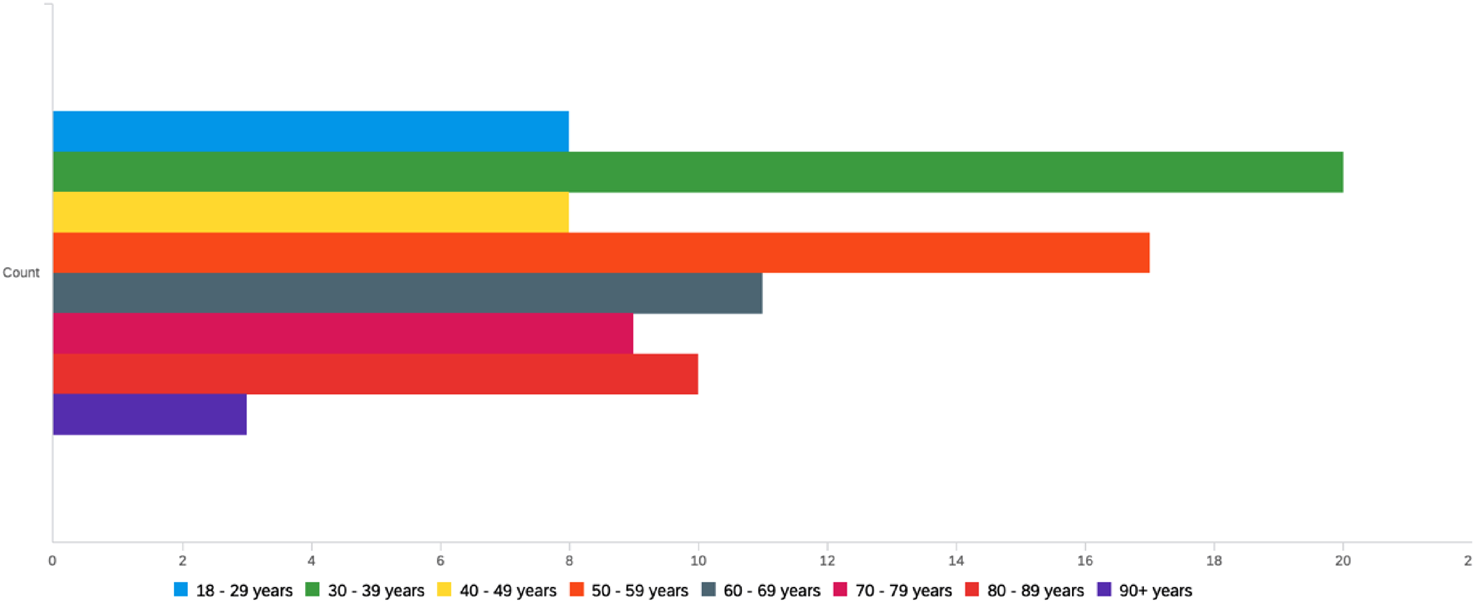
Age range of respondents.
The majority of respondents were Anglican and mostly female who fell into the age range of 30–39. This phenomenon is not new as Francis and Village (2022: 2) report, it is ‘consistent with the broader scientific evidence that women report more signs of religiosity than men’.
Question 1: What is your understanding of hope?
Of all the respondents, many mentioned the notion of hope in relation to belief. For them, hope was:
a belief that things will get better, or that there will be a positive outcome a belief in the good of people a belief in a better future believing that better times will come to pass Confidence in a positive future, a sense of comforting perspective that good will come. it's a source of comfort in believing in a good outcome to a situation having a positive attitude helps according to the Bible hope is when you look forward to something that is positive I experienced hope as I saw my faith community adapting well to the change to online worship and sharing and being able to continue to reflect and share and reach out to one another. I also experienced it as I saw vaccines being developed. My growing relationship with my partner, to whom I became engaged a fortnight prior to lockdown, no doubt also contributed to my sense of hope. hope is the reason we keep on going, believing we will emerge from this pandemic with more understanding and more compassion towards each other hope involves trust and faith the knowledge that there is always something better. It is the opposite of anxiety; it involves trust and faith.
Additionally, respondents also commented that hope involved being positive. Some said:
Several participants indicated that hope seemed to have a strong connection to faith and trust. Some stated:
One person summed up the question of hope as ‘the dreaming, praying, imagining, sharing, and intentional participation in creating a more life-giving, just, peaceful, and joyous reality for all’.
As all participants were members of Christian faith communities, keeping their faith significantly contributed to understanding and experiences of hope. Some felt:
hope is believing that we will be kept safe in the loving arms of Our Lord hope leads to faith, it helps us understand and believe that God will never leave us nor forsake us, which in turn shows our faith in Him hope is for the future; it keeps us going learning and trusting in God fully.
Other respondents identified believing in scripture as key to giving them hope during this unprecedented time. Some found the ‘promises in the Bible’ provided a comforting source of hope. Another recognised that ‘standing on his [God's] word daily is to take courage of the situation and of our future’. Some respondents highlighted specific scriptures passages to describe ‘hope as a firm assurance regarding things that are unclear and unknown’ (Romans 8:24–25; Hebrews 11:1, 7). Another said, ‘amidst all the issues with pandemic, there was still hope that God who helped Noah through 40 days and 40 nights (Genesis 6:9–9:28) is still is able to bring us out of this issue … it is taking time, but Jesus is the same yesterday, today and forever’.
It was interesting to find some participants also found associations to hope between nature and people. Walking outdoors provided a sense of hope as it ‘brings contentment and peace’; additionally, many found that ‘working in the garden’, offered them space to connect with God. While for others connecting with friends and family through technology was another essential channel of hope. This type of connection, as one said, ‘is a source of comfort’ whilst others similarly said, ‘sharing God's love through connecting with people filled them with hope’. One person in particular mentioned ‘living as a migrant also means the importance of inclusion by enabling Indigenous First Nation people to have an active voice in church settings, this helps everyone in the community to know that there is hope for reconciliation’. Another mentioned ‘having a place other than inside the church for reflection about life, death, reconciliation may bring hope to some who don’t belong to a church’.
Question 2: Give an example when you experienced hope during the pandemic?
When asked to give an example of when they experienced hope during the pandemic, some spoke of the vaccination roll-out being a source of hope. For example, ‘when the vaccine was approved, I felt that there was hope that the pandemic would end quickly’. Many felt there was hope in the aged care when ‘relatives and parents received the vaccination, and I was allowed to visit and not use technology to keep in touch’. Others said the lifting of restrictions especially in Melbourne meant ‘more freedom in our daily lives’, and the possibility of ‘doing things, socialising, venturing out some time in the future’, and ‘making frequent visits to my husband in aged care’. One person commented on the opportunities for learning and teaching in the online space, saying ‘I also experienced hope in education as people moved to online learning. There were many positive outcomes from this, and I felt there would be ongoing positives for education. I also figured there was a greater plan [above], and that we would get through it [the pandemic and lockdowns]’.
All respondents found ‘interaction with family and other people’ brought comfort and hope. One person said, ‘being cared for by family, friends and our church minister gave me hope of the kindness and love we have for each other during hard times’. Some felt that keeping the faith, was experienced through, ‘friends joining Zoom services’, as well as ‘quiet times of Home Church with my husband, and the greater closeness shared with each other and to God’. While one person felt ‘hope was experienced when we sat down on Sunday morning together in our own homes and held our Parish Service’. Another found, ‘hope was experienced through phone calls, and by support of family and friends’. As members of faith communities, it was notable that respondents ‘prayed for hope that the [COVID] cases would fall and that our health workers would be kept safe’.
It was evident that several respondents experienced tangible sources of hope through:
seeing God's creation in nature reminds me how wonderful life in spite of the pandemic seeing flowers in my garden beginning to bloom at the beginning of Spring, and I could hear the birds singing in the morning. This reminded me that something ‘better’ was on the way … that the pandemic too, would pass! We ran an online women’s event … It was difficult to prepare. It was postponed and often felt too hard and perhaps like it wouldn’t be worth the stress or effort. But it happened … And suddenly, in the midst of the event, it turned into a worship dance party on zoom. There were older women bopping in chairs, all sorts of people dancing in their loungerooms, someone rocking a baby along … This would never happen in person in church! And it was joyful! I never expected zoom to be joyful. I was on such a high … It gave me hope that God would use all this isolation this to bring communion after all.
One lady said:
Another person summed up her experience of hope and faith by sharing the following: Christian hope is rooted in faith so when my parents had COVID and were in ICU, I hoped, prayed and had faith to believe that God will answer my prayers and make them well and spare their lives. Without hope, life loses its meaning, BUT GOD worked a miracle to restore my parents’ health and answered my prayers. This experience of hope meant I praised God and sang in the middle of my storm. I did not limit GOD, he allowed hope to arise in my heart and mind which filled me with positive thoughts and memories during their illness and my darkest moments. Desmond Tutu once said, ‘Hope is being able to see that there is light despite all of the darkness’.
‘Hope shines as a beacon of light’ as one male experienced. He said: I have new neighbours across the road from my house. They are a youngish Sikh family from India. They are amongst the kindest people I have ever known. We share a good curry every 2nd week or so, and I am teaching them about Australia and, curiously, about India. My Australian parents went to India in 1937 and returned 15 years later with 4 children. I was their first child … went to an International Boarding School in the foothills of the Himalaya mountains. I love India and know that living there was an enormous and wonderful privilege … In this time of pandemic and war I am endlessly surprised by kindness and friendships. I have no reason to think that such virtues will ever disappear from human life.
However, not all participants constantly experienced hope during the pandemic. Extended periods of lockdown meant that some found themselves isolated from the physical presence of others. Some maintained, for instance, that they experienced:
loneliness, as sometimes I only saw one or two people for the week (an) inability to meet children and grandchildren missing family (in-person) and missing important moments: birthdays and things not being able to visit my mother who has dementia in a nursing home. Watching the live streaming of services from the cathedral or other churches may be good if being watched with another person but not when alone. It began to look like people acting in fancy dress. I began to realise the significance of the phrase ‘when two or three are gathered in my name…’ [Matthew 18:20].
For people living by themselves, the adverse impact of lockdowns in Melbourne meant ‘as a single person not being able to drive beyond 5 km to see friends or elderly people I visit and love (as I am like a daughter to them) impacted me’. For several respondents, the enforced physical isolation from other people meant a lack of emotional and practical support from people they anticipated would provide it. For example, one respondent said that their well-being was negatively affected by ‘people not making contact even when they were aware that I was sick’. Another person described ‘feeling abandoned during a two-week period of home isolation as a close contact of a positive COVID Case. People kept away’. A number of participants recognised ‘not being able to worship with others’ as something that had a negative impact on their sense of hope. One person summed this up astutely in saying:
Discussion
From the findings, we discuss two overarching themes (Light despite the darkness, and Connection to God).
Light despite the darkness
The responses of the participants indicate that they tended to see hope as relating to the future (Braun-Lewensohn et al., 2021; Sain, 2020; Sharabi et al., 2012). It enabled them to engage in positive goal-directed thinking (Bernardo and Mendoza, 2021) expressed in terms of ‘hoped for outcomes’ (Kwong, 2018). Experiences of hope resonated religious practices and beliefs that fostered a sense of fulfilment and contentment (Braun-Lewensohn et al., 2021) as they developed coping skills and a sense of hope by staying connected, predominantly using technology (Chirombe et al., 2020). The statements ‘hope is for the future; it keeps us going, leaning on and trusting in God fully’ reflects the future-oriented notion of hope. It indicates participants’ willingness to speak more freely about their thankfulness to God and serves as testimony of a belief in God's intervention in human activity (Boeve, 2007). It also suggests their ability to maintain a continuing stance of hopefulness despite difficult circumstances (Sain, 2020).
The above suggests that far from having a sense of hopelessness the participants held onto and expressed a great sense of hope, despite the challenges they felt they had experienced during the pandemic. Therefore, belonging to a religious tradition may offer people a sense of hope, enabling them to cope during times of difficulty (Eckersley, 2005; Emmons, 1999; Kwilecki, 2004; Szcześniak et al., 2020). The pandemic was no different and the participants were able to hold onto hope by attending online services or reading from scripture passages (Mbwana, 2021). They experienced hoped-for outcomes as genuine possibilities (Kwong, 2018). Furthermore, belonging to a faith community provided them support structures that enabled them to express their sense of hope (cf. Tacey, 2003). In particular, the participant who maintained that hope comprised, ‘the dreaming, praying, imagining, sharing, and intentional participation in creating a more life-giving, just, peaceful, and joyous reality for all’, expressed this best. This statement also reflects the notion that people have not lost hope or faith but shared their faith with others (family, friends, and workmates) through new ways like social media. People are finding God in new places and spaces (Bryson et al., 2020). Many found peace and spiritual refreshment by engaging in different leisure activities including their interactions with people and nature. In this way, people identified signs of hope during the pandemic with their different life circumstances and experiences (Broadhurst and Harrington, 2016). For example, participants with previous experiences of enduring and even surmounting adversity seemed particularly able to look for the indications of hope in their pandemic experiences (Hayes et al., 2017). A similar ability to look for markers of hope was seen in people who enjoyed supportive relationships and rich interpersonal interactions, even if such interactions took place predominantly through virtual platforms (Hayes et al., 2017). In this way people maintained their Christian hope amid isolation and uncertainty and shared this hope with others so that they too could see the light at the end of the tunnel as the darkness was dispelled.
However, our findings also suggest that not all participants experienced a constant sense of hope. During the period of lockdown, for example, the clergy in particular found a disconnect with their members gathering through Zoom and meeting face-to-face. The longing to congregate in one space at the same time was ‘hoped for and prayed for’. As one priest said ‘the optimal way of relating to one another as a faith community through our Eucharistic gathering is the body of Christ coming together physically. Everything else is just an approximation’. For this congregation, the ‘practice of spiritual communion provides an opportunity to seek the sustaining grace of God and maintain a connection to the wider Christian community’ (Parish, 2020: 7).
Being isolated from the physical presence of others took its toll in some instances, and the ‘hoped for outcomes’ (Kwon, 2018) in which people see ways that desired outcomes can eventuate seemed distant and less than a genuine possibility. Loneliness, missing significant family events, and not being able to visit ill relatives sometimes appeared to weaken participants' resolve to engage in positive goal-directed thinking to envision hope (Bernardo and Mendoza, 2021). Such findings suggest participants' vulnerability – of being exposed to the ill effects of the pandemic on social life and connectedness. It is pertinent to note that strength and vulnerability can interact in complex ways (Huta and Hawley, 2010), such that vulnerability may actually, and ultimately, contribute towards a person's overall sense of hope and wellbeing. It is possible the interaction between vulnerability and strength was at play in the experience of some of our participants.
In addition, disillusionment may have entered many participants' minds in relation to when the pandemic would end. They spoke of having relationships with others that uplifted their spirits. They felt they were spiritually nourished by standing on God's word, ‘holding onto hope in the midst of uncertainty’ as ‘hope is most essential in times of overwhelm and despair, fuelling energies and efforts to cope and rebuild lives’ (Walsh, 2020, 906). When despair is experienced people may lean on churches to provide spiritual support that provides hope (Spencer-Thomas, 2018). Perhaps practising hopeful thinking may have positively decreased feelings of sadness and despair and by intentionally meditating on the hope of God found in the scriptures, people sustained wellbeing and a sense of purpose in the immense challenges to faith and practice they encountered during the pandemic (Gallagher et al., 2020; Ritschel and Sheppard, 2018).
Connection to God
The findings show that the word of God carried participants through this difficult time like other Christians in other parts of the world (Deguma et al., 2020; Ibita, 2021; June and June, 2021; Wobodo, 2020). Many highlighted specific scripture passages to build their faith or to assure them of the promises of God, ‘I will never leave you or forsake you’ (Hebrews 13:5). Some felt the word encouraged them to ‘Be strong and bold; have no fear or dread of them, because it is the L
For many participants connecting to God was sharing love, and receiving forgiveness through extending the sign of peace with others and celebrating the Eucharist (VanderWeele, 2020). When churches closed, the aspect of the Eucharist in an online space was unfamiliar and not often favoured by some churches (Francis and Village, 2022; McGowan, 2020). Some people questioned the ‘value and validity of such celebrations’ through media platforms, particularly for Catholics (Birth, 2021: 5). Yet others welcomed the idea of being able to receive communion virtually as the larger percentage of participants in this study were not from the Catholic church.
Most participants felt being part of a faith community gave them a sense of belonging and connection (Dinham, 2011; Spencer-Thomas, 2018). At a time when no visitors were allowed or when very strict travel limits were imposed (Scull et al., 2020; Victorian Government, 2020), technology became an essential way for parishioners to keep in touch with fellow members, family, and friends. The support structure of ‘outreach’ through participants’ engagement through zoom, phone calls, WhatsApp, emails, church weekly newsletters, book club, and Bible study strengthened their confidence in God. As disillusionment may have entered many minds in relation to when the pandemic would end, participants spoke of having relationships with others which uplifted their spirits.
However, some participants did not always feel that being part of a faith community gave them a sense of hope, belonging, and connection. Being unable to physically gather for worship with others – in spite of the creative use of technology – had a negative impact on their sense of hope. For some, these virtual connections were not sufficient and seemed artificial and contrived, ‘like people acting in fancy dress’, as one participant had indicated. This reflects something of the tension that Parish (2020: 11) notes in terms of the online virtual worshipping community, the ‘absence of physical presence in collective worship, juxtaposed with the psychological presence of that absence’. The interaction of faith and community with online means of communication, social distancing, and sacramental theology during and after the COVID-19 pandemic will impact people's sense of hope, belonging and connection.
Once restrictions were eased members pointed out the gladness of being able to see people back in church and feeling a sense of community (Dinham, 2011). They were able to continue to serve the wider community in their outreach (Foley and Hoge, 2007; Lu et al., 2012; Zhang, 2006). Visits to home and hospitals, especially to the elderly resumed and people felt a sense of belonging (Spencer-Thomas, 2018). While participants experienced stresses including not being able to attend church or visit or see family, one summed it up by saying, ‘we all struggled through the hardships, the disappointment of missed opportunities and celebrations with the determination that we would survive with God's help’. Nevertheless, technology played a significant role, offering people virtual connections, which fostered ‘relationships between the individual and the wider fellowship of the congregation’ (Bryson et al., 2020: 365). In this way many felt a sense of community when face-to-face interaction with faith members was not lawful. Whilst this may have been the case in Melbourne between 2020 and 2021, participants maintained ‘a sense of community’ through zoom services as well as through online prayer meetings, bible study, book club and faith-based seminars.
Implications
The impact of closure to churches ‘has led to the reinforcement of the “priest” in each home; someone in the home takes the lead to provide spiritual guidance and nurturance for the family’ (Pillay, 2020: 272). According to Bryson et al. (2020: 370), ‘clergy have been challenged to improvise alternative worship forms to sustain their congregations while providing pastoral support for the apprehensive, ill and bereaved’. The online church environment has opened opportunities for churches to ‘reimagine a new theology for the church, which is not focused on institutionalism, structure, roles and rites but being God's transforming presence in the world’ (Pillay, 2020: 273). In saying this, COVID restrictions have meant more people may have been drawn to ‘virtual streaming of church’ who may not have regularly attended church in-person. Watching ‘live or viewing recorded messages’ has strengthened and renewed people's faith and hope in God. While controversial for some denominations, people were able to receive Holy Communion with the priest/pastor consecrating the bread and wine virtually so members could partake of the Eucharist in their homes (Pillay, 2020). The online environment has equally offered people all over the world the opportunity to connect ‘beyond physical boundaries and existing communities’ (Bryson et al., 2020: 370).
From the wider study, some faith communities have indicated that the pandemic has made them think about church differently, for example, some mentioned they would intentionally advocate about reconciliation and include local Indigenous elders and groups by working and praying together. One church mentioned creating a reconciliation garden that offers people a chance to perhaps plant a tree but also a space to reflect and connect with others. In another church, mention was made of holding more regular prayer meetings in aged care facilities to foster intergenerational friendship groups with the elderly and with their carers. One of the more traditional churches considered including a time of ‘testimony’ in their service for people to share faith and build hope that engenders a sense of having a relationship with God. Whereas another church felt it was important and necessary to strengthen their relations with nearby churches from other denominations to collectively host neighbourhood events (fundraisers, concerts, spiritual retreats, play groups for children, invited guest speakers to speak about issues about reconciliation, social justice, women's and men's health, and climate change). In this way, this church felt this type of outreach may help spread the gospel, inviting newcomers from the wider community to seek and know God's word.
Conclusion
While there is some literature that looks at religion as a phenomenon that assists people to cope in times of difficulty (e.g., Eckersley, 2005; Emmons, 1999; Kwilecki, 2004; Szcześniak et al., 2020), there is no precedent to guide us during this COVID-19 pandemic. Our findings offer an insight into faith community members' experiences during an unprecedented time in Melbourne, a city that faced the longest lockdown in the world (Miller, 2021). By undertaking the survey, participants' mind's eyes and ears were opened to express the role that hope and faith played in their lives. In returning to face-to-face church, participants were hopeful, yet they expressed apprehension about ‘the loss of camaraderie they had experienced through online church’. Others were concerned about ‘people not coming back to church or moving to other churches’ and some ‘enjoyed staying home and watching online livestream’. Our findings provide a sense of hope that the largest age group of respondents – those between 30 and 39 – are wanting to belong and are not losing hope in God and the church. Hebrews (10:23) reminds us, ‘Let us hold fast to the confession of our hope without wavering, for he who has promised is faithful’. Hope – a firm assurance, believing in God's Word sustained these participants in their faith and helped to alleviate stress and anxiety they may have encountered.
Recommendations
From our findings, we recommend:
church leaders think about innovative and creative ways to facilitate church services, which may result in blended forms of communicating hope and faith to their members and the wider community. Such blended modes of connecting to others may offer the wider community better support structures and hope for living in a ‘COVID normal world’ church leaders actively consult their members about new and different ways that they could engage people in worship and faith-forming activities (our findings suggest respondents have much to offer) greater interdenominational sharing of ideas/resources people offer their gifts and talents at their local church and with the wider community the church provides spiritual nourishment in blended formats for those that enjoy online church and those who feel safe to return to face-to-face worship as a way to further spread God's word and his love
Finally, our findings add to the wider body of international research on the connection faith and hope plays in parish communities in Australian churches during the pandemic. Pillay (2020: 274) reminds us ‘if all the church has learnt during this time of COVID-19 is how to live-stream sermons, worship songs, religious rites and requests for tithes, [then] we have lost the Kairos moment’. We agree and assert that individuals and faith communities use Kairos moments to foster hope, faith, and resilience. For Christians, faith cancels out fear as ‘hope dispels the darkness’ as we look to Christ our hope in life and death.
Footnotes
Acknowledgements
The authors thank Elizabeth Culhane our research assistant for contributing to the wider study that has informed this paper.
Declaration of Conflicting Interests
The authors declared no potential conflicts of interest with respect to the research, authorship, and/or publication of this article.
Funding
The authors disclosed receipt of the following financial support for the research, authorship, and/or publication of this article: This work was supported by the Australian Research Theology Foundation incorporated (ARTFinc) (grant number: N/A).

Notes
Author biographies
Dawn Joseph is Associate Professor in the Faculty of Arts and Education at Deakin University. She teaches in undergraduate and postgraduate programmes at the School of Education. She is a member of the editorial boards of international and national refereed journals. As a phenomenalist, her research and publications focus on teacher education, music education, community music, cultural diversity, ageing and well-being in the Arts, and music and spirituality.
Brendan Hyde is a Senior Lecturer in Education (Pedagogy and Curriculum) and a member of the Religion, Society and Culture network at the Melbourne Burwood Campus of Deakin University. He has research interests in children's spirituality and in phenomenology as an approach to studying the lived experiences of people. He is the author of Children and Spirituality: Searching for Meaning and Connectedness (Jessica Kingsley Publishers, London).