



Abstract
This research investigated two competing explanations of the similarity effect: Byrne’s (1971) reinforcement model and the information processing perspective. A meta-analysis of 240 laboratory-based similarity studies explored moderators important to the similarity effect, including set size, proportion of similarity, centrality of attitudes, and information salience. Results indicated effects for proportion of similarity, centrality of attitudes, and information salience, and were largely consistent with predictions of the information processing perspective. We discuss the implications of these findings for the two perspectives, for other models for the similarity effect, and for the role of affect and cognition in the experience of interpersonal attraction.
One of the most robust phenomena in attraction literature is the similarity effect (Byrne, 1997): Increased similarity with a target—with respect to attitudes, personality traits, or a number of other attributes—is associated with increased attraction to the target. The similarity effect has been observed in a multitude of different populations (e.g., Gaynor, 1971; Murstein & Beck, 1972; Tan & Singh, 1995) and has been observed in relation to personality traits (e.g., Carli, Ganley, & Pierce-Otay, 1991; Steele & McGlynn, 1979), attitudes (e.g., Bond, Byrne, & Diamond, 1968; Byrne & Blaylock, 1963), hobbies (Jamieson, Lydon, & Zanna, 1987), and values (Davis, 1979; Lewis & Walsh, 1979), among other attributes (e.g., Gillis & Avis, 1980; Hill, Rubin, & Peplau, 1976; Peterson & Miller, 1980; Spuhler, 1968; Stevens, Owens, & Schaefer, 1990; Susanne & Lepage, 1988). A meta-analysis of over 300 similarity studies observed that similarity produces a positive, moderately sized effect on attraction (Montoya, Horton, & Kirchner, 2008).
Despite the overwhelming evidence that individuals are attracted to others who are similar to them, the explanation for this effect has been the subject of much debate. The two models that have garnered the most empirical attention—the reinforcement model popularized by Byrne and colleagues (e.g., Byrne, 1971; Byrne, Clore, Griffitt, Lamberth, & Mitchell, 1973; Byrne & Rhamey, 1965) and the information processing perspective (e.g., Ajzen, 1974; Fishbein & Ajzen, 1972; Kaplan & Anderson, 1973)—have both received substantial support as well as criticism for their (in)ability to account for the empirical evidence. The reinforcement model, for example, cannot readily explain why attraction does not occur as often in field studies compared with laboratory studies (Montoya et al., 2008; Sunnafrank, 1992) or the lack of attraction from similarity of negative traits (e.g., Ajzen, 1974; Novak & Lerner, 1968). The information processing perspective has been questioned as to why similarity on less important attitudes (i.e., peripheral attitudes) does not lead to less attraction than similarity on important attitudes (i.e., central attitudes; Clore & Baldridge, 1968) and why the similarity effect is not affected by the number of attitudes one is regarded as similar to a target (i.e., set size; Byrne et al., 1973).
Although several other models have been posited to explain the similarity effect (e.g., the repulsion hypothesis; Rosenbaum, 1986), the two models outlined above have generated the vast majority of empirical work and have been elaborated on in enough detail to generate specific predictions for a diversity of findings associated with the effect. In the current research, we conducted a meta-analysis of laboratory investigations of the similarity effect, in order to (a) test the validity of the reinforcement and information processing perspectives, and (b) investigate variables that moderate the similarity effect, in the hope of understanding more clearly what is responsible for interpersonal attraction.
Models of the similarity effect
Byrne’s reinforcement model
The early dominant model of the similarity effect was posited by Byrne (1971), who borrowed concepts from cognitive dissonance theory (Festinger, 1957) and classical conditioning to argue that similar attitudes serve as reinforcers. According to this perspective, individuals have a fundamental need for a logical and consistent view of the world, a need that Byrne called the effectance motive. Individuals favor stimuli that reinforce the logic and consistency of their world. People who agree with us validate our ideas and attitudes and, in so doing, reinforce the logic and consistency of our world (i.e., satisfy our effectance motive). Similar people are reinforcing and thus are associated with positive feelings, which in turn lead to attraction. People who disagree with us create inconsistency in our world (i.e., do not satisfy the effectance motive) and are associated with anxiety and confusion—feelings that lead to repulsion or, at the very least, lack of attraction. Importantly, such reinforcements, like other classically conditioned associations, occur automatically and in the absence of conscious awareness (Byrne & Clore, 1970; Byrne, Rasche, & Kelley, 1974; Clore & Gormly, 1974). Byrne and colleagues labeled their theoretical account the reinforcement model (Byrne et al., 1973).
Information processing
A second explanation of the similarity effect posits that it is a function of the valence and weight of information that one infers about an individual based on similarity or dissimilarity. According to this information processing perspective (e.g., Ajzen, 1974; Kaplan & Anderson, 1973; Tesser, 1971), one person’s attraction to another is determined by the information one has about the other. The available information acts as a direct and immediate influence on attraction. If the information is favorable, then attraction results. The effect of similarity on attraction can be understood as a product of the information implied by a target’s similar or dissimilar attitudes, personality traits, or other attributes. In the words of Kaplan and Anderson (1973, p. 304), “when we are told that X has similar attitudes, we like him not because that information acts as an unconditioned stimulus, but because it leads us to expect that he has various positive aspects to his personality.”
First, the information inferred from an attribute (e.g., attitude or personality trait) is assigned a valence. Information that is regarded as positive will lead to attraction. Importantly, individuals use their own attributes as an anchor by which to assess the information they infer about another (Ajzen, 1974; Insko et al., 1973). Because individuals evaluate their own attributes positively, attributes similar to their own are also evaluated positively. Dissimilar attributes are judged less positively and result in dislike (e.g., Stalling, 1970). In turn, we infer positive information about similar others and less positive information (or even negative information) about dissimilar others, information that translates into differential attraction to similar and dissimilar others.
Second, attributes and the information they imply are assigned a weight, or importance. That weight is at least partially a function of the amount of information one infers about a target. The more information one infers about a target from a particular attribute, the more important that attribute will be to determining one’s attraction to the target. As such, more informative attributes should produce more polarized judgments than less informative attributes. In this way, whereas informative positive and negative stimuli should lead to relatively extreme evaluations and to attraction and repulsion, respectively, non-informative stimuli, either of positive or negative valence, should have less of an impact on interpersonal judgments.
Third, the salience of information is an important determinant of interpersonal judgments. That is, the more attention one allocates to information, the more that information will affect one’s judgments. This presumption is consistent with previous work emphasizing the role of salience on judgments (e.g., Hastie & Kumar, 1979; Jones & Davis, 1965), and several theorists have gone farther to specifically posit that it is the reduced salience of the similarity/dissimilarity information that reduces similarity’s impact outside of the laboratory setting (Montoya et al., 2008; Sunnafrank, 1992). In all, it suggests that the impact of similarity on attraction should be particularly potent when the information implied by such similarity is salient.
Different predictions?
The reinforcement model and the information processing perspective make different predictions regarding factors affecting the magnitude of the similarity effect. In fact, the empirical literature has identified multiple variables that affect the magnitude of the similarity effect and about which these two perspectives make different predictions. As is discussed in the following sections, these moderators provide the means by which to compare the two explanations.
Moderators of the similarity effect
Type of stimuli
One frequently explored moderator of the similarity effect is the centrality, or the importance, of the stimuli used in the description of the target. Newcomb (1956, p. 578) argued that “the discovery of agreement between oneself and a new acquaintance regarding some matter of only casual interest will probably be less rewarding than the discovery of agreement concerning one’s own pet prejudices.” However, past research related to attitude importance has been equivocal: Some studies have found an effect for attitude importance (Davis, 1981; Cheney, 1975); others have not (Byrne & Nelson, 1964; 1965).
With respect to the reinforcement model, Byrne and colleagues (e.g., Byrne, London, & Griffitt 1968; Clore & Baldridge, 1968, 1970) concluded, based on the evidence available at the time, that there was no effect for attitude importance on the similarity effect. However, it is important to note that Byrne and Rhamey (1965, p. 887, emphasis added) acknowledge the possibility of such an effect by suggesting that “if such weights can be empirically established, the [Byrne–Rhamey] attraction law should be rewritten” and claim that such an effect is not fundamentally inconsistent with the reinforcement model. In such a case, Byrne and colleagues (1973) posited, central attitudes would be associated with a greater weight than peripheral attitudes, and such additional weight would then result in greater attraction (or repulsion).
With respect to the information processing perspective, attitude centrality should influence the weight of the stimuli, such that central stimuli are likely to imply more information about a target than peripheral stimuli. As such, the information processing perspective posits that central attitudes should produce more liking from similarity (and more disliking from dissimilarity) than do peripheral attitudes, because there is more information implied about the target (Kaplan & Anderson, 1973; Tesser, 1971).
Personality traits versus attitudes
A related question is whether the similarity effect operates to a similar degree for personality traits as it does for attitudes. Previous research found mixed results when investigating whether personality trait similarity leads to attraction: Some researchers detected a relation (e.g., McLaughlin, 1970; 1971), whereas others failed to (Hoffman & Maier, 1966; Katz, Cohen, & Castiglione, 1963; Reilly, Commins, & Stefic, 1960).
For the reinforcement model, Byrne, Griffitt, and Stefaniak (1967, p. 83) stated that “similarity to self, whether involving attitudes or values or abilities. provides evidence that one is functioning in a logical and meaningful manner” and, as a result, should cause increased attraction to the target. In this way, the reinforcement model predicts that personality trait similarity should result in increased attraction, as does attitude similarity, but did not hypothesize that it should lead to more or less attraction than attitude similarity (see also Byrne et al., 1973).
For the information processing perspective, attitude similarity should have a different effect on attraction than personality trait similarity, to the extent that the amount of information implied by attitudes is greater (or less) than it is for personality traits. Though the question has rarely been explored empirically, direct and indirect evidence indicates that attitudes are, in fact, more informative than personality traits: Individuals are better able to evaluate others when the other is described in terms of the attitudes they hold versus the personality traits they possess (e.g., Higgins & Winter, 1993; Reeder, 2009; Smith & Collins, 2009), and observers infer more information about targets from their attitudes than from their personality traits (Horton & Montoya, 2012). As such, the information processing perspective would posit that attitudes should be associated with a larger effect for similarity.
Set size
Set size refers to the number of stimuli used to manipulate and assess similarity. Previous research has been inconsistent regarding the impact of set size on attraction (Byrne, 1971). Whereas Byrne and Rhamey’s (1965) law of attraction stated that attraction is a function of the proportion of similar attitudes, regardless of whether 10 or 100 attitudes were used in the similarity manipulation (see also Byrne & Nelson, 1965; Rosenblood, 1970), other research has emphasized the influence of set size (e.g., Kaplan & Anderson, 1973).
As with the case of the Type of Stimuli moderator, the prediction of no effect for set size is taken from the empirically derived Byrne–Rhamey (1965) law of attraction rather than the reinforcement model. Had Byrne and colleagues identified an effect for set size in past research, it is likely that the reinforcement model—and the law of attraction—would have been modified to match the empirical findings. In this way, the reinforcement model does not “rule out” an effect for set size per se, but nor does it predict one (Byrne et al., 1973).
Alternatively, the information processing perspective posits that set size will have an effect on the magnitude of the similarity effect because the amount of information increases as set size increases (Kaplan & Anderson, 1973). Moreover, this perspective posits that the relation between attraction and set size will increase linearly for small set sizes, but will then asymptote for larger set size values (Kaplan & Anderson, 1973), as each additional stimulus is relatively less informative of the other’s attributes.
Information salience
Information salience refers to the degree to which the information regarding the target is consciously available immediately before the attraction assessment. Montoya and Horton (2004), for instance, manipulated whether participants completed four “cognitive evaluation” items prior to assessing attraction to a similar or dissimilar target. Responding to the four evaluation items made salient the information implied by the attitude similarity (or not) and resulted in increased attraction; not doing so left that information relatively non-salient and eliminated the influence of similarity on attraction. Similarly, Simons (2008) manipulated the order in which interpersonal attraction and cognitive evaluation items were assessed. He found that when the cognitive evaluation items were assessed before the attraction assessment (high salience), the cognitive evaluation items were significantly better mediators of the similarity effect than when they were presented after the attraction assessment (low salience).
The reinforcement model—grounded in the principles of classical conditioning—maintains that one’s assessment of attraction results from the amount of reinforcement that is associated with the target—a process that is independent of one’s cognitive processes. The reinforcement model suggests that such cognitive processes occur either simultaneously with (Byrne et al., 1974) or after (e.g., Byrne & Clore, 1970; Clore & Gormly, 1974) the experience of interpersonal attraction. By this reasoning, then, salience of information should not affect attraction.
The information processing perspective posits that salient information will have a greater influence on attraction (Fishbein & Ajzen, 1975). As noted previously, this perspective proposes that similarity drives a positive evaluation of the target other, which then produces attraction. The more salient that evaluation is, the more powerful its influence should be (Shaffer & Tabor, 1980; Snyder & Ebbesen, 1972).
Proportion of similarity
Proportion of similarity refers to the ratio of similar to dissimilar stimuli. This moderator is the foundation of the similarity effect and is the defining characteristic of similarity studies. The literature has consistently found an effect for proportion of similarity: Byrne (1962), for example, manipulated seven progressive levels of proportion of similarity and found that attraction increased linearly. In additional studies designed to investigate different proportions of similarity, both Byrne and Nelson (1965) and Byrne and Rhamey (1965) found similar results.
Proportion of similarity is a moderator about which the reinforcement model and information processing perspective agree: Both predict an effect. The reinforcement model regards a higher proportion of similarity as providing more reinforcement for one’s own views, and thus more positive affect associated with a target. The information processing perspective regards the higher proportion of similarity as providing a higher proportion of positive, as opposed to negative, information about a target. Such relative prevalence of positive information should produce more attraction. Although the two perspectives make similar predictions, we included this in our analysis to confirm the basic predictions of these models.
Purpose of this research
We conducted a meta-analysis of 240 laboratory studies of similarity effect to compare the merit of the reinforcement and the information processing perspectives. A meta-analysis provided the opportunity to test the different predictions of the two perspectives. As summarized in Table 1, these predictions involved moderators of the similarity effect: Type of stimuli, set size, and information salience. We also tested the moderating effect of proportion of similarity to test a basic assumption of both perspectives.
Predictions for the reinforcement and information integration models

a Later theorizing indicated that this prediction would change to “Yes” if empirical data were to become available.
Method
Meta-analysis sample
The studies included in this meta-analysis are a subset of those reported in Montoya et al. (2008). Studies for the original sample were gathered in three ways. First, an electronic literature search was conducted using the PsycINFO (1887 – July 2004) and Dissertation Abstracts International (1861 – July 2004) databases. Keywords were “assumed,” “attitude,” “attraction,” “complimentary,” “congruence,” “dissimilarity,” “homogamy,” “ideal self,” “liking,” “perceived,” “personality,” “reinforcement-affect,” “repulsion,” and “similarity,” Second, the sent a request for relevant studies to an Internet discussion forum; third, we contacted investigators who had frequently published research on the similarity effect. We selected only laboratory-based studies that compared similar and dissimilar attitudes or similar and dissimilar personality traits, resulting in 240 laboratory studies. From these studies, we extracted 337 similarity–dissimilarity effect sizes with a total sample size of 28,674 participants. Sample sizes ranged from 13 to 509 (M = 83.84, SD = 71.24). Inspection of the funnel plot of laboratory studies by Montoya et al. (2008) provided no support for publication bias for this set of studies (see Montoya et al., 2008, p. 889 for the funnel plot).
Data coding
Type of stimuli
Laboratory studies of the similarity effect most frequently manipulate similarity using either attitudes or personality traits (Montoya et al., 2008). In order to test predictions of the reinforcement and information processing perspectives using as many studies as possible, we first coded this variable as a categorical variable with two levels: Attitude study and personality study. A study was coded as an attitude study if participants were asked to evaluate specific objects or issues (e.g., death penalty, abortion, discotheques). We coded studies as a personality trait study if participants completed either a personality trait assessment questionnaire (e.g., California Personality Inventory, Minnesota Multiphasic Personality Inventory) or a specific personality trait assessment (e.g., extraversion, agreeableness, hypertraditionality).
As a more sensitive test of this moderator, we further classified attitude studies into one of three categories: Peripheral, central, and unclassified. Studies that used attitudes to manipulate similarity in which the attitudes were defined by the authors as “central,” “critical,” or “important” attitudes were coded as “central” attitude studies. Studies that included attitudes that were described by the authors as “unimportant,” “irrelevant,” or “peripheral” were coded as “peripheral” attitude studies. A vast majority of studies did not report their attitudes and therefore were labeled “unclassified.” Such a process resulted in a four-level variable: personality trait studies, central attitude studies, peripheral attitude studies, and unclassified attitude studies.
Set size
We coded set size as a continuous variable that was equivalent to the number of items used to manipulate the degree of similarity. In any study in which the participant received information from the target other, set size was defined as the number of stimuli about which the participant received information.
Information salience
Information salience was coded as a categorical variable with two levels: Salient evaluation present and salient evaluation absent. We coded each study by noting the questions used to assess the target prior to the assessment of interpersonal attraction. For example, the Interpersonal Judgment Scale (IJS, Byrne, 1971) includes four “filler” questions that ask the participants about the attributes of the target other and that precede the two attraction items. Montoya and Horton (2004) argued that the “filler” questions that ask participants to rate the target other’s intelligence, adjustment, morality, and competence on a given task make salient their evaluation of the target other. We coded as “information salient” those studies in which participants assessed the overall quality of the target before indicating their attraction to the target. We coded as “information not salient” those studies that did not meet this criterion.
Proportion of similarity
We coded proportion of similarity as a continuous variable with the value assigned equal to the percentage of similar attributes. The proportion of similarity was the percent of the partner’s attributes that were similar to those of the participant. For example, in studies that were characterized by “75 vs. 25,” participants shared 75% of attitudes in the similar condition and 25% of attitudes in the dissimilar condition, and thus these studies were coded with a value of “75.” We excluded from this analysis any study that failed to report the degree of similarity or was continuous in nature (i.e., the percentage of similarity between individuals was derived from a post hoc comparison of the participant’s attributes compared with another’s attributes).
Other variables
For each similarity–dissimilarity comparison we coded basic descriptive information and additional variables for exploratory and sensitivity analyses. These variables included: Author and full citation; source (journal, edited volume, thesis or dissertation, or unpublished manuscript); sample (college students, adults, or school children); year of publication; type of personality traits measured (specific personality trait, complete scale); type of relationship (stranger, friend, boyfriend/girlfriend, marriage partner); recruitment method (participant pool, monetary incentive, or volunteer); sample size; and sex composition of the sample (all men, all women, men and women in interactions that were homogenous with respect to sex, or men and women in interactions that were heterogeneous with respect to sex).
Statistical methods
Effect sizes used
The effect size index was Fisher’s z (Fisher, 1928), calculated such that greater positive values indicated greater attraction for similar others and negative values indicated greater attraction for dissimilar others. An effect size of zero indicates no relation between similarity and attraction. Following the recommendations of Rosenthal (1994), we used the effect size z because of its conceptual superiority over effect size d for studies involving continuous data.
Random-effects model
We selected a random-effects model in order to make unconditional inferences that generalized to the hypothetical population of all studies that could exist, rather than simply to the studies included in the present sample (Hedges & Vevea, 1998). We used the method of unconditional maximum likelihood to estimate model parameters. Effect sizes were computed by weighting each individual effect size by the inverse of its variance. We computed a Q-statistic to test the assumption of homogeneity and an I 2 to test the amount of heterogeneity.
For our analyses, we first tested an empty model to determine the average size of the similarity effect. We then tested a model with the four proposed moderators of interest entered simultaneously.
Sensitivity analyses
We made a number of assumptions in this meta-analysis. For example, we identified several moderators for theoretical reasons (e.g., set size, proportion of similarity) and, as such, implicitly assumed that others were less important. To investigate the possible consequences of these assumptions, we performed a series of sensitivity analyses. Our sensitivity analyses involved two processes. First, we tested the six two-way interactions between the four moderators of interest to determine whether important interactions would emerge. Second, to determine if a potentially important moderator was excluded from our a priori analyses, we conducted additional analyses in which other potential moderators (e.g., gender, sample, source) were included one at a time into the a priori model.
Results
Overall model
A Q-test of the null hypothesis that it is plausible that the true variance component is zero was significant (variance component = 0.055), Q(337) = 2886.41, p < .05. A test of heterogeneity indicated substantial heterogeneity across studies, I 2= 88% (95% confidence interval [CI] = 79% to 96%). Using a random-effects estimate, the effect size was strong (r = .59; 95% CI: .55, .63) and different from zero, z = 29.60, p < .05.
Moderators
Type of stimuli
As noted in Table 2, the type of stimuli moderator reached significance. The means for type of stimuli are presented in Table 3. We contrast coded this four-level variable using three orthogonal contrasts. Contrasts were calculated to test two key hypotheses: (a) whether central attitudes were associated with a larger effect than peripheral attitude studies, and (b) whether attitude studies, compared with personality trait studies, were associated with a larger effect. The first contrast, which compared peripheral attitude studies to central attitudes, was significant, χ2(1) = 4.39, p < .05, and indicated that central attitudes were associated with a larger effect than peripheral attitudes. The second contrast detected a difference between all attitude studies and personality trait studies, χ2(1) = 6.25, p < .05, revealing that attitude studies are associated with a larger effect size than personality trait studies. The final contrast, which was included without theoretical prediction, compared central and peripheral attitudes to personality trait studies, and was not significant, χ2(1) = 0.41, p = .52. The contrast indicated that the averaged similarity effect for central and peripheral attitudes was not different from that for the personality trait studies.
Parameter estimates for similarity effect moderators

Mean effect sizes (in r) for each level of the similarity effect moderators
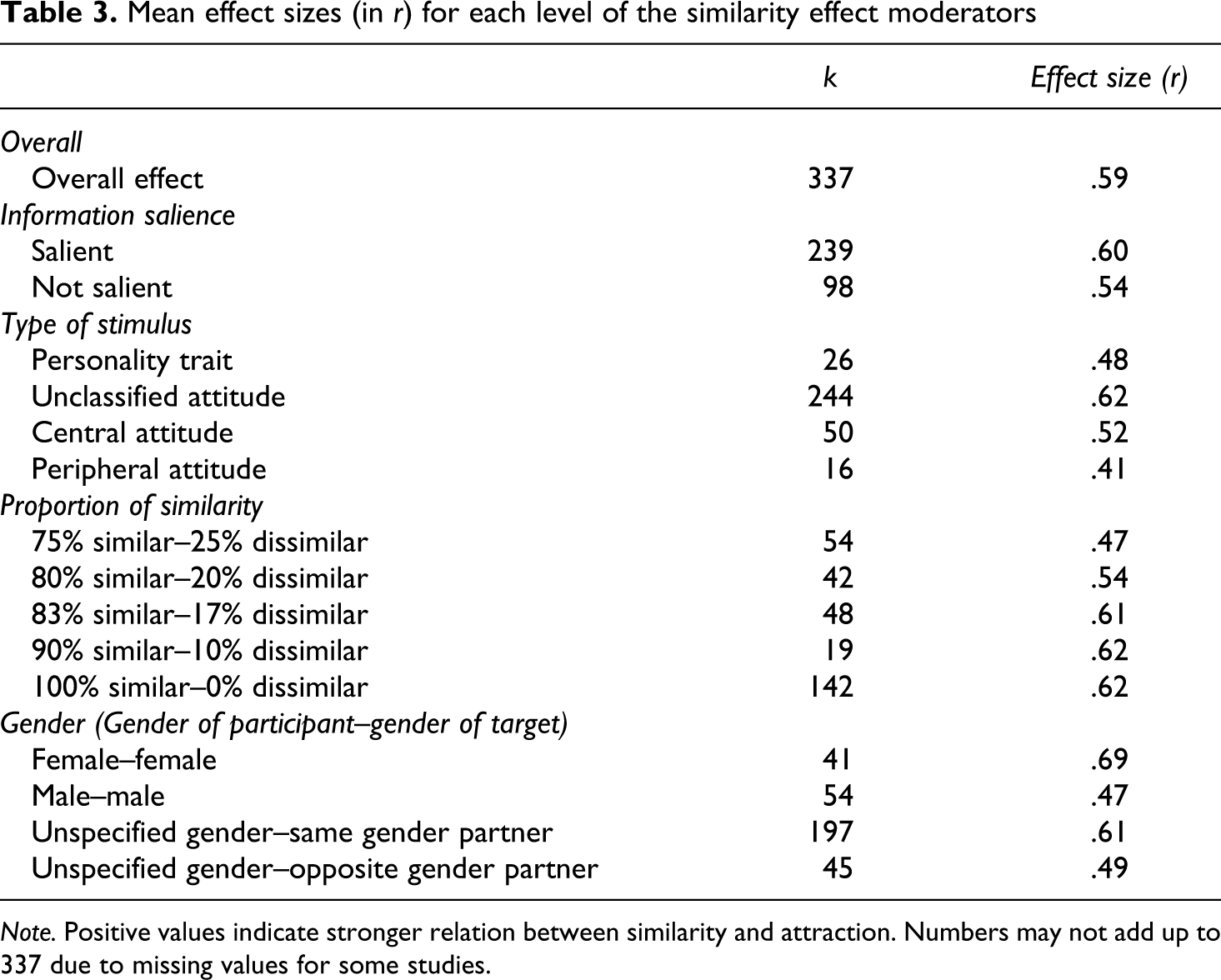
Note. Positive values indicate stronger relation between similarity and attraction. Numbers may not add up to 337 due to missing values for some studies.
Set size
As presented in Table 2, the main effect for set size was not significant. Given the predictions of the information integration perspective, we also tested set size as a quadratic function. The effect was also not significant, χ2(1) = 1.51, p = .21.
Information salience
The main effect for information salience was significant. The main effect indicated that the similarity effect was more potent when the information was made salient than when it was not.
Proportion of similarity
We treated proportion of similarity as a continuous variable. The similarity effect was stronger as the proportion of similarity increased. To illustrate the effects of proportion on the similarity effect, Table 3 presents proportion of similarity as a categorical variable using the commonly used operationalizations of proportion. There was a clear trend for the similarity effect to increase as proportion of similarity increased.
Sensitivity analyses
Sensitivity analysis discovered that one additional factor, gender, was also associated with the size of the similarity effect, χ2 (3) = 12.39, p < .05. To account for gender’s association with the similarity effect, we created a factor that accounted for not only the gender of the participant, but also the gender of the target other. The factor included four participant gender and target gender combinations: female participant–female target, male participant–male target, unspecified participant (defined as groups of participants whose gender was not specified, nor accounted for, in the original study)–matched gender target, and unspecified participant–opposite gender target. To explore this moderator, we created three orthogonal contrasts. The first contrast compared female–female interactions to male–male interactions. This contrast revealed that female–female interactions were associated with a stronger similarity effect than were male–male interactions, χ2(1) = 4.87, p < .05. The second contrast compared unspecified participant–matched gender target to the male–male and female–female conditions, and was not significant, χ2(1) = 0.19, p = .63. The final contrast, which compared the unspecified participant–opposite gender target condition to the three other levels (i.e., contexts in which the gender of the target matched that of the participant), was significant, χ2(1) = 5.10, p < .05. This contrast indicated that unspecified–matched interactions produced a weaker similarity effect than did the combination of all gender-specified interactions.
Information salience by proportion of similarity
Additional tests identified an Information Salience × Proportion of Similarity interaction, χ2(1) = 6.42, p < .05, such that increased proportion of similarity was associated with a stronger similarity effect when information was salient than when information was not salient. In other words, the slope for proportion of similarity was greater when the available information was salient than when it was not.
Information salience by type of stimuli
There was also an Information Salience × Type of Stimuli interaction, χ2(3) = 9.11, p < .05, such that salient information led to a stronger similarity effect in studies that used central attitudes or that were “unclassified,” but not when the studies used peripheral attitudes or personality traits as stimuli.
Discussion
Our meta-analysis of 240 laboratory studies resulted in support for three of the four effects proposed by the information processing perspective, and for two of the four proposed by Byrne’s reinforcement model. More specifically, we observed effects for two moderators which information processing predicted and the reinforcement model did not: Type of stimuli and information salience. First, more informative stimuli (e.g., central attitudes) were associated with a larger similarity effect than were less informative stimuli (e.g., peripheral attitudes). Second, the similarity effect was greater when similarity information was salient before the attraction assessment. Proportion of similarity was also influential, but this was an effect that both the reinforcement model and information processing perspective predicted.
In addition, two interactions identified during the sensitivity analyses were consistent with the information processing perspective. Specifically, the type of stimulus and proportion of similarity mattered more when the information about the target was made salient compared to when it was not. Given the emphasis on cognitive processing in the information processing perspective, having more information available and salient should have a greater impact on the later experienced attraction. Alternatively, given the emphasis and importance of affective processing of the reinforcement model (and the related suggestion that any cognitive processes occur simultaneously or after the affective processes), such findings would not necessarily be predicted by this approach.
Importantly, not all of the meta-analytic findings contradict Byrne’s reinforcement model. First, Byrne et al. (1973) stated that if set size was found to be important to the similarity effect, the model would require revision. However, we found no evidence that the similarity effect is affected by the number of stimuli. Despite a positive slope within a meta-analysis of a large sample (k = 337), the main effect for set size was not significant. As such, it appears that Byrne et al. (1973) were accurate in suggesting that any influence of similarity information is as important for 10 stimuli as it is for 100 stimuli. Second, Byrne and colleagues treated centrality as a hypothetical possibility that may need to be included in the model if data indicated such need. In several papers (e.g., Byrne & Clore, 1970), the researchers presented an alternative equation for the law of attraction had there been sufficient empirical evidence to support “differential weighting in the similarity effect:”

such that AR is the affective response (e.g., attraction), M is the Magnitude (i.e., the weight associated with the reinforcements), and PR and NR represent the positive and negative reinforcements, respectively. The current findings at the very least provide empirical evidence to support the adoption of such a weighted model.
It should be noted that given the large sample size of the meta-analysis, it was likely that significant effects were more “statistically” significant than they were “practically” important. For example, whereas we identified a significant effect for Information Salience, the mean difference between “salience” and “no salience” studies was .06, with “no salience” studies still producing a notable effect size. When comparing the predictive ability of different theoretical models, however, the critical question is whether there is a difference between models in their ability to explain the extant data; in that light, such (perhaps small) effects remain meaningful.
Implications for other models of the similarity effect
It is important to acknowledge that the current work focused on only two explanations for the similarity effect and excluded others, such as the rewards of interaction (Berscheid & Walster, 1969), anticipation of liking (Condon & Crano, 1988), and repulsion (Rosenbaum, 1986) perspectives. We focused on the reinforcement and information processing perspectives because they specifically theorized about moderators important to the similarity effect and have been explicitly tested in previous work. But it is important to note that aspects of other models can be informed by the findings of this meta-analysis.
Rewards of interaction
A rewards of interaction perspective (Berscheid & Walster, 1969) posits that the degree of similarity between two persons predicts the number of rewards an individual expects to experience in an interaction with another. One testable aspect of this approach is that items that are more informative of the rewards (e.g., central attitudes) should be more affected by similarity than less informative items (e.g., peripheral attitudes; Santee, 1976; see also Davis, 1981). From the rewards of interaction perspective, similarity of central attitudes should have a greater influence on attraction because they are more informative about the rewards that might be expected in the future. The results of this meta-analysis are consistent with this prediction.
Second, the rewards of interaction approach has its roots in equity theory (Walster, Walster, & Berscheid, 1978), and as such, includes an emphasis on the cognitive processes that determine benefits and costs. In this light, salience of the anticipated rewards—particularly those inferred from central attitudes—should be more influential on attraction. As described earlier, we found a main effect for salience, in addition to two interactions involving the salience variable that indicate that the effects for similarity are stronger for salient similarity information. In this way, many of the predictions of the rewards of interaction approach would be supported by the results of this meta-analysis.
Repulsion hypothesis
Rosenbaum (1986) proposed that the positive relation between similarity and attraction may result from the repulsion caused by the dissimilar attitudes—the greater the number of dissimilar attitudes, the greater the repulsion. Although this is a testable proposition for a meta-analysis, to our knowledge only four studies have independently varied the number of similar and dissimilar attitudes, making a meta-analysis impractical. Additionally, results of those studies are mixed: Rosenbaum found that the number of dissimilar attitudes had an effect on attraction but the number of similar attitudes did not, while Smeaton, Byrne, and Murnen (1989, Study 1) held the number of dissimilar attitudes constant but changed the number of similar attitudes. Contrary to Rosenbaum’s (1986) findings, attraction increased with an increasing number of similar attitudes.
However, what is really at the heart of this debate is whether dissimilar attitudes have a disproportionate influence on attraction when compared with similar attitudes. Indeed, research has repeatedly demonstrated that dissimilar attitudes affect attraction more than similar attitudes do (e.g., Singh & Teoh, 1999). Whereas the notion that dissimilar attitudes contributes more to the attraction process than do similar attitudes was dismissed out of hand by Byrne and colleagues (Smeaton et al., 1989), it has become clear that dissimilar stimuli—due to a multitude of different affective and cognitive processes—contribute more to the experience of attraction than do similar stimuli (e.g., Jia & Singh, 2009; Singh & Ho, 2000; Singh, Lin, Tan & Ho, 2008; Singh & Teoh, 1999). Such an explanation could be incorporated into both the information processing and reinforcement perspectives: (a) for the reinforcement perspective, it would necessitate a different weight for positive versus negative reinforcements (called “magnitude” in Equation 1 above); and (b) for the information processing perspective, it would simply involve more information being inferred from negative stimuli than from positive stimuli. Such an interpretation indicates that both models—and thus the present meta-analytic findings—can incorporate the expectations of the repulsion hypothesis.
Anticipation of liking
Condon and Crano (1988) argued that a person’s attraction toward another is a function of the extent to which the other is assumed to like that person. From this perspective, people anticipate that those with similar attitudes will like them, and those with dissimilar attitudes will dislike them. In effect, people like similar others because they expect those others to like them. This explanation mirrors another classic finding in the attraction literature: The reciprocity of liking effect (Gouldner, 1960). It is interesting to note that past research has found that the reciprocity of liking effect is approximately three times stronger than that of the similarity effect (e.g., Bell & Baron, 1974; Byrne & Ervin, 1969; Clore & Baldridge, 1970).
There is likely one prediction of this approach that is inconsistent with the meta-analytic results: Specifically, set size. It may be hypothesized that this approach would argue that increased set size should be associated with a smaller similarity effect. With respect to the influence of a specific stimulus, similarity researchers have concluded that the effects of similarity information are additive (Byrne, 1971), whereas the same additive rules may not apply to liking information. In other words, inconsistent liking information (i.e., “I like you. I don’t like you. I like you.”) may influence the evaluations of others differently from similarity information’s influence on the evaluations of others. There are two reasons for this difference: (a) As noted within the gain–loss literature (Aronson, 1969; Aronson & Linder, 1965), not all expressions of (dis)liking are weighted equally, such that expressions of dislike after liking have a disproportionate influence on evaluations; and (b) expressions of liking are informative of another’s “benevolent” orientation toward the other (Montoya & Insko, 2008) and situations in which a benevolent orientation is repeatedly violated may lead to reduced attraction. Such a difference would be most prominent with greater set sizes, such that whereas similarity models would posit that such reinforcements/punishments would accumulate additively, the reciprocity of liking literature would posit that there is a greater opportunity for benevolent expectations to be repeatedly violated. In this way, it is plausible to hypothesize that a reciprocity of liking approach would posit that increased set size would be associated with a smaller similarity effect—a result inconsistent with the findings of this meta-analysis.
The bigger picture
The reinforcement model and the information processing perspective represent two distinct perspectives on the experience of attraction: At their ideological cores, the information processing perspective posits a principally cognitive approach, whereas the reinforcement model posits a fundamentally affective approach. Our findings not only provide evidence regarding the efficacy of these models for explaining the similarity effect, but also provide additional evidence for the processes that underlie the broader experience of attraction. As noted earlier, the findings were largely consistent with the information processing perspective: We found a main effect for salience, and discovered that the salience variable interacted with two variables important for the operation of the similarity effect.
Indeed, the current findings are consistent with recent explanations of other attraction phenomena that focus on underlying cognitive processes. For example, whereas initial explanations of the pratfall effect focused on affective forces (e.g., Aronson, Willerman, & Floyd, 1966), more recent explanations have focused on a combination of cognitive and affective processes (e.g., Herbst, Insko, & Gaertner, 2003). Similarly, initial explanations of the reciprocity of liking effect focused considerably on affective processes (e.g., Adams, 1963); but subsequent research posited that cognitive processes played a dominant role in the effect (e.g., Montoya & Insko, 2008). Further, initial explanations of increased attraction to others who are present during an anxiety-producing event focused on affect (Dutton & Aron, 1974), but later interpretations focused on the influential role of cognitive processes (e.g., Foster, Witcher, Campbell, & Green, 1998). Specific to the similarity effect, research has provided evidence that cognitive processes, compared to affective processes, do a better job at mediating the effect. In a series of studies that specifically tested the different mediators of the similarity effect, Singh and colleagues (Singh et al., 2007; Singh, Ng, Ong, & Lin, 2008) found that affect did not mediate the influence of similarity on attraction when cognitive mediators were included in the model, whereas cognitive processes consistently mediated the effect. Overall, then, cognitive processes effectively explain a variety of attraction phenomena, including the similarity effect, many of which were originally presumed to be a result of affective processes.
It is noteworthy that this cognitive perspective can account effectively for not only the current meta-analytic findings, but also some interesting inconsistencies in the similarity effect. As an example, take the finding that similarity on negative attributes does not lead to attraction (Novak & Lerner, 1968). Though other models struggle to explain this finding (e.g., Ajzen, 1974), the information processing perspective argues that similarity of negative attributes conveys negative information about the target. This negative information would not lead to attraction, but to avoidance. The fact that the information processing perspective explains diverse, and sometimes disparate, findings through the same cognitive model speaks to its value as a more general theory of attraction.
Conclusion
This meta-analysis explored four critical moderators of the similarity effect. The key findings included significant main effects for type of stimulus, proportion of similarity, and information salience. The main effect for information salience, in addition to two interactions involving this variable, provided evidence for the role of cognitive processes in the experience of attraction. In this way, these results provided more support for the information processing perspective than for the reinforcement model and, more generally, provided more support for a cognitive approach than for an affective-based approach.
Footnotes
Acknowledgements
We are grateful to all the authors who made additional information available on their studies. We also thank the SCAR Group for their comments and assistance with this research.
Funding
This research received no specific grant from any agency in the public, commercial, or not-for-profit sectors.