




Abstract
Previous research on the dissolution of long-term romantic relationships has mostly focused on determinants that reflect either the characteristics of the individual partners or the characteristics of the relationship itself. The role of the social context in which couples are embedded has received less attention. This study assesses the association between three characteristics of the social context and the dissolution of long-term romantic relationships simultaneously: the prevalence of divorce in the network of the couple, the extent to which the networks of partners overlap each other, and the amount of social capital in the network of the couple. Using nationally representative panel data from the first and second waves of the Netherlands Kinship Panel Study, partial support was found for the link between the prevalence of divorce and network overlap on the one hand, and the likelihood to dissolve long-term romantic relationships on the other hand, among a sample of 3406 married and 648 unmarried cohabiting respondents. The association with social capital was found to differ between married and unmarried cohabiting respondents, as well as to depend upon the type of relationship the social capital is based in. These findings were interpreted to reflect differences in the symbolic meanings of marital and cohabiting relationships, and differences in types of social capital to which a person has access: relationship-specific versus non-relationship-specific social capital, with the former potentially impeding dissolution, and the latter potentially acting as an alternative to the relationship, thereby encouraging dissolution.
Past research has extensively looked at the determinants of divorce and premarital relationship dissolution (for an overview see Amato, 2010; Seltzer, 2000; White, 1990). While divorce rates stabilized or decreased somewhat in the US (Raley & Bumpass, 2003), the large majority of European countries still show an increase in their divorce rates, with at least 35% of all marriages ending in a divorce (Sardon, 2006). Similarly, while unmarried cohabiting relationships have become more common, and are more stable than in the past due to their grown acceptance as an alternative to marriage (e.g., Brines & Joyner, 1999; Kiernan, 2001), they are still relatively unstable when compared with marriages. Consequently, relationship dissolution continues to be a life event with which many families will be confronted (Schoen & Standish, 2001). Therefore, studying the determinants inducing or preventing this event remains relevant for understanding this aspect of family life.
Two broad strands of research can be distinguished in the literature on relationship stability and dissolution. First, there is literature on marital divorce predominantly focusing on determinants that can be headed under either an economic perspective (e.g., Becker, Landes, & Michael, 1977; Levinger, 1965, 1976) or a cultural perspective (e.g., Bumpass, 1990; Kalmijn, 1998; Lesthaeghe, 1983; Thornton, 1989). The economic perspective highlights factors associated with the benefits and costs of staying in or ending a relationship, whereas the cultural perspective emphasizes the impact of the partner’s family values, gender role norms and attitudes, and the heterogeneity between spouses regarding these, and other values or characteristics. Second, research on social networks has shown the influence of the social context (i.e., family and other relationships) on the formation and stability of romantic relationships. For instance, having joint friends (e.g., Agnew, Loving, & Drigotas, 2001; Julien, Chartrand, & Bégin, 1999; Widmer, Kellerhals, & Levy, 2004) and receiving social approval or support for the romantic relationship (e.g., Blair & Holmberg, 2008; Felmlee, 2001; Felmlee, Sprecher, & Bassin, 1990; Johnson & Milardo, 1984; Lee, Swenson, & Niehuis, 2010; Widmer, Giudici, Le Goff, & Pollien, 2009) both reduce the likelihood of ending a relationship.
Both the marital divorce and social network literature are, to some extent, limited. On the one hand, the research that investigates the determinants influencing divorce focuses either on individual partner characteristics, or on characteristics of the relationship itself, without taking potential influences from the wider social context into account (Furstenberg & Kaplan, 2004; Hudson, 2000; Ridley & Avery, 1979). On the other hand, the findings from the social network literature on the formation and stability of romantic relationships are restricted in terms of external validity, because they mostly rely on samples of college students who are still in the dating phase of their relationship (e.g., Bryan, Fitzpatrick, Crawford, & Fischer, 2001; Etcheverry, Le, & Charania, 2008; Sprecher, 2011; Sprecher & Felmlee, 1992). Consequently, the conclusions of these studies may not be generalized to longer-term cohabiting or marital relationships. The only studies that did use more heterogeneous samples of respondents involved in long-term relationships focused merely on the subjective assessment of relationship success (Bryant & Conger, 1999; Bryant, Conger, & Meehan, 2001; Kearns & Leonard, 2004; Reczek, Liu, & Umberson, 2010; Widmer et al., 2004) and not on the actual stability of the relationships. Two exceptions would be the recent studies by Widmer et al. (2009) and Högnäs and Carlson (2010), which replicated some findings concerning the influences of the social context on the actual stability of relationships using samples of married respondents. However, these studies either focused on only one aspect of the social context (relationship quality with parents in the study by Högnäs & Carlson, 2010) or used typologies for describing the social networks of married partners (i.e., only certain combinations of aspects of networks were analyzed) (Widmer et al., 2009), precluding any inferences on the relative impact of the diverse aspects of the social context on long-term romantic relationships.
Therefore, this study sets out to answer the following research question: To what extent does the social context in which couples are embedded continue to affect the risk to dissolve long-term romantic relationships, long after its initial dating phase? There are good reasons to expect the wider social context to be of a different nature in long-term romantic relationships than in relationships among college students. For instance, younger people have, generally, less stable social networks; the likelihood of a shared circle of friends is therefore smaller for young people’s romantic relationships than for people involved in longer-term relationships. Similarly, informal and formal network ties are likely to differ for both the groups: support by family and friends as well as participation in formal societal organizations, as sources of social capital will play a more important role in long-term romantic relationships than in less stable relationships of younger people. Thus, the role of the social context might be especially pronounced in longer-term romantic relationships, warranting further investigation. Moreover, considering previous evidence on the influence of, for instance, family relationships on other life events, such as the departure from the parental home, marriage, or parenthood (e.g., Axinn & Thornton, 1992; Barber, 2000; Goldscheider & Goldscheider, 1998; Shanahan, 2000), it is likely that the social relationships surrounding couples are indeed factors potentially related to the decision to dissolve or continue long-term romantic relationships, beyond previously established economic and cultural determinants.
As we will elaborate in more detail in the next section, three characteristics of the social context are expected to play a role: the prevalence of relationship dissolution in the wider network of the partners, the extent to which relationships with others are shared by partners (i.e., network overlap) and the amount of social capital (i.e., social support and societal involvement) found in the network. Together, they can be considered to reflect important dimensions of the social context that might be related to the dissolution of partnership relationships. They cover the potential impact of norms and behavioral patterns in the immediate social network of the couple, give an indication of the level of “individualization” in the network structure of the couple and, finally, provide information on the couple’s involvement in informal social support structures and in formal social structures of the larger society. Using Dutch panel data, we tested to what extent these characteristics, which have previously been found to influence the dissolution or continuation of a dating relationship in samples of college students, are also related to the stability of long-term romantic relationships. Different from previous studies, the associations of these characteristics with relationship dissolution are tested simultaneously to reveal whether they persist, while controlling for the other aspects of the social context.
Theories and hypotheses
Prevalence of divorce in the couple’s network
Following a Durkheimian definition (Durkheim, 1897/1951; Stark, 2006), social integration involves high consensus on rules of behavior (norms) and effective means to ensure that most people conform to the norms most of the time. Hence, the more they are socially integrated in any group, the more likely they are to comply with the norms of this group (Booth, Edwards, & Johnson, 1991). We assume that, in the perspective of the couple, important norms with respect to divorce might be derived from the patterns of behavior prevalent in the couple’s network. Thus, if divorce is a frequent occurrence in the couple’s network, the couple is expected to divorce more easily, because common rules tolerate it, even if one is initially less open for divorce (Stalder, 2011). On the other hand, if divorce is not very frequent in the couple’s network, the couple is expected to stay together because divorce is, possibly, less accepted. For these couples, the social costs of divorcing will impede them to do so (e.g., Fenelon, 1971; Shelton, 1987).
Previous research has shown that the occurrence of a parental divorce (e.g., Amato, 1996; Amato & DeBoer, 2001; Wolfinger, 1999), the divorce of siblings (Dronkers & Hox, 2006), the divorce of a close friend (Booth et al., 1991), and divorce in the network (McDermott, Fowler, & Christakis, 2009) indeed increase the likelihood of divorce. Our first hypothesis, therefore, reads: the higher the prevalence of divorce in the couple’s network, the greater the likelihood that the couple will dissolve their long-term romantic relationship. Different from the previous empirical work cited above, this study will, for the first time, simultaneously examine the influence of parental divorce, the divorce of siblings, the divorce of a close friend, as well as the divorce rate in the municipality in which the couple lives, allowing an examination of their relative influence on the likelihood to dissolve long-term romantic relationships.
Structure of the couple’s network
Besides the prevalence of divorce in the network, the structure of the couple’s network is expected to have an effect on the likelihood of dissolving a relationship. As partners become increasingly involved in a relationship, their separate social networks tend to shrink in size, a process also known as social or dyadic withdrawal (Johnson & Leslie, 1982; Slater, 1963), while their mutual or joint networks tend to grow (Milardo, 1982; Milardo, Johnson, & Huston, 1983). Network overlap can be expected to decrease the likelihood of dissolving long-term romantic relationships for three reasons.
First, drawing on symbolic interactionism and the concept of identity, it can be argued that the sense of a couple-identity arises out of interactions with significant others (Lewis, 1972, 1973; Waller & Hill, 1951). Having a joint network and social life increases the social time spent together in the presence of (significant) others (e.g., Surra, 1988), creating the opportunity that these others react to the relationship, which subsequently increases the likelihood that the couple-identity is strengthened and relationship stability is reinforced (Lewis, 1975). Conversely, maintaining separate networks potentially exposes the partners to different sets of values and norms, which might stimulate them to develop divergent interests, thereby increasing the likelihood of relationship instability (Julien et al., 1999; Kearns & Leonard, 2004).
Second, network overlap is expected to influence the stability of relationships by altering the type of support partners receive from their network when relationship problems arise. If network overlap is high, the persons to whom each partner can turn for comfort and advice usually would know the other spouse and will have a more balanced view of the relationship than would persons who know only one side of the story. Under such circumstances, confidants are likely to encourage a dissatisfied partner to try to solve problems within the relationship rather than to encourage a decision to separate (Agnew et al., 2001; Glenn & Shelton, 1985). Network overlap thus prevents the formation of coalitions in the event of relationship conflict, and, as a consequence, decreases the likelihood of relationship dissolution (Ackerman, 1963; Julien et al., 1999; Komarovsky, 1967; Lee, 1979).
Finally, both the microeconomic (Becker et al., 1977) and the social exchange perspectives (Levinger, 1976, 1979) as well as the investment model of relationship commitment (Rusbult, 1980; Rusbult, Martz, & Agnew, 1998) posit that the decision to dissolve or maintain a relationship is based on the expected utility, or costs and rewards, of remaining in the relationship, compared with the utility expected from (i.e., quality of) alternatives, which includes dissolving the relationship. (Note that the exact terminology differs between the theoretical perspectives.) The social and emotional costs of ending a relationship increase with the degree of overlap between the partner’s networks, because the demise of a relationship would typically entail the disruption of multiple shared social relationships for at least one member of the couple (Felmlee, 2001; Sprecher & Felmlee, 1992, 2000). Having a joint social network can thus be conceived as a relationship-specific intangible investment (Goodfriend & Agnew, 2008) that either or both partners risk losing after the dissolution of their relationship. On the basis of these arguments, the second hypothesis can be formulated, reading: the more the networks of partners overlap with each other, the smaller the likelihood the couple will dissolve their relationship.
Social capital in the couple’s network
The third characteristic of the social context of couples considered in this study is the amount of social capital found in the couple’s network. Social capital is classically defined as the resources available to an individual through the relationships he or she has with others (Bourdieu, 1985). Recently, this form of social capital has been labeled “informal” (Pichler & Wallace, 2007), to distinguish it from “formal social capital,” that is participation in civic organizations or public life (e.g., Putnam, 2000). When a couple faces relationship problems, they may seek emotional or instrumental support from others in both their informal and formal networks (Bryant & Conger, 1999; Haas, 2002; Widmer et al., 2004). The availability of informal and/or formal network ties increases the likelihood that the couple can cope with their relationship problems, thereby diminishing the likelihood of relationship dissolution (Bryant & Conger, 1999; Widmer et al., 2009). Reversely, the less social capital, and the more socially isolated a couple is, the greater the burden of lacking support which could have been provided by others, and the greater the likelihood the couple will fail to carry their burden (Bryant et al., 2001; Glenn & Shelton, 1985). Following this line of reasoning, the third hypothesis reads: the more social capital a couple has, the smaller the likelihood the couple will dissolve their relationship. Note that this study does not assess the influence of social network approval of the relationship (as is done in recent studies by Etcheverry & Agnew, 2004; Etcheverry et al., 2008; Lee et al., 2010; Lehmiller & Agnew, 2006, 2007), but assesses the influence of general social support from the network instead.
Method
Data
The secondary data used for the present study were drawn from a large-scale study on family relationships: The Netherlands Kinship Panel Study (NKPS). The NKPS is a longitudinal, nationally representative study among 8161 respondents (6091 in wave 2), aged 18–79 years at wave 1. The first and second wave were conducted from 2002 to 2004 and from 2006 to 2007, respectively (average time lag three years) (Dykstra et al., 2007). The response rate in the first wave was 45%, and the attrition rate in the second wave was 26.2%, which is comparable to that of other large-scale family surveys in the Netherlands (Dykstra et al., 2007). Response rates in the Netherlands tend to be lower than elsewhere and they seem to be declining over time. The Dutch appear to be particularly sensitive about privacy issues, as well as to experience a general survey burden (De Leeuw & De Heer, 2002). The married did not differ from the unmarried cohabiting with respect to attrition.
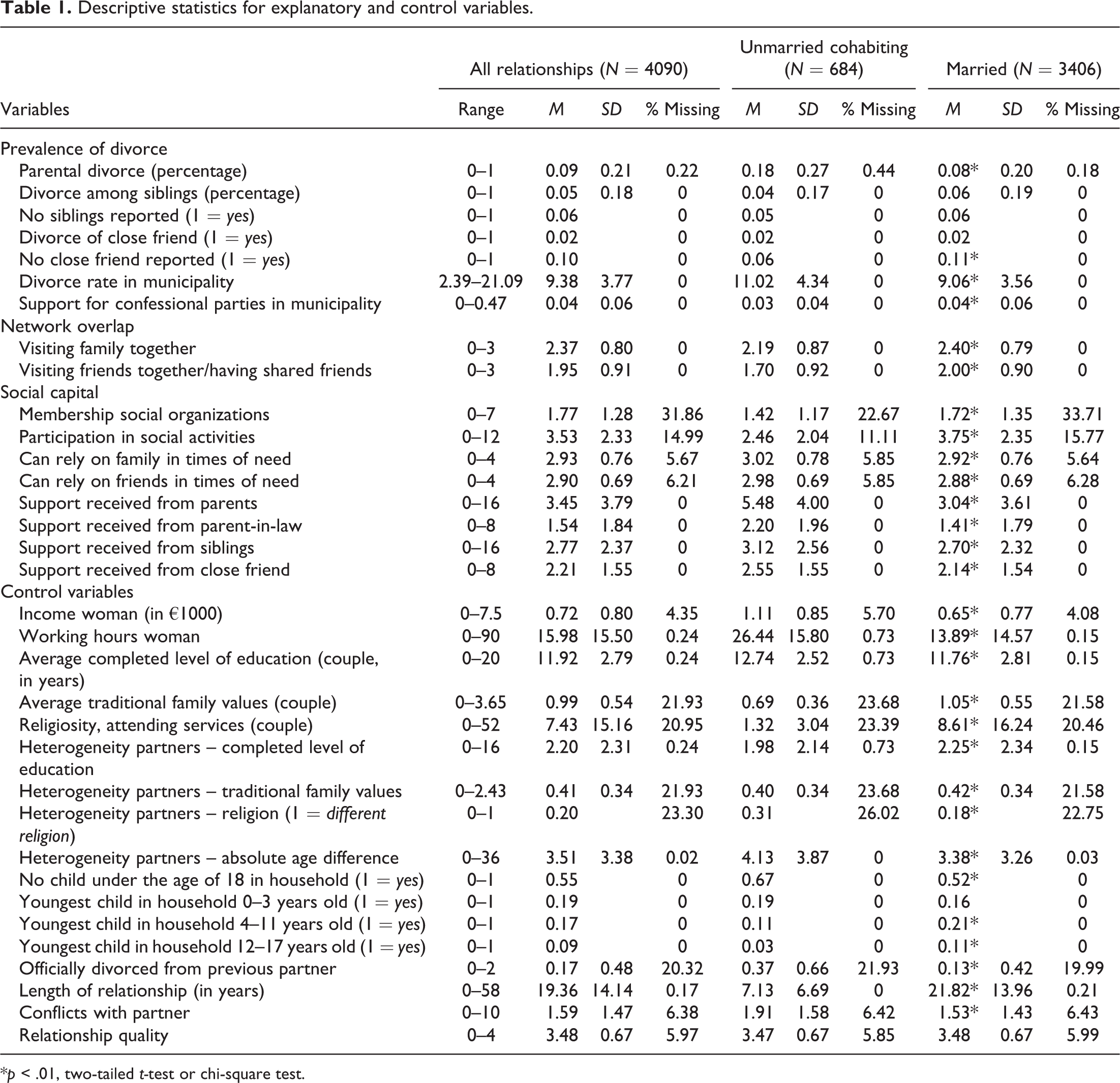
To test the hypotheses, respondents who were either married or unmarried cohabiting at the time of the first interview, and participated in the second wave of the NKPS were selected. This selection resulted in a sample of 4090 respondents, of whom 684 indicated to be in an unmarried cohabiting and 3406 to be in a marital relationship. Whether a partner lived together with the respondent at wave 1 was decided by the respondent himself or herself. Hence, both the unmarried cohabiting and married respondents could include couples who lived together only part-time or with other family members or roommates. Married respondents differed significantly from unmarried cohabiting respondents on a number of characteristics: these differences can be found in Table 1.
Descriptive statistics for explanatory and control variables.
*p < .01, two-tailed t-test or chi-square test.
Measures
The dependent variable in the current study, relationship dissolution, was measured using responses from the second wave on the question: “Are you still together with this partner?” The answer to this question was assumed to reflect whether or not the couple was still sharing a household and/or living in the same house. Among the married respondents, 92 or 2.7% divorced between the first and second wave of the NKPS. Among the unmarried cohabiting respondents, 89 or 13.0% ended their relationship between the first and second wave. This high percentage of partnership dissolution reflects the relative instability of unmarried cohabiting relationships compared with marital relationships.
All explanatory variables were constructed using information from the first wave of the NKPS that was provided by the respondent. Prevalence of divorce in the couple’s network was measured by: the occurrence of parental divorce, the occurrence of divorce among siblings, divorce of a close friend, and the relative divorce rate of the municipality in which the respondent lives. Because the hypothesis on the prevalence of divorce pertains to the effect of the proportion of divorce in the network, relative instead of absolute scores were used. Thus, the difference between respondents with, for instance, only one sibling who happened to be divorced and respondents with two siblings of which only one was divorced was reflected in our measure. Information on the occurrence of a parental divorce from both partners was combined (0 = none of the parents of both parents divorced, 0.5 = the parents of one partner divorced, 1 = the parents of both partners divorced), whereas the divorce of a close friend remained a dichotomous variable (1 = yes). For the occurrence of divorce among siblings, information on two randomly chosen siblings was used (one if the respondent had only one sibling), indicating the relative number of siblings who are currently divorced (range from 0 to 1). Respondents with no siblings and/or no close friend were assigned a score of 0 in the respective measures. To check whether respondents who had no siblings and/or close friend did not differ from respondents who did have non-divorced siblings and/or a non-divorced close friend, two dummy variables were created indicating whether a respondent did not report siblings (1 = yes) or did not report a close friend (1 = yes). For the final measure, Dutch municipality-level information regarding the number of divorces per 1000 married persons per year (Statline, 2009) was used. To control for fluctuations in the divorce rates between years, an average for the period 1993–2002 was used. To account for a possible confounding effect of the level of religiosity in the municipality, information on the percentage of votes for orthodox confessional parties in the municipality during the national elections of 2002 was added to the models.
To capture network overlap, two measures were used, differentiating between the extent to which family relationships and friendships were shared. The two questions used read “When you visit {family/friends}, do you usually do that together with your partner or without your partner?” Answer categories ranged from 0 (usually alone, without my partner) to 3 (usually together with my partner). If the respondent indicated that he or she never visited family or friends, a score of 0 was assigned. Additionally, for friendships, the question “Are your friends mostly your own friends or mostly friends shared with your partner?” was combined with the measurement of visiting friends together (r = .44) by taking the average. Answer categories ranged from 0 (mostly own friends) to 3 (mostly shared friends).
Informal social capital found in the network of the couple was measured in two ways. First, two four-item scales measuring the extent to which the respondent can rely on family and friends when he or she is in need of support were used. Examples of items included “Should I need help, I can always turn to my {family/friends}” and “I can always count on my {family/friends}”, with answer categories ranging from 0 = totally disagree to 4 = totally agree. The items made no distinction between own or partner’s family and friends, but when combining the items, separate variables for family (α = .91) and friends (α = .92) were constructed. The second set of variables measuring informal social capital indicated the support the respondent actually received from parents, two randomly chosen siblings, and a close friend, in the last 3 months before the interview. The question used reads: “In the last 3 months, did you receive {type of support} from {name family member/friend}?” Four types of supports were distinguished: getting council or good advice, showing an interest in one’s personal life, helping with housework (e.g., preparing meals, cleaning, fetching groceries, doing the laundry), and helping with practical matters (e.g., chores in and around the house, lending things, transportation, moving things). For each type of support, answer categories included 0 = never, 1 = once or twice, and 2 = several times. The total amount of support received was calculated for each relationship type separately by summing the answers to the four questions. If a relationship did not exist, for instance, if a respondent had only one sibling or reported to have no close friend, a score of 0 was assigned.
Two variables measuring formal social capital were included in our analyses, distinguishing between membership and active participation in public life (Pichler & Wallace, 2007). The first variable indicated the number of clubs or voluntary organizations of which one is a member, including sports associations, religious or church organizations, and drama associations. The second variable measured the extent to which the respondent participated in four types of social activities in the past 12 months, including participation in a school association or other activity for school, providing unpaid help to sick or handicapped acquaintances or neighbors (not family), volunteer work for an association, and visiting neighbors or being visited by neighbors. Answer categories ranged from 0 = never to 3 = 12 times or more. The reliability scores of these scales were below what is normally accepted (α = .35 and α = .37 for membership and active participation respectively), but are consistent with causal indicator theory, which postulates that causal indicators influence the construct of interest and thus need not to be correlated (Bollen & Lennox, 1991; Streiner, 2003). Indeed, because of time constraints people face in their lives as well as the heterogeneity of organizations and associations included (i.e., membership or active participation in one does not necessarily increase the likelihood of membership or active participation in others), we decided to use a sum score for both variables, instead of taking the average.
Statistical analysis
Because our dependent variable was a binary response indicating dissolution of a romantic relationship between the first and second waves of the NKPS (1 = yes), logistic regression analyses were performed. Although discussed separately, the three characteristics of the social context that were of interest in the current study were likely to overlap. To arrive at a more accurate estimation of the role of the social context, the hypotheses were tested simultaneously in one model. In addition, a number of controls were included in all models. The selection of these controls was based on two considerations. First, we wanted to control for determinants that are potentially confounding, that is, determinants that are associated with both the dependent and explanatory variables: a number of characteristics can be expected to be related to both the likelihood of relationship dissolution (Amato, 2010; Seltzer, 2000; White, 1990), and to how couples arrange their social context, for instance, in terms of frequency of contact with network members (Bengtson, Biblarz, & Roberts, 2002; Rossi & Rossi, 1990). These characteristics include the presence and age of children, the labor force participation of the female partner, endorsing traditional family values, level of religiosity, educational level, heterogeneity between partners, relationship duration, and being previously divorced. The second criterion for including a control was whether previous research on marital divorce that employed an economic or cultural perspective had included the specific determinant. Inclusion of such controls allowed us to make inferences on the extent to which our main explanatory variables were associated with the likelihood of relationship dissolution, over and beyond the determinants used previously. The following control variables related to the arrangement of the couple’s social context as well as to the economic perspective employed in previous research were added to our models: the income of the female partner, the number of paid working hours of the female partner, a number of dummy variables to indicate whether the age of the youngest child is 0–3 years (1 = yes), 4–11 years (1 = yes), or 12–17 years (1 = yes) (reference category is respondents with no children younger than 18 years old in the household) and the length of the relationship (in years). (The first two reflected the extent to which the female partner is financially independent; the latter two reflected investments in the relationship.) In addition, the following control variables originating from the cultural perspective, which are supposedly related to the arrangement of the couple’s social context, were included: the completed level of education of the couple (average of partners, in years), the degree to which the couple endorses traditional family values constructed from two 7-item scales measured for male and female partners separately (α = .77 for both scales), the average number of religious services the couple has attended in the past 12 months, educational heterogeneity (absolute difference in years of education), heterogeneity in terms of endorsement of traditional family values (absolute difference between scores on scales), a dummy indicating religious heterogeneity (1 = partners have different religious backgrounds), age heterogeneity (absolute age difference), and whether the partners have been officially divorced in a previous relationship (1 = yes, one partner; 2 = yes, both partners). (Note that for the variables measuring heterogeneity in terms of endorsement of traditional family values and religious heterogeneity, we needed to supplement the information provided by the respondent with information from his or her partner, provided in a self-completion questionnaire.) To account for the fact that marriages are relatively more stable than unmarried cohabiting relationships, a dummy variable was constructed, indicating whether the respondent is married (1 = yes).
Three models were estimated. The first model tested our main hypotheses. While we did not have any theoretical grounds from which different effects were expected for the unmarried cohabiting and marital relationship types, we explored whether such differences existed. The second model added all interactions terms found to be significant. Finally, some of the characteristics of the social context of the couple were possibly associated with the quality of the relationship. To assess the role of the characteristics of the social context, beyond possible relationship dynamics, a third model including two measures for relationship quality was tested. The first measure was the sum of five items reflecting the occurrence of various forms of conflictive behavior in the past 12 months, including having had heated discussions, not talking to each other for a while, and living apart for a while. Answer categories included 0 = never, 1 = once or twice, and 2 = several times, with the composite measure ranging from 0 to 10. The reliability score was slightly below what is normally accepted (α = .65), but can be attributed to the variation in severity of conflictive behavior the items measure. The second variable was a 4-item scale (α = .95) measuring overall relationship quality. Items included “Our relationship is strong” and “The relationship with my partner makes me happy” with answer categories for all items ranging from 0 = strongly disagree to 4 = strongly agree. The means, SDs, observed range, and fractions of missing data of the explanatory and control variables are presented for the whole sample, and separately for married and unmarried cohabiting respondents, in Table 1.
Missing data on the explanatory and control variables were mainly due to the respondent’s failure to return the self-completion questionnaire (these variables have between 5% and 20% of missing data), or due to the respondent’s partner not returning the self-completion questionnaire (variables with more than 20% of missing data). Analyses revealed that returning the self-completion questionnaire was unrelated to our dependent and explanatory variables of interest. Therefore, missing data were assumed to be missing at random. Consequently, missing data were handled by multiple imputation using the ICE (Imputation by Chained Equations) approach available in the statistical package Stata (StataCorp, 2008). Given other variables in the dataset, 100 other datasets with imputed missing values were created, which were joined in subsequent analyses (Graham, Olchowski, & Gilreath, 2007; Royston, 2007).
Results
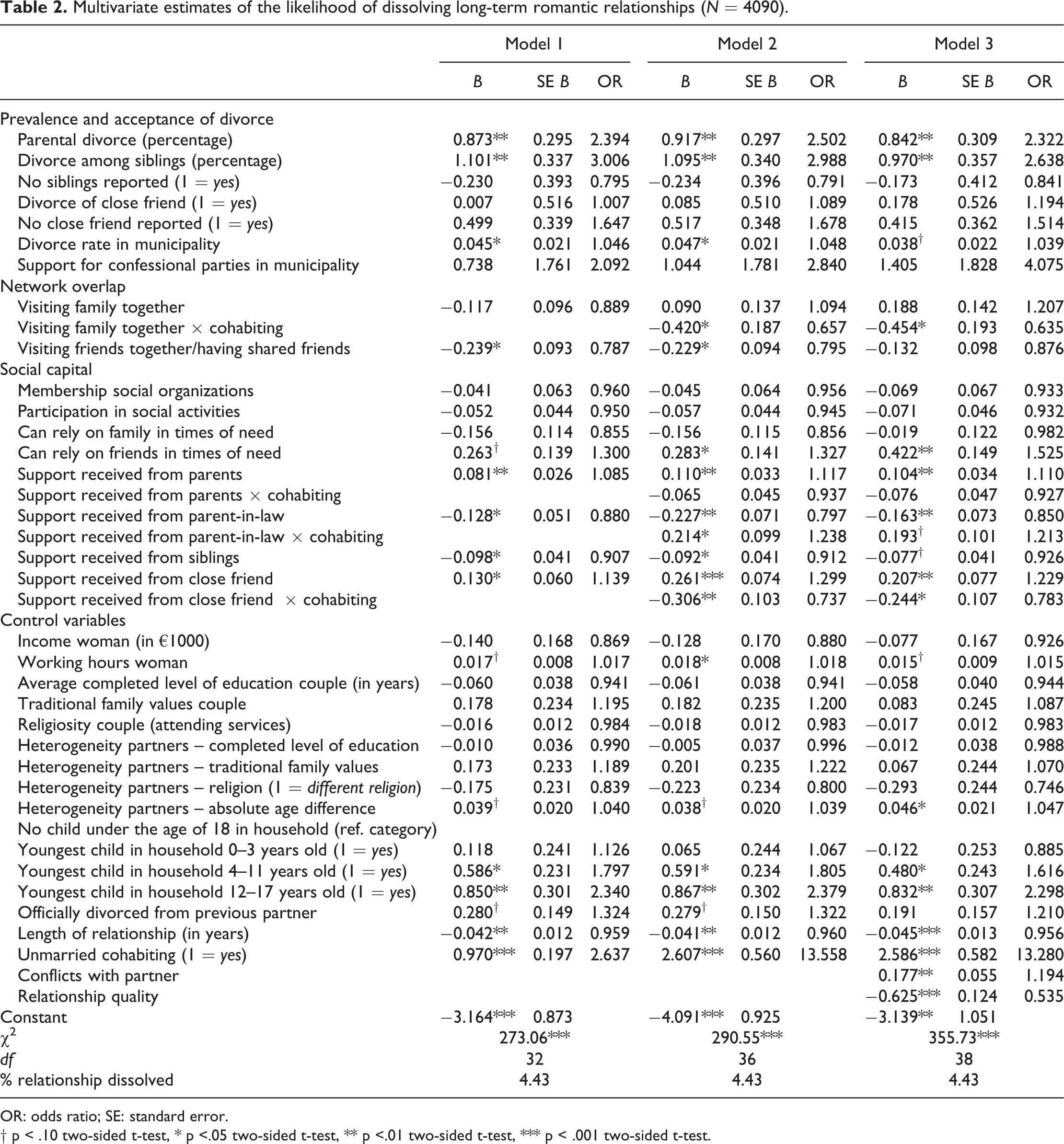
Table 2 shows the results of the three logistic regression models. As expected, the experience of a parental divorce, having divorced siblings, and living in a municipality with a high divorce rate, predicted the likelihood with which couples dissolve their relationship. However, having a close friend who was divorced was not significantly related to the likelihood of dissolving a long-term romantic relationship. Respondents who had no siblings or reported to have no close friend did not significantly differ from those with siblings or a close friend with respect to the likelihood to dissolve their relationship. Additional analyses in which the respondents with either no siblings or no close friend were omitted from the analyses did not alter the results presented here. Adding interaction terms with relationship type to explore possible differences between married and unmarried cohabiting couples regarding the association between the occurrence of divorce in the network and relationship dissolution revealed no differences (non significant results are not printed in Model 2). We conclude that the first hypothesis regarding the association between the prevalence of divorce in the couple’s network and the likelihood of dissolving the relationship was supported by the findings, with the exception of divorce of a close friend, which was not related to relationship dissolution.
Multivariate estimates of the likelihood of dissolving long-term romantic relationships (N = 4090).
OR: odds ratio; SE: standard error.
† p < .10 two-sided t-test, * p <.05 two-sided t-test, ** p <.01 two-sided t-test, *** p < .001 two-sided t-test.
With respect to network overlap, it appeared that both the extent to which family and friends were visited together with the partner and the degree to which the friends of the partners were shared friends, were associated with a decreased likelihood to dissolve a long-term romantic relationship. Respondents who reported visiting friends only without the partner and/or having no shared friends were almost twice as likely to end their relationship, as respondents who had shared friends and who paid visits to their friends only together with their partner. Visiting family together was, however, not significantly associated with the likelihood of relationship dissolution when the association was estimated for married and unmarried respondents simultaneously. Adding an interaction term with relationship type (see Model 2) revealed that this lack of significance was caused by the fact that the association was absent in married relationships (who are more numerous in the study), whereas it was present in unmarried relationships. The second hypothesis on network overlap was partially supported by our findings.
The third hypothesis of this study stated that the more social capital a couple has in their network, the less likely it is that they will dissolve their relationship. Being a member of one or more social organizations or participating in social activities – the measures for formal social capital – were not significantly related to relationship dissolution. The first two measures of informal social capital – the perception that one could rely on family or friends in times of need – were not significant either. However, the measures of actual support received from friends and family were related to the likelihood of dissolving a relationship. Having received actual support from a parent-in-law or from siblings was associated with a decrease in likelihood of dissolving a relationship. Unexpectedly, receiving support from one’s own parents predicted increases in the likelihood of dissolving a relationship. The association of informal social capital based on the relationship with a close friend with the likelihood of relationship dissolution was nonsignificant for the total sample. Yet, adding an interaction term with relationship type revealed that the association was actually ambiguous (see Model 2); for married couples, it was related significantly to an increase in the likelihood of relationship dissolution, whereas for unmarried cohabiting, a decreased likelihood of relationship dissolution was found. Exploratory analyses showed some other interesting and unexpected findings; the association between the support received from one’s own parents and the likelihood to dissolve a relationships was even larger when estimated separately for married respondents, whereas the support received from the parent-in-law was associated only with a reduction in likelihood to dissolve a marital relationship; for unmarried cohabiting respondents, the main and interaction effects were combined to a coefficient that came close to zero. The association between support received from siblings and relationship dissolution did not differ significantly between married and unmarried cohabiting respondents. In other words, the associations between received support from friends and family and relationship dissolution differed by relationship type as well as by who the support provider was. It is concluded that the hypothesis on social capital was only marginally supported.
To test whether the associations between the prevalence of divorce in the network of couples, network overlap, and access to social capital on the one hand, and relationship dissolution on the other, remained significant after controlling for the initial quality of the relationship, an additional model was tested with controls for perceived relationship quality and reports on the number of conflicts and fights the couple had at the first wave of the study (reported in Model 3 of Table 2). It was found that these controls were related (and in the expected directions) to the likelihood to dissolve a relationship, but they also affected some of the significance levels of both our explanatory and control variables. However, given that many findings remained substantially unchanged, we were confident about our general finding on the role of the social context with respect to the likelihood of dissolving long-term romantic relationships. Nonetheless, two findings warranted our attention: after controlling for the quality of the relationship, the association between the overlap of friendship networks of partners and relationships dissolution was no longer significant, whereas the variable measuring the extent to which the respondent can rely on friends in times of need became significant. Additional analyses showed that the relationship quality was positively related to the overlap of friendship networks, suggesting that some of the association between relationship quality and relationship dissolution was mediated by the extent to which the friendship networks of partners overlap. Similarly, the extent to which one can rely on friends was negatively related to the quality of the romantic relationship, suggesting that the association was suppressed when not adjusting for relationship quality.
Discussion
The aim of this study was to assess how the social context in which couples are embedded is associated with the likelihood that they will dissolve their relationship. Three characteristics of the social context were assumed to be important: the prevalence of divorce in the network, the overlap between the networks of the partners, and the amount of social capital based in the couple’s network. The findings lend partial support to two of the three hypotheses; our findings for the third hypothesis regarding the role of social capital are ambiguous. The prevalence of divorce in the couple’s network and network overlap proved to be significant predictors of relationship dissolution. Moreover, the measures representing characteristics of the social context proved to be more strongly related to the likelihood of relationship dissolution than the economic and cultural determinants commonly used in research on marital divorce (e.g., Becker et al., 1977; Bumpass, Martin, & Sweet, 1991; Kalmijn, 1998; Lesthaeghe, 1983; Levinger, 1976). Thus, this study showed that the associations with the social context previously found in college-based samples of dating respondents can be generalized to a more heterogeneous sample of long-term romantic relationships; different from the assumption expressed in the introduction, it seems that similar mechanisms related to the social context are playing a role in romantic relationships in both types of couples. In addition, different aspects of the social context were significantly related to relationship dissolution, even when they were considered simultaneously and after controls for initial relationship quality were added.
The analyses also showed some unexpected findings. First, the network overlap of family relationships was negatively associated with the likelihood of dissolving unmarried cohabiting relationships, but not related to the likelihood to divorce. An explanation might be found in differences in the symbolic meaning of the different relationship types. Besides a legal bond, marriage can also be conceived as a symbolic bond (Brines & Joyner, 1999; Kalmijn, 2004), increasing the shared identity of the married couple. As for unmarried cohabiting couples, such a symbolic bond may be less apparent, so that they may have to establish their shared identity (Berger & Kellner, 1964) through other means, such as having shared contacts with friends and family. Following this reasoning, the reinforcement of the couple-identity by the social network could be more important for unmarried cohabiting than for married couples.
Second, the extent to which one relies on friendships in times of need tended to increase the likelihood of ending a long-term relationship instead of decreasing it. The positive effect of reliance on friends might reflect the concept of relationship-specific versus non-relationship-specific social capital. Social capital to which both partners have access and which devaluates or completely disappears in case of a break-up can be conceived as relationship-specific. In contrast, non-relationship-specific social capital available to only one partner, such as a separate friend or a network of friends, can be conceived as an alternative to the current relationship (Felmlee, 2001; Sprecher, Felmlee, Schmeeckle, & Shu, 2006). It can be transferred to singlehood, reducing the costs for ending the relationship, as resource transfers from the partner can, at least partially, be compensated by the network (Kneip, 2004). Thus, non-relationship-specific social capital may increase the likelihood of relationship dissolution. This is in accordance with the finding concerning the extent to which one can rely on friends in times of need as well as with the finding on the role of informal social capital based in the relationship with a close friend. Here, once more, a difference between married and cohabiting couples became apparent. For those involved in an unmarried cohabiting relationship, the informal social capital based in the relationship with a close friend indeed decreased the likelihood of relationship dissolution, as was hypothesized, but for married couples this was reversed, resulting in an increased likelihood of divorce. A possible explanation for this ambiguous finding is the different nature of married and unmarried cohabiting relationships. Western conceptions of romantic love require the establishment and maintenance of monogamous-exclusive relationships. As a consequence, partners are expected to terminate those relationships that may provide alternative sources of rewards and that are viewed as incompatible with the socially defined ideals of exclusivity and monogamy (Johnson & Leslie, 1982; Milardo & Lewis, 1985). These ideals may be stronger for married than for unmarried cohabiting couples. Consequently, having a close friend interferes more with marriages than with unmarried cohabiting relationships.
Finally, informal social capital based in the relationship with parents was not associated with the likelihood of dissolving a long-term romantic relationship, whereas such an association was found for informal social capital based in relationships with siblings. This might be due to the different life stages parents and siblings are in. Siblings typically are in a life stage similar to the respondent and can therefore relate to and help the respondent more easily.
Some limitations of this study should be recognized. First, the measurement of network overlap does not distinguish the different mechanisms underlying the effect of network overlap that were differentiated in theory. These included a symbolic interactionistic argument regarding the construction of a shared couple-identity, a “balanced support” argument, which emphasizes the more balanced view members of shared networks may have of the relationship in times of relationship problems, and a social exchange argument defining network overlap as relationship-specific capital. An alternative explanation for the effect of network overlap can be given as well: visiting family and friends more often together is an indicator of the fact that the partners have a shared lifestyle, a characteristic which has been found to influence the stability of relationships (Hill, 1988). Unfortunately, the data did not allow us to differentiate between the different mechanisms and the alternative explanation. Future studies might address this issue by using specific measures for the different mechanisms.
A second limitation is the reliance on single-informant data; for the majority of our measures, only one partner provided information on the relationship. Better measures for network overlap and the availability of social capital in the network can be constructed if both partners had provided information on these characteristics. Men and women might, for instance, view the social context of their relationship differently. Similarly, the effects of some theoretically appealing concepts distinguished previously in the social network literature, such as the density and reciprocity of the network as well as the size and relational content of both partner’s networks (e.g., Ridley & Avery, 1979; Surra, 1988; Widmer, 2004) would improve our understanding of the relationship between the social context and the stability of long-term romantic relationships. Unfortunately, such measures were not available in the data employed in the current study.
Finally, the NKPS data includes only information from two points in time. Consequently, the number of relationship dissolutions in our sample is fairly low (although similar to the numbers that can be expected on the basis of national statistics), possibly affecting the significance of findings. Nevertheless, the fact that significant associations are still found underscores the importance of the social context on relationship dissolution. It also suggests an alternative explanation for the increase in relationship dissolution in the Western world, namely the increased individualization of partners, with each partner creating life spheres that are more and more individualized and not necessarily shared. Future research on relationship dissolution could benefit from a focus on possible changes over time in the social contexts in which couples are embedded.
Footnotes
Acknowledgements
The authors thank Jeroen Weesie and Patrick Royston for their advice regarding the statistical analyses performed in this study, as well as Wilma Vollebergh, Rie Bosman, Marloes de Lange, and the participants at the Work and Family Seminar at Utrecht University for providing useful comments on previous versions of this article. They also thank the four anonymous reviewers as well as associate editor Leanne Knobloch for their helpful comments in revising the manuscript.
Funding
This work was supported by the Netherlands Organization of Scientific Research (400-08-203) and based on the data from the Netherlands Kinship Panel Study, which is funded by grant 480-10-009 from the Major Investments Fund of the Netherlands Organization of Scientific Research (NWO), and by the Netherlands Interdisciplinary Demographic Institute (NIDI), Utrecht University, the University of Amsterdam, and Tilburg University.