




Abstract
Romantic relationship breakups induce significant distress, which has prompted interest in the possibility of post-traumatic growth (PTG) following relationship dissolution. However, most studies have relied on retrospective self-reports of growth, raising questions about the actuality of growth following breakup. This prospective study assessed relationship quality prior to breakup, measured growth over time, included a comparison group that did not experience breakup, and tested rival hypotheses to assess PTG in comparison with positive reappraisal (PR). College students (N = 599) in romantic relationships were recruited as participants and assessed at two time points approximately 10 weeks apart. The primary sample includes participants who experienced a relationship breakup (N = 100). Results indicated that, following a breakup, participants reported a high degree of breakup distress and perceived growth. The pattern of results suggests that reports of perceived PTG may reflect PR processes, as evidenced by the correlation between optimism at Time 1 and perceived, but not actual, PTG at Time 2. Consistent with previous prospective research, but differing from much of the retrospective research, a measure of “actual growth” was unrelated to distress, perceived growth, or whether the individual experienced a breakup. The results corroborate research suggesting that retrospective reports of PTG may not reflect actual personal growth measured before and after a traumatic event. Results are discussed in terms of the circumstances in which PR or growth in relationship choices and behaviors may be most appropriate.
It is well-known that romantic relationships are a vital aspect of well-being (e.g., Lee & Ono, 2012). For that reason, relationship dissolution is a significant, life-disrupting event that is often accompanied by significant distress, including depression, anxiety, and post-traumatic stress disorder (PTSD)-like symptoms (Anders, Frazier, & Frankfurt, 2011; Tashiro & Frazier, 2003). Moreover, recent functional MRI research indicated that romantic relationship breakup was associated with activations of neural structures associated with the emotional aspects of physical pain (Kross, Berman, Mischel, Smith, & Wager, 2011). Additionally, when participants freely list traumatic events, relationship dissolution is listed as one of the most distressing events (Anders et al., 2011; Park, Cohen, & Murch, 1996), with reports of PTSD-related symptoms (Anders et al., 2011; Anders, Shallcross, & Frazier, 2012). 1
Relationship breakup distress has generally been described from a stress and coping perspective, suggesting that it is simply a process to be endured. A recent alternative conceptualization has emerged, called post-traumatic growth (PTG), which construes this distress as a more positive, growth-oriented process. PTG theory hypothesizes that traumatic experiences can promote “veridical transformative life changes that go beyond illusion” (Tedeschi & Calhoun, 2004, p. 4). These positive changes are thought to emerge in five domains: greater appreciation of life, warmer relationships with others, increases in perceptions of personal strength, recognition of new possibilities, and spiritual development (Prati & Pietrantoni, 2009; Tedeschi & Calhoun, 2004). If PTG can be documented following relationship dissolution, it has important consequences for understanding relationship skills and maintenance. If individuals experience personal growth after breakups, that growth could promote more successful future relationships, lending a developmental benefit for having multiple dating partners prior to long-term commitment.
This research domain has been controversial, however, due to what Jayawickreme and Blackie (2014) call a “lack of attention to methodological limitations and over-interpretation of extant findings” (p. 313), with the primary flaw being an extensive reliance on retrospective reports of growth. It is unclear whether retrospective reports of change provide evidence of real growth as opposed to positive reappraisal (PR) without change. Although there have been prospective studies of PTG (e.g., Frazier et al., 2009), we are not aware of any studies that prospectively measured growth following a relationship breakup. Therefore, we designed this study to examine PTG prospectively following relationship breakup with the goals of (1) adding to the research examining PTG following relationship breakups and (2) to assess the degree to which retrospective reports of growth are consistent with actual growth.
In this study, we focus on relationship dissolution during the developmental stage termed “emerging adulthood” (Arnett, 2000). Emerging adulthood occurs between the ages of 18 and 25 and is characterized by exploration and change in the areas of love, work, and worldviews. We selected this population because relationship dissolution during emerging adulthood, while relatively common, is also particularly disruptive and distressing. Relationship dissolution is one of the most commonly occurring presenting problems at college counseling centers (Benton, Robertson, Tseng, Newton, & Benton, 2003). In a qualitative study regarding college student breakups, students reported breakups as major life “disruptions,” which included the loss of hopes and “an entire social network” (Herbert & Popadiuk, 2008, p. 6). This degree of distress occurs because long-term relationship formation is a major task of emerging adulthood. PTG following breakups during emerging adulthood may be unique because PTG may accelerate normative growth during this period (Eve & Kangas, 2015). Given the likelihood of relationship dissolution in emerging adulthood and the importance of romantic relationships, PTG may be an important process during this stage.
Individuals have reported PTG (e.g., more than five positive changes per participant) following relationship dissolution in retrospective studies (Herbert & Popadiuk, 2008; Samios, Henson, & Simpson, 2014; Tashiro & Frazier, 2003). Herbert and Popadiuk noted that the growth documented in their study resembled maturational growth typical in emerging adults, but that this maturation occurred more rapidly, perhaps accelerated by the breakup. Lewandowski and Bizzoco (2007) found that ending a relationship low in self-expansion was associated with growth, including the presence of more positive emotions. However, the quality of the dissolved relationship and perceived growth were both measured retrospectively.
One element that has been neglected in research on PTG following breakup is how PTSD symptoms from other traumas affect relationships and breakup experiences. PTSD symptoms predict lower relationship quality (Lambert, Engh, Hasbun, & Holzer, 2012) and previous trauma may make a breakup more distressing (Studley & Chung, 2015). Additionally, cumulative trauma is positively related to PTSD symptoms and depression (Littleton, Grills-Taquechel, Asxom, Bye, & Buck, 2011; Suliman et al., 2009). Kira et al. (2013) found a curvilinear relationship between cumulative trauma and PTG and noted when individuals experience multiple traumas, “their trauma profiles, rather than the existence of any specific trauma, may be more predictive of their potential posttraumatic growth” (p. 136). Because PTSD symptoms due to other traumas may affect PTG, the general neglect of these “non-focal” traumas may result in a misleading picture of this growth. Therefore, we assessed symptoms due to nonfocal trauma with the aim of controlling for other traumatic experiences to focus our attention more clearly on PTG specific to romantic relationship breakups.
PTG or PR?
Many factors have been hypothesized to affect the degree of PTG following relationship dissolution, including the availability of social support, the degree of relationship satisfaction and commitment, relationship length, degree of self-expansion available in the relationship, gender, and PR of the breakup (Berman, Tashiro, & Frazier, 2008; Sprecher, Felmlee, Metts, Fehr, & Vanni, 1998). PR is a particularly important factor because it provides an alternative explanation for retrospective reports of PTG. Critics have questioned whether self-reported PTG is reflecting actual positive change or is due to a simple PR process (Frazier & Kaler, 2006; Jayawickreme & Blackie, 2014; Linley & Joseph, 2004). If an individual engages in PR of the breakup, then that may amount to simply holding the belief that he or she is better-off without the relationship, without having grown as a person (manifested in “transformative life changes”). The problem with retrospectively reporting growth is that the PR of oneself and of the breakup could explain the retrospective endorsement of items in PTG scales as well as actual growth could.
PR may or may not be conscious or volitional, and it can reduce the negative emotions following a breakup in a variety of ways, including reducing the estimates of negative consequences from the breakup (i.e., loss of the relationship, need to find a new romantic partner) and reducing the importance of an incompatible goal (relationship maintenance; Kalish, Müller, & Tüscher, 2015). Reappraisal can improve resiliency and positive coping without requiring any actual behavioral or environmental change. As Kalish et al. put it, “Just appraising negative events differently (i.e., positive reframing) might in fact prevent more active ways to change the situation or to acquire new resources or to extend one’s behavioral repertoire” (p. 30). For example, after relationship breakup, Tashiro and Frazier (2003) found that respondents reported changes such as “I learned many relationship skills” and “I am a lot more cautious in choosing a romantic partner” (p. 120). If these changes were merely PRs that improved one’s mood and perception of the breakup, they may prevent actual behavioral changes that could improve the respondent’s success in future relationships.
Both PR and growth could serve important functions in relationship success. PR may help a person continue dating in the face of failures or maintain a relationship through hardships. In contrast, growth may allow an individual to develop necessary skills for improved relationships in the future. While both can serve important functions in relationships, they are distinctly different processes, and it is important to distinguish the two.
There is evidence that PR and reports of PTG are related. In two studies of recent breakups, university students reported that PR was a very common coping strategy, and it was correlated with PTG (Chung et al., 2003; Lewandowski & Bizzoco, 2007). Additionally, a meta-analysis reported a moderate relationship between optimism and PTG and a large relationship between PR coping and PTG (Prati & Pietrantoni, 2009). In a longitudinal study of breakups, PR coping at Time 1 was positively related to PTG 3 years later (Norona, Scharf, Welsh, & Shulman, 2018). The association between growth and PR coping could indicate that PR is an aspect of PTG, but PTG was only assessed retrospectively in these studies. These results suggest that cognitive reappraisal is related to retrospective reports of PTG, but they do not clarify whether PTG is simply a manifestation of PR or includes the expected “transformative life changes” in the individual’s approach to life.
The importance of prospective research on PTG
Because PR is the simpler way to alleviate negative feelings following a breakup, the burden of proof is to show that the more complex, difficult process of PTG does, in fact, account for those self-reports. This question is consequential because PR can reduce negative feelings without enhancing one’s behavioral repertoire or significantly changing one’s life circumstances (Kalish et al., 2015). Behavioral changes are often necessary and would be an expected aspect of actual growth following a trauma. Because PTG following relationship dissolution has only been studied retrospectively, it is impossible to know the extent to which it involves actual growth rather than simple reappraisal. Assessing these alternate explanations requires a prospective study wherein assessment of pre-trauma to post-trauma change is possible.
Some prospective research has been conducted with other forms of trauma, but it has not corroborated retrospective reports of growth. Frazier et al. (2009) conducted a prospective study of PTG following a variety of traumas. They used a modified version of the Posttraumatic Growth Inventory, called the Current Standing Version of the Posttraumatic Growth Inventory, to assess what they termed “actual growth.” They created the Current Standing scale by rewording the items to change verbs to the present tense. (Perceived PTG was assessed retrospectively at Time 2 with the Posttraumatic Growth Inventory). Perceived growth was positively associated with distress and positive reinterpretation coping, whereas actual growth was negatively correlated with distress and unrelated to positive reinterpretation coping. Frazier et al. reported a correlation of .22 between perceived and actual growth. In addition, only 5–25% of the sample experienced reliable increases on measures matched to growth domains (meaning of life, life satisfaction, etc.). However, the Posttraumatic Growth Inventory (PTGI; Tedeschi & Calhoun, 1996) did not identify these participants. The PTGI was unrelated to changes over time in many measures matched to its content (meaning of life, life satisfaction, positive relationships, gratitude), leading the authors to conclude that it did not measure actual change.
Gunty et al. (2011) reanalyzed Frazier et al.’s (2009) data and found moderation of the relationship between perceived and actual growth by distress and satisfaction with life post-trauma. Gunty et al. suggested that perceived PTG may be a method of coping because more distressed and less satisfied participants appeared to inflate their reports of growth. A third prospective study found a lack of relationship between perceived and actual growth following “stressful situations” (Yanez, Stanton, Hoyt, Tennen, & Lechner, 2011). These authors reported a straightforward relationship between actual growth and psychological adjustment, but perceived growth took one of two different mediation pathways toward psychological adjustment: A positive relationship with psychological adjustment was mediated by approach-oriented coping, whereas a negative relationship with psychological adjustment was mediated by denial coping. This research suggests that perceived and actual growth may be different concepts, predicted by and related to different variables. These three prospective studies provide very little evidence that retrospective measurement of perceived growth is a good proxy for actual growth.
Present study
The present prospective study contributes to the literature on PTG following relationship dissolution in four ways. First, it compares perceived growth with actual PTG measured over time, whereas previous studies of PTG following breakup have been limited to retrospective accounts of growth (Herbert & Popadiuk, 2008; Lewandowski & Bizzoco, 2007; Tashiro & Frazier, 2003). This study also includes relationship variables at Time 1 that retrospective studies have identified as associated with perceived PTG (relationship satisfaction, commitment, and length). Second, we assess distinct hypotheses for the PTG and PR explanations. Third, we took the unusual step of including a comparison group of individuals who did not experience the focal trauma, allowing comparisons of growth between those who experienced the trauma of a breakup and those who did not (see Frazier & Kaler (2006) for an exception). Finally, we included a control measure for PTSD symptoms from non-breakup–related trauma.
In this article, we use the term “perceived post-traumatic growth” to reflect retrospective measurement and the term “actual post-traumatic growth” to represent changes over time on the “current standing” growth measure (Frazier et al., 2009). We will use the term “positive reappraisal” as an alternative conceptual perspective that predicts different outcomes for the period following relationship breakup than the PTG perspective predicts. The PR perspective predicts that reports of growth are comprised primarily by reinterpretations of the relationship and breakup but are not accompanied by indications of “transformative life changes.”
We tested a set of competing hypotheses contrasting predictions from the PTG perspective with predictions from a PR perspective. It is important to note that support for any single hypothesis would be insufficient to distinguish between the PTG and PR explanations. Rather, it is the overall pattern of results that allows the assessment of the rival explanations for retrospective reports of PTG.
Method
Participants
Participants were 599 undergraduates recruited from two universities in South Florida. Unless otherwise noted, the primary sample was 100 participants who had ended their relationship by Time 2. The primary sample was 71% female, 26% male, and 2% transgender. The ethnicity of this sample was 7% African American, 6% Asian American, 4% biracial, 63% Latinx, 16% White, non-Latinx, and 4% missing or “other.” The average age of the sample was 20.48 years (standard deviation (SD) = 2.11). Most participants identified as heterosexual (91%). At Time 1, 80% defined their relationship as exclusive, with a mean relationship length of 9.55 months (SD = 8.35).
Procedure
Participants were recruited through psychology department subject pools and completed the study for class credit. To be included, participants had to be in a romantic relationship that had been between 2 weeks and 2 years in length. (The length of relationship was restricted with the aim of capturing a sample that would be more likely to experience a breakup.) Time 1 took place at the beginning of the semester, and Time 2 took place approximately 3 weeks prior to the end of the semester. All 599 participants completed Time 1 questionnaires on a study website. Time 1 and Time 2 were separated by 5–10 weeks. Of the 599 students in the original sample, 551 also completed Time 2 questionnaires, resulting in a 92% retention rate.
Time 1 measures
Relationship satisfaction and commitment were measured with the Rusbult Satisfaction and Commitment subscales (Rusbult, Martz, & Agnew, 1998), a 12-item measure on a 10-point Likert-type scale (0–9). The authors reported an α of .92 for satisfaction and .91 for commitment with dating college students. In this study, αs were .92 for satisfaction and .91 for commitment.
Optimism was measured with the Life Orientation Test–Revised (Scheier, Carver, & Bridges, 1994). This scale is widely used to assess general expectancies for positive outcomes. It contains 10 items, 6 of which are scored, with 4 filler items. The response set is a 5-point Likert-type scale (0–4), and the authors reported an α of .78 with undergraduate students. In the present study, α was .65.
Actual PTG was measured by the “current standing” version of the Posttraumatic Growth Inventory (CPTGI; Frazier et al., 2009). This instrument contains the same items as the original PTGI; however, the items were altered to reference participants’ feelings over the past 2 weeks. For example, the item “I have a greater sense of closeness with others” was changed to “I have had a sense of closeness with others.” The authors reported αs of .77 or greater for Times 1 and 2 with undergraduate students. We used a single summary score in analyses, as have previous authors (Frazier et al., 2009). The scale contains 21 items, rated on a 6-point Likert-type response set (0–5). In the current study, α was .84.
Time 2 measures
At Time 2, respondents reported whether the relationship at Time 1 had ended. For participants who had broken up, the follow-up questionnaire included questions regarding the date of the breakup, which partner initiated the breakup, whether the participant engaged in contact with the ex-partner since the breakup, and if the individual had begun a new relationship since the breakup.
Breakup distress was assessed only for participants who had a relationship breakup with the Impact of Events Scale (Sundin & Horowitz, 2002). This 15-item scale assesses distress in the past 7 days on a 6-point Likert-type scale (0–5). The scale measures intrusion and avoidance. It was validated on two samples: psychotherapy patients and students who had examined their first cadaver. The authors reported a mean α of .86 for intrusion and .82 for avoidance in combined data from 18 different clinical samples (Sundin & Horowitz, 2002). We modified the instrument instructions, requesting that participants report their distress in the past 7 days regarding their recent breakup. In the current study, the Cronbach’s α for the combined scales was .91.
Perceived PTG was measured for participants who experienced a breakup by the PTGI (Tedeschi & Calhoun, 1996). Participants reported perceived growth due to their recent breakup. The 21-item scale has a 6-point Likert-type response set (0–5). Previous researchers have frequently used a single summary score (Frazier et al., 2009; Tashiro & Frazier, 2003). Tedeschi and Calhoun (1996) reported good internal consistency (α = .90) and acceptable 2-month test–retest reliability with undergraduates (r = .71). In the current study, α was .96.
The 551 participants at Time 2 completed the PTSD Symptom Scale (PSS), to screen for other traumatic events and PTSD symptoms (Foa, Riggs, Dancu, & Rothbaum, 1993). The respondents selected the most traumatic event they had experienced from a list of 12 events and completed this scale with reference to that experience. The 17-item scale assesses PTSD symptoms on a 4-point Likert-type scale (0–3). The scale includes three subscales, which were designed to match the PTSD criteria in the Diagnostic and Statistical Manual of Mental Disorders, Fourth Edition: reexperiencing, arousal, and avoidance. The authors used an overall summary score and reported an α of .91 and a 1-month test–retest reliability of .74 among 118 assault victims. In the present study, the α was .94.
We also assessed actual growth with the 551 participants at Time 2 with the CPTGI to assess change from Time 1 to Time 2. In this study, α was .92 for Time 2.
Results
Descriptive data
The most complex proposed analysis was for Hypothesis 5a, which would include three tested predictors and we anticipated two control variables. A power analysis for this regression model indicated that a sample of 141 would be sufficient to detect an expected effect (ΔR2 of .08 for the predictor models as a block). The primary sample (N = 100) was unexpectedly smaller than the target sample, and attention to effect sizes is important to assess whether lower than expected power affected the results. Preliminary analyses assessed whether the assumptions for regression were met. The skewness and kurtosis values for each dependent variable were examined, and values were within standard tolerance levels. There were no differences on Time 1 variables between those who dropped out and those who were retained at Time 2 data collection. Additionally, there were no differences between institutional samples on key variables.
In the primary sample, at Time 2, the mean number of days since breakup was 28.74 (SD = 17.05). None of the relationship status variables (who initiated the breakup, whether they had contact with their ex-partner, and whether they began a new relationship) were statistically significant predictors of actual or perceived PTG. Women (M = 49.46, SD = 26.61) had significantly higher perceived PTG scores than men (M = 32.12, SD = 25.74; t(94) = 2.91, p = .006, Cohen’s d = .6). Descriptive statistics for study variables are given in Table 1. Bivariate correlations among study variables are given in Table 2.
Descriptive statistics for predictor and outcome variables.
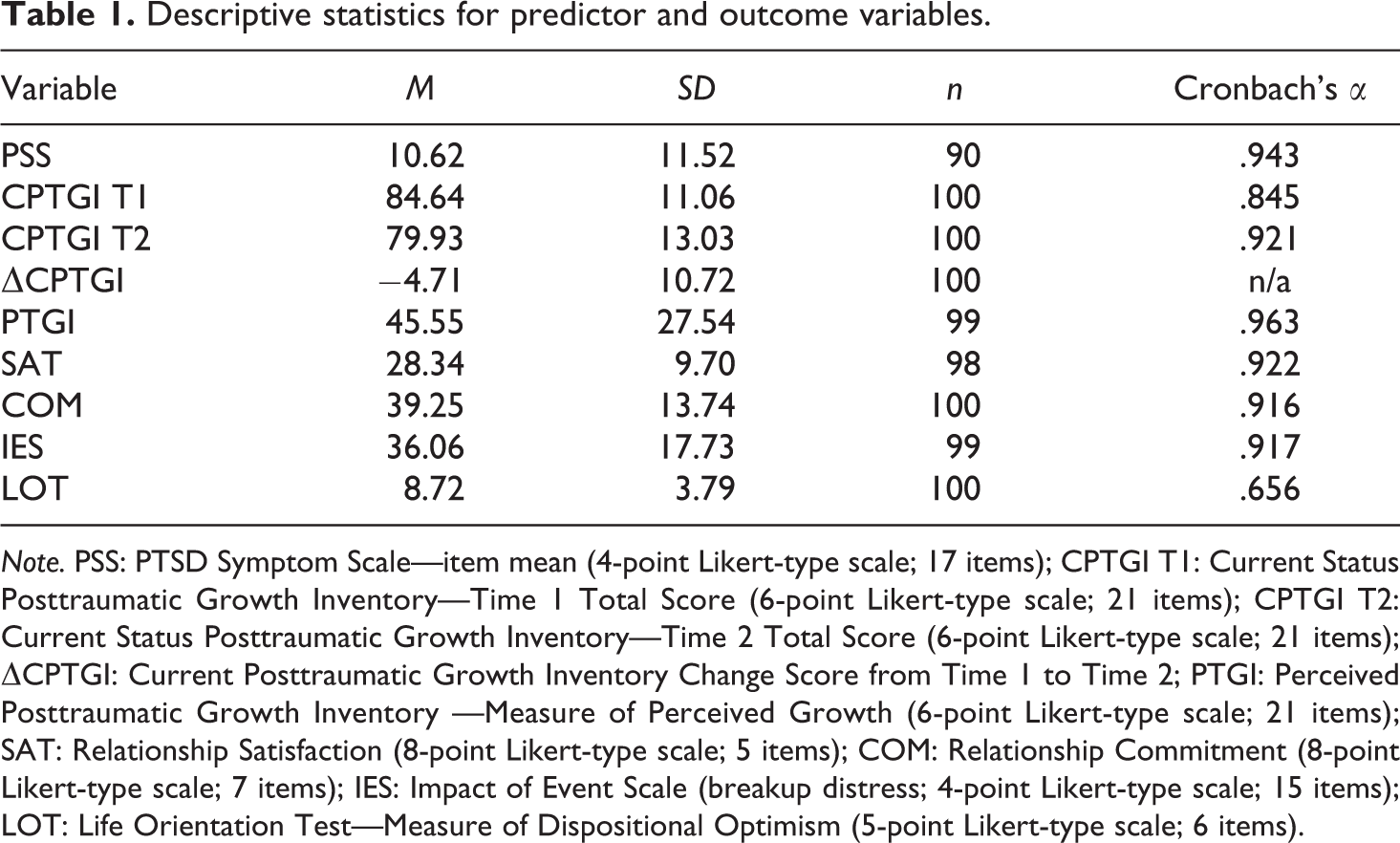
Note. PSS: PTSD Symptom Scale—item mean (4-point Likert-type scale; 17 items); CPTGI T1: Current Status Posttraumatic Growth Inventory—Time 1 Total Score (6-point Likert-type scale; 21 items); CPTGI T2: Current Status Posttraumatic Growth Inventory—Time 2 Total Score (6-point Likert-type scale; 21 items); ΔCPTGI: Current Posttraumatic Growth Inventory Change Score from Time 1 to Time 2; PTGI: Perceived Posttraumatic Growth Inventory —Measure of Perceived Growth (6-point Likert-type scale; 21 items); SAT: Relationship Satisfaction (8-point Likert-type scale; 5 items); COM: Relationship Commitment (8-point Likert-type scale; 7 items); IES: Impact of Event Scale (breakup distress; 4-point Likert-type scale; 15 items); LOT: Life Orientation Test—Measure of Dispositional Optimism (5-point Likert-type scale; 6 items).
Pearson correlations for covariates, predictor, and outcome variables.
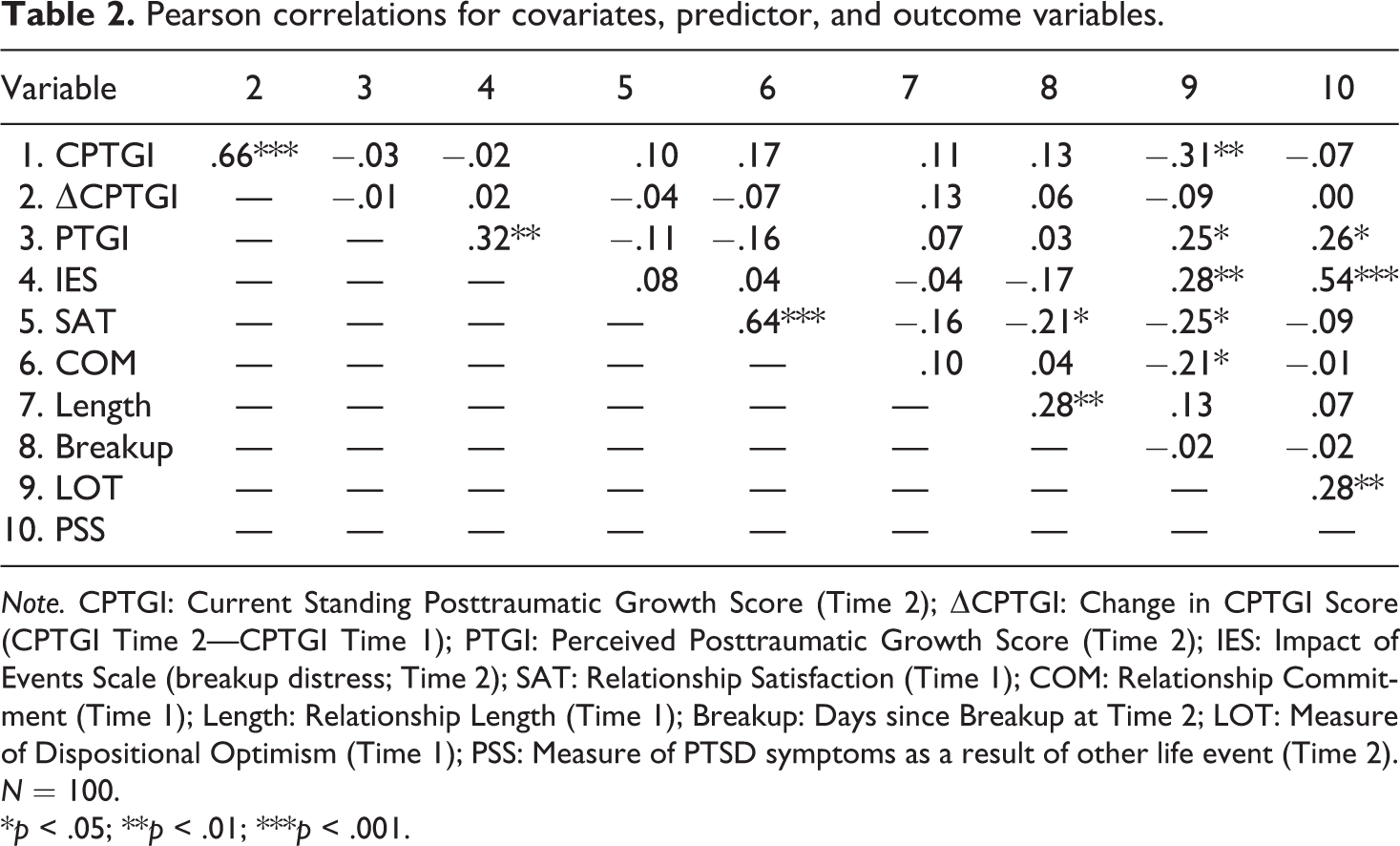
Note. CPTGI: Current Standing Posttraumatic Growth Score (Time 2); ΔCPTGI: Change in CPTGI Score (CPTGI Time 2—CPTGI Time 1); PTGI: Perceived Posttraumatic Growth Score (Time 2); IES: Impact of Events Scale (breakup distress; Time 2); SAT: Relationship Satisfaction (Time 1); COM: Relationship Commitment (Time 1); Length: Relationship Length (Time 1); Breakup: Days since Breakup at Time 2; LOT: Measure of Dispositional Optimism (Time 1); PSS: Measure of PTSD symptoms as a result of other life event (Time 2). N = 100.
*p < .05; **p < .01; ***p < .001.
We assessed whether the PSS would be an appropriate control variable by examining its relationship to the dependent measures. The PSS was significantly correlated with perceived PTG (PTGI), controlling for sex, R2 = .07, F(1, 97) = 6.79, p = .008. The PSS was also significantly associated with breakup distress (r = .54, p < .001) and optimism (r = .28, p < .01), but not the CPTGI at Time 1 (r = −.07) or at Time 2 (r = −.07). Because gender and PSS were significant predictors of the PTGI, we included them as control variables in regression analyses when the PTGI was the outcome variable.
Discussion
Previous research has reported perceived PTG following relationship breakups (Herbert & Popadiuk, 2008; Lewandowski & Bizzoco, 2007; Tashiro & Frazier, 2003), but the present study was the first to examine this question with a prospective design. The key questions were whether the findings of retrospective research on breakups would hold in a prospective design, whether actual PTG occurs, and how actual PTG relates to perceived PTG. This study contributes to the literature on PTG following relationship dissolution by providing prospective evidence, assessing competing hypotheses, using a comparison group, and controlling for non-breakup PTSD symptoms. Overall, the results indicate that perceived growth is more consistent with a PR account than a PTG explanation.
Romantic relationship dissolution and perceived growth
Our results are consistent with the literature that romantic relationship breakup is very distressing for emerging adults. The mean breakup distress score on the Impact of Events Scale (Sundin & Horowitz, 2002) was 36.06, which exceeds the cutoff score of 33 for severe stress recommended by Creamer, Bell, and Failla (2003). This degree of distress is similar in magnitude found in studies of other traumatic events, such as experiencing a severe earthquake, cardiac surgery (Bunze, Roethy, Znoj, & Laederach-Hofmann, 2008), or a motor vehicle accident (Beck et al., 2008). Other research has indicated that breakups are related to depression, PTSD-like symptoms, and neural activations like physical pain (Anders et al., 2011; Kross et al., 2011). Despite being a relatively normative event, breakups during emerging adulthood often result in significant distress and symptoms and are among the most common reasons for college counseling center referrals (Benton et al., 2003).
Previous research indicated that relationship quality prior to breakup was positively associated with PTG when all measurements were conducted retrospectively (Lewandowski & Bizzoco, 2007; Sprecher et al., 1998). The presumption has been that the distress of losing a high-quality relationship spurs growth subsequent to the breakup. We assessed these relationships prospectively with measures of relationship quality (satisfaction and commitment) prior to breakup and did not find any of the expected growth-related correlations. This pattern of results is inconsistent with PTG theory and suggests that the relationships between relationship quality and growth found in retrospective research are just as likely to be due to a PR as to PTG.
We did find the positive correlation between breakup distress and perceived PTG expected from both the PTG and PR perspectives. Although Tashiro and Frazier (2003) did not find this relationship in their study of romantic relationship breakups, a meta-analysis indicated that the relationship between distress and growth is curvilinear: A moderate degree of distress was related to growth, but greater distress was negatively related to growth (Shakespeare-Finch & Lurie-Beck, 2014). In contrast, the correlation in this study was linear. The relationship between distress and growth provides some support for PTG theory because the struggle with losses or traumatic events is what ostensibly produces the growth (Tedeschi & Calhoun, 2004). This support is mitigated, however, because the association was the only prediction from the PTG perspective that was supported, and this correlation was also predicted by the PR perspective.
We also assessed other hypotheses to examine the validity of retrospective reports of growth as a proxy for actual growth. The PTG perspective predicted that actual growth would be higher following the breakup, that actual growth and perceived growth would be correlated, and that individuals who experienced a breakup would have higher scores on actual growth than those who had not experienced a breakup. None of these predictions were confirmed in this study, casting doubt on the claim that retrospective reports of PTG reflect “transformative life changes” for participants following breakup. The lack of a relationship between perceived and actual growth is consistent with previous research (Frazier et al., 2009; Yanez et al., 2011). Frazier et al. (2009) also found lower scores on actual growth at Time 2 than at Time 1.
Romantic relationship dissolution and PR
All of the results of this study were consistent with the PR perspective, which provides another explanation for the correlation of distress with perceived PTG, and an explanation for the absence of change in actual growth over time, the lack of correlation between perceived and actual growth, and the lack of differences between those who experienced breakup trauma and those who did not. That is, retrospective reports of perceived growth may be due to PR as a coping strategy (Kalish et al., 2015; Linley & Joseph, 2004). It is possible that individuals are motivated to present a positive picture of the breakup, distress, and growth, thereby convincing themselves (and perhaps others) that they are doing well. It is reasonable to believe that individuals are motivated to reduce their breakup distress and perceiving growth is one way to positively reframe the breakup, thereby reducing distress. This is consistent with Gunty et al.’s (2011) finding that reports of distress are positively related to reports of perceived growth as a method of coping. PR may also serve an important relationship function by allowing individuals to continue dating with hope following a recent relationship failure.
The fact that participants report perceived growth within an average of 1 month following a relationship breakup also casts doubt on the actuality of growth because it seems unlikely that significant personal growth could be achieved so quickly. As several theorists have noted, it is realistic to expect growth to take time to emerge because distress and grieving are likely to occur first, followed by adjustment and then growth (Miller, 2010; Tedeschi & Calhoun, 2004). This expectation of time necessary for growth is reinforced by the high degree of distress reported regarding the breakup. The relationship breakups were very painful, and one would expect it to take some time to recover and grow from such pain. This rapidity is consistent with meta-analytic results documenting that participants generally report growth soon after a trauma (Shakespeare-Finch & Lurie-Beck, 2014).
The PR perspective prediction that dispositional optimism at Time 1 would be positively related to perceived PTG at Time 2 was also supported. This is consistent with other findings (Helgeson, Reynolds, & Tomich, 2006; Miller, 2010; Prati & Pietratoni, 2009). PTG theorists have recognized this relationship and suggested that optimism may influence cognitive processing involved in PTG (Tedeschi & Calhoun, 2004), but they have not integrated the concept of optimism into their theory. Consequently, the optimism-perceived growth relationship seems to be more readily explained as a dispositional element of PR. This interpretation is consistent with other research, suggesting that perceived growth was related to positive reinterpretation coping (a strategy which may be more likely to be used by optimists; Frazier et al., 2009).
Reporting perceived growth post-breakup may be a coping strategy to reduce the distress associated with a developmental setback for emerging adults, for whom relationships are a central focus (Arnett, 2000). Previous research found that the relationship between perceived and actual growth was moderated by distress and life satisfaction (Gunty et al., 2011). Gunty and colleagues reported that individuals who were more distressed were less accurate in their accounts of growth. Following a breakup, these are the very individuals who may need to improve their mood through PR, so they can move forward with the developmental task of dating. In a qualitative study of relationship breakup and perceived growth in college students, participants collectively reported 69 changes since the breakup and 64 of those changes were positive. The core category of the study was “Moving Self Forward” (Herbert & Popadiuk, 2008), suggesting that emerging adults may have a developmental imperative to move forward with dating relationships and perhaps perceived growth/PR helps to make that possible. Samios, Henson, and Simpson (2014) found empirical support for the adaptive role that perceived growth can play post-breakup: It can reduce depression symptoms and improve overall adjustment.
Perhaps perceived growth and actual growth serve different functions for individuals post-breakup. Perceived growth allows the individual to move forward, reduce distress or depression symptoms, and retain hope for the next relationship. Indeed, research from other relationship processes has shown that positive illusions serve an important role in relationship maintenance and satisfaction (Fowers, Lyons, Montel, & Shaked, 2001; Murray & Holmes, 1997). In contrast, actual growth post-breakup is more effortful but could include behavioral changes that improve the likelihood of success in future relationships. Previous research suggests that both processes exist and that both may be important for the development and success of future romantic relationships, albeit in different ways.
Conclusions and future directions
This was the first prospective study of PTG following relationship dissolution. The degree of distress due to the breakup was significant, indicating that relationship breakups powerfully affect emerging adults, thereby meriting continued research and clinical attention. This distress was related to retrospective reports of perceived growth, which, based on the overall results of this study, we are interpreting as PR. Unlike previous retrospective studies of breakups, relationship variables (satisfaction and commitment), assessed when the relationship was intact, were unrelated to subsequent distress and growth.
It seems plausible that at least some individuals experience growth following the distress of relationship breakups. The kind of “transformative life changes” posited by PTG theory may often be warranted to improve individuals’ prospects for relationship success. In other cases, however, substantial changes may be unnecessary, such as when the breakup is the result of simply recognizing interpersonal incompatibility or insurmountable circumstantial difficulties.
Our results suggest caution in distinguishing between retrospective descriptions of growth and actual growth following relationship breakup. Perhaps PTG is better conceived as a process that only some individuals experience rather than a process that generally follows from traumatic events. In any case, more compelling evidence is needed to justify confidence in the concept of perceived PTG. Future studies should build on research that distinguishes the variables related to perceived and actual growth. Additionally, other methods are needed to provide better evidence for actual PTG. For example, investigators could obtain informant (friends, family) reports of growth to assess the participants’ perceptions of growth, which has been employed in some previous studies (Blackie, Jayawickreme, Helzer, Foregard, & Roepke, 2015; Helgeson, 2010).
The standard method of assessing this construct through retrospective self-report appears to be inadequate and provides weak evidence for the popular concept of PTG. This is particularly worrisome, given the rapid move from research “documenting” PTG to interventions and self-help books (e.g., Joseph, 2011) designed to promote an approach to trauma that remains questionable (Coyne & Tennen, 2010). PTG undoubtedly occurs at times, but likely not for most people who have experienced relationship breakup and other traumas (Linley & Joseph, 2004). Investigating the variables that support actual growth in relationship choices and behaviors could have a significant impact on interventions to promote PTG following breakups when appropriate. Additionally, within the context of relationship breakup in emerging adulthood, it would be important to know whether the lengthier process of PTG contributes to improved future relationship success, prior to promoting the idea of growth.
The lack of association between perceived growth and actual growth corroborates findings from other studies, exacerbating questions about the retrospective measurement of PTG. The retrospective nature and wording of the PTGI(Tedeschi & Calhoun, 1996) are two problems that may make the measure prone to reports of PR rather than actual growth. In a recent study (published after the data were collected for the present study), the PTGI was compared to the Stress-Related Growth Scale–Revised (SRGS-R; Boals & Shuler, 2017). Specifically, the SRGS was reworded to include neutral wording as opposed to positive change, and the rating scale was revised to include both positive and negative impacts. The results of the study suggest that the PTGI is particularly prone to illusory reports of growth, which we suggest is the result of PR. Therefore, prospective research on actual growth should be emphasized in future research to help elucidate which outcomes are the result of reappraisal and which are associated with actual growth. If a retrospective design must be utilized, the SRGS-R (Boals & Shuler, 2017) may be the better measurement choice.
Importantly, individuals who experience a relationship breakup are very likely to pursue subsequent relationships. For some of these individuals, PR will be helpful in continuing to date in the face of a recent failure. It is possible that no substantial changes or growth are necessary. However, if an individual truly needed to “grow” in relationship choices and behaviors but has instead used PR to believe they have grown, they may be vulnerable to repeating problematic choices and behaviors, which may lead to similar distress and breakups in future relationships. Therefore, distinguishing perceived and actual PTG is important within the context of an individual’s future relationship goals, challenges, and successes.
Footnotes
Funding
The author(s) received no financial support for the research, authorship, and/or publication of this article.
Open research statement
As part of IARR’s encouragement of open research practices, the author(s) have provided the following information: This research was not pre-registered. The data used in the research are not available. The materials used in the research are not available.