




Abstract
Romantic partners’ dyadic perceptions of their goals and conflict strategies in ongoing, unresolved conflict are examined in relation to one another and to these serial arguments’ perceived resolvability. Specifically, elements of Bevan, Finan, and Kaminsky’s ((2008) Modeling serial arguments in close relationships: The serial argument process model, Human Communication Research, 34, 600–624) serial argument process model were considered here as dyadic perceptions. Eighty-four romantic partners completed surveys that measured their self-reports of perceived resolvability and self- and perceived partner reports of serial argument goal importance and conflict strategy usage. Whereas there were relatively more self-perception/actor effects for goal importance and conflict strategy usage, there were more partner perception/partner conflict strategy usage effects on perceived resolvability. The implications of these findings for the dyadic consideration of serial arguments and Bevan et al.’s model are presented.
The growing research area of serial argumentation has provided valuable insight into how ongoing, unresolved conflict is enacted in a variety of close relationships. For example, the importance of perceived resolvability (e.g., Johnson & Roloff, 1998) and positively and negatively valenced goals (e.g., Bevan, Hale, & Williams, 2004) has emerged in a variety of studies and were then each linked with conflict strategies (Bevan et al., 2007). Bevan, Finan, and Kaminsky (2008) subsequently introduced the serial argument process model that depicts how these integral serial argument components coalesce in family and romantic argument episodes. Together, these findings suggest that serial argumentation represents a significant communication event in close relationships.
Emotionally laden, intense situations such as conflict and arguments augment perceptual differences and communication and may divide a dyad rather than connect them (Sillars, Roberts, Dun, & Leonard, 2001). Compared to single-episode conflicts, serial argumentation involves interactants engaging in multiple conflict episodes about the same issue over time and without resolution. The unique nature of serial arguments, and their potential to serve as a consistently destructive communication pattern in close relationships, places a premium on examining dyadic perceptions of goals and conflict messages in serial argument episodes. However, to date, published serial argument research has predominantly focused on a single relational partner’s point of view. Dyadic consideration of serial arguments would facilitate greater understanding of how both partners’ perceptions can mutually manage the importance of their serial argument goals, behaviors, and perceived resolvability. As such, the current study examines dyadic relationships among these variables as depicted in Bevan et al.’s (2008) serial argument process model.
Serial argument goals and conflict strategies
Empirical research that considers both partners’ goals is important because it may aid in alleviating the inherent clash between incompatible objectives in interpersonal conflict (Lakey & Canary, 2002). Further, couples’ ability to perceptually understand one another can be impacted by their interaction goals, particularly when these multiple goals are in conflict with one another (Sillars, 1998). The dyadic perceptions of serial argument goal importance (i.e., the extent to which a goal is primary or central in an argument episode) are thus first considered here via Bevan et al.’s (2004) revised set of serial argument goals. This typology (Bevan et al., 2007, 2008) consists of seven goals that were developed specifically for the serial argument context: (a) mutual understanding/resolution: reaching a common agreement and/or increased insight into a partner’s point of view; (b) positive relational expression: conveying constructive feelings about the relationship; (c) relational termination: reducing intimacy or ending the partnership; (d) dominance/control: gaining power over the partner or the argument topic; (e) expressiveness negative: communicating hurtful feelings; (f) change target: altering how a partner acts; and (g) hurt partner/benefit self: purposely wounding the partner to win and/or to feel personally better. The first two goals typically are positively valenced, whereas the remaining goals tend to be negative in nature (e.g., Bevan et al., 2008).
These serial argument goals have been observed in romantic, family, organizational, and educational contexts (Bevan, 2010; Bevan et al., 2008; Hample & Allen, 2012; Hample & Krueger, 2011). Further, this seven-goal typology is flexible in that it allows researchers to either examine clusters of serial argument goals consistent with the commonly held belief that individuals pursue multiple goals during interaction (e.g., Dillard, Segrin, & Harden, 1989; Sillars, 1998) or focus on how specific goals are related to various aspects of communication. For example, Bevan et al.’s (2008) two versions of the serial argument process model separately examined the two positively valenced goals and four of the negatively valenced goals together in relation to how individuals directly communicated in a serial argument episode. In addition, Bevan et al. (2007) studied which goals shared the strongest relationships with perceived resolvability and conflict strategy usage. However, Bevan (2010) and Bevan et al. (2007, 2008) also determined that a number of these goals are unrelated to one another and many also significantly differed from one another in terms of their importance, suggesting that examining them individually can be valuable. Thus, to initially explore how the importance of both partners’ goals may uniquely relate to how the partners employ conflict strategies in serial arguments, the seven serial argument goals are examined individually here.
The ongoing, unresolved nature of serial arguments, in other words, likely implies that both partners consistently perceive that the multiple goals that they are pursuing are not being accomplished or are incompatible, that their communication is individually and/or relationally harmful, and that the likelihood of a satisfactory resolution of the argument for both partners is therefore minimal. The integral link between romantic partners’ goal importance and perception of serial argument resolution is how these partners communicate in serial argument episodes. As such, dyadic perceptions of how romantic partners communicatively engage in serial arguments are of interest here. That conflict avoidance, the demand–withdraw pattern, and integrative communication have been positively related to individuals’ stress and decreased well-being (Malis & Roloff, 2006a; Reznik, Roloff, & Miller, 2010) also illustrates the importance of understanding dyadic serial argument communication processes.
Serial argument goals are typically linked with Sillars’ (1980) integrative, avoidant, and distributive conflict strategies (e.g., Bevan et al., 2008; Bevan, 2010; Hample & Allen, 2012; Hample & Krueger, 2011; Reznik et al., 2010). As these strategies are also commonly examined in dyadic conflict research (e.g., Acitelli, Douvan, & Veroff, 1993; Kurdek, 1995; Segrin, Hanzal, & Domschke, 2009), they are employed here as well to explore dyadic serial argument perceptions of romantic partners’ communication in serial arguments. Integrative communication is a constructive conflict strategy that shows a high concern for both partners, whereas distributive communication involves negative, hurtful messages that show only a high concern for oneself. Avoidance exhibits moderate concern for both partners and involves denials or topic shifting.
Dyadic perceptions of romantic serial arguments
Features of unresolved arguments that can become serial are related to decreased relational quality (Cramer, 2003; Johnson & Roloff, 1998), increased rumination (Bevan et al., 2008), hopelessness about resolution (Miller & Roloff, 2006), and stress (Malis & Roloff, 2006a, 2006b; Reznik et al., 2010). Examining dyadic perceptions in serial arguments could shed light on how to alleviate these detrimental individual and relational correlates. Further, an individual’s perceptions of how their partner is communicating can shape the tenor of a serial argument episode (Johnson, 1998). However, only two known perceptual and/or dyadic serial argument studies have been conducted.
In the first, Bevan, Nicol, Morton, White, and Hale (2006) compared dating partners who took one of two randomly assigned perceptual roles: their own self-reports or their perceptions of partner serial argument goal importance and conflict strategy usage. Those reporting on their own serial argument goals indicated that the expressiveness positive, relational progression/continuation, and mutual understanding/resolution goals were more important than those perceiving their partners’ goals. In contrast, those taking their dating partners’ perceptual roles indicated that the hurt partner/benefit self goal was more important and that the avoidance strategy was utilized more frequently. Although informative, Bevan et al.’s study did not collect dyadic data.
Second, Johnson’s (1998) individual-level findings determined that individuals’ perceptions of their romantic partners’ usage of the distributive and integrative strategies in serial arguments were better predictors of participant-perceived resolvability than participants’ own strategy usage. However, partner use of indirect and avoidant strategies were unrelated to participant-perceived resolvability. A dyadic subsample of Johnson’s data also determined that partner perceptions of participant integrative and avoidance conflict strategy usage predicted participant-perceived resolvability. She concluded that romantic couples perceived their serial arguments similarly. Although these findings offer some preliminary evidence of the utility of dyadic perceptual research in the serial argument context, many questions regarding the specific relationships between serial argument goal importance, conflict strategy usage, and perceived resolvability at a dyadic level of serial arguments remain unanswered. Bevan et al.’s (2008) serial argument process model is thus employed here to understand these relationships.
The serial argument process model
Bevan et al. (2008) proposed and tested a model that attempted to chart the course of a serial argument episode. According to their serial argument process model, the importance of multiple negative and/or positive serial argument goals initiates this process, which then predicts the usage of integrative and/or distributive conflict strategies within the episode. Interactants subsequently consider the perceived resolvability of the serial argument and ruminate about the serial argument. Finally, this rumination predicts an individual’s motivation to achieve serial argument-relevant goals. Two similarly structured models—one each for positive and negative goal importance—emerged and were consistent across romantic partner and family member subsamples.
This model can facilitate understanding romantic partners’ dyadic serial argument perceptions because it formally establishes paths from the importance of positive and negative serial argument goals to usage of integrative and distributive conflict strategies and then from these conflict strategies to perceived resolvability. In addition, recent research in classroom (Hample & Krueger, 2011) and organizational (Hample & Allen, 2010) settings offers support for the general paths established by the serial argument process model as well as broadens its scope. Thus, the serial argument process model is employed here to examine the specific relationships between dyadic perceptions of serial argument cognitions and behaviors.
The current study focuses on two specific dyadic perceptions: individuals’ reports of their own (i.e., self-perceptions) and their romantic partners’ (i.e., partner perceptions) serial argument goal importance and conflict strategy usage. These dyadic perceptions are of interest for two reasons: (a) they allow for simultaneous interactions with the standard actor–partner effects that are examined in dyadic research, resulting in four distinct, but related, self/partner perceptions × actor/partner effects; and (b) though conflict perceptions are frequently misunderstood (Sillars, 1998), individuals rely heavily on their perceptions of their own and their partners’ thoughts and feelings, whether they are accurate, understood, and/or similar.
These perceptions are particularly relevant in the initial step in the serial argument process model (Bevan et al., 2008): in a serial argument episode, individuals first consider which serial argument goal(s) are important to them and then strive to achieve these goals via their conflict strategy usage. In general, positively valenced serial argument goals consistently positively predict integrative strategy usage and negatively predict distributive strategy usage, and vice versa for negatively valenced goals (Bevan et al., 2007, 2008; Hample & Allen, 2012; Hample & Krueger, 2011). Further, when individuals reported that they were sensitive to their partner’s conflict goals, both the individual and the partner were more likely to use the integrative conflict tactic and less likely to employ the distributive tactic (Lakey & Canary, 2002). Similar relationships among the dyadic perceptions of goal importance and self-perceptions of integrative and distributive conflict strategy usage are thus predicted in hypotheses 1 and 2 (H1 and H2). For example, Bevan et al. (2008) found that the mutual understanding/resolution goal positively predicted integrative communication usage for one partner, and it is expected that both partners’ self- and perceived partner reports of the importance of this goal will similarly be linked with each partner’s self-reported use of this strategy. Recall that expressiveness negative, hurt partner/benefit self, relationship termination, change target, and dominance/control are considered as negative serial argument goals, and mutual understanding/resolution and positive relational expression are viewed as positive goals.
Perceived resolvability
The extent to which relational partners believe that their serial argument is progressing toward resolution and, ultimately, conclusion is termed perceived resolvability. Johnson (1998) noted a positive association between both romantic partners’ perceived resolvability and relational quality. Indeed, Roloff (2009) states that having high perceived resolvability about a serial argument can buffer the argument’s negative effects on relational quality. Each partners’ self-reports of their own perceived resolvability are thus considered here in relation to self- and partner perceptions of conflict strategy usage.
As an integral component of serial arguments (Miller, Roloff, & Malis, 2007) that “runs as a common thread throughout the life of a serial argument” (Bevan et al., 2008, p. 603), perceived resolvability is also an aspect of the serial argument process model. Specifically, an individual considers how resolvable the serial argument is upon use of the integrative conflict strategy in an argument episode. Perceived resolvability typically is positively associated with positive serial argument goals and conflict strategies and inversely related to negative serial argument goals and conflict strategies across contexts (Bevan et al., 2007, 2008; Hample & Allen, 2012; Hample & Krueger, 2011). As such, consistent with this model and with previous research findings, hypothesis 3 (H3) predicts that each individual’s report of their own perceived resolvability will be related to both self- and partner perceptions of conflict strategy usage:
Finally, there have been inconsistent findings for both the relational termination goal and the avoidance conflict strategy in previous serial argument research (Bevan et al., 2007, 2008). For example, neither was included in the final serial argument process model because they were not associated with other variables as predicted (Bevan et al., 2008). As such, whether self- and partner perceptions of the relational termination goal are linked to conflict strategy usage and whether dyadic conflict avoidance usage perceptions are associated with each individual’s perceived resolvability are examined via two research questions (RQs):
Method
Participants and general procedures
A larger dyadic study on serial arguments examined romantic dyads who have engaged in serial arguments. Participants (N = 84 couples) were either current students at a small, private university in the Western United States and their romantic partners (n = 24 couples) or community members (n = 60 couples). All participants were heterosexual; half (n = 42) were male and half were female. Average female age was 26 years (range = 18–64 years, SD = 9.07) and males averaged 28 years (range = 18–70 years, SD = 9.43). University participants included freshman (n = 6), sophomores (n = 5), juniors (n = 10), seniors (n = 22), and graduate students (n = 1; did not respond n = 4). The majority of participants described themselves as White (n = 136; bi-/multiracial, n = 8; Hispanic, n = 7; Asian, n = 6; Black/African American, n = 3; other, n = 2; Native American, n = 1; did not respond, n = 5). A variety of romantic relationships, averaging just over 5 years in duration (M = 63.29 months, SD = 79.40, range = 6 months–46 years), were represented, including nonexclusive dating (n = 1), exclusive dating (n = 33), living together but not married or engaged (n = 6), engaged (n = 4), and married (n = 39).
Recruitment and participation took place in two ways. First, university students in communication studies, psychology, English, and political science courses during winter (i.e., interterm) and spring semesters were recruited via e-mail or in-class announcements by professors who agreed to distribute the study information. Interested individuals who e-mailed the researcher were screened for participation (see below for screening details). If the couple qualified, they were either scheduled in small groups for participation at an on-campus location (if both partners were local; n = 15 couples) or provided with study documentation as e-mail attachments for them to complete and return by a specific date (if one partner was not local; n = 9 couples).
Second, in response to Fingerman and Hay’s (2002) call to relationship researchers to study various age groups, study information and participation criteria were posted on the Communication, Research and Theory Network professional listserv and on Facebook. Individuals who qualified received all survey documents by e-mail attachment and returned the completed consent forms and surveys either by e-mail or postal mail by a specific date (n = 60 couples). E-mail reminders were sent approximately 1 week after the documents were initially sent. Snowball sampling also occurred, with a number of initial participants voluntarily forwarding study information to their own social networks. Couples from all areas of the continental United States participated. Overall, participation averaged 30–45 minutes and most couples (n = 80) chose to receive a $25 restaurant gift card as compensation; the remaining four couples opted to not receive compensation.
All potential dyads were screened to ensure that they (a) had been together for at least 6 months (to give them enough time to establish a serial argument) and (b) agreed that they engaged in ongoing, unresolved conflict about at least one topic. If they fulfilled these requirements, the dyads were asked to first agree upon a topic that they have ongoing, unresolved conflict about and then to select together a recent specific serial argument episode they have had about that topic to think about throughout the survey. Reporting on one serial argument episode rather than romantic partners’ global serial argument experience regarding that topic acknowledges that individual conflict goals can shift by situation (e.g., Lakey & Canary, 2002). Couples were then asked to fill out the survey without consulting one another. The first page of the survey presented Johnson and Roloff’s (1998) serial argument definition: “individuals engaging in conflict about the same topic over time, during which they participate in several (at least two) arguments about the topic.” The survey first asked participants to briefly describe the agreed-upon serial argument episode; the author read and compared the topic of the conflict described in each couple’s descriptions to ensure that the same episode was chosen (all dyads had). Participants then responded to a number of items that investigated characteristics of the serial argument (see Table 1).
Female and male frequencies of serial argument characteristics.

Measures
Serial argument goal importance
For their selected serial argument episode, participants next were asked to consider which goals were important to them (self-perception; “My primary goal in this serial argument with my romantic partner was …”) and to their romantic partners (partner perception; “I perceive that my romantic partner’s primary goal in this serial argument with me was …”) using 7-point Likert-type scales (1 = Not at all important, 7 = Very important) via Bevan et al.’s (2008) 33-item scale. For both scales, three items each measured expressiveness negative (e.g., to express frustration), change target (e.g., to change my/my partner’s behavior), mutual understanding/resolution (e.g., to reach a mutual agreement), and dominance/control (e.g., to feel some control of the situation). Four items each measured positive relational expression (e.g., to protect our relationship), relational termination (e.g., to end our relationship), and hurt partner/benefit self (e.g., to get revenge).
Conflict strategies
Based upon recommendations made by Bevan et al. (2007, 2008), the present study combined items from two established conflict strategy scales (Acitelli et al., 1993; Canary, Cunningham, & Cody, 1988) to provide participants with items that potentially represent a broader, more realistic range of serial argument conflict strategies. Participants were asked to report how they (self-perception; “When I engaged in this serial argument with my romantic partner, I …”) and their romantic partners (partner perception; “When my partner engaged in this serial argument with me, I perceived that my partner …”) communicated during their chosen serial argument episode via 30 seven-point Likert-type items for each scale (1 = Not at all, 7 = To a great extent). Because items from multiple scales, some of which have not yet been applied to the serial argument context, were included, a principal component analysis with varimax rotation was conducted on the self-scale version. Following previous serial argument research (Bevan et al., 2007; 2008), factor selection criteria were at least a .65 primary loading with secondary loadings under .35, a minimum eigenvalue of 1, at least two items per factor, and scale reliability for all versions, as assessed by Cronbach’s α. Five factors fit these criteria.
Six items including elements of avoidance of the issue and partner formed an avoidance factor (e.g., I avoided my partner; I changed the topic of discussion; eigenvalue = 6.57, 21.88% of the variance explained). An integrative factor was comprised of six items (e.g., I listened to my partner’s point of view; eigenvalue = 4.611, 15.37% of the variance explained). Five items formed a criticism/blame factor (e.g., I criticized an aspect of his or her personality; eigenvalue = 3.37, 18.70% of the variance explained). A threat/insult factor included four items (e.g., I threatened my partner; eigenvalue = 1.61, 5.03% of the variance explained). The final factor included two compromise items (e.g., I compromised with my partner; eigenvalue = 1.42, 4.43% of the variance explained). Based on the items that loaded onto each factor, the avoidance factor reflects Sillars’ (1980) avoidant conflict strategy, the integrative and compromise factors represent his integrative strategy, and the criticism/blame and threat/insult factors represent his distributive strategy. 1
Perceived resolvability
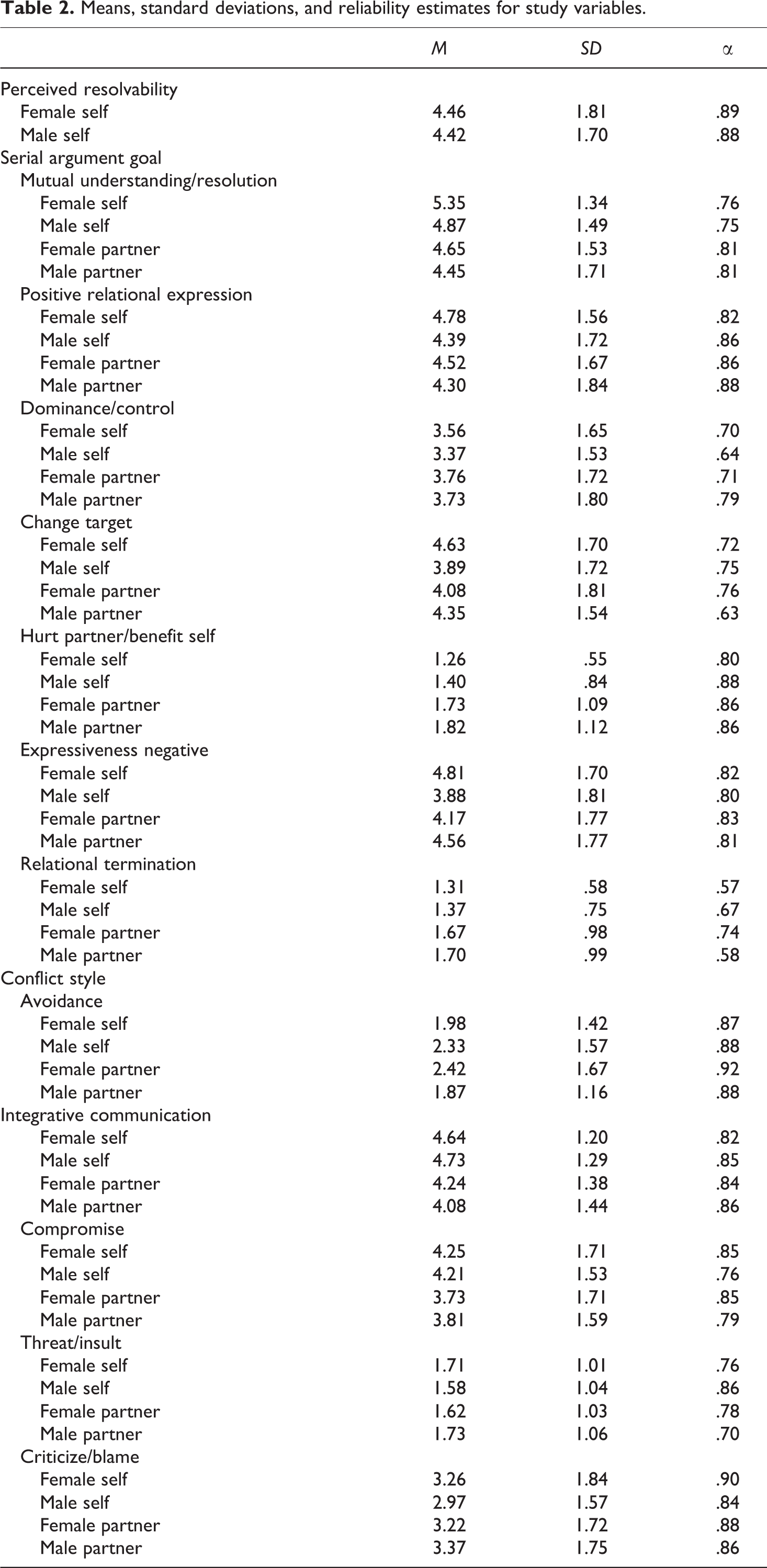
Respondents reported on their own perceived resolvability of the specific serial argument episode (i.e., their self-perceptions) using Johnson and Roloff’s (1998) four-item measure. Participants were asked, “To what extent do you believe the following about your serial argument?” Each item (e.g., I believe that it will never be resolved) was assessed via a seven-point Likert-type scale (1 = Not at all, 7 = To a great extent); items were recoded so that greater values indicate greater perceived resolvability. See Table 2 for means, standard deviations, and reliability scores for all measures.
Means, standard deviations, and reliability estimates for study variables.
Results
Analysis plan
Using the AMOS 7.0 computer program (Arbuckle, 2006), structural equation models where the dyad served as the unit of analysis were employed. Specifically, unstandardized regression coefficients for all hypotheses and RQs were estimated via a modified version of the actor–partner interdependence model (APIM) that includes both romantic partners’ reports of their self- and partner perception data. The APIM allows for the simultaneous consideration of the impact of each romantic partner’s self- and partner perceptions of both goal importance and conflict strategy usage and self-perceptions of perceived resolvability. Four types of relationships were examined for each romantic partner (eight relationships total per model): (a) self-perception/actor effects, where individuals’ assessment of their own goals or behaviors influences their own self-reported behaviors or perceived resolvability; (b) self-perception/partner effects, where individuals’ assessment of their own goals or behaviors influences their partners’ self-reported behaviors or perceived resolvability; (c) partner perception/actor effects, where individuals’ perceptions of their partners’ goals or behaviors influences their own self-reported behaviors or perceived resolvability; and (d) partner perception/partner effects, where individuals’ perceptions of their partners’ goals or behaviors influence their partners’ self-reported behaviors or perceived resolvability (see Figure 1).

Conceptual actor–partner interdependence model of four dyadic perception effects between serial argument goal importance and conflict.
When testing each hypothesis and RQ, separate APIMs were computed for each of the seven serial argument goals and the five conflict strategies. In these models, each of the endogenous self- and partner perception variables were allowed to covary with one another. Model fit statistics are not reported, as the APIM is saturated and has zero degrees of freedom (Cook & Kenny, 2005). As is typical for distinguishable dyads, results are discerned by gender (Kenny, Kashy, & Cook, 2006). Significance level was set at p < .05. 2
Dyadic perception effects of serial argument goal importance on conflict strategy usage
To test H1, H2, and RQ1, APIMs that linked individuals’ self- and partner perceptions of serial argument goal importance and their self-perceptions of integrative, distributive, or avoidance conflict strategy usage were conducted (see Table 3 for the unstandardized regression coefficients). For H1 (which includes APIMs testing both the integrative and compromise conflict strategies that emerged from factor analyses), 38% (9 of 24) of the self-perception/actor effect relationships were significant and all were in the predicted direction; the significant relationships were all from one’s perceptions of the importance of their own positively valenced or dominance/control goals to their own integrative and/or compromise communication usage. There were no significant self-perception/partner effects and minimal partner perception/actor effects (13% or 3 of 24) between serial argument goal importance and integrative conflict strategy usage; however, two of these effects were in the opposite direction predicted by H1a (i.e., the more females perceived the dominance/control goal was important to their partners, the more females used both integrative communication and compromise). Finally, 13% (3 of 24) of the partner perception/partner effects were significant; all were for the integrative conflict strategy and in the predicted direction. Overall, H1 received qualified support and relatively more significant self-perception effects emerged.
Unstandardized coefficients for APIM models testing H1, H2, RQ1, and RQ2.
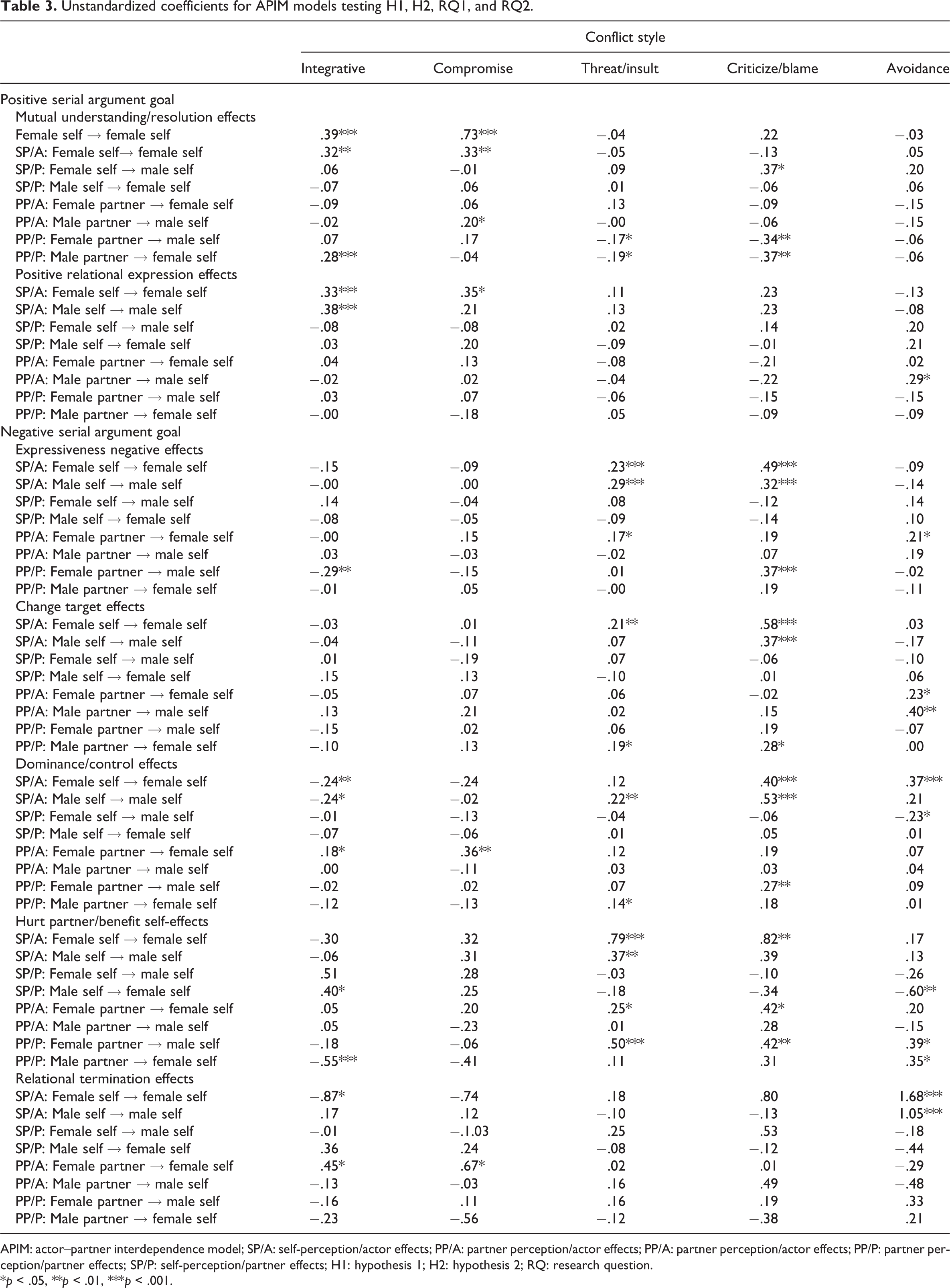
APIM: actor–partner interdependence model; SP/A: self-perception/actor effects; PP/A: partner perception/actor effects; PP/A: partner perception/actor effects; PP/P: partner perception/partner effects; SP/P: self-perception/partner effects; H1: hypothesis 1; H2: hypothesis 2; RQ: research question.
*p < .05, **p < .01, ***p < .001.
For H2 (which included both the threat/insult and criticize/blame conflict strategies), more than half (13 of 24 or 54%) of the self-perception/actor effects were significant, all of which were positive and involved the four negatively valenced goals. One (4%) significant relationship emerged for the self-perception/partner effect; however, when females felt that mutual understanding/resolution was important, their male partners reported they were more likely to use criticize/blame, opposite of what was predicted. Three (13%) of the partner perception/partner effects were significant and in the predicted direction. Finally, almost half of the partner perception/partner effects (11 of 24 or 46%) were significant and in the predicted direction; notably, all four of these effects were significant for the mutual understanding/resolution goal and there were significant effects for each goal except for positive relational expression. As such, partial, moderate support was observed for H2 (see Table 3).
RQ1 explored the relationship between dyadic perceptions of relational termination goal importance and self-reported usage of the five conflict strategies. APIMs revealed three (30%) significant self-perception/actor effects: a negative relationship between females’ goal of relationship termination and their own use of integrative communication, and positive relationships between this goal and both partners’ self-reported use of conflict avoidance. Two (20%) significant partner perception/actor effects were also observed: when females believed relational termination was an important goal for their partners, females reported engaging in more integrative communication and compromise. There were no significant self-perception/partner or partner perception/partner effects. Overall, there were few significant dyadic conflict strategy usage effects for the relational termination serial argument goal (see Table 3).
Dyadic perception effects of conflict strategy usage on perceived resolvability
The final hypothesis and RQ2 investigated the links between self- and partner perceptions of the integrative, distributive, and avoidance conflict strategy usage and both partners’ self-perceptions of the serial argument’s perceived resolvability (see Tables 3 and 4 for the unstandardized regression coefficients). APIMs testing H3 revealed that there were no significant self-perception/actor or self-perception/partner effects for self- and partner perceptions of the integrative, compromise, threat/insult, and criticize/blame conflict strategies in relation to self-reports of perceived resolvability. Further, there was one (13%) significant partner perception/actor effect for H3: females who perceived their male partners compromised reported greater self-perceptions of perceived resolvability. The majority (5 of 8 or 63%) of partner perception/partner effects for H3 were significant: one individual’s perceptions of partner usage of each of the four conflict strategies predicted partner self-reported perceived resolvability in the predicted direction. H3a was thus not supported, but moderate support was found for H3b.
Unstandardized coefficients for APIM models testing H3 and RQ2.

APIM: actor–partner interdependence model; H3: hypothesis 3; RQ: research question.
*p < .05, **p < .01.
For RQ2, conflict avoidance was examined in two sets of APIMs: one where it is predicted by six of the seven serial argument goals (its relationship with the relational termination goal is reported for RQ1); and one where it predicts self-reported perceived resolvability. Where avoidance was the outcome, there was one (8%) significant self-perception/actor effect: female dominance/control goal importance was positively related to female self-reported avoidance. Two (17% or 2 of 12) self-perception/partner negative effects emerged, one each for the dominance/control and hurt partner/benefit self goals. There were four (25%) significant positive partner perception/actor effects for the positive relational expression, expressiveness negative, and change target goals. Two significant (17%) partner perception/partner effects were observed; when females and males perceived that their partners found the hurt partner/benefit goal was important, their partners were each more likely to report responding with avoidance. For perceived resolvability, there was only one (13%) significant self-perception/actor effect: female conflict avoidance was negatively related to female self-reported perceived resolvability. Therefore, there were some self- and partner perception effects for goal importance and conflict avoidance but very minimal avoidance effects for perceived resolvability.
Discussion
This study employed Bevan et al.’s (2008) serial argument process model to examine the link between dyadic perceptions of serial argument goal importance and conflict strategy usage, and how conflict strategy dyadic perceptions are then related to both partners’ self-reports of perceived resolvability about the serial argument. APIMs allowed for the simultaneous consideration of four different, but related, perceptions for male and female romantic partners: two actor effects, involving perceptions about oneself (self-perception/actor effects) and perceptions about one’s partner (partner perception/actor effects) on either one’s own conflict strategy usage or perceived resolvability, and two partner effects where perceptions about the self (self-perception/partner effects) and perceptions about the partner (partner perception/partner effects) impact either the partner’s self-reported conflict strategy usage or perceived resolvability. Relatively more self-perception/actor serial argument goal importance effects on conflict style usage emerged; however, there were more partner perception/partner conflict style usage effects on perceived resolvability. These findings and their implications for serial argument research are described next.
Dyadic perception effects of serial argument goal importance on conflict strategy usage
H1 and H2 predicted that serial argument goal importance would have a significant effect on integrative and distributive conflict strategy usage. Qualified to moderate support was obtained for these hypotheses, with the greatest number of significant relationships (38% for H1 and 54% for H2) being for self-perception/actor effects. As predicted, when one partner perceived that the two positive serial argument goals were important, that partner was also more likely to employ the two constructive conflict styles, with the same positive self-perception/actor effects also mostly evident for the four negative goals in relation to usage of both threat/insult and criticize/blame. As such, it seems that the links between goals and conflict strategies tend to exert more of an individual (i.e., actor), rather than dyadic, effect.
However, except for the dominance/control goal, no significant self-perception/actor positive goal effects on negative strategies, nor negative goal effects on positive strategies, were observed. This pattern is consistent with Bevan et al.’s (2008) serial argument process model, where goals positively predicted conflict strategies that were similarly valenced, but were mostly unrelated to conflict strategies that were opposite in valenced. In serial arguments, then, individuals seem to select conflict strategies that align with the valence of the goals they strive to accomplish; however, they are not necessarily less likely to employ conflict strategies that clash with those goals.
All goals, save for positive relational expression, had at least one significant partner perception/partner effect on the two negative conflict strategies and 46% of these effects were significant for H2. Individuals typically enter into a conflict episode assertively (Johnson, 1998) and enact repetitive, undesired conflict behaviors across multiple episodes (Turk & Monahan, 1999). Thus, individuals may perceive that negative serial argument goals are most important to their partners and respond in accordance to that belief, which then prompts the partner to similarly counter with negative conflict strategies. In essence, though just under half of these effects were significant, identifying the presence of these dyadic associations between both partners’ goals and conflict strategies is noteworthy because they suggest an interesting trend toward a dyadic “partner-fulfilling” prophecy, wherein Partner A’s perceptions of Partner B are detected by Partner B, whose behavior is then consistent with those perceptions. Goal importance and conflict strategy usage also likely mutually influence each partner’s thoughts and messages within, and potentially across, multiple serial argument episodes.
There was also an interesting partner perception/partner effects pattern for the mutual understanding/resolution goal: when individuals perceived that this goal was important to their partners, their partners self-reported using integrative communication more often while employing the threat/insult and criticize/blame strategies less frequently. As such, this study is the first to offer dyadic evidence that this serial argument goal is in fact inherently mutual in nature. Mutual understanding/resolution is both a common (Bevan et al., 2004) and important goal for both romantic and family serial arguers (Bevan, 2010; Bevan et al., 2007). The findings observed here also indicate that an individual perceiving that this goal is important to their partners could encourage that partner to use integrative conflict messages in lieu of threatening or criticizing in serial argument episodes. As only the integrative conflict strategy directly, positively predicts perceived resolvability in the serial argument process model (Bevan et al., 2008), believing that a partner is striving to achieve the mutual understanding/resolution goal may provide the initial spark that both partners can jointly use to resolve the serial argument.
Effects of dyadic perceptions of conflict strategy usage on perceived resolvability
Although H3 found that there were no significant self-perception effects of positive and negative conflict style usage on perceived resolvability, 63% of the partner perception/partner effects were significant. As such, a number of dyadic perceptions were observed for perceived resolvability, such that one individual’s perception of partner conflict style usage is significantly related to the partner’s perceived resolvability self-report. This finding is consistent with Johnson’s (1998) research, which determined that partner perceptions of integrative and distributive conflict strategy usage were better predictors of perceived resolvability than self-perceptions. Bevan et al. (2008) noted that the difficulty they faced with best situating perceived resolvability in the serial argument process model (i.e., proposed as an input variable, perceived resolvability ultimately best fit as an outcome of integrative communication in both versions of the model) may be alleviated if partner perceptions were considered. Thus, communication’s integral role in contributing to perceived resolvability (Bevan et al., 2008) can be expanded to include dyadic conflict style usage perceptions based on the present findings.
Further, the fact that partner perceptions of conflict strategy usage did not affect one’s own perceived resolvability, but did predict more than half of the conflict strategy effects on partner perceived resolvability, is noteworthy. For example, the more she perceives that her boyfriend compromises with her, the greater his (but not her) perceived resolvability about the serial argument is. Perceived resolvability has consistently emerged as a key component of serial arguments and is linked with numerous benefits (e.g., Johnson & Roloff, 1998; Roloff, 2009) and this study suggests that it could be an important dyadic component of serial arguments as well. The current findings suggest that, via a possible dyadic “partner-fulfilling prophecy” effect, how resolvable an individual perceives the serial argument to be is at least partially a product of how the partner thinks that individual communicates in an argument episode.
Dyadic perceptions of the relational termination goal and avoidance conflict strategy
The unexplored and inconsistent nature of findings related to both the relational termination goal and conflict avoidance in the serial argument process led to two RQs investigating their dyadic perceptions. Interestingly, a number of the significant effects observed for these two variables were in relation to each other. Although only five significant effects—three self-perception/actor effects and two partner perception/actor effects—were found for the relational termination goal (RQ1), an interesting pattern emerged. When individuals indicated that relational termination was an important goal to them, females were less likely to use the integrative strategy and both males and females were more likely to avoid conflict. However, when females perceived their partners’ goal was to terminate the relationship, the females utilized more integration and compromise. An asymmetrical demand/withdraw communication pattern may thus exist when this goal is important and should be explored in future research. Further, the absence of any significant partner effects for this goal is likely because ending a romantic relationship is typically a unilateral, individual act (e.g., Cupach & Spitzberg, 2004).
For avoidance (RQ2), only one significant effect was observed for the mutual understanding/resolution and positive relational expression goals or for perceived resolvability, suggesting that this was not a conflict strategy that romantic partners considered when positive goals were primary and perceived resolvability was high in the serial argument episode. These findings are consistent with previous research that has found either small or nonsignificant relationships (Bevan et al., 2007, 2008) between these positive serial argument elements and avoidance. However, it unfortunately does little to clarify avoidance’s role as a conflict strategy in serial arguments.
In terms of negatively valenced serial argument goal effects on conflict avoidance usage, though each of the five negative goals exhibited at least one significant actor or partner effect on avoidance, the most significant effects any one goal had was three, for hurt partner/benefit self. Further, no consistent self- or partner perception patterns emerged for avoidance. The nature of the avoidance scale in this study could aid in clarifying these findings. This scale included items that involved avoiding both the issue itself and the partner, and thus demonstrates the communicative and physical exit forms of withdrawal, which the partner can interpret as being uncooperative (Caughlin & Scott, 2009). As such, this fairly overt and negative method of avoidance (Caughlin & Scott, 2009) could explain why there were relatively more significant associations between avoidance and negative serial argument goal importance. The various ways that individuals can avoid should thus be considered in future serial argument research.
Another explanation involves how relationally satisfied romantic partners are. Afifi, McManus, Steuber, and Coho (2009) found that relationship dissatisfaction predicted avoidance during conflict, and female avoidance then predicted their subsequent dissatisfaction. Although relational quality was negatively related to perceived resolvability in early serial argument research (Johnson & Roloff, 1998), little attention has been paid to it since. As relationship satisfaction is consistently found to be related to dyadic conflict patterns (e.g., Cramer, 2003; Segrin et al., 2009), its role in dyadic serial argumentation processes should be considered in future research.
Limitations and conclusions
Alhough the current study showcases a relatively diverse sample that includes both partners in a variety of romantic dyads, limitations are also present. First, though all major sections of the continental United States and most age ranges were represented here, participants were primarily White and exclusively heterosexual. Heterosexual romantic partners were the focus here because they provide dyadic data that are distinguishable by gender (Kenny et al., 2006); however, future research should seek samples that are more diverse ethnically and include various sexual orientations to offer results with broader generalizability.
In addition, self- and partner perception reports are exclusively employed, to the exclusion of behavioral and/or third-party observations. As two aspects of the serial argument process examined here are cognitive in nature (i.e., goal importance and perceived resolvability), perceptual reports were to some extent necessary. Further, it is generally believed that self- and partner reports of conflict styles do represent actual conflict interaction (e.g., Segrin et al., 2009). However, future serial argument dyadic research should include behavioral observations.
To continue to broaden and clarify our understanding of dyadic perceptions in serial arguments, future research should integrate both partners’ perspectives into the serial argument process model (Bevan et al., 2008), as well as consider how these dyadic perceptions may be related to individual well-being and stress (Malis & Roloff, 2006a, 2006b). Further, as actor and partner effects for integrative and distributive conflict strategies were observed for communication competence (Lakey & Canary, 2002), dyadic perceptions of the effectiveness and appropriateness of serial argument strategies and how each may contribute to the argument’s perceived resolvability is an interesting area for future research. Finally, their fundamentally ongoing nature suggests that longitudinally investigating serial arguments to encompass multiple serial argument episodes is an essential next research step.
In conclusion, this study is an encouraging initial foray into the numerous dyadic associations between serial argument goal importance, conflict strategy usage, and perceived resolvability in the form of self- and partner perceptions and actor and partner effects. At different stages in Bevan et al.’s (2008) serial argument process model, self- and/or partner perceptions were important considerations as romantic partners engaged in a serial argument episode. The dyadic, perceptual relationships identified here were complex, and they serve as an important indicator of the complicated, and often frustrating, nature of serial arguments, where individuals who have a long, interdependent relational history must continually grapple with an important issue without achieving resolution or accomplishing their goals.
Footnotes
Acknowledgment
The author is grateful for the assistance of Kaela Dalton in the initial stages of this project.
Author’s note
An earlier version of this article was presented at the 2013 International Communication Association annual meeting in London, England.
Funding
The study was funded by a 2008–2009 Faculty Scholarly/Creative Activity Grant from Chapman University, Orange, California, USA.