



Abstract
Hooking up is a common behavior among young adults. Studies examining predictors of hooking up have yielded mixed results. This prospective study (N = 339) used latent class regression analysis to identify two distinct groups for which hooking up was predicted differently. In all, 30% of participants accounted for 74% of those reporting hooking up across the entire sample. They reported significantly higher levels of alcohol use and depressive symptoms and lower levels of religiosity compared to participants in the other group. The patterns of predictive variables suggest that some young adults may pursue hooking up as a means of coping with distress, while others may do so as a way to meet attachment needs. These results illustrate that motivational factors for hooking up vary and may manifest in group-defined patterns. Using new methods to analyze hooking up may improve research accuracy and enhance understanding of young adult sexual behavior.
Keywords
Young adults aged 18–25 reported engaging in “hooking up,” a term used to describe a casual penetrative sexual encounter (Glenn & Marquardt, 2001; Paul, McManus, & Hayes, 2000), at a rate of 30% over the past year (Owen, Fincham, & Moore, 2011; Paul et al., 2000). Young adults generally report that hooking up is a more positive than negative emotional experience (Fielder & Carey, 2010b; Owen & Fincham, 2011). The behaviors associated with penetrative sex (oral, anal, and vaginal), however, incur a higher risk of sexually transmitted infections (STIs) compared to other sexual behaviors such as kissing or hand-to-genital contact. This age group also accounts for nearly half of all new reported STIs each year, many of which can be prevented by using condoms (Centers for Disease Control and Prevention, 2010). In a study of 1316 young adults aged 15–21, Lescano, Vazquez, Brown, Litvin, Pugatch, and the Project SHIELD study (2006) found that condoms were used in only 47% of casual sex encounters, suggesting that hooking up is a behavior associated with a high risk of STI.
Across studies, there are many inconsistencies in the way psychosocial predictors relate to the likelihood of engaging in hooking up, leaving most conclusions incomplete. Given the high rate of hooking up among young adults and the complex nature of these encounters, it seems unlikely that there is a one-size-fits-all explanation for this behavior. As a means of improving upon the typical approach to predicting hooking up behaviors, which utilizes cross-sectional comparisons, we opted for a new strategy. Conceptually, there are likely distinct groups of young adults who differ in the way some psychosocial characteristics are associated with hooking up. For example, for some young adults hooking up may be associated with depressive symptoms and religiosity; whereas for other young adults there may be no link between hooking up and depressive symptoms or religiosity. After identifying these patterns for unique subgroups, we can then further disentangle the psychosocial profiles of these groups. In doing so, we may be able to identify groups of young adults whose hooking up behaviors are linked to a constellation of risk factors or healthy expressions of normative sexual development. We selected commonly studied predictors of hooking up, most of which have yielded mixed results across studies. We also included sexual self-schema as a predictor of hooking up, which has not been extensively studied within this context.
Psychosocial factors and hooking up
According to attachment theory, interactions with caregiving figures in childhood lead to the development of internal models that guide our future interactions in other intimate relationships. These models describe the degree to which individuals feel comfortable with and form dependency on others for emotional and interpersonal connectedness (Collins & Read, 1990). Attachment styles generally manifest as secure or insecure. Secure attachment reflects comfort with intimacy in relationships in conjunction with a healthy level of autonomy. In contrast, insecure attachment manifests as either anxiety about potential abandonment in close relationships (an anxious attachment style) or the tendency to avoid emotional intimacy altogether (an avoidant attachment style) (Hazan & Shaver, 1987).
Theoretically, higher levels of anxious or avoidant attachment may be associated with a greater likelihood of engaging in hooking up. For young adults with higher levels of anxious attachment, hooking up may be an attempt to obtain acceptance and intimacy (e.g., Collins, Ford, Guichard, & Allard, 2006; Feeney, Peterson, Gallois, & Terry, 2000). For young adults with higher levels of avoidant attachment, hooking up may be a means of satisfying sexual desire while avoiding subsequent development of intimacy (e.g., Gentzler & Kerns, 2004). Empirically, however, the relationships between attachment styles and hooking up have been mixed. For instance, young adults who report greater avoidant attachment have also reported engaging in hooking up more frequently (Gentzler & Kerns, 2004; Paul et al., 2000); yet, these results have not been replicated (e.g., Owen, Rhoades, Stanley, & Fincham, 2010).
Consistently, young adults’ depressive symptoms and feelings of loneliness have also yielded mixed results in their association with hooking up (e.g., Grello, Welsh, & Harper, 2006; Schwartz et al., 2011; Townsend & Wasserman, 2011). For example, hooking up may be seen as a viable way to connect to others and potentially cope with depression and/or loneliness (e.g., Owen et al., 2011; Townsend, 1995). Alternatively, the act of hooking up may be associated with subsequent greater depressive symptoms or feelings of loneliness. Both of these hypotheses have been supported in prior research. It is possible that the lack of consistent results across these studies is related to the use of correlational designs, which provide little information related to the chronology of relationships between variables. A potentially more viable explanation is that depressive symptoms and loneliness might serve to motivate some subgroups of young adults differentially. For instance, some young adults who report being lonely may lack certain social skills that facilitate hooking up and/or do not take part in social situations that are conducive to hooking up (Owen et al., 2011); while other young adults with high levels of loneliness may pursue hooking up as a means of temporarily alleviating loneliness.
Religiosity has been a commonly studied predictor of hooking up as the vast majority of adults in the US report some type of religious identification (primarily Christian, Jewish, and Muslim; U.S. Census Bureau, 2011). Each of the religions associated with these identities has rules governing sexual behavior, particularly sex outside of marriage, which suggests that religiosity may be a predictor of hooking up. Studies of the association between religiosity and hooking up suggest that the nature of this relationship may be related to specific components of religious adherence (such as frequency of religious attendance or religious affiliation; Burdette, Ellison, Hill, & Glenn, 2009; Penhollow, Young, & Bailey, 2007). In addition, lower levels of religiosity have been found to predict hooking up (Penhollow et al., 2007); however, this association has not been found when accounting for other predictors of hooking up, such as alcohol use (e.g., Owen et al., 2010, 2011). Exploring the role of religiosity in hooking up using analyses that enable identification of subgroups (e.g., little-to-no religiosity vs high religiosity) may help explicate this relationship.
Gender and sexuality have long been studied in the context of traditional binary gender roles wherein women are expected to be more passive and more concerned with romantic interaction compared to men. Men, in turn, are expected to value the physical act of sex more than women (Mahalik, Good, & Englar-Carlson, 2003). These differences in gender norms suggest that gender may also be a factor in the decision to engage in hooking up, but this relationship has varied across studies. For example, some studies have found men more likely to engage in hooking up (Grello et al., 2006; Owen & Fincham, 2011), while others have found that women engage in hooking up at rates similar to men (Fielder & Carey, 2010a; Owen et al., 2010). It may be that gender-defined sexual roles are less applicable to today’s young adults than in the past and/or that men and women are becoming increasingly similar in their approach to sexual relationships. Petersen and Hyde (2010) found that within-gender variation tends to be larger than between-gender variation; also that effect sizes for between-gender variation are consistently null to small (also see Petersen & Hyde, 2011).
Alcohol use is a consistent, robust predictor of hooking up. Of particular interest in the context of STI prevalence, higher levels of alcohol use are associated with penetrative sexual encounters (Fielder & Carey, 2010a; Grello et al., 2006; Paul et al., 2000). Young adults describe alcohol use as a means to facilitate hooking up via disinhibition and as a way to explain or justify hooking up after the fact (Ven & Beck, 2009). In accordance with these findings, we anticipated that alcohol use would predict hooking up across all subgroups of young adults. This variable was included in our analysis as an important and consistent predictor of hooking up.
While numerous behavioral and psychosocial variables have been examined in the context of hooking up, we know very little about the cognitive processes leading to hooking up. Cognitions about the sexual self are organized into sexual self-schemas (SSSs), which inform cognitive processing and affect regulation in response to sexually relevant information (e.g., Andersen & Cyranowski, 1994). SSS is reminiscent in some ways of Lee’s (1988) Love Styles, which describes eight different ideological approaches to love that guide behavior in the context of romantic and sexual relationships.
Three SSS factors, for both men and women, have been identified and refined (Andersen & Cyranowski, 1994; Andersen, Cyranowski, & Espindle, 1999; Hill, 2007). The loving/warm SSS factor reflects an affectionate, romantic, and sensual view of the sexual self; the direct/outspoken factor reflects a straightforward, uninhibited view; and the reserved/conservative factor reflects a self-conscious, cautious view (in the interest of brevity, these factors are hereafter referred to as SSS warm, SSS direct, and SSS reserved, respectively). Compared with the SSS reserved factor, higher scores for the SSS warm and SSS direct factors have been associated with a higher level of experience with sexual and/or romantic relationships in general, greater willingness to engage in casual sex, and anticipation of a higher number of sexual partners in the future (Andersen & Cyranowski, 1994; Andersen et al., 1999). Participants scoring high on the SSS reserved factor report lower levels of sexual self-efficacy and high sexual aversion (Reissing, Laliberté, & Davis, 2005) and are more likely to report insecure attachment styles than those scoring high on the SSS warm and SSS direct factors (Cyranowski & Andersen, 1998). Given these results, it seems probable that participants who view themselves as more sexually warm and as having a more direct approach to sex will be more likely to engage in hooking up; however, the nature of this relationship in the context of other psychosocial variables known to be related to hooking up has not been investigated.
The current study
Previous research has built a foundation for understanding hooking up, but many processes involved in the occurrence of these intimate, yet high-risk interactions remain elusive. The assumption that there is a one-size-fits-all explanation for hooking up is evident in the types of analyses used in previous research, which utilize averages across samples of young adults in a univariate or multivariate context (e.g., an analysis of variance or regression). Given that young adults’ motivations and attitudes for hooking up vary widely and may not conform to a uniform set of behavioral rules associated with hooking up culture (Holman & Sillars, 2012), it seems likely that young adults who hook up, compared to those who do not, may have different psychological profiles. In the context of normative sexual behaviors, an exploration of these differences across young adults may inform how we understand risk and protective factors (Manning, Longmore, & Giordano, 2005). Consequently, this study sought to determine whether there might be distinct groups of young adults for whom the experience of penetrative hooking up is comparatively different.
Method
Participants
All study participants were undergraduate students at a large university in the southeastern US. We excluded participants who (1) were outside of our target age group of 18–25 and/or (2) reported being in a committed relationship at any point in the 10 weeks of the study (in order to avoid the potential for infidelity as a confounding factor). These exclusion criteria are consistent with recommended processes in research on hooking up among young adults (Fincham, Stanley, & Rhoades, 2011; Owen & Fincham, 2011). The exclusions resulted in a final sample size of N = 339 (111 men and 228 women) from an initial pool of 1038. Participants ranged in age from 18 to 23 with a median age of 19. Their reported ethnicities were Caucasian (76.7%), Latino/Latina (9.1%), African American (8.2%), and other (6.0%).
Procedure
Participants completed the study questionnaires as one of the several extra credit options in a large social sciences class offered in the fall semester of 2010. Data for this study were collected at two time points approximately 10 weeks apart. Demographics and all measures except for alcohol use and hooking up were collected at Time 1. Hooking up and alcohol use were measured at Time 2. All study procedures were approved by the university’s institutional review board.
Measures
Hooking up
Hooking up was defined as “when two people get together for a physical encounter and don’t necessarily expect anything further (e.g., no plan or intention to do it again).” Participants were asked at Time 2 whether they engaged in hooking up since Time 1 (10 weeks prior). Those who answered “yes” were asked to specify the type of physical behavior that occurred (i.e., kissing, petting, oral sex, vaginal/anal intercourse). We use the term “hooking up” in this text to reflect penetrative encounters only (i.e., those that included oral, anal, or vaginal sex).
Sexual self-schema
SSS was measured using the SSS Scale (Hill, 2007). The SSS Scale measures both men’s and women’s SSS using a single instrument comprising a list of 36 adjectives (e.g., romantic, aggressive, embarrassed, etc). Participants were asked to rate how each term “describes how you feel about yourself as a sexual person compared to others of your same gender and age” on a scale ranging from 1 (Not at all descriptive of me) to 7 (Very much descriptive of me). The SSS has three factors: loving/warm, direct/outspoken, and reserved/conservative. For the current study, Cronbach’s αs for these factors were .91, .90, and .80, respectively.
Alcohol use
Alcohol use was measured using three questions about the frequency and amount of alcohol consumption. The question, “Within the last 30 days, on how many days did you have a drink containing alcohol?” was rated on a 7-point scale ranging from 1 (Have never drunk at all) to 7 (20–29 days). The question, “How many drinks containing alcohol did you have on a typical day when you were drinking?” was rated on a scale ranging from 1 (Never drank) to 7 (10 or more). The question, “How often in the last 30 days did you have five or more drinks on one occasion?” was rated on a scale ranging from 0 (Never happened) to 10 (More than 10 times). A composite score was created for these items, for which the Cronbach’s α was .89.
Loneliness
Participants’ loneliness was measured using the University of California, Los Angeles Loneliness Scale (version 3) (Russell, 1996). This eight-item measure asks participants to rate the frequency of lonely feelings on a scale ranging from 1 (Never) to 4 (Often). Items include “I feel isolated from others” and “People are around me but not with me.” Convergent and discriminant validity of this measure have been supported by comparisons to related measures of loneliness and associated constructs such as social support and depression (Russell, 1996). Cronbach’s α coefficients have been consistently high across studies using this measure (Vassar & Crosby, 2008). In the current study, the Cronbach’s α was .83.
Depressive symptoms
Participants’ depressive symptoms were measured using the Center for Epidemiologic Studies-Depression Scale (CES-D), Short Form (Cole, Rabin, Smith, & Kaufman, 2004). This 10-item measure asks participants to rate the frequency of various depressive characteristics experienced during the past week on a scale ranging from 1 (Rarely/none of the time) to 4 (Most of the time). Items include, “I felt that everything I did was an effort” and “I felt depressed.” Support for the reliability and validity for the CES-D (full form) has been shown across numerous studies, and validity for the short form version has been supported by comparisons to other established measures of depression and by confirmatory factor analysis-based comparisons to the full-form scale (Cole et al., 2004). In the current study, the Cronbach’s α was .70.
Religiosity
Two items were used to measure participants’ level of religiosity (“How important is religion in your life?” and “How often do you attend religious services?”). Brief measures of general religiosity are common in previous studies of romantic/sexual relationships (e.g., Allen et al., 2008; Owen et al., 2011). There was a significant Pearson’s correlation between these two items (r = .85, p < .001).
Attachment styles
Attachment styles were measured using the Experiences in Close Relationships Scale—Short Form (ECR-SF) (Wei, Russell, Mallinckrodt, & Vogel, 2007). This measure asks participants to rate 12 statements on a scale ranging from 1 (Definitely NOT like me) to 7 (Definitely like me). This measure has two subscales of six items each that reflect either an avoidant attachment style or an anxious attachment style. Avoidant subscale items include “I try to avoid getting too close to my partner” and “It helps to turn to my romantic partner in times of need” (reverse coded). Anxious subscale items include “I worry that romantic partners won’t care about me as much as I care about them” and “I get frustrated if romantic partners are not available when I need them.” Numerous studies that include college-aged participants have supported high estimates of internal reliability for the full form of this measure and these estimates remained consistent in an evaluation of the short form. Construct validity was determined using comparisons to convergent and discriminant measures of related constructs (such as fear of intimacy) (Wei et al., 2007). For the current study, the Avoidant and Anxious subscales yielded Cronbach’s αs of .82 and .75, respectively.
Data analysis
Latent class regression (LCR) (Vermunt & Magidson, 2008) is similar to traditional regression; however, LCR does not assume that the association between two variables (e.g., predictor and criterion variable) is equivalent across participants. Rather, LCR enables the researcher to identify distinct groups of participants for whom the predictive model is significant in different ways. For example, there may be mean-level differences in the predictor variables between the groups (e.g., one group may report higher depression, on average, than another). Additionally, the predictor variables may relate to the outcome variable differently for each group (e.g., depression may predict hooking up in a positive direction for one group, but a negative direction for another). The LCR analysis for the current study was conducted using Latent Gold software (version 4.5) developed by Statistical Innovations (Vermunt & Magidson, 2008a; Vermunt & Magidson, 2008b).
Results
Table 1 shows an overview of the data including bivariate correlations, means, and standard deviations. We conducted an LCR with hooking up as the outcome variable and SSS warm, SSS direct, SSS reserved, alcohol, religiosity, loneliness, depressive symptoms, anxious attachment, avoidant attachment, and gender as predictor variables. In order to determine whether multiple groups were appropriate, we tested the fit of 1-, 2-, 3-, and 4-group models using bootstrapping estimates. The 3- and 4-group models were not a good fit to the data (p > .05 for both models). In contrast, the 1- and 2-group models were a good fit (p < .05 for both models). In comparative tests between the 1- and 2-group models, the 2-group model was a better fit
Bivariate correlations and descriptive statistics.
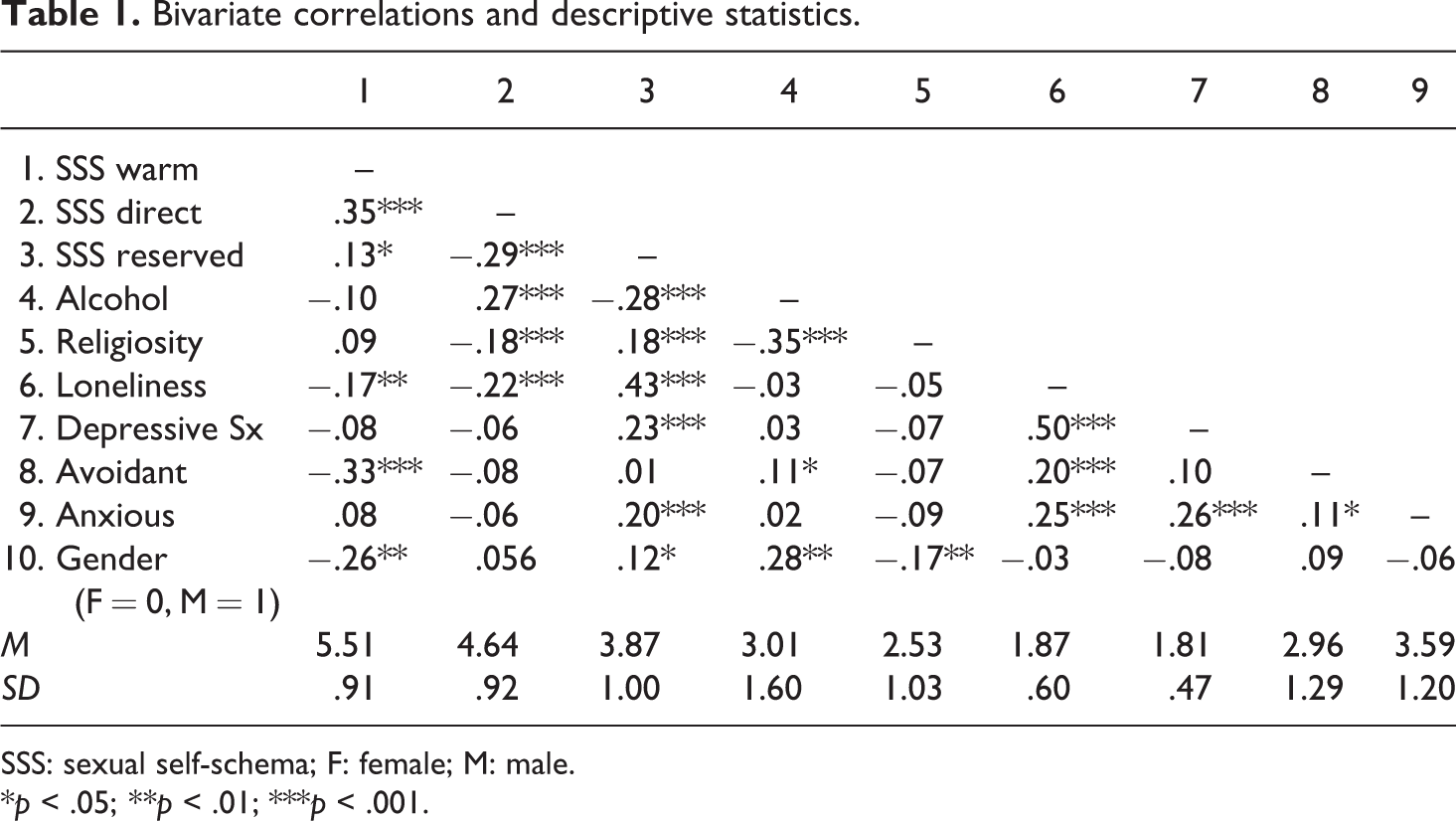
SSS: sexual self-schema; F: female; M: male.
*p < .05; **p < .01; ***p < .001.
Table 2 displays descriptive statistics for each group. T tests and χ2 analyses were used to determine whether or not the differences between groups were significant using a Bonferroni-adjusted α value of .005 (.05/10). Overall, 29.5% of participants engaged in hooking up over the course of a semester. Young adults in Group 1 (n = 239) reported hooking up at a rate of 11%, while young adults in Group 2 (n = 100) reported hooking up at a rate of 73%, χ2(1, N = 339) = 129.07, p < .001. Thus, Group 2 accounted for 30% of the total sample, but 74% of participants reported hooking up.
Descriptive statistics and t tests.
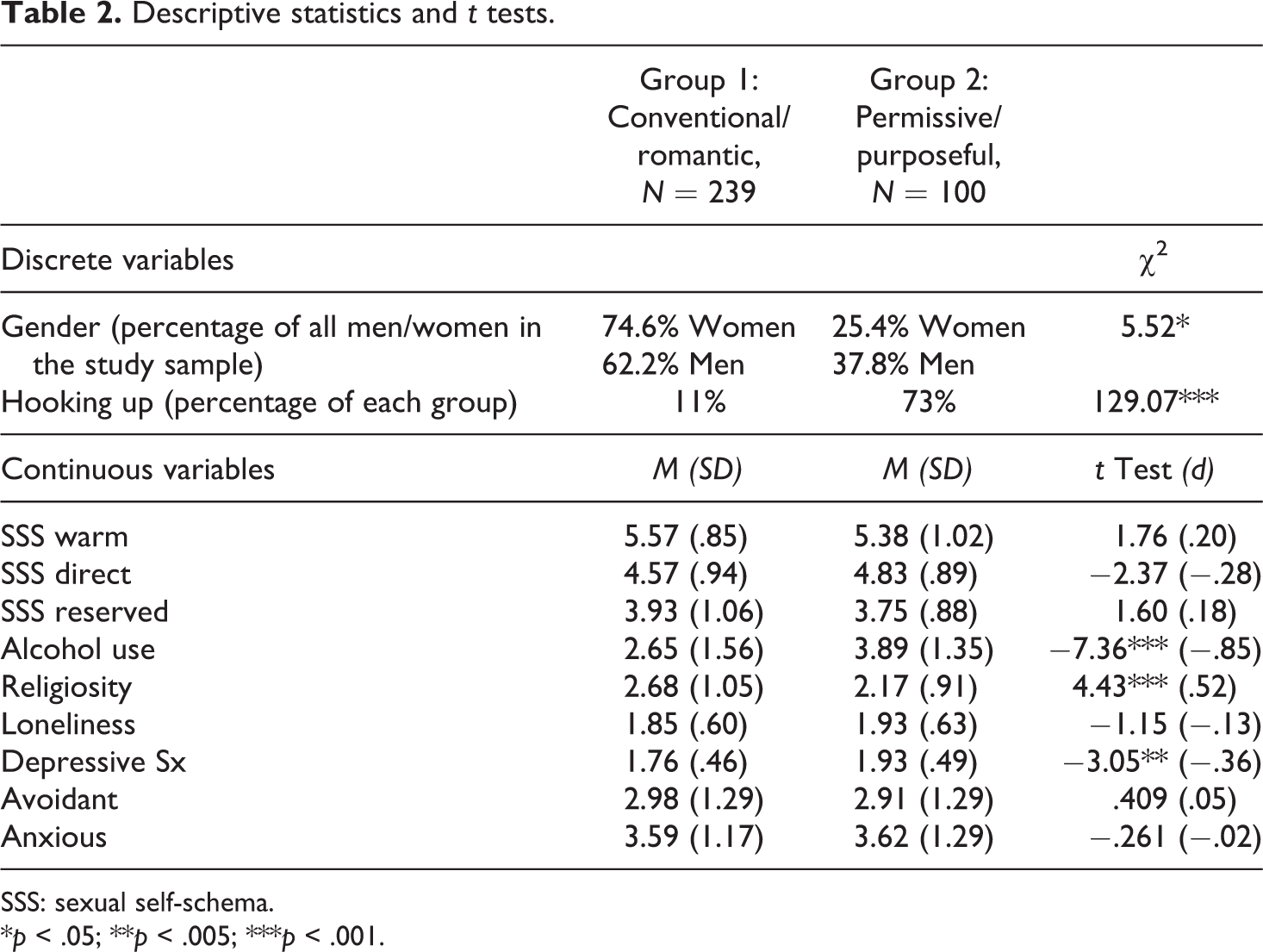
SSS: sexual self-schema.
*p < .05; **p < .005; ***p < .001.
Summary of LCR models predicting hooking up.
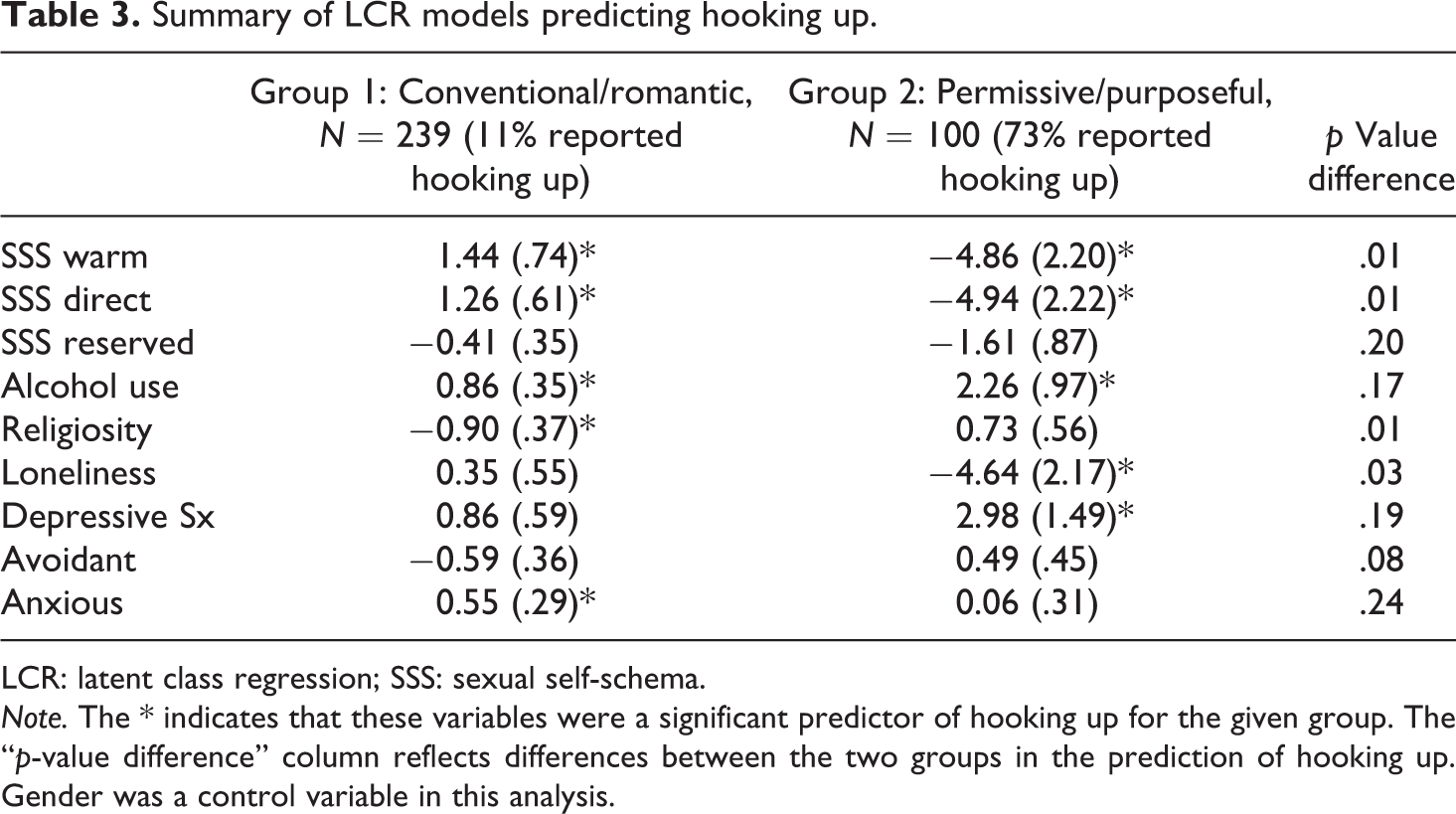
LCR: latent class regression; SSS: sexual self-schema.
Note. The * indicates that these variables were a significant predictor of hooking up for the given group. The “p-value difference” column reflects differences between the two groups in the prediction of hooking up. Gender was a control variable in this analysis.
Four significant differences in the predictor variables (measured at Time 1) were found between the groups. Group 1 members were more likely to be women, as it included 74.6% of the women and 62.2% of the men from the entire sample, χ2(1, N = 339) = 5.52, p < .05. Compared to Group 1, Group 2 had higher scores for alcohol and depressive symptoms and lower scores for religiosity. No significant differences between Groups 1 and 2 were found for SSS warm, SSS direct, SSS reserved, loneliness, anxious attachment, or avoidant attachment. Note that these mean differences reflect variation between the groups but do not provide information about how the variables relate to hooking up.
Table 3 displays the predictor variables and their relationship to hooking up for the two groups. For Group 1, hooking up was predicted by higher levels of SSS warm, SSS direct, alcohol use, and anxious attachment, but lower levels of religiosity. For Group 2, hooking up was predicted by higher levels of alcohol use and depressive symptoms, but lower levels of SSS warm, SSS direct, and loneliness. Notably, some of these predictive relationships were significant in opposite directions for the two groups.
We then compared the two groups to examine the differences in how the predictors related to hooking up. For Group 1, higher levels of SSS warm and SSS direct predicted hooking up; while for Group 2, lower levels of the same variables predicted hooking up. For Group 1, lower levels of religiosity predicted hooking up, while this variable was not a significant predictor for Group 2. Loneliness was not a significant predictor for Group 1, but lower levels of loneliness predicted hooking up for Group 2.
In other words, for the young adults in Group 1, hooking up becomes less likely as they report higher religiosity, which may be accompanied by greater adherence to religious conventions against casual sex. At the same time, hooking up becomes more likely as these participants perceive themselves to be sexually warm and/or romantic. Therefore, Group 1 may be described as conventional/romantic.
The young adults in Group 2 report more sexually permissive behavior than Group 1, as noted by their much higher rate of hooking up. Hooking up was predicted by higher levels of depressive symptoms and perception of the self as less sexually warm and/or romantic, suggesting that hooking up may be related to specific motives such as coping with psychological distress or achieving sexual gratification. Reporting lower levels of loneliness and sexual assertiveness leading to hooking up reflect a path toward this behavior that is typified by receptive social interaction. Therefore, Group 2 may be described as permissive/purposeful.
Discussion
In this short-term prospective study, we identified two distinct groups of young adults for whom the same set of variables differently predicted hooking up over the course of a 10-week period. The conventional/romantic group comprised 70% of the sample but only accounted for 26% of participants who reported hooking up. Eleven percent of participants in this group reported hooking up. In contrast, participants in the permissive/purposeful group comprised 30% of the sample, represented 74% of the total number of participants reporting hooking up, and reported hooking up at a rate of 73%. These findings support our assertion that not only is hooking up more common among some young adults as compared to others, but there are distinct, identifiable groups for which hooking up is differentially predicted.
Initial differences between groups
In addition to the prevalence rates of hooking up described above, there were three notable mean-level differences between the two groups. Participants in the permissive/purposeful group reported higher levels of alcohol use, more depressive symptoms, and less religiosity compared to participants in the conventional/romantic group. Young adults typical of those in the permissive/purposeful group are more likely to be psychologically distressed, uninhibited by religious restraints to their sexual behavior, and consumers of alcohol as a means of relaxing social inhibitions. Notably, men were more likely to be in the permissive/purposeful group than women, which may indicate that some social conventions are reflected in young adults’ patterns of hooking up (see Mahalik et al., 2003).
Predictive comparison: Similarities
Alcohol use predicted hooking up for both groups, a finding that mirrors the vast majority of research supporting the strong link between alcohol use and hooking up (Fielder & Carey, 2010a; Grello et al., 2006; Owen et al., 2010; Paul et al., 2000).
Predictive comparison: Differences
Group 1: Conventional/romantic
For the conventional/romantic group, hooking up was associated with greater alcohol use as well as higher levels of identification with SSSs of warmth and directness. Hooking up for this group was also associated with higher levels of anxious attachment and lower levels of religiosity. Young adults typical of participants in this group may engage in hooking up as a way to meet attachment needs, suggesting a desire for romantic and/or sexual connectedness (Bartholomew & Horowitz, 1991). The degree to which these encounters fulfill this desire is unknown. Given that anxious attachment has been associated with lower levels of positive reactions to sexual encounters (e.g., Tracy, Shaver, Albino, & Cooper, 2003) and that hooking up is not generally conducive to high levels of emotional intimacy, it would be useful to know whether young adults typical of this group find hooking up to be a positive emotional experience.
Religious beliefs and their associated behavioral codes may also be an important factor in the decision-making process involved in hooking up for young adults typical of this group. As most religions have behavioral codes that prohibit casual sexual interaction, it follows suit that participants with stronger religiosity are less likely to pursue hooking up. Religion may play a more active role for conventional/romantic participants in general, which is consistent with the initial mean-level finding that this group had a significantly higher level of religiosity overall.
Group 2: Permissive/purposeful
A very different profile emerged for the permissive/purposeful group. For these young adults, higher levels of alcohol use and depressive symptoms, but lower levels of loneliness and SSSs of warmth and directness were related to a greater likelihood of hooking up. The inverse relationship between hooking up and SSSs of warmth and directness is in contrast with previous research, which has found that higher levels of these SSSs were associated with a greater willingness to engage in casual sex (Andersen & Cyranowski, 1994; Andersen et al., 1999). This finding also seems counterintuitive in light of the higher-than-average rate at which these participants engaged in hooking up. However, given that the participants in this group reported higher levels of depressive symptoms, we surmise that hooking up may serve as a coping mechanism for young adults typical of participants in this group. This explanation is consistent with Owen et al. (2011), who found that young adults reporting higher levels of depressive symptoms also reported significantly lower levels of depressive symptoms subsequent to engaging in hooking up; suggesting that hooking up may be associated with a decrease in depressive symptoms. Seeing themselves as less sexually warm may also indicate that these young adults are driven more by a desire for sexual gratification than social connectedness.
This group was also more likely to hook up as they reported being less lonely and less sexually assertive. Young adults typical of this group may be receptive to sexual advances from potential partners more than they see themselves in the role of the pursuer. One way to communicate this receptivity is through the use of body language and other social skills (social expressivity), which have been linked to lower levels of social loneliness (DiTommaso, Brannen-McNulty, Ross, & Burgess, 2002).
Limitations
Several limitations warrant consideration. Female participants outnumbered male participants, the majority of participants were Caucasian, and our study sample was limited to young adults who were all enrolled in a family studies class at the same university. Thus, it is not known whether our results will generalize to other groups. Hooking up among young adults may also be related to variables that we did not include in this study. Because we excluded participants reporting a relationship over the course of the study in order to control for infidelity effects, the sample may have excluded young adults who favor monogamy over hooking up or who engage in hooking up despite being in a committed relationship. All our measures were self-reports and were therefore subject to possible social desirability biases. Finally, we did not collect data related to condom use or other sexual risk-taking behaviors that might have shed light on the relationship between hooking up and the high rates of STIs in this age group.
Future directions
The use of LCR may assist the field in understanding the diversity of young adults’ experiences of hooking up. Continued research is needed to validate and replicate the groupings that emerged in our study and to further explore how these groups differ in their developmental trajectories for sexual identity and behaviors, as well as their psychological and relational functioning. Future studies have the potential to construct a more accurate framework for understanding how this behavior manifests, and in doing so may identify those more likely to incur long-term risk or benefits related to hooking up. Including assessment of young adults’ expectations and subsequent emotional reactions to hooking up may add additional depth to these groupings. Additional research using methods utilized in this study may also help to illuminate the relationship between hooking up and STI occurrence among young adults. In the interest of public health, collecting data related to condom use and sexual risk-taking behavior in conjunction with psychosocial and cognitive variables would enable researchers to examine links between behavioral and health-related factors in the future.
Conclusion
The results of this study demonstrated that hooking up behavior and related psychosocial variables may vary considerably across groups of young adults. Therefore, studying hooking up as a function of distinct groups may produce a more nuanced representation of hooking up in this population. Wide variation in the psychosocial and cognitive characteristics of young adults may relate to a similarly broad spectrum of risk and protective factors specific to the sexual motivations and behaviors of subgroups within this population. Taking this into account in future research of hooking up behavior may provide us with a more accurate framework for understanding not only how this behavior manifests but its relationship to the extremely high rate of STI occurrence among young adults. In this way, we may continue to explore strategies for the prevention of negative psychological and physiological effects of hooking up. We may also advance our understanding of how hooking up may be a healthy, adaptive behavior for some young adults. This line of research may produce findings that are useful for health care professionals and educators who work with young adults and who wish to tailor interventions or services to honor the unique meaning of this behavior to the individual. Ultimately, we hope that this study contributes to the search for a more contextual and nuanced understanding of young adult sexual behavior.
Footnotes
Funding
This research received no specific grant from any funding agency in the public, commercial, or not-for-profit sectors.