



Abstract
This qualitative study utilized relational dialectics theory (Baxter, 2011) to examine competing discourses within parent–adolescent conversations about extracurricular activities during the transition to high school. The data for this study consisted of self-generated, self-directed conversations between 20 parent–adolescent dyads. Using content analysis, data were coded for the category of conversation topic and then the presence of Baxter’s (1988) three competing discourses within each category: autonomy–connection, openness–closedness, and certainty–uncertainty. Results suggest that the dyads spoke most about the transition to high school, extracurricular activities, peer relationships, and academics. Baxter’s (1990, 2011) three competing discourses were evident in parent–adolescent conversations with autonomy–connection being the most frequent competing discourse noted either alone or co-occurring with another competing discourse.
Keywords
Research on adolescence involving familial relationships has historically been dominated by studies using unilateral models to examine how parenting influences adolescent development. These developmental approaches focus on the ways the parent–child relationship contributes to explaining aspects of adolescents’ development (e.g., Darling & Steinberg, 1993). Although parents are adolescents’ main source of socialization (Grusec & Davidov, 2007; Maccoby, 1992), unilateral models overlook adolescents’ contributions to parent–child relationships (Kuczynski, Marshall, & Schell, 1997; Lollis & Kuczynski, 1997; Sameroff, 2009) and direct attention away from the parent–adolescent relationship itself. The relationship is more than the interactions between independent partners. Relationship dynamics reflect the ways partners respond to one another given their relationship history and anticipations for the future (Hinde & Stevenson-Hinde, 1987; Lollis, 2003).
A relational perspective is particularly useful when dyads are undergoing transitions (e.g., Baxter & Erbert, 1999; Braithwaite & Baxter, 1995; Erbert & Aleman, 2008). One normative transition in North America is adolescents’ entry into high school. This transition has received little attention using a relational perspective despite evidence that most parents are involved in their adolescents’ transition to high school (Falbo, Lein, & Amador, 2001). In this research, we use relational dialectics theory (Baxter, 2011; Baxter & Montgomery, 1996) to examine parent–adolescent conversations during the transition to high school.
Relational dialectics theory is useful for the study of parent–adolescent conversations because it rejects static depictions of social experiences and seeks to expose more of the fluid interplay of competing discourses (Baxter, 2011; Baxter & Montgomery, 1996). Using a relational dialectics perspective to study parent–adolescent conversations acknowledges that family life is a both/and experience, with meaning being gained from the interplay of competing discourses (Baxter, 2006). A key assumption of the theory is that relating is a communicative process characterized by the unity of opposites. The unity of opposites is referred to as competing discourses (Baxter, 2011). Competing discourses are present whenever two forces are interdependent (the principle of unity) yet mutually negate one another (the principle of negation). Competing discourses are not resolvable. Although there may be instances of aesthetic moments when a resolution of competing discourses has been achieved, these are momentary; competing discourses are in a constant state of flux and continually present in relationships (Baxter, 2004a, 2011; Baxter & Montgomery, 1996). Baxter (2011) points out that competing discourses are not a conflict between individuals, nor are they a psychological tension within an individual, rather, she maintains that it is the discourses that are struggling. In other words, within relational dialectics theory, the object of analysis is discourse, not individuals (Baxter, 2011).
Empirical research guided by relational dialectics theory has identified a range of competing discourses (Baxter, Braithwaite, Bryant, & Wagner, 2004; Braithwaite & Baxter, 1995, 2006; Erbert & Aleman, 2008). We elected to focus on three competing discourses: autonomy–connection, openness–closedness, and certainty–uncertainty that have been frequently identified in research on close relationships using retrospective self-reports or interviews (e.g., Baxter, 1990; Baxter & Erbert, 1999; Baxter & Simon, 1993), including conjoint family interviews with parents and adolescents (Ashbourne & Daly, 2010). Retrospective self-reports used in data collection may reflect individuals’ relational schemes (see Baldwin, 1992) rather than the talk between parents and children that is present in everyday life. Therefore, we examine how the three competing discourses of autonomy–connection, openness–closedness, and certainty–uncertainty emerge in everyday talk between parents and adolescents.
Of the three competing discourses examined in this investigation, autonomy–connection is the most central since no relationship can exist unless individuals forego some of their individual autonomy (Baxter, 1990). However, too much connection can destroy the relationship because individual identities become lost (Barber & Buehler, 1996; Bowen, 1978; Grotevant & Cooper, 1986; Schnarch, 1997). The openness–closedness competing discourse refers to the need for disclosure between relationship parties, but this openness creates vulnerabilities for the self, other, and relationship, thus necessitating the competing force of closedness. The third competing discourse, certainty–uncertainty, indicates that relationships need both predictability and novelty. These three competing discourses are also referred to as centrifugal–centripetal forces (Baxter & Montgomery, 1996). Centrifugal influences, such as autonomy and closedness, act to distance parents and adolescents from each other. These centrifugal influences coexist with multiple centripetal forces, such as relational connection, which act to sustain and preserve the parent–adolescent relationship. The nature of connection is dynamic and fluctuates in meaning based on which of these two forces is most emphasized (Baxter & Montgomery, 1996).
Autonomy–connection as a competing discourse differs from several extant approaches to studying parent–adolescent autonomy. Autonomy and connection are themes found in coding systems such as the Autonomy and Relatedness Coding System developed by Allen and colleagues (Allen, Hauser, Borman, & Worrell, 1991) and the codes developed by Grotevant and Cooper (1985) to assess individuation in families. However, these systems of coding were designed to assess behavioral indicators of connection and autonomy in individuals’ utterances and not discursive phenomena. The scores for these systems of coding are frequently summed across the conversation to enable complex analyses (e.g., O’Connor, Hetherington, Reiss, & Plomin, 1995). Such approaches are more concerned with predicting adolescent development and less concerned with understanding the competing discourses that emerge in dialogue. Therefore, using a constitutive approach focused on competing discourses requires moving to the dyadic level of analysis and evaluating talk in a more holistic way than individual utterances. The present study uses an analytic approach more suitable for observing competing discourses during brief conversations.
To gain a sense of competing discourses in everyday talk between parents and adolescents, it is important to use a protocol that elicits conversations that are similar to the way dyads talk when researchers are not watching. Stimulating dyads to engage in naturalistic conversations can be challenging because talk is not a simple matter of beginning to vocalize a topic. In research with parents and adolescents, brief conversations are often stimulated by tasks such as asking them to “plan a vacation” (e.g., Allen, Hauser, Bell, & O’Connor, 1994; Grotevant & Cooper, 1985) or asking them to recall a recent conflict or pleasant experience (e.g., Barkley, Anastopoulos, Guevremont, & Fletcher, 1992; Chaplin et al., 2012; Pinquart, & Silbereisen, 2002). As the purpose of this study was to detect competing discourses in everyday conversation, we used a stimulus that might be a part of the dyads’ lives. We asked parents and adolescents to talk about adolescents’ extracurricular activities during their upcoming transition to high school. The transition to high school is incorporated into this study because it is a culturally bound milestone that most North American adolescents experience, as are structured and unstructured extracurricular activities. The transition to high school is likely to be talked about in anticipation. We hoped to capture how the dyad planned for activities as they anticipated changes in their daily routines due to the restructuring of school hours and changes in school institutions.
The high school transition literature has focused on how high school introduces changes into the lives of adolescents in two main areas, academic performance and social relationships. For example, researchers have found adolescents’ grade point averages and school engagement tend to decline from elementary to high school (Benner & Graham, 2009; Blyth, Simmons, & Carlton-Ford, 1983; Crockett, Peterson, Graber, Schulenberg, & Ebata, 1989; Eccles et al., 1993; Isakson & Jarvis, 1999). With regard to social changes, researchers have found that peer friendships tend to be more vulnerable during the transition than adolescents’ social statuses (Hardy, Bukowski, & Sippola, 2002). Less empirical attention has been given to parental involvement during the transition to high school. Falbo et al. (2001) found that during adolescents’ high school transition, parents involved themselves by doing the following: monitoring their adolescents’ academic and social lives, evaluating information obtained about their adolescents, helping with schoolwork, trying to create positive peer networks, and participating in the school. The reported changes for adolescents as they entered school and the evidence that parents involved themselves in various ways suggest the transition from elementary to high school is something North American parents and adolescents talk about.
Interestingly, research investigating the transition to high school has focused on adolescents or parents but rarely both. Therefore, in addition to using the transition to high school as a stimulus for conversations, we sought to identify the topics emerging in conversations. We believe that parent–adolescent talk about the transition to high school will help us better understand the transition from a dyadic perspective and is consistent with bilateral models of parent–child relationships (Kuczynski, 2003; Lollis & Kuczynski, 1997). Conversational topics about the transition are linked to the competing discourses of autonomy–connection, openness–closedness, and certainty–uncertainty to gain insight into the fluid interplay of competing discourses between parents and adolescents.
Current study
The purpose of this study was to examine parent–adolescent conversations about the transition to high school using relational dialectics (Baxter, 2011) as an organizing framework. This study examined whether three competing discourses frequently found in research (Baxter, 1988, 2004a) were present in parent–adolescent conversations. Two research questions guided the current study. First, what do parents and adolescents talk about in making the transition to high school? Second, does talk between parents and adolescents display competing discourses of autonomy–connection, openness–closedness, and certainty–uncertainty? If so, which of the three competing discourses emerge and how often?
Method
Data analyzed for this investigation came from a longitudinal study of parents’ and adolescents’ planning of extracurricular activities during the transition to high school. Only the data from the first meeting were used for the current study. Before the study began, the project received ethical approval from the universities of the authors. An information letter outlining the current study was sent home with elementary school students in two school districts. Parents who were interested in participating contacted the researchers.
Participants
Twenty parent–adolescent dyads were recruited for this study in collaboration with two school boards. All adolescents were moving from elementary to high school. Of the 20 parent–adolescent dyads, 10 dyads were from a medium-sized urban community (population size approximately 127,000) and 10 dyads were from a large-sized urban community (population size approximately 578,000). The 20 dyads included 9 mother–daughter, 8 mother–son, 2 father–daughter, and 1 father–son pairs. All of the parent–adolescent dyads spoke English during their visits to the research lab; however, at home, 16 dyads spoke English and 4 spoke another language. Regarding the ethnic backgrounds, 80% (n = 16) of the dyads were from Europe, 15% (n = 3) were from Asia, and 1 dyad was from another background. The parents’ mean age was 43.3 (SD = 4.04) years. Seventeen parents were employed and three parents were not employed outside the household. Four parents had completed high school, four parents had earned a college diploma, nine had earned a bachelor’s degree, and three had earned a master’s degree. Two parents were students in graduate programs, while another parent was in a college program at the time of participating in the study. Adolescents from the medium-sized community were approximately one year older than adolescents from the large-sized community because adolescents in the medium-sized community make the transition to high school 1 year later than the adolescents in the large-sized community. The adolescents’ mean age was 13.5 (SD = 0.65) years.
Procedure
Step 1: Explanation of the study and consent
Information about the study was distributed by schools to parents and adolescents who were making the transition to high school. An initial telephone interview was conducted with parents who indicated interest in participating in the study in order to give a summary of the study and to determine that each adolescent was about to move from elementary to high school. Following this call, adolescents were asked by telephone whether they were interested in participating. If both parent and adolescent were interested in participating, an appointment was made for the first meeting at the research lab. During the first meeting, two research interviewers explained the procedures of the study and then asked for written consent from the parents and assent from the adolescents to participate in the study. The video cameras and audio recorder were turned on and the two research interviewers facilitated a warm-up interview with the parent and adolescent simultaneously to help parent–adolescent dyads generate ideas for possible topics to discuss during their joint conversation. The warm-up interview involved the research interviewers leading a conversation with the dyad but permitting the dyad to also steer the topic of conversation. Adolescents were asked to think about their involvement in extracurricular activities, how they organized these activities, how their parent was involved, and any other changes they anticipated during the transition to high school. Parents were also asked to think about their role in their adolescents’ lives. At the end of the warm up, the dyads were asked to have a conversation about a topic of their choice that emerged during the warm-up interview. The researchers then left the room.
Step 2: Parent–adolescent conversation
Parents and adolescents engaged in a self-generated, self-directed conversation, without the presence of the two research interviewers. This segment was both video and audio recorded and was terminated by one of the research interviewers or the participant dyad after approximately 10 min. The average length of these parent–adolescent conversations was 10 min and 46 s.
Data analysis
The audio recordings of parent–adolescent joint conversations were transcribed verbatim. In addition to verbatim transcription of what was spoken, other components of communication were included. For instance, laughter, pauses, or unusual variations in voice or inflection were noted and described. The researchers involved in this study reviewed all transcripts for accuracy of transcription by viewing the video-recorded joint conversation while simultaneously reading the transcripts.
Coding
Ongoing conversations likely hold more than one competing discourse. Rather than coding the entire conversation or transcript as one competing discourse, we divided the transcripts into conversational sequences. A conversational sequence is when a dyad talked about a particular topic. The sequence began when the topic of conversation was introduced and continued until a new topic was initiated. The change in topic was designated as the ending of a conversational sequence and the beginning of the next sequence. These sequences were then used as the parameters for two separate forms of content analysis. The two types of coding are described below.
Categories of conversational sequences
The categories were coded using conventional content analysis, which is an inductive approach to generating categories (Hsieh & Shannon, 2005). Names for codes emerged from the data. The 20 transcripts from parents’ and adolescents’ joint conversations were read several times in order to gain familiarity with the data set as a whole. A single key phrase or theme thought to signify the focus of conversation was noted within each conversational sequence. These phrases were compared across conversational sequences within dyads and then across dyads. Recurring similarities were noted with overlapping categories collapsed. The process of grouping key phrases from conversational sequences created categories that were mutually exclusive. The data were then revisited and all sequences coded with the final set of categorical labels.
Competing discourses
Once all 20 transcripts were segmented into conversational sequences and each sequence coded for category, competing discourses were coded within each sequence. Baxter’s (1988, 2004a) conceptualization of the three competing discourses was used to guide the development of the coding system. This is a directed approach of content analysis that is used to validate or extend theory (Hsieh & Shannon, 2005). Autonomy–connection was coded when parents or adolescents talked about wanting separation or independence to be their own person and engage in their own activities, while also wanting to maintain their relational connection with each other. Openness–closedness was coded when parents or adolescents disclosed information or feelings to each other, yet also exercised discretion. Finally, certainty–uncertainty was coded when parents or adolescents discussed the future predictability of their relationship as well as elements of spontaneity and change.
Baxter (1988) has indicated that the principal competing discourse in close relationships is autonomy–connection, while the other two have been identified as secondary. The rule for coding for this study was that one competing discourse was noted per sequence each time parent–adolescent dyads discussed a particular category of conversation. However, at times, a secondary competing discourse was apparent. During these instances, both primary and secondary competing discourses were noted.
The first author completed the content analysis and coded for competing discourses with the help of a research assistant, while the second and third authors also checked the coding. Minor differences in interpretations during coding were discussed and resolved.
Results
Conventional content analysis resulted in 12 categories for the 159 sequences of conversations between parents and adolescents. Each category was named to capture the broad topic of the parent–adolescent conversation: academics, balance between school and recreation, extracurricular activities, family relationships, family rules, independent behavioral functioning, opposite sex relationships, parent–adolescent relationship, peer relationships, safety, sex/drugs/alcohol, and transition to high school (Table 1). Although sequences of conversation varied in length from 2 conversational turns (1 turn each for the adolescent and parent) to 164 conversational turns (82 turns by the adolescent and 82 turns by the parent), on average dyads engaged in 8.25 sequences involving an average of 22.6 turns per sequence. For the participants, the category of extracurricular activities was the most prevalent occurring conversational topic, occurring in 20.1% of the conversational sequences. However, peer relationships (19.5%), transition to high school (18.2%), and academics (10.1%) were also relatively prevalent. All other categories of the conversational topics including balance between school and recreation, family relationships, family rules, independent behavioral functioning, opposite sex relationships, parent–adolescent relationship, safety, and sex/drugs/alcohol occurred at a rate of lower than 10%.
Categories of parent–adolescent conversations, examples, and frequencies of competing discourses by conversational category.
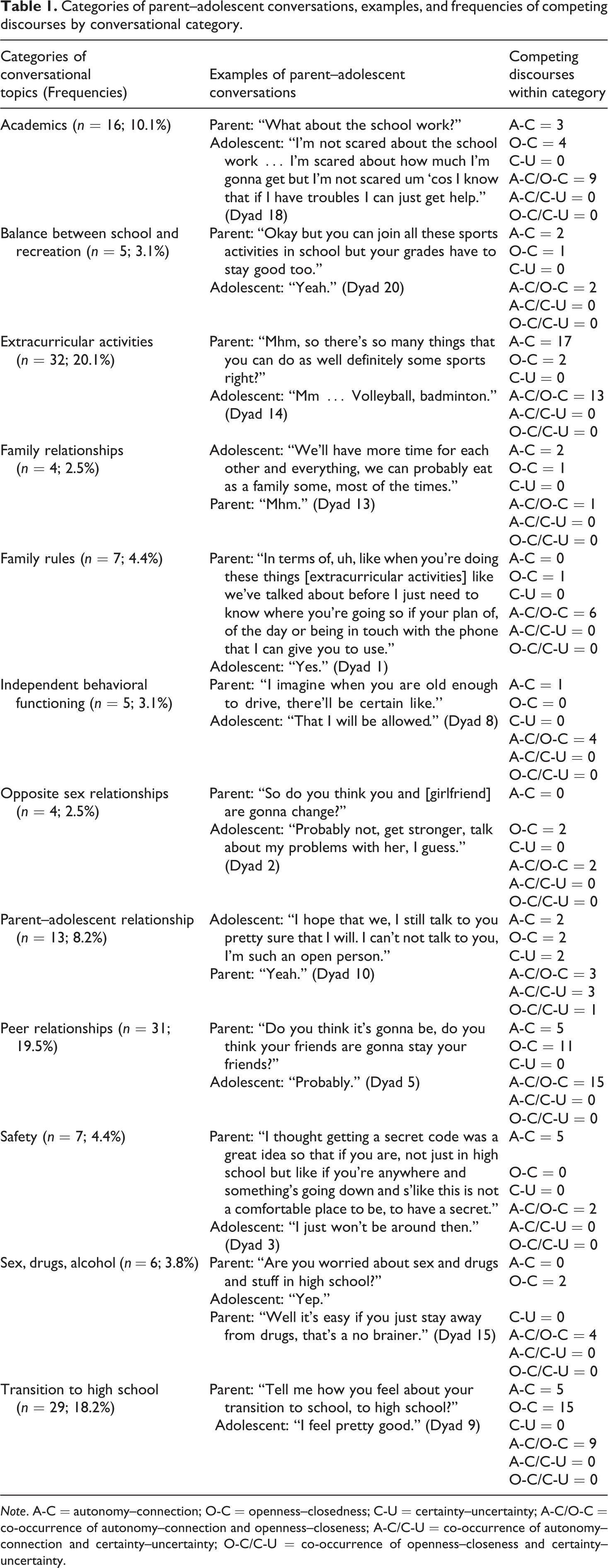
Note. A-C = autonomy–connection; O-C = openness–closedness; C-U = certainty–uncertainty; A-C/O-C = co-occurrence of autonomy–connection and openness–closeness; A-C/C-U = co-occurrence of autonomy–connection and certainty–uncertainty; O-C/C-U = co-occurrence of openness–closeness and certainty–uncertainty.
At least one of Baxter’s (1988) competing discourses was established in each of the 159 sequences of conversation. In 74 (46.5%) of the 159 sequences, two competing discourses were coded (autonomy–connection and openness–closedness = 70, autonomy–connection and certainty–uncertainty = 3, openness–closedness and certainty–uncertainty = 1). The reader may be curious about how the competing discourses are distributed across the 12 categories of conversational topics. Table 1 displays the frequencies of competing discourses found within categories.
Autonomy–connection
Autonomy–connection is the desire for independence while at the same time wanting connection to maintain the relationship (Baxter, 1988). All of the parent–adolescent dyads displayed the competing discourse of autonomy–connection. This competing discourse was evident in 42 (26.4%) of the 159 conversational sequences. The following excerpt from a conversation between a mother and a son (Dyad 3) illustrates the autonomy–connection competing discourse:
I’m not sure in high school if parents are involved like they are in elementary school. I don’t know if I’ll be in there, so many teachers, like over a hundred teachers.
Still though, I don’t need you for my homework though.
Well, for your homework I’ve not really helped you with your homework for quite some time, ever since you got smarter than me [slight laugh]. Not smarter. I’m just joking. No, but like, I mean there are times when …
Yeah, but even when I do get frustrated and forget something you still can’t help me, ‘cos you don’t know it.
I can try and help you find the answer. You should be asking me because then it makes me feel like at least I’m trying.
Yeah, I can find the answer myself too though. That’s what I’m saying, that’s all.
Well, if you get frustrated and you don’t know something, ask me so I can get frustrated too.
Why, no sense in that.
Openness–closedness
Openness–closedness represents the desire to both divulge and withhold information from the other person (Baxter, 1988). This competing discourse was apparent during 41 conversational sequences between parents and adolescents in this study, accounting for 25.8% of the total number of competing discourses. The following excerpt from a conversation between a mother and a daughter (Dyad 8) illustrates the openness–closedness competing discourse:
What kind of sexual conversations do teenagers have these days? [laughs]
You shouldn’t be allowed to ask me that.
[Laughs] I just did [laughs].
What do you mean?
What do they talk about?
Um, I don’t know.
You do so.
[Laughs] We don’t have, we don’t really, we don’t talk about it that much.
What do they talk about?
Dating and stuff. But not, sex really.
That’s good to know. I’m good with that.
Certainty–uncertainty
Certainty–uncertainty is the desire for spontaneity or surprise in the relationship, while at the same time some degree of predictability about the relationship (Baxter, 1988). This competing discourse emerged only two times (1%) on its own. The following excerpt from a conversation between a mother and a daughter (Dyad 1) illustrates the certainty–uncertainty competing discourse:
Our relationship: I think that will stay the same because it’s already very strong [laughing].
You find that funny?
Yeah.
I’m sure it will have ups and downs ‘cos I’m sure you’ll challenge it and.
Probably.
And challenge boundaries … you don’t think so?
No, I think so.
‘Cos you’ll probably always want that little bit more, to do a little bit more.
Yeah.
As you meet different people and do different things with them, that’s what I would think.
Yeah.
Autonomy–connection/openness–closedness
The competing discourses of autonomy–connection and openness–closedness co-occurred in 70 (44%) of the parent–adolescent conversational sequences. This co-occurrence was more prevalent than any other competing discourse or co-occurring competing discourse. Following is one excerpt from a conversation between a mother and a daughter (Dyad 18) illustrating autonomy–connection and openness–closedness co-occurring:
If you tell me that you’re gonna go hang out with, uh, somebody that I don’t know, then I get a little bit worried and especially because you’re sometimes reluctant to give me information.
You mean like when I hung out with C [peer] and E [peer]?
Yeah like if I don’t know exactly where you are and when I ask you, you just sort of say you y’know [funny voice] “I don't know we’re just gonna hang out.” [Slight laugh]
But I don’t know so that’s why I say it.
I know and that’s true, you don’t always know what you’re gonna do.
Mhm.
And I guess that’s sort of the part that we have to kind of figure out is me giving you some freedom, but you also understanding that I need some information because I don’t want, y’know I don’t wanna get stressed out.
Autonomy–connection/certainty–uncertainty
The competing discourses of autonomy–connection and certainty–uncertainty were identified as co-occurring in 3 (2%) of the conversational sequences. The following excerpt from a conversation between a mother and daughter (Dyad 4) illustrates this co-occurrence:
Okay. How d’you think you, how d’you think high school’s gonna change our relationship?
[whispers] Our relationship? Um … I think I will get away more.
‘Cos you want more freedom.
Yeah, so I can like be away from the house a lot more. I hope.
Okay.
‘Cos our house isn’t that big and it’s not that fun.
Well
So y’know.
It, it, and here’s my um, thing. I know my big thing with you is that I know that you know the difference between right and wrong. But … knowing the difference between right and wrong and having the courage to stand up to your friends or walk away from your friends. I’m not … uh, I’m not sure that you have … the strength to do that.
Well, we won’t find out.
Yet, well.
Won’t find out unless you let me do stuff more.
Well, but um … we tried that and you shot yourself in the foot big time.
Well, you can’t hold that to me for the rest of my life.
I know, I can’t hold it against you for the rest of your life. [Slight laugh]
Not even till the next, [P laughs] till the end of the year. That’s not fair either.
I’m just uh.
Well, maybe like one month. I think that’s sufficient instead of like dragging it on and on. {Clicking pen}
Openness–closedness/certainty–uncertainty
The competing discourses of autonomy–connection and certainty–uncertainty were identified as co-occurring in 1 (.6%) of the conversational sequences. The following excerpt from a conversation between a mother and daughter (Dyad 8) illustrates this co-occurrence:
Um, so how do you think high school might affect our relationship?
Ah, I hope it will be bringing it stronger, but I don’t know.
What’s your worry?
That it, it will bring it the opposite of stronger.
What makes you think it would do that?
I don’t know. It’s just like …, because you judge everything I tell you.
I’m not supposed to do that. I forgot. I’m, I’m your mother. I’m a judge, that’s my job.
Yeah, but I told you if you keep judging, I won’t tell you anything.
Yeah, that’s true. Yeah, I don’t blame you.
How do you think it will make our relationship?
I think it will make our relationship stronger. If, as long as we, as long as I don’t judge you, so you keep talking to me! Heehee! That’s a very good point you made, yes.
Discussion
The purpose of this research was to use relational dialectics theory (Baxter, 2011) to examine parent–adolescent conversations about extracurricular activities during the transition to high school. We first documented the content of parents’ and adolescents’ conversations. These conversations were then examined to see whether the competing discourses of autonomy–connection, openness–closedness, and certainty–uncertainty (Baxter, 2004a) emerged and if so, how often. This study contributes to understanding how competing discourses emerge during face-to-face parent–adolescent conversations and informs the literature on the transition to high school.
Similar to previous research on the transition to high school (e.g., Akos & Galassi, 2004), our findings indicated that parents and adolescents talked about social and academic matters. However, the findings from this study extend research on the transition to high school in two areas. First, the existing research on the transition to high school has not focused on the parent–adolescent dyad. One body of research focuses on parents’ perceptions or actions (e.g., Falbo et al., 2001) and the other on adolescents’ perceptions or actions (e.g., Benner & Graham, 2009; Hardy et al., 2002). What has not previously been studied is whether the same topics emerge when parents and adolescents are engaged in conversations with each other. The findings from this study contribute to the transition to high school literature by capturing similar topics during face-to-face conversations between parents and adolescents, as they anticipate the transition to high school.
Second, some of the parents and adolescents involved in this study discussed how their relationship with each other might change during the transition to high school. Although the existing transition to high school literature has documented changes in adolescents’ relationships with peers (Hardy et al., 2002) as well as modifications in types of parental involvement (Falbo et al., 2001), this study provides additional information about changes in relationships. Our findings reveal that dyads anticipate and talk about how the approaching transition to high school may influence their relationship with each other. Parents’ and adolescents’ explorations of how their relationships may change during the transition to high school allowed us to attend to the emergent meaning making that was taking place in their conversations (Baxter, 2004a).
Competing discourses were noted in each of the 159 conversational sequences, with some sequences containing more than one competing discourse. The topic of the conversation does not drive whether or not competing discourses emerge. The competing discourses emerged when parents and adolescents were talking about their relationship and when they were not talking about their relationship. This is an important finding as a great deal of the research on competing discourses asks participants to talk about their relationship (e.g., Baxter & Simon, 1993; Erbert & Aleman, 2008).
It seems that the tension generated by competing discourses gives rise to continuation of talk. Continuation of talk to resolve competing discourses furthers the construction of the relationship—whether or not the valence of the talk is positive or negative. This idea is consistent with Baxter’s (2004a) concept of ‘relationships in communication’. That is, rather than studying communication in parent–adolescent relationships as many scholars have, relational dialectics theory allowed us to study how parent–adolescent relationships are constituted through communication practices, which includes not only centripetal forces but also centrifugal forces.
Relational dialectics theory (Baxter, 2004a, 2011) extends our understanding of parent–adolescent relationships because this theoretical perspective contrasts with many developmental approaches to examining parent–adolescent relationships. Most contemporary developmental approaches to investigating parent–adolescent relationships focus on the ways the relationship contributes to explaining aspects of adolescents’ development (e.g., Darling & Steinberg, 1993; Smetana, 2006). In contrast, there has been less empirical research on parent–adolescent relationships guided by relational perspectives (Baxter, 2011; Kuczynski, 2003; Lollis & Kuczynski, 1997). As such, in this research, we broadened the lens with which we considered parent–adolescent relationships by moving beyond the individual level of analysis and focusing on both parents’ and adolescents’ voices. In other words, rather than studying adolescent development within the context of parent–adolescent relationships, we studied parent–adolescent relationships through competing discourses (Baxter, 2004a, 2011). We highlight how parent–adolescent relationships are constructed in communication through the following discussion of the competing discourses of autonomy–connection, openness–closedness, and certainty–uncertainty.
The competing discourse of autonomy–connection arose in 26.4% of the conversational sequences. Adolescence has long been recognized as a period when parents and children renegotiate their relationships as they balance adolescents’ increasing independence, their need for connection with parents, and parents’ desire for continued involvement in their adolescents’ lives (Collins & Laursen, 2004; Grotevant & Cooper, 1986; Hill & Holmbeck, 1986). It may, therefore, not be surprising to document the competing discourse of autonomy–connection in the conversational sequences. Examining autonomy–connection from the perspective of competing discourses offers a different illustration of the phenomenon in comparison to other approaches to studying autonomy and connection. For instance, coding systems measuring autonomy and connection in parent–adolescent relationships (e.g., Allen et al., 1991) assess behavioral indicators of autonomy and connection, which are then scored as separate constructs. These constructs are then used to predict adolescents’ development and well-being. By contrast, adopting a relational dialectics (Baxter, 2011) approach to autonomy–connection allowed us to focus on the competing discourse contributing to centrifugal and centripetal forces within the parent–adolescent relationship. The focus on the discourse yields a dyadic observation rather than two separate sets of observations (one for the parent, one for the adolescent). The dyadic approach reveals how the competing discourse emerges during talk rather than a count of how much autonomy or connection is observed for each dyad member. This alternative method of examining autonomy and connection in parent–adolescent relationships, as a bilateral model, attends to emergent processes rather than individual contributions to interactions.
Likewise, the openness–closedness competing discourse reveals dyadic processes that differ from the bulk of the literature on parent–adolescent open communication. Open communication is more often understood as sharing information (e.g., Barnes & Olson, 1985). Indeed, there is a good deal of research attention that is paid to determining how parents support or solicit adolescent self-disclosure (e.g., Reidler & Swenson, 2012) or disclosure of information about whereabouts, peers, and activities (e.g., Smetana, Villalobos, Tasoplous-Chan, Gettman, & Campione-Barr, 2009). In other words, individuals are viewed as containers who can be prompted or discouraged from sharing information. In contrast, constitutive approaches such as relational dialectics (Baxter, 2004a; Baxter & Montgomery, 1996) provide a different perspective. Openness–closedness is something that happens during conversations as an emergent process that cannot be predicted. It is more than information exchange from one partner to another. Both partners are part of the process; ideas are formed only through interactions with communication partners (Baxter, 2004a).
In this study, openness–closedness was displayed in 25.8% of the conversational sequences. The openness–closedness competing discourse that emerged in the conversational sequences appears to be a process of boundary negotiation. Take, for example, the adolescent who said “You shouldn’t be allowed to ask me that” when her mother asked her about the kinds of conversations adolescents had about sex. Through her response to her mother’s request, the boundaries for the conversational topic and the daughter’s relationships with her friends are negotiated. Therefore, looking at this conversational sequence as a dyadic process, more is learned about the relationship than examining the extent to which the adolescent shares information in response to parental solicitation as is done in most research on disclosure in parent–adolescent relationships (e.g., Laird, Marrero, & Sentse, 2010).
Certainty–uncertainty was the least evident competing discourse. Parent–adolescent conversations displayed the certainty–uncertainty competing discourse in only 1% of the conversational sequences. This finding is in contrast to Baxter’s (1990) research on romantic relationships, which found that the certainty–uncertainty competing discourse occurred almost as frequently as the autonomy–connection and the openness–closedness competing discourses. The discrepancy between findings is probably due to the nature of these two types of close relationships; romantic relationships are voluntary and of shorter duration, while parent–adolescent relationships are involuntary and generally of longer duration. The low occurrence of the certainty–uncertainty competing discourse in this study possibly suggests that parents’ and adolescents’ discussions demonstrate an overall confidence in their relationship at this stage in life when the future is considered, even amid the ambiguity of what may occur upon entrance into high school. This is consistent with the bilateral model of parent–adolescent relationships (Kuczynski, 2003; Lollis & Kuczynski, 1997). Although parent–adolescent interactions occur across a variety of situations, such as discussions about the transition to high school, parent–adolescent conversations occur in a relationship context. Parent–adolescent interactions are bounded by a specific, enduring, close relationship in which both participants have an investment based on a past history of interactions and an anticipation of future interactions in the present (Lollis, 2003). As such, there is generally less uncertainty about the continuity of parent–adolescent relationships than romantic relationships.
Baxter (1988) has indicated that the principal competing discourse in close relationships is autonomy–connection, while the other two, openness–closedness and certainty–uncertainty, have been identified as secondary. Generally, the ‘rule’ for coding has been that if two competing discourses occur at the same time and one is autonomy–connection, then autonomy–connection is given preference. We would agree that autonomy–connection is an important competing discourse for adolescent–parent relationships. However, and most importantly, when we coded the discourses that co-occurred in the conversational sequences, autonomy–connection and openness–closedness co-occurred in 44% of all the conversational sequences. It appears then, for this group of adolescents and parents who at this developmental stage are making the transition ‘together’ to high school, autonomy–connection and openness–closedness co-occurring (44% of all conversational sequences) is a significant co-occurrence, when considering the rates that autonomy–connection (26.4%) and openness–closedness (25.8%) occurred singularly. This co-occurrence finding in the data suggests that these co-occurrences should be inspected further for their importance. It seems possible that parent–adolescent relationships developmentally may need to display both autonomy–connection and openness–closedness. Researchers long have noted the shift that occurs within parent–child relationships, when the child becomes an adolescent in terms of autonomy and openness (Eccles et al., 1993; Grotevant & Cooper, 1986; Laursen & Collins, 2009; Marshall, Tilton-Weaver, & Bosdet, 2005; Stattin & Kerr, 2000). Co-occurring competing discourses of autonomy–connection and openness–closeness may be an indication of this developmental change.
One of the strengths of this study is that the parent–adolescent conversations were not designed to be about competing discourses. In the context of talking about the transition to high school, competing discourses were evident in each of the conversational sequences. Thus, we were able to see how competing discourses emerged naturally during parents’ and adolescents’ conversations. Published research using relational dialectics theory (Baxter, 2011) has studied competing discourses through self-report rating systems (Baxter & Simon, 1993), individual interviews (Baxter, 1990; Baxter & Erbert, 1999), and conjoint family interviews (Ashbourne & Daly, 2010). It can be argued that the use of self-reports is too distanced from talk between relating parties since relational dialectics theory emphasizes that the objects of analysis are utterances, not the individuals. As such, our study has responded to a call by Baxter (2004b) to study actual talk between relational parties.
Another strength of the current research was that a dyadic level of analysis was used. This is in line with calls by researchers asserting that research on close relationships needs to account for the dependency in the data between relational partners (Kelley et al., 1983; Kenny, Kashy, & Cook, 2006) and to shift from the individual to the dyadic level of analysis (Bulcroft & White, 1997; Lollis & Kuczynski, 1997; Thompson & Walker, 1982). The approach used in this study generates a depiction of talk between parents and adolescents that is bilateral rather than unidirectional (Lollis & Kuczynski, 1997; Kuczynski, 2003).
Limitations and future directions
As with all research, the findings from this sample of parent–adolescent dyads are limited. The use of cameras to record the conversations and the location of the conversations with transition to high school may have generated conversations that were distinct from the way parents and adolescents talk at home or in more familiar settings. However, the warm-up interview that was provided before the conversation ensured as much as possible the comfort of the parent–adolescent dyads. Additionally, parents and adolescents seemed comfortable with the technology used in this study. In that the conversations provided examples of the competing discourses described in Baxter’s (1988, 2006, 2011) relational dialectics theory, the setting and process may not have jeopardized the soundness of the findings.
The gender composition of the parent–adolescent dyads presented limitations to understanding how gender is influential in the patterns of competing discourses. Although the current study included all dyad compositions, mother–son, mother–daughter, father–son, and father–daughter dyads, only three fathers participated and only one father–son dyad. Effort should be made to encourage participation of fathers and particularly fathers with their sons. It will be important in the future to look at possible gender differences in parent–adolescent conversations.
This study provides a first look at whether competing discourses from relational dialectics theory (Baxter, 1988, 2006, 2011) can be observed and recorded from talk between two people. Additional research using similar approaches to the protocol applied here is needed to fully understand how competing discourses emerge in conversations.
Future research might consider the interdependence of these competing discourses, particularly at certain developmental stages. Longitudinal work examining the patterns of the competing discourses over time and across contexts in the same dyad would help illuminate how ‘relationships in communication’ are maintained or change.
Footnotes
Authors’ note
Portions of this study were presented at the 14th Biennial Meeting of the Society for Research on Adolescence, Vancouver, BC, Canada, March 2012.
Funding
This study was supported by a grant from the Social Sciences and Humanities Research Council of Canada. We are very grateful to the parents and adolescents who participated in the study.