



Abstract
Guided by the Development of Early Adult Romantic Relationships (DEARR) model (Bryant & Conger, 2002). The current study explores the direct and indirect associations between family of origin functioning and relationship success among Mainland Chinese young adults in romantic relationships (N = 224). Results from the structural equation model analysis indicated that family dysfunction is negatively related to romantic relationship success directly, and the bootstrap test of indirect effects revealed two significant indirect pathways: (1) family dysfunction to problem solving to relationship success and (2) family dysfunction to depression symptoms to problem solving to relationship success. This model proved a better fit to the data than two plausible alternative models and highlights the potential cross-cultural applicability of the DEARR model. Implications for theory development, intervention, and future research are discussed.
Keywords
The success and failure of romantic relationships have important implications for the health and well-being of individuals and society. There is strong evidence that healthy romantic relationships are associated with better emotional and physical health, better outcomes for children, and stronger social ties and community connections (Amato, 2010; Braithwaite, Delevi, & Fincham, 2010; Proulx, Helms, & Buehler, 2007; Waite, 1995). Given the importance of romantic relationships for the health and well-being of adults and children, there is a growing interest in the factors associated with relationship success in young adult romantic relationships (e.g., Conger, Cui, Bryant, & Elder, 2000; Fincham & Cui, 2011). These studies have generally shown that family of origin environment and experiences, including parental divorce, parent’s marital conflict, parenting practices, and parent–child relationship quality are related to young adult romantic relationship quality (Bryant & Conger, 2002; Cui & Fincham, 2010; Cui, Fincham, & Pasley, 2008; Donnellan, Larsen-Rife, & Conger, 2005; Stocker & Richmond, 2007; Whitton et al., 2008; Yoshida & Busby, 2012). Research is also beginning to tease out the mechanisms through which these family of origin environments and experiences impact romantic relationship quality (e.g., Bryant & Conger, 2002; Cui & Fincham, 2010; Cui et al., 2008).
The purpose of the present study is to test a specific portion of the Development of Early Adult Romantic Relationships (DEARR) model by examining the links between perceptions of family functioning (i.e., family dysfunction), individual characteristics (i.e., depression symptoms), couple relationship processes (i.e., problem solving), and relationship success (i.e., satisfaction, commitment, and confidence) among a group of young adults in Mainland China (see Figure 1). The current study adds to the growing body of literature on young adult romantic relationships in two primary ways. First, we test two potential mechanisms through which perceptions of family of origin functioning are related to romantic relationship success, including both individual factors (i.e., depression symptoms) and relationship process factors (i.e., problem solving). This allows us to explicitly test an important tenant of the DEARR model that individual characteristics, such as depression symptoms, are related to relationship success indirectly through their association with relationship process factors such as problem solving. Most of the studies to date have either not tested both individual and relationship process factors simultaneously or not investigated individual mental health factors such as depression symptoms. Second, the vast majority of studies on the development of young adult romantic relationships have utilized U.S. samples (for an exception, see Yoshida & Busby, 2012). Given the collectivist nature of most of the world’s population, it is important to extend research in this area to other populations and nations to determine the predictors that are linked with romantic relationship success in young adults in diverse contexts (Bryant & Conger, 2002).

Conceptual model for young adult romantic relationships in Mainland China.
Theoretical framework and empirical support
The DEARR model proposes that family of origin experiences impact young adult romantic relationship success indirectly through their influence on social and economic advantage (or disadvantage), individual characteristics, and relationship processes (for a complete overview of the DEARR model, see Bryant & Conger, 2002). Related to this study, the DEARR model proposes that the “quality of interpersonal exchange in the family of origin will have an independent influence on later romantic relationship development” (Bryant & Conger, 2002, p. 64). One mechanism through which these interpersonal exchanges in the family of origin lead to relationship success is through their influence on the interactional styles of young adults in their romantic relationships. Family environments that are supportive, nurturing, and warm, compared to hostile and dismissing family environments are purported to pass along these relationship enhancing interactional styles on to their children. Therefore, children will likely be more nurturing and warm in their own interactions with others and ultimately with their romantic partners. In addition, positive communication and problem-solving experiences in the family of origin serve as a model of positive interpersonal interactions for children. Such environments provide young adults with the communication and problem-solving skills to effectively manage interpersonal conflict (Conger, Rueter, & Elder, 1999; Sanders, Halford, & Behrens, 1999).
The research to date generally supports these assumptions (Bryant & Conger, 2002; Cui & Fincham, 2010; Cui et al., 2008; Donnellan et al., 2005; Stocker & Richmond, 2007; Whitton et al., 2008; Yoshida & Busby, 2012). As one example, using three waves from the National Survey of Families and Households (N = 438), parental reports of warm and harsh parenting at Time 1 (child average age of 8) was found to predict children’s reports of romantic relationship satisfaction at Time 3 (child average age of 23; Parade, Supple, & Helms, 2012). Related to the proposed mediation pathway, Whitton et al. (2008) found that positive engagement and lower hostility in family of origin interactional patterns predicted more positive engagement and lower hostility in later adult romantic relationships, which in turn impacted measures of relationship adjustment. Similarly, Bryant and Conger (2002) found that high warmth and low hostility in the family of origin were prospectively related to relationship success during young adulthood. This relationship was mediated by high levels of warmth and low levels of hostility in the young adult couple’s relationship.
A second mechanism, or indirect pathway, through which family of origin factors are hypothesized to influence young adult romantic relationship success is through the impact individual factors have on interactional styles in the young adult romantic relationship. The DEARR model proposes that family of origin experiences such as the family environment and parenting practices impact individual characteristics of the young adult, such as cognitions, as well as emotional and behavioral characteristics. These individual characteristics influence interactional styles in the young adult romantic relationship, which in turn, are associated with young adult romantic relationship success (Bryant & Conger, 2002). Thus, the association between individual characteristics and relationship success is proposed as an indirect link through couple interactional styles. Depression symptoms, one such individual characteristic, have clear links to both family of origin variables and interactional styles, such as problem-solving skills. For example, family environments that include parenting practices characterized by low levels of nurturance, high levels of overprotection, and high levels of harsh and dismissive parenting are associated with later adolescent and young adult depression (Betts, Gullone, & Allen, 2009; Liem, Cavell, & Lustig, 2010; Slicker & Thornberry, 2003).
Likewise, depression symptoms are related to more negative couple interactions. Persons with more depression symptoms tend to provide more negative supportive behavior toward their partner (Davila, Bradbury, Cohan, & Tochluk, 1997), tend to engage in more excessive reassurance seeking (Prinstein, Borelli, Cheah, Simon, & Aikins, 2005), and tend to seek negative feedback that confirms their negative view of self (Borelli & Prinstein, 2006). In contrast, a disposition of optimism is linked to more satisfying romantic relationships, and this link is mediated by better problem solving (Assad, Donnellan, & Conger, 2007). Indeed, a rather large body of literature highlights the negative relationship between depression symptoms and problem-solving skills (Chang, D’Zurilla, & Sanna, 2004; Haaga, Fine, Terrill, Stewart, & Beck, 1995; Marx, Williams, & Claridge, 1992). Thus, individuals with higher levels of depression symptoms tend to have compromised problem-solving skills and/or find it difficult to invest the effort into problem solving. As previously reviewed, these couple interaction patterns in young adult romantic relationships are then related to relationship success (Bryant & Conger, 2002; Whitton et al., 2008).
The present study
The goal of this study is to examine whether current perceptions of family dysfunction are associated with romantic relationship success among young adults in Mainland China directly, and indirectly through two mechanisms: (1) family dysfunction to problems-solving skills (a couple relationship process factor) to relationship success and (2) family dysfunction to depression symptoms (an individual factor) to problem-solving skills to relationship success. Based on the DEARR model and previous research just reviewed, we hypothesize that higher levels of family dysfunction will be negatively related to relationship success indirectly through problem-solving skills. More specifically, first we propose that family dysfunction will be negatively related to problem-solving skills, which, in turn, will be positively related to relationship success. Second, we propose that family dysfunction will be positively related to higher levels of depression symptoms, which will be negatively related to problem-solving skills, which will be positively related to relationship success. Following the DEARR model, we predict that relationship processes, in this case problem-solving skills, will be the mechanism through which both family of origin factors and individuals factors are associated with relationship success (Bryant & Conger, 2002).
The Chinese context provides a unique cultural context in which to test the tenets of the DEARR model. First, China is a collectivist country where the family has traditionally been the basic unit of society. This has engendered a very strong family orientation where an individual’s sense of self tends to be more closely tied to one’s family and community than is typical for individuals born into Western societies (Lee & Mock, 2005). On the other hand, due to the dramatic cultural and economic changes over the last 30 years, values about self, the family, society, and relationships are also changing. These changes are evidenced by a growing emphasis on individualism and self-expression, greater acceptance of cohabitation and premarital sex, increased divorce rates, and a rise in childless couples by choice (Faure & Fang, 2008). For example, China has experienced a 208% increase in divorce between 1979 and 2007, with the expectation that this increase will only continue in the foreseeable future (Wang & Zhou, 2010). Second, as mentioned previously, few studies of romantic relationship development among young adults exist outside of U.S.-based populations. Yoshida and Busby (2012) have identified differential transmission effects across cultures and gender. Specifically, they found that perceptions of family of origin experiences for Asian-born Asian and North American-born Asian males were more strongly associated with current romantic relationship satisfaction than were these same associations for Caucasian young adult males. Although only a single study, it supports the notion that cultural differences in family and community orientation may influence the ways in which young adult romantic relationships develop. Therefore, it is important to test models of relationship development in diverse contexts and cultures (Bryant & Conger, 2002). As a result of this cultural context, we also propose, counter to the DEARR model, that there will be a direct, negative association between higher levels of family dysfunction and relationship success in addition to the two proposed indirect pathways discussed previously.
To increase confidence in the findings of our model, three control variables (i.e., gender, relationship length, and relationship status) will be included in the analyses and two alternative models will be tested. Gender is included as a control because the association between evaluation of family of origin experiences and relationship satisfaction has found to differ by gender, with the link being stronger for women than for men among European Americans (Holman & Birch, 2001) and stronger for men than for women among Asian-born Asians and North American-born Asians (Yoshida & Busby, 2012). Also, there are well-known gender differences in the rates of depression among adolescents and young adults (Gotlib & Hammon, 2009). Relationship length and relationship status are also included as control variables in the model as they could be related to problem-solving skills and relationship success.
Method
Procedures
This study is part of a larger project that was designed to explore the relationship formation, relationship processes, and dating violence behaviors of Chinese young adults. The sample was recruited from two large universities in Mainland China, one in Beijing and one in Guangzhou. These universities are geographically distinct, the one in Beijing located in the northern “cultural capital” of the country and the one in Guangzhou located in the southern “industrial capital.” Recruitment procedures varied due to differential university policy, with students recruited through advertisements in Beijing and students recruited through classes in Guangzhou. The original survey contained 264 items and was constructed primarily through measures that had already been translated and validated for use in Chinese populations. For the scales not available in Mandarin (only those for the relationship success latent construct), each item was translated from English to Mandarin by a native speaker of Mandarin and then back translated from Mandarin to English by a separate native Mandarin speaker in order to retain the measures’ original meanings. The individuals who completed the translation and back translation were Chinese graduate students at the first author’s university, who were fluent in both English and Mandarin.
Participants
Participants in the current study were Chinese undergraduate and graduate students recruited from two universities in Mainland China. The sample (n = 224) was fairly evenly split between the two regions, with just over half of the sample attending university in Beijing (55.4%) compared with 44.6% who attended university in Guangzhou. All individuals were currently involved in a romantic relationship. Just over 11% of the sample were in a “casual dating” relationship, 39.5% identified as being in a “serious dating” relationship, and the remaining 49.1% were in a “committed relationship, engaged, or married.” Participants were in a romantic relationship for an average of 15 months (SD = 15.7). The sample was well balanced in terms of gender, with slightly more males (53.6%) than females (46.4%). The median family income for the sample was 60,000 renminbi per year, or approximately US$8800 (based on 2010 conversion rates), which is above the per capita income of US$4940 (World Bank, 2013). Given the young adult sample, the mean age for participants was 22 years (SD = 2.47, R = 18–30). The sample was diverse in relation to year in school, with almost a quarter of the sample in their freshman year of college, 7.8% were sophomores, 34.0% were juniors, 13.6% were seniors, and just under 20% reported being graduate students.
Measures
Confirmatory factor analytic methods in a structural equation modeling (SEM) framework were used to develop latent constructs for relationship success, problem solving, depression symptoms, and family dysfunction. For problem solving and depression, we used item-parceling techniques due to the large number of items measuring these constructs (see Little, 2013; Little, Cunningham, Shahar, & Widaman, 2002). Thus, rather than single items, averaged aggregates of three or four items comprised the indicators for these latent constructs. The advantages of parcels over single items include higher reliability, greater communality, a higher ratio of common to unique factor variance, lower likelihood of distributional violations, fewer parameter estimates, lower indicator to subject ratio, and lower likelihood of correlated residuals and dual factor loadings (Little, 2013, p. 22). We calculated internal reliabilities for each scale, including those using parceled indicators.
Relationship success
Participants completed three scales that served as indicators of the latent construct relationship success. The four-item version of the Couples Satisfaction Index (CSI-4; Funk & Rogge, 2007) was used to assess relationship satisfaction. The CSI-4 is a measure of relationship satisfaction that was developed through an item-response theory analysis of 180 items commonly used to measure relationship satisfaction. Sample items include, “I have a warm and comfortable relationship with my partner,” and “In general, how satisfied are you with your relationship?” Responses are measured on Likert scales that vary with each item, but generally range from 0 = Not at all to 5 = Completely. The four items were averaged to create a relationship satisfaction mean score, with higher scores indicating greater relationship satisfaction. The coefficient α in the current sample was .86.
Four items from the confidence scale (Whitton et al., 2007) were used to measure relationship confidence. The items used were “I believe I can handle whatever conflicts will arise in my future marriage,” “I feel good about the prospects of making a marriage work for a lifetime,” “I am very confident that I can create a lifelong happy marriage,” and “I have the skills necessary to make a marriage last.” Responses ranged from 1 = Strongly Disagree to 7 = Strongly Agree. The four items were averaged to create a relationship confidence mean score, with higher scores indicating greater relationship confidence. The coefficient α in the current sample was .93.
Four items from Stanley and Markman’s (1992) commitment scale were used to assess dedication commitment: “My relationship with my partner is more important to me than almost anything else in my life,” “I may not want to be with my partner a few years from now,” “I like to think of my partner and me more in terms of ‘us’ and ‘we’ than ‘me’ and ‘him/her’,” and “I want this relationship to stay strong no matter what rough times we may encounter.” Responses ranged from 1 = Strongly Disagree to 7 = Strongly Agree. The four items were averaged to create a commitment mean score, with higher scores indicating higher levels of dedication commitment. The coefficient α in the current sample was .68.
Problem solving
Problem solving was assessed using 10 items from the Interactional Problem-Solving Inventory (Lange, 1983). This measure assesses participants’ perceived ability to handle relationship problems. This measure has been previously translated and psychometrically validated for use in Chinese samples (Cheung, 2002). Three parcels were created from these 10 items to serve as indicators of the latent construct, problem solving. Sample items include “We have little trouble in choosing a solution for a given problem,” “Our quarrels often end up in discussions about who is right and who is wrong,” and “If my partner in one or other way has disappointed me, I talk to him/her about it.” Responses range from 1 = Totally Disagree to 6 = Totally Agree, with higher scores evidence of more effective problem-solving skills. The coefficient α in the current sample was .78.
Depression Symptoms
The nine-item Patient Health Questionnaire (PHQ-9; Kroenke, Spitzer, & Williams, 2001) was used to assess depression symptoms. Each of the items on the PHQ-9 corresponds directly to the diagnostic criteria for major depressive disorder, as identified by the Diagnostic and Statistical Manual of Mental Disorders-Text Revision (DSM-IV-TR). Three parcels were created from these nine items to serve as indicators of the latent construct, depression symptoms. Respondents indicated over the last 2 weeks, how often they have been bothered by any of the following problems: “Little interest or pleasure in doing things,” “feeling down, depressed, or hopeless,” and “feeling tired or having little energy,” for example. Responses range from 0 = Not at all to 3 = Nearly every day, with higher scores indicative of greater depression symptoms. The coefficient α in the current sample was .86.
Family dysfunction
Indicators of family dysfunction were assessed using the mutuality, communication, and conflict subscales of the Chinese Family Assessment Instrument (Siu & Shek, 2005). This scale is an indigenous Chinese measure of family functioning, and the full items exist only in Mandarin. The scale asks the respondent to rate how similar or dissimilar the 33 items are to his or her family. Truncated English examples of the items include “Family members support each other” (mutuality), “Family members talk to each other often” (communication), and “Family members have no mutual concern” (conflict). Responses range from 1 = This is very similar to my family to 5 = This is very dissimilar to my family. Items were coded such that higher scores indicated greater levels of family dysfunction and were averaged to create total mean scores for each subscale. The coefficient α reliability is .87 for communication, .92 for mutuality, and .80 for conflict.
Control variables
Gender, relationship length, and relationship status were used as control variables. Gender was reported as 1 = male or 2 = female. Relationship length was reported as the number of years and months a participant had been with his/her partner, which was converted to total number of months together. Relationship status was reported as a range of increasing commitment levels from 1 = casual dating to 5 = married.
Preliminary analyses and analytic plan
The data were first explored with descriptive statistics and correlations. Across the eight variables used in the analyses, the amount of missing data ranged from 0.8% (gender) to 46.4% (relationship length). Missing data were handled through the full information maximum likelihood (FIML) procedure, which has been shown to produce less biased results than listwise deletion, pairwise deletion, or mean substitution and produces comparable results to multiple imputation (Acock, 2005). To help justify the missing at random (MAR) assumption of FIML, a logistic regression was run and determined that perceived stress, neuroticism, shame, and social support all predicted missingness on one or more variables included in our model. To correct for any systematic bias that might be related to differences on these variables, we included them as auxiliary variables in the analyses. The methodological literature currently recommends an inclusive analysis strategy that incorporates auxiliary variables into the missing data handling procedure because this approach can make the MAR assumption more plausible and can improve statistical power (Collins, Schafer, & Kam, 2001).
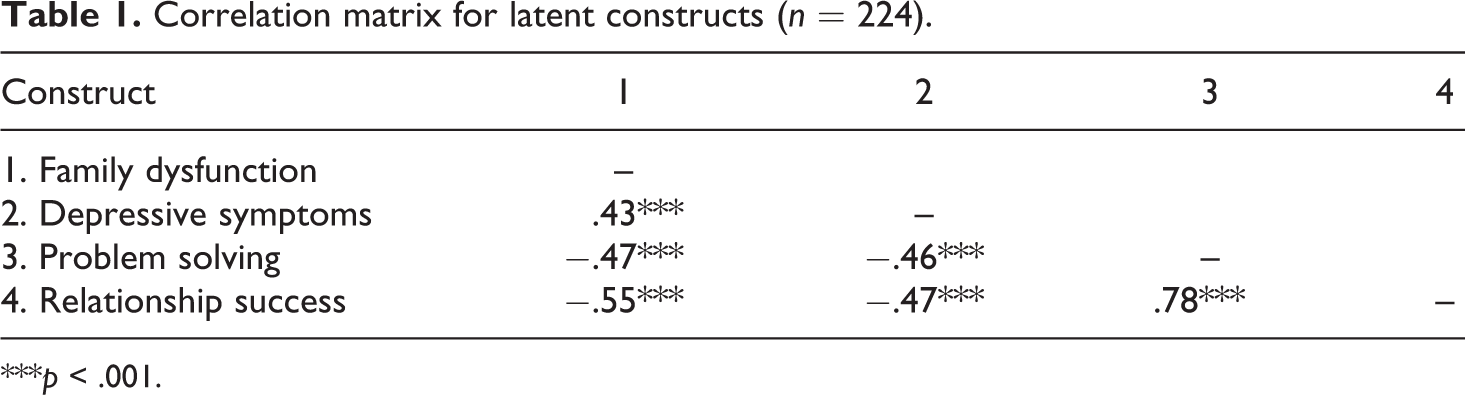
A confirmatory factor analysis (CFA) was first conducted to ensure that the measurement model fit the data well prior to testing the structural model. The CFA demonstrated a good fit to the data using guidelines provided by Kline (2011): χ2 (48) = 81.794, root mean square error of approximation (RMSEA) = .056 (90% confidence interval [CI] = .034, .077), comparative fit index (CFI) = .972; Tucker–Lewis index (TLI) = .961. Results of the CFA also provided information about latent variable correlations (see Table 1). The data were then analyzed through SEM using Mplus 6.0 and maximum likelihood estimation. Next, the indirect paths were tested using a bootstrapping analysis with 2000 bootstraps (Preacher & Hayes, 2008). Bootstrapping is currently the overwhelmingly preferred method for testing indirect effects (Hayes, Preacher, & Myers, 2011; MacKinnon, 2008; Shrout & Bolger, 2002; Williams & MacKinnon, 2008). Since bootstrapping procedures in Mplus are not possible when including auxiliary variables in the model, these were removed when conducting the bootstrapping analyses.
Correlation matrix for latent constructs (n = 224)
***p < .001.
Results
Correlations
The correlations among the latent variables revealed important information about the zero-order relationships among the latent constructs. As anticipated, family dysfunction was related to higher depression symptoms, lower problem-solving ability, and less relationship success. Depression symptoms were related to less problem-solving ability and less success in romantic relationships. Finally, problem-solving ability was related to greater relationship success. With the correlations among the latent constructs consistent with our expectations, the structural model was then analyzed.
SEM results
The standardized results for the SEM analysis can be viewed in Figure 2. The control variables of gender, relationship length, and relationship status were regressed on all the variables in the model. Relationship status was not related to any of the variables of interest in the model and therefore was removed and the model was rerun. The final model fit indices from the SEM analysis indicated a good fit between the model and the data, χ2(63) = 77.325, p = .106; RMSEA = .032 (90% CI = .000, .054); CFI = .988; TLI = .983; and standardized root mean residual = .047, and accounted for 22% of the variance in depression symptoms, 40% of the variance in problem solving, and 73% of the variance in relationship success.
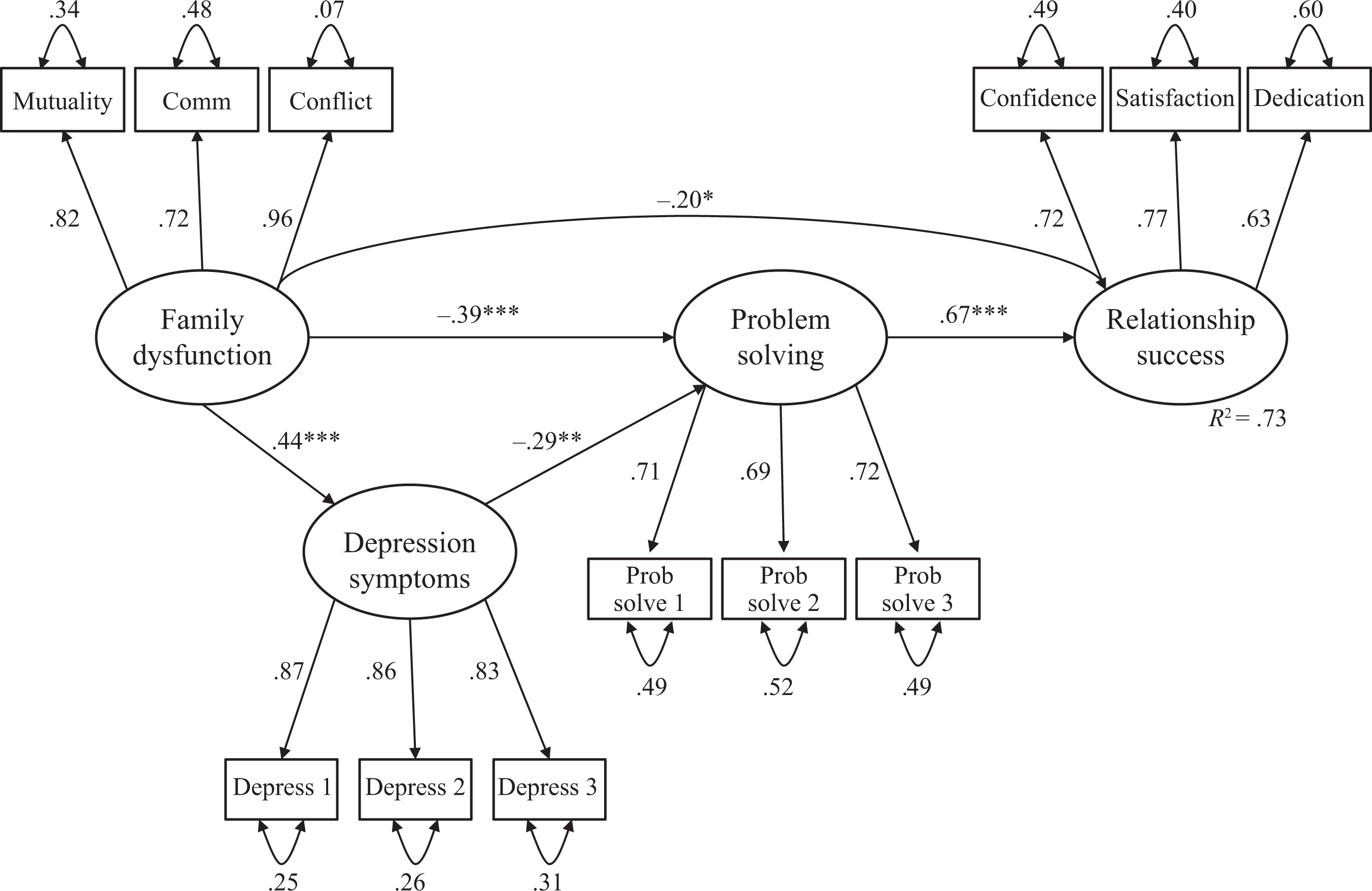
Structural equation model of young adult romantic relationships in Mainland China (standardized estimates shown; n = 224). Note. Gender and relationship length were included as control variables but are not included in the figure for clarity. χ2(63) = 77.325; RMSEA = .032 (.000–.054); CFI = .988; TLI = .983; SRMR = .047. *p < .05; **p < .01; ***p < .001. RMSEA: root mean square error of approximation; SRMR: standardized root mean residual; CFI: comparative fit index; TLI: Tucker–Lewis index.
Higher levels of family dysfunction were related to higher levels of depression symptoms, lower problem-solving skills, and lower levels of relationship success. Depression symptoms were associated with lower problem-solving ability. Higher levels of problem-solving ability were related to higher levels of relationship success. In terms of control variables, the longer a participant had been in their romantic relationship, the higher their relationship success (β = .27, p = .003), while being female was associated with better perceived problem-solving skills (β = .21, p = .003). Relationship length was not associated with problem-solving skills, depression symptoms, or family dysfunction. Finally, gender was not associated with relationship success, depression symptoms, or family dysfunction.
Model comparison
Next, we compared our proposed model to two theoretically plausible alternatives. First, a nested model comparison was conducted to evaluate whether the link between family dysfunction and relationship success is best represented by a direct and an indirect effect, partial mediation (the proposed model), or only an indirect effect, or full mediation (no direct path from family dysfunction to relationship success). Each model was estimated and the χ2 difference test indicated omitting the direct path from family dysfunction to relationship success resulted in poorer model fit, χ2 diff(1) = 4.775, p = .029, supporting the proposed partial mediation model. A second nested model comparison was conducted to evaluate whether, in addition to being indirectly related to relationship success through problem solving (the proposed model), depression was also directly related to relationship success. Again, each model was estimated and the χ2 difference test indicated omitting the direct path from depression to relationship success did not result in a poorer fit to the data, χ2 diff(1) = 0.139, p = .709, supporting the more parsimonious, fully mediated model.
Test of indirect effects
The indirect effect from family dysfunction to relationship success was tested with 2000 bootstraps and a 95% CI. One indirect path from family dysfunction to problem solving to relationship success was significant (β = −.27, p = .003, CI = −.444, −.094). This effect can be interpreted as follows: a 1 standard deviation unit increase in family dysfunction is associated with a .27 standard deviation unit decrease in relationship success via the prior effect on problem solving, holding the control variables and depression constant. A second indirect path from family dysfunction to depression symptoms to problem solving to relationship success was also significant (β = −.08, p = .025, CI = −.155, −.010). This effect can be interpreted as follows: a 1 standard deviation unit increase in family dysfunction is associated with a .08 standard deviation unit decrease in relationship success via the prior effect on depression symptoms and the effect of depression symptoms on problem solving, holding the control variables constant.
Discussion
This study provides two potential mechanisms through which family of origin experiences are associated with young adult romantic relationships in Mainland China. First, family dysfunction (e.g., frequent fighting, lack of harmony and trust, and lack of communication among family members) was associated with poorer problem-solving skills in their current romantic relationship, which in turn was associated with lower levels of relationship confidence, commitment, and dedication (i.e., relationship success). Family of origin environments marred by an inability to handle conflict and that lack trust and good communication are expected to create skills deficits in children that are carried forward into the young adult’s romantic relationship (Bryant & Conger, 2002). A second, yet similar potential mechanism is that family dysfunction is related to higher levels of depression symptoms (confirming previous research, see Betts et al., 2009; Lau & Kwok, 2000; Liem et al., 2010; Slicker & Thornberry, 2003), which in turn are associated with poorer problem-solving skills and relationship success. These results support the DEARR model contention that individual factors such as depression symptoms are associated with relationship success through their association with relationship process variables, in this case, problem-solving skills. Overall, these findings support the general applicability of the DEARR model in understanding young adult romantic relationships in Mainland China.
The direct association between family dysfunction and relationship success was also significant. This is an area that needs further study and could potentially highlight some of the differences in relationship development across cultures. For example, the DEARR model proposes that all family of origin factors will exert indirect influence on relationship success through social and economic advantage (or disadvantage), individual characteristics, and relationship processes. But, given the centrality of family and interpersonal ties in Chinese culture, at least traditionally (Lee & Mock, 2005), it could be that family of origin experiences continue to influence relationship success both directly and indirectly. Yoshida and Busby (2012) found that perceptions of family of origin experiences were more strongly related to relationship satisfaction for Asian-born Asian males than Caucasian males, though this did not hold for females. If future studies also find a direct association between family of origin experiences and relationship success, it will be important to determine whether this finding is moderated by levels of cultural traditionalism, related to the absence or presence of siblings, age, or an artifact resulting from important mediators not being included in previous models.
The results also point to potential areas of focus for prevention and intervention programs with young adults, targeting depression symptoms and enhancing problem-solving skills. Educational programs focused on knowledge and skill building are likely to be more palatable than more intensive interventions such as therapy, given the continued stigma attached to seeking out mental health services and the relative paucity of relationally based services currently available (Anderson et al., 2012). Such programs, at least in Western countries, have been found to be helpful at improving relationship processes such as problem solving and relationship quality (Blanchard, Hawkins, Baldwin, & Fawcett, 2009; Hawkins, Blanchard, Baldwin, & Fawcett, 2008). In addition, there is recent evidence that multiple intervention modalities, including online and DVD formats, can be helpful in improving relationship functioning (Braithwaite & Fincham, 2007, 2009; Halford, Moore, Wilson, Farrugia, & Dyer, 2004) as well as depression symptoms among young adults (Braithwaite & Fincham, 2007). Culturally adapting such programs or developing new programs could be one avenue for enhancing young adult relationships at risk for later problems. Given recent research that indicates that trajectories of relationship success or failure are generally the result of stable, initial relationship factors present during the early stages of a relationship (such as verbal aggression) rather than changes in these factors over time (Lavner, Bradbury, & Karney, 2012), it is even more important to intervene early, during the relationship development stage rather than after a couple has married or made a long-term commitment.
There are several limitations of the current study that should be considered when interpreting the results. First, our data are from a single time point and, therefore, correlational in nature. As a result, the temporal ordering of the variables in our model could only be based on sound theory, but longitudinal data are needed in order to properly test the temporal ordering of the relationships under study. Second, our data were from young adult individuals in romantic relationships; therefore, we are only getting a partial picture of the relationship. Dyadic data are needed to provide a more complete understanding of the interpersonal nature of relationship development. Third, our sample included young adults from Mainland China attending college, as either undergraduate or graduate students. Given that the majority of young adults in Mainland China do not attend college, these participants represent a relatively advantaged group, with respect to education, and therefore the relationships between family of origin factors, depression, problem-solving skills, and relationship success may differ from those who do not attend college.
The current limitations also point to important future research directions. Future research would be enhanced by using both longitudinal designs and studies that include dyadic data. In fact, few longitudinal (see Bryant & Conger, 2002; Cui & Fincham, 2010; Cui et al., 2008 for exceptions) or dyadic (Yoshida & Busby, 2012) studies currently exist but are needed to adequately test the DEARR and other models that attempt to explain young adult romantic relationship development. Further, studies in Mainland China that include noncollege-attending youth would be an important additional step to improve generalizability of the results but to also determine whether individual and relational factors are similar to or different in impacting relationship success for young adults on different educational trajectories. In the U.S., for example, education has been found to be a key variable in understanding marital stability, with individuals who have a high school education or less at significantly greater risk of marital separation and divorce (Cherlin, 2010). In addition, though Mainland China has experienced dramatic economic and social changes over the last 30 years, there remains a significant urban–rural divide with respect to development and modernization. Future studies could consider young adults in more rural areas where traditional values are stronger and poverty levels are much higher in order to determine relationship development in these more traditional contexts. Furthermore, future studies could consider an array of individual and relationship process variables not included in this study. Individual factors such as personality, attachment style, mental health functioning, interpersonal sensitivity and shame, among others, along with relationship process variables such as communication, dyadic coping, and relational aggression, could shed further light on the relationship between family of origin factors and relationship outcomes in young adult romantic relationships.
In conclusion, results of this study find that perceptions of family of origin dysfunction are associated with young adult relationship success in Mainland China directly and through two indirect paths: family dysfunction to problems-solving skills to relationship success and family dysfunction to depression symptoms to problems-solving skills to relationship success. These initial results support the cross-cultural applicability of the DEARR model and point to two potential avenues for intervention in improving relationship success of young adults, by targeting depression symptoms and enhancing problem-solving skills. Given the importance of how relationships start for how they develop over time (Lavner et al., 2012), additional research is necessary in understanding the development of romantic relationships across diverse contexts and cultures.
Footnotes
Funding
This research received no specific grant from any funding agency in the public, commercial, or not-for-profit sectors.