




Abstract
Locations where individuals meet romantic partners may influence the composition and perceived extent of network social support for relationships. In this article, we use in-depth qualitative interviews to examine how 62 cohabiting couples (124 individuals) met their romantic partners, whether this differentiates respondents’ perceptions of support for their relationships, and how this varies by social class. Many of the cohabiting couples in our sample met through friends and family members who can be considered strong ties. Couples also frequently reported meeting in the community, often while pursuing hobbies. Shared network ties and common interests are often attributed to facilitating the progression of relationships. Couples who met through more anomic settings—at a bar or via the Internet—less often viewed their ways of meeting as socially acceptable; many of these couples devised cover stories to tell others about how they met. Our results suggest that those who meet via weak ties perceive lower levels of support for their unions. Working-class couples meet in more anomic settings or through weaker ties more frequently than their middle-class counterparts. Results are interpreted in light of their implications for the diverging family outcomes of working-class and middle-class young adults.
Young adults have increasingly assumed what was historically the purview of parents and community – the right to manage their own relationships (Coontz, 2005; Rosenfeld, 2006). Courtship increasingly moved out of the private sphere of the home, and into more anonymous, often public, spaces (Coontz, 2005). Although parents and relatives continue to play important roles in romantic decision making, they no longer are the main gatekeepers. New technologies, such as the Internet, provide young adults with modern ways to meet prospective mates. At the same time, the family-building behaviors of working- and middle-class young adults have diverged; those who are college educated are more likely to marry, remain married, and bear their children in marital unions (Goldstein & Kenney, 2001; Kennedy & Bumpass, 2008; Martin, 2006).
The loosening of parental and communal control over the mate selection process may have important consequences for the development and quality of intimate relationships. Rosenfeld (2006) argued that the increasing residential and social independence of young adults reduced parental ability to monitor children’s courtship activities and increased heterogeneity in partner choice. Kalmijn and Flap (2001) also document a shift in where relationships form, from settings like the neighborhood and the family context where parents have some control, to places like clubs, schools, and workplaces, where parents are relatively powerless. Assertions regarding the decline of parental or communal influence in the mate selection process are hard to test, however. Data on how young adults meet are scarce. This also makes it difficult to assess whether particular ways of meeting—at school, or through friends—are more conducive to the development of socially sanctioned and supported relationships than new dating venues, such as the Internet, or locales that convey looser social monitoring, such as bars.
This article examines the ecology of romantic relationships—where individuals meet and whether they are embedded in social networks that provide some form of monitoring and support. We ask whether those who report meeting through personal social networks experience their relationships differently from those who indicate they met in more anomic settings with limited oversight. To assess this, we explore how romantically involved couples describe the ways they met and how their relationships unfolded. Data are from in-depth interviews with 62 cohabiting couples. This approach also allows us to theorize how meeting venues operate to recreate social class position and (potentially) impact relationship progression and stability.
Factors shaping the progression of romantic relationships
Research on how marriage markets operate often concentrates on sex ratios and the availability of marriageable partners (e.g., Lichter, LeClere, & McLaughlin, 1991). But social contexts shape the networks from which people choose their mates and constrain their choices (Blau & Schwartz, 1984; Goldscheider & Sassler, 2006; Kalmijn & Flap, 2001; Laumann, Gagnon, Michael, & Michaels, 1994). For example, men who are more socially advantaged (educated, wealthier) have more partners to choose from because of their ability to satisfy the prerequisites deemed necessary for marriage (Cherlin, 2004). Research has also suggested that part of their ability to attract partners is attributable to their more diverse and cohesive social networks (Kadushin, 2002).
The role of social networks in relationship formation
A relationship’s formation and progression may be shaped by the type of network in which the initial meeting occurs. Some ways of meeting romantic partners, such as being introduced by friends or family members, through shared interests, or at school or work may result in more homogamous relationships; participants already assume at least some common characteristics. Inhabiting similar social networks may also inhibit individuals from engaging in behavior deemed by the group as unacceptable, particularly if social networks can control membership (and expulsion). Strong ties, those existing between close friends and family, may facilitate the development of more trusting bonds (Coleman, 1988). Relying on strong ties as intermediaries in one’s love life may also facilitate or temper relationship progression, as couples may feel greater social support for their unions.
Locations less constrained by accepted social norms, on the other hand, may encourage the formation of more heterogamous (by age, race, or religion) or more alternative (in terms of views toward marriage and family) relationships than unions formed with the assistance or oversight of close familiars. Weak ties, such as those between acquaintances, serve as important mechanisms for moderating trust between strangers (Macy & Skvoretz, 1998), help bridge members of different circles, and facilitate the formation of new associations. But such relationships might be more heterogamous or less socially cohesive; weak ties diversify the kinds of people with whom individuals interact (Granovetter, 1973). This can result in lower levels of perceived social support for the relationship (Vaquera & Kao, 2005). Individuals involved in Internet romances frequently report receiving critical comments from family and friends about their relationship, and those who were more conscious of the stigma of relationships that began online reported less satisfaction with the quality of their relationships (Madden & Lenhart, 2006; Wildermuth, 2004). 1
Those who meet via weaker ties, or in more anonymous settings, may also be less concerned with violating social norms that can facilitate the formation of different types of relationships. Internet meetings, which often transpire between individuals with nonexistent social ties present individuals with opportunities to engage in behaviors they might avoid with known others. Men who utilize Internet dating sites, for example, often express interest in partners of different racial or ethnic backgrounds (Feliciano, Robnett, & Komaie, 2009). Individuals who meet in bars are also generally characterized as having weaker social ties, and the setting can encourage risk-taking behaviors (Levonyan-Radloff, Parks, & Collins, 2012).
The few studies that have examined how couples report meeting find that many acknowledge family members or close friends. The National Health and Social Life Survey (Laumann et al., 1994), conducted in 1992, reported that slightly more than half of married and cohabiting individuals sampled were introduced through family or friends (Laumann et al., 1994, table 6.1). Sizable shares of married and cohabiting individuals also met at school or work—38% and 28%, respectively. Only 8% of married couples and 12% of cohabitors had met at a bar. A 2005 nationally representative survey sponsored by the Pew Internet & American Life Project also found that most people currently in serious long-term relationships or marriage met either through family and friends or in a work or school setting (Madden & Lenhart, 2006). More recent studies find that individuals were more likely to report having met at work and school than through family or friends, though the proportions (38% and 34%, respectively) were close. Despite the claims of online dating establishments, nationally representative surveys of American adults find relatively few who report having utilized Internet dating sites. Similar proportions met online as at church—only 3% each—which suggests that Internet dating is highly selective (Madden & Lenhart, 2006; Sautter, Tippett, & Moran, 2010). Gays, lesbians, and middle-aged heterosexuals are the groups most likely to utilize the Internet to meet partners, for example (Rosenfeld & Thomas, 2012). Finally, research based on particular subgroups report similar results. The Marital and Relationship Survey, a study of low- to moderate-income parents, found that over one third of respondents were introduced through a family member or via friends (Sassler, Addo, & Hartmann, 2010). Approximately one in six met at work, while another 14% said they had met in a public place.
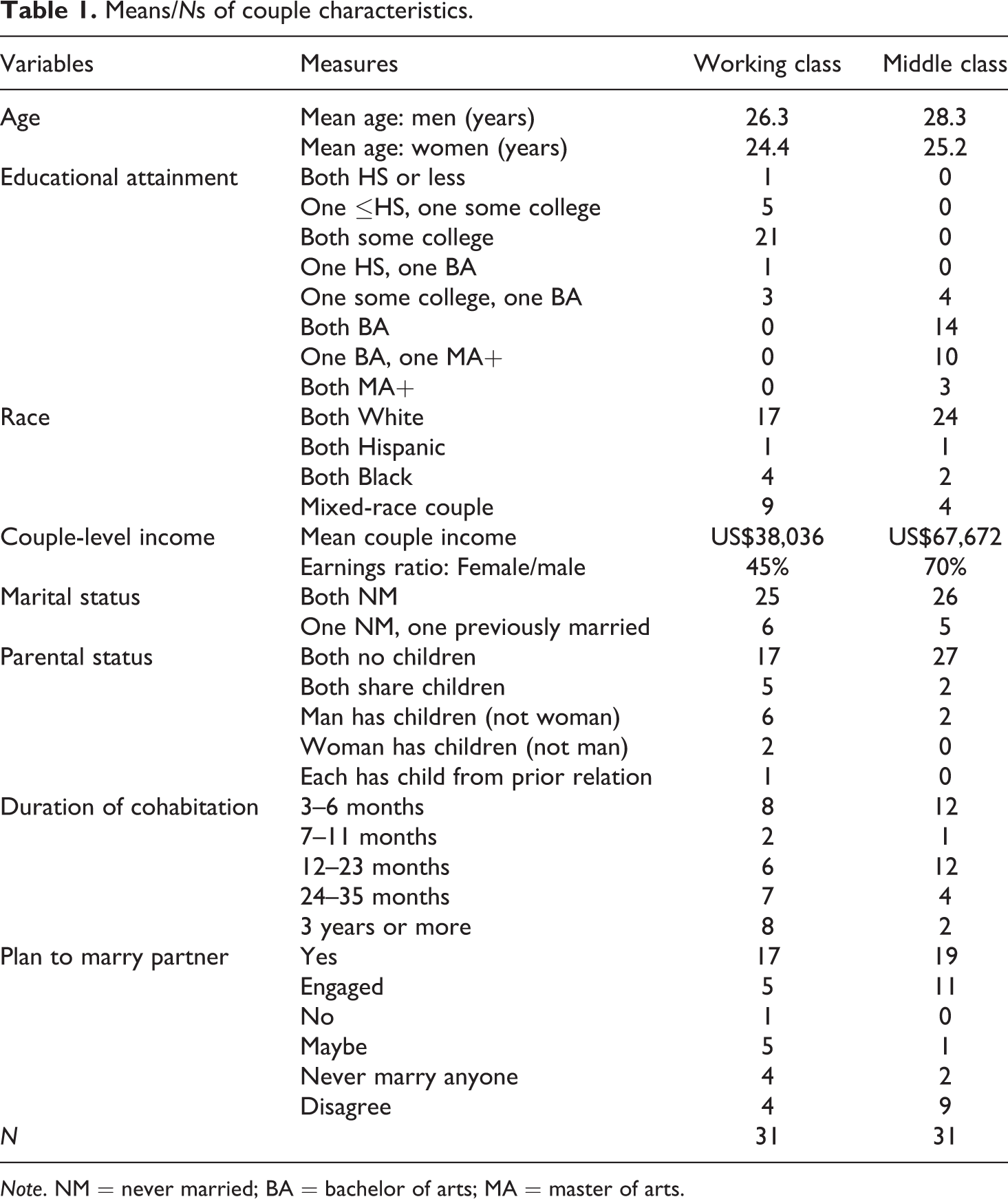
Means/Ns of couple characteristics.
Note. NM = never married; BA = bachelor of arts; MA = master of arts.
Today, the majority of adults have lived together outside of marriage (Kennedy & Bumpass, 2008; Goodwin, Mosher, & Chandra, 2010). In fact, most first unions are cohabiting ones; among women who married in the late 1990s, 62% first lived with their husbands (Kennedy & Bumpass, 2008). Couples’ reasons for entering cohabiting relationships differ, however, by social class. College-educated individuals are less likely to cohabit than those who with a high school diploma or some postsecondary schooling. When college graduates do live together, they are more likely to marry when compared with their working-class peers (Goodwin et al., 2010). This means that cohabitation may not serve the same purpose for all individuals and may not follow the same pathways. The goal of our article is to examine how the ways and places couples meet influence their perceptions of their relationships, as measured through their ‘relationship stories’ (Bolton, 1961). Our analysis enables us to explore the ways in which meeting locations may contribute to the diverging destinies of working- and middle-class young adults.
Method
Quantitative research is unable to provide us with ‘insider accounts’ (Surra & Hughes, 1997) into the meeting and subsequent union progression of couples. We therefore qualitatively examine the ways couples met and their feelings about the meeting process. Data are from in-depth interviews with 62 heterosexual couples (n = 124) living in Columbus, Ohio. Interviews were conducted with both members of the couple simultaneously (Hertz, 1995), in different locations, by the authors and an additional graduate student. These semi-structured interviews covered topics including views of marriage and cohabitation, the household division of labor, and fertility plans. Here, we focus on questions that asked respondents to explain how they met their partners, describe their relationship stories, and talk about their future plans. Interviews took between 1 and 3 hours and were digitally recorded and transcribed verbatim by the interviewers. Names of all respondents have been altered.
In order to be included in the sample, couples had to be in the prime family formation years of 18 to 36. Further, they must have shared a residence for at least 3 months prior to their interviews. Educational attainment, occupational status, and earnings were used to distinguish the working and middle class. We examined these groups separately because their reasons given for living together and the outcomes of their cohabitations (e.g., transitioning into marriage, breaking up) tend to be distinct (Goodwin et al., 2010; Sassler & Miller, 2011).
We pursued our working-class sample from July 2004 to April 2005 by identifying a very large community college. Community college students come from families with fewer economic resources, are less often on an academic track in high school, and have lower rates of college graduation than students who attend 4-year institutions (Goldrick-Rab, 2006). Signs were posted on public message boards around the campus. The majority of the working-class individuals were not students at the time of their interviews; those who were students generally worked part time while attending school part time or intermittently. Several nonstudents were told of the study by an acquaintance; we limited referrals to one per couple.
The second stage of data collection (April 2005–June 2006) targeted middle-class cohabitors, with class defined predominantly by educational attainment—a college degree. The 31 middle-class couples were recruited through fliers posted in gourmet food stores, coffee shops, and a posting on Craigslist, an online community bulletin board. Five couples were referred to the project by colleagues of the researchers.
Four couples in each class group were educationally heterogamous in that one partner had a bachelor’s degree while the other did not. Occupation was used to classify these couples as working or middle class. We also relied on income floors to avoid couples reliant on public assistance, though income alone is an inadequate measure of social class, given the relative youth of the sample.
Our final sample consists of 124 individuals (62 couples). Middle-class couples have completed college and are therefore somewhat older (average age = 28.3 years for men and 25.2 years for women) and had higher incomes (average = US$67,672) than their working-class peers. Among the working class, the mean age for men was 26.3 and for women 24.4 years; the average couple-level income was US$38,036. Additional sample information is shown in Table 1.
Analytic approach
We derived our coding scheme both deductively, based upon past literature (such as the existing literature about meeting locations and social ties), and inductively, as they emerged from the data. For example, one deductive code we utilized from prior studies was meeting “in the community” (such as at church), which has traditionally been one way that couples became acquainted. New forms of meeting—such as through affinity groups like live action role-playing games (LARPs) surfaced from repeated readings of transcripts.
Coding for this project began after all the data collection was finished. Couples nearly always agreed on the stories of how they initially met. In several instances where couples met on the Internet, one partner provided what the other referred to as their “cover story,” while the other described their online meeting; we classify such couples as having met via the Internet, given research indicating high levels of stigma associated with meeting in such a fashion (Madden & Lenhart, 2006; Wildermuth, 2004). In other instances, there were disagreements over small details of the meeting experience. In those cases, we utilized Hertz’s (1995) strategy of assuming that each partner is presenting the truth as he or she views it.
Both authors coded the data separately, then compared results, discussing any differences until they reached consensus. Following open coding to generate initial themes (e.g., “first meeting” or “relationship progression”), narrative segments were classified into subcategories at the couple level by initial meeting location (Strauss & Corbin, 1998). ATLAS.ti was used to facilitate axial coding in the second stage of analysis, where variability and linkages within topics were explored. For example, we examined the feelings about the way in which their relationships began for all of those couples who met online versus through family and friends. The third level of analysis involved selective coding, integrating and refining categories and relating them to other concepts, so as to enable us to understand the particular story the data tell (LaRossa, 2005).
Results
Couples in this study met in a variety of ways. The largest numbers were introduced through friends or family (n = 16 or 25.8%), with another 15 couples (24.2%) meeting while pursuing common interests or hobbies. The workplace was the third most common location for meeting partners, mentioned by 10 of the couples (16.1%). Seven couples each (or 11.3%) reported meeting at a bar, at school, or via the Internet.
Met through friends or family
Couples who were introduced through friends or family members hung out with the same circle of friends until their orbits eventually collided, were friends before becoming romantically involved, or sometimes were directly introduced (“set up,” in the words of Jonathan). Their stories reveal these couples as embedded in large circles of friends and are a testament to the importance of these networks for introducing new partners, serving as sounding boards, and evaluating prospective matches. Many of our respondents implied that meeting through friends, or having friends know their partner, made the relationship more acceptable, natural, or inevitable.
A frequent trope among couples who met through friends was how many people they knew in common prior to meeting. Their shared circles indicated to them that their partners were suitable. Martin, a 31-year-old textbook editor, said “I used to party with all of her friends.” By talking about how their partner had known their friends or that they had known their partner’s friends, respondents implied a familiarity that predated their involvement. As Aaron, a 35-year-old manager, explained, “We have a lot of mutual friends, so I’d sort of peripherally known her through other people for probably a couple of years.”
Friends sometimes brought couples together on purpose. Middle-class Janelle, 33, who owned a yoga studio, revealed how her friend set her up with her husband’s new business partner. Janelle recalled how her friend described him, “He’s your type. He’s a total [expletive] nerd. He’s really smart, he’s really cerebral. You’d love him.” For these respondents, friends were reliable advocates they trusted with their romantic concerns. Respondents even attributed friends with recognizing appropriate matches well before they did. Alisha, engaged to 24-year-old Jared, mused, “We would hang out and I would talk to Jared more than anybody else, but regardless that my best friend told me that was the guy I was going to end up marrying, I didn’t listen. It took 3 years, 4 years, before I realized it.” That her friend had viewed them as an appropriate couple carried great weight with Alisha, a marker that this was a suitable and desirable match.
Six couples were introduced by family members (generally siblings). Evan, a 27-year-old middle-class salesman, revealed, “She was actually friends with my sister and her husband before I even met her. It’s kind of funny, because the day Juliana and I met, my sister and her now husband said that we were going to get married. We didn’t start dating till 6 months after that!” These respondents suggested that family members had approved their partnerships for the long run.
The final couples in this group met through more distant connections, such as through exes or roommates. Their stories suggest that finding a new partner through a former one, or while currently involved, was not socially sanctioned. Describing how he met Anna, Andy, a 24-year-old pizza delivery driver, said, “My good friend’s little brother was dating her and I think it was a birthday party for my friend, and we were all over there….” He hurriedly went on to say “We didn’t get together then or anything like that.” Tyrone, a 25-year-old postman, was being set up with a friend of his current girlfriend but hit it off with the wrong woman; this meant they kept their budding romance on the lowdown. Relationships that transgressed certain boundaries received less social support and had to be pursued more privately.
Equal numbers of working- and middle-class couples met through friends and family, though working-class respondents more frequently were introduced through relatively distant associates. This may explain why most of these middle-class couples reported long-term intentions (engagement, marriage); not only do they have more incentives and social support to make it work but the costs of breaking up may also be greater, as ending a relationship also means fracturing the social circle (Miller, Sassler, & Kusi-Appouh, 2011). Those who most frequently mentioned overlapping friendship networks were college educated, with many of these friends from school. That the largest proportion of our couples met through friends or family highlights a major mechanism through which educational homogamy among couples is reinforced. People are most often friends with others who resemble them, in terms of social class, education, and race (McPherson, Smith-Lovin, & Cook, 2001). When friends are the romantic intermediaries, they will most often arrange a partnering between others similar to them, imparting a feeling of confidence in the selection.
Friends did not necessarily encourage the headlong entrance into romance with new partners. As breakups that may result from moving too hastily could disrupt the entire network, friends sometimes warned respondents against progressing too quickly. Jessica recalled how, despite being acquainted with Martin for years, her friends still advised against becoming sexually involved too rapidly, lest she get hurt. “And of course my friends were like, ‘Don’t do it! Remember what the other guy did to you?’” While network familiarity shaped how respondents viewed the appropriateness of their partners, close familiars could encourage a more tempered progression or greater adherence to social “scripts.”
Met in the community/pursuing common interests
Fifteen couples reported meeting in a community setting, often through hobbies. The largest number met while pursuing a particular interest—such as dancing, sports, or theatrical games. Sometimes individuals considered these activities a good way to meet friends and possibly significant others. Asked how she met her current boyfriend, Dawn, a working-class clerk, replied, “Like I meet all my boyfriends, playing basketball.” Another couple who was involved in the same theater club had initially been friends because they had been dating others from the group. These respondents suggested that their shared interest provided insight into the kind of person their partners were.
In addition to meeting through dance clubs (swing or Latin) or LARP gatherings, other couples met while playing sports. Only one couple met at church, where the male partner played in a Christian rock band. Respondents generally participated in their hobbies with friends, which perhaps made them feel braver about meeting new people. The four couples who met via sports, in contrast, were engaged in more individual pursuits. Those who met while pursuing interests rarely mentioned what their friends had to say about their new partners—even though they talked about attending these events with friends. Rather, their similar interests seemed to count for more than network approval.
The remaining couples met in public settings that are harder to characterize. Two met at coffee shops, one at a support group, and the fourth met at a community music festival. Several of these respondents were reluctant to reveal where they had met. Naomi, 23, a middle-class translator, said of the dingy all night donut shop where she met Soliman, “It’s not a very cute place to meet.” Sheryl, a 29-year-old waitress, was also skittish about describing how she had met Adam, saying very quietly, “I don’t know if he would be comfortable with this,” before explaining that they met at Alcoholics Anonymous. These respondents tacitly acknowledged the stigma felt by those who do not meet through known others or who meet in places they deem as not reflecting their true selves. This sets them apart from those who met via shared interests. There appear to be more and less appropriate venues for meeting significant others, then, when that occurs outside the purview of family and friends.
Clear social class disparities emerged among couples who met in the community. Those meeting partners via their interest in dance were all drawn from the middle class; while most were not undergraduates, many had learned their hobby while attending college, or had, at one time, danced in university clubs. All those who met through role-playing, in contrast, were working class. There were no consistent class patterns for those who met in independent sports activities or other venues. Nonetheless, our results provide further evidence of how social class networks are utilized to ensure relationship homogamy. Furthermore, respondents involved in shared activities often commented on how much time they (initially) spent together engaged in their hobby, which may have increased their mutual interdependence.
Met at work
Another 10 couples met at work, either because they were employed for the same company or because one partner was at work in a service job and the other was a customer. There is quite a bit of disparity in the work sites that served as meeting locales, ranging from a high school where both partners were teaching, to a strip club where the woman was a dancer and the man worked as a disc jockey. Most of these jobs were service oriented in nature. Five of these couples reported meeting at a bar or club where one of the partners was working, for example, while another two met at a restaurant. These couples do not generally mention knowing people in common, and as a result some describe their meetings as serendipitous. Randy, a 35-year-old mechanic, met Ming when he came into the restaurant where she was a cashier, in search of hot soup to cure a bad cold. Because she seemed solicitous for his health, he came back when he felt better to ask her out. Shelly, a 28-year-old waitress, met Brian on his first day of work, when he introduced himself as the new cook.
Several of the couples who met at work expressed reservations about pursuing a romance, concerned about how it would be perceived. Andrew, a 27-year-old middle-class tennis coach, frequented the bar where Rebekah worked. “One night I invited her to come over after work and just hang out,” he said, “which I was a little apprehensive about, ‘cause I felt kinda creepy, you know? I felt like the regulars that hit on the waitresses, you know, creepy old guys.” For others, meeting at work presented challenges due to strictures against office romances. Paul, a 28-year-old lobbyist, highlighted how his relationship with Kate transgressed workplace policy, jokingly saying, “We have a very scandalous relationship. She was actually the internship coordinator and my boss.” Kate’s supervisor told her that such behavior was inappropriate; she was subsequently assigned different job responsibilities. Twenty-year-old Susan, who met her partner when she transferred into the video store he managed, reported a similar story, saying “He doesn’t work there anymore, but we started dating and we couldn’t tell anybody because manager and associate, you’re not supposed to date.” These romances were not begun under the aegis of societal approval like those introduced by friends. As a result, some of these couples had reservations about how they met.
Couples who met at work were more heterogamous, in terms of both age and race, than those who met elsewhere. Of the 10 couples, 3 were interracial, while another 3 were age discrepant. For example, Brian began dating Shelly when he was 19 and she was 26. The workplace appears to provide an opportunity to meet a broader array of potential mates, at least for those employed in service sector jobs.
At a bar
Another seven couples met at a bar both frequented. Not surprisingly, a few of these respondents were rather inebriated at their first encounter, even though some were underage. Twenty-five-year-old middle-class Sean, who assembled art installations, described how he met his fiancée Emily. “The first time I asked her out I was drinking martinis with my friend Pat at the Blue Devil. I had three martinis in me.” Emily, a 28-year-old pastry chef, recalled the event well, saying “He was drunk, I was drunk … God, it was a mess. Yeah, and then we started dating like a week after that.” Carly, who was 18 when she met Vic, said, “So there’s this place that we would go and drink,” with Vic describing them as regulars. For some respondents, meeting at a bar was normative because it played a large role in their social lives.
Not all of those who met at a bar, however, felt that it was such a propitious location. Four of the five who expressed reservations about meeting their partners in a bar were women. Brittany, a veterinary technician, who was 20 when she met Spencer, explained, “Well, we met out at a bar, and I’m usually very picky … but there was just like something about him.” Amy, a 28-year-old respiratory therapist who approached her current fiancé at a high-end Irish pub one night, more clearly expressed the negative connotations such a meeting place conveyed, stating, “I always said I never wanted to pick up a guy at a bar, but I kind of did.” Whereas for men the bar setting can reduce social inhabitations and facilitate one’s ability to approach women (“liquid courage,” in one man’s words), the women were concerned that it implied something less savory about them.
Middle-class couples met in a bar somewhat more often than their working-class counterparts, in part due to the expansion of high-end pubs in the greater Columbus area. Kevin, a manager, was eating dinner by himself at a trendy brew pub featuring craft beers and upscale meals when Amy came in with her coworkers for a “girls’ night out” and approached Kevin to talk. But a few had met their partners at a bar while attending college, where drinking was normative. Those who met at drinking establishments geared toward college students also suggested that they served a particular population. Sean described the bar on the main street of campus where he met Emily as the place where the creative types went to drink. “It used to be the art student bar and kind of has been for the last 40 years. I could walk in any night of the week and just know enough people to hang out,” he explained. The couples who initially met at a bar were quite homogamous with regard to their racial composition and educational attainment. Their narratives highlighted how drinking places can maintain social class homogeneity, whether because friends in similar situations go drinking with like friends (see Schaefer, 2012) or because certain bars were aimed at a particular clientele.
Via the Internet
Six working-class couples and one middle-class couple met via the Internet. Respondents who met online provide a variety of reasons for utilizing this approach. Several mentioned that they just wanted to try something new, in part because they were shy about meeting people in other venues. Julie, a 30-year-old working-class nanny, said that she was ready for a change and sought to explore romantic relationships that had not materialized before. “I didn’t have a boyfriend, really didn’t have much going on,” she said, “and my Mom had gotten a computer. I started hanging out in chat room types of things, so started doing that, just randomly talking to people.” Harry, a 32-year-old unemployed man who usually worked in fast-food establishments, had been badly hurt by a broken engagement. He revealed, “I finally got the courage to start dating again, but everyone was telling me how great Internet dating was, that it’s easier to get rejected, ‘cause you can just delete the e-mail and go to whoever is next.” For such respondents, talking with people online enabled them to get into the dating scene in a way that made them feel more comfortable.
Others turned to the Internet because, in their words, they were not having luck meeting people other ways. Asked why he had signed up with an Internet dating organization, Jeremy, a 29-year-old journalist, said, I was having no luck going to bars. I’m not the kind of guy who goes to bars and, like, hooks up with chicks. It’s not me, so none of that was working for me … I just had a divorce, I moved to Ohio, I didn’t have any friends here other than the people I knew at work.… There was no one to hang out with. So I just decided to try that to meet people.
Those who were new in town could not call on friends to expand their social life; others who were scared of relationships because they either had negative experiences or had limited relationship proficiency also appeared to lack the kinds of social ties that engender meeting prospective romantic partners. These couples welcomed the opportunity that meeting online provided.
Not all respondents, however, were comfortable with telling others that they met online. A few even devised elaborate ruses to tell others. Jerry, 27, who managed a retail store, was reluctant to reveal how he had met Natalie. He said, “It’s a funny story, because the way we met we don’t tell anyone.” He explained about their meeting in 1995, “I was online and then we met in a chat room or something. So we always kind of like just thought that was too silly to tell people. We say we met at a party at Ohio State, which neither one of us went to Ohio State, so it gets kind of confusing.” His partner, Natalie, a 24-year-old secretary, unsure which story Jerry would tell, announced, “We met actually through the Internet. It’s very odd. And he doesn’t like to tell people this story, so I don’t know if when he gets this question he’s going to be saying something totally different.” In the case of Artie and Brandi, she was the one who was uncomfortable revealing how they met. Artie, a 28-year-old working-class computer repairman, explained, “The line that I use is that we met at this place that I was working at, which is the official story. The unofficial story is that I just happened to start chatting with her on the Internet, on AOL, and we decided to meet.” Asked why they had a cover story, Artie surmised, “I don’t think she wants to tell her parents how we met.” Artie’s comments highlight the concern that others—especially family members—will not approve of a way of meeting devoid of social or communal oversight.
Of note is that while Internet dating sites have expanded dramatically in recent years, only one couple utilized a commercial site. Jeremy and Karen detailed the thoroughness of the dating site they had used, expressing great faith in its ability to winnow out inappropriate matches. Jeremy said, “Actually, the personality [test], there must be like 150 questions on this thing.” Both of them appreciated the additional steps designed to winnow out unsuitable matches. “They have like four or five stages before you can talk to each other,” Karen, a 24-year-old research assistant, stated. Most of the others who met through the Internet, however, looked askance at meeting through a site designed specifically for dating. Brandi, a 24-year-old disability fraud investigator, for example, worried that meeting on the Internet was “odd,” in her words, but then specified, “I mean, it wasn’t like a dating site or anything.” Harry also suggested there was a stigma associated with dating-oriented sights, explaining, “I didn’t go through personals, I just went on Yahoo Messenger and was looking for new friends.” They implied that utilizing dating sights to search for romantic partners was an act of desperation.
The responses of this handful of Internet daters provide much fodder for thought with regard to where Internet dating fits in the constellation of romantic relationship progression. The only couple to utilize a commercial dating site was middle class. In lieu of social networks that would provide oversight for partner selection, they relied on various personality tests, matching algorithms, and stages, and trusted that would result in meeting an appropriate mate. The cost of joining also served as a deterrent to less economically privileged individuals. For the working-class respondents, however, relying on such a calculated approach to partnering seemed lame, too planned, or just plain desperate; they implied that their approach was more open-minded. It did, in fact, result in more racially heterogamous unions; two of the six working-class Internet couples were interracial.
The Internet couples in our sample often initially resided in different states, complicating their first meetings. Respondents often commented on their nervousness prior to meeting their partners for the first time, and a few indicated how they arranged to meet in “safe” spaces. While these qualms quickly passed, the absence of a shared network of acquaintances, family members, or friends allowed for more anonymity but also greater risk. 2 But their stories also suggested that these respondents had less of a need for embedded networks to vet their love lives. Maria’s cousin expressed apprehension about Brian staying with her the first time they met; she laughed off those concerns. “I’m stubborn, I’m one of those people that I can take care of myself and I don’t need anybody to take care of me so, you know, I really wasn’t going to listen,” she recalled. Julie also seemed bemused at the way people reacted to how she and Ray met, explaining, “People look at me like, ‘He could have been a serial killer!’” Many of the Internet couples explained that they had already spent a good deal of time communicating online prior to meeting; high levels of personal disclosure, when paired with the absence of a shared network, facilitated their relationship progression, which was quicker than for the overall sample (see also Ben-Ze’eve, 2004; Couch & Liamputtong, 2008).
At school
The final seven couples met at school, mainly when they were students. Of the three who met in high school, two were in the same college-preparatory classes, while a third less academically inclined couple met in a homeroom. The way that college-oriented students are tracked increases the likelihood that those who meet at school are homogamous, at least in terms of social class destinations. Describing how she met Dean, Lindsey, a 36-year-old middle-class assistant professor at the time of her interview, said, “We took Latin class together in high school for years, so we started doing that. We hung out with the same group of kids, and we started dating.”
Of those couples who reported meeting while in college, half met via their involvement in student professional organizations. Not all couples who met at college find each other as a result of shared academic or career interests. As with many romances, appearance can play a salient role. Vickie, a 21-year-old working-class pharmacy technician, met Howard when they moved into dormitories in the beginning of their sophomore year. She explained, “I don’t know, he had a cute butt and I said something to my mom, and she said something to my RA, and he introduced us later that night. And we just, from that night on, we never spent a day apart.”
The couples who met through school were all racially homogamous, and most were close in age. Their social class positions were also analogous. Although many college graduates defer marriage till well after graduation, our middle-class respondents’ stories indicate that networks of school acquaintances reemerge and play new roles subsequently and that this process contributes to the formation of homogamous relationships.
Relationship progression, meeting locale, and network support
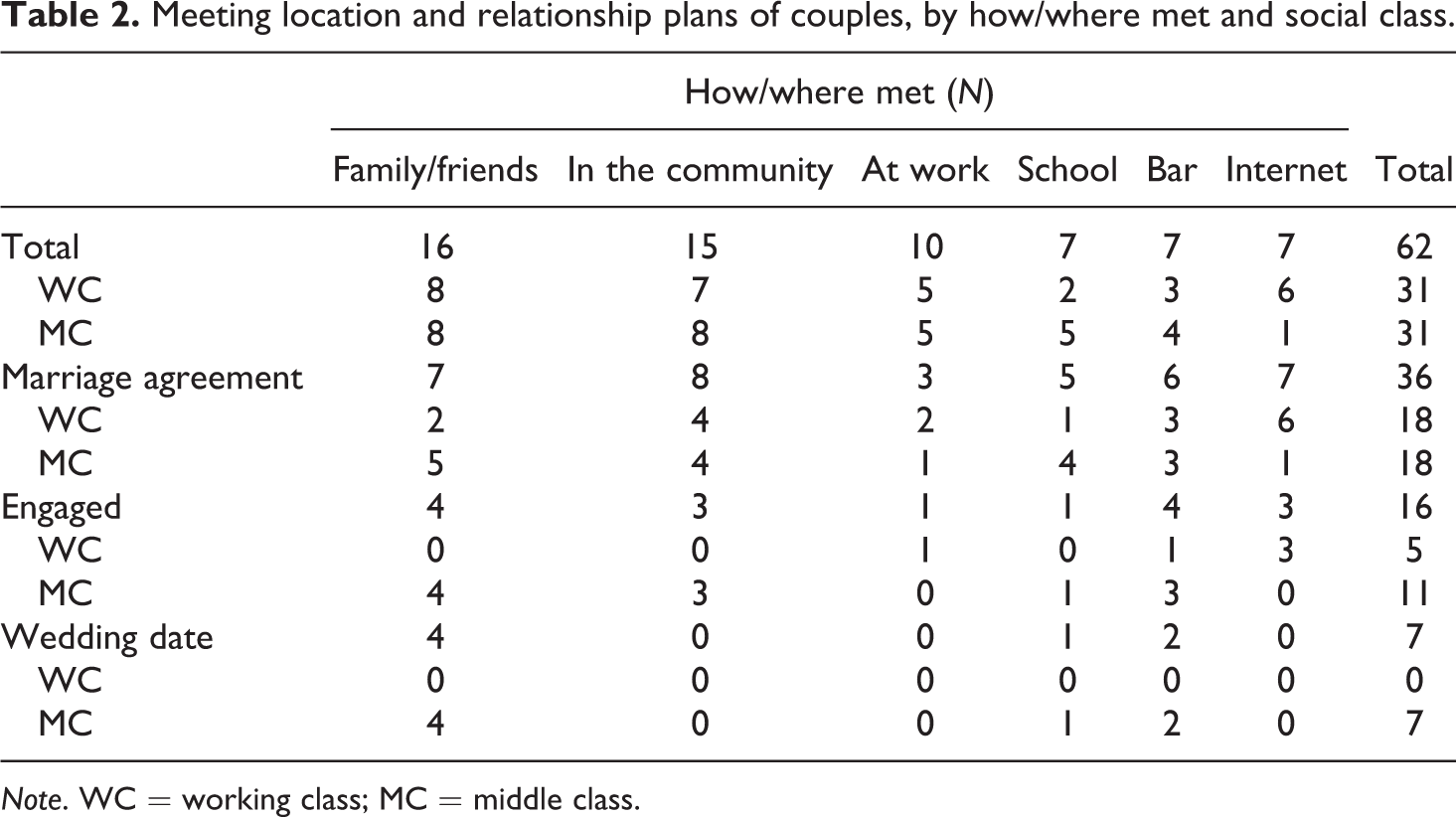
Over the course of their relationships, discussions of the possibility of marriage have occurred for many of these couples. Quite a few have talked about a time frame for getting married, have gotten engaged, or are in the midst of planning for the big day. Conversations regarding marriage have occurred for over half of the couples, with 18 working-class and 18 middle-class couples concurring that they expect to marry eventually (see Table 2). Agreement regarding a future together is more evident among those who met in more anonymous settings. Among couples who had met on the Internet, for example, all seven had discussed marriage and were in agreement that they would marry someday. All seven couples who met at bars concurred that they were life partners. 3 Partners who met in more traditional ways—through friends or family—reported less consensus regarding future plans to marry. Only 7 of the 16 couples who met via friends or family have reached an agreement that they will marry someday. The lowest level of accord regarding future lives together is demonstrated by those who met at work.
Meeting location and relationship plans of couples, by how/where met and social class.
Note. WC = working class; MC = middle class.
Of course, talking about plans to marry does not always mean a marriage ensues. One consistent finding of quantitative research on cohabitation is that the majority report plans to marry their partners, but the proportion who wed is far lower (Lichter, Qian, & Mellott, 2006). Whether couples get engaged is one marker that discussions regarding the future are serious. Whereas 36 of our couples concurred that they would get married in the future, only 16 couples were engaged. Again, the largest proportion of couples who had met at a bar or via the Internet report being engaged—four of those who had met at a bar and three who met online. Similar numbers of those who met via family or friends, or in the community, reported being engaged, but far more of them had met this way. Yet none of the engaged respondents who had met via the Internet had a set wedding date, and several had been engaged for years. All the engaged couples who met via family or friends, in contrast, had a date set and were in the throes of wedding planning.
What distinguishes these two groups? A closer look at the data reveals very different patterns of network support from family members and friends. Among engaged cohabiting couples who met online, for example, parents are often described as opposed to their children cohabiting, relationships with family members are frequently strained, and there is little outside affective support for the relationship. Engaged couples who met via friends and family, in contrast, report consistently high levels of support, often mention affection for and by their prospective in-laws, and describe ways that friends have forwarded their relationships. Furthermore, that support appears to be ongoing, occurring prior to the couple’s engagement and intensifying afterward.
Parental opposition to cohabiting may set the stage for prospective in-law relationships that are subsequently distant or disapproving. Among five (of seven) couples who met on the Internet, parents expressed qualms about their child cohabiting. Natalie’s parents told her, “You don’t move in together unless you’re married.” Brandi described Artie’s mother’s opposition to their moving in together, commenting, “She did not like that at all, thought that we were living in sin.” It is perhaps not surprising that Brandi described her relationship with her partner’s mother as cold. “She was not very nice,” Brandi explained, “… not like she said anything to me, to my face, but just kind of ignored me and what was going on and it’s still kind of you can feel friction between us.”
Two of the three engaged couples who had met on the Internet reported that at least one parent had not approved of their cohabiting on religious grounds, nor were they happy when these couples gave birth to children and still did not wed. Maria’s father asked her point blank, “Well, when is he going to make you an honest woman?” The female partner in the third engaged couple that had met via the Internet felt that neither family nor friends approved of their relationship. Julie explained that she felt that both families were lukewarm, stating “I didn’t think that they felt we were compatible, because I was the princess, the snob, and he was the good ole boy, like he had a mullet at the time.” That might be why Julie felt that no one in her family would help cover the costs of a wedding, even though her sister had a very expensive wedding that her mother paid for. Julie also felt that her sister questioned her desire to marry Ray, particularly given the length of time they had been engaged (5 years at their interview). “And my sister, she hasn’t done it in like a year or two, but she mentioned once ‘Are you sure that you really want to marry Ray? Have you maybe asked yourself why you haven’t gotten married yet? Why you’ve been engaged forever?’” Julie feels particularly unsupported in her relationship, as friends also questioned their commitment to each other. “My friends think we’re not married because I don’t really want to settle for him, and his friends are thinking ‘Oh, he doesn’t want to settle down with just one person,’” she said. Asked point blank if their friends actually said this to them, Julie responded “Our better friends do,” before stating, “It’s mainly his friends.” The general picture that stories like Julie’s paint is of a general lack of social support, which may impede the progression of romantic unions.
Engaged couples who met through family and friends received a good deal of network support. Jared and Alisha both told how their friends helped facilitate his surprise proposal, after a group dinner. Jonathan commented on how well integrated their friendship networks were stating, “I get along great with her friends, she gets along great with my friends.” Family support was also frequently mentioned. Martin, who was the godfather of Jessica’s niece, said her family told him at the christening (before they got engaged), “You’re already in the family. We’re assuming you’re going to be here for the long haul.” Many of these couples also expressed positive feelings about their prospective in-laws. Janelle said about Jonathan’s parents, “They’re the type of parents that if you could pick your parents, you’d pick them.” Jared also mentioned repeatedly how his parents adored Alisha, while Alisha called her mother-in-law to be “an angel.” These couples highlight that not only had their initial introduction been made through friends or family, but they had received ongoing support for their relationships from these members as their romance intensified.
Of course, differences in network support may simply be a function of social class. The engaged couples who met through friends and family were all college educated, while those who met via the Internet were all working class. Why social support should be weaker among the less educated is unclear. Although it could be a function of parental union instability, which was higher among the less educated sample, three of the four college-educated engaged couples contained at least one partner whose parents had gotten divorced during their childhood. Religion might also explain part of the difference, though Catholicism also featured prominently for half of the engaged middle-class couples that had met through friends or family. Perhaps the more advantaged couples received more encouragement to proceed in their relationships because they had attained the markers of adulthood (completing college; obtaining professional jobs) that indicated readiness for adult roles. They certainly received a good deal of fiscal support for their weddings, something that the working-class couples did not believe would be forthcoming.
What this contrast suggests is that social support, by family and friends, facilitates acceptance of relationships initially but also helps grease the wheels to keep relationships progressing, often into marriage. It is not only that the initial way of meeting elevates individual’s comfort with advancing a relationship but that ongoing interaction with others who support young couples socially is important. But is this kind of support only available, or important, to those who meet through friends or family members? To assess this, we look more closely at the few respondents who met at a bar—a meeting location generally presumed to be characterized by weak or nonexistent social ties. Four of the seven couples who met at a bar were engaged, though only two had a set wedding date. Both of the soon-to-be-newlyweds were college educated, making it difficult to dismiss the possibility that network support is related to social class. Nonetheless, both couples report very high levels of familial and friend support for their relationships. Kevin described how he brought Amy home to meet his family at Christmas, within a few months of meeting, and said, “My family just fell in love with her. And then I went home to her family’s house for New Years and I instantly clicked with her family. So at that point, that’s when we knew that we’re in it for the long haul.” Sean and Emily mentioned both family and friends as an integral part of their relationship progression. Both couples talk about the support their families are providing for the wedding. Although their initial meeting was over drinks, in describing how their relationship progressed, these couples referenced the important role that family relationships played in solidifying their romance as something more permanent.
Discussion and conclusion
Our article examined how couples described the ways they met. We find that a large proportion of cohabitors attribute strong network ties with introducing them to their current significant others. This result suggests that notwithstanding young adults’ greater residential mobility and autonomy, many remain embedded in relationship networks that monitor behaviors and also provide instrumental and affective support in matters of the heart. Meeting through close ties also appears to lead to more homogamous pairings; those who met through friends were quite similar in terms of race, age, and educational attainment.
Despite concern regarding the weakening of communal ties (Putnam, 2001), our respondents also demonstrate strong interests in various hobbies that connect them with others who share their interests. Respondents reported meeting in the community, via engagement with hobbies, nearly as frequently as they were introduced through family or friends. Our findings highlight new venues where contemporary young adults meet and document the evolving nature of social class reproduction. The respondents in our samples do not appear to be bowling alone (Putnam, 2001). Many actively pursue hobbies that they hope will connect them with other like-minded young adults and (perhaps) a romance.
As the proportions of married adults decline, concern over the quality and stability of American marriages has elevated. In recent years, it is the college educated who are most likely to get married and stay married (Goldstein & Kenney, 2001; Martin, 2006). Our study provides some tantalizing hints as to where social class discrepancies in union outcomes (such as marriage) as well as stability may begin. Middle-class couples more often met in a school setting, generally during college. Not only does this increase their chances of partnering with someone from a similar social class background but the meeting locale also signals future occupational status and earnings. Reliance on the meeting place as a signal of social position was far less evident among the working class.
Although we found few other social class differences in where young cohabiting couples met, our results highlight considerable heterogeneity within meeting places. Among couples who met through family or friends, middle-class couples were more often introduced through stronger ties than their working-class counterparts (e.g., a best friend or sibling, rather than a “friend of a friend”). The kinds of activities where respondents found partners also highlight the salience of social class. Middle-class respondents were often involved in formalized pursuits, such as Swing or Latin dance. Several of our working-class couples, in contrast, met through large role-playing games characterized by flexible rules and movement in and out of games at will. Even the drinking establishments where couples met differed by social class. The bars where the working class met were often described as “dives,” whereas the high-end pubs where several of the college-educated couples met featured craft brews costing more than entire cases of cheap beer. Middle-class meeting venues, then, provide various filters—affiliation, affordability—that may signal a prospective partner’s future prospects. Working-class meeting locales, in contrast, are less good indicators of class position. Cost or membership requirements serve to reinforce social class homophilly; so too does the cultural capital required to participate in such events.
Our study is not without limitations. The sample is not representative of all cohabitors, as it is based on those living together in the early years of the 21st century. Studies conducted in other regions may yield different results from those we report. The use of the Internet for meeting partners has also dramatically increased. Nonetheless, while the Internet dating industry has proliferated, the evidence continues to suggest that a minority of established couples met in such a fashion (Madden & Lenhart, 2006; Sautter et al., 2010). Furthermore, our sample is somewhat length biased, as we include only cohabiting couples who have remained intact and have not (yet) wed. We might find a higher incidence of meeting in anomic places if we explored where dating couples or more recently formed cohabiting unions met.
Nonetheless, our findings suggest that certain types of relationships formed in the absence of strong ties—meeting through the Internet, for example—result in relationships that receive less ongoing social support than do those formed through closer network ties. We also uncover some important ways that meeting locales enforce homogeneity or increase the likelihood that partners from different backgrounds will meet. Meeting through friendship networks or in a school setting largely reinforce the progression of homogamous relationships; couples who met on the Internet, in contrast, were more racially heterogamous, unmoored as they were from network ties.
Our research provides tantalizing hints that diverging destinies may begin at point of meeting. Locations where individuals meet significant others help promote educational, racial, or social class homogeneity in and of themselves. At the same time, where couples meet can also serve to increase or decrease social support for relationships. Common social ties facilitate the transcendence of various barriers to pursuing relationships (including inertia) and often provide a source of social support. Those who meet in anomic settings, in contrast, often face obstructions to pursuing their relationships. Future research is needed on the early stages of relationships, as a means to better understand developing patterns of heterogamy, the factors contributing to union stability (or dissolution), and the changes buffeting romantic relationships.
Footnotes
Funding
This research received no specific grant from any funding agency in the public, commercial, or not-for-profit sectors.