



Abstract
Four studies documented the pros and cons of people’s experiences of relational commitment. Study 1 used individual’s own words to develop an initial taxonomy of elements connected with commitment. Study 2 empirically refined that taxonomy, identifying three primary factors underlying perceptions of commitment—positive, negative, and constraint. Study 3 found evidence of convergent validity with various measures of relationship commitment and satisfaction. Finally, Study 4 demonstrated that the positive, negative, and constraint elements were differentially associated with ratings of positive and negative relationship quality. The findings provide an important and necessary step in efforts to create a better understanding of how individuals personally view and experience the contradictory nature of commitment in intimate relationships.
Committed relationships comprise one of the great paradoxes of life. On the one hand, people have a strong need to belong and close personal relationships can be a great source of satisfaction and fulfillment (Baumeister & Leary, 1995). Indeed, much research has shown that individuals with stronger commitment tend to experience higher relationship quality, have greater relational adjustment, and be in more stable relationships (Rusbult, Martz, & Agnew, 1998). Furthermore, the stronger people’s commitment, the stronger their feelings of psychological attachment, the more long-term orientation they have, and the greater their intent to persist in their relationships (Rusbult, Agnew, & Arriaga, 2012). Commitment also is a hallmark of long-term, enduring relationships (Macher, 2013).
On the other hand, committed relationships can be a source of conflict, strain, and disappointment and can threaten one’s health and well-being (Agnew & Dove, 2011). In fact, Drigotas, Rusbult, and Verette (1999) argued that commitment can be a two-sided coin. Although high commitment often is beneficial to relationships, it also implies risk—risk of conflict, stress, disappointment, and loss (Drigotas, Rusbult, & Verette, 1999; Murray, Holmes, & Collins, 2006). As commitment increases, people become more dependent on and invested in their relationships and have more to lose if the relationships end (Rusbult et al., 2012). By its very nature, constructing and maintaining commitment in an intimate relationship requires engaging in actions that increase interdependence (e.g., self-disclosure or requesting support) but also can leave one open to rejection, hurt, and dissatisfaction if those actions are not appreciated or reciprocated (Baker & McNulty, 2013; Murray et al., 2006). Therefore, not only can people experience affection and desire, they can feel stuck and constrained in their relationship; embarrassment, shame, and anger in failing to live up to a commitment; or even resentment, rejection, and loneliness by being let down (Leik, Owens, & Tallman, 1999).
To capture this paradox, researchers have proposed various pros (e.g., rewards, attractions, dedication, and attachment) and cons (e.g., costs, constraint, obligations, and barriers) in conjunction with relationship commitment (e.g., Johnson, 1999; Levinger, 1999; Murray et al., 2006; Rusbult et al., 2012). Surprisingly little is known, however, about individuals’ subjective perceptions of the contradiction of commitment. Are people aware of the positive and negative aspects of commitment? To what degree do their experiences of pros and cons align with scholar’s views? Are perceptions of positive and negative elements of commitment associated with other central relationship perceptions?
The goal of this research was to systematically investigate the positive and negative aspects of people’s experience of commitment. We present the results of four studies that generated a list of positive and negative elements associated with relationship commitment, identified a factor structure underlying those elements, and provided preliminary convergent and discriminant validity to that structure. The investigations extend theory and research in this area in four ways. First, they identify the content of pros and cons as seen by people actually in romantic relationships. Second, they explore the underlying dimensions of those perceived pros and cons. Third, they investigate how those perceptions of pros and cons of commitment are differentially associated with broader relationship perceptions. Fourth, they identify several necessary refinements and extensions in the conceptualization of relationship commitment.
Pros and cons of relationship commitment
Although there are a variety of conceptual frameworks of relationship commitment, in one way or another, the paradox of commitment plays out in many of the most popular models. Levinger (1976, 1999), for instance, viewed commitment as an interplay of attractions (driving forces to maintain the relationship) and barriers (restraining forces that inhibit dissolution of the relationship). Stanley and Markman (1992) outlined a similar view of commitment, arguing that commitment is composed of personal dedication (the desire of an individual to maintain a relationship), and constraint commitment (the factors that cause an individual to maintain a relationship regardless of personal dedication). Johnson’s Tripartite Model (Johnson, 1991, 1999) purports that individuals stay in relationships not only because they want to (personal commitment) but because they feel that they ought to (moral commitment) or perceive that they have to (structural commitment). Although personal commitment entails positive perceptions such as affection and longing, moral and structural commitment suggests elements of obligation, constraint, frustration, and resentment.
Likewise, pros and cons, in the form of rewards and costs, play an important role in Rusbult’s Investment Theory (Rusbult, 1983; Rusbult et al., 1998, 2012). Rusbult and her colleagues defined rewards as attributes of the relationship and partner that the person likes or enjoys, while costs are attributes that the person dislikes. Individuals are more likely to stay in their relationships when the rewards outweigh the costs as well as the alternatives. Finally, Sahlstein and Baxter’s (2001) dialogic approach to commitment is especially concerned with contradictions. A contradiction can be seen as the dynamic interplay between unified opposites. In particular, Sahlstein and Baxter see commitment as a simultaneous need for partners to be connected, close, and interdependent on the one hand, and the need for partner independence and autonomy, on the other hand. In this way, in order to maintain their commitment, partners continually attempt to cope with the ongoing tension between opposite needs, such as autonomy and connection. Such opposing forces are a normal, inherent part of relationships, and partners should experience various pros and cons as they continually construct and manage their commitment.
Even though these prominent frameworks of relationship commitment allude to the commitment paradox, a limitation of our understanding of the pros and cons of commitment is that perceptions of the paradox has not been verified in the experiences of those actually in committed relationships. A fundamental assumption of commitment research is that laypeople are aware of the positive and negative aspects of commitment and experience them in similar ways as proposed by researchers. Because the pros and cons are typically defined in an a priori fashion by researchers, however, it is not clear whether the positive and negative elements studied by researchers are the most salient ones for committed individuals. In fact, laypeople’s actual perceptions and experiences of commitment often do not match scholarly conceptualizations of commitment (Fehr, 1988).
There are numerous practical and theoretical considerations that make it important to understand how romantically involved individuals conceive of commitment. First, if laypeople’s reports of the pros and cons of commitment match those suggested in prominent models, it provides added validity to those models; if they do not match, it suggests that additional work is needed toward accounting for commitment in intimate relationships. Second, understanding lay conceptions of commitment is important as most research is done based on the assumption that what the investigator is measuring corresponds to the idea of commitment in the minds of participants. Third, identifying how laypeople see commitment allows researchers to understand the lived reality of commitment in everyday lives. How people view and experience the pros and cons of commitment likely impacts the way they view their overall level of commitment and quality of their relationships.
Overview of present research
Therefore, we conducted a series of studies to more fully document the various pros and cons people connect with relationship commitment. Several important questions guided our work. First, what is the extent of individual’s awareness of the positive and negative aspects of commitment? If individuals are indeed aware of a variety of pros and cons, such findings would provide additional support and validity for the idea that relationship commitment has an underlying positive and negative nature. Second, to what degree do layperson’s perceptions of the pros and cons of commitment align with current theory? Current research and theory suggests that the experience of commitment in relationships may, at the very least, consist of positive and negative dimensions (e.g., Levinger, 1999; Stanley & Markman, 1992). Third, to what degree might perceptions of positive and negative elements of commitment be differentially associated with other relationship perceptions? If perceptions of both the pros and cons of commitment have meaning, those perceptions should be differentially associated with other important relationship perceptions, such as relationship quality and satisfaction.
In Study 1, we identified the specific positive and negative perceptions and feelings people associate with commitment. Study 2 examined the factor structure of the item pool to identify one or more factors underlying perceived elements of commitment in romantic relationships. In Study 3, we confirmed the factor structure from Study 2 and obtained evidence regarding the convergent validity of perceptions of the pros and cons of relationship commitment. Finally, Study 4 tested the discriminant validity of the positive and negative elements by comparing the degree to which those elements were differentially associated with positive and negative perceptions of relationship quality.
We reasoned that given the inevitable ups and downs of intimate relationships, individuals in those relationships would be able to identify a number of pros and cons in association with the paradox of commitment. Although past research has addressed various positive and negative aspects in commitment, no single study has investigated the spectrum of pros and cons simultaneously. Also, we would expect a potential underlying structure to those perceptions of pros and cons. At the very least, commitment theory would suggest an underlying positive/attraction, negative/barriers structure. Furthermore, we believe that a greater understanding of the perceived pros and cons of commitment only becomes useful when they are shown to be connected with other relationship aspects in a meaningful way. Such findings would give added weight to the importance of perceived pros and cons in people’s everyday experiences of commitment.
Study 1
The purpose of Study 1 was to generate an initial taxonomy of the specific positive and negative perceptions and feelings people associate with commitment in romantic relationships. People experience commitment in multiple ways and the best way to understand it is to elicit their personal perceptions of commitment (Marston, Hecht, Manke, McDaniel, & Reeder, 1998).
Method
Participants and procedures
Students in human development, communication, and sociology courses at a midsized university in Western U.S. and adult participants in community education classes conducted by university faculty completed questionnaires during class periods. This strategy resulted in 202 respondents (132 females and 70 males). The mean age of respondents was 28 years (median of 23). Relationship status consisted of 64 married, 24 engaged, 63 seriously dating, 30 casually dating, and 21 not currently involved in a relationship. The mean relationship length for married respondents was 14.1 years and 2.1 years for engaged and dating respondents. Seventy-nine percent of the sample was White, non-Hispanic. Those respondents not currently in romantic relationships were not included in subsequent data analyses.
Respondents completed an open-ended question designed to elicit words describing thoughts associated with commitment. Specifically, respondents were asked the following question: When we think of commitment to another person or a relationship, it can stir up a lot of different thoughts and feelings, both positive and negative. When you think of commitment, what feelings come to mind? Try to list both positive and negative feelings.
In accordance with current theory and the literature cited above that people encounter both positive (e.g., attraction, comfort, and admiration) and negative (e.g., constraint, discomfort, and irritation) aspects in their commitment experiences (e.g., Drigotas et al., 1999; Leik et al., 1999; Levinger, 1999), we asked respondents to list positive thoughts and then negative thoughts. No definition of positive or negative was given and respondents were allowed to self-define a thought as positive or negative.
Results and discussion
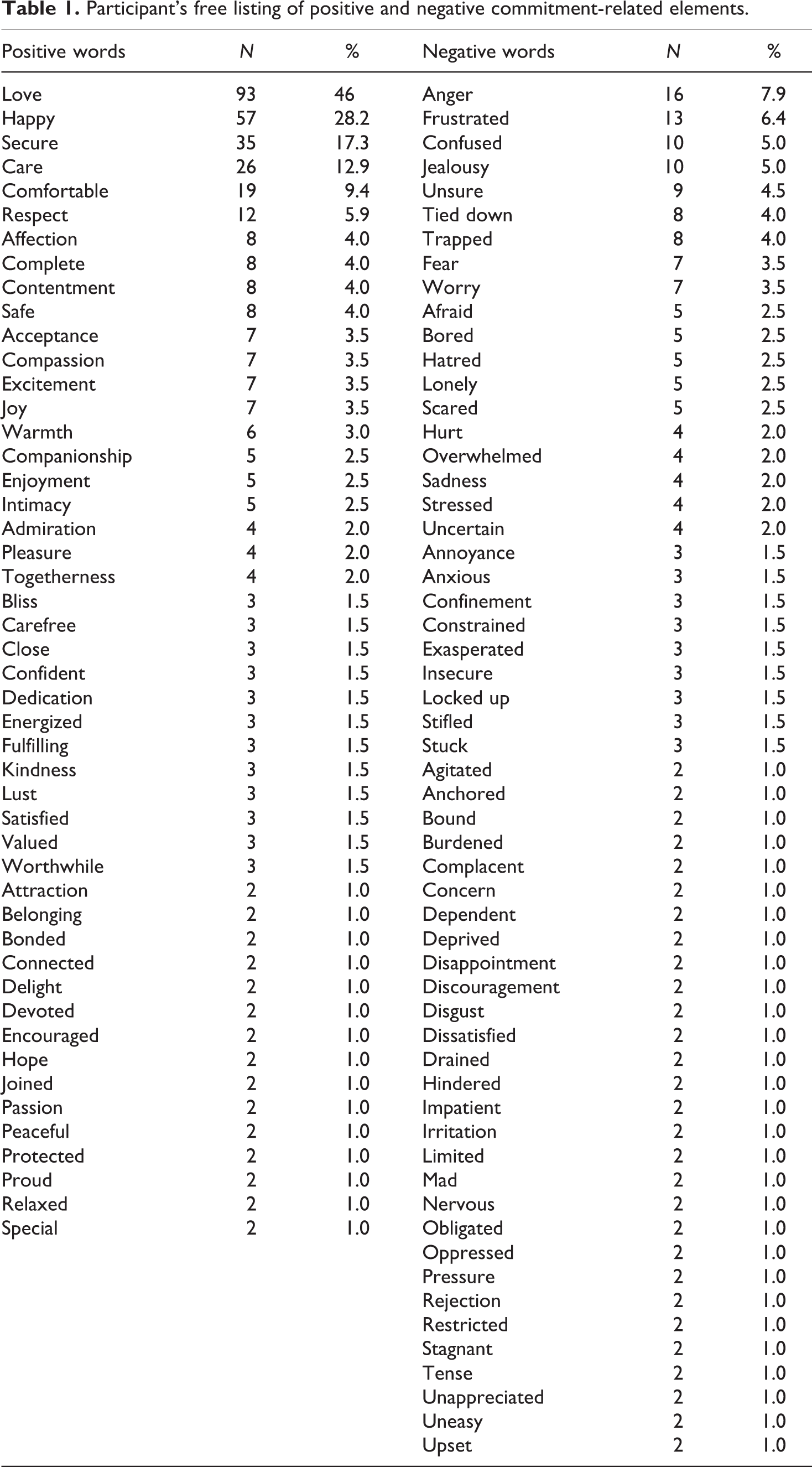
We used a multistep process to extract distinct words generated in response to the open-ended question. Two undergraduate student coders first read approximately 50% of the positive words and independently devised an initial set of distinct elements. They repeated the process with the negative words. The coders then met with the first author, discussed the lists, and created a revised, final coding scheme. The two original coders, plus the first author, used the revised scheme to code all of the positive and negative words. Specifically, single words such as “anger,” “companionship,” or “respect” were readily identified. When a participant used a phrase, however, a judgment was necessary as to whether it referred to a single element or could be divided into two or more elements (e.g., “feeling scared but hopeful” was separated into “scared” and “hopeful” elements). Next, we removed words that simply repeated the broad concept (e.g., “committed”). Overall percentage agreement in coding decisions between the three coders was 85% for positive elements and 86% for the negative elements. All coding discrepancies were resolved through joint review and discussion by the three coders. We then removed all words that were idiosyncratic—listed by only one participant. Table 1 presents the final list of positive and negative words participants associated with commitment in romantic relationships.
Participant’s free listing of positive and negative commitment-related elements.
Positive elements of relationship commitment
The coding procedure resulted in a final list of 48 distinct positive words that were listed a total of 401 times. As seen in Table 1, love was the most frequently listed positive element. Love is often cited as a central ingredient in commitment and vice versa (Fehr, 1988). A number of respondents also associated happiness with relationship commitment. Although one can be committed to a relationship without being happy, respondents envisioned happiness as a common positive element of relationship commitment. In addition, words such as secure, comfortable, safe, and contentment, captured the feeling of security. Respondents also identified various elements associated with the attachment and closeness aspect of relationships (e.g., care, affection, intimacy, and closeness). Finally, a number of respondents focused on the pleasurable side of relationships by listing words such as joy, excitement, enjoyment, and bliss. These words conjure up the fun and pleasure that is often found in committed relationships. In all, respondents identified a wide variety of positive elements in conjunction with relationship commitment.
Negative elements of relationship commitment
A list of 58 distinct negative elements were listed a total of 201 times (Table 1). Respondents listed a number of strong negative emotions, such as anger, frustration, jealousy, hurt, and sadness. The existence of such strong negative emotions indicates that in terms of commitment, not only do people see the positive aspects but apparently they also see the potential for strong negative aspects as well. Uncertainty is another theme that can be seen in the list of negative elements. Words such as confused, unsure, fear, and scared relate to the lack of certainty that can be found in relationships (Knobloch & Theiss, 2011). A number of respondents also associated feelings of being constrained (e.g., trapped, stifled, stuck, and bound) with relationship commitment. As mentioned previously, constraint is a common theme found in the commitment literature (e.g., Johnson, 1999; Levinger, 1999; Stanley & Markman, 1992).
Overall, the results demonstrated that participants could identify a variety of positive and negative elements in conjunction with relational commitment. The generation of positive elements would be expected; however, the identification of a large number of negative elements in conjunction with relationship commitment is important. When hearing the word commitment, perceptions like fear, obligation, and anger may not initially come to mind. However, as people contend with the constantly changing attractions and barriers influencing their commitment, a number of positive and negative experiences are possible (Johnson, 1999; Levinger, 1999). Apparently, even though people tend to have a positive bias toward their close relationships (Fletcher & Kerr, 2010; Murray, 2005), when specifically asked, participants in this study associated both pros and cons with commitment in romantic relationships.
A second study was undertaken to more fully refine the list of positive and negative elements from Study 1. We asked a new sample to rate the elements as to how often they experienced the various elements in conjunction with their commitment. By having people rate the elements, we hoped to identify a possible structure that might underlie those perceptions.
Study 2
Method
Participants and procedures
A total of 326 romantically involved individuals (238 females and 88 males) in graduate and undergraduate human development, communication, and sociology courses at a midsized university in Western U.S. completed questionnaires during class periods. The mean age of respondents was 29 years (median of 27). Relationship status of respondents consisted of 128 married, 25 engaged, 104 seriously dating, 32 casually dating, and 37 not currently involved in a relationship. Those respondents not currently in romantic relationships were not included in subsequent data analyses. The mean relationship length for married respondents was 11.5 years and 1.9 years for engaged and dating respondents. Eighty-five percent of the sample was White, non-Hispanic.
Participants completed a questionnaire that included the 106 positive and negative words generated in Study 1. Participants were asked to rate each word according to the following stem, “My present level of commitment makes me feel …” and ratings ranged from 1 (never) to 7 (all of the time). Words taken from the positive and negative lists in Study 1 were randomly ordered. We were somewhat concerned that our decision in Study 1 to specifically ask participants to list negative aspects might have inflated the presence of those negative aspects; therefore, in Study 2 no distinction was made in the questionnaire between positive and negative elements.
Results and discussion
Ratings of the 106 elements were submitted to a principal axis factor analysis using an oblique rotation. No restrictions were made on the number of factors that could be extracted; however, factors needed to have an eigenvalue of 1.00 or greater, at least three viable items, have a primary factor loading of .50 or greater, and a second loading of no less than .20 difference between the primary and secondary loading (Mertler & Vannatta, 2001). Although 13 factors were extracted with eigenvalues greater than one, only three factors had more than three viable items and accounted for greater than 2% of the variance. In addition, examination of the scree plot indicated a bend after the third factor. Therefore, we examined the three factor solution, which accounted for 58.96% of the total variance.
Table 2 presents the results of the factor analysis and lists items with the strongest loadings in each factor. The first factor, labeled positive commitment elements (PCE), accounted for 37.20% of the variance and was comprised of 45 positive items that met the criterion. Elements such as affection, joy, confidence, belonging, connection, and love are found in this factor. As with Study 1, the experiences of positive elements were expected and in line with the notion that people are typically aware of the positive aspects of commitment.
Factor loadings of specific items in positive, negative, and constraint factors: Studies 2, 3, and 4.
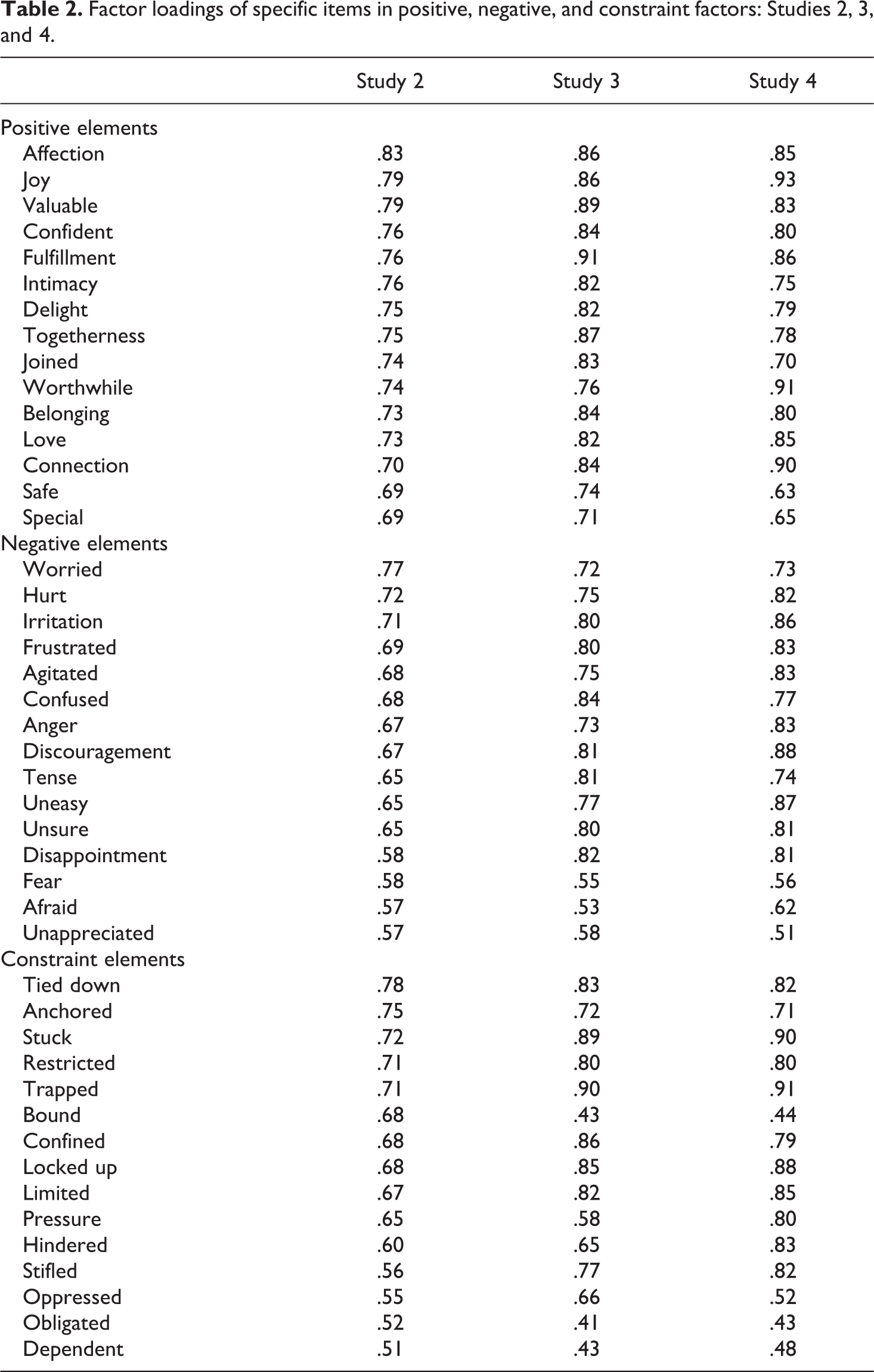
The second factor, labeled negative commitment elements (NCE), was comprised of 24 negative items and accounted for 16.02% of the variance. Respondents reported experiencing worry, irritation, anger, confusion, disappointment, and fear in conjunction with their committed relationships. Such elements also were identified in Study 1 and attest to the inevitable ups and downs of romantic relationships.
The third factor accounted for 5.74% of the variance and was comprised of 15 items that met the criterion. This factor was labeled constraint commitment elements (CCE) and was comprised of items such as stuck, restriction, bound, confined, stifled, and oppression. We were not expecting a third factor to emerge; however, upon further reflection, the finding of a separate constraint factor makes sense in light of several frameworks of commitment that include obligation and constraint as an integral component of commitment (e.g., Johnson, 1999; Levinger, 1999; Stanley & Markman, 1992). Levinger, for instance, contended that relationship commitment involves restraining forces (i.e., barriers) that inhibit the dissolution of relationships. These restraining forces can foster perceptions of constraint, obligation, and suppression.
We created factor scores for PCE, NCE, and CCE based on the factor analysis results to explore the associations among the three commitment-related elements. Means, standard deviations, and αs are presented in Table 3. Each factor exhibited excellent internal consistency. We then computed Pearson correlations among the factors. PCE was inversely correlated with NCE (r = −.73) and CCE (r = −.60), while NCE and CCE were positively correlated (r = .70). The correlations confirm the inverse relationship among PCE and NCE, while indicating that CCE is negatively correlated with PCE but positively correlated with NCE. In addition, these factors were not significantly correlated with relationship length or participant age. However, differences between women and men were found, F(3,286) = 7.04, p < .001, η2 = .126, as men were more likely than women to report experiencing constraint elements, M F = 2.67, M M = 3.13.
Means, standard deviations, and αs for commitment-related elements, relationship commitment, satisfaction, and quality: Studies 2, 3, and 4.
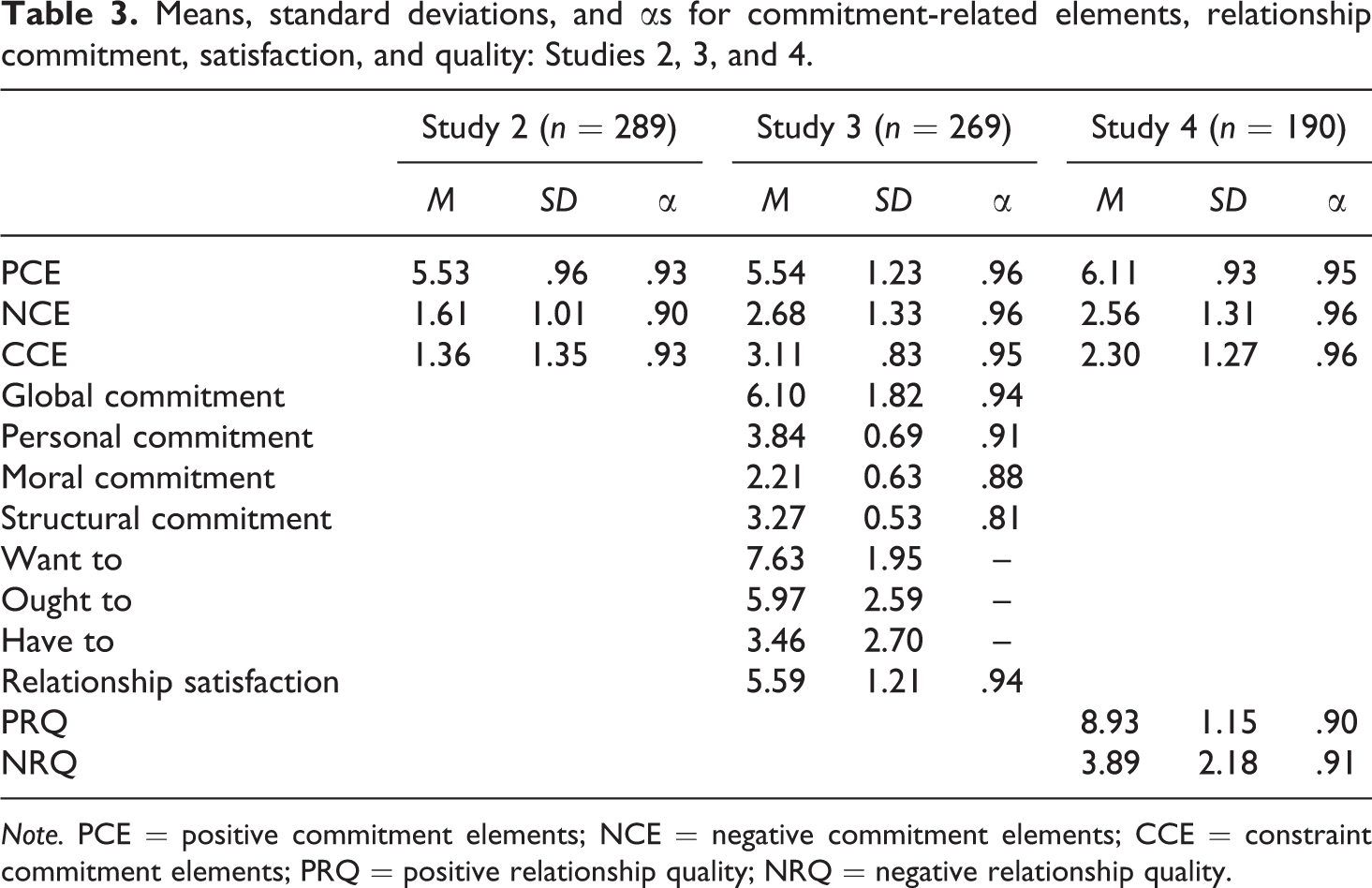
Note. PCE = positive commitment elements; NCE = negative commitment elements; CCE = constraint commitment elements; PRQ = positive relationship quality; NRQ = negative relationship quality.
Overall, Study 2 identified a three-factor structure (positive, negative, and constraint) underlying experiences of relationship commitment, which support several conceptual frameworks of relationship commitment (e.g., Johnson, 1999; Levinger, 1999; Stanley & Markman, 1992). In other words, there is some correspondence between laypeople’s perceptions of their relationship commitment and current theory. A third study was undertaken with two goals in mind. First, we wanted to verify the factor structure from Study 2 using confirmatory factor analysis (CFA). We reasoned that if similar results replicated across a new sample, then the robustness of the three-factor structure would be better established. Then, to explore issues of convergent validity, we examined the associations of PCE, NCE, and CCE with several measures of relationship commitment and satisfaction. Specifically, we expected that if PCE, NCE, and CCE are meaningful dimensions of committed relationships, PCE should be positively correlated with perceptions of higher relationship commitment and satisfaction, while NCE and CCE should be inversely related to relationship commitment and satisfaction.
Study 3
Method
Participants and procedure
A total of 269 romantically involved individuals (183 females and 86 males), recruited from the research subject pool at a midsized Western university in the U.S., completed an online survey for credit. Of the total, 27 respondents were married, 9 engaged, 201 dating exclusively, and 32 dating but not exclusively. Married respondents had been married for a mean of 7.1 years, while the mean relationship length for engaged and dating respondents was 1.8 years. The mean age of respondents was 22 years (median of 20). Seventy-four percent of the sample was White, non-Hispanic.
Measures
Participants rated the commitment-related elements from Study 2 according to the following stem, “My present level of commitment makes me feel ….” To guard against respondent fatigue and for the sake of parsimony, we only used the top 15 loading items for each factor in Study 2 (15 PCE, 15 NCE, and 15 CCE for a total of 45 items). Ratings ranged from 1 (never) to 7 (all of the time), and items were randomly ordered.
Three scales were included to measure various aspects of relationship commitment. First, we used Rusbult, Martz, and Agnew’s, (1998) 7-item Commitment Scale to measure perceptions of global commitment level on an 8-point Likert-type scale ranging from 1 (do not agree at all) to 8 (agree completely). Higher scores indicated perceptions of higher global commitment. Second, participants completed Adams and Jones’ (1997) Dimensions of Commitment Inventory (DCI). The DCI is a 45-item Likert-type instrument composed of three 15-item subscales corresponding to each of Johnson’s (1999) three commitment types (personal, moral, and structural). Items were rated on a scale from 1 (strongly disagree) to 5 (strongly agree) with higher scores indicating perceptions of higher personal, moral, and structural commitment, respectively. We also included Johnson and colleagues’ (Johnson, Caughlin, & Huston, 1999) single-item measures of personal (“How much do you WANT to stay in your relationship with your partner?”), moral (“How much do you feel that you SHOULD stay in your relationship with your partner?”), and structural (“How much do you feel that you HAVE to stay in your relationship with your partner?”) commitment. Each item was rated on a scale from 1 (not at all) to 9 (very much) as to the degree to which the statement reflected their current opinions. Higher scores indicated greater endorsement of each type of commitment.
Finally, perceptions of relationship satisfaction were measured using the Kansas Marital Satisfaction Scale (KMSS; Schumm et al., 1986). The KMSS is composed of three items that assessed feelings of satisfaction with the marriage, with one’s partner as a spouse, and with one’s relationship with one’s spouse. We adapted the items to pertain to romantic relationships rather than just marriage. Higher scores indicated greater relationship satisfaction. Means, standard deviations, and reliability coefficients for all of the measures are presented in Table 3.
Results and discussion
Confirmatory factor analysis
We first conducted CFA to test the factor structure identified in Study 2. Several indices of fit were used to judge the adequacy of the models, including χ2/degrees of freedom (df), comparative fit index (CFI), and the root mean square error of approximation (RMSEA). A χ2/df ratio of less than 3.0 indicates a good fit (Kline, 1998), while the CFI is usually considered to show a good fit when it is .90 or higher (Bentler & Dudgeon, 1996). Browne and Cudeck (1993) suggest that an RMSEA value of .08 or lower reflects a reasonable fit. The results are presented in Table 4. We tested three potential models. First, we explored the possibility that all of the items load on one general factor. One might argue that there is one, general dimension underlying experiences in committed relationships. If so, then distinct positive, negative, and constraint elements would not exist as separate experiential dimensions. Given the strength of the correlations among the three commitment-related factors in Study 2, this argument seemed plausible. In Model 1, we treated the 45 items as all loading on a single factor. This model showed poor fit, with an RMSEA well above .08, a CFI just barely over .90, and a χ2/df ratio over 4.00.
Fit statistics for each model testing the factor structure underlying the commitment-related elements: Studies 3 and 4.
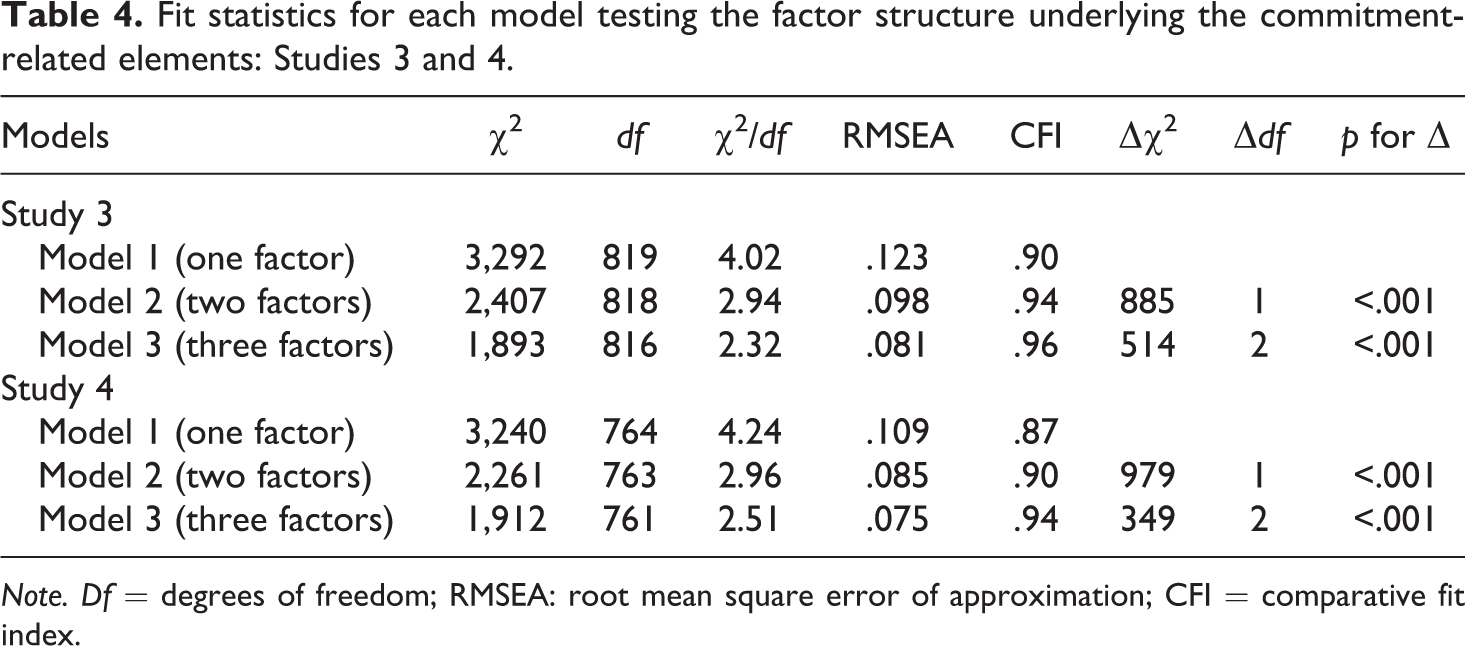
Note. Df = degrees of freedom; RMSEA: root mean square error of approximation; CFI = comparative fit index.
Next, we explored the possibility of a two-factor model with PCE items loading on a positive factor and the NCE and CCE items loading together on a second factor. Findings from Studies 1 and 2 hint that this might be the case. In Study 1, for instance, constraint words were listed by respondents under the negative category. Also, CCE correlated rather strongly with NCE in Study 2. This implies that it is possible that even though the exploratory factor analysis in Study 2 resulted in a third factor, in reality, constraint is just another class of negative elements. Therefore, we tested Model 2, in which the 15 positive items loaded on one factor and the 15 negative and 15 constraint items loaded on a second factor. This model exhibited significantly better fit than Model 1 with a CFI of .938 and χ2/df less than 3.00. However, the RMSEA was still above .08.
Finally, we tested Model 3, the three-factor structure obtained in Study 2, which had the 15 positive items loading on a factor, the 15 negative items loading on a second factor, and the 15 constraint items loading on a third factor. Model 3 revealed a good fit, with a CFI well above .90, an RMSEA of nearly .08, and χ2/df ratio below 3.00. Moreover, Model 3 showed significantly improved fit over Model 2. In short, the results of the CFA supported the three-factor structure of positive, negative, and constraint commitment-related factors identified in Study 2. The individual item factor loadings are presented in Table 2.
Next, we examined the associations among the positive, negative, and constraint factors. The correlations revealed that the higher the perceived frequency of PCE, the lower the frequency of NCE (r = −.73) and CCE (r = −.60). Further, the higher the frequency of NCE, the higher the frequency of CCE (r = .69). The correlations were all significant at p < .001 level and are similar to those found in Study 2. No significant correlations were found for relationship length and age, but gender differences were again found, F(3,255) = 7.13, p < .001, η2 = .077. Women were higher on positive elements (M F = 5.29, M M = 4.80), but men were higher on negative elements (M F = 2.44, M M = 2.80) and constraint elements (M F = 2.39, M M = 3.01).
Tests of convergent validity
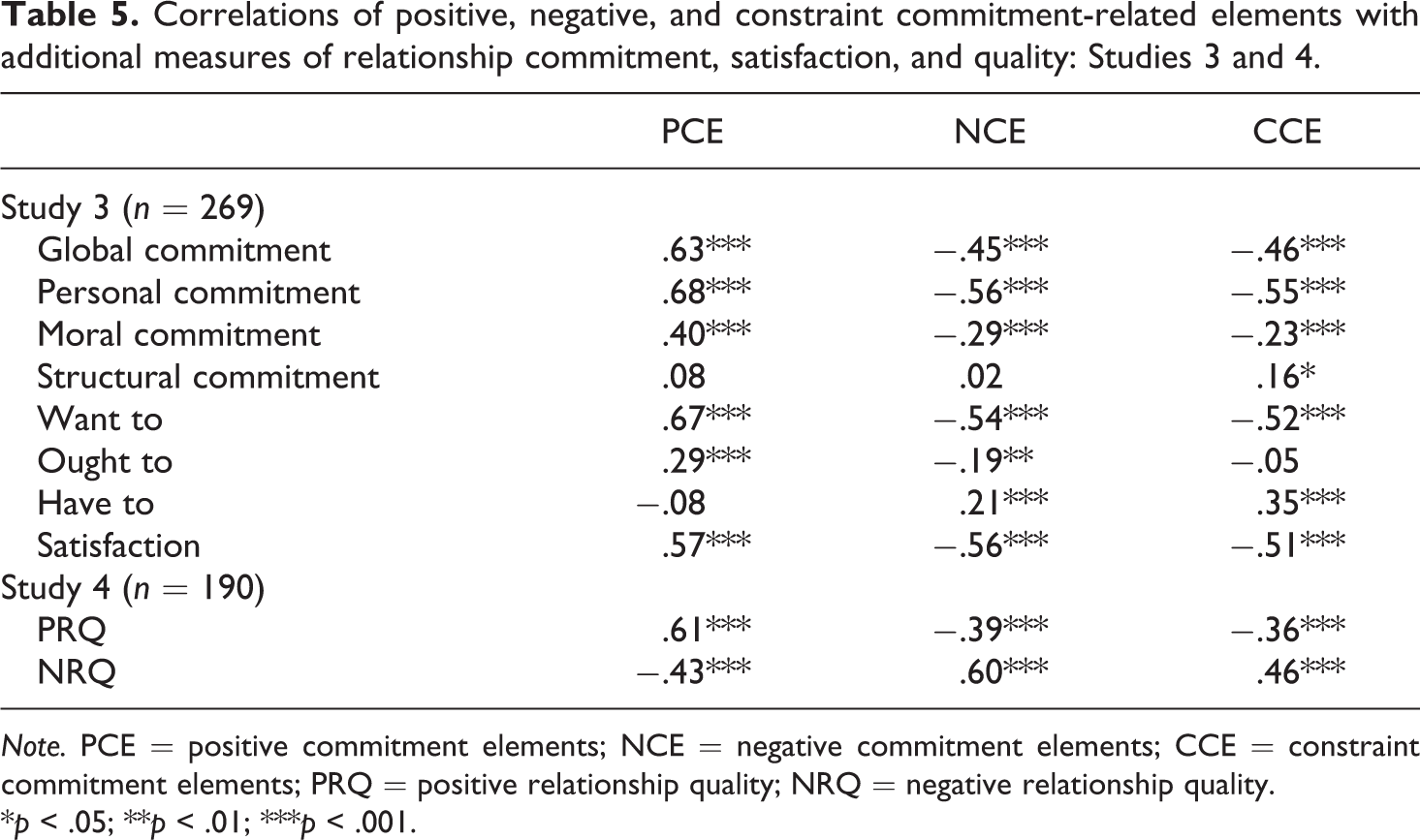
A second goal of Study 3 was to investigate convergent validity by examining the associations of PCE, NCE, and CCE with extant measures of relationship commitment and satisfaction. As shown in Table 5, higher perceived PCE was consistently associated with perceptions of healthy relationship functioning: the higher the levels of global, personal, moral, want to, ought to, and relationship satisfaction, the more likely participants were to experience PCE. Conversely, the lower the ratings of the various measures of commitment and relationship satisfaction, the more likely participants were to report experiencing NCE and CCE. In addition, NCE was positively correlated with the have to commitment item, while CCE was positively correlated with both the structural commitment and the have to commitment item. These correlations are in the expected direction and attest to the convergent validity of the positive, negative, and constraint dimensions of relationship commitment. Furthermore, the correlations are in the small to moderate range and suggest that the three categories of commitment-related elements are related but not redundant aspects of perceptions of relationship commitment and satisfaction.
Correlations of positive, negative, and constraint commitment-related elements with additional measures of relationship commitment, satisfaction, and quality: Studies 3 and 4.
Note. PCE = positive commitment elements; NCE = negative commitment elements; CCE = constraint commitment elements; PRQ = positive relationship quality; NRQ = negative relationship quality.
*p < .05; **p < .01; ***p < .001.
Overall, the findings from Study 3 replicated the factor analysis structure from Study 2. It appears that people perceive three general types of elements—positive, negative, and constraint—in conjunction with relationship commitment. In addition, the results revealed that the three types of commitment-related elements were significantly correlated with perceptions of relationship commitment and satisfaction in the expected direction, supporting the convergent validity of the positive, negative, and constraint commitment-related elements.
A final study was undertaken to demonstrate the discriminant validity of the perceptions of positive, negative, and constraint elements of commitment. If the commitment-related elements are meaningful dimensions of the experience of relationship commitment, they should be able to discriminate other perceptions of the relationship. Fincham and Linfield (1997) found that perceptions of relationship quality include separate positive and negative dimensions and that individuals can simultaneously hold opinions of both the positive and negative qualities of their relationships. These distinct positive and negative perceptions are differentially associated with perceptions of a number of relationship features (Fincham & Linfield, 1997). Therefore, in the present study we predicted that PCE would be positively associated with positive relationship quality and negatively associated with negative relationship quality, while NCE and CCE would be negatively correlated with positive relationship quality and positively associated with negative relationship quality. We also conducted a second CFA with a new sample to further verify the three-factor structure.
Study 4
Method
Participants and procedures
A total of 190 romantically involved individuals (129 females and 61 males) were recruited from the research subject pool at a midsize Western university in the U.S who completed an online survey for credit. Of the total, 25 respondents were married, 23 engaged, 127 dating exclusively, and 15 dating but not exclusively. Married respondents had been married for a mean of 8.4 years, while the mean relationship length for engaged and dating respondents was 1.6 years. The mean age of respondents was 22 years (median of 20). Seventy-one percent of the sample was White, non-Hispanic.
Measures
Participants rated the commitment-related elements from Studies 2 and 3 according to the following stem, “My present level of commitment makes me feel …” on a scale from 1 (never) to 7 (all of the time). In addition, participants completed the Positive and Negative Quality of Marriage Scale (Fincham & Linfield, 1997). The scale was adapted for a wider variety of romantic relationships by changing the references of “spouse” to “partner.” The measure has two separate, 3-item scales, one scale measuring perceptions of positive relationship quality (PRQ) and the second scale measuring negative relationship quality (NRQ). Perceptions were rated as to the degree to which respondents perceived the positive and negative qualities of their relationships on a scale from 0 (not at all) to 10 (extremely). Means, standard deviations, and Cronbach’s αs for the scales are presented in Table 3.
Results and discussion
We again conducted CFA to test the factor structure identified in Studies 2 and 3. We used the same criteria to judge the adequacy of the models as was used in Study 3, including χ2/df < 3.0, CFI > .90, and RMSEA < .08. In Model 1, we treated the 45 observed variables (items) as all loading on a single factor. This model showed poor fit, with an RMSEA well above .08, a CFI under .90, and a χ2/df ratio over 4.00 (see Table 4). Next, we tested Model 2 in which the 15 positive items loaded on one factor and the 15 negative and 15 constraint items loaded on a second factor. This model exhibited significantly better fit than Model 1 with a CFI of .90 and χ2/df less than 3.00. However, the RMSEA was still above .08. Finally, we tested Model 3, the three-factor structure obtained in Studies 2 and 3, which had the 15 positive items loading on one factor, the 15 negative items loading on a second factor, and the 15 constraint items loading on a third factor. Model 3 revealed a good fit, with a CFI of .94, an RMSEA under .08, and χ2/df ratio below 3.00. Moreover, Model 3 showed significantly improved fit over Model 2. In short, the results of the CFA again supported the three-factor structure of positive, negative, and constraint commitment-related factors identified in Studies 2 and 3. The individual item factor loadings are presented in Table 2.
Next, we calculated correlations among the three factors. The correlations revealed that the higher the perceived frequency of PCE, the lower the frequency of NCE (r = −.51) and CCE (r = −.43). The higher the frequency of NCE, the higher the frequency of CCE (r = .60). The correlations were all significant at p < .001 level and are similar, although slightly weaker, than those found in Studies 2 and 3.
Then we calculated correlations of the three commitment-related elements with the two measures of relationship quality (see Table 5). As expected, PCE was positively correlated with PRQ (r = .61) and negatively correlated with NRQ (r = −.43). Thus, the more highly rated the positive elements of commitment, the more strongly people reported positive relationship quality and the less strongly they reported negative relationship quality. Conversely, both NCE and CCE were negatively correlated with PRQ (r = −.39 and r = −.36, respectively) but positively correlated with NRQ (r = .60 and r = .46, respectively). Respondents who rated the negative quality of their relationship higher and the positive quality lower were also more inclined to rate the negative and constraint commitment elements more strongly. All correlations were significant at the p < .001 level.
To further validate the ability of the elements to differentially predict positive and negative relationship quality, we conducted multiple regression analyses in which PCE, NCE, and CCE scores were used to predict PRQ and NRQ. Table 6 displays the results. PCE, NCE, and CCE together explained significant variance in PRQ; however, PCE was the only significant predictor of PRQ, accounting for most of the explained variance. As for NRQ, all three elements significantly predicted NRQ, with NCE being the strongest predictor and accounting for the most variance. CCE was positively associated with NRQ, while PCE was negatively associated with NRQ, although the strength of these associations is much smaller than NCE. Overall, the findings from Study 4 support the prediction that the positive, negative, and constraint elements would be differentially associated with positive and negative perceptions of relationship quality, suggesting that the commitment-related elements were able to discriminate between positive and negative relationship quality. Once again, no significant correlations were found for relationship length and age. Gender differences were found, F(3,312) = 9.46, p < .001, η2 = .083, however, as women were more likely to report experiencing the positive elements than were men (M F = 5.79, M M = 5.44), but men were more likely to report experiencing the constraint elements (M F = 2.34, M M = 3.11).
Results of multiple regression analysis predicting positive and negative relationship quality.

Note. PCE = positive commitment elements; NCE = negative commitment elements; CCE = constraint commitment elements; PRQ = positive relationship quality; NRQ = negative relationship quality.
*p < .05; ***p < .001.
General discussion
The purpose of this research was to investigate the paradox of commitment by examining perceptions of the positive and negative aspects in people’s experience of commitment. Study 1 used individual’s own words to develop an initial taxonomy of positive and negative elements connected with perceptions of commitment. Study 2 identified three primary factors underlying those perceptions—positive, negative, and constraint. Study 3 confirmed the three-factor structure and found evidence of convergent validity with various measures of relationship commitment and satisfaction. Finally, Study 4 again confirmed the three-factor structure and demonstrated that the positive, negative, and constraint elements were differentially associated with ratings of positive and negative relationship quality.
The results demonstrate that perceptions of the pros and cons people associate with their committed relationships fall along multiple dimensions—positive, negative, and constraint. The positive dimension captures aspects such as attachment and closeness, feelings of security, and the pleasurable side of relationships, which are in line with the types of features often associated with commitment. The negative dimension includes aspects such as worry, irritation, anger, confusion, disappointment, and fear. Although probably not the first things that come to mind when thinking about commitment, these aspects attest to the inevitable ups and downs of romantic relationships. The constraint dimension is comprised of elements such as being stuck, restriction, bound, confined, stifled, and oppression and call to mind the restraining forces that often inhibit the dissolution of relationships (e.g., Johnson, 1999; Levinger, 1999; Stanley & Markman, 1992). Furthermore, as predicted, positivity was associated with higher perceived commitment, satisfaction, and relationship quality, while negative and constraint elements were associated with lower commitment and satisfaction and higher negative relationship quality. In all, these findings support the value of the three commitment-related dimensions.
The identification of these three dimensions is significant because they map onto several prominent theories of commitment. Johnson (1999), Levinger (1999), Rusbult, Agnew, and Arriaga (2012), and Stanley and Markman (1992) all describe the positive elements of relationship commitment in terms of attractions, dedication, satisfaction, rewards, and personal commitment. Likewise, the experience of negative and constraint aspects can be found in the concepts of barriers, constraints, obligations, costs, and investments. More important, however, is that individuals in actual romantic relationships not only recognize the benefits of being in a committed relationship but also the costs and obligations. They are fully aware of the contradiction of commitment and that commitment not only includes affection, desire, and security, it can entail restriction, obligation, resentment, rejection, and loss.
It is important to note, however, that the positive elements tended to be rated as occurring more frequently than the negative and constraint elements. Our decision to prompt participants in Study 1 to list both positive and negative thoughts and feelings about commitment may have encouraged participants to list negative features of commitment that otherwise would not have been considered without this prompt. Even though no specific mention of positive, negative, and constraint was given to respondents in Studies 2 to 4, the positive elements were reported as occurring more frequently than the other two dimensions. Therefore, we cannot say that the dimensions of positive, negative, and constraint are equally prominent in individual’s perceptions of commitment. Nevertheless, the experience of negative and constraint aspects is in concert with existing theory, and they appear to play a meaningful role in committed relationships and should be considered in future research.
Implications for theory and research
Our findings have several important implications for the study of relationship commitment. First, they highlight the importance of operationalizing commitment as multidimensional. Although the results of the studies revealed medium to strong correlations among the three elements, the findings that (a) negative and constraint elements did not load (in a reverse way) on the same factor as positive elements, (b) the three-dimensional model provided a better fit to the data than the one- and two-dimensional models in two independent follow-up samples, and (c) the factors were differentially associated with other important relationship perceptions lends support to the argument that commitment might be more accurately conceived of and measured as a multidimensional relationship phenomenon. The findings also align with growing evidence of the multidimensional nature of many core relationship perceptions, beliefs, and motives (e.g., Fincham & Linfield, 1997; Gable, 2006; Murray et al., 2006). Overall, the findings suggest that viewing commitment as just more or less may be missing the nuances of relationship commitment and researchers interested in assessing romantically involved individuals’ perceptions of the nature of their commitment might find the scales developed in this research useful.
Second, the findings reinforce the central role of perception in judging positive, negative, and constraint elements. It is interesting that several of the positive elements might be interpreted as negative or constraint depending on how they are perceived. For example, what one person perceives as togetherness, feeling joined, and belonging could be seen by someone else as being tied down, stuck, or confined, or experienced by a third person as irritation, confusion, or fear. Such findings raise an important question on how individuals come to define aspects of their commitment as positive, negative, or constraint. One possibility is that people compare their current commitment experiences with their standard and if the comparison is relatively congruent they are likely to perceive positive elements as more prominent. However, if the comparison is discrepant, then they will be more likely to perceive negative or constraint elements as more prominent. In this way, perceptions of pros and cons may emerge from a matching of people’s relationship ideals and the reality of current relationships (Simpson, Fletcher, & Campbell, 2001). Although speculative, such an argument is in concert with other frameworks of relationship perception, such as relationship schema and scripts (Baldwin, 1992), relationship expectations (Baker & McNulty, 2013), prototypes (Fehr, 2005), and implicit beliefs (Knee, Patrick, & Lonsbary, 2003).
Third, the findings highlight the importance of constraint in perceptions of the pros and cons of commitment. Whereas the identification of positive and negative elements of commitment was predicted, the identification of a distinct constraint factor was not. Why did constraint emerge as a separate factor? In hindsight, we may have erred in initially assuming constraint would have a negative connotation. Even though constraint may be an integral part of relationship commitment (Johnson, 1999; Levinger, 1999), it is not inherently negative (or positive). Current theory typically views constraint as relating to those forces preventing the dissolution of the relationship, which, in many cases, is desirable. Aspects of constraint, such as belonging, togetherness, or feeling joined, might be seen positively when things are going well in the relationship, but when things are not going so well, these same factors could take on a more negative tone, leading to perceptions of being confined, stifled, or tied down. It also is possible that perceptions of constraint may originate in the wake of the contrasting goals of relatedness and autonomy (Hui, Molden, & Finkel, 2013; Ryan & Deci, 2000). Perceptions of constraint might be less prominent when relationship forces deepen the level of relatedness when increased relatedness is the goal for the individual; conversely, perceptions of constraint may become stronger when relationship forces push for greater relatedness when increased autonomy is the goal for the individual.
Fourth, on a related note, although the findings support current theories of commitment, they also challenge some assumptions of those theories. Current theories typically associate constraint with those forces preventing the dissolution of the relationship (e.g., Johnson, 1999; Levinger, 1999; Rusbult et al., 2012), whereby relationship stability and longevity becomes the “holy grail” of commitment. Some have argued (e.g., Cancion, 1987; Giddens, 1992), however, that the nature of intimate relationships in Western societies have changed from ones built on structure and obligation to ones built on mutual self-fulfillment. Due to the weakening of social norms toward marriage (Cherlin, 2004), the rise of a therapeutic culture that encourages self-improvement and self-awareness (Santore, 2008), and greater flexibility in charting one’s life course (Beck & Beck-Gersheim, 2002), commitment to the ideal of one long-term relationship during one’s life may no longer be the dominant model. According to this alternative perspective, intimate relationships are sought as a means to self-fulfillment and when the values, interests, and identities of the partners begin to diverge, the relationship loses its reason for being and becomes subject to dissolution. Rather than emanating from barriers that keep relationships together (i.e., relationship stability and longevity), constraint might arise from anything that blocks or hinders growth and self-fulfillment, and people would feel that constraint when their relationship experience is not meeting the standard of mutual self-fulfillment. Subsequent research should delve more deeply into the meaning and origin of constraint in intimate relationships.
Fifth, the presence and role of negative and constraint elements highlights a more fundamental question about the nature of risk and vulnerability in the context of relationship commitment. On one hand, as Murray and others point out (Baker & McNulty, 2013; Murray et al., 2006), as people become more dependent on and invested in their relationships, it can leave them open to rejection, hurt, and dissatisfaction, and they can have more to lose if the relationships end. On the other hand, the very process of committing to another is to make oneself vulnerable to that person. To commit to another, one has to put aside his or her own self-interests and desires for the sake of the other and the relationship (Rusbult et al., 2012). Self-interests become “we” interests. As Brown (2012) argues, “vulnerability is the core, the heart, the center, of meaningful human experiences” (p. 12). Hence, relationship commitment entails risk and vulnerability, but this may not necessarily be negative. Such a possibility calls for greater conceptual refinement of risk and vulnerability in theories of relationship commitment.
Finally, although we did not set out to test sex differences, our results indicated that women and men differed in their perceptions of the pros and cons. Women were more likely to report the positive elements (Studies 3 and 4), but men were more likely to report the negative (Study 3) and constraint elements (all three studies). A possible explanation for these differences might be found in the interdependent versus independent relationship construals held by women and men (Gore, Cross, & Morris, 2006). Research has shown that women tend to hold more interdependent and relationship-oriented construals, while men are more independent. For example, as a group, women’s self-identities are oriented toward their connections with others (Cross & Madson, 1997), and they tend to focus on, talk about, and attend to relationship issues more frequently than do men (Acitelli, 1992). Given that a woman’s sense of self is more oriented toward her personal relationships than is a man’s (Cross & Madson, 1997), when women are in relationships with others, their identity is at stake, and thus may be more motivated to see the positive side of their commitment experiences. Conversely, men tend to be more independent oriented and may see commitment as more of a restriction upon their independence and autonomy, leading to a greater focus on the more negative and constraining aspects of committed relationships. Although this explanation is speculative, future research might examine the potential moderating effect of relationship construal upon perceptions of the pros and cons of commitment.
Limitations and conclusions
We need to acknowledge a few additional limitations as a guide for future work. First, the samples were primarily drawn from participants in university classes and community programs. As such, the data likely do not represent the range of people, relationships, and life experiences of the population at large. For instance, we did not ask whether partners were opposite or same sex, and the results may not be generalizable to same-sex couples or individuals. Also, we did not specifically seek out long-term married partners, who likely make up the group of persons with the broadest and most complete view of romantic commitment, or individuals with children, a factor often cited as a prime barrier to leaving a relationship. Finally, our samples included a mix of married and nonmarried participants, and the pros and cons may mean something different depending on where one is in a relationship. Although this research offers a helpful perspective on commitment, sampling more diverse individuals and couples could offer a more comprehensive understanding of the pros and cons of commitment.
A second limitation is that we only focused on perceptions of frequency of experiencing the positive, negative, and constraint commitment-related elements. We chose to focus on frequency in this initial research to first gain a sense for how common the pros and cons are in intimate relationships. If negative and constraint elements rarely occur, for example, it would diminish their meaning in intimate relationships. However, it is possible that the picture might look somewhat different when intensity of experience is added. It is possible that anger might occur less frequently than safety, for example, but when anger does occur, it is more intense than safety. The inclusion of the element of intensity would make for an even clearer picture of the function of pros and cons in relationship commitment.
Third, although the findings of these studies are noteworthy, they could be extended through the use of additional research methods. Subsequent research might use longitudinal methods to examine the role of pros and cons over the course of relationships. The nature of positive, negative, and constraint elements may change over time and what was once positive (e.g., togetherness) may become constraint (stifling) or what was negative (obligation) may become positive (support). Also, prototype methods would help verify and extend the findings of the present research in two ways. First, we could identify the centrality of specific pros and cons in individual’s overall perceptions of commitment. Second, we could identify the relative cognitive accessibility of the pros and cons in individual’s cognitive structures of commitment. In addition, experimental studies would allow us to manipulate potential moderating variables and examine their impact on perceptions of pros and cons. For instance, we could manipulate the level of perceived risk or vulnerability, level of fit between ideal standards and current relationship, or type of relationship construal and test the impact of these manipulations on ratings of the positive, negative, and constraint elements.
Overall, this research addressed a shortcoming of commitment research by uncovering perceptions of pros and cons of commitment from the vantage of those actually in intimate relationships. This is an important contribution to the commitment literature because if future studies are to provide a full understanding of how individuals experience commitment in their intimate relationships, it is imperative to examine the ways in which those individuals subjectively come to know and perceive the pros and cons of their commitment. Our findings demonstrate that (a) people do identify a variety of positive, negative, and constraint elements in their experience of commitment, (b) these elements align with current theory, and (c) the elements are differentially associated with other important relationship perceptions. Our findings provide an important and necessary step in efforts to create a better understanding of how individuals personally view and experience the paradox of commitment in their intimate relationships.
Footnotes
Authors’ note
Parts of this article were presented at the 2012 Annual Conference of the International Association for Relationship Research, Chicago, Illinois, USA.
Acknowledgment
The authors gratefully acknowledge Alyssa Wry and Danya Peters for their assistance in conducting parts of this study.
Funding
This research received no specific grant from any funding agency in the public, commercial, or not-for-profit sectors.