



Abstract
The reported research tested whether the social and agentic content of nostalgic memories varies as a function of attachment-related avoidance. We measured individual differences in attachment-related avoidance and anxiety and coded the interpersonal and agentic content of nostalgic and non-nostalgic narratives. Results revealed that nostalgic (relative to non-nostalgic) narratives contained more social content and that this link was not moderated by attachment-related avoidance. There was a significant association between attachment-related avoidance and attachment-related social content in nostalgic, but not non-nostalgic, past narratives. There was also a significant association between attachment-related avoidance and agency content in nostalgic, but not non-nostalgic narratives.
A growing literature indicates that nostalgia, a sentimental longing for the past, is a self-relevant, but social, and predominantly positive emotion that promotes psychological health and well-being (for a review, see Routledge, Wildschut, Sedikides, & Juhl, 2013). Though a good deal of attention has been and continues to be paid to elucidating the psychological functions of nostalgia, much less consideration has been given to detailing how individual differences may influence the experience of nostalgia. Do psychological traits influence the content of nostalgic memories? Considering that nostalgia is commonplace (Wildschut, Sedikides, Arndt, & Routledge, 2006) and consequential for well-being, it is important to understand the role of individual differences in nostalgic memories.
The little research that has been conducted on the content of nostalgia indicates that nostalgic memories prominently feature the self in the context of close relationships and contain expressions of both positive and negative emotions, although the former outnumber the latter (Wildschut et al., 2006). However, to date, only one study has considered how the content of nostalgic memories varies as a function of individual differences. Hart and colleagues (2011) demonstrated that the nostalgic narratives of high narcissists, relative to low narcissists, comprise more agency-related words (e.g., achieve, competitive).
In the present study, we focus on the potential for attachment style to influence the experience of nostalgia. According to attachment theory, attachment styles represent the extent to which individuals rely on close relationships as stable and available sources of psychological security (Bowlby, 1969). Attachment styles are conceptualized along dimensions of attachment-related avoidance and attachment-related anxiety. Attachment-related avoidance reflects the extent to which one avoids (vs. relies on) interpersonal relationships as a source of psychological security, whereas attachment-related anxiety reflects the extent to which one views oneself as unworthy (vs. worthy) of love (Brennan, Clark, & Shaver, 1998). We examined whether attachment style influences the content of nostalgic memories for several reasons. First, nostalgic narratives typically feature close others (Wildschut et al., 2006). Second, nostalgia heightens social connectedness (a sense of belongingness or acceptance; Wildschut et al., 2006) and bolsters social support at times of loneliness (Zhou, Sedikides, Wildschut, & Gao, 2008). Third and most relevant, attachment-related avoidance moderates the social functions of nostalgia. Specifically, nostalgia increases social connectedness, social competence, relationship satisfaction, and a desire to pursue romantic relationships for individuals low, but not high, in attachment-related avoidance (Juhl, Sand, & Routledge, 2012; Wildschut, Sedikides, Routledge, Arndt, & Cordaro, 2010). In this past research, attachment-related anxiety did not predict differences in the social functions of nostalgia.
In short, given that social functions of nostalgia are moderated by attachment-related avoidance, the content of nostalgia may be influenced by attachment-related avoidance. In the current study, we specifically examined the presence and nature of social content in nostalgic and non-nostalgic narratives. Based on indications that nostalgia is a social emotion (Wildschut et al., 2006), we hypothesized that nostalgic narratives would contain more social content than non-nostalgic autobiographical narratives. We did not anticipate for this effect to be moderated by attachment-related avoidance. That is, attachment style may not be predictive of the mere presence or absence of social content. This is because most nostalgic memories involve others, and, though individuals high in attachment-related avoidance are thought to avoid intimacy and relational closeness, they do not necessarily avoid relationships per se (Collins & Allard, 2001). Instead, we predicted that the qualitative nature of social content would vary as a function of attachment-related avoidance. Individuals low in avoidance might recall deep loving relationships and describe attachment-related feelings of comfort, trust, and security felt in those relationships, whereas individuals high in attachment avoidance might not recall this more intimate attachment-related information. Consistent with this proposition, evidence has indicated memory deficits for attachment-related information among those high in attachment avoidance (Edelstein, 2006), though no research has examined the implications of this deficit for nostalgic memories and few studies have examined this deficit in memories that are not explicitly social. Therefore, we hypothesized that, for nostalgic (but not for non-nostalgic) autobiographical narratives, attachment avoidance would be negatively related to references of feeling loved, protected, and trusted by others. We did not expect a moderating role for attachment-related anxiety, based on the existing literature (Juhl et al., 2012; Wildschut et al., 2010). Finally, individuals high in attachment avoidance are thought to strive for self-reliance (Shaver & Mikulincer, 2002), but few studies have examined how these motives influence autobiographical recall. We hypothesized that, for nostalgic (but not for non-nostalgic) autobiographical narratives, attachment avoidance would be positively related to references of feeling competent, successful, and powerful.
A secondary focus of our study was to replicate findings that nostalgic memories have an ambivalent emotional signature containing more positive than negative emotional expressions. In the previous content analysis work, nostalgic narratives were coded but were not compared to another autobiographical memory (Wildschut et al., 2006). Therefore, we implemented a non-nostalgic autobiographical memory comparison group. We did not expect the emotional content to vary as a function of attachment orientation.
Method
We tested 101 (34 female; M age = 19.49, SD age = 1.70) North Dakota State University undergraduate students. They completed the 36-item Experiences in Close Relationship scale (ECR; Brennan et al., 1998), which measures individual difference in attachment-related avoidance and anxiety. We reverse-scored appropriate items so that higher values indicated greater avoidance (α = .88; M = 3.24, SD = 0.83) or greater anxiety (α = .91; M = 3.87, SD = 1.05). Next, we randomly assigned participants to one of two writing prompts (Wildschut et al., 2006). The nostalgic past writing prompt presented participants with a dictionary definition of nostalgia and asked them to describe the nostalgic memory in writing. The non-nostalgic writing prompt asked them to write about a recent ordinary autobiographical event.
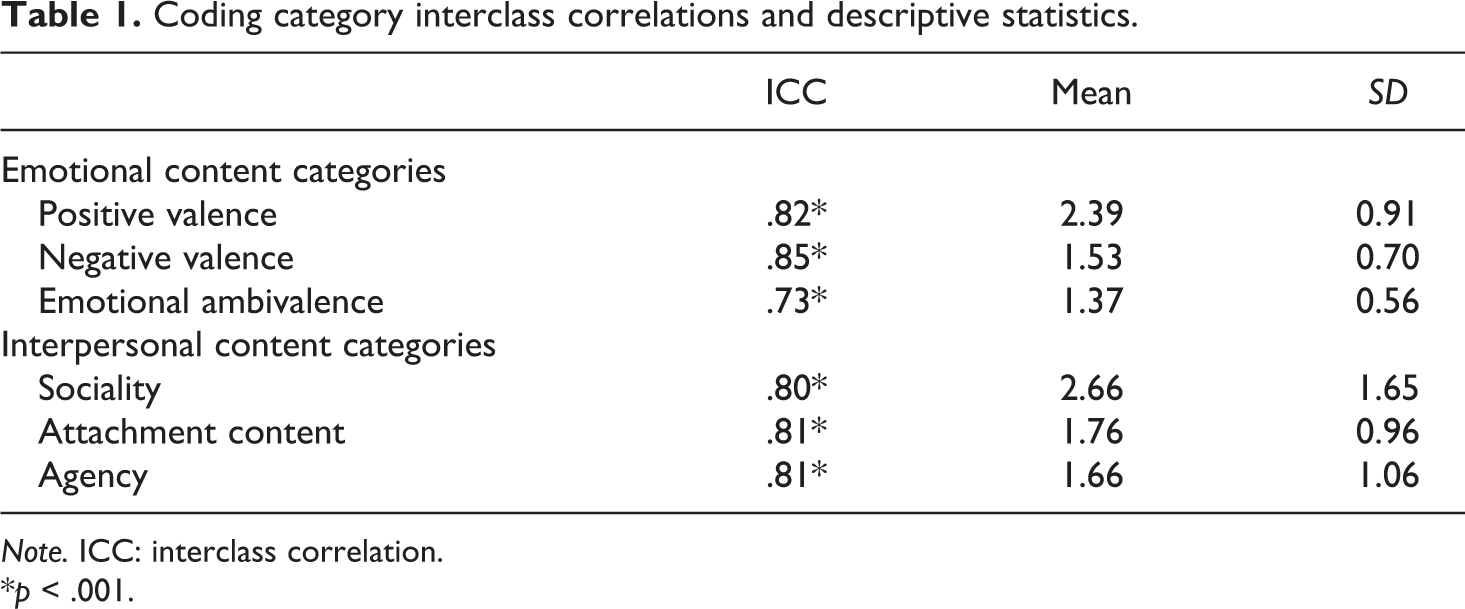
Three trained coders (unaware of hypotheses or conditions) independently rated the narratives on predetermined content dimensions. One coding category assessed the degree of social interaction referenced in the narrative (i.e., social content), one category assessed the degree to which the narrative referenced a strong sense of feeling loved, protected, and trusted by others (i.e., attachment-related social content), and one category assessed the degree of personal competence, success, and power referenced (i.e., agency content). The coders also rated the degree of positive, negative, and ambivalent emotions. Interclass correlations were high. We therefore averaged coder ratings to create an overall score for each category (Table 1).
Coding category interclass correlations and descriptive statistics.
Note. ICC: interclass correlation.
*p < .001.
Results
Social content
We conducted a hierarchical linear regression to determine whether the sociality of nostalgic narratives varies as a function of attachment dimensions. Nostalgic (relative to non-nostalgic) narratives contained more references to social relationships (b = 1.22, SE = .31, t = 3.96, p < .001). All other effects, including possible two and three-way interactions, were nonsignificant (all ps > .19).
We carried out the same analysis on attachment-related social content. Nostalgic narratives contained more attachment-related social content than non-nostalgic narratives (b = .82, SE = .17, t = 4.83, p < .001). Further, greater levels of attachment avoidance corresponded with less attachment-related social content (b = −.30, SE = .10, t = −2.85, p = .005). The Narrative Type × Attachment Avoidance interaction was the only significant interaction (b = −0.50, SE = .22, t = −2.26, p = .03). Predicted mean tests revealed that, at low levels of avoidance (−1 SD), nostalgic narratives contained more attachment-related social content than non-nostalgic narratives (b = 1.29, SE = .23, t = 5.49, p < .001). We observed no effects at high levels of attachment avoidance (b = 0.36, SE = .23, t = 1.52, p = .13). Simple slope tests revealed that, within the nostalgia condition, higher attachment avoidance was associated with less attachment-related social content (b = −0.55, SE = .14, t = −3.91, p < .001). However, this was not the case for the control condition (b = 0.01, SE = .14, t = 0.07, p = .95; Figure 1). All other main and interaction effects were nonsignificant (ps > .12).
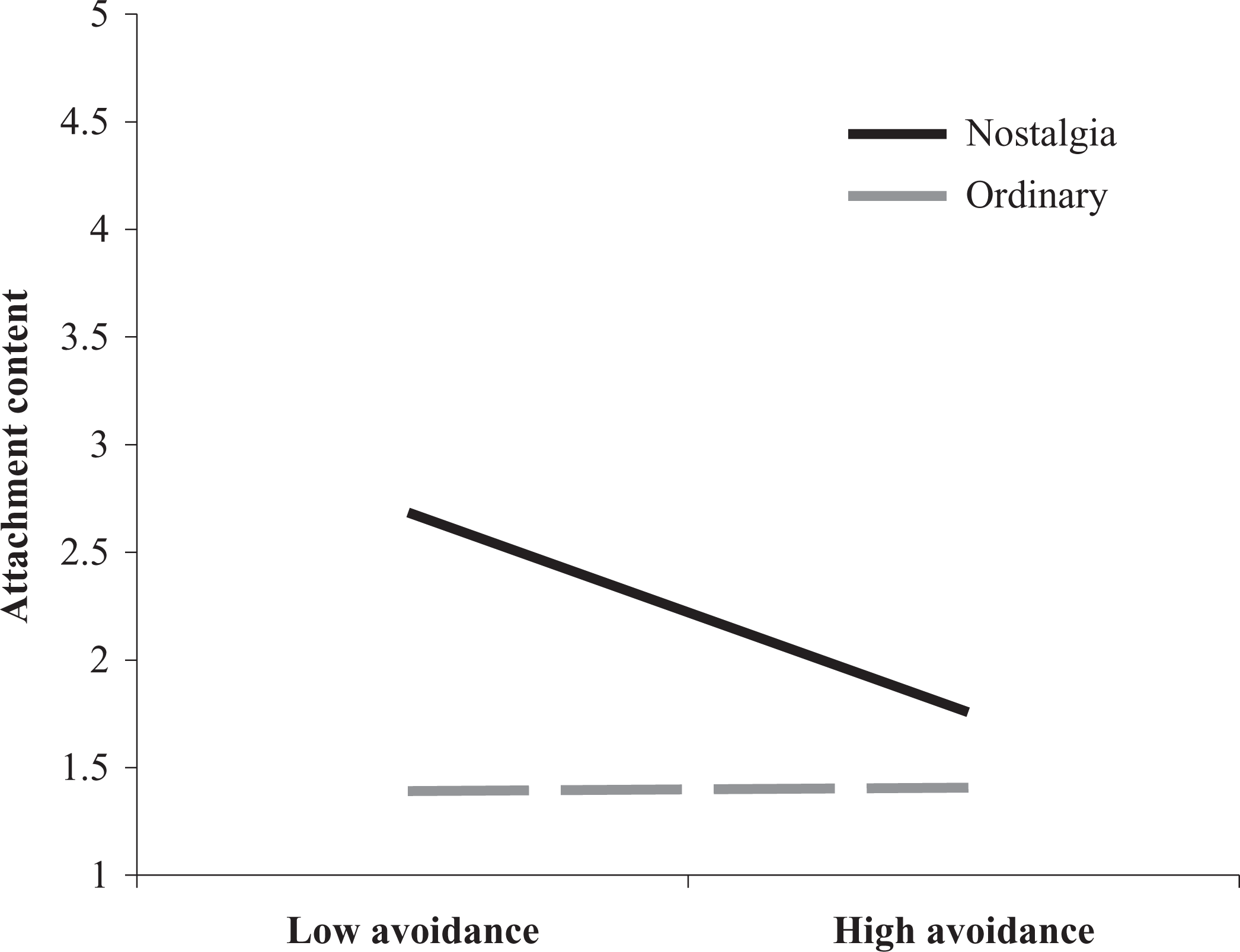
The association between attachment content and attachment-related avoidance in nostalgic and ordinary writing conditions.
We conducted the same analyses on agency content. Nostalgic narratives contained more agency themes than non-nostalgic narratives (b = 0.48, SE = .21, t = 2.35, p = .02). The Narrative Type × Attachment Avoidance interaction was marginal when the model included anxiety and all possible interactions (b = 0.48, SE = .27, t = 1.79, p = .076) but significant when anxiety and the accompanied interactions (all nonsignificant) were excluded (b = 0.50, SE = .25, t = 2.02, p = .046). Predicted means tests revealed that, at high levels of attachment avoidance (+1 SD), nostalgic narratives contained more agency references (b = 0.89, SE = .29, t = 3.11, p = .002). We did not observe a difference at low levels of attachment avoidance (b = 0.07, SE = .29, t = 0.25, p = .80). Simple slope tests also revealed that, within the nostalgia condition, higher attachment avoidance was associated with more agency references (b = 0.37, SE = .17, t = 2.12, p = .04). This was not the case, however, in the control condition (b = −0.13, SE = .17, t = −0.74, p = .46; Figure 2). All other main and interaction effects were nonsignificant (ps > .28).
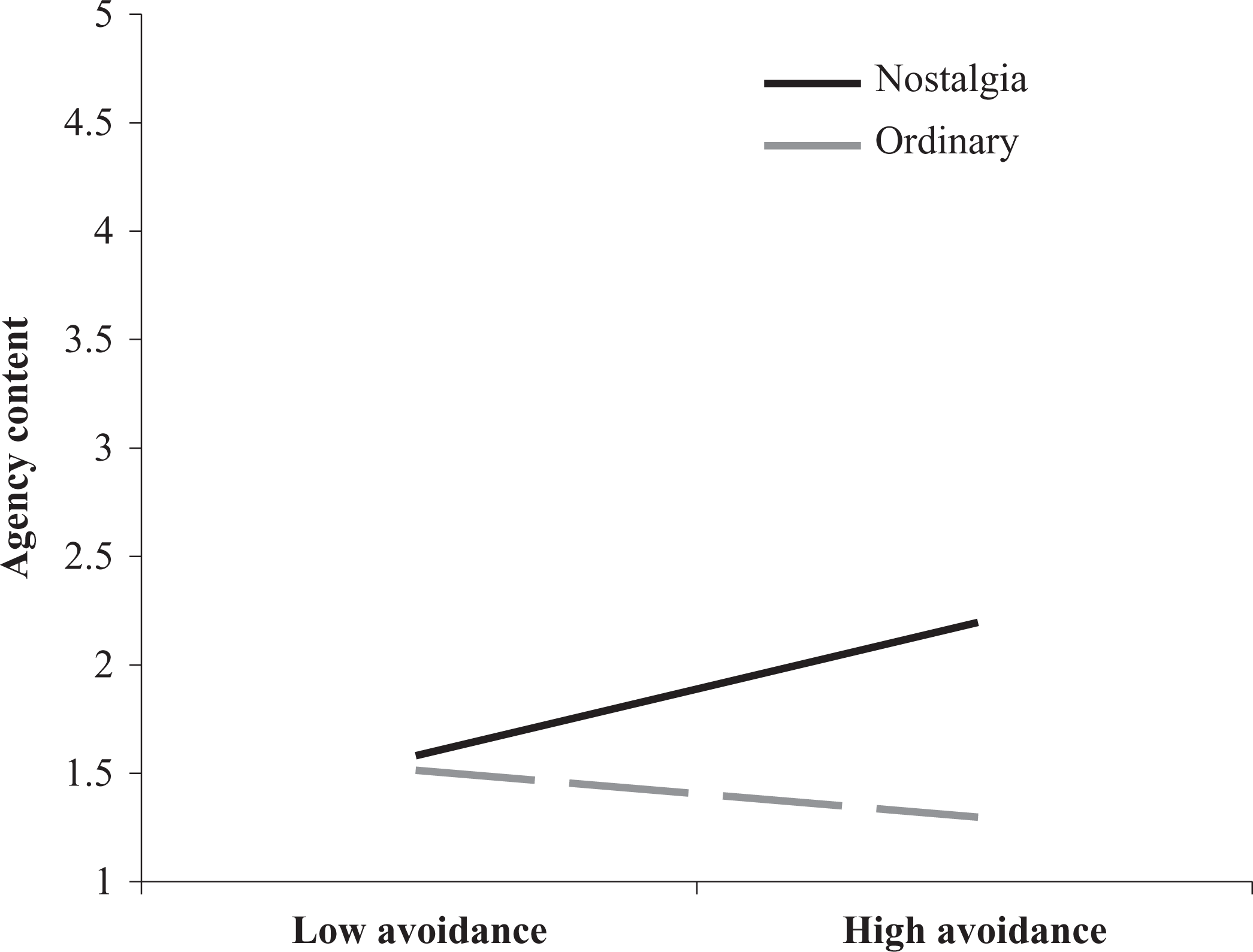
The association between agency content and attachment-related avoidance in nostalgic and ordinary writing conditions.
Emotional content
To investigate the affective profile of nostalgic memories, we first conducted a 2 (affect: positive or negative emotions) × 2 (narrative type: nostalgic vs. ordinary) mixed analysis of variance (ANOVA) on emotions. Nostalgic memories contained stronger emotions overall (M = 2.06, SE = .05) than ordinary memories (M = 1.86, SE = .05), F(1, 99) = 43.23, p < .001. Further, the narratives contained more positive (M = 2.39, SE = .08) than negative emotions (M = 1.53, SE = .07), F(1, 99) = 6.95, p = .01. These main effects were qualified by a significant Narrative Type × Affect interaction, F(1, 99) = 18.98, p < .001. Follow-up Fisher’s least significant difference (LSD) pairwise comparisons revealed that nostalgic narratives contained stronger positive emotions (M = 2.77, SE = .12) than negative emotions (M = 1.34, SE = 1.34), F(1, 99) = 59.17, p < .001. Ordinary narratives did not differ significantly on expressions of positive (M = 2.01, SE = .12) and negative (M = 1.72, SE = .09) emotions, F(1, 99) = 2.45, p = .118.
As before, we conducted a series of hierarchical linear regressions. Nostalgic (relative to non-nostalgic) narratives contained stronger positive emotions (b = 0.78, SE = .16, t = 4.80, p < .001). All other effects were nonsignificant (all ps > .07). Nostalgic (relative to non-nostalgic) narratives contained less strong negative emotions (b = −.39, SE = .13, t = −2.95, p = .004). All other effects were nonsignificant (all ps > .45). Finally, nostalgic (relative to non-nostalgic) narratives contained more ambivalent emotions (b = .26, SE = .11, t = 2.37, p = .02). All other effects were nonsignificant (all ps > .09).
Discussion
The current study builds on research indicating that individual differences predict nostalgic content (Hart et al., 2011). In line with Wildschut, Sedikides, Arndt, and Routledge (2006), the presence of social information was a common feature of nostalgic narratives: It did not vary as a function of attachment avoidance. However, the quality of social content did vary as a function of attachment avoidance. The nostalgic memories of those low in avoidance were more likely to reflect a sense of being loved, trusted, and comforted by others than the nostalgic memories of those high in avoidance. These findings suggest that, even though nostalgic memories by and large feature close relationships, the way in which these relationships are reflected upon is profoundly shaped by attachment-related avoidance.
The current research also adds to the understanding of the link between nostalgia and the attachment system more generally. Attachment theory proposes that experiences with interpersonal relationships create stable cognitive structures (i.e., internal working models) that organize interpersonal knowledge and contain scripts that direct interpersonal behaviors. Internal working models operate automatically and can be triggered by attachment-related events (Collins & Allard, 2001). The current results provide two strings of evidence suggesting nostalgia may be one such experience that brings online the attachment system. First, the content of nostalgic narratives reflected one’s level of attachment-related avoidance. That is, individuals high in attachment avoidance are thought to eschew interpersonal relationships as a source of psychological security (Brennan et al., 1998) and, consistent with this, the nostalgic memories of high-avoidance individuals contained fewer attachment-related references. Individuals high in attachment avoidance are also thought to value self-reliance (Shaver & Mikulincer, 2002), and there was evidence that nostalgic memories of high-avoidance individuals contained more references to personal competence, success, and power. This finding is noteworthy because it sheds light on the role of nostalgia for individuals high in attachment avoidance. Second, attachment-related avoidance was related to attachment-related social content and agency-related content in nostalgic, but not in non-nostalgic, memories. We note that, whereas research suggests that psychological threat activates the attachment system (Mikulincer, Gillath, & Shaver, 2002), there is no evidence that nostalgia is a threat. Instead, nostalgia is triggered by psychological threat and helps mitigate the impact of interpersonal threats (e.g., loneliness) by making salient a sense of social support (Zhou et al., 2008). Nostalgia thus appears to be a unique psychological resource that individuals, particularly those low in attachment avoidance, can implement to activate the attachment system in response to threat.
Consistent with previous research on attachment differences in the interpersonal function of nostalgia (Wildschut et al., 2010), the current study did not find a link between the attachment content of nostalgic narratives and attachment-related anxiety. On the surface, this issue seems perplexing. Why would individuals who view themselves as unworthy of love be as likely to reference love, trust, and support in nostalgic narratives, as individuals who do view themselves as worthy of love? Those high in attachment anxiety are thought to be hypervigilant about relationships and highly attentive to attachment information (Collins & Allard, 2001; Mikulincer et al., 2002). Thus, instead of avoiding interpersonal content when being nostalgic, those high in anxiety might cling to idealized relationships from their past, which mitigate feelings that they are unworthy of affection.
Finally, the current study builds upon past work on the emotional content of nostalgic narratives. The study replicates previous findings on the ambivalent emotional nature of nostalgia (Wildschut et al., 2006) but also extends those findings by providing a non-nostalgic comparison: nostalgic memories contain significantly more positive and ambivalent, but less negative, emotional content than ordinary autobiographical memories.
Our findings suggest that, instead of being a one-size-fits-all experience, nostalgic memories are shaped by attachment-related avoidance. It is critical to pursue investigations of individual differences in the content of nostalgia not only to determine the nuanced forms that nostalgic memories take but also to gain insight into the interpersonal and psychological benefits that nostalgia provides.
Footnotes
Funding
This research received no specific grant from any funding agency in the public, commercial, or not-for-profit sectors.