



Abstract
Seeking help from close friends is beneficial for help seekers but also entails costs. Past research on social support suggested that East Asians were more likely than their North American counterparts to perceive relational costs (e.g., causing trouble for close friends), whereas North Americans tended to selectively perceive personal costs (e.g., admitting incompetence). We first collected European Canadian and Japanese people’s everyday experiences of help-seeking behaviors. We then examined whether norms would mediate the relationship between perceptions of costs and expected closeness in friendship. For European Canadians, we found such meditating relationships only for personal costs; whereas for the Japanese, the relationships were observed for both personal and relational costs. Implications for social cognitive research and clinical research are discussed.
People often seek help from friends. Students ask classmates to lend them notes from a missed class. Doctors ask other doctors to provide feedback to confirm their diagnoses. Married couples seek advice from their friends to solve marital crises. Such help-seeking behaviors involve individuals’ explicit requests for aid from other persons when they encounter a problem or a need. When individuals consider asking for help, they become sensitive to the issue of whether the help request is socially appropriate or not. If the requested help is outside the accepted norms, help seekers could experience negative social outcomes as a result. Therefore, people are more likely to seek help if they infer that the request seldom burdens the help provider in terms of time, effort, or resources (DePaulo, 1983). If there are cultural variations in people’s beliefs about seeking help from close others, elucidating the diverging effects of the cultural norms will benefit research on close relationships, social support, and culture. In this study, we tested whether the cultural norms of help-seeking behaviors—which involve relational costs for East Asians and personal costs for North Americans—influence expectations of closeness in close, same-sex friendships.
Costs of seeking help in east versus west
Past research indicates that East Asians and North Americans differently perceive the costs of seeking help from close others. People from East Asia are more likely than North Americans of European descent to perceive relational costs; that is, costs associated with one’s self-evaluation as interdependent, supportive of harmonious relationships, or perceptive about others’ welfare (Kim, Sherman, Ko, & Taylor, 2006; Kim, Sherman, & Taylor, 2008). For example, Asian Americans and Asian immigrants who hesitated to seek help from close friends or family members were highly concerned about embarrassment, harming a relationship, worsening a problem, the negative evaluations of others, or one’s obligation to be a mature group member who lives up to group standards (Taylor et al., 2004). In addition, when they wrote letters soliciting help from close friends or family members, Asian Americans and Asian immigrants reported higher levels of distress and showed greater increase in cortisol levels than did European Americans (Taylor, Welch, Kim, & Sherman, 2007).
Help-seeking behaviors also entail personal costs, because asking for help makes individuals feel less self-satisfied as a result of being less independent, self-contained, or self-reliant. In general, both North Americans and East Asians perceive personal costs when they exchange support with close friends (Uchida, Kitayama, Mesquita, Reys, & Morling, 2008); however, past research indicates that North Americans tend to be more sensitive to perceived personal costs than relational costs (Fisher, Nadler, & Witcher-Alagna, 1983). For people from Western cultural traditions, seeking help from others implies failure or an inability to handle difficulties in their lives and involves admitting their incompetence and inferiority to help providers (Nadler, 1983). Therefore, asking for help in certain situations can threaten their positive self-image. For example, American participants tended to perceive high costs when they sought help to overcome problems that were central to their identity (Lee, 2002), when they sought help from socially powerless individuals or people from a lower social class (Druian & DePaulo, 1977), or when help providers were meaningful social comparison targets (i.e., attitudinally similar persons such as close friends; Fisher, Harrison, & Nadler, 1978).
Cultural norms, expected consequences in friendship, and costs of seeking help
The act of seeking help, however, takes place in specific sociocultural contexts. We maintain that, to better understand the structure of help-seeking behaviors, it is necessary to consider not only relational and personal costs of help-seeking behaviors but also expected consequences (e.g., expected closeness in friendship after seeking help) and norms.
The act of seeking help from close friend is different from the act of seeking help from strangers. In addition to solving the problem at hand, people must consider the consequence of seeking help in the context of friendship. If the help provider evaluates the help seeker’s request to be optimal, they can maintain closeness in friendship or their closeness in friendship could be enhanced. However, if the help provider evaluates the request to be beyond the appropriate level, their closeness in friendship could be undermined. In addition to being evaluated by the help providers, the act of seeking help from close friend is observed and evaluated also by other members of the cultural group to which help seekers and help providers belong. That is, individuals are concerned about how other members would evaluate the act or how other members would act in the same situation. In other words, help-seeking behaviors are subjected to social influence, in that people tend to seek help when they expect other members of the cultural group to approve the act of seeking help because it is perceived as a common practice (see Prentice & Miller, 1993). Therefore, we included the perceived norm of help-seeking behaviors. Throughout this article, we use the word normativity and common interchangeably to describe individuals’ perception of norm.
To formulate hypotheses that would take norms in a given culture into account, we used the intersubjective approach to culture (Chiu, Gelfand, Yamagishi, Shteynberg, & Wan, 2010). A basic premise of the intersubjective approach to culture is that people act on what they perceive to be the common beliefs, values, or practices in their culture. Chiu et al. argued that this perception of norm, which they call intersubjective perception, forms a mental representation of cultural ideas, from which members of a given culture acquire guidance to coordinate their behaviors within that culture. The term intersubjective perception is sometimes used interchangeably with generalized common ground (Kashima, Klein, & Clark, 2007), perceived consensus (Zou et al., 2009), or cultural descriptive norms (Fischer, 2009; Shteynberg, Gelfand, & Kim, 2009). In colloquial terms, it is best described as “common sense” among members of a given culture (Zou et al., 2009, p. 581); it is the awareness of what other members of one’s own cultural group know. These and other researchers maintain that individuals who belong to a given cultural group are required to develop intersubjective perception in order to socially verify their actions (Hardin & Higgins, 1996), form trust with others (Hardin & Conley, 2001), and avoid offending other members of the culture (Yamagishi, Hashimoto, & Schug, 2008).
According to the intersubjective approach, characteristics of action are sometimes associated with the perception of norm to predict cultural variations in psychological tendencies. For example, instead of personal beliefs about the applicability of individualistic or collectivistic statements (e.g., how much an individualistic statement applies to oneself), beliefs about the extent to which such statements applied to members of one’s own culture were a better predictor of whether one engaged in target traditional behaviors, and this in turn helps to explain cultural variations in those behaviors (Fischer et al., 2009). This perceived norm of individualistic or collectivistic behaviors also predicted cultural differences in perceptions of harm and attributions of blame for office workers’ behaviors (Shteynberg et al., 2009). On the basis of the above research on culturally unique perception of cost, we assume that in a given culture, help-seeking behaviors are likely to be associated with the perceived norm of such behaviors and can be used to predict psychological tendencies in that culture.
The intersubjective approach suggests that perceived norms are highly associated with expected consequences in friendship (e.g., intimacy and closeness) because actions based on norms provide cues about common ground on which good relationships can be established. Past research indicates that as individuals establish common beliefs, values, or practices in their relationships, they become close or intimate with each other, and such closeness is reflected in their actions (Hardin & Conley, 2001). Furthermore, individuals are likely to conform to the opinions of others when they want to affiliate with them (Prentice & Miller, 1993; Sinclair, Huntsinger, Skorinko, & Hardin, 2005). Therefore, individuals in general act on what they perceive to be normative practices, even if such actions are at odds with their personal beliefs (Prentice & Miller, 1993). These findings suggest that individuals believe that close relationships are unlikely to develop when their behavior violates the beliefs mutually shared by members of a given culture. In the context of help-seeking behaviors, individuals may assume that seeking uncommon help from close others will challenge or violate established normative beliefs, values, or practices regarding close relationships. In this case, help seekers may expect that seeking such help will lessen the closeness of the relationship by going against normative beliefs about how friends act toward one another.
Hypotheses
This article undertakes to demonstrate that cultural norms are an important underlying factor of culturally specific costs of help-seeking behaviors and that these norms play a pivotal role in individuals’ expectations for relational outcomes in close friendships. The target cultural groups were European Canadian and Japanese undergraduate students, and the target relationship was close, same-sex friendships. 1
We examined cultural variations in the association among costs, norms, and closeness in friendships based on the following assumptions: People’s perception of costs would be associated with their perception of norms. That is, when a help-seeking behavior is characterized by specific costs, people perceive the behavior to be less common in friendships. The perception of norm would be associated with expected consequences of behaviors (closeness in friendships). That is, if people perceive a help-seeking behavior to be less common in friendships, they will expect lower closeness in their friendships after seeking help. Therefore, the degree of perceived norm of help-seeking behaviors would mediate the relationship between perceived costs of help-seeking behaviors and expected closeness in friendships.
We then hypothesized that (1) perceived cultural norm (norm of behaviors in a given culture) would mediate the relationship between relational costs for seeking help and expected closeness in friendships and that such a pattern is stronger for Japanese participants than for Canadian participants. We also hypothesized that (2) perceived cultural norm of behaviors would mediate the relationship between European Canadians’ perception of personal costs and expected closeness in friendships but not between their perception of relational costs and expected closeness in friendships. Finally, we hypothesized that (3) perceived cultural norm of behaviors would mediate the relationship between Japanese perception of personal costs and expected closeness in friendships in addition to the relationship between their perception of relational costs and expected closeness in friendships. These specific hypotheses are based on past cross-cultural studies which suggest that relational costs are more important to Japanese than to North Americans (Kim et al., 2006, 2008), North Americans consider personal costs as one of the most important characteristics for seeking help (e.g. Fisher et al., 1983), and relational and personal costs are equally important to Japanese individuals (e.g. Uchida et al., 2008).
Overview of studies
We tested these hypotheses by conducting three studies. In Study 1, we identified help-seeking behaviors shared among European Canadians or among Japanese people. Using an open-ended format, we asked European Canadian and Japanese participants to describe their everyday experiences of seeking help from close, same-sex friends. In Study 2, presenting the list of help-seeking behaviors generated by European Canadians and Japanese participants in Study 1, we asked a different group of European Canadian and Japanese participants to report (1) relational costs, (2) perceived cultural norms, entailed in the target help-seeking behaviors, and (3) expected consequences in terms of closeness in friendships. We analyzed the relationships between these variables and examined the cultural variations in the mediation effect. In Study 3, we conceptually replicated the Study 2 results, while adding an additional measure—personal costs. We again used the same list of help-seeking behaviors as in Study 2. A new group of European Canadian and Japanese participants were asked to report (1) perceived relational costs, (2) perceived personal costs, (3) perceived cultural norms of the help-seeking behaviors, and (4) expected closeness in friendship. We analyzed the relationships between relational costs, closeness in friendships, and cultural norms as a replication of Study 2. We also analyzed the relationships between personal costs, closeness in friendship, and cultural norms.
In the current study, we operationalized the cultural norms in two ways. First, we used the frequency of participants’ identical/synonymous descriptions about help-seeking behaviors as an indicator of norms (see Stimuli Selection in Study 1, for details). According to Cohen (2007), a list of behavioral descriptions obtained through an open-ended questionnaire roughly corresponds to the behaviors people in a given culture encounter in real life (albeit imperfectly). We therefore reasoned that, if many (or few) participants recall a particular help-seeking behavior, the frequency value of the behavior indicates that they often (or seldom) experience or observe such a behavior in a given social environment. We admit that, although the frequency value based on such a single set of data does not represent the actual number of frequency observed in a given culture, and may not perfectly estimate the degree of availability or occurrence of the target help-seeking behaviors, it is still a useful value to help us picture to what extent the target behaviors occur and are experienced among people in Japanese or Canadian culture. In Studies 2 and 3, we operationally defined cultural norms as participants’ self-report on how common the selected help-seeking behaviors are in their friendships. Zou et al. (2009) noted the self-report of consensus as a valid indicator, arguing that people refer to the knowledge about how common concrete behaviors are in order to arrive at acceptable decisions in a given culture.
Study 1
Method
Participants
Participants were 123 European Canadian undergraduate students (58 females) at the University of Alberta, Canada, and 110 Japanese undergraduate students (43 females) at Kyoto University and Kobe University, Japan. The average age of Canadian participants was 19.38 (SD = 3.21) and that of Japanese participants was 20.69 (SD = 2.16). Participants responded to an online questionnaire at separate workstations in groups of 5 to 20. Canadian participants received a partial course credit, and Japanese participants received a US$5 gift certificate for their participation.
Procedure
To facilitate their understanding of the task, participants read the following passage describing a definition of close friendship based on empathetic concerns (Dunn, 2004; Tomasello, 2009) and mutual exchange of support (Burleson & Samter, 1994; Clark, 1983). A close friend is someone who doesn’t have to be told when I am in trouble. They sense it. If something is worrying me, my friend will say “I can see you’re upset about something. What’s wrong?” without me having to say anything. For example, if they come around and see that I am working on a tough assignment, they immediately notice that I am in trouble. I would do the same for my friend. If my friend is upset or worrying about something, I can sense it right away.
Participants were asked to think of same-sex friends whose relationship with them was as intimate as the one described in the passage. Afterward, they reported their concrete experiences of asking a favor of close, same-sex friends. In order to help us select favors (i.e., help-seeking behaviors) specific to close friendships, participants responded to two screening questions: (a) whether or not their friend actually granted the favor and (b) the inappropriateness of the favor if asked outside of close friendships (9-point scale). Note that we did not use these questions to estimate perceived norm of behaviors, because participants might have overestimated the commonality of their undesirable behaviors as the research on the false consensus effect documents (Marks & Miller, 1987). We merely used these questions to screen out the behaviors unrelated to close friendships. Participants answered the questionnaires in their native language. The English version of the questionnaire was first translated into Japanese and then back translated into English for consistency. Any disagreements in translations were resolved through discussions among the translators.
Results and discussion
Participants reported 1,407 help-seeking behaviors in total (M = 6.04); these numbers are comparable to those in previous studies that used similar methods (e.g., Fehr, 2004; Kitayama, Markus, Matsumoto, & Norasakkunkit, 1997). To focus only on help-seeking behaviors specific to friendship interactions, we excluded favors that had not been granted by friends, because the friends might have considered those favors to be unusual in friendship contexts. We also excluded help-seeking behaviors that would be considered appropriate, had the favor been asked outside of a close, same-sex friendship (i.e., rating less than 5, the theoretical midpoint of the scale, on question b). As a result, 25% of the help-seeking behaviors (355 behaviors, of which 197 were reported by Canadians and 158 were reported by Japanese) were excluded from further analysis. We excluded five Canadian and seven Japanese participants who did not report any help-seeking behaviors specific to friendship interactions. We then compared the frequency of help-seeking behaviors between the two cultural groups and found that Japanese participants reported fewer help-seeking behaviors (M = 3.83, N Situation = 396) than did European Canadians (M = 5.56, N Situation = 656), t(219) = 4.06, p < .001. This result corroborated a previous study in which East Asians perceived higher relational concerns than North Americans and thereby were less likely than North Americans to seek help from close others (Taylor et al., 2007), based on which we interpret that the low frequency of reported help-seeking behavior might result from Japanese participants’ experience of embarrassment, harming a relationship, worsening a problem, negative evaluations of others, or being an immature group member. 2
Stimuli selection
These results suggested that people have mental representations of concrete help-seeking behaviors. Thus, using the list of obtained help-seeking behaviors, we moved on to select descriptions of help-seeking behaviors to be used in subsequent studies.
In order to select descriptions of help-seeking behaviors with a wide range of perceived normativity, we first selected shared help-seeking behaviors within each cultural group from the behaviors. In selecting shared help-seeking behaviors, we counted the number of participants within each cultural group who reported identical or highly synonymous description of a help-seeking behavior. For example, “Asking a friend to let me copy his/her notes” and “Asking a friend to lend me his/her notes” were considered as highly synonymous description of help-seeking behaviors. However, “Asking a friend to collect handouts from a class” was not considered as synonymous; thus, considered as a distinct help-seeking behavior on its own. When two or more participants in the same cultural group reported identical/synonymous description, it was considered as shared help-seeking behavior in that culture (cf. Fehr, 1988, 2004).
Adopting the coding procedure from Fehr’s previous studies (1988, 2004), the first author with extensive knowledge of coding, who is a Japanese–English bilingual, coded both Canadian and Japanese help-seeking behaviors. A native English speaker and a native Japanese speaker, who was blind to the research hypotheses, independently coded Canadian or Japanese help-seeking behaviors, respectively. An interrater reliability analysis between the first author and the coders, using the Cohen’s κ statistic, showed fair to good consistency for both Japanese (κ = .51, p < .001) and Canadian (κ = .40, p < .001) help-seeking behaviors (Fleiss, 2003; Landis & Koch, 1977). In order to counteract potential experimenter biases, we applied a strict criterion, that is, we removed participants’ descriptions that the coders and the first author disagreed on. That is, if the first author found that a description had one or more identical/synonymous descriptions, that description was kept only if the other coder, who was blind to the research hypotheses, also found an identical/synonymous description for it. After endorsing this rule, the match between the first author and the coders as to finding identical/synonymous description was 100%. With this conservative coding method, we minimized the bias of knowing the hypotheses. Four hundred eighty-nine idiosyncratic (or culturally uncommon) help-seeking behaviors (46%), of which 326 were reported by Canadian participants and 163 were reported by Japanese participants, were excluded from the analysis. For example, only one participant reported “Asking a friend to keep an eye on my partner when I was out of town.” Nine Canadian and 17 Japanese participants reported only idiosyncratic help-seeking behaviors. In total, 330 Canadian-generated and 233 Japanese-generated help-seeking behaviors remained for further selection.
These shared help-seeking behaviors were then grouped based on the frequency of identical/synonymous descriptions. According to previous cultural psychological research using open-ended questionnaires, behavioral descriptions that are obtained through the situation sampling method roughly corresponds to the behaviors people in a given culture encounter in real life (Cohen, 2007). That is, different frequencies of shared help-seeking behavior suggested that some behaviors are more readily available in mind of participants than the other. Based on this assumption, we chose the behaviors with varying degrees of perceived norm in the respective cultures, that is, those that had different numbers of synonymous descriptions. We randomly selected 20 behaviors that had been generated by Canadian participants and 20 behaviors generated by Japanese participants (see Appendix 1).
Using these 40 help-seeking behaviors, we next tested the predictions regarding perceived costs of help-seeking behaviors from the standpoint of the intersubjective approach to culture in Study 2. In particular, we tested our hypotheses that perceived norm of behaviors would mediate the relationship between relational costs for seeking help and expected closeness in friendships. We also hypothesized that this pattern would be stronger for Japanese participants than for Canadian participants
Study 2
Method
Participants
Participants were 77 European Canadian undergraduate students (37 males and 40 females) at the University of Alberta and 76 Japanese undergraduate students (35 males and 41 females) at Kyoto University. The average age of Canadian participants was 19.30 (SD = 1.70); the average age of Japanese participants was 18.86 (SD = .89). Participants responded to an online questionnaire at separate workstations in groups of 5 to 20. Canadian participants received a partial course credit, and Japanese participants received a US$5 gift certificate for their participation.
Procedure
Participants were presented with 40 help-seeking behaviors and were asked to imagine seeking help from their close, same-sex friends. The “typical close friendship” passage used in Study 1 was presented to participants before they answered the questions. Participants answered the questionnaires in their native language. For each help-seeking behavior, participants were asked to rate, on 9-point scales (a) how common the behavior is, as an indicator of perceived norm; (b) the expected intimacy levels in the friendship after the help request, as an indicator of expected closeness in friendship; and (c) the degree of trouble the favor would inflict upon their friend, as an indicator of relational costs. In responding to their local help-seeking behaviors, Japanese participants reported highest relational costs when they imagined asking a favor, “Asking a friend to lend me a large amount of money when I lost my wallet when we were travelling together” (M = 7.08). European Canadian participants did so when they imagined asking a favor, “Asking a friend to back me up when I got in a fight” (M = 5.95).
Results and discussion
We tested the hypothesized effect of perceived relational costs on expected closeness in friendships through perceived norm of behaviors. This analysis reconfirmed that relational cost is a more salient feature of help-seeking behavior for Japanese participants than for European Canadian participants. A multiple regression method was used to analyze data. In the subsequent analysis with the bootstrapping method, we reported unstandardized coefficients (b) and 95% bias corrected and accelerated confidence interval (CI) estimated from 5,000 bootstrap samples where it was appropriate. The patterns of results obtained were the same as the analysis using gender as a covariate. Therefore, we reported the model without gender for the sake of simplicity.
We first regressed participants’ ratings on expected closeness in friendships on the cultural origins of help-seeking behaviors (Canadian generated vs. Japanese generated), cultural backgrounds of participants (European Canadians vs. Japanese), participants’ ratings of relational costs, and interactions among the three predictors. Ratings of relational costs were centered on the grand mean. The results of this analysis revealed a significant three-way interaction, b = .20, t(6069) = 6.18, p < .001, R2 = .19, which suggested that participants from the two cultural groups responded to Canadian-generated and Japanese-generated help-seeking behaviors differently. Thus, we separately analyzed responses to Canadian-generated behaviors from responses to Japanese-generated behaviors
In a regression model, perceived relational costs (IV), normativity of help-seeking behaviors (mediator), and participants’ cultural backgrounds (moderator:Dummy code:Japanese = 0, European Canadian = 1) predicted expected closeness in friendships with the Statistical Package for Social Sciences (SPSS; SPSS Inc., Chicago, Illinois, USA) macro for moderated mediation analysis developed by Preacher, Rucker, and Hayes (2007). For Japanese-generated help-seeking behaviors, participants’ cultural backgrounds marginally moderated the effect of perceived relational costs on the normativity of behaviors, b = .41, t(149) = 1.85, p = .07. Simple effect analysis revealed that Japanese participants expected lower normativity of help-seeking behaviors as they perceived higher relational costs for the behaviors, b = −.56, t(149) = −3.13, p < .01; however, the effect was nonsignificant among European Canadian participants, b = −.16, t(149) = −1.22, ns (see Figure 1). As hypothesized, the mediation effect was significantly different from 0 for Japanese participants, slope = −.11 with CI of [−.19, −.06], but not for European Canadian participants, slope = −.03 with CI of [−.10, .01].

Simple effect analysis of the association between perceived norm and relational costs for Japanese-generated help-seeking behaviors in Study 2. High and low perceived relational costs indicate 1 SD above or below the mean. CND refers to Canadian participants’ results and JPN refers to Japanese participants’ results.
For Canadian-generated help-seeking behaviors, we found a similar pattern of mediation effect. That is, Japanese participants’ mediation effect was significantly different from 0, slope = −.05 with CI of [−.10, −.01], but not for European Canadian participants, slope = −.01 with CI of [−.06, .03]. Interestingly, in contrast to the analysis on Japanese-generated behaviors, the moderating effect of participants’ cultural backgrounds on the relationship between perceived relational costs and normativity of behaviors was not significant, b = .32, t(149) = 1.31, ns. For exploratory purpose, we probed the moderation effect and found that Japanese participants expected marginally lower normativity of help-seeking behaviors as they perceived higher relational costs for the behaviors, b = −.40, t(149) = −1.93, p = .06; however, the effect was unobservable among European Canadian participants, t < 1, ns.
The pattern of results supported our first hypothesis that perceived cultural norm mediated the relationship between relational costs and expected closeness in friendships and that such a pattern is stronger for Japanese participants than for European Canadian participants. It is noteworthy that, in response to foreign help-seeking behaviors, Japanese participants showed a weaker association between relational costs and norm. As we will discuss in the General Discussion section in detail, we assumed that Japanese participants find it difficult to assess normativity of foreign (Canadian-generated) behavioral samples.
Study 3
In Study 3, we aimed to conceptually replicate the Study 2 results while adding personal costs, another salient cost when individuals ask help from close friends. Personal costs refer to threats to individuals’ feeling of self-satisfaction for seeking help. Individuals perceive high personal costs when the requests for help lead them to be less independent, self-contained, or self-reliant as a result of admitting their incompetence or inferiority to help providers (Fisher et al., 1983; Nadler, 1983). Researchers in the area of social support documented the influence of personal costs in a wide range of situations (Druian & DePaulo, 1977; Fisher et al., 1978; Lee, 2002). Personal costs for seeking help are often viewed as an important characteristic for North Americans because independence, self-containedness, or self-reliance is cultural mandates for people with Western cultural backgrounds (Nadler, 1983). However, recent cross-cultural research suggests that East Asians also perceive personal costs during the exchange of social support (Uchida, et al., 2008). According to the intersubjective approach to culture, personal costs for seeking help can be associated with cultural norms to influence one’s expected closeness in the relationship with help providers (Hardin & Conley, 2001). Therefore, we tested whether perceived norm of behaviors would mediate the relationship between perceived personal costs and expected closeness in friendships for European Canadian and Japanese participants in addition to replicating the Study 2 results.
Method
Participants
A total of 66 European Canadian undergraduate students (30 males and 36 females) at the University of Alberta and 71 Japanese undergraduate students (24 males and 47 females) at the Kyoto University participated in Study 3. The average age of Canadian and Japanese participants was 19.14 (SD = 1.94) and 19.55 (SD = 1.19), respectively. Participants responded to an online questionnaire at separate workstations in groups of 5 to 20. Canadian participants received a partial course credit, and Japanese participants received a US$5 gift certificate for their participation.
Procedure
Participants were presented with the same 40 help-seeking behaviors as the ones used in Study 2 and were asked to imagine seeking help from their close, same-sex friends. The “typical close friendship” passage used in Study 1 was presented to participants before they answered the questions. Participants answered the questionnaires in their native language. For each help-seeking behavior, participants were asked to rate on 9-point scales (a) how common the behavior is; (b) the expected intimacy levels in the friendship after the help request; (c) the degree of trouble they would inflict upon their friend; and (d) the degree of feeling good about themselves for requesting help, as an indicator of personal costs. 3 We phrased the question regarding personal costs in a reverse manner in order to avoid unnecessary reactance to evaluate oneself negatively (Hamamura, Meijer, Heine, Kamaya, & Hori, 2009). The same favors as Study 2, “Asking a friend to lend me a large amount of money when I lost my wallet when we were travelling together” for Japanese (M = 7.53) and “Asking a friend to back me up when I got in a fight” (M = 6.06) for European Canadians, were rated as most relationally costly. For personal costs, Japanese participants again reported that “Asking a friend to lend me a large amount of money when I lost my wallet when we were travelling together” to be most costly (M = 7.00). European Canadian participants reported the highest personal costs for “Asking a friend to tell a lie to my parents in order to keep me out of trouble” (M = 6.57).
Results and discussion
We tested the hypothesized effect of perceived relational costs and of perceived personal costs on expected closeness in friendships through perceived cultural norm of behaviors. This analysis revealed cultural similarities and variations in salient costs for seeking help. A multiple regression method was used to analyze data. Following Study 2, we used the bootstrapping method to analyze mediation effect and reported relevant results for relational costs and personal costs. The obtained patterns of results were same as the analysis using gender as a covariate. Therefore, we reported the model without gender for the sake of simplicity.
Relational costs
We first regressed participants’ ratings on expected closeness in friendships on the cultural origins of help-seeking behaviors (Canadian-generated vs. Japanese-generated), cultural backgrounds of participants (European Canadians vs. Japanese), participants’ ratings of relational costs, and interactions among the three predictors. Ratings of relational costs were centered on the grand mean. The results of this analysis revealed a significant three-way interaction, b = .21, t(5421) = 6.47, p < .001, R2 = .21, which suggested that participants from the two cultural groups responded to Canadian-generated and Japanese-generated help-seeking behaviors differently. Therefore, we separately analyzed responses to Canadian-generated behaviors from responses to Japanese-generated behaviors
In a regression model, perceived relational costs (IV), norm of behaviors (mediator), and participants’ cultural backgrounds (moderator:Dummy code:Japanese = 0, European Canadian = 1) predicted expected closeness in friendships with Preacher et al.’s (2007) SPSS macro. For Japanese-generated help-seeking behaviors, participants’ cultural backgrounds significantly moderated the effect of perceived relational costs on the norm of behaviors, b = .47, t(133) = 2.35, p < .05. Replicating Study 2 results, Japanese participants expected lower normativity of help-seeking behaviors as they perceived higher relational costs for the behaviors, b = −.71, t(133) = −4.50, p < .001; however, the effect was marginal among European Canadian participants, b = −.24, t(133) = −1.96, p = .052 (see Figure 2). As hypothesized, the mediation effect was significantly different from 0 for Japanese participants, slope = −.11 with CI of [−.20, −.05], but not for European Canadian participants, slope = −.04 with CI of [−.11, .001].
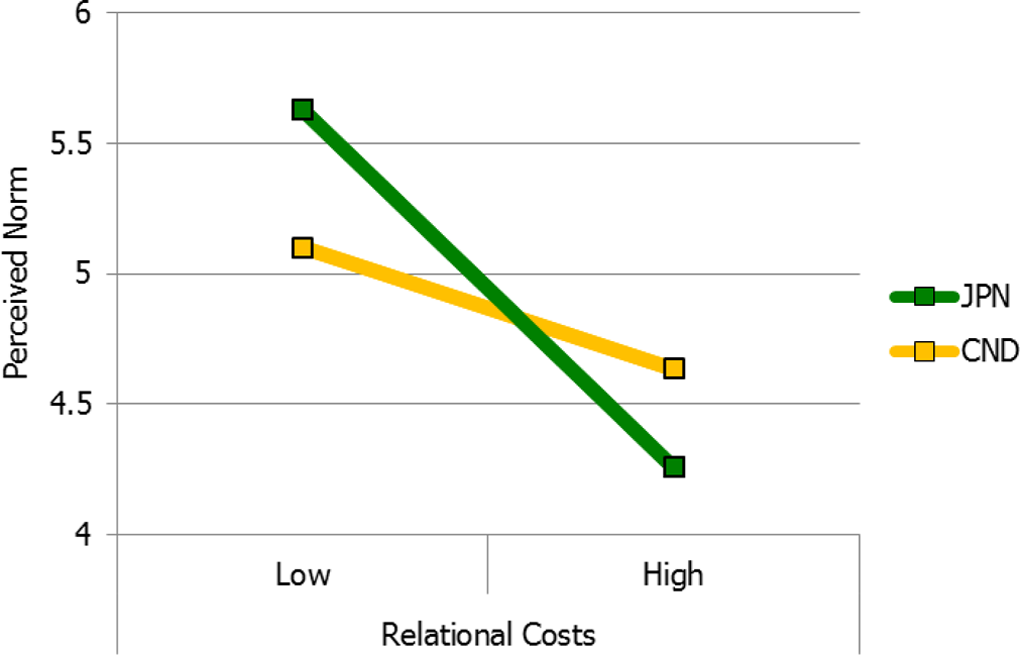
Simple effect analysis of the association between perceived norm and relational costs for Japanese-generated help-seeking behaviors in Study 3. High and low perceived relational costs indicate 1 SD above or below the mean. CND refers to Canadian participants’ results and JPN refers to Japanese participants results.
For Canadian-generated help-seeking behaviors, we again found that the mediation effect was significantly different from 0 for Japanese participants, slope = −.05 with CI of [−.09, −.01], but not for European Canadian participants, slope = −.001 with CI of [−.03, .03]. The moderating effect of cultural backgrounds on the relationship between perceived relational costs and norm of behaviors was significant, b = .60, t(133) = 2.56, p < .05. Simple effect analysis revealed that Japanese participants expected lower normativity of help-seeking behaviors as they perceived higher relational costs for the behaviors, b = −.57, t(133) = −3.08, p < .01; however, the effect was nonsignificant among European Canadian participants, t < 1, ns.
Personal costs
We regressed participants’ ratings on expected closeness in friendships on the cultural origins of help-seeking behaviors (Canadian-generated vs. Japanese-generated), cultural backgrounds of participants (European Canadians vs. Japanese), participants’ ratings of personal costs, and interactions among the three predictors. Ratings of personal costs were centered on the grand mean. The results of this analysis revealed a significant three-way interaction, b = .20, t(5439) = 5.95, p < .001, R2 = .29, which suggested that participants from the two cultural groups responded differently to Canadian-generated and Japanese-generated help-seeking behaviors. Therefore, we separately analyzed responses to Canadian-generated behaviors from responses to Japanese-generated behaviors.
For this analysis, perceived personal costs (IV), normativity of behaviors (mediator), and participants’ cultural backgrounds (moderator:Dummy code:Japanese = 0, European Canadian = 1) predicted expected closeness in friendships with Preacher et al.’s (2007) SPSS macro. For Japanese-generated help-seeking behaviors, as hypothesized, participants’ cultural backgrounds did not moderate the effect of perceived personal costs on the normativity of behaviors, t < 1, ns. Both Japanese and European Canadian participants expected significantly lower normativity of help-seeking behaviors as they perceived higher personal costs for the behaviors, b = −.61, t(133) = −5.10, p < .001, and b = −.58, t(133) = −3.54, p < .001, respectively. The mediation effect was significantly different from 0 for Japanese participants, slope = −.07 with CI of [−.14, −.01], and for European Canadian participants, slope = −.06 with CI of [−.16, −.01].
For Canadian-generated help-seeking behaviors, participants’ cultural backgrounds marginally moderated the effect of perceived personal costs on the normativity of behaviors, b = .44, t(133) = 1.61, p = .11. European Canadian participants expected lower normativity of help-seeking behaviors as they perceived higher personal costs for the behaviors, b = −.98, t(133) = −4.45, p < .001. Similarly, Japanese participants expected lower normativity of help-seeking behaviors as they perceived higher personal costs for the behaviors, b = −.54, t(133) = −3.37, p < .01 (see Figure 3). The mediation effect was significantly different from 0 for European Canadian participants, slope = −.05 with CI of [−.16, −.001], but not for Japanese participants, slope = −.02 with CI of [−.02, .07]. 4
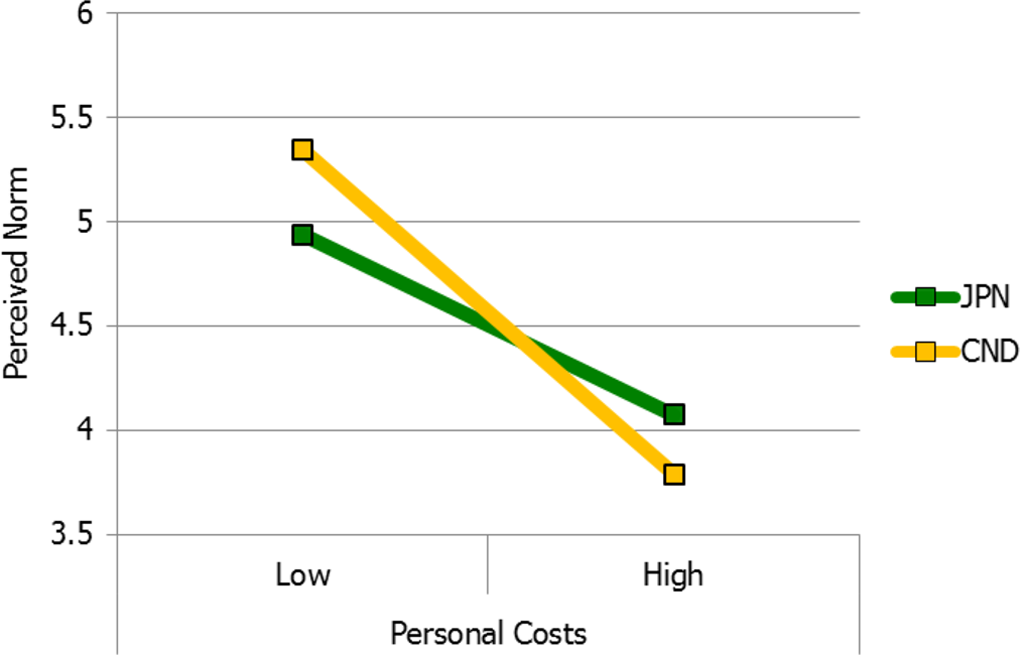
Simple effect analysis of the association between perceived commonness and personal costs for Canadian-generated help-seeking behaviors in Study 3. High and low perceived relational costs indicate 1 SD above or below the mean. CND refers to Canadian participants’ results and JPN refers to Japanese participants results.
General discussion
In three studies, we examined cultural norms that underlie culturally specific costs for seeking help, and the impact of these norms on people’s expectations for relational outcomes in the context of close, same-sex friendships. We hypothesized and found that Japanese and European Canadians differ in their concerns about seeking help, in that Japanese were concerned with both relational and personal costs, while European Canadians were concerned with personal costs more than relational costs. These culturally specific costs were negatively associated with the cultural norms of help-seeking behaviors, that is, help-seeking behaviors were perceived to be less common as they become more costly. The cultural norms, in turn, formed a basis for expectations of relational outcomes, so that participants reported expectations of lower closeness in friendships as they imagined seeking less common help from close, same-sex friends. These findings supported the intersubjective approach to culture. In the following, we will discuss the issue of cultural affordance and implications of the current study in social cognitive and clinical research.
Cultural affordance
According to the notion of cultural affordance proposed by Kitayama and his colleagues (Kitayama et al., 1997; Kitayama, Mesquita, & Karasawa, 2006; Morling, Kitayama, & Miyamoto, 2002), everyday situations prevalent in a given culture highlight and elaborate values and beliefs that are loosely shared among members of that culture. Mature members of a culture are those who acquire ways of thinking, feeling, and relating that enable them to navigate themselves appropriately within the culturally specific confines of situations. In other words, the characteristics of situations elicit dominant ways of thinking, feeling, and relating in a given culture. Past studies showed that situations in North American cultures were likely to highlight self-enhancement, socially disengaging emotions (i.e., emotions deriving from self-reliance), or primary control (i.e., one’s active influence on the social environment), whereas situations in East Asian cultures were likely to highlight self-criticism, socially engaging emotions (i.e., emotions deriving from relational harmony), or secondary control (i.e., one’s adjustment to the social environment).
Some patterns of the mediation effect found in Studies 2 and 3 supported the notion of cultural affordance. That is, the norm of help-seeking behaviors was strongly associated with perceptions of costs when Japanese or European Canadian participants responded to local help-seeking behaviors. For example, in Study 2, Japanese participants showed a significant tendency to associate relational costs with norm of behaviors when they responded to local help-seeking behaviors (b = −.56), but the tendency was weaker when they responded to foreign help-seeking behaviors (b = −.40). In Study 3, European Canadian participants showed stronger tendency to associate personal costs with norm of behavior for local help-seeking behaviors (b = −.98) than for foreign help-seeking behaviors (b = −.58). Moreover, Japanese participants in Study 3 showed a significant tendency to associate personal and relational costs with norm of behaviors for local help-seeking behaviors (b personal = −.61 and b relational = −.71), but the tendency was weaker for foreign help-seeking behaviors (b personal = −.54 and b relational = −.57). These patterns of results suggest that there is a consensus within each cultural group in terms of which local help-seeking behaviors, characterized by culturally specific costs, are common and facilitate closeness in friendships. In order to be a mature member of a given culture, as suggested by the notion of cultural affordance, people may acquire ways of thinking, feeling, and relating through experiencing local help-seeking behaviors.
Implications
Prototype interaction-pattern model
The current research suggested cultural variations in the prototype interaction-pattern model in the area of close relationship research. Fehr (2004) proposed the prototype interaction-pattern model of intimacy in close friendships, which specifies the mental structure of common practices. According to this model, people organize various behaviors in friendships according to the prototypicality of the behaviors. In other words, some behaviors are more representative of intimate interactions in friendships than the others. Fehr (2004) showed that Canadian participants were able to delineate behaviors based on the degree of prototypicality, responded more quickly to prototypical behaviors than nonprototypical behaviors, and expected negative relational outcomes for failing to execute highly prototypical behaviors. The perceived norm of behaviors in the current study is similar to the notion of prototypicality that normative or prototypical behaviors are associated with the maintenance of friendships. 5
The mediation effect of perceived cultural norms in the current study suggested the influence of culture on the prototype interaction–pattern model. As the model predicts, the current results indicate that both European Canadian and Japanese participants have a mental structure of behaviors that form a basis for intimacy in friendships. The results of Studies 2 and 3 showed a significant association between Canadian and Japanese participants’ perceived norm of help-seeking behaviors and their expectations of closeness in friendships, confirming Fehr’s (2004) model. However, perceived norm was organized based on relational and personal costs for Japanese participants and personal costs for European Canadian participants. This implies a systematic cultural variation in prototypicality of interaction patterns. A specific help-seeking behavior that Japanese individuals think of as normative or prototypical is unlikely to be perceived as such by European Canadians or vice versa. In fact, some of the mediation effect of perceived norm of help-seeking behavior was more pronounced when participants responded to their local help-seeking behaviors. To extend this line of research, future studies should examine what would happen when people chose not to follow the perceived cultural norms of help-seeking behaviors (see also Argyle & Henderson, 1984). Fehr (2004) showed that people tend to estimate low intimacy in friendships if their friends fail to do what is commonly done in friendships. We must further investigate whether such uncommon behaviors lead to more serious outcomes such as being ostracized by the group or by society.
Taijin kyofusho
Our results also suggest a possible way to remedy the Japanese psychological disorder, taijin kyofusho. Taijin kyofusho refers to a Japanese culture-specific social anxiety disorder characterized by fear of offending, displeasing, or embarrassing others by means of one’s body parts or functions (American Psychiatric Association, 2000). According to Maeda and Nathan (1999), individuals who are diagnosed with taijin kyofusho tend to fear that their odors, eye contact, facial expressions, or physical features offend their interaction partners. Therefore, these individuals become convinced that they are disrupting harmonious relationships, and they avoid or fear interacting with others. The current findings offer a possible explanation for the mechanism of taijin kyofusho, from a social cognitive perspective. That is, people who are diagnosed with taijin kyofusho may have dysfunctional cognitions about which behaviors lead to closeness in interpersonal relationships. As we reported, Japanese participants’ cultural norm was organized according to relational and personal costs. Actions based on the cultural norm were, in turn, associated with expectations of closeness in the relationship. Taijin kyofusho patients may perceive overly high relational costs for most of their actions in interpersonal relationships and perceive their actions to be obnoxiously uncommon. Therefore, they become convinced that their actions will offend others. In order to relieve some of the symptoms of taijin kyofusho, cognitive behavioral therapy that rectifies maladaptive cognition may be useful.
Limitations
The current studies had several limitations. First limitation is the direction of causality. Although we maintain that people’s perception of cost for seeking help forms a basis for their perceived norm for seeking help, the opposite direction of causality is also tenable. Testing this possibility, we run additional analyses on the mediation effect of perceived relational or personal costs on the relationship between perceived norm and expected closeness in friendships. The results showed that participants’ perceived relational cost in Studies 2 and 3 did not mediate the effect of perceived norm on expected closeness in friendships. These results strengthened our argument that people’s perception of relational costs for seeking help forms a basis for norms, which then lead them to expect the outcome of seeking help from close friends.
Interestingly, participants’ perceived personal cost in Study 3 mediated the effect of perceived norm on expected closeness in friendships. For Japanese-generated help-seeking behaviors, perceived personal costs mediated both the effect of Canadian participants’ perceived norm on expected closeness, slope = −.12 with CI of [−.05, −.22], and the effect of Japanese participants’ perceived norm on expected closeness, slope = −.05, with CI of [−.02, −.10]. Similarly for Canadian-generated help-seeking behavior, perceived personal costs mediated the effect of Canadian participants’ perceived norm on expected closeness, slope = −.03 with CI of [−.01, −.08] as well as the effect of Japanese participants’ perceived norm on expected closeness, slope = −.09 with CI of [−.01, −.20]. Therefore, the direction of causality should be further examined in future research. We interpret these results are attributable to the fact that the operationalization of personal cost in Study 3 was too abstract. In the current research, we asked the degree in which participants feel good about themselves when they imagine seeking help from close friends and use the responses as the measure of the level of dissatisfaction for being less independent, self-contained, or self-reliant. To enhance the confidence of our interpretation, future research needs to be designed to measure one’s sense of independence, self-containment, and self-reliance in more concrete contexts. Furthermore, experimentally investigating the effect of personal costs for European Canadians and Japanese on the perceived norm of the help and expected closeness in friendships will be a solution to alleviate the measurement bias. For example, we may be able to manipulate the perceived norm of help-seeking behaviors by providing participants with false information about the norm.
The generalizability of current results to other members of East Asian or North American cultures is the second limitation. The hypotheses of the current studies are deductively formulated on the basis of past findings from Canadian, European, and Asian American participants as well as Korean, Chinese, Japanese, and Hindu Indian participants. Whether our results apply to all these groups of people needs further investigation. It is possible that people in a society, a region within a society, or a community within a region within a society use distinct help-seeking behaviors and organize them around different values, depending on the expected consequences in interpersonal relationships.
The third limitation is the use of a conservative coding scheme in the selection of stimuli in Study 2, following a previous study with similar design (Fehr, 2004). As a result, the list of help-seeking behaviors was trimmed down to 40% of its original length. We speculate that the reason the percentage of idiosyncratic behaviors was reasonably large was that participants differed in various dimensions that might influence their need for support, such as socioeconomic status, dwellings, residential mobility, support networks, and personality. Despite the large proportion of idiosyncratic behaviors, participants who imagined seeking help from others were able to estimate the normativity of help-seeking behaviors. It was remarkable to discover that people within a given culture encountered similar situations in their everyday lives. Therefore, we concluded that it was worth investigating the way in which people used the knowledge of shared help-seeking behaviors to navigate themselves within their culture.
Footnotes
Appendix 1
Acknowledgments
A part of this research was conducted as the first author’s PhD dissertation research at the University of Alberta. We thank Kim Noels, Elena Nicoladis, Heejung Kim, and Chi Yue Chiu for valuable feedback on an earlier version of this article.
Funding
This research was supported in part by Institute on Asian Consumer Insight Start-Up Grant awarded to the author K.I. and SSHRC Standard Research Grants 410-2007-382 and 410-2010-0720, awarded to the author T.M.