




Abstract
Advice is a common element of supportive interactions, but unsolicited advice can harm the advice recipient as well as the relationship between the advice recipient and the advice giver. Despite the potential negative implications of unsolicited advice, very little is known about what predicts unsolicited advice giving in personal relationships. The present studies provide an empirical test of the association between relational closeness and unsolicited advice giving. In two studies, undergraduate students and members of the general population responded to hypothetical statements of discontent from friends who were not asking for advice. Relational closeness and unsolicited advice giving were positively correlated, with participants tending to provide more unsolicited advice to friends toward whom they felt greater relational closeness. Overall, participants gave unsolicited advice to their friends at a very early stage of a supportive interaction in approximately 70% of cases. Explanations and implications for these findings were discussed.
Keywords
Supportive interactions are ubiquitous in people’s social lives, providing relief from stress and mitigating its negative consequences on individuals’ physical and psychological well-being (Cohen, 2004; House, Landis, & Umberson, 1988; Uchino, Cacioppo, & Kiecolt-Glaser, 1996; for a review, see MacGeorge, Feng, & Burleson, 2011). Advice in supportive interactions can be defined as a recommendation about what to do, think, or feel to cope with a problematic situation (MacGeorge, Graves, Feng, Gillihan, & Burleson, 2004). When done skillfully, advice giving can be an important part of providing support. Although a seemingly simple action to take, giving advice skillfully constitutes an intellectually and socially challenging task for people in everyday life.
Many of the challenges associated with giving advice originate from its nature as an intrinsically face-threatening act (Brown & Levinson, 1987; Goffman, 2003; Goldsmith & MacGeorge, 2000; Locher, 2006). “Face” is the “socially situated identities people claim or attribute to others” (Tracy, 1990, p. 210). Advice giving suggests that the advice recipient lacks knowledge or competence concerning the issue at hand or is unable to cope with a problem without external aid (Goldsmith & Fitch, 1997; Harber, Schneider, Everard, & Fisher, 2005; Heritage & Sefi, 1992; Shaw & Hepburn, 2013; Smith & Goodnow, 1999; Wilson & Kunkel, 2000). This implication can thus threaten the advice recipient’s positive face—the desire to have one’s image and behaviors recognized and approved by others (Brown & Levinson, 1987). By the same token, telling someone how to cope with a situation implies that the advice giver has knowledge or insight that the advice recipient lacks, thus positioning the interactants asymmetrically (Vehviläinen, 2001). Advice is also likely to be viewed as “butting in” or constraining the advice recipient’s autonomy (i.e., threatening the advice recipient’s negative face; Brown & Levinson, 1987; Wilson, Aleman, & Leatham, 1998), especially if the advice recipient feels obligated to follow the advice or resents being told what to do (Goldsmith, 1994; Harber et al., 2005).
The delicate issues concerning the face of both parties in advice interactions are particularly salient when advice is unsolicited (i.e., volunteered by the advice giver in the absence of any clear indication of desire for advice by the would-be advice recipient; Coyne, Wortman, & Lehman, 1988; Goldsmith, 2000; Goldsmith & Fitch, 1997). Although some research suggests that receiving unsolicited support can bring benefits to the recipient, especially when provided in an “invisible” (indirect and subtle) way (Bolger & Amarel, 2007), such as assisting the recipient’s coping and promoting the recipient’s feelings of connectedness and self-worth (Chentsova-Dutton & Vaughn 2012; Fisher, La Greca, Greco, Arfken, & Schneiderman, 1997; Mojaverian & Kim, 2013), most research indicates that receiving unsolicited advice tends to have more negative effects than receiving solicited advice. Unsolicited advice tends to be seen as inappropriate or unhelpful (Boutin-Foster, 2005; B. Feng & MacGeorge, 2006; Miller-Ott & Durham, 2011; Servaty-Seib & Burleson, 2007), and is thus likely to be met with resistance from its recipient (Coyne et al., 1988; Fitzsimons & Lehmann, 2004; Heritage & Sefi, 1992; Riccioni, Bongelli, & Zuczkowski, 2014) and may even exacerbate advice recipients’ stress, depression, and loneliness (for a review, see Rafaeli & Gleason, 2009). In addition to hurting the advice recipient, unsolicited, premature advice can damage the interpersonal relationship between the advice giver and the advice recipient and make it less likely that the advice recipient would seek support from the advice giver at a later time (Amy, Aalborg, Lyons, & Keranen, 2006). In marital relationships, overprovision of support (such as giving too much unsolicited advice) constitutes a greater risk factor for marital dissatisfaction and marital decline than underprovision of support (Brock & Lawrence, 2009).
Despite the potential negative implications of unsolicited advice, we know very little about what prompts people to offer unsolicited advice. In this article, we present two studies that aim to examine the association between relational closeness and unsolicited advice giving. Most prior research examined advice in one of two major forms: (a) as a speech act of directive or judgment in decision making in institutional or professional settings, or (b) as a form of supportive communication in personal, everyday encounters (for reviews, see Bonaccio & Dalal, 2006; Limberg & Locher, 2012; MacGeorge, Feng, & Thompson, 2008). Research on advice in the former tradition, much of which was conducted in the field of conversational analysis (see Limberg & Locher, 2012), has investigated advice giving and advice taking in an array of institutional or professional settings, including counseling interactions (Heritage & Lindström, 2012; Silverman, 1997), educational peer tutoring sessions (Waring, 2012), and in interactions over telephone help lines (Emmison, Butler, & Danby, 2011; Pudlinski, 2002). Advice is a common feature in these interactions, as professionals are frequently sought out, and are expected, to give advice on matters in their epistemic domain. Therefore, it can be argued that advice giving in these settings may be characterized as a form of dominant behavior (Dunbar & Burgoon, 2005). In personal relationships such as friendship, however, there is typically an absence of significant hierarchy between relational partners, and hence there is a lack of clear warrant to give advice (Shaw & Hepburn, 2013). Given these considerations, we chose to focus on relational closeness, arguably the “flagship variable” of interpersonal research (Dibble, Levine, & Park, 2012), to determine how it may predict unsolicited advice giving in supportive interactions among friends.
Unsolicited advice giving
When an individual explicitly asks for advice from another person (e.g., “I need your advice,” “What should I do?,” and “Should I do X?”; Goldsmith, 2000), there is little doubt that advice is solicited. In many other cases, however, whether or not a speaker has solicited advice from a listener is subject to the listener’s interpretation (Horowitz et al., 2001). For instance, when an individual discloses a personal problem, the act of disclosure may or may not be motivated by a desire to solicit advice (Goldsmith, 2000). The assumption that the act of disclosure implies the solicitation of advice may be wrong: Research shows that when individuals engage in “troubles talk,” their intention may be to seek sympathy, understanding, a responsive “troubles” listener, or simply to construct a shared identity with others, rather than to solicit advice (Basow & Rubenfeld, 2003; Horowitz et al., 2001; Jefferson & Lee, 1992; Mewburn, 2011; Michaud & Warner, 1997). Misinterpretation of a problem-teller’s goal in his or her disclosure can thus lead to mismatched, ineffective support responses (Horowitz et al., 2001). In the current studies, we focus on unsolicited advice giving that occurs after hearing another person disclose a personal problem without explicitly soliciting advice.
Relational closeness and unsolicited advice giving
The construct of relational closeness is critical to the theory and research on personal relationships and social interactions because “variations in closeness impact a wide range of interpersonal and relational phenomena” (Dibble et al., 2012). Although different definitions of relational closeness exist (Agnew, 2000; Aron & Fraley, 1999), most converge on the notion that relational closeness involves interdependence. Hence, in keeping with the generally accepted definitions in the field of interpersonal communication, we define relational closeness as the degree of affective, cognitive, and behavioral mutual dependence between two people (Dibble et al., 2012).
Close relationships are the locus of intimacy and care and are typically characterized by high levels of trust, liking, and compassion between relational partners. People are more motivated to help those they are close to (Collins et al., 2014; Padilla-Walker & Christensen, 2011; Weinstein & Ryan, 2010). They also tend to have a better understanding of and greater empathic accuracy for others toward whom they feel close (Stinson & Ickes, 1992; Thomas & Fletcher, 2003), which could result in more sensitive, finely tuned, and effective support. It is therefore not surprising that people often seek support from those they feel close to, most commonly from their family members, friends, and romantic partners (B. Feng & Feng, 2013; Griffith, 1985; Kaniasty & Norris, 2000; Miller & Darlington, 2002; Rafaeli & Gleason, 2009; Wilson & Deane, 2005).
People also tend to be more ready or willing to receive advice from intimate others than from people outside of their close social network. B. Feng and MacGeorge’s (2006) study found that, among all the predictors examined in their study (e.g., expertise, prior influence, and problem seriousness), relational closeness had the strongest impact on receptiveness to advice. It is therefore reasonable to infer that people are more likely to solicit advice from people they are close to. However, it remains an empirical question as to whether or not people are more likely to offer unsolicited advice to close others. In other words, the association between relational closeness and unsolicited advice giving is unknown. There are theoretical reasons to predict that greater relational closeness may lead either to (a) greater unsolicited advice giving due to greater sense of responsibility for the welfare of the distressed support recipient, less concern about offending the support recipient, and greater emphatic pain or to (b) less unsolicited advice giving due to greater willingness of the support provider to devote time and attention to a distressed support recipient. We now turn to examine the rationale for each prediction more closely.
Several arguments support predicting a positive association between relational closeness and rates of unsolicited advice giving. First, compared to people in less-close relationships, intimates tend to experience a higher degree of responsibility for the welfare of their support recipients, which may increase the motivation to respond to the support recipient’s distress by offering advice (Collins et al., 2014). Second, seen from the perspective of politeness theory (Brown & Levinson, 1987), advice from someone who has a close relationship with the advice recipient is likely to pose less threat to the advice recipient’s face and is therefore more likely to be appreciated and accepted than advice from someone who is not close to the advice recipient (B. Feng & MacGeorge, 2006). It is therefore plausible that support providers will be less concerned with face issues when trying to help a close other and will be more likely to offer unsolicited advice. Third, social neuroscience research has shown that witnessing others who are experiencing physical or emotional pain activates one’s own neural pain network (Beeney, Franklin, Levy, & Adams, 2011; Singer et al., 2004), and that the extent of this empathic pain is correlated with the emotional closeness that the observer feels toward the sufferer (Beeney et al., 2011). Such vicarious distress, elicited by witnessing the distress of close others, can be a strong motivator to quickly reduce the other’s distress. In the context of a supportive interaction about an issue that is distressing to a close other, this empathic pain can manifest as emotional contagion between support seekers and support providers (Magen & Konasewich, 2011). The motivation to quickly reduce the distress may lead to unsolicited advice giving. In summary, politeness theory and social neuroscience evidence of empathic pain both support a prediction of a positive association between relational closeness and rates of unsolicited advice giving.
However, relational closeness may be negatively associated with rates of unsolicited advice giving. Support providers who are closer to support recipients, and are presumably more invested in the support recipients, may be willing to spend more time and attention in the supportive interaction. Time and attention are precious resources, and people are more likely to devote them to interactions when they are highly invested in the topic or in the person they are talking with (Bodie et al., 2011; Chaiken, 1980; Petty & Cacioppo, 1986). Thus, relational closeness may motivate support providers to spend a greater amount of time listening to a support seeker, asking questions to obtain a better understanding of the support seeker’s situation, and enduring the vicarious distress that results from observing a support seeker’s distress, consequently resulting in decreased tendency to offer unsolicited advice (B. Feng, 2009).
In sum, there are conflicting theory-based predictions regarding the association between relational closeness and unsolicited advice giving: While some theoretical accounts predict higher rates of unsolicited advice giving as relational closeness increases, other theoretical accounts predict lower rates of unsolicited advice giving as relational closeness increases.
The present studies
To our knowledge, no prior studies provided an empirical test of the association between relational closeness and rates of unsolicited advice giving. The present studies sought to fill this knowledge gap by testing the association between relational closeness and unsolicited advice giving in the context of supportive interactions between friends. Different research paradigms have been utilized by researchers to study supportive interactions. Research using the naturalistic paradigm has focused attention on “real-life” social support instances and therefore examined naturalistic data (e.g., B. Feng & Feng, 2013). A major strength of this paradigm is its ecological validity: It examines instances of naturally occurring supportive communication in the context of real—and often substantial—stressors. However, given the ethical and logistic issues involved in making direct observations of naturally occurring supportive interactions, research using this paradigm has typically relied on participants’ recall of past interactions, which may lack precision and accuracy and may, in turn, challenge the validity of research findings generated from such studies.
In the current studies, we chose to employ hypothetical scenarios to elicit participants’ responses to troubles talk with friends. The use of hypothetical scenarios allows us to standardize and control the scenarios that participants respond to with great precision, at a level that would be difficult to achieve when observing real interactions between friends. This standardization, in turn, would facilitate valid comparisons across participants. Furthermore, there is strong evidence in favor of treating participants’ responses to hypothetical situations as indicative of their responses to similar real-life situations (e.g., Magen, Dweck, & Gross, 2008), although the magnitude of response may be different in each case. Therefore, in both studies, we asked participants to name a close friend and a less-close friend and then presented participants with troubles talk scenarios in which one of those friends told them about an upsetting situation they were experiencing without explicitly soliciting advice. After reading each scenario, participants were instructed to write the actual words they would say in response to the friend’s troubles talk. Study 1 employed a sample of college students, and Study 2 replicated Study 1 with a sample of participants from the general population.
Study 1: Relationship closeness and advice giving among college students
Methods
Participants
Undergraduate students (n = 117, 64 women and 53 men; mean age = 19.42, SD = 1.25) participated in this study in exchange for course credit. In terms of ethnic self-identification, 60.68% of participants identified as White, 22.22% as Asian/Asian-American, 6.84% as Hispanic/Latino, 5.13% as African/African-American, and 5.13% as multiethnic.
Measurement
Relational closeness was measured using the Unidimensional Relationship Closeness Scale (Dibble et al., 2012). Participants rated their agreement with 12 statements about the strength and importance of their relationship with a specific individual (e.g., “[name] and I disclose important personal things to each other,” “[name] and I have a strong connection,” and “My relationship with [name] is important in my life”), using a 7-point Likert-type scale ranging from Disagree Strongly to Agree Strongly. The scale exhibited excellent internal reliability, α = .94.
Procedure
The study was conducted online. Institutional review board approval was obtained prior to data collection. Participants were asked to name one male/female friend (gender counterbalanced across participants, stratified by participants’ gender), 1 with whom they were “close and not romantically involved,” and a second friend of the same gender as the first friend, with whom they were “not very close and not romantically involved.” Participants were then presented with eight hypothetical troubles talk scenarios in which one of the friends they had named told them about an upsetting situation they were experiencing. After reading each scenario, participants were instructed to write the actual words they would say in response to the friend (see Table 1). Scenarios 1–4 were presented as involving one friend (the close friend or the less-close friend, counterbalanced across participants), and scenarios 5–8 were presented as involving the other friend. In each scenario, the friend expressed discontent with a certain event or situation without asking for advice. For example, if a participant named a friend as “Jane,” one of the scenarios the participant encountered was as follows:
Support-seeking scenarios and examples of participants’ responses.
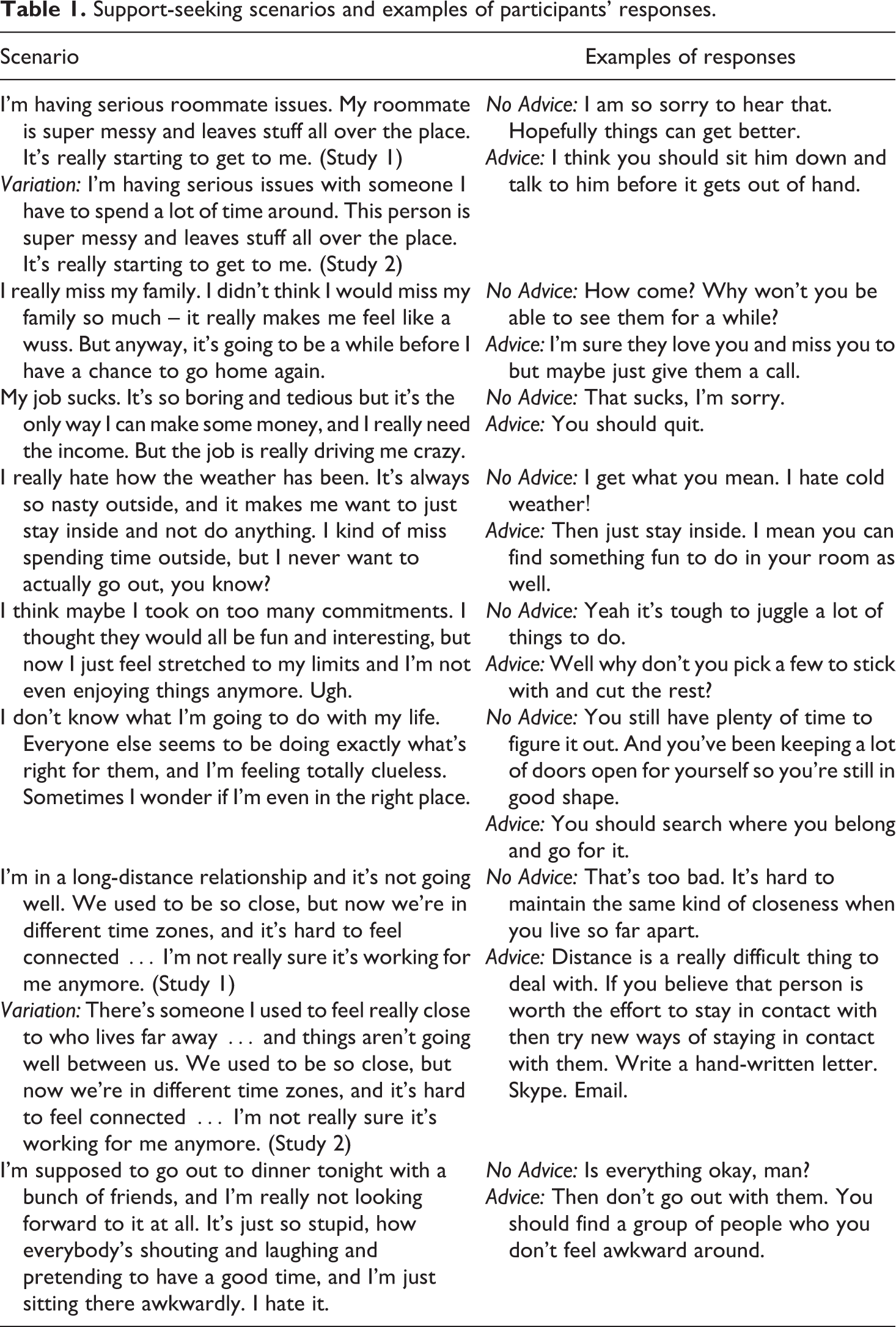
Imagine meeting Jane. After you greet one another, Jane turns to you and says: “My job sucks. It’s so boring and tedious but it’s the only way I can make some money, and I really need the income. But the job is really driving me crazy.” What would you say in response? (Please write the actual words you would say)
After responding to all scenarios, participants were presented with their own responses and asked to determine whether or not each response contained advice, using a dichotomous “Yes/No” response scale. In order to test the validity of participants’ coding of their own responses, a random sample of the responses (1 response per participant; i.e., 12.5% of all responses) was coded by two trained external judges, who determined whether or not each response contained advice. After completing this procedure for all of their responses, participants completed the relational closeness measure for each friend as well as a set of demographic questions.
Results and discussion
All analyses were conducted using the Stata Statistical Software: Release 12 (StataCorp, 2011).
Manipulation check
We tested for differences in participants’ relational closeness with the close friend and with the less-close friend using a paired t-test. Relational closeness scores were significantly higher for close friends (M = 4.45, SD = 0.09) than for less-close friends (M = 1.94, SD = 0.14), t(116) = 13.96, p < .01, indicating that our procedure for identifying friends at different levels of relational closeness was successful.
External coding
Initial inter-rater agreement between external judges’ coding of participants’ responses as “advice” or “not advice” was 92.31% (κ = .83, SE = 0.09, Z = 8.99, p < .01). Disagreements were resolved through discussion and consensus. Agreement between external judges’ final coding and participants’ coding was 88.03% (κ = .72, SE = 0.09, Z = 7.92, p < .01). Given the high rate of agreement between external judges’ coding and participants’ coding, we used participants’ coding of advice giving as the main outcome measure. Table 1 provides examples of responses that do and do not contain advice.
Relational closeness and advice giving
We tested the association between relational closeness (close friend vs. less-close friend) and advice giving (advice vs. no advice) using a repeated-measures mixed-effects logistic regression, with each participant providing a total of eight trials (four scenarios involving a close friend and four scenarios involving a less-close friend), controlling for response length (i.e., number of characters typed). The random-intercept nested logistic model (scenarios nested within participants) was specified as follows, defining πij = Pr(advice = 1):

for j = 1, … ,117 participants, with i = 1, … , nj scenarios for participant j.
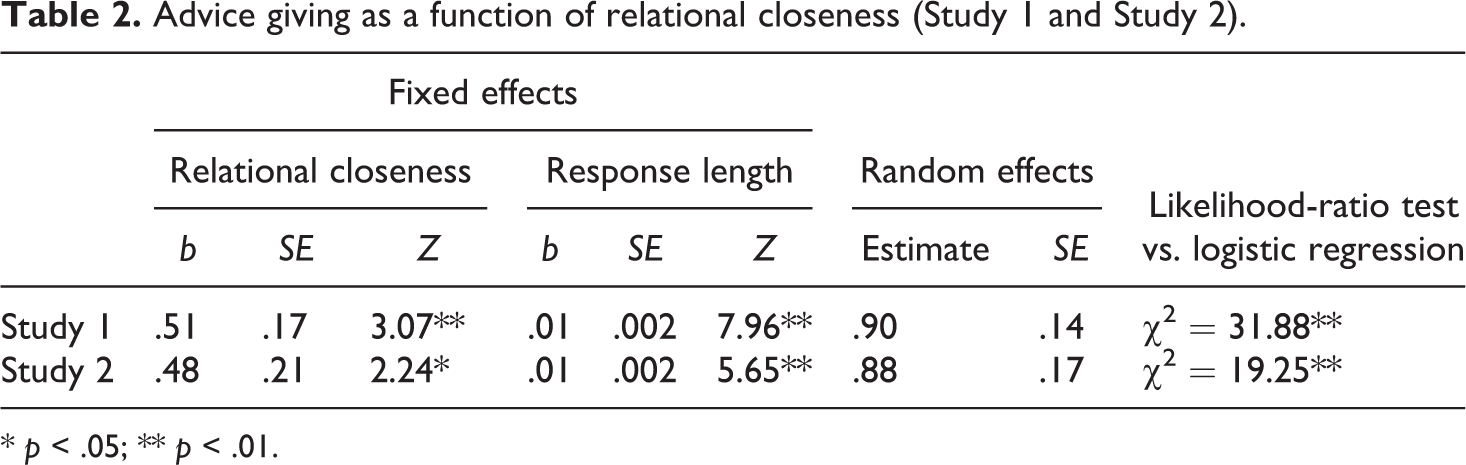
Results of the analyses showed that relational closeness was associated with advice giving, b = 0.51, SE = 0.17, Z = 3.07, p < .01 (see Table 2). In order to test for possible gender differences in the effect of relational closeness on advice giving, we expanded the model to include participants’ gender, friends’ gender, and their interaction with the relational closeness. Gender was not associated with advice giving (no significant main effects or interactions).
Advice giving as a function of relational closeness (Study 1 and Study 2).
* p < .05; ** p < .01.
Participants gave friends unsolicited advice in 70.62% of their responses, despite the fact that none of the friends explicitly asked for advice in any of their statements. Participants gave more unsolicited advice to close friends (76.50% of responses) than to less-close friends (64.74% of all responses). Given the potential negative intra- and interpersonal consequences of unsolicited advice, such a high rate of unsolicited advice giving seems surprising, and its association with relational closeness may be particularly so, as the very closeness of a relationship predicts a behavior (unsolicited advice giving) that could erode the relationship. However, the sample employed in this study consisted of undergraduate students, who may not have had much experience with or insight into the potential negative consequences of unsolicited advice giving. We therefore sought to replicate this study with a more mature sample of participants from the general population, in order to check if the positive association between relational closeness and advice giving will hold.
Study 2: Relationship closeness and advice giving in the general population
Methods
Participants
Volunteers from the general population (n = 70, 42 women and 28 men; mean age = 32.54, SD = 12.14) were recruited through online advertisements. In terms of ethnic self-identification, 64.29% of participants identified as White, 11.43% as Hispanic/Latino, 7.14% as African/African-American, 5.71% as Asian/Asian-American, 1.43% as Native Hawaiian or Other Pacific Islander, 7.14% as multiethnic, and 2.86% as “Other.”
Materials and procedure
We employed the same materials and procedure as used in Study 1. We modified the wording of some scenarios in order to make them more relevant to participants who were not undergraduate college students (see Table 1).
Results and discussion
All analyses were conducted using the Stata Statistical Software: Release12 (StataCorp, 2011).
Manipulation check
We tested for differences in participants’ relational closeness with the close friend and with the less-close friend using a paired t-test. Relational closeness scores were significantly higher for close friends (M = 4.01, SD = 0.14) than for less-close friends (M = 1.46, SD = 0.11), t(69) = 15.86, p < .01, indicating that our procedure for identifying friends with different levels of relational closeness was successful.
External coding
Initial inter-rater agreement between external judges’ coding of participants’ responses as advice or not advice was 89.74% (κ = .78, SE = 0.11, Z = 6.89, p < .01). Disagreements were resolved through discussion and consensus. Agreement between external judges’ final coding and participants’ coding was 85.90% (κ = .69, SE = 0.11, Z = 6.20, p < .01). Given the high rate of agreement between external judges’ coding and participants’ coding, we used participants’ coding of advice giving as the main outcome measure. Table 1 provides examples of responses that do and do not contain advice.
Relational closeness and advice giving
We tested the association between relational closeness (close friend vs. less-close friend) and advice giving (advice vs. no advice) using the same analytical approach as in Study 1. Relational closeness was associated with advice giving, b = 0.48, SE = 0.21, Z = 2.24, p < .03 (see Table 2). In order to test for possible gender differences in the effect of relational closeness on advice giving, we expanded the model to include participants’ gender, friends’ gender, and their interaction with the relational closeness. Gender was not associated with advice giving (no significant main effects or interactions).
The results of this study replicated the results of Study 1 in virtually every aspect. Participants gave friends unsolicited advice in 68.93% of their responses, despite the fact that none of the friends explicitly asked for advice in any of their statements. As with the undergraduate sample, participants gave more unsolicited advice to close friends (75% of responses) than to less-close friends (62.86% of all responses).
General discussion
Giving unsolicited advice at an early stage of supportive interactions can have a negative impact on the well-being of the advice recipient due to the face-threatening nature of the act (Brown & Levinson, 1987; Goffman, 2003; Goldsmith, 2000), makes the advice less likely to be seen as helpful by its recipient (B. Feng & MacGeorge, 2006), and can make the advice recipient less likely to seek the advice giver’s support in the future (Amy et al., 2006). Therefore, examining predictors of unsolicited advice giving is of both theoretical and pragmatic value. Our studies found that participants gave unsolicited advice to their friends at a very early stage of a supportive interaction (in their very first response to a friend’s statement of discontent) approximately 70% of the time. Furthermore, relational closeness was positively correlated with unsolicited advice giving, with participants tending to give more advice to friends with whom they felt closer than to friends with whom they felt less close.
The results of our studies suggest that people frequently give unsolicited advice to their friends, and that they are more likely to give unsolicited advice to a friend as their relational closeness to the friend increases. Given the potential negative individual and relational consequences of unsolicited advice giving, why would this response be so common—and even more common in closer relationships, which are presumably more valued? There are a number of possible explanations. First, advice giving may relieve some pressure that support providers feel to help support recipients and, in this regard, may primarily benefit support providers (Brown et al., 2009; Warner, Schüz, Wurm, Ziegelmann, & Tesch-Römer, 2010). Second, support providers may perceive low face threat in giving unsolicited advice to a close friend and may thus feel less “inhibited” with respect to giving advice (Brown & Levinson, 1987). Third, and similarly, support providers may perceive close friends as more willing to receive advice than less-close friends. Fourth, troubles talk from a close friend may be more likely to be interpreted by support providers as a request for advice than the same disclosure from a less-close friend. Fifth and lastly, it is possible that support providers may not realize that they are giving advice. Although our participants were able to judge whether their own responses consisted of advice giving (and their judgment was highly consonant with that of trained external judges), participants performed this judgment after providing the responses, and it is unclear if participants were aware of giving advice while they were doing it. The studies reported here did not provide us with data to empirically assess these possible explanations, and we are not aware of studies that have investigated these possibilities, and thus we recommend these for further research.
In our studies, participants responded to hypothetical statements that were presented as coming from two friends that each participant named. Although we believe that we have chosen a method that we consider more experimentally rigorous and logistically feasible (i.e., standardized hypothetical situations rather than observing naturally occurring conversations) than alternative methods, we recognize that this design led to methodological limitations that warrant consideration. First, in real-life supportive interactions, which are dynamic and involve the give-and-take of all parties involved, support providers may be more likely to ask for more information to clarify the support recipient’s situation and therefore wait until later in the conversation to offer advice, if advice is deemed appropriate. Support providers responding to hypothetical troubles talk scenarios cannot elicit any response from the target. Therefore, participants in our studies might have consciously or subconsciously skipped the “problem inquiry” stage of advice giving (B. Feng, 2009). In other words, the high frequency of unsolicited advice giving observed in our studies might be partially attributed to the hypothetical scenario design of the studies. However, this limitation does not explain the positive association between relational closeness and unsolicited advice giving, suggesting instead that in naturalistic settings rates of unsolicited advice giving may be lower overall, but still higher for close friends than for less-close friends. Future research should seek replications of our findings using more naturalistic, interactional data. More specifically, future research can examine conversations between participants in a laboratory setting in which one participant reveals a current stressor and the other responds. This method can elicit quasi-natural supportive interactions in controlled settings and allow for detailed analyses of those interactions. It should be noted, however, that there are also limitations with this methodology. For example, data collected using this design may still lack ecological validity, because participants may feel uncomfortable discussing important (and personal) stressors in a lab setting. Also, for reasons such as concern for social desirability and uneasiness with being studied as a research participant, behavior in the lab setting may or may not validly represent behavior in a private setting, where most supportive interactions are likely to take place.
A second methodological limitation of our studies involves the relationship between participants and the people whom participants responded to, namely their friends, as opposed to people with whom participants have other types of relationships (e.g., strangers, spouses, and family members). Conversations in the context of different types of relationships may elicit different responses, and it is plausible that our finding regarding the positive association between relational closeness and advice giving may be true only for some types of relationships (e.g., friends) but not others (e.g., family members). Further research is needed to test the generalizability of our findings to other relationship types.
In addition, our studies did not assess potential mediators in the link between relational closeness and advice giving. Such potential mediators may include, for example, perceptions of the degree of face threat in different relationships, expectations of advice giving norms in close and non-close relationships, and appraisal of past supportive interactions with the relational partner. Future research should pursue these directions.
Lastly, although our studies employed samples of participants who were relatively diverse in their ethno-demographic characteristics, our participants were nevertheless of a predominantly European-American cultural background. Social support is a culturally defined behavior (H. Feng, 2013; Kim, Sherman, & Taylor, 2008; Mortenson, 2009). As work by Chentsova-Dutton and Vaughn (2012) demonstrated, cultural models of social relationships can promote or inhibit unsolicited advice giving. Their research found that, compared to European Americans, Russians are more likely to view advice as a characteristic of supportive social relationships and tend to offer unsolicited advice more often. Future research should examine how cultural conceptualizations of social relationships may moderate the association between relational closeness and unsolicited advice giving.
Advice is an important element of supportive interactions, and advice from a close friend who knows and understands us can be very valuable indeed. However, offering unsolicited advice may result in negative individual and relational consequences that are diametrically opposed to the intentions of the advice giver. Our studies reveal that such unsolicited—and possibly premature—advice giving becomes more common as relationships become closer. Support providers would be wise to realize their tendency to give advice too soon, especially in closer relationships, and make greater effort to delay advice giving in order to offer it in a skillful and sensitive manner that would be of benefit to their support recipient (B. Feng, 2009).
Footnotes
Funding
This research received no specific grant from any funding agency in the public, commercial, or not-for-profit sectors.